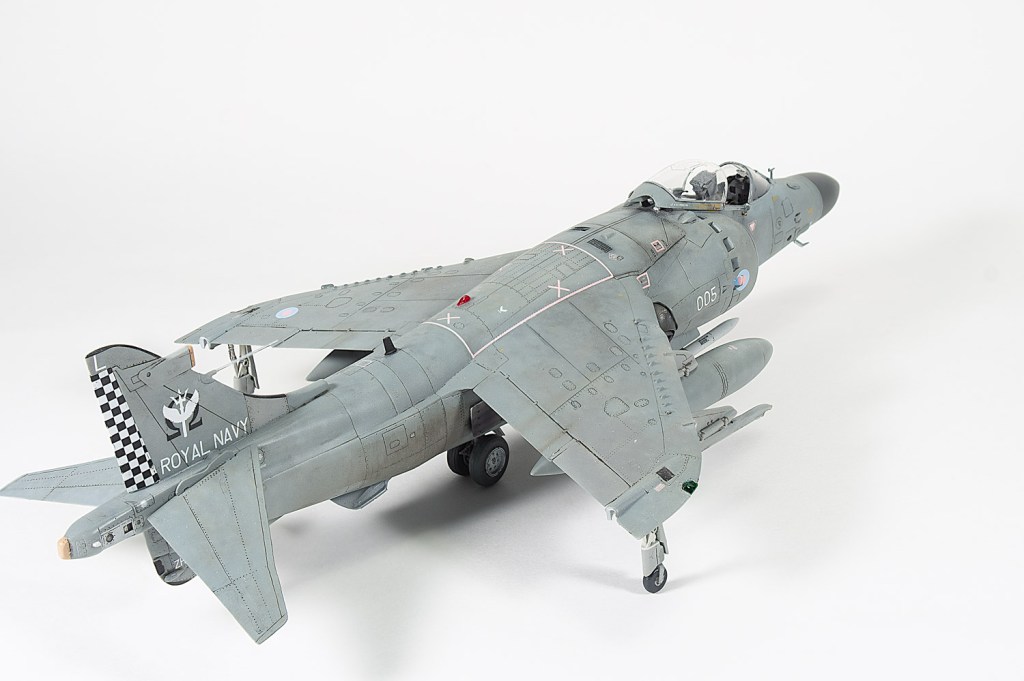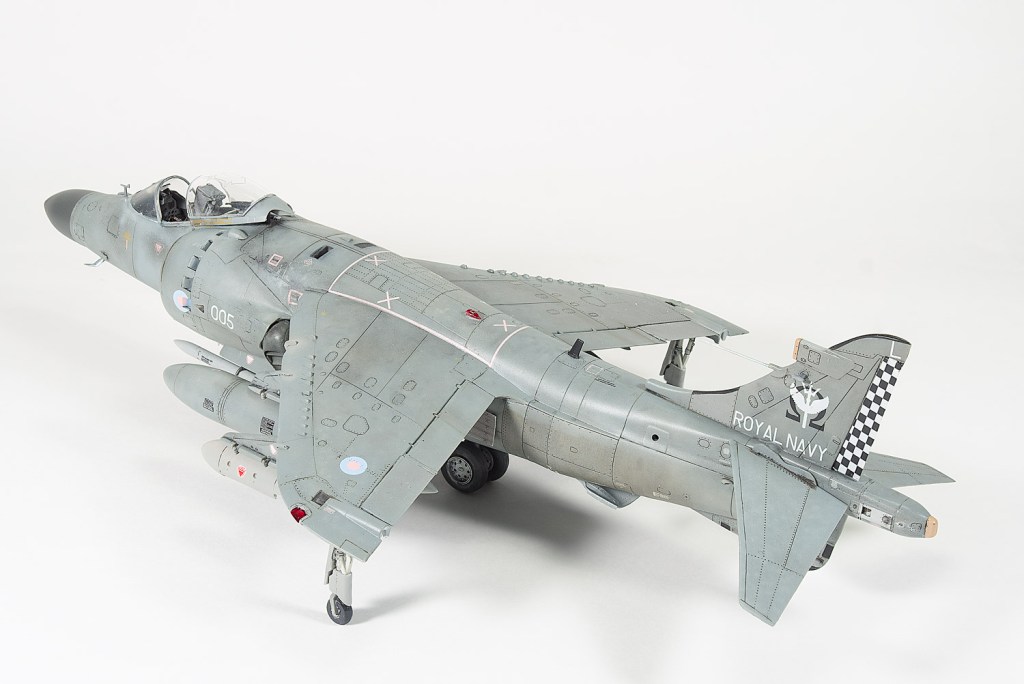
Kinetic 1/48 Bae Sea Harrier FA2

Built: 2021
Added to Stash: 2014
Enhancements:
Cockpit: Eduard PE Interior
Wheels:  Reskit
Jet Nozzles: ​Aires
Practice Bomb Carrier: Flightpath

This year, I have had friends randomly picking kits for me to build.  This FA2 was a follow on build to the Kinetic FRS1 that was the actual kit picked out for me.  Like my tornado builds, I decided in addition to the FRS1, I would also tackle the other Kinetic Harriers in the stash.  And like the Tornado, if I had not have started both sea harriers at the same time, I would have sold the FA2 after completing the FRS1.  Its not a difficult kit, but its not the most enjoyable either.  The third Kinetic Harrier I started was their new AV-8A, and it was obvious from the fit of the intakes, Kinetic have retooled these parts and the fuselage halves.

Construction Notes
The intakes were built up on each fuselage side prior to assembling the fuselage halves, rather than after as the instructions would have you.  The advantage to this is a a slightly better fit although I found the rear cockpit bulkhead pushed the nose wheels halves out a bit.  My solution to this was widening the location channel to ease the fit of the bulkhead..
There is also an atrocious joint where the wing undersides join the fuselage, despite me adding a spreader to widen the fuselage a little.  
Making matters worse, is it is very difficult to get any sort of sanding stick in there to clean the joint up, even custom made ones.  On all kits, I just put up with it.

Whilst we are on the wings, if you do not want a step between the separate control surfaces and the rear of the wing, the thickness of the wing interior needs to be substantially reduced before you cement the wing halves together.  If left as the kit comes the flaps and ailerons are a lot thinner in cross section than the rear of the wing. Supposedly the wing pylons need to be moved 4mm back, but I didn’t bother with this.

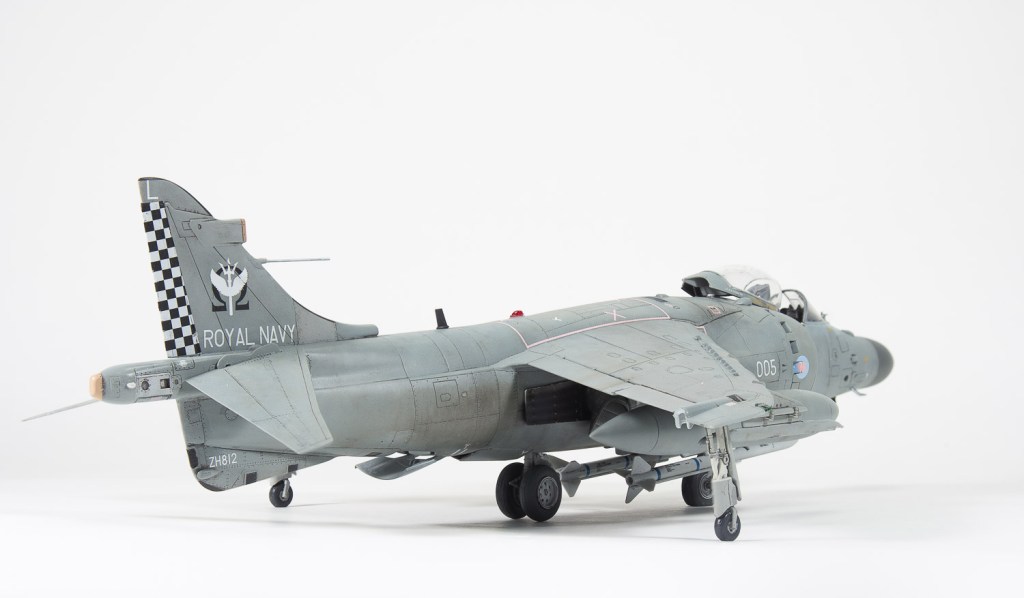
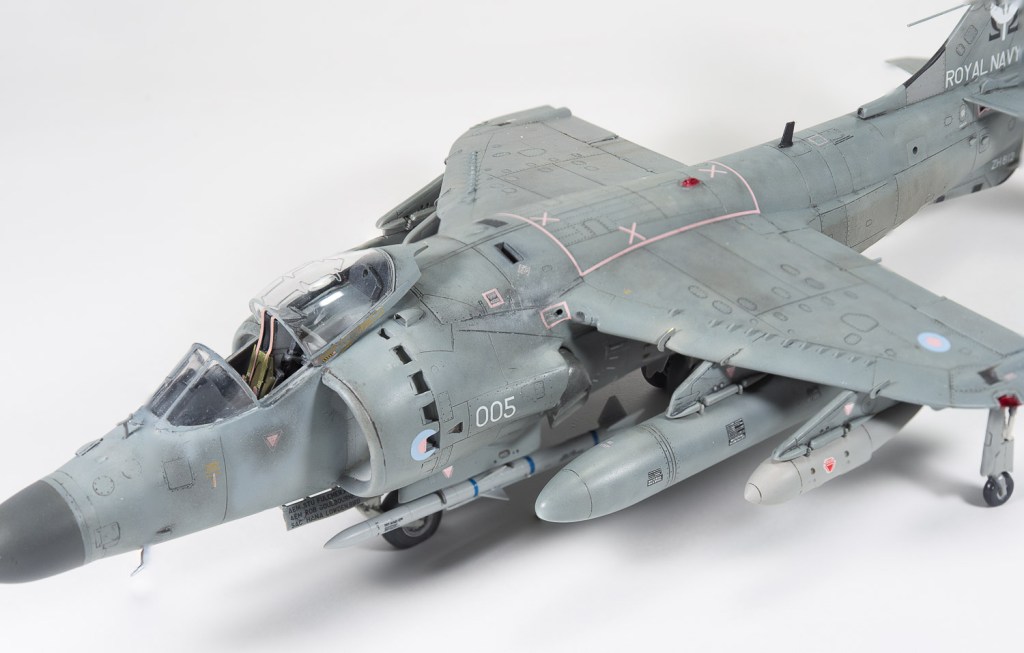
Panel line detail on kinetics SHARS are a little inconsistent, so the scriber was run along most of the main panel lines to deepen them.  A thin coat of Mr Color Medium Sea Grey was then applied.  Over the top of this I marbled on various greys, both lighter and darker than the MSG, before another thin blending coat of lightened MSG was sprayed.  A couple of panels were then masked off and painted with MRP MSG to give the look of replaced panels.  The fuselage extension was also painted in untainted Medium Sea Grey straight from the jar, as this showed as a different shade even on heavily weathered jets.  Then began the time consuming process of masking off and painting all those RWRs, doppler panels, dielectric panels and rubbing strips on the leading edge of the fin.  Jets are definitely more work than WW2 aircraft!

The under fuselage pylons and AMRAAMS were decided on to make the jet a little different from other models of the FA2.  Several reference photos were consulted to get the placement of the pylons correct as Kinetic do not give you any guidance in the instructions.  Despite the photos, I got some feedback when I posted the model on Britmodeller, the AMRAAMs were still tool forward by a couple of mm.  I can live with that

The decal sheets in these SHAR kits are nothing short of comprehensive, probably amongst the best you can find in a kit.  From the FA2 sheet, you can make just about every FA2 in service, in either hi viz or subdued schemes, as Kinetic provide you all squadron insignia, and all serial numbers by way of separate numbers you then combine to make your desired serial.  All stencilling is provided in both pink, red and black depending on which scheme you finish your jet in.
The sheet is printed by cartography, and they performed excellently sinking into all the recessed detail with the aid of Micro set and Micro Sol.

It was then that disaster struck.  I foolishly glued the windscreen on with Tamiya extra thin. I must have had the windscreen touching the instrument coaming one one side as the glue wicked straight up the inside of the windscreen.  AAAAGGGGHHH!  I managed to get the windscreen off, and polished the glue mark out, but the damage had been done as this kind of thing is hard to come back from.  The model no longer matched my vision of it in my head and I found I was just wanting to get it off the bench so that I could concentrate on making a better job of the others. Hence, the rather sloppy touch up paint around the reattached windscreen.

​ This is the problem I always have when building multiple kits in parallel.  I won’t be doing it again.  My new found apathy for the model only increased when I found the canopy would not sit flush when in the closed position.  The simple workaround to this was to just place it in the open position. A couple of the antennas had broken off with my handling of the model, and I didn’t replace them as by this stage I was over the kit. Annoyingly Kinetic want you too drill out all the location points for the antennas, which are moulded with a little tab on the underside, so your hole has then to be cut into a rectangular shaped hole.  I daresay, Kinetic have done this rather than provide holes so any antenna fit can be catered for, but really Kinetic, you could have provided flashed over slots to make this job easier. To top the model off, it then rocked ever so slightly once placed on its gear, despite me fitting the main gear last to ensure it would sit on all five wheels.  Thats it.  It will be going to the back of the cabinet.  Im hoping my other two will turn out better as Im using a bit more patience in their construction.  Meanwhile, Im not rating the Kinetic kit as an enjoyable build.

BAE Sea Harrier FA2 ZH812 801 SQNFleet Air Arm.  Yeovilton. U.K 2006

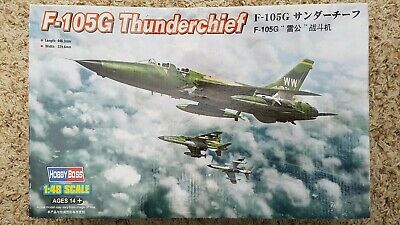
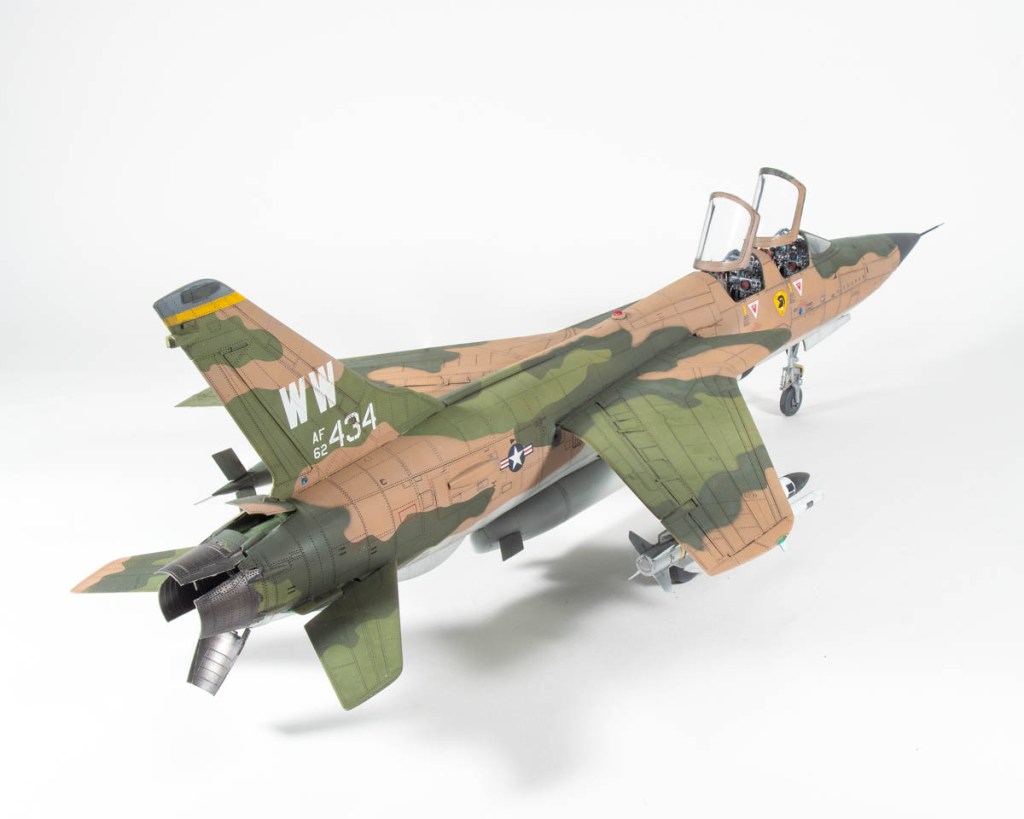
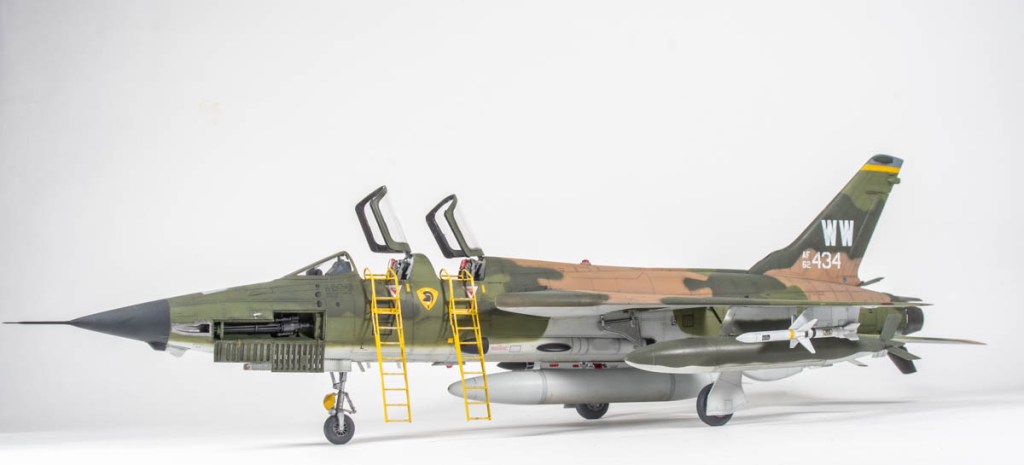
Hobby Boss 1/48 F-105G Thunderchief

Added to stash:  2017
Finished:  2021
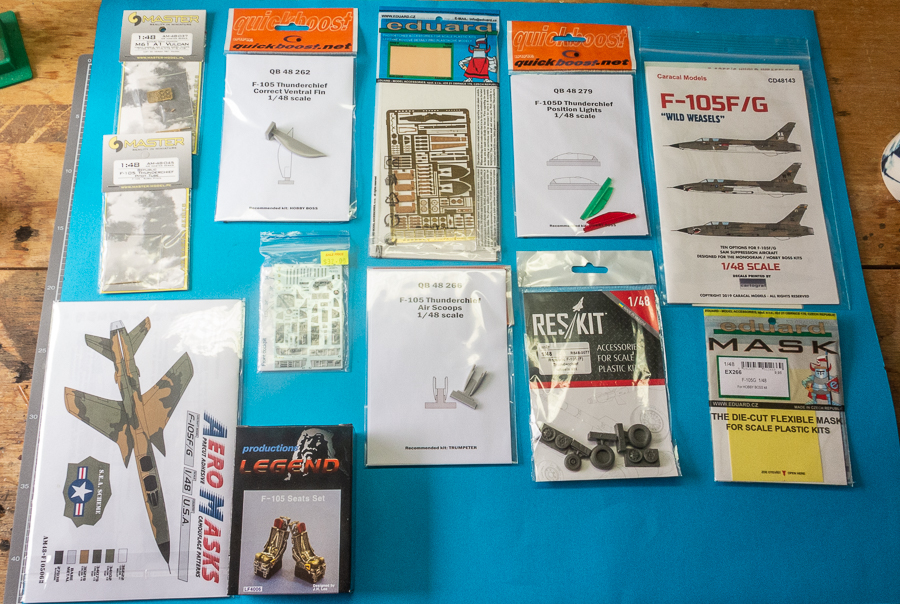
Enhancements

Cockpit Panels:  Quinta 3D decals
Seats:  Legend 
Gun Barrels:  Master Barrels
Pitot Tube:     Master Barrels
Wheels:  Reskit                                                                                External details:  Eduard Exterior set.  Quickboost vents                                                                                       Navigation Lights:  Quickboost                                                                              Decals:  Caracal                                                                          Boarding Ladders:  LF Models

This is not the first time the HobbyBoss Thunderchief has formed part of my stash.  It first joined the stash soon after its release, only to be sold off in the Great Stash Slash of 2013.  However, its funny the effect of looking at the real aeroplane can have on us as modellers.  
 
What had previously been so many disparate grey parts in a box took on form and  large menacing  grace when I stood next to several real Thunderchiefs whilst on an Aviation Odyssey to the USA,


I knew I had to build one upon my return home.  My mate had a similar feeling upon looking at the F-101B Voodoo, a jet he had previously had no love for either.

Consequently the HB two seat Thud rejoined my ever growing stash, and this year was picked out by a mate for my 2021 build schedule.  I should add here, for a kit to only spend 3 years in my stash between being purchased and then built is well above the average!

 As with all my builds, I started out watching related youtube videos and pulling all the reference material I had in my library.  Republic’s Thunderchief had  a very tumultuous start, during which the project was almost cancelled. Republic refined the original design markedly and the Thud went on to deliver sterling service during the Vietnam War before being withdrawn due to crippling losses.  This was due to the jet performing a role it was never designed for.  All this research helps with motivation for the build.

HobbyBoss’ Thud is one of their earlier releases, I believe it’s scaled down from their 32 scale kit, hence the breakdown is far more complicated than it probably needs to be with an engine, open gun bay and even parts for the nose mounted radar.  That said, I do like the display options these details offer the builder.

Ive made a conscious effort lately to plan how I want my finished builds to look.  This helps me with purchasing aftermarket parts that may be needed, and on the flip side, deciding what assembly steps and parts can be skipped due to closed panels etc.  I’m finding planning like this leads to saved time on the build.
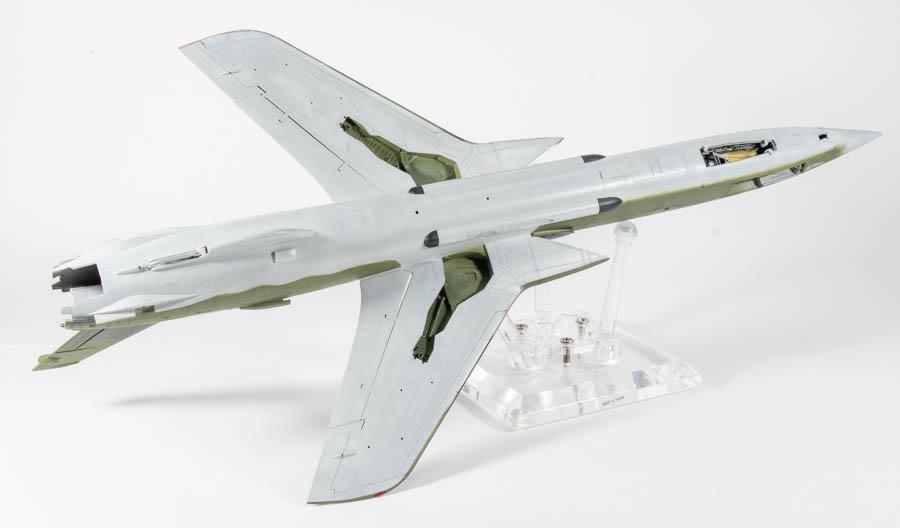
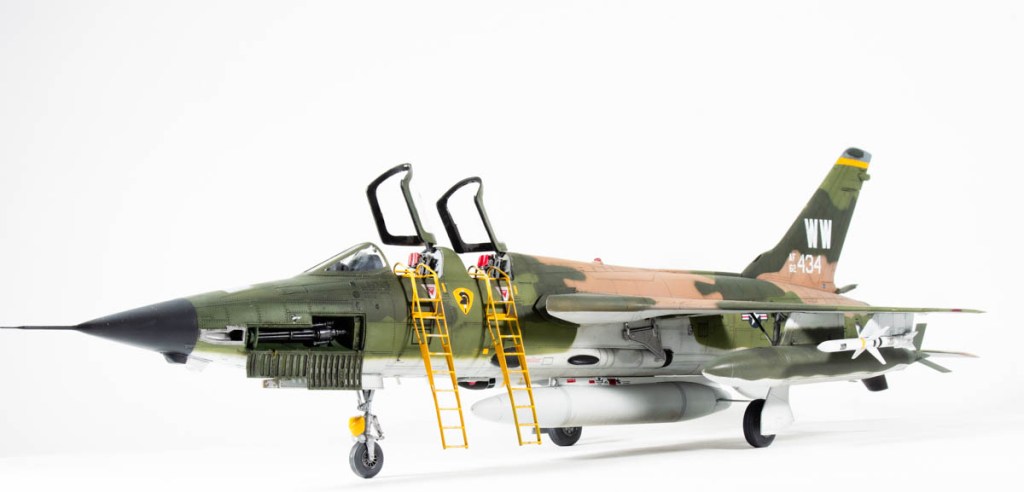
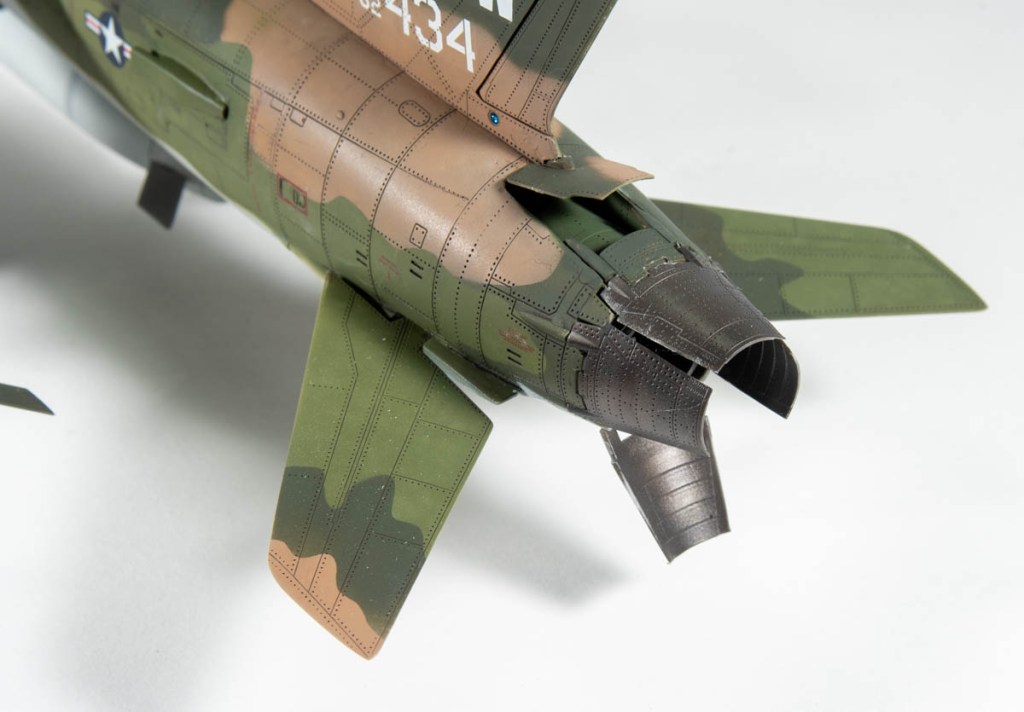
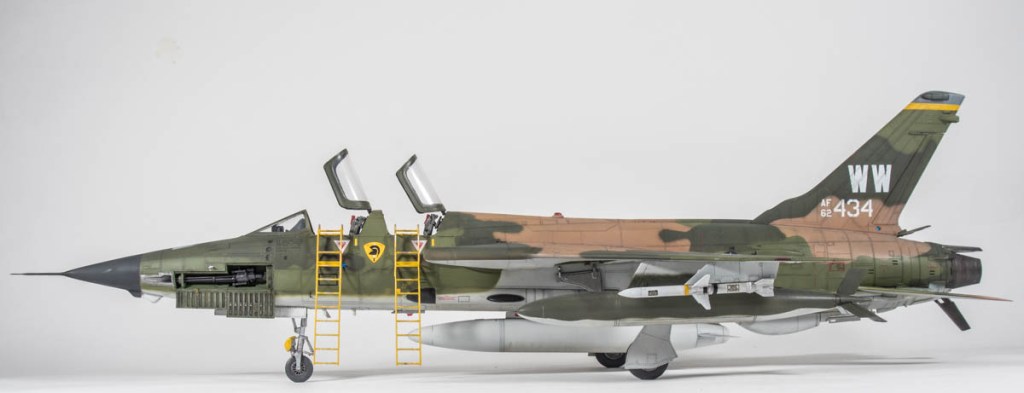
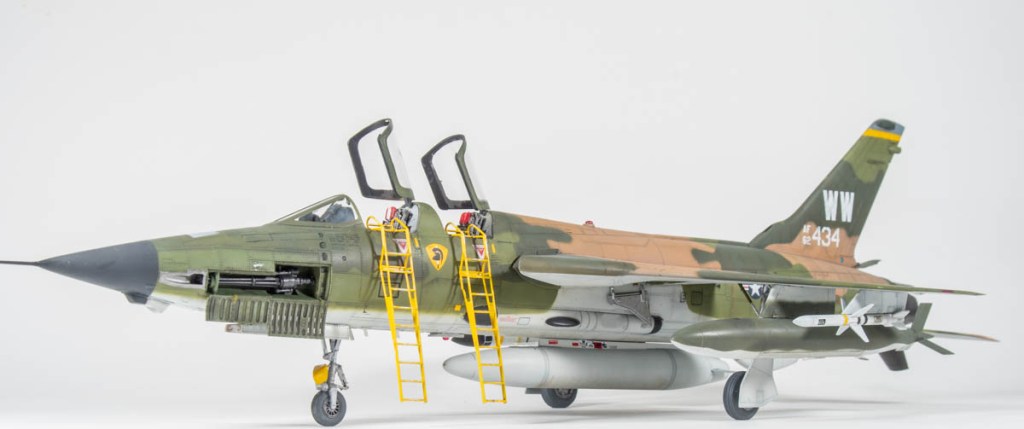
With this jet,  the canopies and gun bay would be opened to show those details of the jet.  The drag chute door behind the fin and the lower speed brake would also be shown open as seen in many period photos.
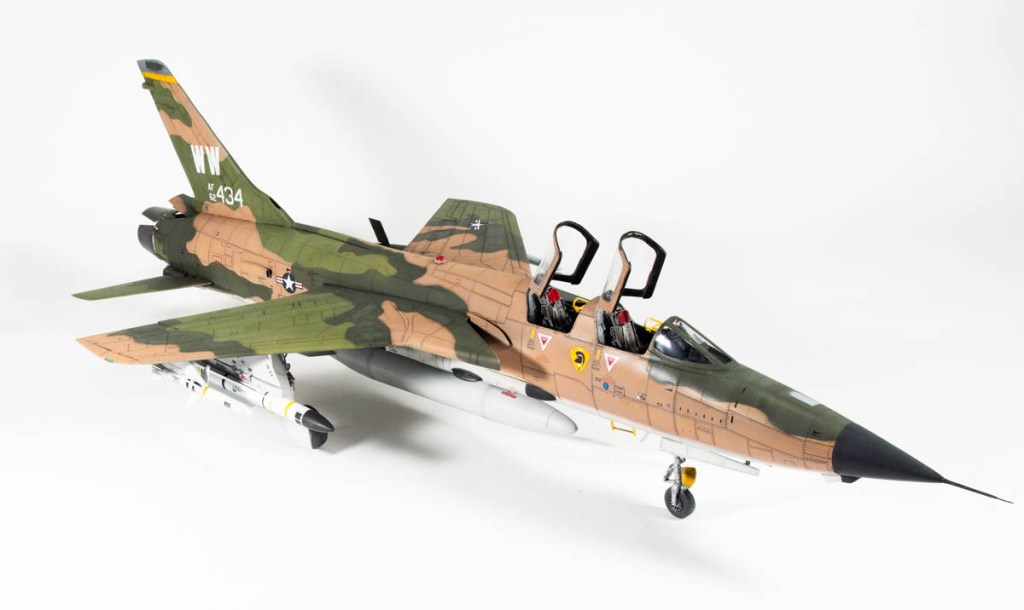
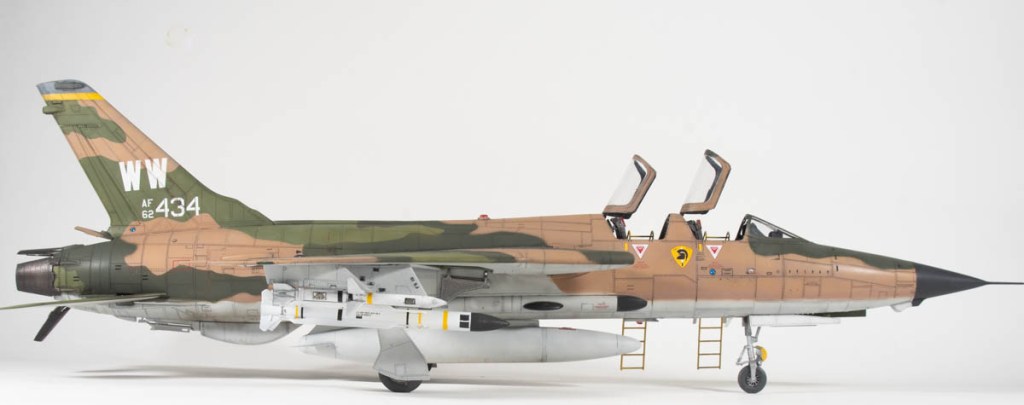
It would also be tooled up  with a typical Wild Weasel asymmetrical load out that would have been carried during the Vietnam war.  Naturally, it would need to wear the WW tail codes for Wild Weasel.

I was surprised to find I had amassed quite a bit pf AM for the Thud!

aftermarket

Construction Notes
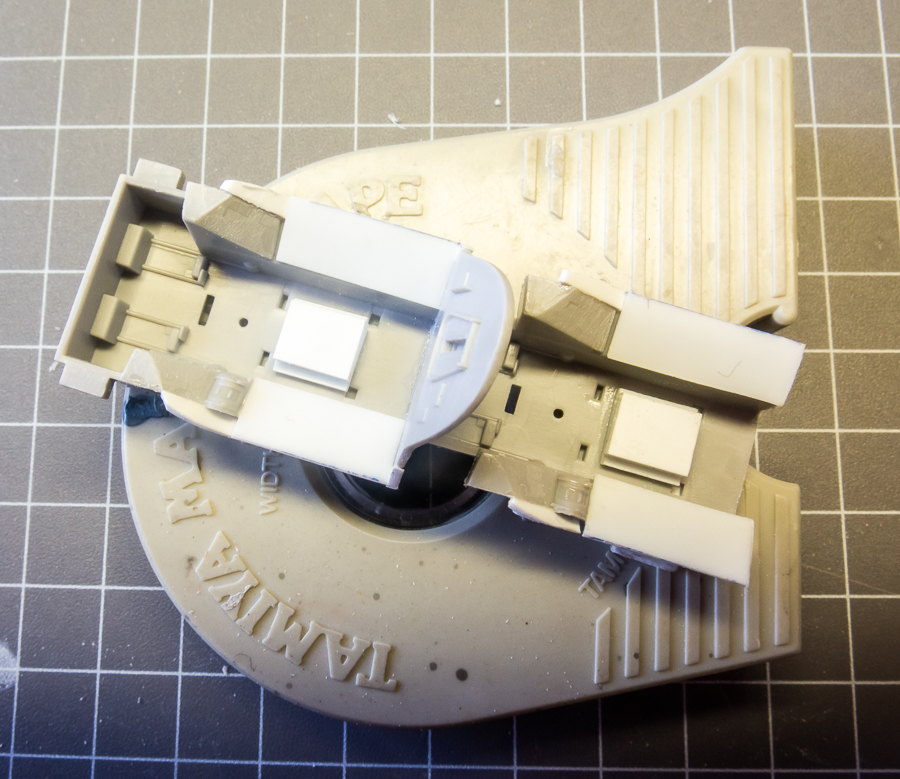
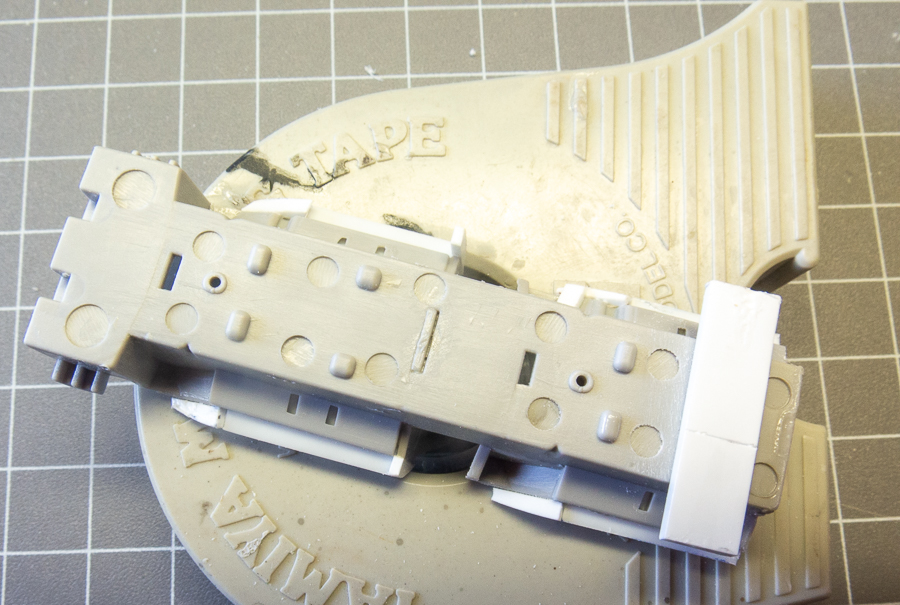
I started by making up complete fuselage halves by assembling each fuselage rear to the front half.  Doing it this way ensures a neat gap free join. Plastic strip was glued to the rebate where the engine bulkhead would normally be glued to provide more glueing area.


Cockpit
H
obbyBoss really mucked up here.  The kit cockpit side consoles are way too narrow and do not reach the fuselage walls.  You will need to add plastic sheet to widen them.  What on earth were you thinking HB?
extra width topextra width bottom
 
 
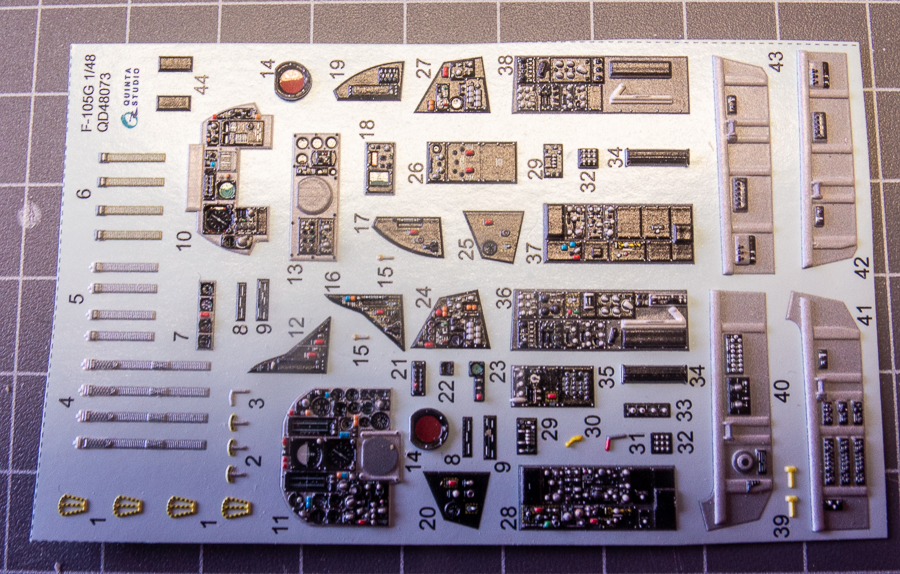
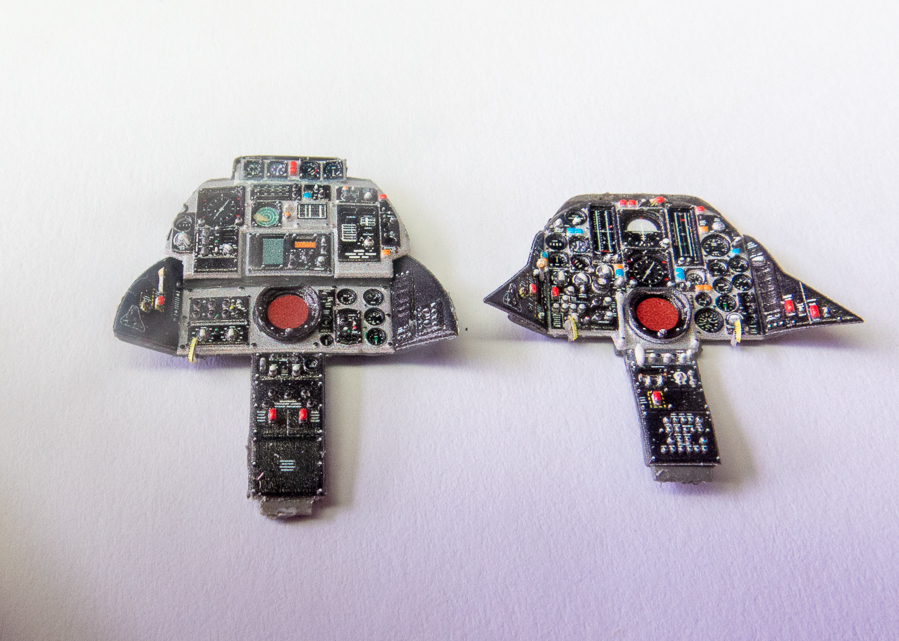
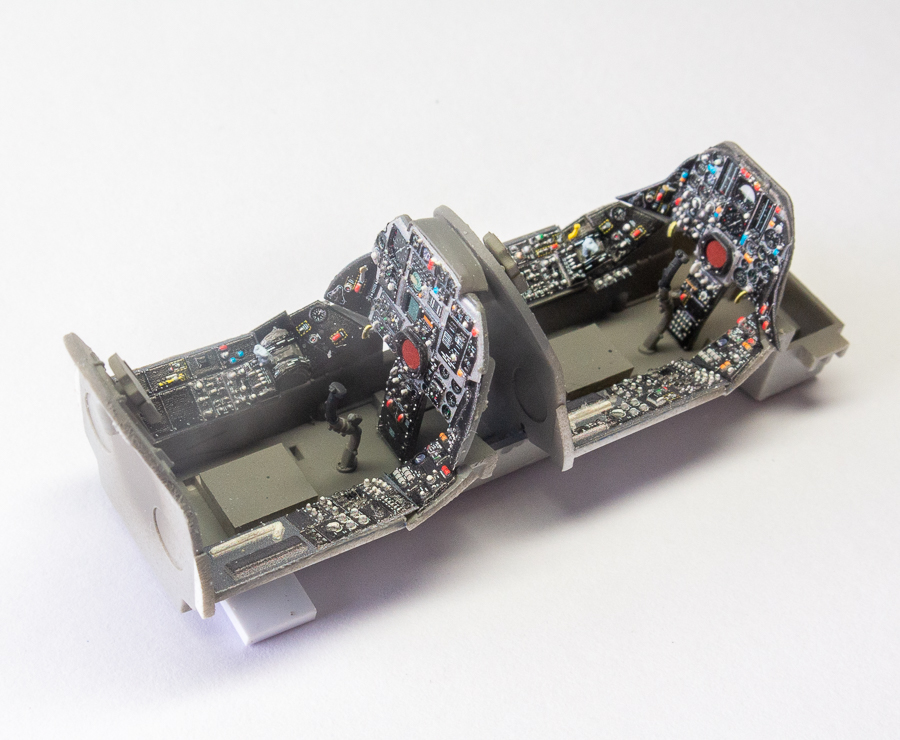
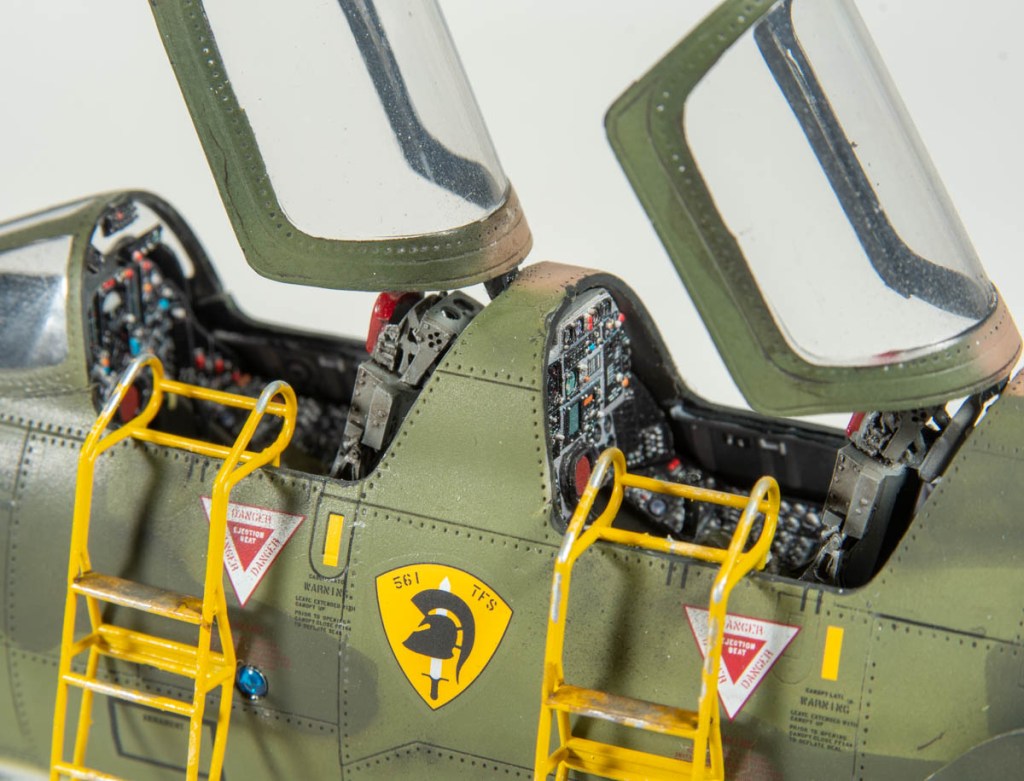
The Thunderchief has a wide very visible cockpit that rewards extra detailing.  I chose to use one of the new Quinta cockpit sets specifically for this kit.  Well, colour me impressed!  This was the first time I had used these sets.  The Thud one fit perfectly, correcting the too narrow kit consoles.  They are easy tao apply once all the moulded detail had been sanded off the panels and look far more realistic than just flat PE panels.  Printed on white vinyl, you may have to touch in the odd visible white edge, but this is nothing hard.  the dials are already gloss coated, although I would probably hit the panel with a matt to dull Quinta’s semi gloss finish.  These will be  my go-to panels for all aircraft that feature highly visible cockpits in future.
quinta sheetquinta panelsquinta panels-2


Construction Continues
For such a complicated looking kit, it went together surprisingly quickly.  The separate spoilers were individually added to the top wing before the halves were glued together.  Doing it this way ensures you get the best possible flush fit as it allows access to  both sides of the wing, which you wouldn’t be able to do if you added the spoilers to the assembled wing halves.  I had the Quickboost navigation lights to hand so also added these.  Strange decision by Quickboost to mould the complete wing tip in red and green plastic when the actual light is quite small.  I can only assume they did it this way so the light is correctly faired in.  Be careful to avoid a step though.  I also added the completed wings to each fuselage half to better ensure  a gap free join.  Hobby boss’ kit has the wing strengthening plates moulded on.  I could not glean a date though when these were added to the real jet, just that the constant tempo of operations in SVN had lead to fatigue issues, hence the reason they were added.  Anyway, I was not going to risk destroying detail by sanding them off.  The Gs were late airframes anyway so hopefully they had them fitted.

Eduard PE fascias were added to the gun bay and the plastic vulcan barrels replaced by the incredible brass turned Master Barrels ones, You will go crosseyed trying to assemble them.  The Eduard gun bay door with its open gas vents is a massive improvement on the kit part.  Should you be building your Thud with the gun bay open, I’d suggest the Eduard set is a must.

Painting and Decorating
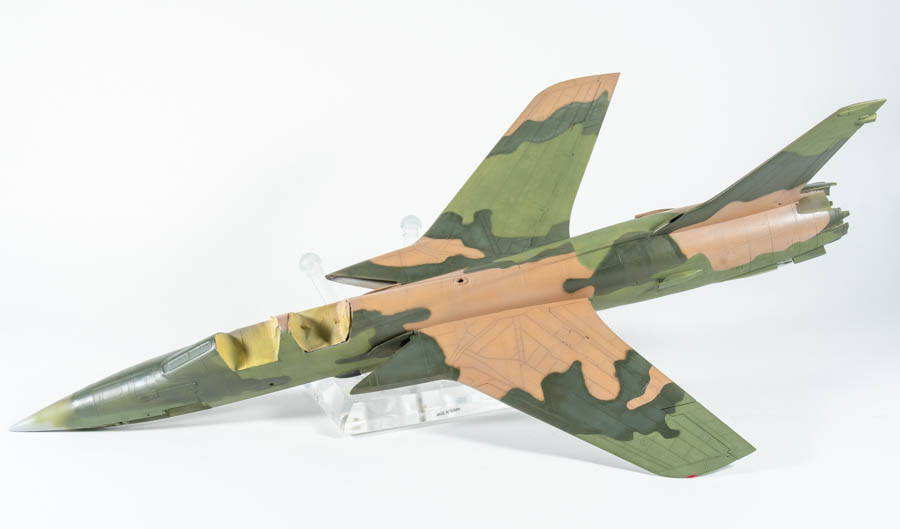
Aeromasks are a manufacturer unknown to me.  I stumbled across them browsing facebook.  They offer a very comprehensive range of camouflage mask sets in all scales.  Seeing they offered a set for the Thud, I promptly ordered one thinking it would really ease painting the S.E.A scheme.

​The sets arrived pretty quickly from America and are indeed fairly comprehensive, even providing masks to paint the demarcation lines on the fuel tanks.  Clear instructions leave you in no doubt how to position the masks and in what order to paint the scheme.  You are well advised to follow these as the painting order is designed to ease the masking process, not necessarily the painting.  Therefore you start with the medium green not the tan as you would imagine.
Being the masks are not designed to fit specific kits, you may find some trimming necessary in order to fit the kit you are using.

The masks were placed on little blobs of white tac so as to leave a soft edge.  This was only marginally successful so I ended up tracing around most colours with the airbrush freehand to soften edges.
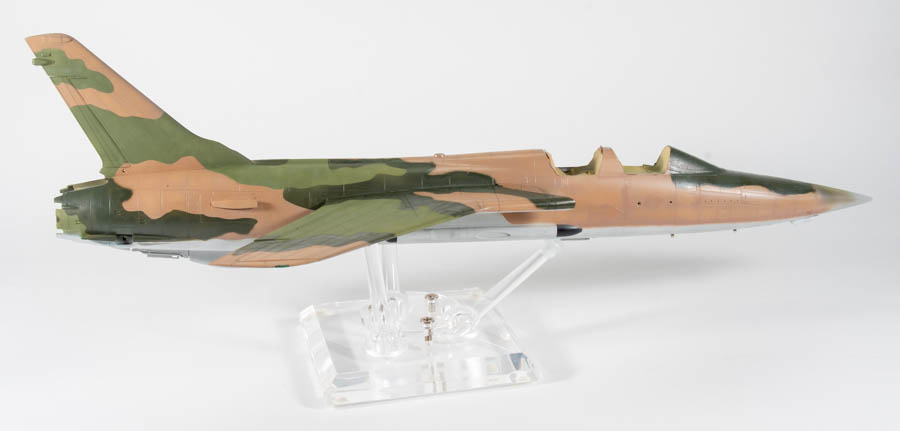
Overall, I was happy with the masks and the intricate pattern using them provided, which seemed to match photos.  A lot of the jets had their camo field applied as they entered the theatre still in their silver schemes, so there would have been some minor differences from airframe to airframe.

 The bloke who runs Aeromask used to paint  real Thunderchiefs at Hill AFB, so has access to all the official paint schemes.
My intention was to portray a battered and faded jet, but again looking at photos revealed not a lot of faded paint on the Wild Weasles, so the faded look was held back apart from the upper surfaces.
​The Caracal  decals performed flawlessly as always.  Prior to decalling, an oil wash was applied straight over the lacquer paint.  This was then sealed with a gloss coat ready for decalling.

Thunderchief_initial paintThunderchief_initial paint stb sideThunderchief_initial paint-2


Once decalled a further gloss coat was applied to seal the decals before stains and leaks were added with more oils.  The model was then flat coated before proceeding to final assembly.  This is now my preferred work flow.


Final assembly reveals the achilles heal of the HB kit.  That being the very spindly weak undercarriage legs, upon which the completed model wobbles alarmingly.  Against my better judgement white metal legs were purchased, and ultimately discarded, because they were….well….crap plus the main reason the kit legs are spindly is the insubstantial socket HB have moulded for them to sit into.  The metal legs weren’t going to fix this, nor could I glue in more substantial sockets.  The Thud continues to wobble on its legs.

upongear_Thud_21-03_04

​Weapons were sourced from a hasegawa weapons set.  There was a difference in size between the kit missiles and the hasegawa ones .  My faith went into the Japanese manufacturers product.
A final lack of detail that was not discovered until I went to fit the canopy was that HB had made absolutely no allowances for the modeller to pose them open.  Thus actuators had to be scratch built.  This was achieved with brass wire and rod
The brass pitot tube was push fit into the hole in the nose cone and this mighty Vietnam warrior was finished.

Final Thoughts
The Thunderchief makes for an imposing model in the cabinet.  Its a decent size in 48 scale, and stands out amongst all those grey jets  in its multi hued warpaint.  The lovely LF Models ladders provide a nice splash of colour and draw your eye to the cockpits
I think the Thud is one of my best efforts yet.  the trouble free construction being a bonus I had not expected when first perusing the instructions and parts.  An enjoyable build, although one will do me.

Republic F-105G-1-RE Thunderchief  U.S.A.F  561st TFS Korat Thailand  1972


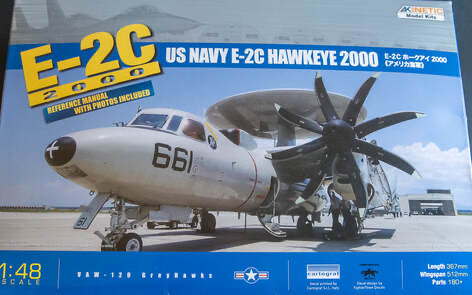
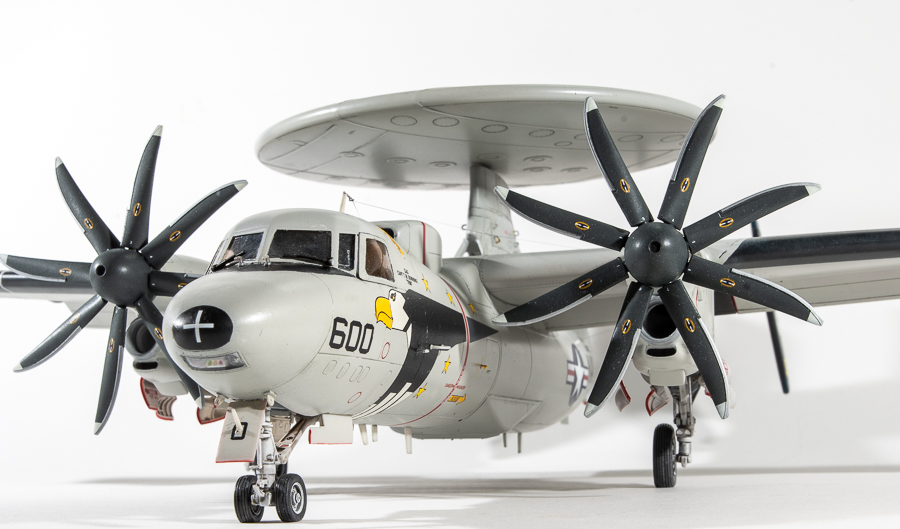
Kinetic 1/48 E-2C Hawkeye 2000

  • Purchased: 2018
  • Completed:2021
  • Enhancements:
  • Wheels  Royale Resin
  • Decals: Authentic Decals
The hawkeye was quite a bold release for the then relatively new Kinetic.  Although I have never seen a built example grace the competition tables here in Australia, there are quite a few builds featured on line.  Perhaps a better indicator of what people are building.  In any case, I hope Kinetics courage in releasing it has been rewarded by good sales.
Being one of Kinetics earlier kits, there are a few sink marks evident on wings, the crew door and the rotordome pylons, easily fixed, as they are quite shallow.
Panel lines are somewhat heavy and ejector pins mar the wheelwells.  Options out of the kit allow the modeller to fold the wings, drop the flaps or model the crew door open
Interior detail is fine for what can be seen and full intake trunking is included for the engine intakes.  Upon its release, the kit seems to have met with good reviews, some commentators remarking that the 4 bladed propellers would need some minor reshaping to better reflect the full sized blades.  All reviewers experienced a nasty step between the upper nacelle and the wing interface. otherwise the kit was found to be well fitting

Kinetic followed up their original boxing with this later boxing that includes parts for upgraded satellite antenna fits, engine cowlings with stiffeners and the 8 bladed propellers.  The four bladed props are still included.  Both boxing s are let down by the very plain markings offered.  Surprising, given the schemes this aircraft has worn and the fact the decals were designed by Fightertown.  Italeri have also reboxed the kit with a far more colourful aircraft sporting markings from “Liberty Belles”


Build Notes
Assembly
2020 was to be the year I built anything from my stash  that saw service with the United States Navy.  It didn’t work out too well!.  Pandemic aside, the start of 2020 turned out to be a modelling disaster that saw about 4 kits started and promptly consigned to the bin before finally managing to complete one.  The Hawkeye was the fifth kit started and was shaping up well, until I discovered the canopy had been short shot.  Kinetic though were very receptive when I requested a replacement, although the part did not reach me until quite some months later due to global airmail almost shutting down.

I had decided early on to build the model with wings extended as to me, wings that fold along the fuselage hide too much of the aircraft. In the Hawkeys case it would also take away from the greyhound look of the aircraft.  Kinetic offer decent spars that go some way towards ensuring the spread wings form a solid join and align with the fixed centre section.  Fit is good, but not exceptional.  I was left with gaps top and bottom that needed filling and rescribing.  Greater care and some fettling on my part would have probably reduced these, as dry fits without the spars revealed tight joints
Sink marks across the wing top surface were dealt with by application of Mr Surfacer 500.  Rather than slather on putty, the nacelle step was dealt with by careful sanding of the nacelle mating surfaces where they met the wing undersides, taking care to maintain the contours.  Serial dry fits were carried out until the step had been eliminated.  The then very minor gaps were filled with Apoxie Sculpt, the excess being removed with a damp finger.  The overscale static discharge wicks were cut off, to be replaced with toothbrush bristles.  Being the lazy Modeller I am, the ejector pins in the wheelwells were ignored.

As a result of having to wait for the canopy, the kit was built up in sub–assemblies, being the wing, comprising the nacelles, the rotordome and supporting pylons, and finally the fuselage, being I did not want to contend with possibly having to fair a badly fitting canopy into a large and unwieldy model.  I carried this method right through to painting and decalling.  Dry fits had shown the wing to fuselage fit could be easily dealt with, when the time came, and this method would also allow unfettered access to the inside faces of the nacelles and the fuselage sides that would otherwise  be underneath the wing.
Fuselage assembly was unremarkable, an average fitting belly panel required some use of Mr surfacer, and  a large amount of lead sheeting was epoxied in behind the cockpit bulkhead with lead shot filling the gaps either side of the nose wheel well to ensure the aircraft sat on all three undercarriage legs.  Fitting the clear nose cone left a step on one side.  The low side of the step was built up with apoxie sculpt and sanded to shape.

Paint and decals

Whilst still in its sub assemblies, the model was painted using Mr Color light gull grey with the tail fins in SMS Insignia Blue.  Black de icer boots were sprayed tamiya rubber black after some very time consuming masking.  The portions of the flaps hidden by the wings and the flap wells got a  coat of Mr Color Flat Red
Not a single chip of paint peeled up on the removal of the tape, unlike most of my Tornado builds.  Looks like that old Alcad grey primer was the culprit!
The cockpit tinting was done using a 50:50 mix of tamiya Metallic brown and smoke, overcoated with several layers of future.
Unless you want to build the very boring kit option, aftermarket decal sheets are a must, even then options are few, with the decal manufacturers seeming to offer nothing post 2008.  This machine has worn some very colourful markings which have not at all been mirrored by the very uninspired decal sheets out there, save for the Fightertown Liberty belles sheet.

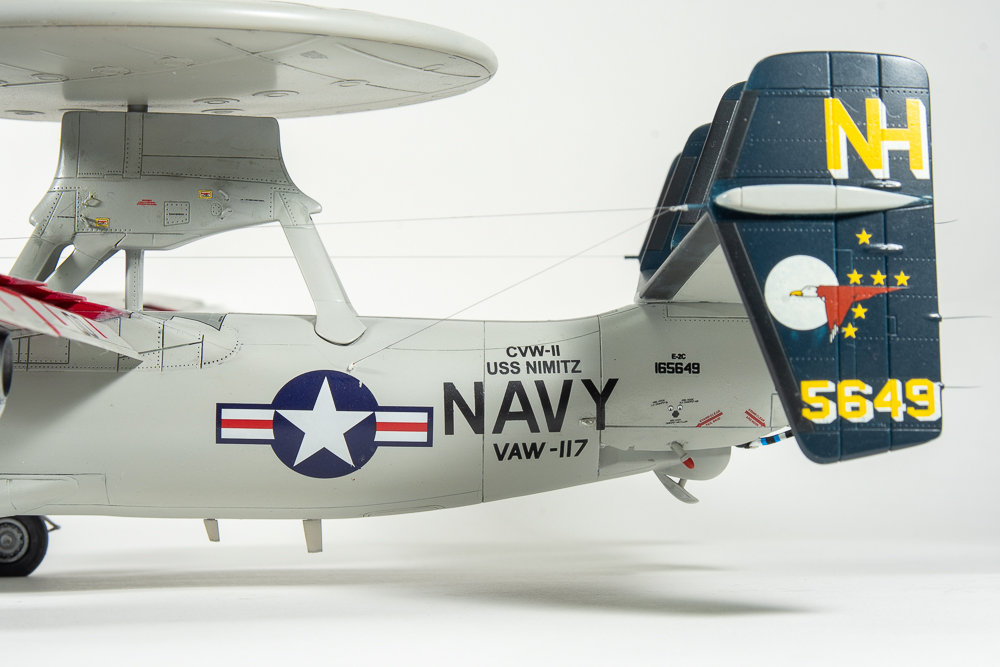
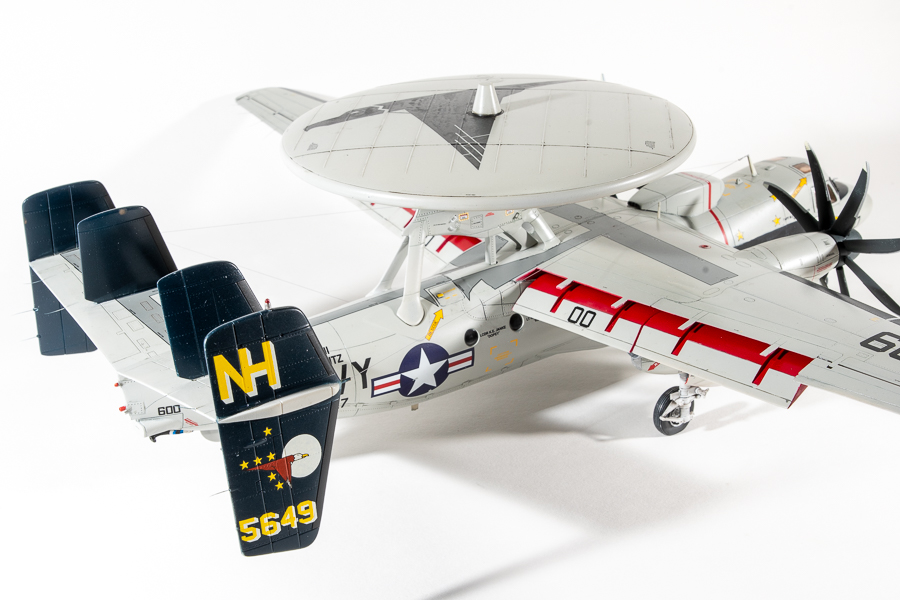
I chose a decal sheet by the-to me- unknown manufacturer, Authentic Decals that included a scheme with a large hawk on the side, and ticked my boxes of having coloured fins and a artwork on the rotordome top surfaces
My concerns about the Authentic decals not performing or breaking apart in the water were unfounded.  Turns out they are printed by Bergemot.  (EDIT, It seems this sheet is also offered under the Bingo Decals brand, I’m not sure which came first, or if one is a knock off of the other, or printed with permission)
They performed flawlessly and reacted very well to the Micro decal solutions settling down into even the rivets with only two applications.  This is more than I can say for the kit decals which had been printed by cartograf. They took multiple applications of setting solution before sinking into the detail, and only after resorting to using Daco strong solution.  All walkway decals and fuselage national insignia were left off until the wing had been mated to the fuselage.  However this then exposed the fact the Authentic Decals NAVY titles were far too big, when compared to photos of the real machine and how the NAVY titles sat in relation to the national markings.  The kit NAVY titles were the correct size, but it was too late as even removing the oversize titles would still leave the ship and squadron designations in the wrong spot in relation to the NAVY titles. There was no choice but to just suck it up, and move on.  I decided to do a clean build as photos I had of the real aircraft showed it very clean indeed, like fresh paint clean, plus I was getting to the stage where I wanted it off the bench

Final details were added and EZ line used for the antenna lines.  Like  all modern aircraft , the model was starting to get hard to pick up, the more you added to it.  Royal Resin wheels replaced the rather bland, and in any case far too weighted kit wheels.  All those pesky red lines on the wheelwell doors were applied with a fine tipped gundam marker, and she was done, ready to almost take up half a shelf in my cabinet.

SO! The two questions I ask myself after each build

HOW DID I GO? 
Well, not bad. I think its an incremental improvement over my Tornado builds.  I’m still marring my finish with stupid mistakes, which are only too apparent to the camera lens, damn you macro camera!!There’s some silly construction and finish mistakes as a result of just not taking my time but, overall,  I’m  pretty happy with it, and just love the look of the finished model. It just looks so busy with the aerial wires, the multi bladed props, deployed flaps and that large Hawk on the fuselage and dish.  Its one of my favourite builds.

WOULD I BUILD ANOTHER?
Not another Hawkeye, but if I found the Greyhound at a reasonable price, then possibly!
Thanks for looking in.  See you after the next build
Bruce

 Grumman E-2C Hawkeye 2000 VAW-117 Wallbangers USN.  USS Nimitz Pacific Ocean 2009                                                                                   

Go back

Your message has been sent

Warning
Warning
Warning
Warning.

Revell 1/48 Tornado GR4

Completed:2020
Enhancements Used:  
Cockpit: Eduard
Seats: Paragon
Wheels: Brassin
Wheelwells: Eduard
Weapons: Brassin
Pitot: Master Barrel
Wing Seals: Shaun off Britmodeller
                                                                                                  Decals: Model Alliance Op Telic Part 1

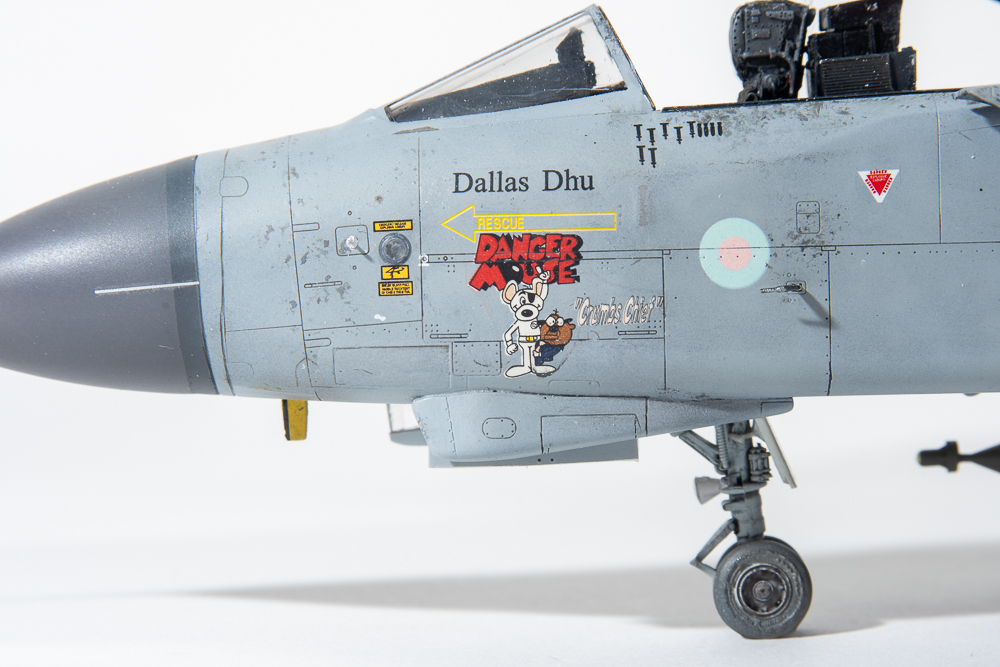
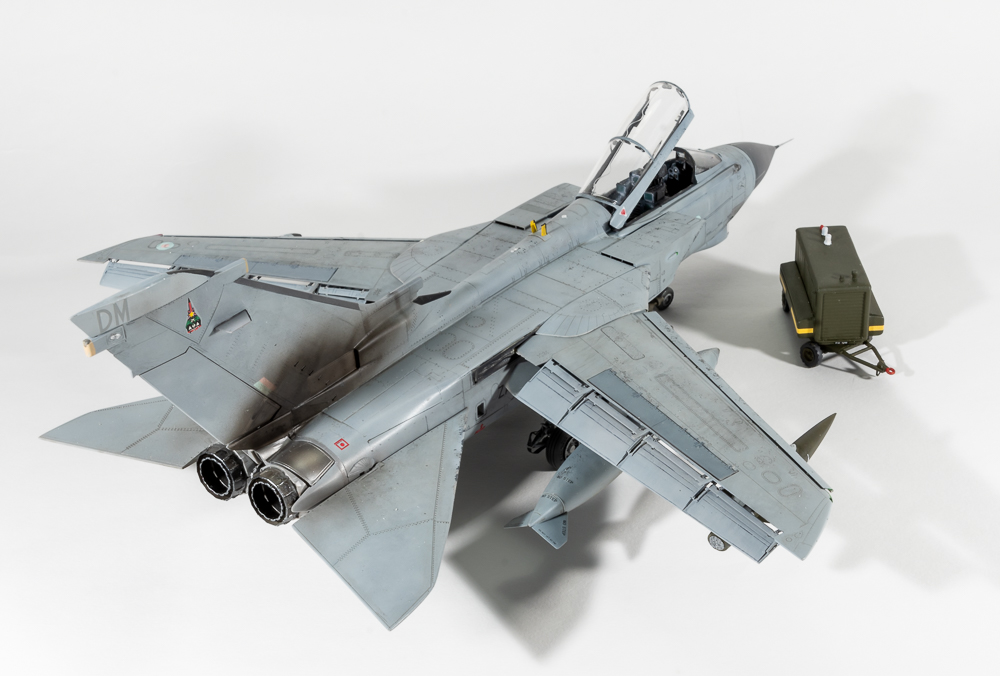
The third and final instalment!  I had wanted to build Danger Mouse from the start.  For some reason I thought it was a ADV though, not a GR4, so then had to keep on  building tornadoes until I got to my GR4.  Well that’s my excuse for building 3 Revell Tornadoes.

I had a load of aftermarket I had planned on using on this build.  Some of it got binned as not value adding to the build though.  
Firmly in this camp, I place the phase Resin Hangar seamless intakes.  For a start, I just don’t think they are needed.  Whilst the kit intakes do have a nasty seam, you can really only see the first couple of mm of the kit intake trunking, ands then only by holding the model up at a weird angle and craning your neck to look down the intakes.  If this bothers you, a bit of filler and sanding will eradicate the seam. Secondly, the case resin intakes are moulded as just the intake tunnels without the bulkheads provided as part of the kit trunking.  These bulkheads form the front and back walls of the wheel wells and provide important structural integrity.  As I was going to be using the aires resin wheels this was not a dealbreaker.  What was the dealbreaker was the resin intakes would not fit over the top of the resin wheel wells without removing a big chunk.  This  was after sanding both the roof of the wells and the outer wall of the intake wafer thin, so, the resin intakes got binned and I reverted to the kit intakes.  To be fair to Phase Resin, Mike is probably not expecting you to use his intakes in congestion with resin wheel wells.  That aside, to not cast the integral bulkheads seems strange..  My opinion. Don’t bother with the intakes.  The wheel wells however do add to the kit, beautifully detailed as are all aires sets, these even fit with a minimum of fuss.  What led to them getting junked along with the intakes was after glueing them I found I just could not get the fuselage parts to line up seamlessly as the other kits had, so they got hit with the debonder and binned as well.  Not going too well so far!  The aires wells do add a lot to the kit though, and I’m sure the fit issues were due to something I did.

The rest of the build proceeded as per the other tornado builds.  Again I cut off the wing cogs to fit them at a later stage.  Again this is another thing I would never do were I to build another tornado ( I won’t be!)

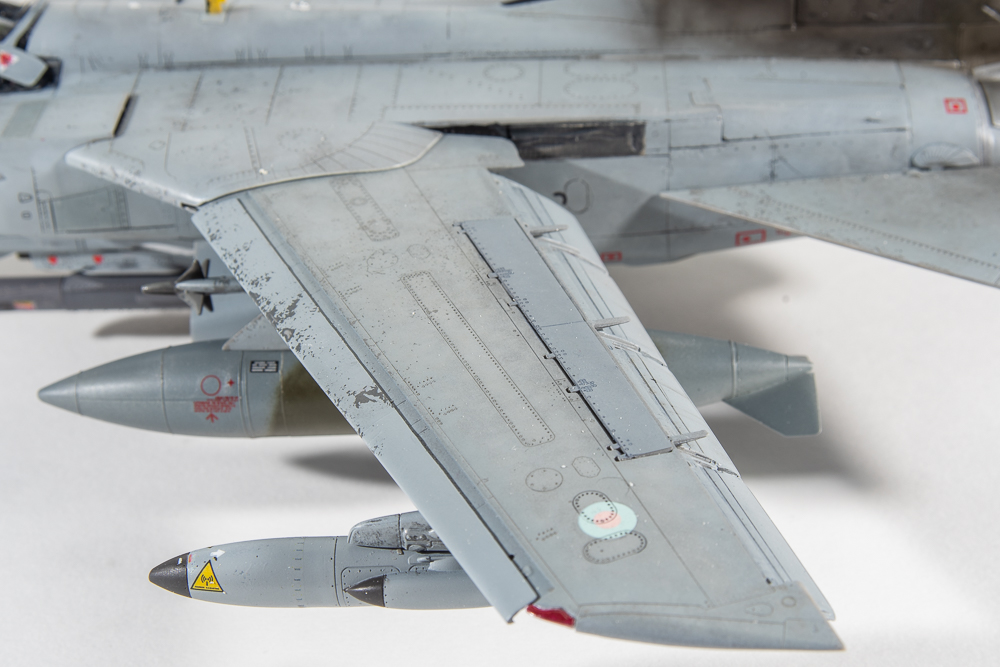
Revell would have you assemble the wing flaps as a three piece assembly whereas in real life they are one piece with only the small aerofoil section being a separate piece.  Make sure you fill and sand the join line.  Hopefully the photos explain this a bit better.  Shaun’s resin wing seals are far better representations of the real things rather than the featureless kits items.  He can be contacted through  Britmodeller.com

Photos I found on the net of Danger Mouse and other Operation relic jets showed a fair bit of wear and tear with scuffing and chipping of the ARTF grey paint exposing the underlying dark camouflage grey paint.  To portray this on the model. I first applied a coat of dark sea grey to the leading edge slats, nose, pylons and one of the drop tanks.  Mr Neo masking fluid was then dabbed on with a torn bit of sponge and the model sprayed with a couple of light coats of Scale Modeller’s Supply Barley Grey.  SMS is a home grown  Australian paint manufacturer.  I have been increasingly using his paints, as Im finding them excellent to spray.  You can spray them straight from the bottle, but I add a drop or two of thinner to make them spray even better.  They are a lacquer paint that has proven to be hard wearing and quick drying.  Once this paint had dried I rubbed my finger over the Neo to remove it from the airframe leaving the model looking chipped and scuffed.  The jet was made to further look worn by painting a few panels in either dark sea grey or lightened shades of the barley grey. One of the fuel tanks was painted in the old wrap around scheme, jets being fitted with different coloured tanks being quite common, even today.

I applied a panel wash with Payne’s grey oil paint straight over the SMS paint, with the excess wiped off and no damage to the underlying paint.  The decals were also placed straight over the paint, which dries with a sheen, the model Alliance decals performing well, although the DM code letters were too light and did not stand out enough when compared to photos of the real jet.  As I could not find any dark grey or black letters of the correct size to replace them, so had to resort to painting the fin top a lighter grey.  I replaced the letters with other codes from the same sheet.  Penfold’s catch cry “Crumbs Chief” should also be far pinker than the pale shade on the sheet, maybe it faded!  Op Telic jets do not seem to have been as well photographed as Op Granby jets, well so it seemed to me with good quality photos being hard to source. In particular I wanted to know if these jets wore the full suite of stencils after they were repainted.  In the end I went with just the major ones figuring only those stencils that dealt with rescue or crash procedures would have been re applied.

With this model I decided to really strengthen the pylon to wing attachment by using epoxy glue.  They ain’t coming apart now, although perhaps I should have ensured they were parallel to the centre line first!

With that Danger Mouse was done.  One of my favourite cartoon characters as a child.  There are still a few build and finish faults, but this is my favourite of the three.  I love the pugnacious look of the short nose coupled with the laser sensors.  The Eduard Brassin weapons are also a must have, being better detailed and more accurate than the kit supplied weapons.  Out of the box, you can arm a Operation Granby or Operation Telic jet.  Even the stenciling is provided.

So with three Revell Tornadoes done, what are my thoughts?  Well, let me start by saying I sold my remaining Revell tornado from the stash, as to build more would be just like beating yourself over the head repeatedly using a hammer.  I think you would really have to love Tornadoes to build multiples of the Revell kit.  Marred by soft detail in a lot of places, sink marks, flash, it can be  a troublesome build in inexperienced hands.  Take the time to research other on line builds and the previously linked youtube videos as fit problems can be mitigated if the builder departs from Revells suggested build sequence.  I really cant see anyone else aside from Airfix releasing a newer tooled Tornado, so Im thinking the revell is going to be the go-to in 48 scale for quite some time.  I might just order that new 32 scale Italeri tornado, as the Tornado itch still needs to be scratched with a wrap around GR1.

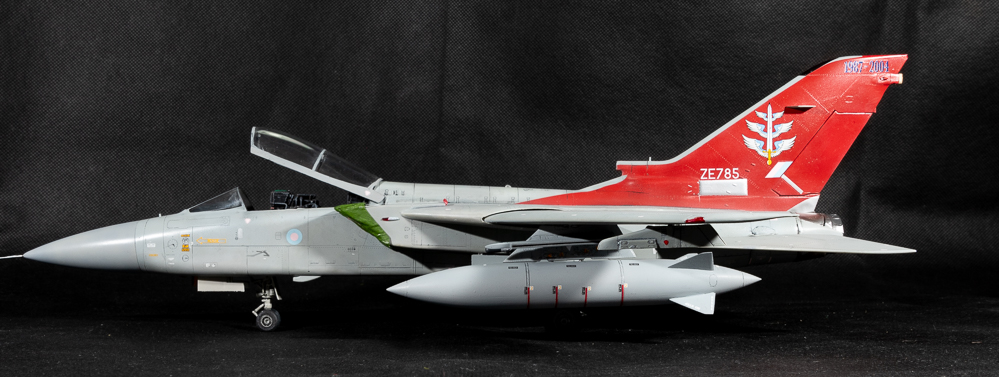
 Tornado GR4 ZA542 31SQN Royal Air Force. Combat Air Wing Ali Al Salem Op. Telic 2003


Revell 1/48 ADV Torando F3

Enhancements Used
Seats: CMK 
Seatbelts: Eduard steel
Wheels: Eduard
Pitot Tube: master barrels
Decals: Xtradecals Tornado F3 part 1
BOL Rails: Phase Resin Hangar

Construction Notes
 Oh God, what was I thinking, building three of these at the one time?.  In last months gripping episode you will recall that I (rashly) decided to build all three of my tornadoes from the stash at the same time.
​Well the plan didn’t quite start out like that.  This tornado was actually the first started, and the original plan was to just build this one,  however, it was not really turning out as I had pictured in my mind, – a common theme with my builds –  so it got shelved, and my other F3 pulled out of the stash, and started with the intent of being a better build (yeah, right!).  It was at this stage the idea to build all the tornadoes in my stash was born.  In actual fact, I thought I would  only be  building the other ADV  and my GR4.  
It  was only when the other ADV was almost finished, this one was revisited, and the decision made to complete it.

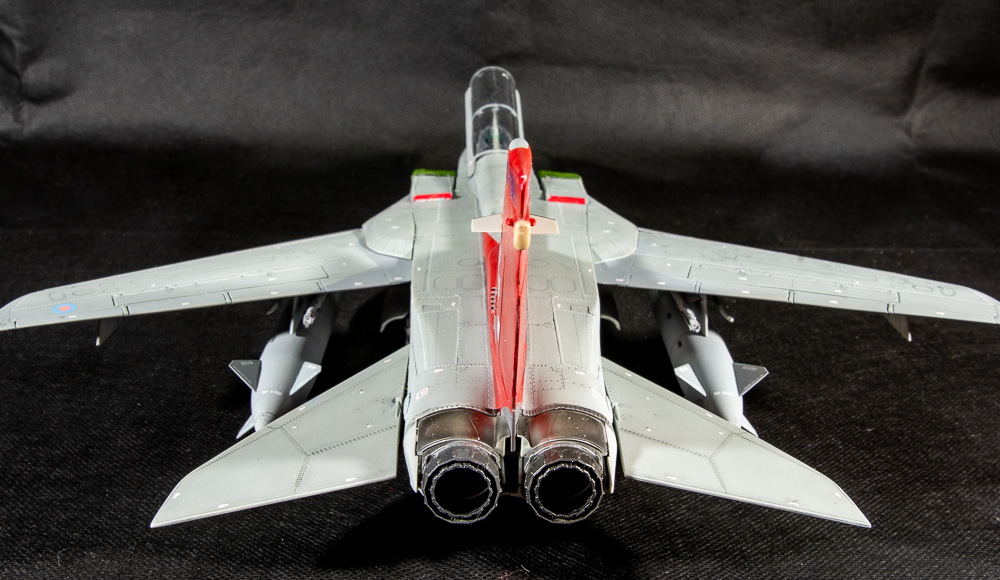
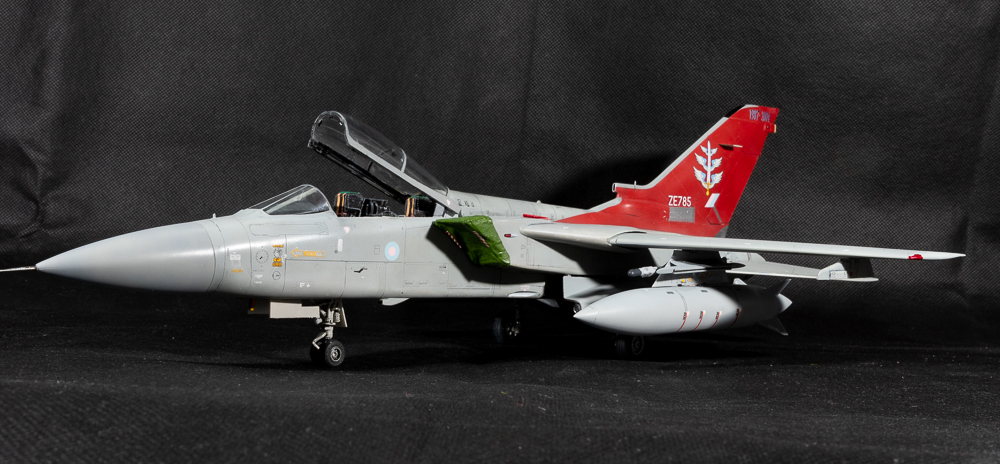
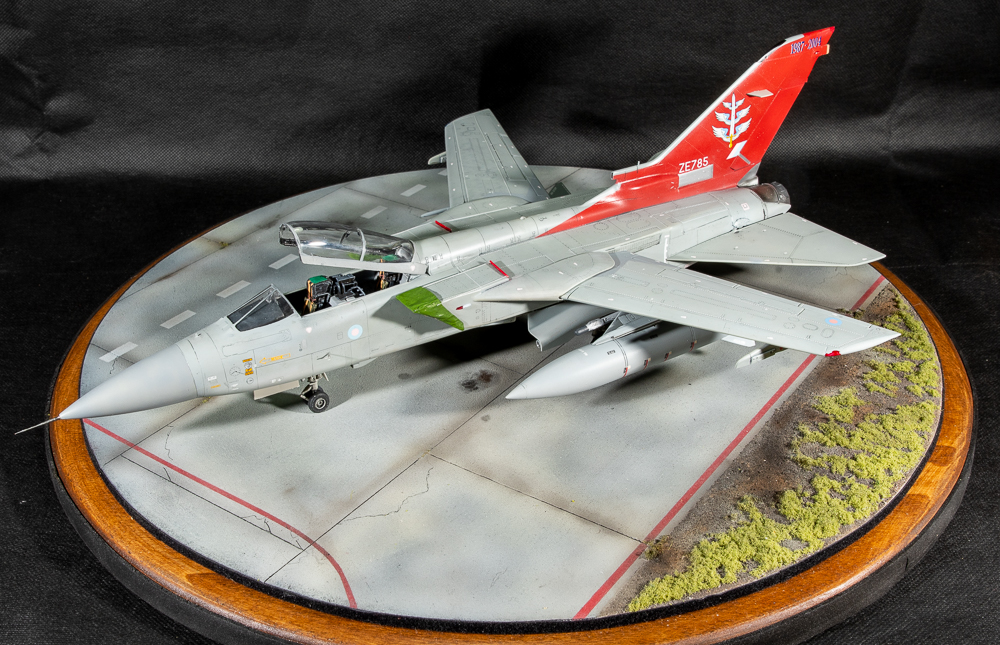
​Being the same kit, most of my notes from the first build stand.  My thought process with finishing this kit was to make it a clean build, as, with three builds now underway, getting  Tornadoed out, was a real possibility!   To this end, no stores were added, apart from the large tanks. Photos of the actual jet showed it sans stores anyway, save for tanks and a RAID pod on one of the BOL rails.

 This time the BOL rails came from Phase Resin hangar.  To better reflect RAF pylons, the sway braces were cut off and the “bulges” on both sides of the pylon had their length shortened.  Close enough for Govt. work as the saying goes.  there are plenty of photos available on the internet to aid as reference in this task.
The wings again had their cogged teeth cut off so that they could be painted separately and added later as part of final assembly.  This time I left I bit more of the “spar” with the result the wings attach far more securely, although they don’t have that classic Tornado anhedral

For this model, I wanted to add FOD covers too.  They were formed by covering the intake firstly with  household aluminium foil.  Kleenex tissue was then laid over the foil and coated in diluted white glue.  The thought process being to then slide the hardened tissue off the foil.  In reality, this didn’t work as the glue had worked too well, and stuck the tissue to the foil!
Once dry, the tissue FOD covers were trimmed to shape, and then painted.  Thin strips of tamiya tape formed the ties underneath the jet, whilst white EZline stood in for the bungee cords stretching back to the intake vent FOD guards which were formed from offcuts of red painted plastic card.  RBF flags came from an old Verlinden sheet.

As the Eduard PE wheel well set was not used on this model, the door retraction struts fitted neatly into their slots without the need to shorten them as was required on the other ADV build.
The kit decals were again used for the instruments, but this time the CMK seats were used, dressed with Eduard “steel” seatbelts which are far easier to use than their normal PE belts, being far more malleable, and less prone to the paint flaking off.

Paints used on this completion were Mr Color, another of my favourite brands, This actually being the first of my tornado builds, it was again plagued by large chunks of paint peeling off when the masking tape was removed.  This being one of the things that contributed to the build being abandoned in the first place, the painting process becoming an endless look of touch ups.
​In an effort to allow the wash to enhance more of the surface detail than the first kit, I applied the wash straight over the lacquer paints without first applying a barrier coat of gloss.  The excess was wiped away without removing any of the underlying paint.  Lacquer paints really are bulletproof!  Shock, Horror, the decals were then applied, still without a gloss coat.  No problems with silvering.  It was only after decalling that  a sealing coat of semi matt was applied.  
The Xtradecal decals behaved flawlessly, although again I used the too thick kit decals for the stencilling.  They stand out way too much on close inspection.  If you are building this kit, I would ditch the kit decals completely and use AM sheets, Xtradecal, also doing a stencilling sheet.

Since these photos were taken, I have  divided the four sky flash missiles from the first build between the two ADVs so each jet carries two skyflash.

So, how’d I go?  Well, in some ways I feel I did a better job on this one than the first ADV, although it still has plenty of flaws.  I still feel I can do better.  Anyway, here are the photos so you can judge for yourself.  Next instalment should be the third and final Revell Tornado.
​Thanks again for looking.

Panavia Tornado ADV. F3 OEU Royal Air Force RAF Waddington. May 2003

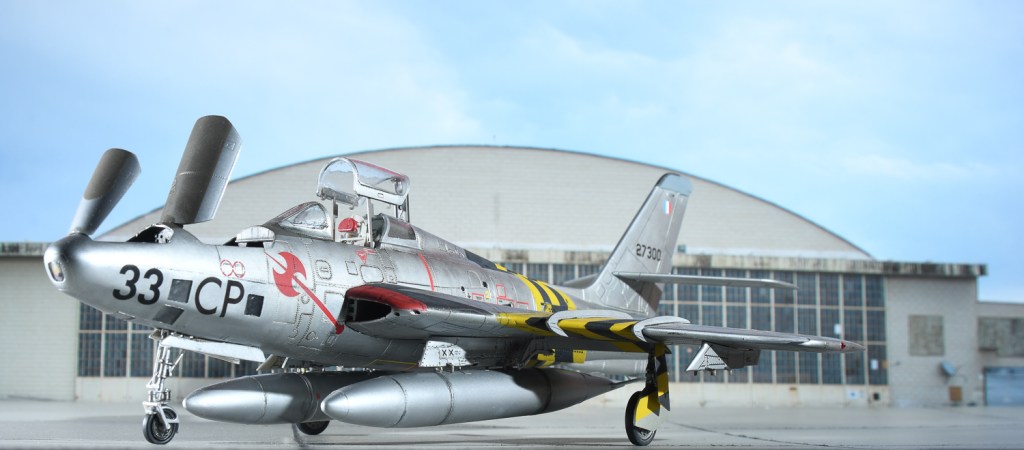
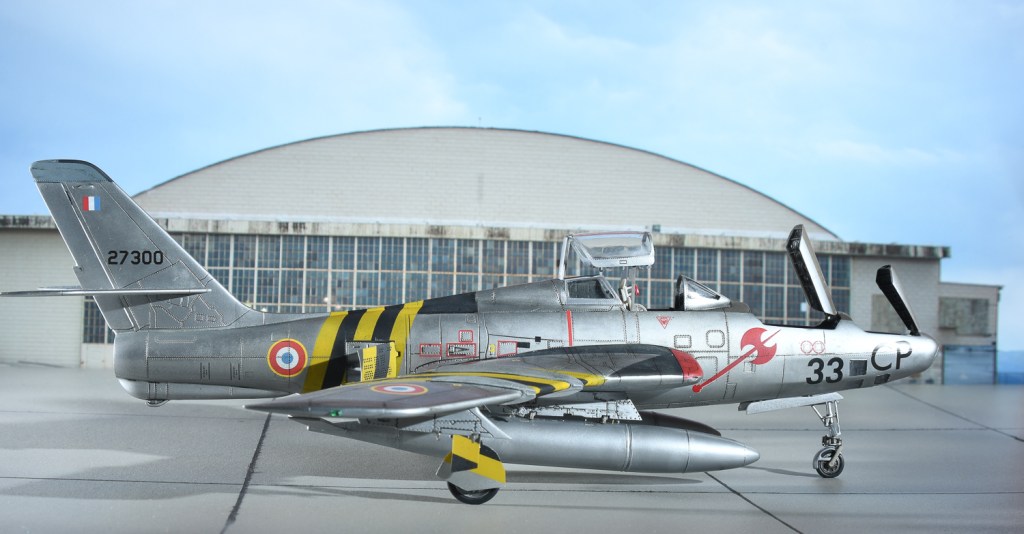
TanModel 1/48 RF-84F ThunderFlash

Built: 2019
Enhancements: CMK MB ejection seat 
Paint: AK Real Colours
Decals: OOB

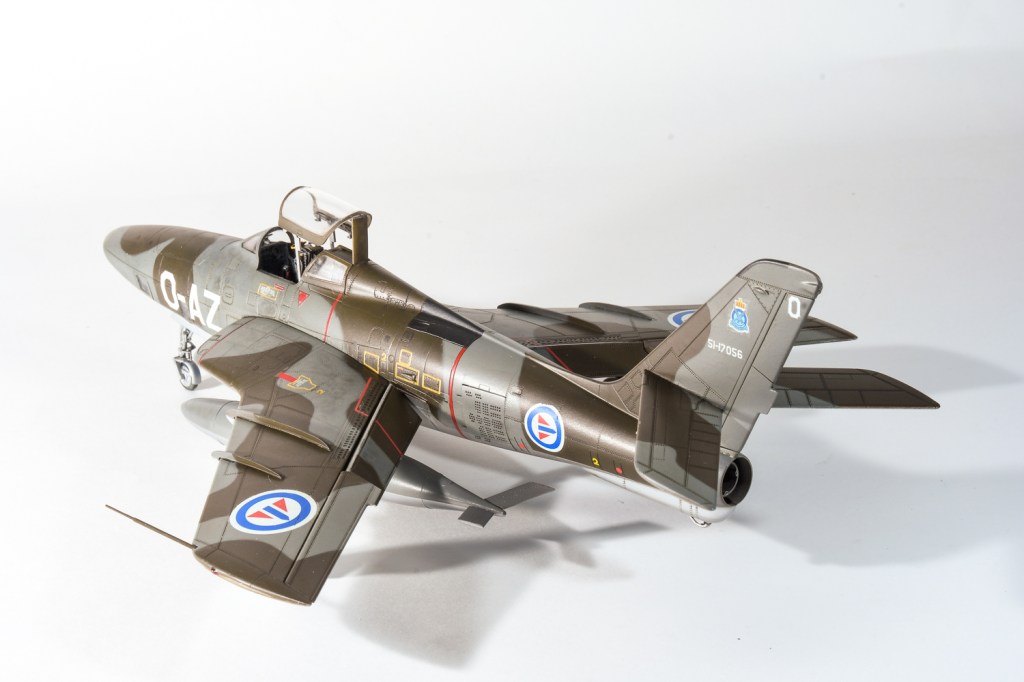
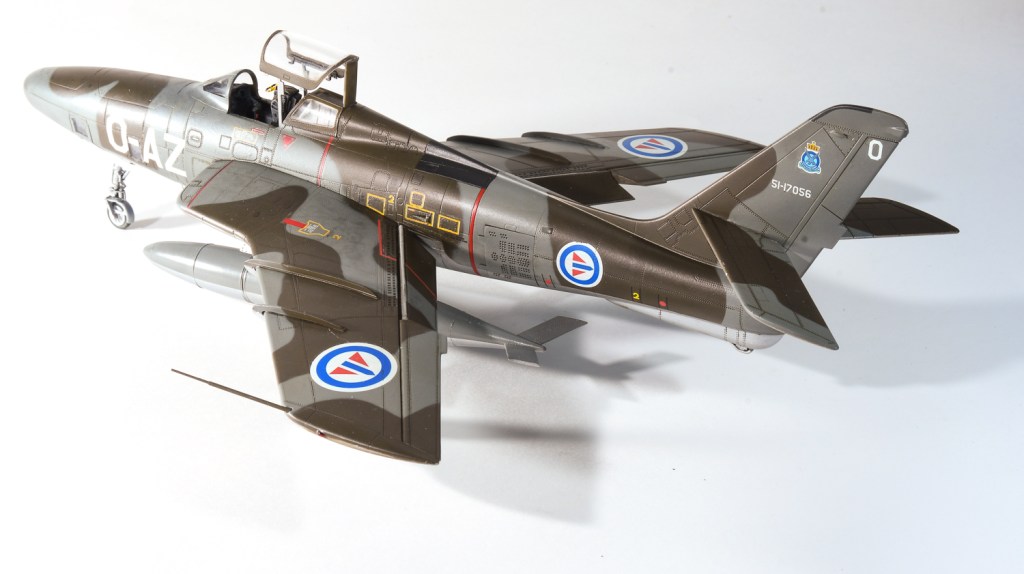
My second attempt at Tanmodels Thunderflash was borne out of my dissatisfaction at my first attempt, and I have to say, Im not really happy with the second attempt either

This example was built from the first issue of the kit, but using the second release decal sheet, as it is far superior to the initial issue in quality, anyway, although I do think the first sheet had better options. Confused yet?

This first release of the kit had very pebbled plastic, so a NMF finish was out, I decided.

;In any case, I wanted to complete a camouflaged jet so as showcase the aircrafts service life and different operators.

Assembly on this one was streamlined by keeping the nose camera covers closed.You still have to build the camera bodies, which still constitute a finicky assembly due to their near scale racks.

The rest of the jet assembled a little easier than my first attempt as well.

This time, the intakes and wings assembling without any fit issues. Aside from this, all the weak points of the other build were still encountered, the disappearing panel line and rivet detail around the bottom of the fuselage, that required rescribing, the very weak attachment points for the nose landing gear doors and the sloppy fit of the tailplanes.

The model was painted using the RAL shades by AK Real Colours, my first time using these paints.  I thought they sprayed OK, but a few modelling friends have raved about their performance, so maybe I need to revisit them. The camouflage pattern was laid out using blu tac sausages.

A gloss coat was then applied and recalling commenced. The decals on this revised sheet, as stated before are a big improvement over the first sheet, being both in register and a little thinner. Im not sure about the Norwegian roundels though as they look a bit pale when compared to photos on the web.

AKs panel line wash for grey green aircraft was then brushed on and the excess removed after an hour before a final semi matt coat was sprayed all over.

The masking from the canopy was removed and the CMK seat added as these jets, in fact, all the NATO jets – apart from the French ones – were fitted with a Martin Baker seat.

The CMK seat has excellent detail and was a drop fit.

Finally the undercarriage was added, the nose leg still being a less than sound fit and the drop tanks added, although I have failed to push one of them home against the pylon with the result the nose of it droops, and it is out of line with the other one. During the build I managed to lose one of the airbrakes (I seem to lose a part every build) 

An email to Tanmodel resulted in them sending me a replacement part without charge which was very kind of TanModel, seeing as it was my fault.

So, my second TanModel ThunderFlash and the last one I can see myself doing. 

The result, again is a model that Im far from happy with. I have seen some very nicely done examples on the net, so it can be made up into a lovely looking model. As can any kit really!

Again, my lack of satisfaction with the project and how it was progressing led me to rush it towards the finish line. In fact I sold this one off in 2021.


Republic RF-84F Royal Norwegian Air Force 717 SQN. Rygge Air Base. Norway 1956

Go back

Your message has been sent

Warning
Warning
Warning
Warning.

TanModels 1/48 RF-84 Thunderflash

  • Completed:        May 2019
  • Enhancements: Seatbelts ExtraTech
  • Wheelwells, CMK
  • Camera access Doors- CMK
  • Control Surfaces CMK 

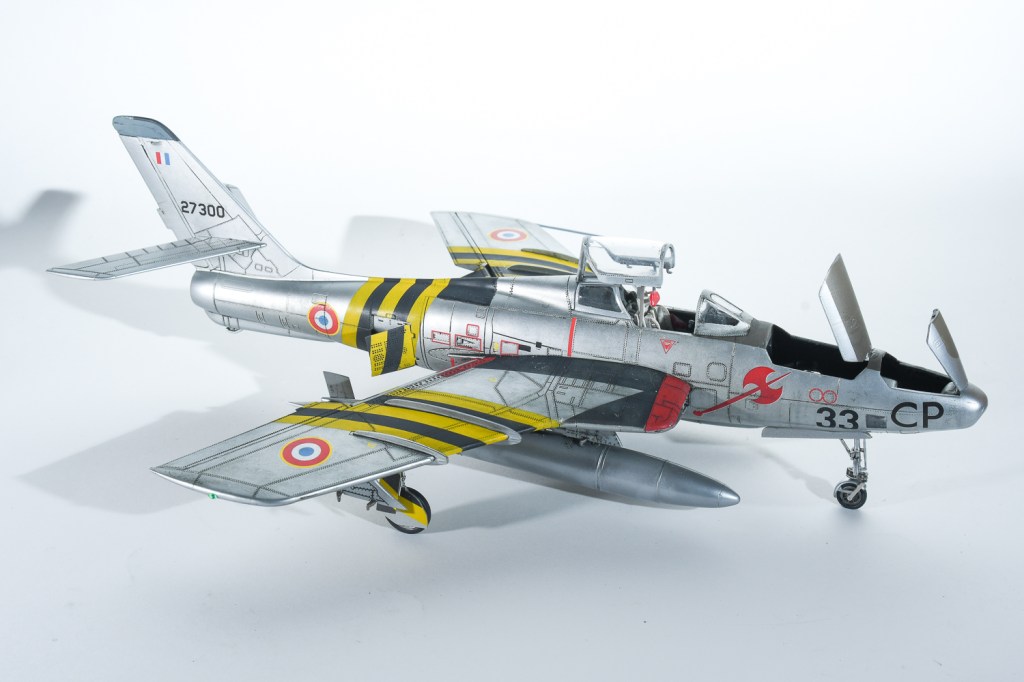
After the Trumpeter Thunderbolt, I was looking for something of a quicker build, so when my random stash pick system yielded the tanmodels Thundeflash, I was initially happy as I had been thinking about building this for a while. That initial enthusiasm quickly dissipated during the early stages of construction. Ejector pins marred the interior surfaces, the plastic parts had a pebbly texture that would require lots of polishing if I wanted to do a NMF and the surface detail almost disappeared on the underside of one fuselage half, meaning a rescribe would be in order. Coupled with this, assembling the brackets that hold the cameras proved fiddly with small in scale parts that had minimal glueing area. It fell apart on me a couple of times.  It would have gone back in the box if it were not for the reason I am trying to reduce the number of half built models on my stalled list, not add to them!  So construction carried on. The cockpit reminds me of the old monogram kits with nice relief on the side consoles that responded very well to dry brushing, same with the instrument panel. The seat had some generic US Seat belts added, painted, and was seat aside after a wash of Mig Products Dark Wash.

The kit has the option to cut out the camera access doors, and seeing as TanModels had gone to the trouble of including all the cameras, I thought I should show them off. The doors are demarcated by cut lines on the inside surfaces.  These lines are a little wide, so care is needed in cutting them out.  I used repeated scalpel passes, until they came away.  Separate doors are in the kit, but I decided to use nicer detailed ones from CMK that show the insulation on their interior surfaces. The cameras, save the nose one were left out until final assembly. Suddenly I was up to closing the fuselage halves! They fit together without problem I’m pleased to say, and a scribing tool and riveting tool was used to reinstate and deepen the underside surface detail using dymo tape as a guide. This actually went a lot better than I thought, given rescribing isn’t one of my better skills.  It wasn’t until this stage that I actually started enjoying the build! Dry fits had shown a very nice tight fit of the wing assemblies that slide into recessed areas on the fuselage without any need for filler, however with the intakes added, the fit was nowhere near as nice. I ended up dissembling the wing intake trunking and splitter plates (thanks Tamiya Super Thin Glue) and reassembled the splitter plates and trunking to the wings one piece at a time, constantly checking the fit of the wings to the fuselage.  This worked and led to the initial nice tight fit that the first dry fits had shown. I have no idea what the problem was, but can only guess the splitter plates when added to the assembled fuselage trunking caused the interference. It has to be said the internal trunking does not really fit together seamlessly. Ensure when done, that you sand the openings flush so that there are no steps that will cause the splitter plates to sit proud. Prior to gluing the wing halves together the CMK wheelwells were glued in place.  I found the plastic around the wheel bay opening needed to be thinned slightly.  I used a dremel. If its one measuring tool I have of my increasing skill, it’s the dremel. In years gone by this would have resulted in carnage and unusable wings. These days I can manage quite surgical cuts and thinning.  The CMK nose wheel was also used which is just a direct replacement for the kit part, but with greater detail. I also used CMK ailerons and flaps as I had them in the box for some reason, but there is no discernible difference in detail that I can see. I now had a complete airframe with filler only being used on the underside centre seam and a tiny bit around the windscreen panel.  Overall I found the fit excellent and my initial bad thoughts about the kit had disappeared.  Before any primer could be applied though, that pebbly texture had to go.

Republic RF-84F Thunderflash
27300 ER 4/33  Armee de l’Air RAF Akrotiri. Cyprus 1956

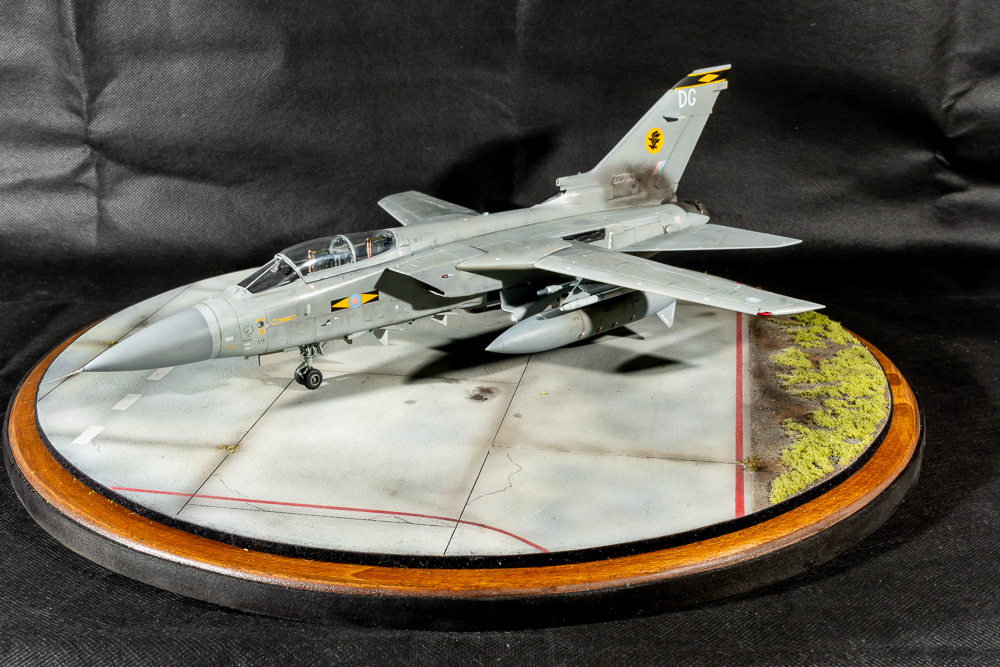
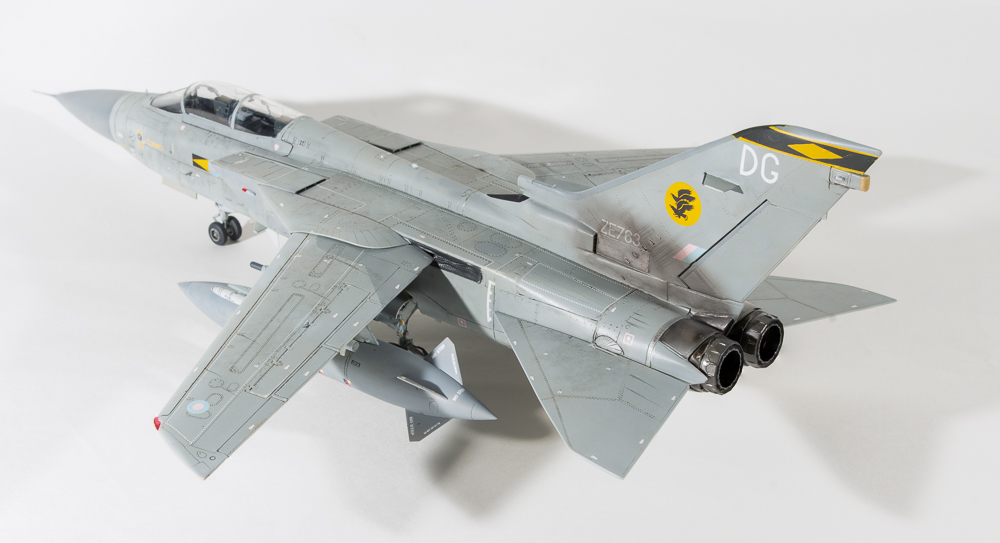
Revell 1/48 ADV Tornado F3

  • Built 2020
  • Enhancements Used 
  • Seatbelts,  Eduard
  • Wheels   Brassin
  • Wheelbays  Eduard
  • Pitot Tubes and AoA sensors  Master Barrel
  • Weapons  Brassin ASRAAM   Hasegawa Sparrows (skyflash)  BOL rails  F4Dable Models
  • Decals  Xtradecal Tornado F3 Part 1
 Like a lot of modellers, I had heard some horror stories about the fit of the Revell Tornadoes.  The consensus seemed to be whilst they were definitely a step up on what was currently available, the fit left something to be desired.  The kit seems to be one of those that polarise modellers world wide.  The truth is, like the Hasegawa Harrier, the ease of build is directly linked to how you build the tornado.
What inspired this particular build was a mate directing me to a series of youtube videos done by a fellow named Nathan Robinson.
Nathan is a member of the IPMS Tornado SIG and admits to having built six of these!  So if anyone will have the build down pat it should be him.
Deciding to take a leaf out of Jon Bryons book, all three revell tonkas – 2 ADVs and a GR4 – were pulled from  the stash to be built as a batch.
Following Nathans build sequence, I found the build progressed fairly quickly. I still needed filler around the intakes and along the fuselage sides,where it meets the bottom plate, but these were all easy joins to clean up and rescribe.
For the cockpit, the kit decals were used which sat down surprisingly well over the moulded detail and certainly looked busy enough through the closed canopy.  Note Revell call out the wrong rear instrument panel, you need part S214

I deviated from Nathans build my cutting off the cogged part of the wing so I could add them later. To be honest, Im not sure this is the best way as you lose a bit of structural integrity. Ive already so modified all three of my kits, but wish Id left one to compare the two different methods.  Maybe on my eduard Desert Babe kit!

I replaced the rather bland wing seals with some moulded by a fellow called Shaun from Britmodeller.com.  I’m not sure if they are still available as he was doing them when the kits first became available.
The decision was also made on this model to have the flaps up, to better show off the lines of the ADV.  The best way to achieve a flush fit with the wings is to cut the bar on parts B111 &113 so you are left with separate flaps.  These can then be glued  individually to the top wing ensuring they sit  flush with the upper wing.

The undercarriage assembles fairly easily, despite being moulded in two halves. Revell have form here, which means you have a seam to clean up. Part C159 and 168 placement is a little vague. Step 69 shows it the best. On gluing the PE facia to the back wall of the wheelwell, I had an alarm bell go off in my head going, “I wonder if this slot the PE covers is important” Well, Yes, it is as this is where the door retraction strut sits.  Didn’t realise this until I added them, so then had to cut the struts, in fact I replaced them with thin rod. I find this annoying on Eduard’s part. They could have easily made the back facia in two parts to be fitted either side of the slot. Its not the first time Eduard have failed to take into account the fitting of kit parts around their etch, and one of the reasons I find myself using less AM these days unless it is drop fit. Some etch placards and brake lines dress up the legs nicely, but on my other F3 I will use wire and decals instead..

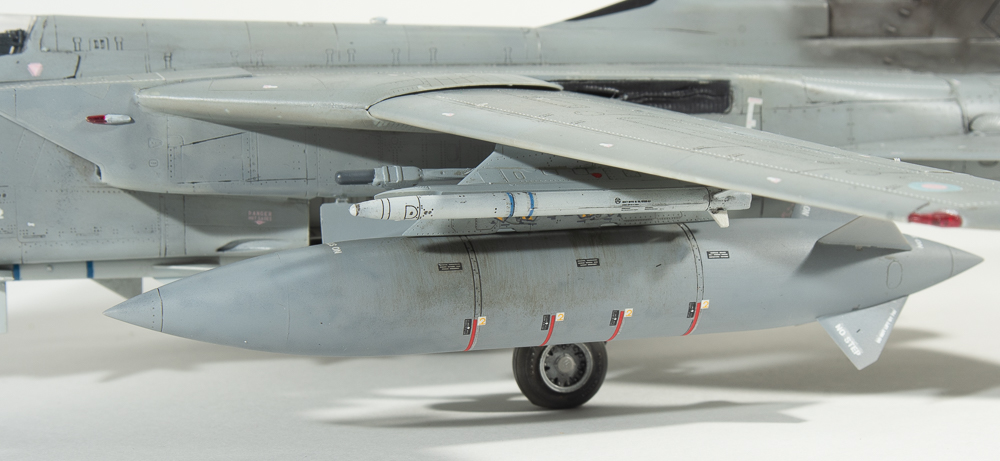
Photos of my chosen jet show it fitted with BOL rails on the inner side of the wing pylon. If like me, you didn’t know what BOL rails are, I can know tell you they are a launch rail with an inbuilt countermeasures pod. They are surprisingly hard to track down as an aftermarket item, considering quite a few jets use them.  A friend offered me his Steel Beach ones, but they looked quite a crude casting. The F4DModels were much better although warped.  Hot water straightened this out.

For the Barley Grey, I used a home grown paint SMS which performed quite well, Its marketed as ready to spray, but I still thinned mine a little. Colour looked good, but I find it strange they do not offer a Light Aircraft Grey in their range to go with the barley grey, so it was back to my go-to paint. Mr Color.
Again on this model, I had problems with the paint and primer peeling off when removing the tape. I have no idea whats causing this. The model was wiped down with tamiya thinner prior to paint, and was primed with Alclad Grey.  The consensus amongst my modelling mates was it could be the primer, which Ive had for a while, so in the bin it went.
The model was gloss coated for decals and in preparation for the wash. These days I apply the wash before the decals, despite this method, the wash failed to pick up a lot of the very fine detail, despite repeated applications, which was annoying in the extreme.
The decalling should have been easy, but again my poor build planning brought things unstuck. Literally!
The decals had all been applied when I realised I had not painted the fintop di electric panel, so as the tape would lay over the decalled fin band I religiously detacked the tamiya tape before laying it over the decal.  Of course, on pulling off the tape, the decal came with it, necessitating me having to  paint the fin band back on.  This in itself needed a lot of touching up as each time I pulled tape off, paint came away too. I really need to get to the bottom of why this is happening.
Surprisingly, my enthusiasm hadn’t waned for the model, so I pressed on, applying a satin sheen, which I then went over with dullcoate. Even with the satin, the model still looked far too glossy.  Annoyingly, all the stencils stood out as too thick as well. I had applied them in little pools of future to stop any silvering. I wont do this on my next one.

This just left final assembly of wheels, aerials, canopy mirrors and nav lights. none of which I managed to lose as is the usual case despite several of them pinging off the tweeezers.
And that was that! One down, two to go
So what do I think of the Revell Tornado? Well I think the main problem is, its Revell!  I have no problems with the breakdown of the kit, but the kit quality is poor indeed, flash, sink marks and ejector pin marks mar the parts, making assembly harder than it should be. These kits, like Airfix, are designed for the mass market, the so called “pocket money brigade” and the tooling shows it. You get what you pay for.
Despite this, if you ever release a new tool Jaguar, Revell, I’d buy it in a heartbeat.
Anything would be better than the horrid kittyhawk kit thats still sitting on my shelf of doom.

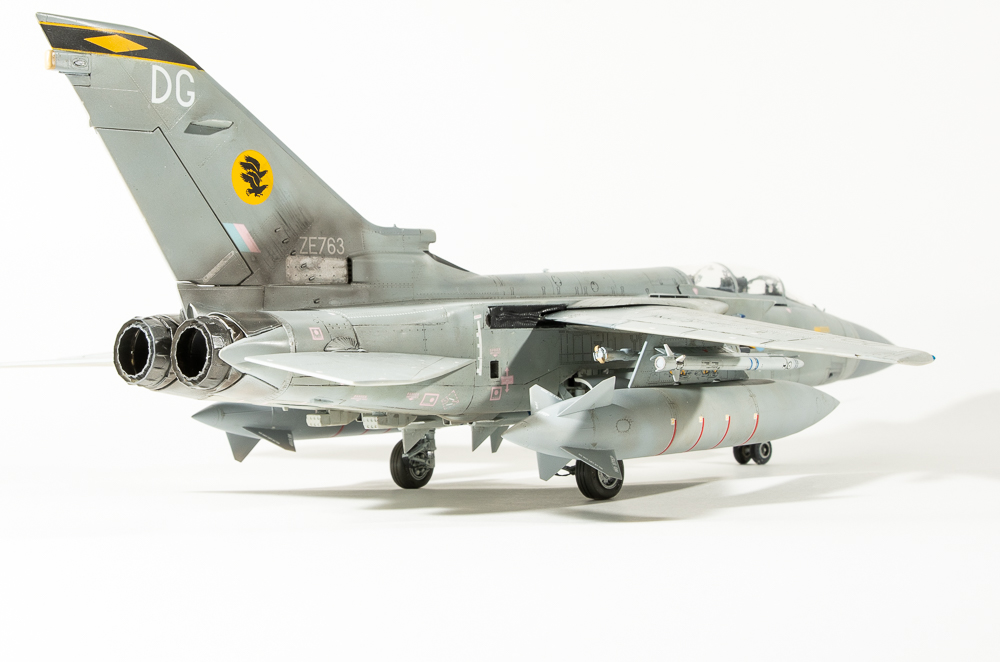
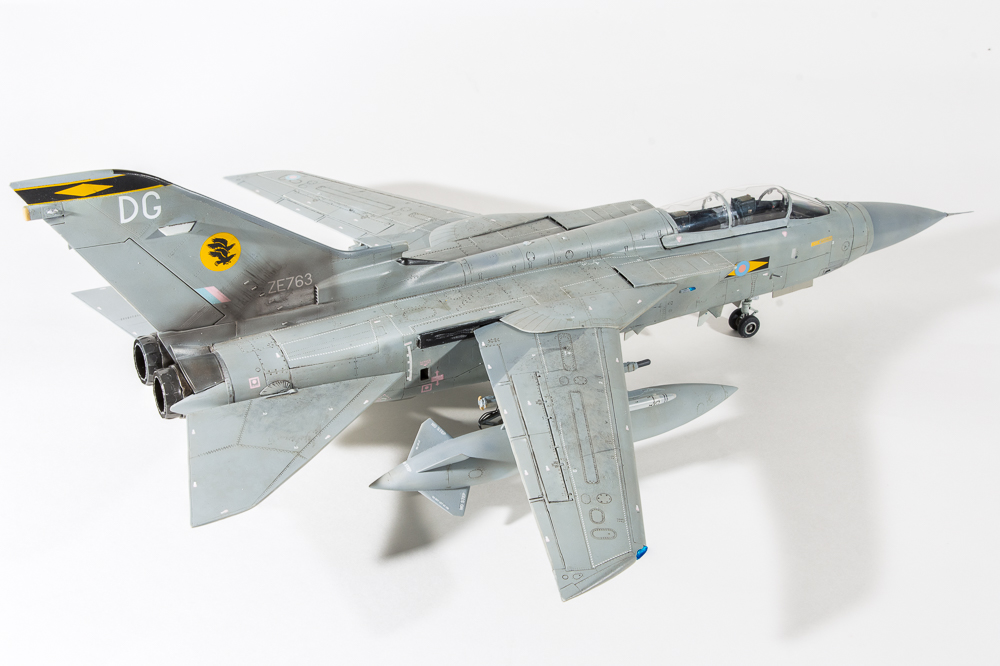
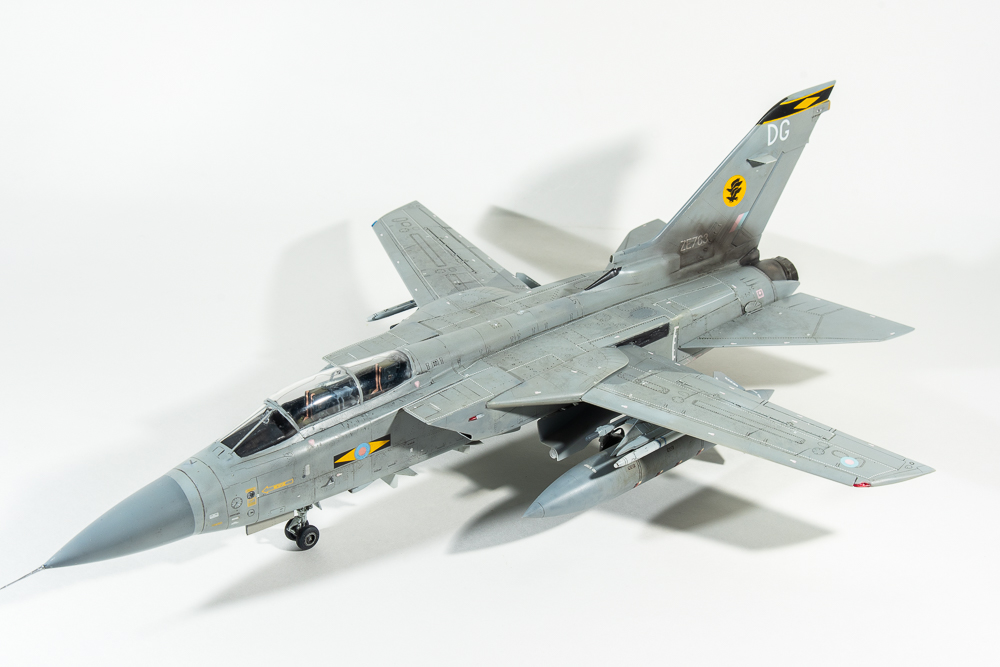
Panavia Tornado F3 ADV ZE763 11 SQN Leuchars Royal Air Force 2006

Airfix 1/48 Boulton Paul Defiant Mk1

  • Built: 2019
         Enhancements :  Eduard Interior and exterior details
  •                                    Landing Flaps: Eduard. 
  •                                    Gun barrels; Master Model
  •                                    Wheels; Barracuda Studios 
  •                                    Exhausts: Quickboost    
  •                                    Paint:  Gunze
    ​                                   Decals: Ropasmodels 
Airfix’s 1/48 Defiant, released in 2016, and purchased by myself soon after is what we have now come to expect from Airfix’s new line of kits.   Evocative box art, soft grey plastic, sharply printed decals and well illustrated  clear instructions outlining the different  ways you can complete your defiant, in flight, or wheels down, separate control surfaces, choice of open or closed canopy, this also extends to the turret, which can be modelled with the doors open, and raised or lowered turtledeck  (why are they called turtle decks?)
Neither the now obsolete Classic Airframes or Trumpeter kit offered that.

I decided that wasn’t enough for me though, so added Eduard’s flap set.  My search of defiant photos revealed a few on the ground with flaps cracked open, certainly not fully open as I have depicted, but that’s how I pictured I wanted the completed model to look.
Construction was fairly painless, fit being almost excellent.  I needed to trim the cockpit floor on one side as the wing assembly did not not quite close up snugly underneath the fuselage on one side.  The cowling also needed a bit of clamping, as again on one side I had a bit of a gap underneath the oil tank cover.  I can only surmise I had the floor slightly out of alignment.  The eduard set added the colour printed instrument panel and some side console detail plus the seat straps for pilot and gunner.  I have read some on line reviews bemoaning the simplified cockpit, to me, what you get in the box is fine, especially when dressed with the eduard PE.  The wheel wells also get a helping of PE around their walls which brings them to life.  The model built up quickly, the smallest amount of filler being needed around the tailplanes and the rear underside join of the power wings to the fuselage.  The PE flaps were folded up without difficulty (surprisingly for me) and offered up to the previously cut out kit flaps.  Some shimming was needed to spread the open areas of the rear wing to ensure the rear wall of the brass flap bay sat at the same level as the underside of the wing.  I should have taken my time a bit more here ensuring a better fit, and cutting out the slots for the flap actuators which I completely missed.
The machine gun barrels were cut off and the breeches drilled to take the sublime master Models barrels. I fit these wherever possible as they really add to the look of the model.  It would be icing on the cake if they came pre blackened!  The kit pitot tube was also replaced with Albion Alloys tubing.  Although there is nothing wrong with the kit wheels, being moulded as they are, weighted and with separate hubs, I had a set of Barracuda wheels in the box, so these were duly added.  Waste not, want not. The landing lights were not the best fit, so were fitted at this time, so they could be faired in prior to painting.

The turret popped into place without all the fuss, some other online and magazine builds report, but I was surprised to have trouble pushing the clear dome down onto the base, thinned white glue being required to fill the resultant small gap.

Painting was made easy using a set of camouflage masks from Mal Mayfield.  From the decal sheet, I had decided on an early war scheme with the black and white undersides and A type fuselage roundel to push home the early war use of this aircraft.  The decal manufacturer was new to me, I ended up using the kit roundels and codes and Ropos’  roundels looked a little bright, whilst the codes looked too pale.  The “T” was sourced from an Extradecal Medium Sea Grey RAF Codes sheet, as  With the multitude of decal sheets on the market, these generic sheets are not as probably as handy as they once were, but to me, they are still a must have in my decal bank for this very reason.  The only decals I used from were the serials and these performed fine, being quite thin.  No stencilling was applied to the underside as they would have all been overpainted when the undersides were done. AK panel line wash for brown/green aircraft was used as  a wash on the top surfaces.  Chipping was added using vallejo silver, whilst highly thinned tamely black was used for the exhaust stains.  Emboldened by watching Plasmo use his dremel to  surgically cut parts out, I set forth with my dremel to open up the kit exhausts.  30 seconds later, I was ordering quickboost  exhausts from BNA Modelworld. Rather than displaying the same skill as Plasmo, my exhausts looked like Dexter, the serial killer had gone to work on them.  You will need to cut off one of the locating tabs  in order to fit them into the airfoil slots.  Whilst you are ordering your exhausts, also order a set of landing gear covers, as the kit ones are overly thick and simplified, and do not portray the real ones very well.

Final assembly involved adding the undercarriage which fitted snugly into their respective sockets.  I was expecting a fight with the flaps and their tiny actuators, but was pleasantly surprised how easy they were to place.  In reality the actuators should fir in their respective slots, but I failed to cut out the ones on the bottom wing and clogged the flap ones with a thick coat of future I had applied to also act as a glue.  Therefore my actuators are a butt fit to wing and flap which is not correct for the real machine.
An  aerial line from EZ line  and a bit of sprue and punched plastic disc to represent the extended gunners footstep bought my first build for 2019 to a close. 

Boulton Paul Defiant Mk.1 264 SQN Royal Air Force. Biggin Hill. February 1940

Eduard 1/48 Supermarine Spitfire HFVIII

  • Date Completed:2018
  •   Aftermarket Used:  None, model built completely from box
  •   Paint Used: Xtracolour Medium Sea Grey and PRU Blue

Supermarine Spitfire HF Mk.VIII 32 SQN Foggia. Italy 1944

This model was completed as a review build for The Modelling News, so I will not put a detailed guide here as the article covers the build and finishing in depth.
http://www.themodellingnews.com/2018/08/build-guide-spitfire-mk-hf-viii-in-48th.html
http://www.themodellingnews.com/2018/08/painting-finishing-bruce-tops-off-his.html#more
  Which only leaves me to say, this really was an enjoyable build.  If you have not built one of the Eduard Spitfires, Get On it!!!