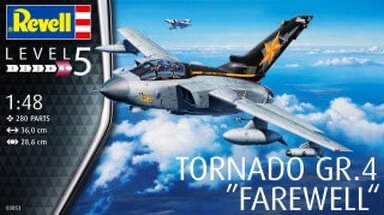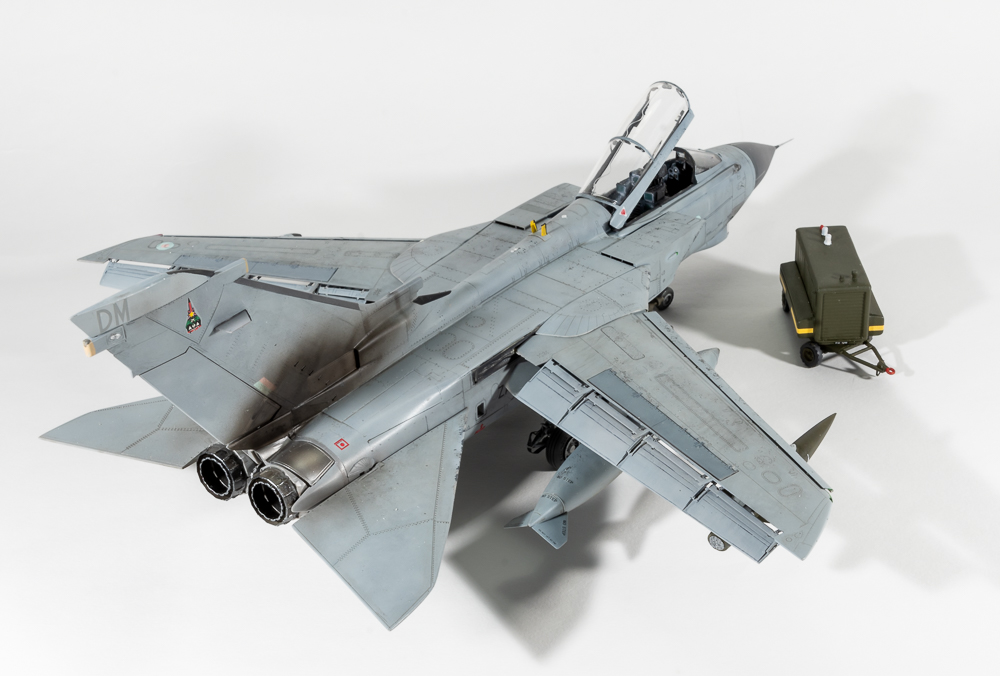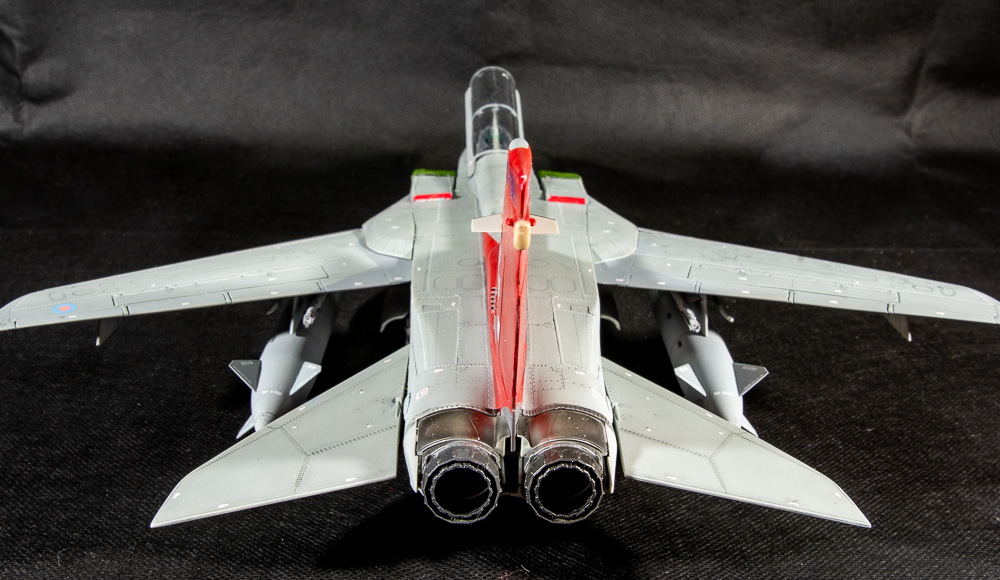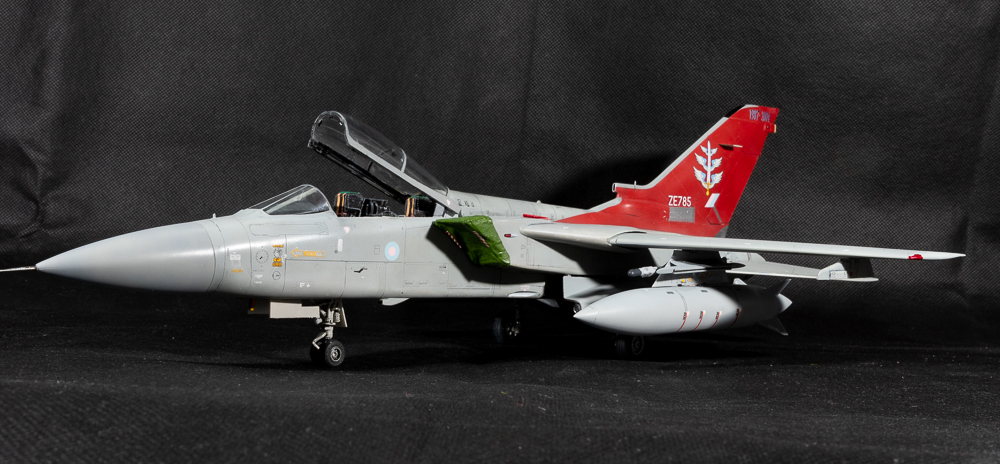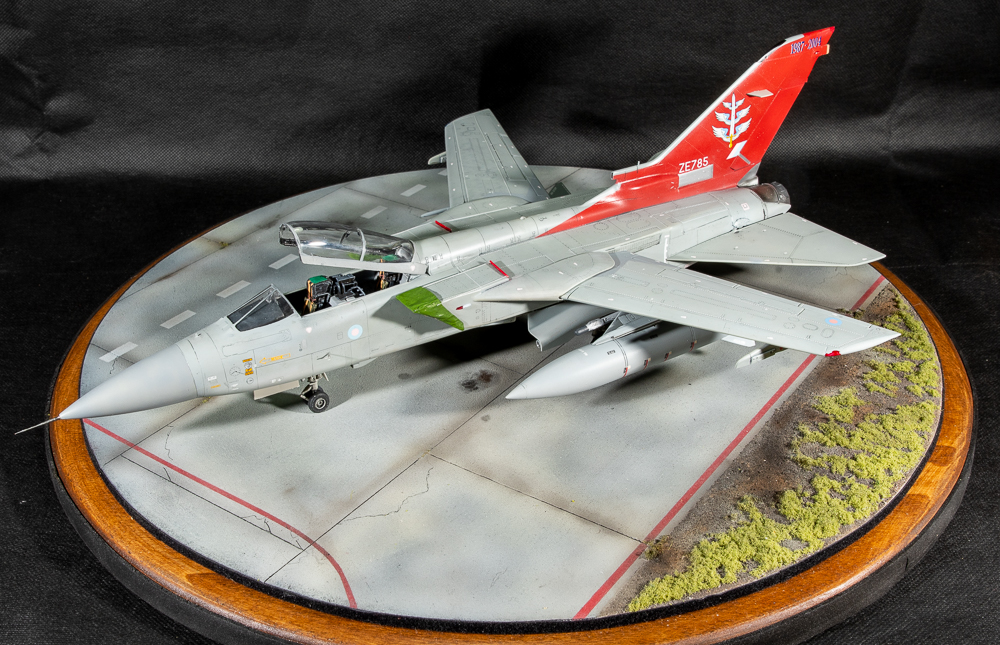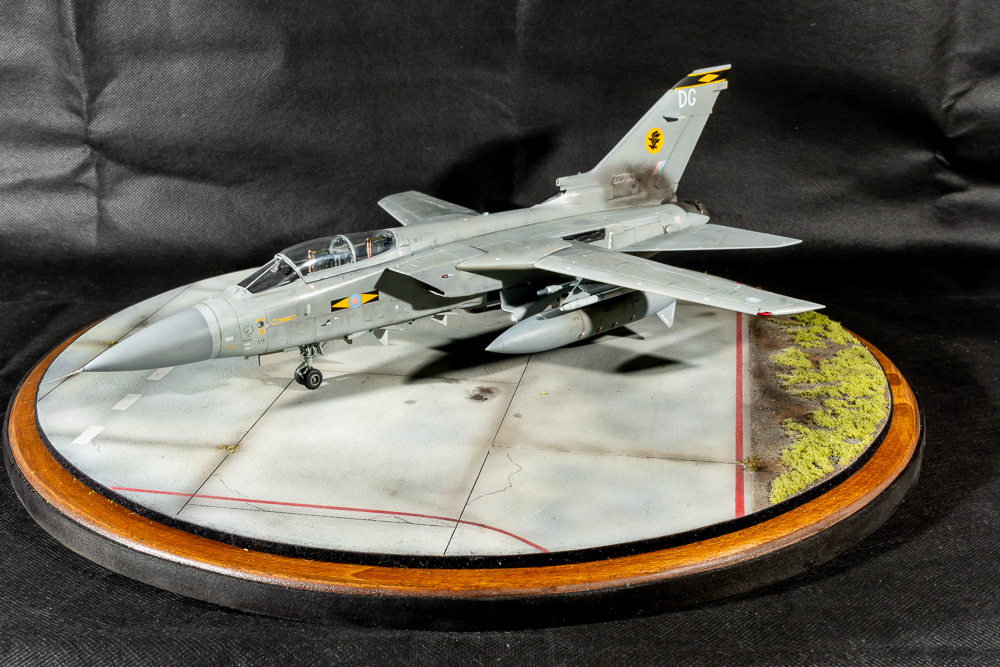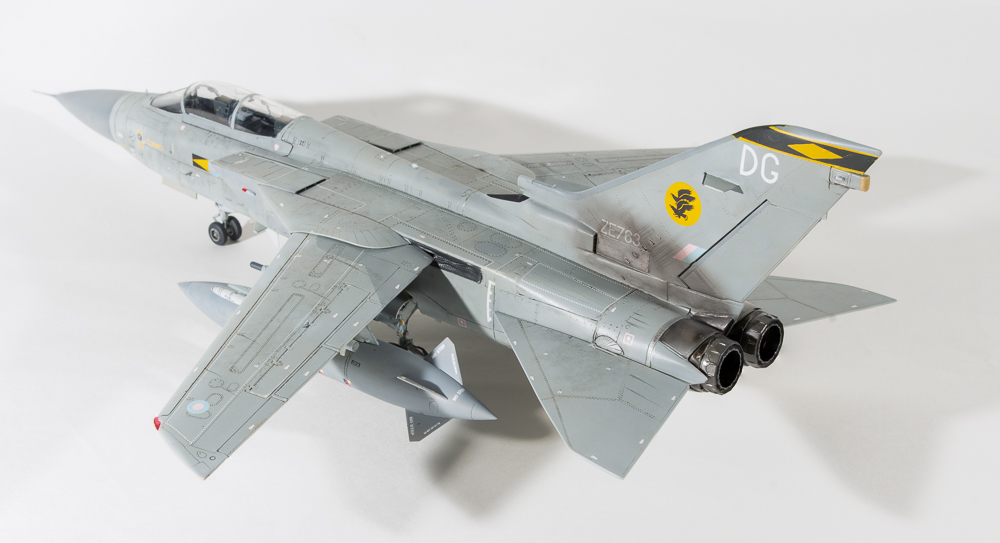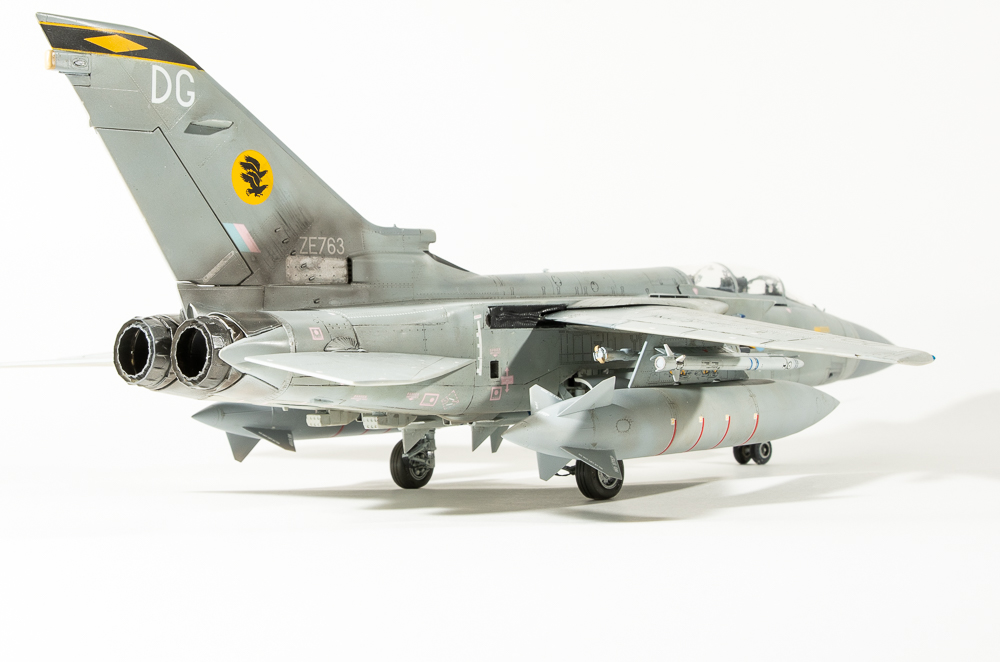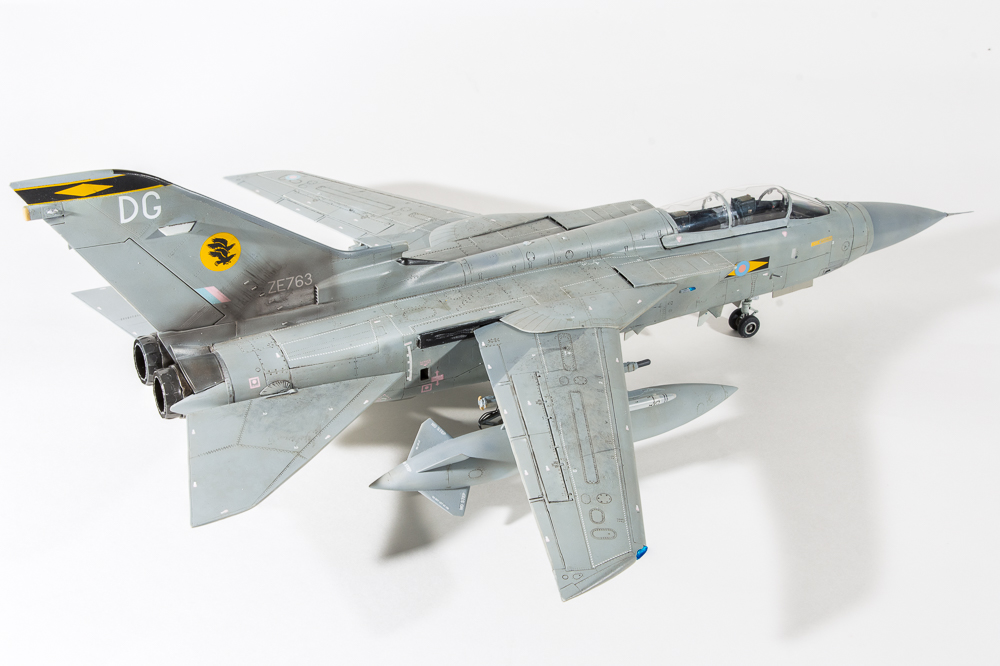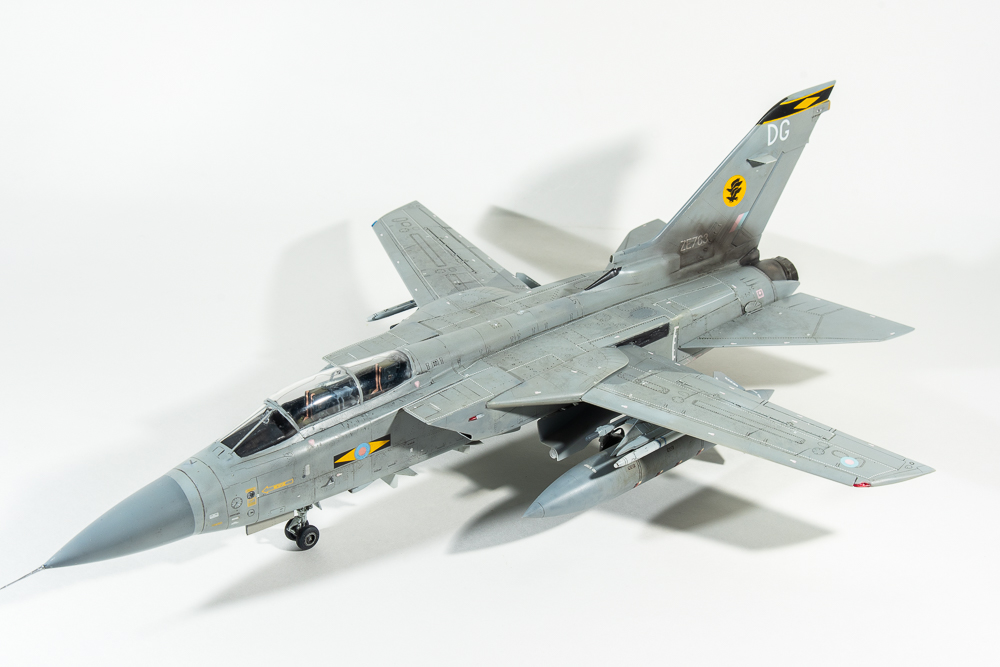
Revell 1/48 Tornado GR4

Completed:2020
Enhancements Used:  
Cockpit: Eduard
Seats: Paragon
Wheels: Brassin
Wheelwells: Eduard
Weapons: Brassin
Pitot: Master Barrel
Wing Seals: Shaun off Britmodeller
                                                                                                  Decals: Model Alliance Op Telic Part 1

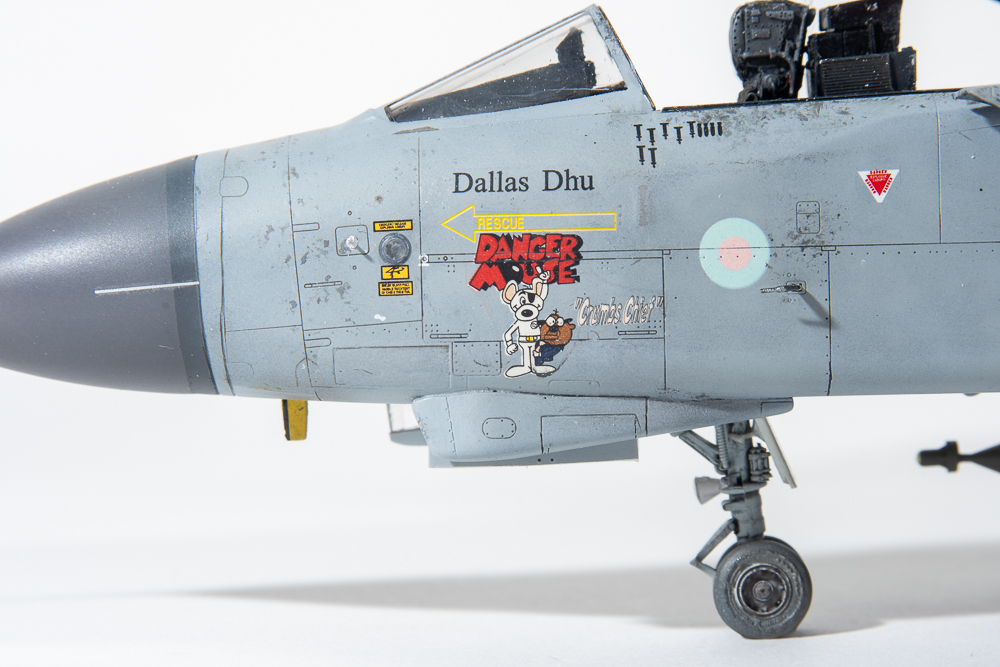
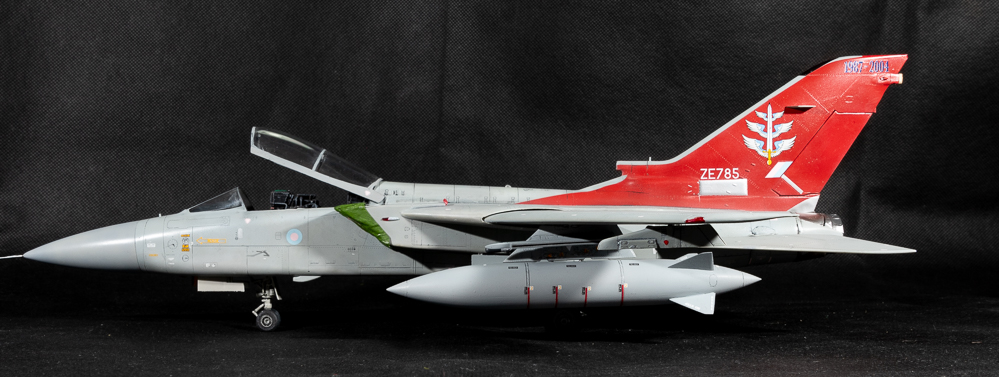
The third and final instalment!  I had wanted to build Danger Mouse from the start.  For some reason I thought it was a ADV though, not a GR4, so then had to keep on  building tornadoes until I got to my GR4.  Well that’s my excuse for building 3 Revell Tornadoes.

I had a load of aftermarket I had planned on using on this build.  Some of it got binned as not value adding to the build though.  
Firmly in this camp, I place the phase Resin Hangar seamless intakes.  For a start, I just don’t think they are needed.  Whilst the kit intakes do have a nasty seam, you can really only see the first couple of mm of the kit intake trunking, ands then only by holding the model up at a weird angle and craning your neck to look down the intakes.  If this bothers you, a bit of filler and sanding will eradicate the seam. Secondly, the case resin intakes are moulded as just the intake tunnels without the bulkheads provided as part of the kit trunking.  These bulkheads form the front and back walls of the wheel wells and provide important structural integrity.  As I was going to be using the aires resin wheels this was not a dealbreaker.  What was the dealbreaker was the resin intakes would not fit over the top of the resin wheel wells without removing a big chunk.  This  was after sanding both the roof of the wells and the outer wall of the intake wafer thin, so, the resin intakes got binned and I reverted to the kit intakes.  To be fair to Phase Resin, Mike is probably not expecting you to use his intakes in congestion with resin wheel wells.  That aside, to not cast the integral bulkheads seems strange..  My opinion. Don’t bother with the intakes.  The wheel wells however do add to the kit, beautifully detailed as are all aires sets, these even fit with a minimum of fuss.  What led to them getting junked along with the intakes was after glueing them I found I just could not get the fuselage parts to line up seamlessly as the other kits had, so they got hit with the debonder and binned as well.  Not going too well so far!  The aires wells do add a lot to the kit though, and I’m sure the fit issues were due to something I did.

The rest of the build proceeded as per the other tornado builds.  Again I cut off the wing cogs to fit them at a later stage.  Again this is another thing I would never do were I to build another tornado ( I won’t be!)

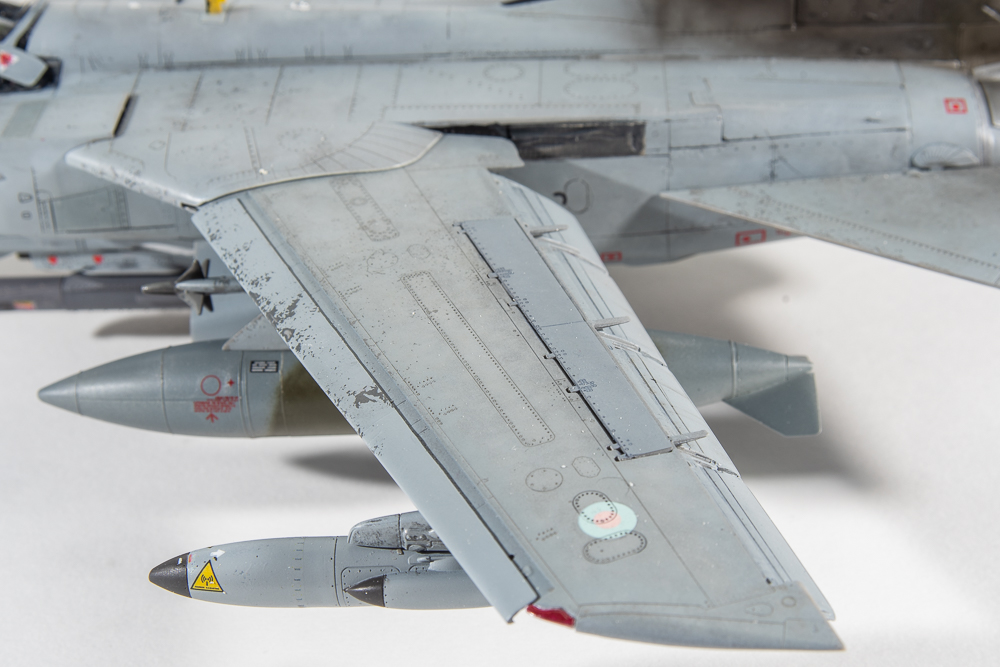
Revell would have you assemble the wing flaps as a three piece assembly whereas in real life they are one piece with only the small aerofoil section being a separate piece.  Make sure you fill and sand the join line.  Hopefully the photos explain this a bit better.  Shaun’s resin wing seals are far better representations of the real things rather than the featureless kits items.  He can be contacted through  Britmodeller.com

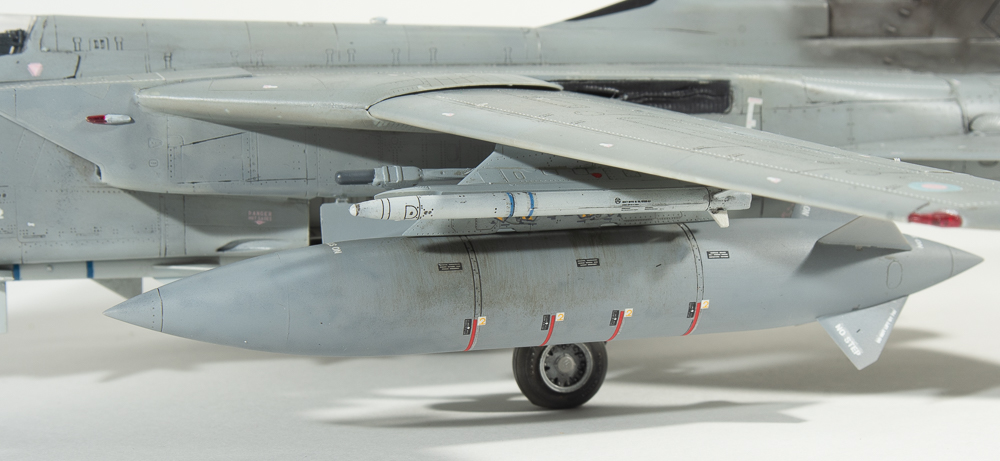
Photos I found on the net of Danger Mouse and other Operation relic jets showed a fair bit of wear and tear with scuffing and chipping of the ARTF grey paint exposing the underlying dark camouflage grey paint.  To portray this on the model. I first applied a coat of dark sea grey to the leading edge slats, nose, pylons and one of the drop tanks.  Mr Neo masking fluid was then dabbed on with a torn bit of sponge and the model sprayed with a couple of light coats of Scale Modeller’s Supply Barley Grey.  SMS is a home grown  Australian paint manufacturer.  I have been increasingly using his paints, as Im finding them excellent to spray.  You can spray them straight from the bottle, but I add a drop or two of thinner to make them spray even better.  They are a lacquer paint that has proven to be hard wearing and quick drying.  Once this paint had dried I rubbed my finger over the Neo to remove it from the airframe leaving the model looking chipped and scuffed.  The jet was made to further look worn by painting a few panels in either dark sea grey or lightened shades of the barley grey. One of the fuel tanks was painted in the old wrap around scheme, jets being fitted with different coloured tanks being quite common, even today.

I applied a panel wash with Payne’s grey oil paint straight over the SMS paint, with the excess wiped off and no damage to the underlying paint.  The decals were also placed straight over the paint, which dries with a sheen, the model Alliance decals performing well, although the DM code letters were too light and did not stand out enough when compared to photos of the real jet.  As I could not find any dark grey or black letters of the correct size to replace them, so had to resort to painting the fin top a lighter grey.  I replaced the letters with other codes from the same sheet.  Penfold’s catch cry “Crumbs Chief” should also be far pinker than the pale shade on the sheet, maybe it faded!  Op Telic jets do not seem to have been as well photographed as Op Granby jets, well so it seemed to me with good quality photos being hard to source. In particular I wanted to know if these jets wore the full suite of stencils after they were repainted.  In the end I went with just the major ones figuring only those stencils that dealt with rescue or crash procedures would have been re applied.

With this model I decided to really strengthen the pylon to wing attachment by using epoxy glue.  They ain’t coming apart now, although perhaps I should have ensured they were parallel to the centre line first!

With that Danger Mouse was done.  One of my favourite cartoon characters as a child.  There are still a few build and finish faults, but this is my favourite of the three.  I love the pugnacious look of the short nose coupled with the laser sensors.  The Eduard Brassin weapons are also a must have, being better detailed and more accurate than the kit supplied weapons.  Out of the box, you can arm a Operation Granby or Operation Telic jet.  Even the stenciling is provided.

So with three Revell Tornadoes done, what are my thoughts?  Well, let me start by saying I sold my remaining Revell tornado from the stash, as to build more would be just like beating yourself over the head repeatedly using a hammer.  I think you would really have to love Tornadoes to build multiples of the Revell kit.  Marred by soft detail in a lot of places, sink marks, flash, it can be  a troublesome build in inexperienced hands.  Take the time to research other on line builds and the previously linked youtube videos as fit problems can be mitigated if the builder departs from Revells suggested build sequence.  I really cant see anyone else aside from Airfix releasing a newer tooled Tornado, so Im thinking the revell is going to be the go-to in 48 scale for quite some time.  I might just order that new 32 scale Italeri tornado, as the Tornado itch still needs to be scratched with a wrap around GR1.

 Tornado GR4 ZA542 31SQN Royal Air Force. Combat Air Wing Ali Al Salem Op. Telic 2003


Revell 1/48 ADV Torando F3

Enhancements Used
Seats: CMK 
Seatbelts: Eduard steel
Wheels: Eduard
Pitot Tube: master barrels
Decals: Xtradecals Tornado F3 part 1
BOL Rails: Phase Resin Hangar

Construction Notes
 Oh God, what was I thinking, building three of these at the one time?.  In last months gripping episode you will recall that I (rashly) decided to build all three of my tornadoes from the stash at the same time.
​Well the plan didn’t quite start out like that.  This tornado was actually the first started, and the original plan was to just build this one,  however, it was not really turning out as I had pictured in my mind, – a common theme with my builds –  so it got shelved, and my other F3 pulled out of the stash, and started with the intent of being a better build (yeah, right!).  It was at this stage the idea to build all the tornadoes in my stash was born.  In actual fact, I thought I would  only be  building the other ADV  and my GR4.  
It  was only when the other ADV was almost finished, this one was revisited, and the decision made to complete it.

​Being the same kit, most of my notes from the first build stand.  My thought process with finishing this kit was to make it a clean build, as, with three builds now underway, getting  Tornadoed out, was a real possibility!   To this end, no stores were added, apart from the large tanks. Photos of the actual jet showed it sans stores anyway, save for tanks and a RAID pod on one of the BOL rails.

 This time the BOL rails came from Phase Resin hangar.  To better reflect RAF pylons, the sway braces were cut off and the “bulges” on both sides of the pylon had their length shortened.  Close enough for Govt. work as the saying goes.  there are plenty of photos available on the internet to aid as reference in this task.
The wings again had their cogged teeth cut off so that they could be painted separately and added later as part of final assembly.  This time I left I bit more of the “spar” with the result the wings attach far more securely, although they don’t have that classic Tornado anhedral

For this model, I wanted to add FOD covers too.  They were formed by covering the intake firstly with  household aluminium foil.  Kleenex tissue was then laid over the foil and coated in diluted white glue.  The thought process being to then slide the hardened tissue off the foil.  In reality, this didn’t work as the glue had worked too well, and stuck the tissue to the foil!
Once dry, the tissue FOD covers were trimmed to shape, and then painted.  Thin strips of tamiya tape formed the ties underneath the jet, whilst white EZline stood in for the bungee cords stretching back to the intake vent FOD guards which were formed from offcuts of red painted plastic card.  RBF flags came from an old Verlinden sheet.

As the Eduard PE wheel well set was not used on this model, the door retraction struts fitted neatly into their slots without the need to shorten them as was required on the other ADV build.
The kit decals were again used for the instruments, but this time the CMK seats were used, dressed with Eduard “steel” seatbelts which are far easier to use than their normal PE belts, being far more malleable, and less prone to the paint flaking off.

Paints used on this completion were Mr Color, another of my favourite brands, This actually being the first of my tornado builds, it was again plagued by large chunks of paint peeling off when the masking tape was removed.  This being one of the things that contributed to the build being abandoned in the first place, the painting process becoming an endless look of touch ups.
​In an effort to allow the wash to enhance more of the surface detail than the first kit, I applied the wash straight over the lacquer paints without first applying a barrier coat of gloss.  The excess was wiped away without removing any of the underlying paint.  Lacquer paints really are bulletproof!  Shock, Horror, the decals were then applied, still without a gloss coat.  No problems with silvering.  It was only after decalling that  a sealing coat of semi matt was applied.  
The Xtradecal decals behaved flawlessly, although again I used the too thick kit decals for the stencilling.  They stand out way too much on close inspection.  If you are building this kit, I would ditch the kit decals completely and use AM sheets, Xtradecal, also doing a stencilling sheet.

Since these photos were taken, I have  divided the four sky flash missiles from the first build between the two ADVs so each jet carries two skyflash.

So, how’d I go?  Well, in some ways I feel I did a better job on this one than the first ADV, although it still has plenty of flaws.  I still feel I can do better.  Anyway, here are the photos so you can judge for yourself.  Next instalment should be the third and final Revell Tornado.
​Thanks again for looking.

Panavia Tornado ADV. F3 OEU Royal Air Force RAF Waddington. May 2003

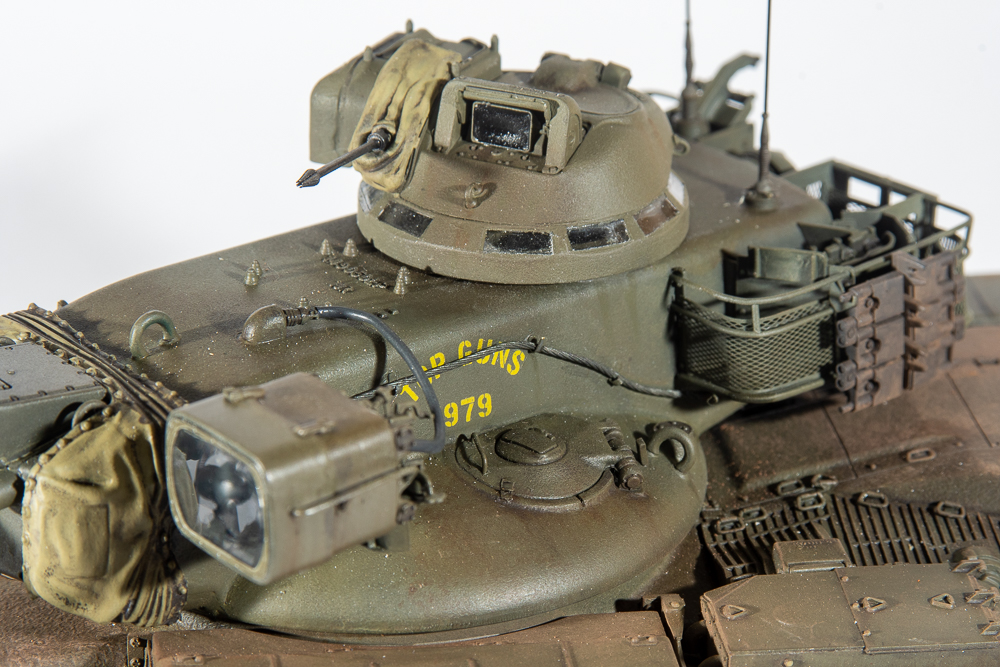
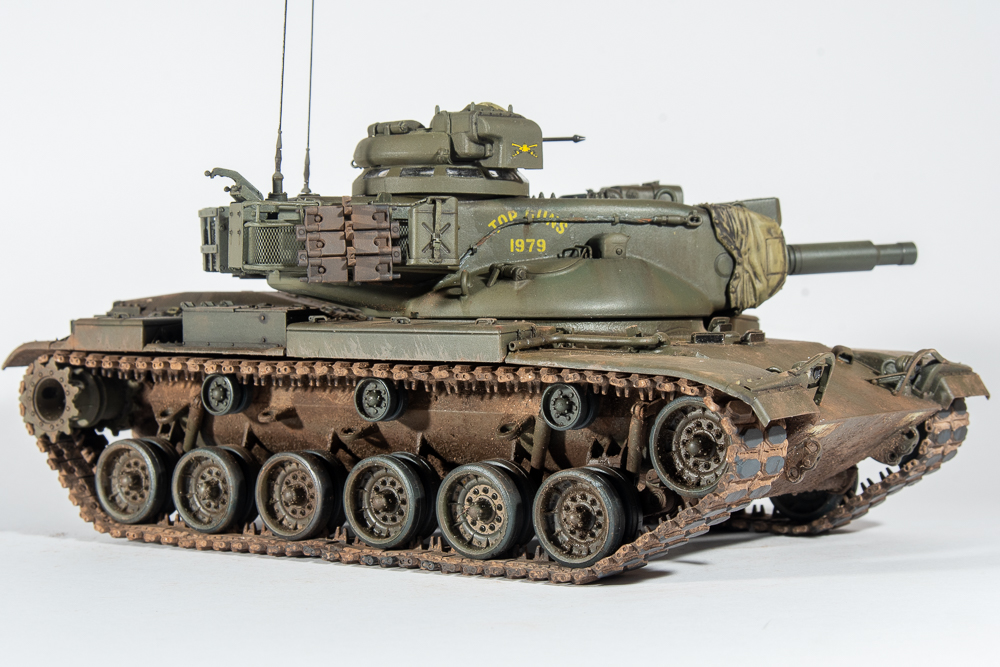
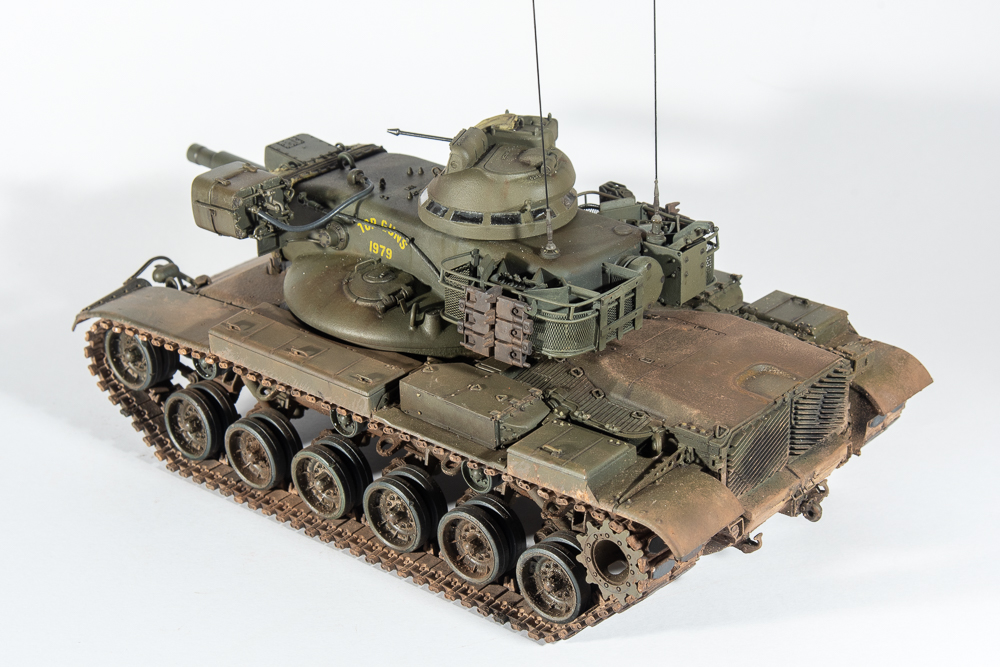
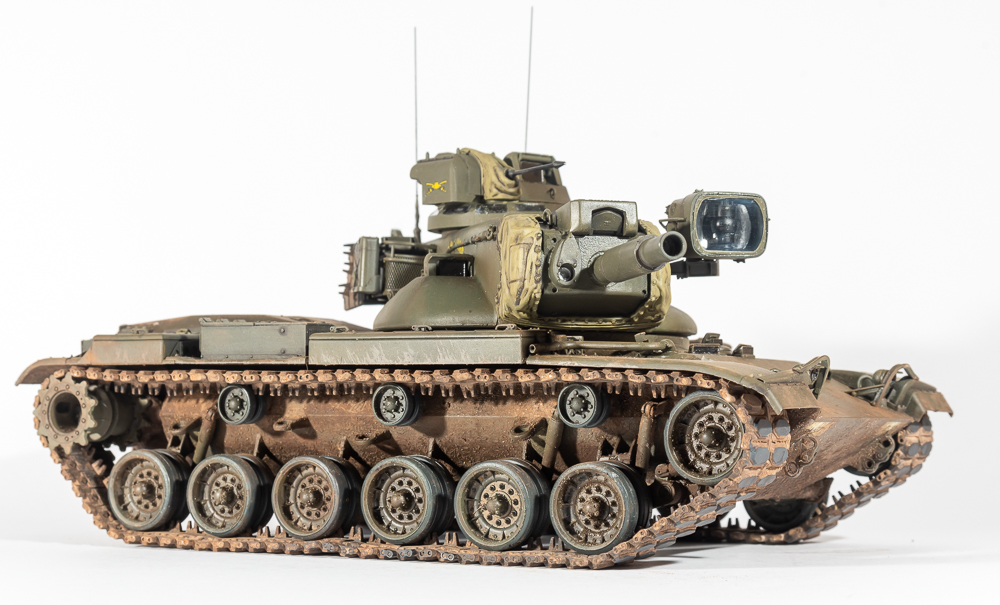
AFV Club 1/35 M60A2

  • Purchased:  2020
    Built:             2020
    Enhancements:  Tracks: AFV Club                              
                                  MG Barrel:    Master barrel                          Headlights: SKP Model                                               
    Antenna bases: Voyager  ​
The AFV Club (AFVC) M60 was one of those kits I didn’t realise I needed until it was offered to me by a friend!  Thanks Norm.
 I’ve always loved these cold war tanks, the M60A2 having a  rather uniquely shaped turret which added to the appeal.
 Reviews on line painted a rather good picture of AFV Club’s kit too, although its not a kit I’ve seen built often.

The AFV Club kit is moulded in an olive drab plastic, the many sprues filling the box to the brim.  An aluminium main gun barrel, PE mesh and detail parts, string tow cables,  clear parts for the periscopes also round out the package.  Tracks are of the rubber band variety, the main gun and machine gun dust covers are  provided in a vinyl type material.  The armour version of an Eduard Profipack kit, although this seems to be a standard of all AFV Club kits.

Once construction is commenced though, you realise a lot of the parts are not needed as they apply to other variants of the M60 family.  Although AFVC also offer a late type M60A2, I imagine you could also build one from this boxing as they include the later type wheels and air intakes.  You might  need different tracks.

The build seemed to go on for ever, mainly due to having to clean up a faint mould seam on all parts, which started to become tedious, especially on the small parts and certainly took away some of the enjoyment.
I ended up breaking some of the turret basket rails whilst doing this so  replaced  the broken parts with brass and plastic rod.  I not sure I got it all square though.
A Master Details brass barrel replaced the plastic M85 barrel provided by AFVC, and I replaced the kit provided tow cables with some copper ones I found in my spares box, and she was  ready for painting.


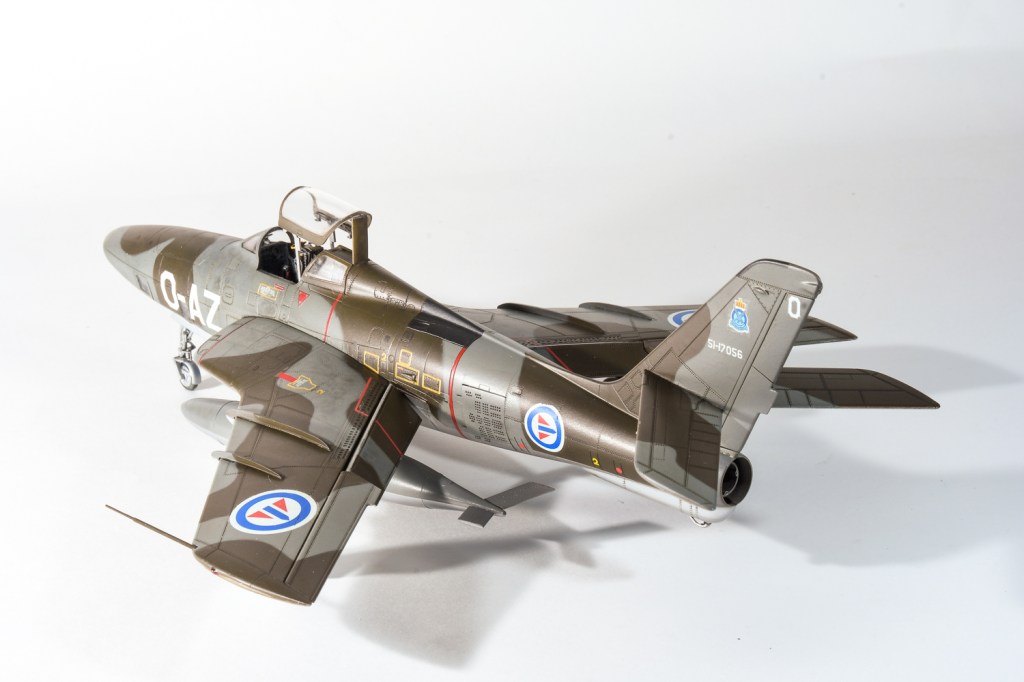
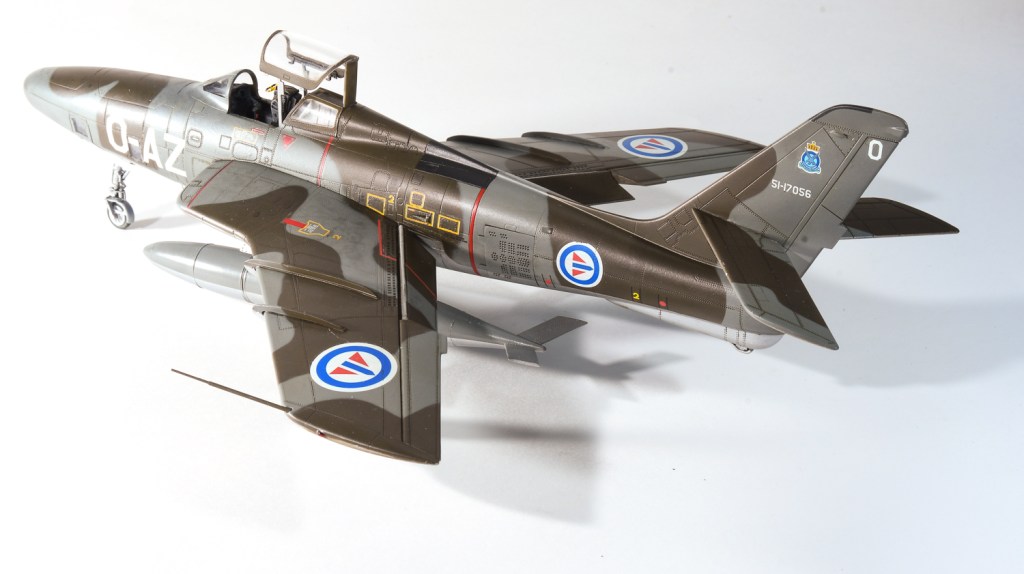
TanModel 1/48 RF-84F ThunderFlash

Built: 2019
Enhancements: CMK MB ejection seat 
Paint: AK Real Colours
Decals: OOB

My second attempt at Tanmodels Thunderflash was borne out of my dissatisfaction at my first attempt, and I have to say, Im not really happy with the second attempt either

This example was built from the first issue of the kit, but using the second release decal sheet, as it is far superior to the initial issue in quality, anyway, although I do think the first sheet had better options. Confused yet?

This first release of the kit had very pebbled plastic, so a NMF finish was out, I decided.

;In any case, I wanted to complete a camouflaged jet so as showcase the aircrafts service life and different operators.

Assembly on this one was streamlined by keeping the nose camera covers closed.You still have to build the camera bodies, which still constitute a finicky assembly due to their near scale racks.

The rest of the jet assembled a little easier than my first attempt as well.

This time, the intakes and wings assembling without any fit issues. Aside from this, all the weak points of the other build were still encountered, the disappearing panel line and rivet detail around the bottom of the fuselage, that required rescribing, the very weak attachment points for the nose landing gear doors and the sloppy fit of the tailplanes.

The model was painted using the RAL shades by AK Real Colours, my first time using these paints.  I thought they sprayed OK, but a few modelling friends have raved about their performance, so maybe I need to revisit them. The camouflage pattern was laid out using blu tac sausages.

A gloss coat was then applied and recalling commenced. The decals on this revised sheet, as stated before are a big improvement over the first sheet, being both in register and a little thinner. Im not sure about the Norwegian roundels though as they look a bit pale when compared to photos on the web.

AKs panel line wash for grey green aircraft was then brushed on and the excess removed after an hour before a final semi matt coat was sprayed all over.

The masking from the canopy was removed and the CMK seat added as these jets, in fact, all the NATO jets – apart from the French ones – were fitted with a Martin Baker seat.

The CMK seat has excellent detail and was a drop fit.

Finally the undercarriage was added, the nose leg still being a less than sound fit and the drop tanks added, although I have failed to push one of them home against the pylon with the result the nose of it droops, and it is out of line with the other one. During the build I managed to lose one of the airbrakes (I seem to lose a part every build) 

An email to Tanmodel resulted in them sending me a replacement part without charge which was very kind of TanModel, seeing as it was my fault.

So, my second TanModel ThunderFlash and the last one I can see myself doing. 

The result, again is a model that Im far from happy with. I have seen some very nicely done examples on the net, so it can be made up into a lovely looking model. As can any kit really!

Again, my lack of satisfaction with the project and how it was progressing led me to rush it towards the finish line. In fact I sold this one off in 2021.


Republic RF-84F Royal Norwegian Air Force 717 SQN. Rygge Air Base. Norway 1956

Go back

Your message has been sent

Warning
Warning
Warning
Warning.

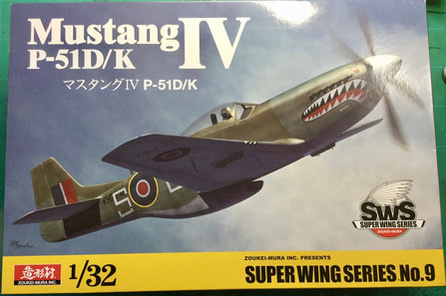
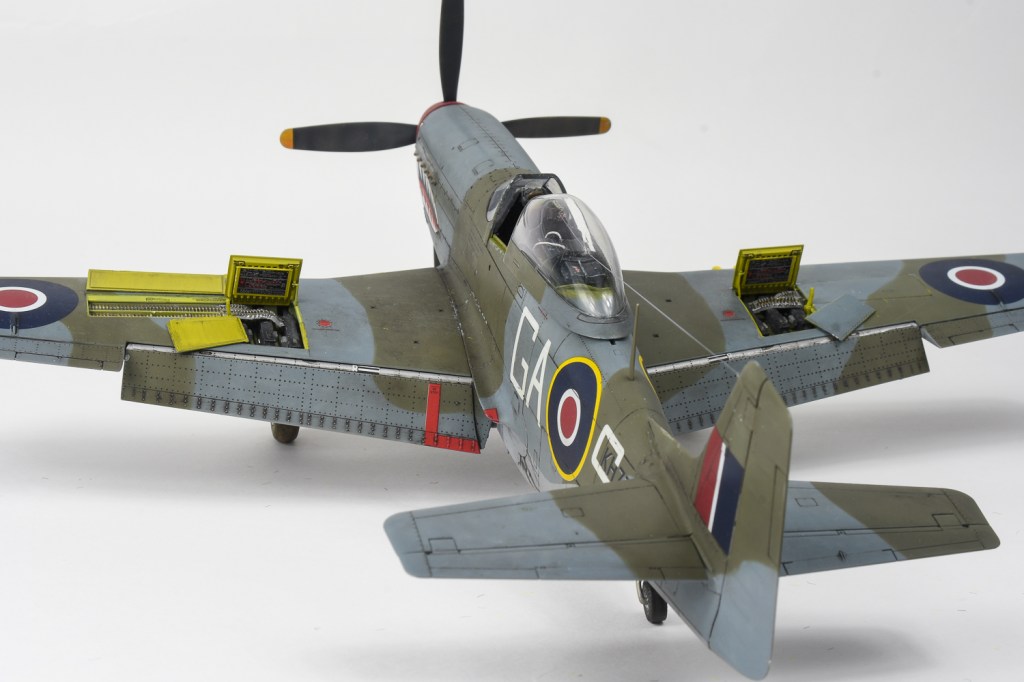
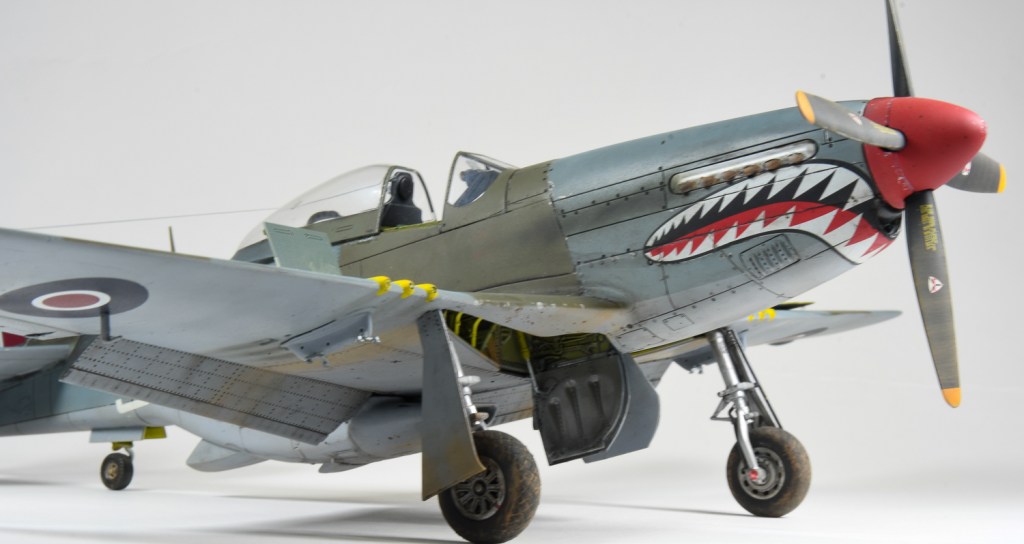
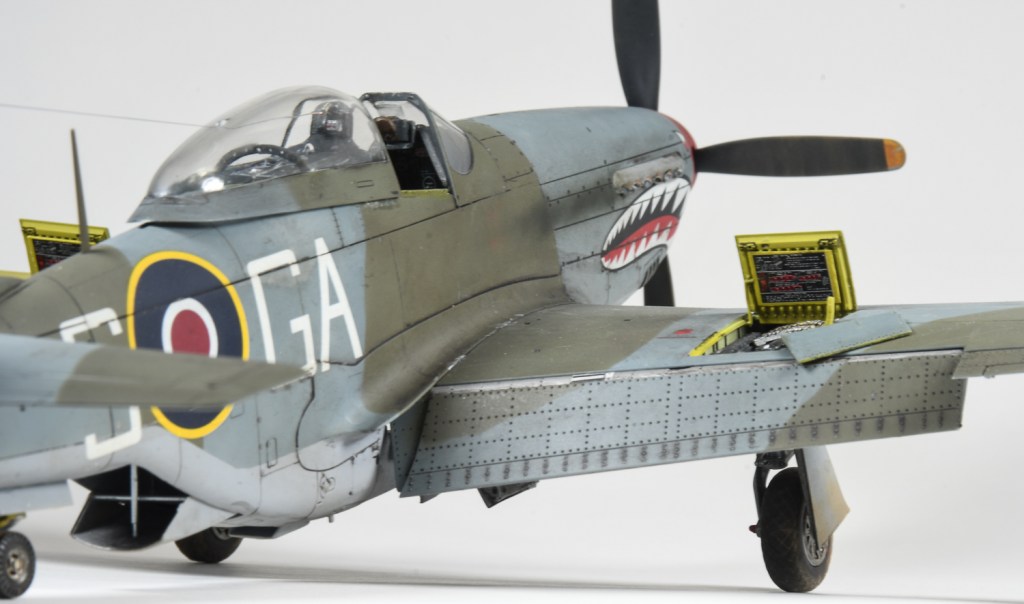
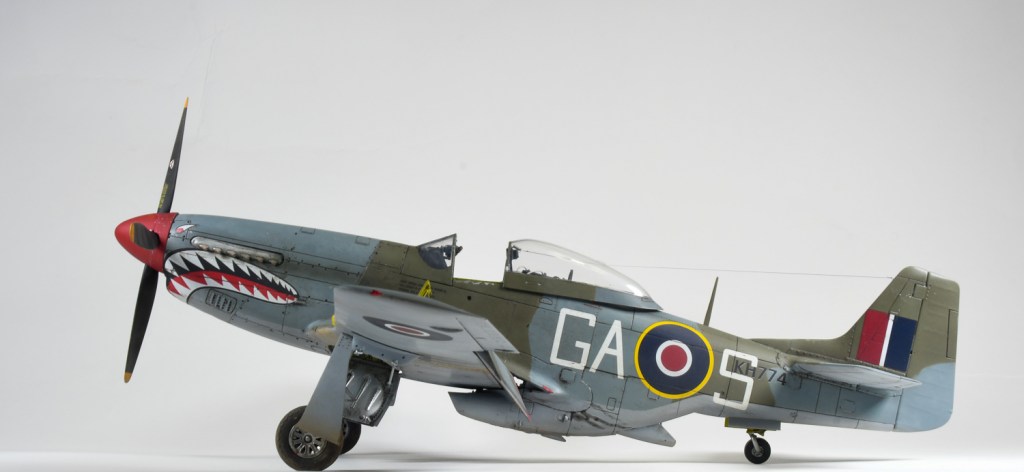
Zukei-Mura 1/32 N.A.A P-51K Mustang IV

  • Purchased   2019
  •      Built             2019
  •  Enhancements:  Seatbelts:  HGW 
  •         Paint   MR Paint
  •         Decals   Kit scheme
Build Notes:
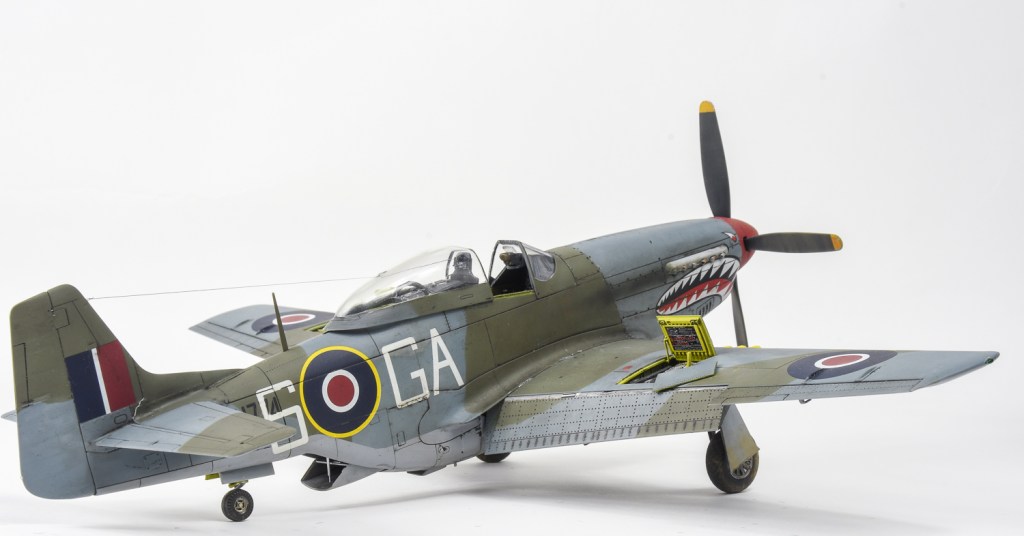
The inspiration for this model came from seeing a 48 scale kit completed in these markings on the Britmodeller.com forum. Instantly, I wanted to build it, however, in 32 scale, rather than 48 scale, as I feel these single engine fighters have more presence in this scale.

I knew Zoukei Mura had produced a boxing of their Mustang in these markings, so the kit was duly purchased, and promptly started, as BM were running a “shark mouth” theme Group build. Talk about the planets aligning
​We all start our impulse purchases right after buying them, Right!  Actually this would be one of the very few kits I have started straight after buying it, strangely all the previous one have been Airfix kits being the Walrus and Defiant
​ The build log can be viewed here although I did not finish the kit by the deadline.


​This was my first ZM kit, and I have to say, I thoroughly enjoyed it.  They do not build up like your usual kit.  The design philosophy being the makers want you to build the model similar to how the real aircraft was assembled.  A very Japanese thing.
Many people dont seem to like the complexity of these kits, but like the trumpeter kits, a lot of the innards that will never be seen can be left out helping speed and uncomplicate the build.  Despite the complex breakdown of the kit, it went together remarkably well, most joins falling on panel lines and  being engineered to look like panel lines.  Interestingly the new Eduard Mustang looks like it may have borrowed some of its breakdown from this ZM kit, the wheelwell for one being engineered the same.

I puttied the wings, a task made easier by ZM only having the panel lines present, saving you having to fill hundreds of rivets like you would have if using  the tamiya kit
Assembly proceeded quickly as I had made the decision to have the cowlings closed in order to show off the shark mouth.  Therefore I only assembled the bare bones of the engine, really just the block in actual fact.
the only fit problems encountered were  a bit of a step on one side between the cowling and the fuselage and a gap around the carburettor scoop.  Im guessing this was down to me.  You really do need to ensure all parts are aligned, otherwise it will have a knock on effect, and I think this is where my step on the cowling crept in.  On my next one (Yes, I intend to make another) I think I would save glueing the rear fuselage bulkhead until I added the empennage to further aid correct alignment
Aside from this, I managed to forget to add the landing light.  Never think you can build one of these kits without always consulting the instruction sheet at each stage.  Speaking of the instructions, I reckon they rival Wingnut Wings sheets for clarity and well thought out construction steps and build tips.

My only disappointment with the kit was, the flaps.  Like a lot of other mustang kit, the  flaps had the scalloped cutout to enable them to fit flush against the wing when added in the up position.  Given the attention to detail ZM have shown in other areas of the kit, I thought they could have given you alternative flaps for the down position like tamiya did with their kit.  Did I say only disappointment?  Irritatingly, some of the decal designs had a registration problem, the sharkmouth, serials and walkway red  L stripe all having a thin white drop shadow.  I painted this out with a thin black sharpie on the mouth, but decided to live with the serials on one side after a bit of a failed attempt at correcting the other side.  Subject to say, I can’t see the R.A.F calling me anytime soon for a job painting serial numbers on their aircraft!  The provided wheels are not weighted, and come in halves necessitating the tread to be reinstalled after eradicating the seam.  ZM do offer AM wheels, as do barracuda.  ZM also offer quite a few figures and photo etch sets to complement the model, so their website is worth looking at.  I will be purchasing their PE gun bay set so as to build the gun bay covers with the locking handles extended.  I did purchase some 500lb bombs, so may well arm her up in future as well

Z.M call out U.S colours for the camouflage, which many RAF mustangs were indeed painted in during manufacture, however, this particular machine was painted at an RAF Maintenance Unit.  I surmised that they would have painted her in RAF colours rather than US colours, so went for the standard RAF day fighter colours instead.  If you look at the build log, you can see in one of the posts a very helpful modeller posts the service history of this machine which shows it came from the factory in NMF and was camouflaged in Italy
​I went for a lightly weathered model, adding some light exhaust staining, oil leaks and grubbiness from foot traffic on the wings using oil paint.  Vallejo silver was used for the chipping with mud splatters underneath from pigments.  Testors Dullcote was used to finish off before the aerial line was added with EZ line.  Talk about a frustrating hour trying to thread it through the canopy.  It doesn’t bode well for that WNW Felixstowe in the stash patiently waiting its turn to be built.
​Im happy with my ZM mustang. I have another in the stash to build, on which I will use all the parts, and I also have a tamiya mustang to build.  It will be interesting to compare the two.

North American Mustang IVA  KH774  112 SQN Royal Air Force. Italy. 1945

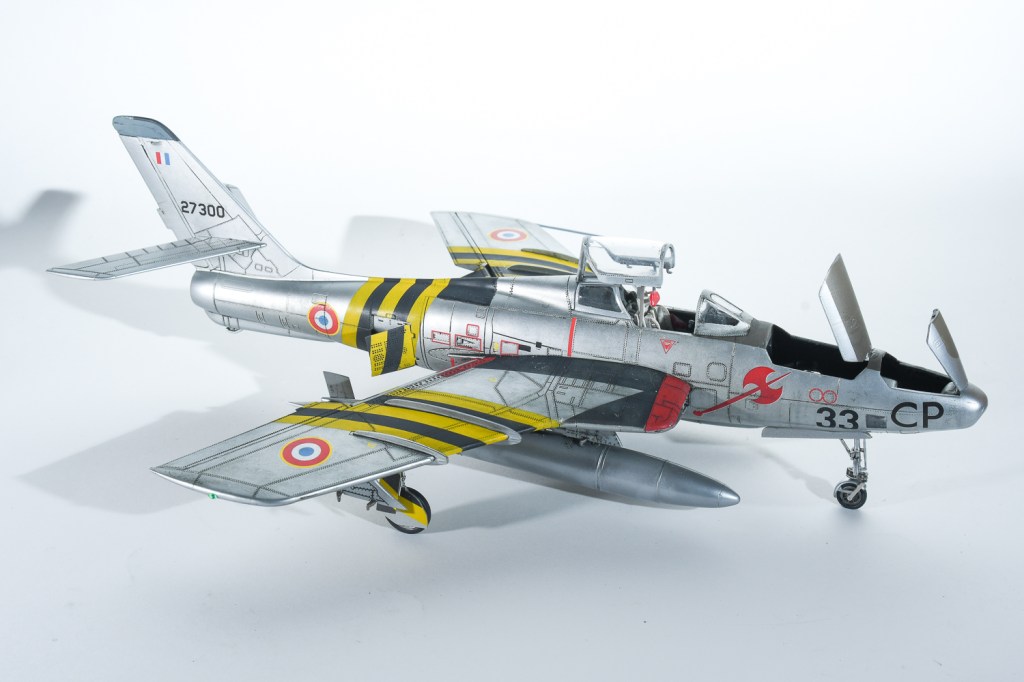
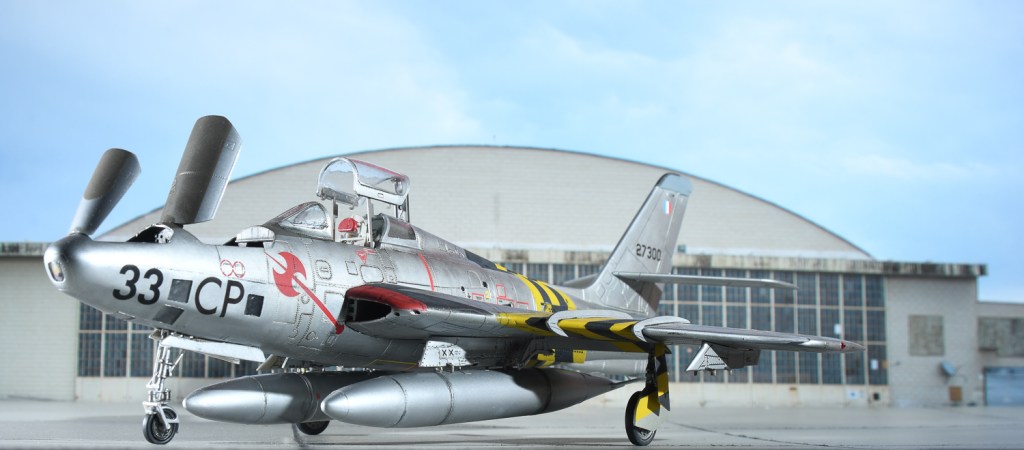
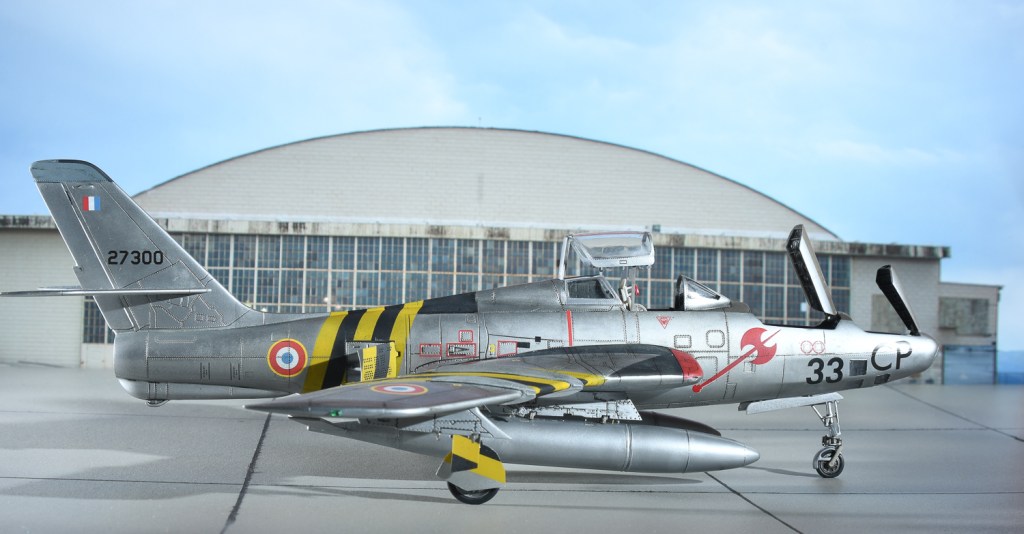
TanModels 1/48 RF-84 Thunderflash

  • Completed:        May 2019
  • Enhancements: Seatbelts ExtraTech
  • Wheelwells, CMK
  • Camera access Doors- CMK
  • Control Surfaces CMK 

After the Trumpeter Thunderbolt, I was looking for something of a quicker build, so when my random stash pick system yielded the tanmodels Thundeflash, I was initially happy as I had been thinking about building this for a while. That initial enthusiasm quickly dissipated during the early stages of construction. Ejector pins marred the interior surfaces, the plastic parts had a pebbly texture that would require lots of polishing if I wanted to do a NMF and the surface detail almost disappeared on the underside of one fuselage half, meaning a rescribe would be in order. Coupled with this, assembling the brackets that hold the cameras proved fiddly with small in scale parts that had minimal glueing area. It fell apart on me a couple of times.  It would have gone back in the box if it were not for the reason I am trying to reduce the number of half built models on my stalled list, not add to them!  So construction carried on. The cockpit reminds me of the old monogram kits with nice relief on the side consoles that responded very well to dry brushing, same with the instrument panel. The seat had some generic US Seat belts added, painted, and was seat aside after a wash of Mig Products Dark Wash.

The kit has the option to cut out the camera access doors, and seeing as TanModels had gone to the trouble of including all the cameras, I thought I should show them off. The doors are demarcated by cut lines on the inside surfaces.  These lines are a little wide, so care is needed in cutting them out.  I used repeated scalpel passes, until they came away.  Separate doors are in the kit, but I decided to use nicer detailed ones from CMK that show the insulation on their interior surfaces. The cameras, save the nose one were left out until final assembly. Suddenly I was up to closing the fuselage halves! They fit together without problem I’m pleased to say, and a scribing tool and riveting tool was used to reinstate and deepen the underside surface detail using dymo tape as a guide. This actually went a lot better than I thought, given rescribing isn’t one of my better skills.  It wasn’t until this stage that I actually started enjoying the build! Dry fits had shown a very nice tight fit of the wing assemblies that slide into recessed areas on the fuselage without any need for filler, however with the intakes added, the fit was nowhere near as nice. I ended up dissembling the wing intake trunking and splitter plates (thanks Tamiya Super Thin Glue) and reassembled the splitter plates and trunking to the wings one piece at a time, constantly checking the fit of the wings to the fuselage.  This worked and led to the initial nice tight fit that the first dry fits had shown. I have no idea what the problem was, but can only guess the splitter plates when added to the assembled fuselage trunking caused the interference. It has to be said the internal trunking does not really fit together seamlessly. Ensure when done, that you sand the openings flush so that there are no steps that will cause the splitter plates to sit proud. Prior to gluing the wing halves together the CMK wheelwells were glued in place.  I found the plastic around the wheel bay opening needed to be thinned slightly.  I used a dremel. If its one measuring tool I have of my increasing skill, it’s the dremel. In years gone by this would have resulted in carnage and unusable wings. These days I can manage quite surgical cuts and thinning.  The CMK nose wheel was also used which is just a direct replacement for the kit part, but with greater detail. I also used CMK ailerons and flaps as I had them in the box for some reason, but there is no discernible difference in detail that I can see. I now had a complete airframe with filler only being used on the underside centre seam and a tiny bit around the windscreen panel.  Overall I found the fit excellent and my initial bad thoughts about the kit had disappeared.  Before any primer could be applied though, that pebbly texture had to go.

Republic RF-84F Thunderflash
27300 ER 4/33  Armee de l’Air RAF Akrotiri. Cyprus 1956

Trumpeter 1/32 P-47D Thunderbolt

Built:  2019
     Enhancements Used: 
Gunbays: Eduard PE. Wheels-Brassin. Seat Belts-HGW. Gun Barrels-Master Barrel

Decals:  Combination of Ad Astra masks and Superscale Cowl checks

One of my New Year resolutions was to tackle some of the stalled builds taking up room in my cupboard. 
Being as the Trumpeter Thunderbolt box was taking up the most room, it was summarily dragged down onto the Cutting Mat.
I’m not sure when or why work on this stalled, but a look in the box revealed all major sub assemblies completed, just needing their seams dressed and then bringing together to be ready for paint.  A nice shortcut to getting Build No.2 done for the year. 

I rate Trumpeter’s Razorback Thunderbolt as  one of their nicer kits. Reasonably accurate, options to allow dropped flaps. open gunbays, open or closed canopy, and plenty of underwing stores options.  It also goes together quite quickly if you don’t use all the unnecessary interior parts. such as the   full ducting for the superchargers.  Contrary to a lot of on line builds and reviews out there, the  cockpit does not require the ducting to sit on, as it is will locate quite solidly  into slots provided on each fuselage half.  The wing spars slot through the openings provided for them as well without needing the ducting added.  Leaving these parts out plus the engine accessory bay greatly simplifies the assembly of the model.

All I added behind the engine was the bulkhead and firewall to provide some rigidity to the fuselage.  Its a big model, and you do not want seams popping open when it is picked up or otherwise handled. Assembly still throws out a few  fit issues.  Steps on the wing undersides when fitted to the fuselage, leading edge gun inserts and windscreen all required attention on mine.  The attention taking the form of filler and plastic shims to even up gaps and steps.  I have heard the gunbay panels can be an troublesome fit, but this would not concern me as I wanted mine open.  If the details there, why not show it off, right?

The only frustration I found, in common with all Trumpeter’s radial engine kits is the poor fit of the engine parts.  The parts certainly do not click together with the result it is quite easy to end up with an engine and propeller out of alignment as I found on my Hellcat build. 
This is then compounded by Trumpeter also not engineering the cowling to be a strong positive fit to either the engine or airframe.  At least in the thunderbolt, the engine is held solidly within the cowling by a frame.
I further reinforced the cowling airframe join by inserting two pieces of plastic tubing into the cooler ducts to provide a more positive fit

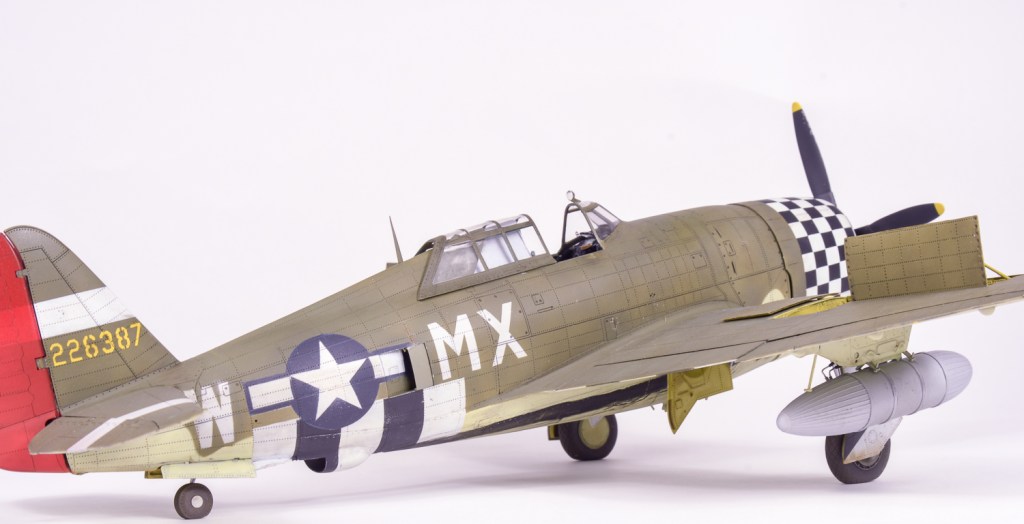
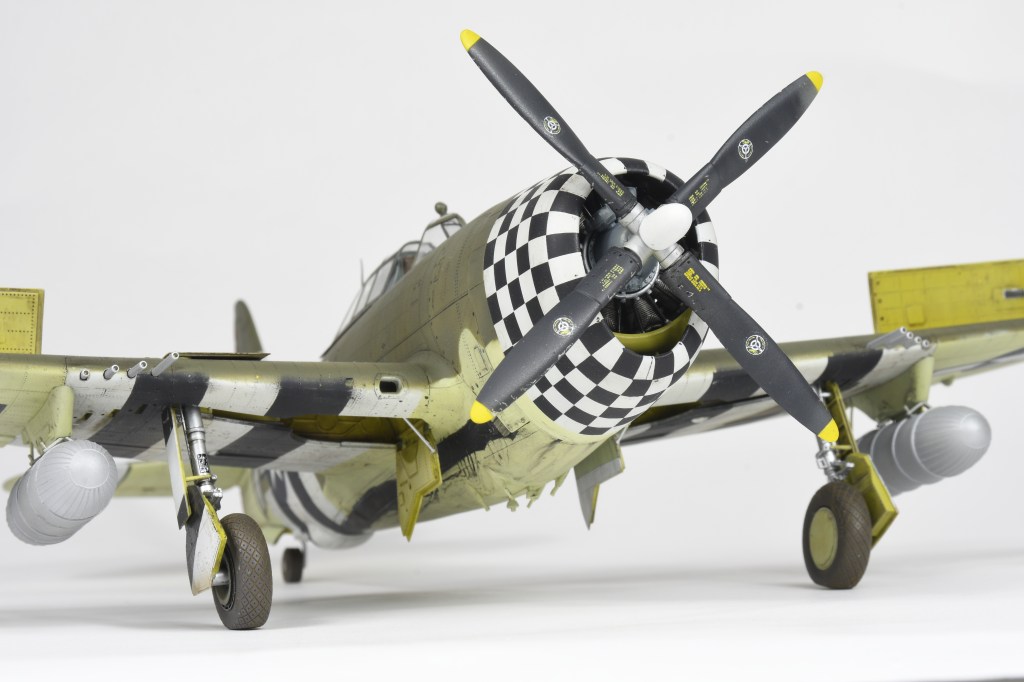
In regards to the chosen scheme, I have always thought the checkered cowling of the 78th FG would stand out in the cabinet, so looked for a suitable machine to model.  I was quite taken by “Miss Behave” with her RAF colours of dark green upper surfaces, and sky undersurfaces.  Invasion stripes, red rudder and the scalloped area under the canopy remaining NMF reinforced my choice. 

With this scheme originally picked when the model was originally started, masks for all markings were ordered from a bloke in Canada that called himself Ad Astra masks.  Now sadly no longer doing them as mask set was excellent to use.  He based the masks on photos of the real aircraft and an aeromaster decal sheet.

This time, the deciasion was made to apply the insignia first, mask and then paint the camouflage.  It was hoped doing this, the masks would be easier to align, and I would avoid that thin white ring of built up paint you can get if painting the markings last
What I learnt from this was the US star and bar markings must be the most complex markings to paint, even more so than RAF type A1 roundels.  There are just so many elements you need to ensure are aligned and straight.  Anyway I got there in the end having to only touch up two stars  Painted markings are the only way to go in 32 scale in my opinion.  Even the “miss Behave” came out nicely, a true testament to the great job Ad Astra did cutting these masks.  Then there was the cowling!
Well, I tried to mask that too using a montex mask set, but it was just an abject failure, so was my attempt at cutting little squares of Tamiya tape.  Buggar it, I thought, this will be decalled, so I dragged out the Barracuda sheet, but I could not get this aligned either despite it being sized for the Trumpeter kit.  It must be me as I imagine Roy would have been meticulous in designing the sheet..  Rapidly running out of options, I found an old Superscale sheet with checks on it for the old Revell kit.   It fit surprisingly well, just needing a couple of black squares filled in with black paint around the cowl opening and underneath where the two halves met.

This just left the final assembly where I discovered I had lost a wingtip light and also one of the landing gear covers.  Despite hunting high and low, no sign of them.  I can only think I accidentally chucked the gear cover out as it was stuck to  the big ball of Tamiya tape that was sitting on my desk.  The jigsaw that are HGW belts were then assembled using wild guesswork as to how they all threaded together!  HGW could really help here by providing step by step instructions rather than just a picture of the completed belts.  

Searches of the various fora hasn’t revealed anyone else knowing how to assemble them either!  The guns also provided a bit of frustration trying to get them all aligned and properly seated.  I really need to either test fit these items and engineer proper fit, or assemble them way before I get to this stage.  I had the same problems with the guns on my hellcat.  To add the brass gun tubes, I simply drilled the holes in the leading edges out slightly and pushed them through into the breechs. 
The 108 gallon drop tanks are from the kit with plumbing added from wire and steadying braces from plastic rod.  If I was being strict to the 84FS’s missions I should have added bombs as after D-Day this squadron switched from long range escort duties to ground attack, but I wanted my aircraft to wear the tanks.

​Adding the ammo bay doors, I also discovered I had the door upside down when I painted the star and bar portion on it.  A modeller worried about perfection would have repainted the star.  I just flipped the door upside down as the model had got to the stage where I just wanted it off the bench so I could move onto something new. 
Does anyone else get like this?

The photo I had of Miss Behave showed no chipping or fading that I could make out, just that very extensive oil streak leading from the oil cooler doors, so this was added with black oil paint, and then the whole model dullcoated .  I should probably go back and gloss the oil streaks at some stage.
It was then time to sit back and enjoy the model, happy that I had reduced by one the small amount of kits on the shelf of doom. (there’s still 6 on the SoD if you must know!)
Overall, not as good as I was hoping it would turn out, but it still looks imposing on the shelf and Im happy I have a 32 razorback in markings not usually seen.  I just love that big checkered cowling.  I really hope that we get a 1/32 P-47D from Tamiya at some stage.

Republic P-47D-22RE Thunderbolt 84FS 78thFG 8th A.F U.S.A.A.F Duxford England. 1944

Revell 1/48 ADV Tornado F3

  • Built 2020
  • Enhancements Used 
  • Seatbelts,  Eduard
  • Wheels   Brassin
  • Wheelbays  Eduard
  • Pitot Tubes and AoA sensors  Master Barrel
  • Weapons  Brassin ASRAAM   Hasegawa Sparrows (skyflash)  BOL rails  F4Dable Models
  • Decals  Xtradecal Tornado F3 Part 1
 Like a lot of modellers, I had heard some horror stories about the fit of the Revell Tornadoes.  The consensus seemed to be whilst they were definitely a step up on what was currently available, the fit left something to be desired.  The kit seems to be one of those that polarise modellers world wide.  The truth is, like the Hasegawa Harrier, the ease of build is directly linked to how you build the tornado.
What inspired this particular build was a mate directing me to a series of youtube videos done by a fellow named Nathan Robinson.
Nathan is a member of the IPMS Tornado SIG and admits to having built six of these!  So if anyone will have the build down pat it should be him.
Deciding to take a leaf out of Jon Bryons book, all three revell tonkas – 2 ADVs and a GR4 – were pulled from  the stash to be built as a batch.
Following Nathans build sequence, I found the build progressed fairly quickly. I still needed filler around the intakes and along the fuselage sides,where it meets the bottom plate, but these were all easy joins to clean up and rescribe.
For the cockpit, the kit decals were used which sat down surprisingly well over the moulded detail and certainly looked busy enough through the closed canopy.  Note Revell call out the wrong rear instrument panel, you need part S214

I deviated from Nathans build my cutting off the cogged part of the wing so I could add them later. To be honest, Im not sure this is the best way as you lose a bit of structural integrity. Ive already so modified all three of my kits, but wish Id left one to compare the two different methods.  Maybe on my eduard Desert Babe kit!

I replaced the rather bland wing seals with some moulded by a fellow called Shaun from Britmodeller.com.  I’m not sure if they are still available as he was doing them when the kits first became available.
The decision was also made on this model to have the flaps up, to better show off the lines of the ADV.  The best way to achieve a flush fit with the wings is to cut the bar on parts B111 &113 so you are left with separate flaps.  These can then be glued  individually to the top wing ensuring they sit  flush with the upper wing.

The undercarriage assembles fairly easily, despite being moulded in two halves. Revell have form here, which means you have a seam to clean up. Part C159 and 168 placement is a little vague. Step 69 shows it the best. On gluing the PE facia to the back wall of the wheelwell, I had an alarm bell go off in my head going, “I wonder if this slot the PE covers is important” Well, Yes, it is as this is where the door retraction strut sits.  Didn’t realise this until I added them, so then had to cut the struts, in fact I replaced them with thin rod. I find this annoying on Eduard’s part. They could have easily made the back facia in two parts to be fitted either side of the slot. Its not the first time Eduard have failed to take into account the fitting of kit parts around their etch, and one of the reasons I find myself using less AM these days unless it is drop fit. Some etch placards and brake lines dress up the legs nicely, but on my other F3 I will use wire and decals instead..

Photos of my chosen jet show it fitted with BOL rails on the inner side of the wing pylon. If like me, you didn’t know what BOL rails are, I can know tell you they are a launch rail with an inbuilt countermeasures pod. They are surprisingly hard to track down as an aftermarket item, considering quite a few jets use them.  A friend offered me his Steel Beach ones, but they looked quite a crude casting. The F4DModels were much better although warped.  Hot water straightened this out.

For the Barley Grey, I used a home grown paint SMS which performed quite well, Its marketed as ready to spray, but I still thinned mine a little. Colour looked good, but I find it strange they do not offer a Light Aircraft Grey in their range to go with the barley grey, so it was back to my go-to paint. Mr Color.
Again on this model, I had problems with the paint and primer peeling off when removing the tape. I have no idea whats causing this. The model was wiped down with tamiya thinner prior to paint, and was primed with Alclad Grey.  The consensus amongst my modelling mates was it could be the primer, which Ive had for a while, so in the bin it went.
The model was gloss coated for decals and in preparation for the wash. These days I apply the wash before the decals, despite this method, the wash failed to pick up a lot of the very fine detail, despite repeated applications, which was annoying in the extreme.
The decalling should have been easy, but again my poor build planning brought things unstuck. Literally!
The decals had all been applied when I realised I had not painted the fintop di electric panel, so as the tape would lay over the decalled fin band I religiously detacked the tamiya tape before laying it over the decal.  Of course, on pulling off the tape, the decal came with it, necessitating me having to  paint the fin band back on.  This in itself needed a lot of touching up as each time I pulled tape off, paint came away too. I really need to get to the bottom of why this is happening.
Surprisingly, my enthusiasm hadn’t waned for the model, so I pressed on, applying a satin sheen, which I then went over with dullcoate. Even with the satin, the model still looked far too glossy.  Annoyingly, all the stencils stood out as too thick as well. I had applied them in little pools of future to stop any silvering. I wont do this on my next one.

This just left final assembly of wheels, aerials, canopy mirrors and nav lights. none of which I managed to lose as is the usual case despite several of them pinging off the tweeezers.
And that was that! One down, two to go
So what do I think of the Revell Tornado? Well I think the main problem is, its Revell!  I have no problems with the breakdown of the kit, but the kit quality is poor indeed, flash, sink marks and ejector pin marks mar the parts, making assembly harder than it should be. These kits, like Airfix, are designed for the mass market, the so called “pocket money brigade” and the tooling shows it. You get what you pay for.
Despite this, if you ever release a new tool Jaguar, Revell, I’d buy it in a heartbeat.
Anything would be better than the horrid kittyhawk kit thats still sitting on my shelf of doom.

Panavia Tornado F3 ADV ZE763 11 SQN Leuchars Royal Air Force 2006

Airfix 1/48 Boulton Paul Defiant Mk1

  • Built: 2019
         Enhancements :  Eduard Interior and exterior details
  •                                    Landing Flaps: Eduard. 
  •                                    Gun barrels; Master Model
  •                                    Wheels; Barracuda Studios 
  •                                    Exhausts: Quickboost    
  •                                    Paint:  Gunze
    ​                                   Decals: Ropasmodels 
Airfix’s 1/48 Defiant, released in 2016, and purchased by myself soon after is what we have now come to expect from Airfix’s new line of kits.   Evocative box art, soft grey plastic, sharply printed decals and well illustrated  clear instructions outlining the different  ways you can complete your defiant, in flight, or wheels down, separate control surfaces, choice of open or closed canopy, this also extends to the turret, which can be modelled with the doors open, and raised or lowered turtledeck  (why are they called turtle decks?)
Neither the now obsolete Classic Airframes or Trumpeter kit offered that.

I decided that wasn’t enough for me though, so added Eduard’s flap set.  My search of defiant photos revealed a few on the ground with flaps cracked open, certainly not fully open as I have depicted, but that’s how I pictured I wanted the completed model to look.
Construction was fairly painless, fit being almost excellent.  I needed to trim the cockpit floor on one side as the wing assembly did not not quite close up snugly underneath the fuselage on one side.  The cowling also needed a bit of clamping, as again on one side I had a bit of a gap underneath the oil tank cover.  I can only surmise I had the floor slightly out of alignment.  The eduard set added the colour printed instrument panel and some side console detail plus the seat straps for pilot and gunner.  I have read some on line reviews bemoaning the simplified cockpit, to me, what you get in the box is fine, especially when dressed with the eduard PE.  The wheel wells also get a helping of PE around their walls which brings them to life.  The model built up quickly, the smallest amount of filler being needed around the tailplanes and the rear underside join of the power wings to the fuselage.  The PE flaps were folded up without difficulty (surprisingly for me) and offered up to the previously cut out kit flaps.  Some shimming was needed to spread the open areas of the rear wing to ensure the rear wall of the brass flap bay sat at the same level as the underside of the wing.  I should have taken my time a bit more here ensuring a better fit, and cutting out the slots for the flap actuators which I completely missed.
The machine gun barrels were cut off and the breeches drilled to take the sublime master Models barrels. I fit these wherever possible as they really add to the look of the model.  It would be icing on the cake if they came pre blackened!  The kit pitot tube was also replaced with Albion Alloys tubing.  Although there is nothing wrong with the kit wheels, being moulded as they are, weighted and with separate hubs, I had a set of Barracuda wheels in the box, so these were duly added.  Waste not, want not. The landing lights were not the best fit, so were fitted at this time, so they could be faired in prior to painting.

The turret popped into place without all the fuss, some other online and magazine builds report, but I was surprised to have trouble pushing the clear dome down onto the base, thinned white glue being required to fill the resultant small gap.

Painting was made easy using a set of camouflage masks from Mal Mayfield.  From the decal sheet, I had decided on an early war scheme with the black and white undersides and A type fuselage roundel to push home the early war use of this aircraft.  The decal manufacturer was new to me, I ended up using the kit roundels and codes and Ropos’  roundels looked a little bright, whilst the codes looked too pale.  The “T” was sourced from an Extradecal Medium Sea Grey RAF Codes sheet, as  With the multitude of decal sheets on the market, these generic sheets are not as probably as handy as they once were, but to me, they are still a must have in my decal bank for this very reason.  The only decals I used from were the serials and these performed fine, being quite thin.  No stencilling was applied to the underside as they would have all been overpainted when the undersides were done. AK panel line wash for brown/green aircraft was used as  a wash on the top surfaces.  Chipping was added using vallejo silver, whilst highly thinned tamely black was used for the exhaust stains.  Emboldened by watching Plasmo use his dremel to  surgically cut parts out, I set forth with my dremel to open up the kit exhausts.  30 seconds later, I was ordering quickboost  exhausts from BNA Modelworld. Rather than displaying the same skill as Plasmo, my exhausts looked like Dexter, the serial killer had gone to work on them.  You will need to cut off one of the locating tabs  in order to fit them into the airfoil slots.  Whilst you are ordering your exhausts, also order a set of landing gear covers, as the kit ones are overly thick and simplified, and do not portray the real ones very well.

Final assembly involved adding the undercarriage which fitted snugly into their respective sockets.  I was expecting a fight with the flaps and their tiny actuators, but was pleasantly surprised how easy they were to place.  In reality the actuators should fir in their respective slots, but I failed to cut out the ones on the bottom wing and clogged the flap ones with a thick coat of future I had applied to also act as a glue.  Therefore my actuators are a butt fit to wing and flap which is not correct for the real machine.
An  aerial line from EZ line  and a bit of sprue and punched plastic disc to represent the extended gunners footstep bought my first build for 2019 to a close. 

Boulton Paul Defiant Mk.1 264 SQN Royal Air Force. Biggin Hill. February 1940

Trumpeter 1/32 Hellcat MkII

  • Built: 2018

    Aftermarket Used:  Cockpit:Eduard Interior. Wheelwells, Eduard PE. Wheels-Barracuda. Seat Belts-HGW. 

Decals:  Home made masks

I first made the trumpeter hellcat in 2007, and finished it as a FAA machine.  I quite liked the build, and the scheme, but unfortunately the model got damaged in a house move.  I bought this model with the idea of making another FAA Hellcat, and initially was quite motivated when the kit made my to do pile for 2018 builds.  That motivation evaporated when it hit my bench and I discovered the wings had sink marks in them over the rear spars.  As I had just completed two involved builds of the HobbyBoss Tomcats, here and here I just didn’t need the grief, so the model went on the “For Sale” pile.  A week later, I decided I wasn’t going to let any minor sink marks beat me, and the kit ended up back on the bench.  A bit of brushed on Mr Surfacer 500 made quick work of the sink marks.  Restoring the rivets wasn’t as hard as I had imagined which is what really led me to put the kit aside in the first place.  A Rosie Riveter tool was used  plus the ubiquitous sewing needle.

The Eduard interior set was used for the cockpit, the pre painted etch certainly giving that busy look to the consoles and circuit breakers that painting just cannot achieve. The Trumpeter hellcat suffers from a few inaccuracies, the main one being the cockpit is far too wide and the rear fuselage does not capture the flat sides of the real machine.  This did not bother me greatly with my first hellcat, but with this one, I cant unsee it.
In an effort to reduce the oval sides, I sanded flat  the curved sides of the interior bulkheads, and when glueing the fuselage halves together, pushed in the fuselage sides aft of the cockpit.  If it made any difference, it was minimal.  The engine accessories, bearers and oil tank were all left out, as was the radio equipment as none of it will be seen, the engine itself pushed into the  firewall, so the bearers are not required to be assembled.
Fit of the major parts was pretty good as it usually is with most trumpeter kits, even the wing halves mating nicely in the extended position, although I managed to introduce a slight step between the port wing sections.
Prior to this, the moulded wheel well ribs had been shaved off so that the eduard parts could be used.  These being fairly easy to place and  superior to  the shallow kit detail.
The completed wing sub assembly nestled in nicely to the fuselage, with again just a smear of Mr Surfacer.  Eduard provide a PE panel that skins the panel adjacent to this seam so that you don not lose any detail through sanding.  Painting the scheme was made easier by using LF Models  camouflage mask but I’m jumping ahead!  As my chosen aircraft was a Hellcat MkII, or F6F-5, and the kit represents a late -3, a few changes had to be made.  The windscreen in particular needed some frames sanding off.  The clarity was restored with various grades of micromesh, and Eduards canopy mask set for the trumpeter -5 used to save me masking some tricky curves.  A rear view mirror was furnished from then plastic card and added to the interior of the screen.  FAA Hellcats also had a round external mirror mounted to the top of the windscreen and this has still to be added to the completed model.  The camouflage was started by first spraying the white areas before masking these off so the sky undersurfaces and  dark slate grey, and extra dark sea grey uppers could be painted.  Extracolour paints were used for this, the final model I will be using enamels on as I finally made the decision to abandon them in favour of acrylics and lacquers.  For the roundels, a friend cut them from an upscaled and scanned aeromaster sheet for FAA Hellcats.  This is the second time I have got a friend to cut masks for me, and I’m wondering whether I should just buy a cutter myself although the learning curve with the software scares me.  Trumpeter also left the supporting straps off the drop tank although they have included the holes in the fuselage underside for them.  I fashioned them from thein strips of plastic card glued to rod which then was pushed into the holes.  Bombs were from the kit, although the tailfins were from the Eduard sheet.  Stippled on Mr Surfacer represented the cast iron bodies before they were painted olive drab with a yellow ring denoting HE.  Around this point my interest in the model started to wane.  I had had to repaint the roundels a couple of times and touch up various parts of the airframe paintwork caused by clumsy handling and poor masking. The serials which were decals had also silvered.
  The model was not reflecting the vision I had started with, and I was keen just to get it finished and off the bench.  I decided to scrimp a lot of the weathering and shading I had planned instead opting for a simple wash and some oil streaks using AK Dark wash.  This is something I really need to beat next year, so that I see each model through to completion with a consistent level of skill and patience. Roy Sutherland’s superb resin wheels were painted and glued to the previously assembled undercarriage legs, which had had wire brake lines added.
 Finally exhaust streaks were added with highly thinned Tamiya NATO black, although I don’t think they are nearly pronounced enough before the whole model was hit with Testors Dullcote, and that signalled the end of 2018 for me modelling wise.  Shame about those silvered decals, and Ive just noticed the prop is off centre too!


Grumman Hellcat MkII. 896 SQN. Royal Navy Fleet Air Arm.  HMS Emperor 1945