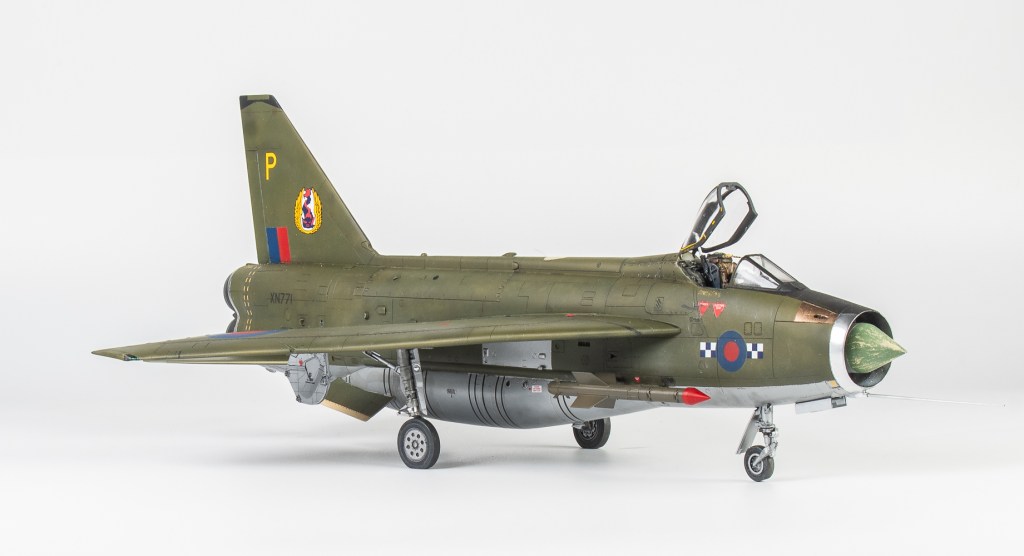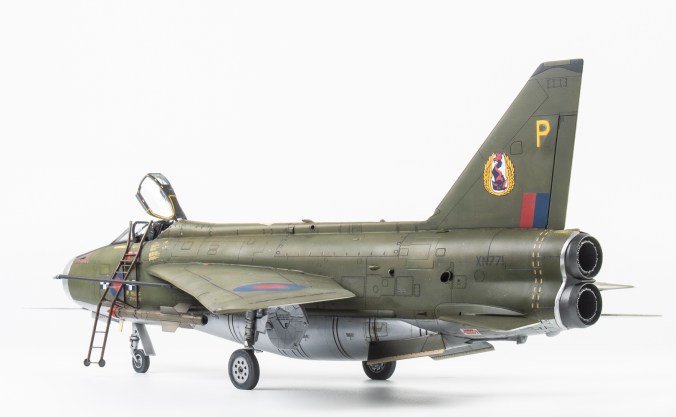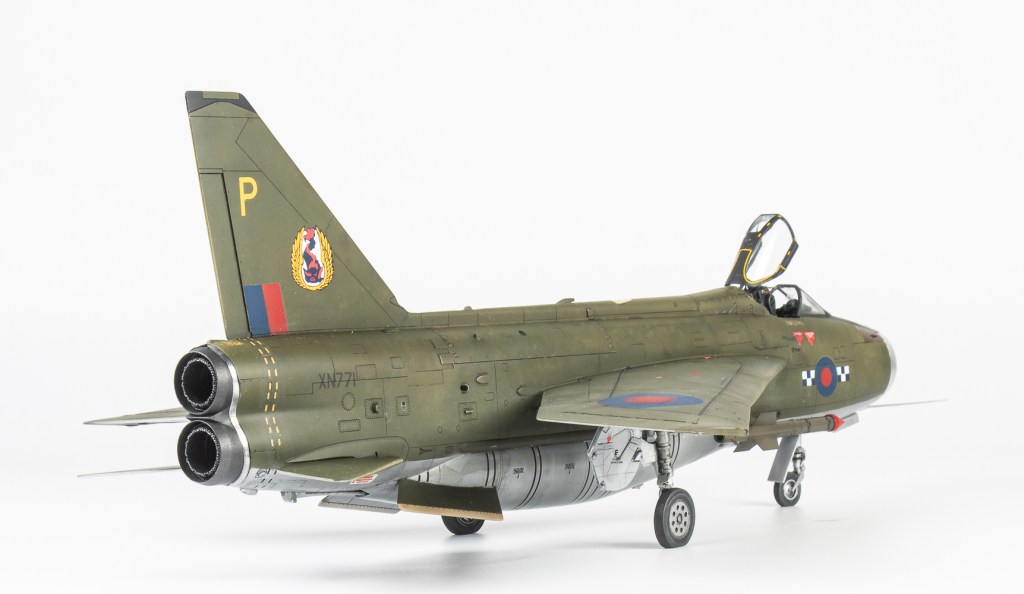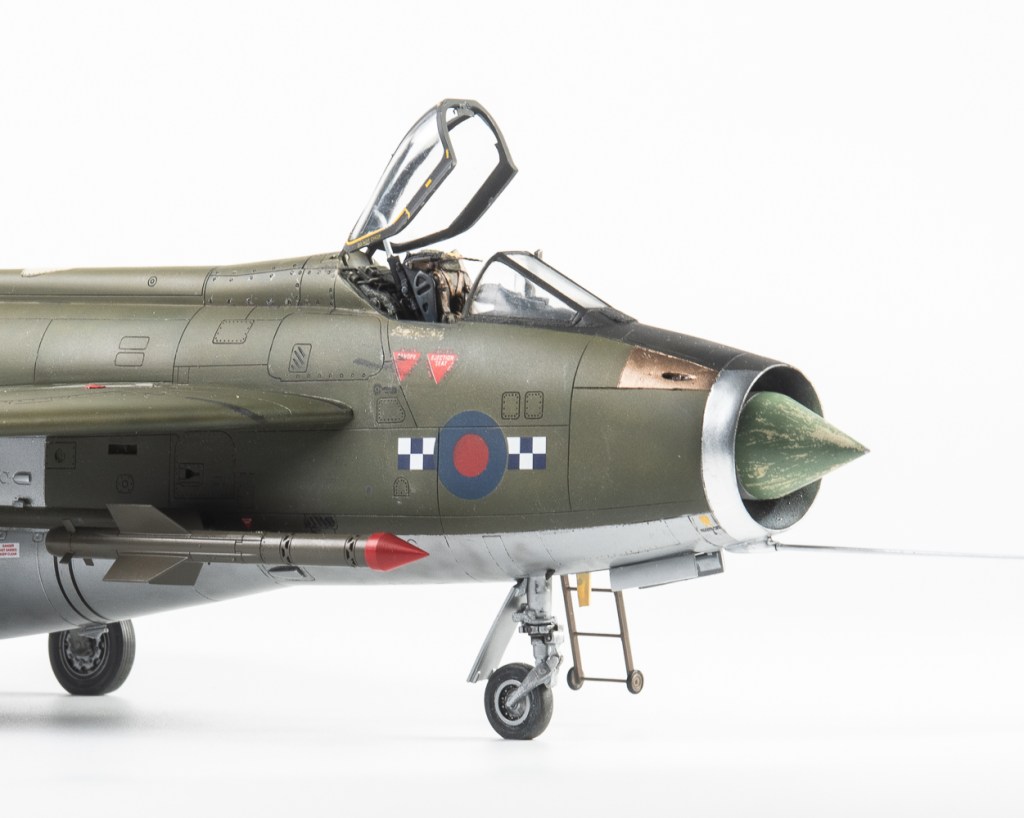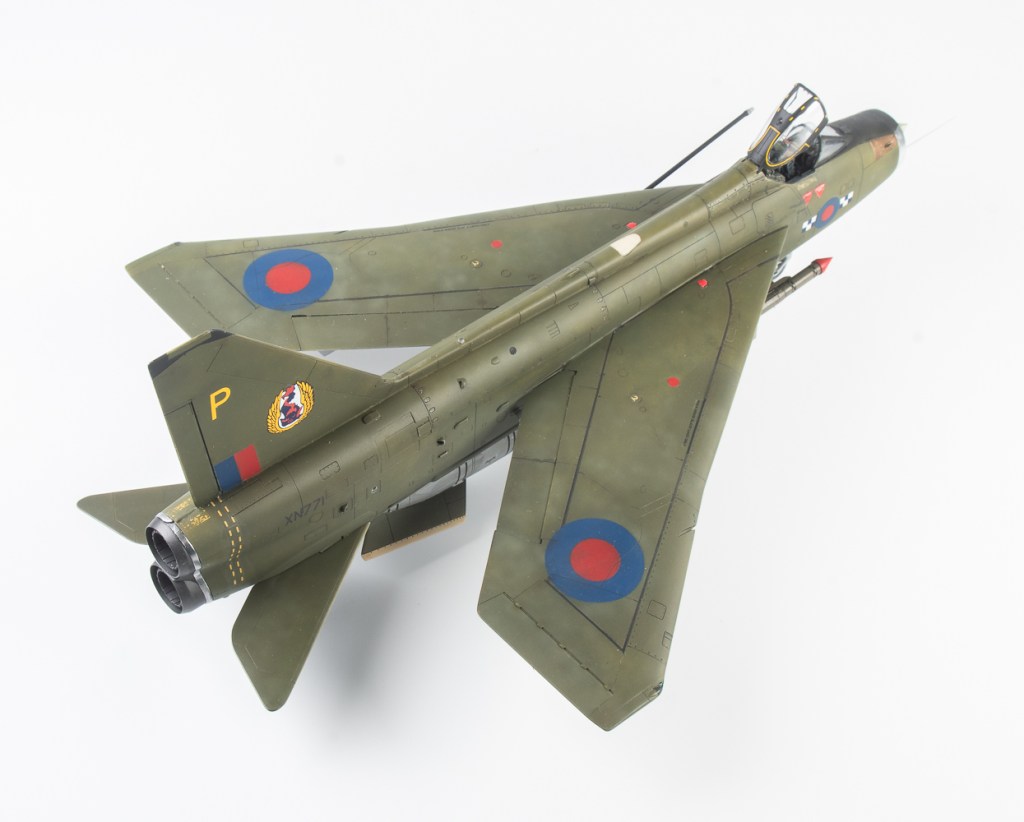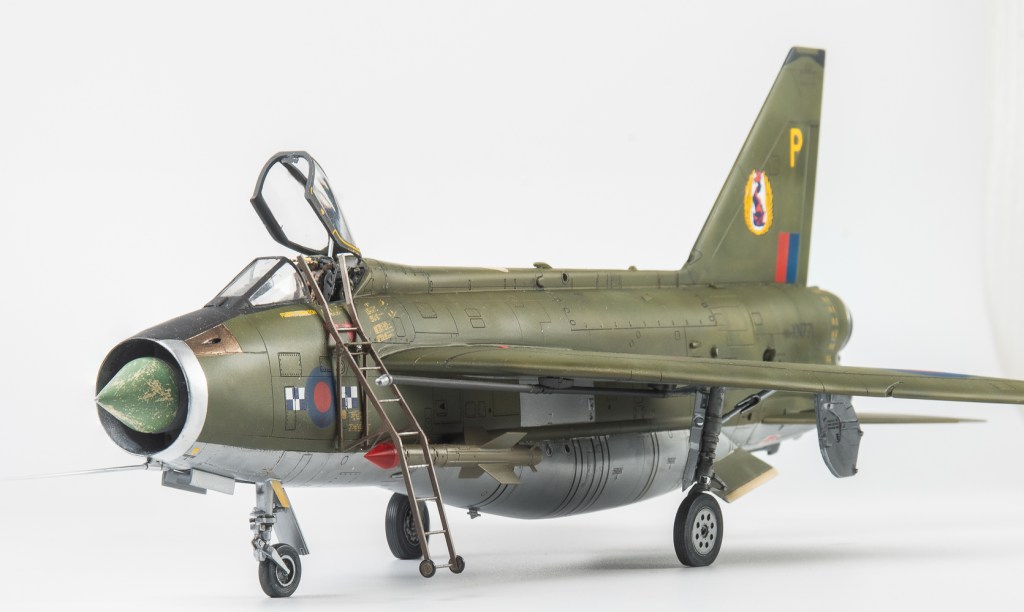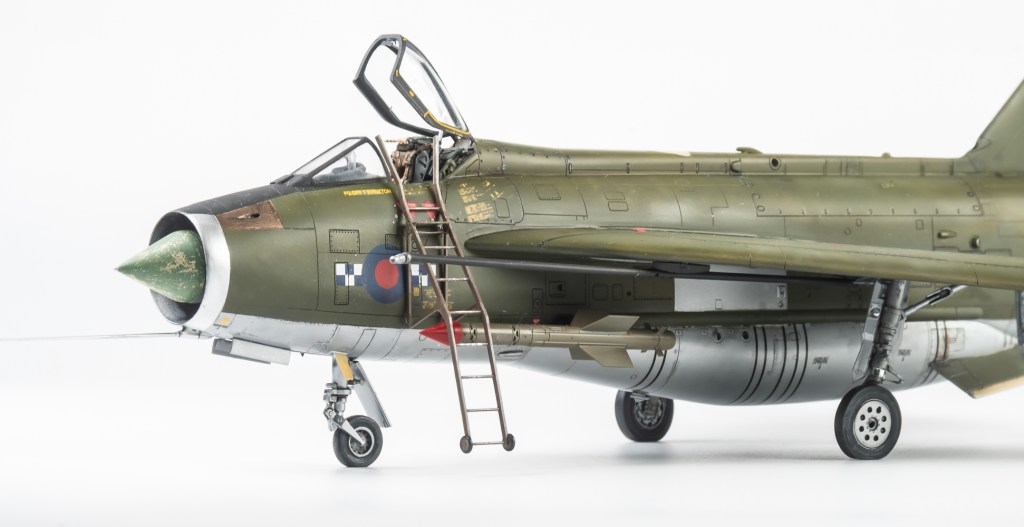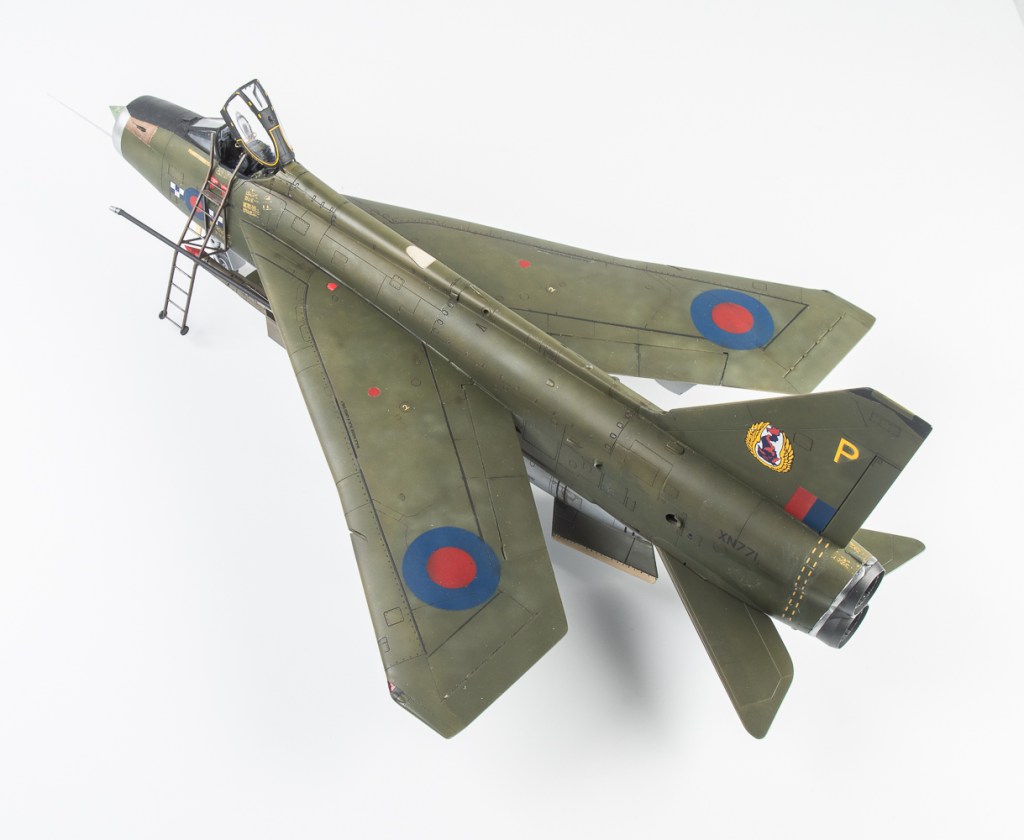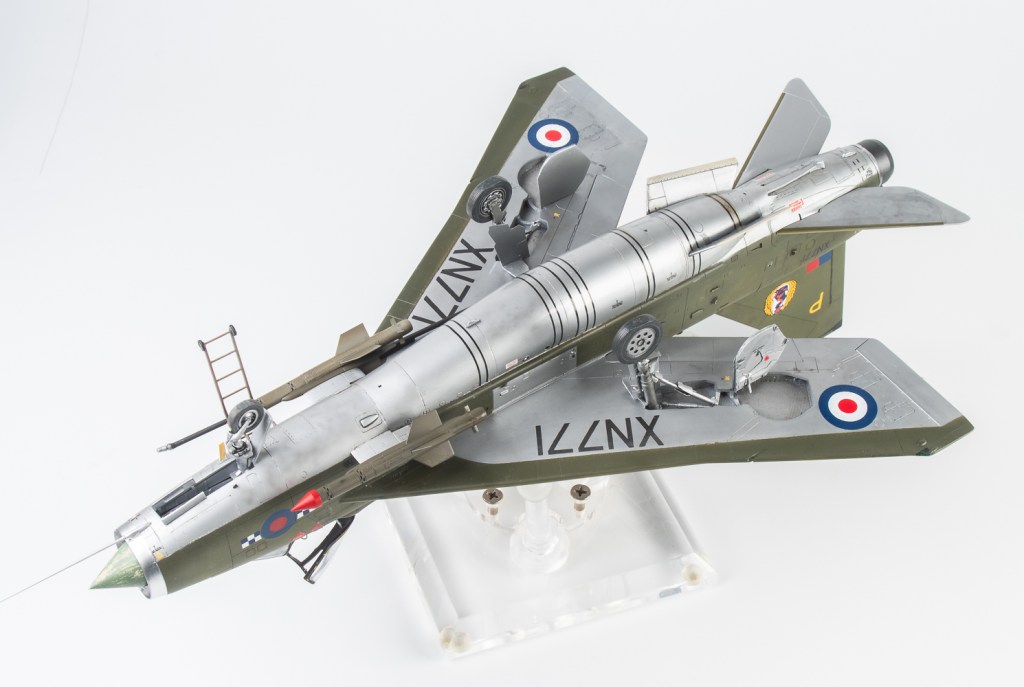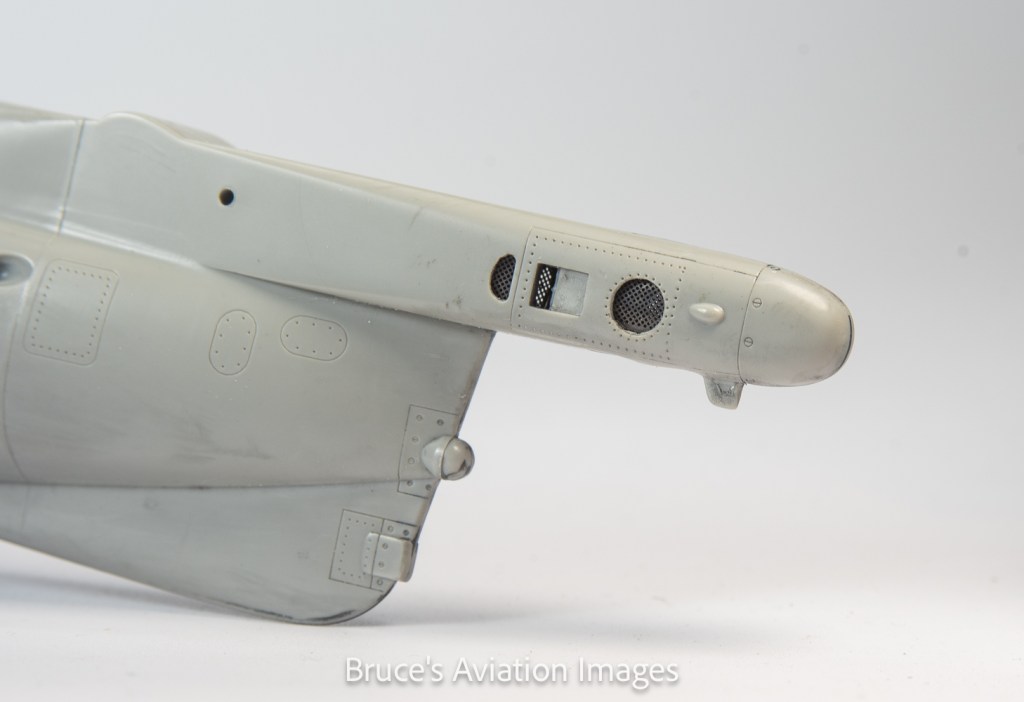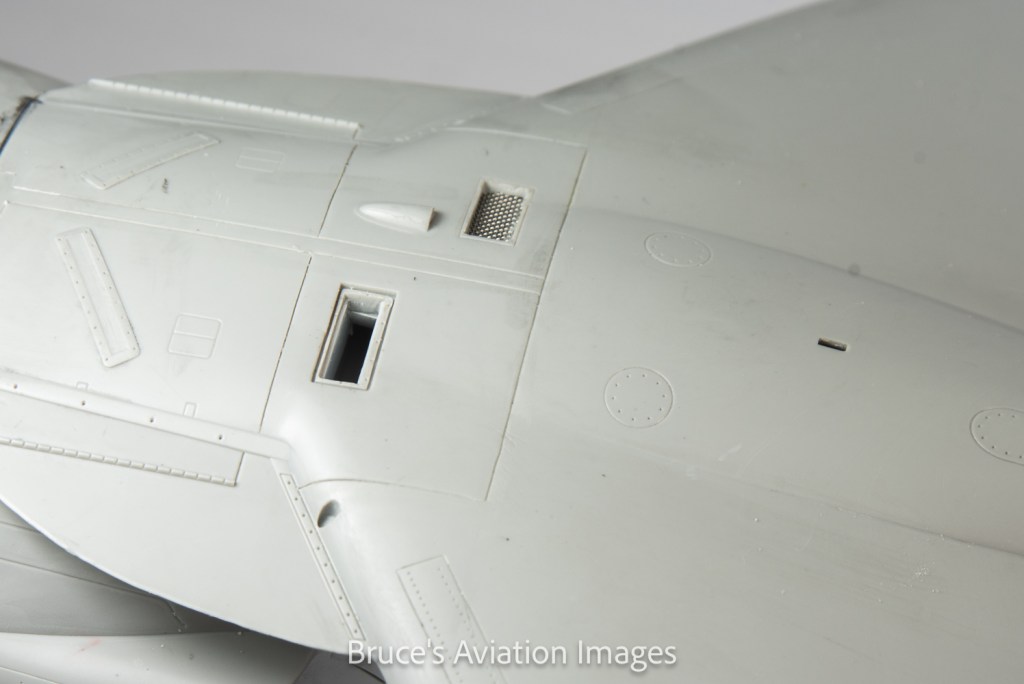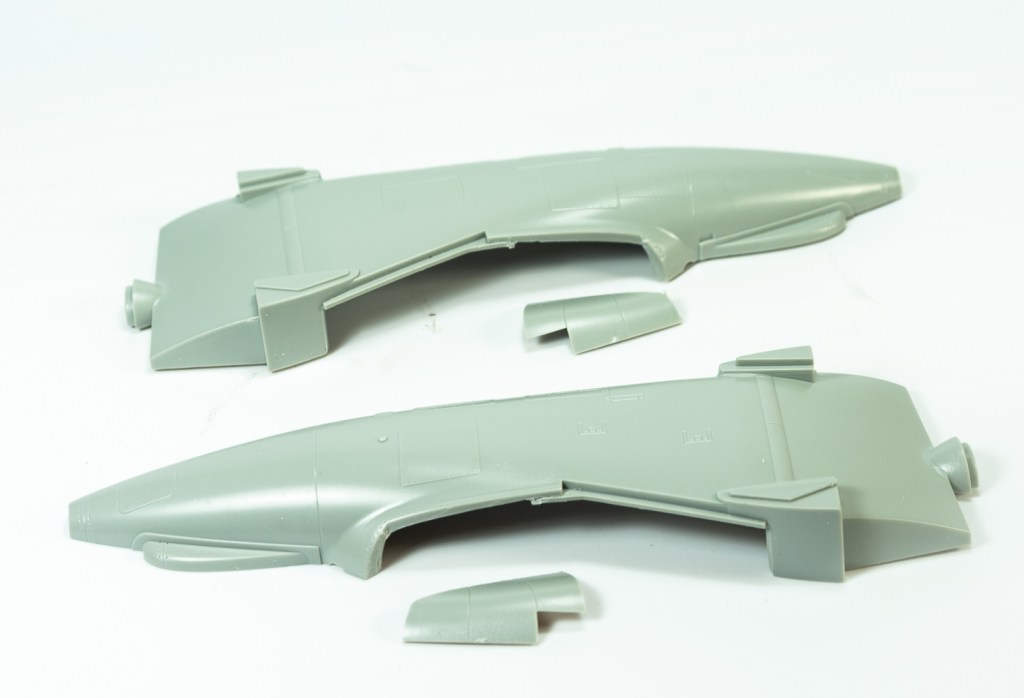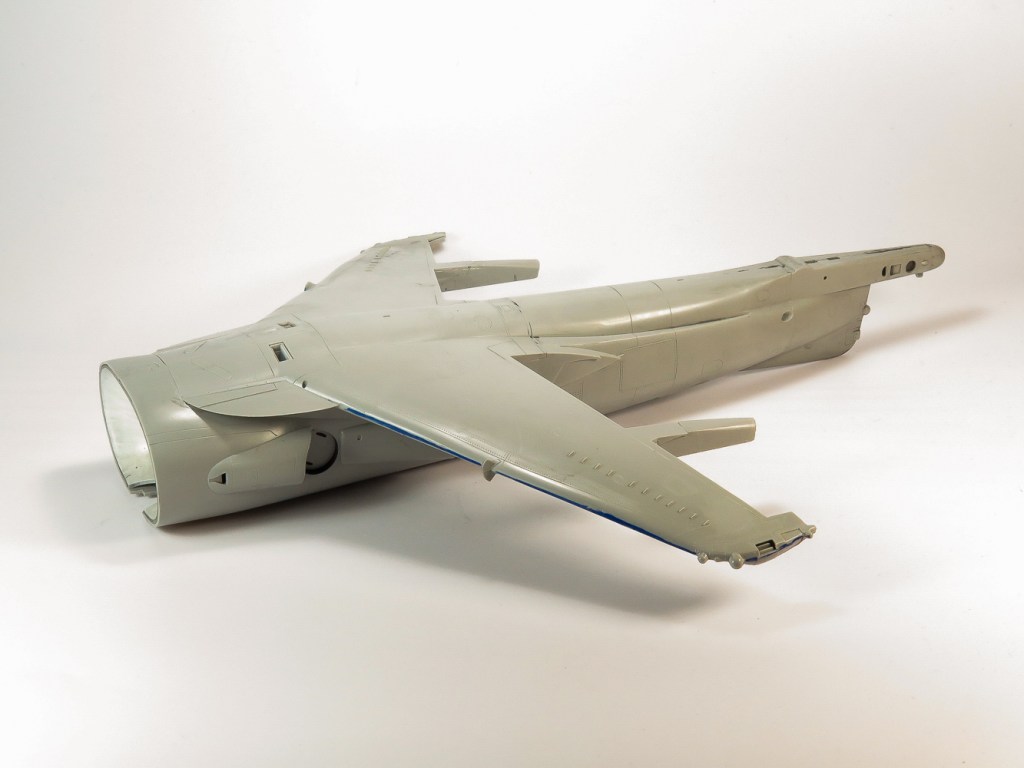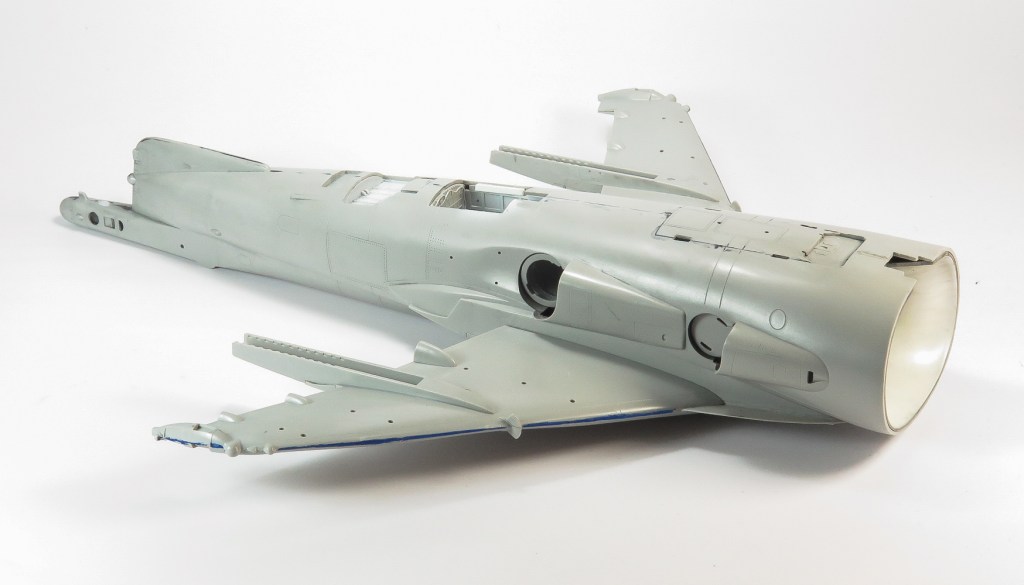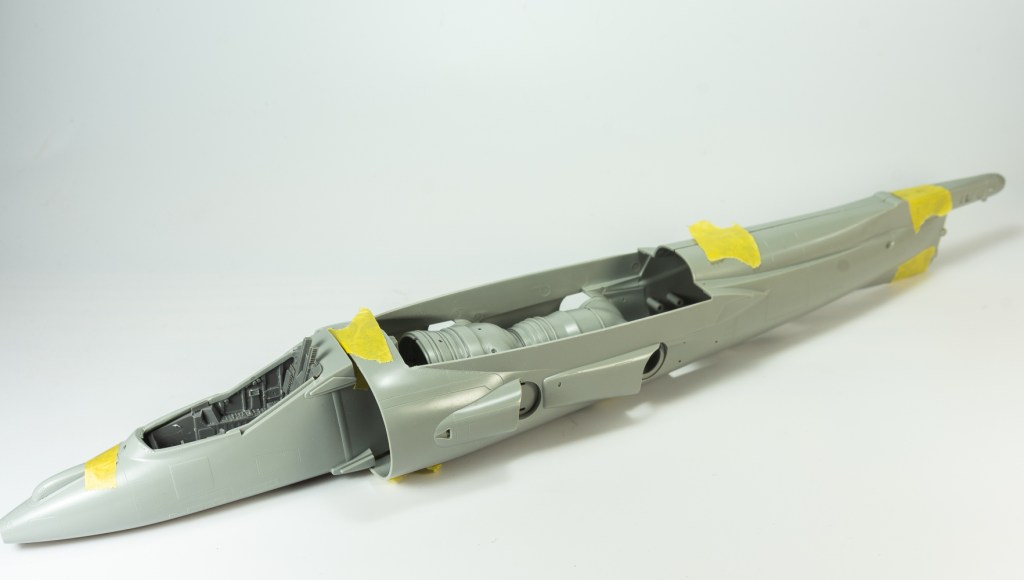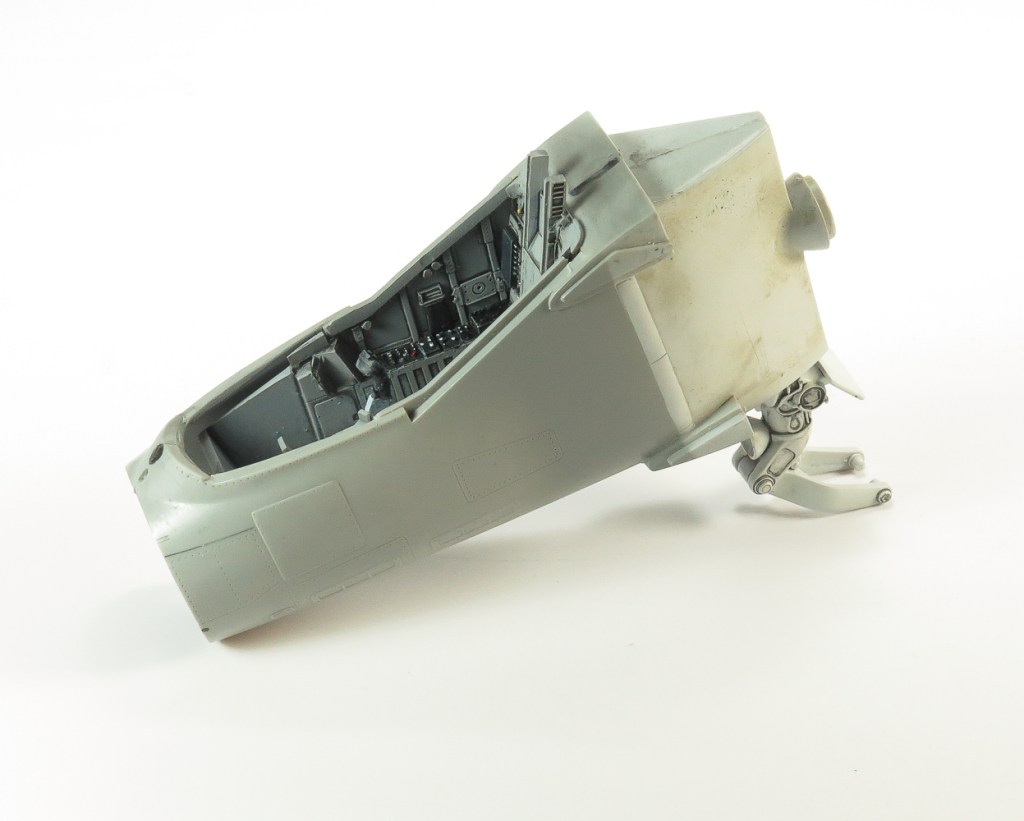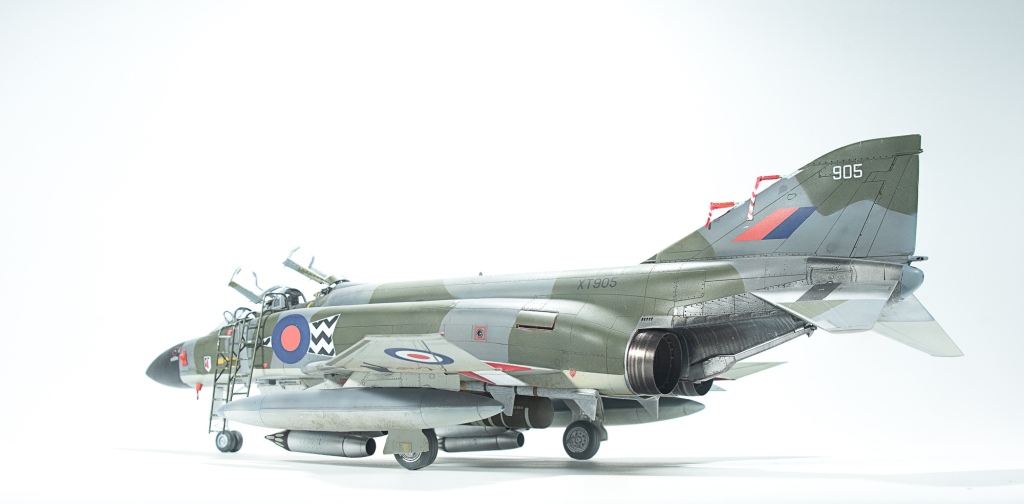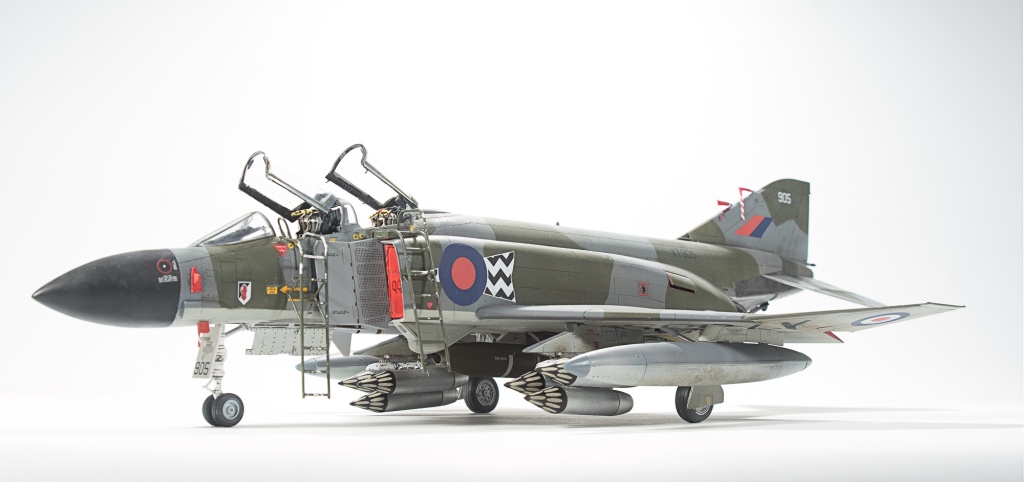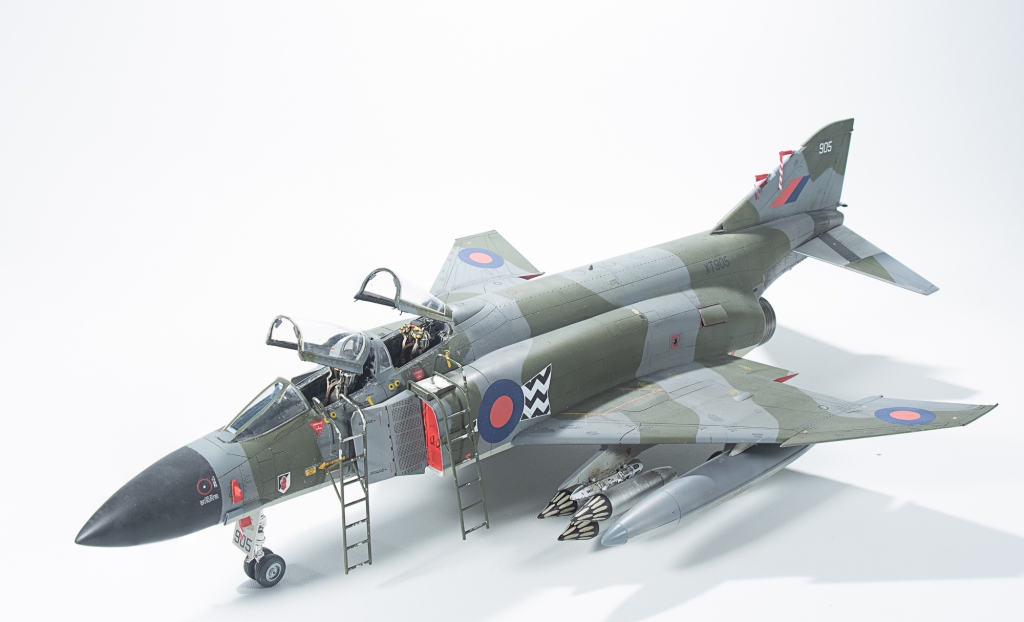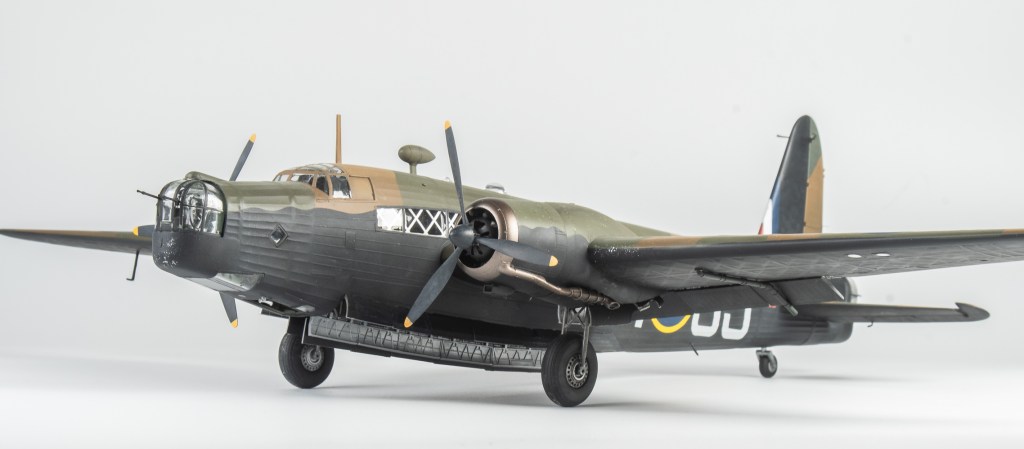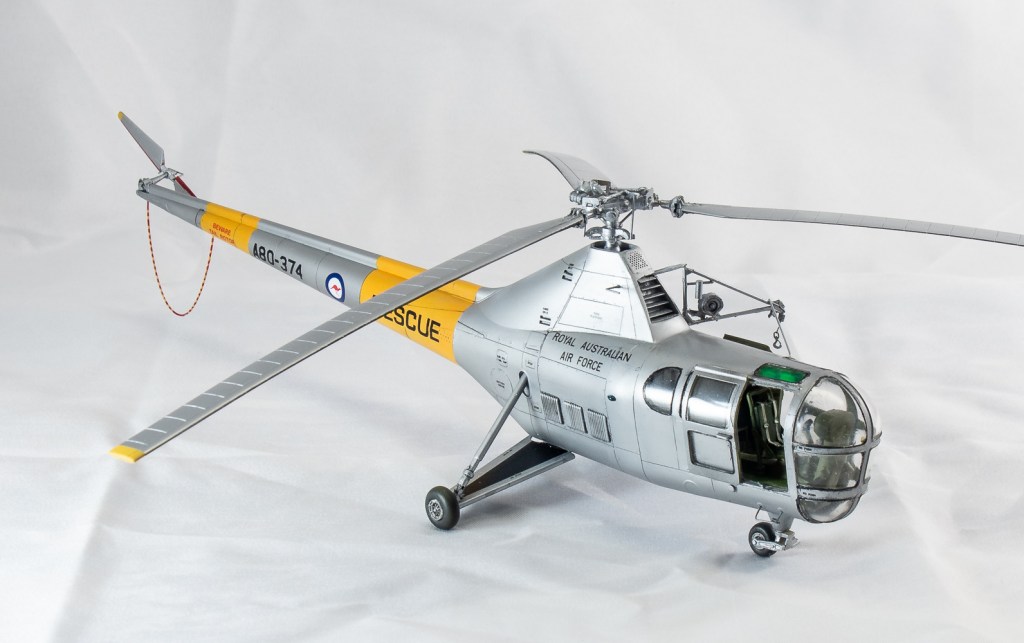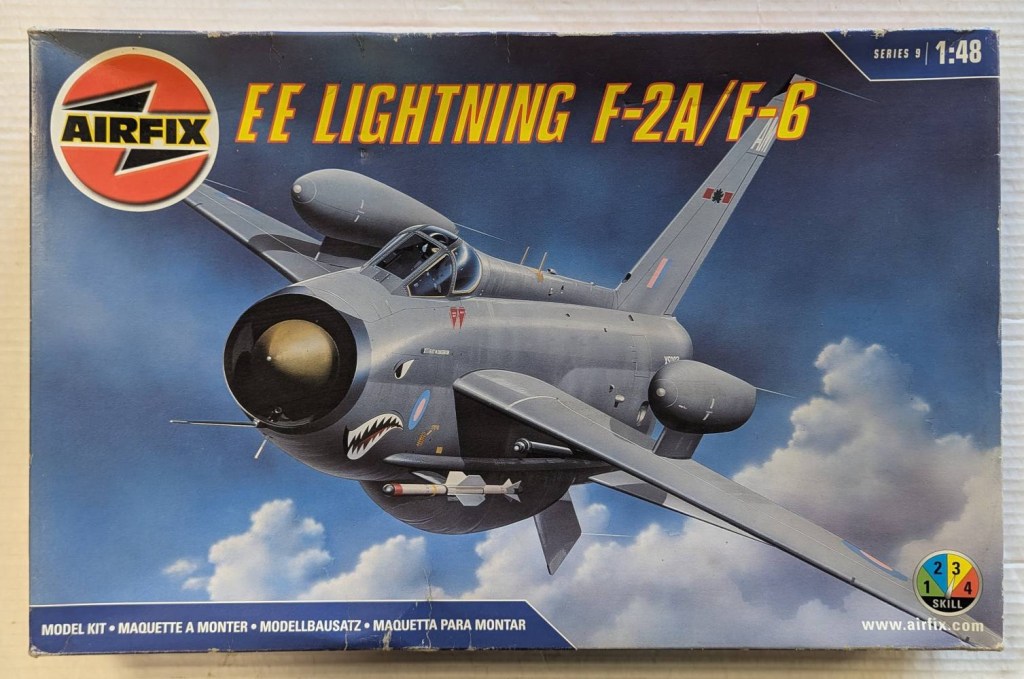
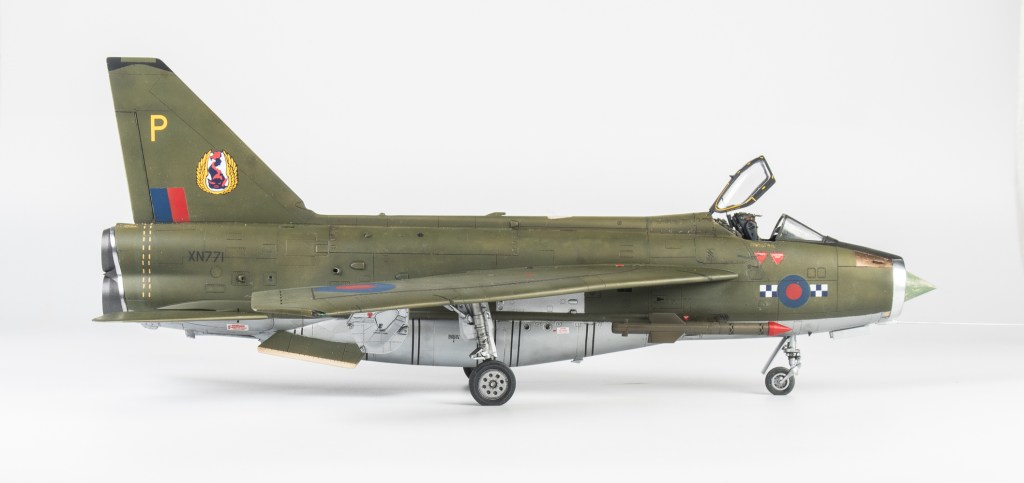
Airfix 1/48 Lightning F2A

image credit. Kingkit website
  • Purchased: 1998
  • Built: 2025
  • Enhancements:
  • Cockpit and seat – Cutting Edge
  • Wheels – Armory
  • Exhausts – Reskit
  • Wheel well roofs : Eduard PE
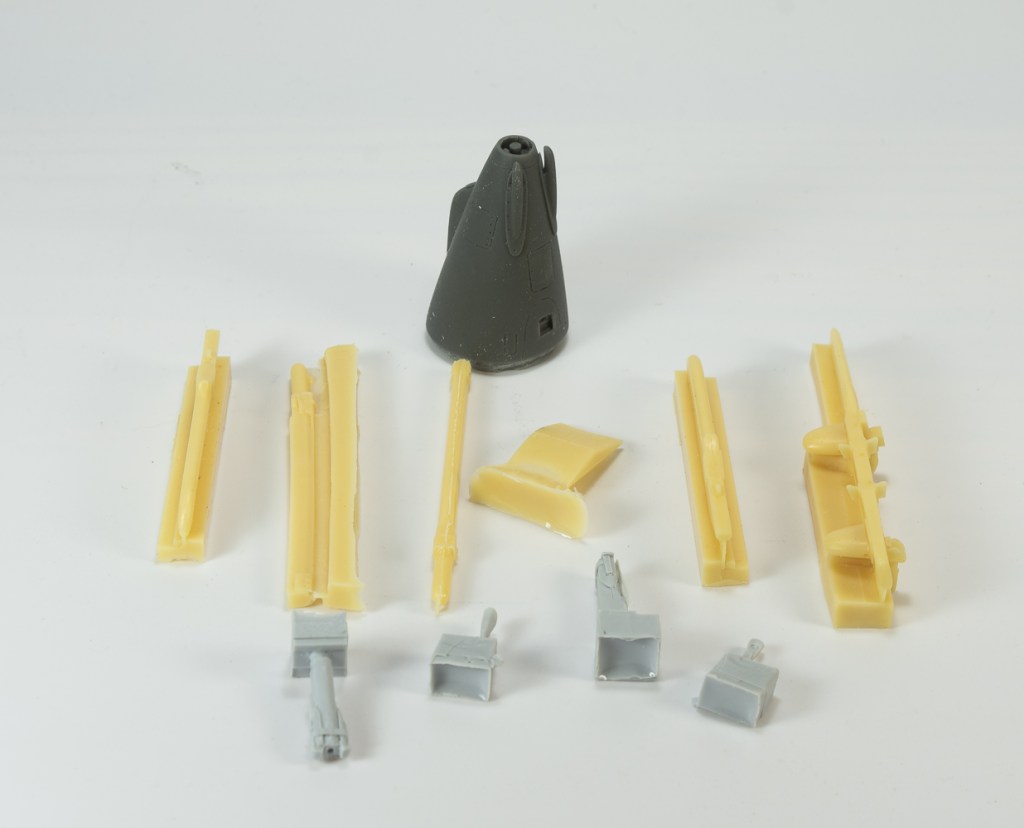
  • Missiles – Reskit
  • Pitot Tube – Master Details
  • Ladder: LP Models
  • Decals- Cutting Edge, then Model Alliance, then painted!

Introduction

This, after the Phantom is the oldest kit in my stash. It was purchased shortly after its original release from Wonderland Hobbies Scotland for the princely sum of 21.99 pounds according to the sticker on the box. Back when the only way to order kits from overseas was to actually telephone the shop! Back in the Jurassic Period before on-line ordering became the norm.

Upon release the Airfix Lightnings were lauded in the modelling press as Airfix at its zenith. And many modellers, particularly those from the UK still seem to think this.

This modeller though certainly does not. Perhaps if I had built the model upon its release, my impressions of it too, would still be favourable. However, building it in 2025 and measuring it – perhaps unfairly – against newer Airfix kits brings forward all its shortcomings. In fact, even measured against contemporary Japanese kits, it falls a little short. Poor cockpit details, no wheel well detail at all, vague instructions, sink marks, thick decals. It certainly was not the kit I was expecting. A mate came to the same conclusion after building his. The kit was the subject of the Annual friendly Build-Off between The HamFisted Modeller and myself. The results are judged at a local competition we both attend. It should be noted that HFM handicaps himself to give me a chance. (EDIT.) Suspiciously that last sentence only appeared after I sent the article to HFM for proofreading

Construction Notes

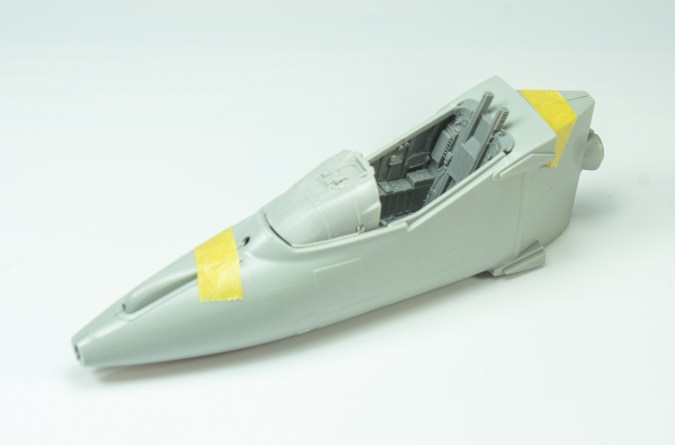
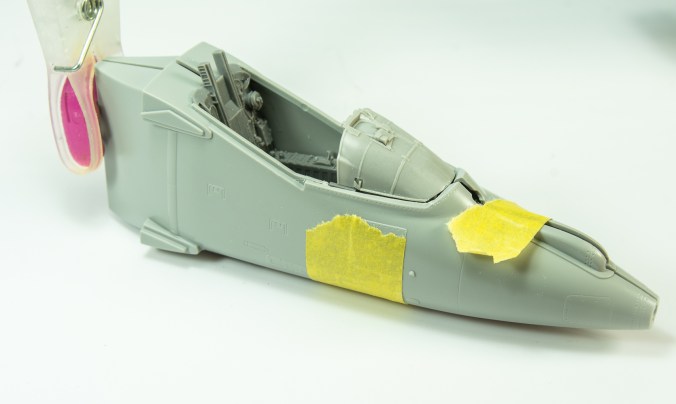
The Cutting Edge Super detailed Cockpit upgrade was one of many aftermarket sets stuffed in the box. It was used to replace the woefully detailed kit cockpit. Calum had stated that pretty much nothing of the cockpit can be seen anyway. Anyway , as I had the set, it was used. Unlike an Aires set, minimal sanding was required to make it fit. Just the backs of the sidewalls and some material removed from the casting block to ensure the tub sat down over the intake trunking.
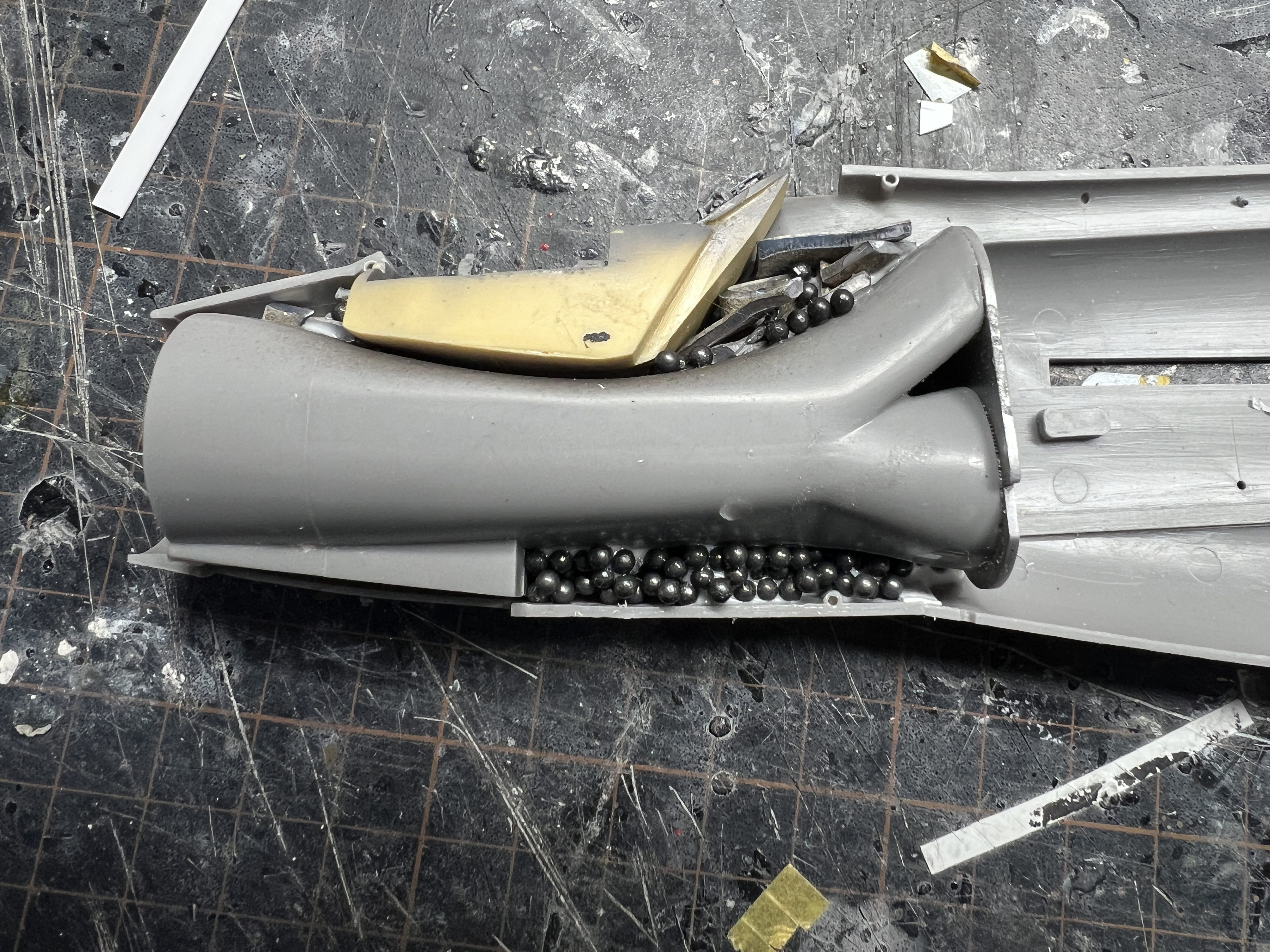
The cockpit was painted with MRP Medium Sea Grey, this being a later mark Lightning.

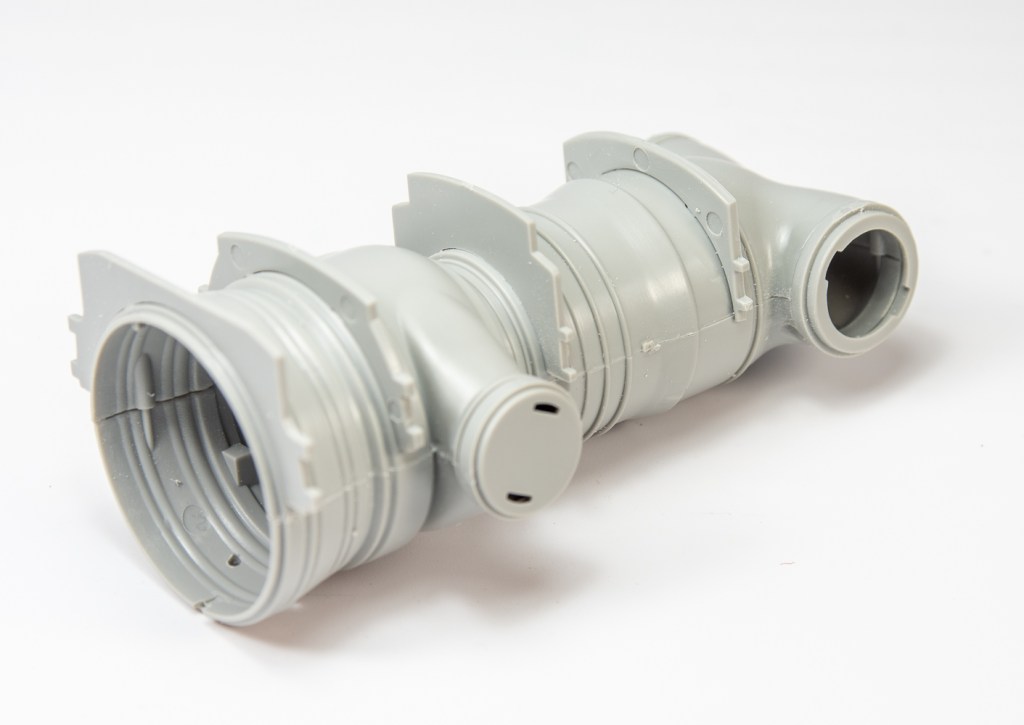
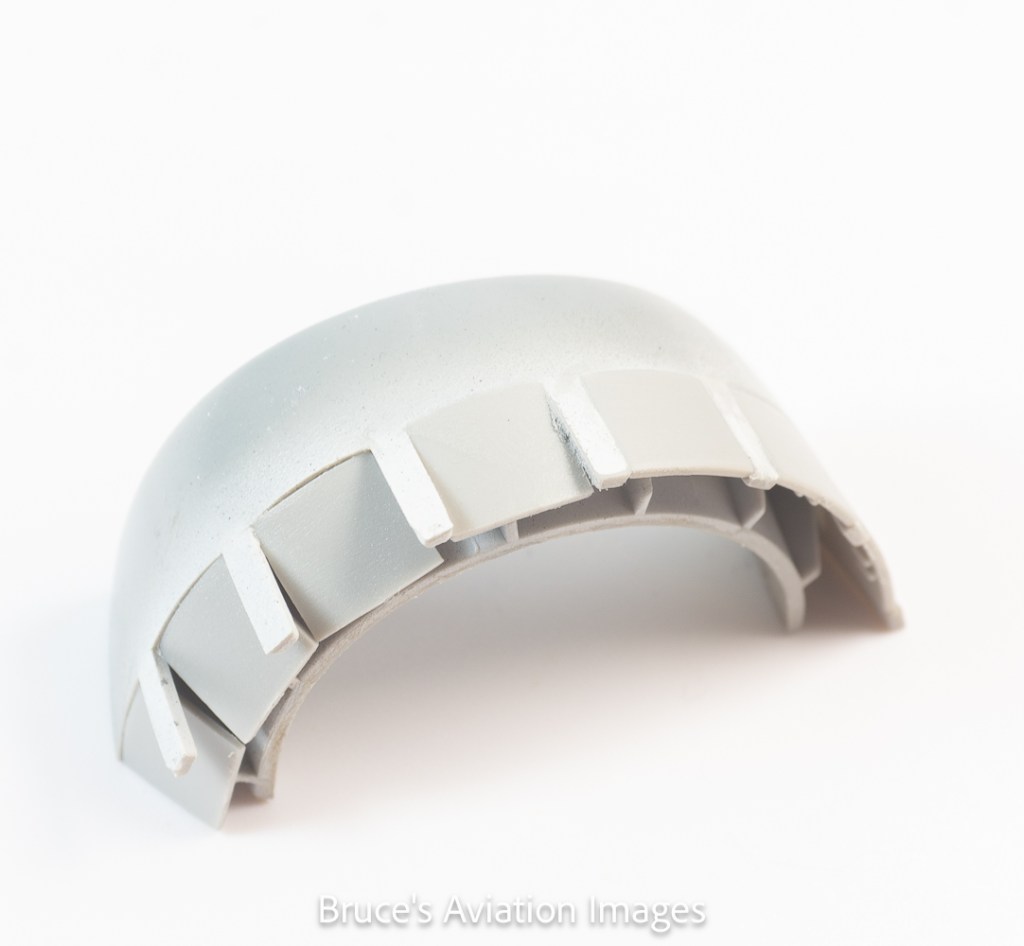
Building the intake we come to the first “WTF Airfix?” moment. The bottom of the nose wheel well is a rectangle to fit the wheel well opening. Airfix want you to mate it to the top half which is an elliptical shape. This of course leaves large visible gaps. I left it as is, as there id very limited viewing up into the well. Very poor engineering on Airfix’s part.

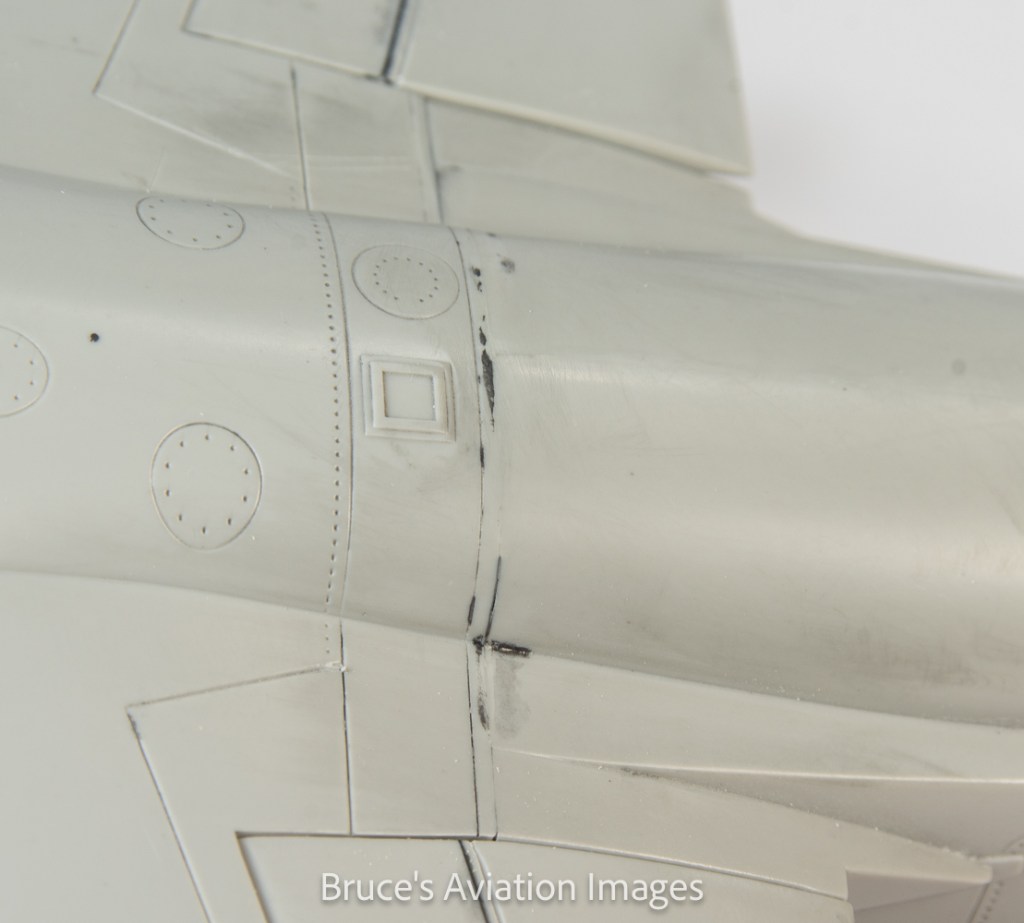
Take care to ensure the radar bullet nose cone is central in the intake. Also don’t forget the nose weight, remembering to take into account the added weight of resin exhaust cans if you are using some. Airfix helpfully includes a diagram in the instructions of the best place to pack it. The fuselage on mine closed up OK, but the panel lines did not align across the seams, requiring them all to be filled and rescribed. The nose ring is a poor fit and will require fairing in.

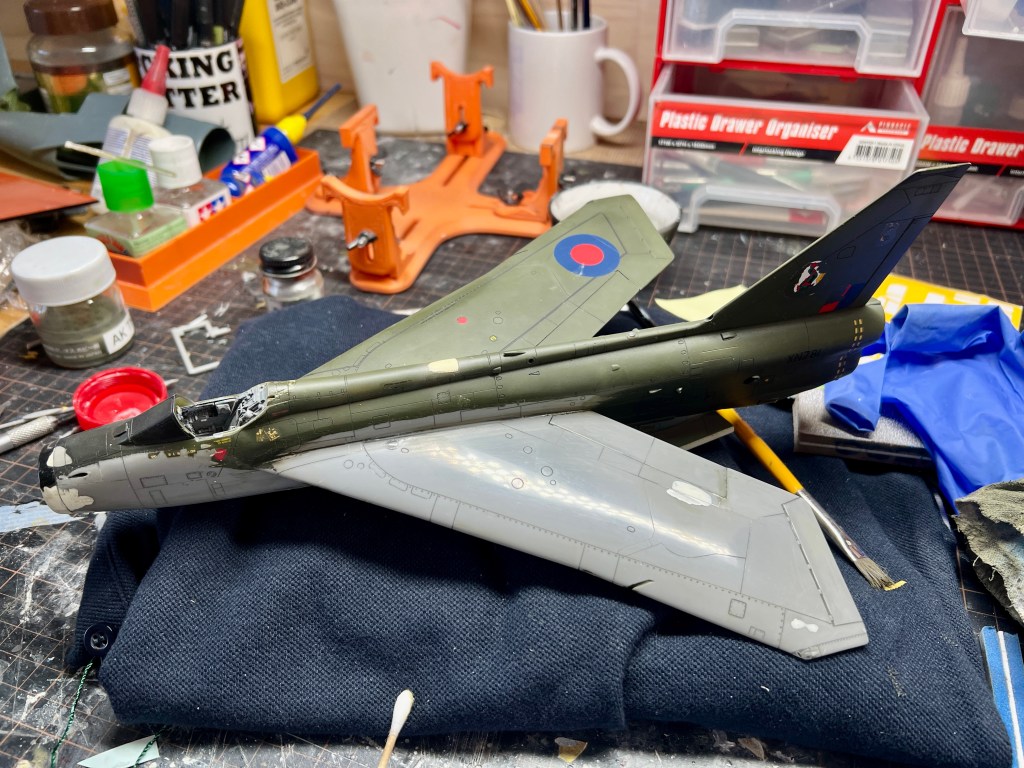
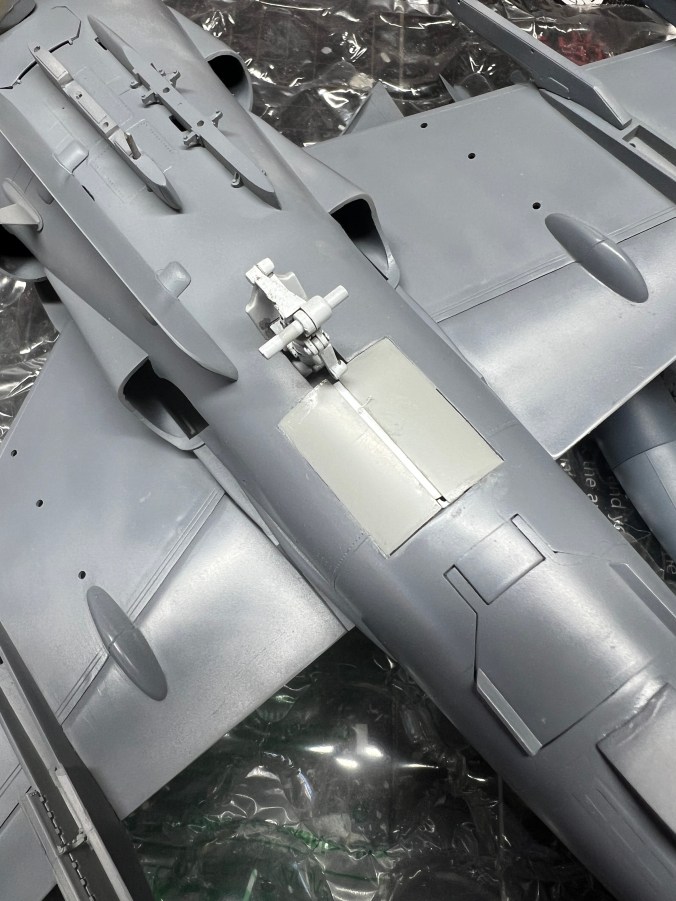
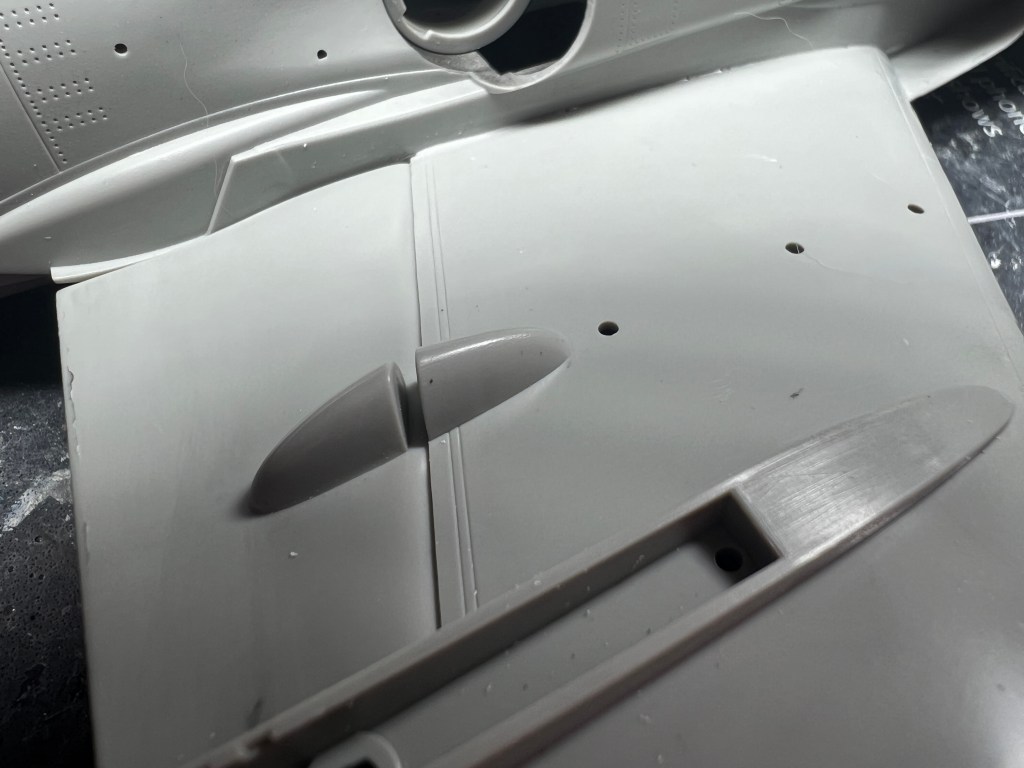
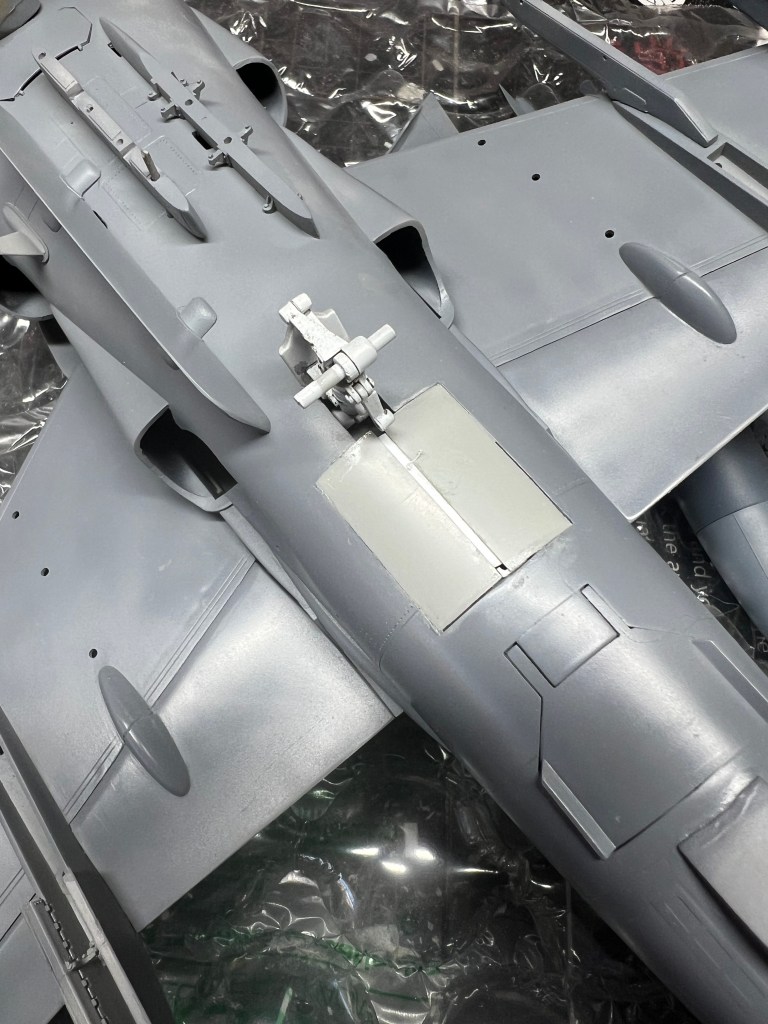
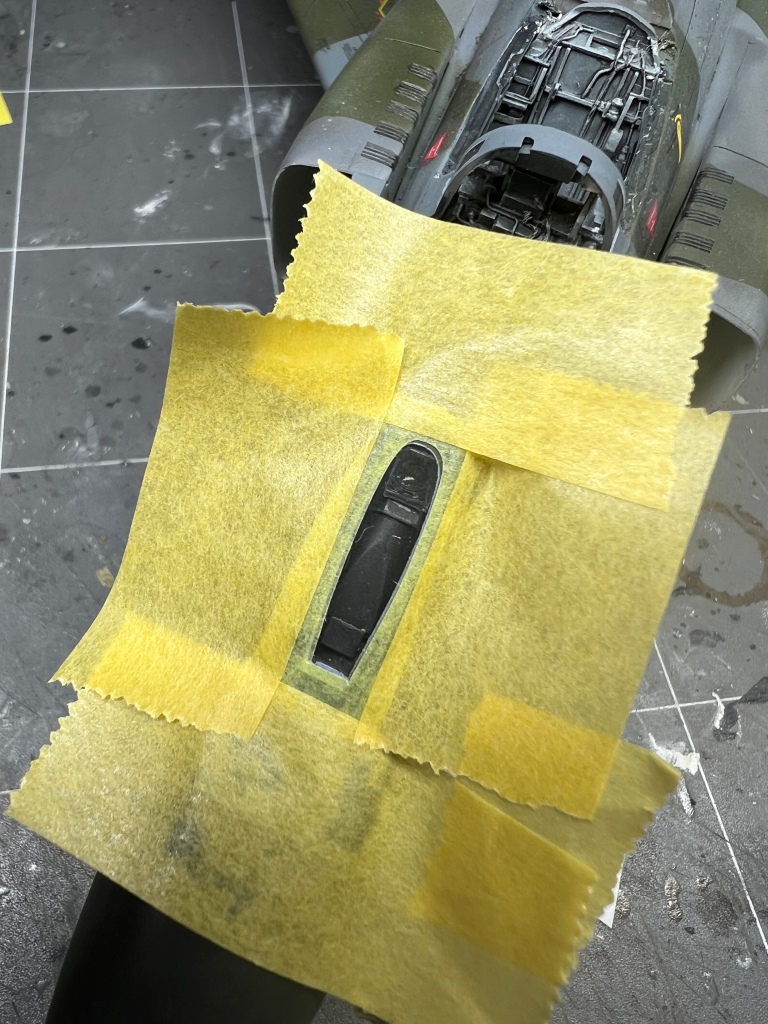
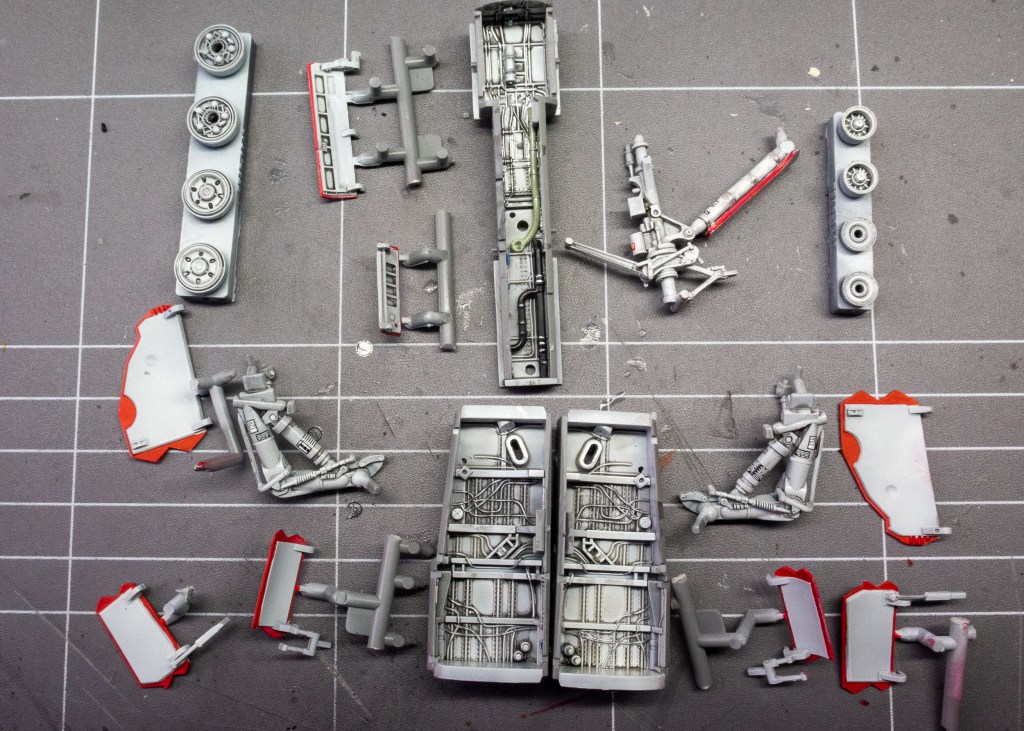
Onto the wings, and mine were looking a little warped. There were also several sink marks requiring filling. Airfix provide absolutely no wheel well detail. CMK and Aires both have resin sets in their ranges. I decided to steer clear. I knew full well the work these would require fitting to the model. Instead, The HamFisted Modeller generously provided an Eduard PE set. It was put to use to add the distinctive patterned roofs to the wheel wells. It is very worth your time to set up the undercarriage leg components now. Dry fitting them helps in seeing how they fit together. You must carefully look at photos of the real jet. The Airfix instructions are of no use at all. I had to add small blocks of sprue to each leg to allow the retraction strut to locate. There is nothing moulded on the leg. Again, really poor engineering by Airfix. I must apologise here as I thought I had photographed this step, but apparently not!

Out of the box, the kit wings do fit to the fuselage quite well, only problem is they are level, whereas the real wings had slight anhedral. Adding this to the kit wings left a slight gap on each top surface which was filled with Milliput

So far, despite the noted annoyances, the model had gone together reasonably well, and construction progress was swift. Unfortunately this was about to change rather drastically with the decalling.

Painting and Decalling

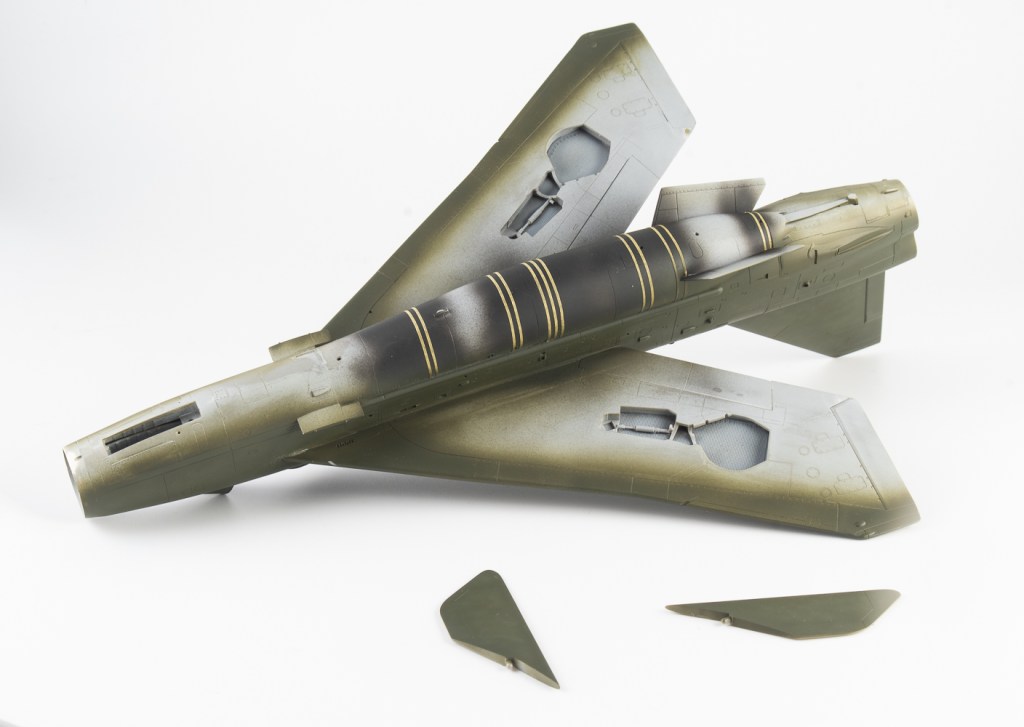
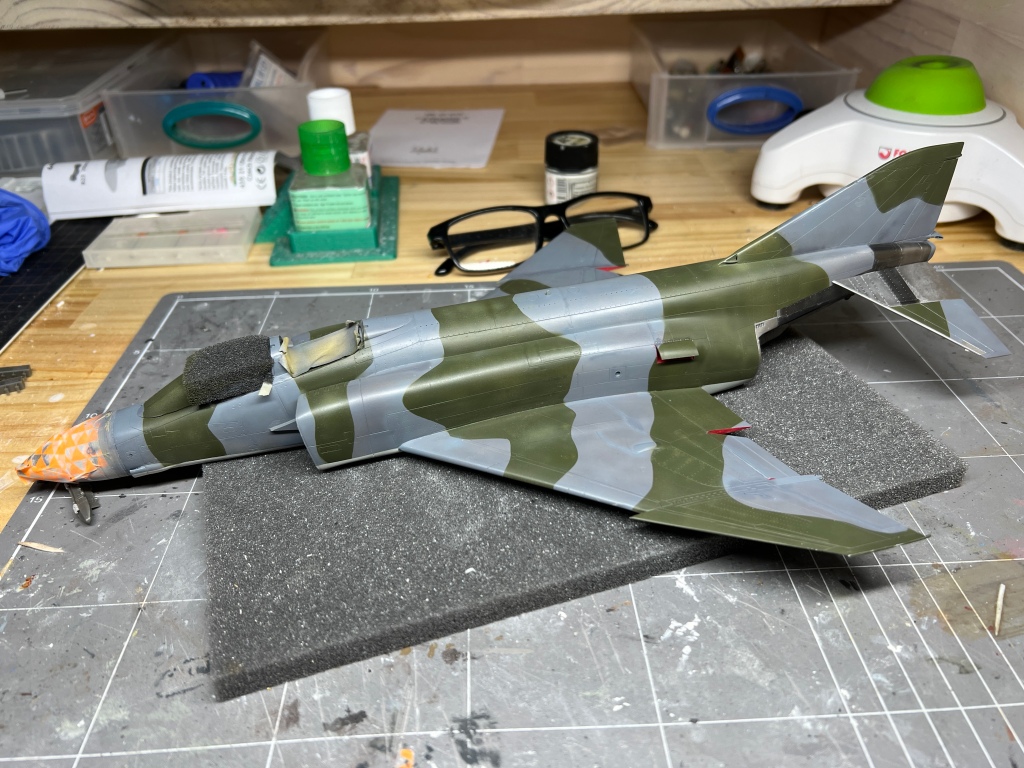
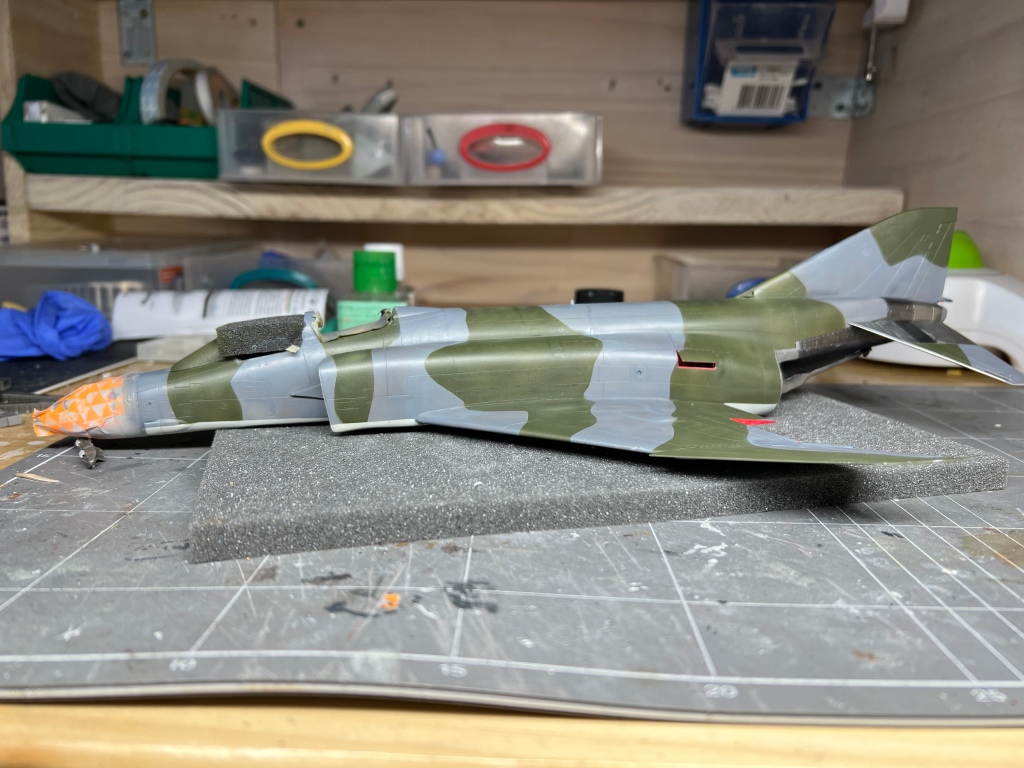
To limit the chances of silvering, I opted to paint the walkway and tank stripes. First, I applied a coat of matt black. Then, I masked out the stripes with thin strips of tape.
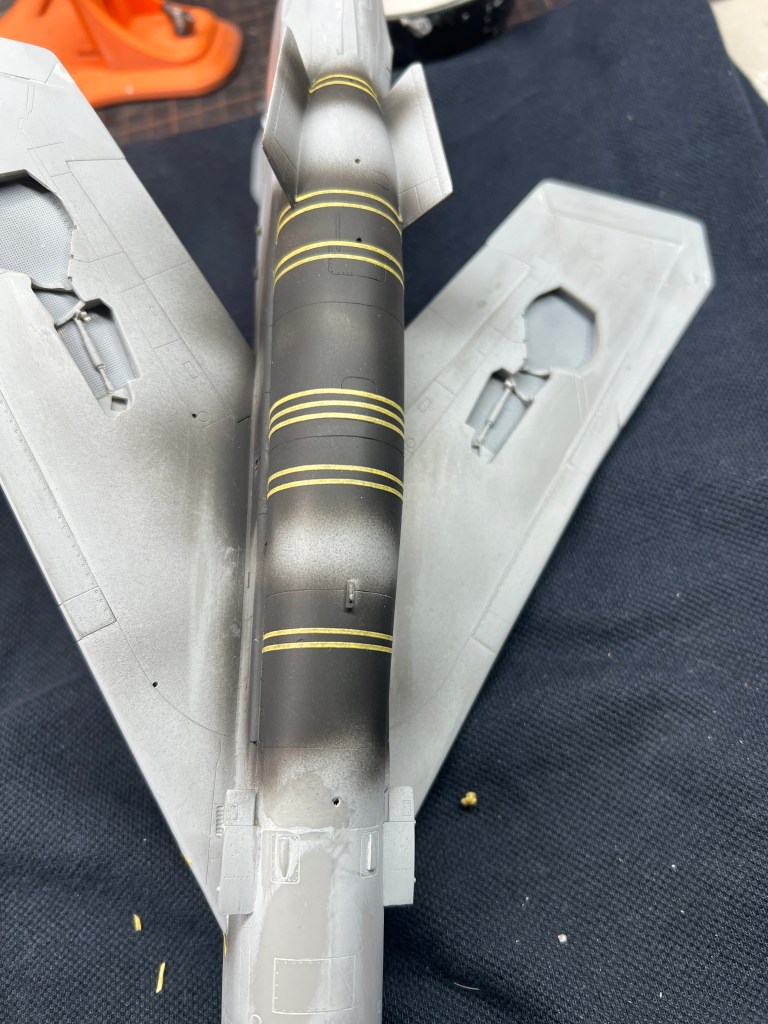
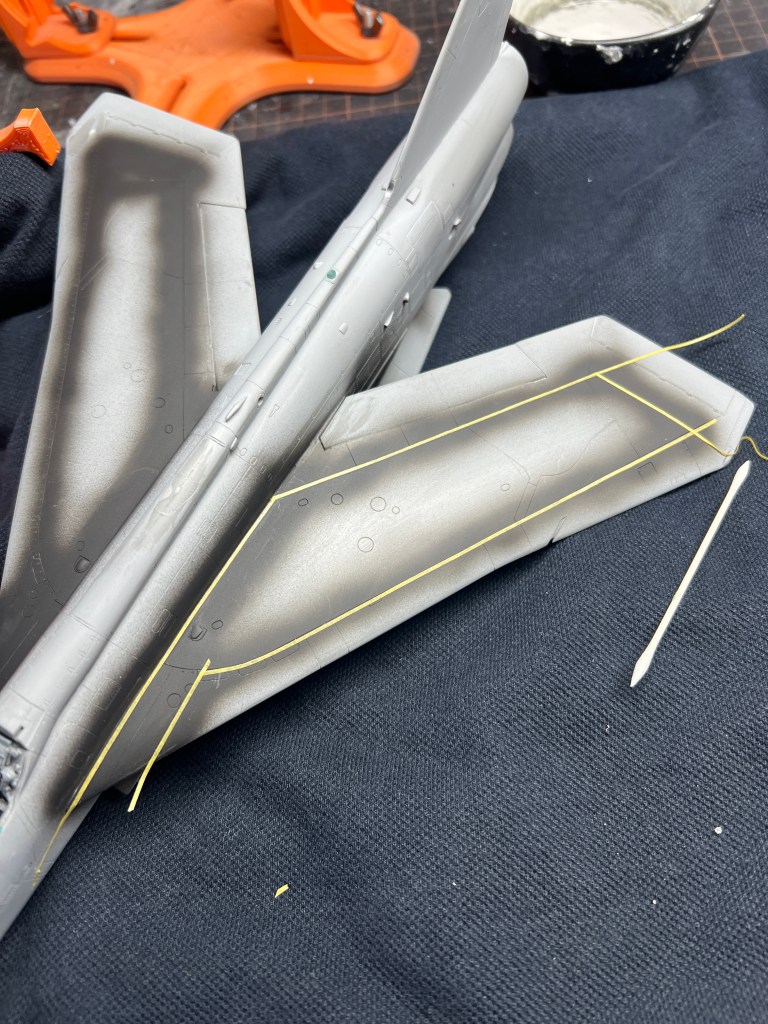
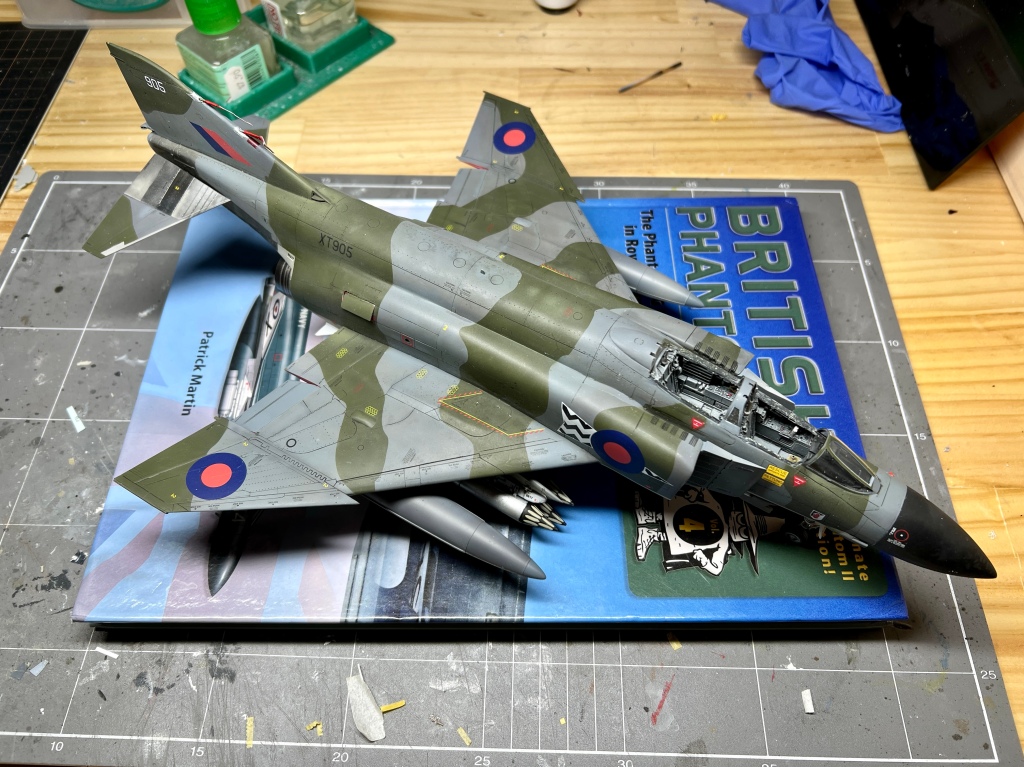
For the top surfaces, Gunze Mr Color 330 was used. Lightened as out of the bottle it is quite dark. Various shades lightened with yellow and white were applied with the undersides being spread with Tamiya LP-11 Silver
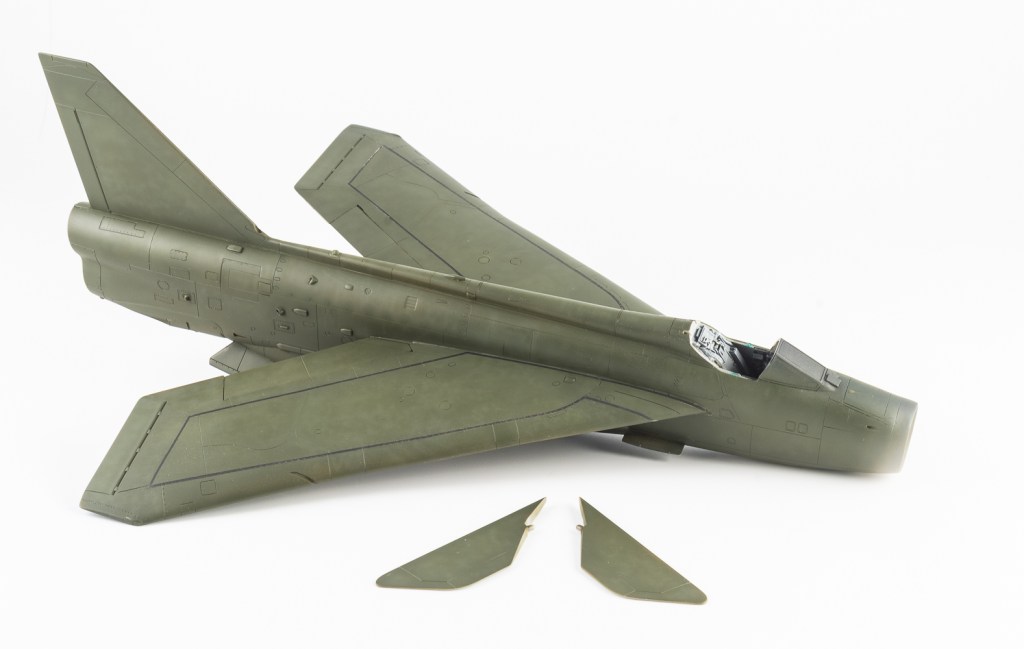
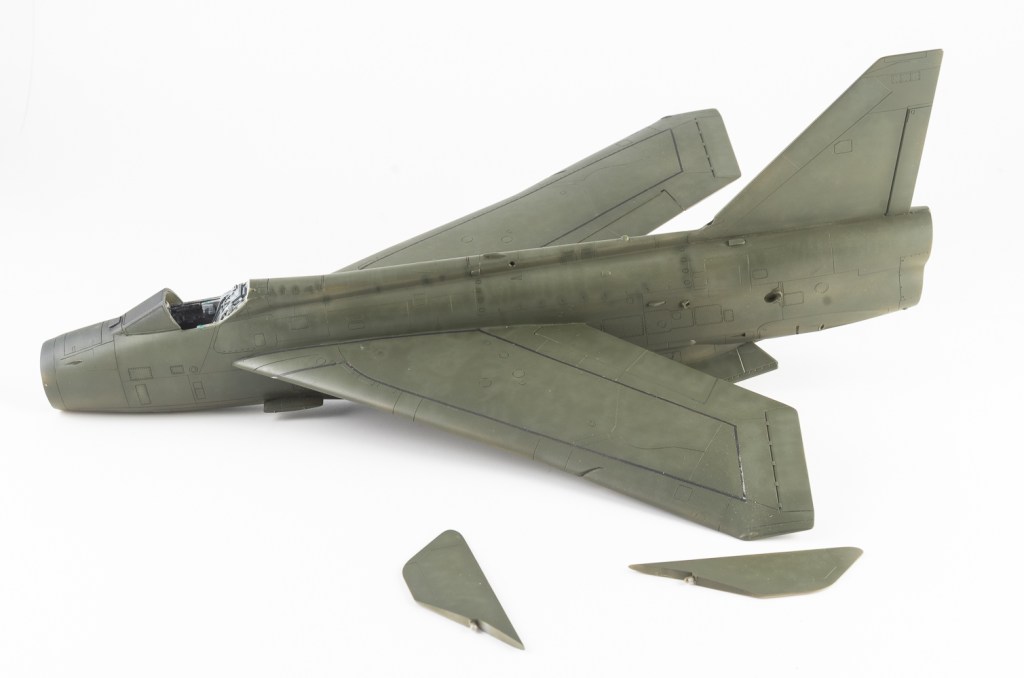
I was actually quite pleased with the appearance of the model. at this point so it was straight on to decalling. After applying a coat of Tamiya Gloss varnish. The decal sheet I was using was a Cutting Edge set. It had far better printing, colour, and register than the Airfix sheet. It should be noted that the sheet in my kit was the original issue. Later releases of the kit have included better printed decals

The Cutting Edge decals looked fine on the sheet, so the two large upper wing roundels were applied. One promptly tore whilst moving it into position , and the other separated into bits whilst in the water. Not a great start, but not to worry as these would be easy to mask and paint. Next up were the various individual jet markings. All decals were sandwiched between a layer of Mr Setter and Mig Ammo decal solvent.. I rolled a cotton bud across some of the decals to squeeze out excess solution. This revealed some of the decals were not adhering to the model very well..

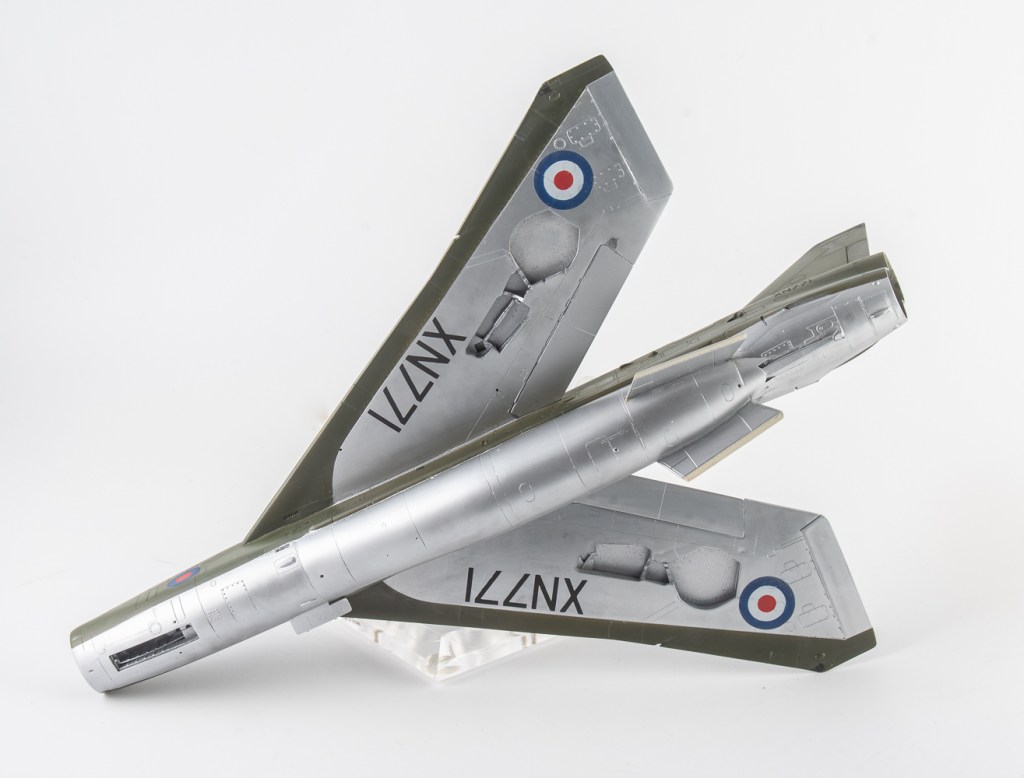
A sealing clear coat was applied. Then, a wash using Tamiya dark Brown accent colour was run into all the panel lines. It was now that the lack of adhesion from the decals started to give me problems. After inspecting the model, I found that I had managed to remove the face of the gargoyle at some stage. Possibly with my sticky mitts! This was patched using a bit of the Airfix decal. Further handling of the model pulled the nose checks off, despite my gloves and the protective gloss coat. Some of the underwing serial numbers also pulled off, again requiring replacement.
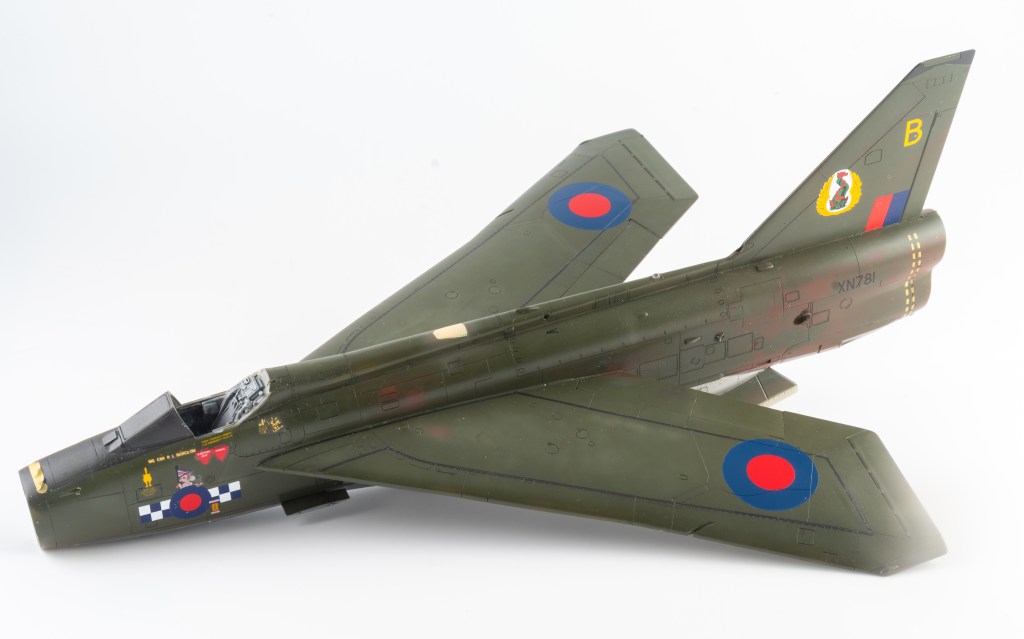
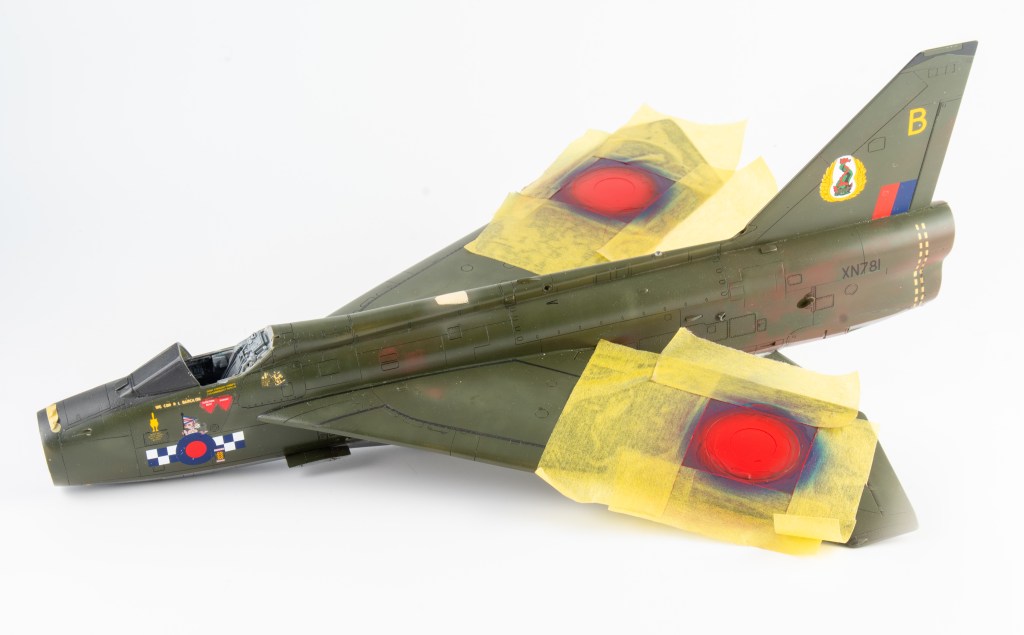
SMS Matt coat was used to dull down the gloss to achieve the flat finish I wanted. SMS is one of my favourite matt coats, drying to a low sheen smooth finish. Not this time though, as there was frosting evident around the flanks of the fuselage behind the wings.

With its mid mounted swept back wings, the Lightning has a multitude of tricky areas to get an airbrush into. All those right angles caused turbulence in my spray pattern. They resulted in texture and buildup of the clear coat. I had some frosting along the fuselage underneath the wings. There was also some silvering evident on some of the smaller decals. I was starting to feel like the model was getting away from me but I pushed on anyway as I really wanted it off the bench. Everything came to a head., when whilst masking off the nose ring, a corner of the tape caught the nose check decal. It pulled them off with far too much ease.
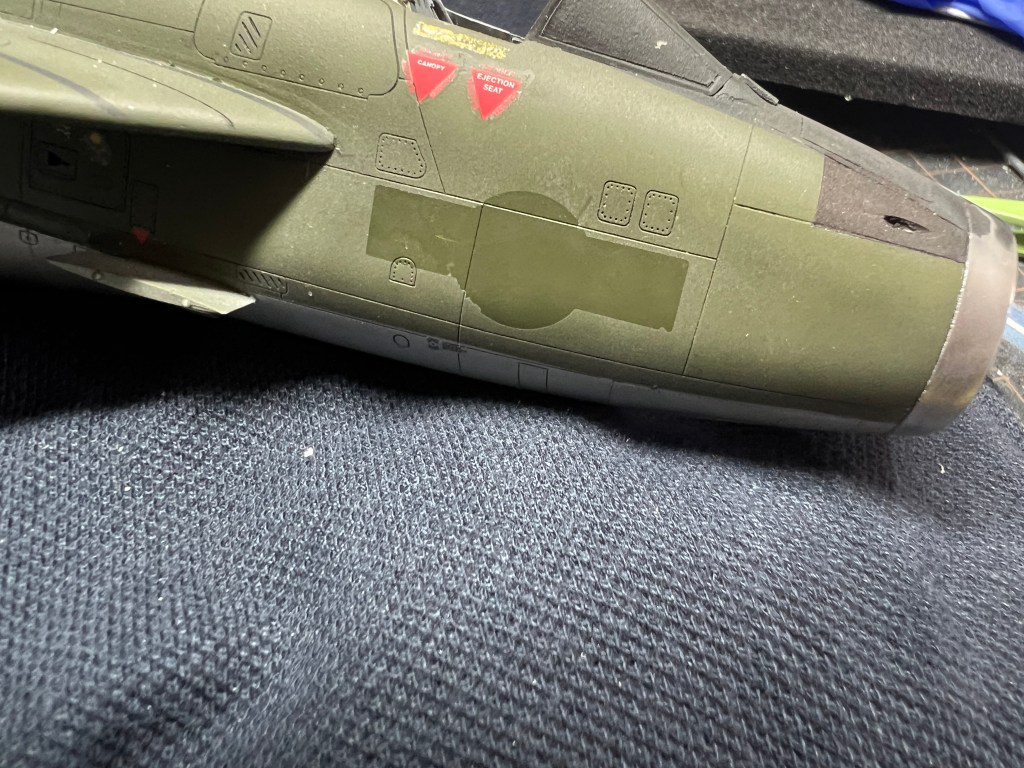
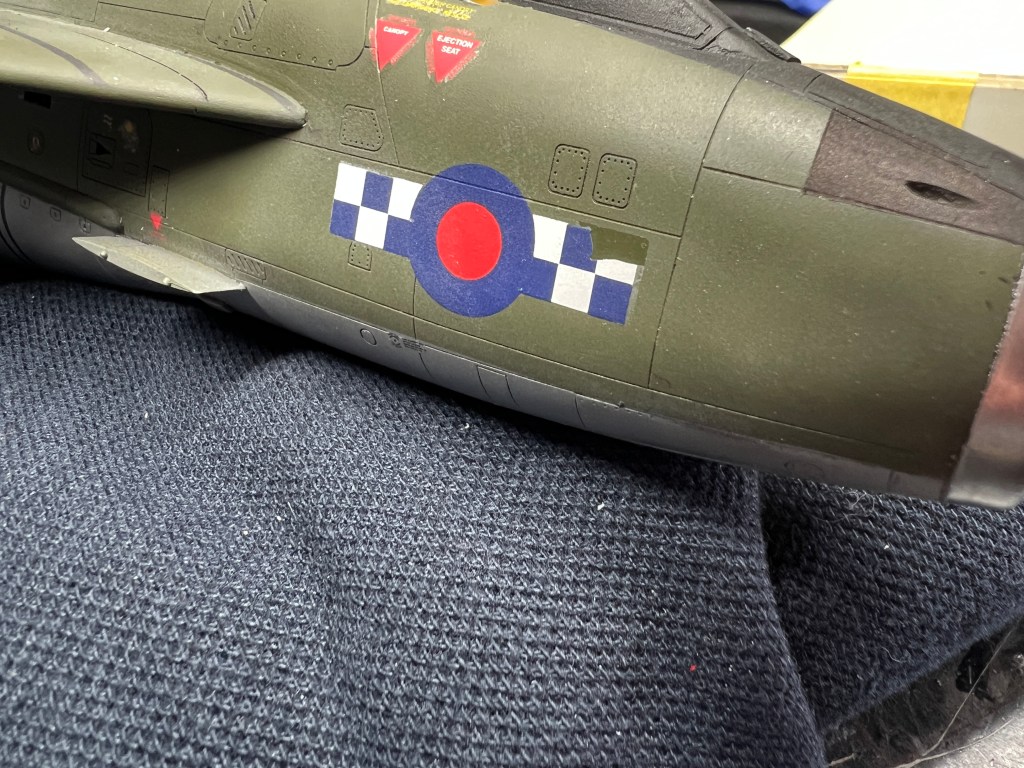
To be honest, the kit almost got binned at this stage, but I decided to sleep on it. In the morning, a thorough analysis was taken of my progress on the model. There were several aspects I was not happy with. These included the frosty matt coat, silvered decals, and textured paint. Therefore, the decision was made to strip it back to bare plastic. Also I knew a DNF (did not finish) would subject me to much “Gibson Grief”, and no-one needs that!

So, out came the VMS Clean Slate and after some vigorous scrubbing we were indeed back to a clean slate.
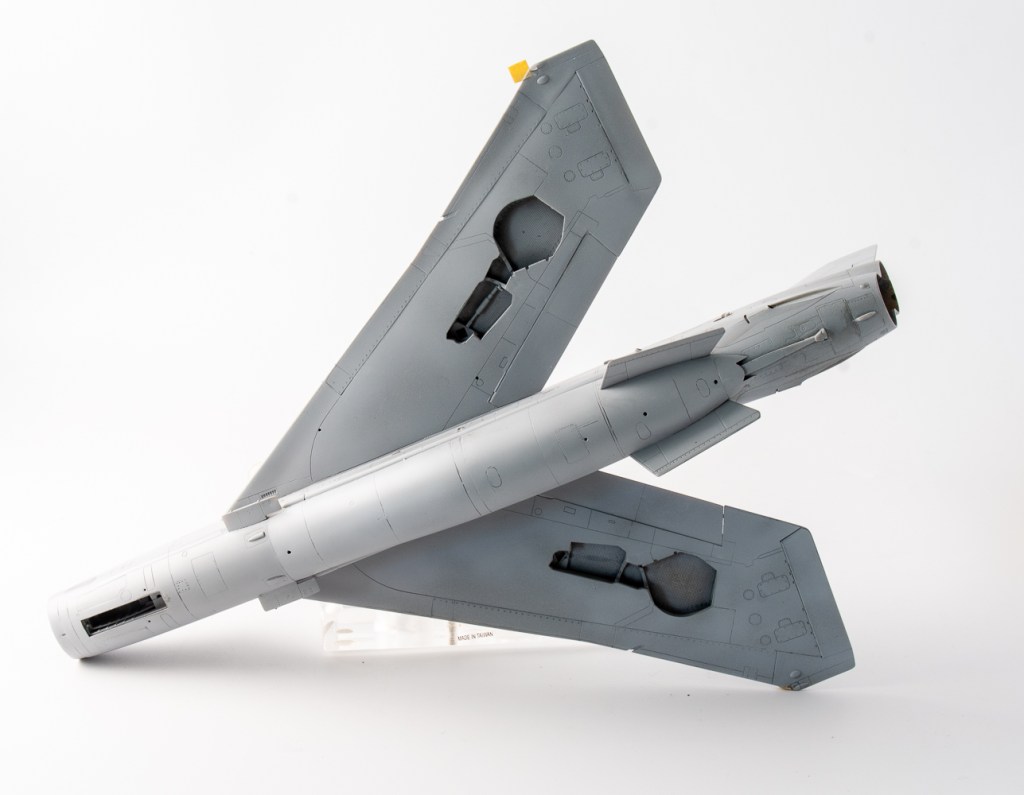
Then, it was simply a matter of repeating all the steps. This time, I painted all the National Markings and serials.
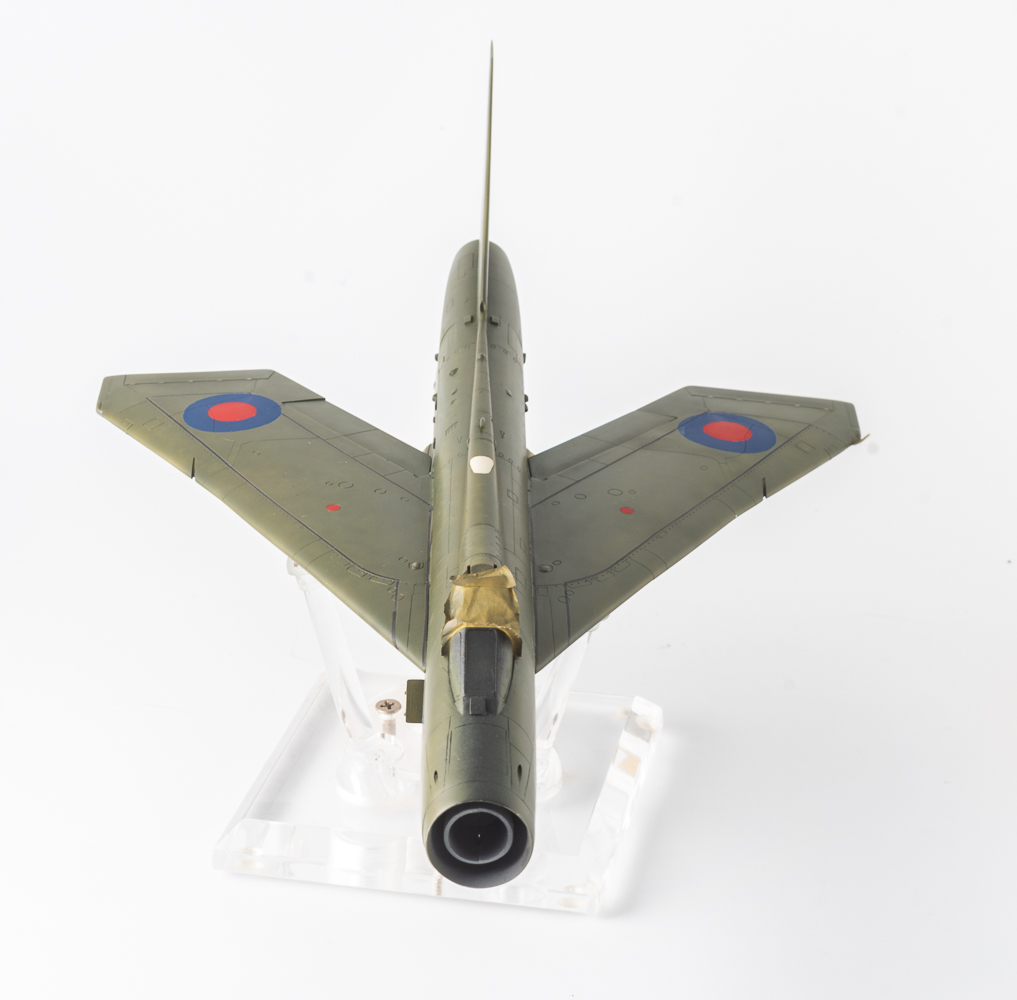
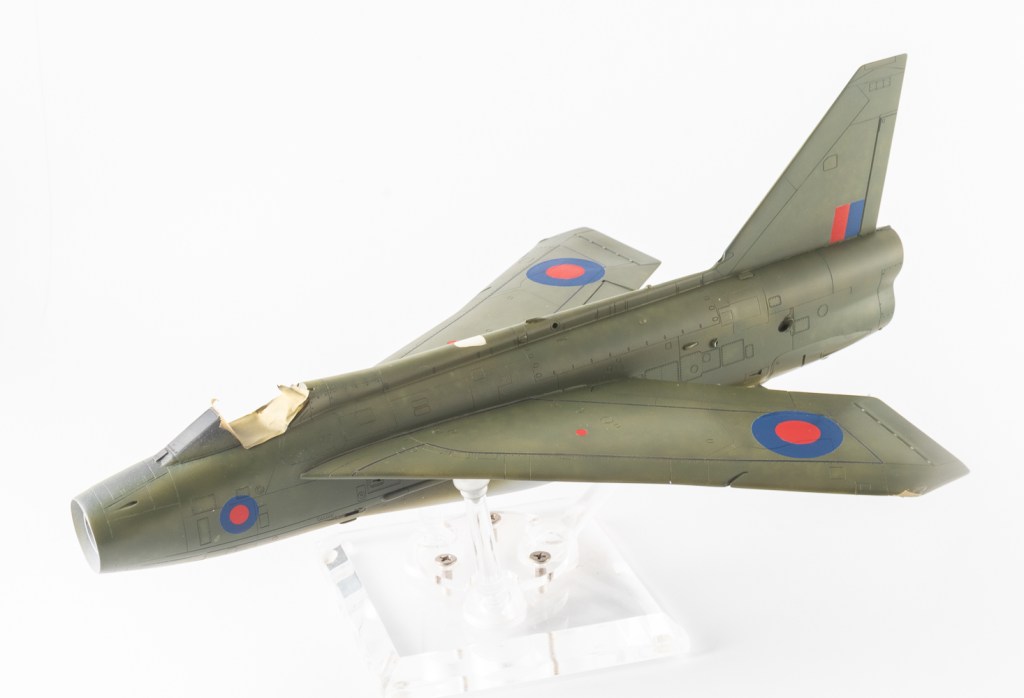
A mate sent me a set of Model Alliance decals for another jet from the same SQN. These were applied without issue. However, I had to scrimp on the stencilling out of necessity this time around. There were no yellow stencils left on any of the sheets. The Barracuda stencil sheet is very comprehensive. However, Roy, for some reason, includes none of the unique yellow stencilling seen on the RAFG jets. Quite a glaring omission in my book.

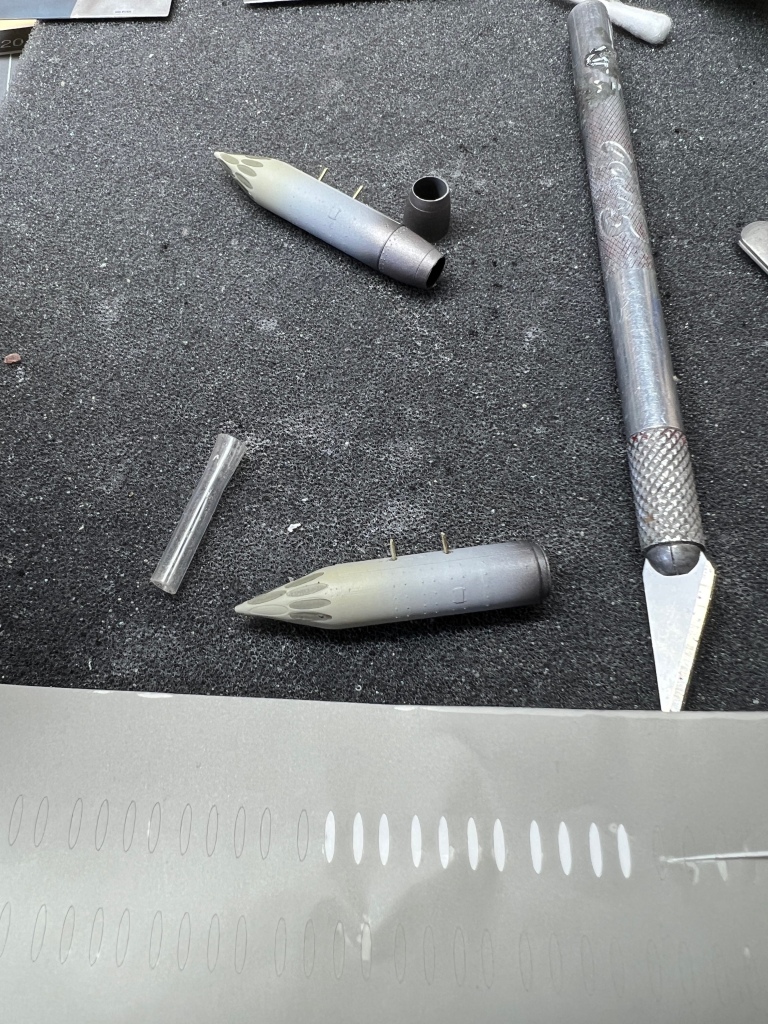
Again a Sepia wash was applied to all the panel lines. By this time, I was well over the model. Weathering was limited to some chipping around fasteners. This chipping was evident in all photos of these jets I looked at. The chipping on the nose cone was done using the hairspray method. That just left final assembly. Whilst the Reskit missiles are beautiful models in their own right, they lacked positive location devices. There was no way to mount them on the rails. I understand this is to preserve the detail on them and the rails. If you wish to mount them off the jet, 3DP should surely allow you to print them with solid locating pins. These pins can be cut off or filled if not needed. I glued them on with copious amounts of white glue.

The undercarriage was easy to locate, thanks to my pre-planning. and adding those bits of plastic stock.

Conclusion

Finally, it’s done, But, Man! What a slog in getting there! This was mainly to do with unforced errors on my part, but the kit certainly played its part.

It’s great to have a Lightning in the green RAFG gracing my shelves again. My first Lightning in this scheme being the ancient Matchbox kit way back in the 1970s. My love for this scheme has stayed with me ever since. To my mind’s eye, it looks like what I envisioned when the build was started. This is due to me making the decision to strip and repaint the model. Even so, it’s not my best work. It looks just workmanlike. However, it is far better than it would have looked if I had continued pushing ahead with the original finish.

Regarding aftermarket used, the only essentials in my opinion would be a seat and metal pitot tube. Nothing can be seen of the cockpit, or even the wheel wells, despite the high wing. The Armoury wheels look good and are weighted but ,the kit wheels also suffice.

The Lightning is such a brute of a machine and an icon of Cold war British Air Power. It deserves to be retooled up to Airfix’s current standard. In its current form, Im not sure I’d build another one.

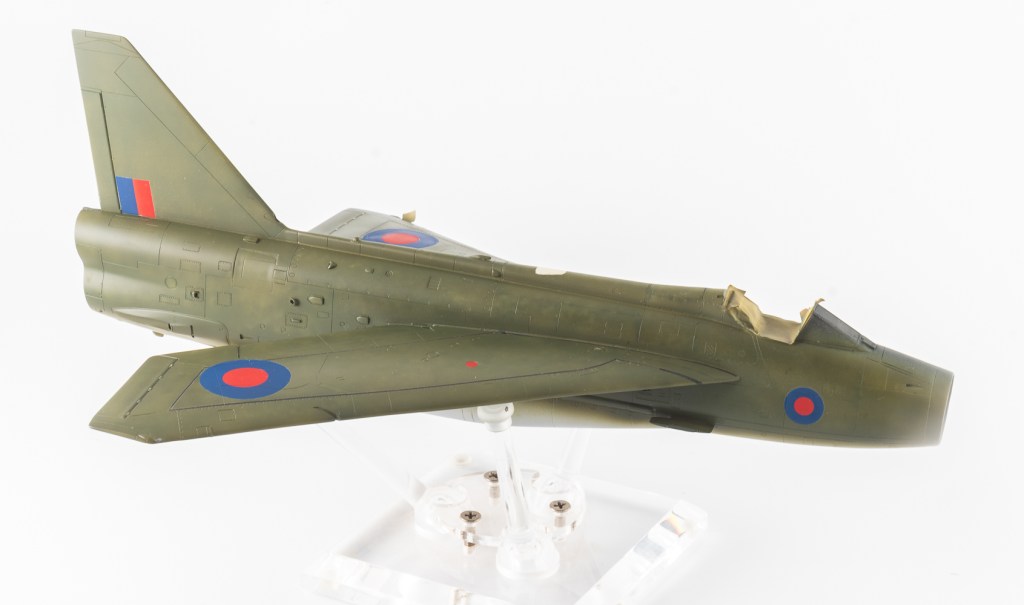
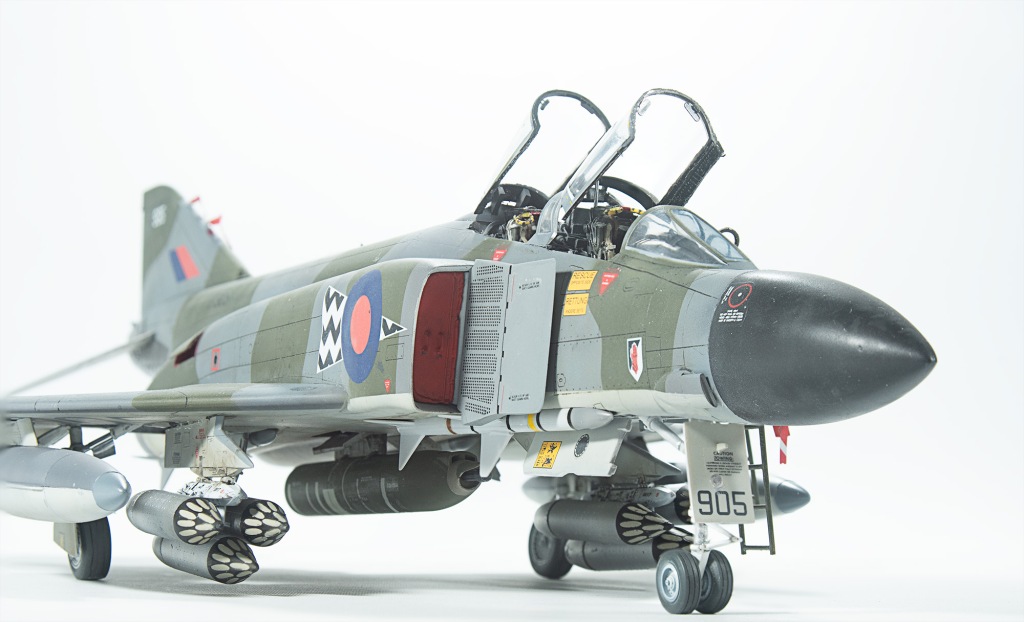
E.E Lightning F2A. Royal Air Force 19 SQN. Guttersloh Germany 1973
Leave a comment

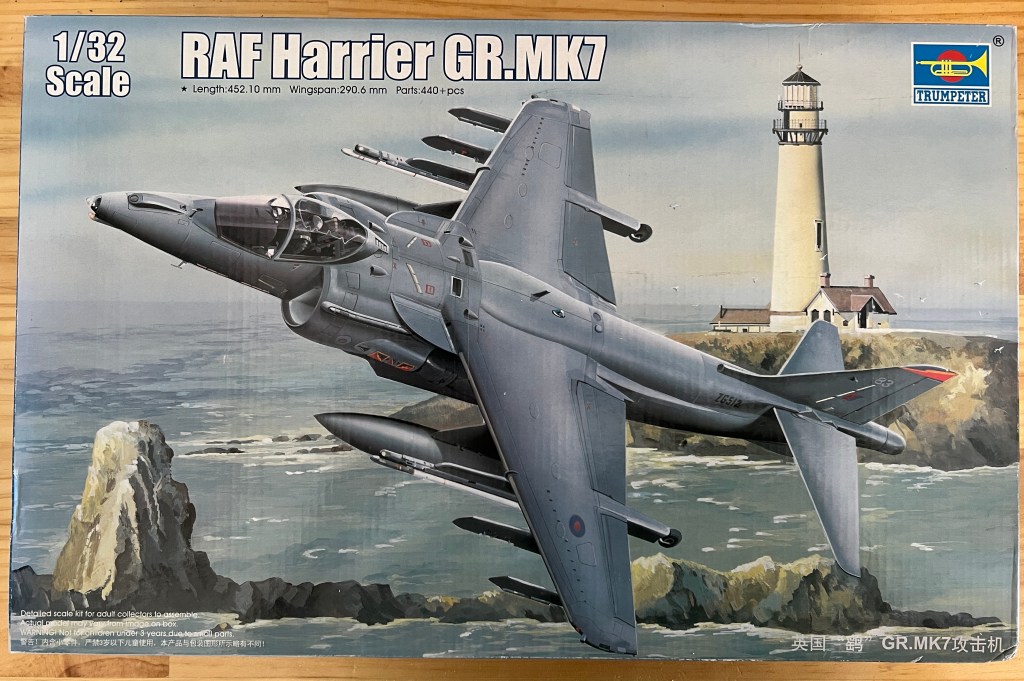
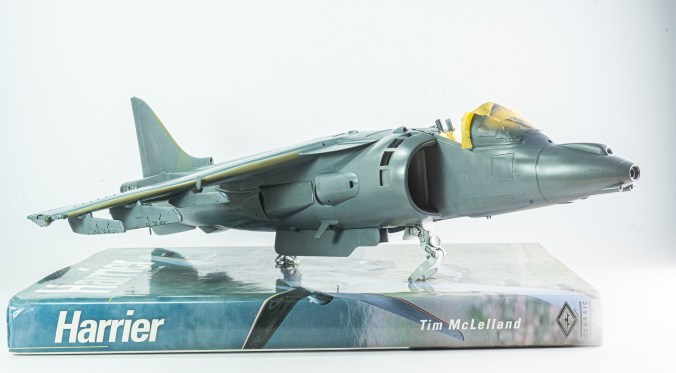
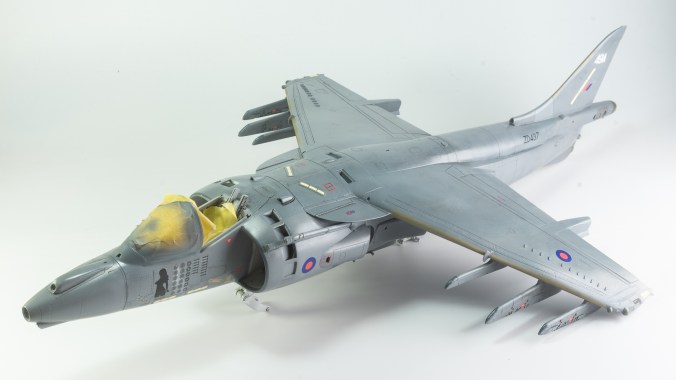
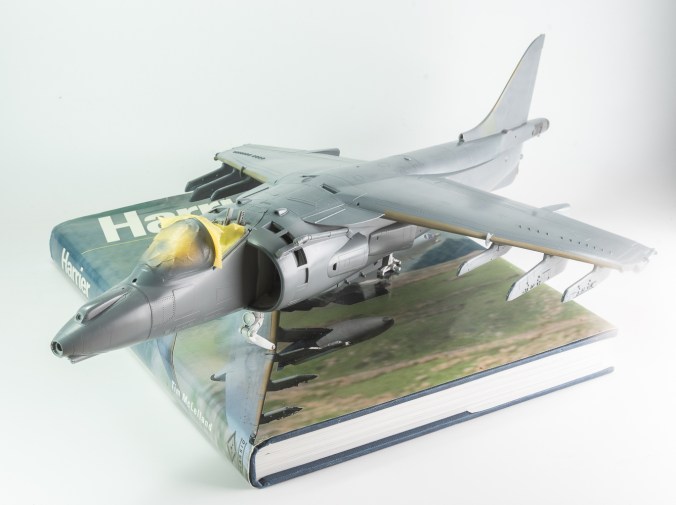
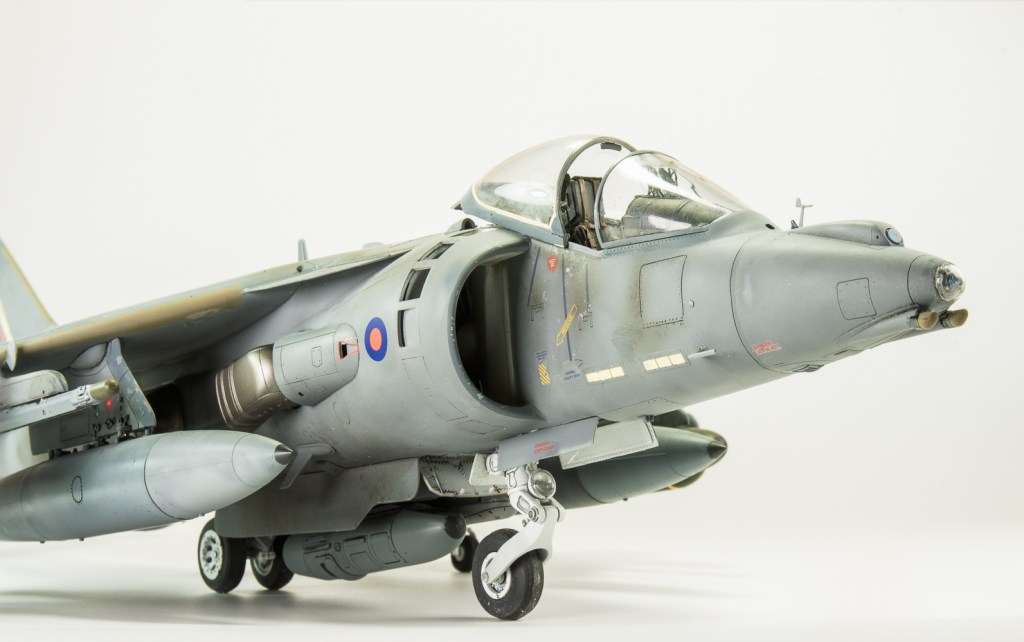
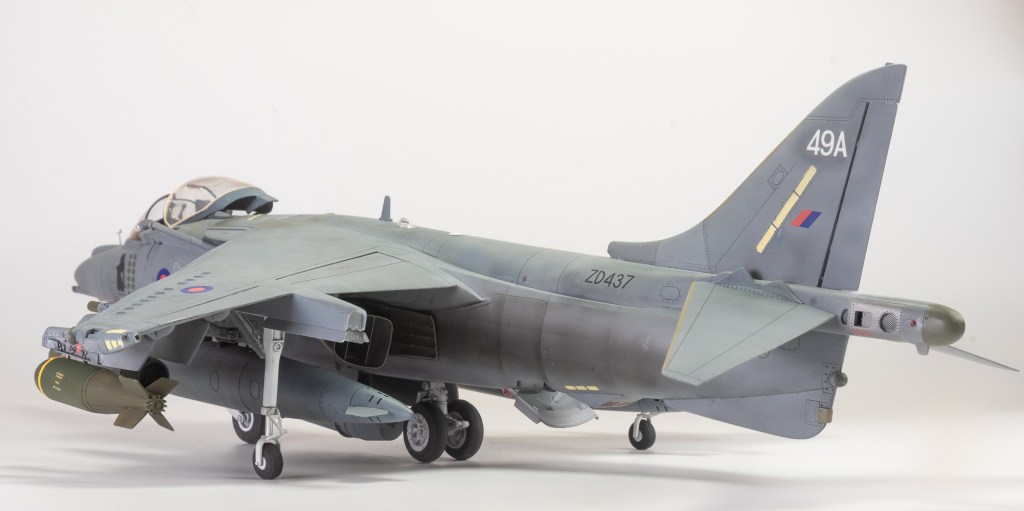
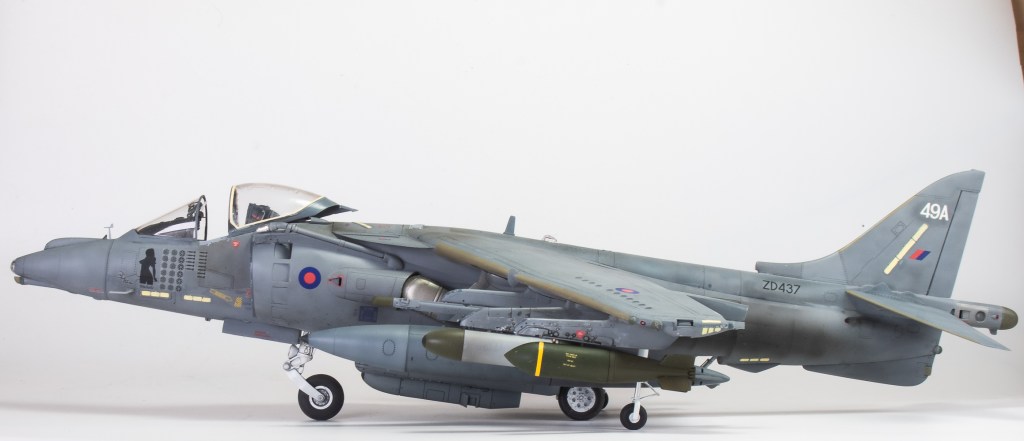
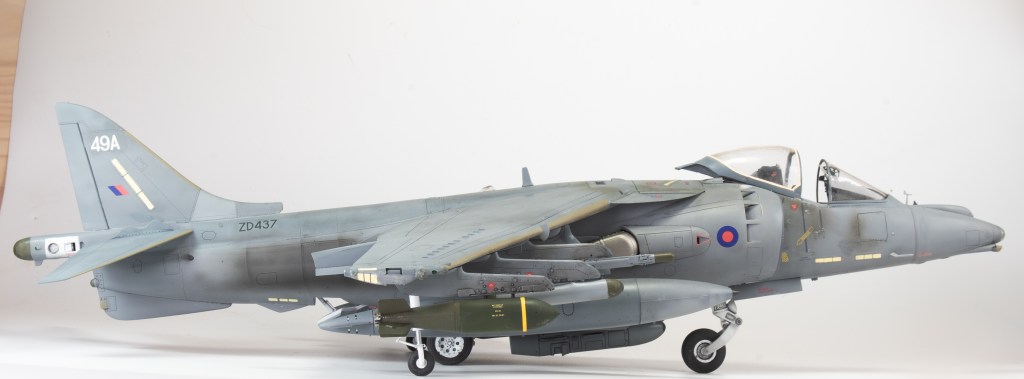
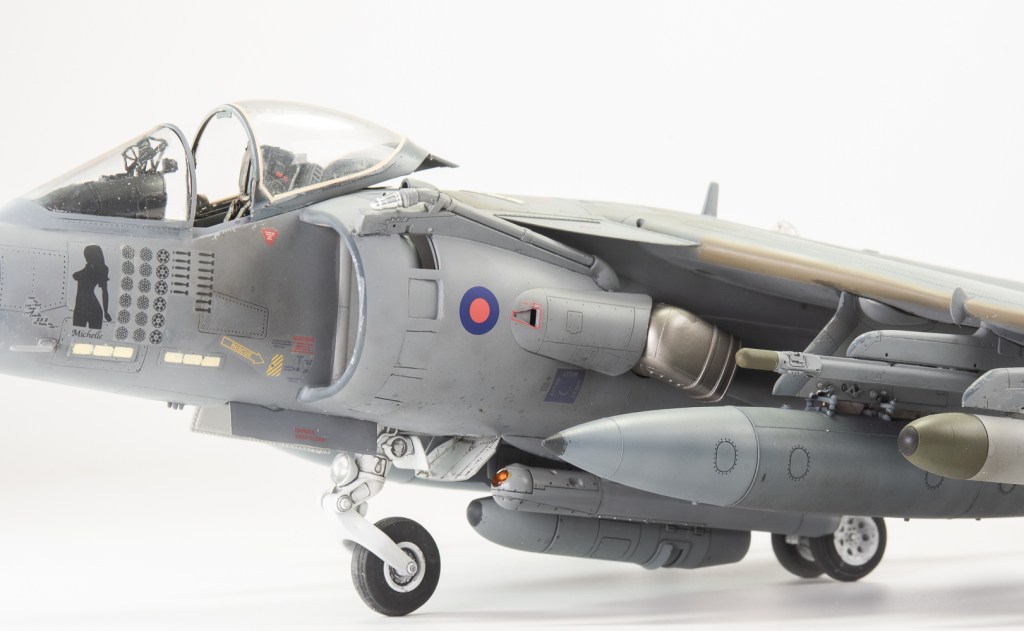
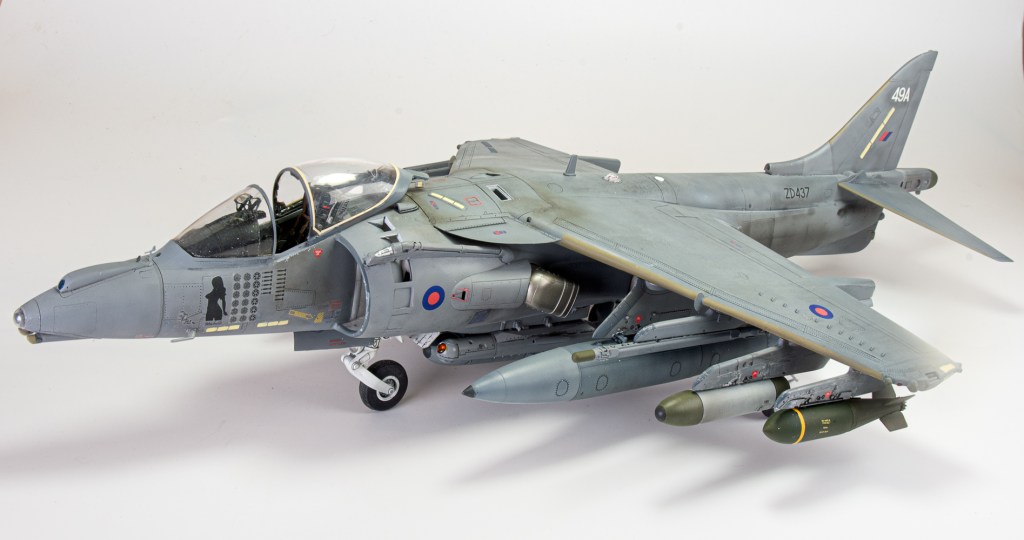
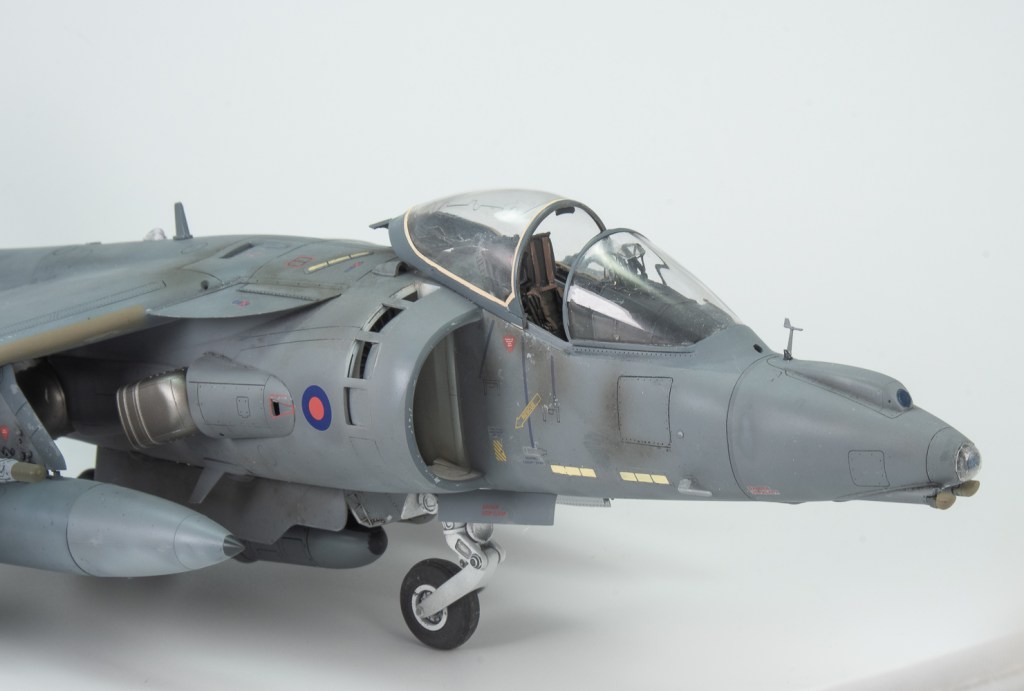
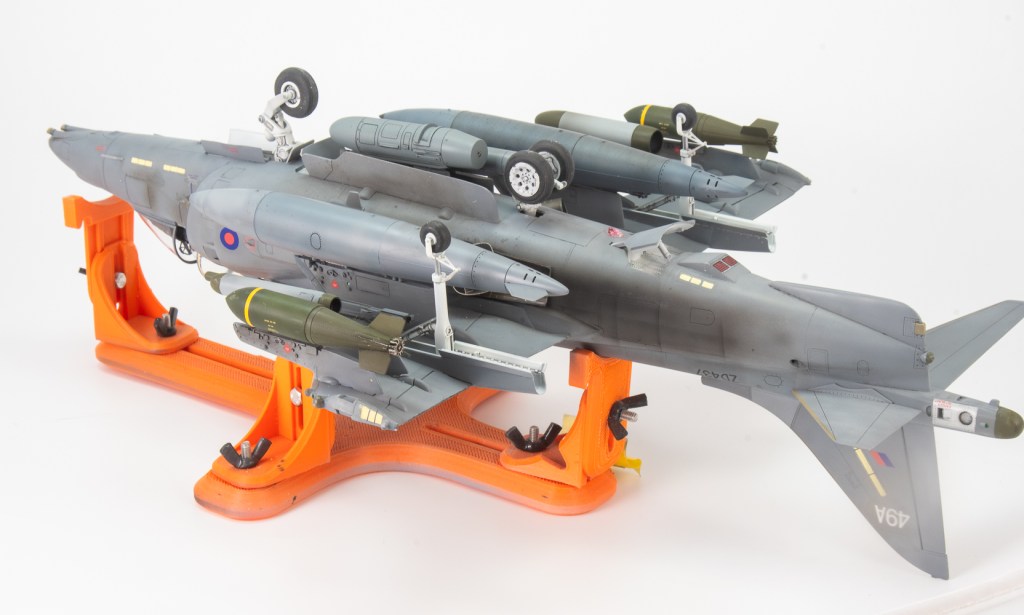
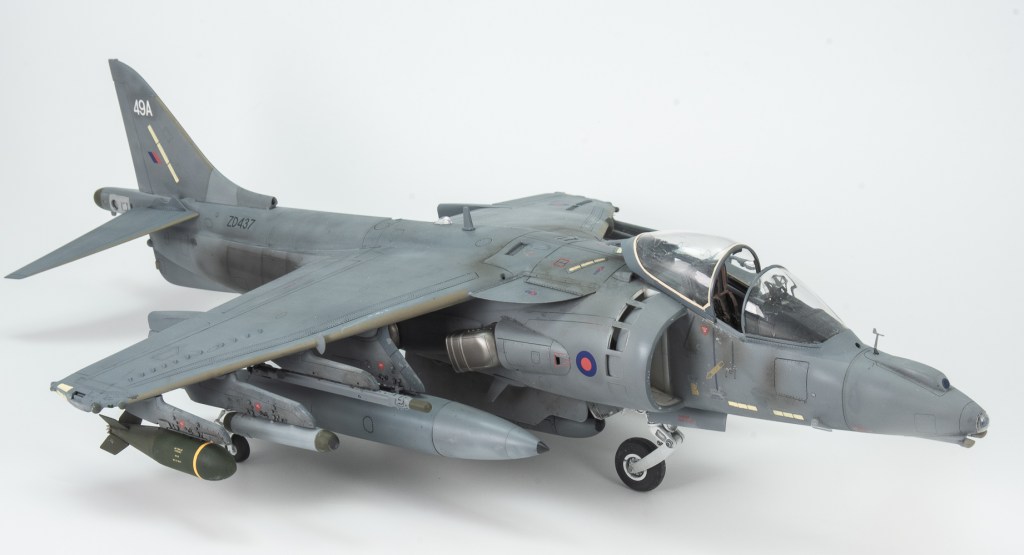
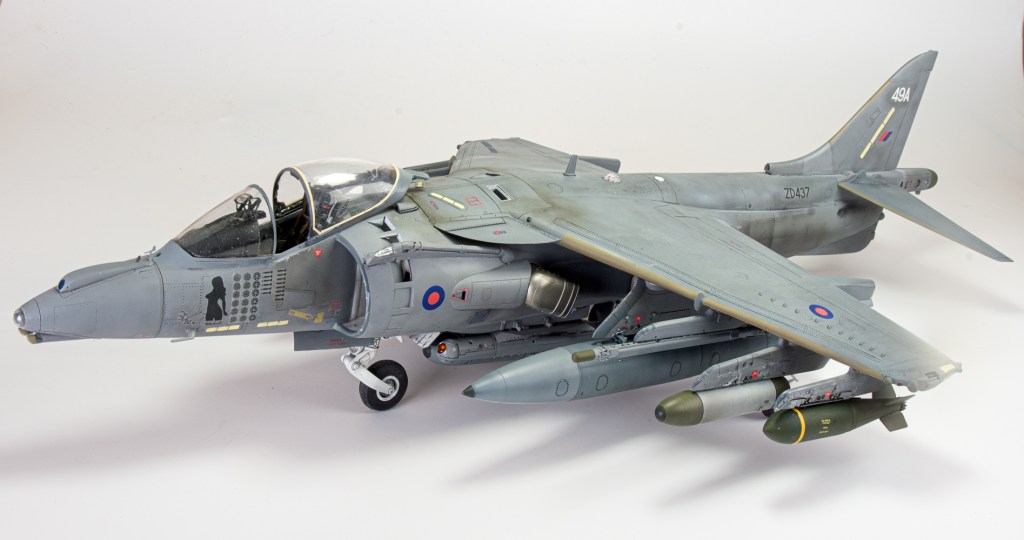
Trumpeter 1/32 Harrier GR7

  • Purchased: 2014
  • Completed; 2025
  • Enhancements;
  • Cockpit. Aires
  • Seat; resin cast by Piero on Britmodeller. No longer available
  • Jet nozzles. Aires
  • GR7 pylons: Wolfpack
  • GR7 Nose: eBay seller Sonconat
  • Tanks; Reskit
  • CRV; 3D printed from modeller on eBay. Sonconat
  • Bombs; Reskit
  • DJRP; 3dP from ebay. Sonconat
  • TIALD pod; Brassin
  • BOL Rails. ; Jet Passion

Introduction

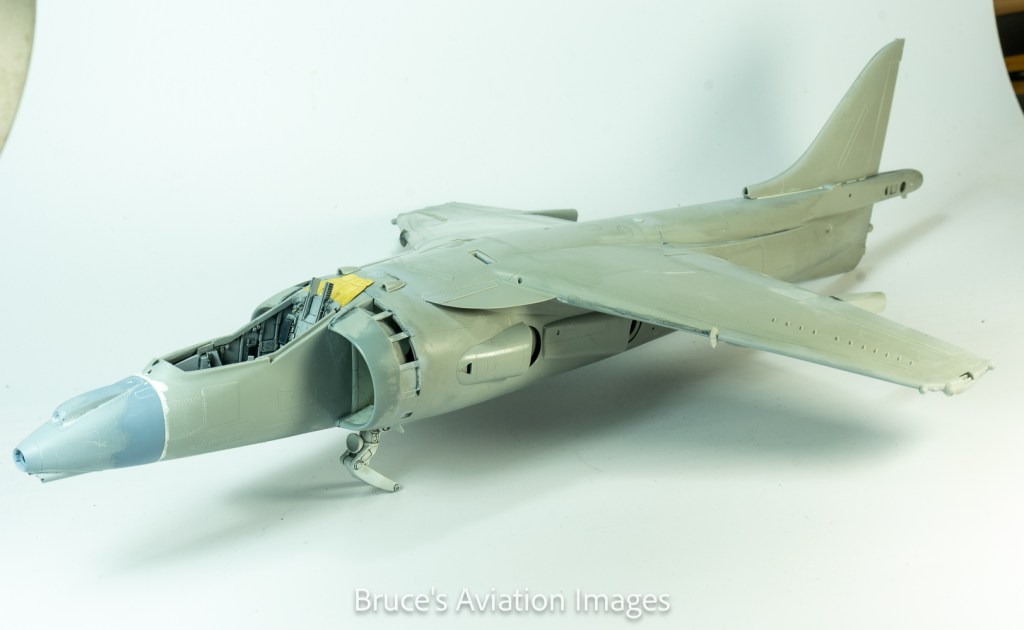
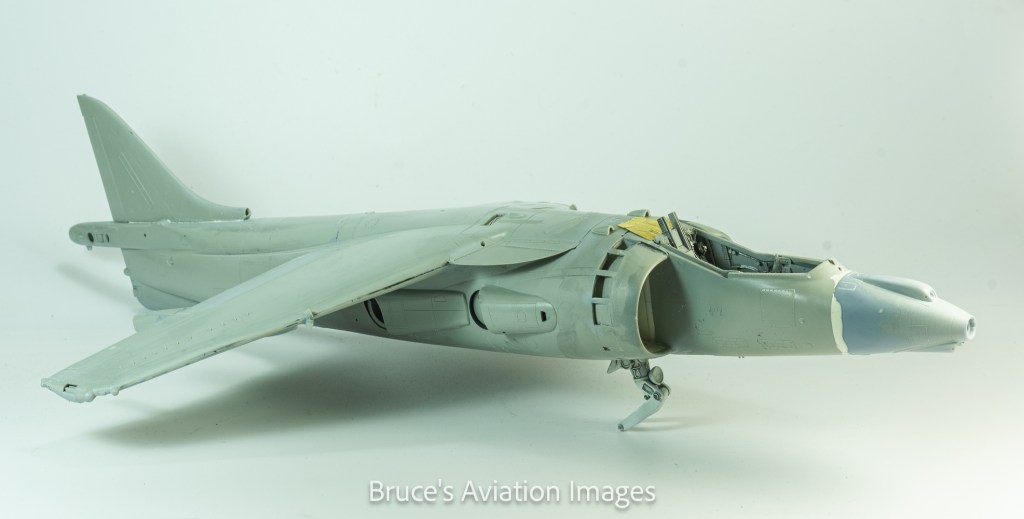
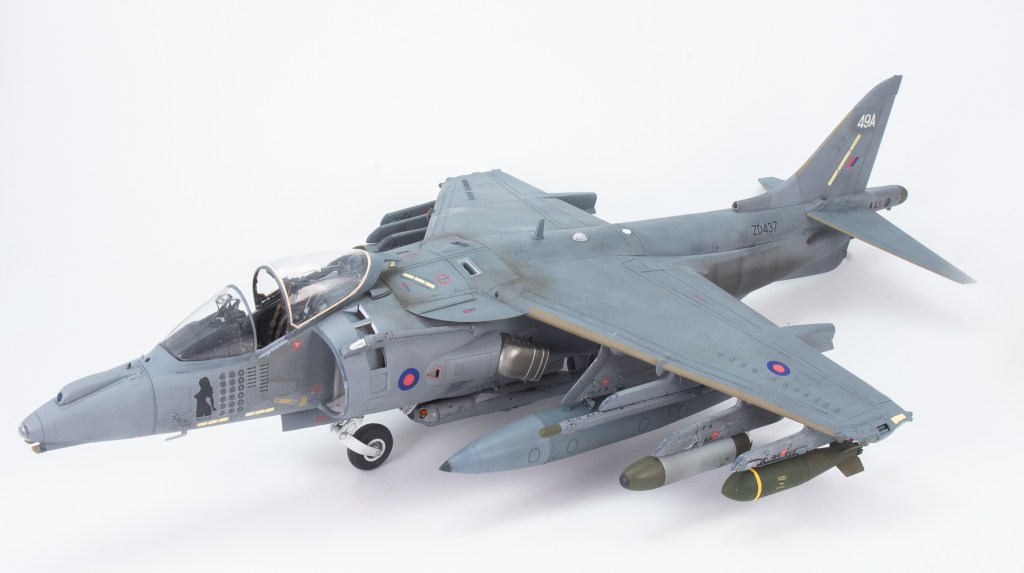
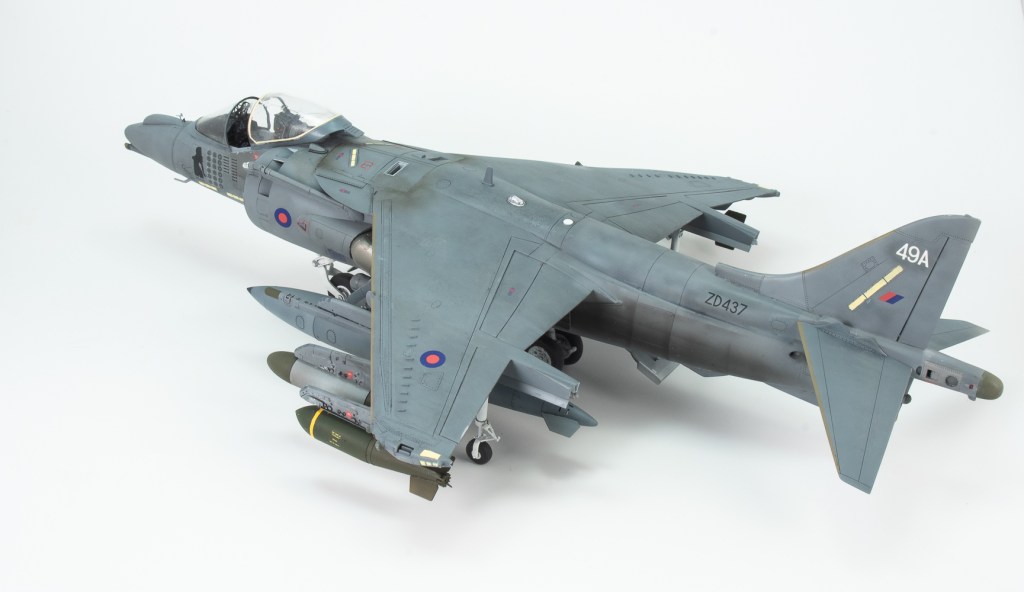
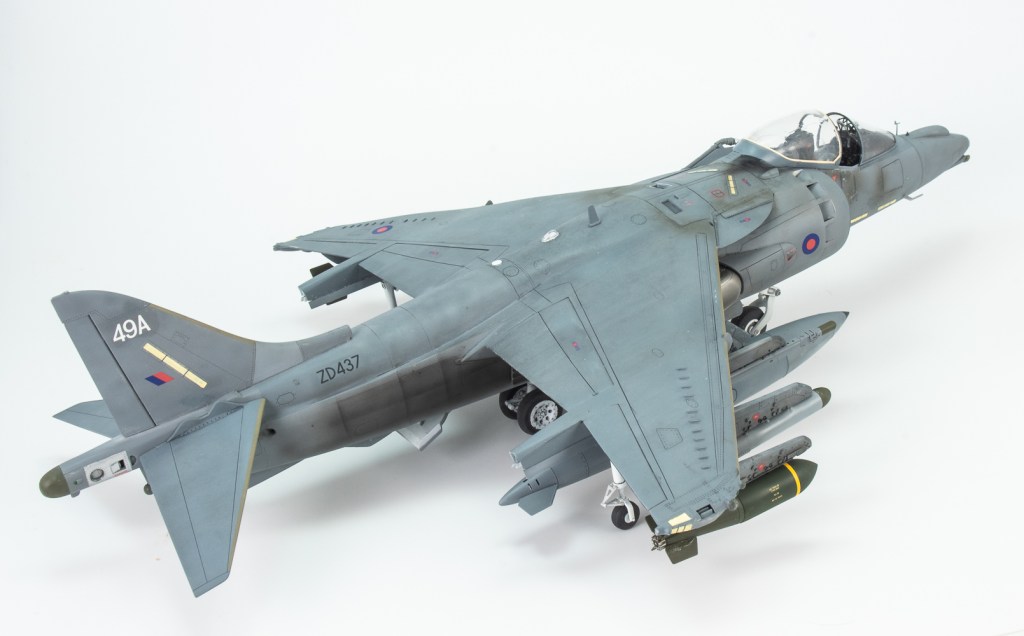
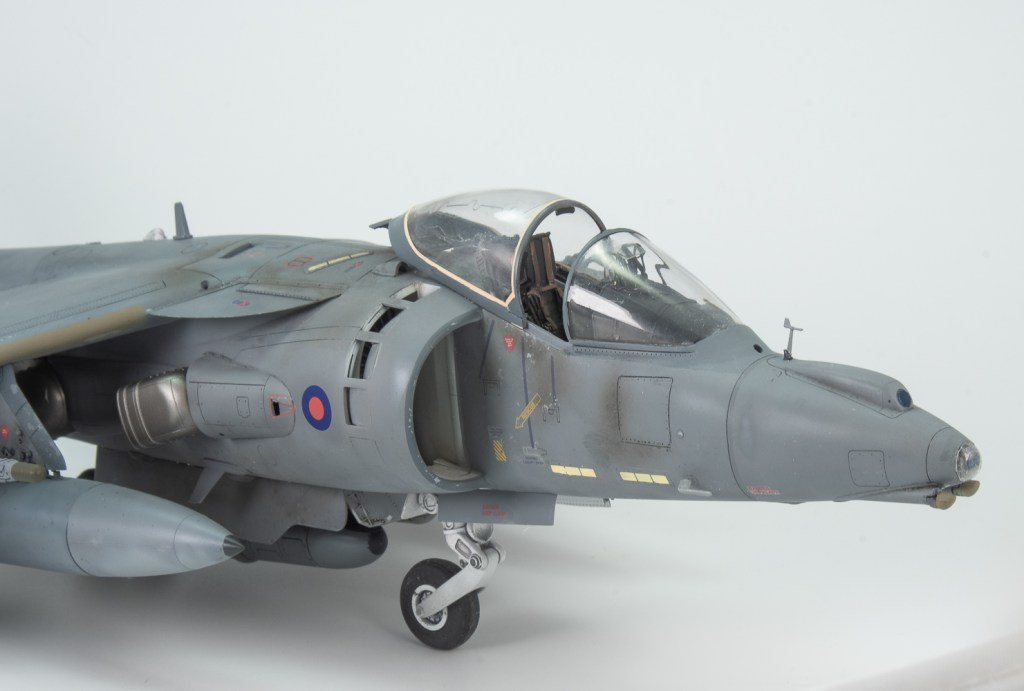
Trumpeter’s supposed GR7 Harrier followed on from their release of the US variants, these being the AV-8B and Night attack variant. I say supposed, because despite saying GR7 on the box, Trumpeter failed to include any specific GR7 parts, the nose being the most glaring inaccuracy, despite getting expert assistance from a UK Harrier model group

Trumpeter’s RAF Harrier is nothing more than their US Harrier boxed with some British markings, and even these are wrong. There are no specific RAF weapons either, the kit coming with the standard US weapon sprues. The national Markings look to be the wrong colour and size as well.

The kit has several incorrect shaped access panels for a GR7. I decided to leave these as they came in the kit, but if you want to correct your kit, pretty much all the access panels and rivet lines on the wingtips need changing .The kit wings have a weird bulge midway along the wing leading edge when looked at front on. I suspect this is Trumpeter’s method of dealing with the wing “kink” but it just looks wrong. Mould lines will also have to be removed from each upper wingtip. Raised panels on either side of the nose should be sanded flat and the foremost panel just behind the nose on the port side removed as I cannot see this panel on any GR7s I looked at. A deliberate decision was made to not go down the rabbit hole of changing every detail on the kit to accurately portray a GR7 or 9, as one could spend 6 months doing this. Consequently, whilst my model better represents a GR7 than an OOB build, it’s still not an accurate to the last detail GR7. And Im quite happy with this compromise in the name of a quick build.

Construction Notes

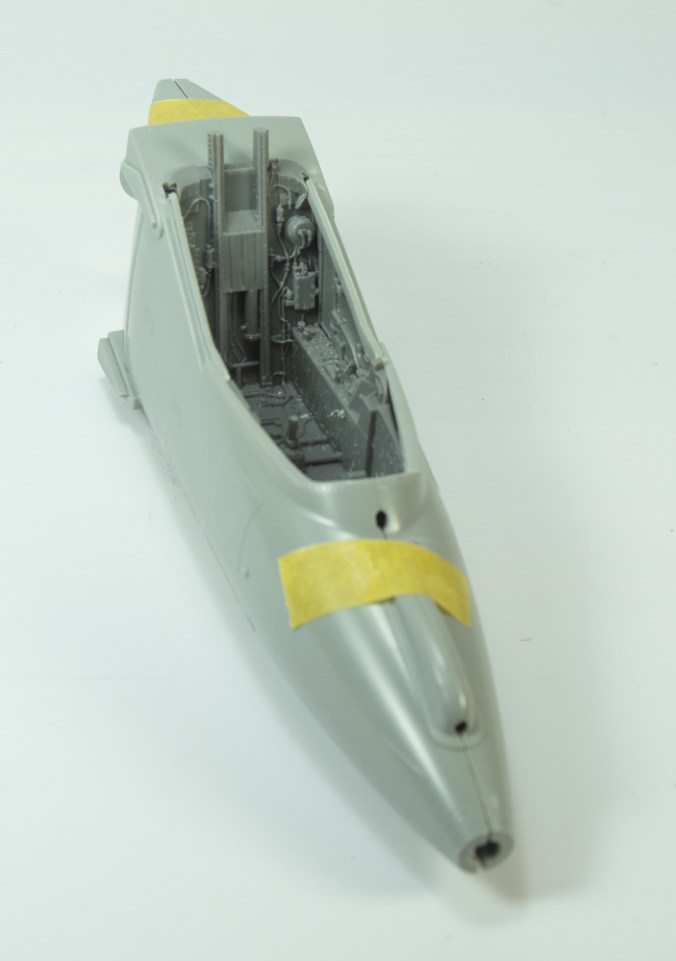
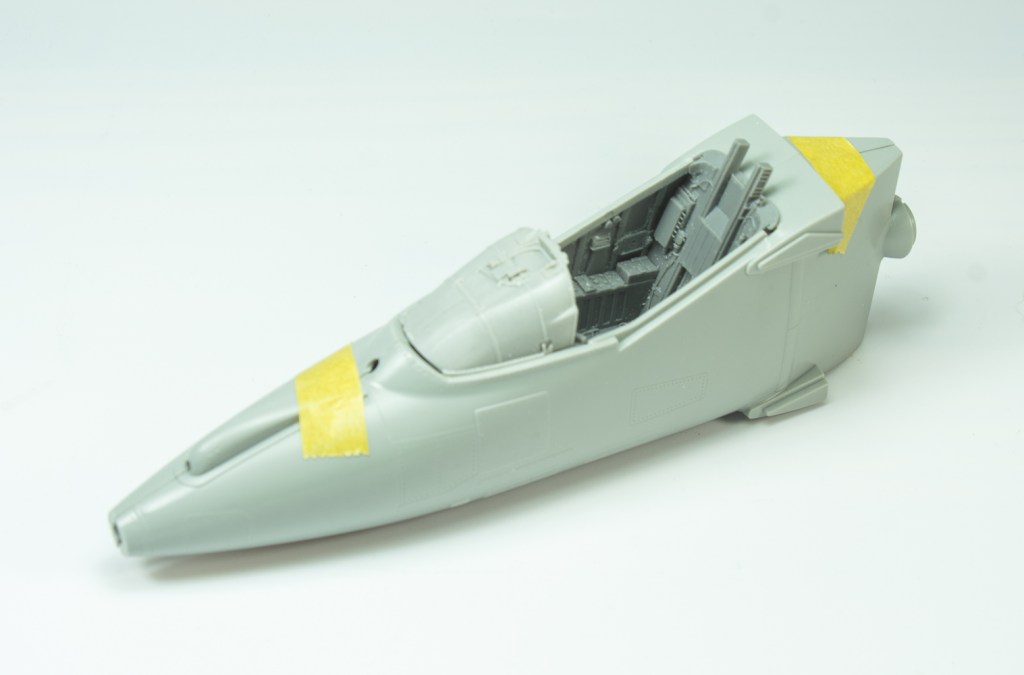
Aires’s cockpit actually wasn’t a bad fit . Although not quite a drop fit, it didn’t take too much sanding to fit between the nose halves, even locating to the kit cockpit location tabs. Ah, if only all Aires sets fitted like this.

Trumpeter would also have you glue all the auxiliary intake doors in the open position, rather than just the top 3 on each side that flopped open through gravity. Look at photos of parked Harriers to see what I mean.
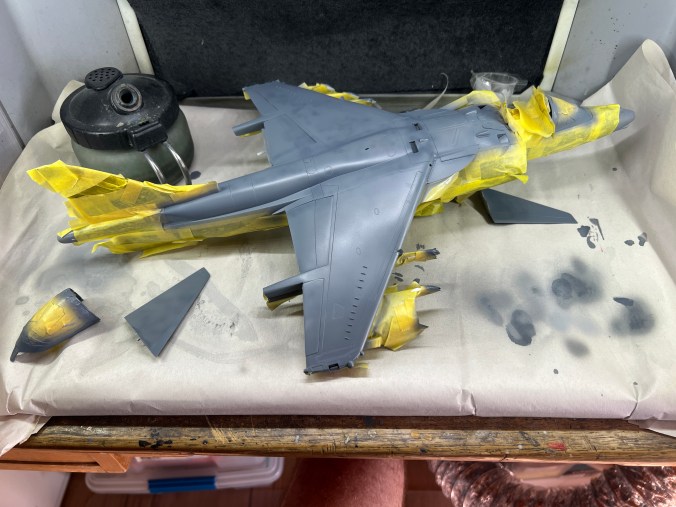
In a similar vein, Trumpeter would have you glue the main undercarriage doors in the open position, again not prototypical for the real jet. all photos I looked at showing the main doors closed. Achieving this took a bit of work, as the doors are not the best fit in the closed position, requiring lots of filling and rescribing.

The kit pylons are the US pattern, so the Flying Leathernecks supposedly RAF corrected pylons were used, although comparison to photos, showed they are still not correct for RAF pylons. In fact the Flying Leathernecks pylons were a bit of a disappointment, also being a very poor fit to the wings. At least the rear of them was contoured to fit over the flap actuators, unlike the kit pylons. Speaking of the flap (and aileron) actuators, they will need to be extended with scraps of thick plastic card as they are too short, and uncorrected, leave large gaps as they don’t meet the control surface actuators.

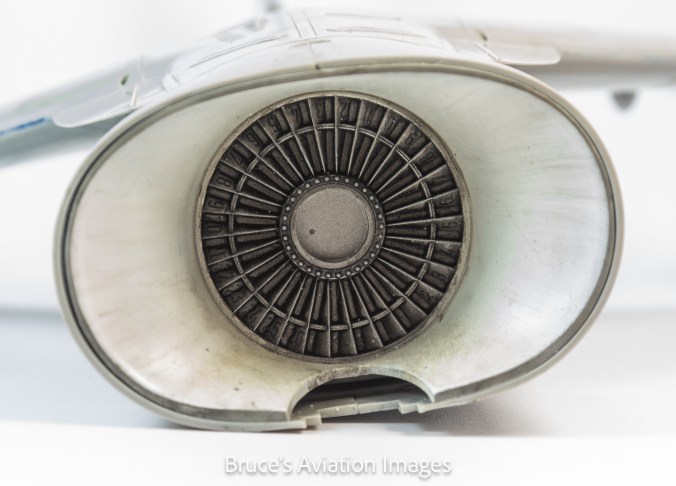
I only used the 2 halves of the engine and the mounting bulkheads, enough to mount the aires jet nozzles to. The rest of the kit engine parts were confined to the bin, as they will never be seen on the completed kit. Similarly thrown out were the kit blast plates and nozzles, these parts being replaced with the Aires items.

Parts D24 and D25 were not added as I could not see them on photos of real GR7As. All moulded vents on the rear fuselage and wing top were cut out and replaced with suitably sized PE mesh .

Part E55 was added but all the detail was filled and then faired into the fuselage contours. A new RAF type Flare unit was then shaped from laminated sheets of thick plastic card and added just behind the rear wheel bay. Details were represenrted with decals. The square GPS antenna was shaved off the wing centre section, and replaced with a round one as per photos.

The new 3D printed nose fit reasonably well, just requiring fairing in on one side after the kit nose was cut away, it being completely wrong for a British Harrier.

Painting and Decalling

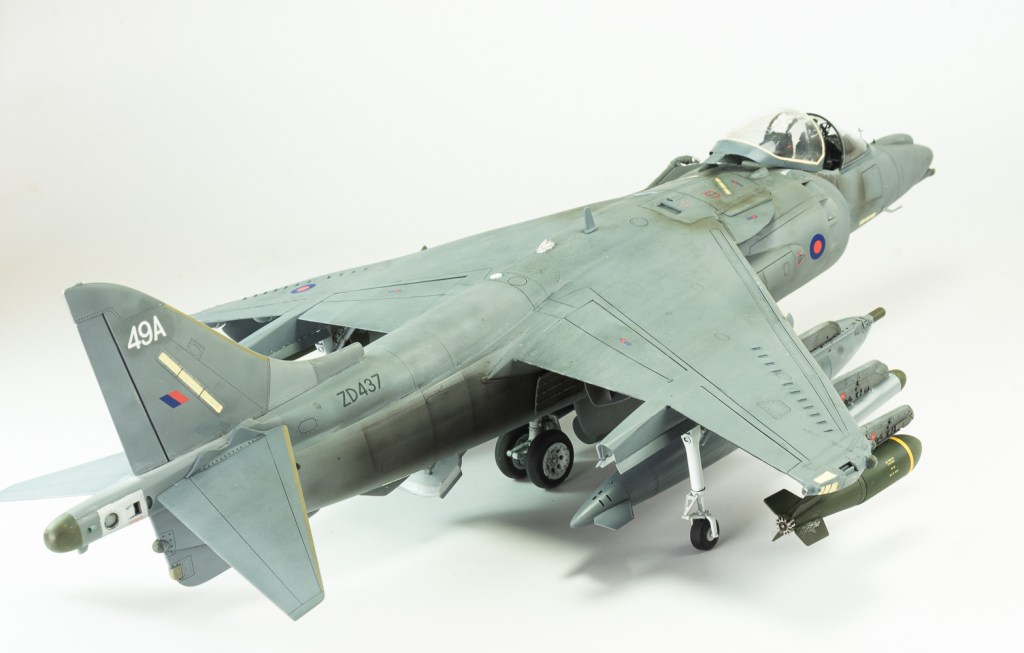
The first thing to do here was throw out Trumpeter’s painting guide. Instead, I borrowed from the painting guide for Airfix’s 72 scale kit, which calls out the correct Herrick scheme of Dark Sea Grey and Dark Camouflage Grey. The Camouflage Grey proved a problem until I found AK Real Colours offered it.

MRP furnished the Dark Sea Grey. Photos of this particular jet were quite hard to come by and I am indebted to Nick Greenall from the UK IPMS Harrier SIG for sending me some through as well as details of the correct Operation Herrick load out.

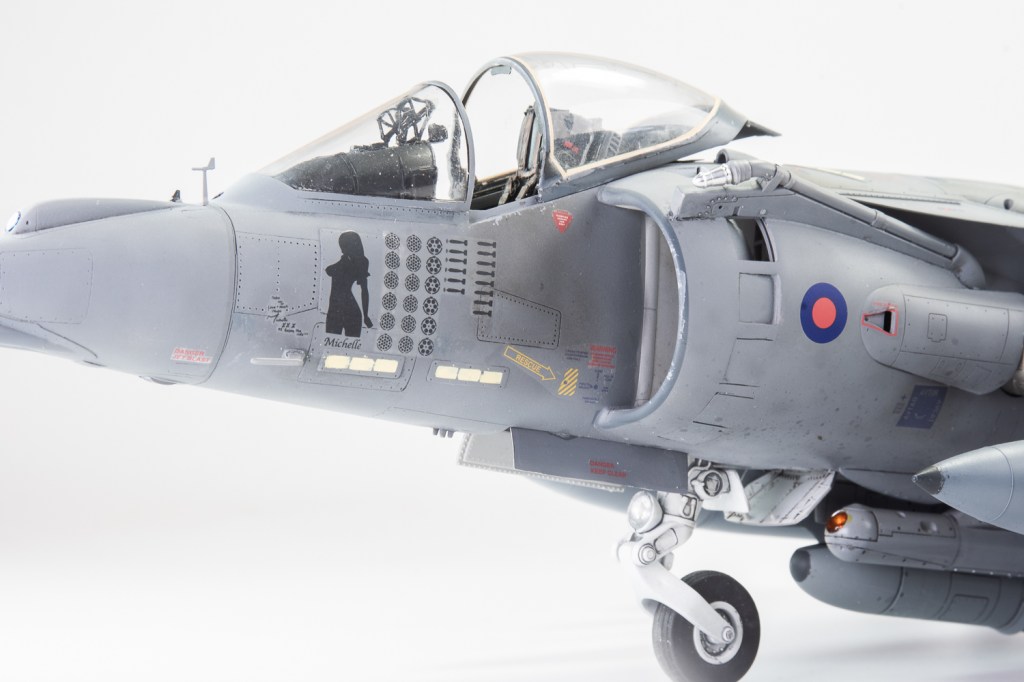
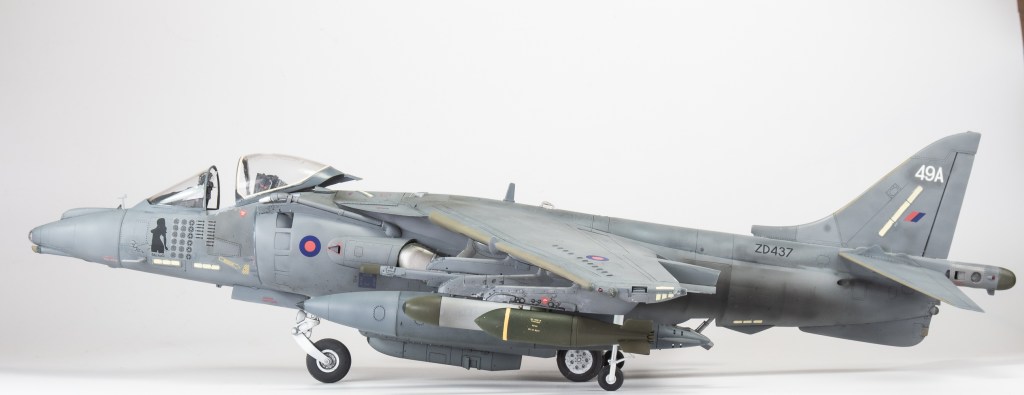
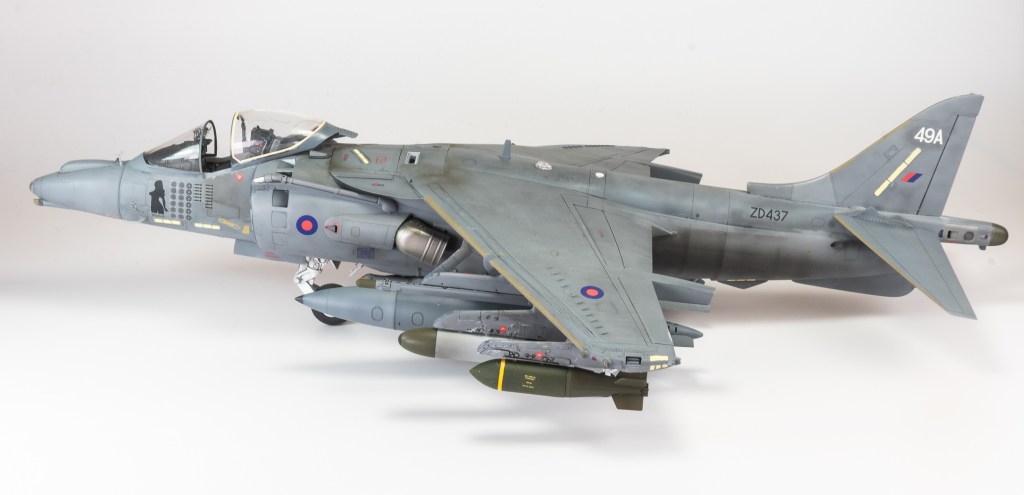
The colours were faded just slightly. Whilst photos show a lot of staining and fluid spills, there is not an awful lot of paint wear evident. A replacement grey panel was depicted on the tail despite this not being evident whilst the jet wore the nose art. Artistic Licence! The jet is pictured at a later date with light grey replacement panels in evidence, but by this stage “Michelle” had been painted out. She wasn’t getting painted out on this jet, let me tell you!! The tanks also had different greys applied to the separate sections as images of real harriers showed this was a thing.

Michelle, the mission tally and the tail number all came from Zotz decals. Not my favourite manufacturer. I find their decals quite thick, and generally non conforming to detail. Here they were coated with several layers of gloss varnish and then gently sanded to blend the carrier film into the surrounding clear coats, which, to my surprise. worked very well. A new technique to me. National markings came from an Airframe decal sheet as both Trumpeter and Zotz had the size and colours wrong, likewise all the stencilling and serial numbers. No underside stencilling was applied as it looks like it was not reapplied after the undersides were repainted with the camouflage grey on the real jet. There was some evidence of general grubbiness around the engine bay doors, so I used Starship Filth to add this. Wrong colour!! I should have just used black as it looks like there’s been an engine bay fire. Nethertheless, I was quite happy with my blending efforts, these being better than some previous attempts at the technique.

Final Assembly

In what was becoming a recurring thing with this kit, the Trumpeter pylons and weapons were thrown in the bin. ( I used to keep all this stuff, but it was becoming unmanageable, and it turned out a lot of it wasn’t getting used, so now it just gets thrown out {I imagine Jon Bryon is grimacing with horror if he’s reading this!})

I have already given my thoughts on the Flying Leathernecks pylons, but at least they are better than nothing and I’m happy that Flying Leathernecks saw fit to release them. Kit fuel tanks were replaced with the fantastic, but expensive Reskit items. Bombs are also by Reskit. These are 1000lbers, as I could not find any 540lbers, which I think are the correct bombs for this particular loadout. The pilot will soon find the jet feels a bit sluggish!!

BOL rails came from Jet passion, the CRV pods and DJRP came from a fellow on eBay who 3d prints corrections for the GR7. Originally I was going to use a cast nose that I got years ago from a bloke off Britmodeller, but the 3DP nose had a lot more fidelity, it just needs the print lines sanding off, as do the rocket pods and the fuel tanks. And finally the TIALD pod came from Brassin, it being drilled and pinned to the adaptor pylon that comes with the Wolfpack Sniper pod, with brass rod , as were all the stores.

Conclusion

Not the most enjoyable build. OOB, the Trumpeter GR7 needs A LOT of modifications if you want to accurately portray a GR7 or 9. Aside from this, the model is not some of Trumpeters finest tooling, the plastic being textured with some panel lines that fade away. However, like all Trumpeter kits, the model looks complex, but is not that complicated to assemble. The gaps between the flap actuators, misnumbered parts in the instructions and poor engineering that required the nose leg to be fitted at an early stage all combined to make the model frustrating to construct in some respects. I doubt, I’d do another.

To finish off, I thought I’d list the Aftermarket used and how important it was to the build. Please note, these are my opinions only.

Aires Cockpit. Definitely adds to finished build with minimal effort needed to fit to kit. You will need a MB Mk12 seat though and not the American Stencil one.

Aires Jet Nozzles – Essential. Much better than kit nozzles. Again minimal effort needed to integrate into build

Resin wheels. I didn’t use any, but looking at my completed model, Im going to suggest they are essential as the kit rubber tyres are rubbish. At some stage mine will get replaced with resin ones too.

Soconat 3DP nose and DJRP – Essential if you want to accurately portray a GR7/9

Flying Leatherneck correct GR7/9 pylons. – Again essential if you want to do a RAF jet, for the only reason they more closely resemble RAF pylons than the Trumpeter pylons. And that’s not saying much!

Reskit Drop tanks – Very nice to have , as the kit tanks are inaccurate. Not essential though.

Weapons – Essential as kit weapons are US pattern weapons only.

This was my first completed build of 2025. There was a stage where it was looking like it would be my only 2025 build, So Im glad its done.

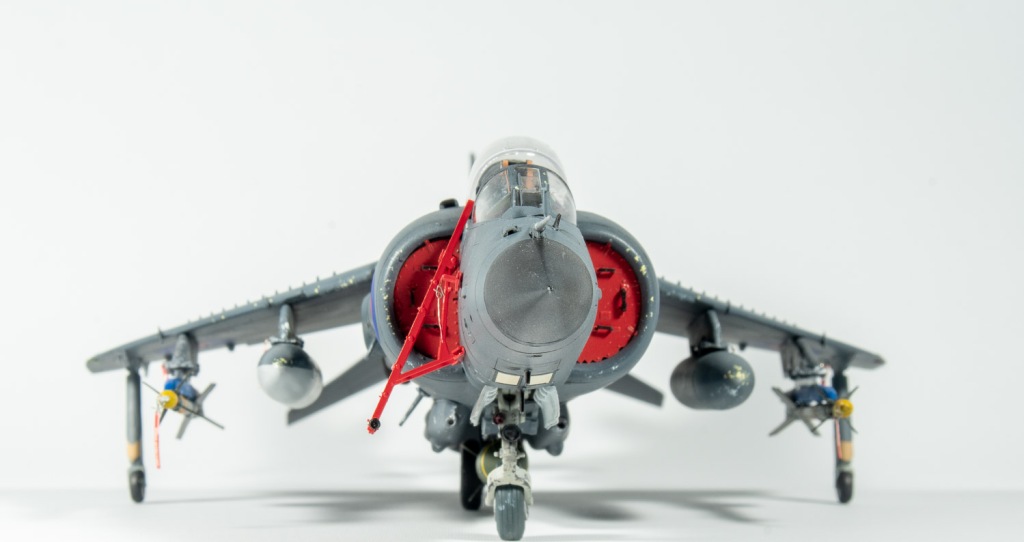
BAe Systems Harrier GR7A 1 SQN Royal Air Force. Kandahar Afghanistan 2007

Leave a comment

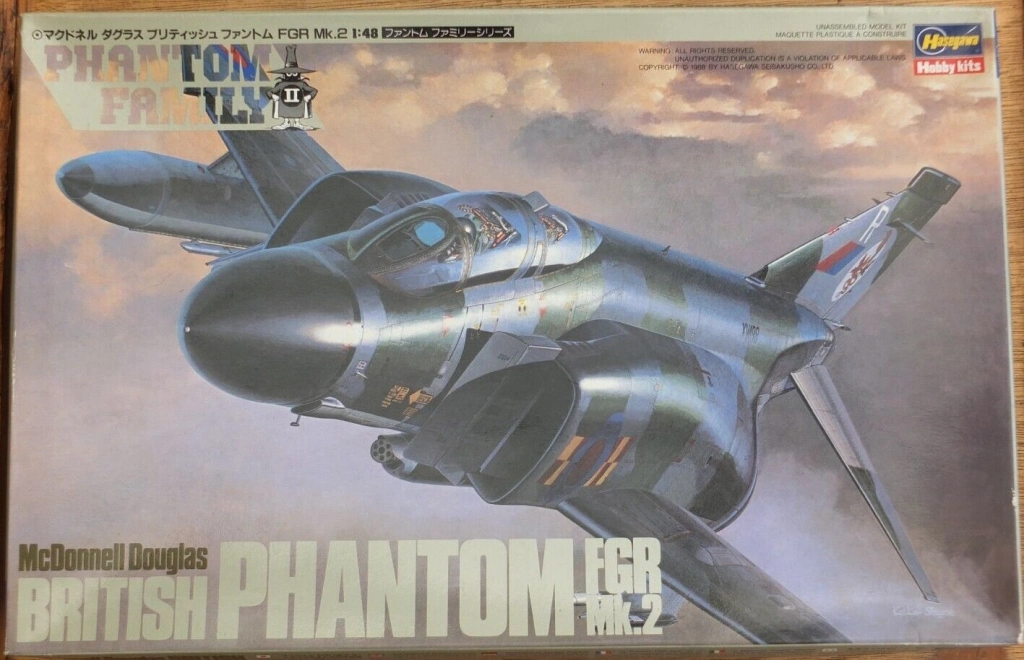
Hasegawa 1/48 Phantom FGR2

  • Acquired: 1988
  • Completed: 2023
  • Enhancements
  • Seats; Quickboost
  • Cockpit; Aires
  • Wheels; Reskit
  • Matra Pods; Reskit
  • Exhausts: Reskit
  • FOD covers; Quickboost and Two Mikes
  • Decals; Model Alliance RAF in Germany Part 1
  • Wing Tanks; Hypersonic
  • Triple Ejector Racks for Matras; Eduard Brassin
  • Ladders; LP Models

Up until completing this build 2023 had been a horror year for me modelling wise, with several kits started, but none completed.

The bin was the final repository for more than one of those builds that had not satisfied me.

Whether it was my recent retirement, the house move, the time taken setting up a new model room or a combination of all those factors playing with me, I found myself getting easily frustrated with builds that actually weren’t that bad, but to me had been ruined by some silly minor error on my part.

In an effort to reset, I decided to build the model that appeared first on m stash database, the venerable Hasegawa Phantom, even this was not without its setbacks, but this time I persevered through to completion. It may not be my finest work, but at least I have completed a model, which brings my total to 4 so far this year. Four! I built more when I was working full time.

This particular kit is the oldest kit in my stash, having been purchased in 1988 when it first appeared in Australian shops, its been packed, unpacked, placed on shelfs, shoved behind shelves, fallen down the back of shelves several times and the box bears the scars.

Opening the box revealed a fair bit of aftermarket had been purchased for it over the years. Even closer inspection showing I had at some stage made a start on the model, most likely soon after buying it, as that’s how I rolled then. Heady days indeed!

Wheel wells and undercarriage struts bore testament to my early airbrushing efforts where seemingly I blasted everything with thick underthinned paint at about 40 bar!

However what it did show me was my modelling has in fact improved greatly over the intervening years. If like me, you have long disposed of your early canon of work, it can be difficult to determine if you have indeed made great strides in modelling Looking at recent models in the cabinet sometimes only reveals incremental improvement. Looking at your amateurish attempts from 35 years ago certainly brings home the large improvements you have made in your modelling.

Construction Notes

The Aires cockpits are always incredibly detailed but have a reputation for being difficult to fit in just about all cases. That being the case with this one too, although I found it easier than some of their products. That was once I’d worked out what parts of the kit to remove. The instructions being virtually useless in this regard, save for the sage advice of “kit parts will need got be sanded”.

Eventually I worked out from studying the resin parts, the kit sills needed to go. The clue was the sill detail contained on the Aires part.

Still, the bottom of the resin cockpit floor and the top of the kit nose wheel well had to be sanded to within a mm of their life, before the cockpit would sit at the right height. Width wise though, not a lot of sanding needed to be done apart from removing the rudimentary side wall detail from the Hasegawa fuselage halves.

Stout plastic sheet locators were fabricated to hold it in place and the gaps between the sills and plastic fuselage sides filled with Milliput.

The rest of the kit went together remarkably well, minimal gaps at the intakes, a slightly wider gap at the front edge where the underside of the wing joins the nose was shimmed with plastic card which helped to minimise the filling. As the plan was to use FOD guards I could dispense with faffing around adding full intake trunking, although the abrupt end to the intakes trunking as hasegawa have moulded it is not a huge issue in my book, and can be minimised with some creative painting.

I say relatively well. There were complications but these were due to the kit missing a few parts due to the length of time it has been in my stash and the repeated packing and unpacking it has seen with various house moves. Here I have a friend, Ian Bevan who came to my rescue. If you are using the reskit exhausts, be forewarned you need to either shorten the rear of the flat area that forms the bottom of the fuselage halves or cut out openings to accept the extra length of the RESKIT exhaust tubes.

The spine just needed some panels and covers rescribed and she was pretty much ready for paint.

This model was always going to be in the classic cold war scheme – for me anyway- of grey/green/light grey camouflage they wore whilst employed in the strike role.

Gunze paints were used for the topside colours, AK Real Colours Light Aircraft Grey was employed on the underside due to it having a warmer tone, than Gunzes interpretation, which seemed to match my refs better

The Model Alliance decals were no problem. Stencils came from an Extradecals sheet for British Phantom stencils, and being printed by Microscale, also performed well, although Im not sure all the stencils on the sheet were applied to British Phantoms. The Xtradecal sheet was employed as the Hasegawa stencils had shown a propensity to break up when introduced to water.

Gunze gloss had been applied prior and post decal application followed by SMS Flat which gave the required sheen I was looking for. However the edges of all carrier film was still very visible, no silvering, but quite apparent edges. I have read where these lacquer clears can be too thin to hide decal carrier film edges. A coat of Testers Dullcote was applied, which hid all the carrier film, but also led to some frosting. Subsequent coats of SMS flat failed to bring back the sheen I wanted. Semi gloss should have been used in retrospect.

Later analysis showed this was the point where things started to go wrong!

My reference photos of this particular jet, (and here I need to mention Geoff Coughlin’s suburb e-book series) showed the jets from 17 SQN at this particular time to be fairly well looked after, with minimal weathering on top surfaces although the undersides were filthy. The jets at this stage being fairly new in squadron service.

To this end oils were used to impart heavy streaking and fluid loss. Speckling was also heavily employed to show the grime that would have been flicked up from wet runways.

For the loadout, I came across a photo in Double Ugly’s book on British Phantoms that showed a load of 3 MATRA Pods being carried on TERs. Hasegawa TERS from one of their weapon sets would be used, that is, until I screwed up drilling holes in them for brass pins, so Brassin TERS were used instead.

The whole drilling-tiny-holes-and-pinning-stores-to-pylons affair was incredibly frustrating. It didn’t help the hasegawa inboard pylons are an incredibly loose fit to the wing too.. The hypersonic tanks and pylons were trouble free and were a push fit.

With the Matra pods I also have to throw out a thanks to The Hamfisted Modeller for sending me the cut files for the frangible covers on the nose cones. The method is outlined in his build of the Kinetic Harrier

I did ask him to send me some skill too, but sadly , he had run out!

With the canopies, I found the Eduard PE canopy bow fascias just would not fit the canopy profiles. I should have just yanked them off, FGR2s of this era were only fitted with 2 mirrors so the centre one was cut off, Bizarre thing with the rear canopy, it had no hinges moulded on like the pilot canopy, a check of the FG! in the stash revealed that canopy also with no hinges.

Fault by Hasegawa maybe? Its marked as the standard F-4 Sprue, and all other Phantom sprues I have seen have been correctly moulded.

By this stage, as always happens with kits that aren’t going the way I envisaged, I began to take shortcuts and rush things as I really just wanted it off the bench. The next model will be wayyyyy better, right?

Therefore I didn’t bother with the full complement of RBF flags, so with the addition of the LP Ladders, I called it done.

Its not as good as I was hoping for, but Im pleased to have finally built the oldest model in my stash. There is the FG1 to build as well, but first a cheap Hasegawa Phantom will need to be sourced to replenish the parts I took from it to build this kit.

Hopefully Airfix see fit to release this iconic jet in 48 scale. The Hasegawa Phantom series have not aged as well as some of their other kits, the B/N, E, C/D and J all being rendered pretty much obsolete by newer kits from Meng and Zoukie Mura.

However, the Hasegawa kits remain the only Spey engined Phantoms in 48 scale to this day, and are still well sought after. They are still available on the second hand market as are the Revell reboxings for reasonable prices, well, here in Australia anyway.

Finally, Im not one for nostalgia kits or rebuilding kits from my youth, but this kit does have special meaning for me. Decades ago, it was purchased from a stalwart of the Perth modelling scene.,Tim Vickerage who owned a shop in Fremantle of which I forget the name, Modelcraft?

Tim was responsible for introducing me to Iwata airbrushes, Xtracolour paints and the model club scene. Tim sadly is no longer with us, so this build is dedicated to his memory.

Phantom FGR2 17 SQN. Royal Air Force RAF Bruggen Germany 1975

Leave a comment

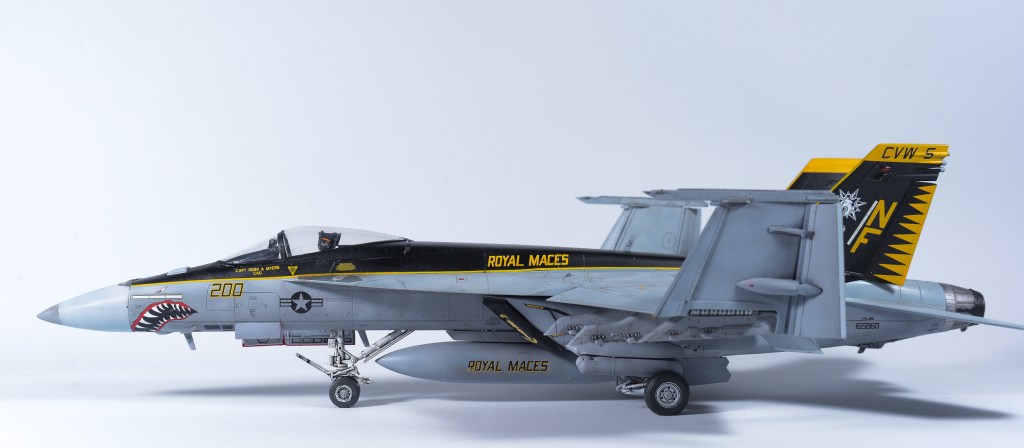
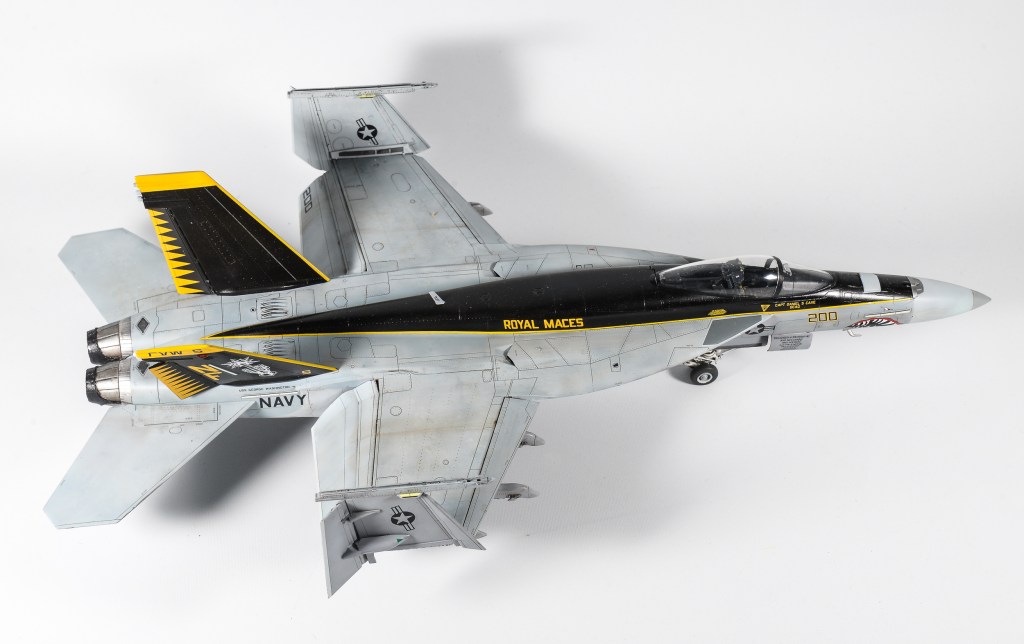
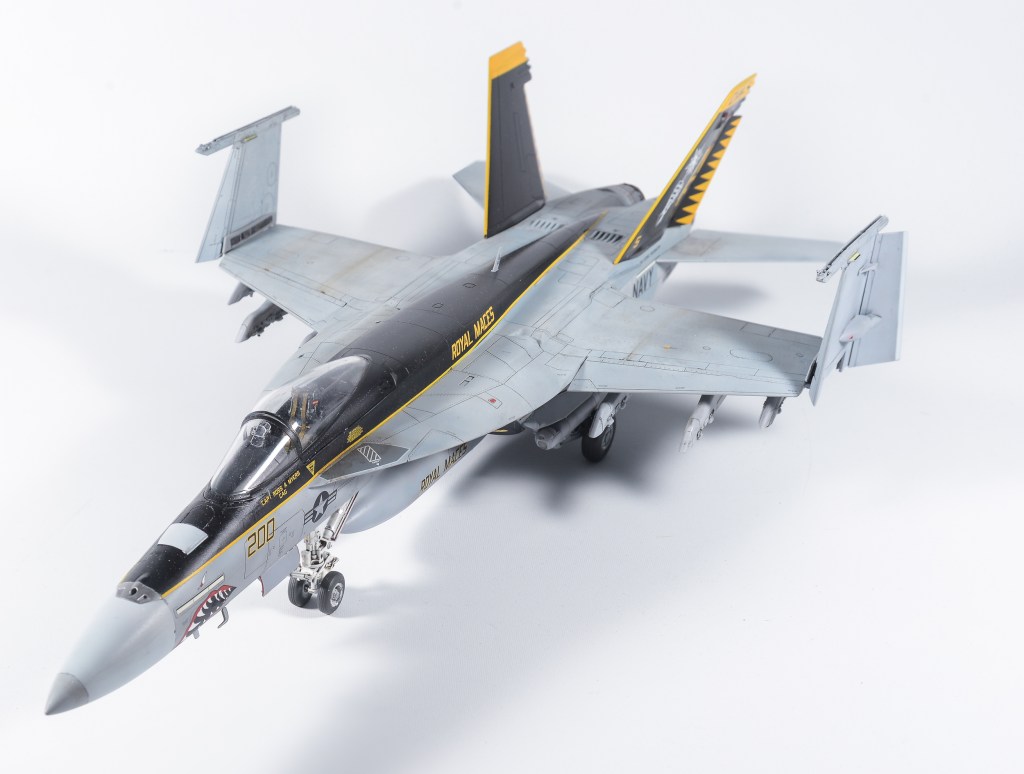
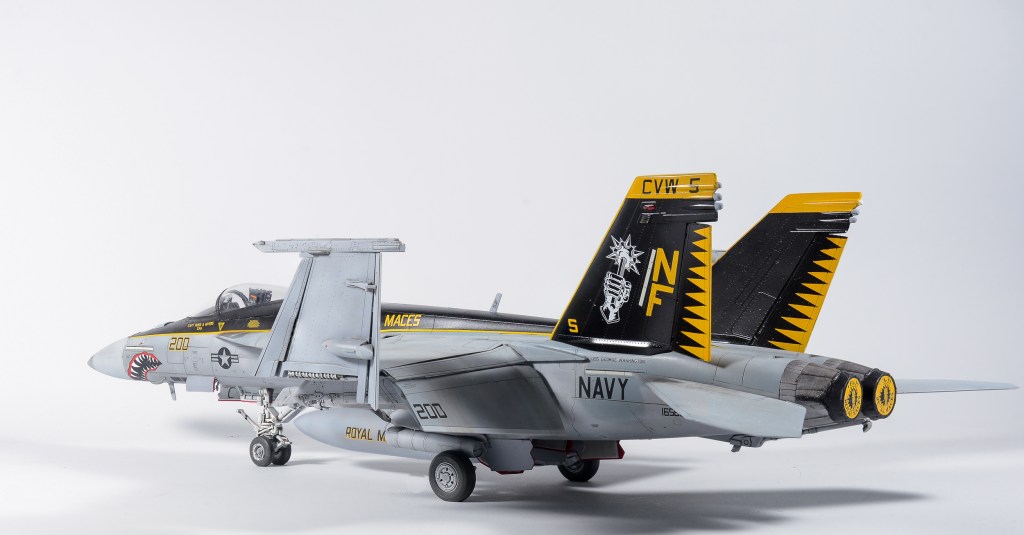
Meng 1/48 F-18E Super Hornet

photo credit. Scalemates
  • Added to stash 2022
  • Built: 2022
  • Enhancements:
  • Seat– Brassin
  • Wheels-Reskit
  • Nozzles- SteelBeach
  • Pylons: Phase hangar resin.
  • Wingtip launchers: Flying Leathernecks
  • Decals: Afterburner Pacific Coast CAG Superbugs

Construction Notes

I need to stop writing these so long after I have finished the model, as its sometimes hard to remember stuff encountered during the construction!

That aside, I found Meng’s kit to be a painless build, construction wise. There were some pesky seams under the LEX that took a while to remove, and there are some spurious panel lines on the rear fuselage sides that need filling. Overall though I would rate it as a well fitting kit that is quite enjoyable to build.

As with any kit, multiple dry runs and careful preparation of the parts to ensure all mating surfaces are clean will reward you with far less problems than the modeller that does not take these steps.

The gun muzzle and fins can be painted separately and then added during final assembly, so good is their fit.

It easily eclipses Hasegawa’s ageing kit (as it should)

However, should you only have the Hobby Boss kit in your stash, I certainly wouldn’t be rushing out and replacing it with the Meng kit. Comparing notes with my mate, there doesn’t seem to be a lot between the two, perhaps a slightly better fit with the Meng kit-maybe!

Calum’s build here

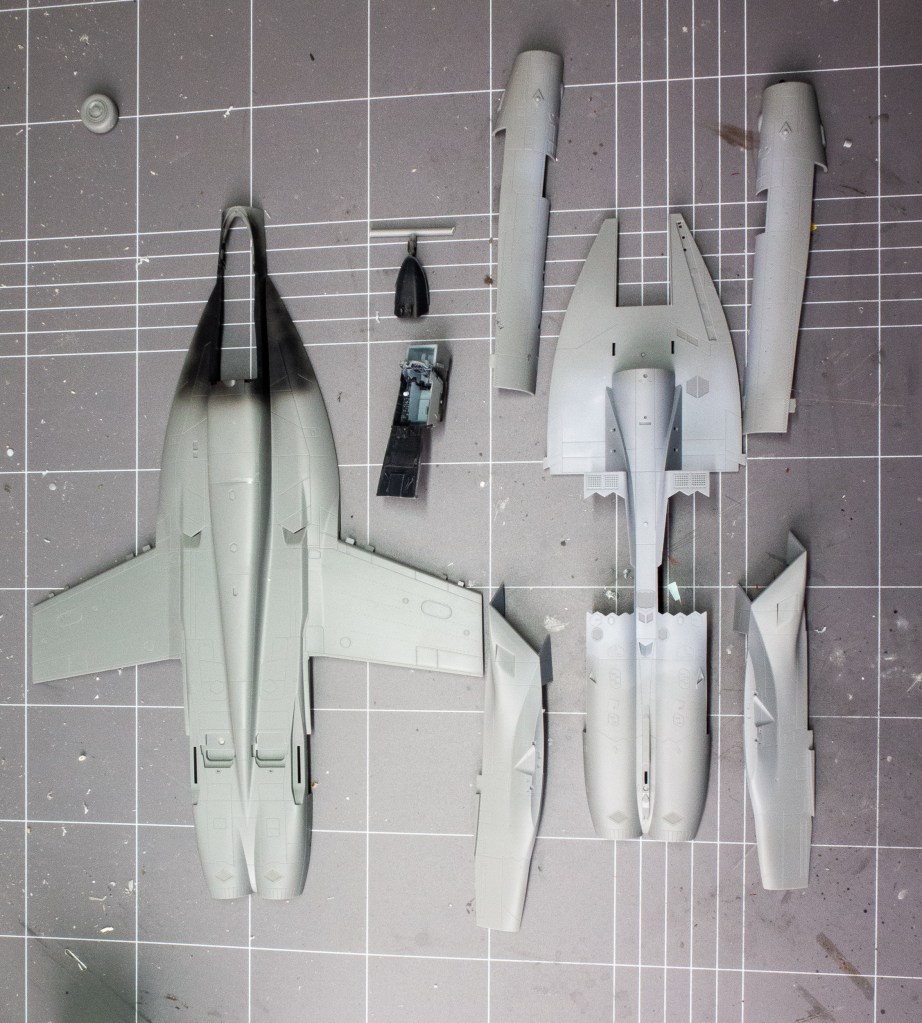
My plan was to model a clean jet, as this is what most photos of this jet showed, clean as in both condition, and having no stores save a centreline fuel tank fitted. The phase hangar 3d printed pylons were therefore purchased in order to show detailed undersides with all holes slots etc hollowed out unlike the kit pylons that just have no detail on the undersides.

Likewise the resin Flying Leatherneck wingtip launchers. Whilst the kit wingtip launchers actually weren’t bad, if modelled bare, they displayed a nasty centreline seam which would have been difficult to fill.

Initial construction of the model proceeded fairly quickly although progress was held up whilst waiting for the resin to arrive from the United States. Thinking back on the build, no real problems were encountered. As my intention was to fit FOD guards, I left out the intake trunking and compressor fans. The intake FOD Guards are made from Apoxie-Sculp formed over the intake, then left to harden. The afterburner sheet included decals for the FOD guards so it would have been a crime not to use them.

I faffed around endlessly and to no avail trying to come up with home made covers for the nozzles, epoxy putty, glue dampened tissue being two materials that were tried and quickly removed as my efforts looked rubbish. In the end I found Steel Beach resin had done the work for me by releasing a set of covered nozzles for the hasegawa kit. Long OOP, I managed to find a set from a German retailer, even better, they fitted the Meng kit.

Halfway through the build, my wife and I put our house on the market, which resulted in me packing the modelling bench up to project the house in the best way during inspections.

We sold the house, but this then had the effect of me putting a clock on my modelling projects, in an effort to get them done before starting to pack the bench up in November. Experience has shown me that half finished projects that get packed away for house moves never get finished upon unpacking at the new house.

Subsequently. the Super Hornet was finished in a bit of a rush, with not the greatest attention paid to final assembly, or even the weathering really. Just a few token stains appearing on the wings.

The one store it carries, the target seeking pod, has just been tacked on as an afterthought with no decals or weathering. This was a deliberate choice on my part. When the new bench is set up, the ordnance will again be getting the attention it deserves

A mix of gunze and SMS paints were used for the USN greys, they ended up being mixed as I thought the SMS FS36320 was way too light as was their version of FS36375., but thats just my opinion. Some tonal shifts and fading being achieved by post shading on various shades of grey before a final blend coat.

The Afterburner decals performed flawlessly. I chse to paint the yellow trim and squadron codes on the fins using masks cut from scanning the decal sheet into my silhouette cutter. Im slowly getting better at using the software. The yellow border to the black spine was also masked and painted rather than using the decals. Long thin decals and I don’t get on a lot of the time.

The Meng decals, however were a big let down. Only the stencils were used, instead of being legible, they were just formed from random lines and are also the wrong colour being black instead of the contrasting grey. That said, they did perform alright and responded well to micro’s setting solution where used. Most of them were applied to little pools of future as I find this the best method for applying stencils and avoiding silvering.

Yes, I should have just used the afterburner stencils, but wanted to save these for a future Meng F-18F thats in the stash, in fact somehow the stash has ended up with THREE Meng Fs. Im not sure how this happened!

So thats it, my Meng Super Hornet. It was originally started for a FB group build, but it overrun the deadline. Whilst I enjoyed the build, I find modern jets can get a bit draining around the 80% mark, all those pylons, stores, undercarriage componets and aerials make them a fussy build. At least one of those two seaters will get done though, either as a USN jet or a R.A.AF jet

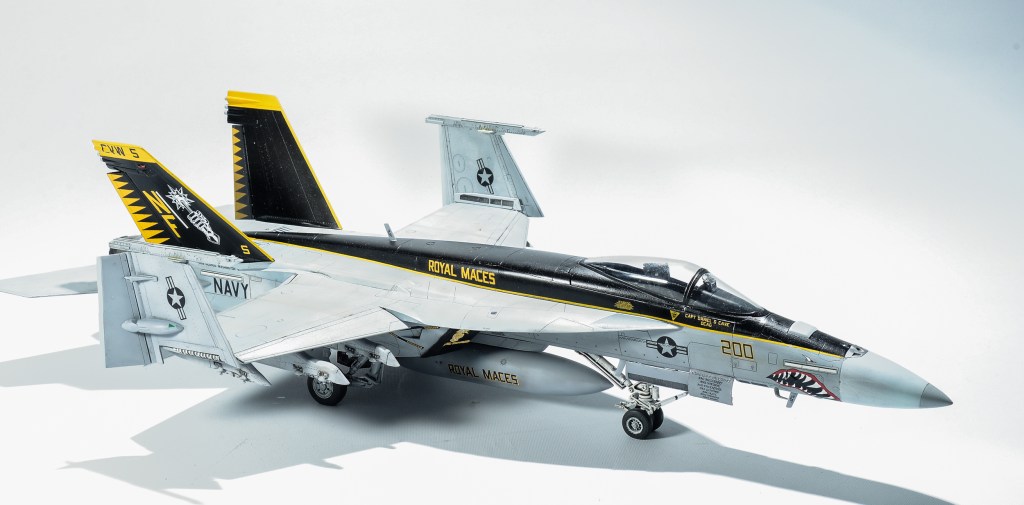
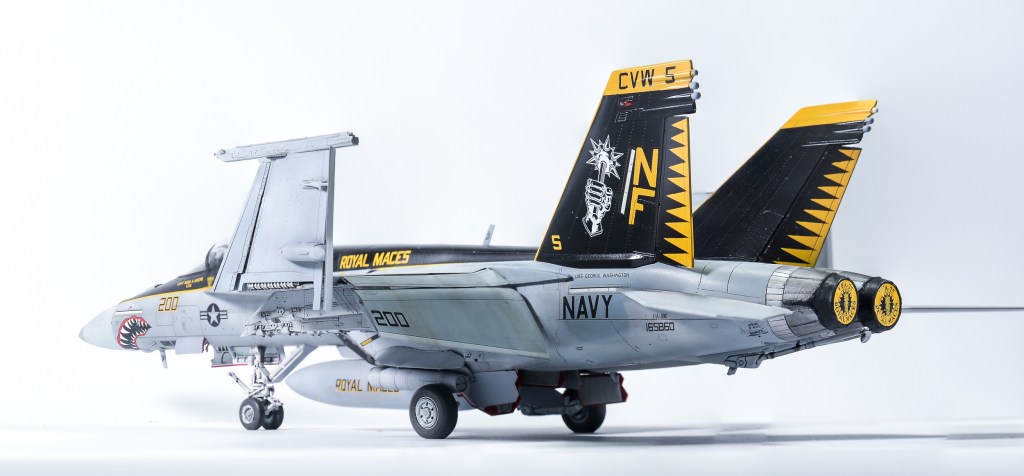
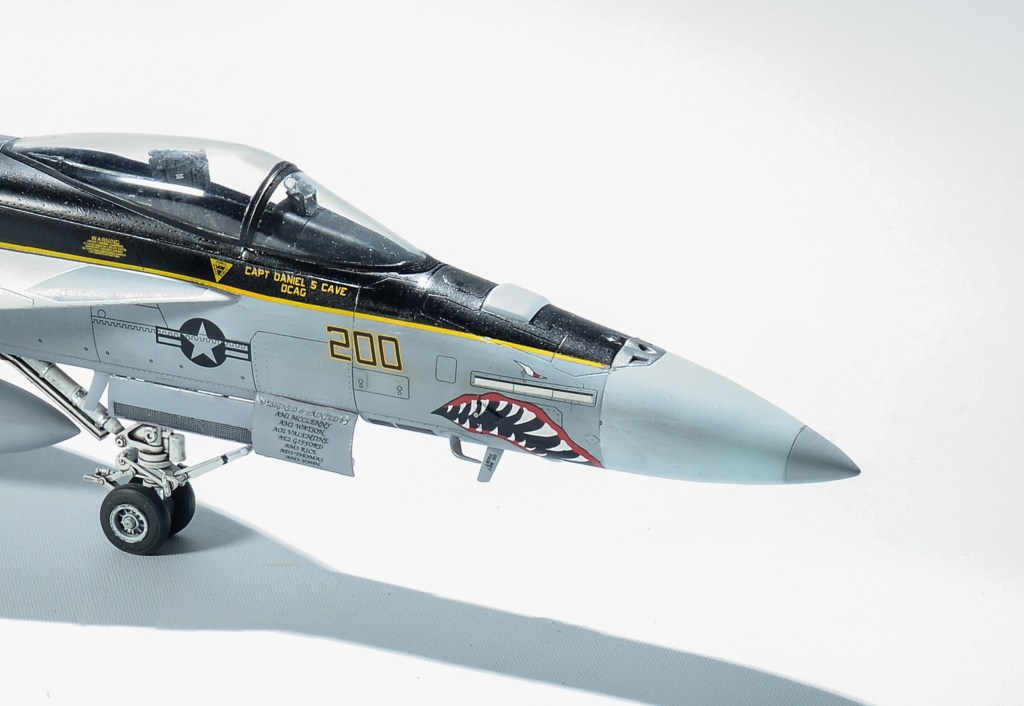
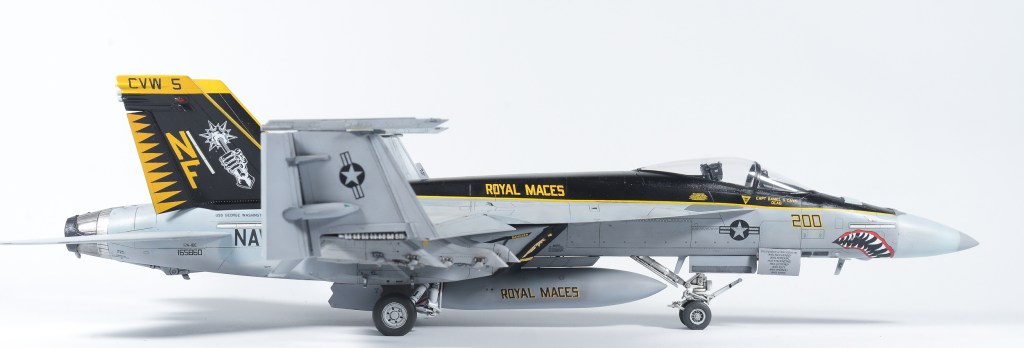
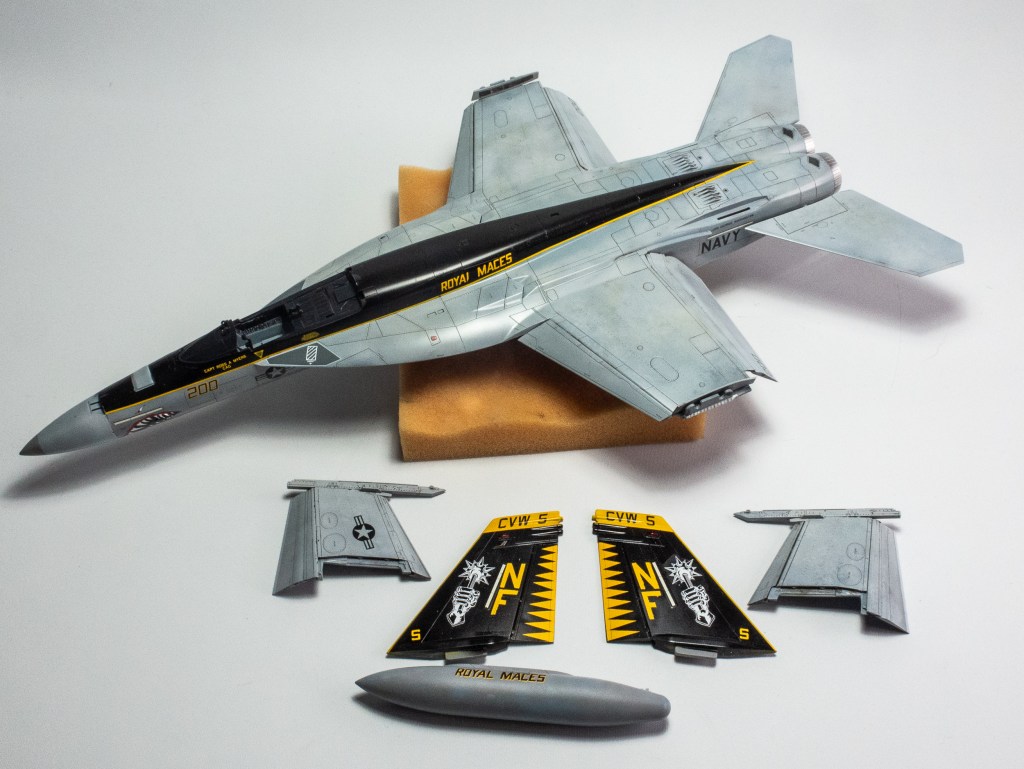
Boeing F-18E Super Hornet. VFA27 Royal Maces. U.S. Navy

USS George Washington 2010.

Please excuse the photography. I was having all sorts of issues getting my speedlights to slave to the camera.

Leave a comment

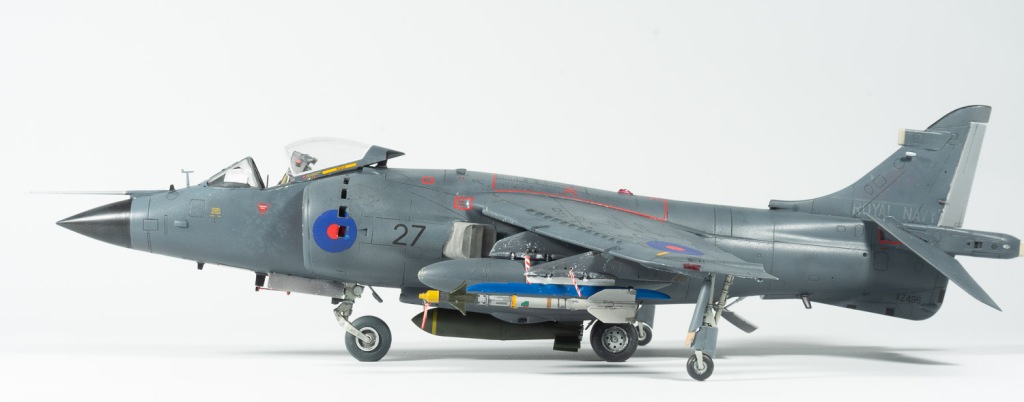
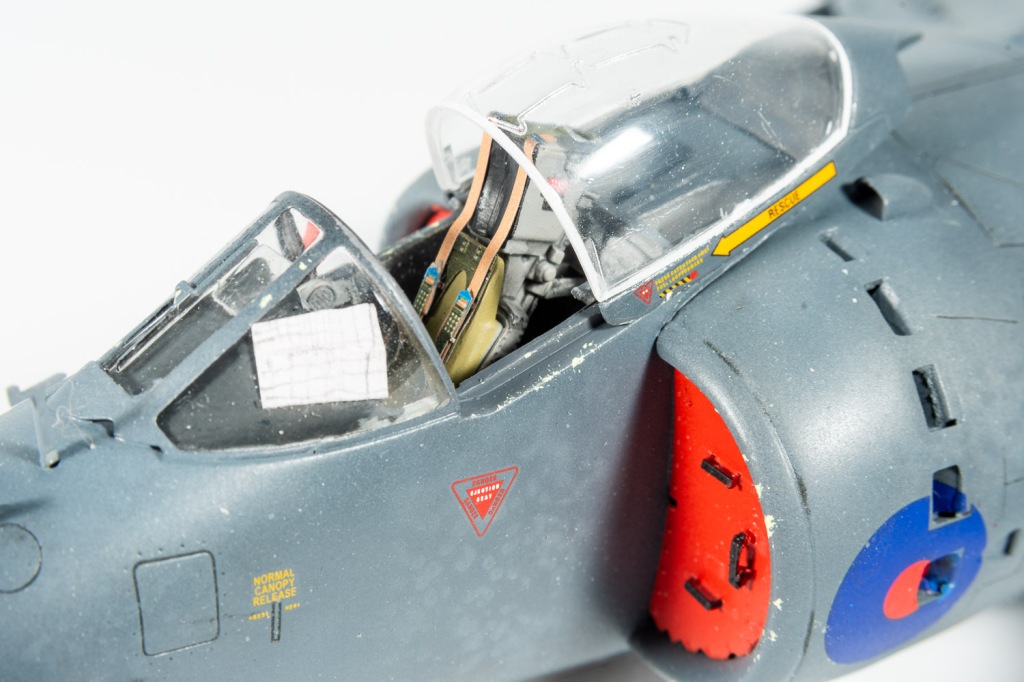
Kinetic 1/48 Bae Sea Harrier FRS1

  • Built: 2021
  • Added to stash: 2015
  • Enhancements:
    • wheels-reskit
    • Ladder-Brengun
    • FOD covers-Flightpath
    • Cockpit-Eduard PE
    • RBF flags-Fantasy printshop
    • Bomb-Reskit
    • Pitot tube-Master
    • Sidewinders – Reskit
  • Decals: Xtradecal Harrier Falklands 25 year Anniversary

The third and final of my Harrier triple build. The first being the FA2 and the second, the AV-8A. I have to say, I am quite happy with how this one turned out too.

Being pretty much the same kit as the FA2, I will refer you to that article for the build notes. The Flightpath FOD guards are made to fit the kinetic intakes and are cleverly integrated into the interior during assembly.

Right from the off, I wanted to do a Falklands harrier. The very comprehensive kinetic decal sheet will allow you to build just about any SHAR used during that conflict in any of the main schemes, but I turned to the Xtradecal sheet for my scheme. To me the EDSG, makes the jet look dark and menacing. My chosen jet is portrayed as she was towards the end of the conflict. She is staring to look a bit battered with a replacement rudder and jet nozzle from a medium sea grey jet.

Painting started with applying a white undercoat to the undersides of the jet and the fuel tanks. Maskol was then dabbed on with a sponge around the pylons and noses of tanks and gunpods. The idea being, once the EDSG had been applied, these little dabs of masks would be rubbed off, revealing the chips of white. Over the white undersides, lightened mix of Mr Paint Extra Dark Sea Grey was ten sprayed through my Badger 150. The demarcation line was masks off, and neat EDSG applied. Over this Mr Color EDSG was randomly mottled as well as some dark Sea Grey. The finish was starting to look a little battered now. To complete the illusion, darkened EDSG was sprayed through one of those splatter templates which are all the rage now. The model now had the tail Royal Navy titles and SQN badge applied. Very thinned EDSG was then applied over this until the title just showed through. Not quite sure if the real jets had these marking ghosting through, but I wanted it as an interest point.

From here, Gunze X113 gloss varnish was applied before the rest of the decals. The xtradecal sheet contains a very thorough run down of the jets from both carriers, calling out any marking oddments or variations. For those questioning those blue LAU10s, apparently some Hermes jets had their rails painted roundel blue as EDSG was starting to run short.

Final assembly consisted of adding tanks, undercarriage, wheels and all those sticky out bits such as pitot tube etc.

I love the SHAR in these colours. The addition of the ladder and FOD guards add a splash of colour to an otherwise dark scheme.. Heading its way towards me is the Skunkworks RN carrier base and tractor, which should make for a nice little display.

And thats it for this instalment of Kinetic harrier builds. I have one remaining GR3 in the inventory, which will be tackled later as an early GR1.

Bae Sea Harrier FRS1. 800SQN. F.A.A. H.M.S Hermes. South Atlantic 1982

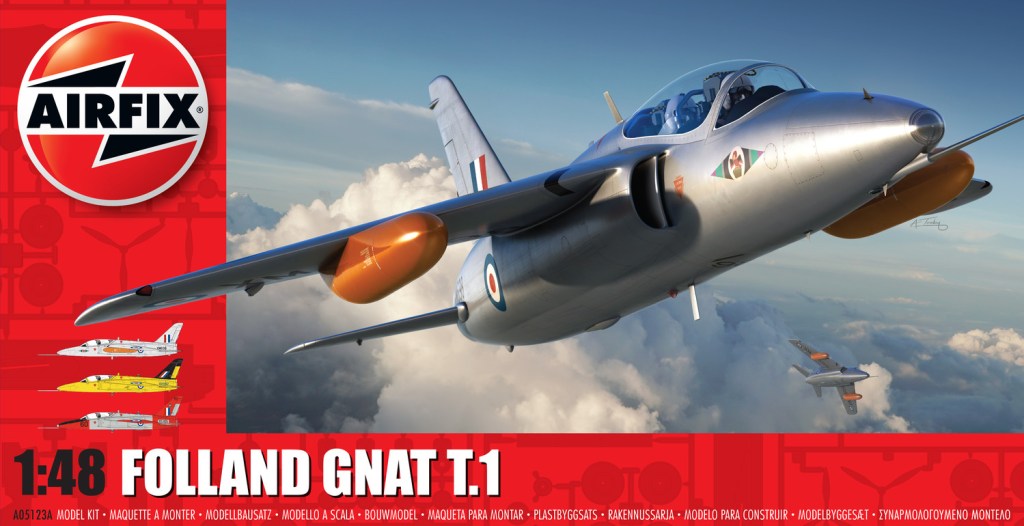
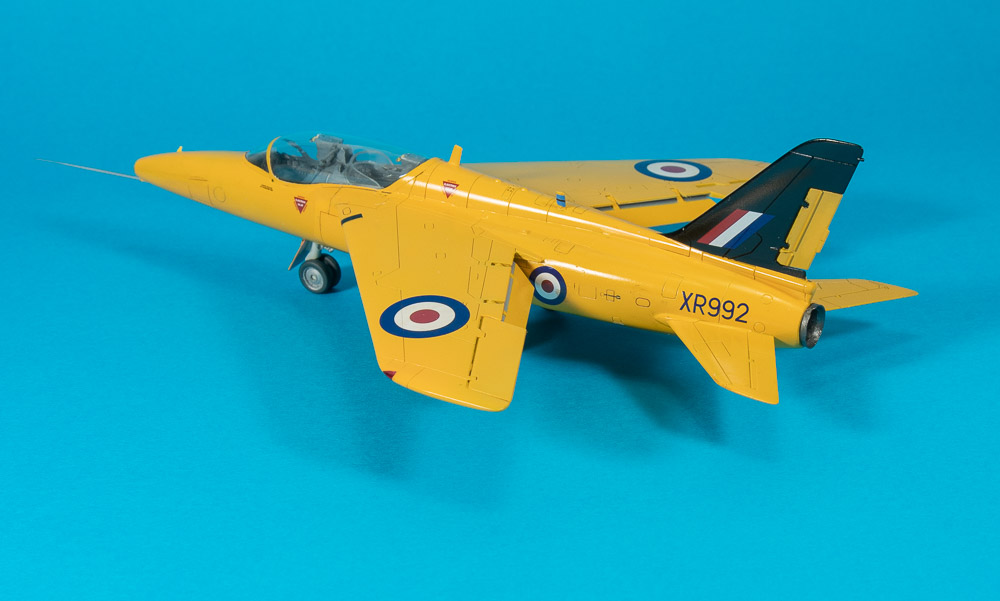
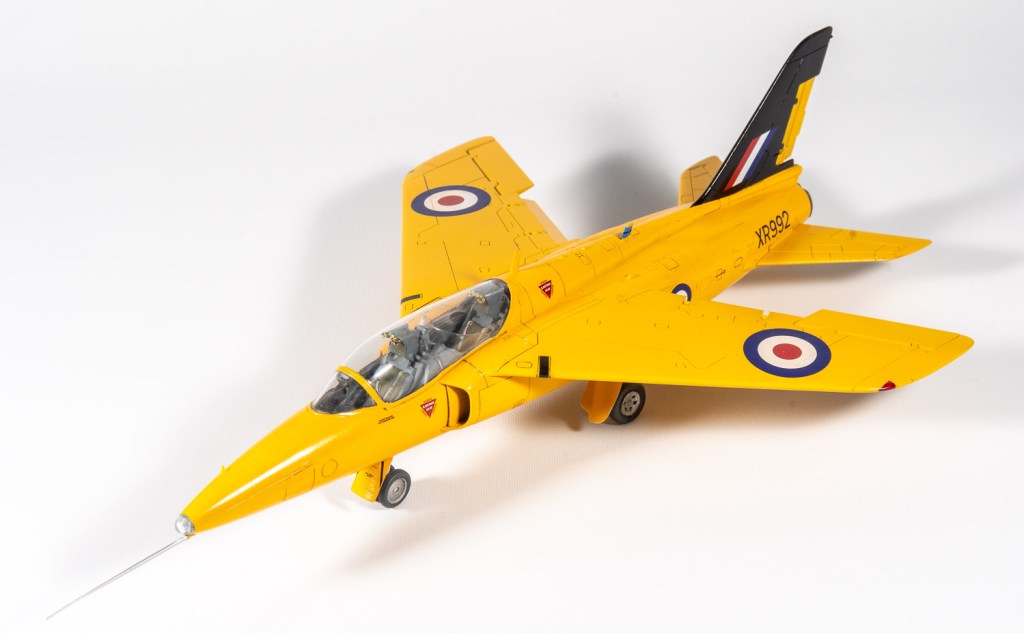
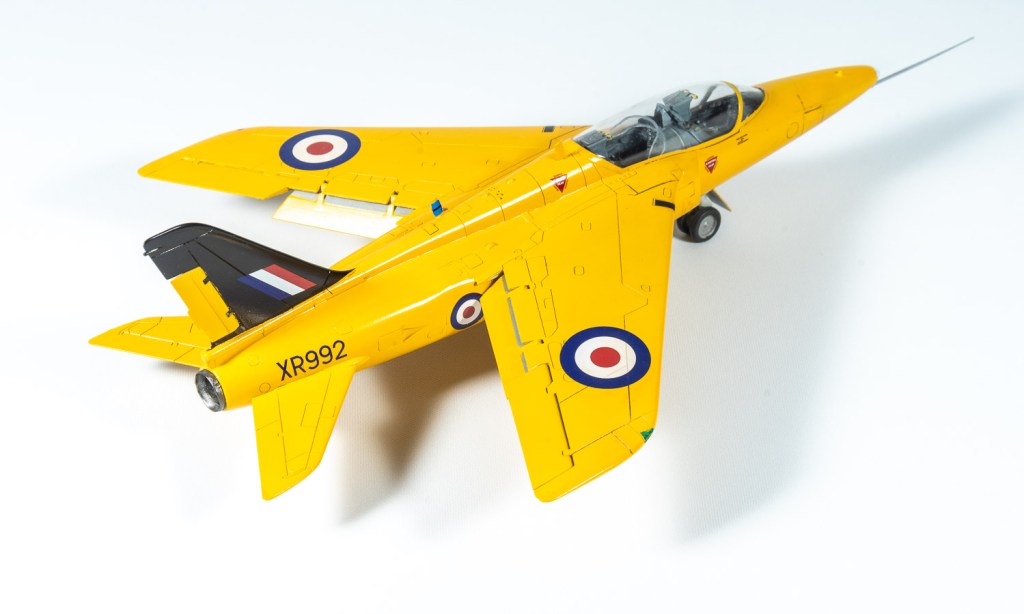
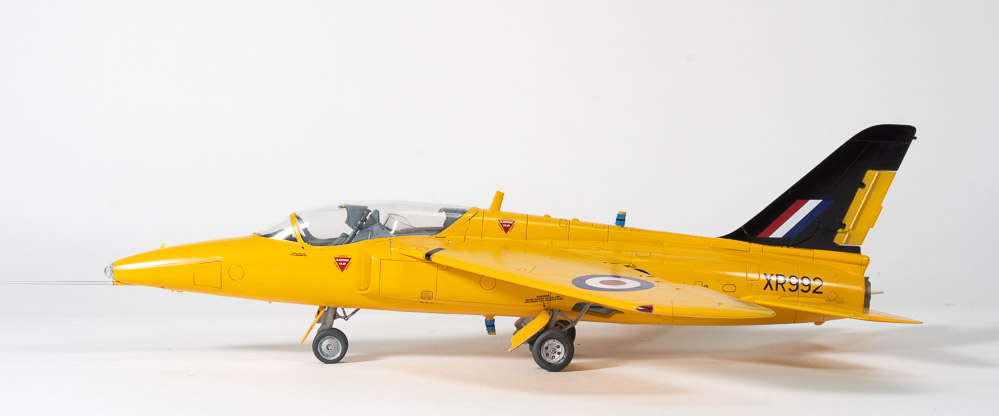
Airfix 1/48 Folland Gnat T1

  • Built: 2021
  • Added to Stash: 2020
  • Aftermarket: Wheels, SBS. Pitot Tube, Master Detail
  • Decals: kit

This build was undertaken on a recent 4 week leave block. At the time I had decided on a – far too ambitious, as it turned out- idea of building three kits in four weeks. This, the Riich universal carrier and the Gecko Models Bedford MWD. Lockdown. Wife at work. All the planets were aligning for a solid four weeks at the bench.

Well, getting called back to work for a week, and the Riich Bren gun carrier with its 400 parts put paid to that idea!

I was originally going to mount the gnat in flight, but didn’t really want to waste the SBS wheels. The other thing that squashed this idea was the fact Airfix only supply one pilot, for a jet that is a trainer!

A bit of penny pinching on Airfix s part I think. Anyway, the plan last this stage was to build the box art scheme, so I really needed two pilots. So the idea of a jet in flight was abandoned.

The model assembled easily enough with the use of minimal filler. Aside from the wheels and pitot tube, the model was OOB. CMK and Eduard do AM sets for the cockpit, but I found the kit cockpit and instrument panel decals were fine, especially under a closed canopy.

Soon enough, it was time for paint. After a bit of to-ing and fro-ing, between schemes, the Yellowjacks scheme was decided on. Mr Surfacer pink was used as a primer, which revealed a few seams needing a revisit from the sanding stick. Mainly the underside seam and the wing roots, not sure what I did here, but I was left with a small step, previous dry fits had shown a problem free fit, maybe the intake trunking had interfered slightly.

Main colour was Mr Hobby Insignia yellow, applied in two thin coats, the pink undercoat helping to provide a nice vibrant deep yellow. The Airfix decals performed as advertised, as they always do, Microscale products helping them sink into the underlying detail on the wings and fuselage.

Tamiya brown panel line accent was carefully run along all engraved detail, before being allowed to dry, the excess then being removed with then aid of a odourless thinner dampened cotton bud.

There is really nothing further to add about the build. Again the photos show where I have been less than careful with my masking of the wheels and restating panel lines around the avionics bay, but this model really was just an exercise to see if I could get it built in a week.

Would I build another? Absolutely! It seems fashionable these days for some “serious” modellers to bag Airfix as lacking in detail and aiming their kits purely at kids. Yes, they may be simplified in a lot of cases, but their 48 scale kits, I believe certainly have the enthusiast in mind. This is the fourth Airfix kit I have completed. Every one of them has been a joy to construct, and that to me is what its all about.

Folland Gnat T1. “Yellowjacks” Aerobatic Team.

No4F.T.S Royal Air Force.R.A.F.Station Valley . Wales 1964

Kinetic 1/48 Bae Sea Harrier FA2

Built: 2021
Added to Stash: 2014
Enhancements:
Cockpit: Eduard PE Interior
Wheels:  Reskit
Jet Nozzles: ​Aires
Practice Bomb Carrier: Flightpath

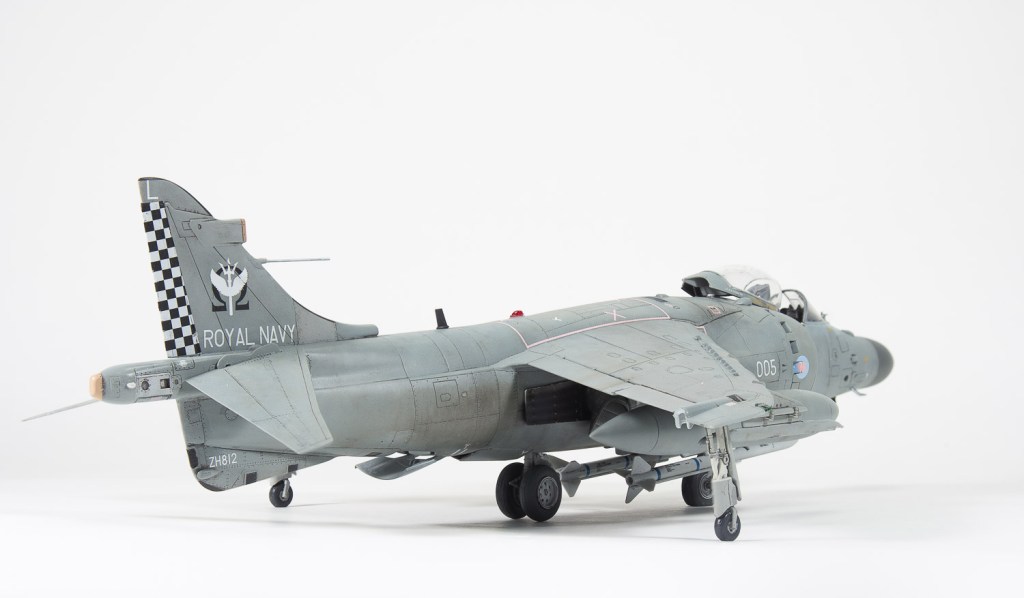
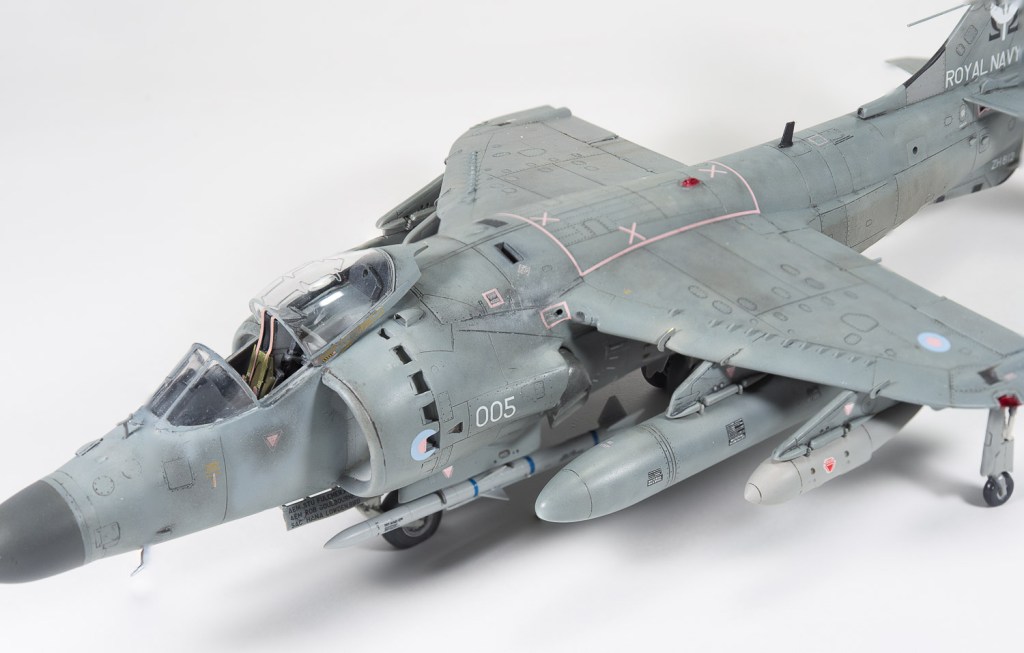
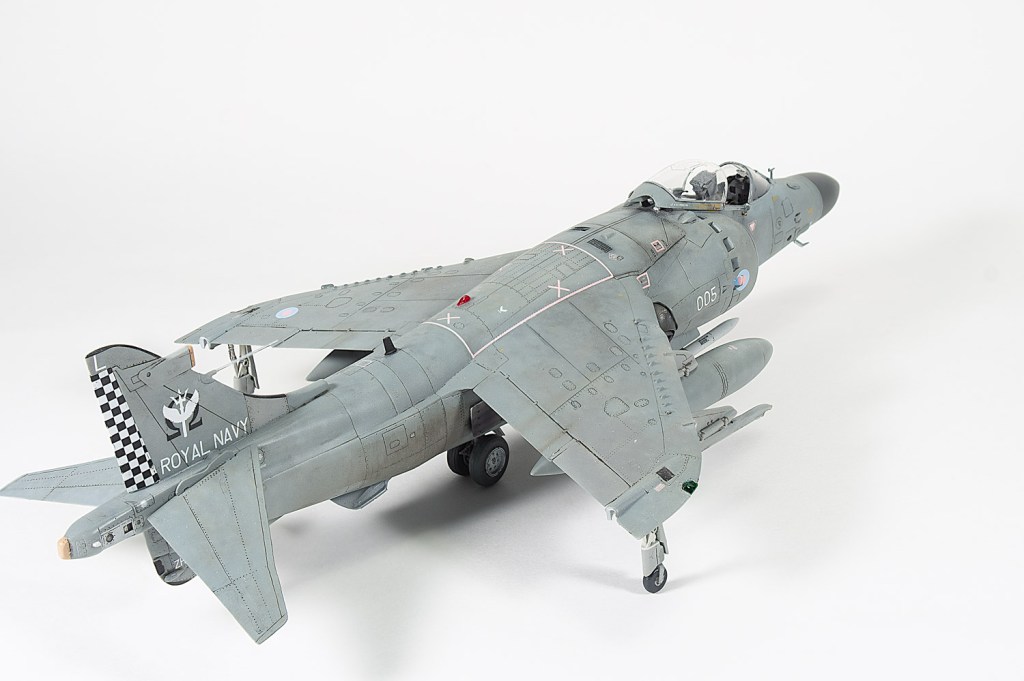
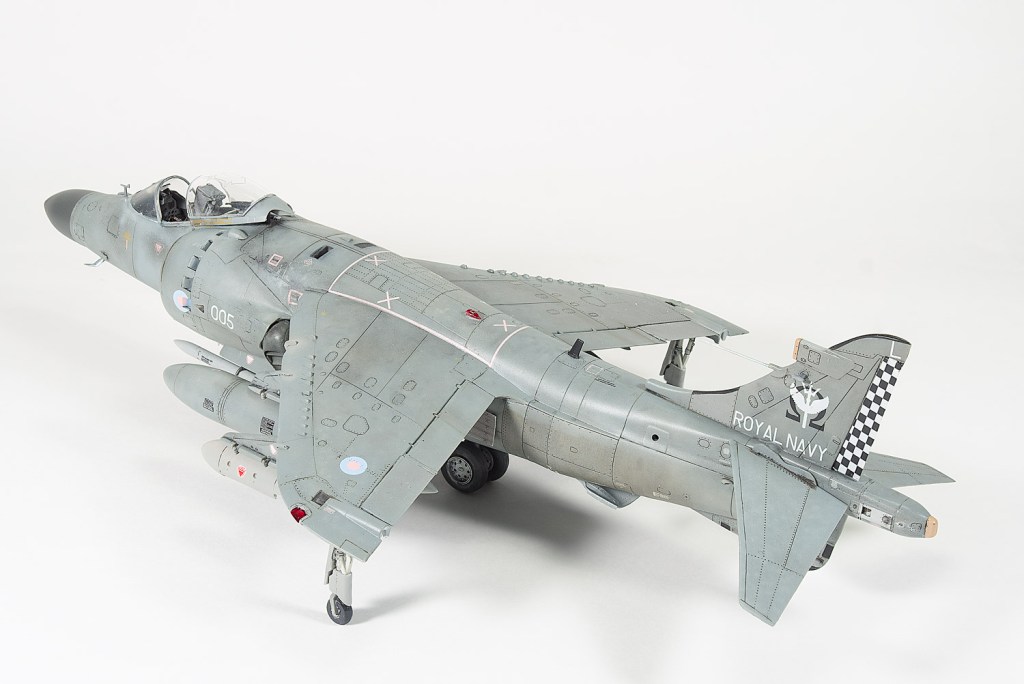
This year, I have had friends randomly picking kits for me to build.  This FA2 was a follow on build to the Kinetic FRS1 that was the actual kit picked out for me.  Like my tornado builds, I decided in addition to the FRS1, I would also tackle the other Kinetic Harriers in the stash.  And like the Tornado, if I had not have started both sea harriers at the same time, I would have sold the FA2 after completing the FRS1.  Its not a difficult kit, but its not the most enjoyable either.  The third Kinetic Harrier I started was their new AV-8A, and it was obvious from the fit of the intakes, Kinetic have retooled these parts and the fuselage halves.

Construction Notes
The intakes were built up on each fuselage side prior to assembling the fuselage halves, rather than after as the instructions would have you.  The advantage to this is a a slightly better fit although I found the rear cockpit bulkhead pushed the nose wheels halves out a bit.  My solution to this was widening the location channel to ease the fit of the bulkhead..
There is also an atrocious joint where the wing undersides join the fuselage, despite me adding a spreader to widen the fuselage a little.  
Making matters worse, is it is very difficult to get any sort of sanding stick in there to clean the joint up, even custom made ones.  On all kits, I just put up with it.

Whilst we are on the wings, if you do not want a step between the separate control surfaces and the rear of the wing, the thickness of the wing interior needs to be substantially reduced before you cement the wing halves together.  If left as the kit comes the flaps and ailerons are a lot thinner in cross section than the rear of the wing. Supposedly the wing pylons need to be moved 4mm back, but I didn’t bother with this.

Panel line detail on kinetics SHARS are a little inconsistent, so the scriber was run along most of the main panel lines to deepen them.  A thin coat of Mr Color Medium Sea Grey was then applied.  Over the top of this I marbled on various greys, both lighter and darker than the MSG, before another thin blending coat of lightened MSG was sprayed.  A couple of panels were then masked off and painted with MRP MSG to give the look of replaced panels.  The fuselage extension was also painted in untainted Medium Sea Grey straight from the jar, as this showed as a different shade even on heavily weathered jets.  Then began the time consuming process of masking off and painting all those RWRs, doppler panels, dielectric panels and rubbing strips on the leading edge of the fin.  Jets are definitely more work than WW2 aircraft!

The under fuselage pylons and AMRAAMS were decided on to make the jet a little different from other models of the FA2.  Several reference photos were consulted to get the placement of the pylons correct as Kinetic do not give you any guidance in the instructions.  Despite the photos, I got some feedback when I posted the model on Britmodeller, the AMRAAMs were still tool forward by a couple of mm.  I can live with that

The decal sheets in these SHAR kits are nothing short of comprehensive, probably amongst the best you can find in a kit.  From the FA2 sheet, you can make just about every FA2 in service, in either hi viz or subdued schemes, as Kinetic provide you all squadron insignia, and all serial numbers by way of separate numbers you then combine to make your desired serial.  All stencilling is provided in both pink, red and black depending on which scheme you finish your jet in.
The sheet is printed by cartography, and they performed excellently sinking into all the recessed detail with the aid of Micro set and Micro Sol.

It was then that disaster struck.  I foolishly glued the windscreen on with Tamiya extra thin. I must have had the windscreen touching the instrument coaming one one side as the glue wicked straight up the inside of the windscreen.  AAAAGGGGHHH!  I managed to get the windscreen off, and polished the glue mark out, but the damage had been done as this kind of thing is hard to come back from.  The model no longer matched my vision of it in my head and I found I was just wanting to get it off the bench so that I could concentrate on making a better job of the others. Hence, the rather sloppy touch up paint around the reattached windscreen.

​ This is the problem I always have when building multiple kits in parallel.  I won’t be doing it again.  My new found apathy for the model only increased when I found the canopy would not sit flush when in the closed position.  The simple workaround to this was to just place it in the open position. A couple of the antennas had broken off with my handling of the model, and I didn’t replace them as by this stage I was over the kit. Annoyingly Kinetic want you too drill out all the location points for the antennas, which are moulded with a little tab on the underside, so your hole has then to be cut into a rectangular shaped hole.  I daresay, Kinetic have done this rather than provide holes so any antenna fit can be catered for, but really Kinetic, you could have provided flashed over slots to make this job easier. To top the model off, it then rocked ever so slightly once placed on its gear, despite me fitting the main gear last to ensure it would sit on all five wheels.  Thats it.  It will be going to the back of the cabinet.  Im hoping my other two will turn out better as Im using a bit more patience in their construction.  Meanwhile, Im not rating the Kinetic kit as an enjoyable build.

BAE Sea Harrier FA2 ZH812 801 SQNFleet Air Arm.  Yeovilton. U.K 2006

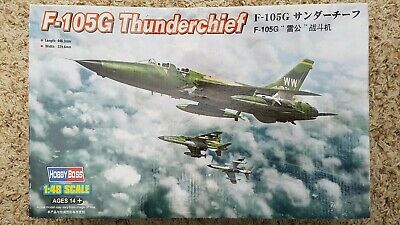
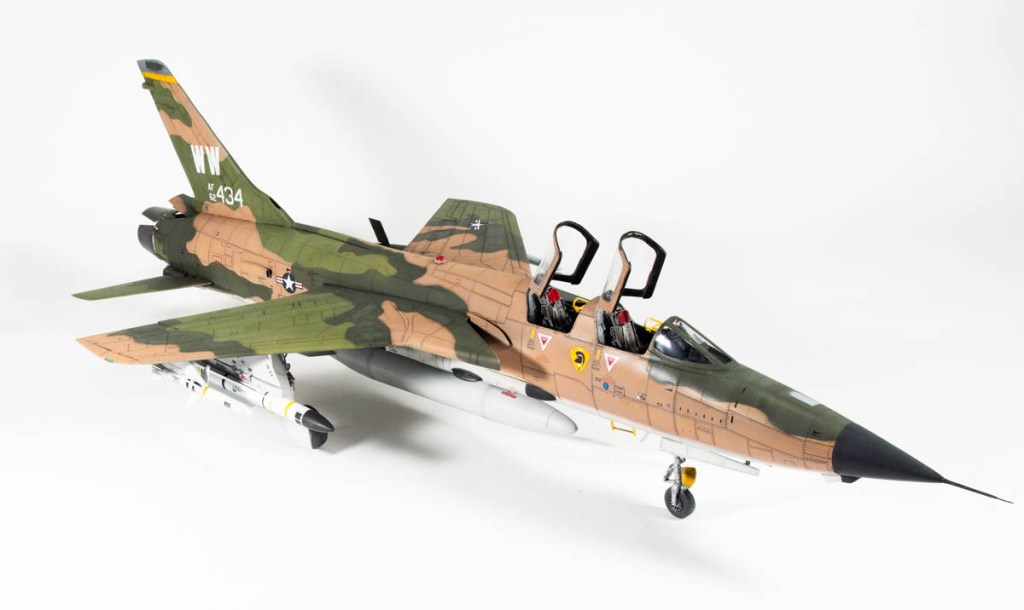
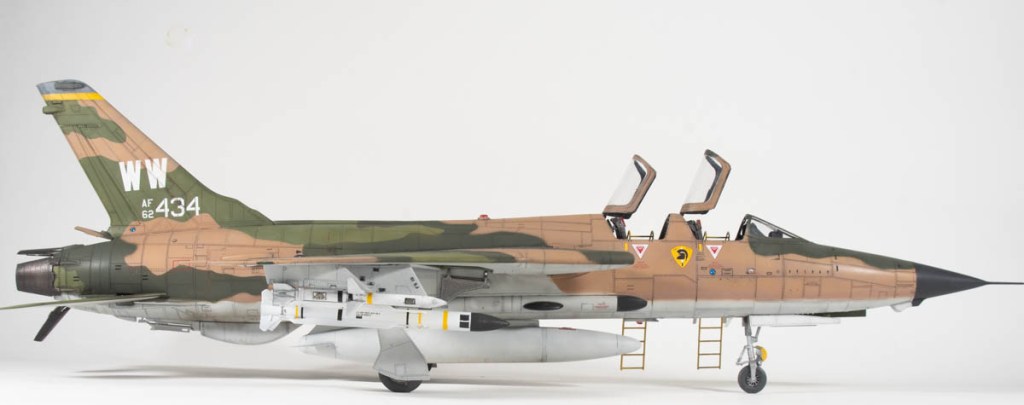
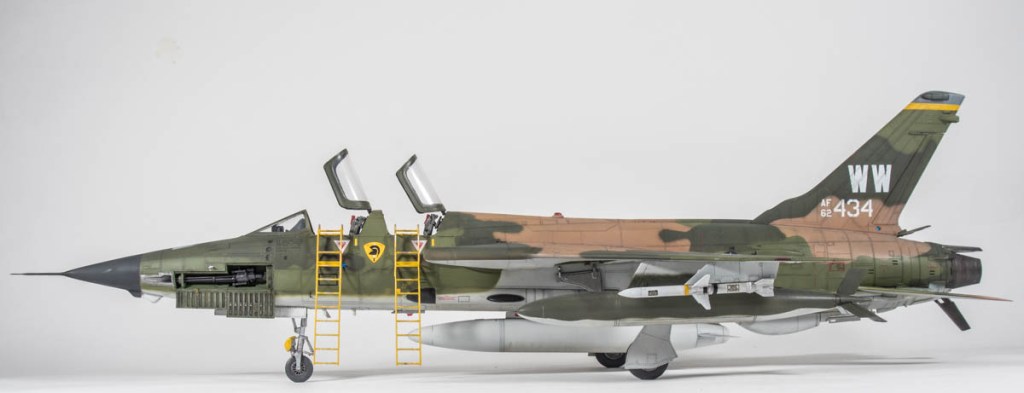
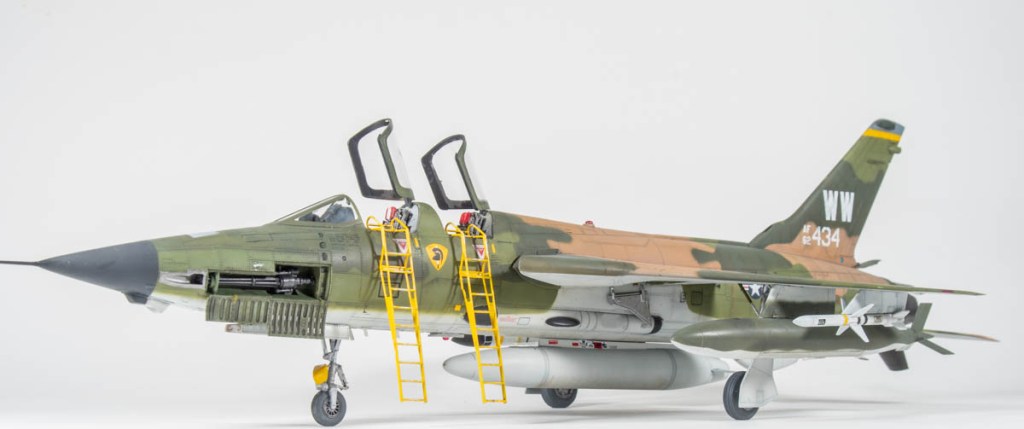
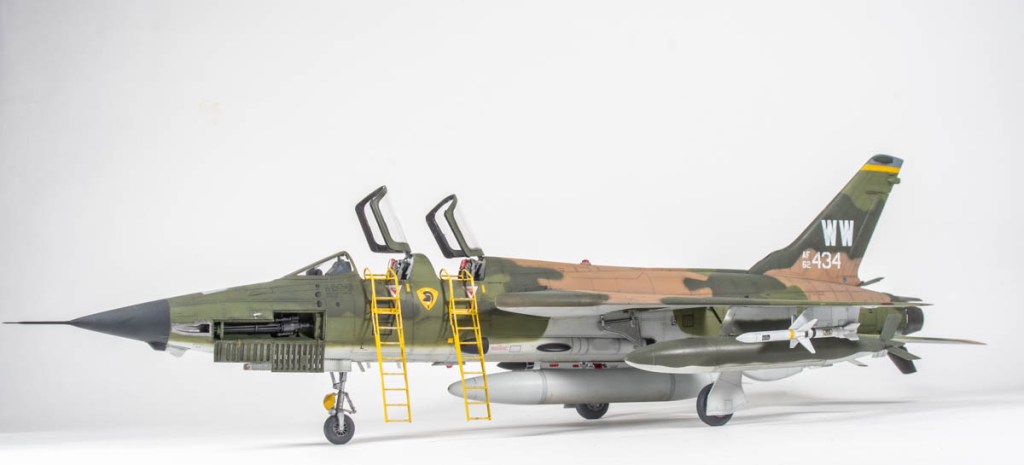
Hobby Boss 1/48 F-105G Thunderchief

Added to stash:  2017
Finished:  2021
Enhancements

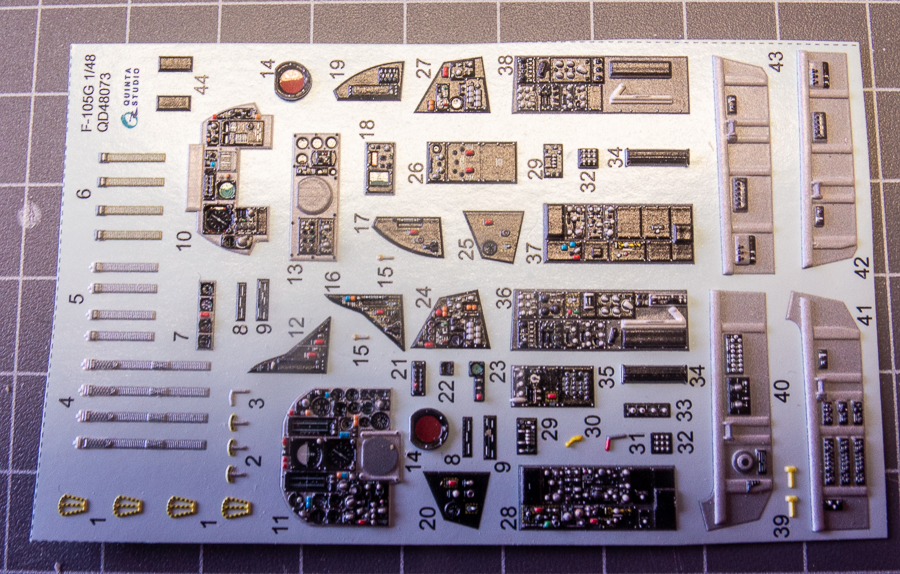
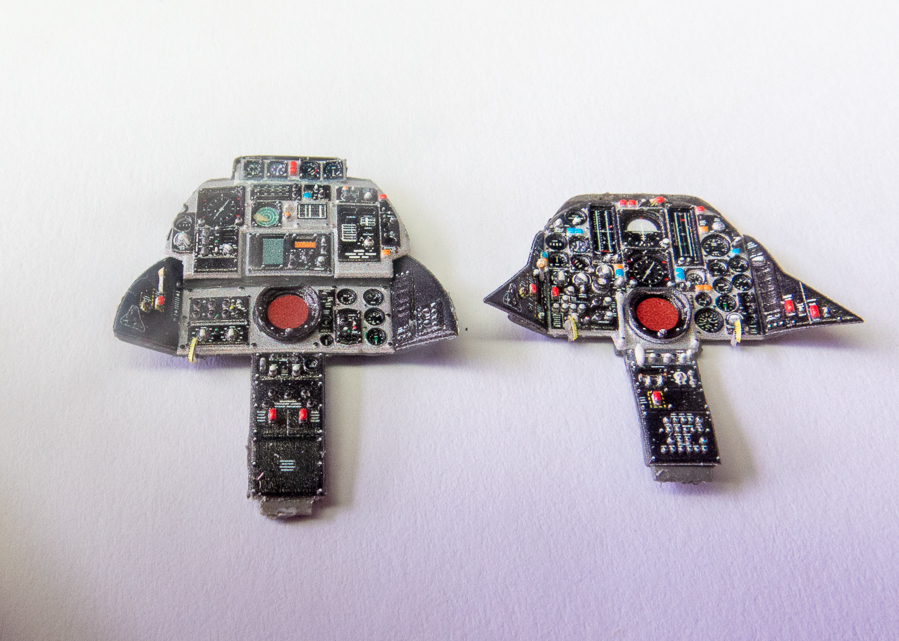
Cockpit Panels:  Quinta 3D decals
Seats:  Legend 
Gun Barrels:  Master Barrels
Pitot Tube:     Master Barrels
Wheels:  Reskit                                                                                External details:  Eduard Exterior set.  Quickboost vents                                                                                       Navigation Lights:  Quickboost                                                                              Decals:  Caracal                                                                          Boarding Ladders:  LF Models

This is not the first time the HobbyBoss Thunderchief has formed part of my stash.  It first joined the stash soon after its release, only to be sold off in the Great Stash Slash of 2013.  However, its funny the effect of looking at the real aeroplane can have on us as modellers.  
 
What had previously been so many disparate grey parts in a box took on form and  large menacing  grace when I stood next to several real Thunderchiefs whilst on an Aviation Odyssey to the USA,


I knew I had to build one upon my return home.  My mate had a similar feeling upon looking at the F-101B Voodoo, a jet he had previously had no love for either.

Consequently the HB two seat Thud rejoined my ever growing stash, and this year was picked out by a mate for my 2021 build schedule.  I should add here, for a kit to only spend 3 years in my stash between being purchased and then built is well above the average!

 As with all my builds, I started out watching related youtube videos and pulling all the reference material I had in my library.  Republic’s Thunderchief had  a very tumultuous start, during which the project was almost cancelled. Republic refined the original design markedly and the Thud went on to deliver sterling service during the Vietnam War before being withdrawn due to crippling losses.  This was due to the jet performing a role it was never designed for.  All this research helps with motivation for the build.

HobbyBoss’ Thud is one of their earlier releases, I believe it’s scaled down from their 32 scale kit, hence the breakdown is far more complicated than it probably needs to be with an engine, open gun bay and even parts for the nose mounted radar.  That said, I do like the display options these details offer the builder.

Ive made a conscious effort lately to plan how I want my finished builds to look.  This helps me with purchasing aftermarket parts that may be needed, and on the flip side, deciding what assembly steps and parts can be skipped due to closed panels etc.  I’m finding planning like this leads to saved time on the build.
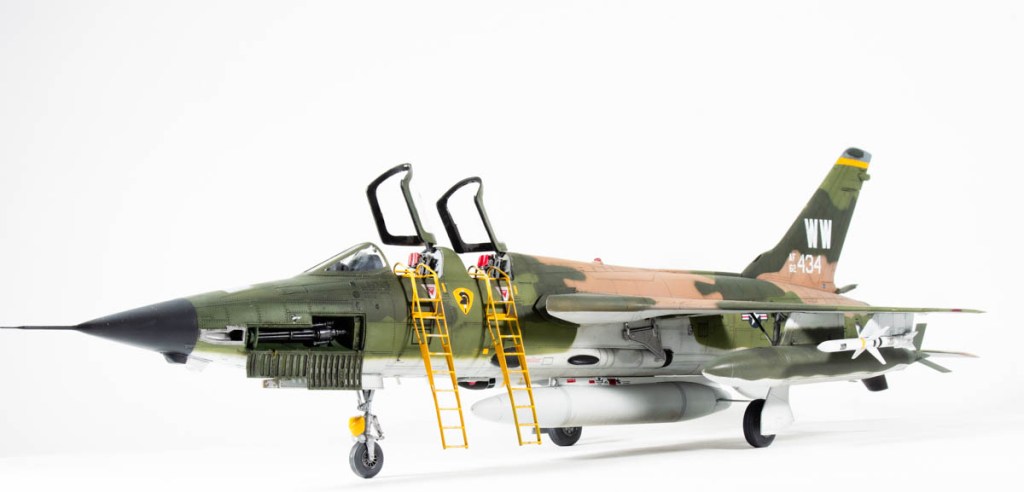
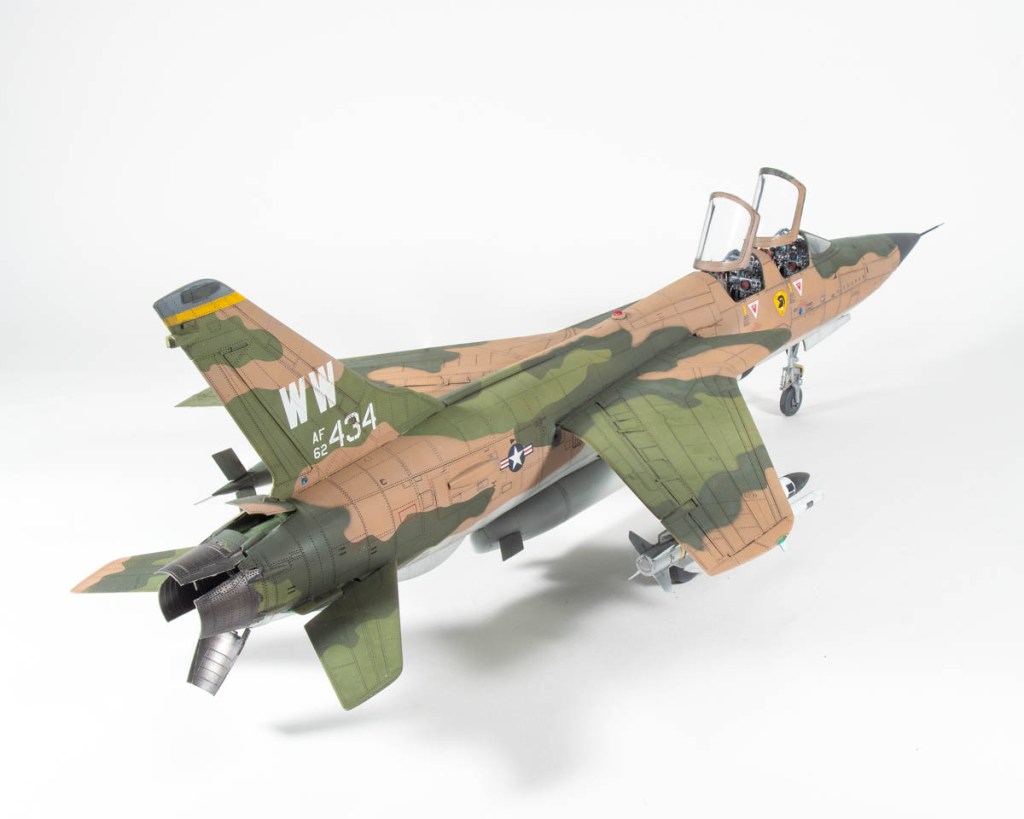
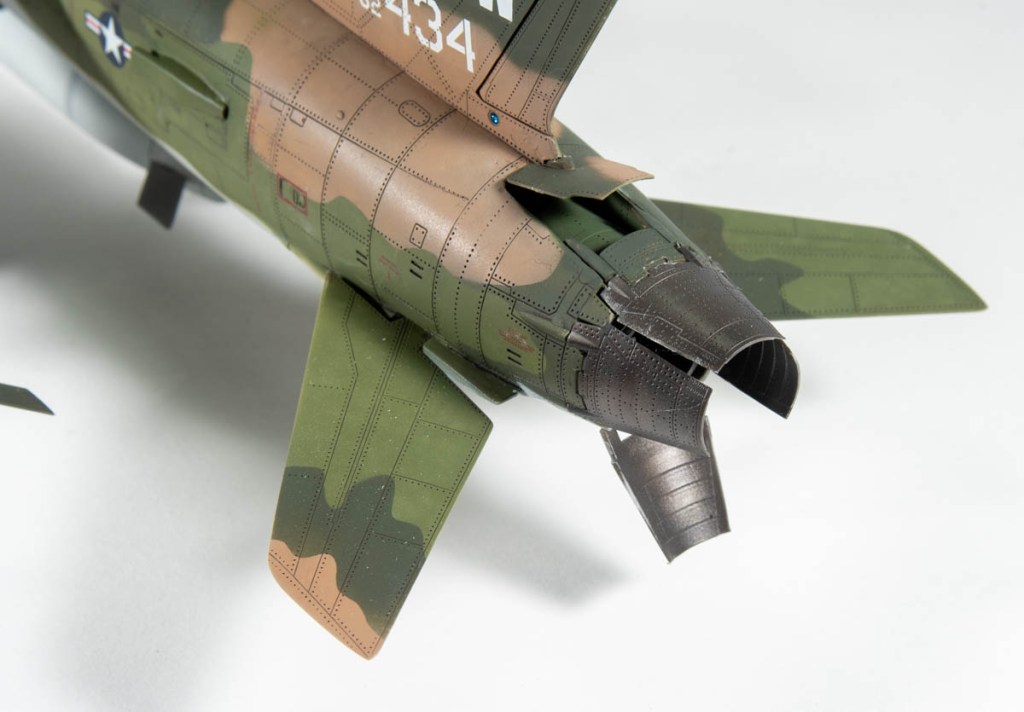
With this jet,  the canopies and gun bay would be opened to show those details of the jet.  The drag chute door behind the fin and the lower speed brake would also be shown open as seen in many period photos.
It would also be tooled up  with a typical Wild Weasel asymmetrical load out that would have been carried during the Vietnam war.  Naturally, it would need to wear the WW tail codes for Wild Weasel.

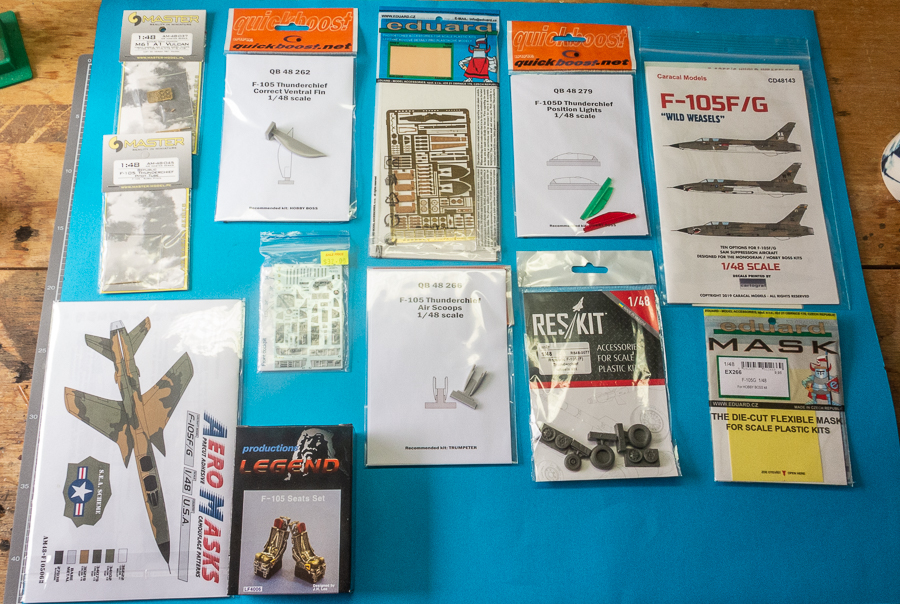
I was surprised to find I had amassed quite a bit pf AM for the Thud!

aftermarket

Construction Notes
I started by making up complete fuselage halves by assembling each fuselage rear to the front half.  Doing it this way ensures a neat gap free join. Plastic strip was glued to the rebate where the engine bulkhead would normally be glued to provide more glueing area.


Cockpit
H
obbyBoss really mucked up here.  The kit cockpit side consoles are way too narrow and do not reach the fuselage walls.  You will need to add plastic sheet to widen them.  What on earth were you thinking HB?
extra width topextra width bottom
 
 
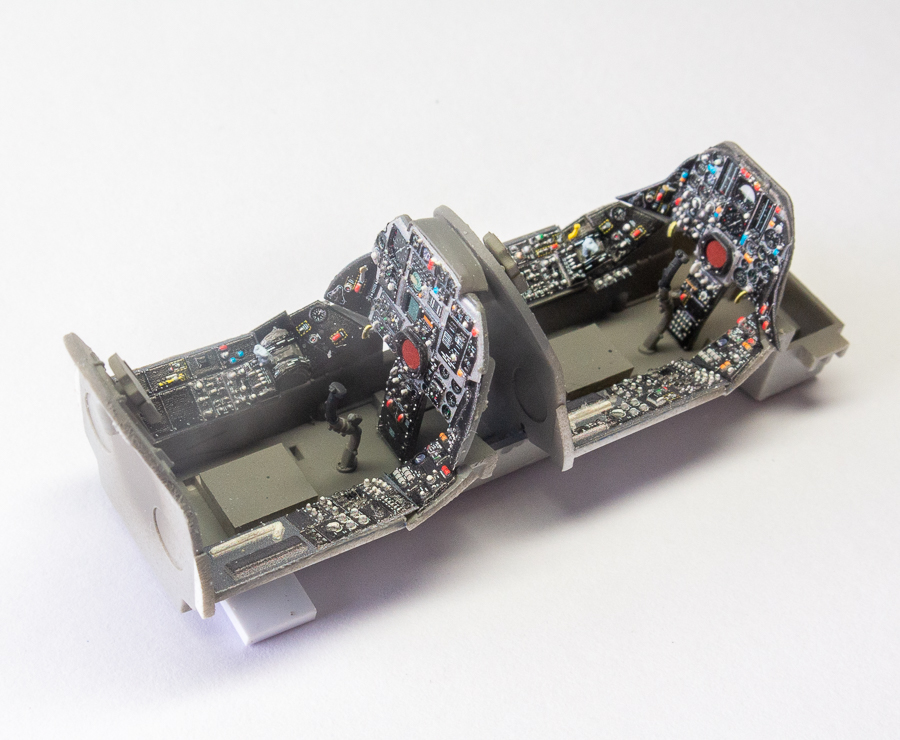
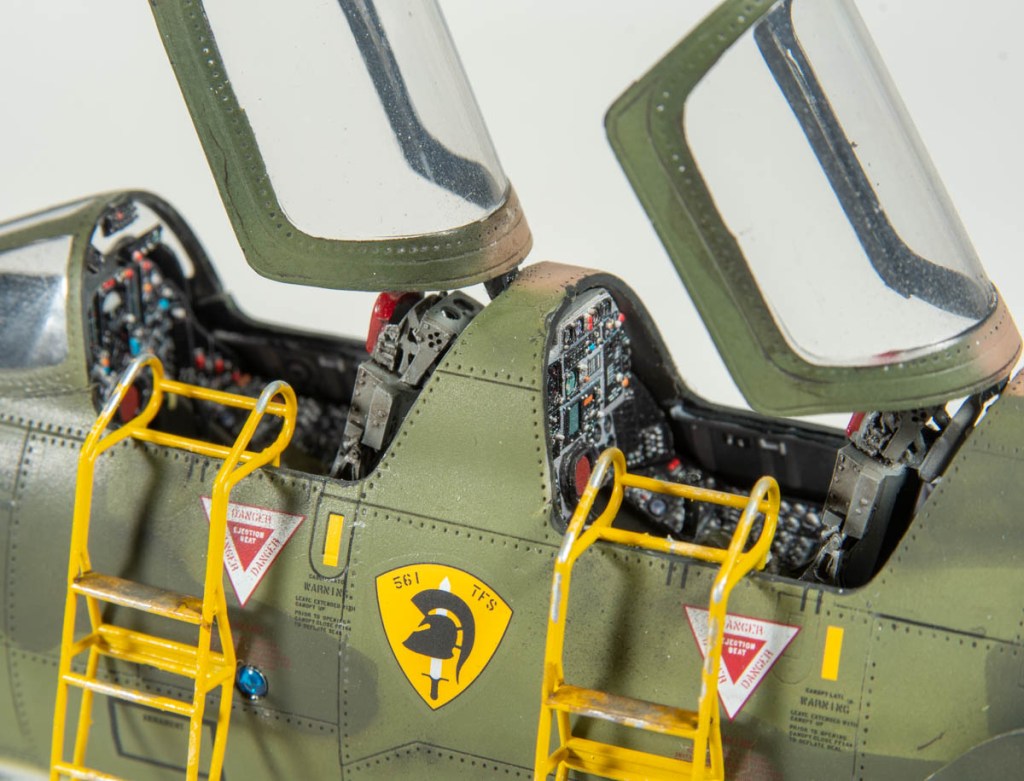
The Thunderchief has a wide very visible cockpit that rewards extra detailing.  I chose to use one of the new Quinta cockpit sets specifically for this kit.  Well, colour me impressed!  This was the first time I had used these sets.  The Thud one fit perfectly, correcting the too narrow kit consoles.  They are easy tao apply once all the moulded detail had been sanded off the panels and look far more realistic than just flat PE panels.  Printed on white vinyl, you may have to touch in the odd visible white edge, but this is nothing hard.  the dials are already gloss coated, although I would probably hit the panel with a matt to dull Quinta’s semi gloss finish.  These will be  my go-to panels for all aircraft that feature highly visible cockpits in future.
quinta sheetquinta panelsquinta panels-2


Construction Continues
For such a complicated looking kit, it went together surprisingly quickly.  The separate spoilers were individually added to the top wing before the halves were glued together.  Doing it this way ensures you get the best possible flush fit as it allows access to  both sides of the wing, which you wouldn’t be able to do if you added the spoilers to the assembled wing halves.  I had the Quickboost navigation lights to hand so also added these.  Strange decision by Quickboost to mould the complete wing tip in red and green plastic when the actual light is quite small.  I can only assume they did it this way so the light is correctly faired in.  Be careful to avoid a step though.  I also added the completed wings to each fuselage half to better ensure  a gap free join.  Hobby boss’ kit has the wing strengthening plates moulded on.  I could not glean a date though when these were added to the real jet, just that the constant tempo of operations in SVN had lead to fatigue issues, hence the reason they were added.  Anyway, I was not going to risk destroying detail by sanding them off.  The Gs were late airframes anyway so hopefully they had them fitted.

Eduard PE fascias were added to the gun bay and the plastic vulcan barrels replaced by the incredible brass turned Master Barrels ones, You will go crosseyed trying to assemble them.  The Eduard gun bay door with its open gas vents is a massive improvement on the kit part.  Should you be building your Thud with the gun bay open, I’d suggest the Eduard set is a must.

Painting and Decorating
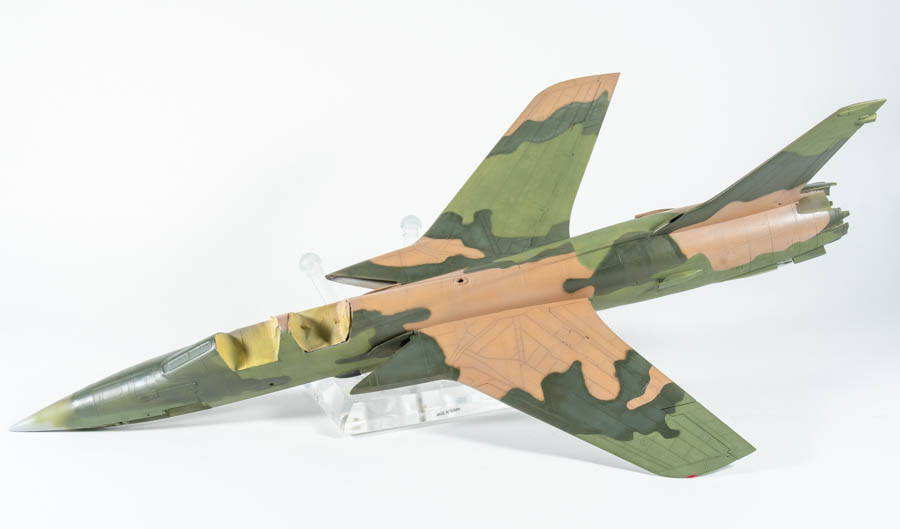
Aeromasks are a manufacturer unknown to me.  I stumbled across them browsing facebook.  They offer a very comprehensive range of camouflage mask sets in all scales.  Seeing they offered a set for the Thud, I promptly ordered one thinking it would really ease painting the S.E.A scheme.

​The sets arrived pretty quickly from America and are indeed fairly comprehensive, even providing masks to paint the demarcation lines on the fuel tanks.  Clear instructions leave you in no doubt how to position the masks and in what order to paint the scheme.  You are well advised to follow these as the painting order is designed to ease the masking process, not necessarily the painting.  Therefore you start with the medium green not the tan as you would imagine.
Being the masks are not designed to fit specific kits, you may find some trimming necessary in order to fit the kit you are using.

The masks were placed on little blobs of white tac so as to leave a soft edge.  This was only marginally successful so I ended up tracing around most colours with the airbrush freehand to soften edges.
Overall, I was happy with the masks and the intricate pattern using them provided, which seemed to match photos.  A lot of the jets had their camo field applied as they entered the theatre still in their silver schemes, so there would have been some minor differences from airframe to airframe.

 The bloke who runs Aeromask used to paint  real Thunderchiefs at Hill AFB, so has access to all the official paint schemes.
My intention was to portray a battered and faded jet, but again looking at photos revealed not a lot of faded paint on the Wild Weasles, so the faded look was held back apart from the upper surfaces.
​The Caracal  decals performed flawlessly as always.  Prior to decalling, an oil wash was applied straight over the lacquer paint.  This was then sealed with a gloss coat ready for decalling.

Thunderchief_initial paintThunderchief_initial paint stb sideThunderchief_initial paint-2


Once decalled a further gloss coat was applied to seal the decals before stains and leaks were added with more oils.  The model was then flat coated before proceeding to final assembly.  This is now my preferred work flow.


Final assembly reveals the achilles heal of the HB kit.  That being the very spindly weak undercarriage legs, upon which the completed model wobbles alarmingly.  Against my better judgement white metal legs were purchased, and ultimately discarded, because they were….well….crap plus the main reason the kit legs are spindly is the insubstantial socket HB have moulded for them to sit into.  The metal legs weren’t going to fix this, nor could I glue in more substantial sockets.  The Thud continues to wobble on its legs.

upongear_Thud_21-03_04

​Weapons were sourced from a hasegawa weapons set.  There was a difference in size between the kit missiles and the hasegawa ones .  My faith went into the Japanese manufacturers product.
A final lack of detail that was not discovered until I went to fit the canopy was that HB had made absolutely no allowances for the modeller to pose them open.  Thus actuators had to be scratch built.  This was achieved with brass wire and rod
The brass pitot tube was push fit into the hole in the nose cone and this mighty Vietnam warrior was finished.

Final Thoughts
The Thunderchief makes for an imposing model in the cabinet.  Its a decent size in 48 scale, and stands out amongst all those grey jets  in its multi hued warpaint.  The lovely LF Models ladders provide a nice splash of colour and draw your eye to the cockpits
I think the Thud is one of my best efforts yet.  the trouble free construction being a bonus I had not expected when first perusing the instructions and parts.  An enjoyable build, although one will do me.

Republic F-105G-1-RE Thunderchief  U.S.A.F  561st TFS Korat Thailand  1972


Revell 1/48 Tornado GR4

Completed:2020
Enhancements Used:  
Cockpit: Eduard
Seats: Paragon
Wheels: Brassin
Wheelwells: Eduard
Weapons: Brassin
Pitot: Master Barrel
Wing Seals: Shaun off Britmodeller
                                                                                                  Decals: Model Alliance Op Telic Part 1

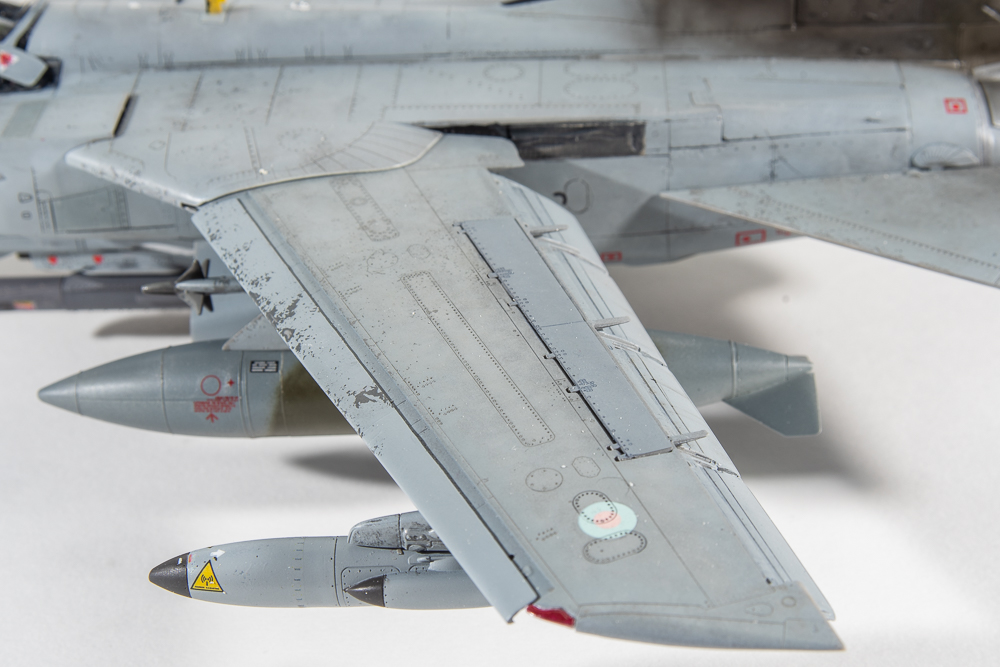
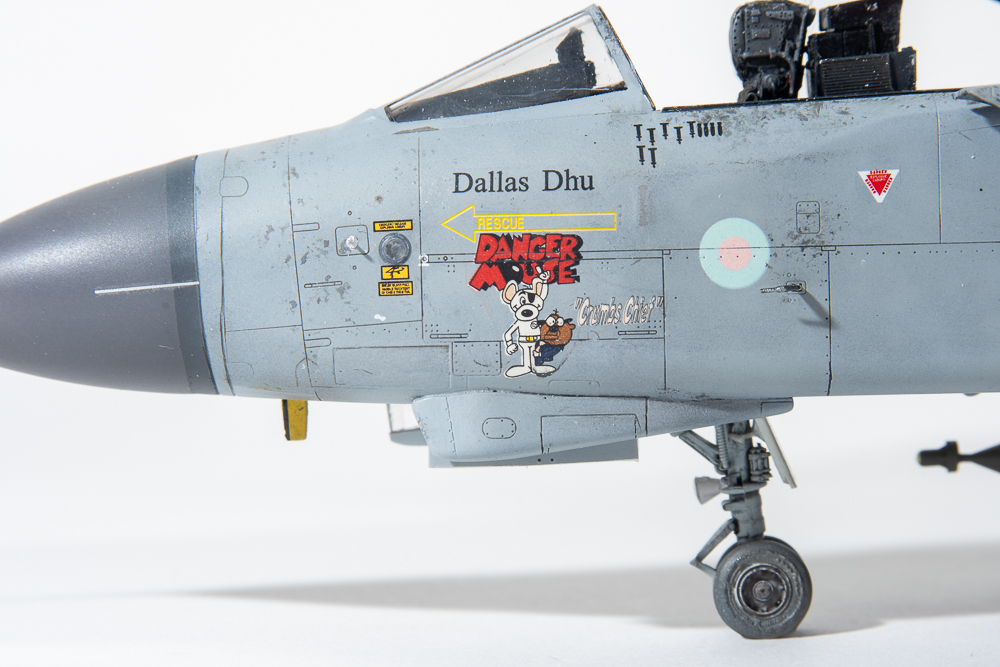
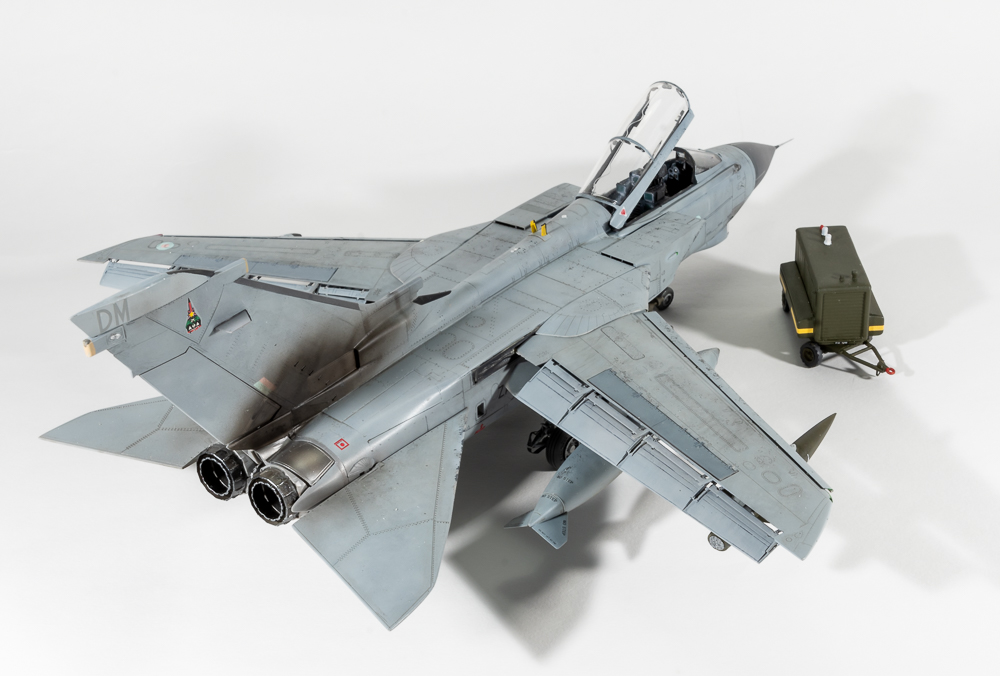
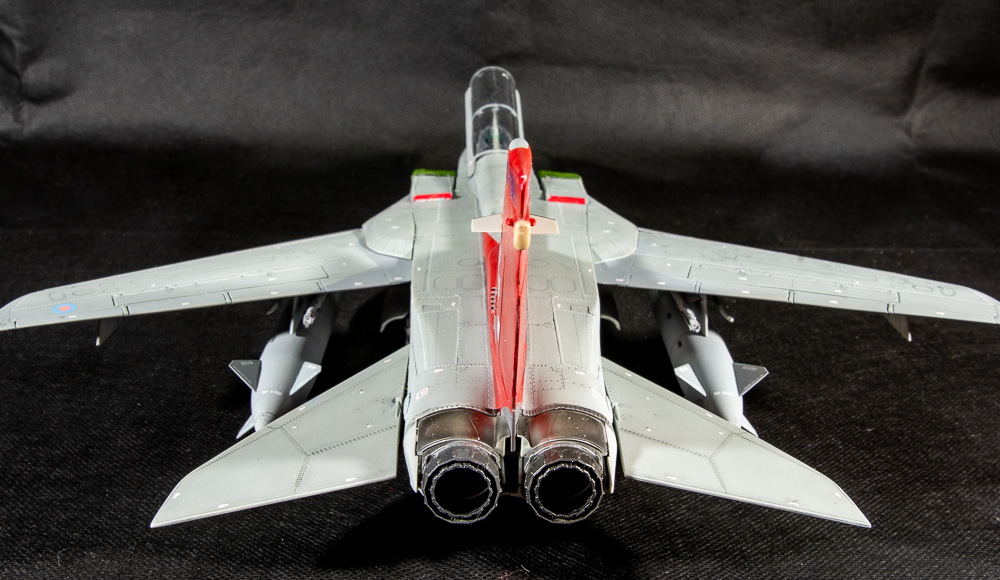
The third and final instalment!  I had wanted to build Danger Mouse from the start.  For some reason I thought it was a ADV though, not a GR4, so then had to keep on  building tornadoes until I got to my GR4.  Well that’s my excuse for building 3 Revell Tornadoes.

I had a load of aftermarket I had planned on using on this build.  Some of it got binned as not value adding to the build though.  
Firmly in this camp, I place the phase Resin Hangar seamless intakes.  For a start, I just don’t think they are needed.  Whilst the kit intakes do have a nasty seam, you can really only see the first couple of mm of the kit intake trunking, ands then only by holding the model up at a weird angle and craning your neck to look down the intakes.  If this bothers you, a bit of filler and sanding will eradicate the seam. Secondly, the case resin intakes are moulded as just the intake tunnels without the bulkheads provided as part of the kit trunking.  These bulkheads form the front and back walls of the wheel wells and provide important structural integrity.  As I was going to be using the aires resin wheels this was not a dealbreaker.  What was the dealbreaker was the resin intakes would not fit over the top of the resin wheel wells without removing a big chunk.  This  was after sanding both the roof of the wells and the outer wall of the intake wafer thin, so, the resin intakes got binned and I reverted to the kit intakes.  To be fair to Phase Resin, Mike is probably not expecting you to use his intakes in congestion with resin wheel wells.  That aside, to not cast the integral bulkheads seems strange..  My opinion. Don’t bother with the intakes.  The wheel wells however do add to the kit, beautifully detailed as are all aires sets, these even fit with a minimum of fuss.  What led to them getting junked along with the intakes was after glueing them I found I just could not get the fuselage parts to line up seamlessly as the other kits had, so they got hit with the debonder and binned as well.  Not going too well so far!  The aires wells do add a lot to the kit though, and I’m sure the fit issues were due to something I did.

The rest of the build proceeded as per the other tornado builds.  Again I cut off the wing cogs to fit them at a later stage.  Again this is another thing I would never do were I to build another tornado ( I won’t be!)

Revell would have you assemble the wing flaps as a three piece assembly whereas in real life they are one piece with only the small aerofoil section being a separate piece.  Make sure you fill and sand the join line.  Hopefully the photos explain this a bit better.  Shaun’s resin wing seals are far better representations of the real things rather than the featureless kits items.  He can be contacted through  Britmodeller.com

Photos I found on the net of Danger Mouse and other Operation relic jets showed a fair bit of wear and tear with scuffing and chipping of the ARTF grey paint exposing the underlying dark camouflage grey paint.  To portray this on the model. I first applied a coat of dark sea grey to the leading edge slats, nose, pylons and one of the drop tanks.  Mr Neo masking fluid was then dabbed on with a torn bit of sponge and the model sprayed with a couple of light coats of Scale Modeller’s Supply Barley Grey.  SMS is a home grown  Australian paint manufacturer.  I have been increasingly using his paints, as Im finding them excellent to spray.  You can spray them straight from the bottle, but I add a drop or two of thinner to make them spray even better.  They are a lacquer paint that has proven to be hard wearing and quick drying.  Once this paint had dried I rubbed my finger over the Neo to remove it from the airframe leaving the model looking chipped and scuffed.  The jet was made to further look worn by painting a few panels in either dark sea grey or lightened shades of the barley grey. One of the fuel tanks was painted in the old wrap around scheme, jets being fitted with different coloured tanks being quite common, even today.

I applied a panel wash with Payne’s grey oil paint straight over the SMS paint, with the excess wiped off and no damage to the underlying paint.  The decals were also placed straight over the paint, which dries with a sheen, the model Alliance decals performing well, although the DM code letters were too light and did not stand out enough when compared to photos of the real jet.  As I could not find any dark grey or black letters of the correct size to replace them, so had to resort to painting the fin top a lighter grey.  I replaced the letters with other codes from the same sheet.  Penfold’s catch cry “Crumbs Chief” should also be far pinker than the pale shade on the sheet, maybe it faded!  Op Telic jets do not seem to have been as well photographed as Op Granby jets, well so it seemed to me with good quality photos being hard to source. In particular I wanted to know if these jets wore the full suite of stencils after they were repainted.  In the end I went with just the major ones figuring only those stencils that dealt with rescue or crash procedures would have been re applied.

With this model I decided to really strengthen the pylon to wing attachment by using epoxy glue.  They ain’t coming apart now, although perhaps I should have ensured they were parallel to the centre line first!

With that Danger Mouse was done.  One of my favourite cartoon characters as a child.  There are still a few build and finish faults, but this is my favourite of the three.  I love the pugnacious look of the short nose coupled with the laser sensors.  The Eduard Brassin weapons are also a must have, being better detailed and more accurate than the kit supplied weapons.  Out of the box, you can arm a Operation Granby or Operation Telic jet.  Even the stenciling is provided.

So with three Revell Tornadoes done, what are my thoughts?  Well, let me start by saying I sold my remaining Revell tornado from the stash, as to build more would be just like beating yourself over the head repeatedly using a hammer.  I think you would really have to love Tornadoes to build multiples of the Revell kit.  Marred by soft detail in a lot of places, sink marks, flash, it can be  a troublesome build in inexperienced hands.  Take the time to research other on line builds and the previously linked youtube videos as fit problems can be mitigated if the builder departs from Revells suggested build sequence.  I really cant see anyone else aside from Airfix releasing a newer tooled Tornado, so Im thinking the revell is going to be the go-to in 48 scale for quite some time.  I might just order that new 32 scale Italeri tornado, as the Tornado itch still needs to be scratched with a wrap around GR1.

 Tornado GR4 ZA542 31SQN Royal Air Force. Combat Air Wing Ali Al Salem Op. Telic 2003


Revell 1/48 ADV Torando F3

Enhancements Used
Seats: CMK 
Seatbelts: Eduard steel
Wheels: Eduard
Pitot Tube: master barrels
Decals: Xtradecals Tornado F3 part 1
BOL Rails: Phase Resin Hangar

Construction Notes
 Oh God, what was I thinking, building three of these at the one time?.  In last months gripping episode you will recall that I (rashly) decided to build all three of my tornadoes from the stash at the same time.
​Well the plan didn’t quite start out like that.  This tornado was actually the first started, and the original plan was to just build this one,  however, it was not really turning out as I had pictured in my mind, – a common theme with my builds –  so it got shelved, and my other F3 pulled out of the stash, and started with the intent of being a better build (yeah, right!).  It was at this stage the idea to build all the tornadoes in my stash was born.  In actual fact, I thought I would  only be  building the other ADV  and my GR4.  
It  was only when the other ADV was almost finished, this one was revisited, and the decision made to complete it.

​Being the same kit, most of my notes from the first build stand.  My thought process with finishing this kit was to make it a clean build, as, with three builds now underway, getting  Tornadoed out, was a real possibility!   To this end, no stores were added, apart from the large tanks. Photos of the actual jet showed it sans stores anyway, save for tanks and a RAID pod on one of the BOL rails.

 This time the BOL rails came from Phase Resin hangar.  To better reflect RAF pylons, the sway braces were cut off and the “bulges” on both sides of the pylon had their length shortened.  Close enough for Govt. work as the saying goes.  there are plenty of photos available on the internet to aid as reference in this task.
The wings again had their cogged teeth cut off so that they could be painted separately and added later as part of final assembly.  This time I left I bit more of the “spar” with the result the wings attach far more securely, although they don’t have that classic Tornado anhedral

For this model, I wanted to add FOD covers too.  They were formed by covering the intake firstly with  household aluminium foil.  Kleenex tissue was then laid over the foil and coated in diluted white glue.  The thought process being to then slide the hardened tissue off the foil.  In reality, this didn’t work as the glue had worked too well, and stuck the tissue to the foil!
Once dry, the tissue FOD covers were trimmed to shape, and then painted.  Thin strips of tamiya tape formed the ties underneath the jet, whilst white EZline stood in for the bungee cords stretching back to the intake vent FOD guards which were formed from offcuts of red painted plastic card.  RBF flags came from an old Verlinden sheet.

As the Eduard PE wheel well set was not used on this model, the door retraction struts fitted neatly into their slots without the need to shorten them as was required on the other ADV build.
The kit decals were again used for the instruments, but this time the CMK seats were used, dressed with Eduard “steel” seatbelts which are far easier to use than their normal PE belts, being far more malleable, and less prone to the paint flaking off.

Paints used on this completion were Mr Color, another of my favourite brands, This actually being the first of my tornado builds, it was again plagued by large chunks of paint peeling off when the masking tape was removed.  This being one of the things that contributed to the build being abandoned in the first place, the painting process becoming an endless look of touch ups.
​In an effort to allow the wash to enhance more of the surface detail than the first kit, I applied the wash straight over the lacquer paints without first applying a barrier coat of gloss.  The excess was wiped away without removing any of the underlying paint.  Lacquer paints really are bulletproof!  Shock, Horror, the decals were then applied, still without a gloss coat.  No problems with silvering.  It was only after decalling that  a sealing coat of semi matt was applied.  
The Xtradecal decals behaved flawlessly, although again I used the too thick kit decals for the stencilling.  They stand out way too much on close inspection.  If you are building this kit, I would ditch the kit decals completely and use AM sheets, Xtradecal, also doing a stencilling sheet.

Since these photos were taken, I have  divided the four sky flash missiles from the first build between the two ADVs so each jet carries two skyflash.

So, how’d I go?  Well, in some ways I feel I did a better job on this one than the first ADV, although it still has plenty of flaws.  I still feel I can do better.  Anyway, here are the photos so you can judge for yourself.  Next instalment should be the third and final Revell Tornado.
​Thanks again for looking.

Panavia Tornado ADV. F3 OEU Royal Air Force RAF Waddington. May 2003