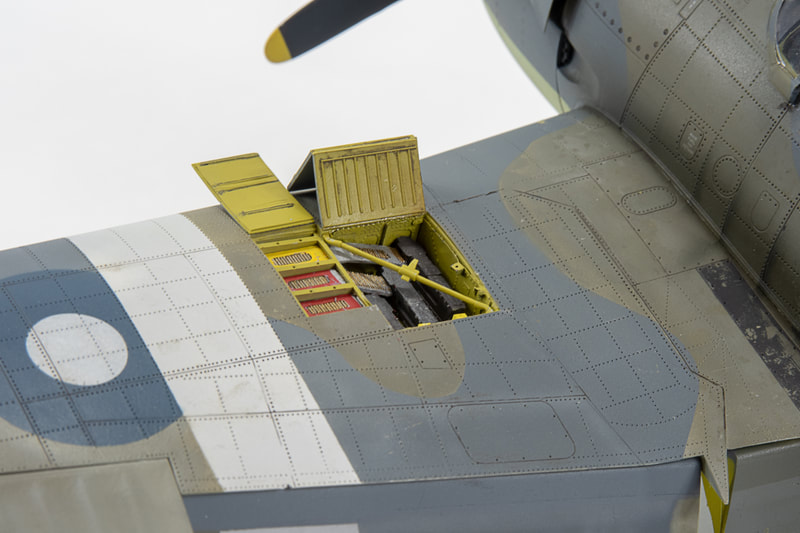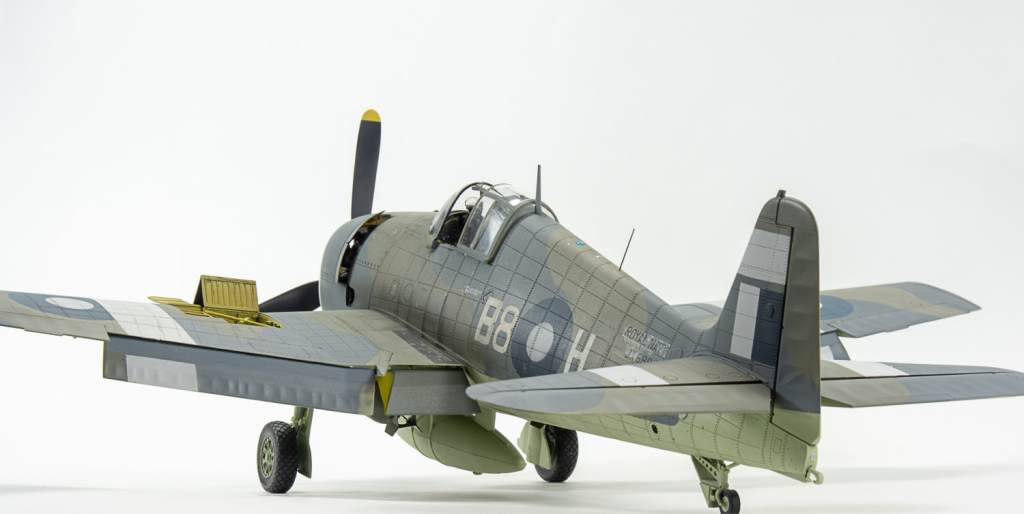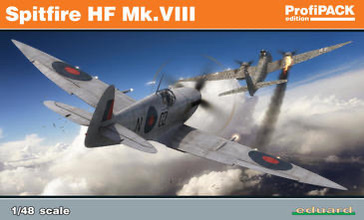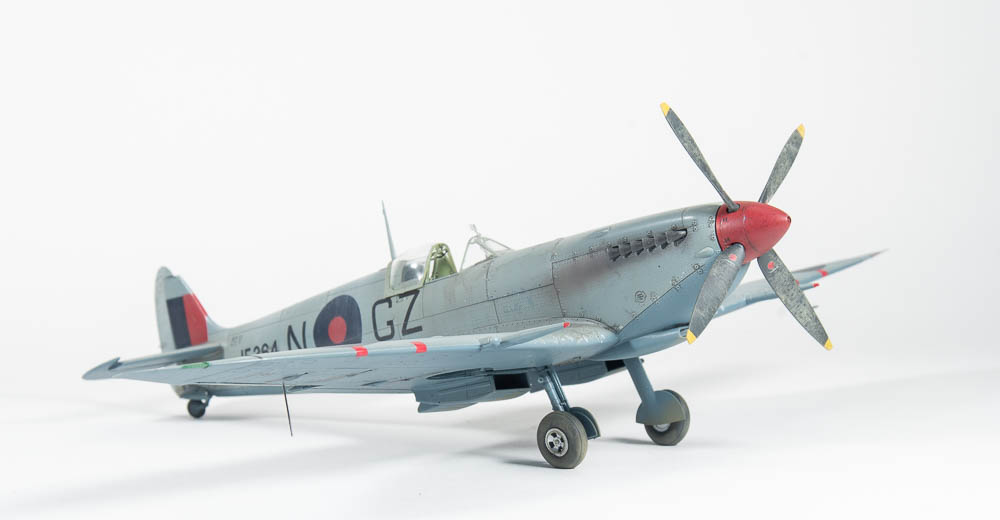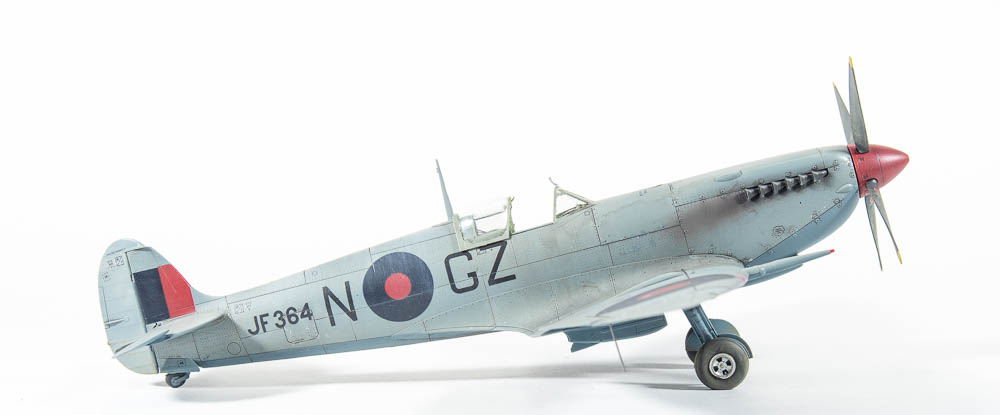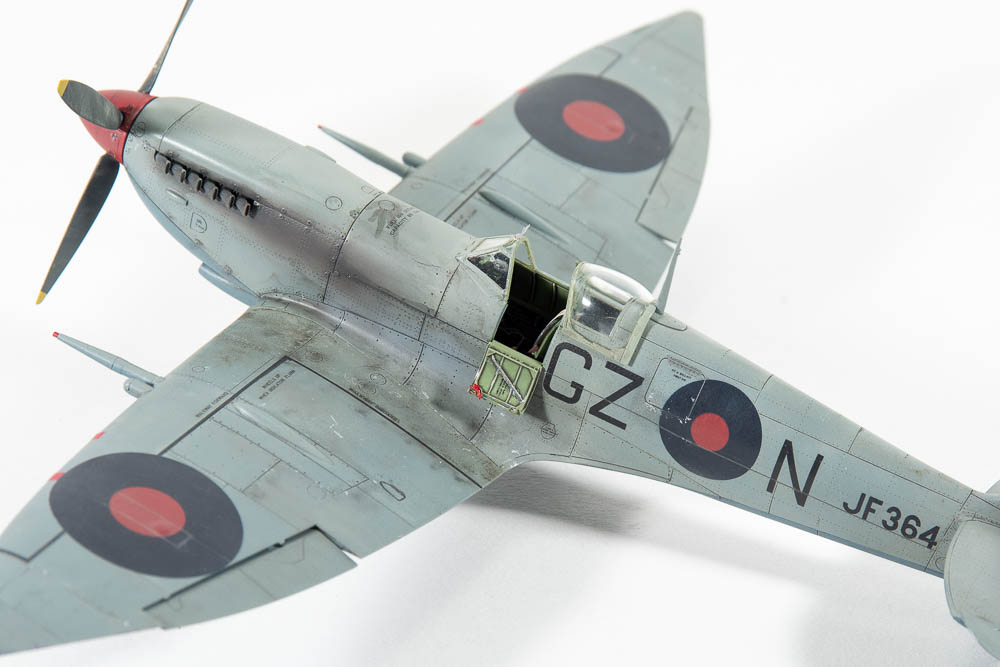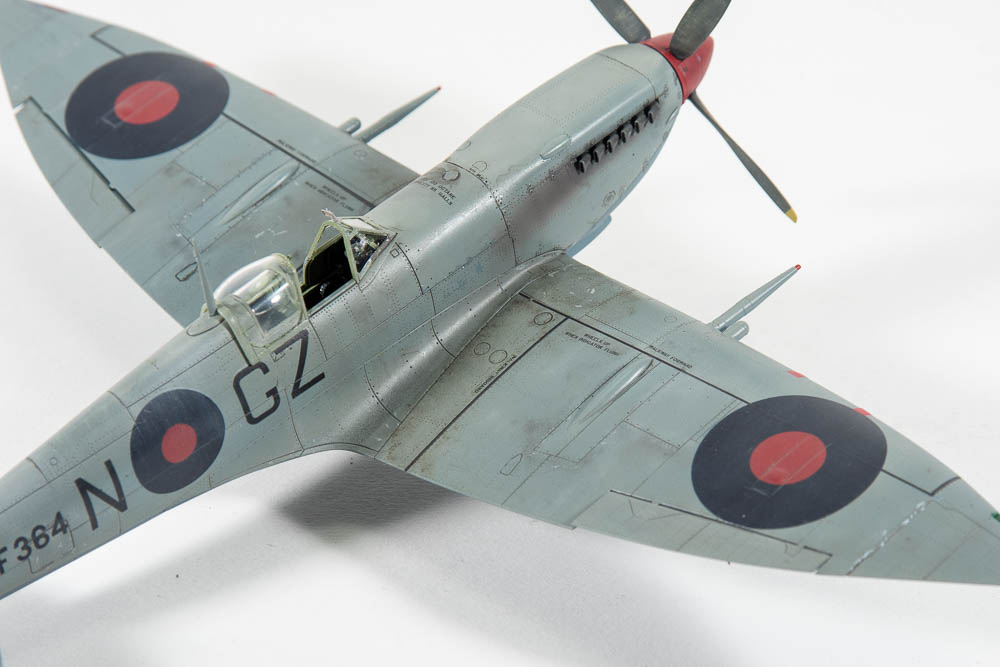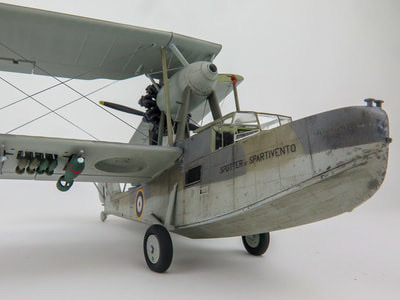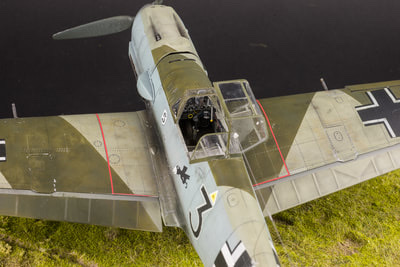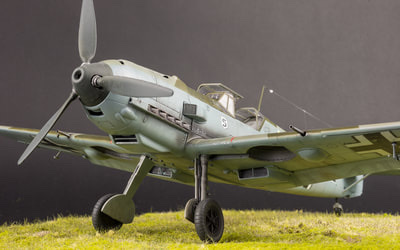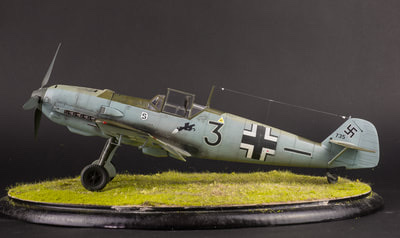
Eduard 1/48 Supermarine Spitfire HFVIII

  • Date Completed:2018
  •   Aftermarket Used:  None, model built completely from box
  •   Paint Used: Xtracolour Medium Sea Grey and PRU Blue

Supermarine Spitfire HF Mk.VIII 32 SQN Foggia. Italy 1944

This model was completed as a review build for The Modelling News, so I will not put a detailed guide here as the article covers the build and finishing in depth.
http://www.themodellingnews.com/2018/08/build-guide-spitfire-mk-hf-viii-in-48th.html
http://www.themodellingnews.com/2018/08/painting-finishing-bruce-tops-off-his.html#more
  Which only leaves me to say, this really was an enjoyable build.  If you have not built one of the Eduard Spitfires, Get On it!!!

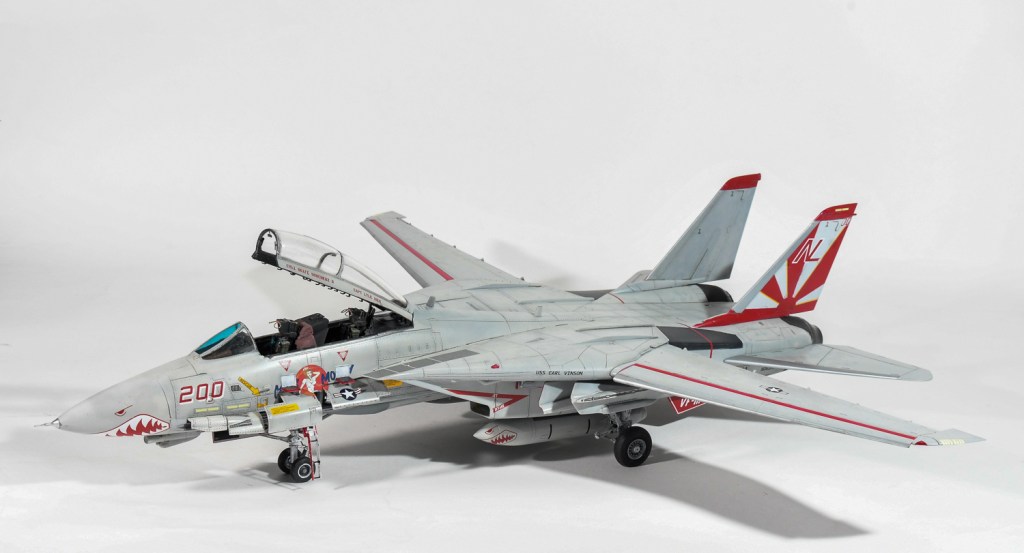
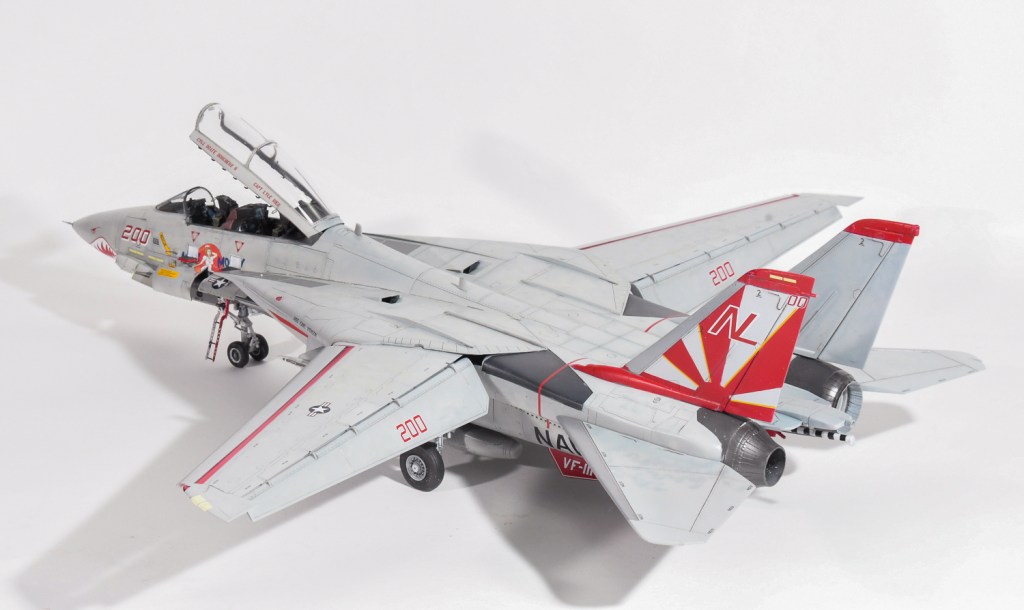
Eduard 1/48 F-14A Tomcat

Date added to stash: 2016
  Date Completed: 2018
  Aftermarket used:
some parts from Eduard Detail set 
  Paint: Mr Color Light Gull Grey
  Decals:  Furball Sundowner Anthology

I started this at the same time as lthe other Tomcat I was building for a friend.  At the time, it seemed like a good way to build a kit from my stash as well.  In hindsight, if I had not started this one, I would have sold it, because its position has been ably taken by the Tamiya kit, and building the two HobbyBoss kits was a real grind.  Not that there was anything wrong with the kit, but it was just one HB Tomcat too many. (Although this boxing was done by Eduard, it is the HobbyBoss kit, so I will refer to the kit as HobbyBoss)
The previous article covers the build in detail, although I would add my take home lesson from building Tomcats is mask the intake camouflage demarcation before you add them to the jet I didnt on either build and it was a hell of a job to add them later!
I had high hopes for this build wanting to build it with all panels open.  In the end the build just started annoying me as there ws other stuff I wanted to build and I chose to rush  a lot of things.  Im not really happy with it, but HB Tomcats are a long complicated, involved build as are many modern jets, so to do two in a year is not bad.  I have  three tamiya Tomcats in the stash and look forward to tackling those at a later date.  Just not for a while, as Im all Tomcatted out. 
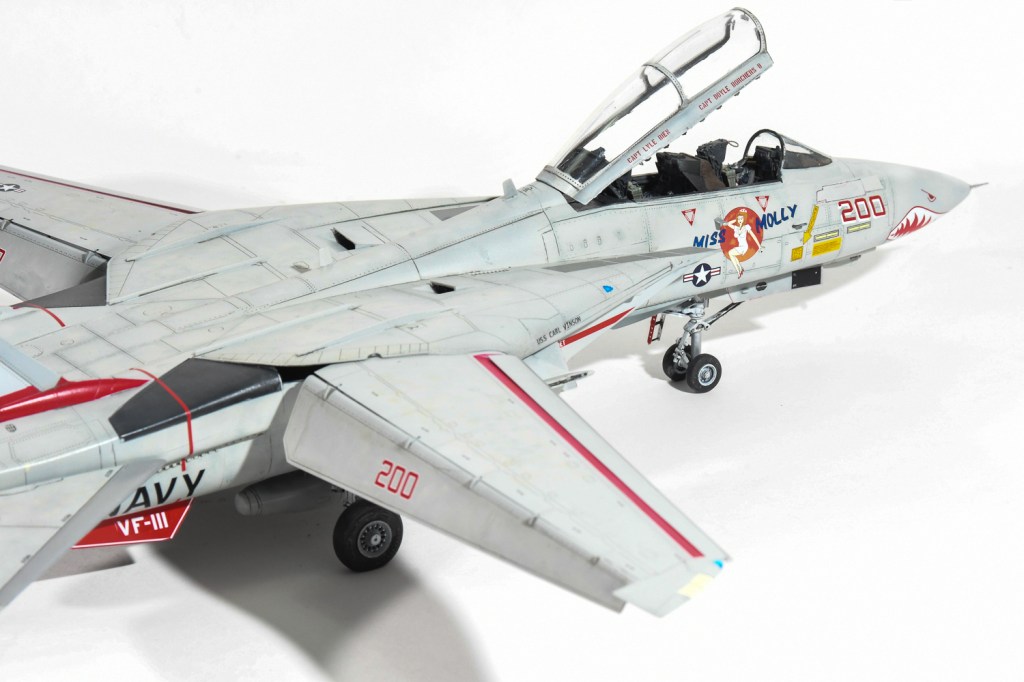
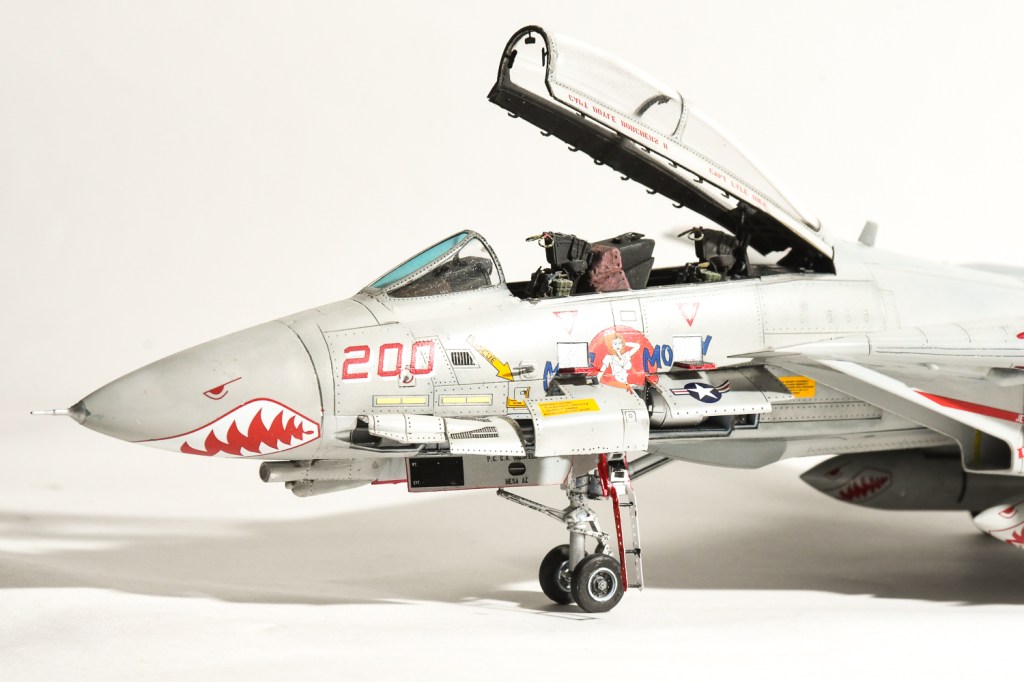
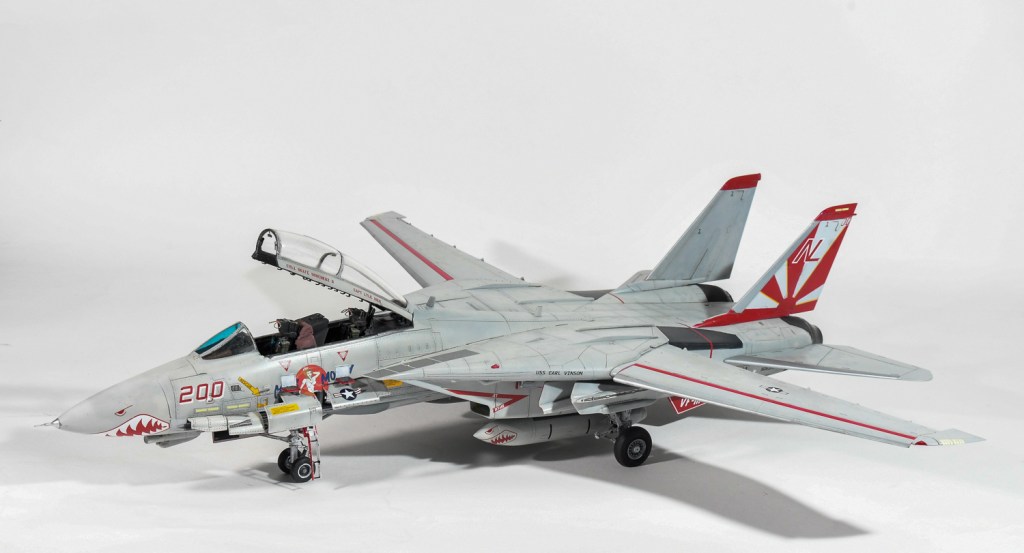
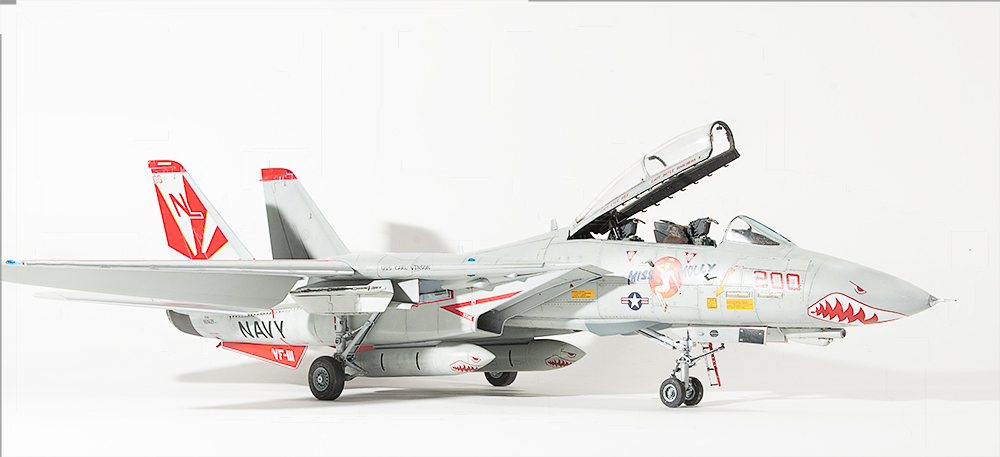
I also think Miss Molly was the wrong jet to pick, as all those open panels do not allow you to see that nose art in its entirety.  Live and Learn, hey.
And wheres that sensor gone from under Miss Molly’s hand on the starboard side?  I definetly  added it LOL
For those who don’t know, Miss Molly was named for Molly Snead, a nurse to Senator Carl  Vinson, yep, the Senator the carrier is named after.
 I visited  the USS Carl Vinson at Fremantle Western Australia in 1994, so like to model aircraft from her.

Grumman F-14A Tomcat VF-111 “Sundowners”  U.S Navy U.S.S Carl Vinson  1989

Go back

Your message has been sent

Warning
Warning
Warning
Warning.

Hobby Boss 1/48 F-14A Tomcat

  • Date Completed: July2018
  • Aftermarket Used: Quickboost Pilots
  • Paint: Gunze Mr Color 
  • Decals: Kit supplied  for airframe, missile stripes from Fightertown Tomcat Data sheet           
This build was borne out of a work colleague’s request for me to build the kit for him.  As I also had the kit in my stash, I thought I would build the two of them alongside each other.  As often happens with my double builds, this one sped ahead and was completed whilst mine sat on the bench falling further and further behind.
The Eduard boxing contains the Hobby Boss plastic, brassin resin burner cans,chin pod, wheels and a PE sheet specific to this kit with a large decal sheet done by Furball Aero Designs
The HB Tomcat is a nice kit, there a few accuracy issues, most noticeably, the bottom edges of the intake openings are not parallel to the top edges as they should be, but this is only noticeable from head on.  Rivets punctuate the flying surfaces which should be smooth, but apart from that, its  a detail packed kit,  allowing you options to open the gun bay, avionics panel, display the radar and extend the wing control surfaces. 

It assembles well and does not really deserve all the wailing and teeth gnashing it gets on the internet.  I put it above the Hasegawa offering, but it has been pushed into the shade a bit with  the release of the tamiya kit.

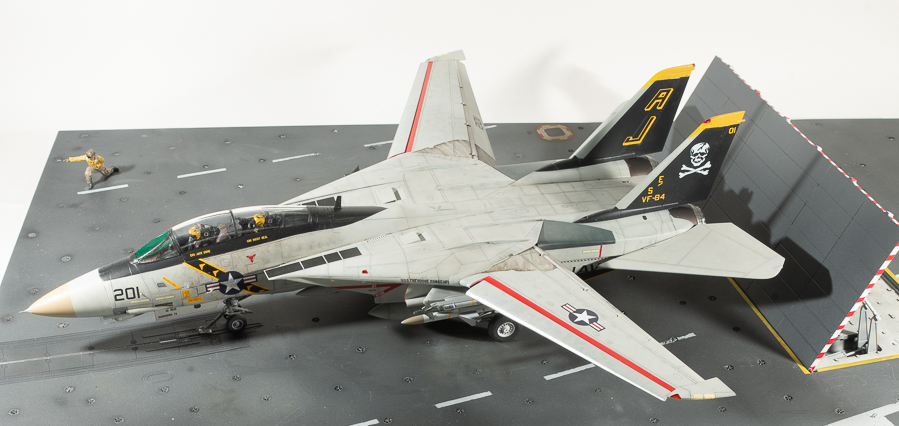
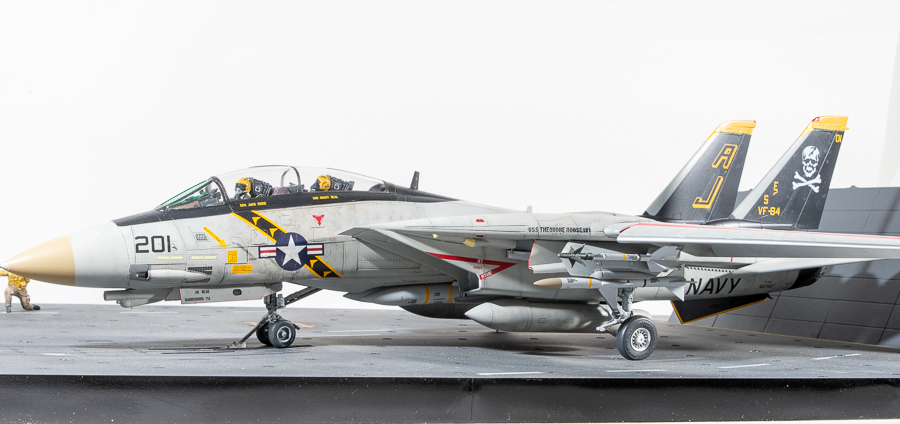
Jeff had requested his model be finished in Jolly Roger markings as if just about to launch, so I used the compressed nose leg,  extended the wings and dropped the flaps and leading edge slats.  Naturally, all the access hatches were glued in the closed position.

  Of course this meant I also had to crew the jet, so used the aerobonus crew .  Although Aerobonus should be applauded for the idea of releasing seated pilots, I really wish that they would include alternative helmeted heads with visors down and masks in place.  As it is,  their entire range of seated pilots have visors up and masks dangling which means they can not be used for in flight models, which I imagine is what most people want them for.

I sourced correctly helmeted heads, as well as a gloved hand that grips the throttle from an Academy Phantom.  As the canopy would be closed on this particular jet, I didn’t bother using the PE consoles and panels, rather relying on the entirely adequate kit parts.  The canvas coverings over the instrument panel glare shields were beefed up with milliput draped over the kit parts, and then painted a dark leather colour, which according to the DACO book, is the shade the original black covers fade to.
The HB kit includes the short lived glove vanes, (they were wired shut in A models, puttied over in B models and left out altogether in Ds, I believe) requiring you to open up  flashed over slots in the wing gloves. Stupidly, I didn’t, thinking I could just scribe the vanes in later, This would have worked if I was halfway good at scribing, as it was, it just created more problems for me.  My tip. Open up the slots and use the kit vanes as even shut, the openings  are quite prominent on the real jet.

For some reason I had a gap when fitting the bottom plate, not sure why as dry fits had shown a good fit.  Fitting the phoenix pallets hid most of it and a plastic card shim covered the rest.  The forward fuselage fitted to the rear with no gaps or steps as did the tailfins.  I had read about fit problems when glueing the gun bay  and avionics panels in the closed position, but being patient and gluing a side at a time will reward you with reasonable fit, still, I needed a small smear of Mr Surfacer around the ladder door.

Apart from this, the kit assembled quickly.  I left the brass burner rings out after successfully bending one up, only to then  drop the pliers on it.
The WIP shots on the front page outline my painting steps in achieving a bit of tonal variation to the Light Gull Grey

Moving onto the decals, I didn’t apply any of the stencils. as photos of the actual jet showed very few.  The decal instructions call out the red turbine warning stripes to be placed along the jet nacelles whereas they should go around them.  That said, I forgot to add the stripes above the NAVY titles. I was disappointed the yellow border of the VF84 sash showed through the US star, I didn’t want to lay another start and bar over the top so left it as was.  For the other side I cut away the yellow border where from where the star and bar would overlay it.

 The Fightertown data sheet, whilst being quite comprehensive, does not include enough stripes for a full suite of phoenix, so I could only add the stripes which would remain the most visible, and with the stores fitted, the canopy was the only part left to fit.  The fit to the windscreen is not to my liking as there is a step and small gap as you can see, but at the rest of causing cracks to the canopy from forcing it, I decided to leave this too as it was.
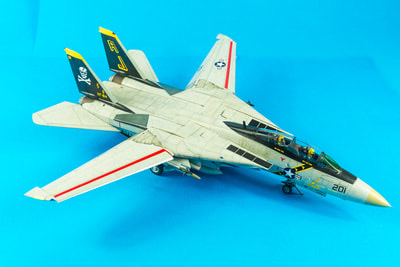
The Jolly Rogers scheme is most attractive and I can understand why a lot of modellers choose it to adorn their Tomcats

F-14A Tomcat VF-84 “Jolly Rogers”  U.S.S Theodore Roosevelt  U.S Navy  1989


Airfix 1/48 North American P-51D Mustang

Year Purchased: 2018
Date Completed:  April 2018
Aftermarket Used: Eduard Brassin shrouded exhausts
Paint: Floquil Bright silver, Xtracolour Olive Drab, various vallejo and tamiya colours used for detail painting

Construction Notes: Im loving the new Airfix kits.  This is the second Ive built after the walrus.  From the excellent box art to the many options included in each kit, you can tell they are designed with the modeller in mind.
Airfix’s mustang was a very enjoyable build, with excellent engineering, detail and fit.  That there will be other boxings is evident from the options in the kit for different windscreens, canopies and tail units.  A Commonwealth boxing has already been announced.  As good as the kit is, it is let down by a few parts, mainly the cross hatched wheels, where the tread just does not extend to the centre of the tyres.  You will either have to source replacements, or scribe the tread in ( badly) as I did.  Brassin make resin replacements, but inexplicably would have you drill out the hubs rather than use the same mounting as the kit uses.  I would also recommend the Brassin M-10s as the kit ones are a little clunky.

 The propeller has some sink marks on the blade tips, and the gun inserts aren’t the best fit.  Other than these minor quibbles, the kit is a joy. 
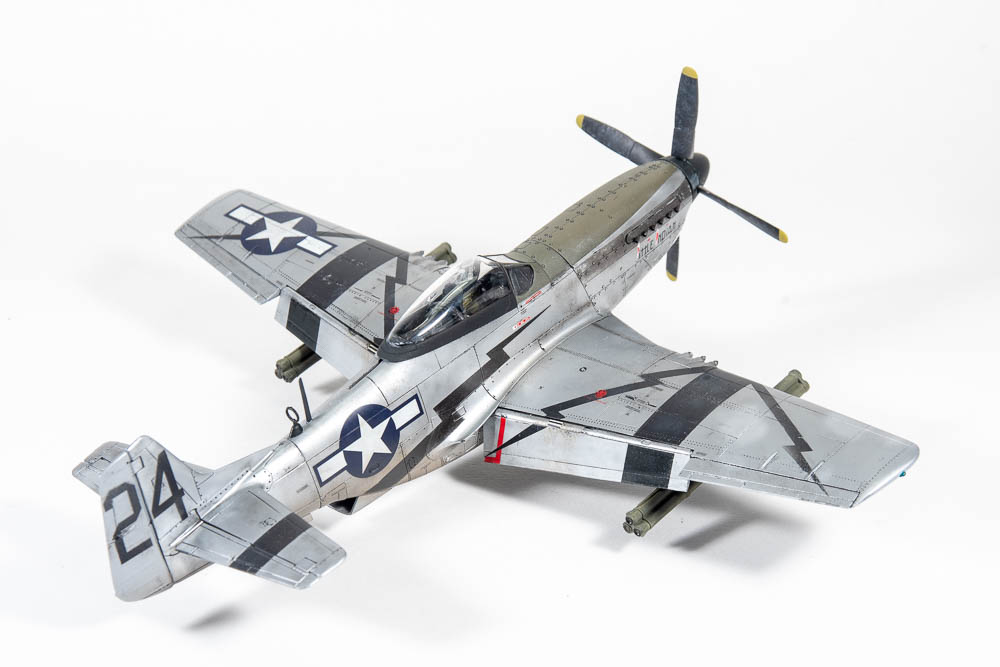
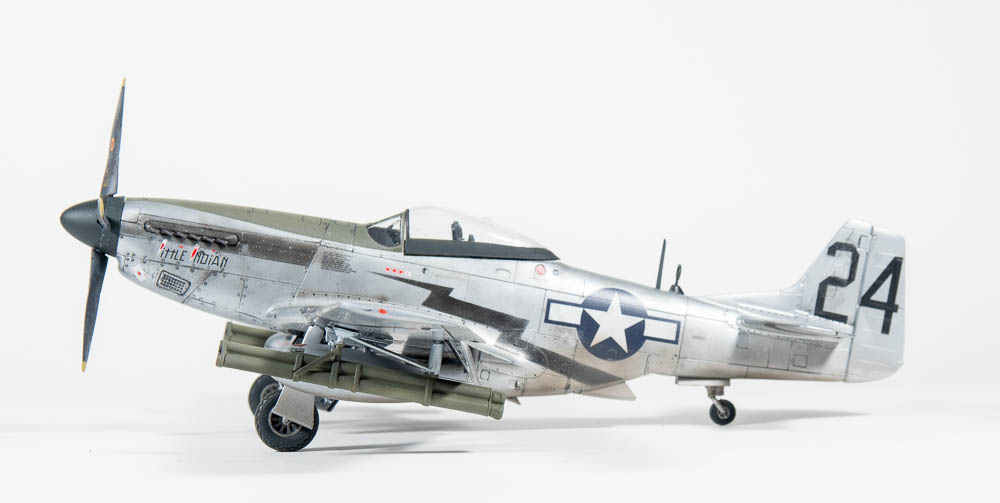
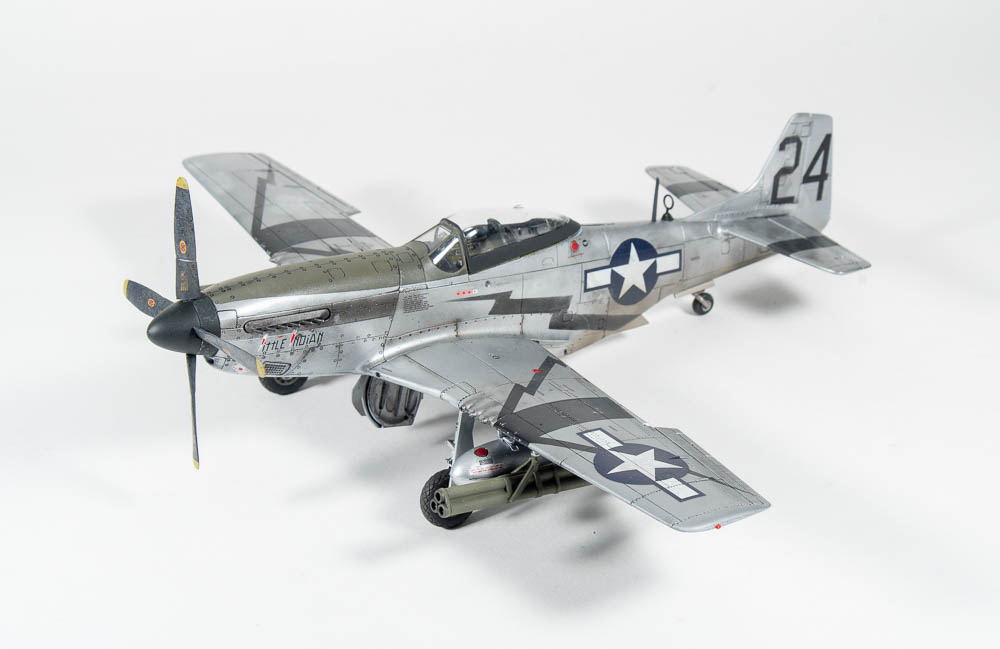
There is some rivet detail on the wings which you will need to fill should you so desire, but the wheel wells are moulded correctly with the straight rear spar. The kit cockpit looks busy enough assembled OOB and even comes with decals for placards.  When choosing a scheme, I could not go past the striking 2ACG machine with its Black Lightning bolts on wings and fuselage, and it meant I could use those M-10 airborne bazooka tubes.
Rather than use the kit decals for the arrows I had a friend cut some masks for me.  Other than the black arrows, the kit decals were used and performed flawlessly.

I used Floquil Bright silver for the finish, with grey and black preshading underneath to try and get a bit of tonal variety. This will bear further experimentation as in certain light, you can see a bit of variation in the silver finish.
 I decided on impulse to build the kit for an upcoming themed competition, so feel I rushed it a little bit. Everything was going fine until I applied one of the Mig Panel line washes over what I thought would be an  impervious base of Future but to my horror, as well as removing the excess wash with an old T shirt, I also removed paint in some areas.  This then began the downward spiral of touchups which never match.  Anyway, its done, but Im annoyed that this is another finish that was going nicely until this stuff up sent it down a different path.  I can only surmise my coat of future was not thick enough.  Another enjoyable build, although these days I would build the Eduard kit.

U.S.A.A.C P-51D Mustang 2nd Air Commando Group India 1945

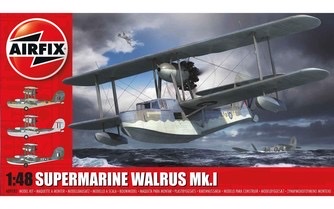
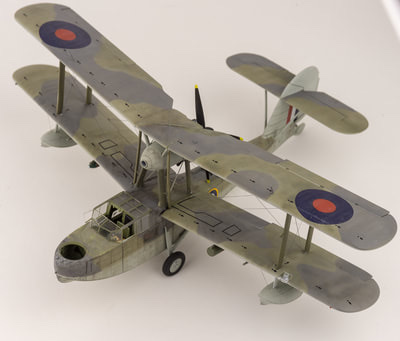
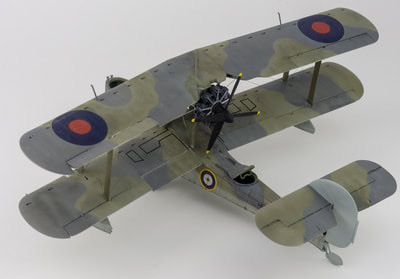
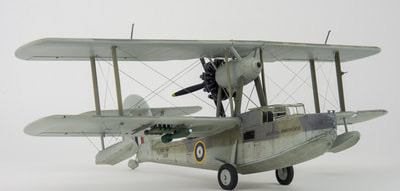
Airfix 1/48 Supermarine Walrus Mk1

  • Year Purchased: 2017
  • Date completed     March 2018
  • Aftermarket used:  Eduard mask set
  • ​Paint: Xtracolour Dark sea grey, Dark slate grey,  FAA sky grey

I had held off on getting Airfix’s new Walrus due to me having HPHs big resin 32 scale kit to build, however upon seeing a mate’s I just had to buy it. Not only that, I had to build it straight away!
Airfix are really kicking goals with their new 48 scale kits, and this is no exception, with a fully riveted hull,  stressed skin effect on the roof, a nice interior, and  several options that allow you to model the wings folded or spread, canopies open or closed and wheels up or down 
The model assembled well with good fit. I found it a thoroughly enjoyable build, well, until I got to the rigging!

Painting was done with xtracolours and all was good until I got to the rigging.  A combination of super glue that had gone off and would not instantly set and not really knowing what I was doing sort of bought the build undone.  Still, I got their in the end, better equipped to handle that wingnut wings kit I want to tackle this year.
Construction Notes
Although there are plenty of injection moulding pins present on the interior surfaces, you cant see any, apart from two in the extreme nose once the fuselage is together.
I elected to glue the roof to one side to better handle the joint as I could then attack it from both sides. Airfix have moulded some lovely surface detail into this kit so you want to reduce any need for sanding as much as possible
The centre “fan looking thing” needs all traces of the moulding seam sanded off before glueing between the two engine nacelle halves
I found the open cockpit a little too wide for the fuselage, although that could have been a fault on my part.
Back to my kit.  I found when on its wheels the folded wing float dragged on the ground due to me not securely glueing the wing spar.  At the last minute I decided to cut the spar off and have both wings extended, This is the wing with the aileron deflected up.  I could not debond the glue join unfortunately, so I will just have to live with it.
An enjoyable kit, although the rigging turned it into a bit of a grind in the end.

Supermarine Walrus Mk1 700 N.A.S Royal Navy. H.M.S Sheffield

Cyber-Wings 1/32 Messerschmitt Bf-109E3

  • Date Completed:  January 2018
  • Aftermarket Used
  • Gun barrels: Master Model
  • Paint: Mr Paint, Mr Color, Tamiya, Creos GSI
  • Decals: Stencils from kit, National markings painted on using Montex masks.

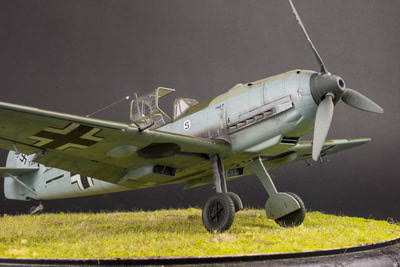
Ive always liked the lithe looks of the E model 109, and have always wanted to build one in “classic” Battle of France/Britain colours.  I have several 109s in the stash but picked out the Dragon one to do.  I also decided this would be a good kit to practise riveting on.  I used some plans I found in the Aero detail volume on the 109E firstly marking all rivet lines with a pencil and then using a Rosie The Riveter tool to emboss them on the kit parts.  It went quicker than I thought.  Otherwise the kit is OOB.  My copy had two left hand wheel well liners in it.  All attempts to get a replacement one from the so called support service “Dragon care” went unanswered.  Thanks for your useless after sales care Dragon!
The only difficulty I encountered with the kit was the well known problem of getting the engine cowl to sit over the guns.  I ended up just using the barrels glued to a bulkhead I fitted into the interior of the cowl.  Still not happy with the fit.  I thinned the rear edge as the real cowl is not a seamless fit with the gun cowl, certainly not as pronounced as the gap on my model though.  The kit PE was used for the seatbelts.  The kit PE hinges were fiddly to construct but look and function well when done.
Montex masks were used to portray Lt Walter Schneider’s machine from May 1940, not the most photographed aircraft but I managed to find a pic which tallied with the Montex masks.

Messerschmitt Bf-109E-3 Luftwaffe. France 1940
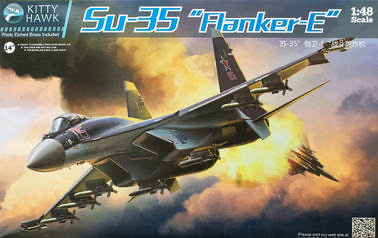
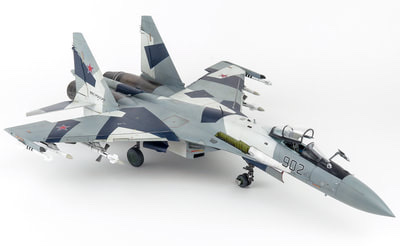
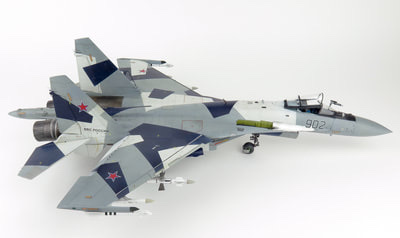
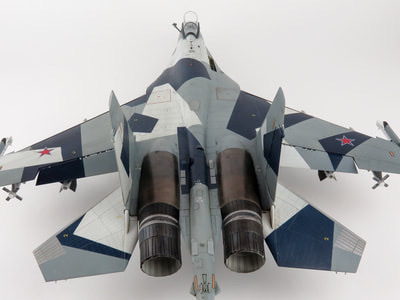
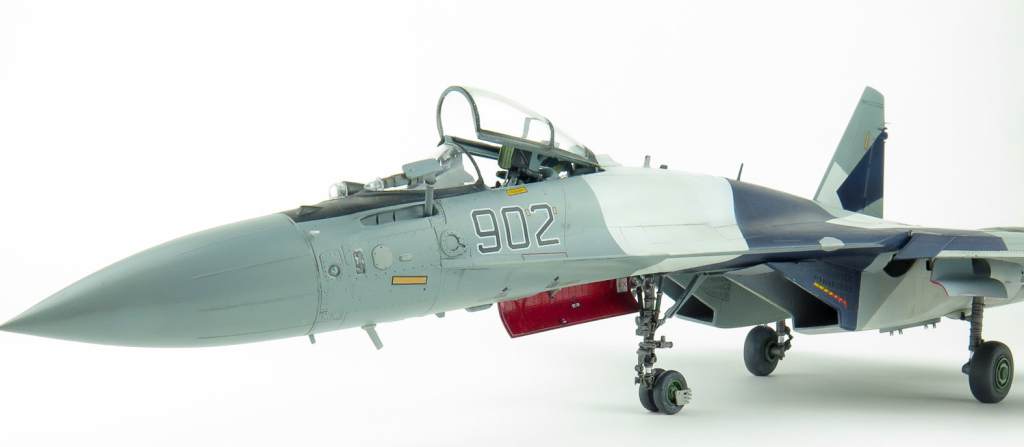
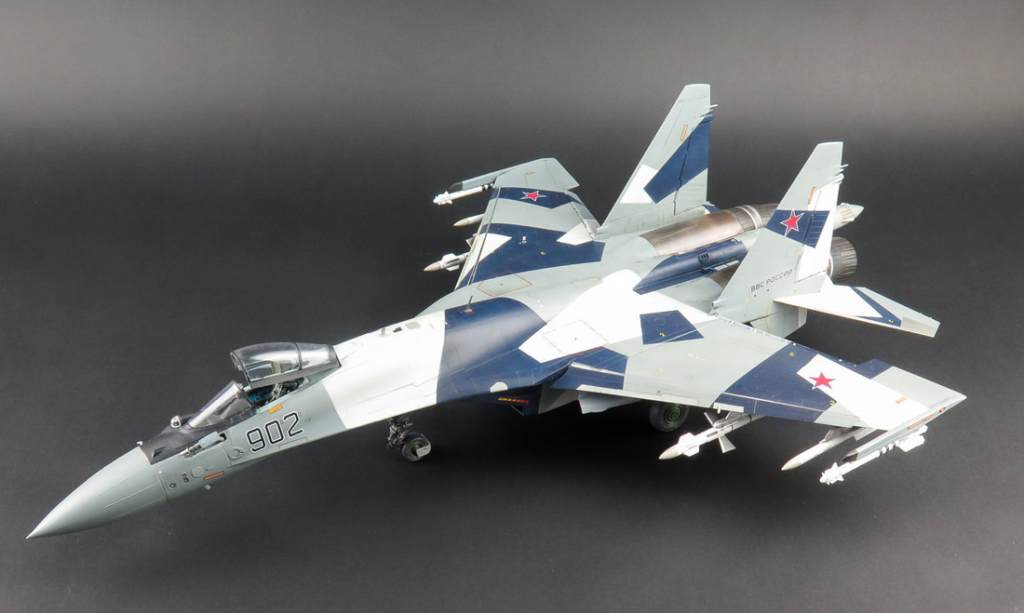
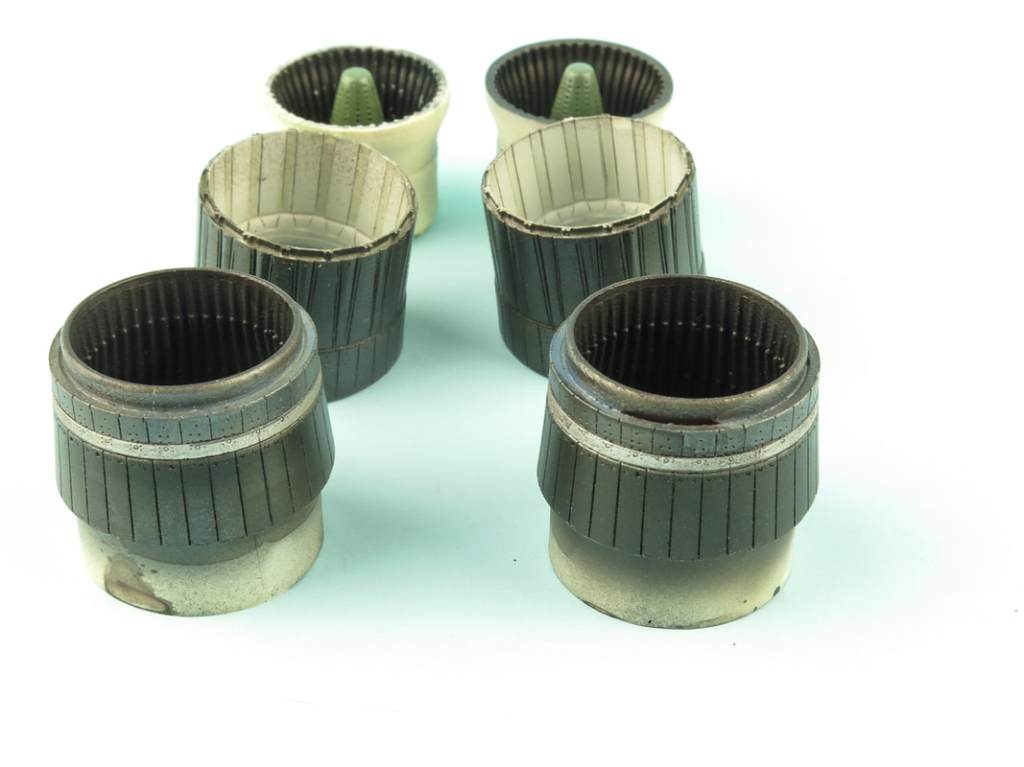
Kittyhawk 1/48 Su-35

  • Built: 2017
  • Aftermarket Used: A.M.U.R Reaver afterburners
  • Decals: Kit

This was another review I completed for The Modelling News
You can read the articles here, which covers construction and finishing of the model

Overall, I enjoyed building the model, and think it ranks as one of kittyhawks better models to date, only let down by the lack of drooped nozzles and being able to make a late version Flanker OOB. Well, that and the normal KH issues like poor instructions and could-be-better moulding . 

Really though, I thought KH might have started to overcome a few of these things by now.  That KH instructions continue to mis number parts or show them incorrectly is incredibly frustrating, and seems to just illustrate (excuse the pun) a lack of listening to customer feedback
  I cant comment on the accuracy, but nothing really glaring stood out to me.
Since I have completed this kit, Great Wall Hobbies have released theirs, and were I ever to do another, this is the kit I would choose, being superior in all facets, but I wont do another as one Su-35 in the cabinet is enough for me.
  This was also the first time I completely painted a model using Mr Color laquers, and I will certainly be using them again I have to say, the finished model looks quite striking in the cabinet due to its size and that colour scheme. 

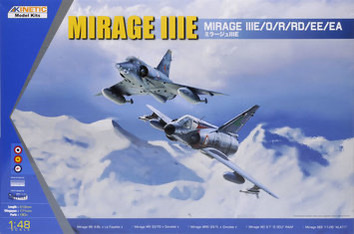
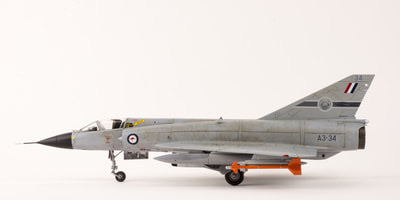
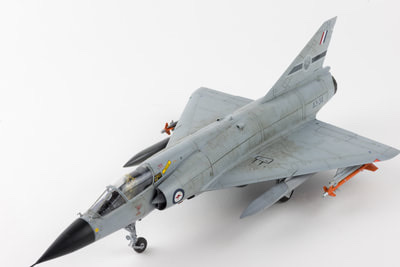
Kinetic 1/48 Dassault Mirage IIIO

  • Built: 2017
  • Aftermarket Used: Wheels-Resin art. Pitot Tube-Master detail
  • Decals: Caracal Mirages over Australia

The Mirage holds a favourite place in the hearts of many Australian Aircraft modellers, so there was much rejoicing when Kinetic announced they were releasing this kit.  Although in my opinion,  it renders the Heller and Italeri kits obsolete, moulding is a little soft and the fit is not the best. 
There is still room for the definitive kit out there. 
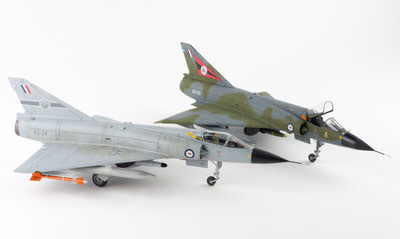
Two of my friends and I decided to build this kit as a challenge build to get judged at a show.  the winner gets to pick the next subject.  At least I finished this one, the last build – the Kittyhawk Jaguar- is still languishing in its box with broken u/c.  In a fit of insanity, I decided to build all three kinetic mirages in my stash.  two single seaters and a trainer, the trainer still needing to be finished as I’m a little “miraged out” at the moment.  The kit goes together quickly enough, but there are several traps  awaiting the unwary, and the moulding is quite poor for a kit released in 2015, mine having many sink marks and a lot of flash. OOB, the nose gear also has a little bit of an exaggerated backward rake.
With the two Caracal sheets, you can pretty much make any mirage in the RAAF fleet, wearing any of the many schemes it wore during its service life
 I found though, the caracal tail bands needed trimming for a better fit, and the blue in the roundels and fin flash is too vivid. 
Ronin Graphics also do a couple of very comprehensive sheets, that also allow you to build a few of the commemorative schemes.
In fact there  is a fair bit of AM around for this kit
And the winner of the challenge build?  Well, all three of us never managed to get to the show!

Dassault Mirage IIIO 77 SQN R.A.A.F Williamtown. Australia 1986

Kinetic 1/48 C.A.C Mirage IIIO

  • Date Completed;  December 2017
  • Aftermarket Used: Eduard interior set, Seat-Pavla MB4, Pitot tube- master barrel. Stores-PJ productions PM3 bomb rack, Hasegawa bombs, Wheels-Resin art
  • Decals: Caracal Mirages over Australia

The Mirage holds a favourite place in the hearts of many Australian Aircraft modellers, so there was much rejoicing when Kinetic announced they were releasing this kit.  Although in my opinion,  it renders the Heller and Italeri kits obsolete, moulding is a little soft and the fit is not the best. 
There is still room for the definitive kit out there. 
Two of my friends and I decided to build this kit as a challenge build to get judged at a show.  the winner gets to pick the next subject.  At least I finished this one, the last build – the Kittyhawk Jaguar- is still languishing in its box with broken u/c.  In a fit of insanity, I decided to build all three kinetic mirages in my stash.  two single seaters and a trainer, the trainer still needing to be finished as I’m a little “miraged out” at the moment.  The kit goes together quickly enough, but there are several traps  awaiting the unwary, and the moulding is quite poor for a kit released in 2015, mine having many sink marks and a lot of flash. OOB, the nose gear also has a little bit of an exaggerated backward rake.
With the two Caracal sheets, you can pretty much make any mirage in the RAAF fleet, wearing any of the many schemes it wore during its service life
 I found though, the caracal tail bands needed trimming for a better fit, and the blue in the roundels and fin flash is too vivid. 
Ronin Graphics also do a couple of very comprehensive sheets, that also allow you to build a few of the commemorative schemes.
In fact there  is a fair bit of AM around for this kit
And the winner of the challenge build?  Well, all three of us never managed to get to the show!

C.A.C Mirage IIIO(A) 3 SQN. Butterworth. Malaya. R.A.A F

Kittyhawk 1/32 P-39 Bell Airacobra Mk1

Year Purchased: 2016
Date Completed: 2017
​Aftermarket used
Eduard 
Cockpit interior set, and exterior set ,exhausts
HGW Seatbelts RAF eraly style Sutton Harness
Mastercaster early style wheels and fishtail exhausts for Mk1
Master Model  .50in and .303 gun barrels with no flash hider
Maketar Masks  RAF and RAAF airacobra for Special Hobby kit

I have always loved the Airacobra in Royal Air Force markings, so when Kittyhawk announced their kit, thoughts turned to modifying it to represent a Mk 1 Airacobra as briefly used by 601 SQN
Research revealed there weren’t too many visible differences between the kit version and the one I wanted to model.  Fishtail exhausts, wheels, armament and a smaller diameter propeller being the main ones.  Mastercaster did wheels and exhausts for a Mk1.  Although made to fit the Special Hobby kit, they were easily adaptable to the KH kit.  Master of Poland supplied the gun barrels for wings and fuselage, the nose cannon being made from brass tubing.  I had planned to have the nose gun bay open, and had even gone as far as to replace the kit 37mm cannon with a 20mm hispano robbed from a HobbyBoss Spitfire, but in the end was not happy that I had portrayed the interior correctly, so reluctantly glued the panels shut.  The aerial mast was scratchbuilt from plastic strip, and the pitot tube came from a Trumpeter P-47
Overall I found the kit a reasonable build, although there were a couple of areas where fit was less than stellar, the wingroots being the main culprit.  This was due to the recess for the inner walls of the wheelbays not being deep enough.  The problem was solved by fitting the wings to the fuselage minus the wheelwell inner walls.  These were fitted after the wings were glued on.  To enable this, you need to cut the tabs off the wheelwell front and rear walls that the inner walls locate onto.  Do this and you will be rewarded with a join that just needs a smear of filler to hide.  It remains one of my favourite builds.

Bell P-39 Airacobra Mk1 601 SQN. Royal Air Force. Duxford 1941