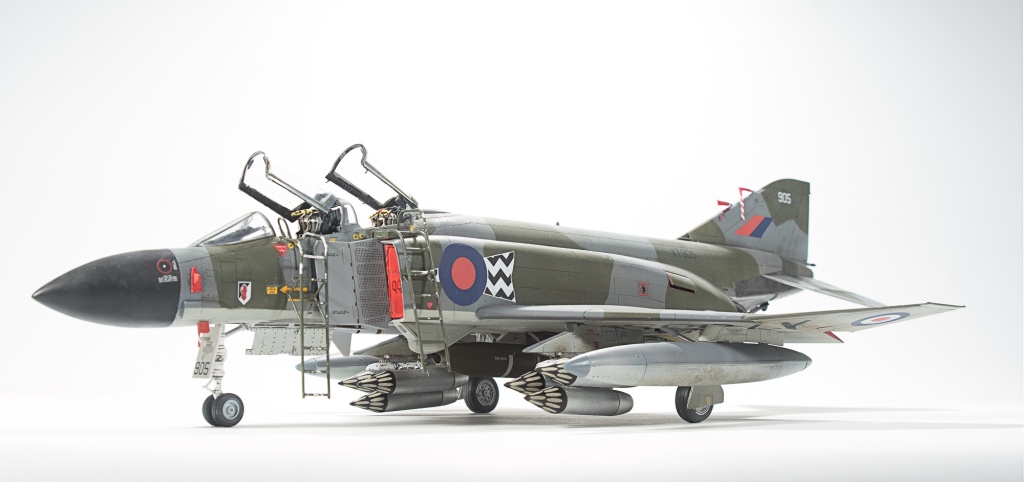
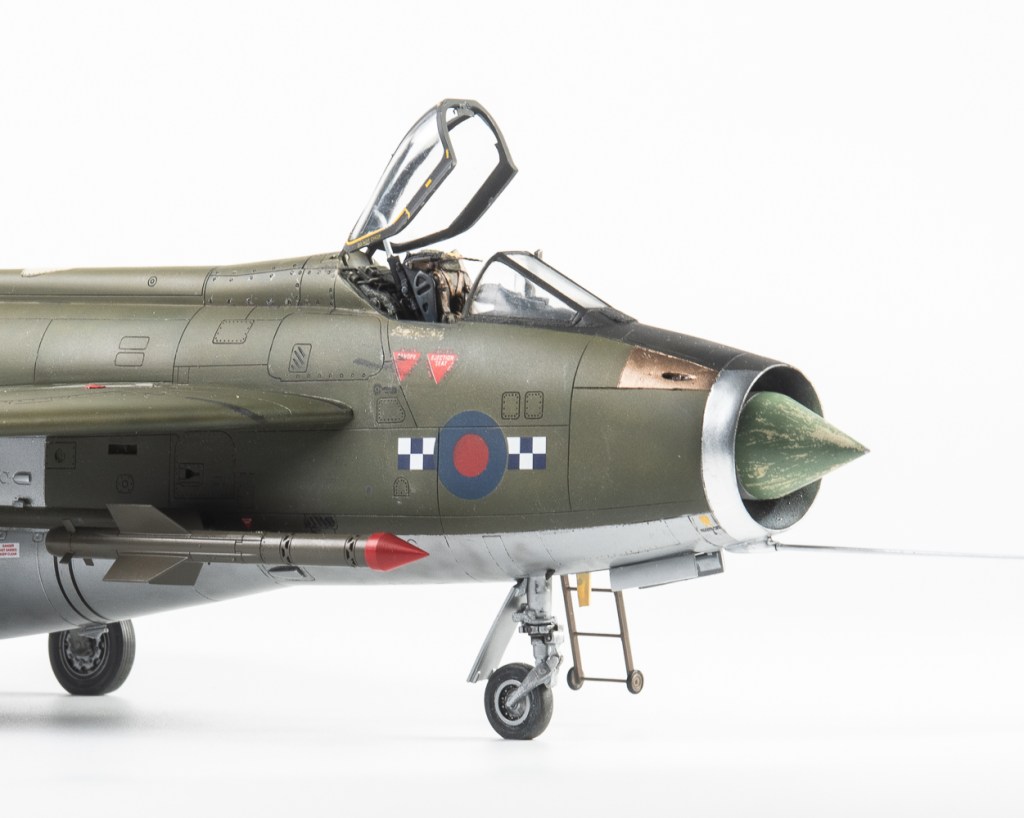
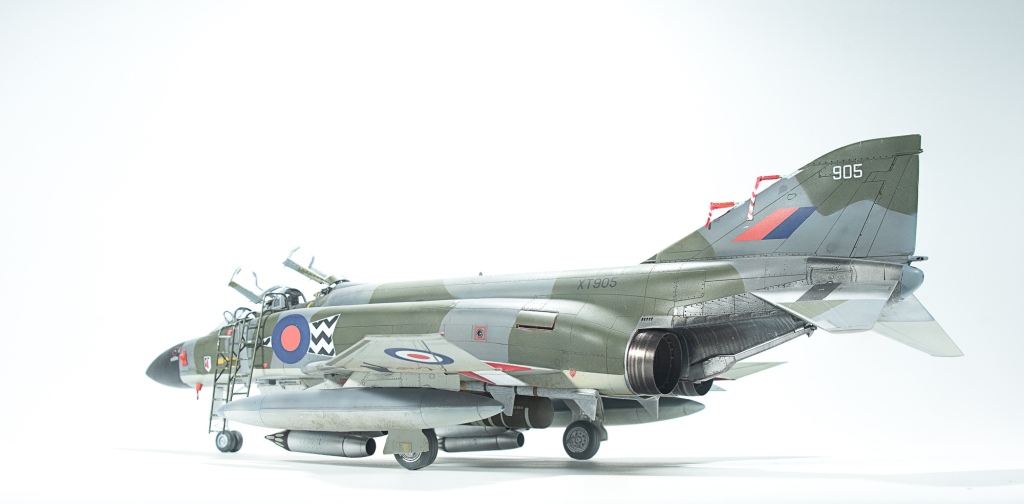
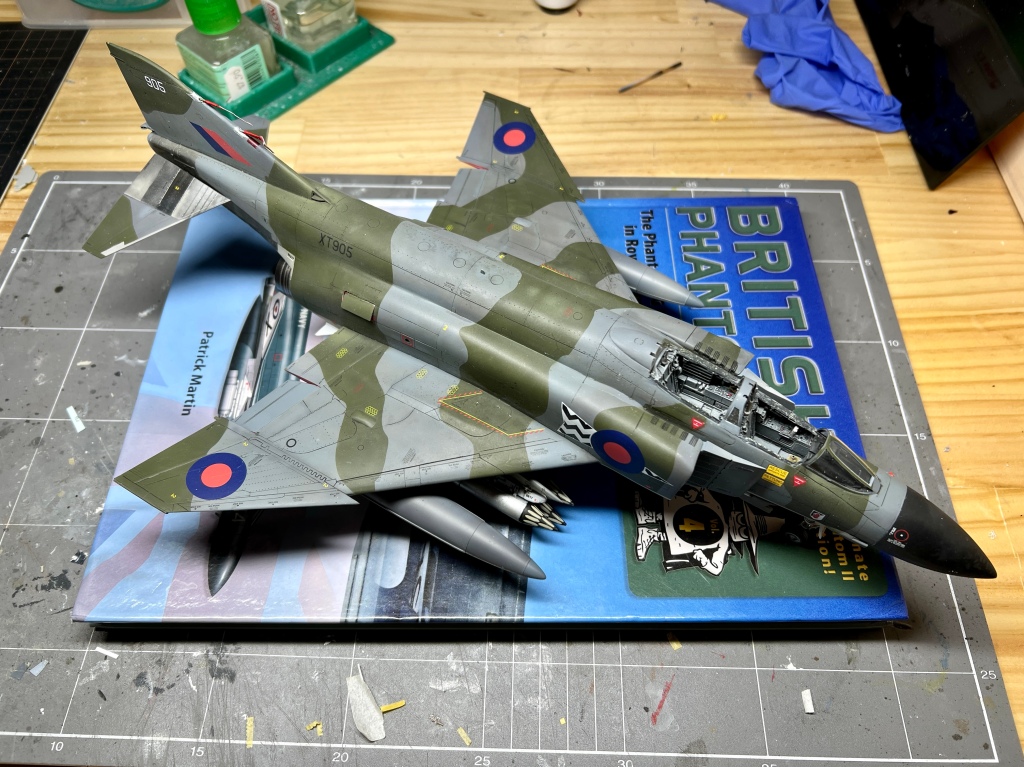
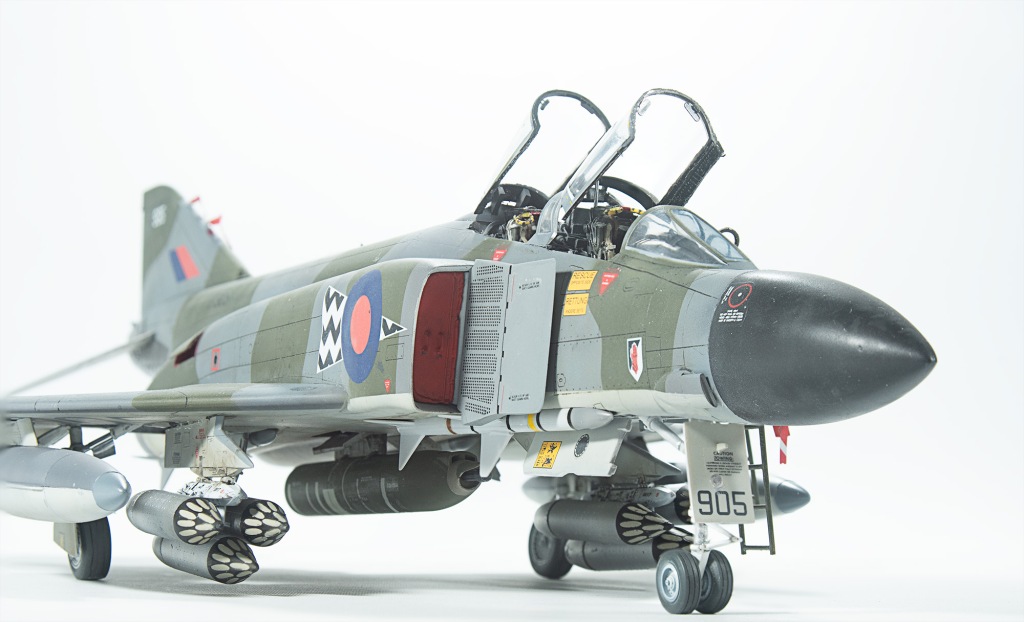
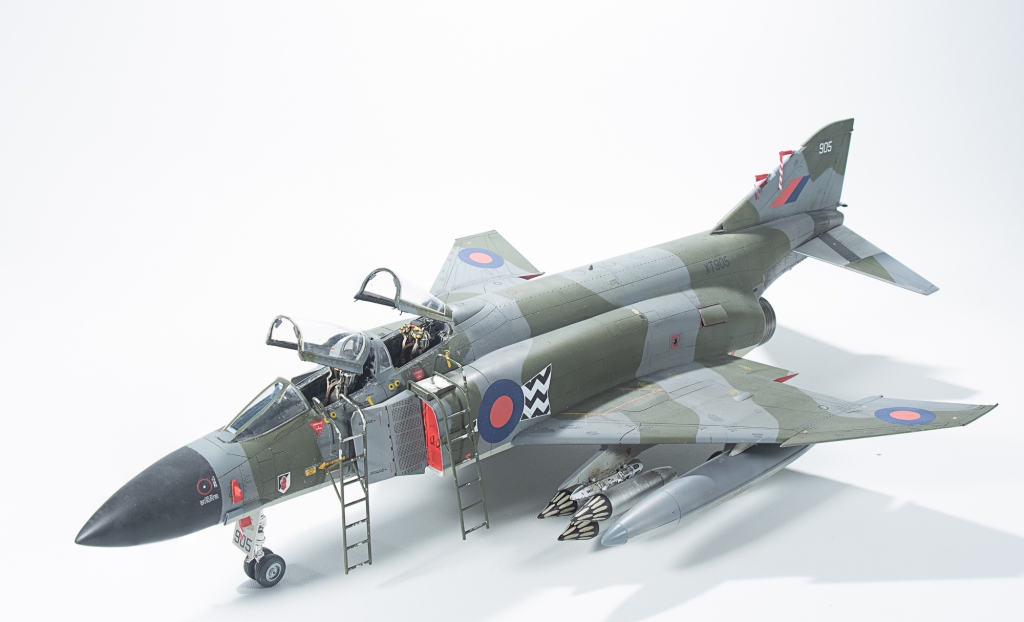
Hasegawa 1/48 Phantom FGR2

  • Acquired: 1988
  • Completed: 2023
  • Enhancements
  • Seats; Quickboost
  • Cockpit; Aires
  • Wheels; Reskit
  • Matra Pods; Reskit
  • Exhausts: Reskit
  • FOD covers; Quickboost and Two Mikes
  • Decals; Model Alliance RAF in Germany Part 1
  • Wing Tanks; Hypersonic
  • Triple Ejector Racks for Matras; Eduard Brassin
  • Ladders; LP Models

Up until completing this build 2023 had been a horror year for me modelling wise, with several kits started, but none completed.

The bin was the final repository for more than one of those builds that had not satisfied me.

Whether it was my recent retirement, the house move, the time taken setting up a new model room or a combination of all those factors playing with me, I found myself getting easily frustrated with builds that actually weren’t that bad, but to me had been ruined by some silly minor error on my part.

In an effort to reset, I decided to build the model that appeared first on m stash database, the venerable Hasegawa Phantom, even this was not without its setbacks, but this time I persevered through to completion. It may not be my finest work, but at least I have completed a model, which brings my total to 4 so far this year. Four! I built more when I was working full time.

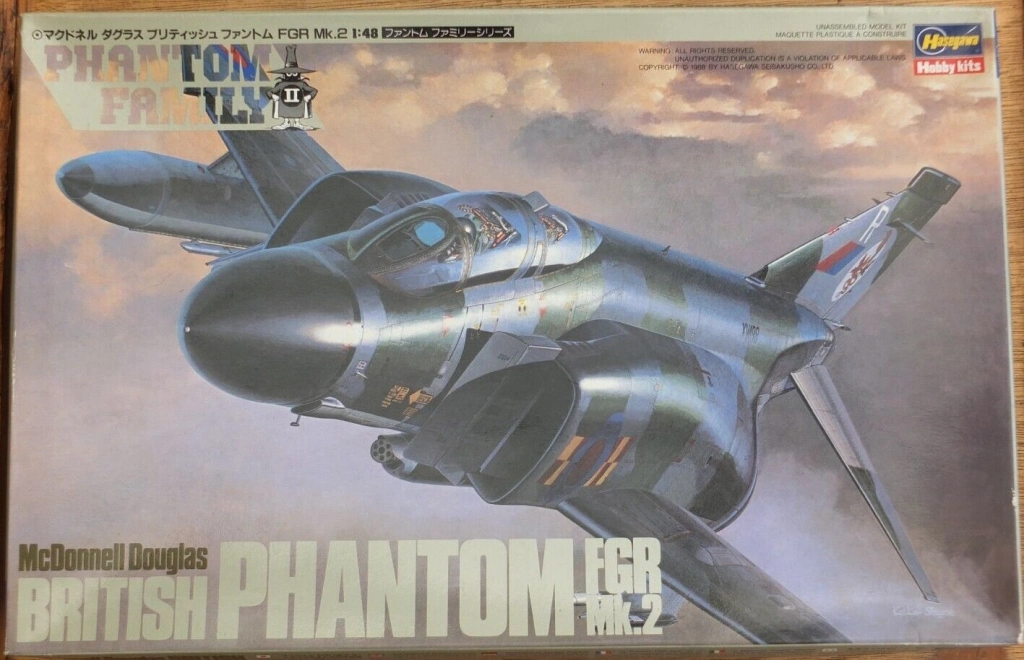
This particular kit is the oldest kit in my stash, having been purchased in 1988 when it first appeared in Australian shops, its been packed, unpacked, placed on shelfs, shoved behind shelves, fallen down the back of shelves several times and the box bears the scars.

Opening the box revealed a fair bit of aftermarket had been purchased for it over the years. Even closer inspection showing I had at some stage made a start on the model, most likely soon after buying it, as that’s how I rolled then. Heady days indeed!

Wheel wells and undercarriage struts bore testament to my early airbrushing efforts where seemingly I blasted everything with thick underthinned paint at about 40 bar!

However what it did show me was my modelling has in fact improved greatly over the intervening years. If like me, you have long disposed of your early canon of work, it can be difficult to determine if you have indeed made great strides in modelling Looking at recent models in the cabinet sometimes only reveals incremental improvement. Looking at your amateurish attempts from 35 years ago certainly brings home the large improvements you have made in your modelling.

Construction Notes

The Aires cockpits are always incredibly detailed but have a reputation for being difficult to fit in just about all cases. That being the case with this one too, although I found it easier than some of their products. That was once I’d worked out what parts of the kit to remove. The instructions being virtually useless in this regard, save for the sage advice of “kit parts will need got be sanded”.

Eventually I worked out from studying the resin parts, the kit sills needed to go. The clue was the sill detail contained on the Aires part.

Still, the bottom of the resin cockpit floor and the top of the kit nose wheel well had to be sanded to within a mm of their life, before the cockpit would sit at the right height. Width wise though, not a lot of sanding needed to be done apart from removing the rudimentary side wall detail from the Hasegawa fuselage halves.

Stout plastic sheet locators were fabricated to hold it in place and the gaps between the sills and plastic fuselage sides filled with Milliput.

The rest of the kit went together remarkably well, minimal gaps at the intakes, a slightly wider gap at the front edge where the underside of the wing joins the nose was shimmed with plastic card which helped to minimise the filling. As the plan was to use FOD guards I could dispense with faffing around adding full intake trunking, although the abrupt end to the intakes trunking as hasegawa have moulded it is not a huge issue in my book, and can be minimised with some creative painting.

I say relatively well. There were complications but these were due to the kit missing a few parts due to the length of time it has been in my stash and the repeated packing and unpacking it has seen with various house moves. Here I have a friend, Ian Bevan who came to my rescue. If you are using the reskit exhausts, be forewarned you need to either shorten the rear of the flat area that forms the bottom of the fuselage halves or cut out openings to accept the extra length of the RESKIT exhaust tubes.

The spine just needed some panels and covers rescribed and she was pretty much ready for paint.

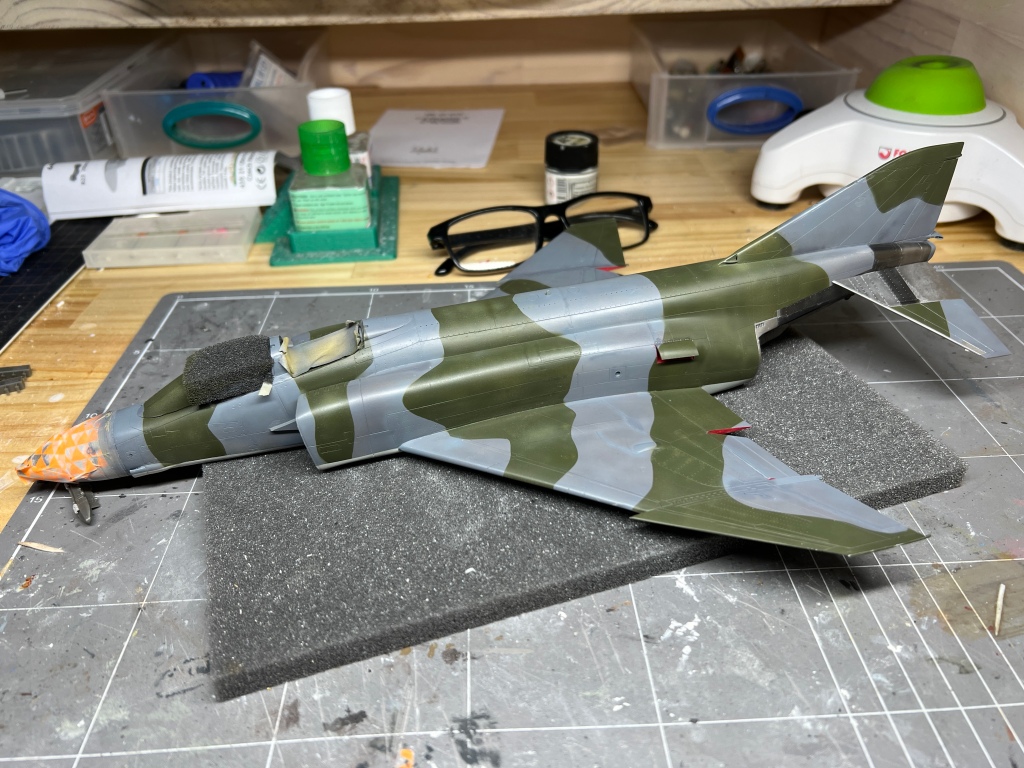
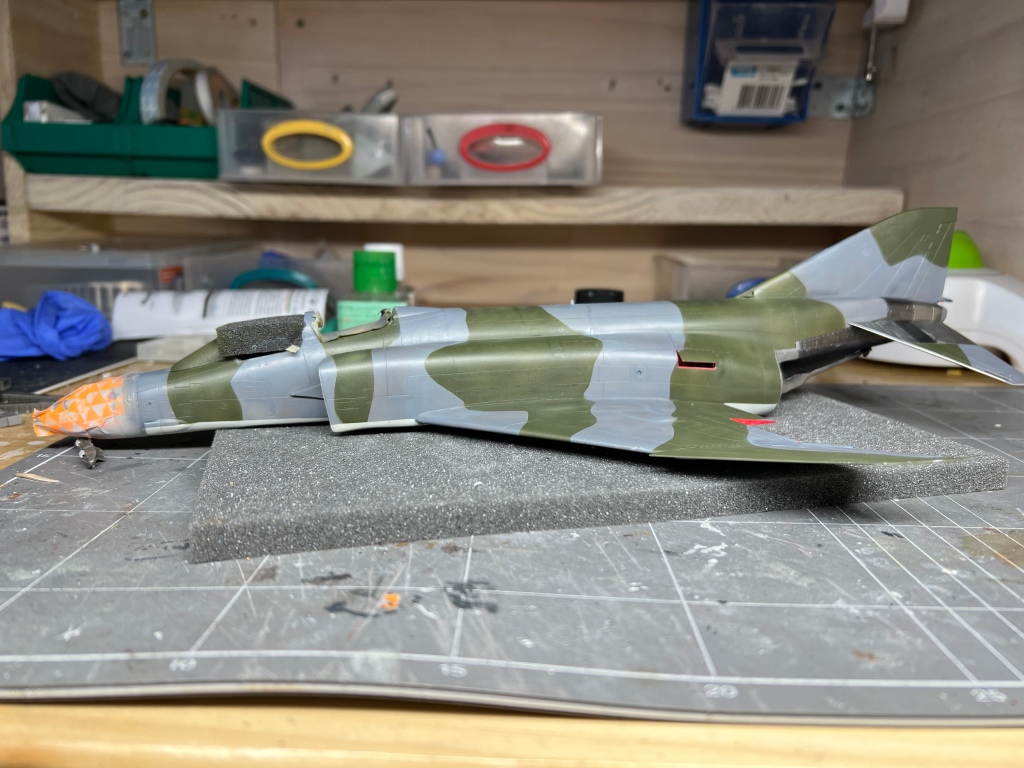
This model was always going to be in the classic cold war scheme – for me anyway- of grey/green/light grey camouflage they wore whilst employed in the strike role.

Gunze paints were used for the topside colours, AK Real Colours Light Aircraft Grey was employed on the underside due to it having a warmer tone, than Gunzes interpretation, which seemed to match my refs better

The Model Alliance decals were no problem. Stencils came from an Extradecals sheet for British Phantom stencils, and being printed by Microscale, also performed well, although Im not sure all the stencils on the sheet were applied to British Phantoms. The Xtradecal sheet was employed as the Hasegawa stencils had shown a propensity to break up when introduced to water.

Gunze gloss had been applied prior and post decal application followed by SMS Flat which gave the required sheen I was looking for. However the edges of all carrier film was still very visible, no silvering, but quite apparent edges. I have read where these lacquer clears can be too thin to hide decal carrier film edges. A coat of Testers Dullcote was applied, which hid all the carrier film, but also led to some frosting. Subsequent coats of SMS flat failed to bring back the sheen I wanted. Semi gloss should have been used in retrospect.

Later analysis showed this was the point where things started to go wrong!

My reference photos of this particular jet, (and here I need to mention Geoff Coughlin’s suburb e-book series) showed the jets from 17 SQN at this particular time to be fairly well looked after, with minimal weathering on top surfaces although the undersides were filthy. The jets at this stage being fairly new in squadron service.

To this end oils were used to impart heavy streaking and fluid loss. Speckling was also heavily employed to show the grime that would have been flicked up from wet runways.

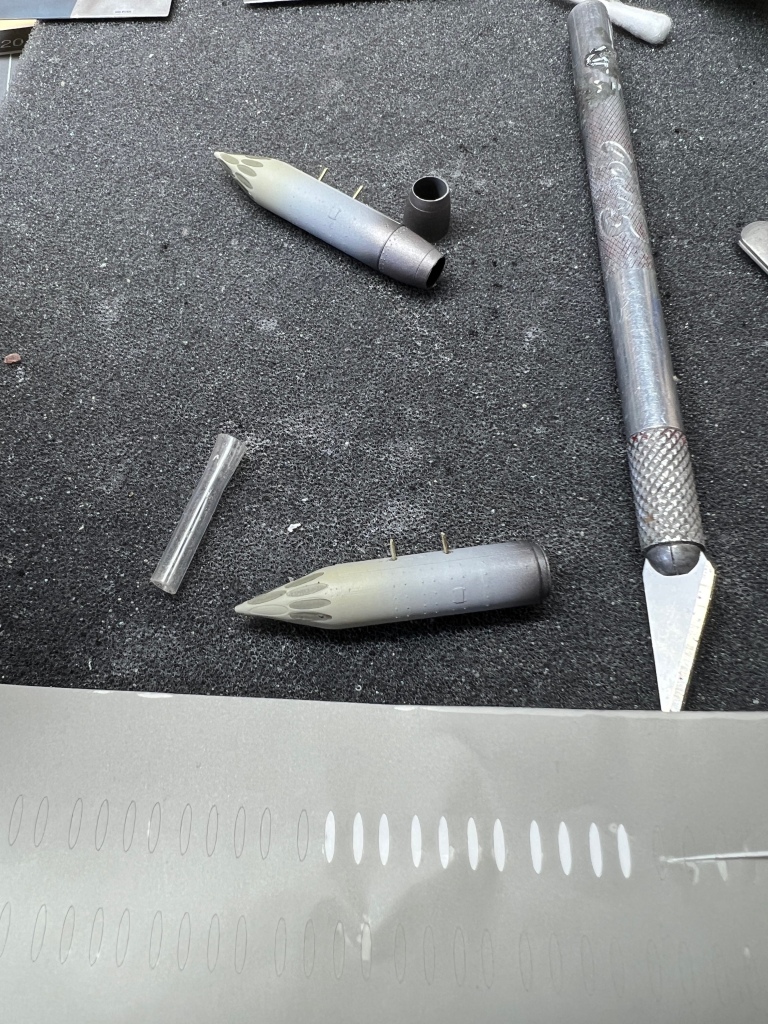
For the loadout, I came across a photo in Double Ugly’s book on British Phantoms that showed a load of 3 MATRA Pods being carried on TERs. Hasegawa TERS from one of their weapon sets would be used, that is, until I screwed up drilling holes in them for brass pins, so Brassin TERS were used instead.

The whole drilling-tiny-holes-and-pinning-stores-to-pylons affair was incredibly frustrating. It didn’t help the hasegawa inboard pylons are an incredibly loose fit to the wing too.. The hypersonic tanks and pylons were trouble free and were a push fit.

With the Matra pods I also have to throw out a thanks to The Hamfisted Modeller for sending me the cut files for the frangible covers on the nose cones. The method is outlined in his build of the Kinetic Harrier

I did ask him to send me some skill too, but sadly , he had run out!

With the canopies, I found the Eduard PE canopy bow fascias just would not fit the canopy profiles. I should have just yanked them off, FGR2s of this era were only fitted with 2 mirrors so the centre one was cut off, Bizarre thing with the rear canopy, it had no hinges moulded on like the pilot canopy, a check of the FG! in the stash revealed that canopy also with no hinges.

Fault by Hasegawa maybe? Its marked as the standard F-4 Sprue, and all other Phantom sprues I have seen have been correctly moulded.

By this stage, as always happens with kits that aren’t going the way I envisaged, I began to take shortcuts and rush things as I really just wanted it off the bench. The next model will be wayyyyy better, right?

Therefore I didn’t bother with the full complement of RBF flags, so with the addition of the LP Ladders, I called it done.

Its not as good as I was hoping for, but Im pleased to have finally built the oldest model in my stash. There is the FG1 to build as well, but first a cheap Hasegawa Phantom will need to be sourced to replenish the parts I took from it to build this kit.

Hopefully Airfix see fit to release this iconic jet in 48 scale. The Hasegawa Phantom series have not aged as well as some of their other kits, the B/N, E, C/D and J all being rendered pretty much obsolete by newer kits from Meng and Zoukie Mura.

However, the Hasegawa kits remain the only Spey engined Phantoms in 48 scale to this day, and are still well sought after. They are still available on the second hand market as are the Revell reboxings for reasonable prices, well, here in Australia anyway.

Finally, Im not one for nostalgia kits or rebuilding kits from my youth, but this kit does have special meaning for me. Decades ago, it was purchased from a stalwart of the Perth modelling scene.,Tim Vickerage who owned a shop in Fremantle of which I forget the name, Modelcraft?

Tim was responsible for introducing me to Iwata airbrushes, Xtracolour paints and the model club scene. Tim sadly is no longer with us, so this build is dedicated to his memory.

Phantom FGR2 17 SQN. Royal Air Force RAF Bruggen Germany 1975

Leave a comment

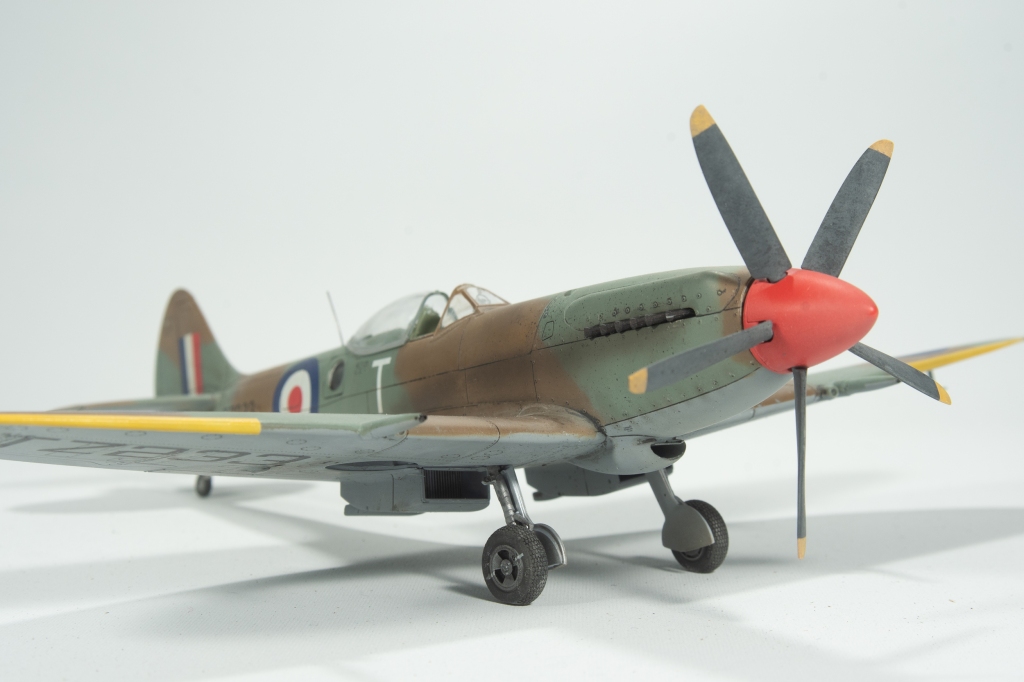
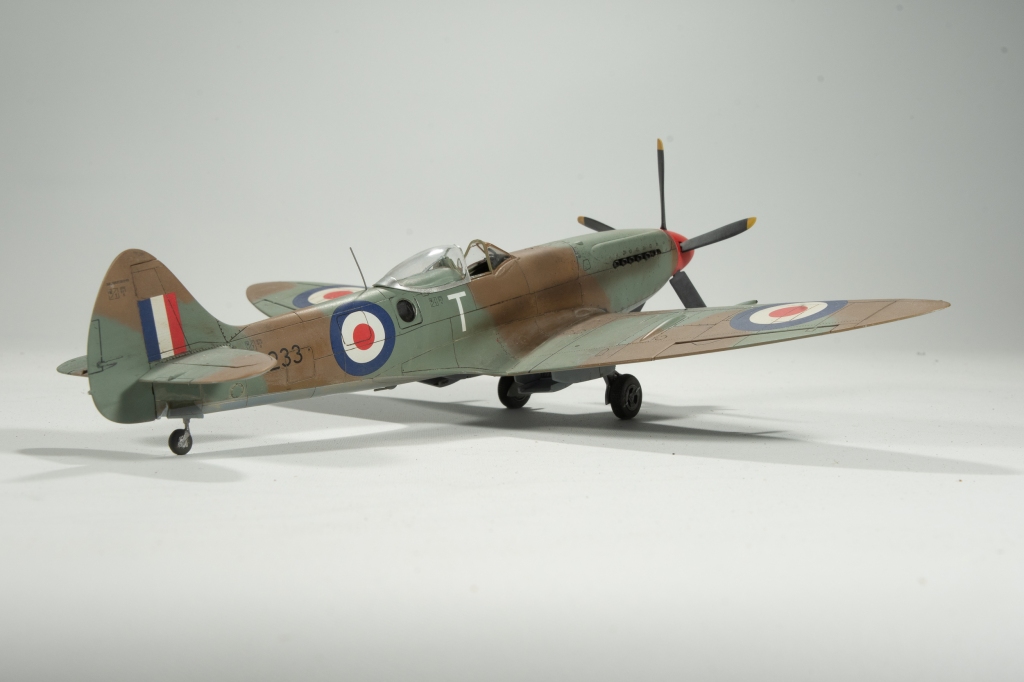
Airfix 1/48 Spitfire Mk XIVe (conversion)

  • Acquired: 2023
  • Completed: 2023
  • Enhancements;
  • Wheels; Brassin
  • Gun Barrels; Master Model
  • Exhausts; Brassin
  • Seat Belts; Eduard
  • Decals; Xtradecal

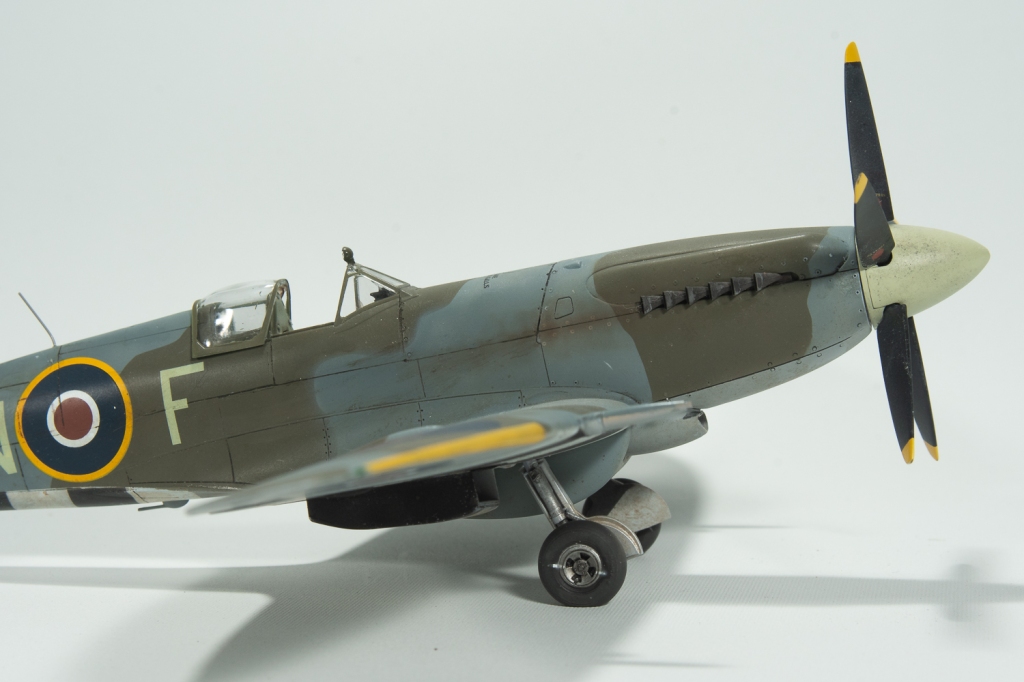
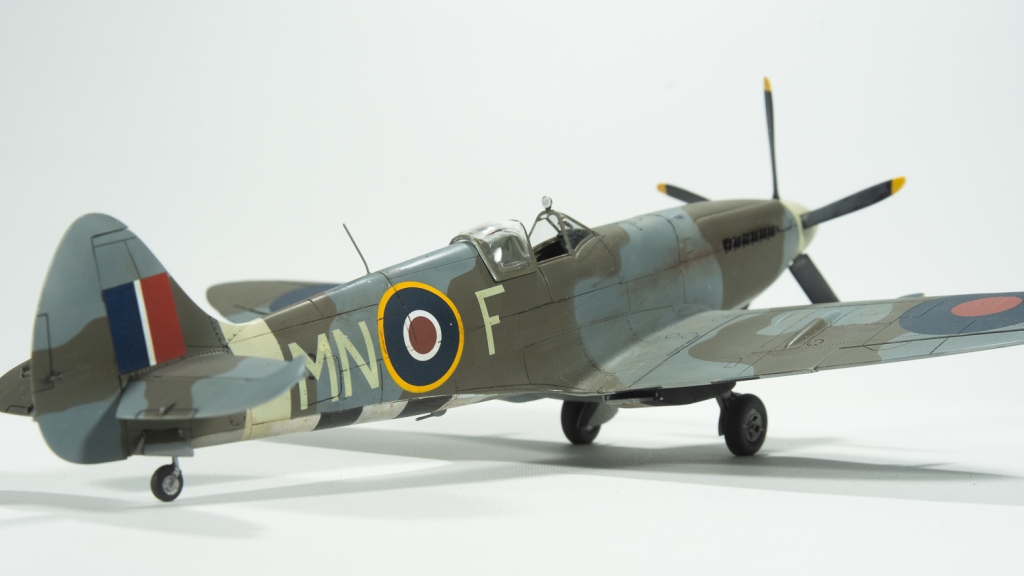
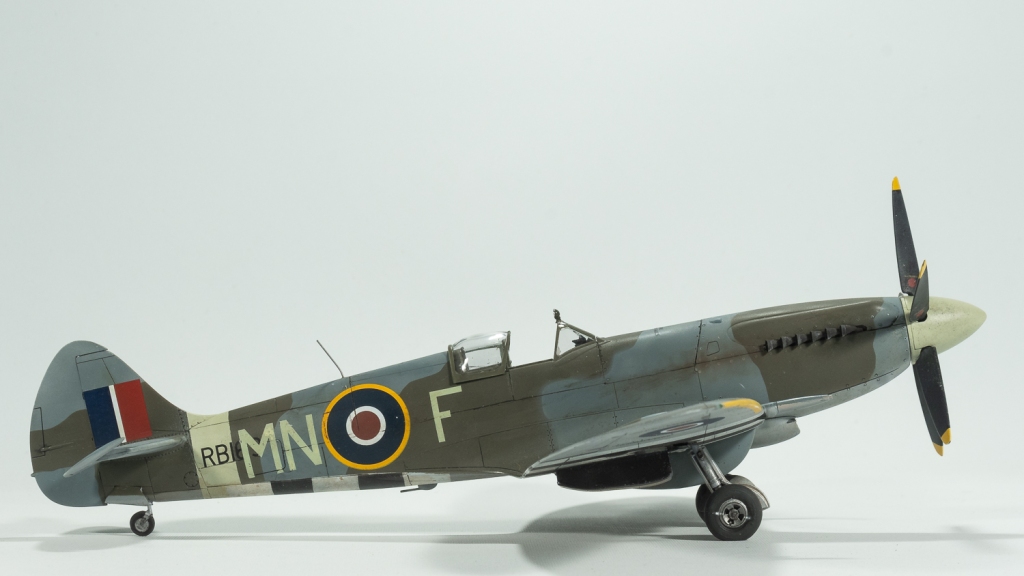
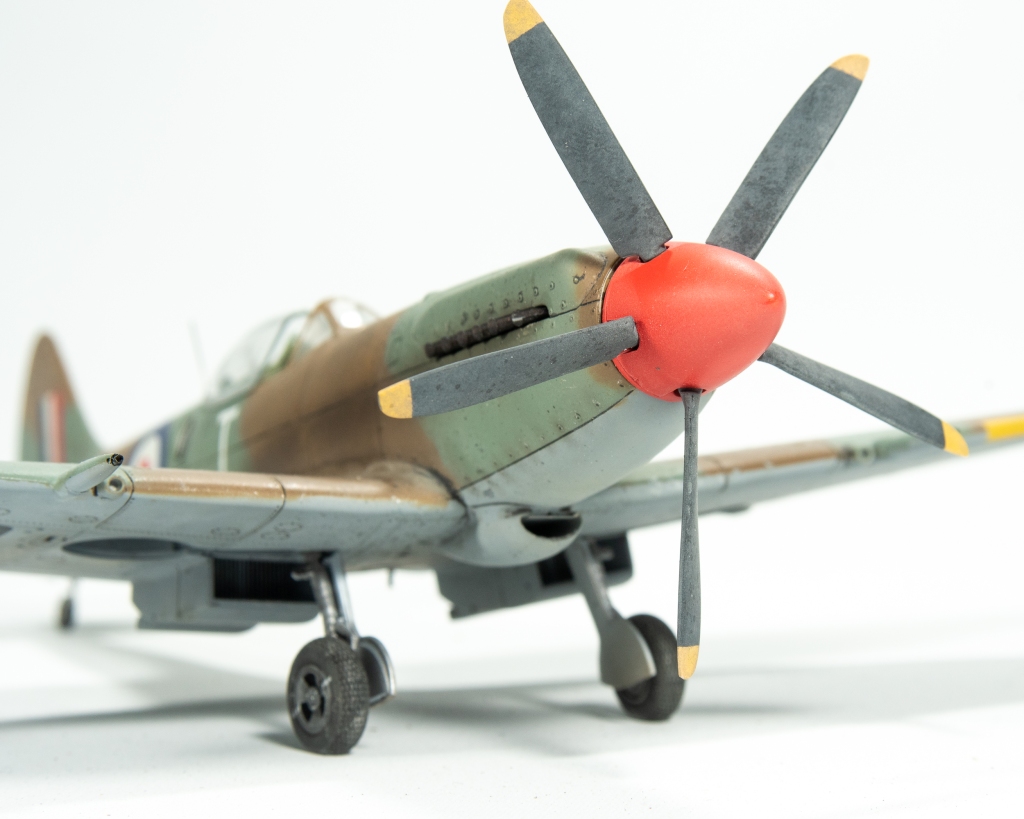
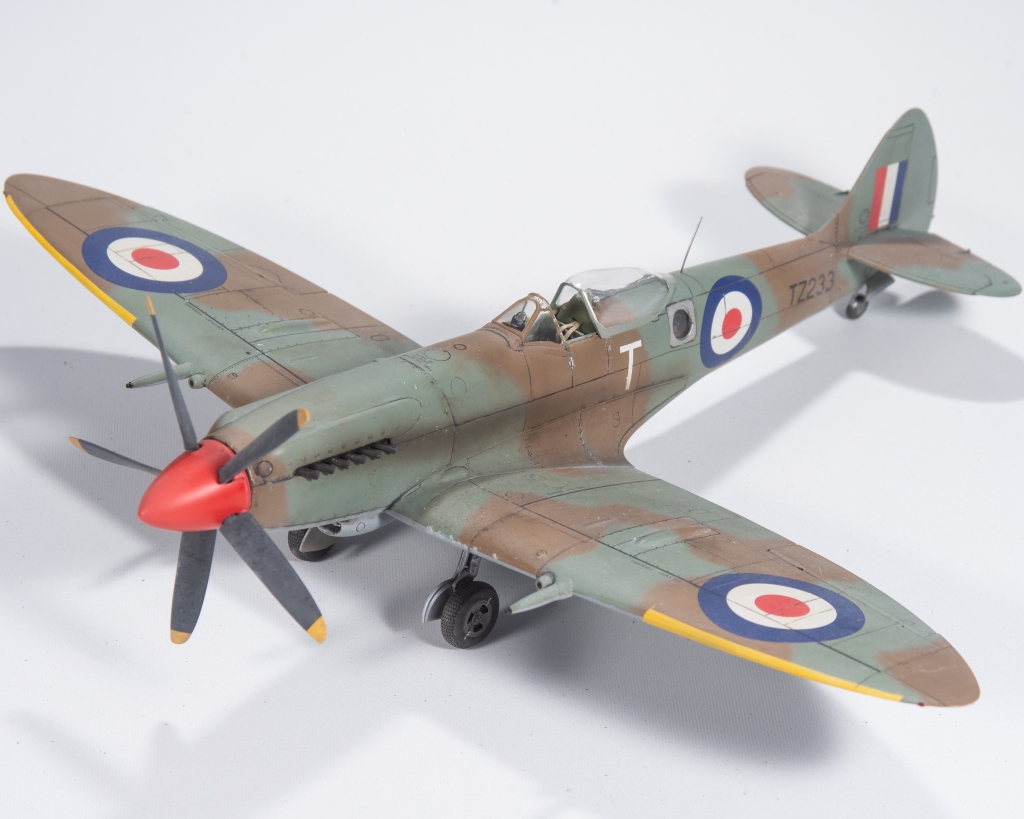
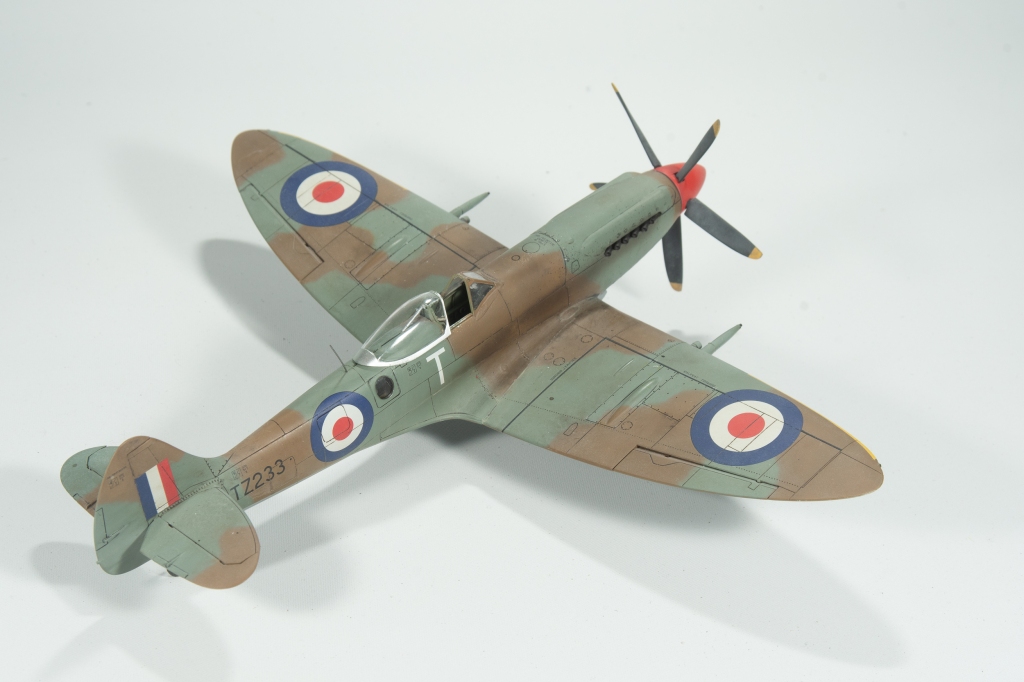
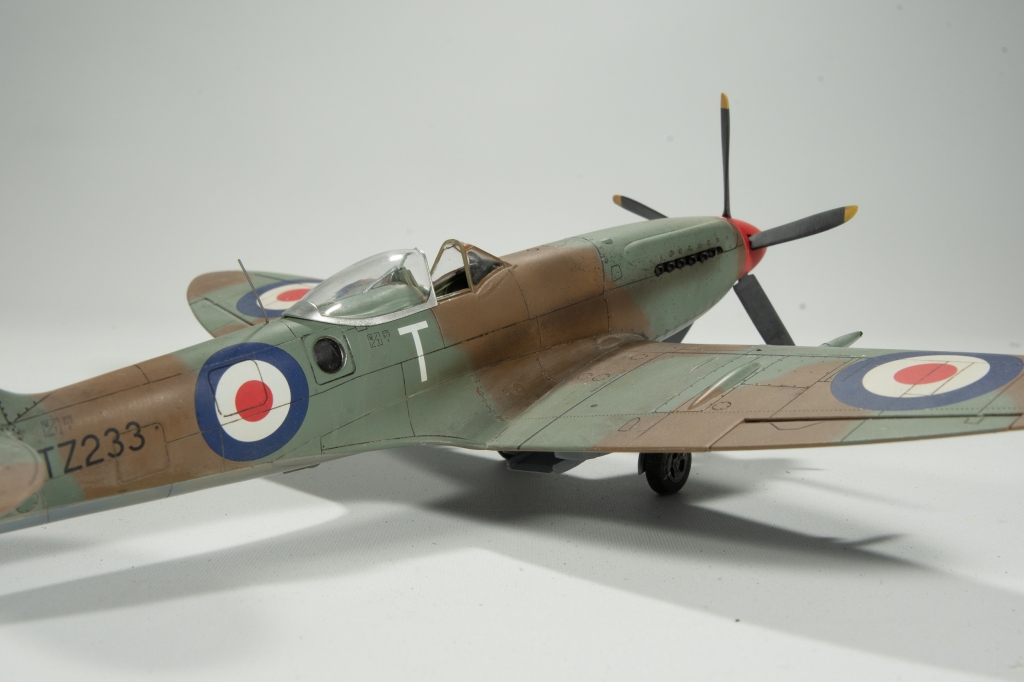
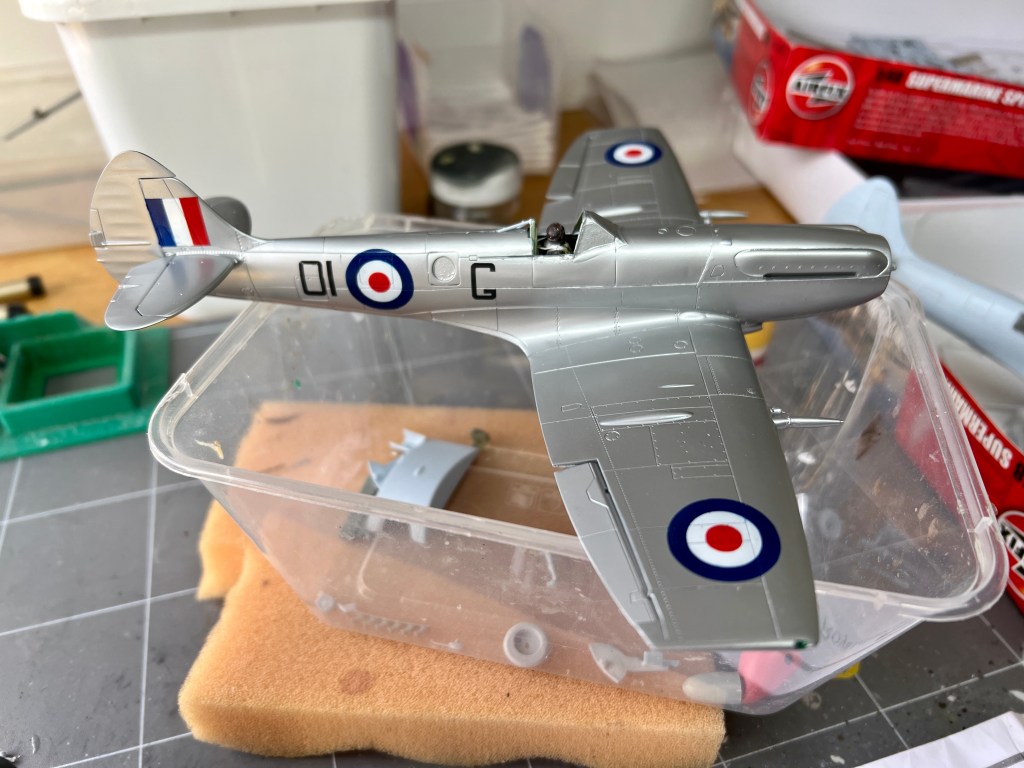
Another project (and Spitfire) started on nothing but an impulse. That impulse came in the form of fellow modeller Andy King publishing a post on his blog on how he was tackling converting the above two kits to arrive at an early Spitfire MkXIV,

His clear photos and narrative indicated what seemed a fairly straight forward conversion, one possibly even I could handle despite my inability to constantly cut straight lines.

A mate very graciously sent me the required Airfix kits, those being the Spitfire MkVb and XIV. Thanks Norm!

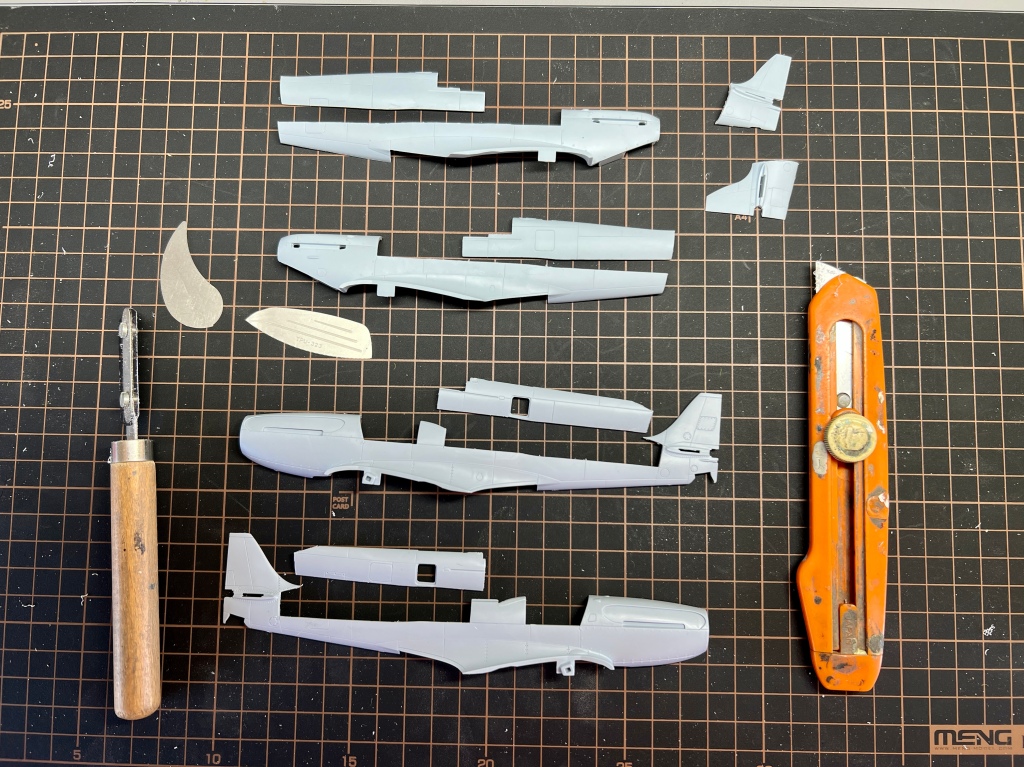
First order of (de) construction was too cut the kits along the required panel line as indicated in Andy’s article, although I deviated from Andy in just cutting straight through the rear access hatch rather than cutting around it to make the cut easier. Take particular care around the fin fillet of the XIV. Once cut, I traced the fillet onto the Vb fuselage halves with a pencil so I had an accurate edge to cut to.

It was then a simple matter of joining the spine from the Vb kit to the lower fuselage of the XIV.

This had been the deciding moment. If this had not worked, the project probably would have been binned, but I was very happy with the result.

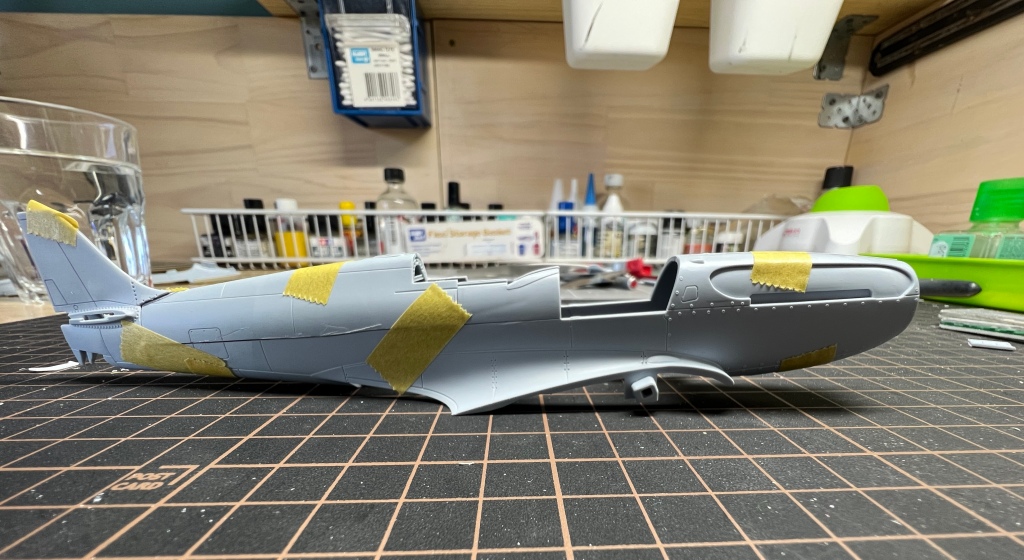
A tape together showed everything that needed to match up did

From here it was just a matter of assembling the spitfire as per the XIV instructions. The fuselage join did require some filler and subsequent rescribing of the lost panel line with that troublesome little jig just aft of the canopy. My work here was not great and I wish i had of had the patience to persist with it until I was truly happy with the result rather than settling for just “good enough”

If I could offer one bit of advice to modellers on the oft asked question of “How can I improve ?” it would be to persist until you are happy with your efforts rather than just accepting mediocrity. If only I took my own advice more often!

For the cockpit, the rear bulkhead from the Vb was married to the sidewalls of the XIV cockpit, and the fit of the fixed rear clear section from the Vb checked for fit. All good

What wasn’t so good though was when it came time to offer the lower wing section up to the fuselage, I could not get to mate to the wing fillets as it was fouling on the rear of the cockpit tub. Talking to Andy, he’d faced the same problem although in his case it was possibly due to him using the Eduard cockpit.

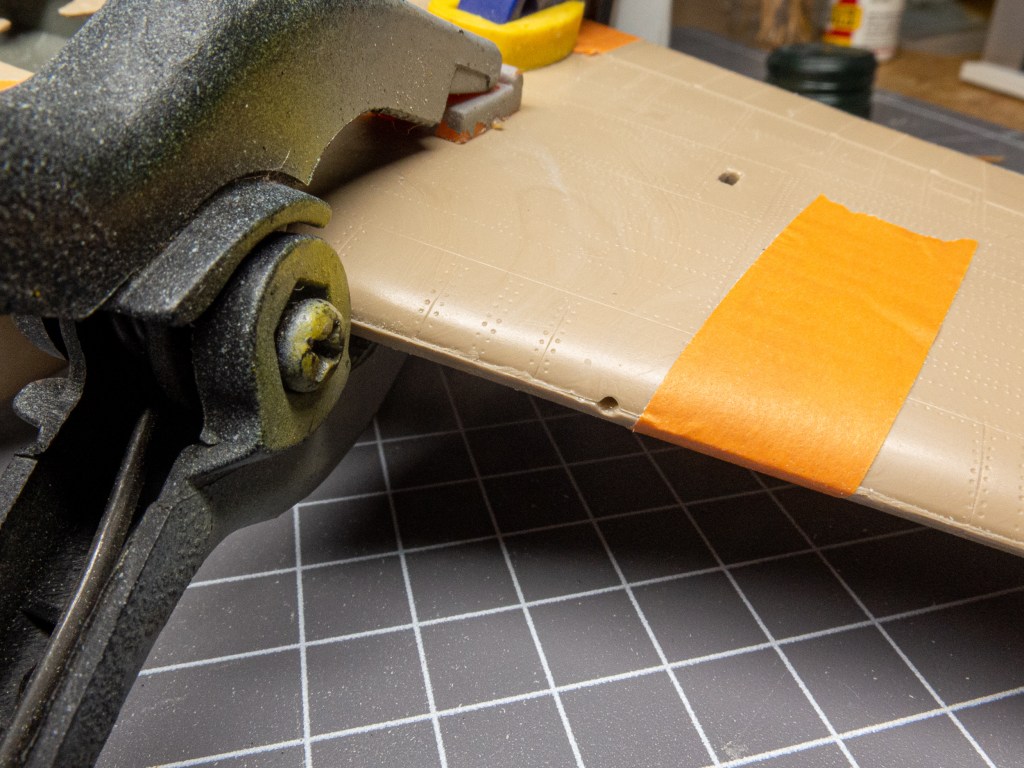
A long process of elimination and trouble shooting revealed the Vb bulkhead was not sitting as deep into the tub as it could. Remedying this sorted the problem and i got the lower wing fitted without further problem, and before you say “Bruce, that photo does not look like the fit is problem free,” the clamps are actually ensuring the underwing radiators sit flush with their cutouts. They mating surfaces do require some judicious sanding to ensure their fillets sit flush with the wing.

The top surfaces were then added for a nice tight fit. There was a small misalignment on the cannon stubs, but a skinny sanding stick paid short shift to that!

Painting time!

Annoyingly I had small flecks of paint pull up with tape all through the painting stage, no idea why as I had cleaned the plastic prior to painting with tamiya thinner X20A, and also used a primer. Nothing major, until I went to swab up some surplus Mig Ultra decal solvent with a cotton bud and removed not only the decal solvent, but also the clear finish and paint down to the plastic.

I have never had this happen before. It was easily touched up, although you can still see the scar. Also evident in the above pic are my dodgy scribing skills.

The camouflage demarcation was achieved by using the AML camouflage mask set. Its designed for the Academy kit, but still fits the airfix kit nicely. I managed to create a few ridge lines though with over judicious coats of paint.

Weathering was achieved with oil washes and spattering on Tamiya brown panel liner to represent spaces of mud kicked up by the propeller. Just needed to add the exhaust pipes and the mirror that came from a quick boost set and she was done

There exhausts were base coated in dark iron, then washed progressively with tamiya dark brown panel liner, Vallejo pale german camouflage brown and finally Vallejo white grey.

Im very happy to have this mark of Spitfire in the cabinet. A shout out to Andy King for doing the conversion as I never would have thought of it. Do check out his blog. He has always got something interesting on his bench.

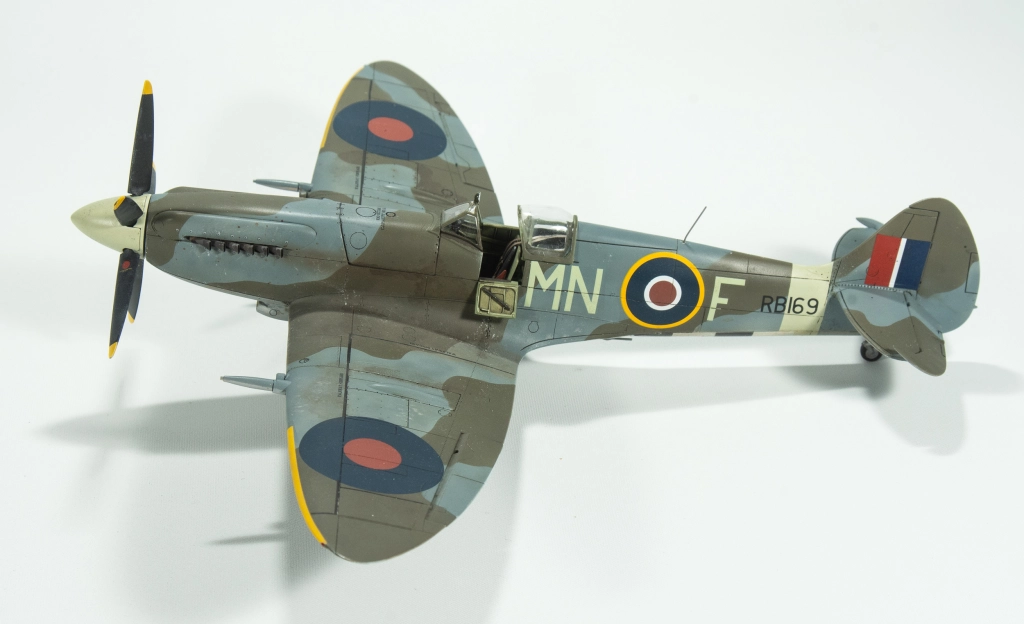
Supermarine Spitfire XIVe. 350 (Belgian) SQN. R.A.F Lympne. 1944

Leave a comment

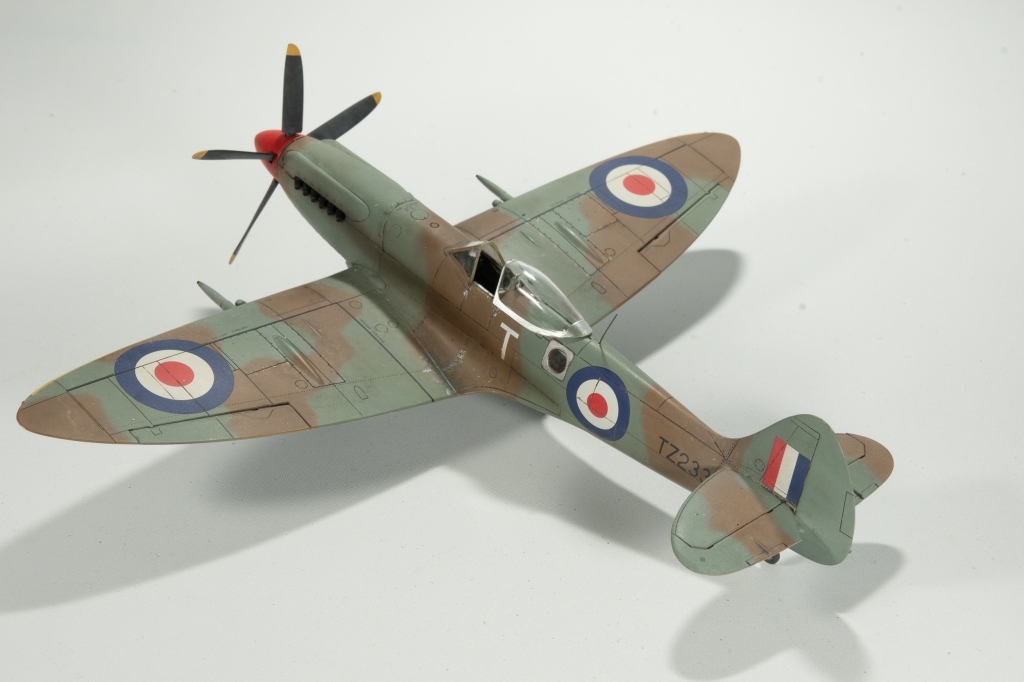
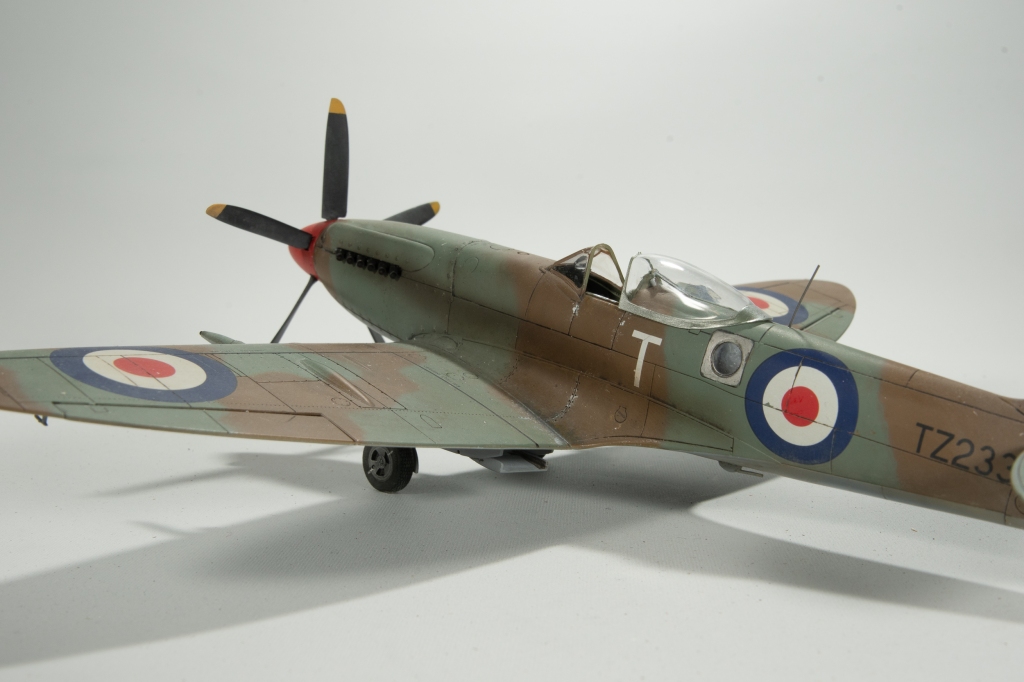
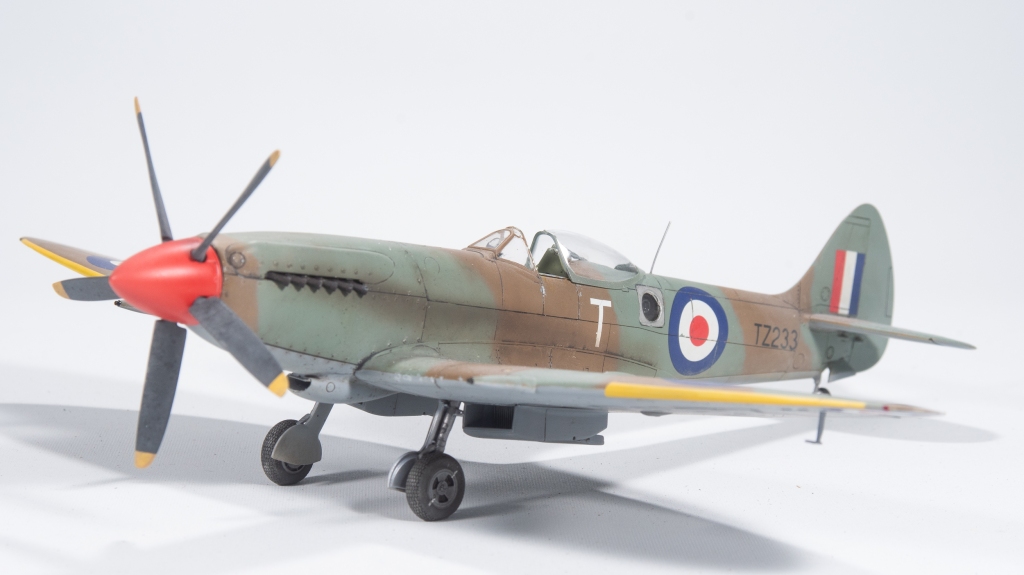
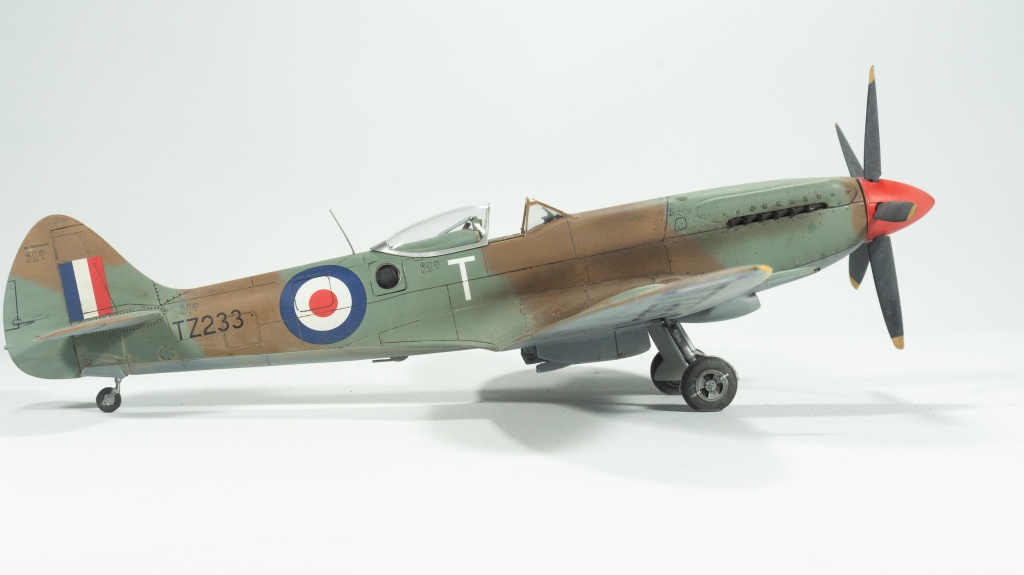
Airfix 1/48 Spitfire FRXIV (yes, another one!)

  • Added to Stash; 2022
  • Completed; 2023
  • Enhancements:
  • Exhausts: Brassin
  • Wheels: Brassin
  • Seat Belts: Eduard
  • Guns: master barrel
  • Decals: Xtradecals

Well! I certainly did not see myself completing another of these kits, immediately following on from my other one, but I had become intrigued by a few comments on my Facebook page as to how to get a better fit at the wing roots.

The suggested method was to fit the upper wings direct to the fuselage . This allowing the best way to get a tight fit, then the lower wing is added.

I was doubtful this would work on this model, given the very small contact area for the upper wings abutting the wing fillets. Instead I added the upper wings to the lower wings, only glueing the tips together to ensure there would be no step. As the wings had had no glue added inboard of the aileron cut outs, the soft plastic allowed me to spread the upper and lower wing to fit over the undercarriage location stubs moulded in situ along the wing root. My wing root gap was almost non existent this time, needing only a thin smear of Mr Surfacer to reduce the join.

My other major departure from the instructions with this build was to glue the fuselage halves together, completely dress the join, then add the fuselage from below. The fuel tank was still a poor fit.

I added a 10thou shim to the front. The shim was sanded to conform to the cross section of the cover before it was put fit on. Result was a much tighter fit.

The construction on this was looking a lot tighter than my first one, which pleased me. For the finish, a modified desert day scheme used by the RAF post war was settled on. The different scheme a mate had used on his really appealed to me, so I wanted something similar for mine.

Not the same, obviously as I didn’t want to show him up!

The modified desert scheme was only used on two aircraft types that I know of, the Spitfires XIVs of 208 SQN and Tempests of 6 SQN. It was arrived at to differentiate the spitfires of the RAF from those of the Israeli Air Force and the Royal Egyptian Airforce, following a couple of “friendly’ fire incidents, which led to the loss of a few RAF machines.

During this time frame, all three Air Forces flew Spitfires, albeit different marks, so making your aircraft different from the others was a necessity.

Colours used were Gunze’s dark earth and MRPs light slate grey and medium sea grey for the undersides. The camouflage being freehand with my Iwata HP-C. Some tonal variation was achieved by utilising a random preshade of differing colours such as yellow, tan and light grey,

Decals were from xtradecals and there was no problems with applying them over a gloss coat, the post war D type roundels looking superb against the drab camouflage. With the national markings done it was time for the stencils which came from the kit sheet, well that was if I hadn’t accidentally thrown them out during packing up for the house move. Actually, there was nothing accidental about it as I can remember looking at them and thinking “I won’t need these, its a field applied camouflage” so in the bin they went.

I may have been correct in this assumption as the only two photos I could find on the net of these machines showed weren’t the best quality, so I couldn’t make out if there was stencilling or not. Given the machines were completely painted in a new scheme – well the top surfaces anyway – my supposition was stencilling was reapplied. In any case a lat mark spitfire stencil sheet by Barracuda Studios was duly ordered

Given Roy Sutherland markets this as suitable for any Spitfire from mark nine to mark 22, it was disappointing to find only enough stencils for four propeller blades, not five as needed in my case, or in fact for a mark 22/24.

Wing Walk lines were masked and painted as long thin decals and I don’t get on well!

An interesting little fact I discovered on Spitfires post VIII – the mechanical undercarriage down rods which extend above the wings when the gear is down, were deleted. So I didn’t add them as was my original intent and what started me down the stencilling rabbit hole

I was particularly pleased with my handling of the canopy on this kit. It was sharply masked and remained crystal clear, which is not usual for me, well thats how I remembered it before the move.

Imagine my horror when I pulled it from the box to discover a dirty great crack the length of it.

No problem, there’s two in the kit, in fact I had two remaining ones from both kits. I had used one as a mask when painting this kit, so cleaned it up with some MR Thinner, which revealed that this one was also cracked, I mean for christs sake!!!! Maybe I applied too much pressure whist holding it when painting the kit. So, the remaining canopy was masked up and painted. Unmasking this revealed………. a tiny spot where the plastic had crazed, what caused it. I don’t know, no glue had been near it, only lacquer paint, whether it pooled on this spot whilst painting, I have no idea. The offending area was sanded out and repolished but I could not eradicate it completely.

Thanks though to some fellow modellers following a plea on one of the facebook sites, I soon had not one but two extra canopies to replace my marred example. The whip aerial was added from some piano wire and she was done.

Looking at the completed model with a critical eye, there are a few areas Im not happy with, and some unforced errors I continue to make, but the different camouflage certainly sets it apart from my other Spitfires, and I have really grown to love the Griffon engined spits.

Supermarine Spitfire FRXVIII 208 SQN Royal Air Force Egypt 1949

Leave a comment

2022 Build Year in Review

Well, combined with not yet having a bench up and running, and being coerced into visiting the in -laws for Xmas

(turns out five hours drive is STILL too close!) it’s beginning to look like…. my modelling year is done.

Net result? five models, which is actually not that bad for me, given my usual is 5-8 a year. There were a few false starts, although not nearly as many as in previous years. Toward the middle of the year, my wife and I made the decision that we were going to bring forward our retirement and move interstate to a retirement property we had previously purchased. This of course severely curtailed bench activities as we started to get our house ready for market. We are now in the new house but the modelling bench has not yet come back on line.

Anyway, on to the builds. In order of completion.

The year started out with The Eduard Spitfire I had bought The Few double boxing with full intention of building both. The second having opened cowls and gun bays, but that one became the first of the year to fall. Its back in the box and will be revived at some stage

What can I say about the Eduard Spits that has not already been said? Nothing really. Just. Build. One!

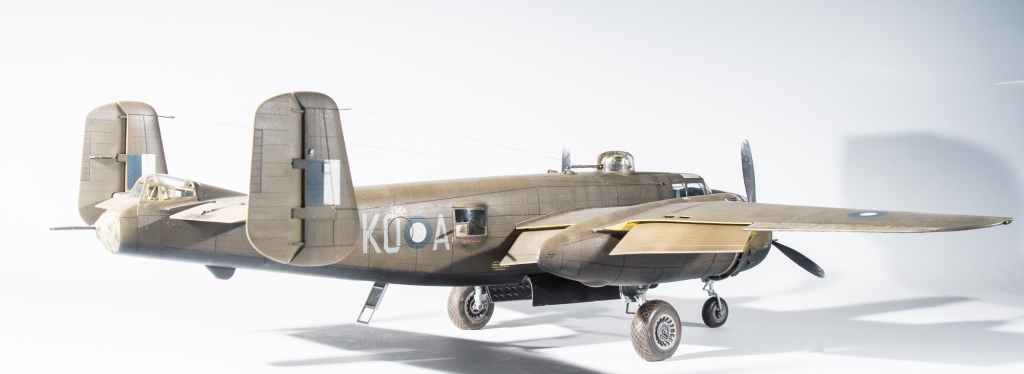
Second kit was the Accurate Miniatures 1/48 Mitchell C/D

This was my second go around with this kit, having attempted it upon its initial release. From memory, that one never reached completion.

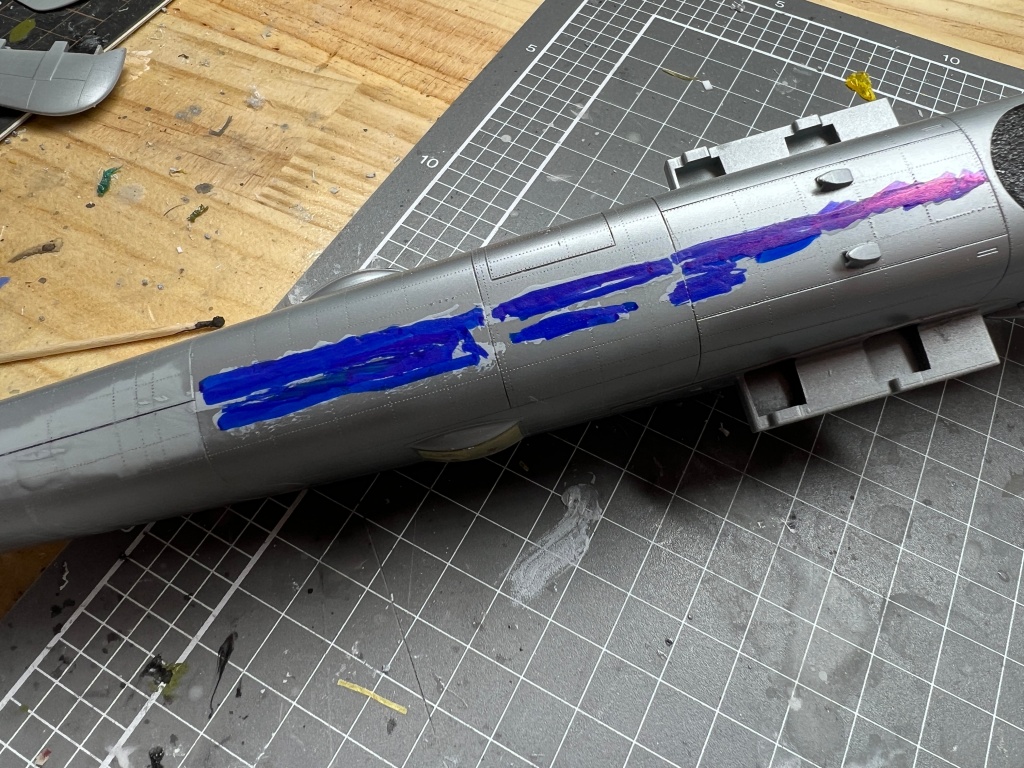
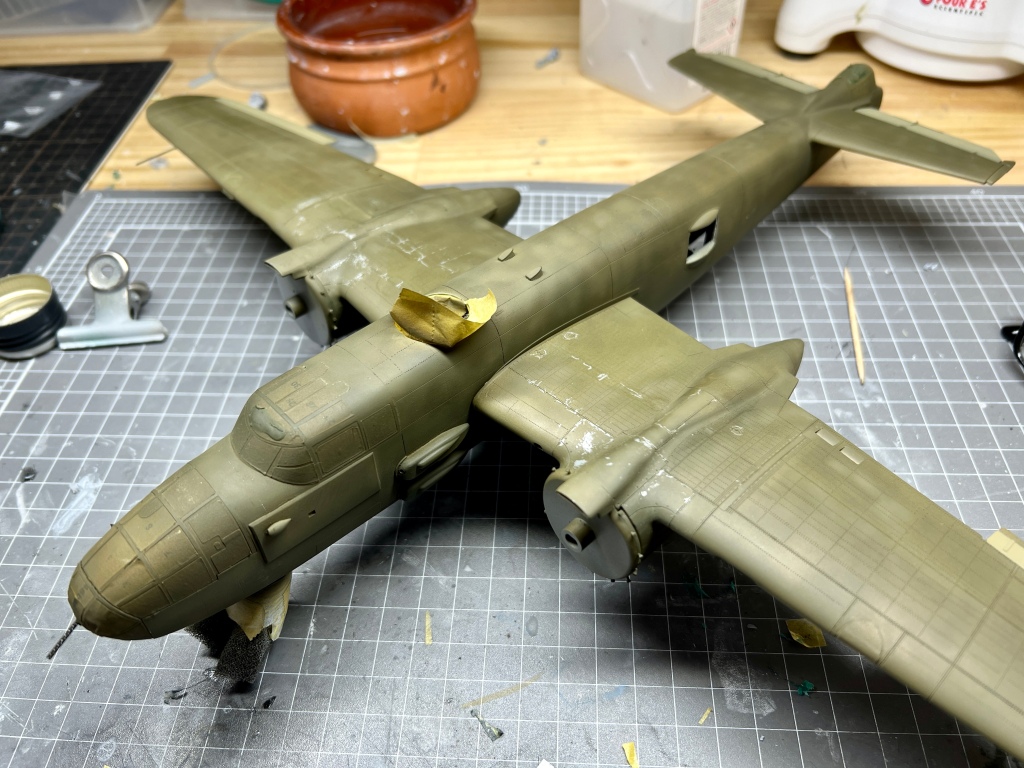
The kit was neither as much fun to build, nor as good as I remembered it, but Im happy with the completed model and its been a favourite on line. I must admit Im very chuffed with how the distressed stripes came out. Am I allowed a bit of self congratulations? Yeah, of course I am.:)

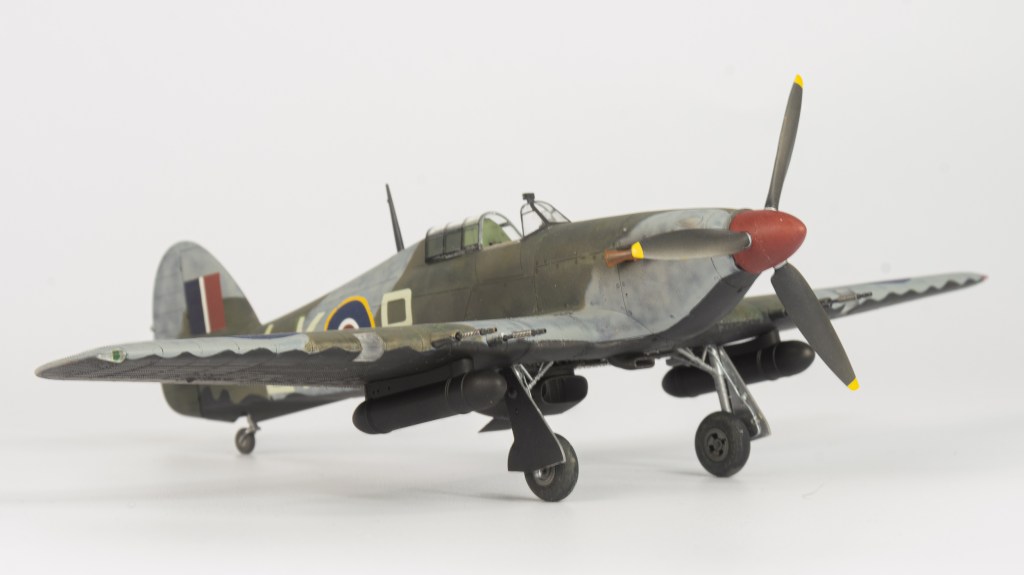
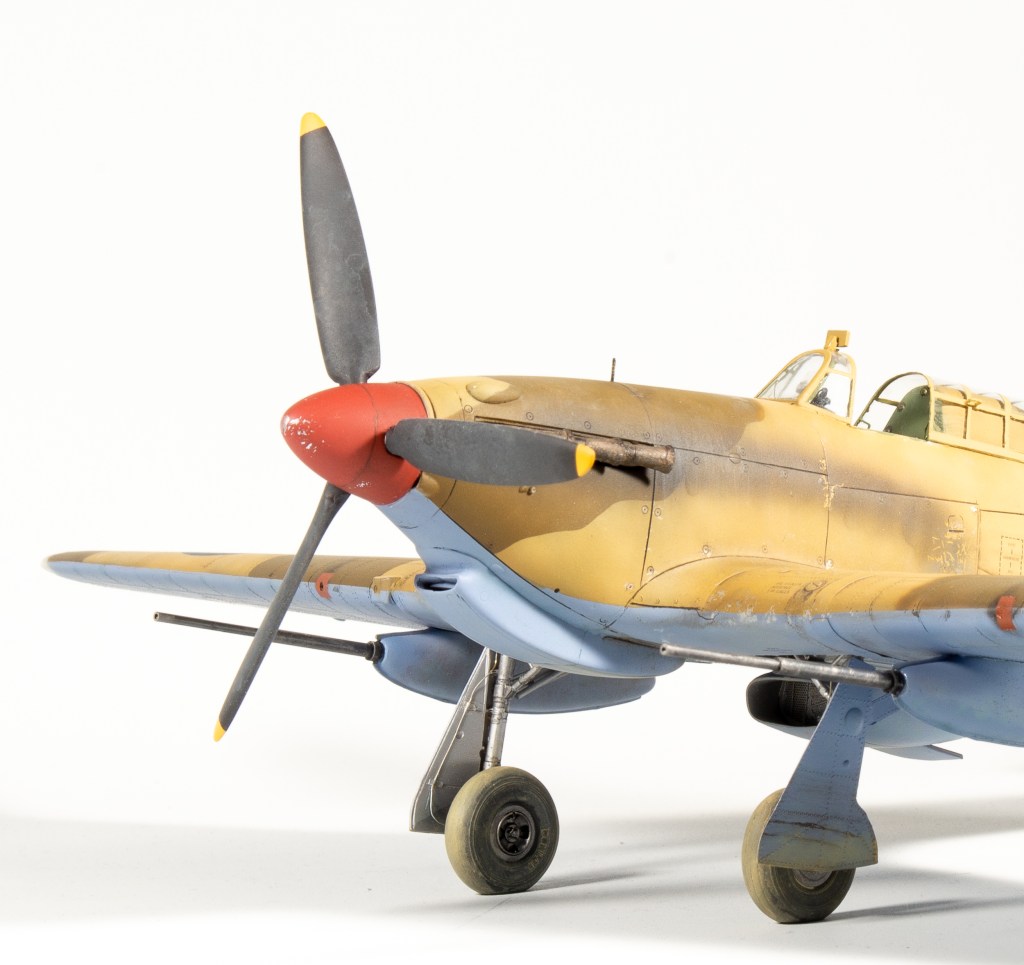
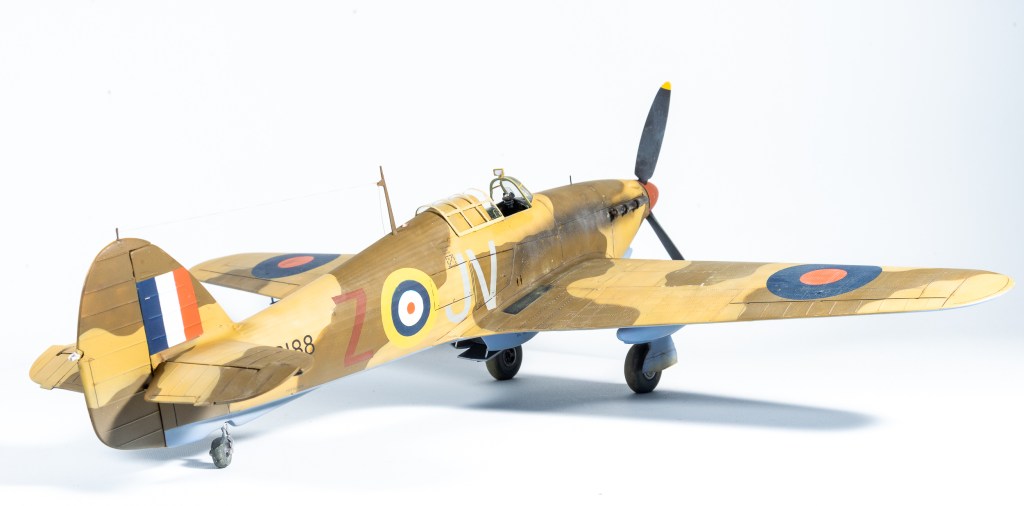
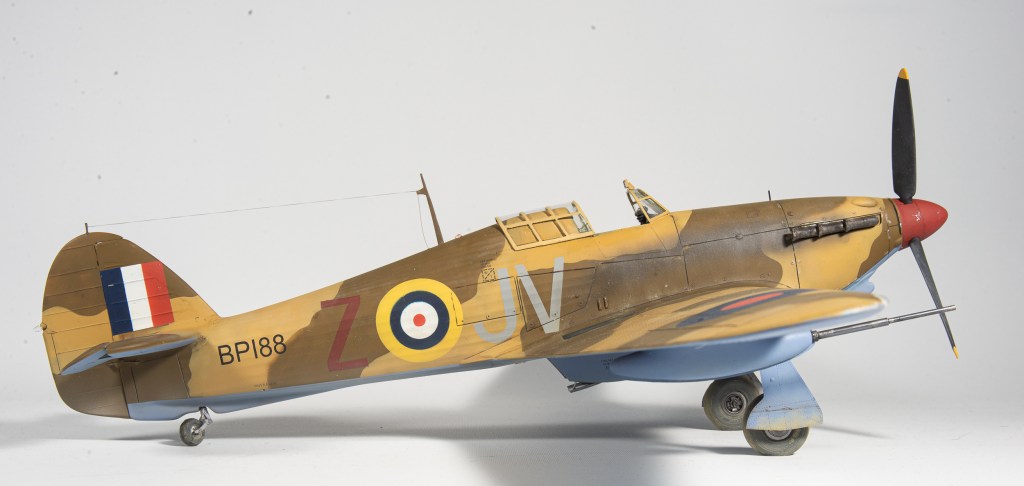
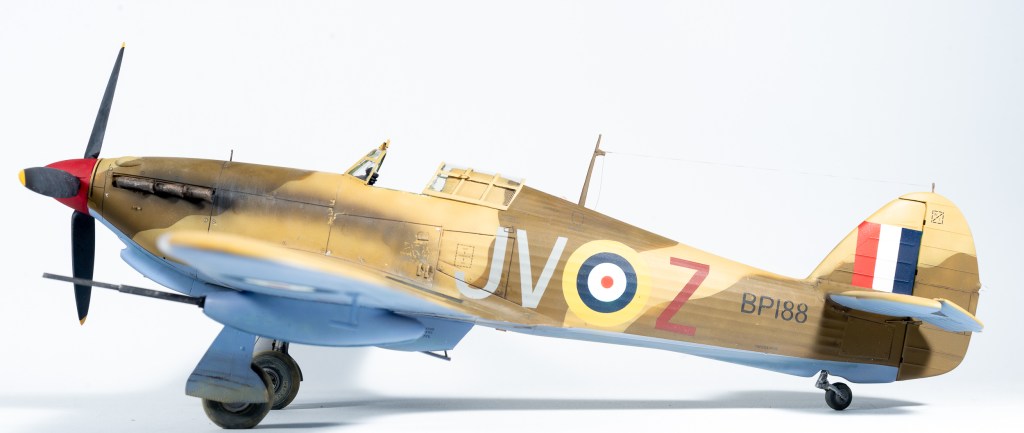
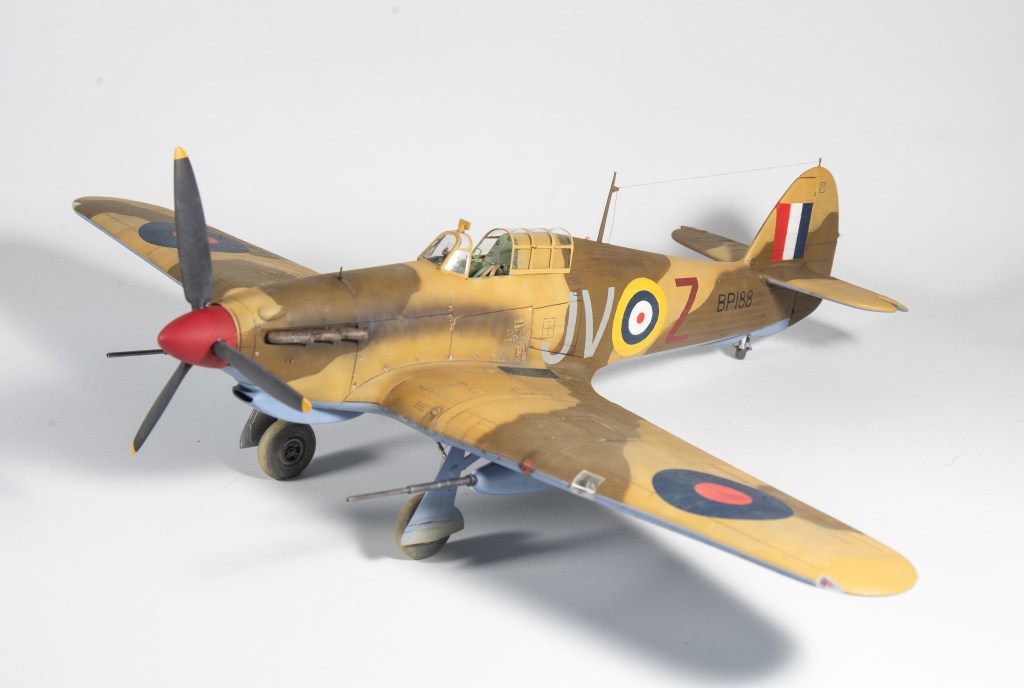
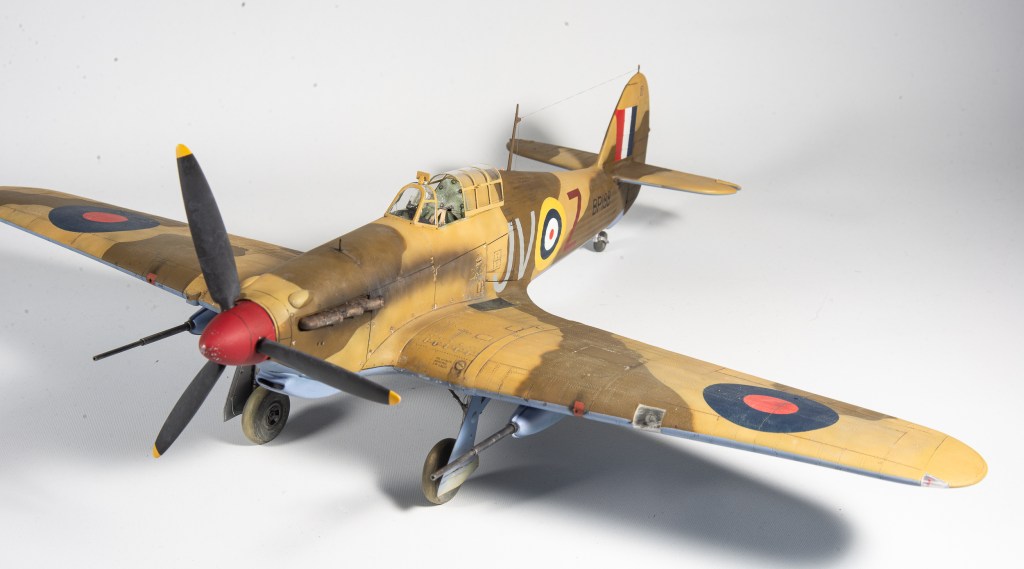
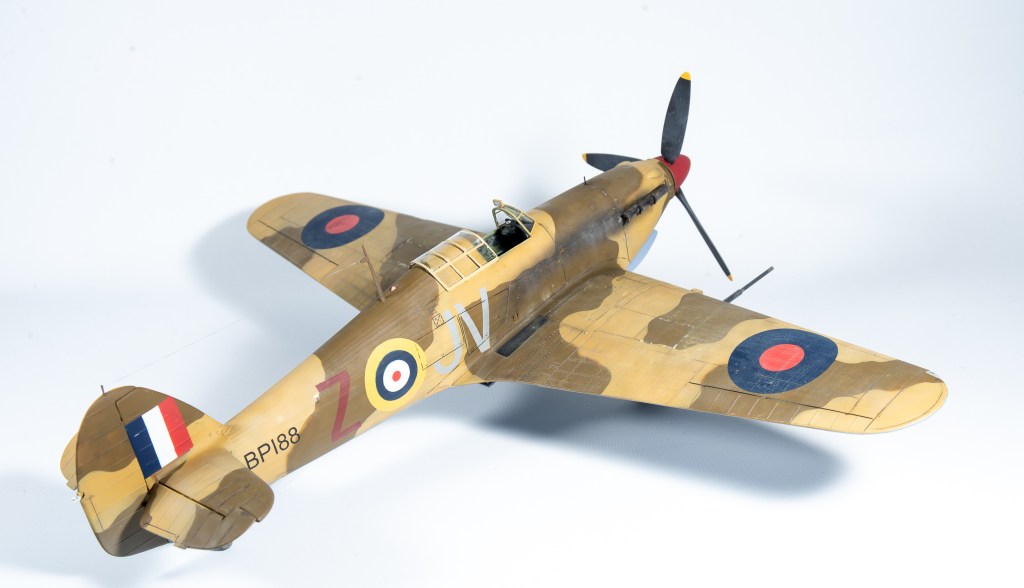
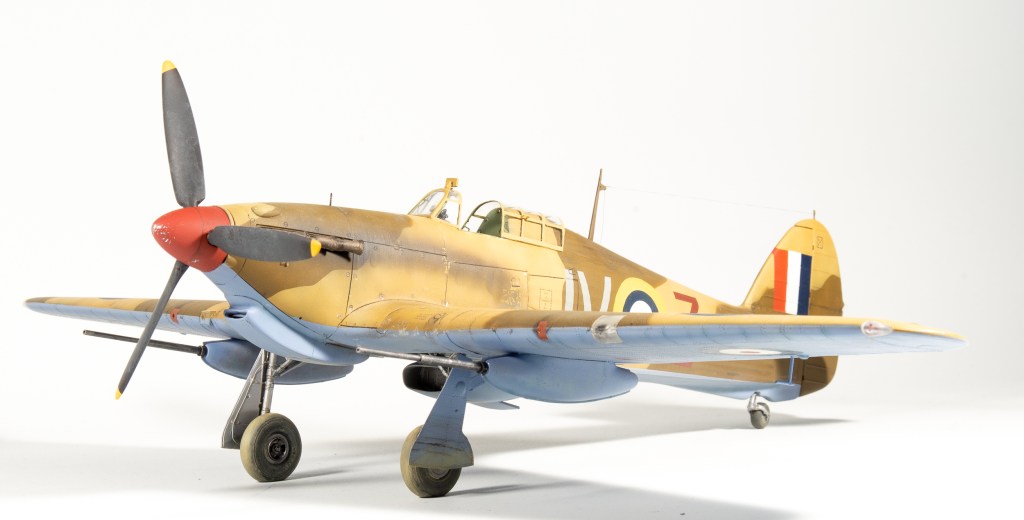
It was then the turn of Fly Models 1/32 Hurricane MkIId One of my favourite aircraft in one of my favourite schemes, what’s not to like? Well the whole kit really!

Beautiful surface detail, but not an enjoyable build. Looking at it on the shelf, Im also not totally convinced by SMS paint’s interpretation of Dark earth and Middle stone to be honest.

So, what’s next after two complicated builds? Well, Hell, lets just lurch into a complicated 1/48 jet!!!

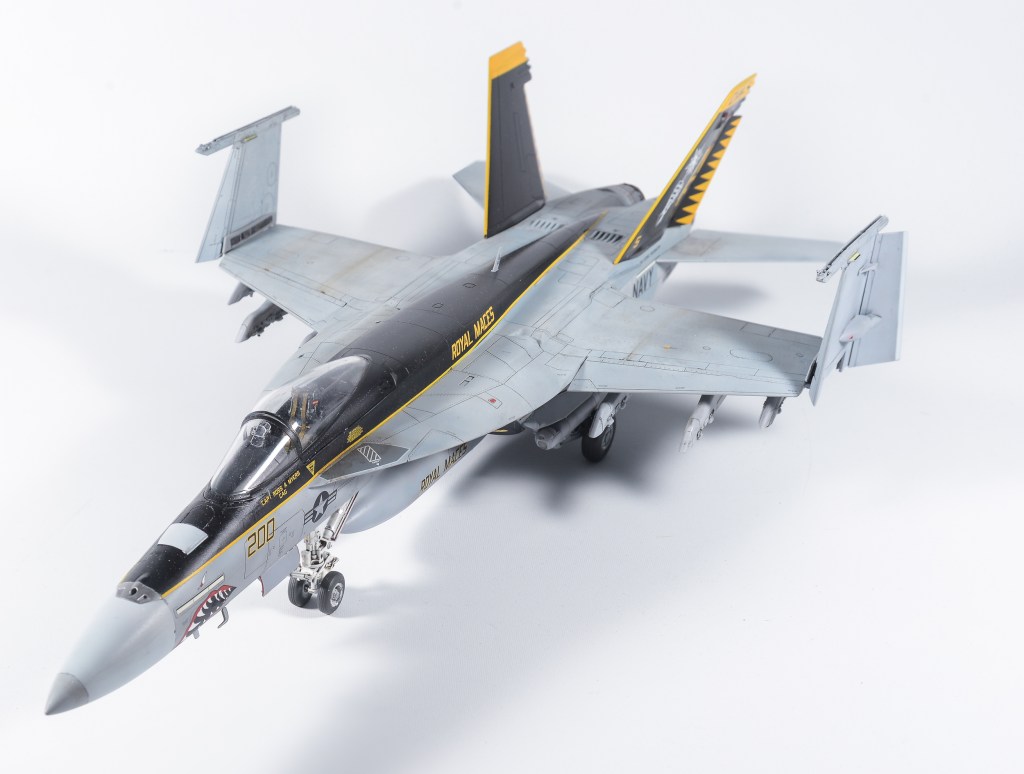
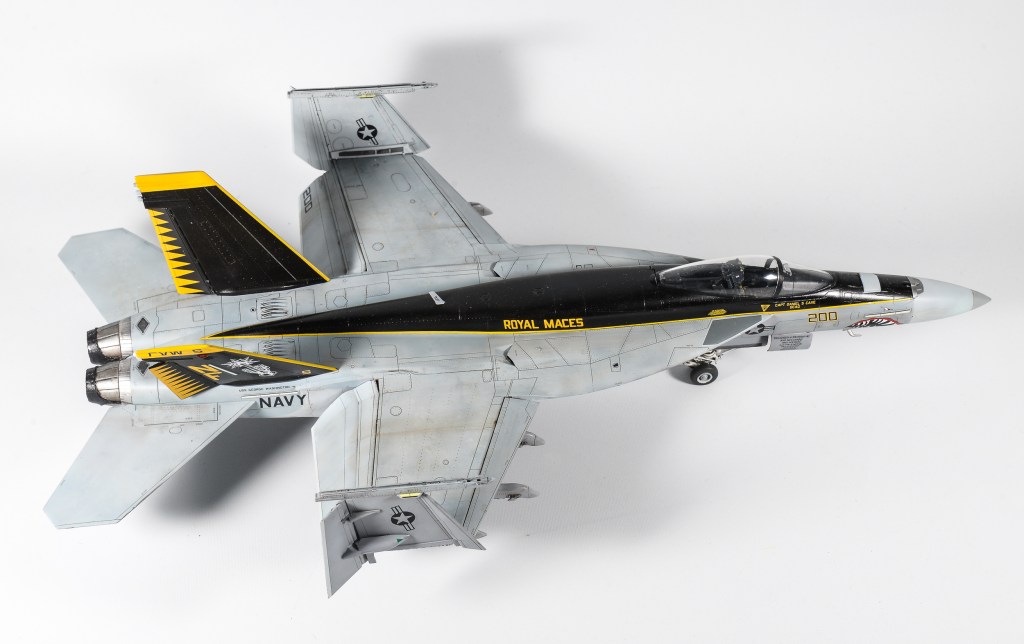
Meng’s F-18E Super Hornet was started as a mate was building the Hobby Boss kit. Mercifully, this build stalled a little whilst I waited for some resin that seemed to be taking its sweet time proceeding through the U.S postal system to arrive.

In the meantime I started the Hasegawa 1/48 Ki-44 Tojo, as I needed a quick build. Or slammer build, if you want to stay hip and cool in the new modelling scene

Did I say quick? That fucking camouflage took me two goes!

That done, back to the Super Hornet, which actually was an enjoyable build, or as enjoyable as modern jets can be with all that pylon and stores palaver to go through.

This is pretty much where the packing up of the bench commenced, the F-18 being rushed behind for a point, as we say in the AFL states. Is there any other kind of footy? (No, there’s not, is the correct answer) which I feel is reflected in the completed model.

I almost got the Airfix Spitfire XIV over the line, but moving day arrived first

Somewhere along the way, a Wingsy kits 1/48 109E1 also died .

Far too many kits were added to the stash. On the other hand, a chunk of built models were sold, so there’s a bit of room in the cabinet.

The first job in the New Year will be to get the bench up and running. There is a decent sized room in our new place that will become mine. Planning has already started, the first step being to sort out modelling accessories and tools I no longer use or cant see me having a use for any more.

I was a little horrified at just how much modelling stuff I had to pack up, as a result my number one goal for next year will be sorting and, where necessary culling them . The decals have already been done, with the surplus decals going up on FB over the next couple of weeks.

Aside from that.

Make More Models.

Im on a transition to retirement, which means 11 months of Long Service Leave. Thanks Ambulance Victoria! Thats gotta get me through about……oh, an eighth of the stash! I’d also like to fiddle around with this site a bit more.

Thanks for looking at at my ramblings throughout the year, both here and the FB page

A Merry Festive Season to you all

Bruce

Leave a comment

Meng 1/48 F-18E Super Hornet

photo credit. Scalemates
  • Added to stash 2022
  • Built: 2022
  • Enhancements:
  • Seat– Brassin
  • Wheels-Reskit
  • Nozzles- SteelBeach
  • Pylons: Phase hangar resin.
  • Wingtip launchers: Flying Leathernecks
  • Decals: Afterburner Pacific Coast CAG Superbugs

Construction Notes

I need to stop writing these so long after I have finished the model, as its sometimes hard to remember stuff encountered during the construction!

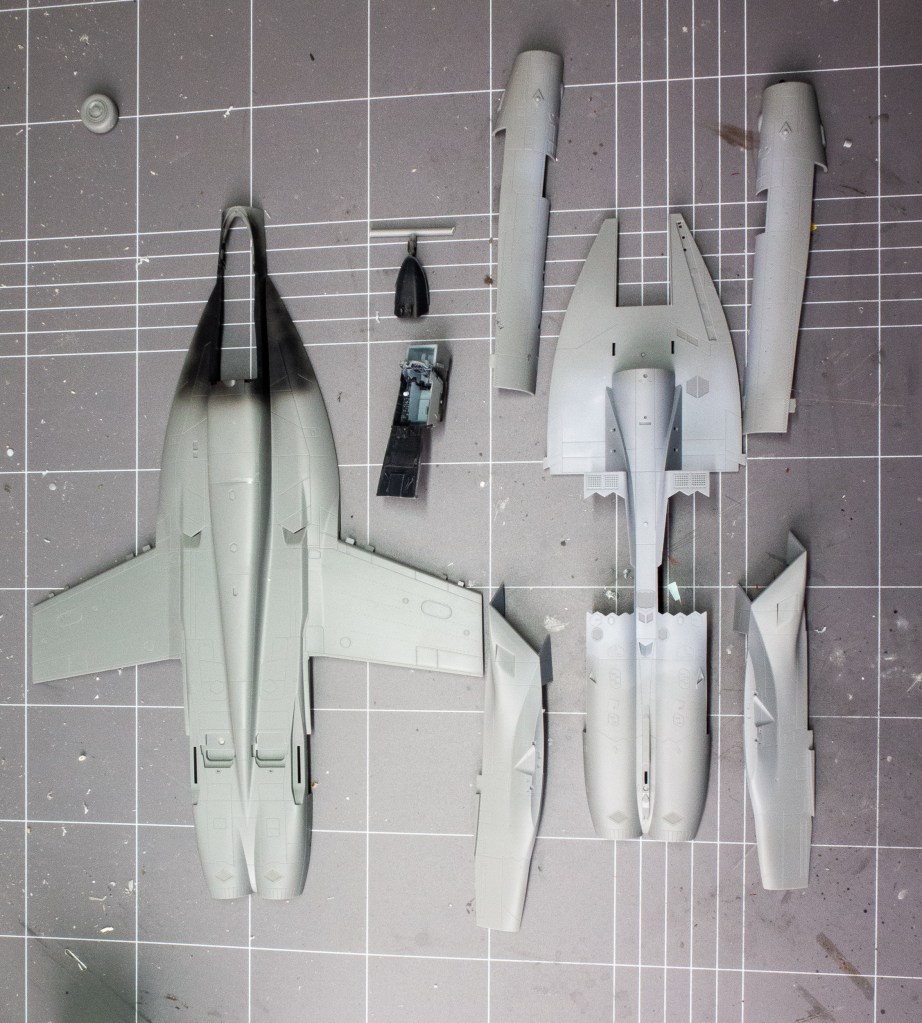
That aside, I found Meng’s kit to be a painless build, construction wise. There were some pesky seams under the LEX that took a while to remove, and there are some spurious panel lines on the rear fuselage sides that need filling. Overall though I would rate it as a well fitting kit that is quite enjoyable to build.

As with any kit, multiple dry runs and careful preparation of the parts to ensure all mating surfaces are clean will reward you with far less problems than the modeller that does not take these steps.

The gun muzzle and fins can be painted separately and then added during final assembly, so good is their fit.

It easily eclipses Hasegawa’s ageing kit (as it should)

However, should you only have the Hobby Boss kit in your stash, I certainly wouldn’t be rushing out and replacing it with the Meng kit. Comparing notes with my mate, there doesn’t seem to be a lot between the two, perhaps a slightly better fit with the Meng kit-maybe!

Calum’s build here

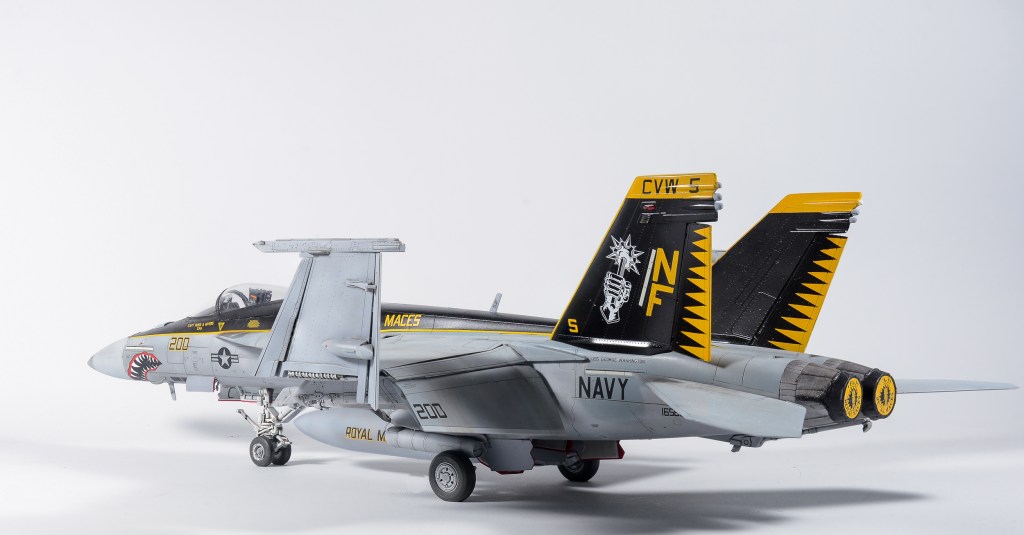
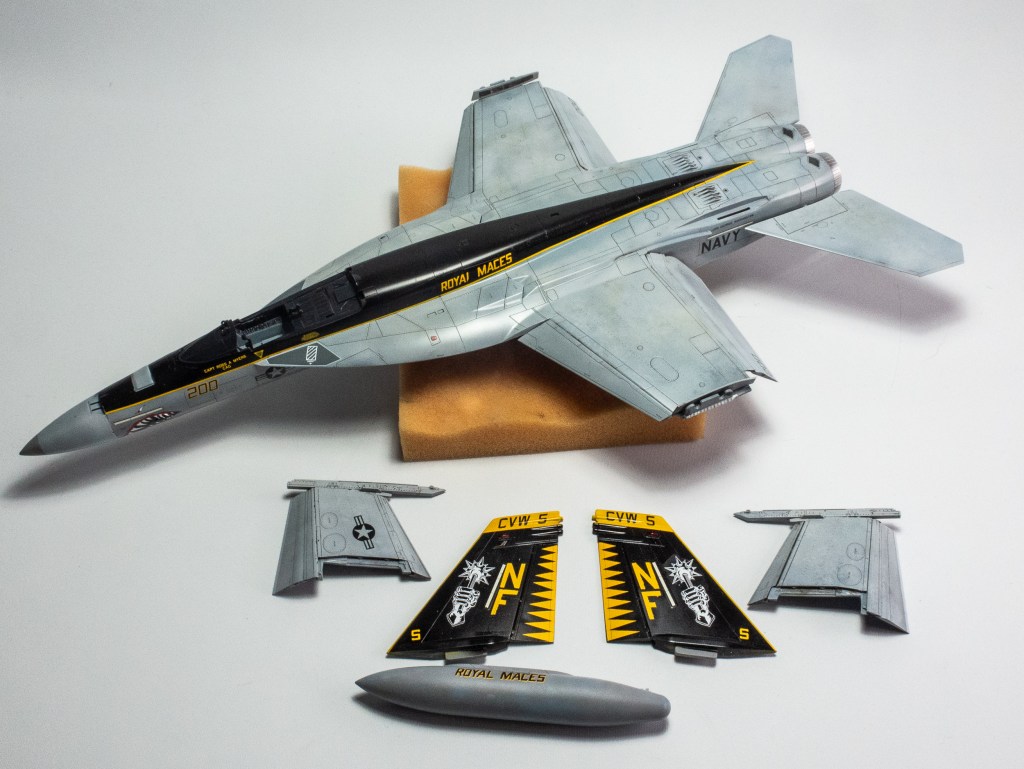
My plan was to model a clean jet, as this is what most photos of this jet showed, clean as in both condition, and having no stores save a centreline fuel tank fitted. The phase hangar 3d printed pylons were therefore purchased in order to show detailed undersides with all holes slots etc hollowed out unlike the kit pylons that just have no detail on the undersides.

Likewise the resin Flying Leatherneck wingtip launchers. Whilst the kit wingtip launchers actually weren’t bad, if modelled bare, they displayed a nasty centreline seam which would have been difficult to fill.

Initial construction of the model proceeded fairly quickly although progress was held up whilst waiting for the resin to arrive from the United States. Thinking back on the build, no real problems were encountered. As my intention was to fit FOD guards, I left out the intake trunking and compressor fans. The intake FOD Guards are made from Apoxie-Sculp formed over the intake, then left to harden. The afterburner sheet included decals for the FOD guards so it would have been a crime not to use them.

I faffed around endlessly and to no avail trying to come up with home made covers for the nozzles, epoxy putty, glue dampened tissue being two materials that were tried and quickly removed as my efforts looked rubbish. In the end I found Steel Beach resin had done the work for me by releasing a set of covered nozzles for the hasegawa kit. Long OOP, I managed to find a set from a German retailer, even better, they fitted the Meng kit.

Halfway through the build, my wife and I put our house on the market, which resulted in me packing the modelling bench up to project the house in the best way during inspections.

We sold the house, but this then had the effect of me putting a clock on my modelling projects, in an effort to get them done before starting to pack the bench up in November. Experience has shown me that half finished projects that get packed away for house moves never get finished upon unpacking at the new house.

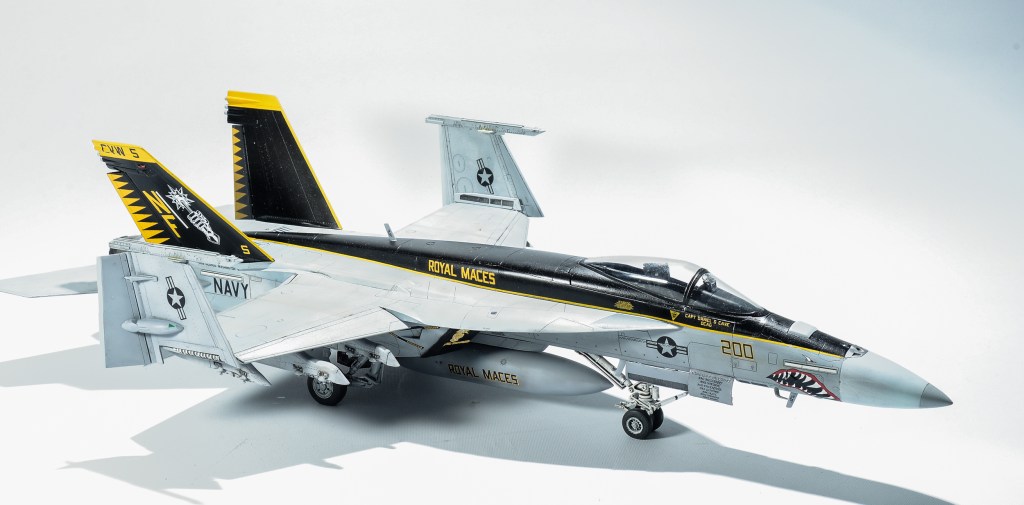
Subsequently. the Super Hornet was finished in a bit of a rush, with not the greatest attention paid to final assembly, or even the weathering really. Just a few token stains appearing on the wings.

The one store it carries, the target seeking pod, has just been tacked on as an afterthought with no decals or weathering. This was a deliberate choice on my part. When the new bench is set up, the ordnance will again be getting the attention it deserves

A mix of gunze and SMS paints were used for the USN greys, they ended up being mixed as I thought the SMS FS36320 was way too light as was their version of FS36375., but thats just my opinion. Some tonal shifts and fading being achieved by post shading on various shades of grey before a final blend coat.

The Afterburner decals performed flawlessly. I chse to paint the yellow trim and squadron codes on the fins using masks cut from scanning the decal sheet into my silhouette cutter. Im slowly getting better at using the software. The yellow border to the black spine was also masked and painted rather than using the decals. Long thin decals and I don’t get on a lot of the time.

The Meng decals, however were a big let down. Only the stencils were used, instead of being legible, they were just formed from random lines and are also the wrong colour being black instead of the contrasting grey. That said, they did perform alright and responded well to micro’s setting solution where used. Most of them were applied to little pools of future as I find this the best method for applying stencils and avoiding silvering.

Yes, I should have just used the afterburner stencils, but wanted to save these for a future Meng F-18F thats in the stash, in fact somehow the stash has ended up with THREE Meng Fs. Im not sure how this happened!

So thats it, my Meng Super Hornet. It was originally started for a FB group build, but it overrun the deadline. Whilst I enjoyed the build, I find modern jets can get a bit draining around the 80% mark, all those pylons, stores, undercarriage componets and aerials make them a fussy build. At least one of those two seaters will get done though, either as a USN jet or a R.A.AF jet

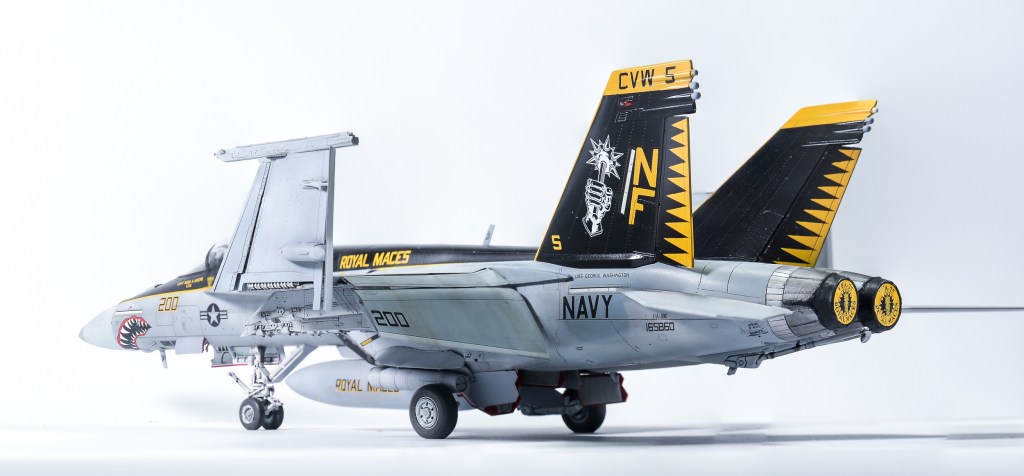
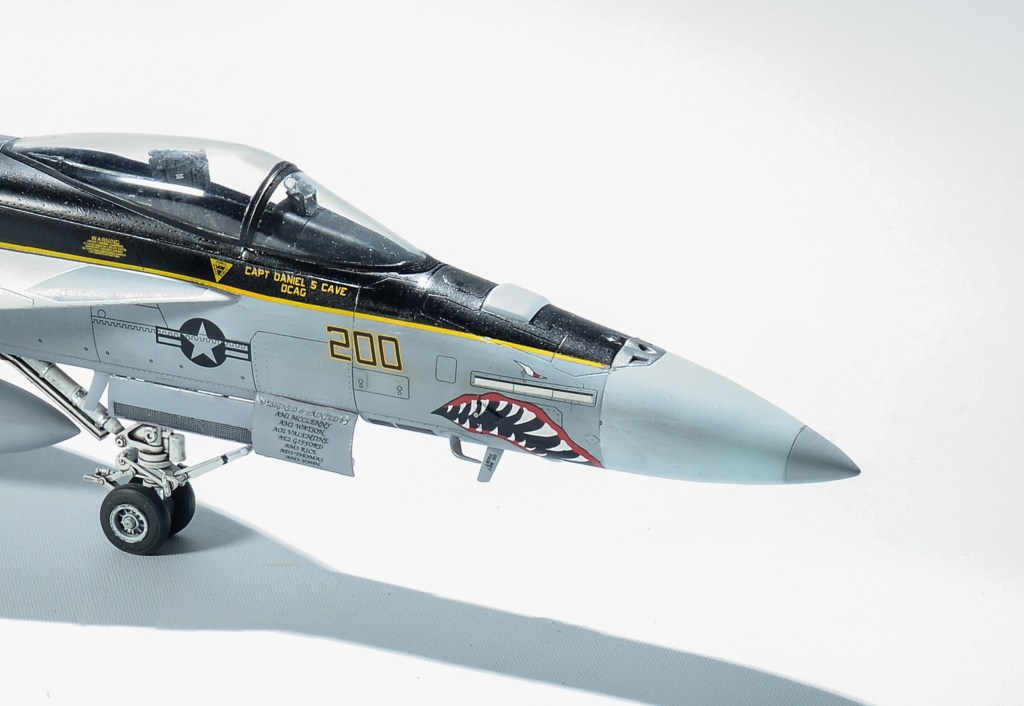
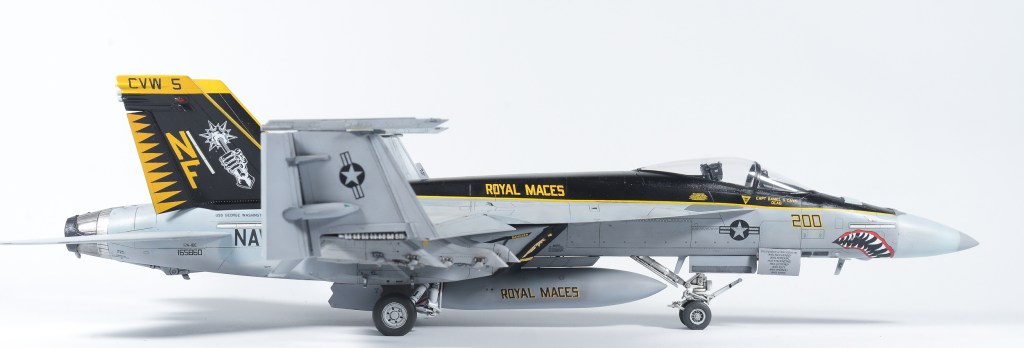
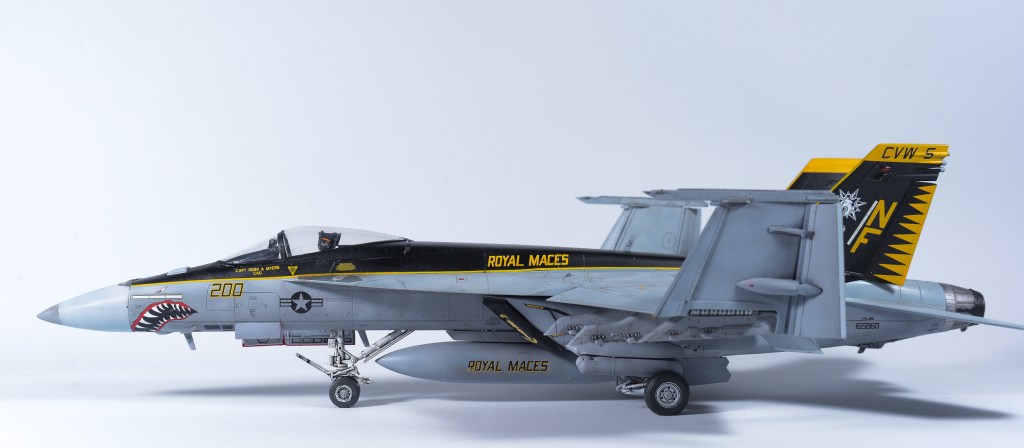
Boeing F-18E Super Hornet. VFA27 Royal Maces. U.S. Navy

USS George Washington 2010.

Please excuse the photography. I was having all sorts of issues getting my speedlights to slave to the camera.

Leave a comment

Hasegawa 1/48 Nakajima Ki44 Tojo

  • Added to stash: 2022
  • Built: 2022
  • Enhancements: Seat belts- Eduard
  • Decals: Combination of kit and home made masks

There is not really much to say about the construction off this kit at all, it being virtually viceless

The model was purchased off Facebook along with the hasegawa Val, both fine examples of Hasegawa single engined Japanese WW2 aircraft dating from the early 2000s. Kits that have pretty much stood the test of time well, although some of the details could now be considered a bit clunky.

The only tweak made to the model was to insert a spreader bar of plastic to eliminate a wing root gap.

Aside from this, assembly was trouble free. The model was assembled with super glue in an effort to avoid ghost seams. The fact I still experienced some has left me on the fence about assembling kits with superglue. Certainly with this kit, it led to no advantage.

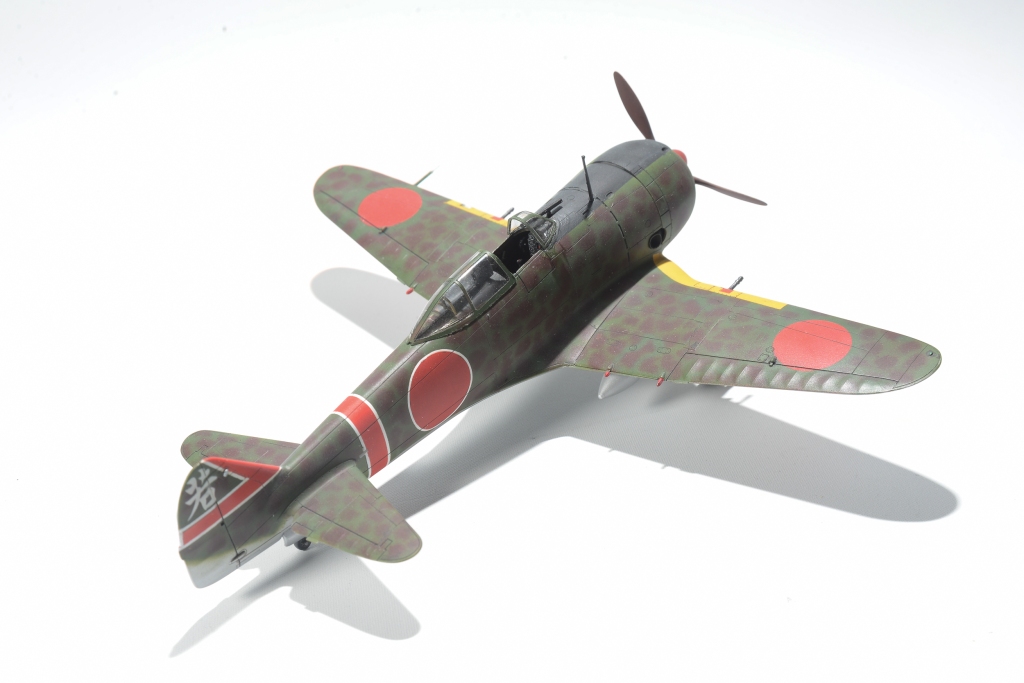
The intent behind this model was purely as a fun build and to test my airbrush skills whilst I waited for resin bits to arrive for my Meng Super Hornet build. As such, only PE seatbelts were added and I left it as a clean unweathered build. Given the simple shapes of the markings, the opportunity was taken to further learn how to use my silhouette machine. The decal sheet was scanned and the required decals traced out and cut from Oromask 810. This is certainly getting easier, the more I use the machine and software.

Undersides were painted in tamiya LP11 whilst upper surfaces were done using Mr Color nakajima green and a mix of tamiya acrylics to match the gunze colour “propeller colour” which is a dark brown. It took me two goes with my Iwata HP-C, the first being stripped back as the mottle did not look dense enough compared to the kit paint guide.

Yellow ID bands were gunze yellow with a bit of red added. Lastly the black anti glare panel was added before all the bits such as undercarriage, doors, tanks were glued on. Well, not all bits, the telescope sight managed to end up in that alternate universe a lot of plastic kit parts end up in. This necessitated a new one being made from some plastic rod and the windscreen being levered off to fit it. I never managed to get a clean fit on the windscreen again, so left it slightly wonky.

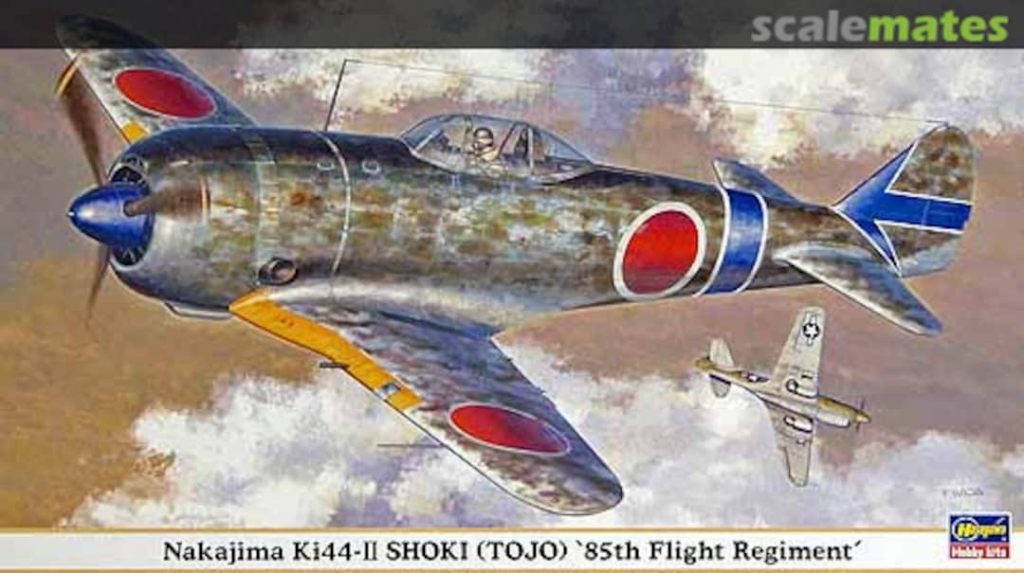
The Hasegawa Tojo was a fun little build. I didn’t get it done in the last week of my holidays as planned due to coming down with Covid, and its certainly not my best work, I mean look at that windscreen for gods sake! As a break from larger and more complicated builds though, it certainly was the required tonic. The big brother of this kit lives in my stash, and I wouldn’t mind doing this one in the box scheme from this kit with those striking blue bands.

Nakajima Ki44-II “tojo” 2nd Company 85th Flight Reg.

Imperial Japanese Army. China 1944

Leave a comment

Fly Models 1/32 Hawker Hurricane llD

  • Built: 2022
  • Added to stash: 2017
  • Enhancements:
  • Instrument panel-Yahu
  • Seatbelts-HGW
  • Decals: all insignia painted on using kit scheme as templates. Stencils-1 man Army

“I can’t see any more Fly kits in my future”

My love for this particular mark of Hurricane dates back to the mid 70s when the owner of a Perth W.A hobby shop I frequented showed me his rendition of the ancient Monogram 48 scale kit.

It is still clear in my mind (yet I cant remember what I did last week!) as he had added the exhaust streaks and some scuffing around the wing roots. All the raised rivets had been dry brushed and there was not a seam or silvered decal anywhere. At the time I had no idea kits could be made to this standard, where did the seams go, and why were there no brush strokes!!!!

This stalwart of early British fighters, though has sadly been ignored by the main manufacturers when it comes to 32 scale.

There was a early kit released by Revell in the lates 60s, which remained the only game in town until Pacific Coast Models and then Fly released their non mainstream kits.

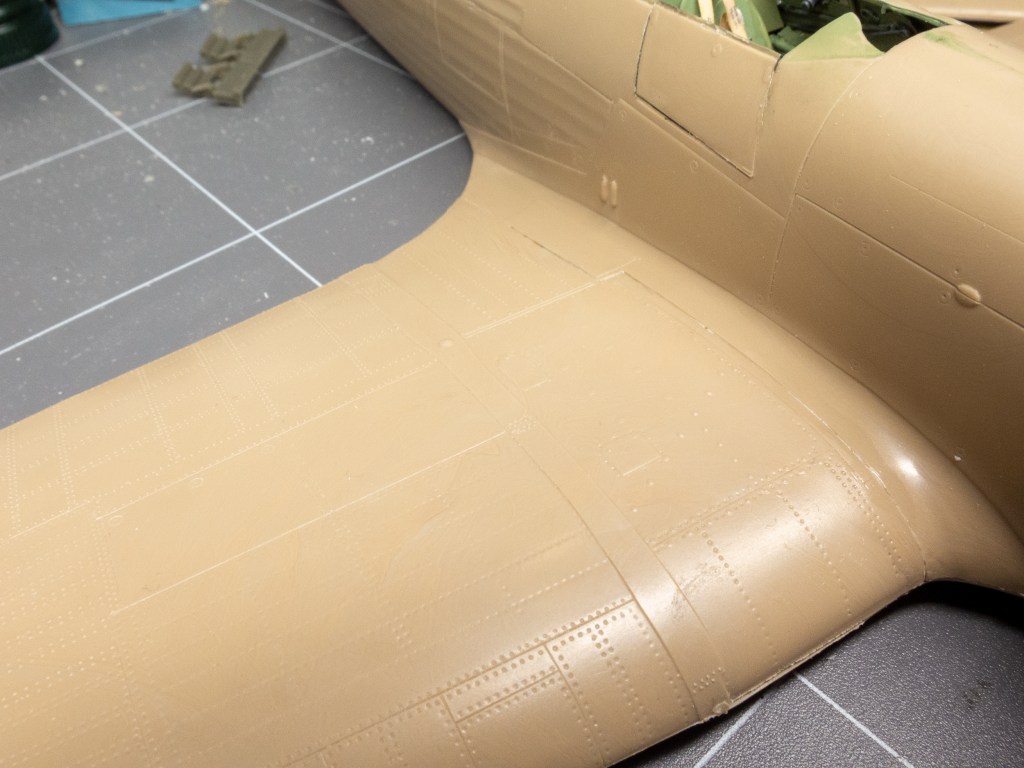
As a “lo-fi” kit, I think the Fly Models Hurricane rates above the Pacific Coast kit from what I can remember of my PCM kit before I sold it. Out of the box, the Fly kit boasts sublime surface detail on the wings in the form of raised rivets. The fabric effect on the fuselage is not overdone, there are recessed rivets on the leading edge which means it will be easy to reinstate these following sanding and filling sessions. All this complimented by some nice resin and photo etched details. Not mentioned in the instructions, there are also parts to make a MkIV out of the box, with the armoured radiator and (crude) rockets, rails, blast plates and drop tanks being included. These parts will find a new home in my spares box.

There are surprisingly few parts for a 32 scale model, but construction certainly was not simple. Not helping in this was the instruction booklet. There detail on illustrated parts in some cases not matching the detail on the actual parts in some cases. The seat adjustment handle, bulletproof glass, and armoured rear cockpit bulkhead being some examples.

I would advise washing the sprues in soapy water before assembly. Usually I would not do this but found on this particular model, my Tamiya extra thin just did not grab like it does on other plastic. I can only assume this was due to some contaminenat on the plastic, although they did not feel greasy.

The cockpit “cage” was frustrating to clean up and get square, again not aided by vague instructions. I used the compass face included in the Yahu set. Fly would have you glue the seat adjustment lever to the wrong side of the seat, they also have you incorrectly have the seat harness attaching to the rear of the seat. It should in fact run through a slot in the armour plate. Despite the diagram showing an armour plate detailed with bolt heads the PE item in the kit is featureless. I added punched plastic card discs, although mine are overscale. The control column likewise is not the detailed item shown in the instructions but a rather featureless plastic part. I wrapped fine wire around the spade grip. The super detailers amounts you could also add the chain running from the pulley mounted on the column .

The fuselage went together without too much drama, well apart from a seam on the cowling that just would not disappear despite numerous sanding sessions. In the end I scribed a trench along it then filled it with superglue and sanded it down. That did the trick.

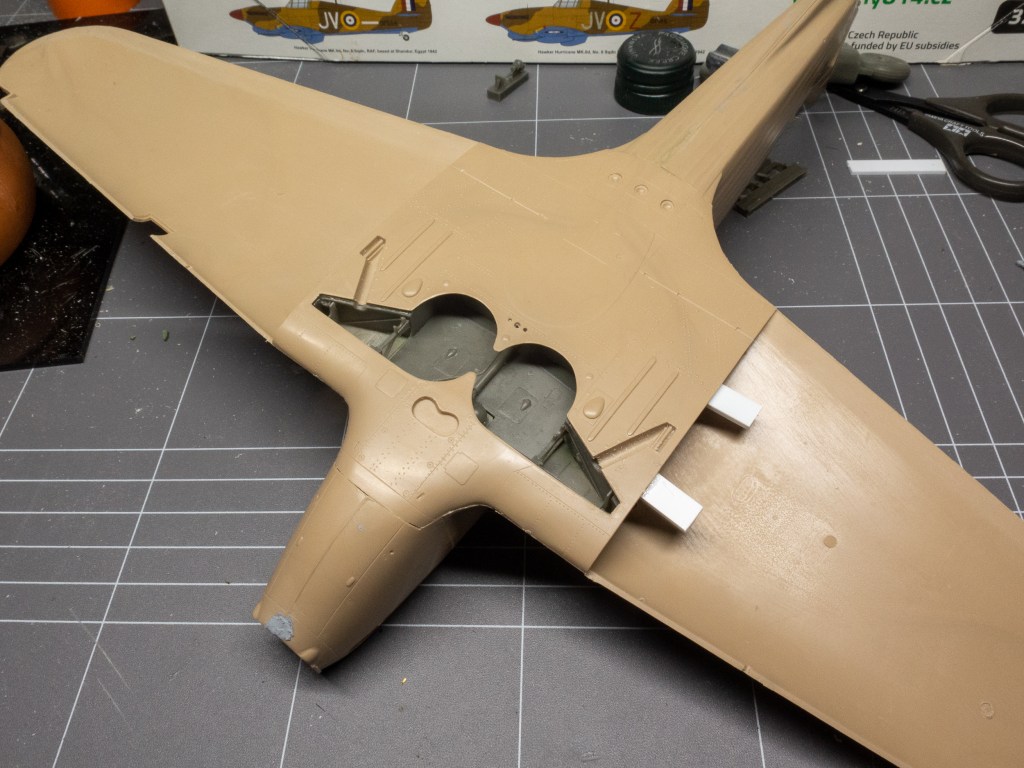
If there is one trick to this kit, it is ensuring that you remove COMPLETELY, the casting block on the wheel well roof. My dremel got this job. When I had finished, in some areas the roof was that thin it was almost transparent!

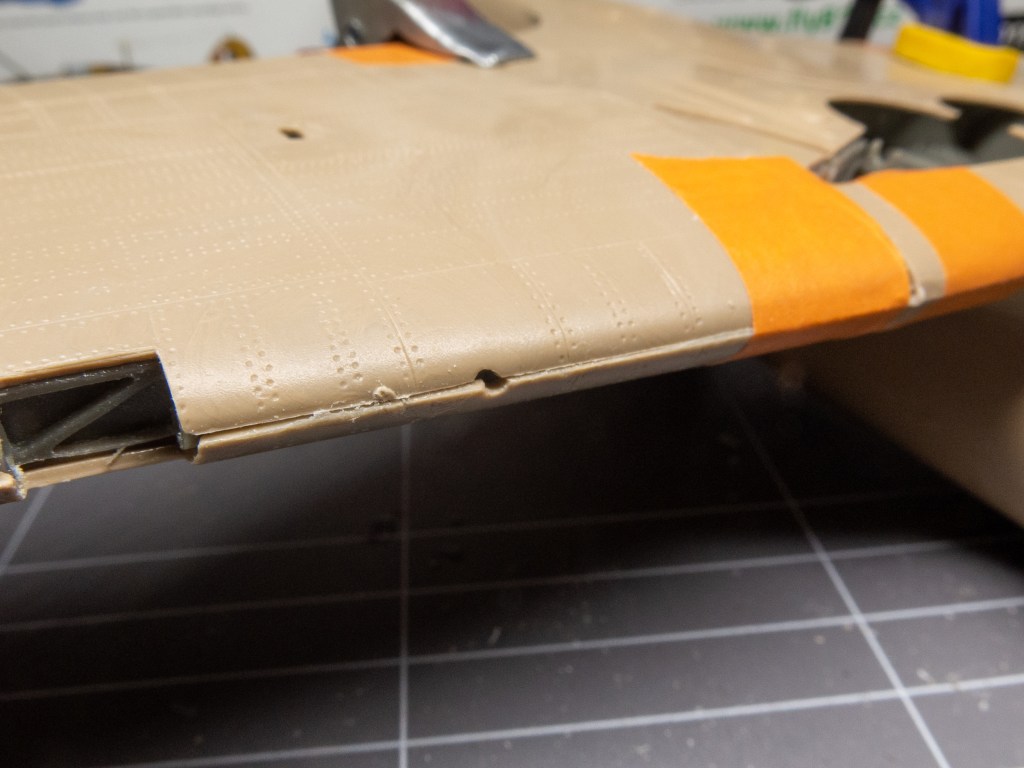
Get this right, and assembly is reasonably straight forward, with the wing centre section fitting to the fuselage reasonably well. I chose to add plastic card tabs to the various wing sections to aid assembly. You want to avoid steps at all costs, sanding will destroy all that lovely raised detail.. To this end I chose to add the top halves of the wings to the wing roots as I wanted a clean join here. This meant, on my kit I had a step on the leading edges, but figured any detail destroyed here would be easier to re instate than the raised rivets around the wing root.

The landing light as a consequence also was not the best fit. Superglue came to the rescue. The tailplanes also required filler along their roots as did almost every trailing edge. No razor sharp trailing edges on this Hurricane!

Fly would have you add three recognition lights underneath. Wartime aircraft seem tp have only the centre one fitted based on photos I looked at, so the two outer lenses were glued in place then faired over with putty. Whilst we are on the bottom of the machine, of you are going to add the pulldown footstep, don’t forget it is linked to the handhold to the rear of the cockpit, so this should also be cut out and the inward folding cover added. I didn’t bother so I won’t add the step either.

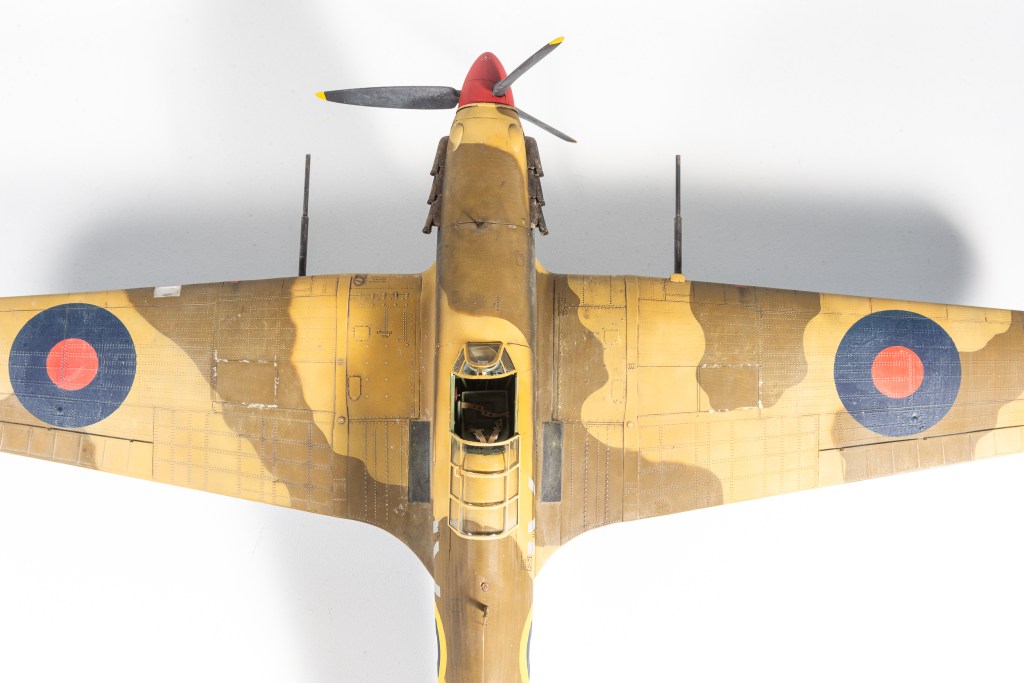
The model required several sessions of priming, and then remedial sanding and filling to smooth over several areas. The underside could then be preshaded in SMS PRU Blue before the final colour using SMS Azure Blue. A marbled coat was then applied using lightened Azure Blue. Staying with the undersides, the wheelwells were painted silver and the underside roundels painted using Montex masks from their A type roundel set. Whilst masking the underside demarcation line, something was not looking right. My theory is Fly have engraved the bottom lines of the side cowlings too low. They should be higher up the fuselage sides which would make the bottom cowling also wider as it looks a bit too narrow. I have not compared this to any plans, just eyeballing photos. I probably should have filled and re engraved the lines, but I was on a roll now and not wanting to slow my progress.

Uppersurfaces were painted with SMS Mid Stone and SMS Dark Earth. The SMS rendition of Dark Earth looks a little too dark too me, but it does complement the mid stone nicely. Lightened mixes of each colour were applied in random streaks and mottles, with the fabric rear and control surfaces being painted in paler still shades of the basic colours to represent the different way these would have faded from the metal areas.

Masks for the codes and serials were cut by a mate. Thanks Calum. The roundels again are from Montex masks as was the fin flash. Artillery Models actually sell the decal sheets from each boxing as masks, but don’t waste your money. They are made from a very light tack transparent frisket, and just do not easily transfer from the sheet or even stick to the model.

What is worth the money (well maybe not, as they are very expensive, are the set of stencils from One Man Army out of Belgium. These are masks which you can spray all the stencils through, rather than using decals or dry transfers. Some of these stencils such as the No Step markings are tiny, but the masks are very sharply cut. I was most impressed and will be investing in more of their sets. they can be re used so my set will be re used on Revells forthcoming new tool Hurricane. TIP: buy from Hannants as even with postage to Australia, they are still cheaper than BNA have them for.

Chipping was added using Vallejo white grey and then the whole model sprayed with tamiya semi gloss varnish ready for washes and further weathering to be applied.

For this model, the oil dot filter process was used. Small dots of white, buff and yellow oil paint was applied to the top surfaces and scrubbed in with an old brush. This had the effect of bleaching the upper surfaces. Im not sure Im really happy with the effect although it does give a sun faced effect to the model.

The Artillery Models vac form canopy was cut out and fitted as the kit plastic canopy did not fit over the spine of the aircraft and sat high. Reskit wheels were purchased but they look to be significantly undersized. Looking at photo I think the kit supplied resin wheels are more correct, but their hubs are way too small.

I found the undercarriage difficult to fit as it does not locate positively within the wheelwell. The tailwheel was ri enforced with a bit of brass tubing as I did not trust the kit plastic.

Lastly the kit gun barrels were replaced with brass tubing although I think mine are fairly anaemic looking for 40mm weapons. I may revisit these later.

Conclusion

The Fly Hurricane kit is one Ive been wanting to make for a while, purely as I love the aeroplane, but it certainly tested me, to the point Ive sold the other Fly Hurricane kits I had in the stash. They are just not an enjoyable build experience.

Having this model on the shelf takes me many years back, to a young boy,, standing at the counter of that upstairs Hay St. Mall hobby shop gazing in awe at another hurricane in desert camouflage. And for that reason alone this rates as one of my favourite builds so far.

Hawker Hurricane Mk.IID. 6 SQN Royal Air Force.

Shandur. Egypt 1942

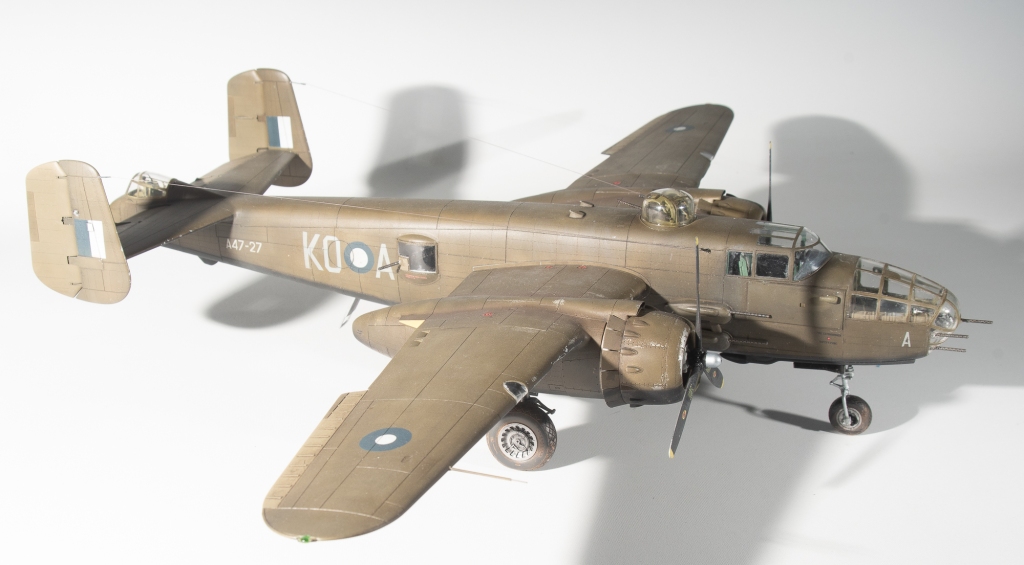
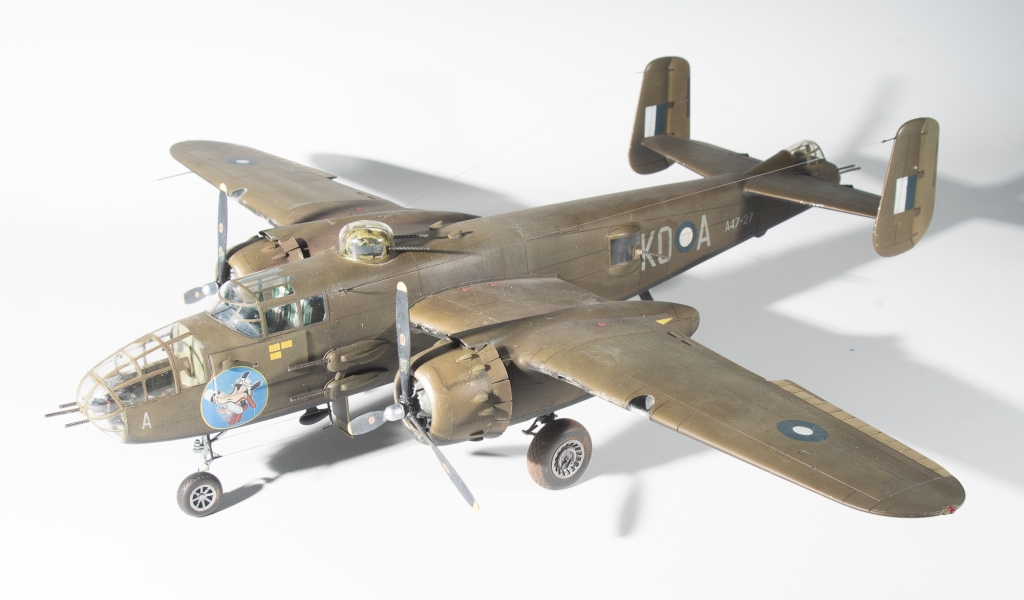
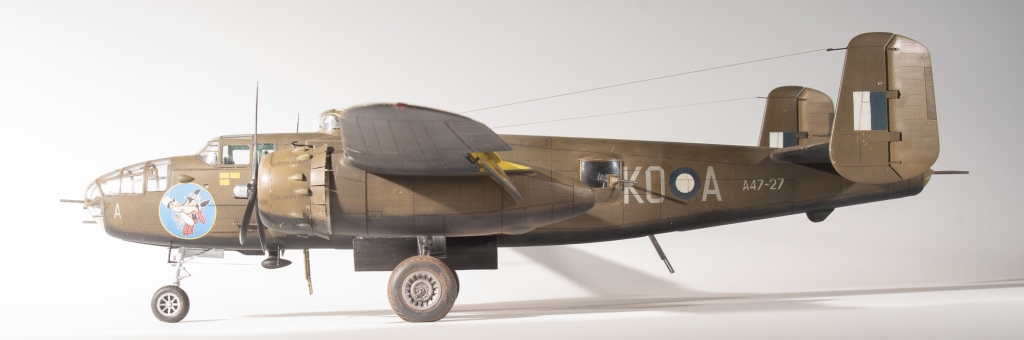
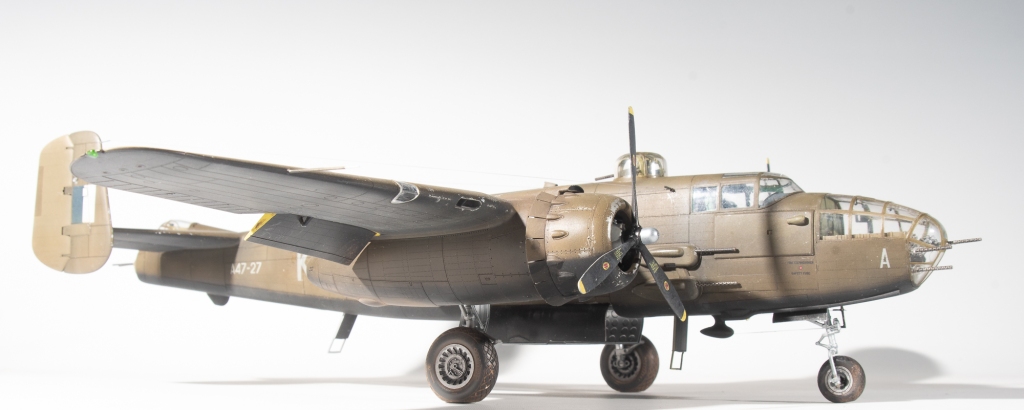
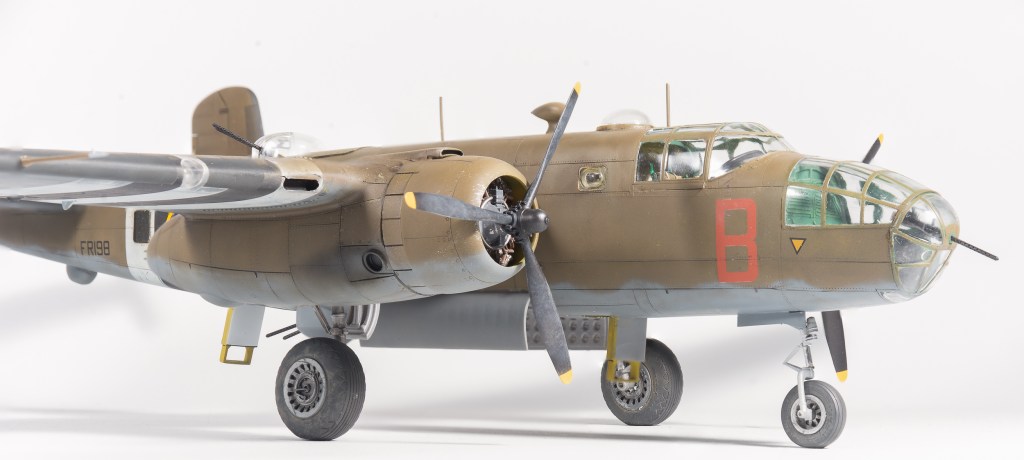
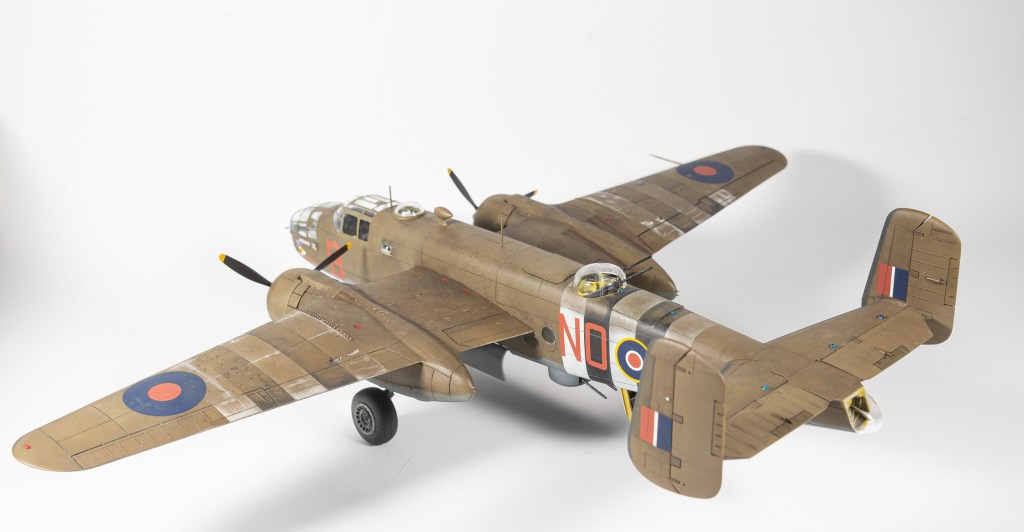
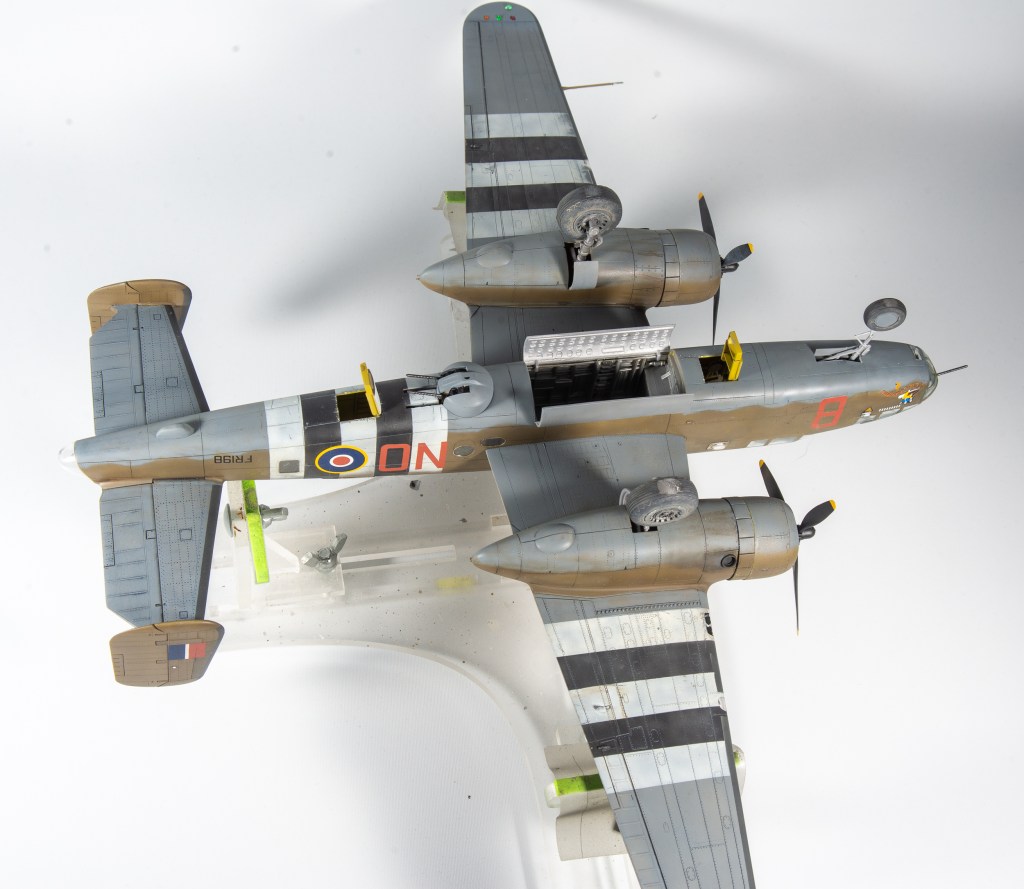
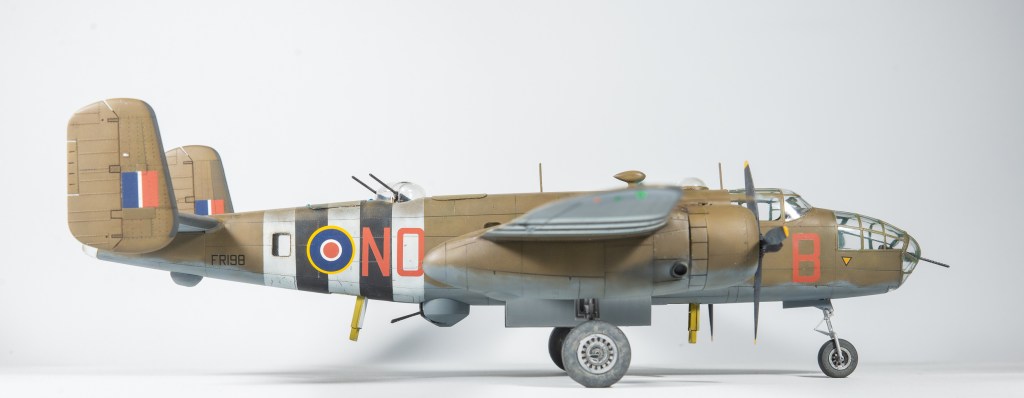
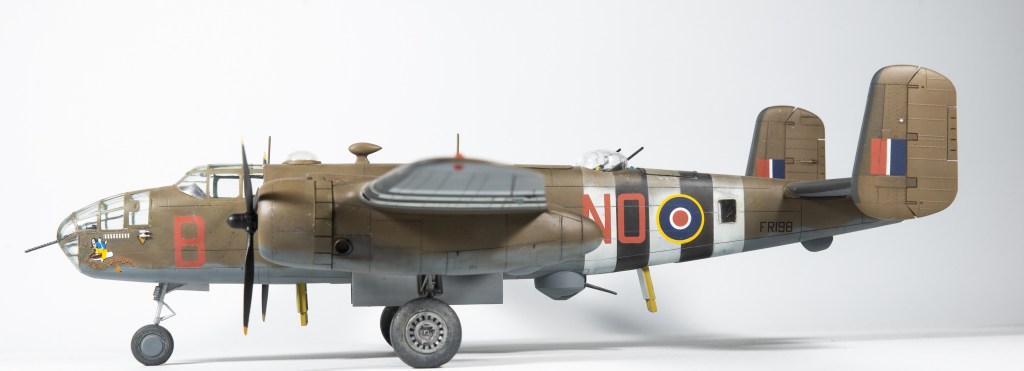
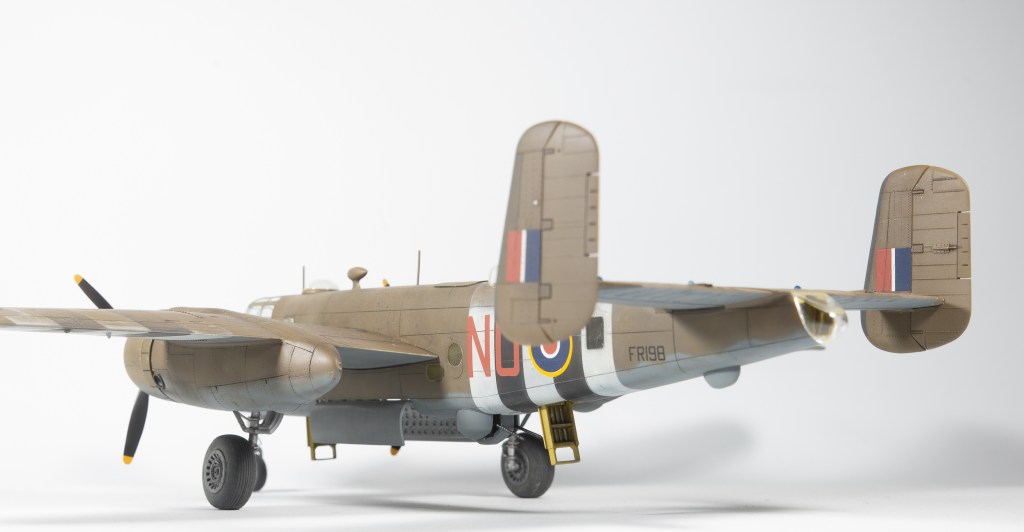
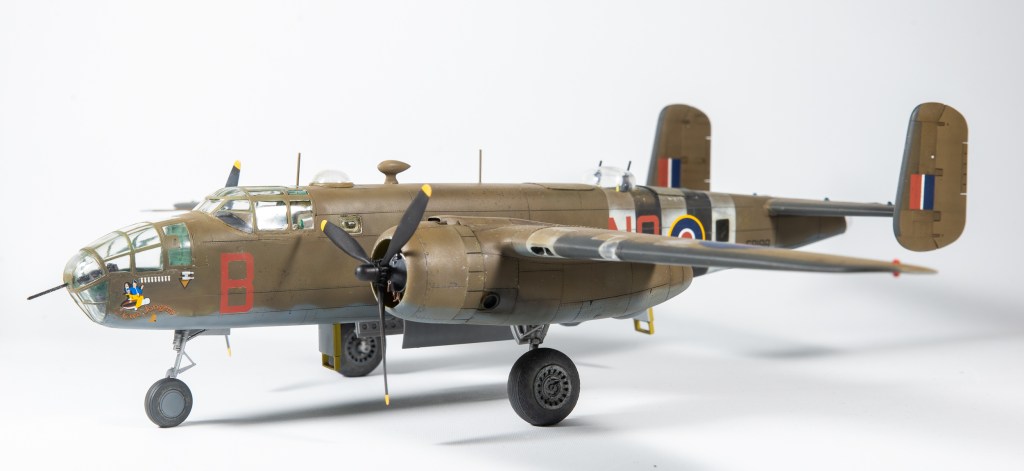
Accurate Miniatures 1/48 B-25C/D Mitchell

  • Completed: 2022
  • Enhancements;
  • Wheels-Reskit
  • Machine gun barrels-Master Model
  • Decals: Eagle-cals Dutch Mitchells
  • Formation lights– CMK
  • Seats-Quickboost

This is the second time I have tackled the AM Mitchell, the first one ending up in the bin, having never got to the painting stage, so Im very happy to final have a completed AM Mitchell in the cabinet, albeit not the first Mitchell to grace my shelves, having built the old Monogram B-25J about two decades ago.

My memories at the time of the A.M Michell was its fine engraved surface detail comprising rivets and panel lines plus fasteners, and its detailed interior, both features which garnered it praise in the modelling press at the time of its release. Critiques were too narrow cowl openings and a nose transparency which perhaps sloped too much in profile

Fast forward to this year and a third of the way into the build, my over riding thought was “this aint as good a kit as I remember”

The surface detail was in places shallow, rivets and panel lines were definitely not consistent in depth, fit was average, especially the nacelles and intakes, and transparencies were certainly not crystal clear.

The instructions I remembered being clear and informative did not really point out location points of some parts accurately, leaving the builder to guess on a couple of occasions. That said enough alternative parts are included to build a few different modifications of the B-25C/D Mitchell. The instructions helpfully pointing these out for the kit schemes. If you are doing another scheme though, as I was, you’re best off consulting images.

Construction Notes

I pretty much left the interior in the aft fuselage out as you will never see it. The kit pilot seats looked a little chunky, so were replaced with the quick boost resin seats, complete with belts. Rather than painting the rear interior yellow Zinc Chromate, I think I should have used a green chromate. The first hint of fit problems came with fitting the bomb bay, the rear bulkhead not matching the contour of the fuselage at all. A not insignificant gap had to be filled with thick plastic strip. This being an original A.M boxing, the brass shim nose weights were included, these being augmented with some small lead shot poured into a couple of crevices. This precaution proving its worth with the completed model still only just balancing on all three points.

Blast panels in front of and behind the upper turret were cut from thin card on my silhouette machine using the templates printed on the instructions. I still think they are a little oversized though. The ventral turret and guns were a sloppy fit, the soft plastic not helping, the glue join breaking several times. In the end I replaced the kit gun breeches with blocks of plastic strip drilled to take the brass barrels, this being a lot more solid.

The real fight came with the wings though. Whilst the nacelles were a reasonable fit to the undersides, they left large gaps and steps on the top of the wing, with the separate carberetter intakes not helping. These parts required multiple goes at filing, sanding and re-scribing. Just when I thought I was winning, I noticed plastic on the undersides of one of the wings seemed to be delaminating, sure enough, I could peel up flakes of plastic. More supergluing, sanding and re-scribing followed. The plastic in my kit ws soft, almost soapy, which led to me managing to also break one of the wing spars, and nose wheel leg off It didn’t so much snap off as just bend and break during my repeated handling of the fuselage. The nose strut was rebuilt with brass tubing. The instructions call for it to be added prior to the fuselage halves being closed up, the narrow wheel well not allowing it to be added later.

The tail plane assembly fit reasonable well, certainly not as bad as some other online modellers seemed to find, putty was still needed though, but only a smear. The leading edge landing light covers also required a fair bit of fairing in. The separate nose part also came in for some judicious sanding on one side to remove a slight step.

The kit wingtip lights and upper fuselage formation lights were all removed and holes drilled to accept aftermarket CMK lights, although these were the last items added. The kit cowlings were opened out slightly by wrapping sandpaper around an appropriately sized bit of dowel. They do not need much sanding to look a little better. I had a set of quick boost engines which look far better than the kit engines, but they need pushrods and ignition wiring adding and I was losing patience with the build, so used the kit engines after all. If you do use the kit engines, you will need to remove a section of the attachment collar, otherwise the crankcases protrude proud of the cowling face. There is a faint scribed line around the collar, which I used as a cut line.

After an uneasy ride, we had arrived at the painting stage

Paint and Decalling

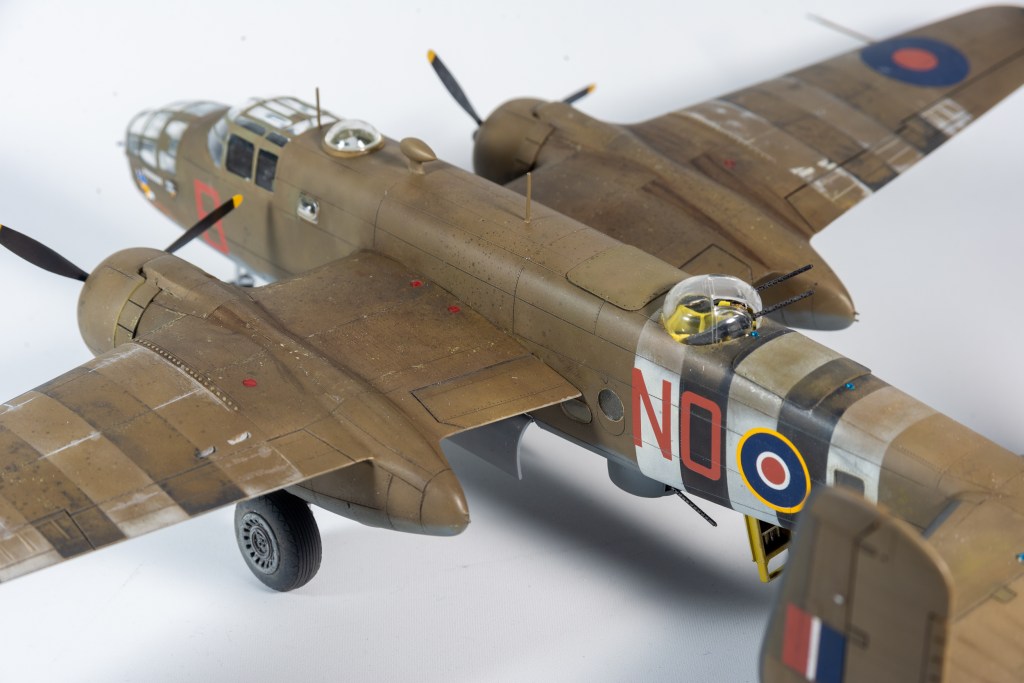
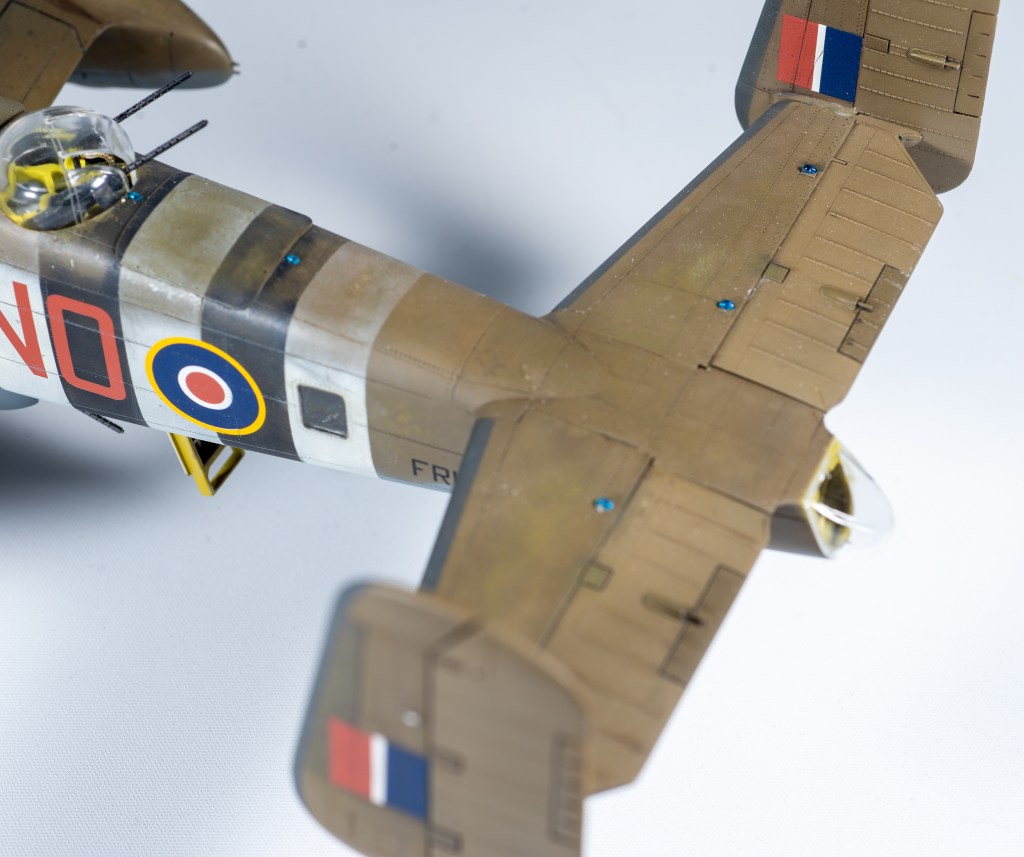
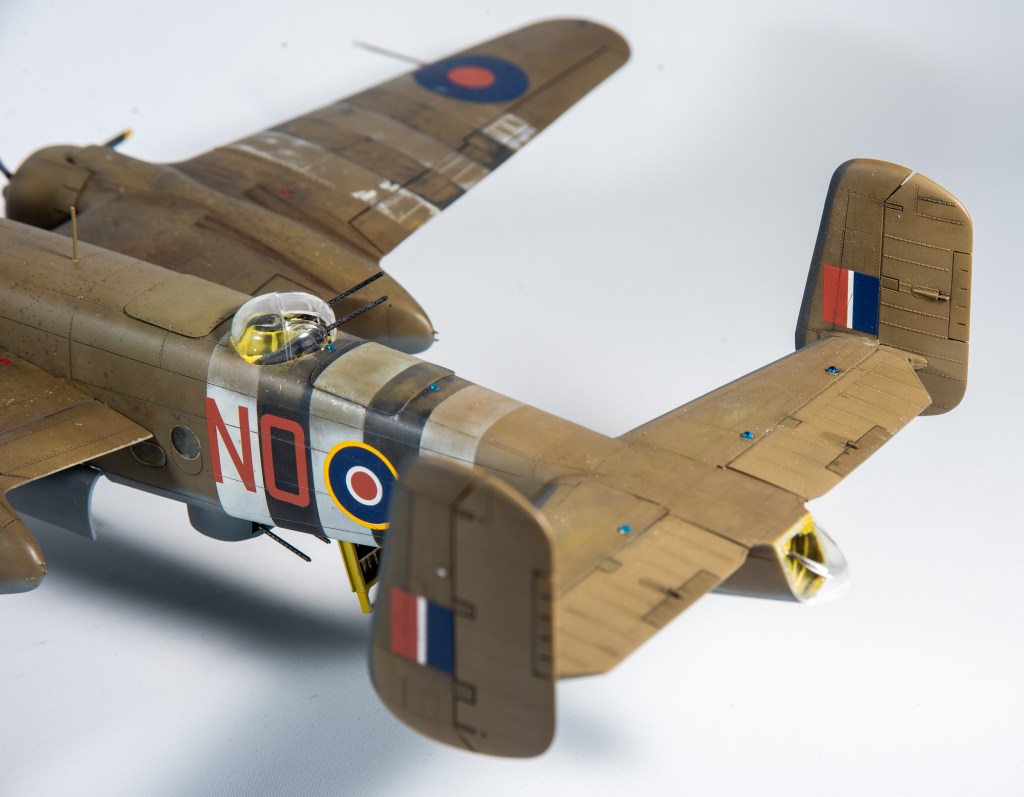
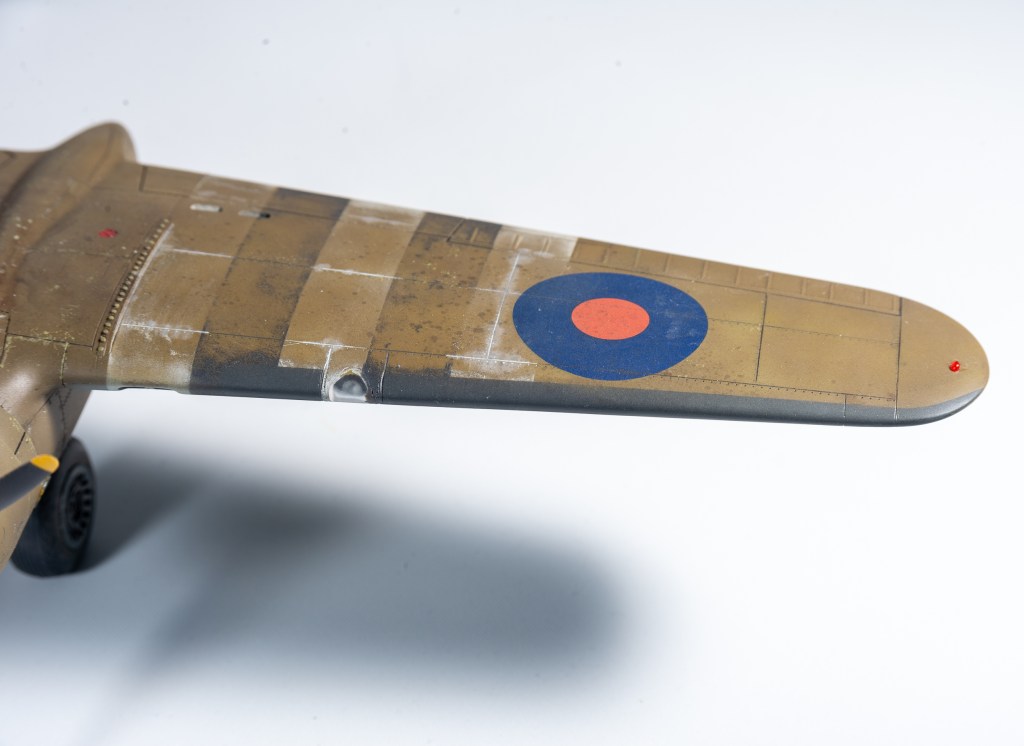
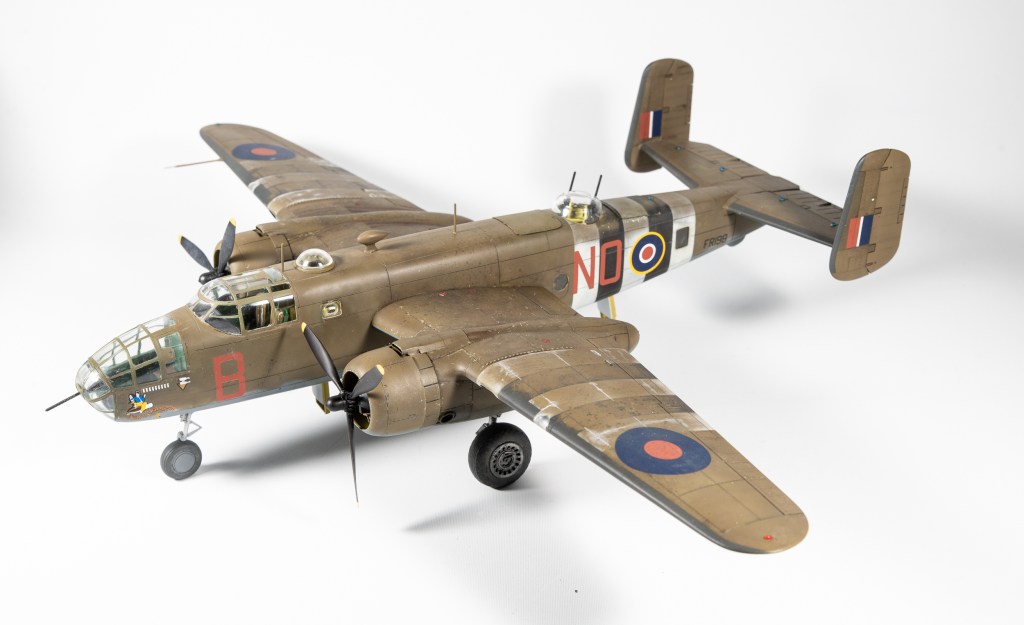
Right from the start, This was going to be finished as a R.A.F 2Tactical Air Force machine with D Day stripes. Two decal sheets from my decal bank contained such subjects, one from Dutch Decals and a much better quality item in terms of colour and printing from Eagle Cals. the plan was in place……until I saw a 2TAF Mitchell on Britmodeller forum that the builder had portrayed with the upper surface stripes removed leaving just traces. I loved the look, and although it was a different SQN we know for a fact that all aircraft had their upper stripes removed by August 1944, although some Mitchells had them reinstated to guard against friendly fire. How to paint traces of D Day stripes though, I considered applying super thin paint, hairspray chipping, micromeshing before deciding on using water soluble Mission Model paints for the stripes. But this is leaping forward many steps. First the basic colours were applied using MRP Neutral grey for the undersides and Mr Color Olive Drab for the upper surfaces. This was then mottled and streaked with the OD tinted with flesh, then tamiya Khaki Drab, and finally Desert yellow in order to build up a multi layered variated Olive Drab colour. Fresh OD was then used for a few select panels to mimic replacement panels.

D Day stripes were then masked out and applied with thin coats of MMP thinned with water. Just like in real life the top stripes were then scrubbed off with a stiff brush moistened with water. Not happy with the first attempt which looked too symmetrical from side to side, I resprayed the stripes before, again scrubbing them off, this time aiming for a fa more irregular look. I left some remnants around panel lines and raised detail. This second attempt looked far better. An overall wash using Mig Dark wash was then applied to the upper surfaces with ABt 502 Paynes Grey being used on the lower neutral grey. I found Abts version of Paynes Grey far bluer than other Paynes Greys I have used, nothing alarming just something to be aware of.

Decals were then applied, the decals, being printed by Microscale , going down fine. Eaglecal providing photos of the actual machine in the instructions. Upon studying these, I realised I had added the flat window instead of the astrodome, and also my chosen machine had the fixed 50 calibre gun in the nose as well as the flex .50. What did I say about studying photos? I need to take my own advice! The spine window came out reasonably easily and was replaced with the astrodome. I decided to leave the nose armament alone, as I could see damage arising with any attempt to remove the nose transparency.

Several thin coats of Dullcote were then applied to get a dead matt finish, before oil leaks were added with several applications of……oil paint! Raw umber mixed with black and starry filth were the colours of choice. One engine had marked breaking to represent a damaged or severely leaking engine.

The transparencies were then unmasked to reveal a stain or crack in one pane of the cockpit. There was no option but to remove it and add the alternative cockpit canopy. As luck would have it, this was the canopy that should have been used in the first place, having the additional framing evident in the photo.

The soft plastic kit aerial posts were replaced with brass wire. The last wall hurdle thrown at me came when I noticed that somehow one of the small dutch orange triangles had superimposed itself over the nose art, I wondered where that triangle had gone!. naturally I managed to tear half the nose art off trying to remove it necessitating ordering a new set of decals from Ultracast in Canada. SIGH!

Whilst the Dutch Decals decal set also carried the same nose art, it was nowhere near as sharp as the Eagle cal sheet. This just left the bomb doors, undercarriage doors and wheels to be added, and she was done.

Im pretty happy to finally have a completed Accurate Miniatures R.A.F B-25 in my cabinet, even if the kit was a chore to build. Like my revell tornadoes, the experience of this build led me to sell all other A.M Mitchells in the stash. One is enough!

The A.M kit has not aged well, and is another of those kits that could do with a new modern tooling, although Im not sure who this would come from, perhaps HKM will downscale their 32 scale J model. The only manufacturer I see doing new tool twins these days would be I.C.M and they may well take years getting back on their feet following Russia’s inhumane invasion

North American B-25 Mitchell II. 320 SQN Royal Air Force.

Belgium 1944

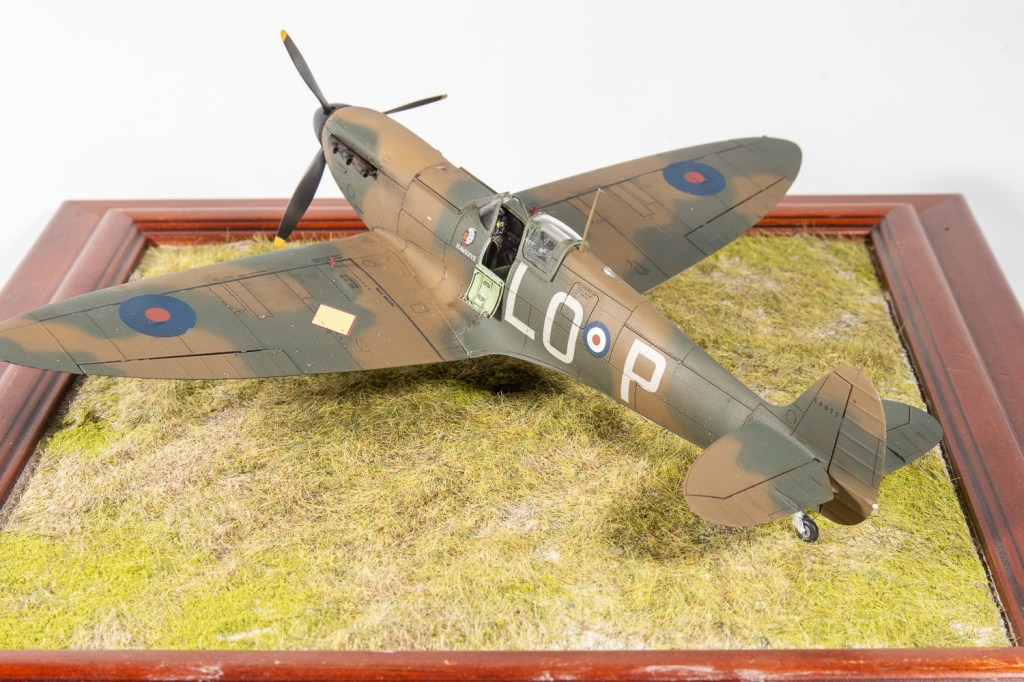
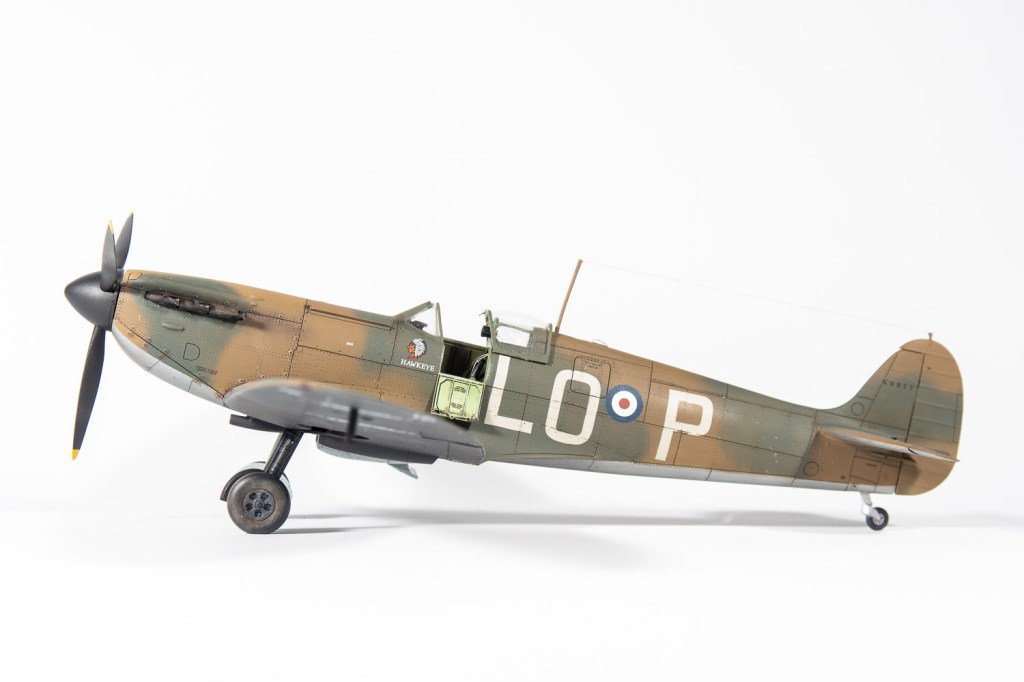
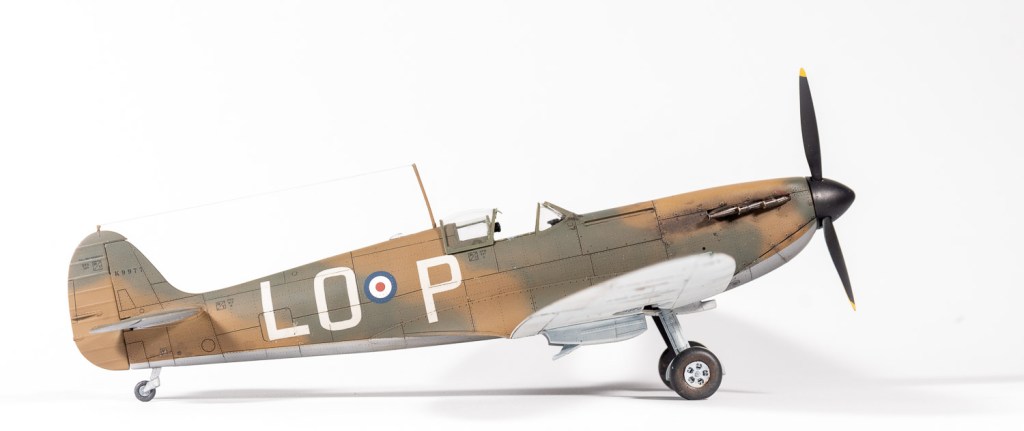
Eduard 1/48 Spitfire Mk1

  • Built: 2022
  • Added to stash: 2021
  • Enhancements: None
  • Decals: Fundekals, Early War Spitfires Part 2

This is my second build of Eduard’s spitfire, and I found the experience as enjoyable as the first.

Upon examination of the parts the first thing the jumps out at you is the extensive surface detail Eduard’s mould makers have lavished on this kit. The empennage is covered in fine raised rivets whilst the wing rivets are recessed.

Careful study of the instructions and sprues reveals that Eduard have included parts to make any spitfire from the first production machines up to mid 1940 machines. There are unarmored and armoured windscreens, various separate armour plates and gunsights plus seats. Useful to understand all these differences was Wingleaders photo archive on the Spitfire Mk1. The Few boxing allows one to build two Spitfires, one with the later armoured fuel tank and one without, although this was not immediately apparent to me. It was only after careful study of the Wingleader book and the Fundekal instructions that I understood the various differences that I was looking at in photos. That Eduard has included all these optional parts shows how thoroughly they researched the aircraft.

Its a shame they did not include the later undercarriage selection lever as that would then allow you to build any spitfire up to the end of the Battle of Britain, although the later selection lever looks easy enough to scratchbuild, or you could just buy the Tamiya Mk 1. My research unearthed the electric undercarriage selector appeared around the 600th or February 1940 build machines. I could not find a definitive answer.

For this build, I deviated from the instructions a bit in that the cockpit sidewalls were added to the fuselage sides before being painted. The floor, complete with stick, rudder pedals and seat was treated as a separate subassembly. As were the various bulkheads, the rear bulkheads having their lightening holes drilled out. This method made it harder to get a paintbrush to all the little detail areas, and for the second build, the instructions were followed to the letter, which resulted in details being easier to reach with the paintbrush. The cockpit colour used for this build was a coat of SMS RAF interior green with the sidewalls washed with Mig Dark Wash.

With the cockpit completed, the rest of the build proceeds quite quickly. Ensure all mating surfaces of the wheel well parts are sanded at the correct angles to lessen gaps between the parts . Eduard, I feel could have made the fit of the sockets that accept the landing gear legs far more positive. Be careful ensuring you locate these carefully into parts xxx . Any misalignment here will affect the sit of the model later.

I had some gaps at the wing roots that I thought I could close up by running tape spanwise from wingtip to wingtip. While this did close up the gaps, it also introduced other problems such as too great a dihedral and led to some alignment issues. I won’t be doing that again!

A smear of filler was needed around the stabilisers, and we were ready for paint. For this model I had decided to use some Mission Models Paint I had previously purchased. Reading up on peoples experience with this paint revealed modellers have a love hate relationship with it, but if modellers of the stature of Mike Rinaldi swear by it, it can’t be that bad, surely ?

Whilst I managed to get the paint down OK, I had great difficulty getting a fine line with the dark green, despite following MMPs mixing ratios and advised spraying pressure. The paint is also a little fragile with it lifting in several spots. A Peter on my FB page suggested thinning it with future with I will try on my next Spitfire build. The undersides were finished in Tamiya lacquers as per my usual practice.

Like MMP , Eduard’s decals also seem to have polarised modellers. For this build, only their stencils were used. Over a gloss coat, they were applied on little pools of Mr Setter, with the excess being wicked away with a cotton bud. Left to set overnight, I found I could peel away the carrier film off some of the larger designs like the trestle markings and gas patch, without tearing the decal.

The code letters and roundels came from the fundekals sheets and performed absolutely flawlessly, even over the raised rivets on the fuselage. The unusually sized roundel appealed to me, and I wanted to represent a Spitfire from The Phony War period during which the R.A.Fs markings were rapidly evolving.

I should have mentioned prior to laying down the camouflage colours, black was airbrushed along the wings, then masked off to portray the wing walk lines.

Final assembly saw the wheels, propeller resin exhausts and aerial pole mounted, the antenna wire from infinity rigging wire, which despite my best efforts, still bent under the elasticity of the infini thread. I’ll replace the kit part with some brass rod on my next build.

Eduard’s spitfire was a very enjoyable build. To my mind though, the kit contains some unnecessary complications, the undercarriage sockets being one. Fit was for the most part good, with a slight smear being needed on the taipan roots, and most reviewers stating the wing root fit also leaves a slight gap. Ima already working on the second kit from the box and have added the Vb dual boxing to the stash.

Supermarine Spitfire Mk 1. Royal Air Force Drem Scotland Jan. 1940

2021 Build Year

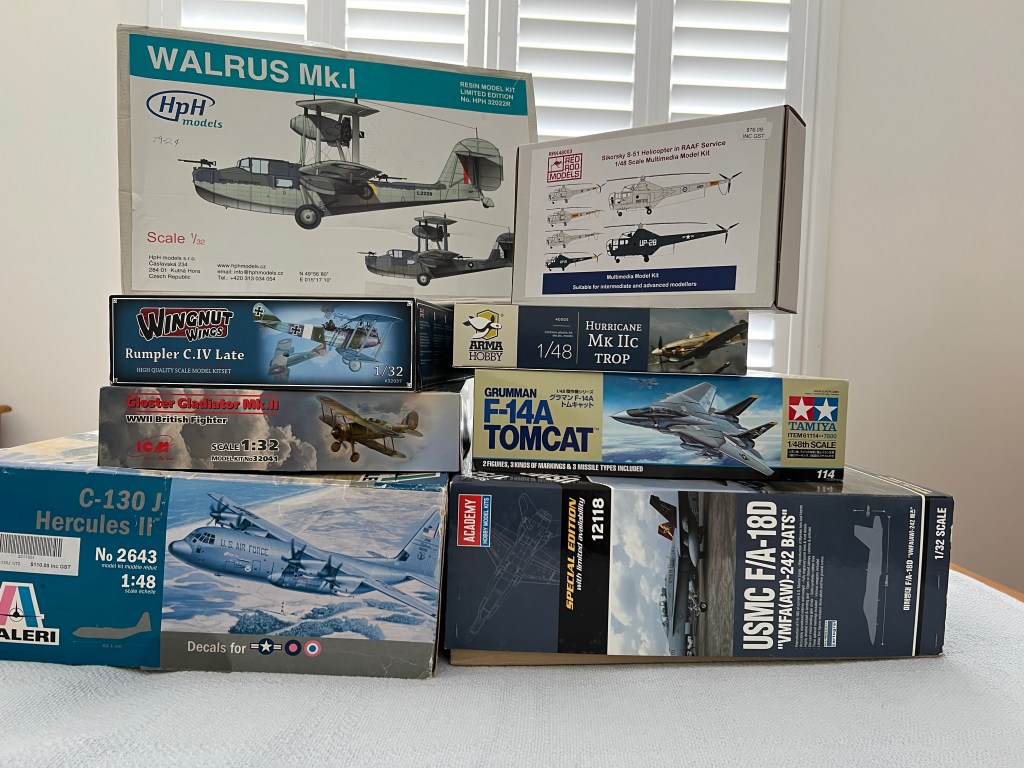
For 2021 , I went to my modelling mates and asked them to select a number from 1 to 241 which is the number of kits in the stash.

Each chosen number was then matched to a particular kit in my spreadsheet.

The selected kits were pulled from the shelves. Leaving me with the below selected kits. The phantom was my wildcard choice!

Selected builds for the year. I didn’t do too badly by years end.

Before I could commence these though, I had a leftover build from 2020 to complete . For readers who may have forgotten previous episodes, 2020 was the year I designated “USN year” Well, that worked well. I think this was the only kit of the 5 built that year connected to the USN

So the first kit to cross the line in 2021 was the Kinetic 1/48 E-2C Hawkeye 2000

Now that was out of the way, the real 2021 builds could get under way.

My mate Mick had picked the Thunderchief out. A purchase inspired by seeing the real one during a trip to North America.

Hobby Boss 1/48 F-105G Thunderchief

Darren picked out the next kit. The Dragon 1/35 SdKfz 7/2 + Bronco 1/35 Sd.Ah. 52 Ammunition Trailer

The Kinetic Harrier picked by AP followed, but this is where things got a little crazy. Why make one harrier when you can make three!

The first kit to be completed being the Kinetic 1/48 Bae Sea Harrier FA2 I wasn’t really happy with this one, and in fact, based on my build experience, would have flogged the FRS1 if I had not already started it .

Already broken by the FA2, I turned to something easier, the Iconicair 1/32 David Brown airfield tractor, a 3D painted resin kit, which was a very enjoyable build that will find a use on some airfield diorama.

Meanwhile, back at the harrier factory, the AV-8A crossed the line

Kinetic 1/48 AV-8A Harrier

Whilst the third harrier was inching to completion ( I was starting to tire of kinetic Harriers) the Riich Models 1/35 Universal carrier MkI was completed, followed closely by Calum’s pick of the Airfix 1/48 Folland Gnat T1

Prior to finishing these two I realised I could probably crack a double digit completion rate for the year. Blinded by this, these two kits were completed in a rush with a view more to a quick completion rather than quality. Well as much as you can rush sticking together 348 metal track links!

That left the third Harrier to complete, and I had completed my Kinetic Harrier triple build

The third harrier being the Kinetic 1/48 Bae Sea Harrier FRS1

So, ten builds. I’m pretty happy with that, as my usual rate is 5 a year.. of course the lockdown helped as it meant interstate holidays were off the agenda. Looking back, the 105 is probably my favourite. I really took my time with this and I think it paid off. A lesson there I think. I didn’t get to the Hornet or the Phantom due to going a bit off-piste with the harriers and universal Carrier. There was also a dalliance with a Blenheim that ended badly.My

Spreadsheet tells me I purchased 20 kits and sold 10. Next years builds haven’t been decided yet. There’s an Eduard Spitfire and Accurate Miniatures B-25 to finish first. See you all next year

Bruce