Trumpeter 1/32 P-47D Thunderbolt

Built:  2019
     Enhancements Used: 
Gunbays: Eduard PE. Wheels-Brassin. Seat Belts-HGW. Gun Barrels-Master Barrel

Decals:  Combination of Ad Astra masks and Superscale Cowl checks

One of my New Year resolutions was to tackle some of the stalled builds taking up room in my cupboard. 
Being as the Trumpeter Thunderbolt box was taking up the most room, it was summarily dragged down onto the Cutting Mat.
I’m not sure when or why work on this stalled, but a look in the box revealed all major sub assemblies completed, just needing their seams dressed and then bringing together to be ready for paint.  A nice shortcut to getting Build No.2 done for the year. 

I rate Trumpeter’s Razorback Thunderbolt as  one of their nicer kits. Reasonably accurate, options to allow dropped flaps. open gunbays, open or closed canopy, and plenty of underwing stores options.  It also goes together quite quickly if you don’t use all the unnecessary interior parts. such as the   full ducting for the superchargers.  Contrary to a lot of on line builds and reviews out there, the  cockpit does not require the ducting to sit on, as it is will locate quite solidly  into slots provided on each fuselage half.  The wing spars slot through the openings provided for them as well without needing the ducting added.  Leaving these parts out plus the engine accessory bay greatly simplifies the assembly of the model.

All I added behind the engine was the bulkhead and firewall to provide some rigidity to the fuselage.  Its a big model, and you do not want seams popping open when it is picked up or otherwise handled. Assembly still throws out a few  fit issues.  Steps on the wing undersides when fitted to the fuselage, leading edge gun inserts and windscreen all required attention on mine.  The attention taking the form of filler and plastic shims to even up gaps and steps.  I have heard the gunbay panels can be an troublesome fit, but this would not concern me as I wanted mine open.  If the details there, why not show it off, right?

The only frustration I found, in common with all Trumpeter’s radial engine kits is the poor fit of the engine parts.  The parts certainly do not click together with the result it is quite easy to end up with an engine and propeller out of alignment as I found on my Hellcat build. 
This is then compounded by Trumpeter also not engineering the cowling to be a strong positive fit to either the engine or airframe.  At least in the thunderbolt, the engine is held solidly within the cowling by a frame.
I further reinforced the cowling airframe join by inserting two pieces of plastic tubing into the cooler ducts to provide a more positive fit

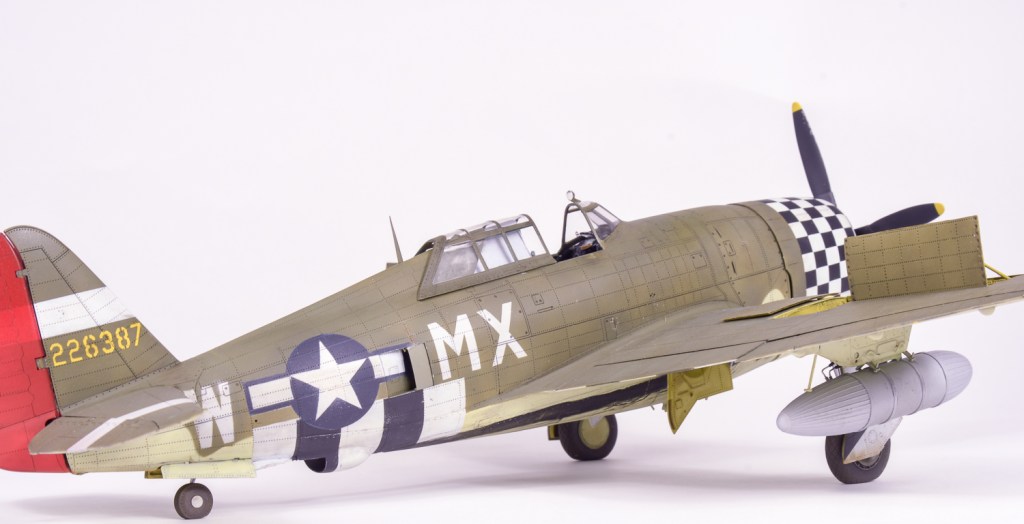
In regards to the chosen scheme, I have always thought the checkered cowling of the 78th FG would stand out in the cabinet, so looked for a suitable machine to model.  I was quite taken by “Miss Behave” with her RAF colours of dark green upper surfaces, and sky undersurfaces.  Invasion stripes, red rudder and the scalloped area under the canopy remaining NMF reinforced my choice. 

With this scheme originally picked when the model was originally started, masks for all markings were ordered from a bloke in Canada that called himself Ad Astra masks.  Now sadly no longer doing them as mask set was excellent to use.  He based the masks on photos of the real aircraft and an aeromaster decal sheet.

This time, the deciasion was made to apply the insignia first, mask and then paint the camouflage.  It was hoped doing this, the masks would be easier to align, and I would avoid that thin white ring of built up paint you can get if painting the markings last
What I learnt from this was the US star and bar markings must be the most complex markings to paint, even more so than RAF type A1 roundels.  There are just so many elements you need to ensure are aligned and straight.  Anyway I got there in the end having to only touch up two stars  Painted markings are the only way to go in 32 scale in my opinion.  Even the “miss Behave” came out nicely, a true testament to the great job Ad Astra did cutting these masks.  Then there was the cowling!
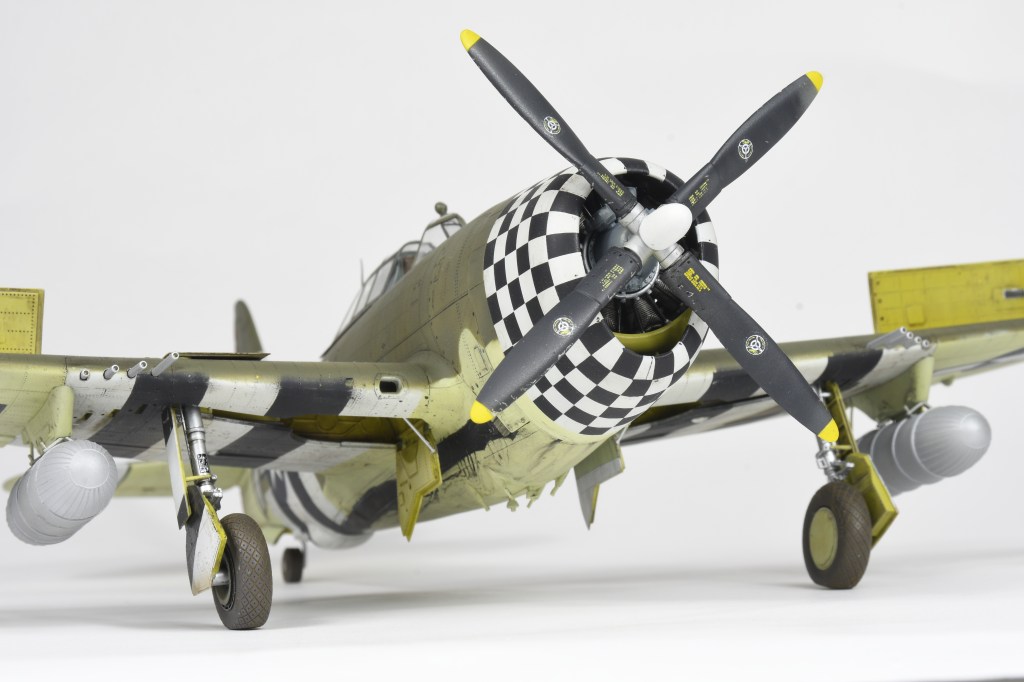
Well, I tried to mask that too using a montex mask set, but it was just an abject failure, so was my attempt at cutting little squares of Tamiya tape.  Buggar it, I thought, this will be decalled, so I dragged out the Barracuda sheet, but I could not get this aligned either despite it being sized for the Trumpeter kit.  It must be me as I imagine Roy would have been meticulous in designing the sheet..  Rapidly running out of options, I found an old Superscale sheet with checks on it for the old Revell kit.   It fit surprisingly well, just needing a couple of black squares filled in with black paint around the cowl opening and underneath where the two halves met.

This just left the final assembly where I discovered I had lost a wingtip light and also one of the landing gear covers.  Despite hunting high and low, no sign of them.  I can only think I accidentally chucked the gear cover out as it was stuck to  the big ball of Tamiya tape that was sitting on my desk.  The jigsaw that are HGW belts were then assembled using wild guesswork as to how they all threaded together!  HGW could really help here by providing step by step instructions rather than just a picture of the completed belts.  

Searches of the various fora hasn’t revealed anyone else knowing how to assemble them either!  The guns also provided a bit of frustration trying to get them all aligned and properly seated.  I really need to either test fit these items and engineer proper fit, or assemble them way before I get to this stage.  I had the same problems with the guns on my hellcat.  To add the brass gun tubes, I simply drilled the holes in the leading edges out slightly and pushed them through into the breechs. 
The 108 gallon drop tanks are from the kit with plumbing added from wire and steadying braces from plastic rod.  If I was being strict to the 84FS’s missions I should have added bombs as after D-Day this squadron switched from long range escort duties to ground attack, but I wanted my aircraft to wear the tanks.

​Adding the ammo bay doors, I also discovered I had the door upside down when I painted the star and bar portion on it.  A modeller worried about perfection would have repainted the star.  I just flipped the door upside down as the model had got to the stage where I just wanted it off the bench so I could move onto something new. 
Does anyone else get like this?

The photo I had of Miss Behave showed no chipping or fading that I could make out, just that very extensive oil streak leading from the oil cooler doors, so this was added with black oil paint, and then the whole model dullcoated .  I should probably go back and gloss the oil streaks at some stage.
It was then time to sit back and enjoy the model, happy that I had reduced by one the small amount of kits on the shelf of doom. (there’s still 6 on the SoD if you must know!)
Overall, not as good as I was hoping it would turn out, but it still looks imposing on the shelf and Im happy I have a 32 razorback in markings not usually seen.  I just love that big checkered cowling.  I really hope that we get a 1/32 P-47D from Tamiya at some stage.

Republic P-47D-22RE Thunderbolt 84FS 78thFG 8th A.F U.S.A.A.F Duxford England. 1944

Trumpeter 1/32 Hellcat MkII

  • Built: 2018

    Aftermarket Used:  Cockpit:Eduard Interior. Wheelwells, Eduard PE. Wheels-Barracuda. Seat Belts-HGW. 

Decals:  Home made masks

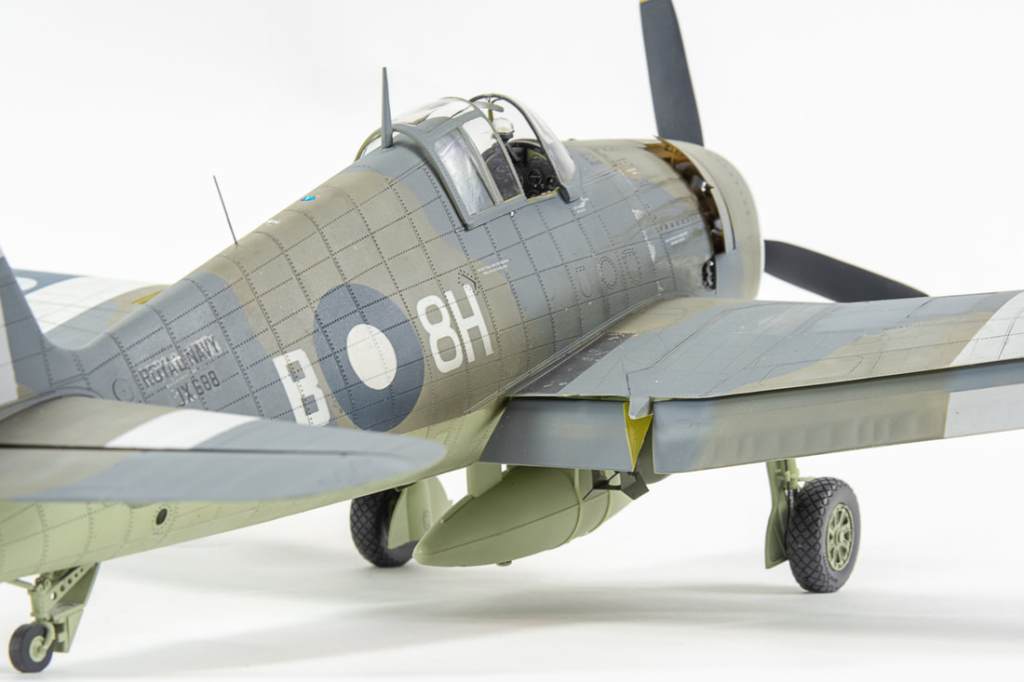
I first made the trumpeter hellcat in 2007, and finished it as a FAA machine.  I quite liked the build, and the scheme, but unfortunately the model got damaged in a house move.  I bought this model with the idea of making another FAA Hellcat, and initially was quite motivated when the kit made my to do pile for 2018 builds.  That motivation evaporated when it hit my bench and I discovered the wings had sink marks in them over the rear spars.  As I had just completed two involved builds of the HobbyBoss Tomcats, here and here I just didn’t need the grief, so the model went on the “For Sale” pile.  A week later, I decided I wasn’t going to let any minor sink marks beat me, and the kit ended up back on the bench.  A bit of brushed on Mr Surfacer 500 made quick work of the sink marks.  Restoring the rivets wasn’t as hard as I had imagined which is what really led me to put the kit aside in the first place.  A Rosie Riveter tool was used  plus the ubiquitous sewing needle.

The Eduard interior set was used for the cockpit, the pre painted etch certainly giving that busy look to the consoles and circuit breakers that painting just cannot achieve. The Trumpeter hellcat suffers from a few inaccuracies, the main one being the cockpit is far too wide and the rear fuselage does not capture the flat sides of the real machine.  This did not bother me greatly with my first hellcat, but with this one, I cant unsee it.
In an effort to reduce the oval sides, I sanded flat  the curved sides of the interior bulkheads, and when glueing the fuselage halves together, pushed in the fuselage sides aft of the cockpit.  If it made any difference, it was minimal.  The engine accessories, bearers and oil tank were all left out, as was the radio equipment as none of it will be seen, the engine itself pushed into the  firewall, so the bearers are not required to be assembled.
Fit of the major parts was pretty good as it usually is with most trumpeter kits, even the wing halves mating nicely in the extended position, although I managed to introduce a slight step between the port wing sections.
Prior to this, the moulded wheel well ribs had been shaved off so that the eduard parts could be used.  These being fairly easy to place and  superior to  the shallow kit detail.
The completed wing sub assembly nestled in nicely to the fuselage, with again just a smear of Mr Surfacer.  Eduard provide a PE panel that skins the panel adjacent to this seam so that you don not lose any detail through sanding.  Painting the scheme was made easier by using LF Models  camouflage mask but I’m jumping ahead!  As my chosen aircraft was a Hellcat MkII, or F6F-5, and the kit represents a late -3, a few changes had to be made.  The windscreen in particular needed some frames sanding off.  The clarity was restored with various grades of micromesh, and Eduards canopy mask set for the trumpeter -5 used to save me masking some tricky curves.  A rear view mirror was furnished from then plastic card and added to the interior of the screen.  FAA Hellcats also had a round external mirror mounted to the top of the windscreen and this has still to be added to the completed model.  The camouflage was started by first spraying the white areas before masking these off so the sky undersurfaces and  dark slate grey, and extra dark sea grey uppers could be painted.  Extracolour paints were used for this, the final model I will be using enamels on as I finally made the decision to abandon them in favour of acrylics and lacquers.  For the roundels, a friend cut them from an upscaled and scanned aeromaster sheet for FAA Hellcats.  This is the second time I have got a friend to cut masks for me, and I’m wondering whether I should just buy a cutter myself although the learning curve with the software scares me.  Trumpeter also left the supporting straps off the drop tank although they have included the holes in the fuselage underside for them.  I fashioned them from thein strips of plastic card glued to rod which then was pushed into the holes.  Bombs were from the kit, although the tailfins were from the Eduard sheet.  Stippled on Mr Surfacer represented the cast iron bodies before they were painted olive drab with a yellow ring denoting HE.  Around this point my interest in the model started to wane.  I had had to repaint the roundels a couple of times and touch up various parts of the airframe paintwork caused by clumsy handling and poor masking. The serials which were decals had also silvered.
  The model was not reflecting the vision I had started with, and I was keen just to get it finished and off the bench.  I decided to scrimp a lot of the weathering and shading I had planned instead opting for a simple wash and some oil streaks using AK Dark wash.  This is something I really need to beat next year, so that I see each model through to completion with a consistent level of skill and patience. Roy Sutherland’s superb resin wheels were painted and glued to the previously assembled undercarriage legs, which had had wire brake lines added.
 Finally exhaust streaks were added with highly thinned Tamiya NATO black, although I don’t think they are nearly pronounced enough before the whole model was hit with Testors Dullcote, and that signalled the end of 2018 for me modelling wise.  Shame about those silvered decals, and Ive just noticed the prop is off centre too!


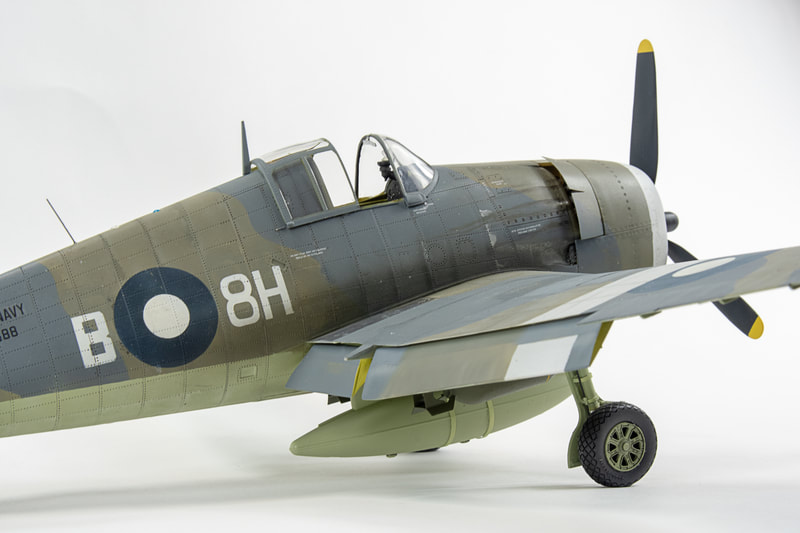
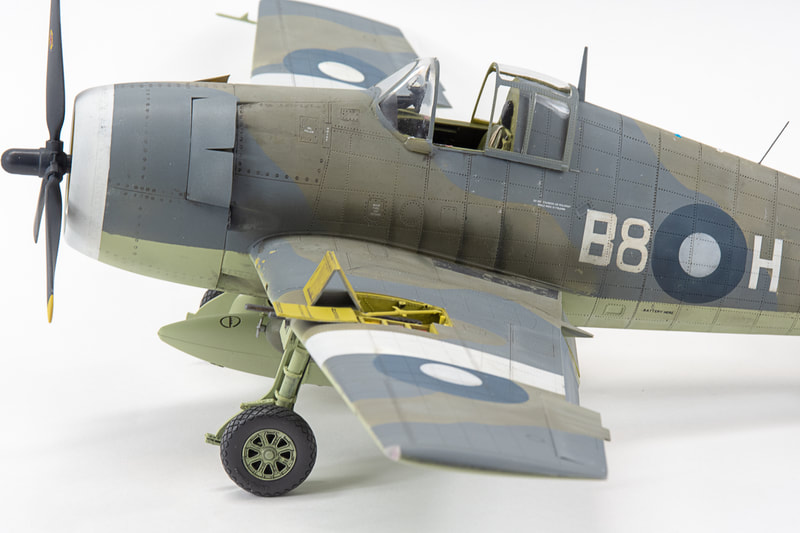
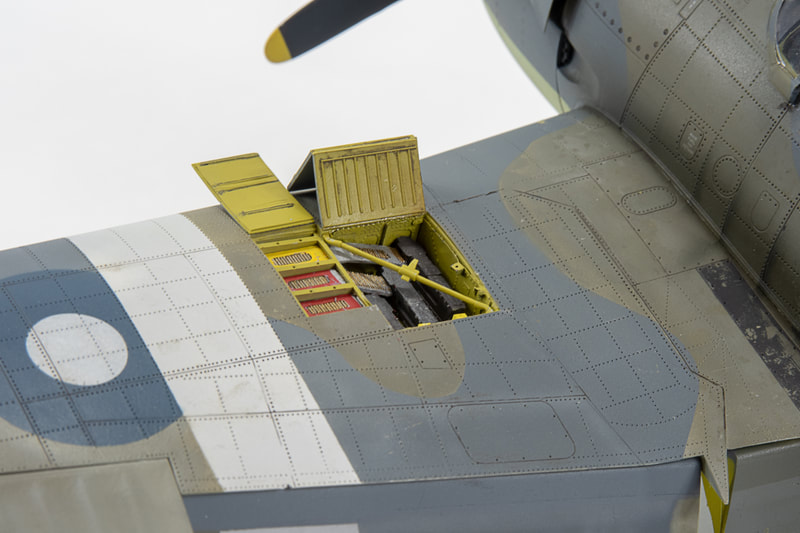
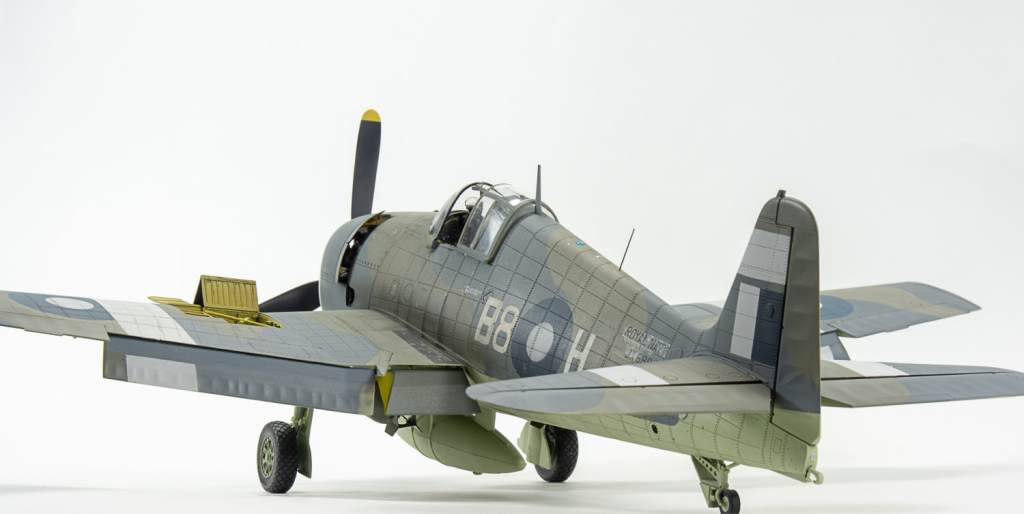
Grumman Hellcat MkII. 896 SQN. Royal Navy Fleet Air Arm.  HMS Emperor 1945


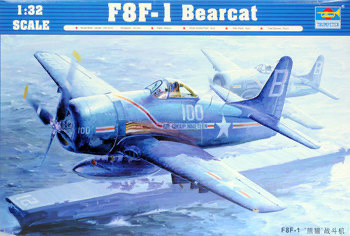
Trumpeter 1/32 F8F-1 Bearcat

This image has an empty alt attribute; its file name is 36bfd781-8593-425a-a037-b4bbec31f269_4_5005_c.jpeg
 
 
  • Built: 2008
  • Enhancements: Eduard USN Seat Belts
  • Decals: Berna French Bearcats
 

As soon as this kit was released I bought it with the idea of doing a French Bearcat used in IndoChina. The kit was purchased from France as there, the model came with the French decals included

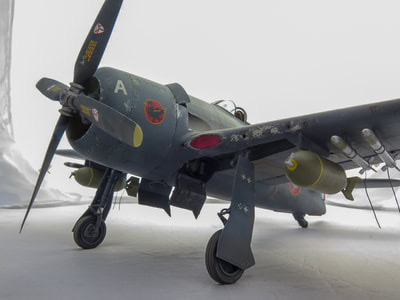
My idea was to do a very weathered Bearcat as seen in all the photos. I belive these machines came from the USN. They operated from forward airfields, so were exposed to all weather conditions. Bearcats were used in an air support role to lift the siege at Dien Bien Phu. The loss of which led to France withdrawing from Vietnam The Model assembled fairly easily. I glued all the panels in the closed position and kept the wings spread. Fit was pretty good. The rivet detail around the underside centre had to be deepened as it disappeared, a common thing with Trumpeter kits. The weathering process was started by priming the model in Floquil Silver. Over this maskol was dabbed on with a sponge before a patchy coat of Xtracolour Chromate yellow was sprayed over the wing roots, around the gun bays and forward fuselage. Again maskol was applied with a sponge concentrating on areas that would have seen high wear. Next Xtracolour GSB was sprayed over the entire model. This was then lightend with white and sprayed in a cloudy pattern over all upper surfaces. To this mix, some light grey was added and the resulting colour sprayed in a random pattern around wing roots and the spine of the aircraft. Some intermediate blue was also added and sprayed in random vertical streaks down the fuselage and chord wise across the wings. The dabs of maskol were then removed by the simple expedient of using my finger to rub them off. A clear coat followed, and then decalling commenced. The decals behaved fine and sank into the recessed detail with the aid of Micro set and sol. Exhaust stains were added using highly thinned black and light grey shades. Finally some earth brown shades were lightly dusted over the wingroots, using the airbrush. I added intake blanks from plastic card to hide the visible seams inside the wing intakes, and some stretched sprue to represent the cowling cooling flap rods as I had posed these in the open position. Some arming wires were added to the rockets and bombs with fine fuse wire. I made the mistake of adding brake lines to the undercarriage with florists wire. This is far too stiff and served to force the undercarriage legs out, so that they were perpendicular to the dihedral rather than perpendicular to the ground. This was one of the first models I entered in a competition, and to my amazement was awarded Third place in the now defunct Eagle’s Day held in Melbourne that year, and a First Place at SCALEACT at Canberra Australia in 2016

Grumman F8F-1 Bearcat. GC1/21Armee De La Air Bach-Mai. Indo China 1953