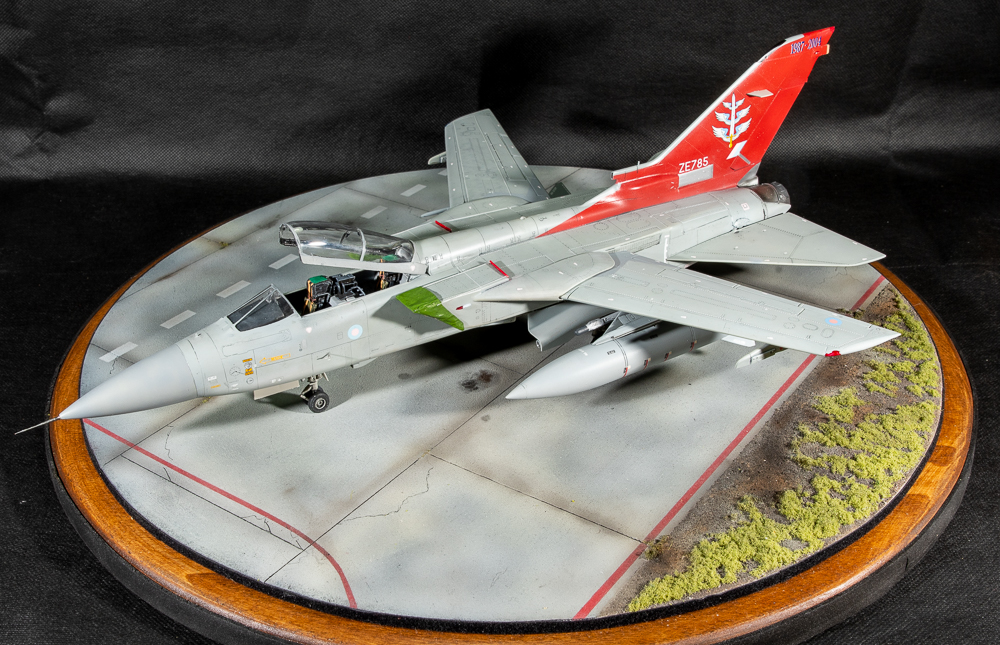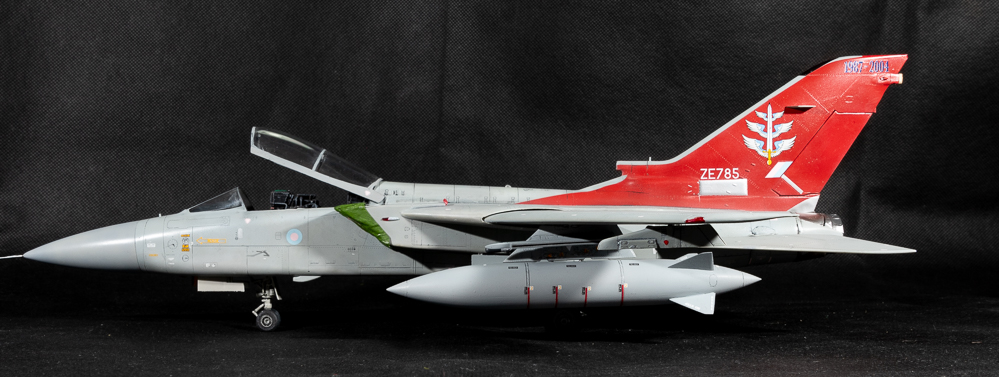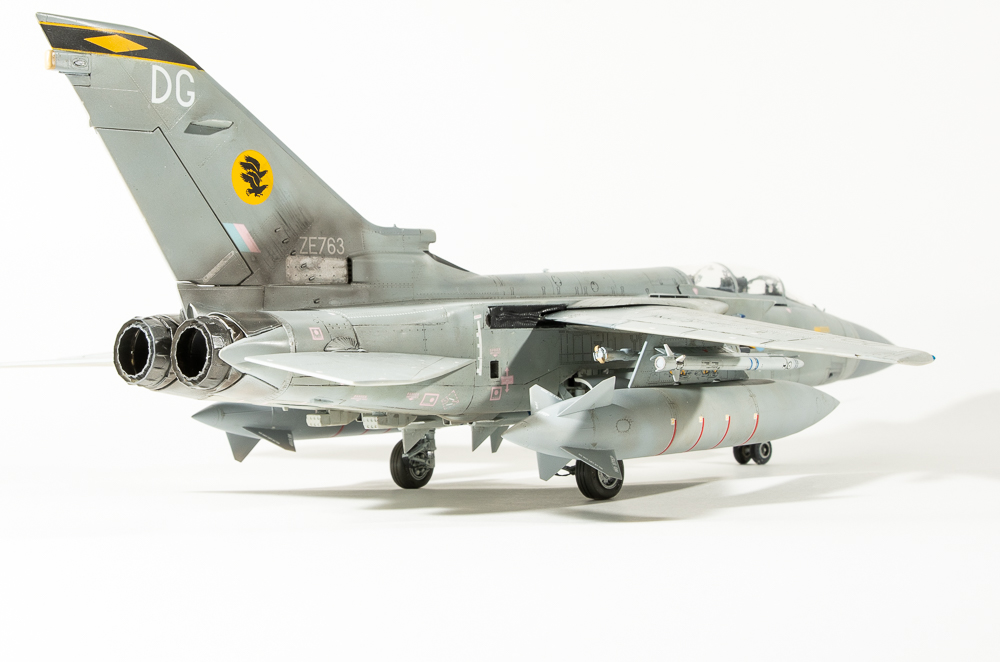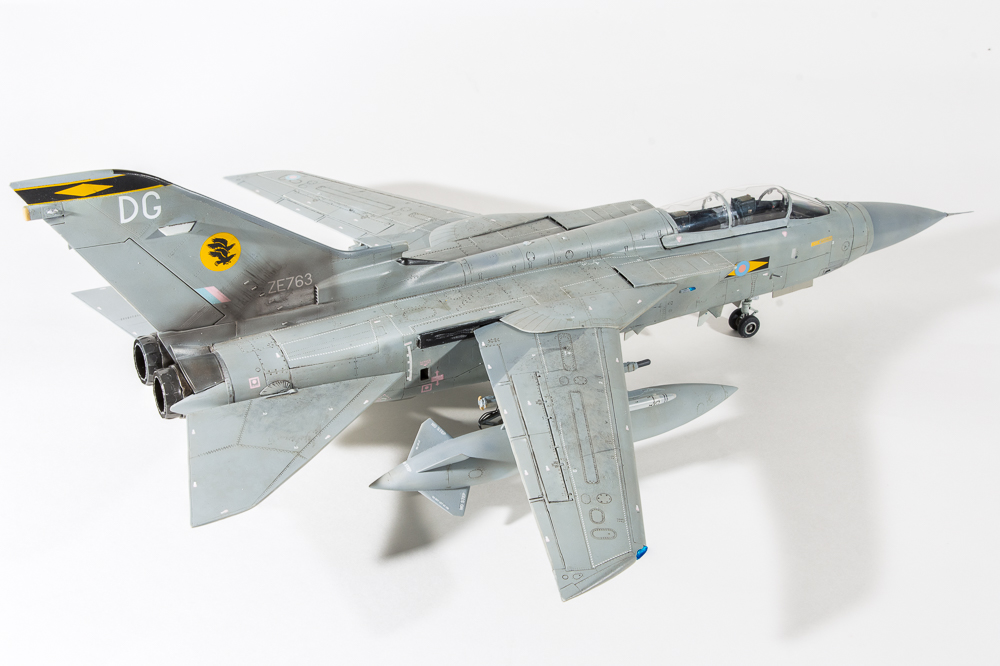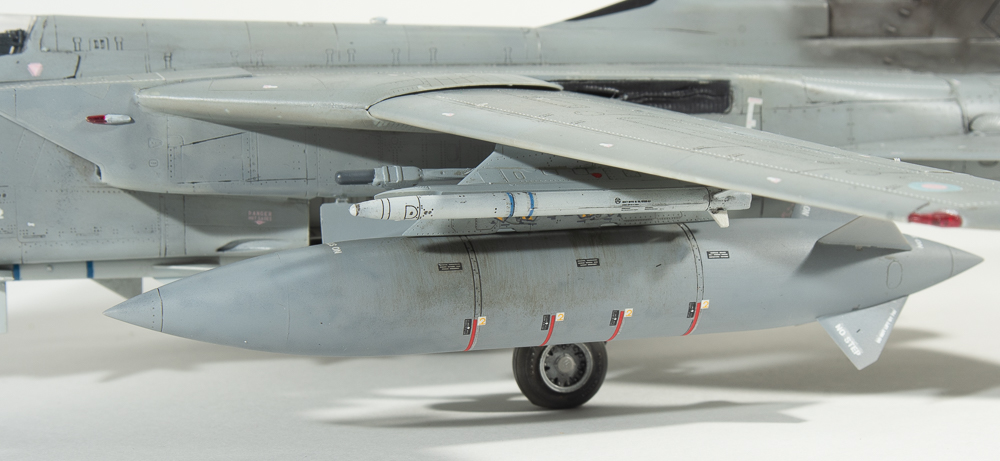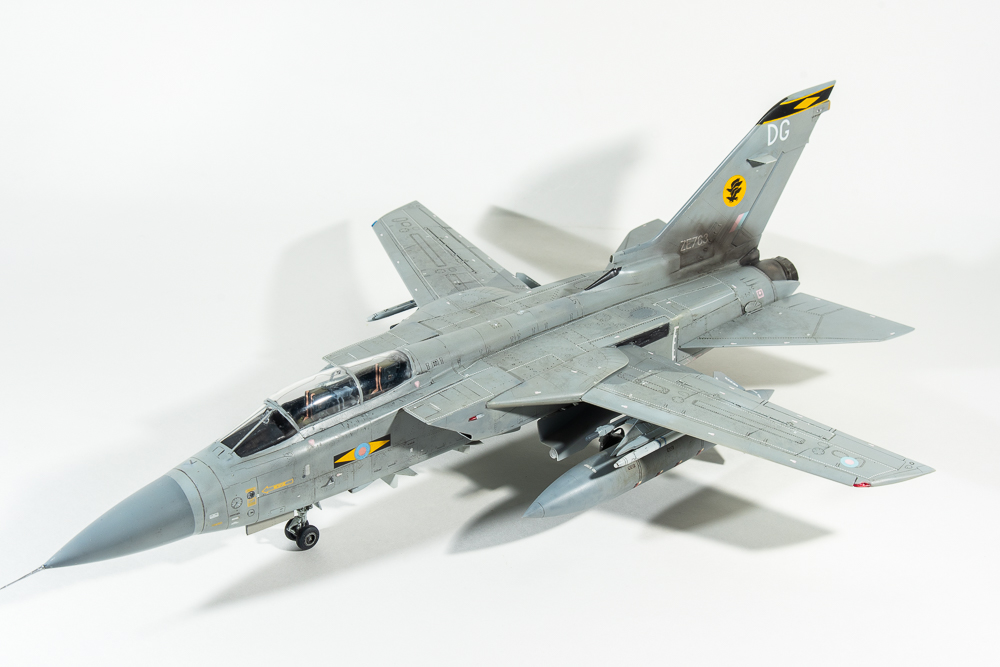
Revell 1/48 Tornado GR4

Completed:2020
Enhancements Used:  
Cockpit: Eduard
Seats: Paragon
Wheels: Brassin
Wheelwells: Eduard
Weapons: Brassin
Pitot: Master Barrel
Wing Seals: Shaun off Britmodeller
                                                                                                  Decals: Model Alliance Op Telic Part 1

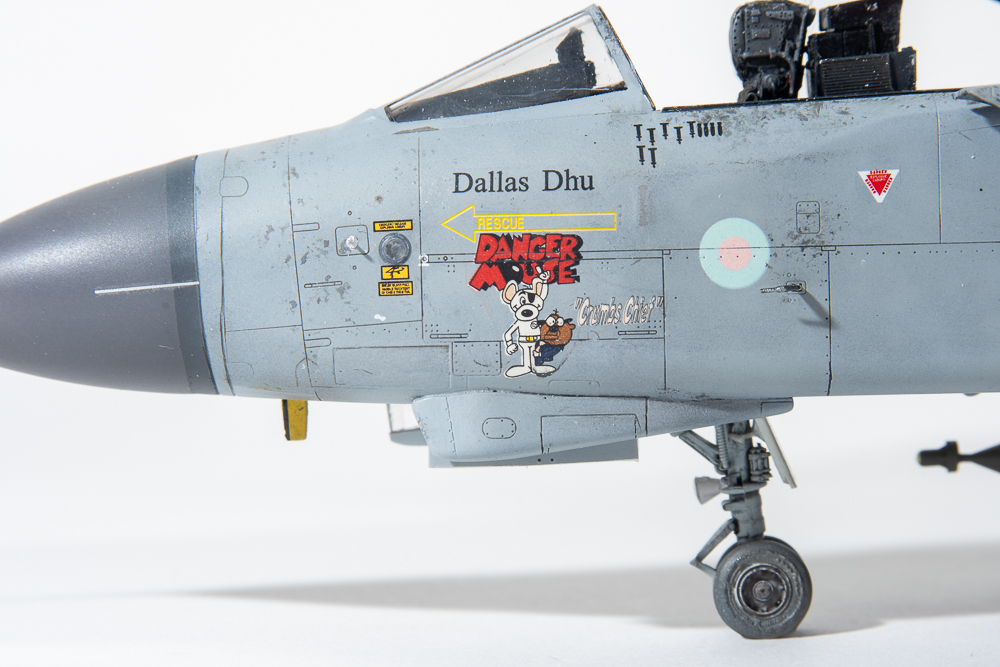
The third and final instalment!  I had wanted to build Danger Mouse from the start.  For some reason I thought it was a ADV though, not a GR4, so then had to keep on  building tornadoes until I got to my GR4.  Well that’s my excuse for building 3 Revell Tornadoes.

I had a load of aftermarket I had planned on using on this build.  Some of it got binned as not value adding to the build though.  
Firmly in this camp, I place the phase Resin Hangar seamless intakes.  For a start, I just don’t think they are needed.  Whilst the kit intakes do have a nasty seam, you can really only see the first couple of mm of the kit intake trunking, ands then only by holding the model up at a weird angle and craning your neck to look down the intakes.  If this bothers you, a bit of filler and sanding will eradicate the seam. Secondly, the case resin intakes are moulded as just the intake tunnels without the bulkheads provided as part of the kit trunking.  These bulkheads form the front and back walls of the wheel wells and provide important structural integrity.  As I was going to be using the aires resin wheels this was not a dealbreaker.  What was the dealbreaker was the resin intakes would not fit over the top of the resin wheel wells without removing a big chunk.  This  was after sanding both the roof of the wells and the outer wall of the intake wafer thin, so, the resin intakes got binned and I reverted to the kit intakes.  To be fair to Phase Resin, Mike is probably not expecting you to use his intakes in congestion with resin wheel wells.  That aside, to not cast the integral bulkheads seems strange..  My opinion. Don’t bother with the intakes.  The wheel wells however do add to the kit, beautifully detailed as are all aires sets, these even fit with a minimum of fuss.  What led to them getting junked along with the intakes was after glueing them I found I just could not get the fuselage parts to line up seamlessly as the other kits had, so they got hit with the debonder and binned as well.  Not going too well so far!  The aires wells do add a lot to the kit though, and I’m sure the fit issues were due to something I did.

The rest of the build proceeded as per the other tornado builds.  Again I cut off the wing cogs to fit them at a later stage.  Again this is another thing I would never do were I to build another tornado ( I won’t be!)

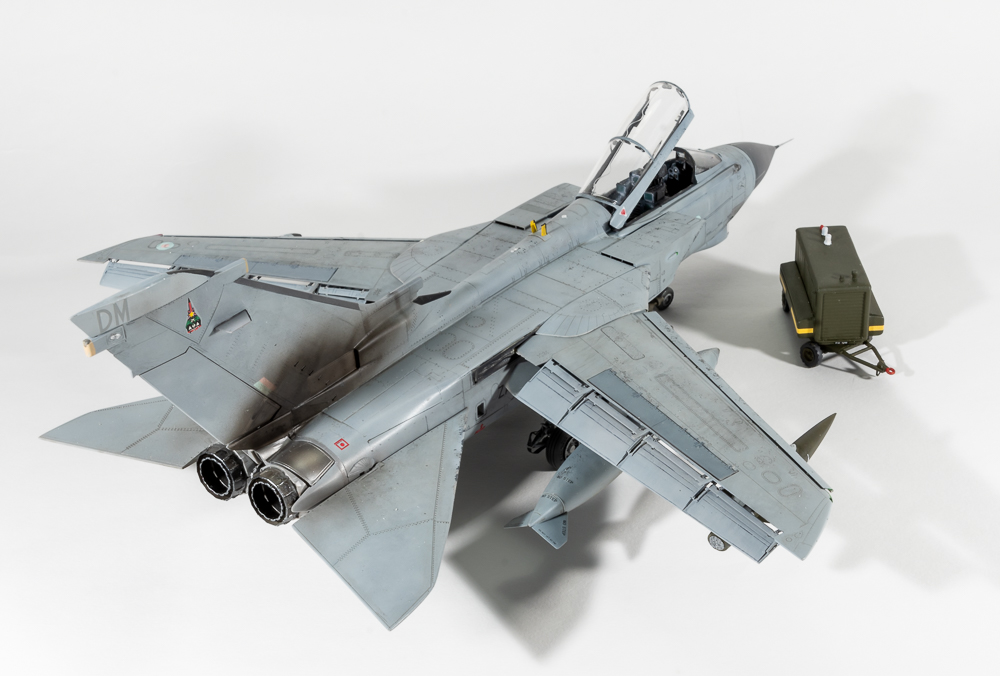
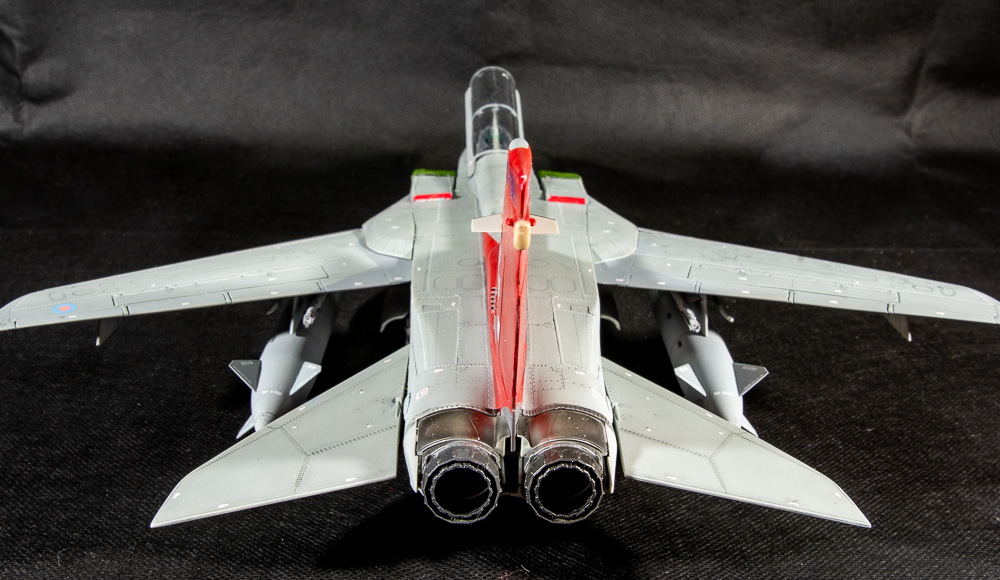
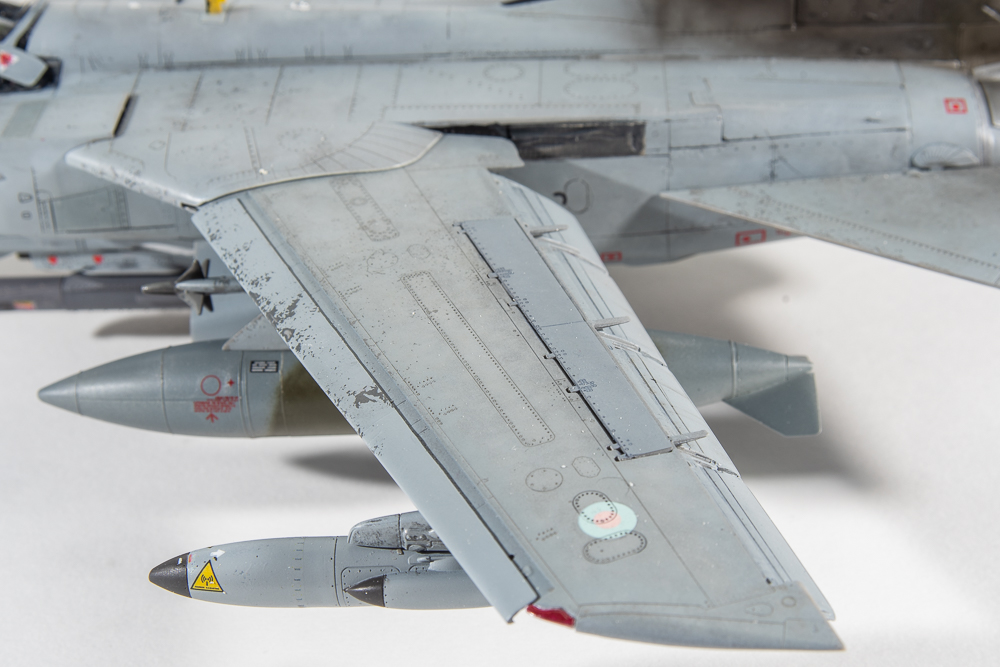
Revell would have you assemble the wing flaps as a three piece assembly whereas in real life they are one piece with only the small aerofoil section being a separate piece.  Make sure you fill and sand the join line.  Hopefully the photos explain this a bit better.  Shaun’s resin wing seals are far better representations of the real things rather than the featureless kits items.  He can be contacted through  Britmodeller.com

Photos I found on the net of Danger Mouse and other Operation relic jets showed a fair bit of wear and tear with scuffing and chipping of the ARTF grey paint exposing the underlying dark camouflage grey paint.  To portray this on the model. I first applied a coat of dark sea grey to the leading edge slats, nose, pylons and one of the drop tanks.  Mr Neo masking fluid was then dabbed on with a torn bit of sponge and the model sprayed with a couple of light coats of Scale Modeller’s Supply Barley Grey.  SMS is a home grown  Australian paint manufacturer.  I have been increasingly using his paints, as Im finding them excellent to spray.  You can spray them straight from the bottle, but I add a drop or two of thinner to make them spray even better.  They are a lacquer paint that has proven to be hard wearing and quick drying.  Once this paint had dried I rubbed my finger over the Neo to remove it from the airframe leaving the model looking chipped and scuffed.  The jet was made to further look worn by painting a few panels in either dark sea grey or lightened shades of the barley grey. One of the fuel tanks was painted in the old wrap around scheme, jets being fitted with different coloured tanks being quite common, even today.

I applied a panel wash with Payne’s grey oil paint straight over the SMS paint, with the excess wiped off and no damage to the underlying paint.  The decals were also placed straight over the paint, which dries with a sheen, the model Alliance decals performing well, although the DM code letters were too light and did not stand out enough when compared to photos of the real jet.  As I could not find any dark grey or black letters of the correct size to replace them, so had to resort to painting the fin top a lighter grey.  I replaced the letters with other codes from the same sheet.  Penfold’s catch cry “Crumbs Chief” should also be far pinker than the pale shade on the sheet, maybe it faded!  Op Telic jets do not seem to have been as well photographed as Op Granby jets, well so it seemed to me with good quality photos being hard to source. In particular I wanted to know if these jets wore the full suite of stencils after they were repainted.  In the end I went with just the major ones figuring only those stencils that dealt with rescue or crash procedures would have been re applied.

With this model I decided to really strengthen the pylon to wing attachment by using epoxy glue.  They ain’t coming apart now, although perhaps I should have ensured they were parallel to the centre line first!

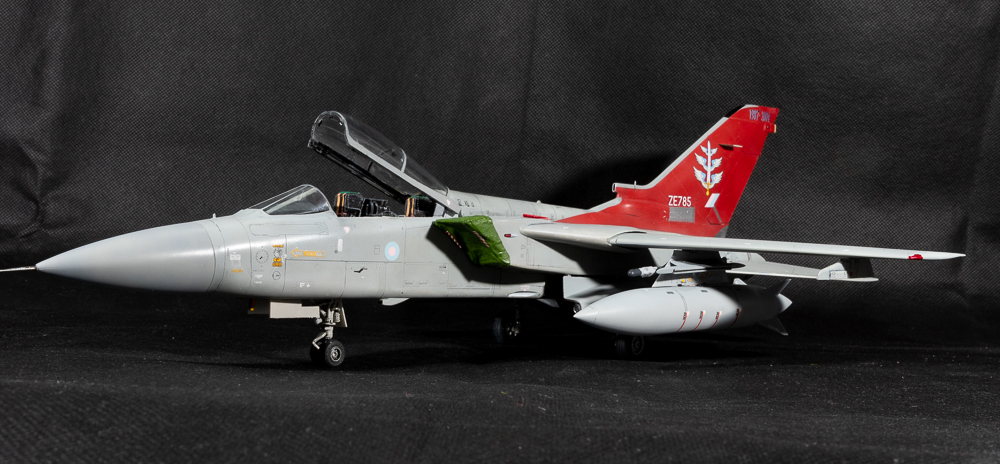
With that Danger Mouse was done.  One of my favourite cartoon characters as a child.  There are still a few build and finish faults, but this is my favourite of the three.  I love the pugnacious look of the short nose coupled with the laser sensors.  The Eduard Brassin weapons are also a must have, being better detailed and more accurate than the kit supplied weapons.  Out of the box, you can arm a Operation Granby or Operation Telic jet.  Even the stenciling is provided.

So with three Revell Tornadoes done, what are my thoughts?  Well, let me start by saying I sold my remaining Revell tornado from the stash, as to build more would be just like beating yourself over the head repeatedly using a hammer.  I think you would really have to love Tornadoes to build multiples of the Revell kit.  Marred by soft detail in a lot of places, sink marks, flash, it can be  a troublesome build in inexperienced hands.  Take the time to research other on line builds and the previously linked youtube videos as fit problems can be mitigated if the builder departs from Revells suggested build sequence.  I really cant see anyone else aside from Airfix releasing a newer tooled Tornado, so Im thinking the revell is going to be the go-to in 48 scale for quite some time.  I might just order that new 32 scale Italeri tornado, as the Tornado itch still needs to be scratched with a wrap around GR1.

 Tornado GR4 ZA542 31SQN Royal Air Force. Combat Air Wing Ali Al Salem Op. Telic 2003
 

Revell 1/48 ADV Torando F3

Enhancements Used
Seats: CMK 
Seatbelts: Eduard steel
Wheels: Eduard
Pitot Tube: master barrels
Decals: Xtradecals Tornado F3 part 1
BOL Rails: Phase Resin Hangar

Construction Notes
 Oh God, what was I thinking, building three of these at the one time?.  In last months gripping episode you will recall that I (rashly) decided to build all three of my tornadoes from the stash at the same time.
​Well the plan didn’t quite start out like that.  This tornado was actually the first started, and the original plan was to just build this one,  however, it was not really turning out as I had pictured in my mind, – a common theme with my builds –  so it got shelved, and my other F3 pulled out of the stash, and started with the intent of being a better build (yeah, right!).  It was at this stage the idea to build all the tornadoes in my stash was born.  In actual fact, I thought I would  only be  building the other ADV  and my GR4.  
It  was only when the other ADV was almost finished, this one was revisited, and the decision made to complete it.

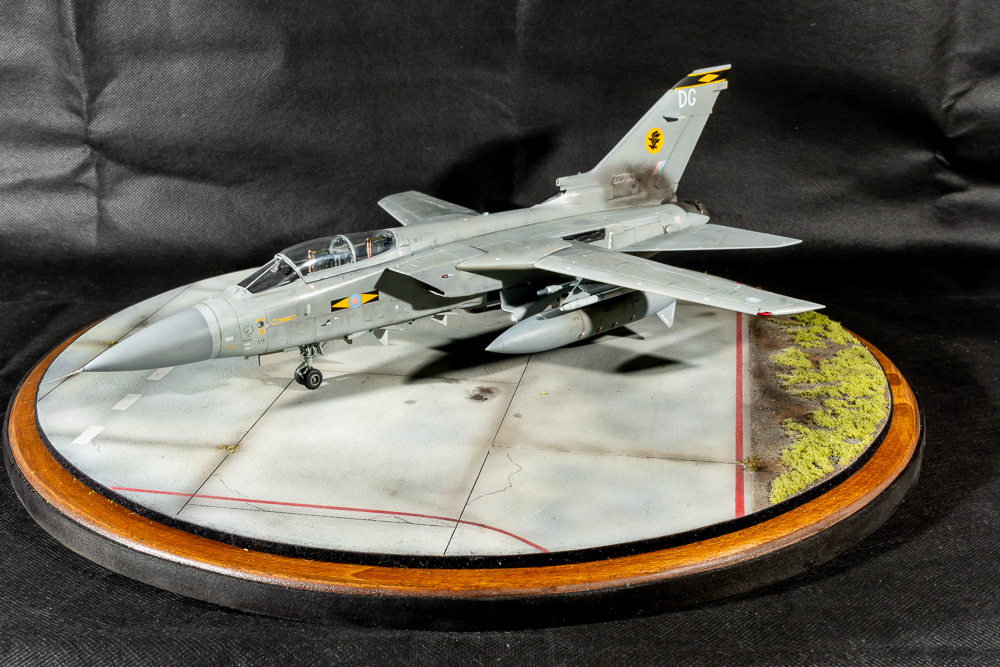
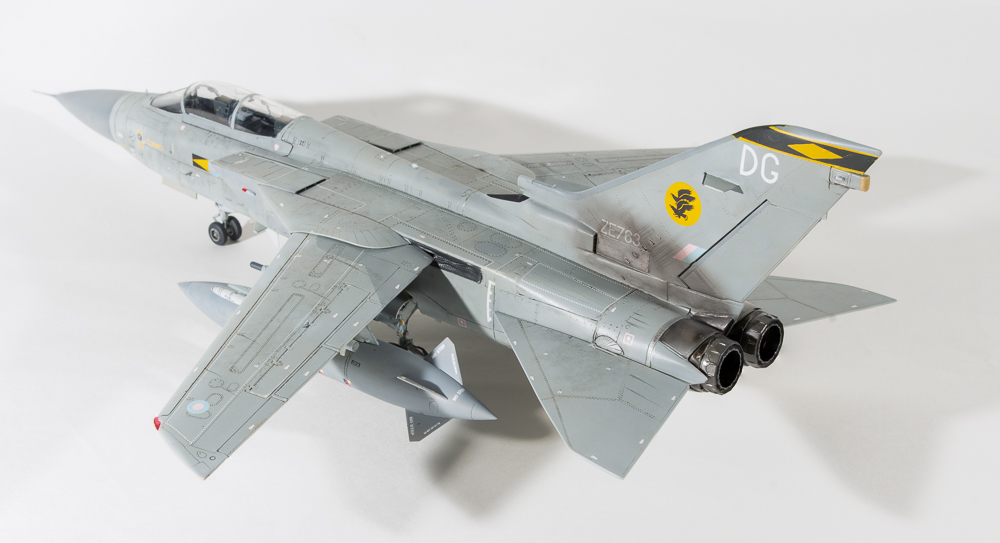
​Being the same kit, most of my notes from the first build stand.  My thought process with finishing this kit was to make it a clean build, as, with three builds now underway, getting  Tornadoed out, was a real possibility!   To this end, no stores were added, apart from the large tanks. Photos of the actual jet showed it sans stores anyway, save for tanks and a RAID pod on one of the BOL rails.

 This time the BOL rails came from Phase Resin hangar.  To better reflect RAF pylons, the sway braces were cut off and the “bulges” on both sides of the pylon had their length shortened.  Close enough for Govt. work as the saying goes.  there are plenty of photos available on the internet to aid as reference in this task.
The wings again had their cogged teeth cut off so that they could be painted separately and added later as part of final assembly.  This time I left I bit more of the “spar” with the result the wings attach far more securely, although they don’t have that classic Tornado anhedral

For this model, I wanted to add FOD covers too.  They were formed by covering the intake firstly with  household aluminium foil.  Kleenex tissue was then laid over the foil and coated in diluted white glue.  The thought process being to then slide the hardened tissue off the foil.  In reality, this didn’t work as the glue had worked too well, and stuck the tissue to the foil!
Once dry, the tissue FOD covers were trimmed to shape, and then painted.  Thin strips of tamiya tape formed the ties underneath the jet, whilst white EZline stood in for the bungee cords stretching back to the intake vent FOD guards which were formed from offcuts of red painted plastic card.  RBF flags came from an old Verlinden sheet.

As the Eduard PE wheel well set was not used on this model, the door retraction struts fitted neatly into their slots without the need to shorten them as was required on the other ADV build.
The kit decals were again used for the instruments, but this time the CMK seats were used, dressed with Eduard “steel” seatbelts which are far easier to use than their normal PE belts, being far more malleable, and less prone to the paint flaking off.

Paints used on this completion were Mr Color, another of my favourite brands, This actually being the first of my tornado builds, it was again plagued by large chunks of paint peeling off when the masking tape was removed.  This being one of the things that contributed to the build being abandoned in the first place, the painting process becoming an endless look of touch ups.
​In an effort to allow the wash to enhance more of the surface detail than the first kit, I applied the wash straight over the lacquer paints without first applying a barrier coat of gloss.  The excess was wiped away without removing any of the underlying paint.  Lacquer paints really are bulletproof!  Shock, Horror, the decals were then applied, still without a gloss coat.  No problems with silvering.  It was only after decalling that  a sealing coat of semi matt was applied.  
The Xtradecal decals behaved flawlessly, although again I used the too thick kit decals for the stencilling.  They stand out way too much on close inspection.  If you are building this kit, I would ditch the kit decals completely and use AM sheets, Xtradecal, also doing a stencilling sheet.

Since these photos were taken, I have  divided the four sky flash missiles from the first build between the two ADVs so each jet carries two skyflash.

So, how’d I go?  Well, in some ways I feel I did a better job on this one than the first ADV, although it still has plenty of flaws.  I still feel I can do better.  Anyway, here are the photos so you can judge for yourself.  Next instalment should be the third and final Revell Tornado.
​Thanks again for looking.

Panavia Tornado ADV. F3 OEU Royal Air Force RAF Waddington. May 2003

Revell 1/48 ADV Tornado F3

  • Built 2020
  • Enhancements Used 
  • Seatbelts,  Eduard
  • Wheels   Brassin
  • Wheelbays  Eduard
  • Pitot Tubes and AoA sensors  Master Barrel
  • Weapons  Brassin ASRAAM   Hasegawa Sparrows (skyflash)  BOL rails  F4Dable Models
  • Decals  Xtradecal Tornado F3 Part 1
 Like a lot of modellers, I had heard some horror stories about the fit of the Revell Tornadoes.  The consensus seemed to be whilst they were definitely a step up on what was currently available, the fit left something to be desired.  The kit seems to be one of those that polarise modellers world wide.  The truth is, like the Hasegawa Harrier, the ease of build is directly linked to how you build the tornado.
What inspired this particular build was a mate directing me to a series of youtube videos done by a fellow named Nathan Robinson.
Nathan is a member of the IPMS Tornado SIG and admits to having built six of these!  So if anyone will have the build down pat it should be him.
Deciding to take a leaf out of Jon Bryons book, all three revell tonkas – 2 ADVs and a GR4 – were pulled from  the stash to be built as a batch.
Following Nathans build sequence, I found the build progressed fairly quickly. I still needed filler around the intakes and along the fuselage sides,where it meets the bottom plate, but these were all easy joins to clean up and rescribe.
For the cockpit, the kit decals were used which sat down surprisingly well over the moulded detail and certainly looked busy enough through the closed canopy.  Note Revell call out the wrong rear instrument panel, you need part S214

I deviated from Nathans build my cutting off the cogged part of the wing so I could add them later. To be honest, Im not sure this is the best way as you lose a bit of structural integrity. Ive already so modified all three of my kits, but wish Id left one to compare the two different methods.  Maybe on my eduard Desert Babe kit!

I replaced the rather bland wing seals with some moulded by a fellow called Shaun from Britmodeller.com.  I’m not sure if they are still available as he was doing them when the kits first became available.
The decision was also made on this model to have the flaps up, to better show off the lines of the ADV.  The best way to achieve a flush fit with the wings is to cut the bar on parts B111 &113 so you are left with separate flaps.  These can then be glued  individually to the top wing ensuring they sit  flush with the upper wing.

The undercarriage assembles fairly easily, despite being moulded in two halves. Revell have form here, which means you have a seam to clean up. Part C159 and 168 placement is a little vague. Step 69 shows it the best. On gluing the PE facia to the back wall of the wheelwell, I had an alarm bell go off in my head going, “I wonder if this slot the PE covers is important” Well, Yes, it is as this is where the door retraction strut sits.  Didn’t realise this until I added them, so then had to cut the struts, in fact I replaced them with thin rod. I find this annoying on Eduard’s part. They could have easily made the back facia in two parts to be fitted either side of the slot. Its not the first time Eduard have failed to take into account the fitting of kit parts around their etch, and one of the reasons I find myself using less AM these days unless it is drop fit. Some etch placards and brake lines dress up the legs nicely, but on my other F3 I will use wire and decals instead..

Photos of my chosen jet show it fitted with BOL rails on the inner side of the wing pylon. If like me, you didn’t know what BOL rails are, I can know tell you they are a launch rail with an inbuilt countermeasures pod. They are surprisingly hard to track down as an aftermarket item, considering quite a few jets use them.  A friend offered me his Steel Beach ones, but they looked quite a crude casting. The F4DModels were much better although warped.  Hot water straightened this out.

For the Barley Grey, I used a home grown paint SMS which performed quite well, Its marketed as ready to spray, but I still thinned mine a little. Colour looked good, but I find it strange they do not offer a Light Aircraft Grey in their range to go with the barley grey, so it was back to my go-to paint. Mr Color.
Again on this model, I had problems with the paint and primer peeling off when removing the tape. I have no idea whats causing this. The model was wiped down with tamiya thinner prior to paint, and was primed with Alclad Grey.  The consensus amongst my modelling mates was it could be the primer, which Ive had for a while, so in the bin it went.
The model was gloss coated for decals and in preparation for the wash. These days I apply the wash before the decals, despite this method, the wash failed to pick up a lot of the very fine detail, despite repeated applications, which was annoying in the extreme.
The decalling should have been easy, but again my poor build planning brought things unstuck. Literally!
The decals had all been applied when I realised I had not painted the fintop di electric panel, so as the tape would lay over the decalled fin band I religiously detacked the tamiya tape before laying it over the decal.  Of course, on pulling off the tape, the decal came with it, necessitating me having to  paint the fin band back on.  This in itself needed a lot of touching up as each time I pulled tape off, paint came away too. I really need to get to the bottom of why this is happening.
Surprisingly, my enthusiasm hadn’t waned for the model, so I pressed on, applying a satin sheen, which I then went over with dullcoate. Even with the satin, the model still looked far too glossy.  Annoyingly, all the stencils stood out as too thick as well. I had applied them in little pools of future to stop any silvering. I wont do this on my next one.

This just left final assembly of wheels, aerials, canopy mirrors and nav lights. none of which I managed to lose as is the usual case despite several of them pinging off the tweeezers.
And that was that! One down, two to go
So what do I think of the Revell Tornado? Well I think the main problem is, its Revell!  I have no problems with the breakdown of the kit, but the kit quality is poor indeed, flash, sink marks and ejector pin marks mar the parts, making assembly harder than it should be. These kits, like Airfix, are designed for the mass market, the so called “pocket money brigade” and the tooling shows it. You get what you pay for.
Despite this, if you ever release a new tool Jaguar, Revell, I’d buy it in a heartbeat.
Anything would be better than the horrid kittyhawk kit thats still sitting on my shelf of doom.

Panavia Tornado F3 ADV ZE763 11 SQN Leuchars Royal Air Force 2006

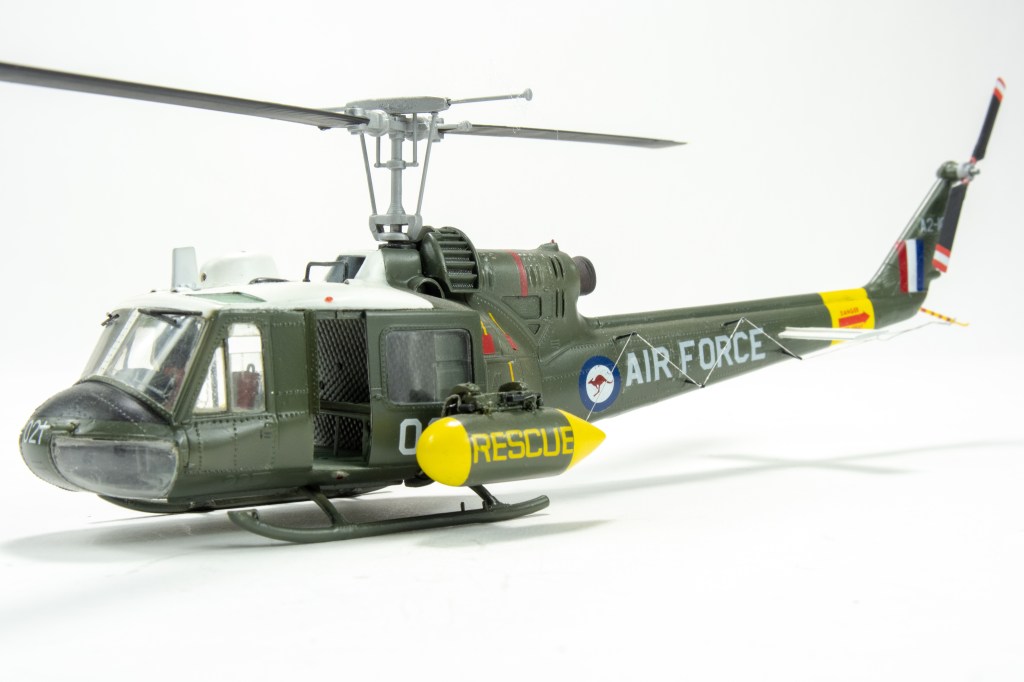
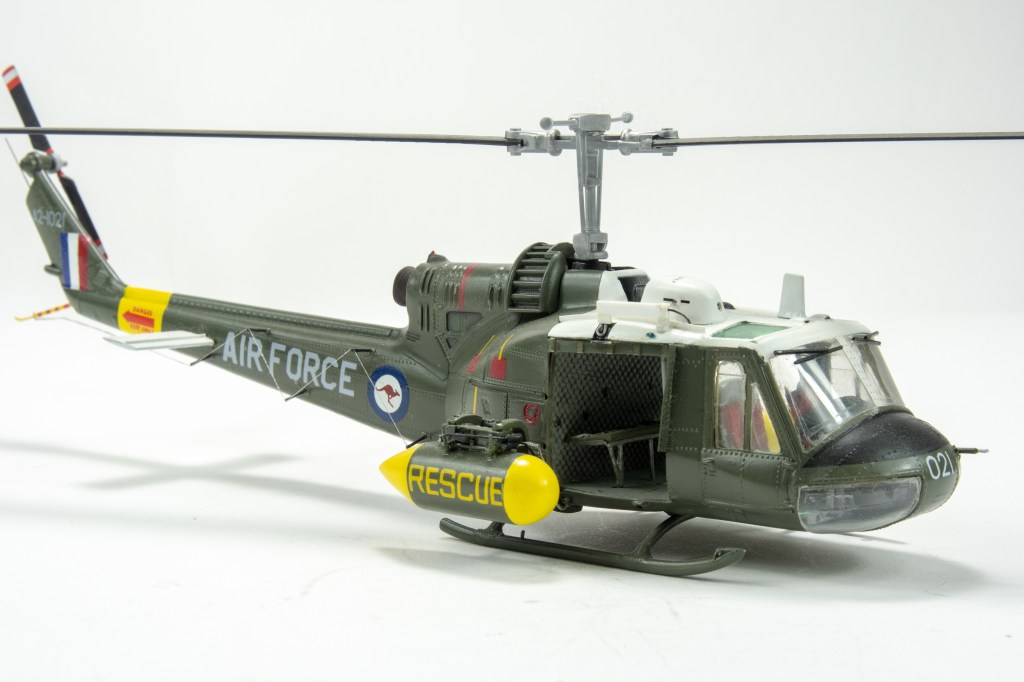
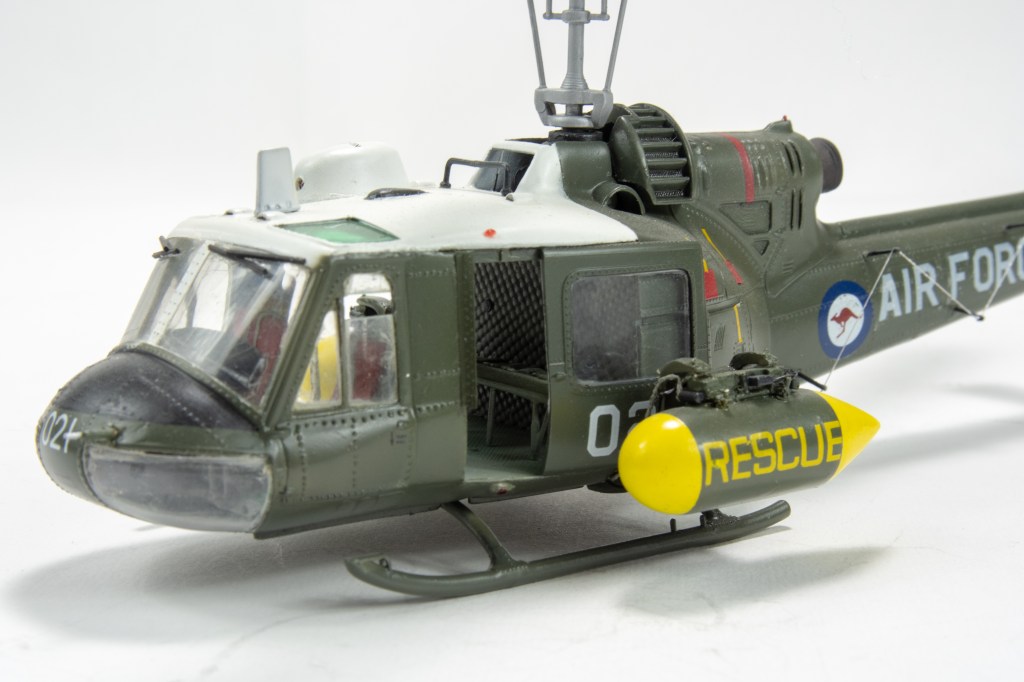
Revell 1/48 UH-1B


This image has an empty alt attribute; its file name is 5e5ea59c-8674-467c-aaf6-4df45a534280_4_5005_c.jpeg
 
 
  • Built: 2010
  • Aftermarket Used: Hamilton Hobbies UH-1B conversion
  • Decals: Custom made
Add block
 
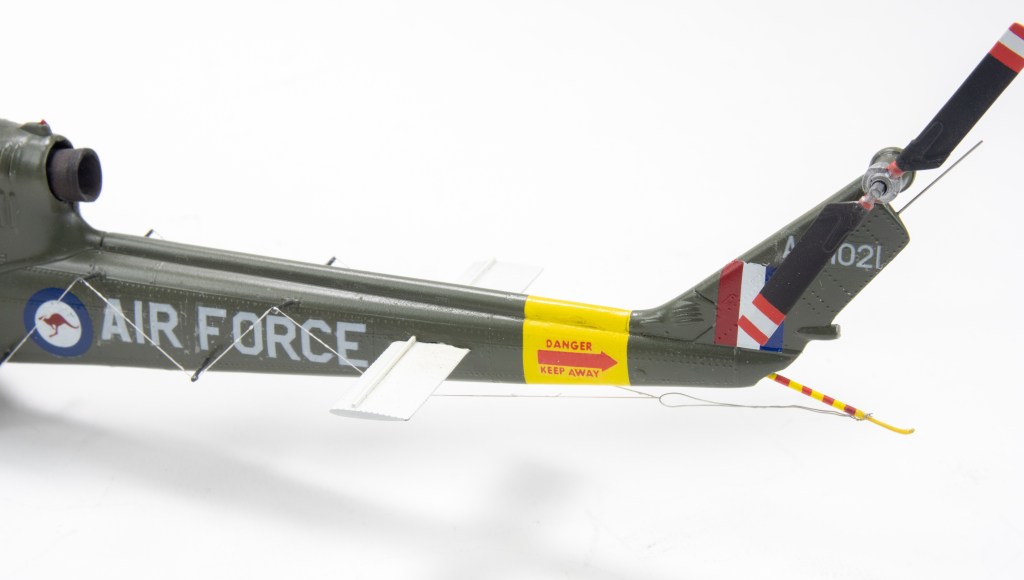
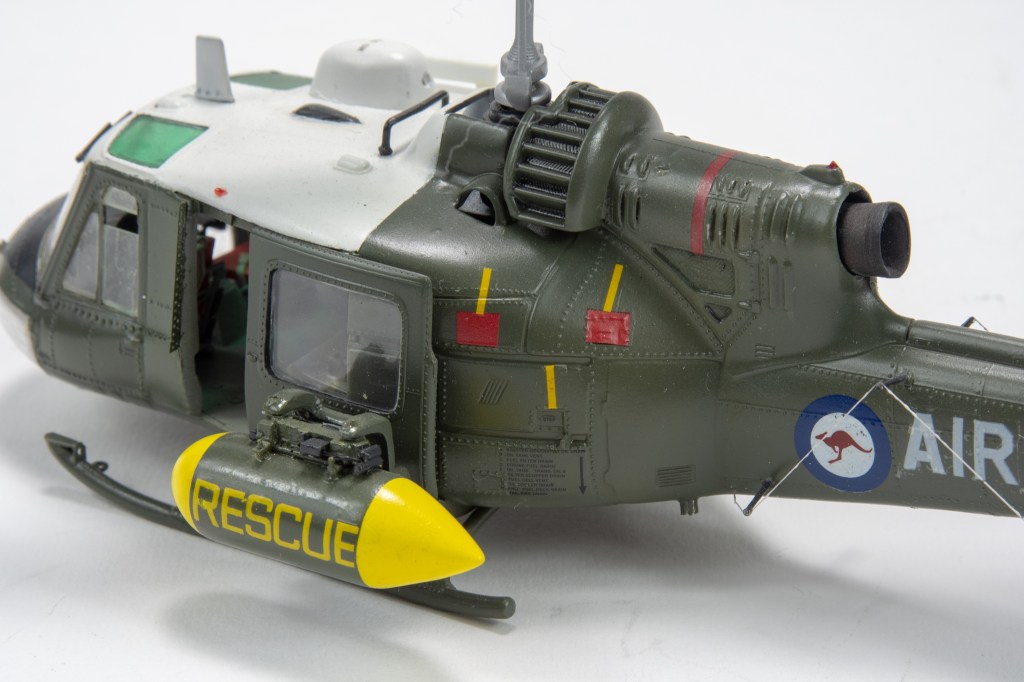
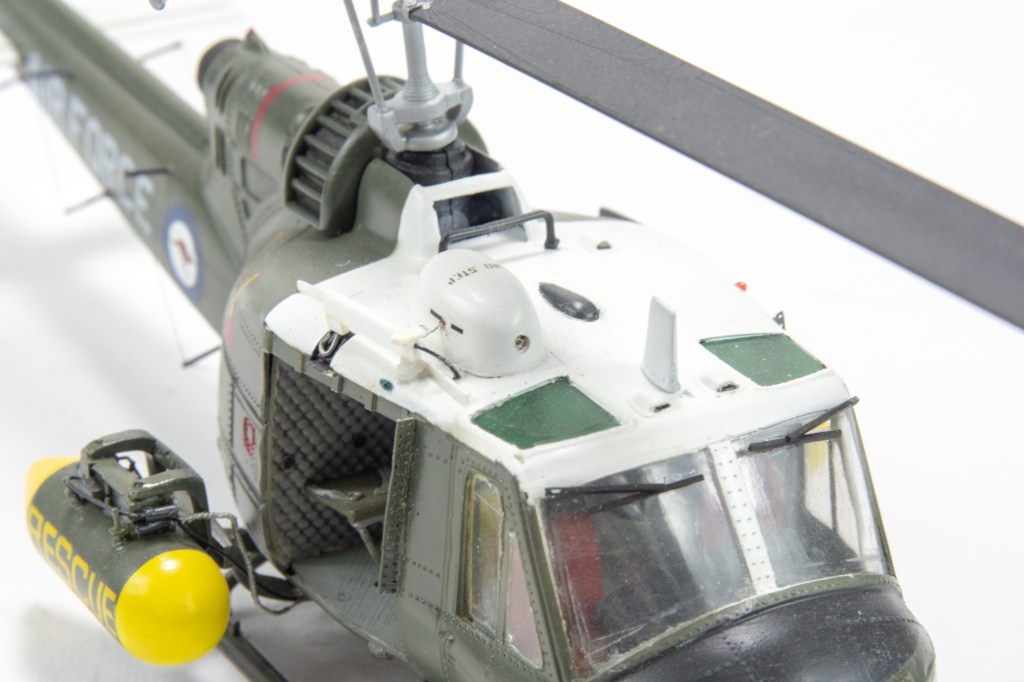
The short bodied Hueys have been woefully represented in 48 scale, with still no decent kit available.  The best of a bad bunch being the Monogram boxing, in its various boxings, which is the basis of this model.  As a young Air Training Corps cadet, this helicopter gave me my first ride in a military aircraft, and what a ride it was.  Based at RAAF Base Pearce as part of their SAR flight, in the mid seventies they were crewed by pilots and crewmen who had seen service in the recently ended Vietnam war, and boy, did they give us rides to remember.  I loved every minute of it and it started a love affair with helicopters, even though I don’t model a lot of them.
Out of the box, the monogram (although it is now boxed by revell) Huey C is a mix of B and C features, which need correcting.  As I was not building this as a gunship, I started off by cutting off the integrally moulded ammo box from the floor and filling the gap with plastic card.  The rear bulkhead is detailed with a curtain, that also got shaved off before the sound proof quilting was restored with embossed tin foil.  New scratchbuilt unarmoured pilot seats replaced the armoured kit seats.
Sealing the fuselage halves up –  not a great fit-  attention turned to the roof. where a bit of rectangular stock was used for the hoist arm.  The motor housing came from Hamilton Hobbies. A local producer of home made resin conversions for ADF aircraft. Although a bit rudimentary at times they were a godsend for modellers of ADF aircraft. The roof also had the airvents repositioned to their proper locations.  The kit pylons were used to hang the Kellett tanks from.  Ryan Hamilton again doing the hard work for me by providing the tanks in his detail set. Copper wire was used for the fuel lines that run from the tanks to the airframe
 The rotor head and blades came ftom an ESCI Huey 1D, the blades having been cut down to the shorter B length.  This assembly replacing the kits C type rotor head and wide chord blades, which were not used on the B model.  Finally, the model could be painted using Xtracolour olive drab and white with yellow trim on the tanks.  Speaking of yellow, I must have bought every sheet of yellow lettering available trying to source correct font and size for the RESCUE titles, without success, same with the AIR FORCE titles on the boom.  There was no other option, but to get custom decals made.  These cost me a small fortune, thanks to the manufacturer not using paypal or CC, so I had to transfer the money using Western Union.  This aside the finished items semed to match my photos of the real machine exactly, however they were translucent when applied, probably having been ALPS printed.  The Air Force titles have been built up with two layers to produce opaque lettering which still looks light grey rather than white.  White underlays were supplied for the tanks yellow titles, but for some strange reason, were differently sized from the yellow lettering.  In the end Ryan Hamilton came to my rescue (pun intended) with some decent yellow RESCUE titles.  All that was left to do was add the rear aerial from brass wire and EZ line and she was done.  Looking at the photos, you can make out it is well below my best work, but I just cannot bring myself to retire it yet.  Perhaps because of the memories it brings back to me.  It is definitely a model I will revisit once someone releases a decent B model in 35th scale.  Ronin Decals of Australia hopefully will release his long promised Huey history sheet in 35 scale as well EDIT, still has not been released as of 2021.

Bell UH-1B SAR Flight 2 Flying Training School. Royal Australian Air Force. Pearce. West Australia 1977