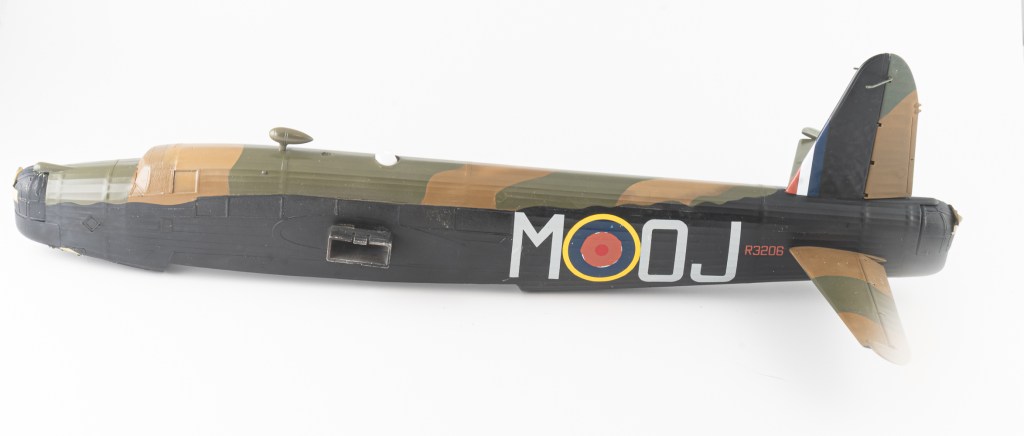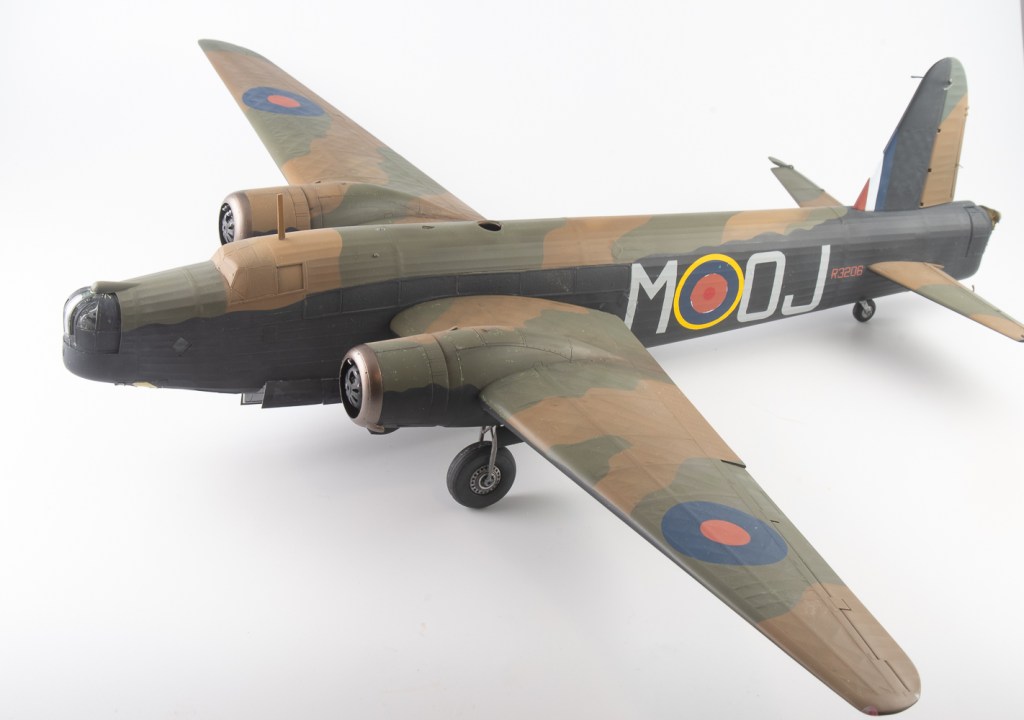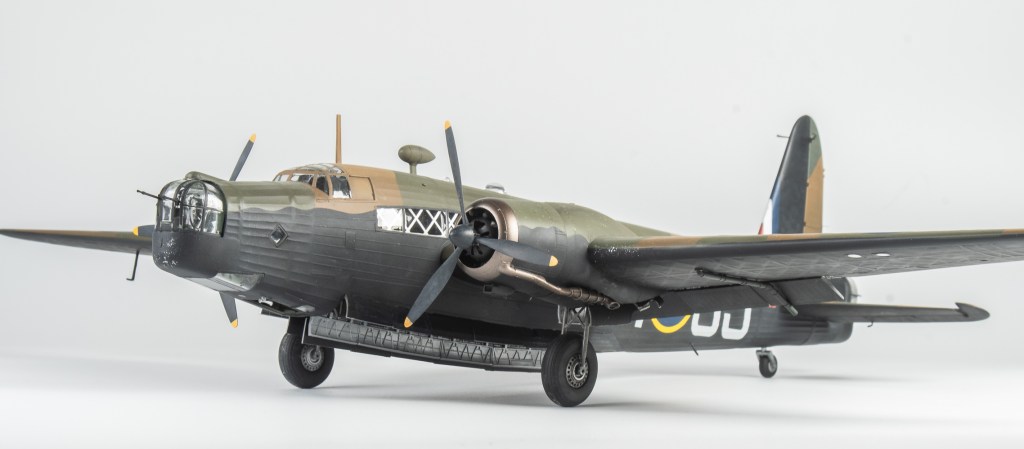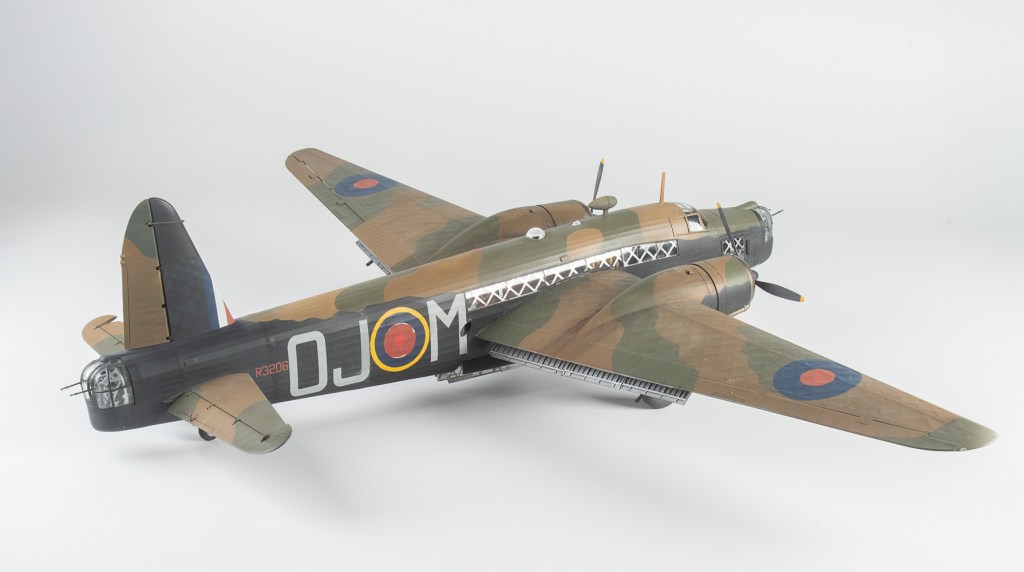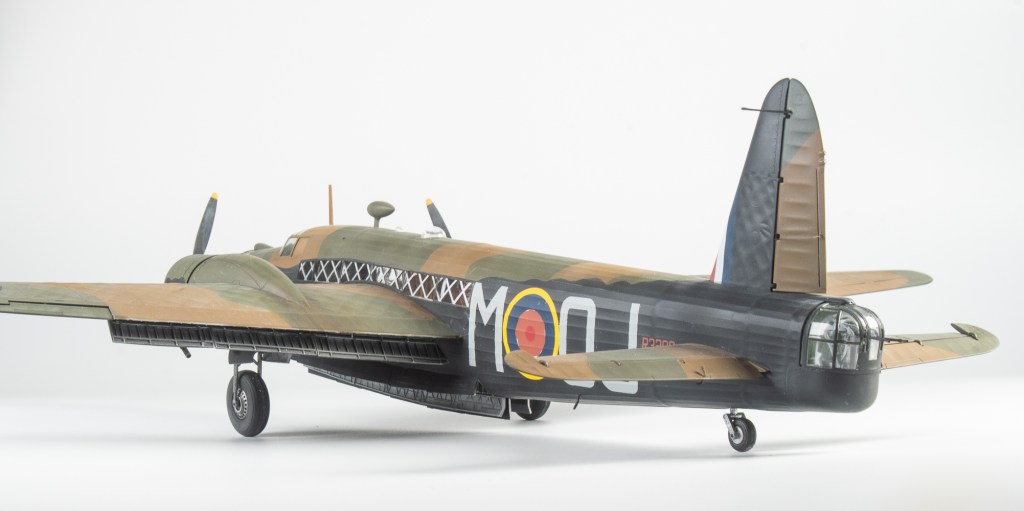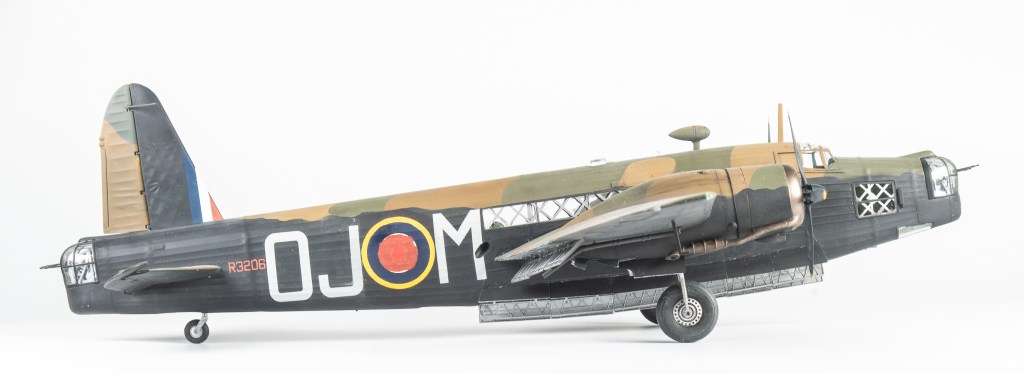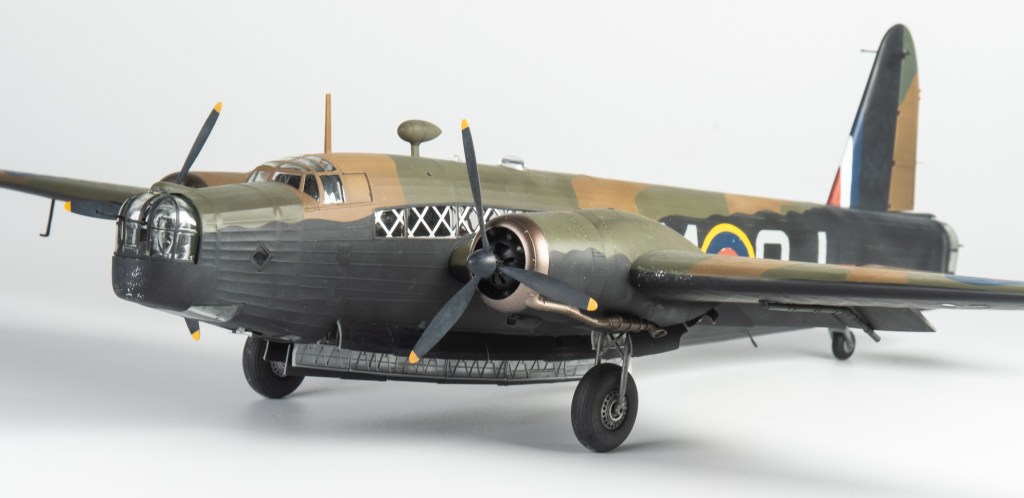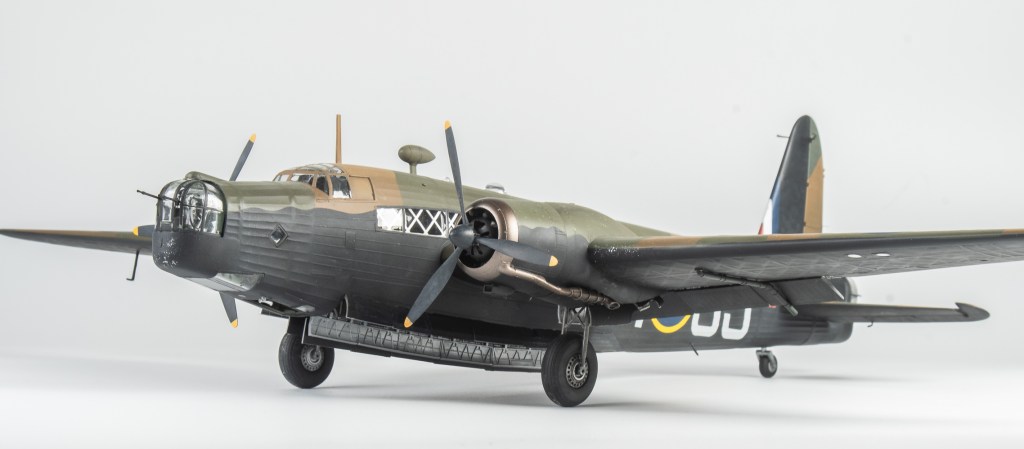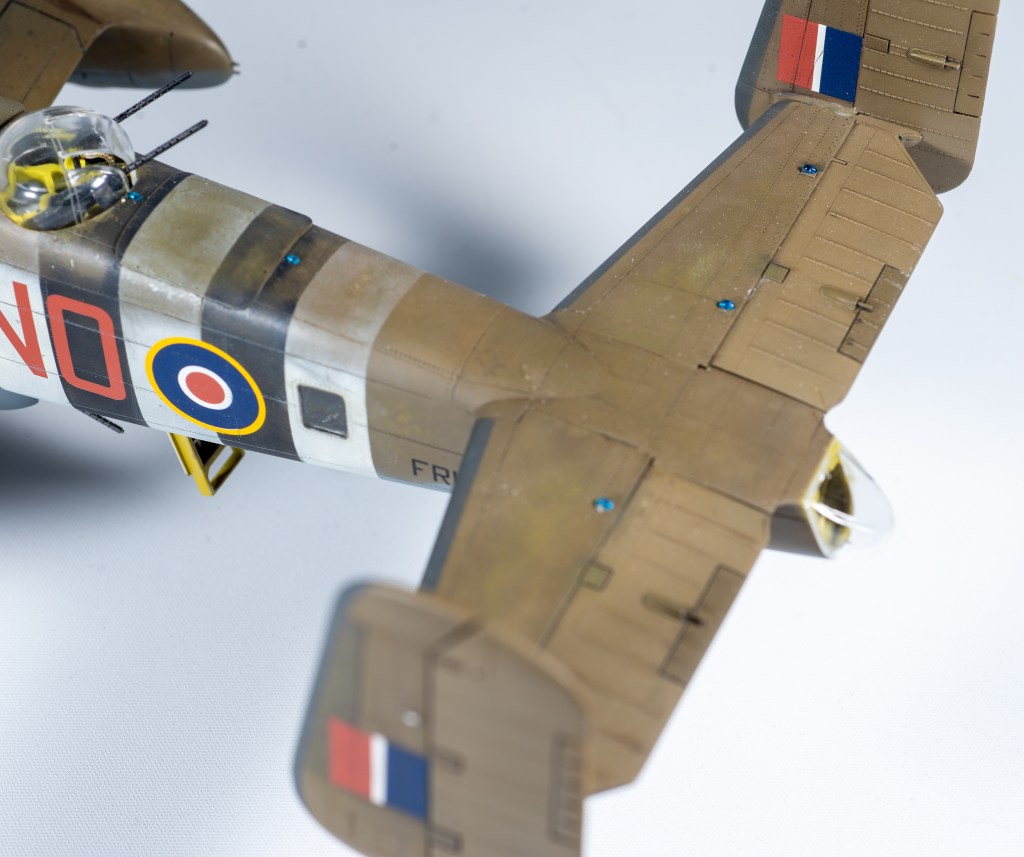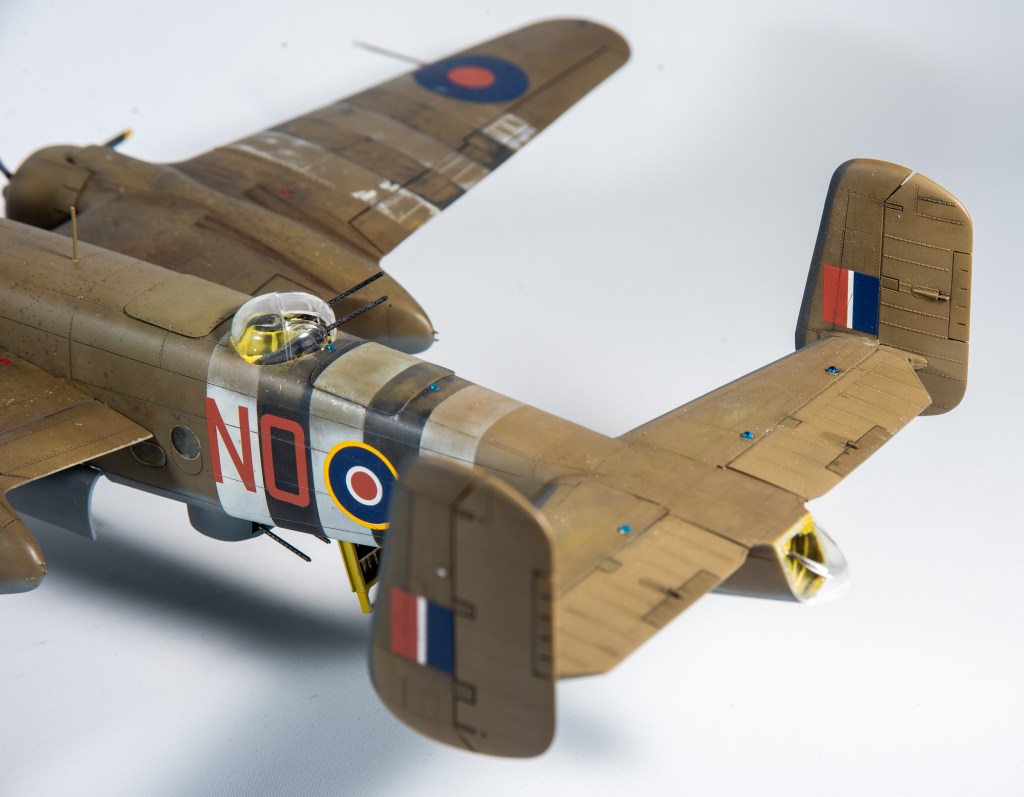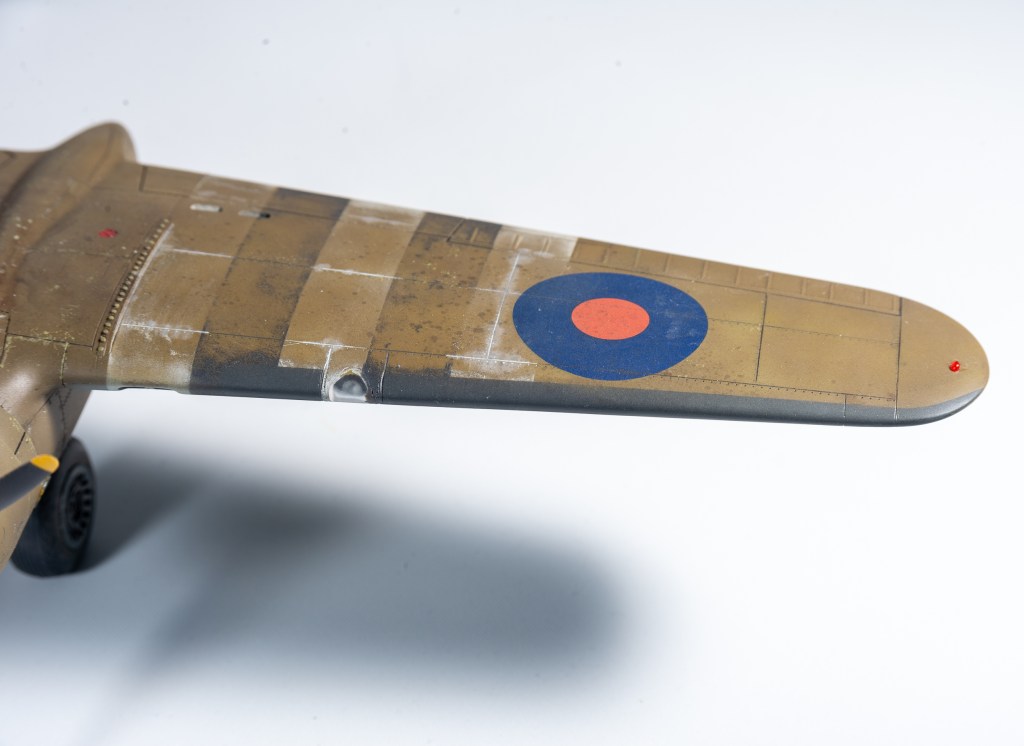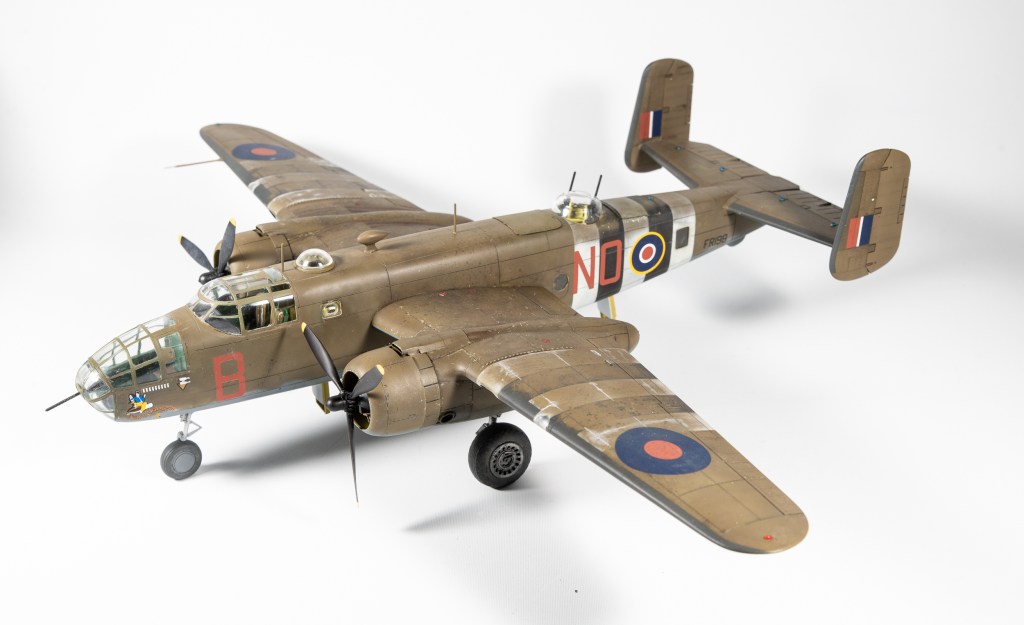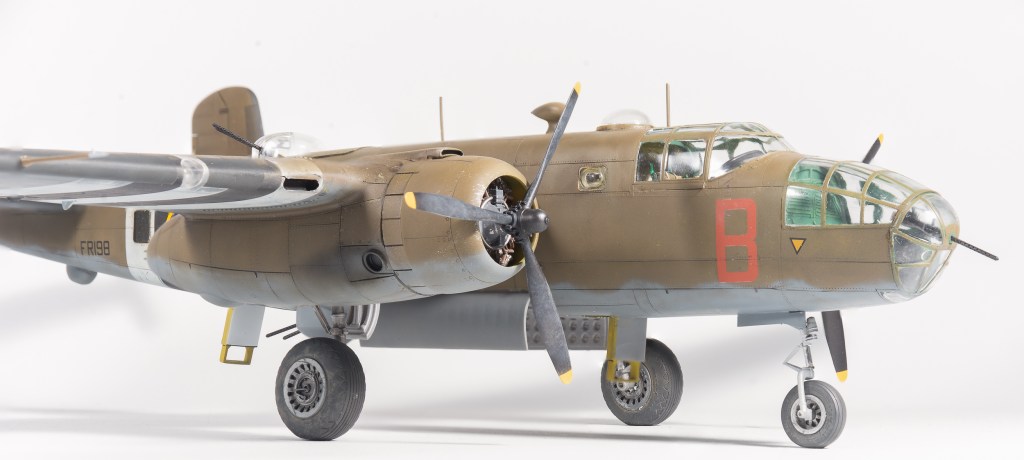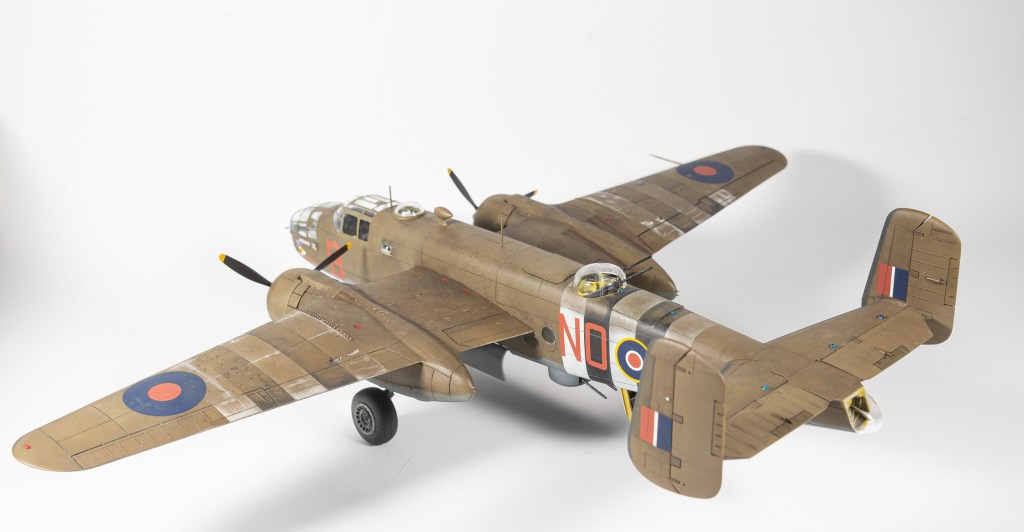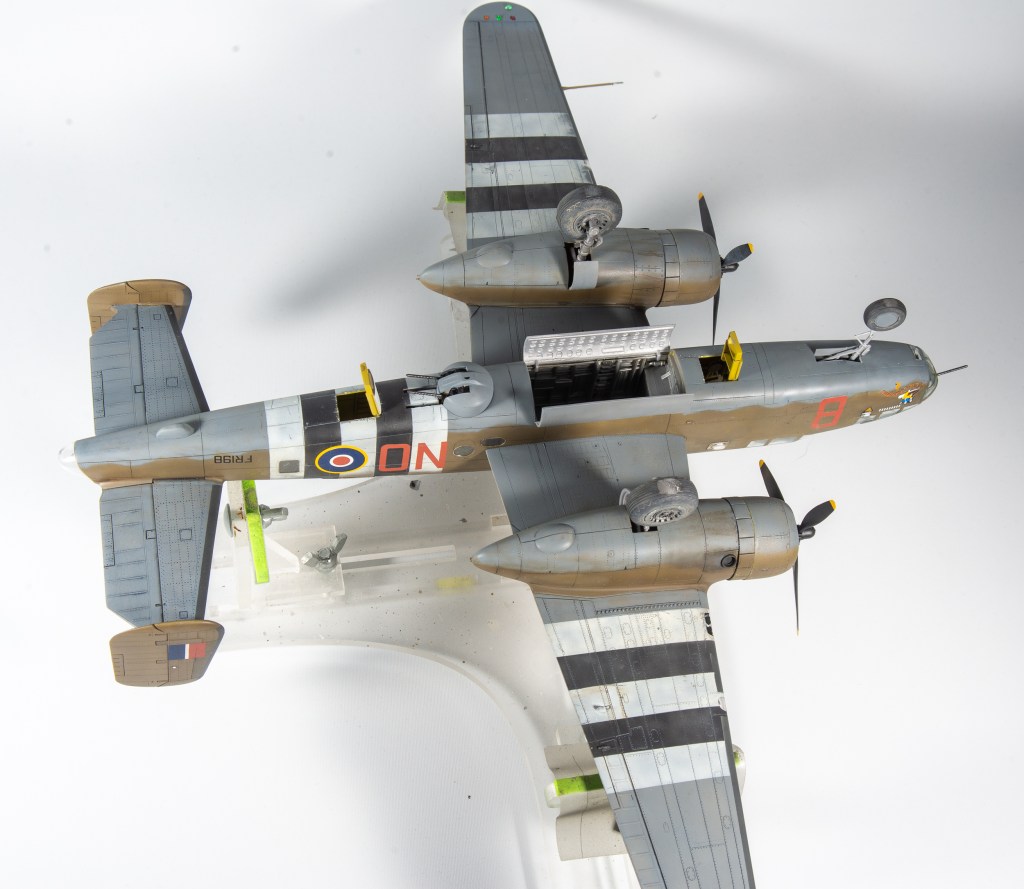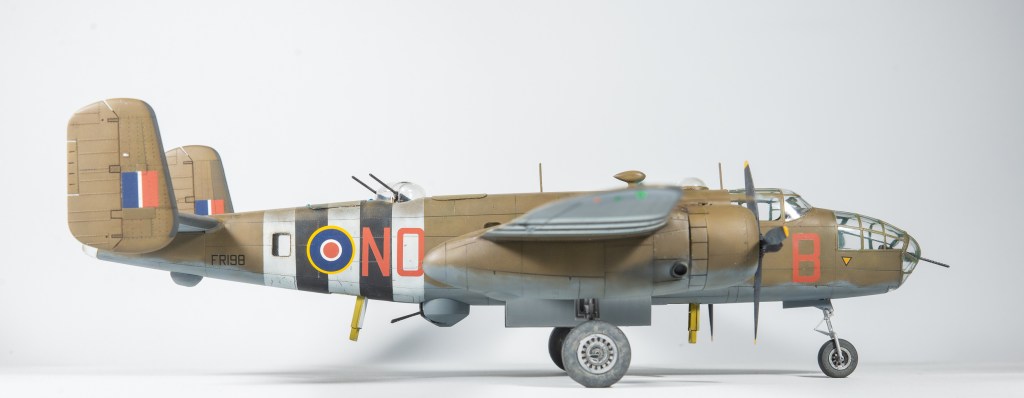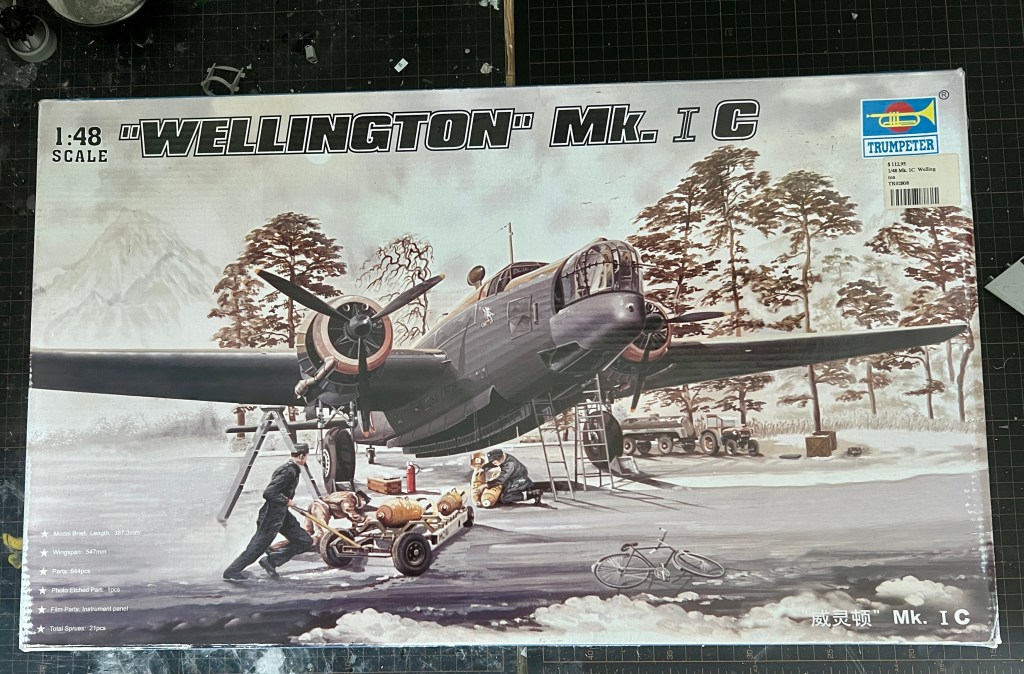
Trumpeter 1/48 Vickers Wellington Ic

  • Purchased; 2016
  • Completed; 2025
  • Enhancements;
  • Gun barrels. Master Details
  • Flaps- Brengun
  • Fuel Dump Pipes – Quickboost
  • Decals: Xtradecals

I remember being quite excited at the news that Trumpeter was releasing this, as it filled a major gap in 1/48 RAF WW2 subjects. Its not a kit that has graced many competition tables or on line sites though, so that to me tends to indicate not many are getting built, perhaps as its a sizeable model once done.

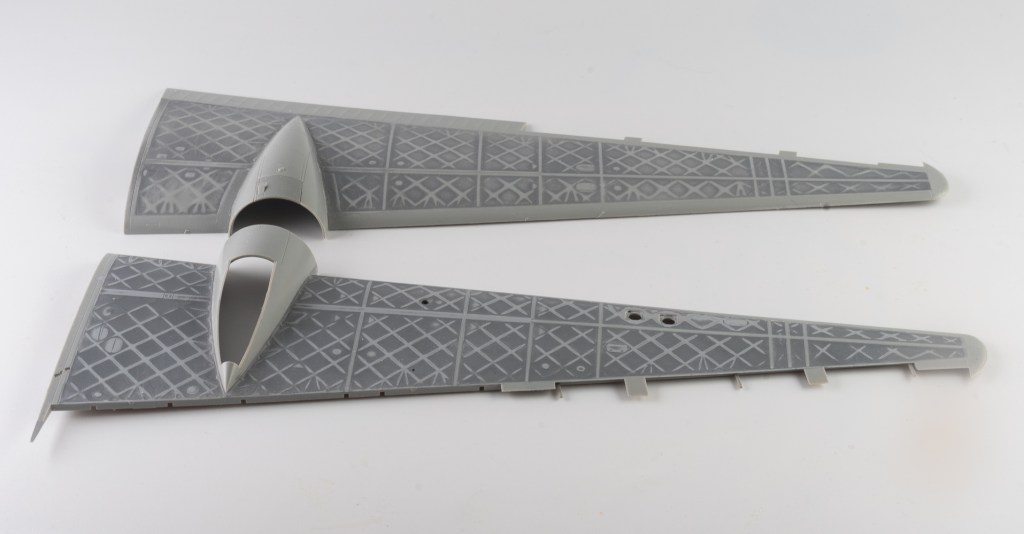
Accuracy wise, it suffers from a too narrow undercarriage and very overstated surface textures.The undercarriage I could live with, the surface detail though had to be reduced. There is a reasonably complete interior, albeit somewhat simplified, that pretty much gets hidden away once the fuselage is closed up. Fit for the most part is good, but the kit shows its age as one of Trumpeter’s earlier releases with the parts not as sharply moulded as some of their later releases, and also exhibiting fine mould seams along mating edges. Perhaps the biggest plus of the kit are the THREE sprues of early RAF type bombs Trumpeter includes to load the bomb bay with various types of bombs. Transparencies are lovely and clear, but the decal sheet, as per usual with Trumpeter RAF subjects has markings with colours that are far too bright.

Construction

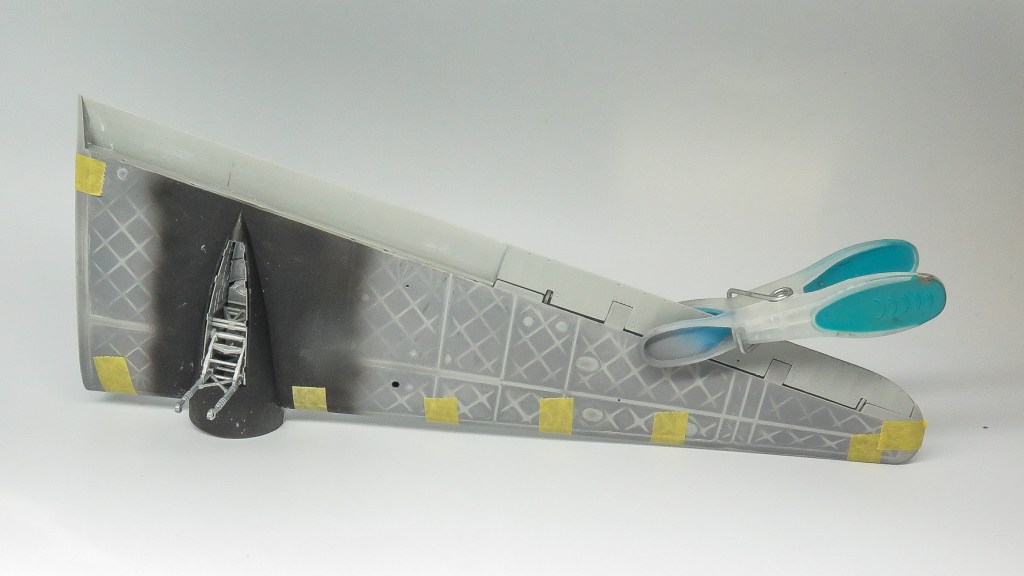
Even before construction started, several thick coats of SMS surfacer grey to the wing and horizontal stabiliser parts. Once dry, it was rubbed back until the kit surface detail showed as bare plastic . After being repeated a few times, the Trumpeter geodetic pattern had become somewhat subdued. This probably could have been taken further as it shows as quite subtle in photos, but I chose to leave it as was.

The colour call outs in the instructions were disregarded as mine would be an early war bomber and research on Britmodeller had uncovered more correct colours.

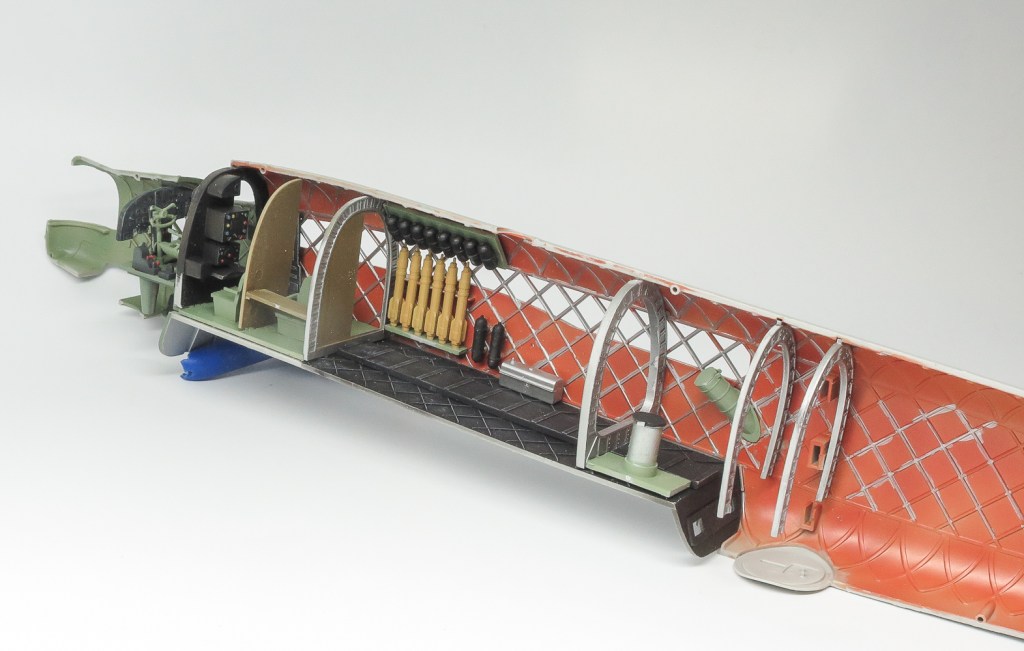
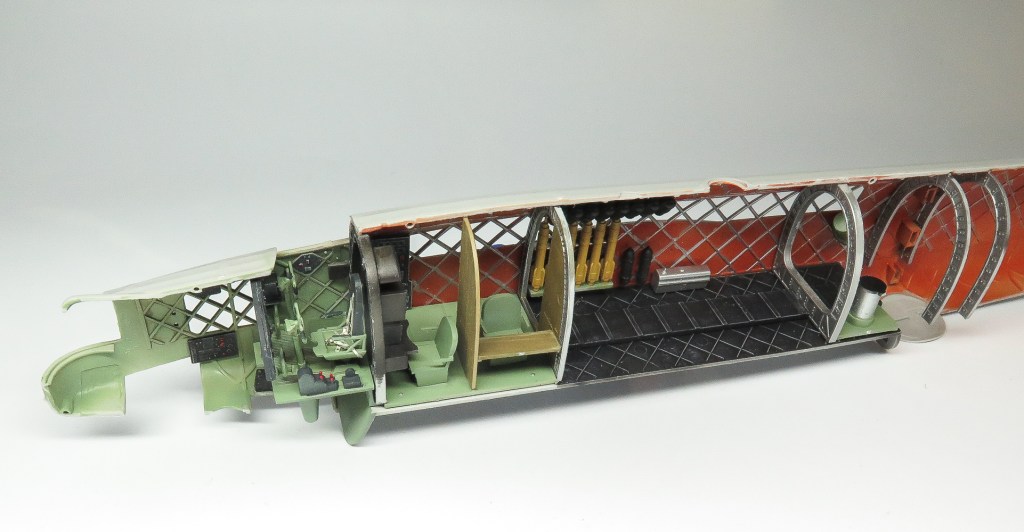
So on my kit, cockpit is RAF grey green as is the bomb aimers position. Mid fuselage is a brick red colour with silver framing. Floors are black. Bomb bay interior and insides of doors are silver.

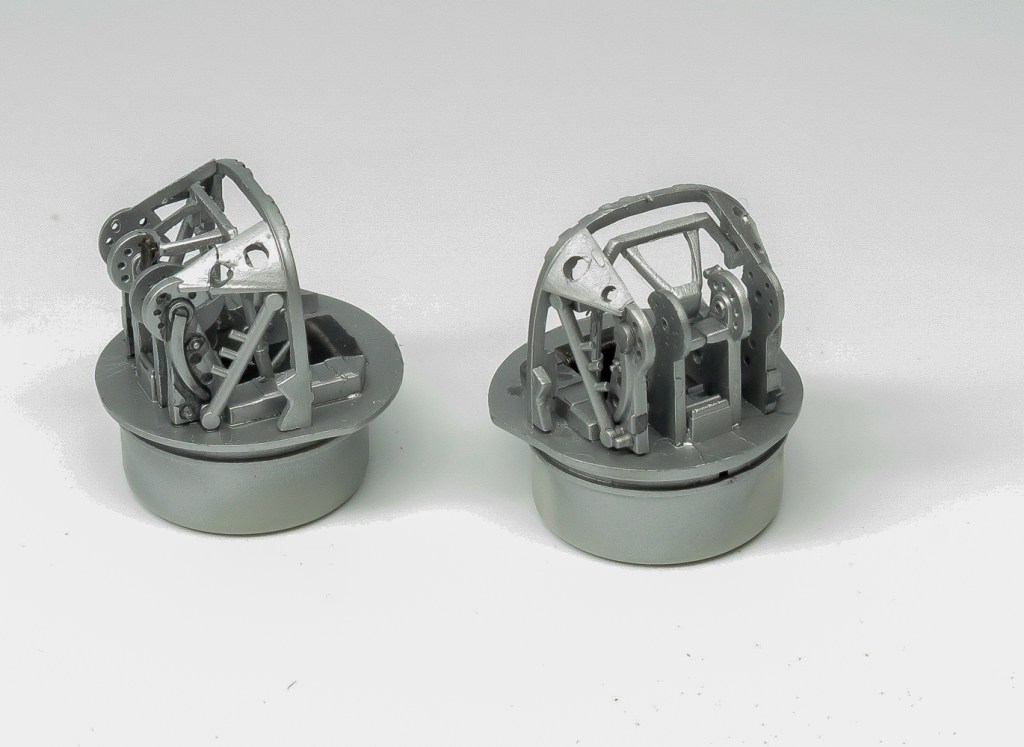
Turret interiors are also silver. Black turret interiors seem to have come later after the RAF doctrine had changed to night bombing.

I would recommend that the turrets complete with guns are built as a whole rather than doing what I did, and leaving the guns out to be added later. This resulted in me having difficulty aligning them. The kit barrels were replaced with brass items at final assembly.

Aside from the ventral turret and rear ammunition runs, the complete interior was assembled , although not a lot of effort was expended in painting it as very little can be seen. Don’t forget to paint the underside of the front turret as this can be seen through the bomb aimers window. Trumpeter have not included a bomb sight, so one will have to be scratch built should you desire.

The engines assembled fine, just ensure you double check the instructions to ensure the parts are correctly orientated. Don’t bother with after market engines as you can see very little of the completed engines.

Why Trumpeter made the wheel well interiors from PE, is a bit of a mystery to me, but they must have been made by Bluescope Steel! Have fun removing them from the frets! I also took the precaution of drilling all the holes out so that the landing gear assembled easily. Apparently the wheels and therefore struts are too narrow., not something that bothered until me until found out, then it did!

Back in the day when this kit was first released CMK did resin wheel wells for it, but these have long since disappeared from shops (as has most AM for the kit). The kit rubber tyres needed to be dunked in boiling water to soften them enough to conform to the rims. Although I did have Brengun resin wheels, they were even narrower than the kit wheels so were not used.

The only major construction issue faced by me was, when locating the bomb aimers window, it was found to be wider than the fuselage cutout. This must have been me as the rest of the transparencies fitted like a glove. In the end a piece of clear CD cover and a shim were used to bring out the fuselage to match the bomb aimers window.

If you are reluctant to test fit the wings fearing, like the Tamiya Mosquito, they will never be able to be removed again, don’t be. The wings are a very sloppy fit, and hardly a friction fit to the support boxes, so can be slid on and off with carefree abandon. To attach these, you are best off using epoxy glue , ensuring the wings are level to get a nice solid fit. There were no gaps on my kit . The PE ?cable cutters were left off my kit as I could not find any photos of machines with them fitted. My references were the 4+ book and images from IWM website.

The Brengun flap interiors fitted nicely into the kit flap wells, once the required material had been removed. I do wish these companies though would engineer the flaps to fit far more solidly. Small glue contacts areas such as PE hinges just don’t cut it.
Painting and Decaling

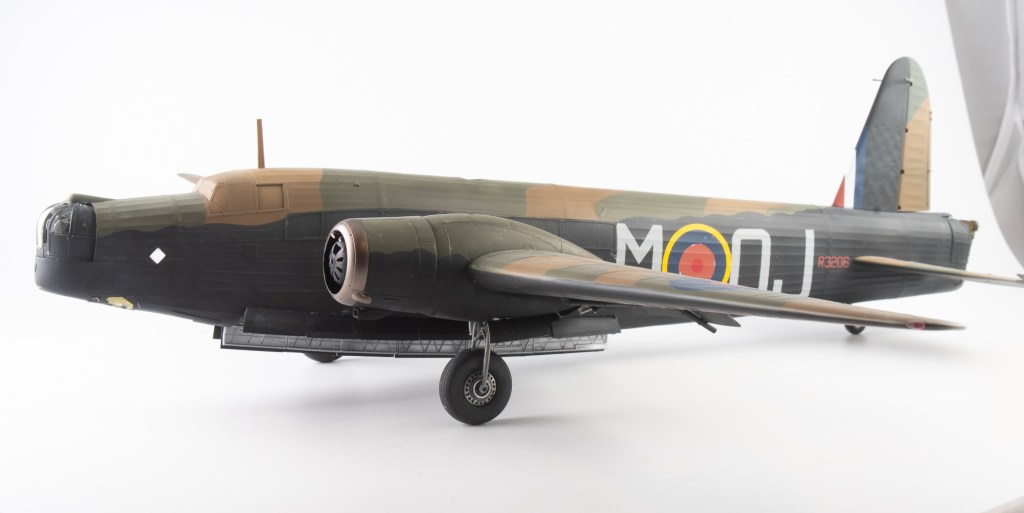
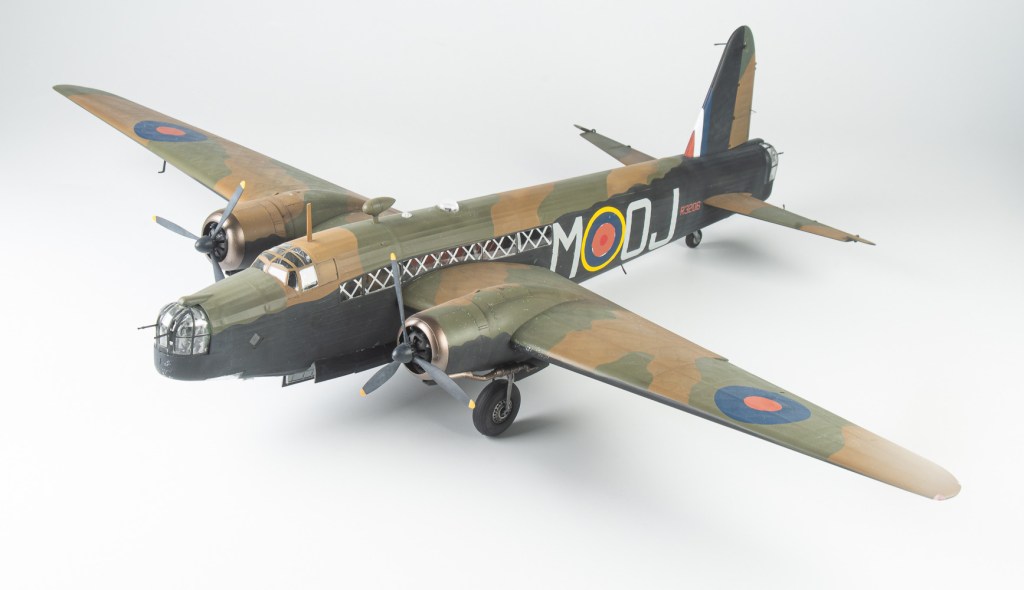
From the start, my Wellington was going to portray an early war bomber to pay homage to these early Bomber Command crews that starting taking the war to Germany just a few days after the Declaration of War. An early war scheme of overall DE/DG almost won out, but the toned down roundels on the Xtradecal sheet really appealed to me, bringing home these early attempts at toned -down markings, plus it had an early fin flash, replacement rudder and those lovely large codes. What’s not to like there?

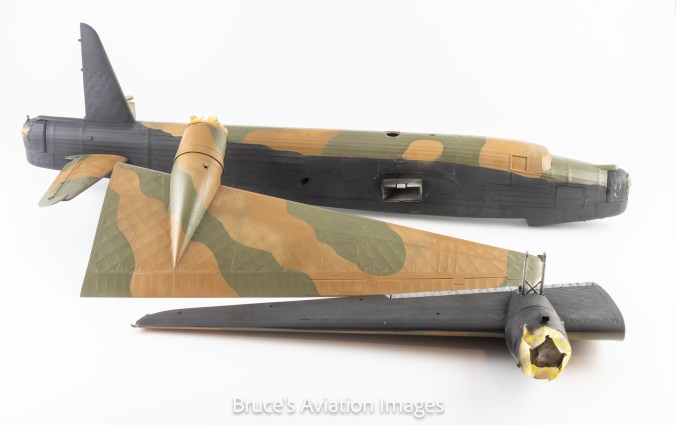
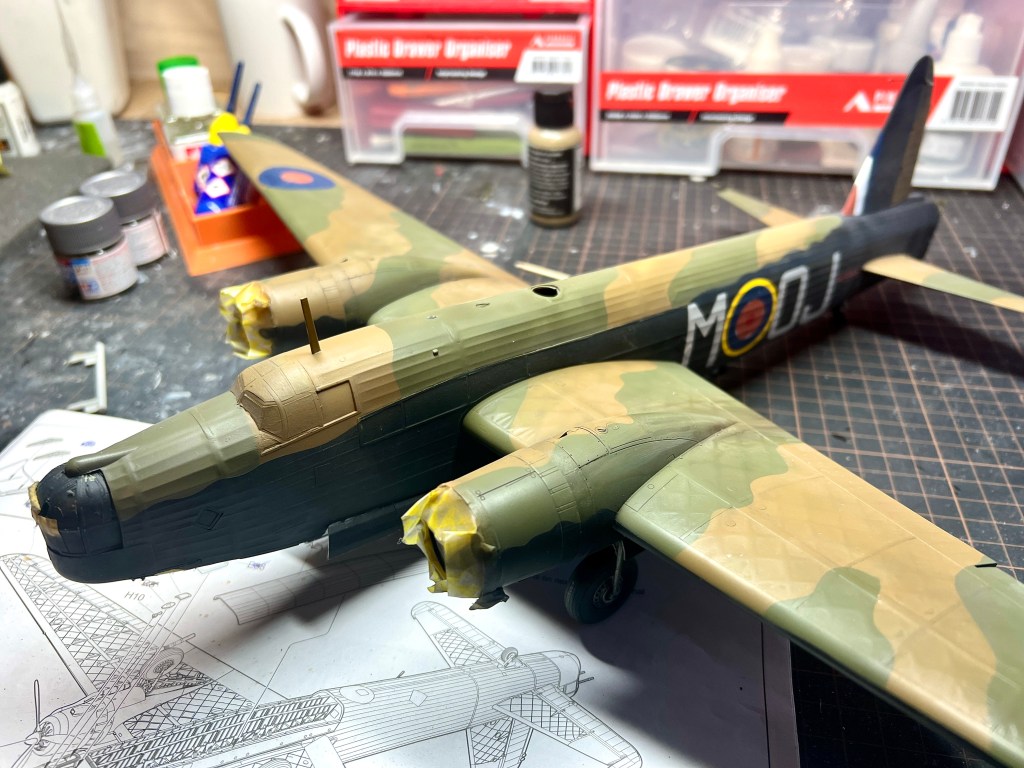
SMS Camo black is my favourite black these days, having a warmish brown tone to it. Over this was sprayed various shades of greys and other blacks such as NATO and Rubber Black. This was done through two different splatter type masks. Not forgetting to also do the flaps and bomb bay doors at the same time

For the top sides, LF camouflage masks were used with the Dark Earth being SMS, and the Dark Green GSI Gunze.. Darker and lighter shades of these colours were used to break them up. Oil paints were used to depict oil leaks and staining trailing back from the nacelles across the wings. AK Starbay sludge was used for this. A shade which in retrospect is far too browny -grey . I should have used black or Sepia

The Xtradecal decals performed well. As they are printed by Microscale, they really only needed the mild micro products to settle into any detail. As I had nil micro sol, I used Mr Setter, which was far too hot and damaged one of the roundels. It was repainted with a mask created on my silhouette machine.

Final assembly consisted of bringing the various components together and adding all the fiddly little details such as gun barrels, flaps, propellers and aerial mast. Oh! And the 30 separate bomb bay doors.
Conclusion

It’s a large model!

In the main, it was a fun build, let down by the very exaggerated surface detailing and some strange engineering choices such as the requirement to fit the turrets before closing up the fuselage

That aside, it was an enjoyable build, and most likely the only 1/48 Wellington we are likely to see, although back in 1975 we all thought the Tamiya Lancaster would be the only 1/48 Lancaster we would ever see!

The Wellington has a lovely quaint ungainly look, belying it being one of the mainstay bombers of the RAF throughout the war. Im looking forward to the ICM Hampden joining it in the cabinet to represent Bomber Command in the first year of the war.

Vickers Armstrong Wellington Ic 149 SQN R.A.F Mildenhall UK 1940
Leave a comment

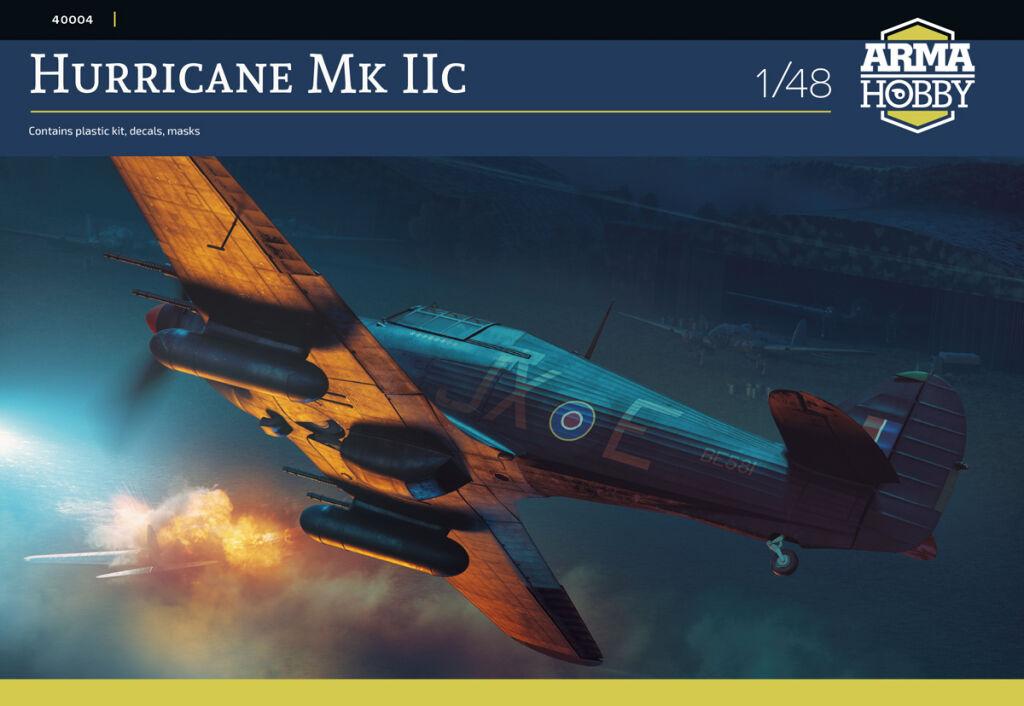
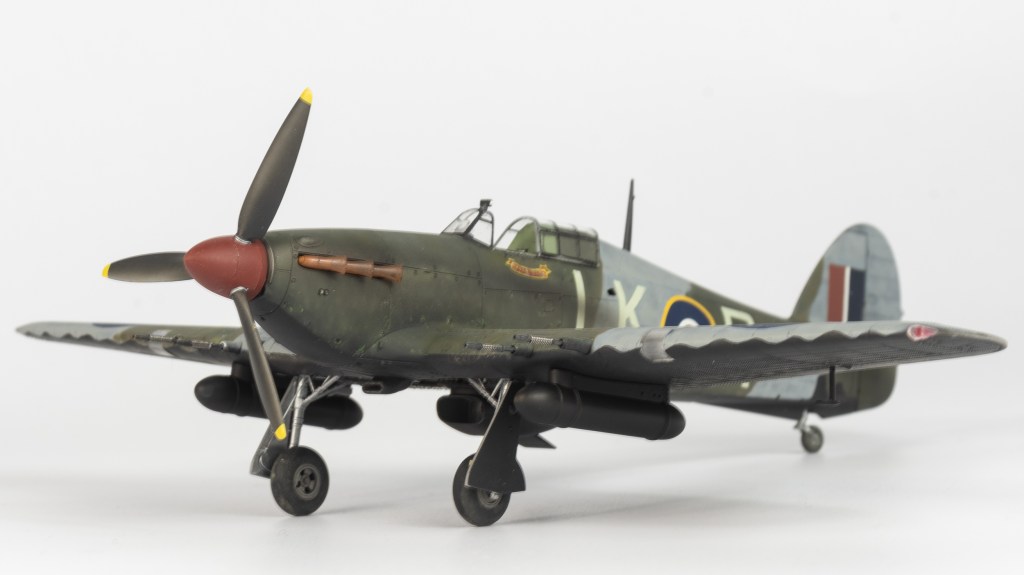
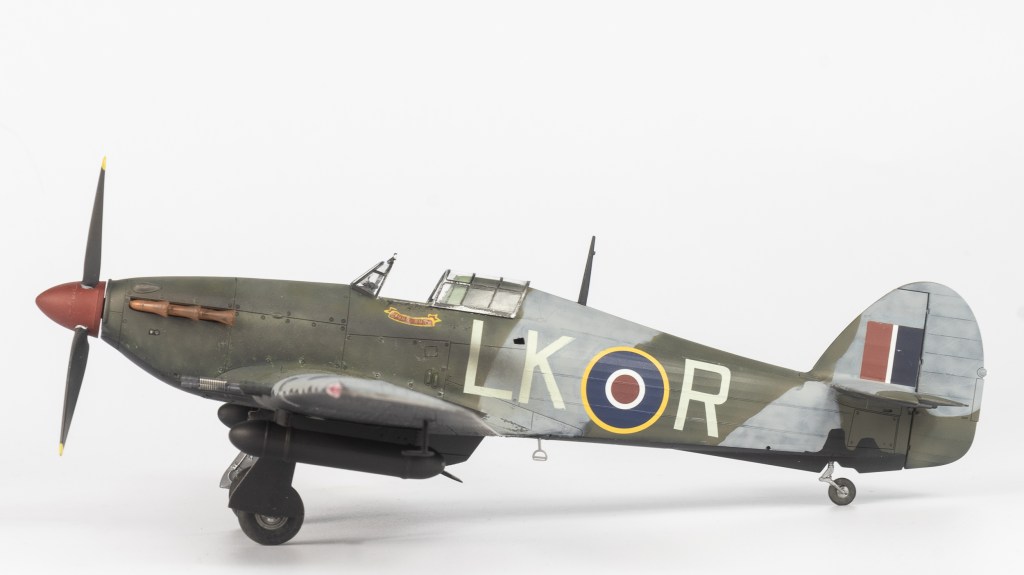
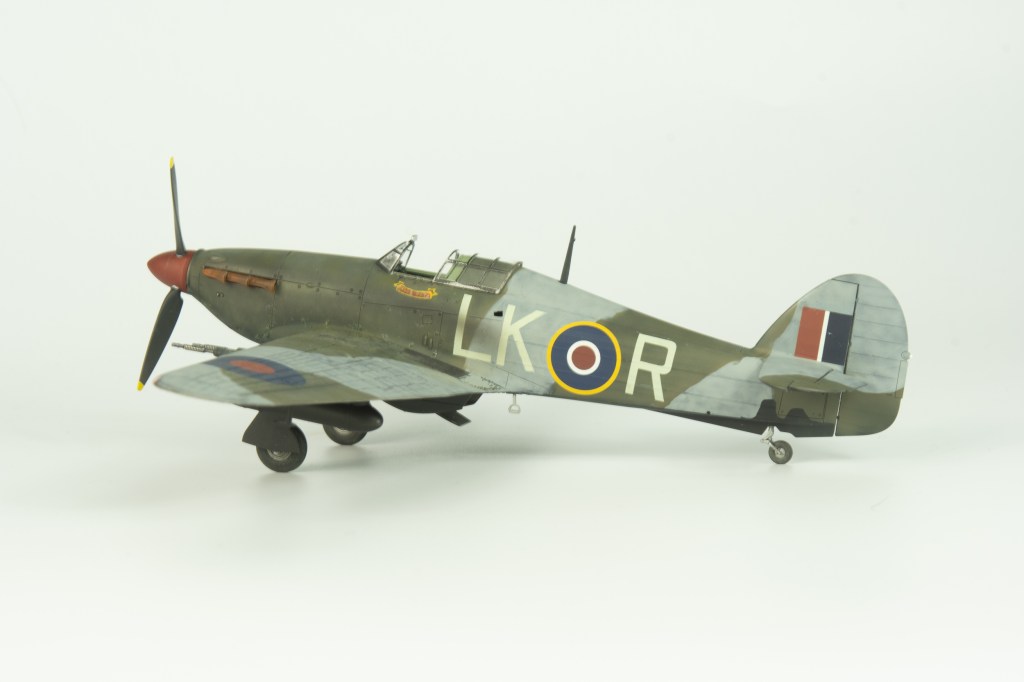
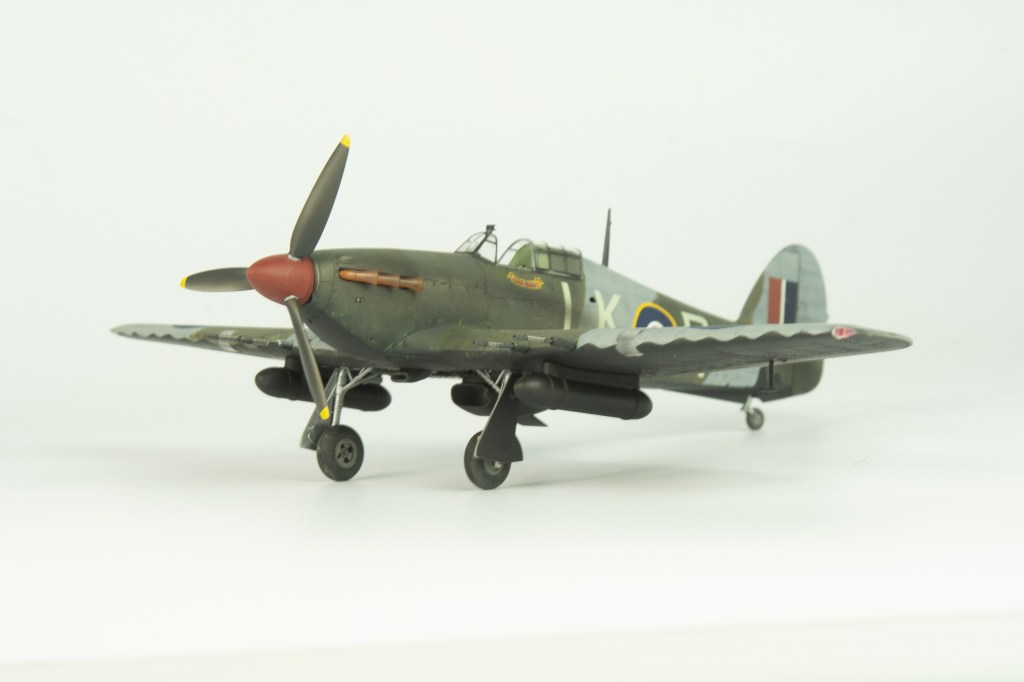
Arma Models 1/48 Hurricane MkIIc

  • Purchased; 2023
  • Completed; 2024
  • Enhancements;
  • Guns; Master Detail
  • wheels ASK distributors
  • Decals; Eagle Strike Night Hurricanes Part 1

Introduction

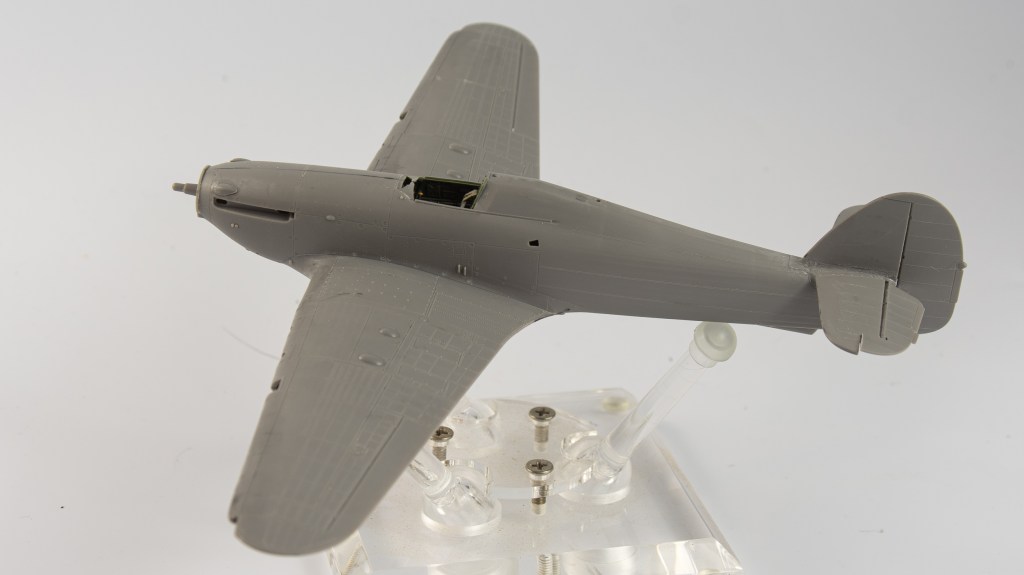
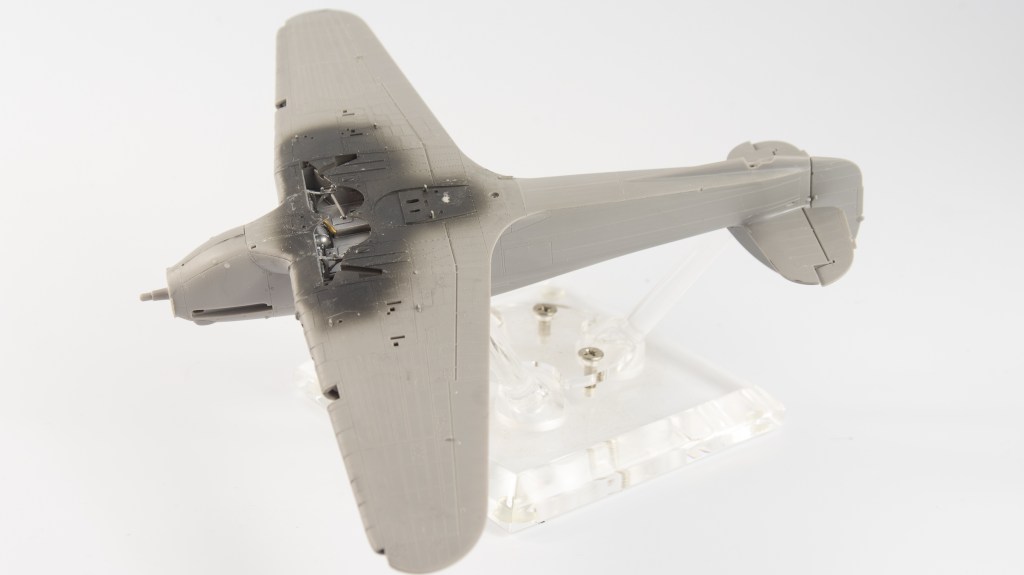
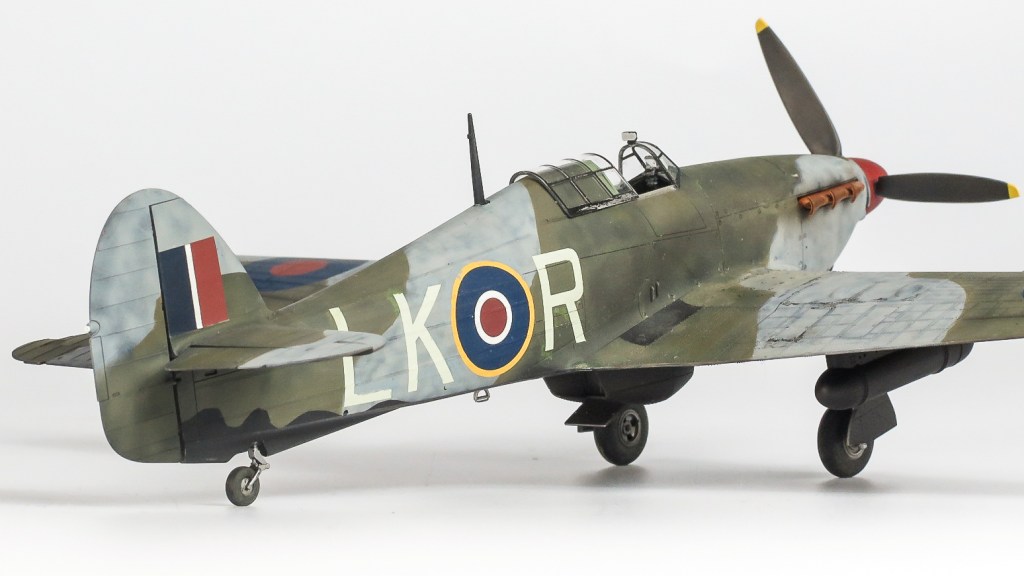
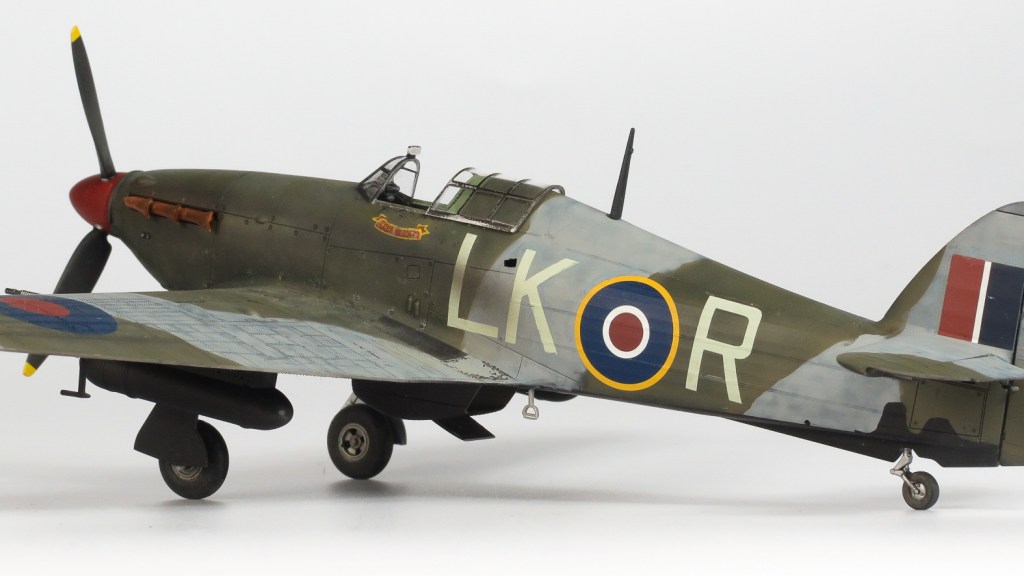
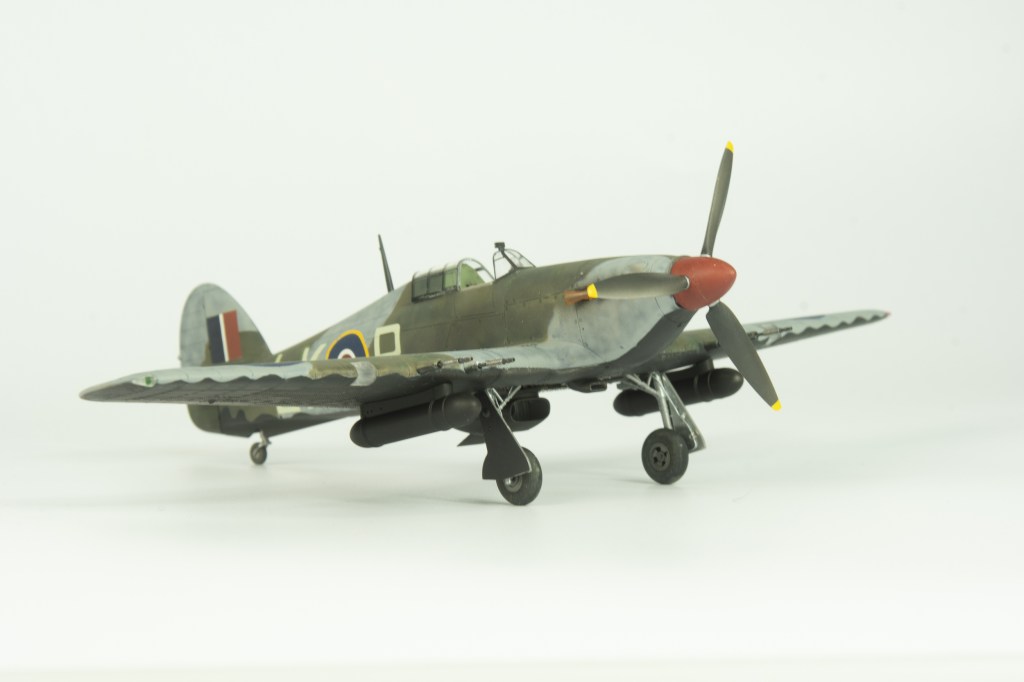
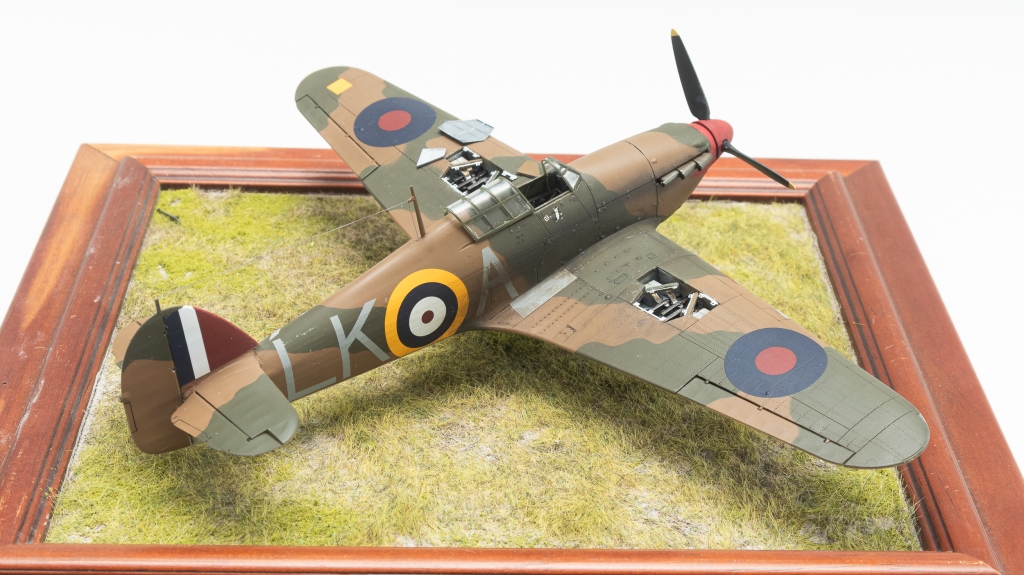
The Arma Models 1/48 Hurricane was the perfect antidote to the preceding Walrus It is a lovely fitting, well detailed model that builds up very quickly. the surface detail is some of the best out there, Arma using both raised and recessed detail to achieve the multitude of rivets on the wings. The fabric surfaces are not overdone, also being rendered subtly. Heres hoping Arma follow it up with the Mk1.

Construction

Really there’s nothing that I can add here that the many YouTube builds of the kit don’t already cover. The cockpit whilst being a little fiddly to clean up fits perfectly. It even clips into place without the need for any glue, although obviously you do need to use glue. For one thing, your seat will fall out! Talking about the seat, the kit one is a little thick, my boxing came with a lovely resin item, making the kit seat redundant. Same for the exhausts.

Some further thoughts;

Be precise cleaning up all sprue stubs , ensuring all mating surfaces are flat as this determines how much filling you will need to do.

If you are fitting the drop tanks, you can dispense with filling the shell ejection ports as suggested by Arma as the drop tank pylons cover the holes that need filling

Added details,; Obviously this is entirely up to the individual modeller how far he goes with adding all this, but Id suggest, at a minimum, the radiator bracing, upper nav. light, brake lines and rudder control lines although only the prominent brake lines were added to my model. I did open up the slot in the rear armour plate to allow the shoulder harness tail to fit through.

When choosing a particular airframe to model, check such details as round or rectangular rear view mirror, cockpit ventilation slots present or not, glare shields fitted or not and IFF aerials as these details varied greatly from airframe to airframe. As an example the aircraft I modelled had the cockpit ventilation slots fitted and no glare shield whereas other planes in the same Sqn did not have the slots or had the glare shields. Photos are your friend, and for RAF Aircraft, Flickr and the IWM website are the first places I visit. If I have any questions, Britmodeller will usually have the answer.

Finishing

A mate of mine, being Kiwi likes to finish a lot of his WW2 aircraft as aircraft that were flown by NZ pilots. Obviously he can’t do this with modern day subjects as NZ don’t have an Air Force of note anymore ( Sorry all my Kiwi followers, Im assuming you all have the same sense of humour as my mate that requires you to keep on kicking that dead horse until its completely lifeless!!)

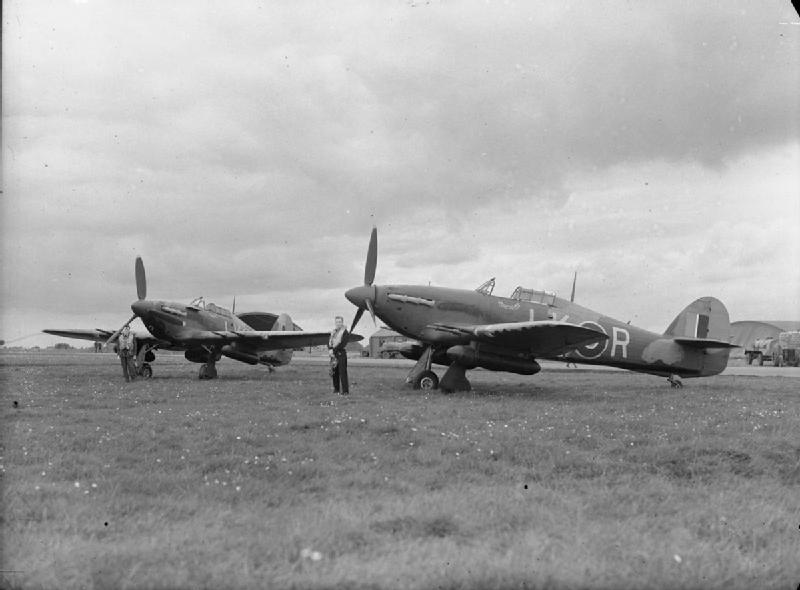
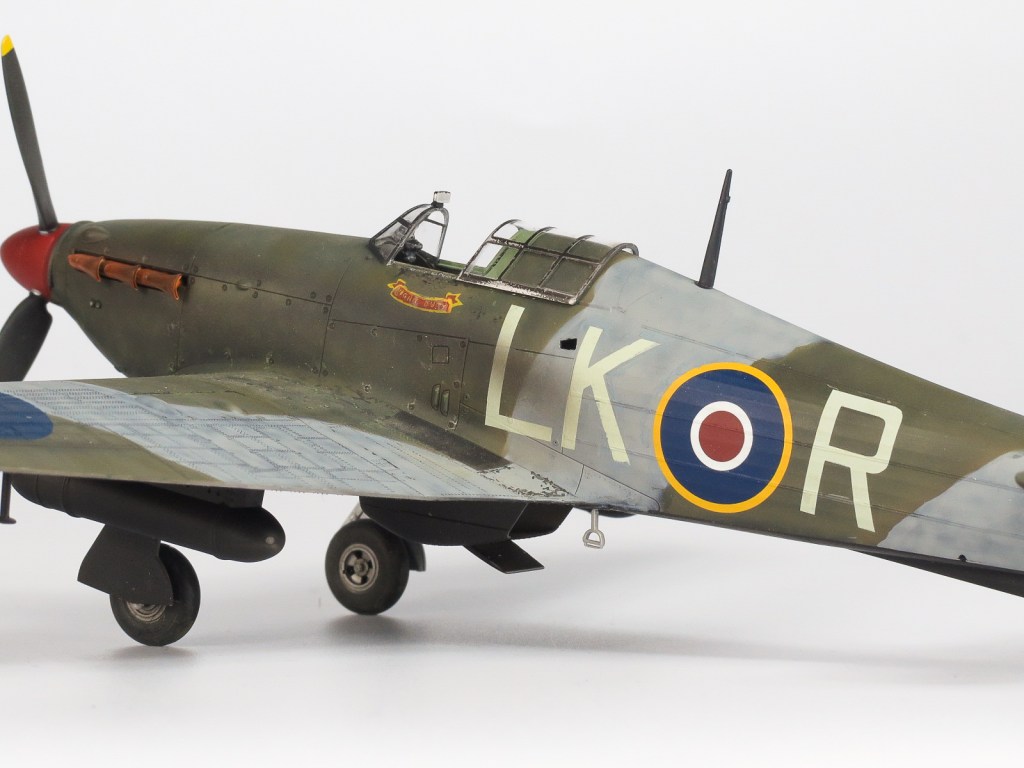
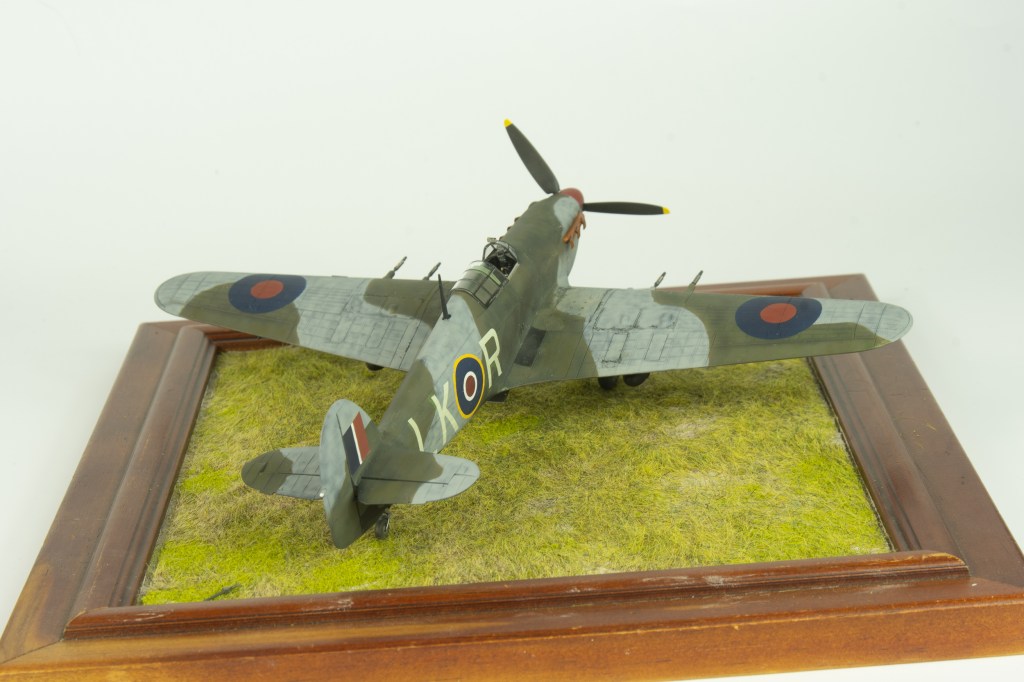
So when I found an 87 Sqn, machine that was flown by an Aussie, Sgt B Bawden from Sydney, I decided to take a leaf from Calum’s (rather thin) book. My model was always going to be finished as an 87 Sqn machine so an Aussie pilot was the icing on the cake. Of course there were no available decals for Sgt Bawden’s machine in 1/48 scale meaning the scroll and NIGHT DUTY title would need to be hand painted. The below photo shows the actual machine, and Yes, I keep referring to aircraft as machines because thats how Biggles referred to them !

Researching the 87 Sqn machines revealed they were a Night Intruder Squadron, with overall black aircraft, however as the aircraft were required for daylight missions over the Dieppe beaches to support the landing their top surfaces were hastily painted with brushes in the temperate land scheme which at that stage would have comprised of mixed grey, (not Medium sea grey as Ive used) and dark green.

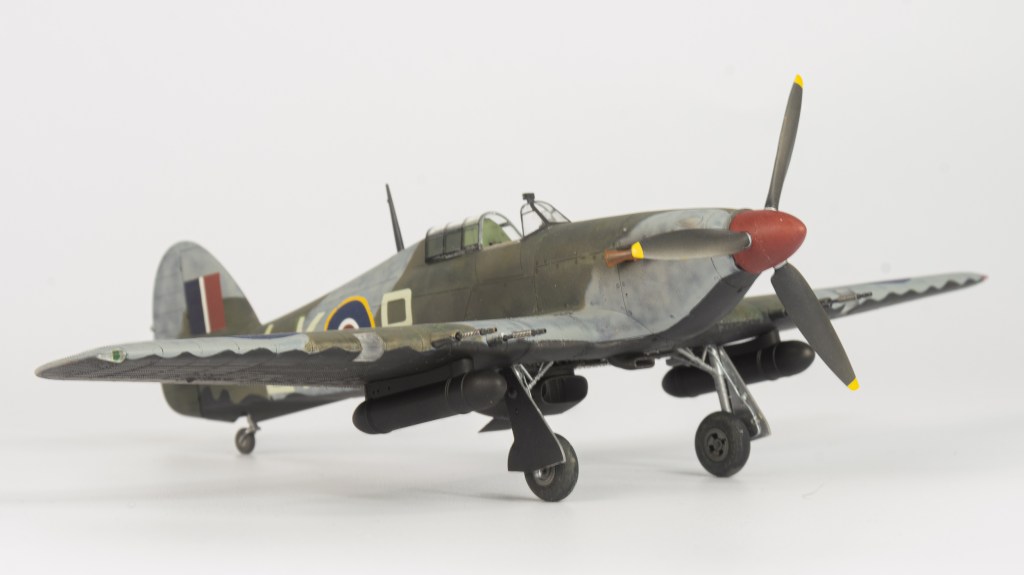
To achieve this rough look the model was first painted overall black, then a very patchy coat of MR Paint MSG applied by airbrush. Panzer putty was then used to mask off the grey areas and the green applied, this time using Gunze . The demarcations o these aircraft were not standard and differed from machine to machine.

There are some excellent articles on Britmodeller regarding these schemes, well worth a read if you love getting into the minutia of these things. It appears on this particular aircraft, the green covered the black quite well, but the grey, not so much. The plan was to brush tamiya MSG around the codes to emphasise the brush painted nature, but of course, I didn’t have any.

The wing roundels were sprayed on using masks from Hawaiian Air Depot https://www.hawaiianairdepot.com/shop/p/coming-soon-87-squadron-hurricane-night-intruders-for-the-148-arma-mk-iic

The rest of the national insignia were from the kit decal sheet. Codes came from a generic Xtradecals RAF code sheet. Colours for the wing roundels were Tamiya Flat Red mixed with a bit of Hull Red until a matt with the decals was achieved. The blue was Royal Blue with a few drops of Flat Black.

With regard to the HAD masks, I thought a real shortcoming with the set was no masks for the underside demarcation. Aircraft from this squadron had quite distinctive wavy demarcation on the empennage, and HAD should really have included these on their otherwise very complete mask set as its a unique feature of these schemes

That just left the scroll. The Eagle Strike Night Hurricanes Part 1 sheet contains a red scroll of the right size, but it reads – actually I can’t remember what it reads, but it certainly wasn’t NIGHT DUTY!. Underneath this red decal, the modeller applies a slightly larger white decal which allows the white border and lettering to appear.. Current sources suggest the scroll on Bawden’s aircraft was red with yellow border and lettering.

This was achieved – after a night of thinking about it in my sleep – by cutting out the underlying scroll shape from yellow decal using the Eagle Strike decal as a template. this only took 4 goes!

The lettering on the red scroll was painted out and I found some tiny tiny yellow decal letters to spell out Night Duty, as you can imagine, these were incredibly difficult to apply and I resorted to (untidily) brush painting the I and Y

No one seems sure how long these aircraft stayed in this scheme so I went light with the weathering. Just some black chips around access hatches and wing roots and exhaust stains as evident in the photos. The chipping on the canopy was achieved with the hairspray technique.

The exhausts were painted an orangey colour as the real things were coated with a paint that reduced glare, hence why this particular machine is not fitted with the glare guards./ Feedback from a couple of modelling friends led to me darkening them up as my mates felt they were too orange. They were shaded with a black brown mix, which I feel does make them look better. They are 3D printed by ARMA and have incredible detail. Far and above better than the kit offerings.

Conclusion

The Arma Hurricane is highly recommended. Although Arma market the IIc and IIc Trop as separate boxings, all the IIc boxings come with the parts to make a tropical or Night Fighter, so it doesn’t really matter which boxing you buy unless you are after one of the particular kit schemes. The only thing I wish I had done differently was use a mixed grey rather than the Medium Sea Grey for the camouflage.

This was a thoroughly enjoyable kit and I have already ordered a Sea Hurricane and a IIb . As Molly Meldrum would say ” Do yourself a favour”

Hawker Hurricane IIc 87 Sqn. RAF Charmy Down UK June 1942

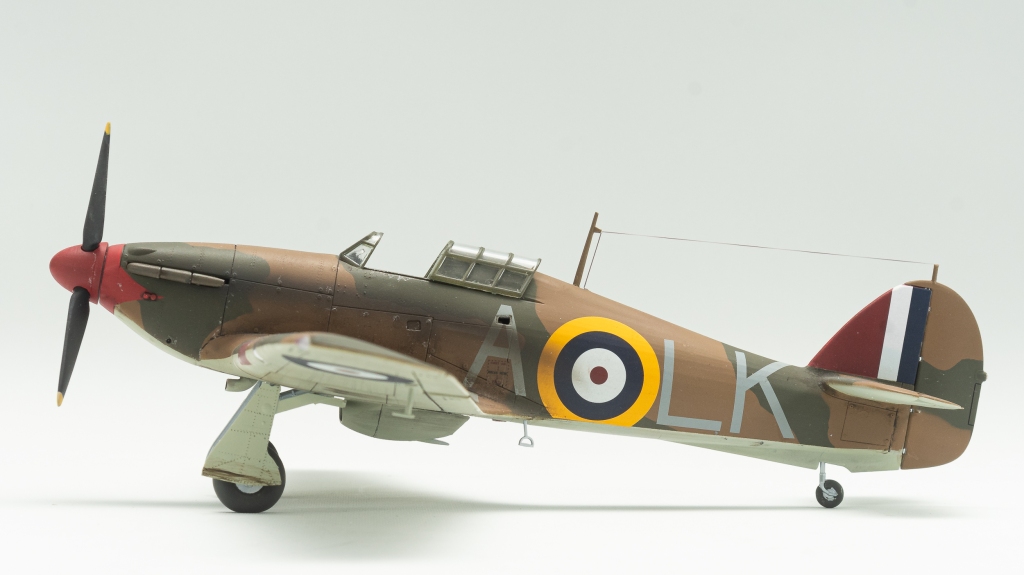
Airfix 1/48 Hurricane Mk1

  • Purchased; 2023
  • Built; 2023
  • Enhancements
  • Seat Belts; Eduard
  • Exterior details Eduard
  • Decals; Kit

What could be easier than an Airfix Hurricane to complete the years builds? A quick slammer, that should comfortably fit into the remaining three weeks of 2023. Well, only just as it turned out, with the EZ line being attached – the full stop to the sentence if you like – on the 29th December. PHEW! That was close.

Construction Notes

Judging by the many on line builds of the Hurricane, modellers either have an easy time ” took me back to my childhood memories of building models” or, its the kit from hell “the wing to fuselage join left gaps like the Grand Canyon”

My experience of the kit fell into the latter. Given the two extremes relayed by previous builders, Im still not sure whether it was the kit or me, although my lower wing half was slightly deformed out of the box, requiring gentle coaxing to meet the inner forward wing fillets of the upper wing parts.

I took particular care in ensuring all wing spars sat square, but still the wing would not fit snugly to the fuselage. Industrial type clamping was required! That said, with this, everything did close up quite tightly. Prior to this, the gun bay hatches were cut out so the nicely detailed bays could be displayed. A nice option on Airfix’s part.

It was here things sort of veered away from a quick build, as prior to closing the fuselage , the fuselage hand hold was drilled and cut out, but then things got crazy as the decision was taken to rivet the whole airframe. This was actually easier than first thought, although there were a few wavy lines requiring correction. The purpose of the exercise was to determine how involved it would adding rivets to the plain wings of the Revell 32 scale Hurricane. Overall, I feel far more confident now in adding detail like this.

Painting and Decalling

Gunze dark Earth and Tamiya Dark Green type 2, coupled with SMS Sky provided the classic British early war scheme. One of my favourite schemes, as evidenced by the growing number of models in my cabinet that wear it. The spinner colour and fin leading edge were matched to the decals using Vallejo flat red with a touch of vallejo cavalry brown. The kit decals performed without trouble, even the nose flash laying down over the nose drain detail with the aid of Micro set and sol.. Weathering was by way of Ammos PLW for brown and green camouflage. The jar was then binned as there was a ton of sediment in it that no amount of stirring would reduce. Binning it was also in line with my 2023 goal of consolidating my consumables. In future, my washes will be mixed from oil paints.

Stains ands other weathering was added with small dots of starship filth oil paint, then blended in with a dry brush. This is something I still very much need to refine though.

And That, as they say, was That!

Conclusion

Many modellers seem to have reported a trouble free build of the Airfix Hurricane. An equal number have found it a troublesome build. Further proof, that modelling experiences can be such an individual thing. I’m sure there will be other Hurricane Is along in 48 scale. Eduard and Arma are two brands that spring to mind that could potentially offer one, and if I make another Hurricane, it will be from these companies, rather than Airfix.

Thanks to everyone that has read my ramblings throughout the year, I hope that there will be many more in 2024.

Hawker Hurricane Mk1. 87 SQN Royal Air Force. Exeter England. August 1940

Leave a comment

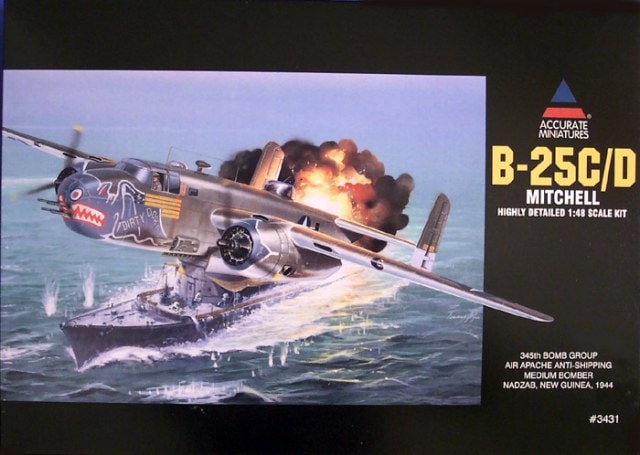
Accurate Miniatures 1/48 B-25C/D Mitchell

  • Completed: 2022
  • Enhancements;
  • Wheels-Reskit
  • Machine gun barrels-Master Model
  • Decals: Eagle-cals Dutch Mitchells
  • Formation lights– CMK
  • Seats-Quickboost

This is the second time I have tackled the AM Mitchell, the first one ending up in the bin, having never got to the painting stage, so Im very happy to final have a completed AM Mitchell in the cabinet, albeit not the first Mitchell to grace my shelves, having built the old Monogram B-25J about two decades ago.

My memories at the time of the A.M Michell was its fine engraved surface detail comprising rivets and panel lines plus fasteners, and its detailed interior, both features which garnered it praise in the modelling press at the time of its release. Critiques were too narrow cowl openings and a nose transparency which perhaps sloped too much in profile

Fast forward to this year and a third of the way into the build, my over riding thought was “this aint as good a kit as I remember”

The surface detail was in places shallow, rivets and panel lines were definitely not consistent in depth, fit was average, especially the nacelles and intakes, and transparencies were certainly not crystal clear.

The instructions I remembered being clear and informative did not really point out location points of some parts accurately, leaving the builder to guess on a couple of occasions. That said enough alternative parts are included to build a few different modifications of the B-25C/D Mitchell. The instructions helpfully pointing these out for the kit schemes. If you are doing another scheme though, as I was, you’re best off consulting images.

Construction Notes

I pretty much left the interior in the aft fuselage out as you will never see it. The kit pilot seats looked a little chunky, so were replaced with the quick boost resin seats, complete with belts. Rather than painting the rear interior yellow Zinc Chromate, I think I should have used a green chromate. The first hint of fit problems came with fitting the bomb bay, the rear bulkhead not matching the contour of the fuselage at all. A not insignificant gap had to be filled with thick plastic strip. This being an original A.M boxing, the brass shim nose weights were included, these being augmented with some small lead shot poured into a couple of crevices. This precaution proving its worth with the completed model still only just balancing on all three points.

Blast panels in front of and behind the upper turret were cut from thin card on my silhouette machine using the templates printed on the instructions. I still think they are a little oversized though. The ventral turret and guns were a sloppy fit, the soft plastic not helping, the glue join breaking several times. In the end I replaced the kit gun breeches with blocks of plastic strip drilled to take the brass barrels, this being a lot more solid.

The real fight came with the wings though. Whilst the nacelles were a reasonable fit to the undersides, they left large gaps and steps on the top of the wing, with the separate carberetter intakes not helping. These parts required multiple goes at filing, sanding and re-scribing. Just when I thought I was winning, I noticed plastic on the undersides of one of the wings seemed to be delaminating, sure enough, I could peel up flakes of plastic. More supergluing, sanding and re-scribing followed. The plastic in my kit ws soft, almost soapy, which led to me managing to also break one of the wing spars, and nose wheel leg off It didn’t so much snap off as just bend and break during my repeated handling of the fuselage. The nose strut was rebuilt with brass tubing. The instructions call for it to be added prior to the fuselage halves being closed up, the narrow wheel well not allowing it to be added later.

The tail plane assembly fit reasonable well, certainly not as bad as some other online modellers seemed to find, putty was still needed though, but only a smear. The leading edge landing light covers also required a fair bit of fairing in. The separate nose part also came in for some judicious sanding on one side to remove a slight step.

The kit wingtip lights and upper fuselage formation lights were all removed and holes drilled to accept aftermarket CMK lights, although these were the last items added. The kit cowlings were opened out slightly by wrapping sandpaper around an appropriately sized bit of dowel. They do not need much sanding to look a little better. I had a set of quick boost engines which look far better than the kit engines, but they need pushrods and ignition wiring adding and I was losing patience with the build, so used the kit engines after all. If you do use the kit engines, you will need to remove a section of the attachment collar, otherwise the crankcases protrude proud of the cowling face. There is a faint scribed line around the collar, which I used as a cut line.

After an uneasy ride, we had arrived at the painting stage

Paint and Decalling

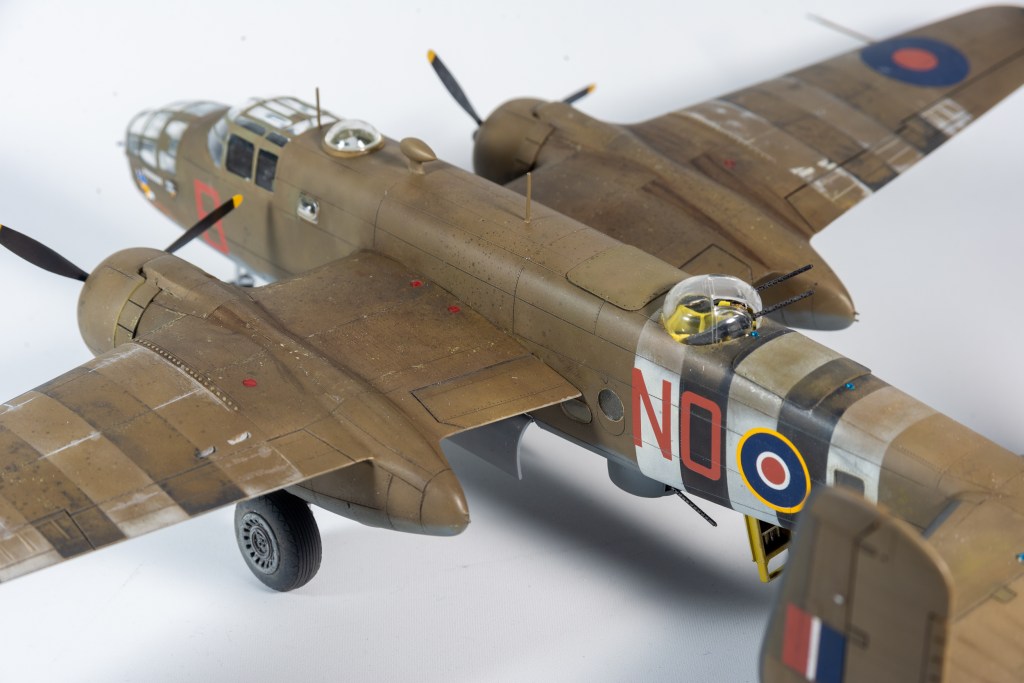
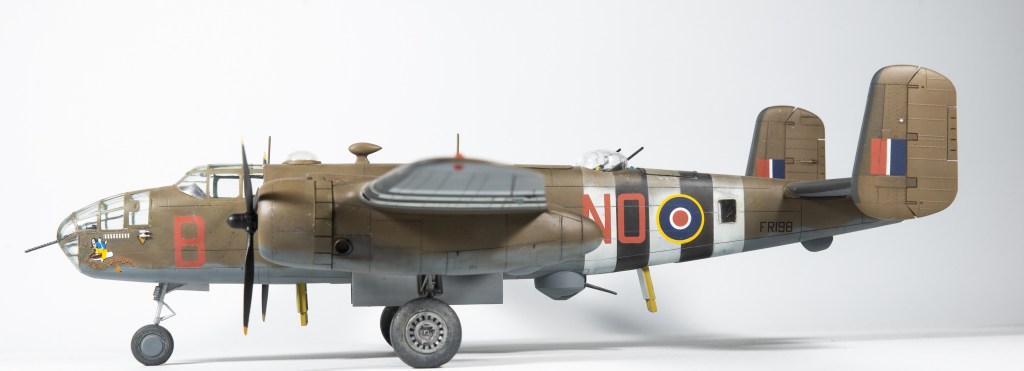
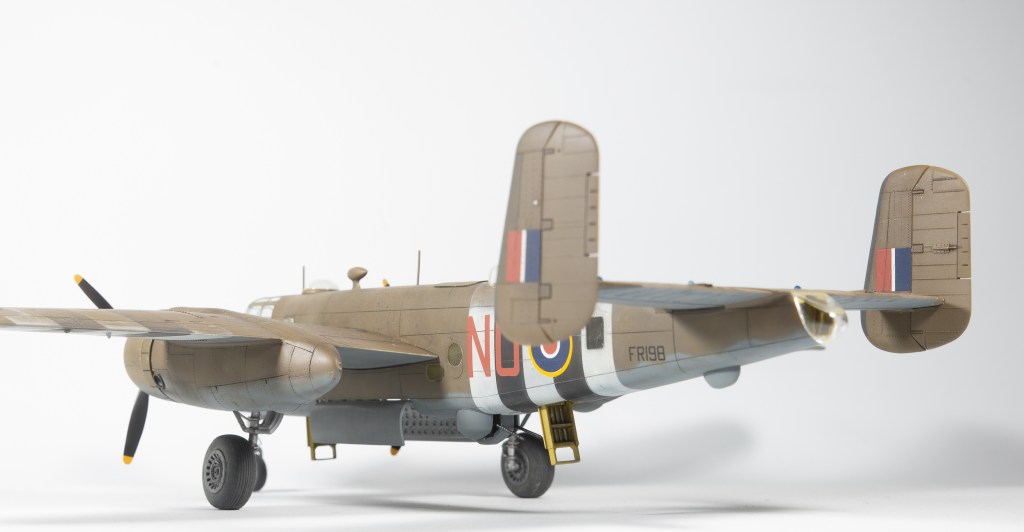
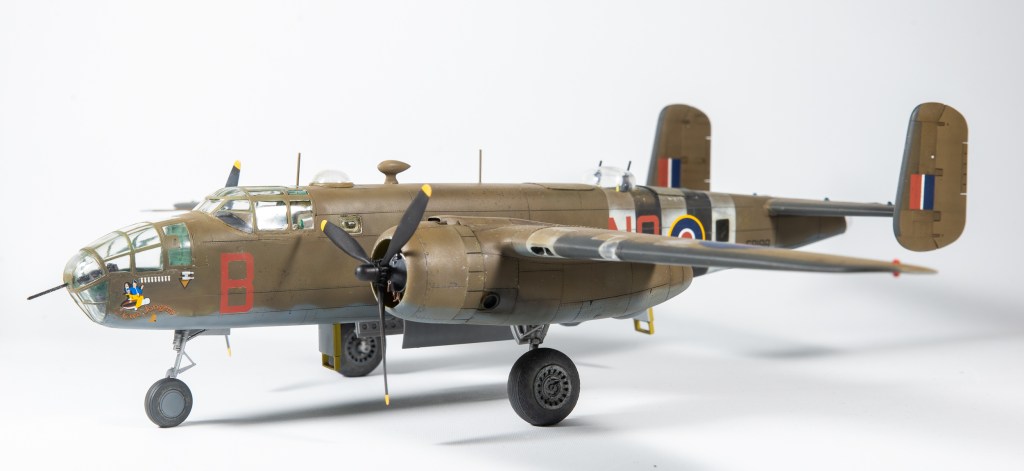
Right from the start, This was going to be finished as a R.A.F 2Tactical Air Force machine with D Day stripes. Two decal sheets from my decal bank contained such subjects, one from Dutch Decals and a much better quality item in terms of colour and printing from Eagle Cals. the plan was in place……until I saw a 2TAF Mitchell on Britmodeller forum that the builder had portrayed with the upper surface stripes removed leaving just traces. I loved the look, and although it was a different SQN we know for a fact that all aircraft had their upper stripes removed by August 1944, although some Mitchells had them reinstated to guard against friendly fire. How to paint traces of D Day stripes though, I considered applying super thin paint, hairspray chipping, micromeshing before deciding on using water soluble Mission Model paints for the stripes. But this is leaping forward many steps. First the basic colours were applied using MRP Neutral grey for the undersides and Mr Color Olive Drab for the upper surfaces. This was then mottled and streaked with the OD tinted with flesh, then tamiya Khaki Drab, and finally Desert yellow in order to build up a multi layered variated Olive Drab colour. Fresh OD was then used for a few select panels to mimic replacement panels.

D Day stripes were then masked out and applied with thin coats of MMP thinned with water. Just like in real life the top stripes were then scrubbed off with a stiff brush moistened with water. Not happy with the first attempt which looked too symmetrical from side to side, I resprayed the stripes before, again scrubbing them off, this time aiming for a fa more irregular look. I left some remnants around panel lines and raised detail. This second attempt looked far better. An overall wash using Mig Dark wash was then applied to the upper surfaces with ABt 502 Paynes Grey being used on the lower neutral grey. I found Abts version of Paynes Grey far bluer than other Paynes Greys I have used, nothing alarming just something to be aware of.

Decals were then applied, the decals, being printed by Microscale , going down fine. Eaglecal providing photos of the actual machine in the instructions. Upon studying these, I realised I had added the flat window instead of the astrodome, and also my chosen machine had the fixed 50 calibre gun in the nose as well as the flex .50. What did I say about studying photos? I need to take my own advice! The spine window came out reasonably easily and was replaced with the astrodome. I decided to leave the nose armament alone, as I could see damage arising with any attempt to remove the nose transparency.
Several thin coats of Dullcote were then applied to get a dead matt finish, before oil leaks were added with several applications of……oil paint! Raw umber mixed with black and starry filth were the colours of choice. One engine had marked breaking to represent a damaged or severely leaking engine.

The transparencies were then unmasked to reveal a stain or crack in one pane of the cockpit. There was no option but to remove it and add the alternative cockpit canopy. As luck would have it, this was the canopy that should have been used in the first place, having the additional framing evident in the photo.

The soft plastic kit aerial posts were replaced with brass wire. The last wall hurdle thrown at me came when I noticed that somehow one of the small dutch orange triangles had superimposed itself over the nose art, I wondered where that triangle had gone!. naturally I managed to tear half the nose art off trying to remove it necessitating ordering a new set of decals from Ultracast in Canada. SIGH!

Whilst the Dutch Decals decal set also carried the same nose art, it was nowhere near as sharp as the Eagle cal sheet. This just left the bomb doors, undercarriage doors and wheels to be added, and she was done.

Im pretty happy to finally have a completed Accurate Miniatures R.A.F B-25 in my cabinet, even if the kit was a chore to build. Like my revell tornadoes, the experience of this build led me to sell all other A.M Mitchells in the stash. One is enough!

The A.M kit has not aged well, and is another of those kits that could do with a new modern tooling, although Im not sure who this would come from, perhaps HKM will downscale their 32 scale J model. The only manufacturer I see doing new tool twins these days would be I.C.M and they may well take years getting back on their feet following Russia’s inhumane invasion

North American B-25 Mitchell II. 320 SQN Royal Air Force.

Belgium 1944

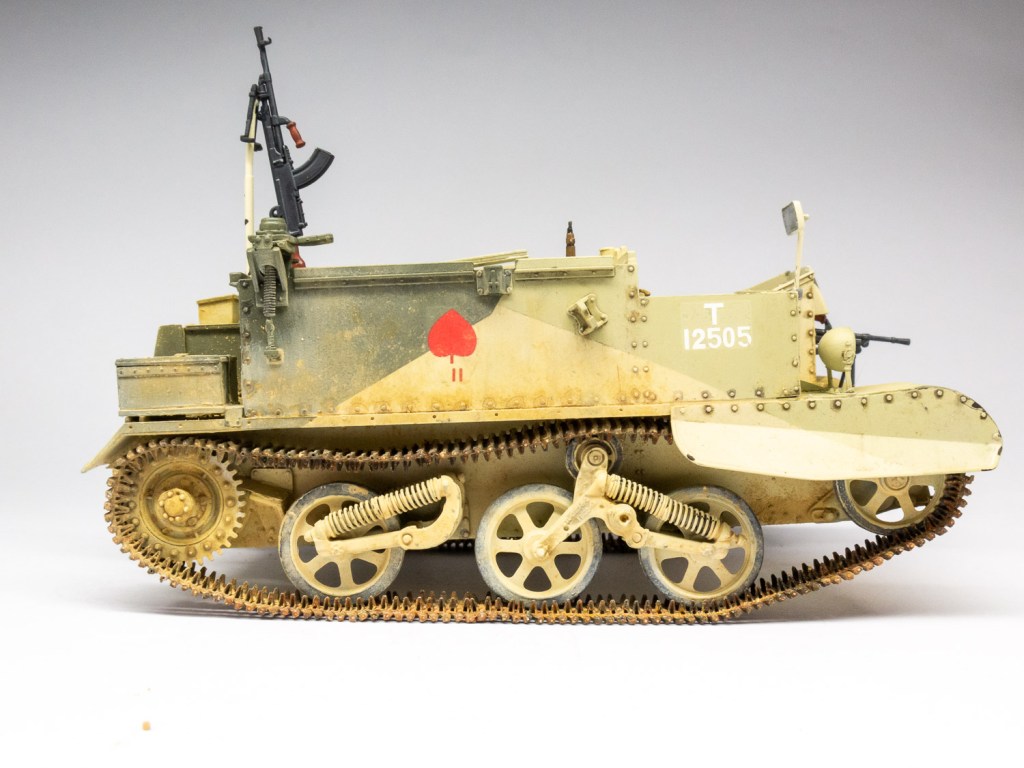
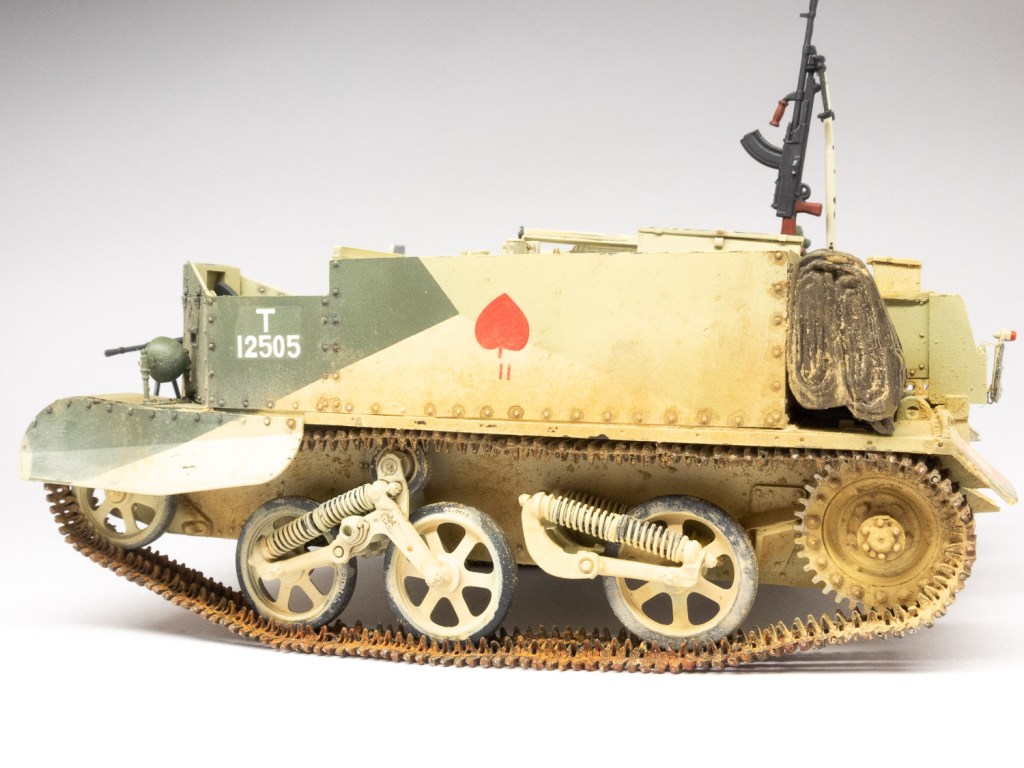
Riich Models 1/35 Universal carrier MkI

  • Built: 2021
  • Added to Stash:2020
  • Enhancements: Tracks- MasterClub

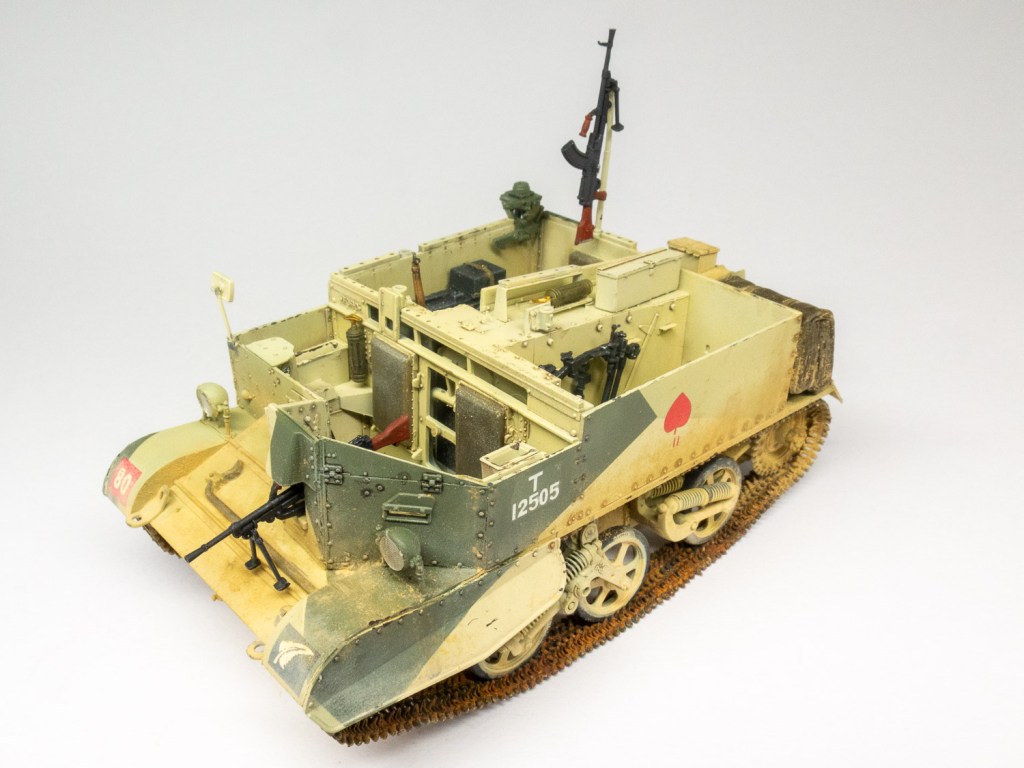
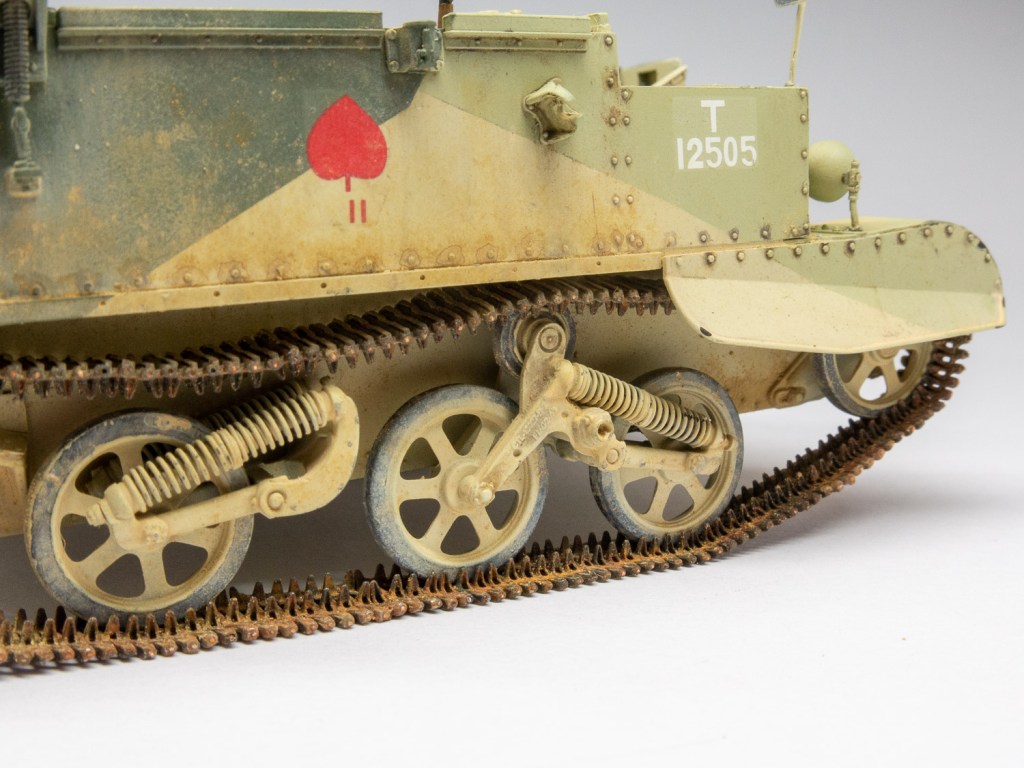
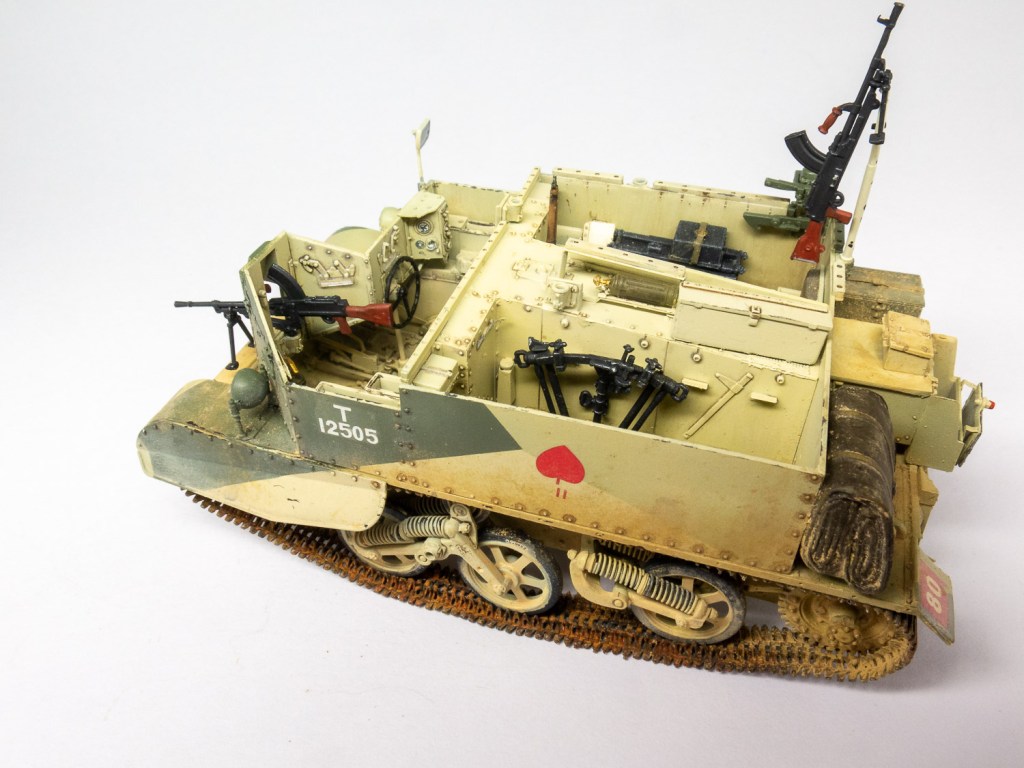
Riich’s Universal carrier must surely rate as the definitive model of the Universal, or Bren Gun carrier in 1/35th scale. A title Riich could hang onto for some considerable time , given the very detailed model that emerges from Riches multi media offering. Plastic, photo etch and even thread and springs combine to build an outstanding model.

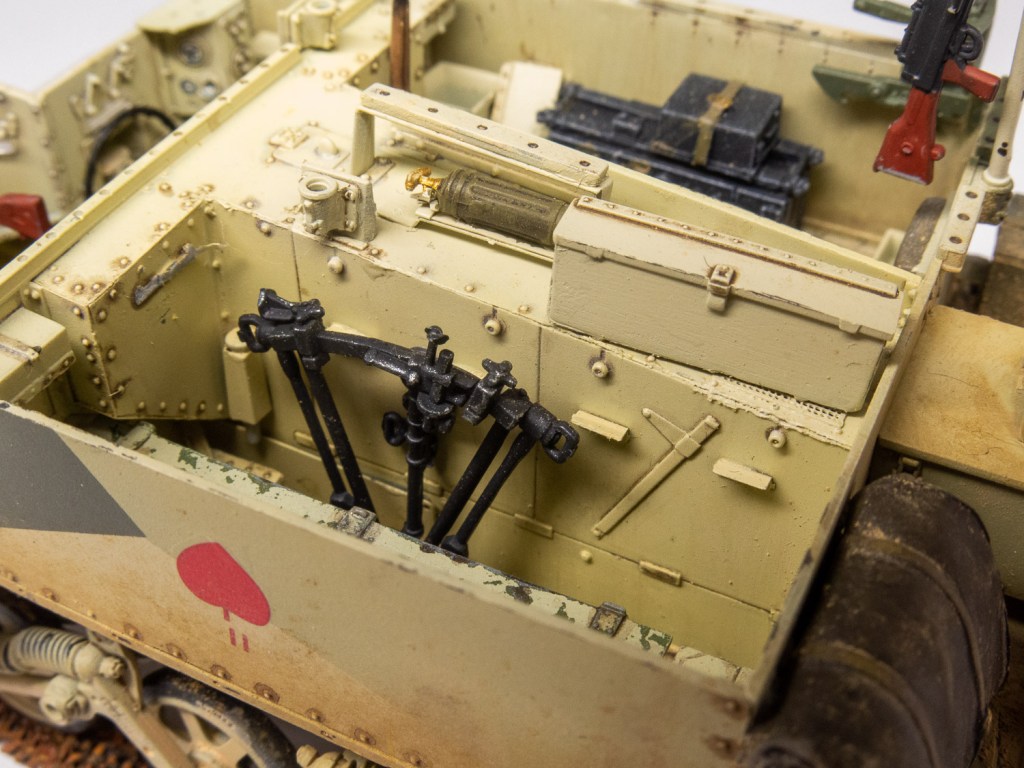
I felt like I could put together a real Bren Gun carrier after this kit. Construction starts with a very detailed Ford V8 engine that would benefit from being displayed beside the completed model on a scratchbuilt stand, as its not seen once the engine cover gets fitted over the top. Given this, modellers can save themselves some time by just building the radiator, as that is all that can be seen on the completed model.

Although, from the instructions, the build looks daunting, I found if I took my time, things progressed smoothly, if not exactly slowly. This was the wrong kit to pick for a week build project!

Fit of parts is excellent, even down to integrating the supplied P.E. Everything fitted perfectly. I found only a couple of weak points whilst building the kit. The main one being the suspension locating pegs are very weak, partly the soft plastic and partly the lac of robustness. I broke two. They were replaced with brass rod. Were I to build another, the suspension would be left off until the final steps.

The rear diff. in step 6 is better added after the back wall, part E1 has ben added. Some steps in the instructions weren’t too clear, to me anyway! It took me a while to work out the correct placement of the wood floor sections, parts F38, F36 and F37, which actually sit on the floor, and also the fact you fit either the two Lee Enfields OR the folded Bren tripod K11. And don’t start me on those bloody etched seat legs!! I really wish Riich had supplied a little jig to assist with getting consistent folds and the required angled with these. In the end, my seats sit at the right height and look level(ish) but it was fiddly work getting there. For the visibility these parts have on the constructed model, plastic would have been easier to apply. The interior looks very complete once built and really only needs the addition of ammo boxes and sundry other personal items to make it look lived in..

Riich Models supply three figures which I didn’t use, given they are wearing NW Europe kit., separate earphones and a microphone are even supplied for the radio op> I imagine you may have to fit them during construction. Some nicely detailed Lee Enfield rifles and Bren LMGs are also supplied. Personal equipment and additional storage will have to be sourced from accessory kits though as none is provided.

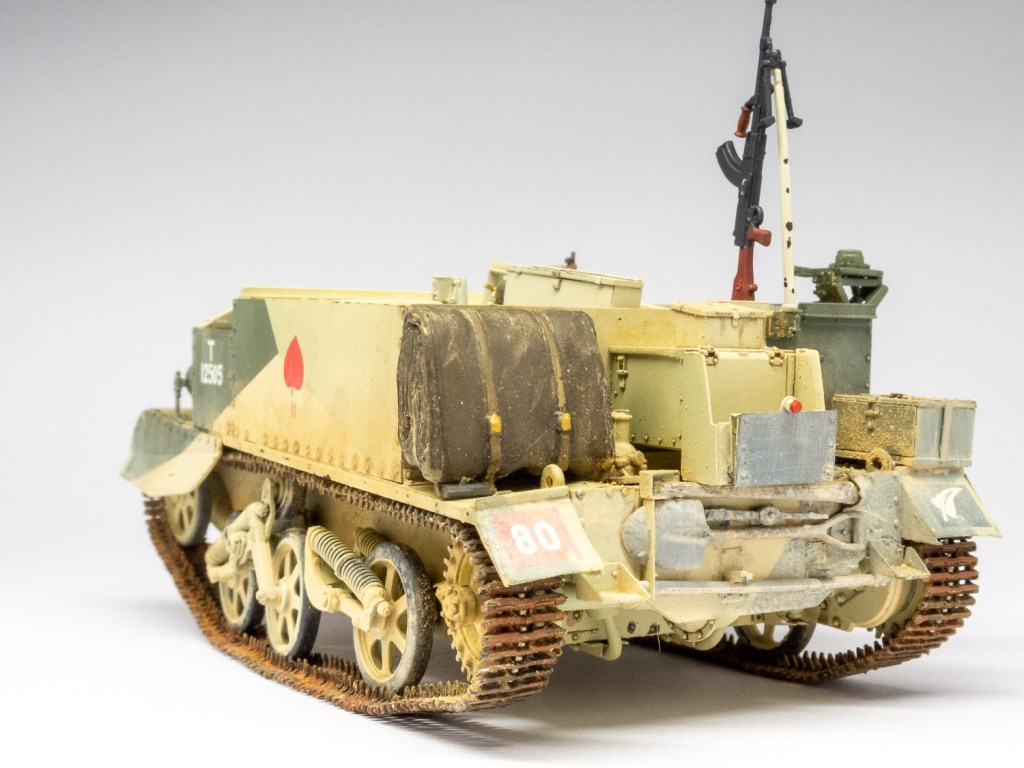
Some thought on what scheme you will finish your model in, needs to be done prior to construction as its much easier to paint the interior as you go along rather than at the end. Riich provide marking for four vehicles on a colour marking guide that also identifies the vehicle unit and theatre. I had already decided on the kiwi vehicle, so SMS Portland stone was applied to interior parts as I went along. Link and Length parts are provided for the tracks, and don’t look too bad at al, the top sections even having some sag built in. I decided to complicate matters even further and added master club metal track links . These are the first metal tracks I have built and Im here to tell you, tiny bren gun track links are probably not the best introduction to these after market items!

They do look good once completed,, and give the model a nice heft. I didn’t go as far with the weathering on mine as I perhaps should have. In fact I was not happy with my weathering at alll on this, but thats getting ahead of myself here. First off the model was painted in the Counter scheme using SMS paints, which to me look spot on. A wash was then applied around all rivets using Migs Neutral wash. At this stage the vehicle looked quite stark so a filter for desert yellow was applied, to my eye, it made absolutely no difference!

I thin sprayed on some AK Dust effects around the running gear. Around this time Rinaldo released his “Desert Weathering” you tube. I applied pigments following his lead, but picked the wrong colour, mine are far too brown. I should have aimed for something more yellow. The pigments did impart a dusty look to the vehicle though and toned the camouflage down. It wa at this stage I felt like I had lost my vision for the model and rather than spend more time on fine-tuning the weathering I decided to just add the small parts and call it done. A decent armour modeller could turn this model into a gem I feel. I probably should have spent a bit more time applying chipping scrapes etc, but my return to work was looming and I wanted to say I had completed a couple of models over my leave.

In summing up, this is a little gem of a kit. The build was enjoyable enough although the etched seat frame and building the tracks frustrated me. Again, I lost the vision I had for the model near the end of the build, so it was just rushed to completion. This is something I need to overcome, although this and the gnat fell to my wish to say I had completed 10 models this year rather than any quest for quality.

Universal Carrier Mk 1 19th Bn 2nd New Zealand Army. Libya 1941