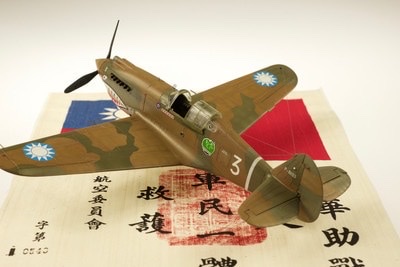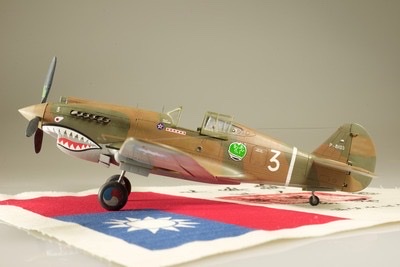
Decals: Combination of Cutting Edge Pyn Up and Aussie decals
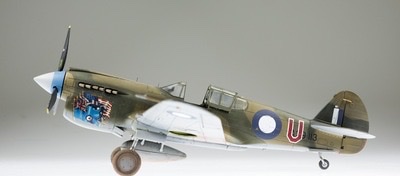
Hasegawa’s P-40 series seems to be one of those kits modellers either love or hate Flick through any of the fora and you will find modellers that rate it as a horrible fitting kit through to other modellers that have had no fit problems at all. It does require care in assembly – like any kit – but I found mine went together reasonably well with only a small amount of iller needed around the gun ports and fuselage. To be honest, I found the Cutting Edge decals a real disappointment, thick and reluctant to conform to recessed details. The nose art decals, although very thin, were not sharply printed. I dare say though printing technology has improved since these decals were first released.
Aftermarket Used: Master barrel brass gun barrels, RedRoo Models tropical cowls, Vector corrected control surfaces, MDC main wheels.
Decals: RedRoo Models
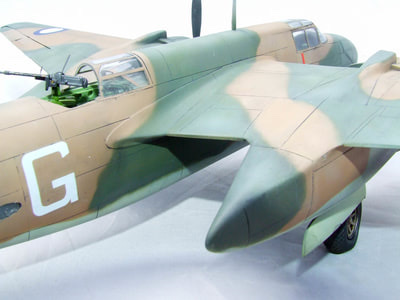
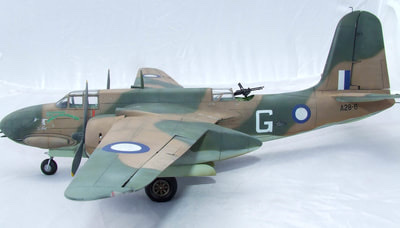
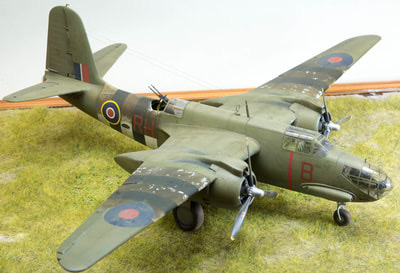
The second of a parallel Boston build, This one was finished as a RAAF machine. All the comments from my first Boston Build apply here too, including the spindly landing gear.
Decals: Various spare decals with nose art being hand painted.
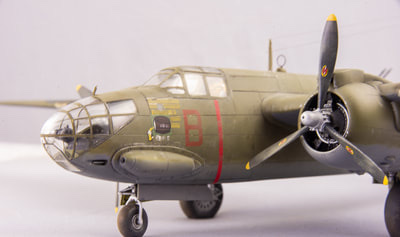
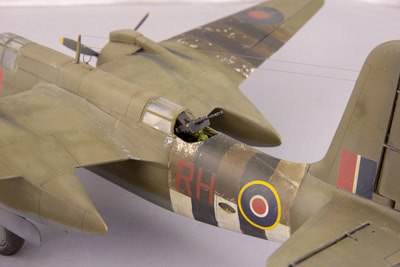
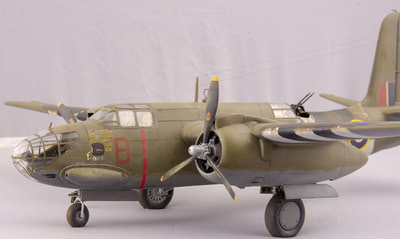
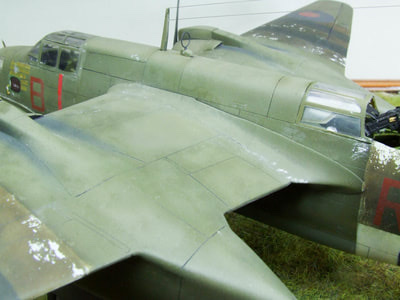
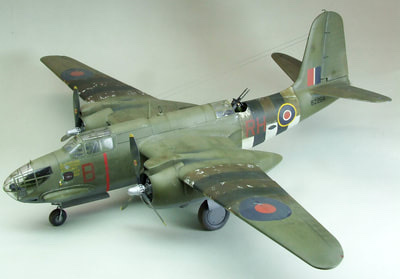
Another two builds of the same kit in parallel. AMTs kit is getting rather old now and we really need a new one. Detail is soft, although there are now sets available for it from Vector, and it has several inaccuracies including metal control surfaces where they should be fabric and I believe the main landing gear is to far backward, or forward, cant remember which. That said, it is a pretty viceless build. The only weak point being the undercarriage attachment. It is incredibly flimsy. Mine have sheared off twice!!. The doors also have poor attachment points. I cut out all the control surfaces and replaced them with the Vector resin replacements, I built the RAF one for a group build on an on-line forum. It was the first time I had used the salt chipping method, and I was quite pleased with the results. I wanted an machine that reflected the haste with which some units applied their invasion stripes., so the stripes were hand painted using vallejo paints.
As there are no decals for this scheme in 48 scale I used various generic sheets for the codes and national markings and hand painted the nose art. She was flown by an Australian crew. Im really hoping a new tool kit of this important aircraft is released soon. The A.M.T kit has served well, but is long overdue for replacement.
Xtracolour enamels were again used
Douglas Boston Mk IIIA Royal Air Force. England. 1944
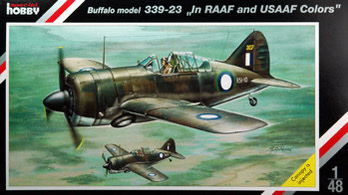
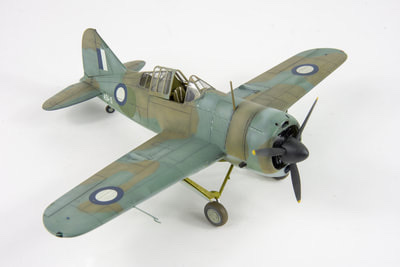
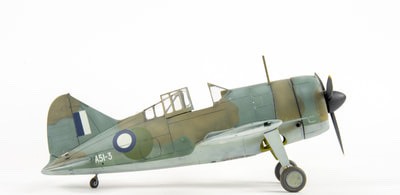
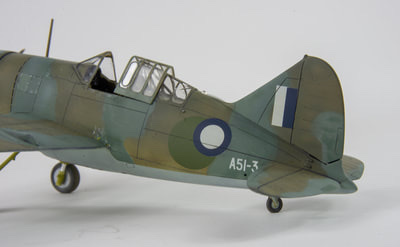
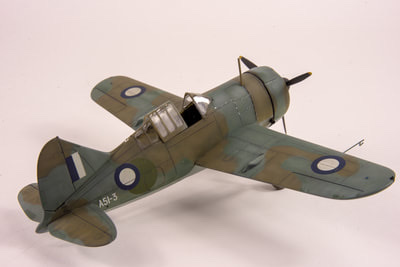
The second part of my double Buffalo build. Like the other build, this one also went together quite effortlessly.
To paint it I used the then popular “black base” technique. I remember not liking it that much as I didn’t think it gave you a lot of range with the colours. The colours on this were all lightened considerably to portray a faded machine that had been operating under a blazing hot Northern Territory sun.
Extracolour paints were again used from my now diminishing supply.
I think this one turned out better than the U.S one I completed just prior.
Brewster Buffalo. 1 P.R.U SQN Royal Australian Air Force. Hughes Air Base.N.T 1942
Date Completed: 2014 Aftermarket used: Quickboost rudder and corrected cowlings Decals Not decals at all, but masks from Mal’s Miracle Masks
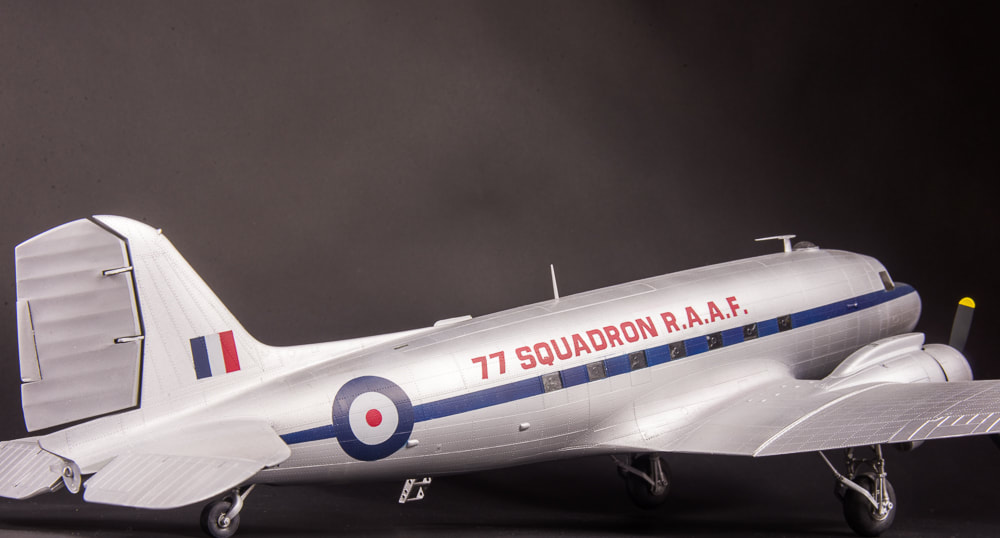
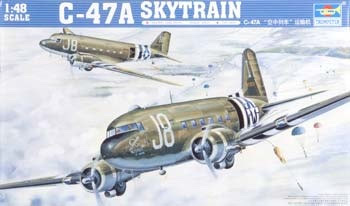
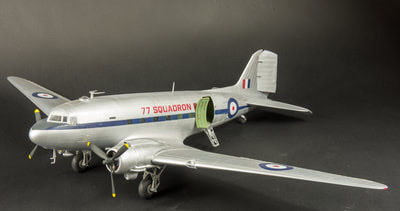
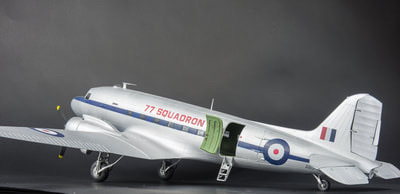
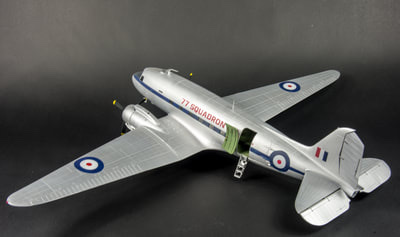
Trumpeter’s Dakota gets cast as inferior to Monogram’s ancient model in some quarters. I built the monogram one as a kid and found the Trumpeter kit light years ahead in fit, detail and engineering. Ok, there are some accuracy issues, the rudder is riveted where it should be fabric covered, the cowlings are based on the soviet copycat aircraft and the sit of the aircraft is not quite correct but these can be fixed with aftermarket items. I just love all the riveting on the kit which you really need on a kit this size. Mine was built for a Korean war GB on Britmodeller.com. Th year had started off with several failed builds, so this one reaching the finish line was very satisfying indeed I left the wings removable to ease transport, which leaves slight gaps, maybe this is why it has received no love at competitions, plus I have modelled it clean with no weathering whatsoever. I increased the height of the undercarriage by adding plastic block spacers to the locators in the cowlings so the aircraft nose points up more. The drag links were lengthened with rod. This was the first time I painted national markings on using masks. I got Mal Mayfield to cut masks from a Hawkeye decal sheet. I impressed myself with how easy painting the roundels was, and determined to go this route on all of my future larger builds. There is some conjecture over whether the cheat line was red or blue. I opted for blue after seeking answers on Aussie Modeller International on-line forum
C-47B Dakota 77 SQN Royal Australian Air Force Korea 1952
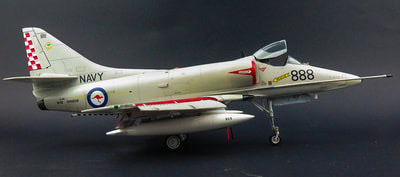
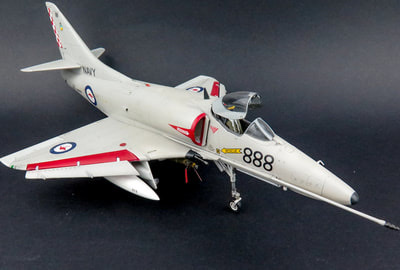
A little more effort was put into this model of the skyhawk than my last one as I wanted to display it with the tailplanes tinted up exposing the hole through the fin and the hellhole open.
Cutting off the moulded tailplane rub plates was trickier than expected, but I got there in the end using a thin razor saw. These days I would use a P.E saw.
I made up some rudimentary innards through the open hell hole door. The door itself had its interior detailed with plastic strip and some foil to replicate the small bag for the R.B.Fs. These doors were commonly seen open on the flight line.
The air superiority scheme consisted of light and dark admiralty grey. At the time of modelling, no off the shelf paints were available from any of the major manufacturers.
The paints for this came from a local company that actually made model railway colours. As far as I kno, these paints were their only foray into aircraft sets.. The practise bomb carrier seen so often on Aussie skyhawks was scratch built from plastic card and strip.
McDonald Douglas A-4G Skyhawk 805 SQN R.A.N F.A.A H.M.A.S Melbourne
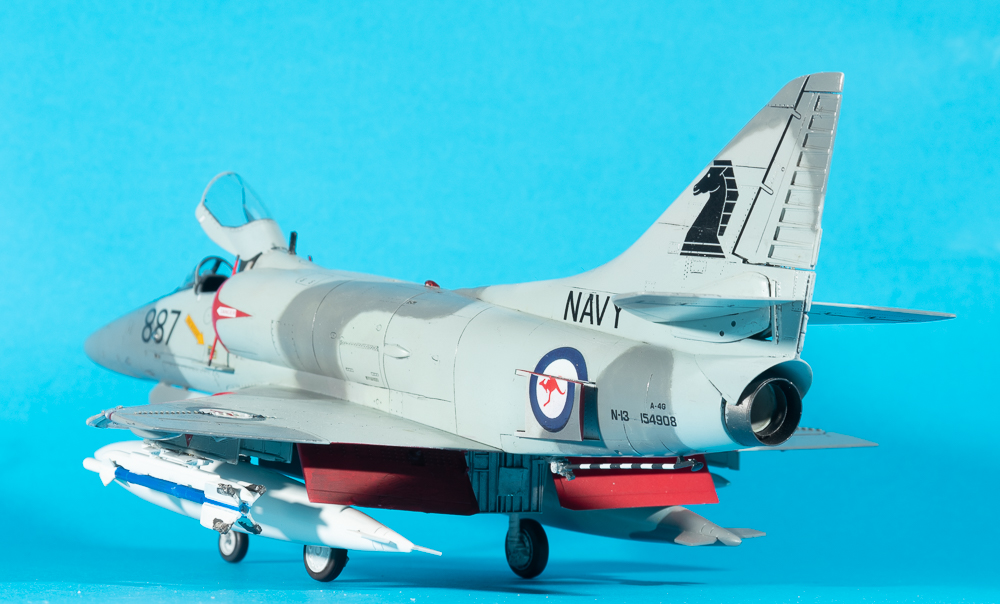
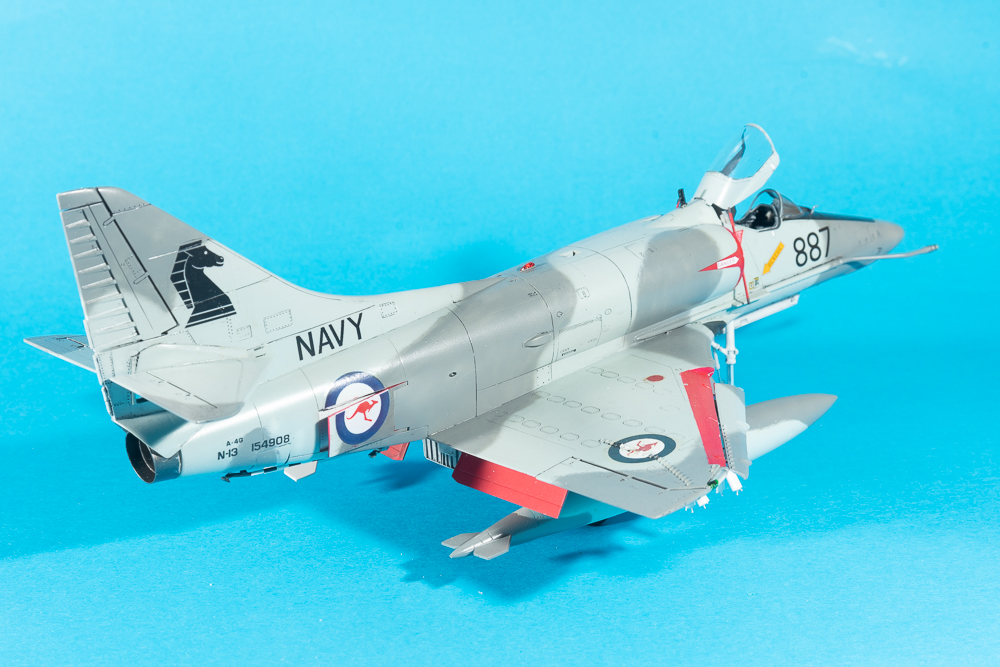
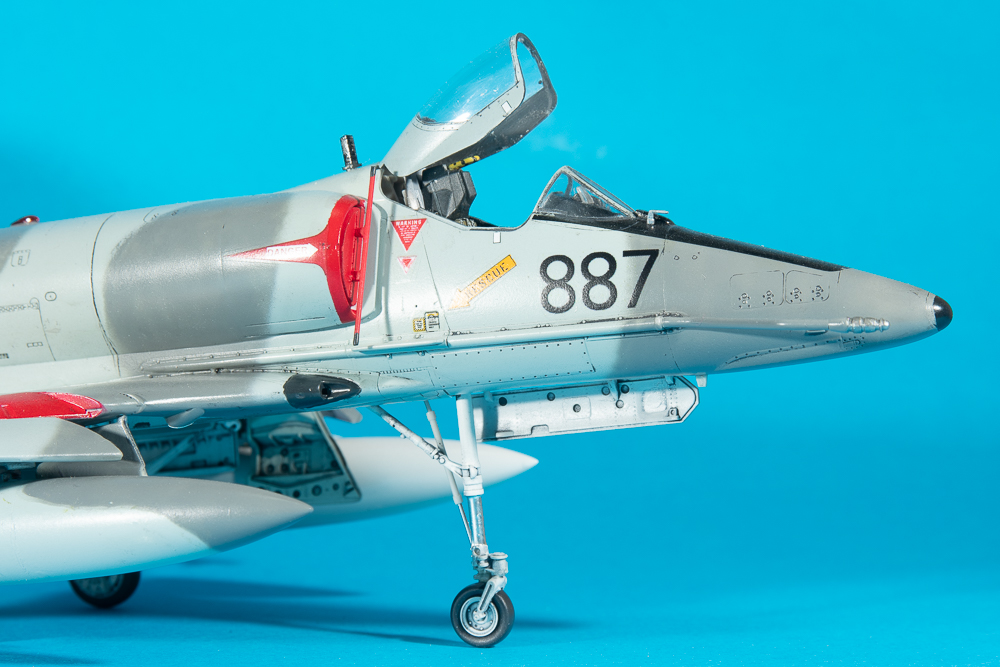
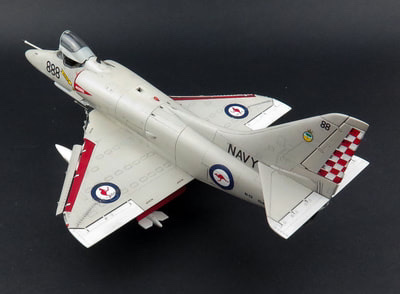
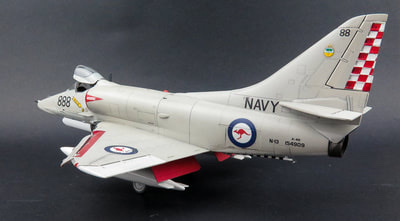
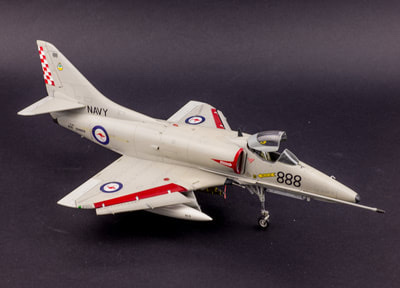
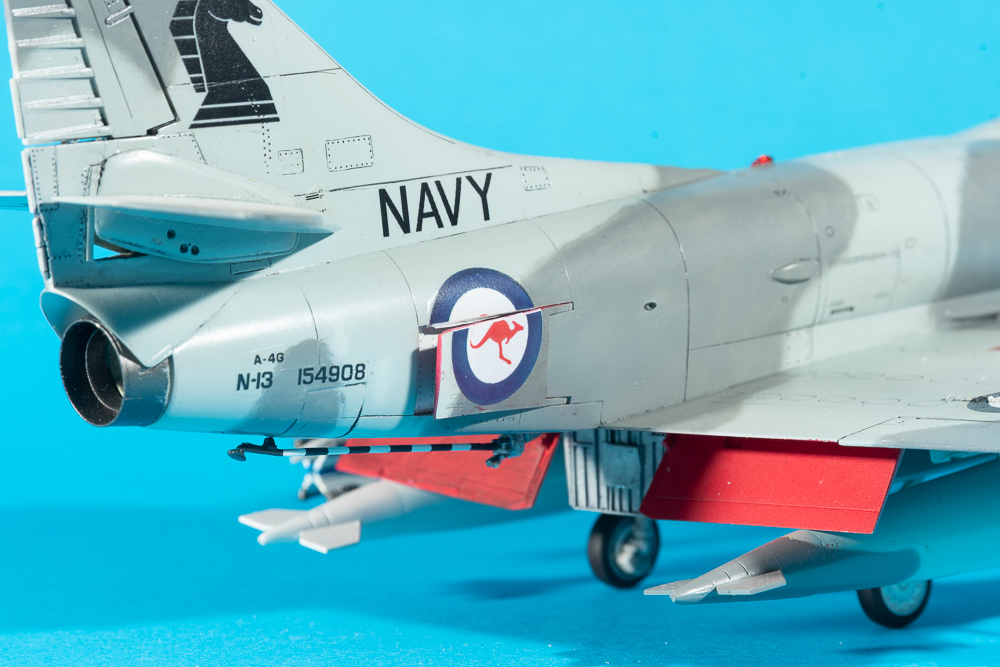
This is one of my older models. The still nice Hasegawa 1/48 Skyhawk from when Hasegawa were a big name in model kits. This one has been modified into a Royal Australian Navy A-4G which were basically E models anyway. All the parts to make a G are included in the kit. I decided to do an early Skyhawk before colourful unit markings became all the rage in the R.A.N. Mainly because I had not seen one done before. As well as completing this one, I also did one in the Air Superiority scheme as a parallel build. Decals came from a Hawkeye sheet for R.A.N Skyhawks, which was an early ALPS printed sheet. The decals were thick and the underlying white shapes for the decals that needed them were oversized. In a word they were crap, but Steve Evans is completely redoing the sheet under his Ronin Aviation Graphics label. The decals released under this label bear no resemblance to his earlier Hawkeye sheets in either printing or performance The latest sheet – when he finally gets around to releasing it – will allow you to model any skyhawk that saw service. Centre line TER came from Aerobonus and bombs came from a hasegawa weapons set. There are lots of mistakes if you look closely, but I am happy with it. It remains as a timeline marker as to how my skills are slowly improving. I remember the kit as being easy to assemble with some fit issues around intakes and the gun inserts.
A-4G Skyhawk 805 SQN. H.M.A.S Melbourne. Royal Australian Navy
Aftermarket Used: Rocket rails and radiator recast from Guideline Publications items, Ultracast wheels and exhaust
Decals: from the “decal bank”
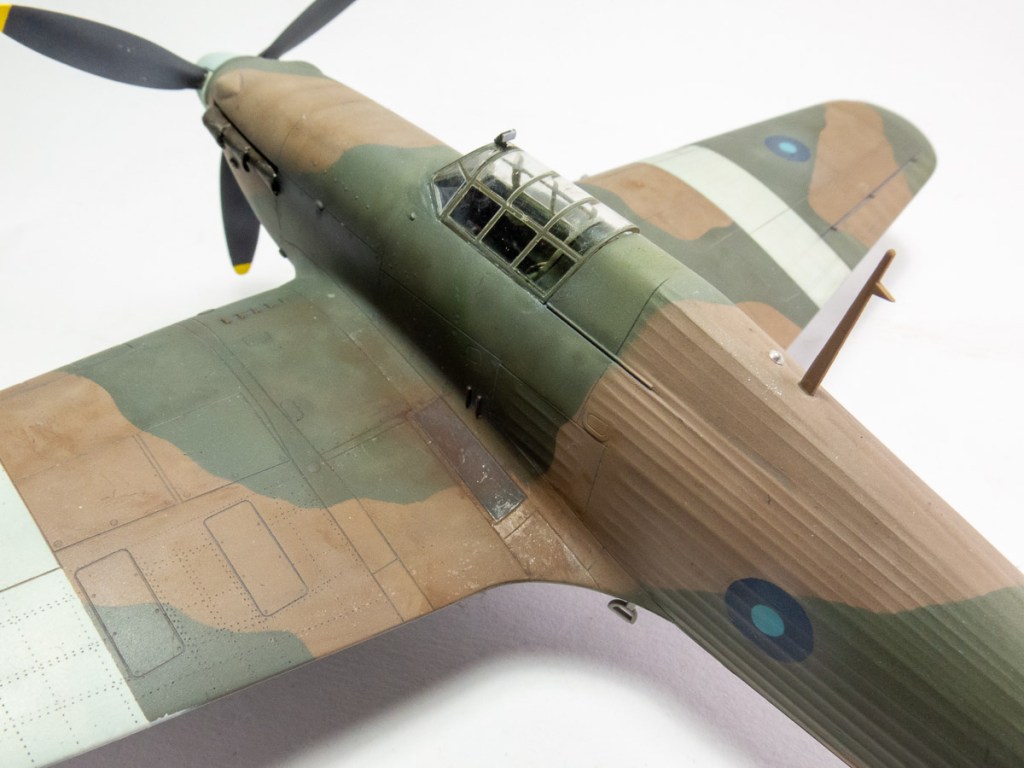
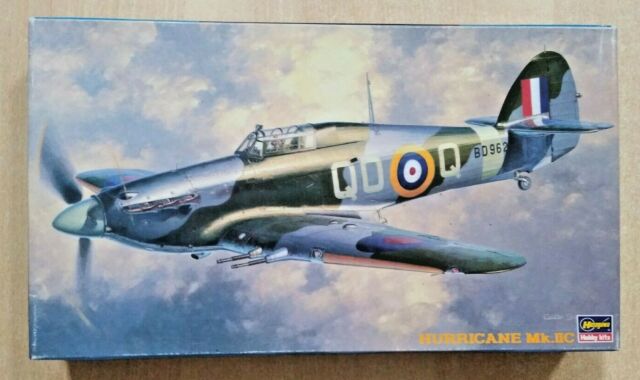
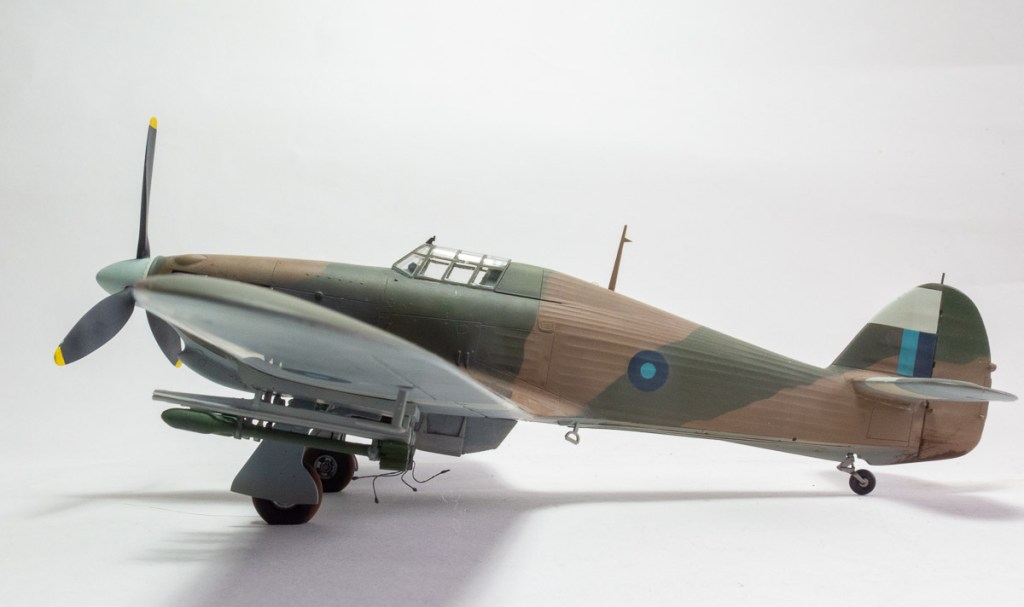
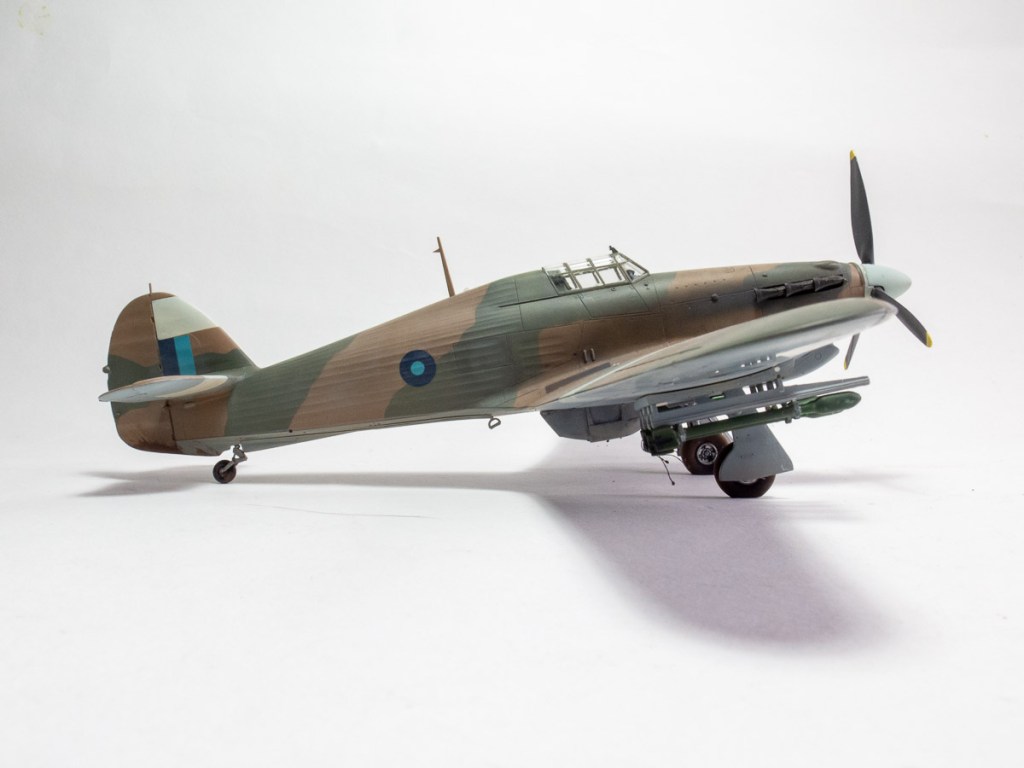
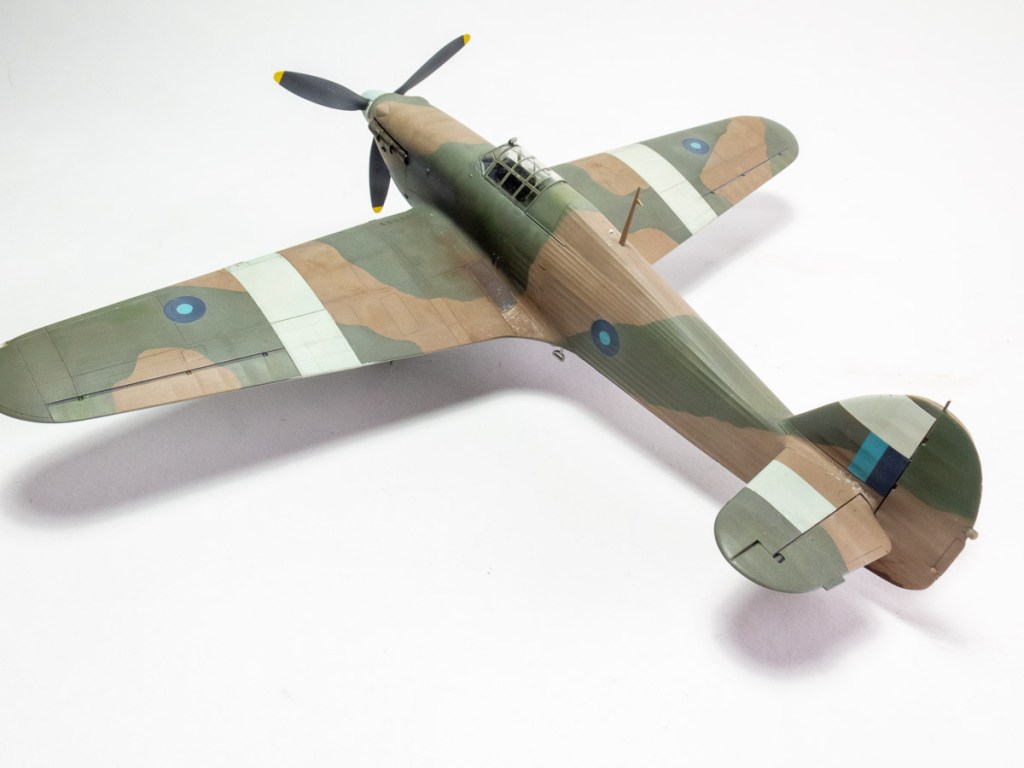
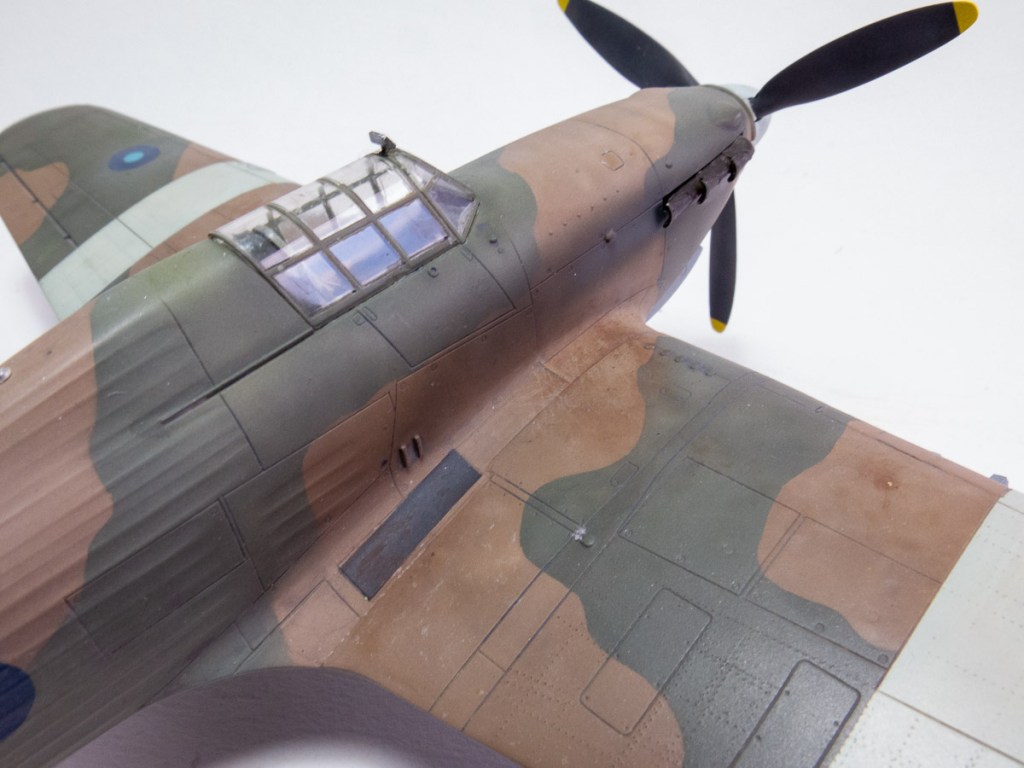
I have always loved the look of the Hurricane armed with rockets. Again it evokes memories of building the 72 Airfix kit as a child. It was another model I wanted to revisit, so my second Hasegawa Hurricane used a resin conversion set from Guideline Publications which included the armoured radiator and resin rockets and rails. The rails were rather twisted so a friend kindly recast me a new set. Searching out colour schemes was interesting as it was quite difficult locating photos of rocket armed Hurricanes. I eventually settled on this one from South East Asia Command, although you will note it has no codes or serial. Much searching and asking of questions failed to reveal an accurate combination I could use. This model was also riveted with my new Rosie the Riveter tool, although I just confined it to the wing upper surfaces
Hawker Hurricane MkIV 20 SQN Royal Air Force. Burma 1944
Theres not too much I can remember about this build, being as Im writing it up about ten years after completion. The gunship grey scheme the RAAF trialled appealed to me, and I thought it would make the jet stand out from all the other Aussie hornets you see.
In fact the jet standing out is why the RAAF did not go ahead with the scheme
Decals are Hawkeye decals which, although quite thick performed adequately. There are much better decals on the market now, although up to date markings for RAAF “Classic” remain rarer than hens teeth.
For some reason, even our own Australian decal manufactures can not come up with a decent decal sheet. The long OOP Afterburner sheet remaining the best out there still.
This model no longer remains ion my collection having been sold off in 2021. I will replace it with a hopefully better RAAF Classic Hornet build sometime in the future.
McDonnell Douglas F-18A Hornet 77SQN R.A.A.F Williamtown Australia