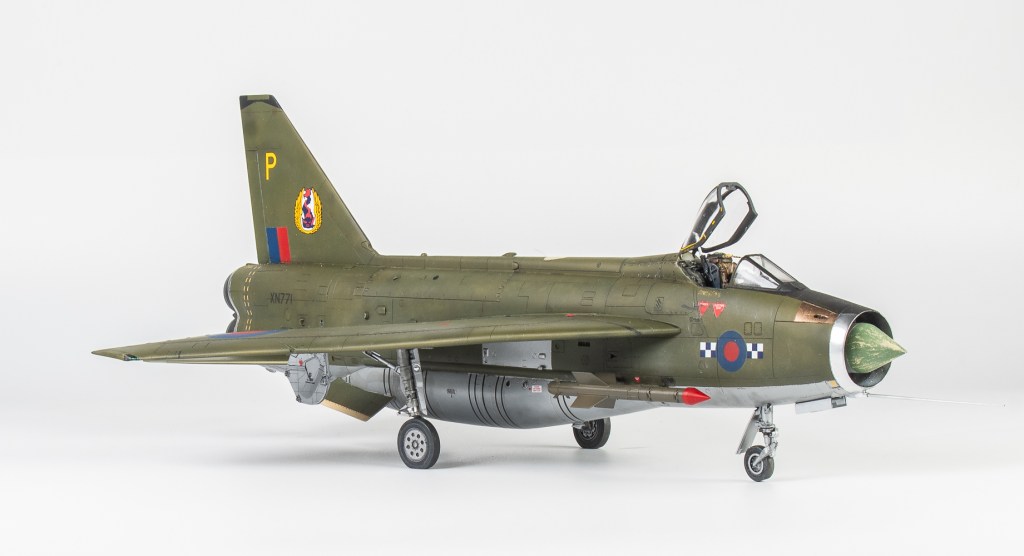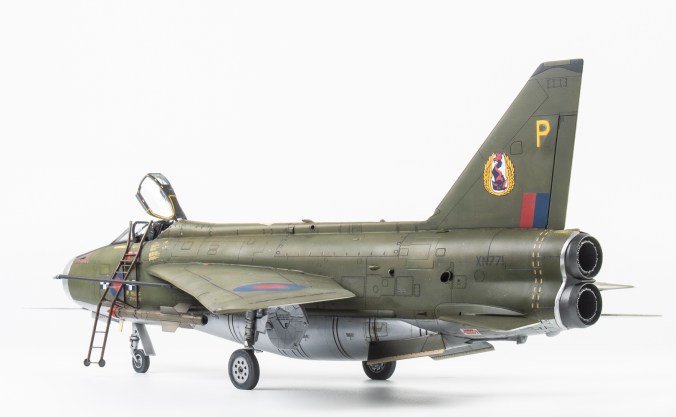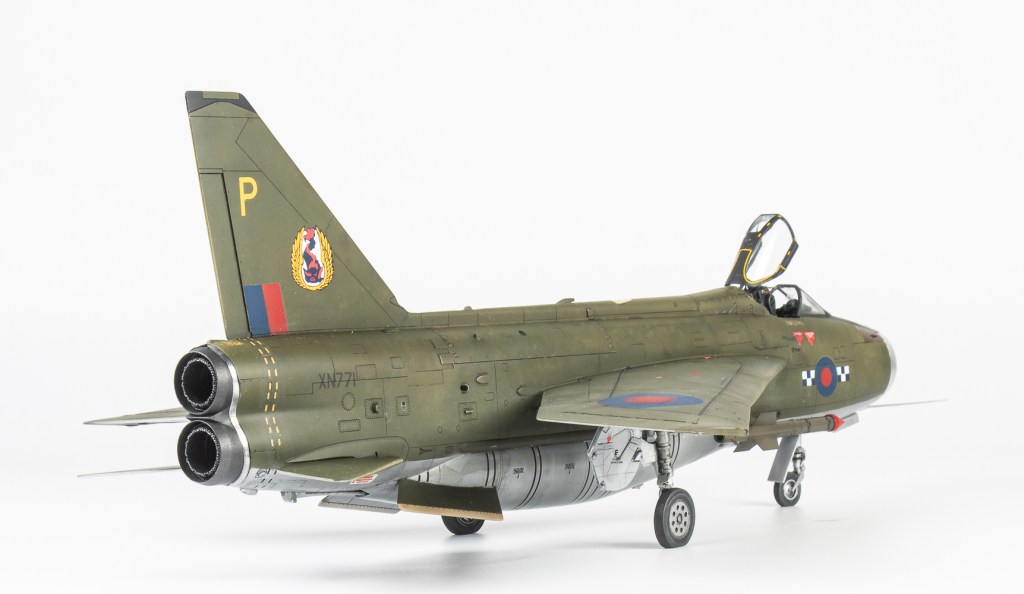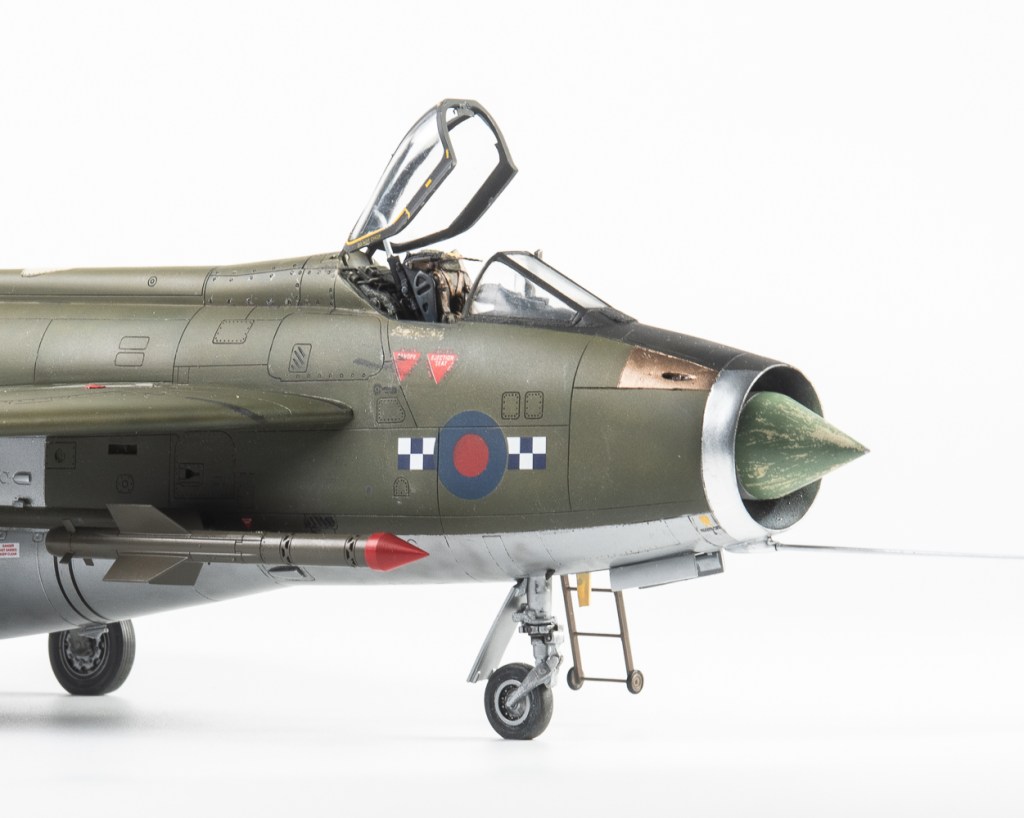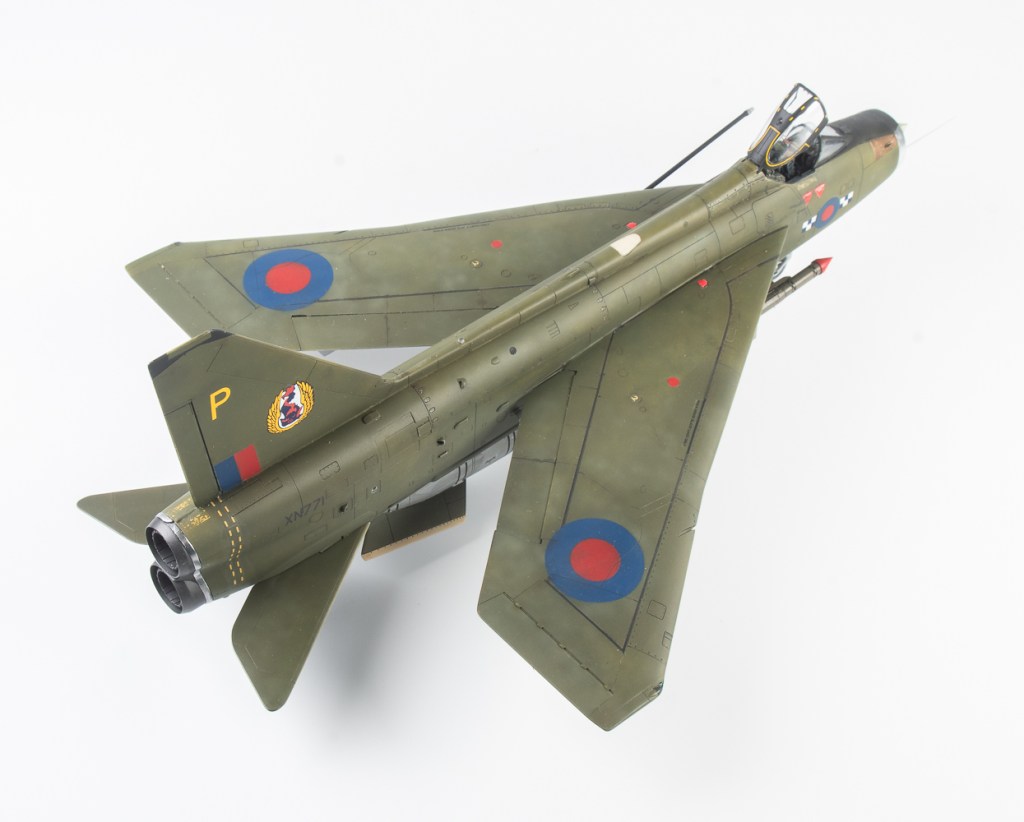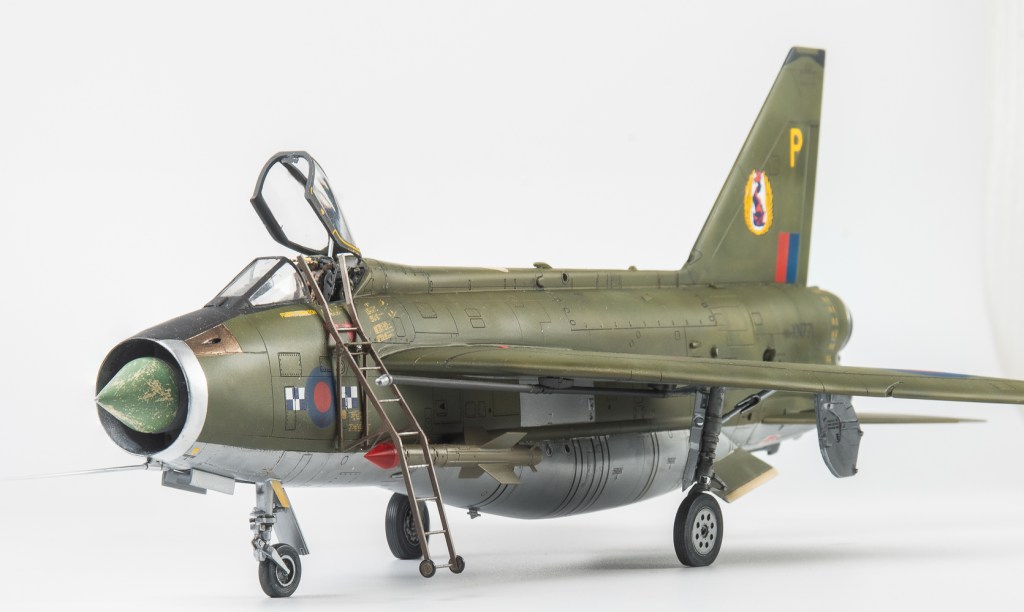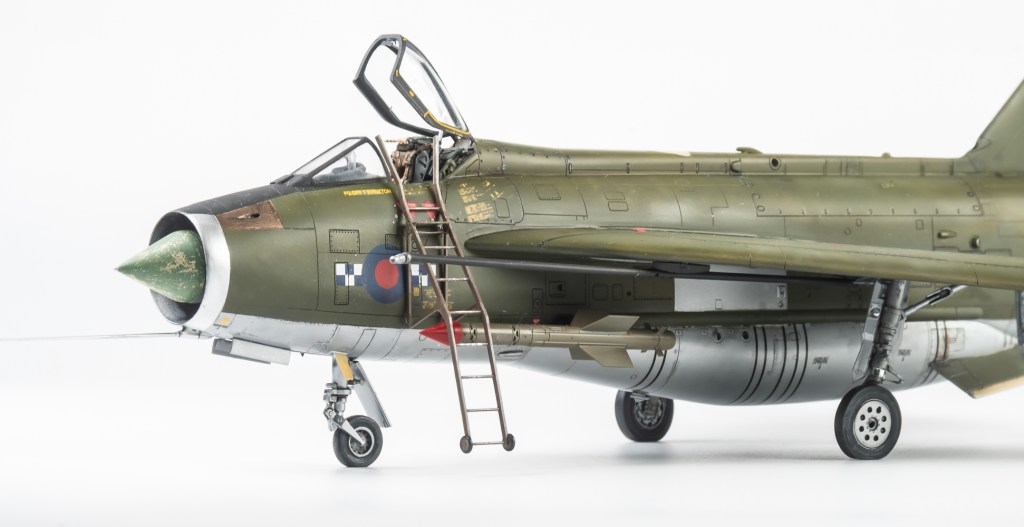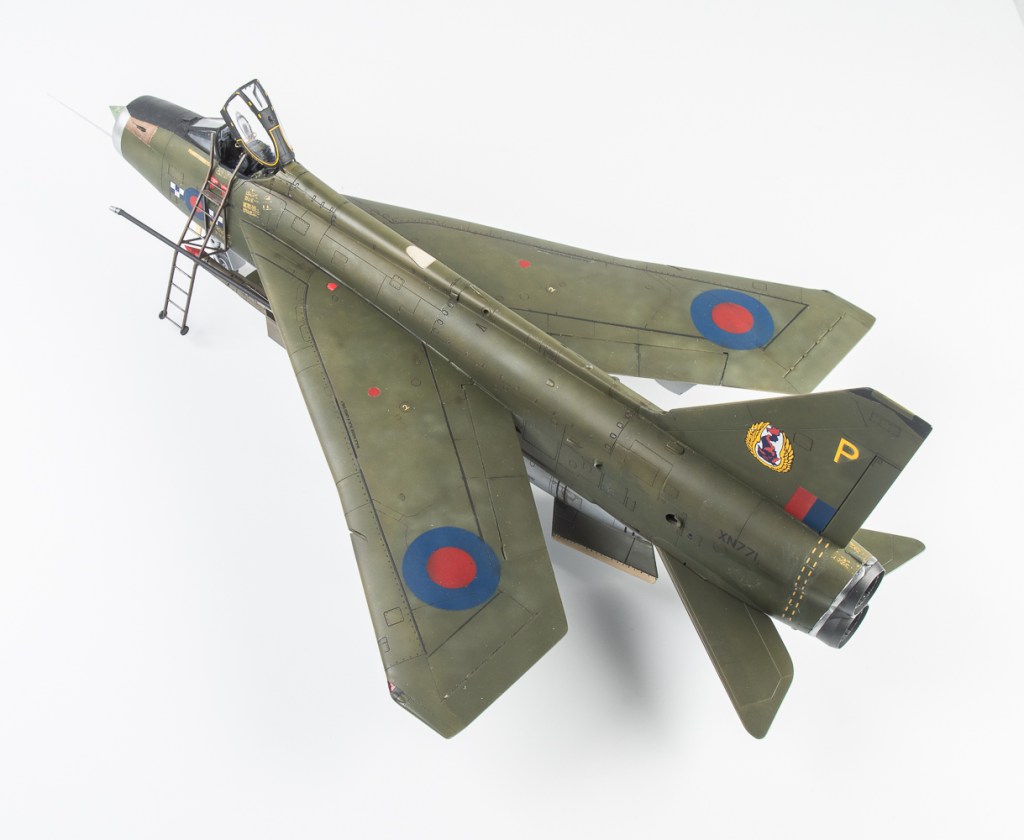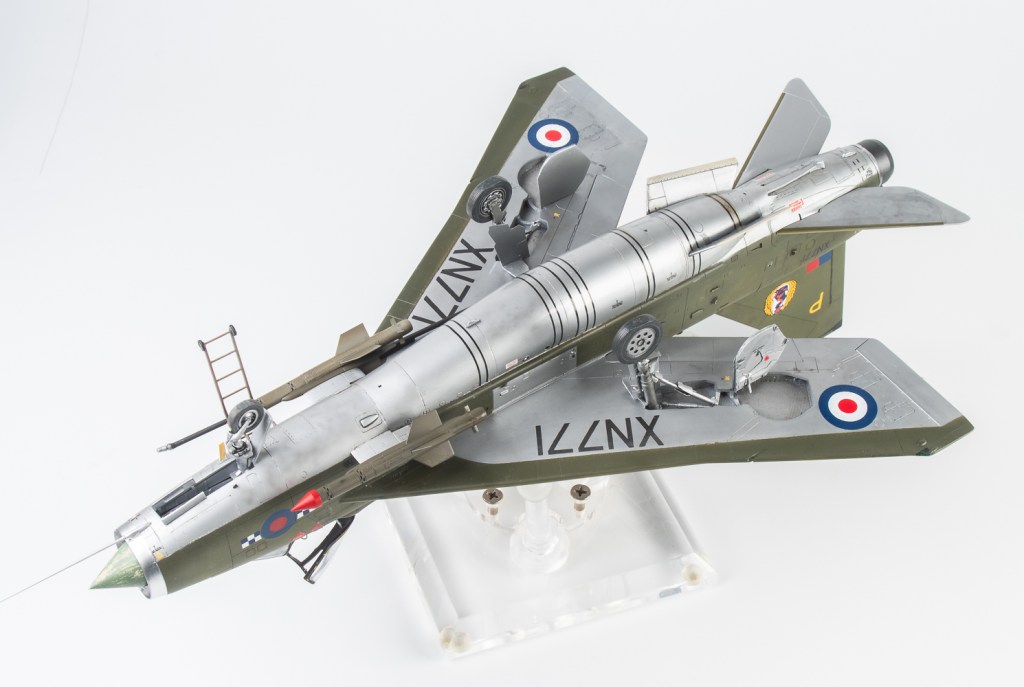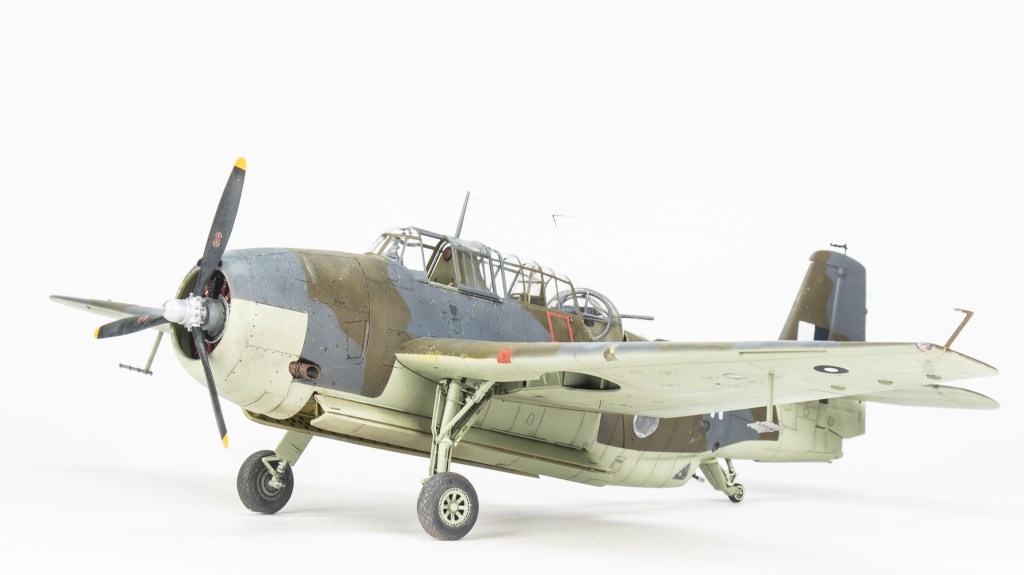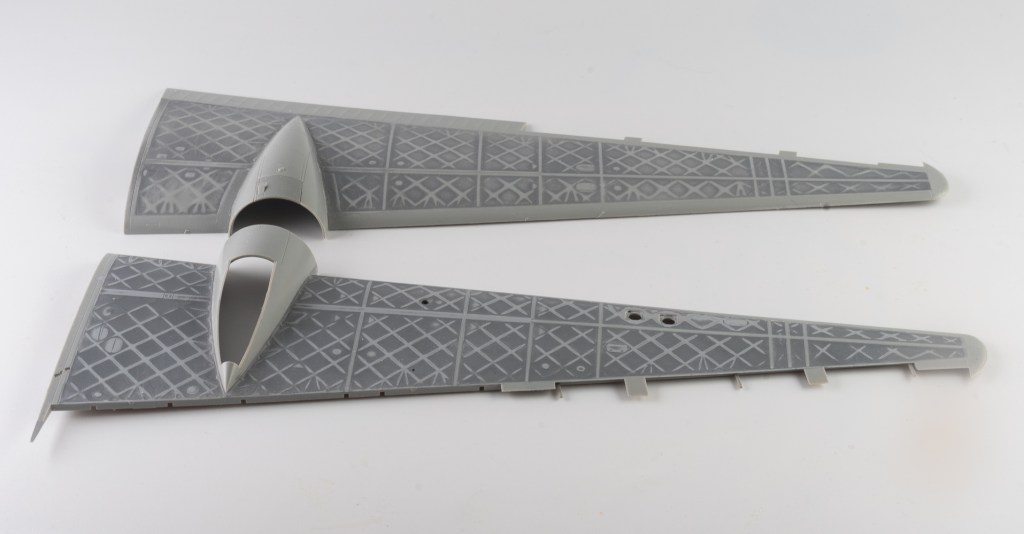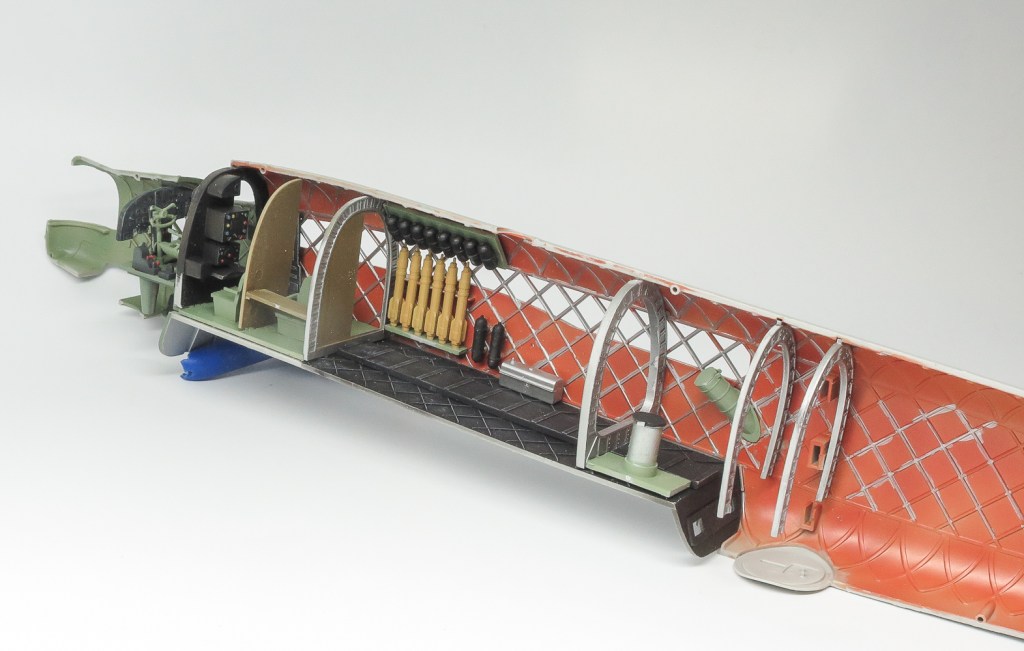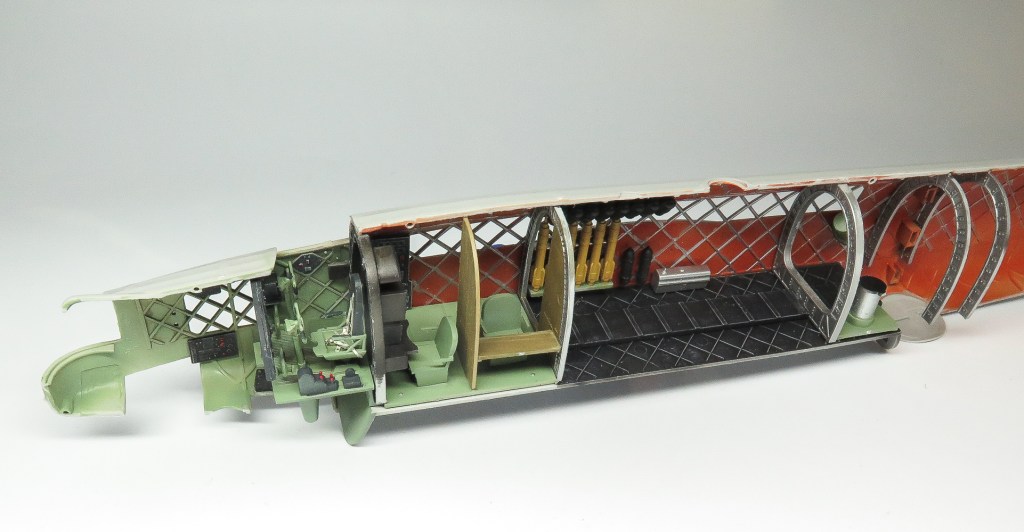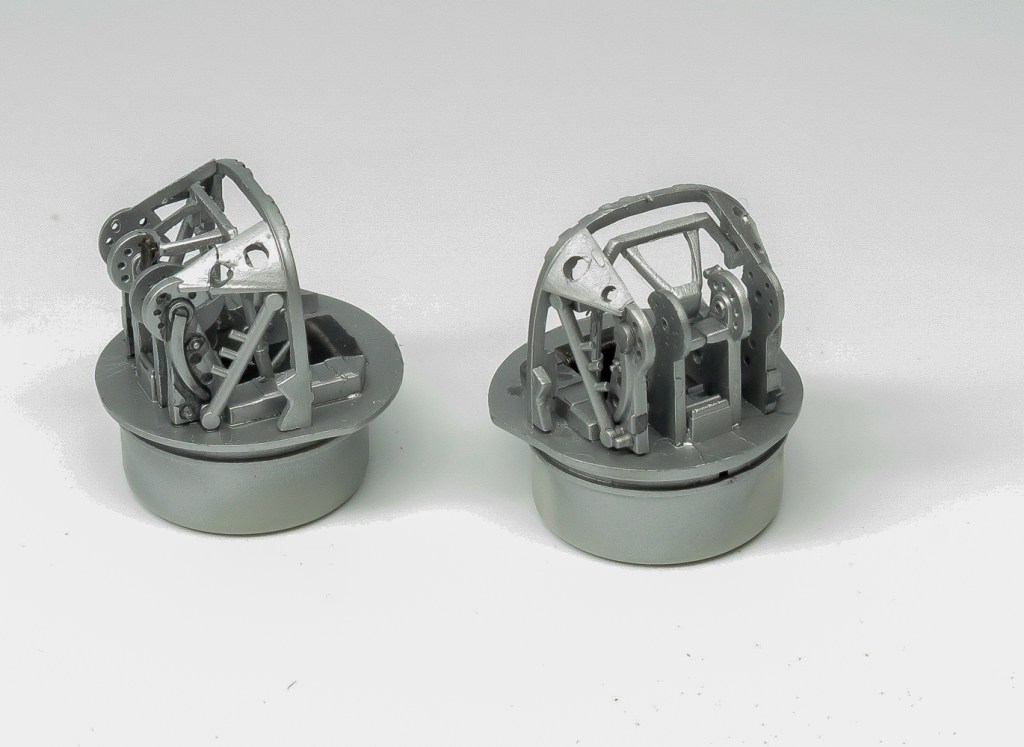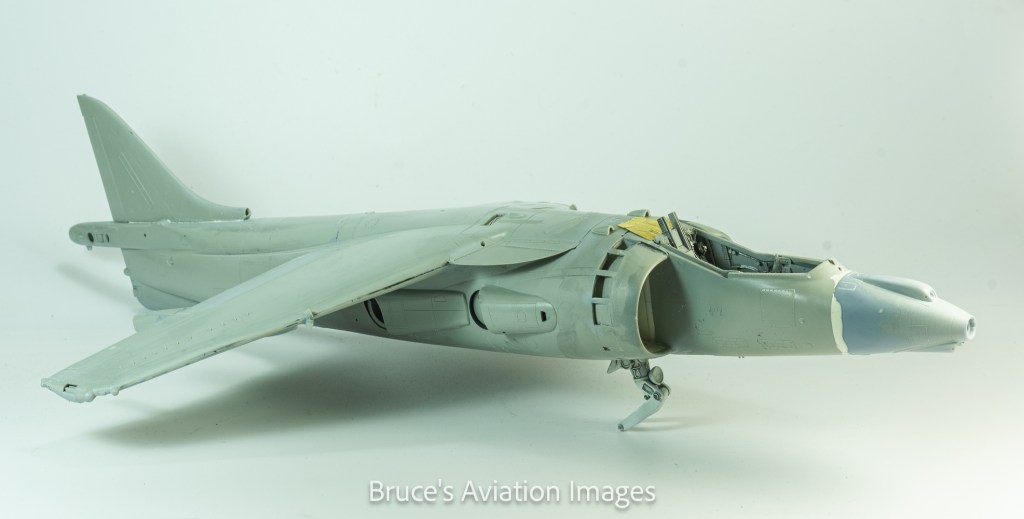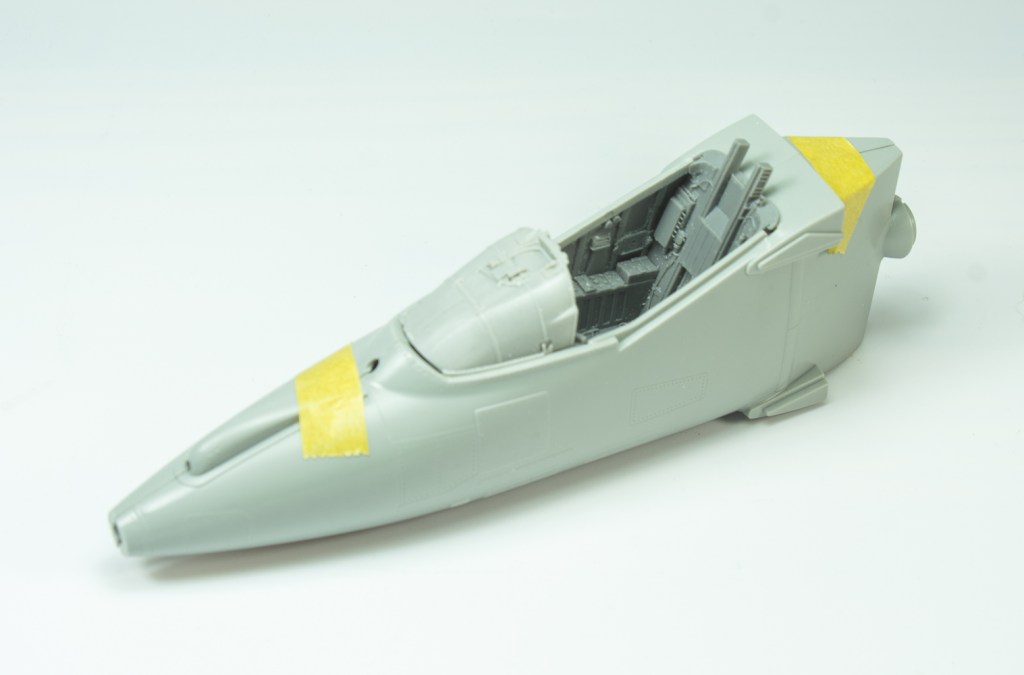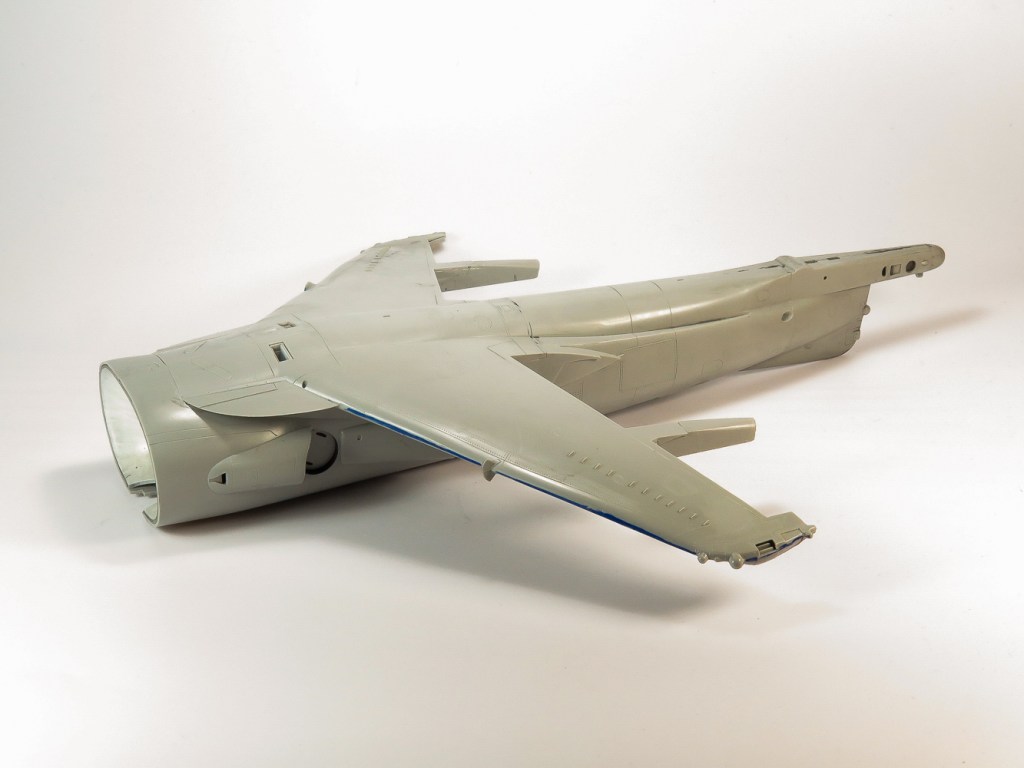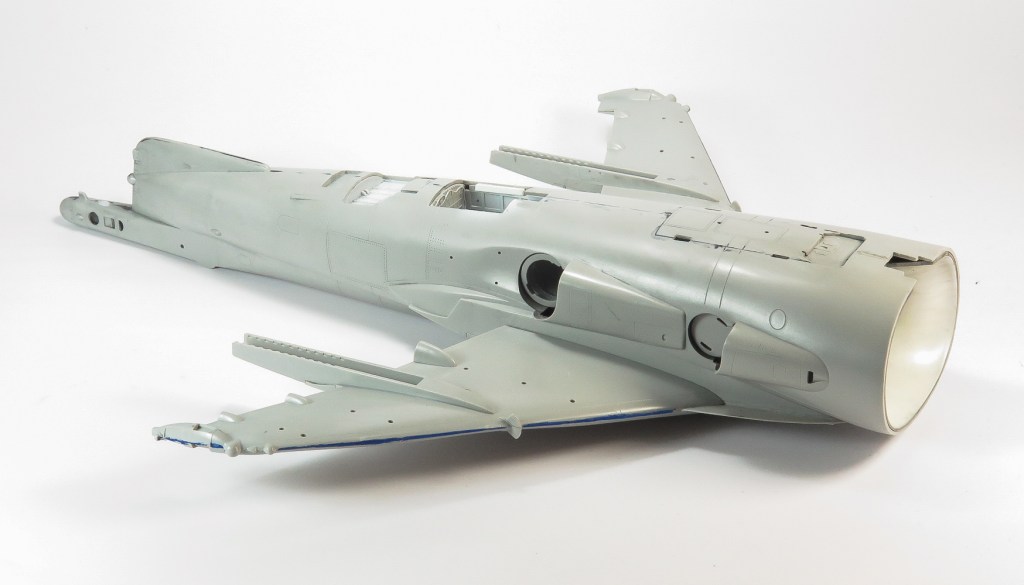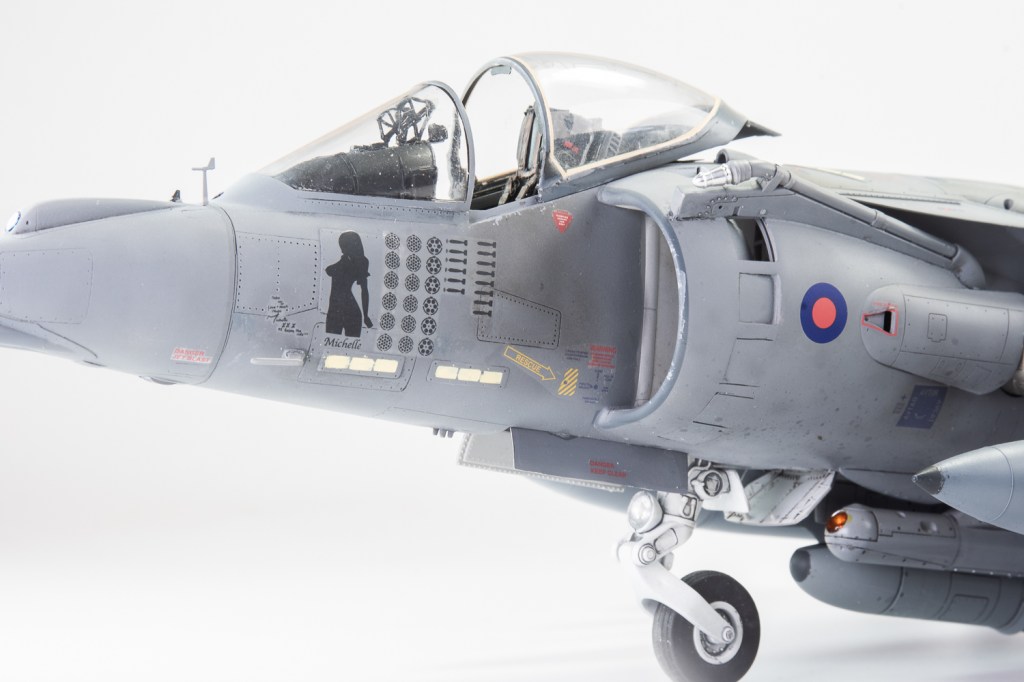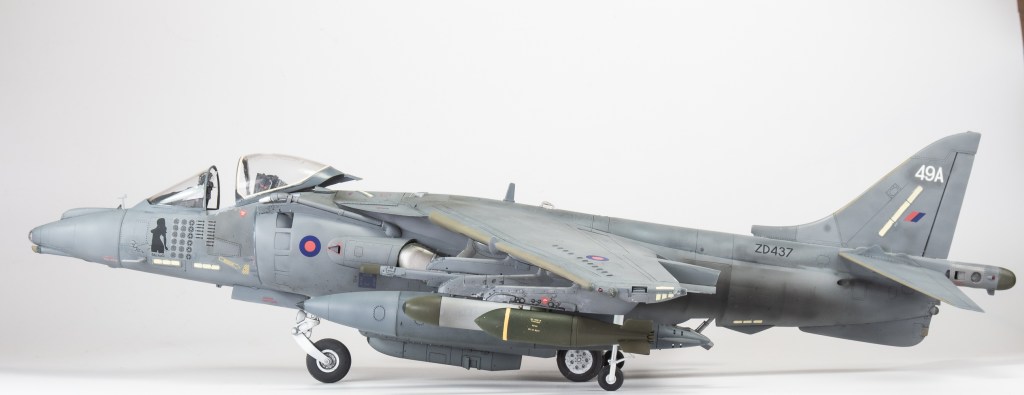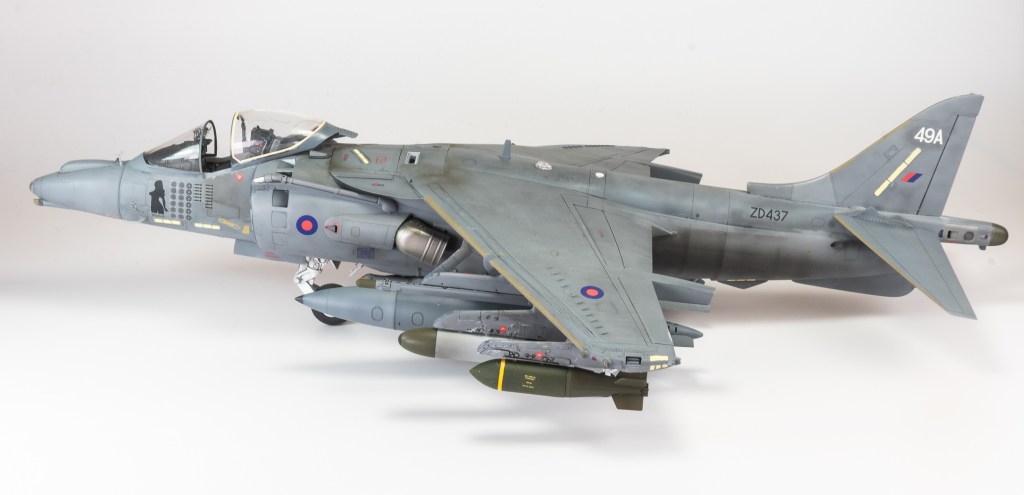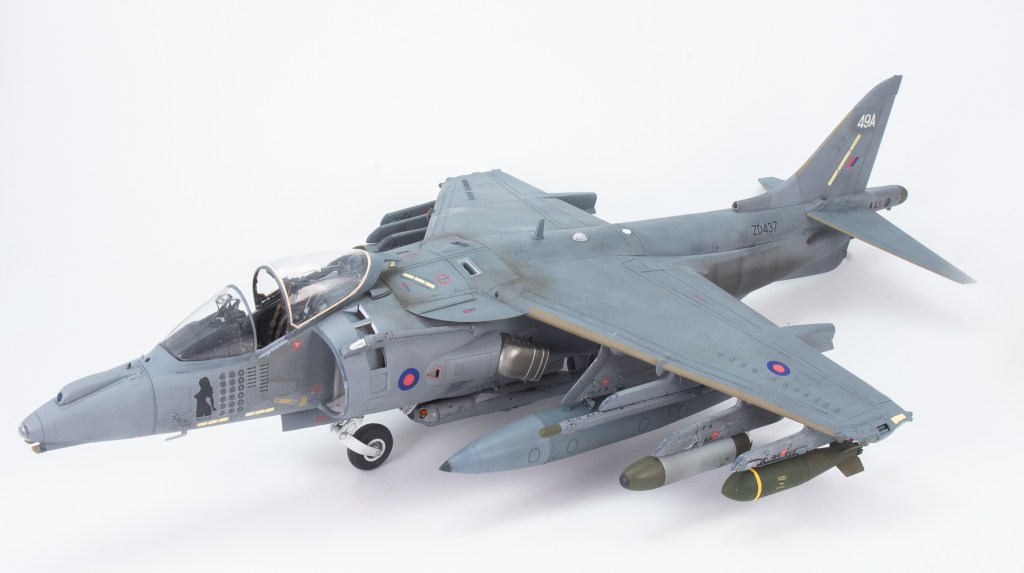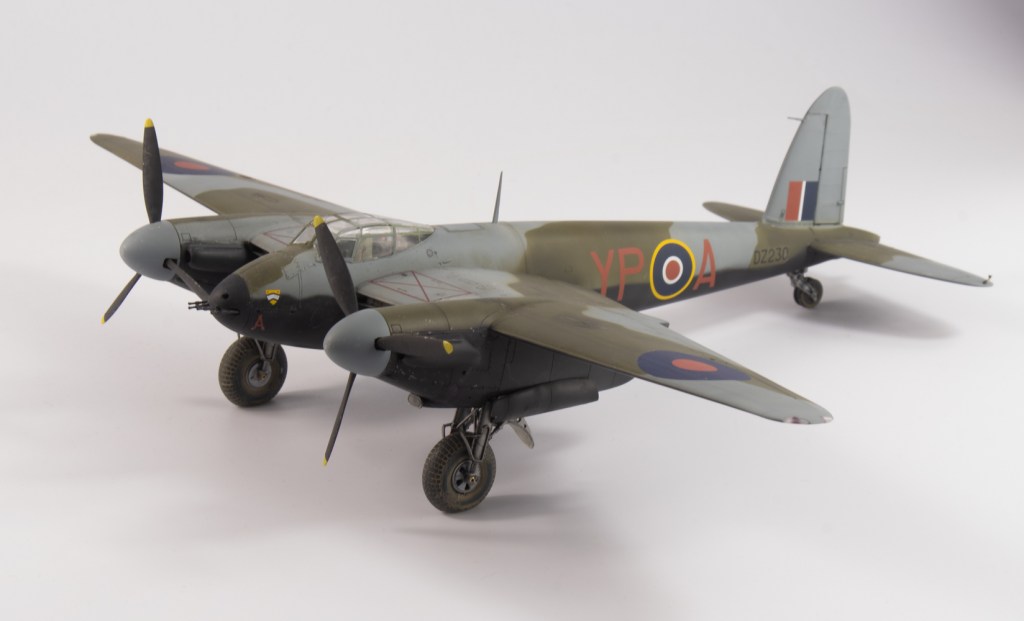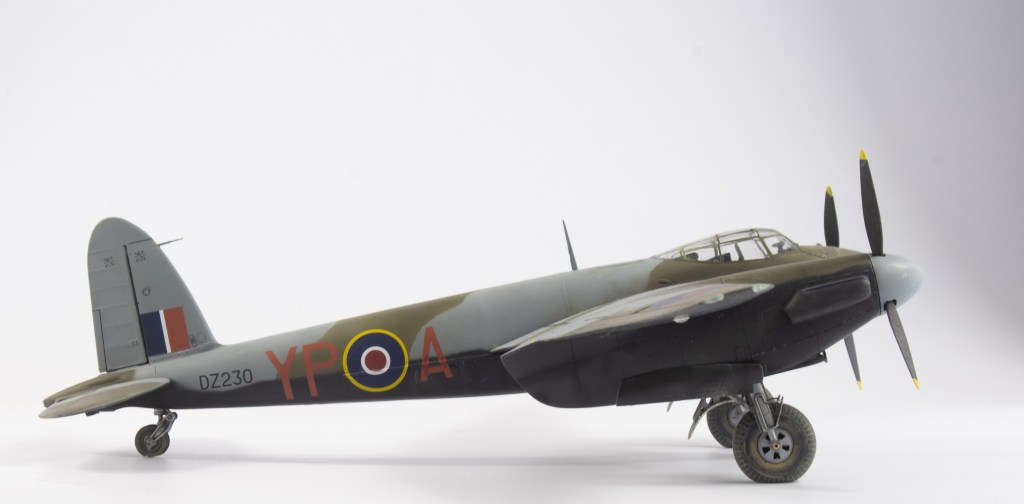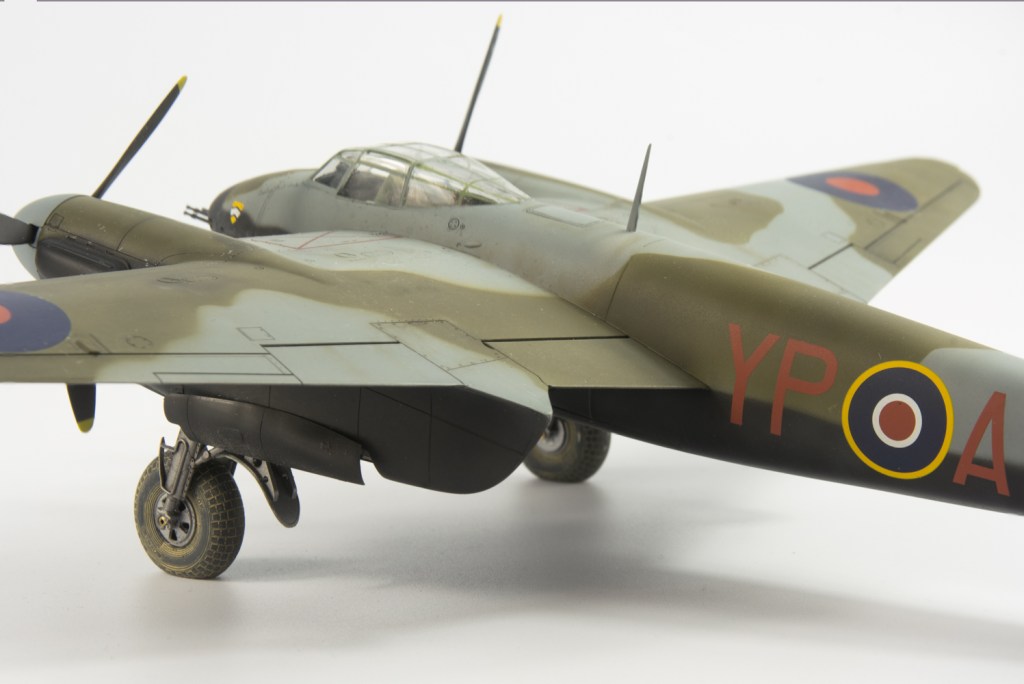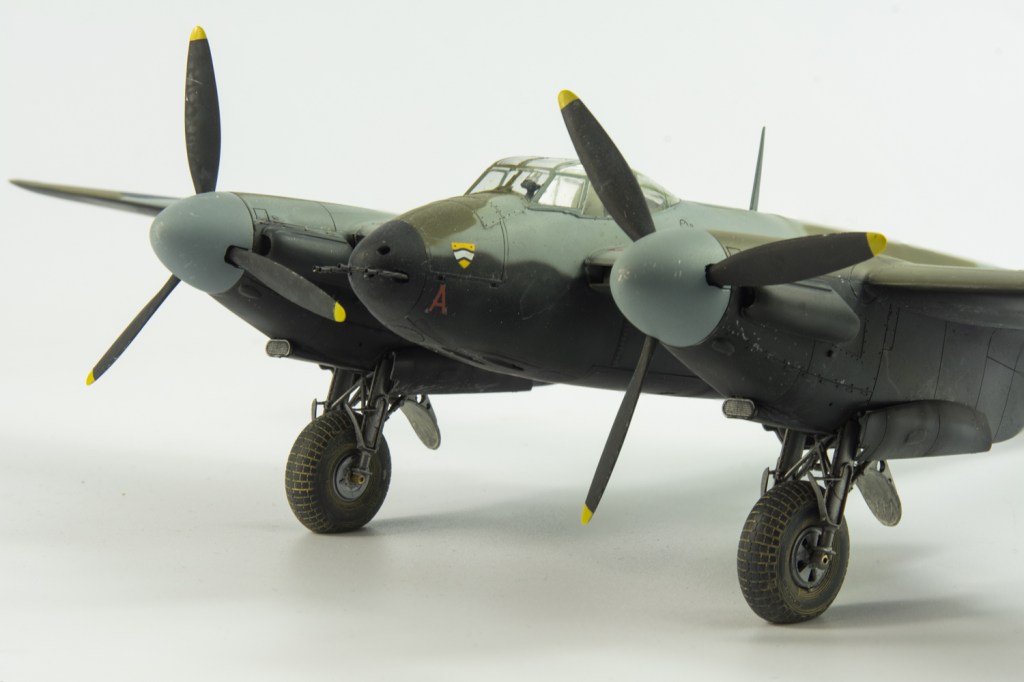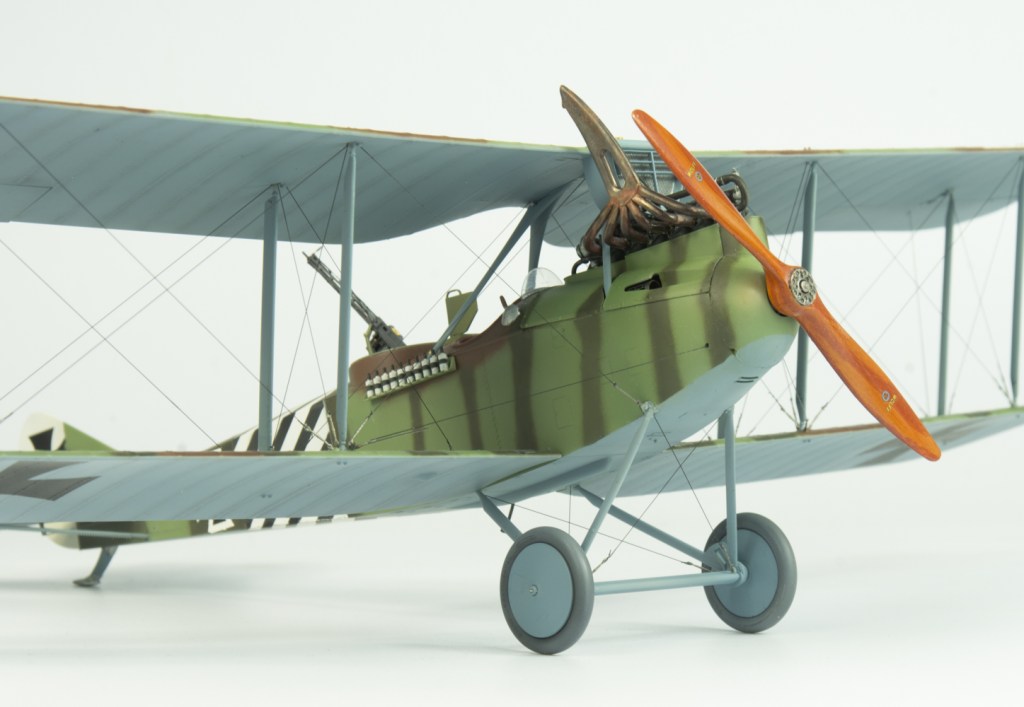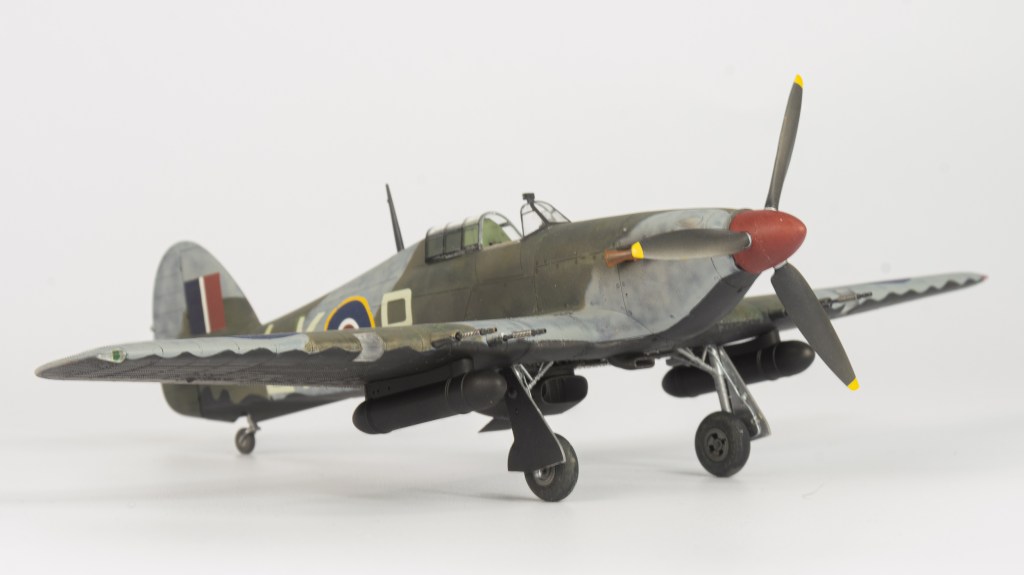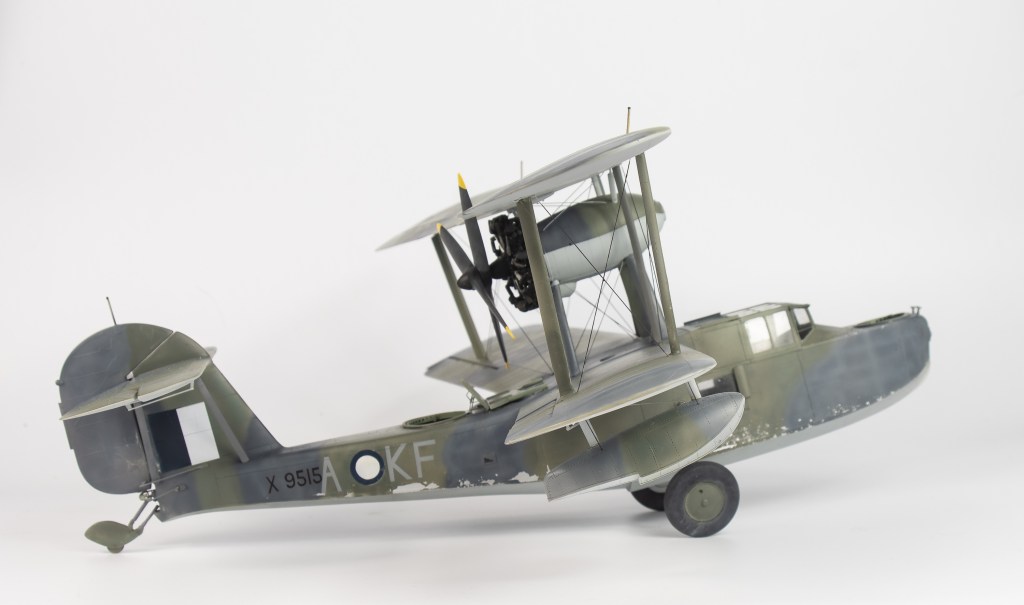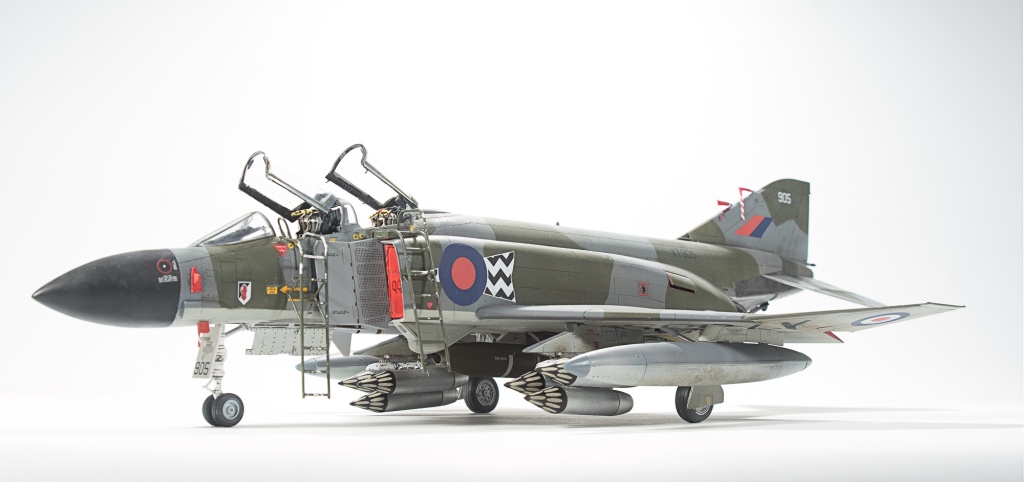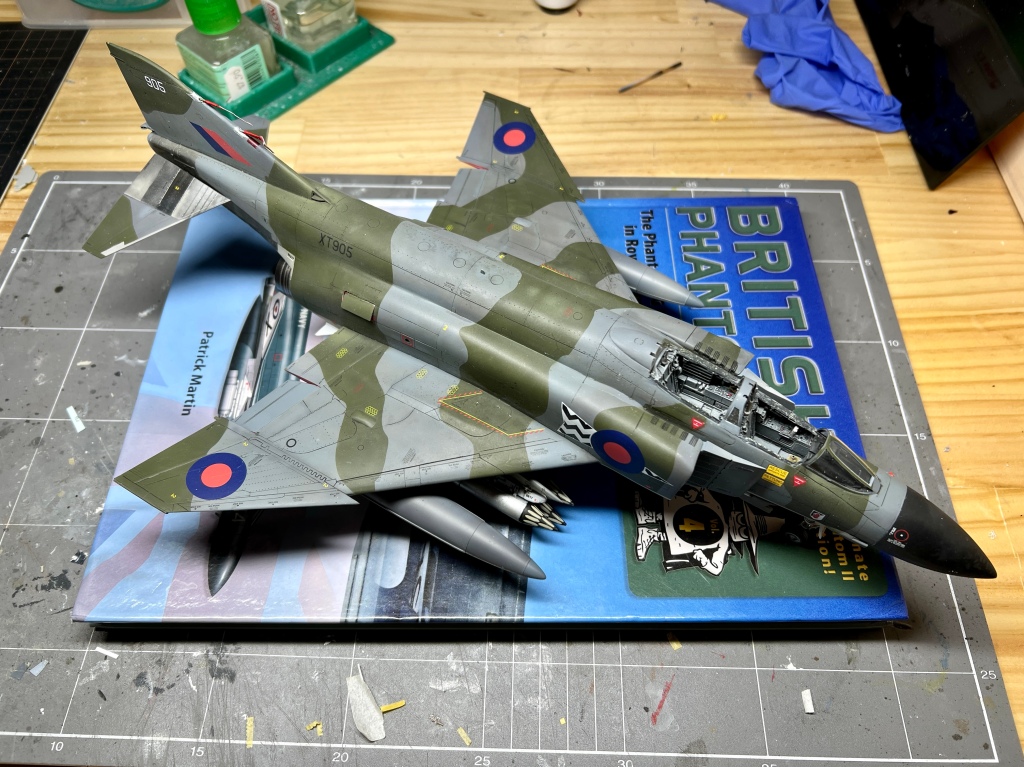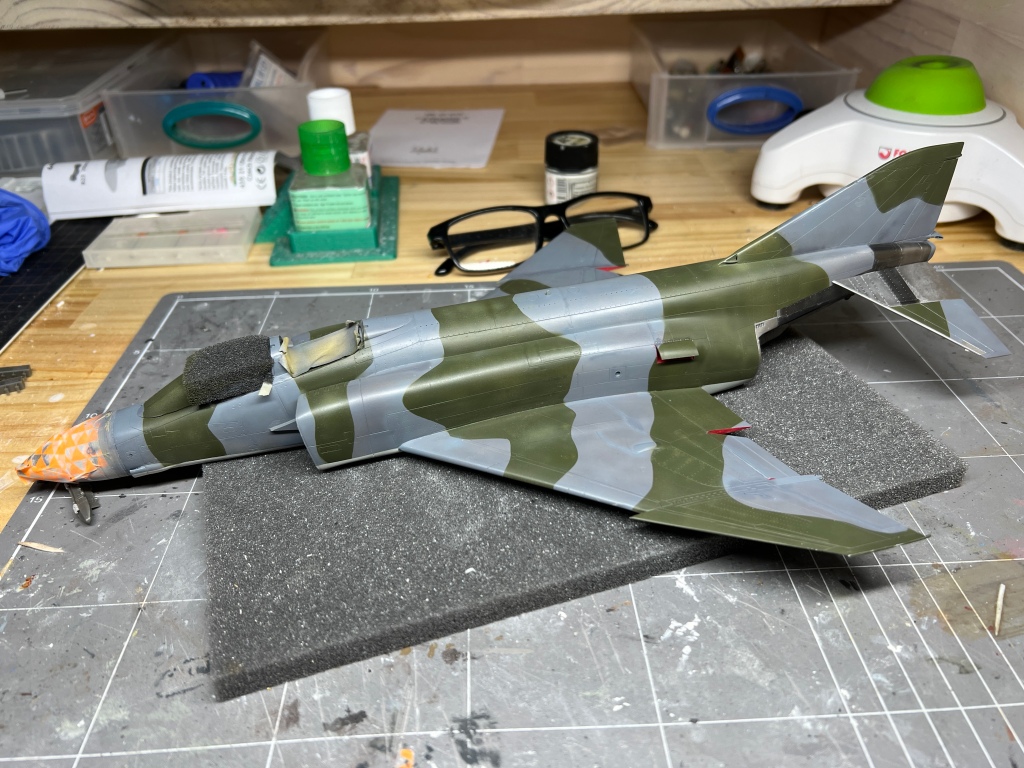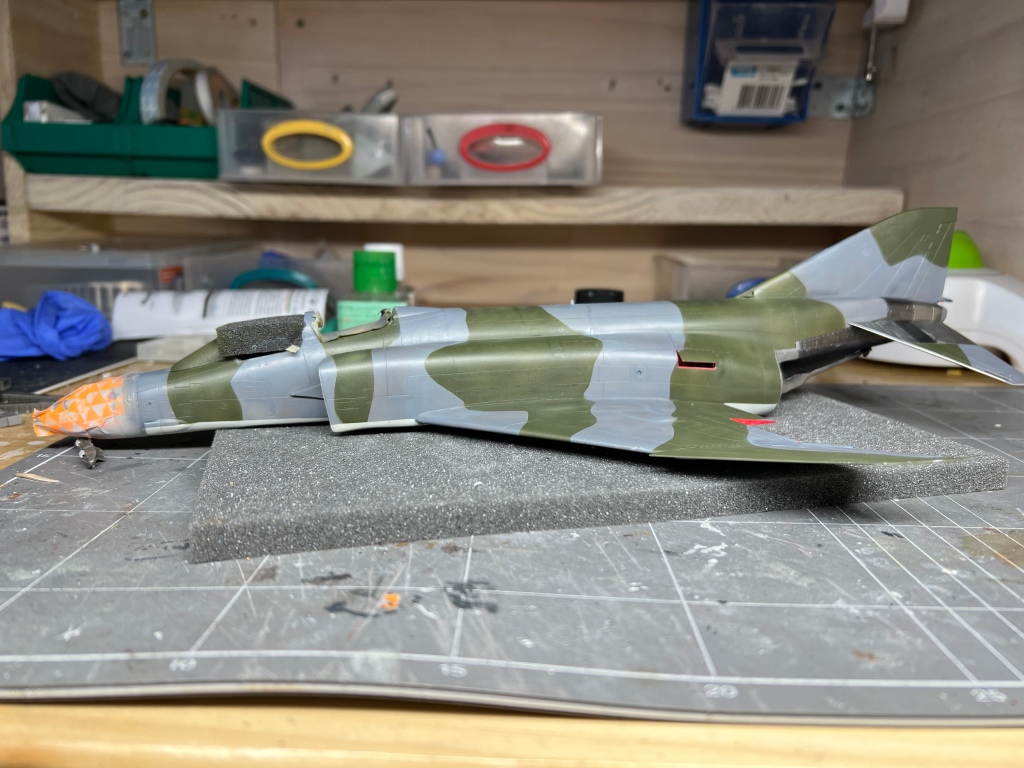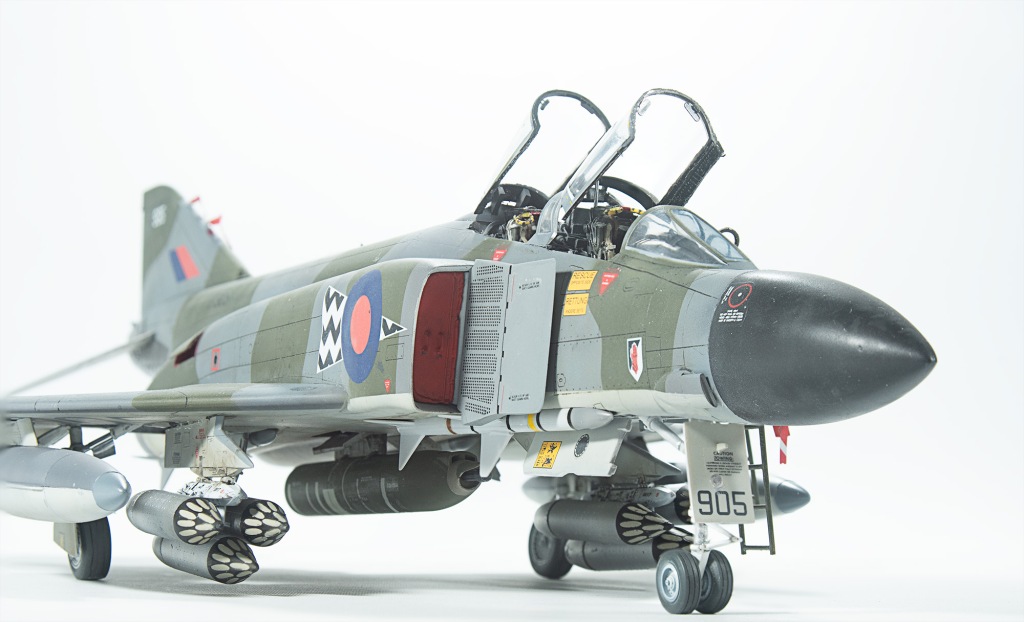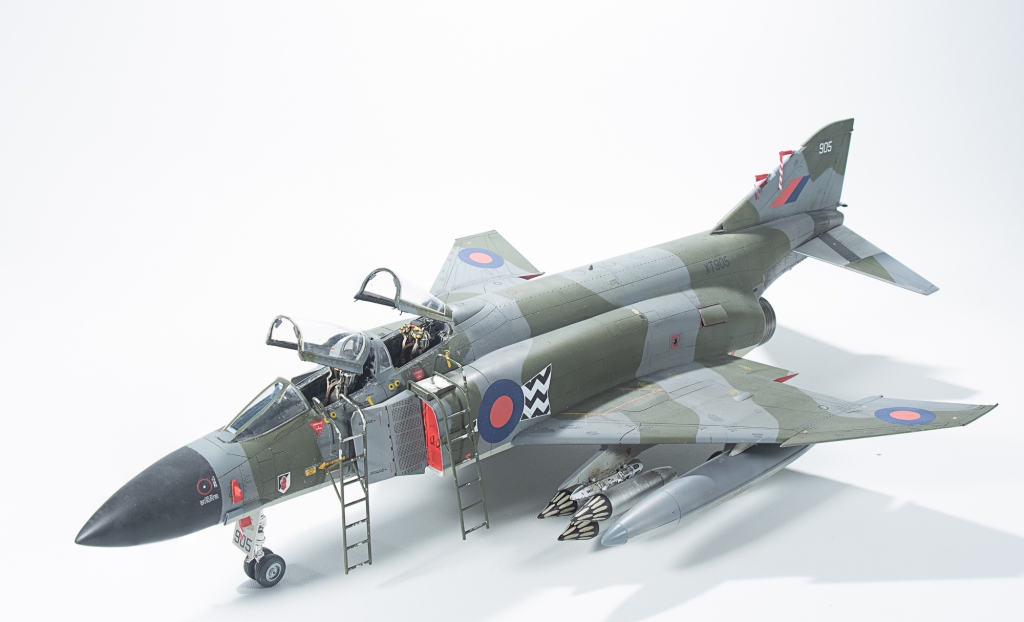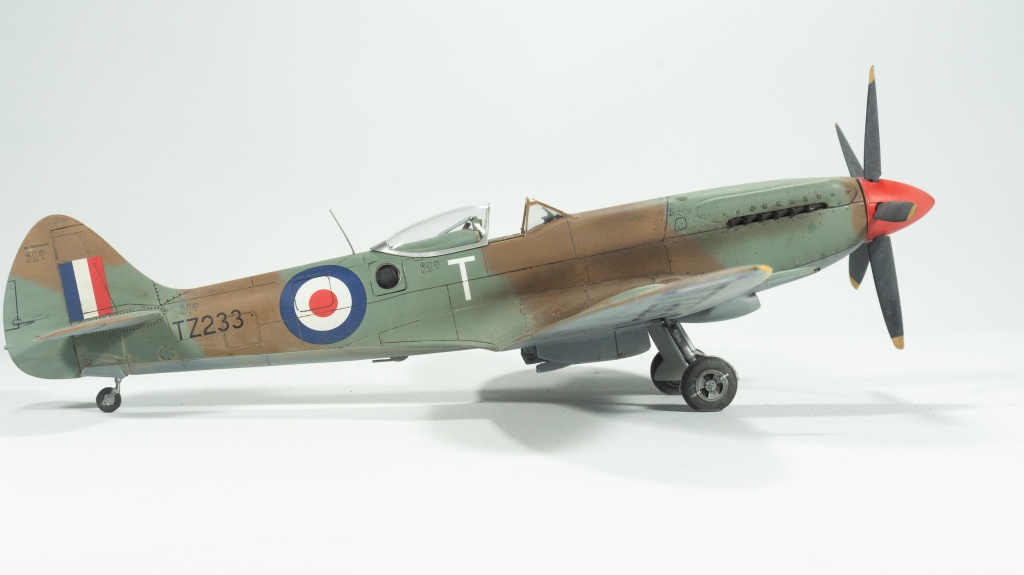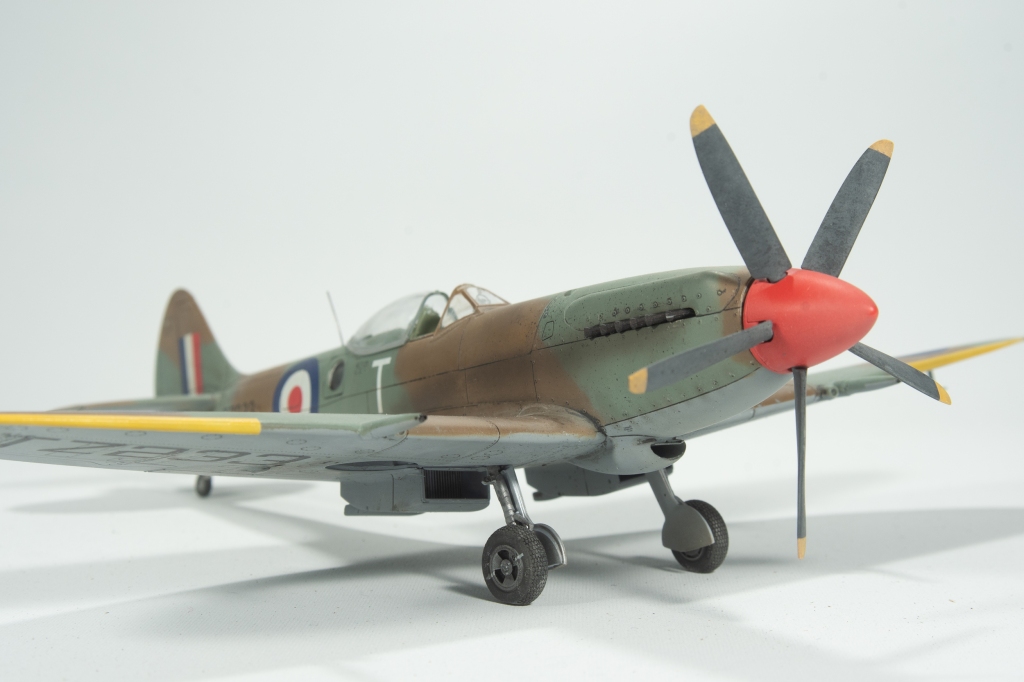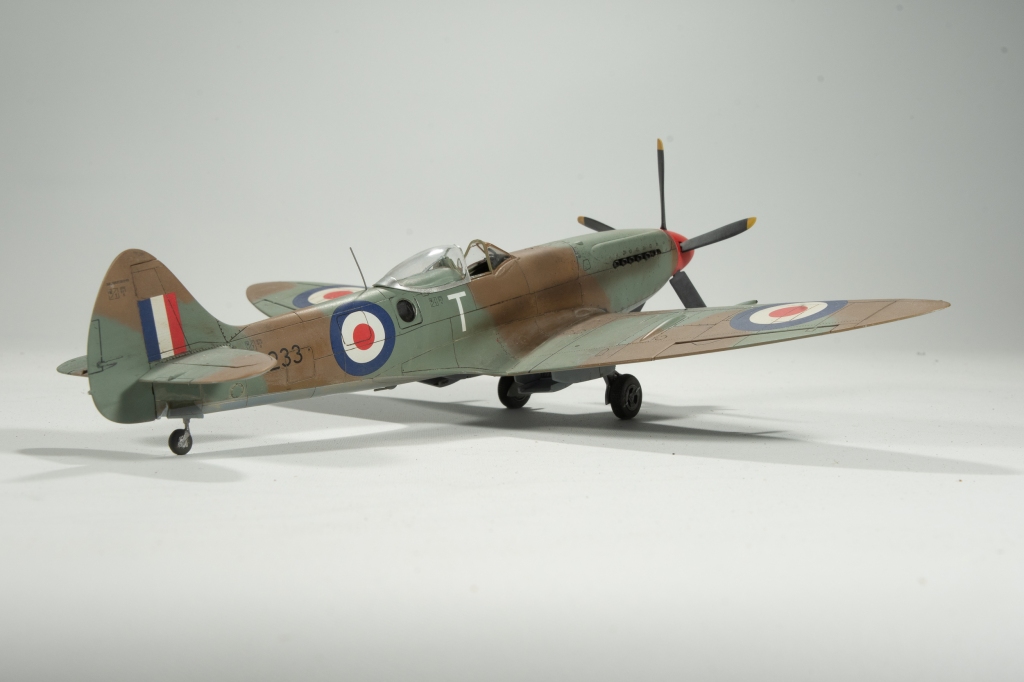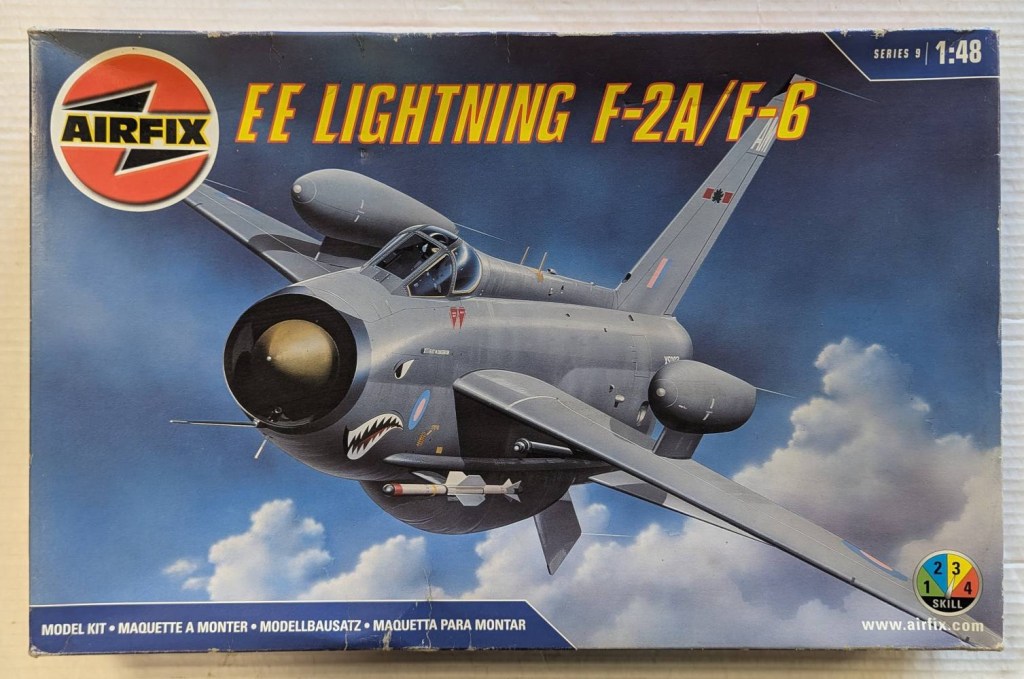
Airfix 1/48 Lightning F2A

image credit. Kingkit website
  • Purchased: 1998
  • Built: 2025
  • Enhancements:
  • Cockpit and seat – Cutting Edge
  • Wheels – Armory
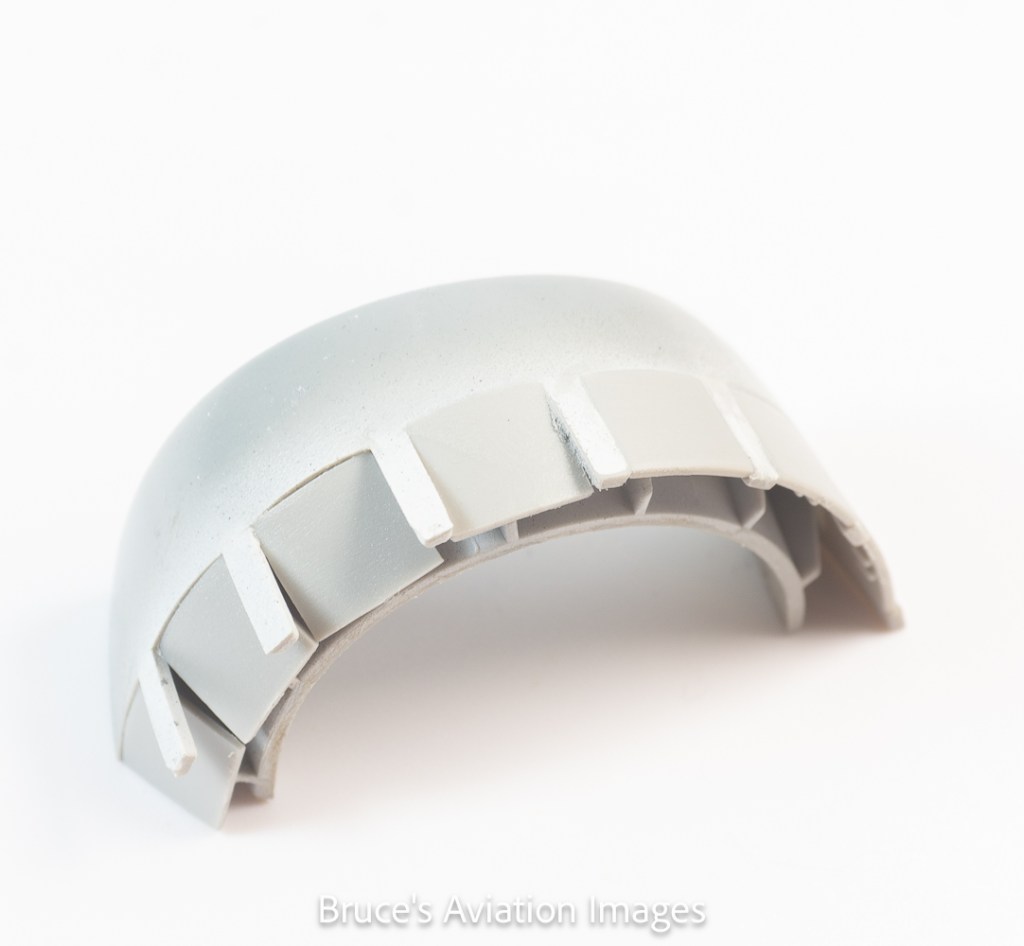
  • Exhausts – Reskit
  • Wheel well roofs : Eduard PE
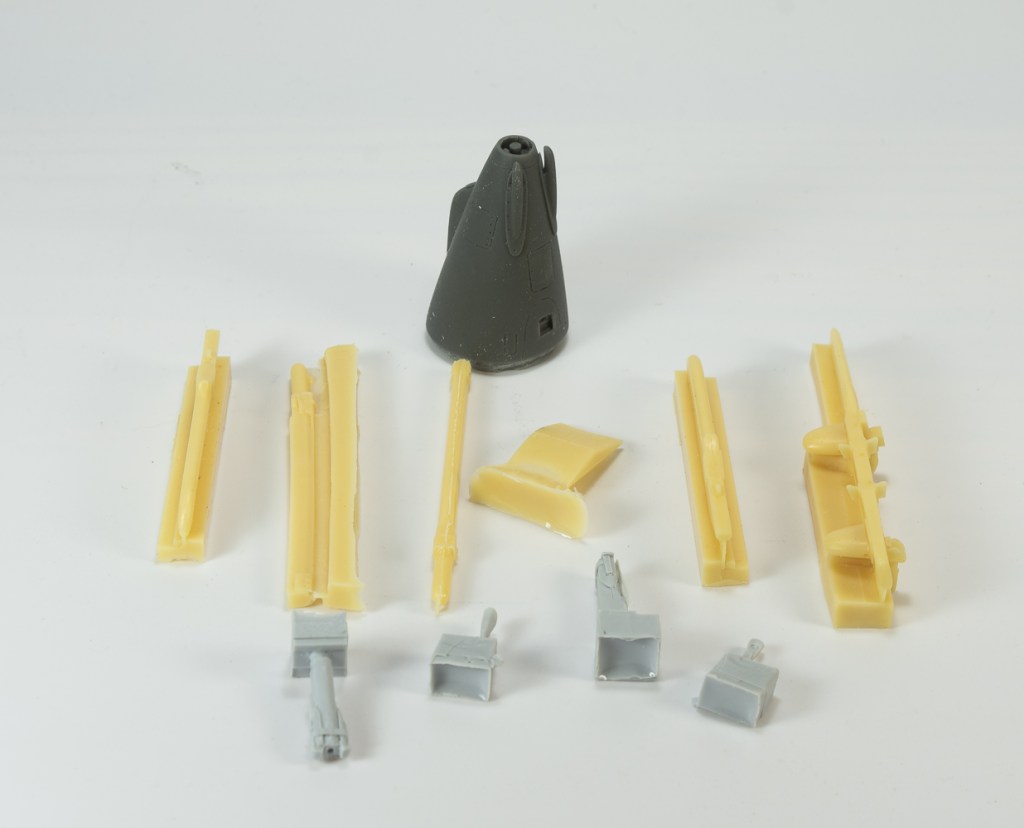
  • Missiles – Reskit
  • Pitot Tube – Master Details
  • Ladder: LP Models
  • Decals- Cutting Edge, then Model Alliance, then painted!

Introduction

This, after the Phantom is the oldest kit in my stash. It was purchased shortly after its original release from Wonderland Hobbies Scotland for the princely sum of 21.99 pounds according to the sticker on the box. Back when the only way to order kits from overseas was to actually telephone the shop! Back in the Jurassic Period before on-line ordering became the norm.

Upon release the Airfix Lightnings were lauded in the modelling press as Airfix at its zenith. And many modellers, particularly those from the UK still seem to think this.

This modeller though certainly does not. Perhaps if I had built the model upon its release, my impressions of it too, would still be favourable. However, building it in 2025 and measuring it – perhaps unfairly – against newer Airfix kits brings forward all its shortcomings. In fact, even measured against contemporary Japanese kits, it falls a little short. Poor cockpit details, no wheel well detail at all, vague instructions, sink marks, thick decals. It certainly was not the kit I was expecting. A mate came to the same conclusion after building his. The kit was the subject of the Annual friendly Build-Off between The HamFisted Modeller and myself. The results are judged at a local competition we both attend. It should be noted that HFM handicaps himself to give me a chance. (EDIT.) Suspiciously that last sentence only appeared after I sent the article to HFM for proofreading

Construction Notes

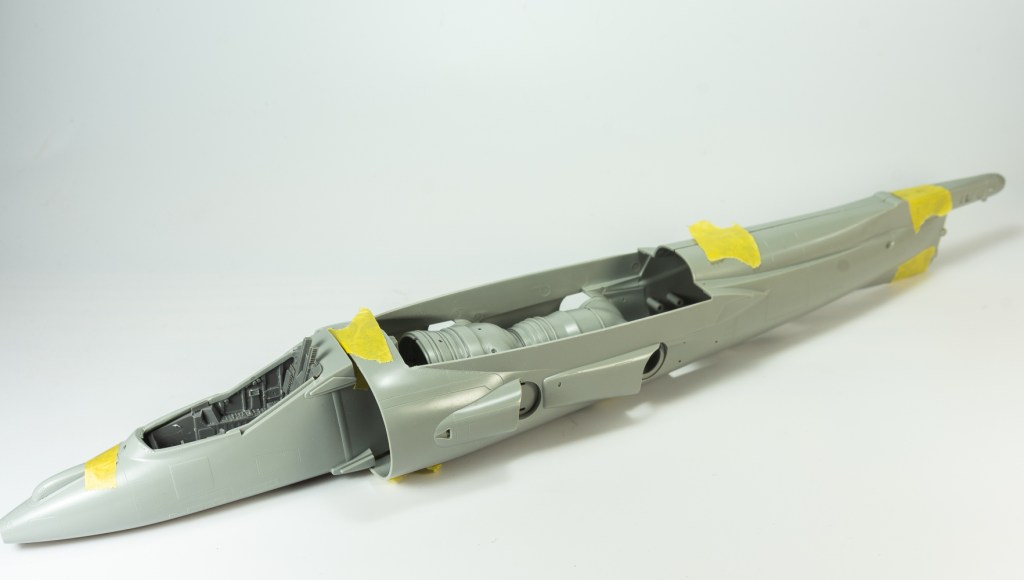
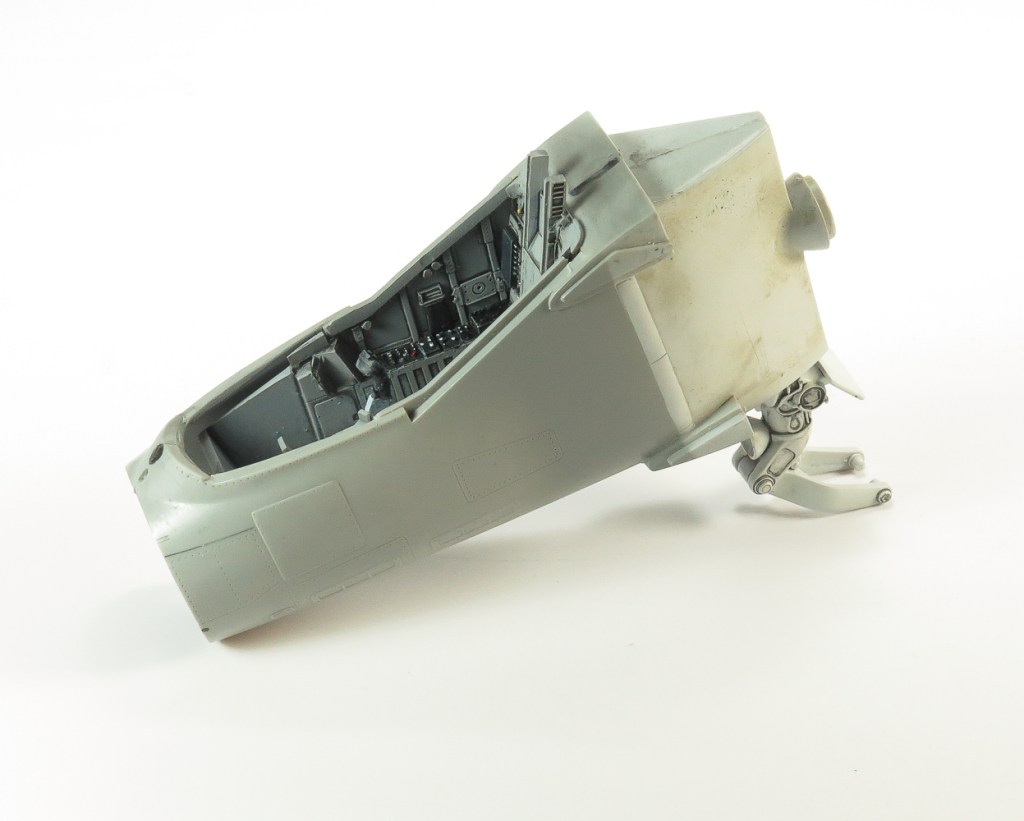
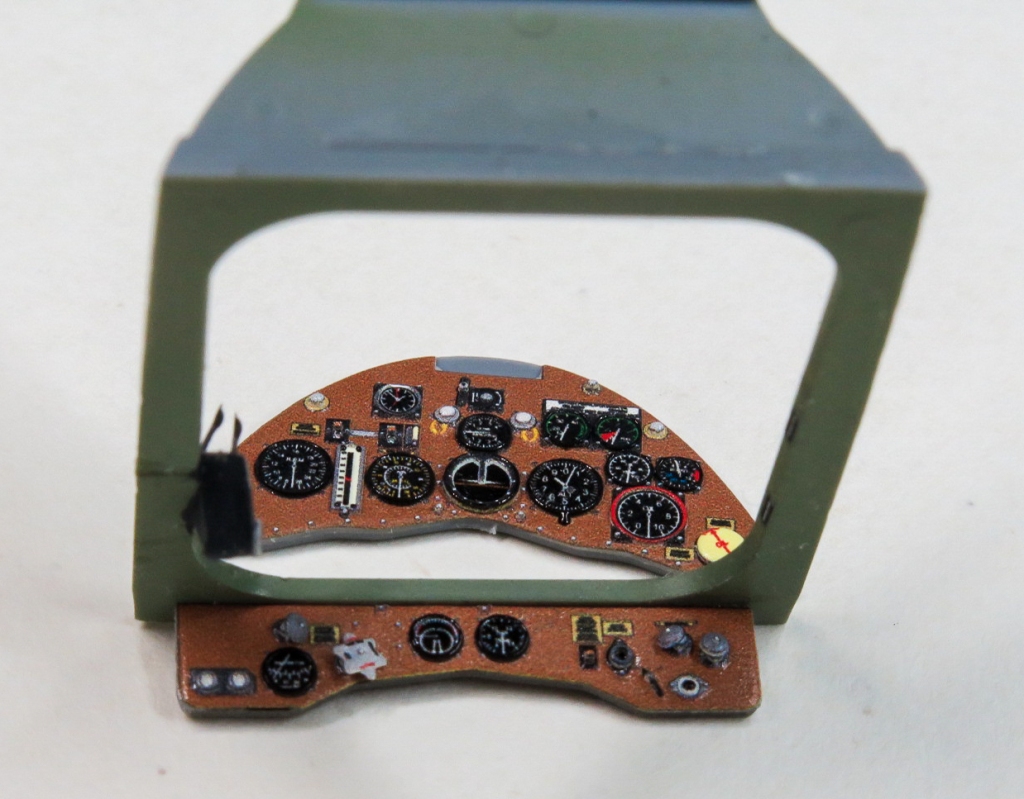
The Cutting Edge Super detailed Cockpit upgrade was one of many aftermarket sets stuffed in the box. It was used to replace the woefully detailed kit cockpit. Calum had stated that pretty much nothing of the cockpit can be seen anyway. Anyway , as I had the set, it was used. Unlike an Aires set, minimal sanding was required to make it fit. Just the backs of the sidewalls and some material removed from the casting block to ensure the tub sat down over the intake trunking.
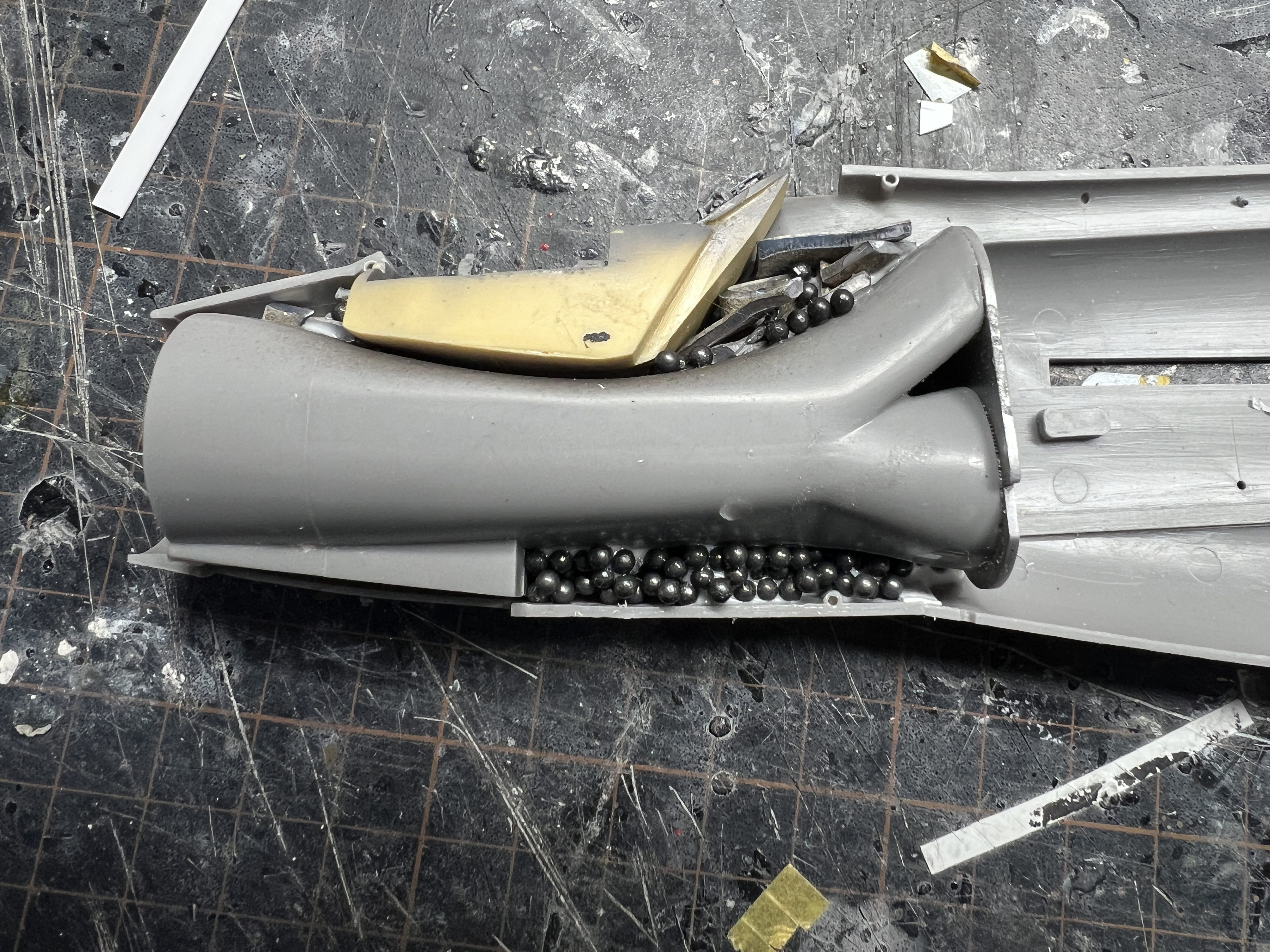
The cockpit was painted with MRP Medium Sea Grey, this being a later mark Lightning.

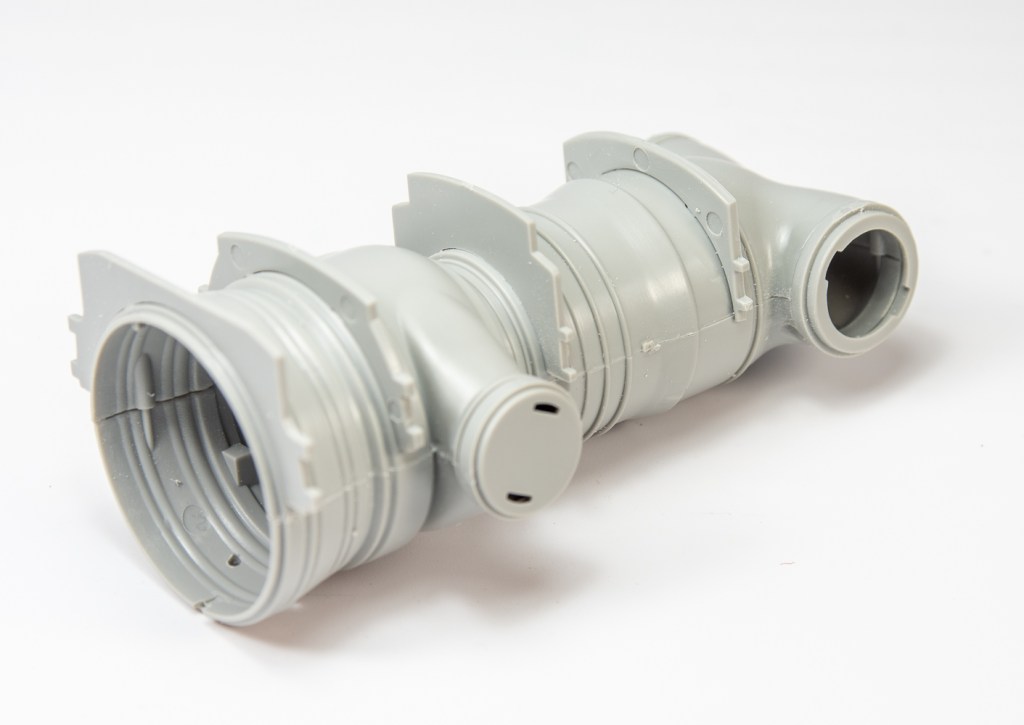
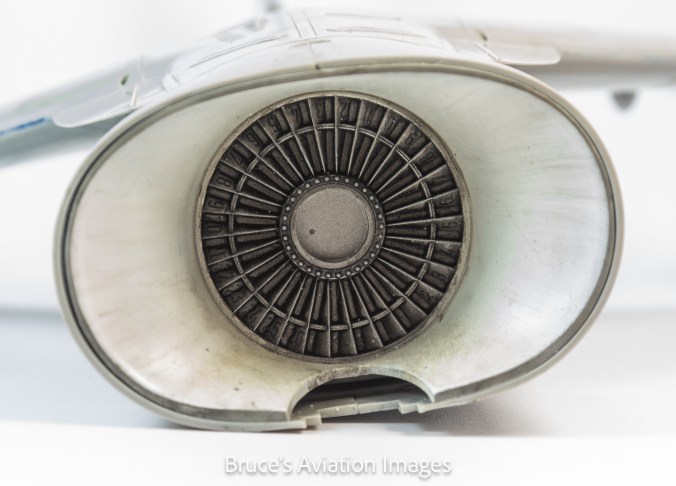
Building the intake we come to the first “WTF Airfix?” moment. The bottom of the nose wheel well is a rectangle to fit the wheel well opening. Airfix want you to mate it to the top half which is an elliptical shape. This of course leaves large visible gaps. I left it as is, as there id very limited viewing up into the well. Very poor engineering on Airfix’s part.

Take care to ensure the radar bullet nose cone is central in the intake. Also don’t forget the nose weight, remembering to take into account the added weight of resin exhaust cans if you are using some. Airfix helpfully includes a diagram in the instructions of the best place to pack it. The fuselage on mine closed up OK, but the panel lines did not align across the seams, requiring them all to be filled and rescribed. The nose ring is a poor fit and will require fairing in.

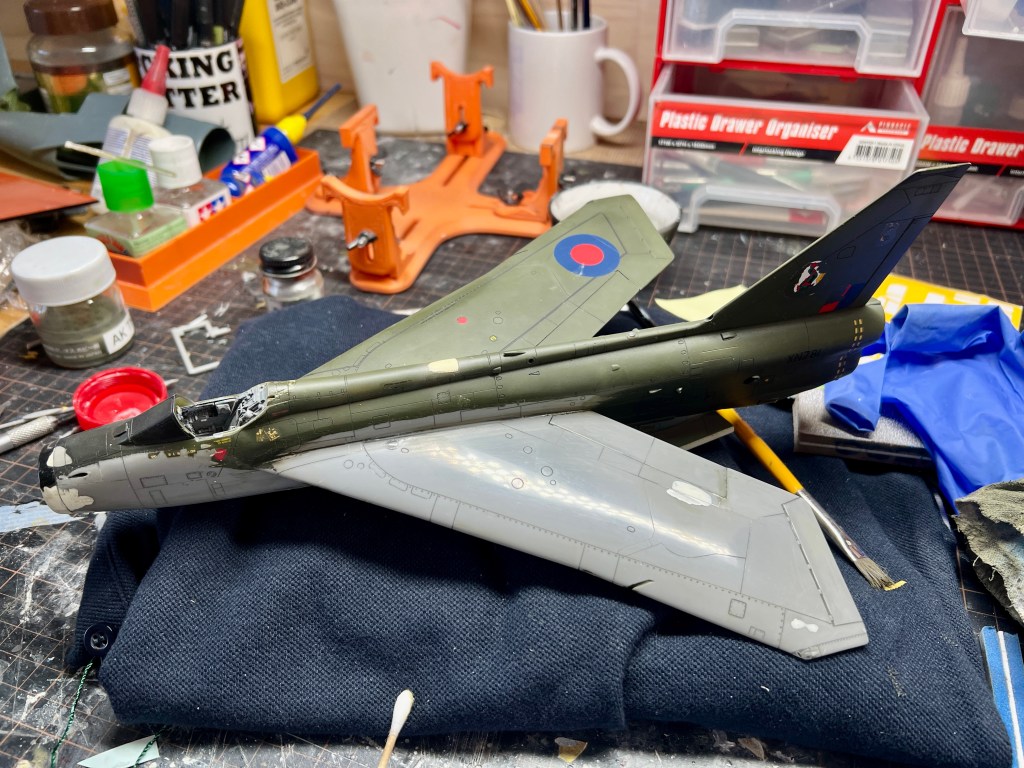
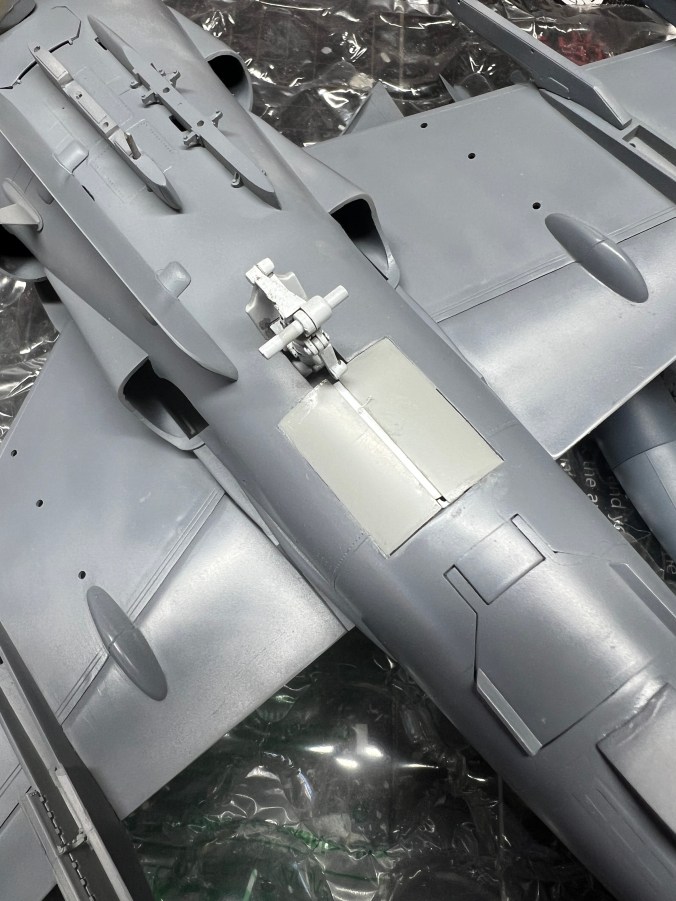
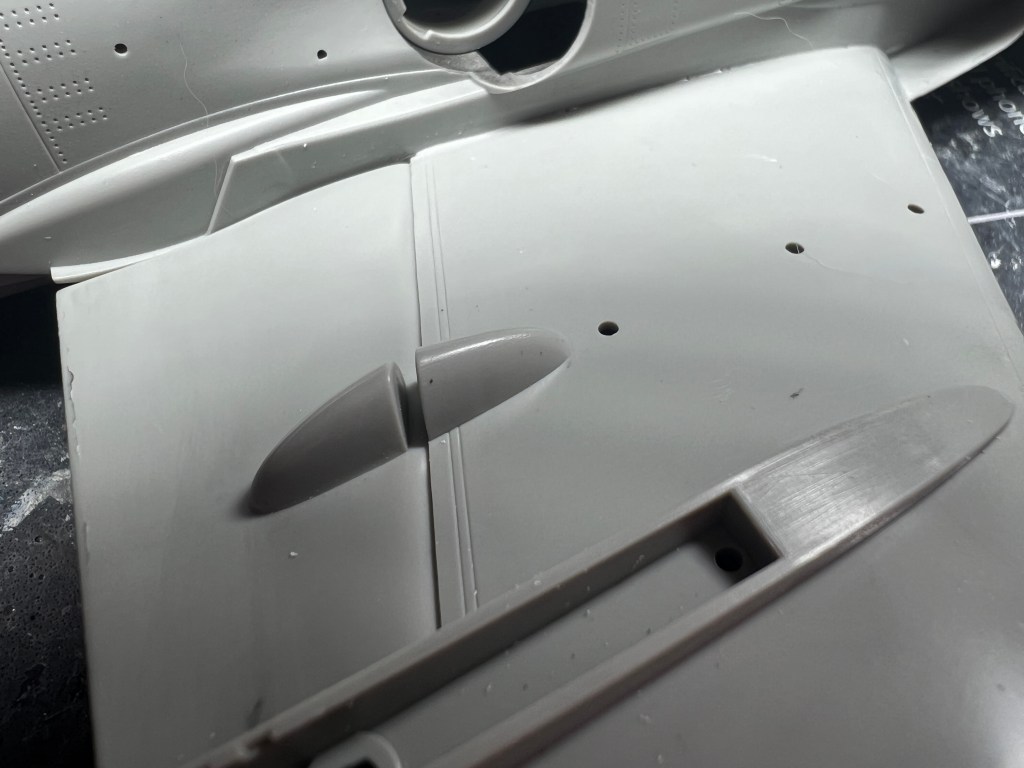
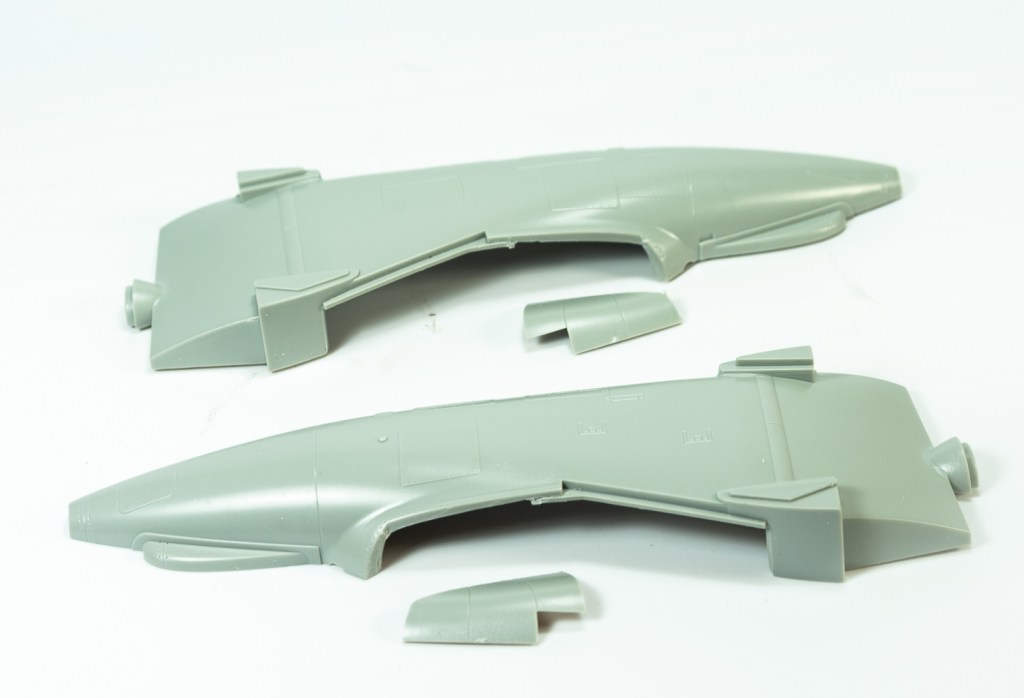
Onto the wings, and mine were looking a little warped. There were also several sink marks requiring filling. Airfix provide absolutely no wheel well detail. CMK and Aires both have resin sets in their ranges. I decided to steer clear. I knew full well the work these would require fitting to the model. Instead, The HamFisted Modeller generously provided an Eduard PE set. It was put to use to add the distinctive patterned roofs to the wheel wells. It is very worth your time to set up the undercarriage leg components now. Dry fitting them helps in seeing how they fit together. You must carefully look at photos of the real jet. The Airfix instructions are of no use at all. I had to add small blocks of sprue to each leg to allow the retraction strut to locate. There is nothing moulded on the leg. Again, really poor engineering by Airfix. I must apologise here as I thought I had photographed this step, but apparently not!

Out of the box, the kit wings do fit to the fuselage quite well, only problem is they are level, whereas the real wings had slight anhedral. Adding this to the kit wings left a slight gap on each top surface which was filled with Milliput

So far, despite the noted annoyances, the model had gone together reasonably well, and construction progress was swift. Unfortunately this was about to change rather drastically with the decalling.

Painting and Decalling

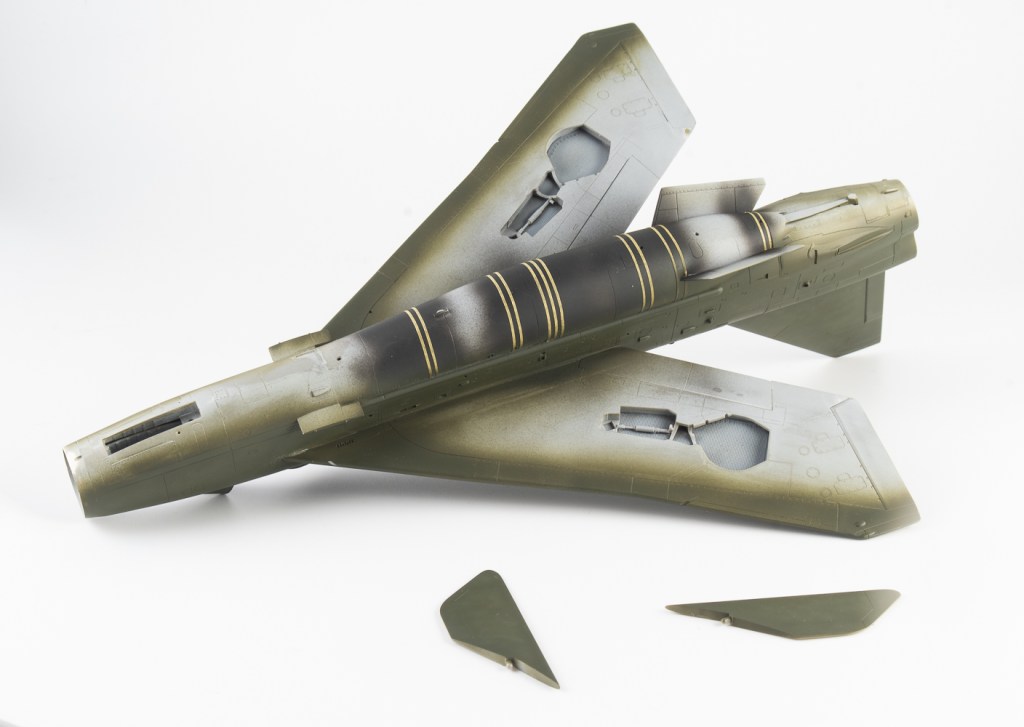
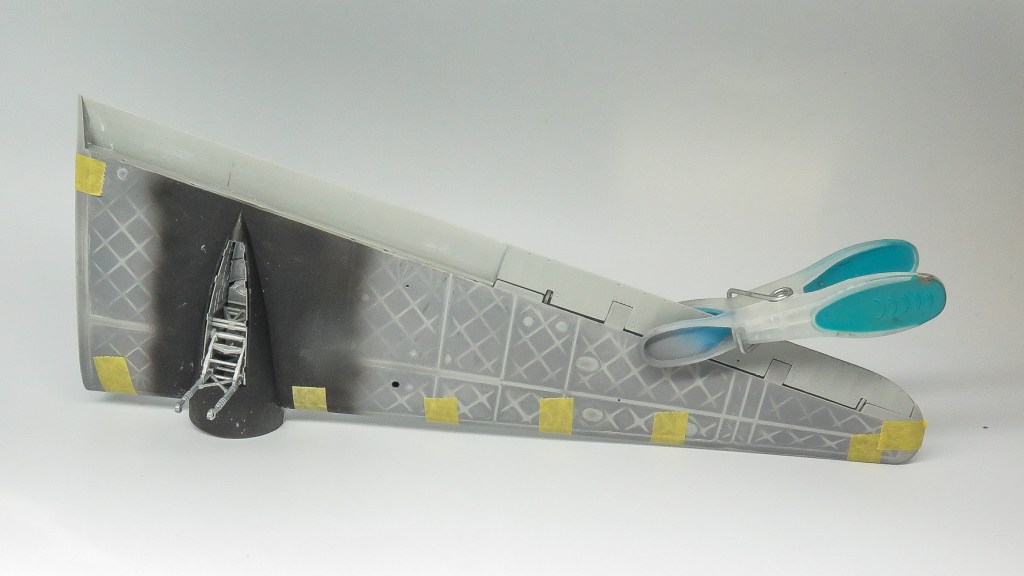
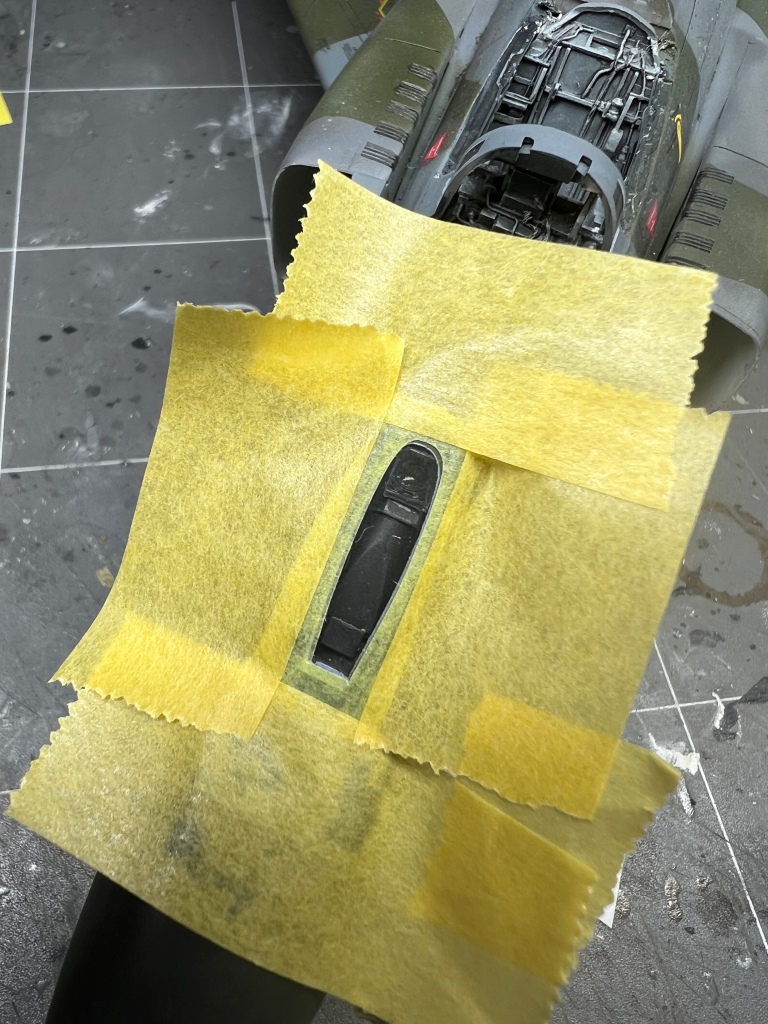
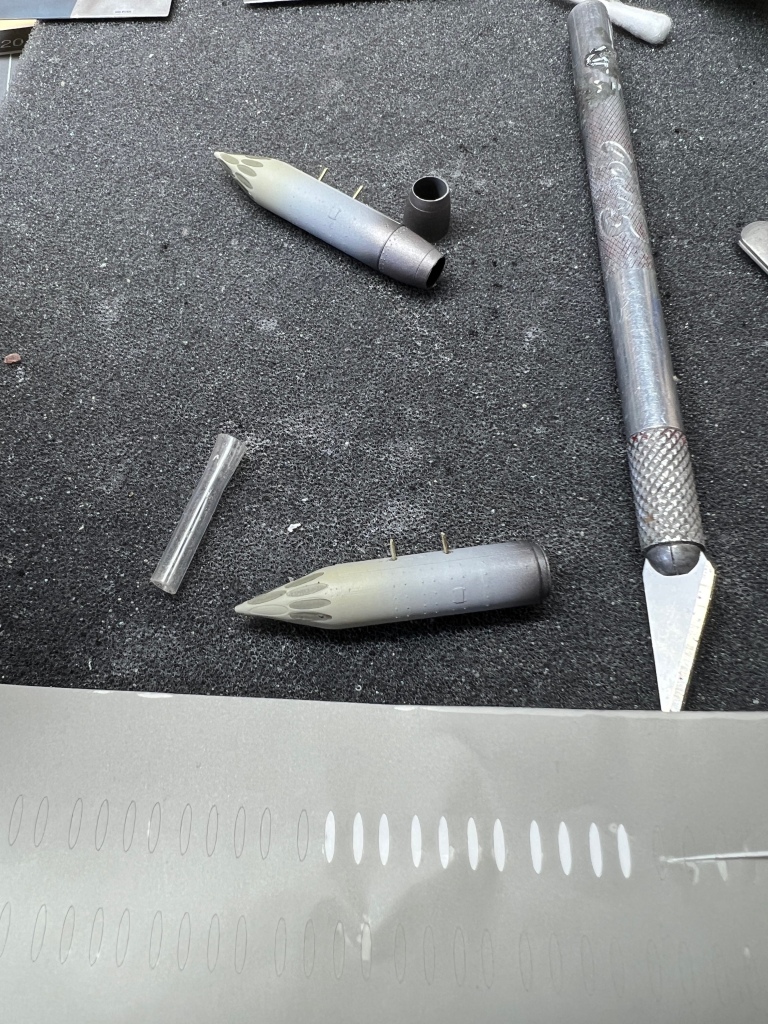
To limit the chances of silvering, I opted to paint the walkway and tank stripes. First, I applied a coat of matt black. Then, I masked out the stripes with thin strips of tape.
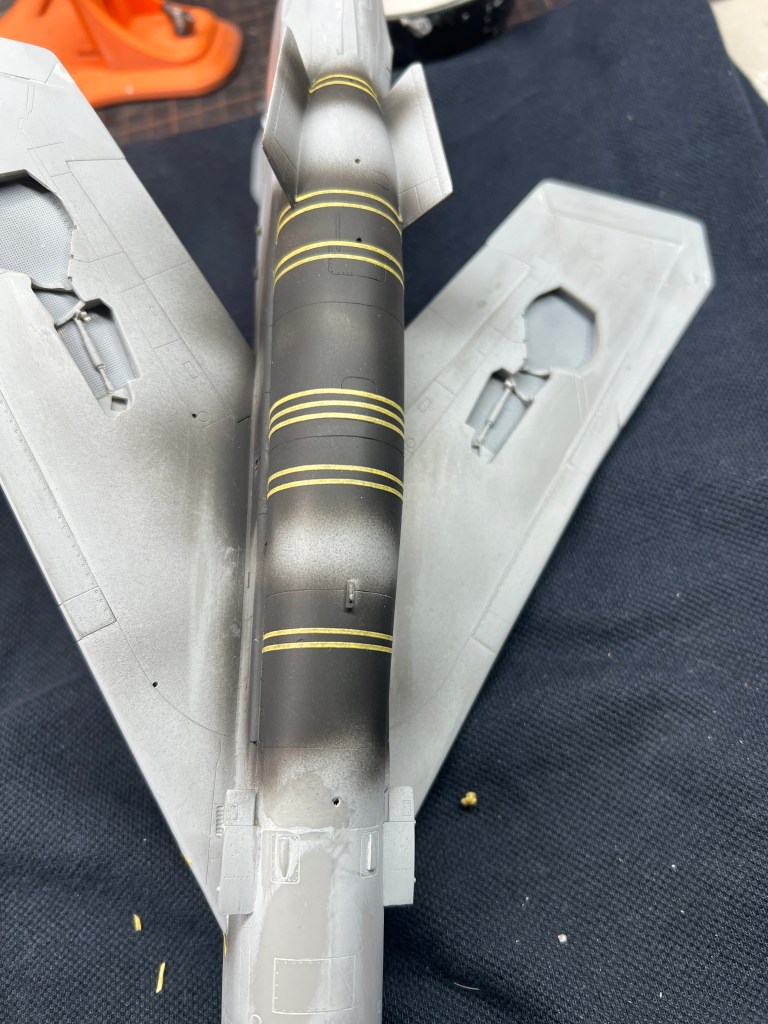
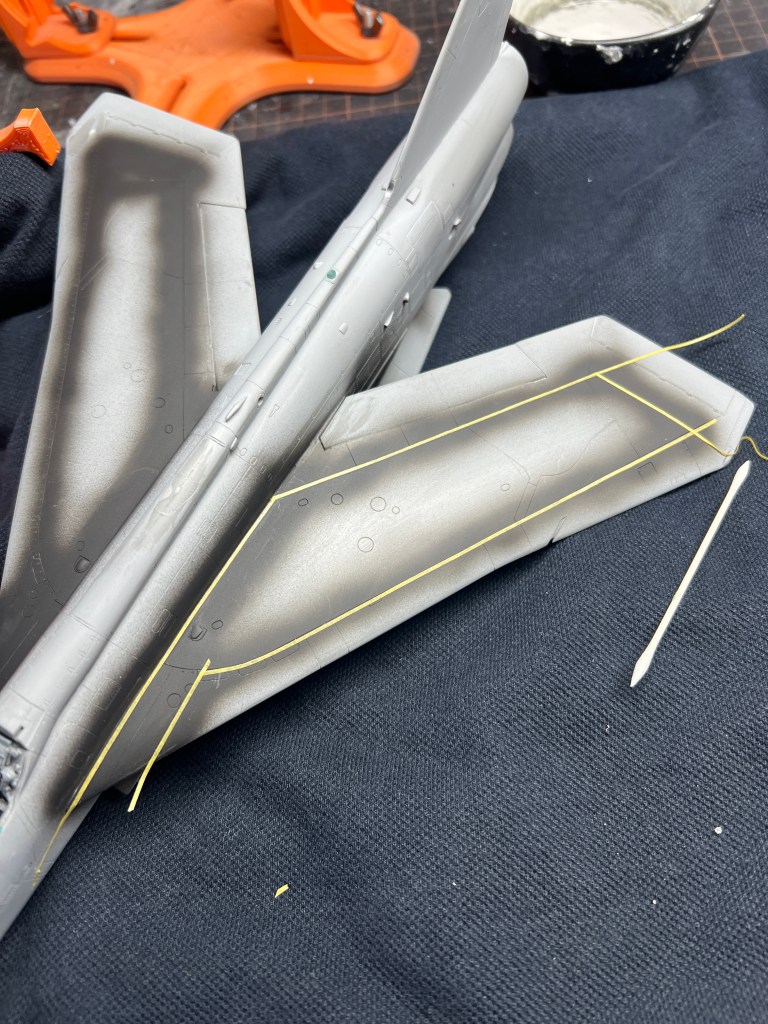
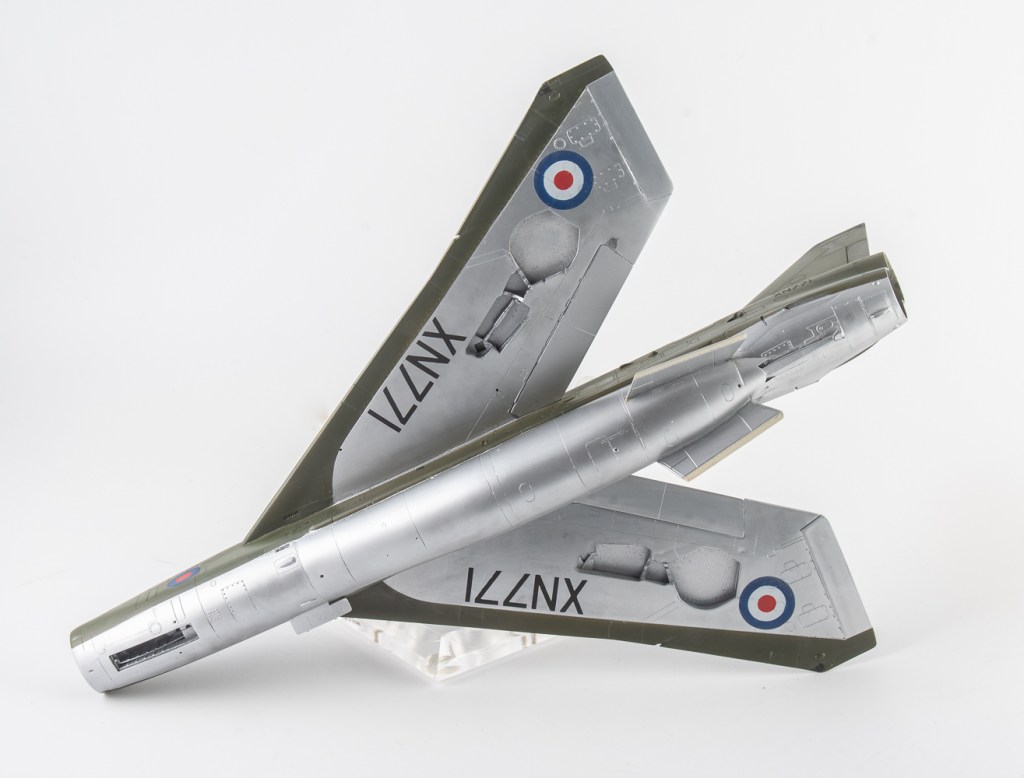
For the top surfaces, Gunze Mr Color 330 was used. Lightened as out of the bottle it is quite dark. Various shades lightened with yellow and white were applied with the undersides being spread with Tamiya LP-11 Silver
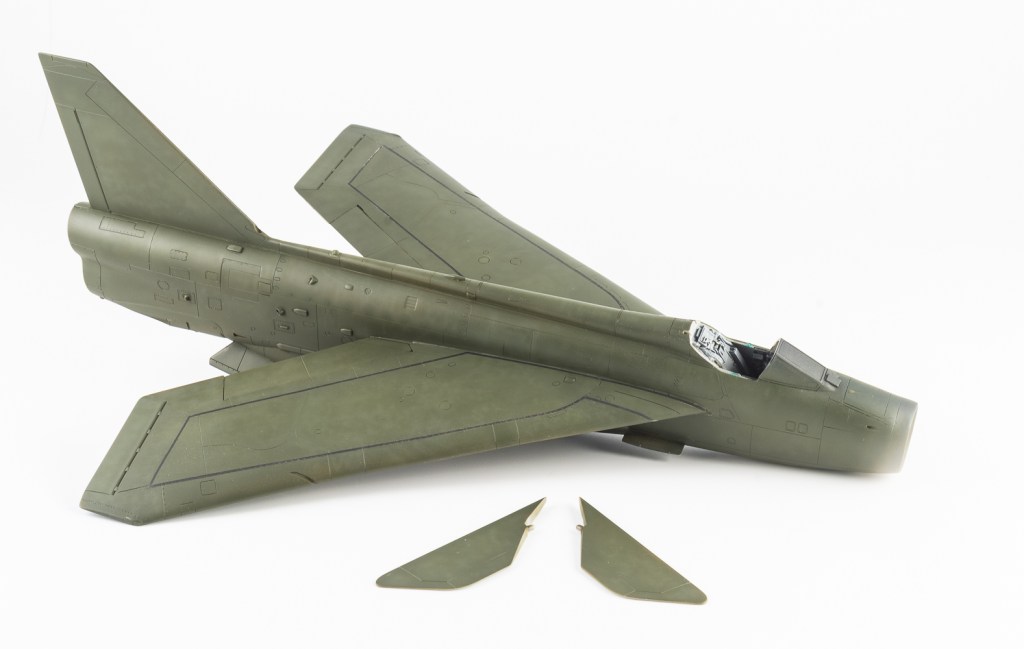
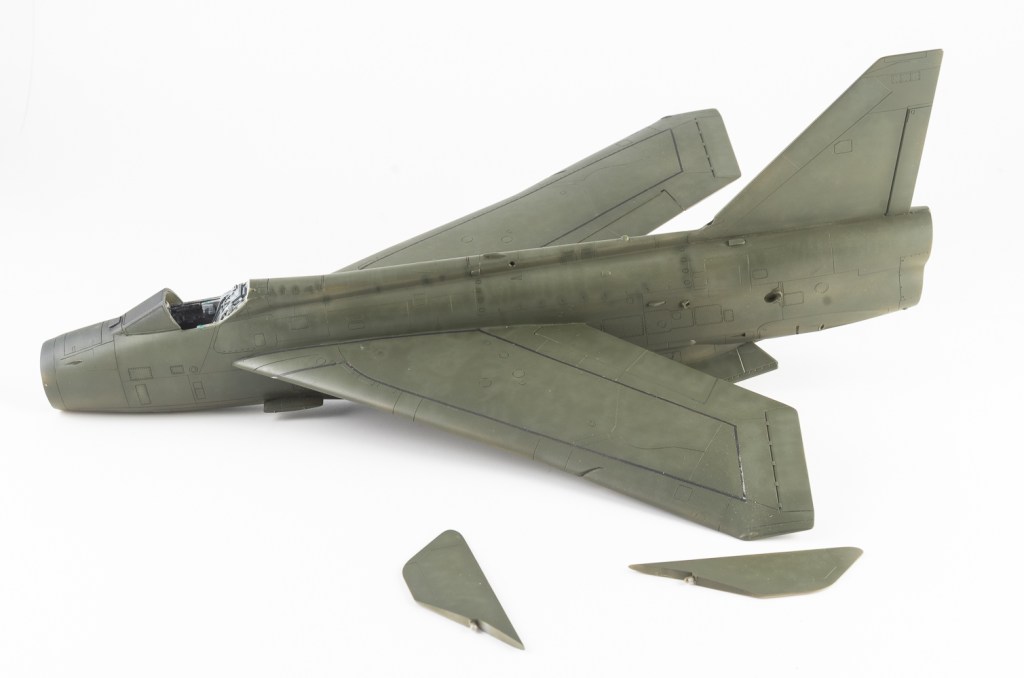
I was actually quite pleased with the appearance of the model. at this point so it was straight on to decalling. After applying a coat of Tamiya Gloss varnish. The decal sheet I was using was a Cutting Edge set. It had far better printing, colour, and register than the Airfix sheet. It should be noted that the sheet in my kit was the original issue. Later releases of the kit have included better printed decals

The Cutting Edge decals looked fine on the sheet, so the two large upper wing roundels were applied. One promptly tore whilst moving it into position , and the other separated into bits whilst in the water. Not a great start, but not to worry as these would be easy to mask and paint. Next up were the various individual jet markings. All decals were sandwiched between a layer of Mr Setter and Mig Ammo decal solvent.. I rolled a cotton bud across some of the decals to squeeze out excess solution. This revealed some of the decals were not adhering to the model very well..

A sealing clear coat was applied. Then, a wash using Tamiya dark Brown accent colour was run into all the panel lines. It was now that the lack of adhesion from the decals started to give me problems. After inspecting the model, I found that I had managed to remove the face of the gargoyle at some stage. Possibly with my sticky mitts! This was patched using a bit of the Airfix decal. Further handling of the model pulled the nose checks off, despite my gloves and the protective gloss coat. Some of the underwing serial numbers also pulled off, again requiring replacement.
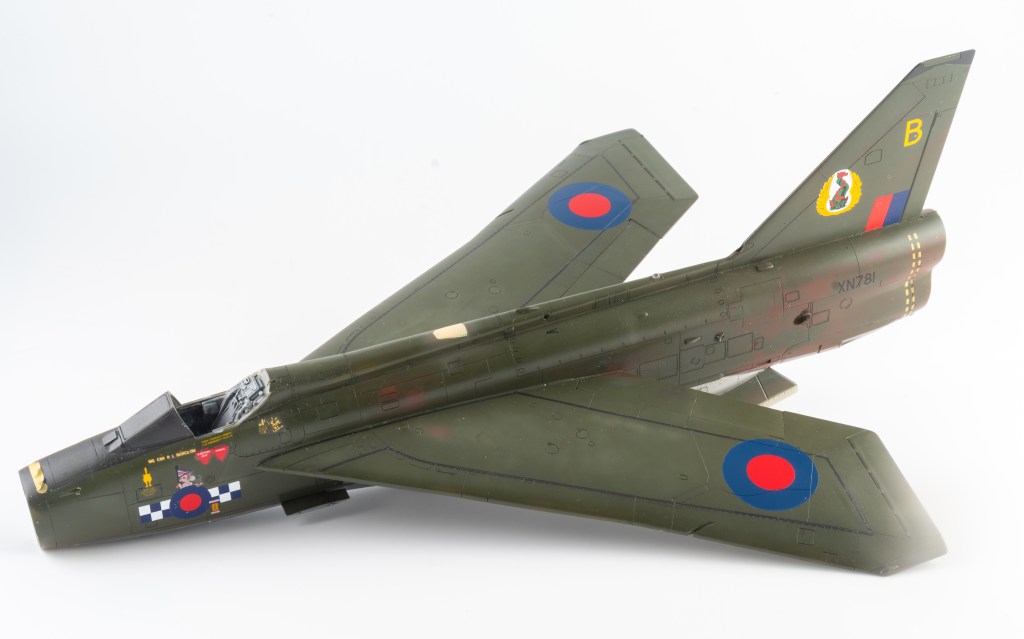
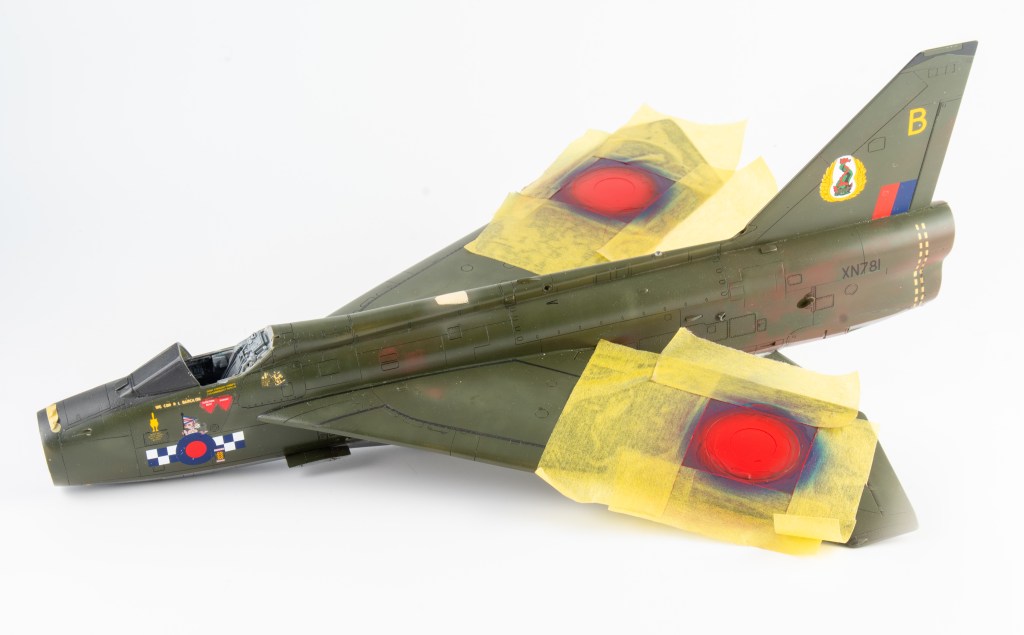
SMS Matt coat was used to dull down the gloss to achieve the flat finish I wanted. SMS is one of my favourite matt coats, drying to a low sheen smooth finish. Not this time though, as there was frosting evident around the flanks of the fuselage behind the wings.

With its mid mounted swept back wings, the Lightning has a multitude of tricky areas to get an airbrush into. All those right angles caused turbulence in my spray pattern. They resulted in texture and buildup of the clear coat. I had some frosting along the fuselage underneath the wings. There was also some silvering evident on some of the smaller decals. I was starting to feel like the model was getting away from me but I pushed on anyway as I really wanted it off the bench. Everything came to a head., when whilst masking off the nose ring, a corner of the tape caught the nose check decal. It pulled them off with far too much ease.
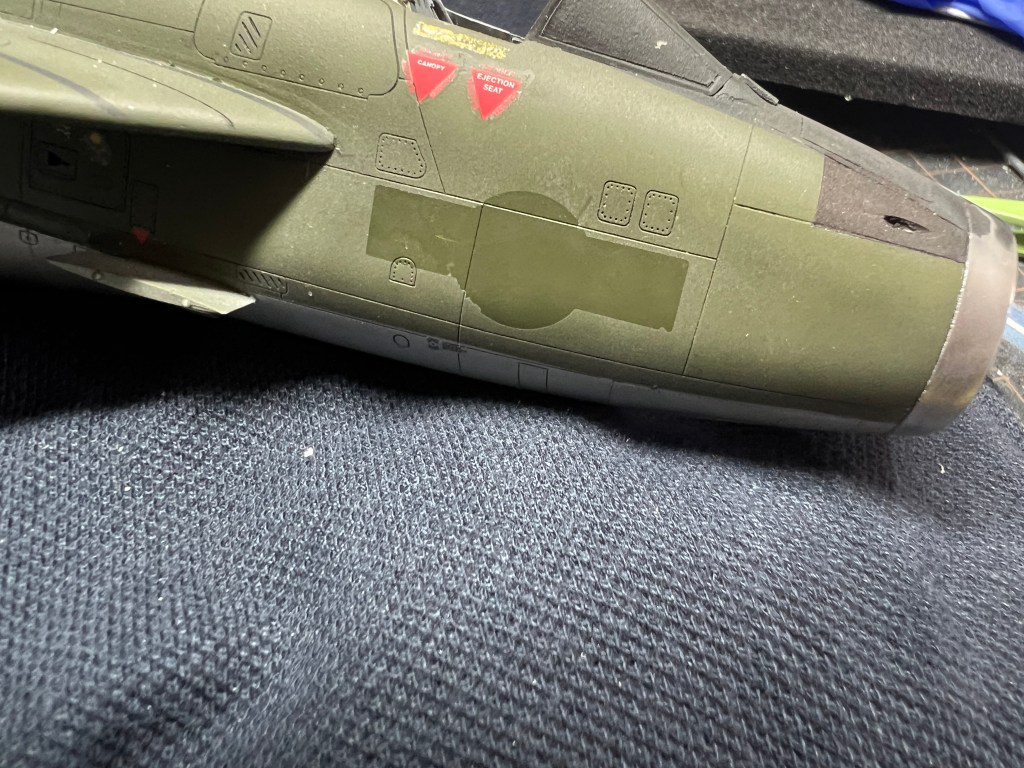
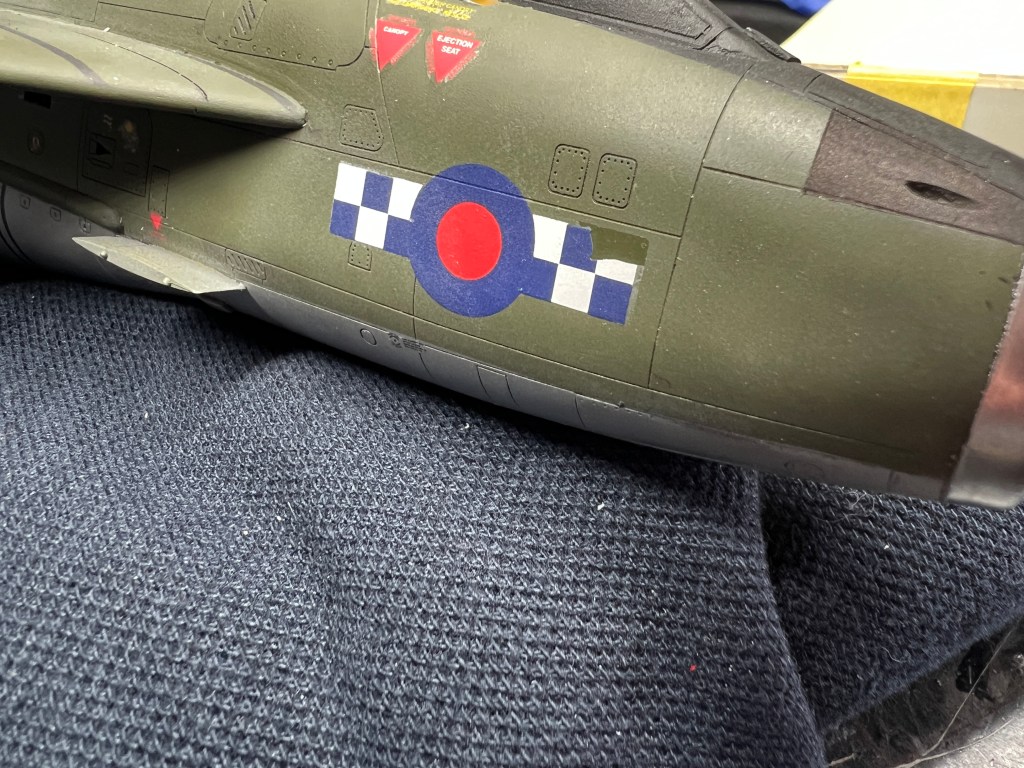
To be honest, the kit almost got binned at this stage, but I decided to sleep on it. In the morning, a thorough analysis was taken of my progress on the model. There were several aspects I was not happy with. These included the frosty matt coat, silvered decals, and textured paint. Therefore, the decision was made to strip it back to bare plastic. Also I knew a DNF (did not finish) would subject me to much “Gibson Grief”, and no-one needs that!

So, out came the VMS Clean Slate and after some vigorous scrubbing we were indeed back to a clean slate.
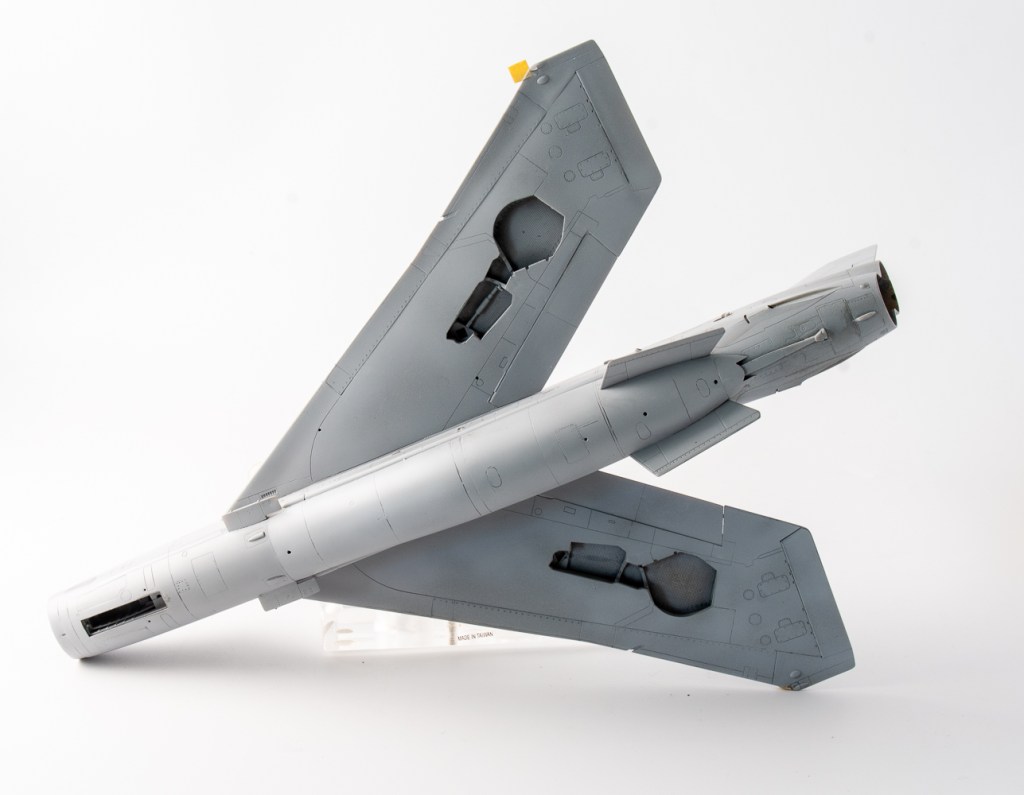
Then, it was simply a matter of repeating all the steps. This time, I painted all the National Markings and serials.
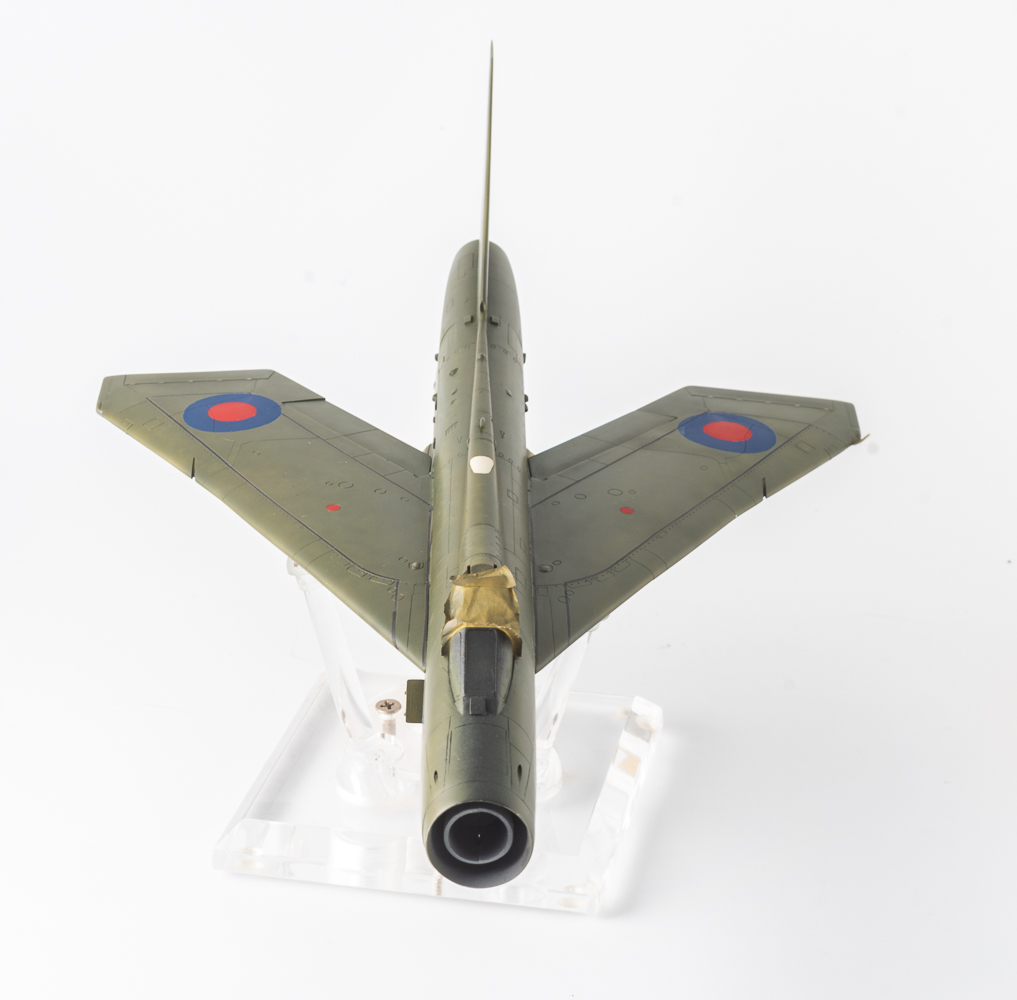
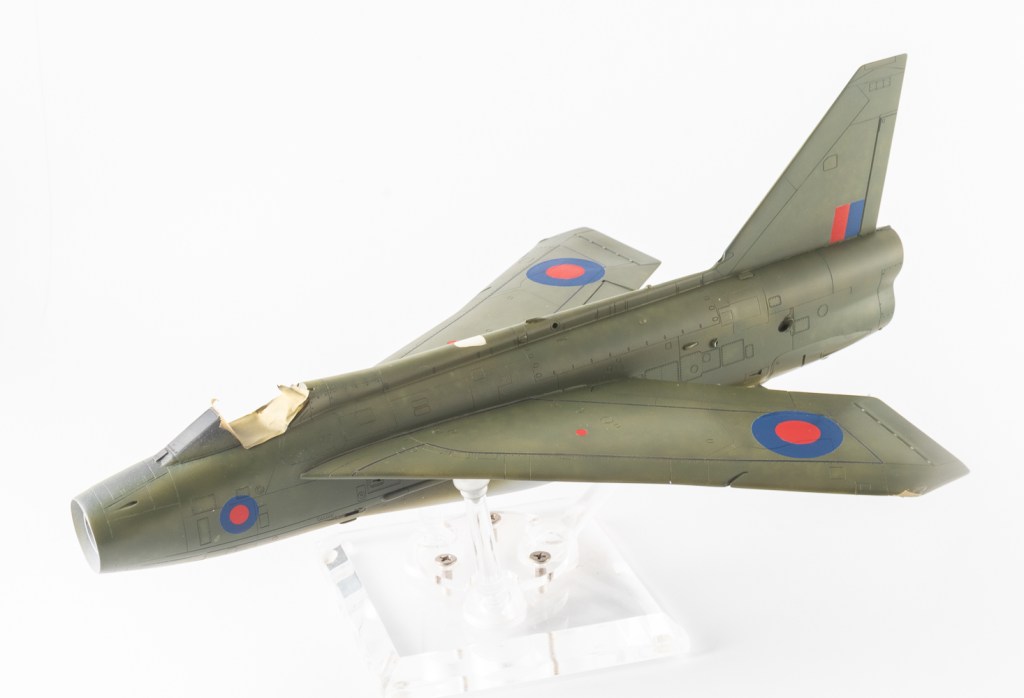
A mate sent me a set of Model Alliance decals for another jet from the same SQN. These were applied without issue. However, I had to scrimp on the stencilling out of necessity this time around. There were no yellow stencils left on any of the sheets. The Barracuda stencil sheet is very comprehensive. However, Roy, for some reason, includes none of the unique yellow stencilling seen on the RAFG jets. Quite a glaring omission in my book.

Again a Sepia wash was applied to all the panel lines. By this time, I was well over the model. Weathering was limited to some chipping around fasteners. This chipping was evident in all photos of these jets I looked at. The chipping on the nose cone was done using the hairspray method. That just left final assembly. Whilst the Reskit missiles are beautiful models in their own right, they lacked positive location devices. There was no way to mount them on the rails. I understand this is to preserve the detail on them and the rails. If you wish to mount them off the jet, 3DP should surely allow you to print them with solid locating pins. These pins can be cut off or filled if not needed. I glued them on with copious amounts of white glue.

The undercarriage was easy to locate, thanks to my pre-planning. and adding those bits of plastic stock.

Conclusion

Finally, it’s done, But, Man! What a slog in getting there! This was mainly to do with unforced errors on my part, but the kit certainly played its part.

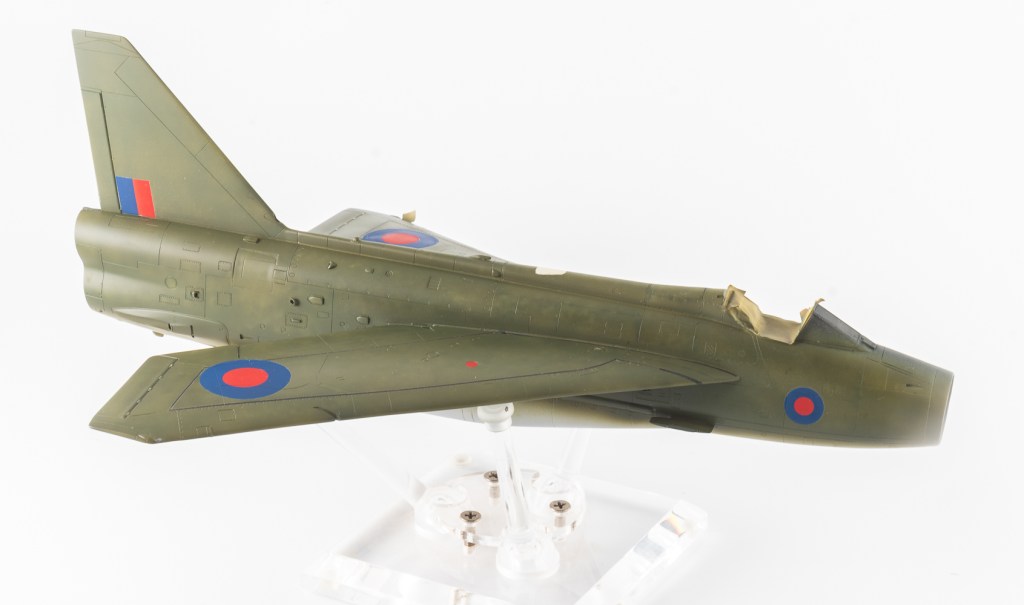
It’s great to have a Lightning in the green RAFG gracing my shelves again. My first Lightning in this scheme being the ancient Matchbox kit way back in the 1970s. My love for this scheme has stayed with me ever since. To my mind’s eye, it looks like what I envisioned when the build was started. This is due to me making the decision to strip and repaint the model. Even so, it’s not my best work. It looks just workmanlike. However, it is far better than it would have looked if I had continued pushing ahead with the original finish.

Regarding aftermarket used, the only essentials in my opinion would be a seat and metal pitot tube. Nothing can be seen of the cockpit, or even the wheel wells, despite the high wing. The Armoury wheels look good and are weighted but ,the kit wheels also suffice.

The Lightning is such a brute of a machine and an icon of Cold war British Air Power. It deserves to be retooled up to Airfix’s current standard. In its current form, Im not sure I’d build another one.

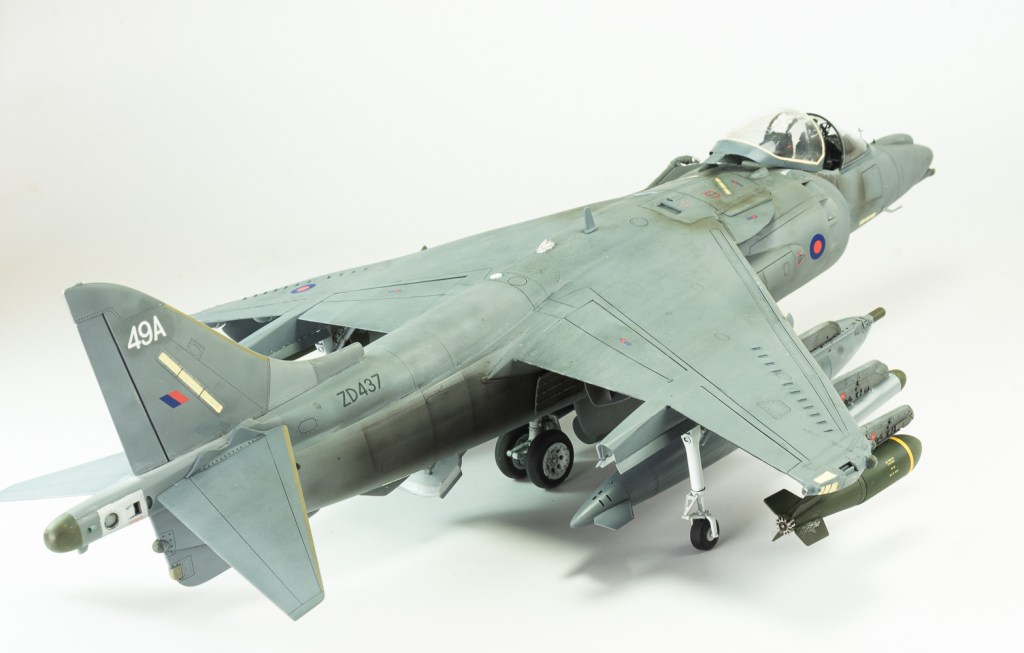
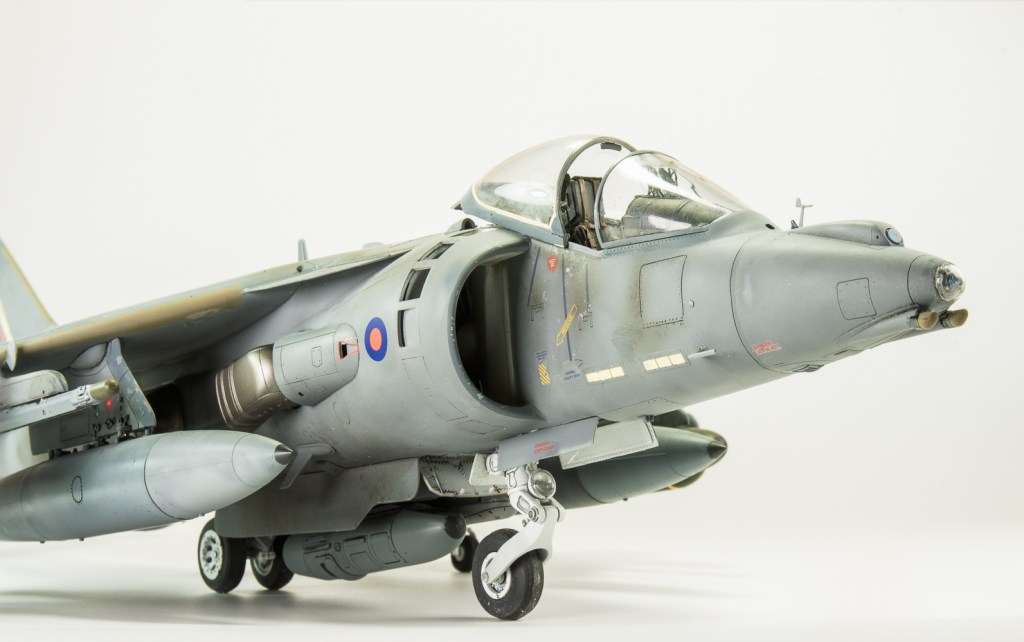
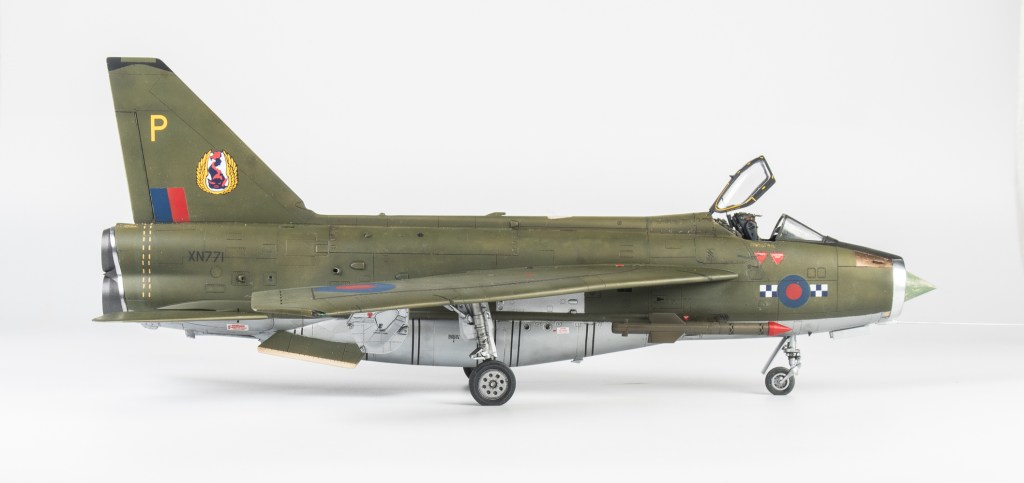
E.E Lightning F2A. Royal Air Force 19 SQN. Guttersloh Germany 1973
Leave a comment

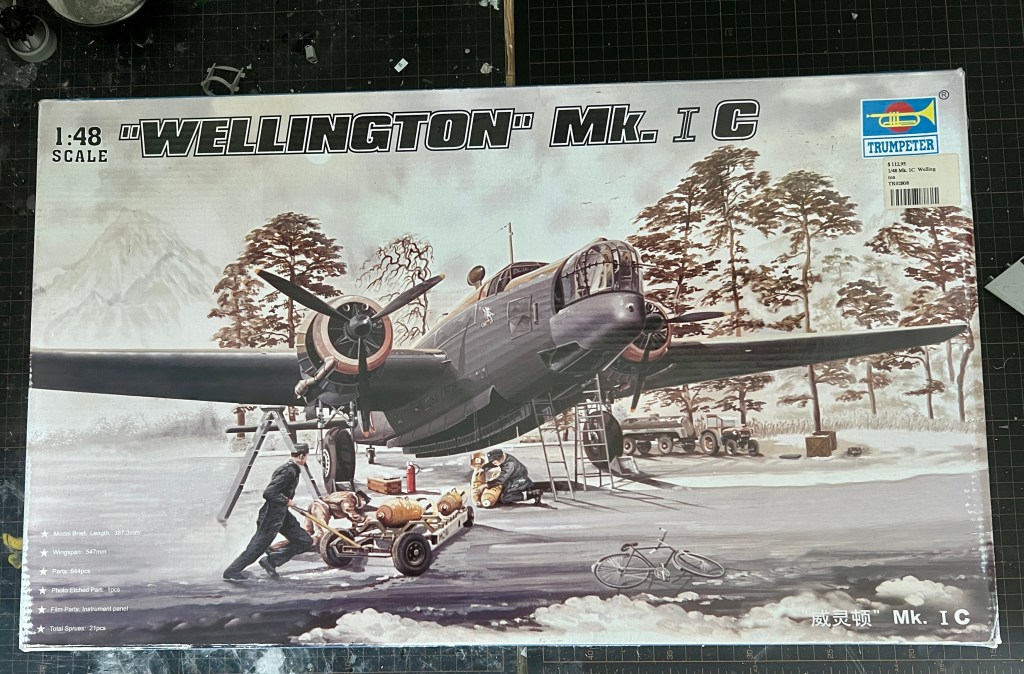
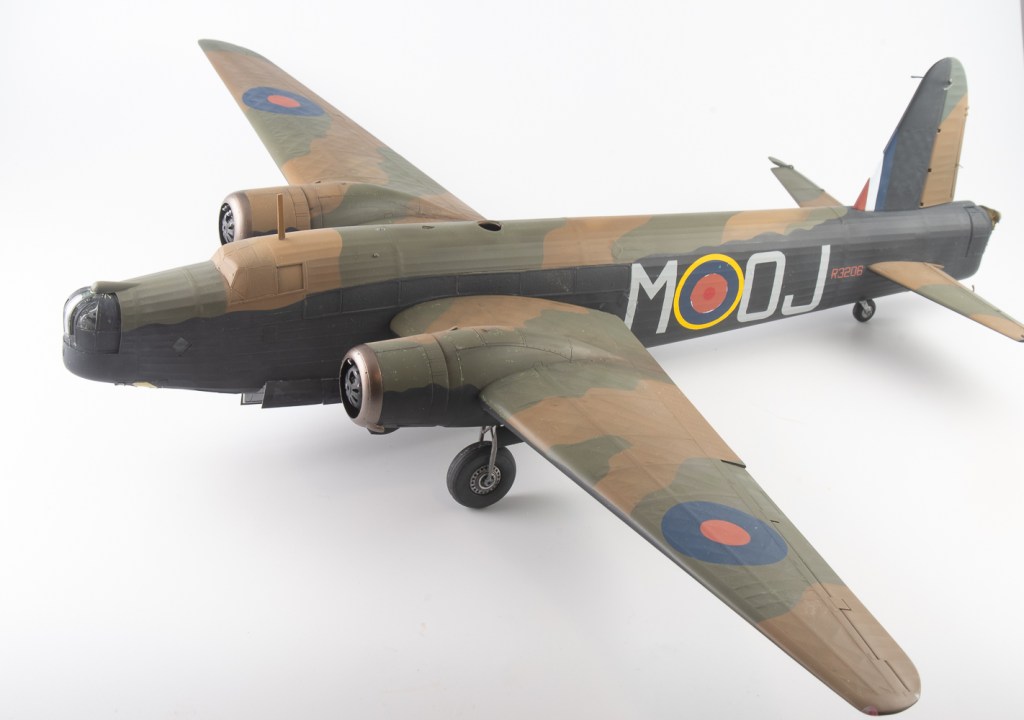
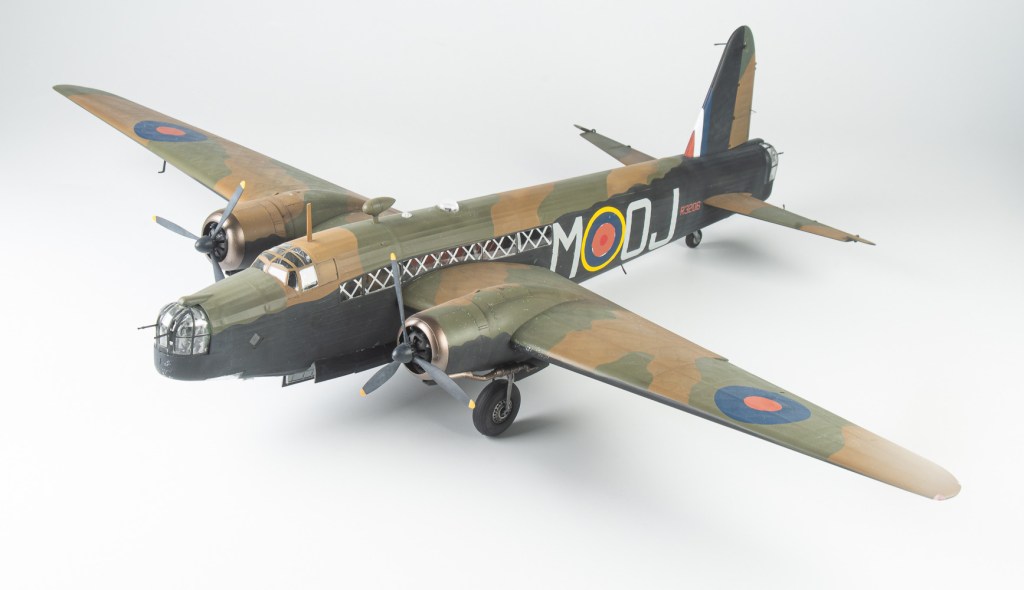
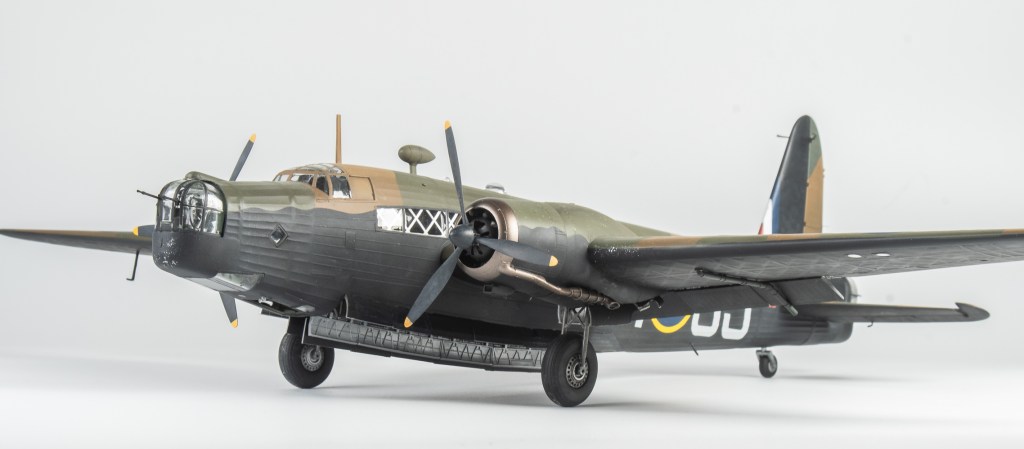
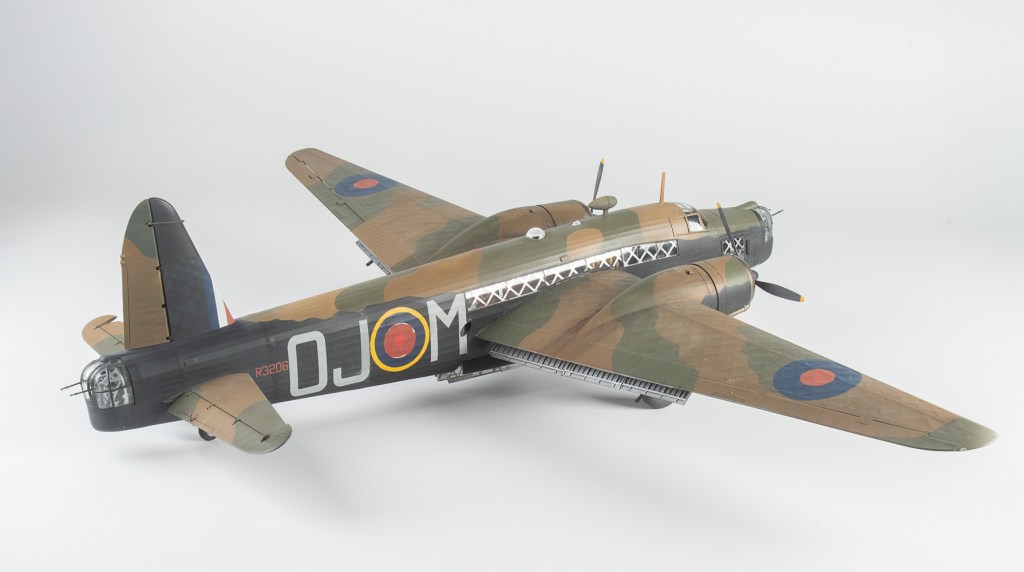
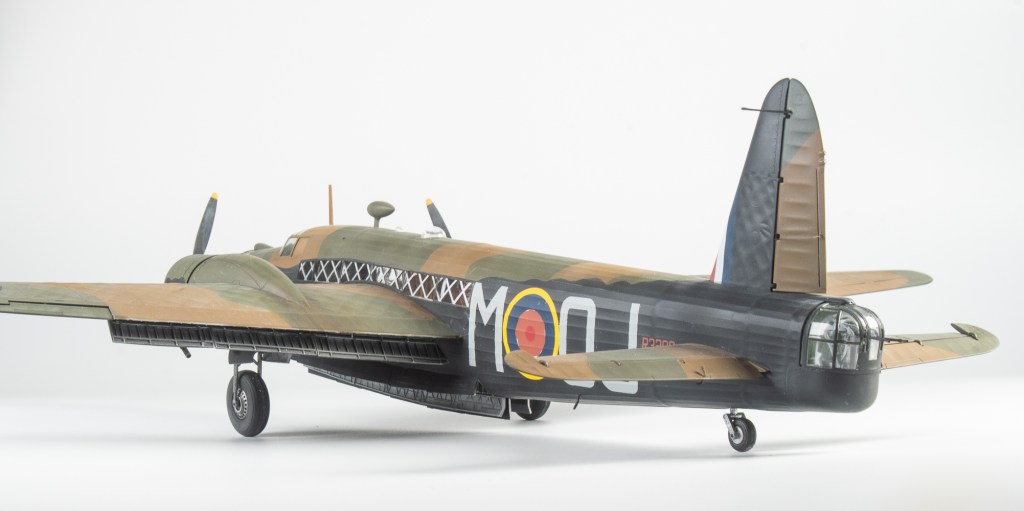
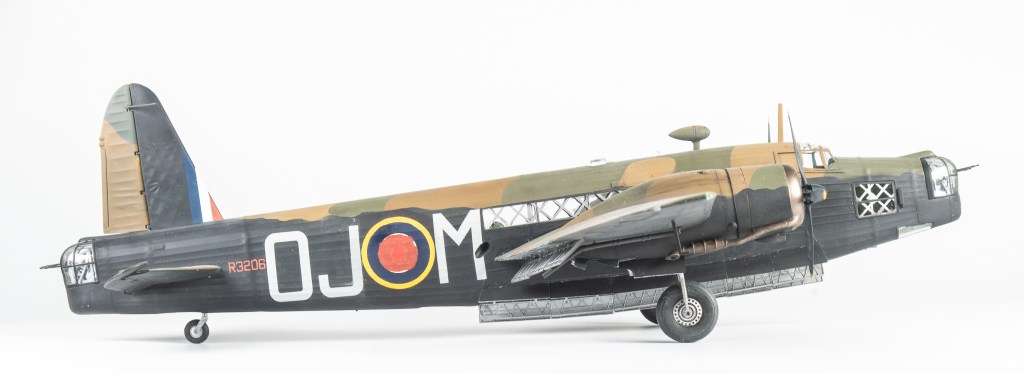
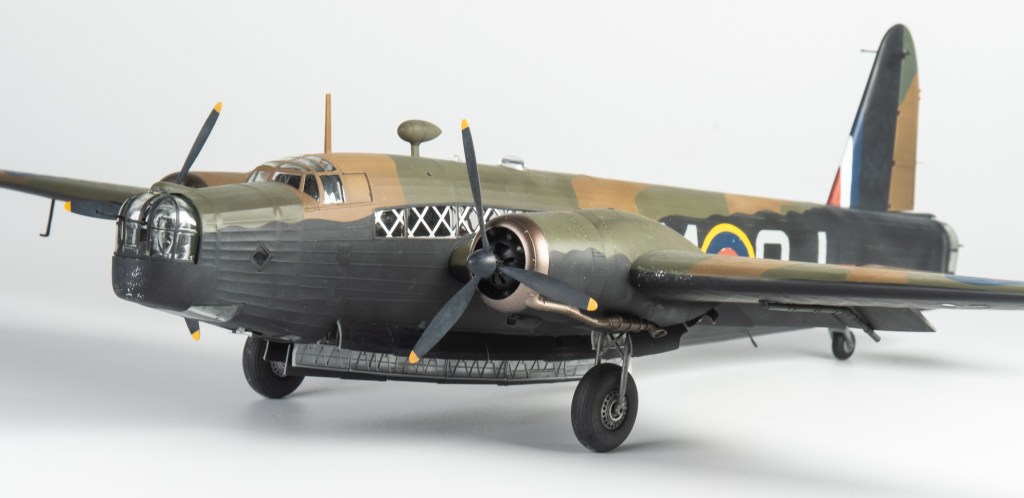
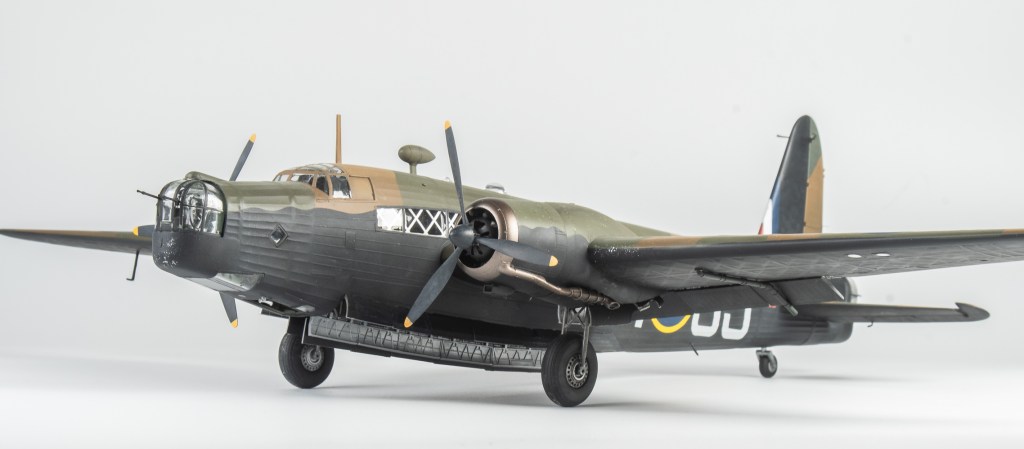
Trumpeter 1/48 Vickers Wellington Ic

  • Purchased; 2016
  • Completed; 2025
  • Enhancements;
  • Gun barrels. Master Details
  • Flaps- Brengun
  • Fuel Dump Pipes – Quickboost
  • Decals: Xtradecals

I remember being quite excited at the news that Trumpeter was releasing this, as it filled a major gap in 1/48 RAF WW2 subjects. Its not a kit that has graced many competition tables or on line sites though, so that to me tends to indicate not many are getting built, perhaps as its a sizeable model once done.

Accuracy wise, it suffers from a too narrow undercarriage and very overstated surface textures.The undercarriage I could live with, the surface detail though had to be reduced. There is a reasonably complete interior, albeit somewhat simplified, that pretty much gets hidden away once the fuselage is closed up. Fit for the most part is good, but the kit shows its age as one of Trumpeter’s earlier releases with the parts not as sharply moulded as some of their later releases, and also exhibiting fine mould seams along mating edges. Perhaps the biggest plus of the kit are the THREE sprues of early RAF type bombs Trumpeter includes to load the bomb bay with various types of bombs. Transparencies are lovely and clear, but the decal sheet, as per usual with Trumpeter RAF subjects has markings with colours that are far too bright.

Construction

Even before construction started, several thick coats of SMS surfacer grey to the wing and horizontal stabiliser parts. Once dry, it was rubbed back until the kit surface detail showed as bare plastic . After being repeated a few times, the Trumpeter geodetic pattern had become somewhat subdued. This probably could have been taken further as it shows as quite subtle in photos, but I chose to leave it as was.

The colour call outs in the instructions were disregarded as mine would be an early war bomber and research on Britmodeller had uncovered more correct colours.

So on my kit, cockpit is RAF grey green as is the bomb aimers position. Mid fuselage is a brick red colour with silver framing. Floors are black. Bomb bay interior and insides of doors are silver.

Turret interiors are also silver. Black turret interiors seem to have come later after the RAF doctrine had changed to night bombing.

I would recommend that the turrets complete with guns are built as a whole rather than doing what I did, and leaving the guns out to be added later. This resulted in me having difficulty aligning them. The kit barrels were replaced with brass items at final assembly.

Aside from the ventral turret and rear ammunition runs, the complete interior was assembled , although not a lot of effort was expended in painting it as very little can be seen. Don’t forget to paint the underside of the front turret as this can be seen through the bomb aimers window. Trumpeter have not included a bomb sight, so one will have to be scratch built should you desire.

The engines assembled fine, just ensure you double check the instructions to ensure the parts are correctly orientated. Don’t bother with after market engines as you can see very little of the completed engines.

Why Trumpeter made the wheel well interiors from PE, is a bit of a mystery to me, but they must have been made by Bluescope Steel! Have fun removing them from the frets! I also took the precaution of drilling all the holes out so that the landing gear assembled easily. Apparently the wheels and therefore struts are too narrow., not something that bothered until me until found out, then it did!

Back in the day when this kit was first released CMK did resin wheel wells for it, but these have long since disappeared from shops (as has most AM for the kit). The kit rubber tyres needed to be dunked in boiling water to soften them enough to conform to the rims. Although I did have Brengun resin wheels, they were even narrower than the kit wheels so were not used.

The only major construction issue faced by me was, when locating the bomb aimers window, it was found to be wider than the fuselage cutout. This must have been me as the rest of the transparencies fitted like a glove. In the end a piece of clear CD cover and a shim were used to bring out the fuselage to match the bomb aimers window.

If you are reluctant to test fit the wings fearing, like the Tamiya Mosquito, they will never be able to be removed again, don’t be. The wings are a very sloppy fit, and hardly a friction fit to the support boxes, so can be slid on and off with carefree abandon. To attach these, you are best off using epoxy glue , ensuring the wings are level to get a nice solid fit. There were no gaps on my kit . The PE ?cable cutters were left off my kit as I could not find any photos of machines with them fitted. My references were the 4+ book and images from IWM website.

The Brengun flap interiors fitted nicely into the kit flap wells, once the required material had been removed. I do wish these companies though would engineer the flaps to fit far more solidly. Small glue contacts areas such as PE hinges just don’t cut it.

Painting and Decaling

From the start, my Wellington was going to portray an early war bomber to pay homage to these early Bomber Command crews that starting taking the war to Germany just a few days after the Declaration of War. An early war scheme of overall DE/DG almost won out, but the toned down roundels on the Xtradecal sheet really appealed to me, bringing home these early attempts at toned -down markings, plus it had an early fin flash, replacement rudder and those lovely large codes. What’s not to like there?

SMS Camo black is my favourite black these days, having a warmish brown tone to it. Over this was sprayed various shades of greys and other blacks such as NATO and Rubber Black. This was done through two different splatter type masks. Not forgetting to also do the flaps and bomb bay doors at the same time

For the top sides, LF camouflage masks were used with the Dark Earth being SMS, and the Dark Green GSI Gunze.. Darker and lighter shades of these colours were used to break them up. Oil paints were used to depict oil leaks and staining trailing back from the nacelles across the wings. AK Starbay sludge was used for this. A shade which in retrospect is far too browny -grey . I should have used black or Sepia

The Xtradecal decals performed well. As they are printed by Microscale, they really only needed the mild micro products to settle into any detail. As I had nil micro sol, I used Mr Setter, which was far too hot and damaged one of the roundels. It was repainted with a mask created on my silhouette machine.

Final assembly consisted of bringing the various components together and adding all the fiddly little details such as gun barrels, flaps, propellers and aerial mast. Oh! And the 30 separate bomb bay doors.

Conclusion

It’s a large model!

In the main, it was a fun build, let down by the very exaggerated surface detailing and some strange engineering choices such as the requirement to fit the turrets before closing up the fuselage

That aside, it was an enjoyable build, and most likely the only 1/48 Wellington we are likely to see, although back in 1975 we all thought the Tamiya Lancaster would be the only 1/48 Lancaster we would ever see!

The Wellington has a lovely quaint ungainly look, belying it being one of the mainstay bombers of the RAF throughout the war. Im looking forward to the ICM Hampden joining it in the cabinet to represent Bomber Command in the first year of the war.

Vickers Armstrong Wellington Ic 149 SQN R.A.F Mildenhall UK 1940

Leave a comment

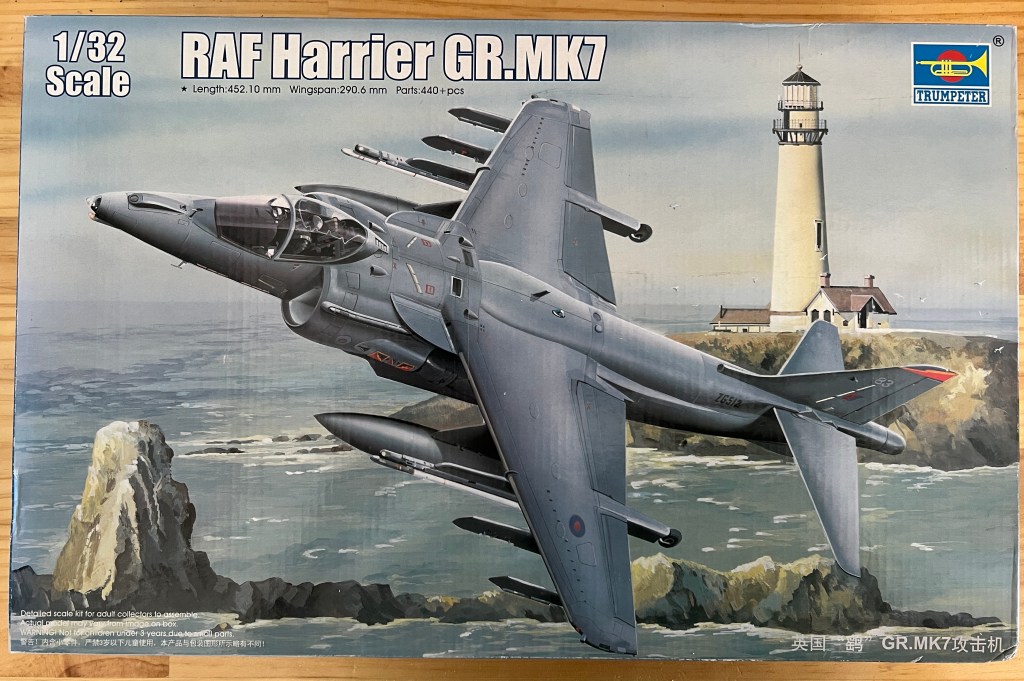
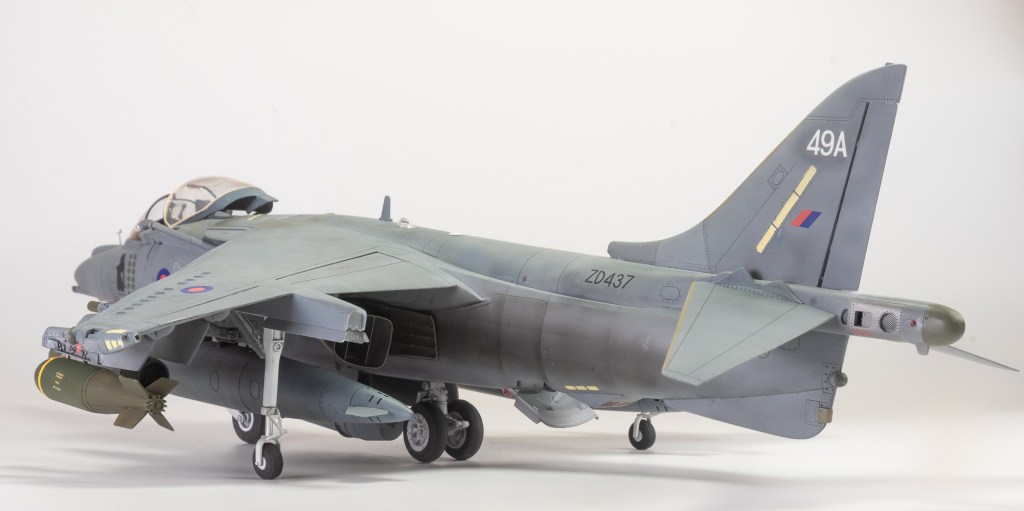
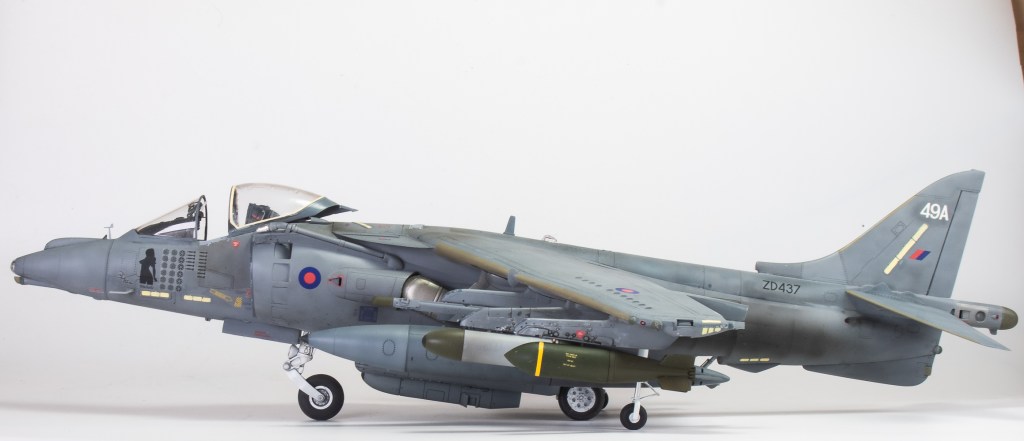
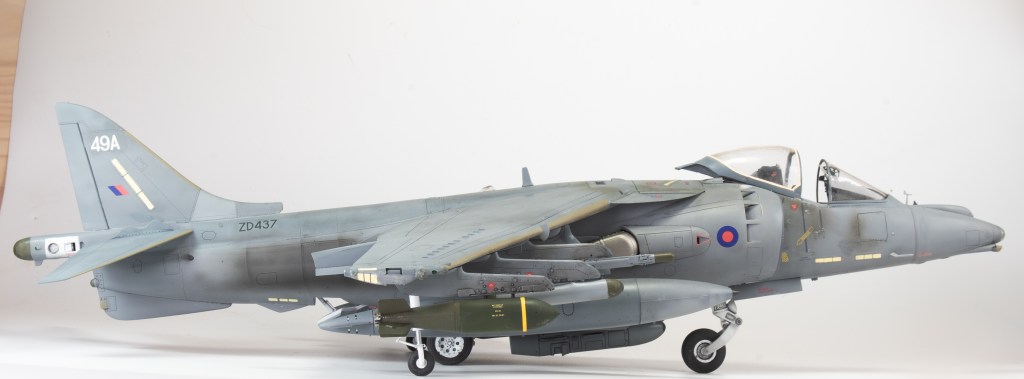
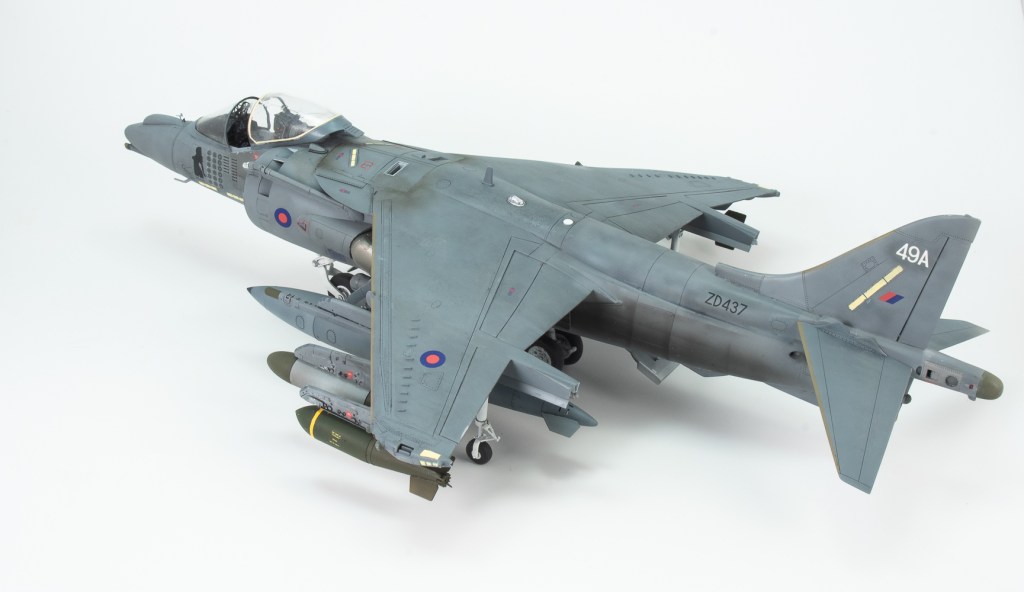
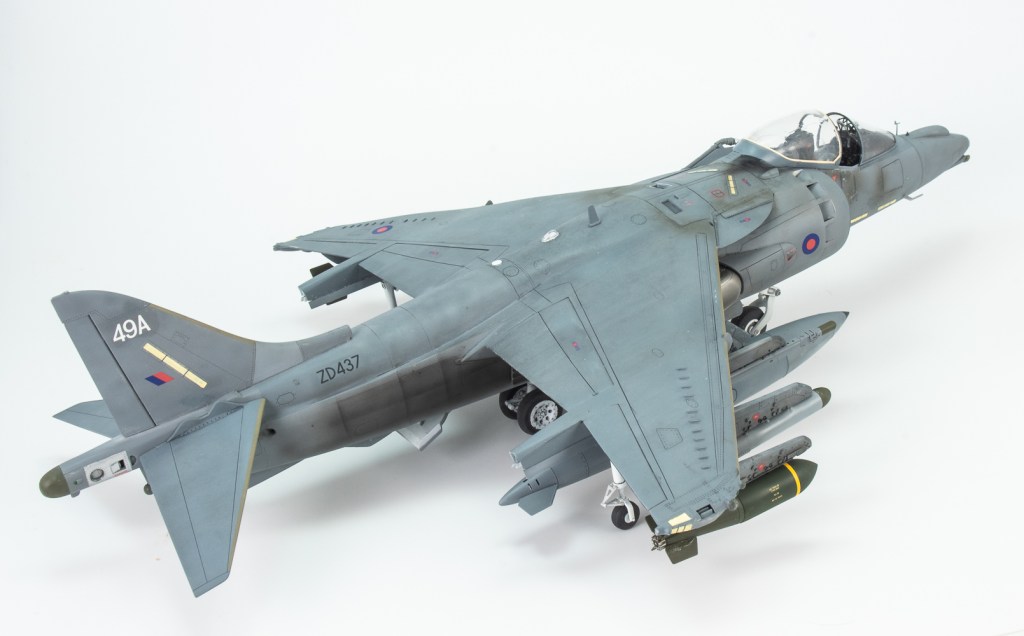
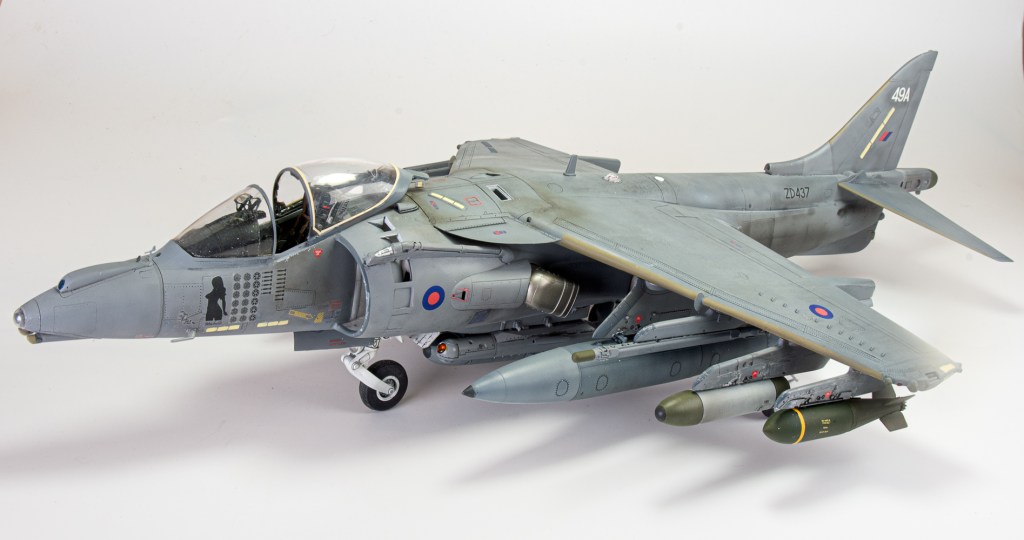
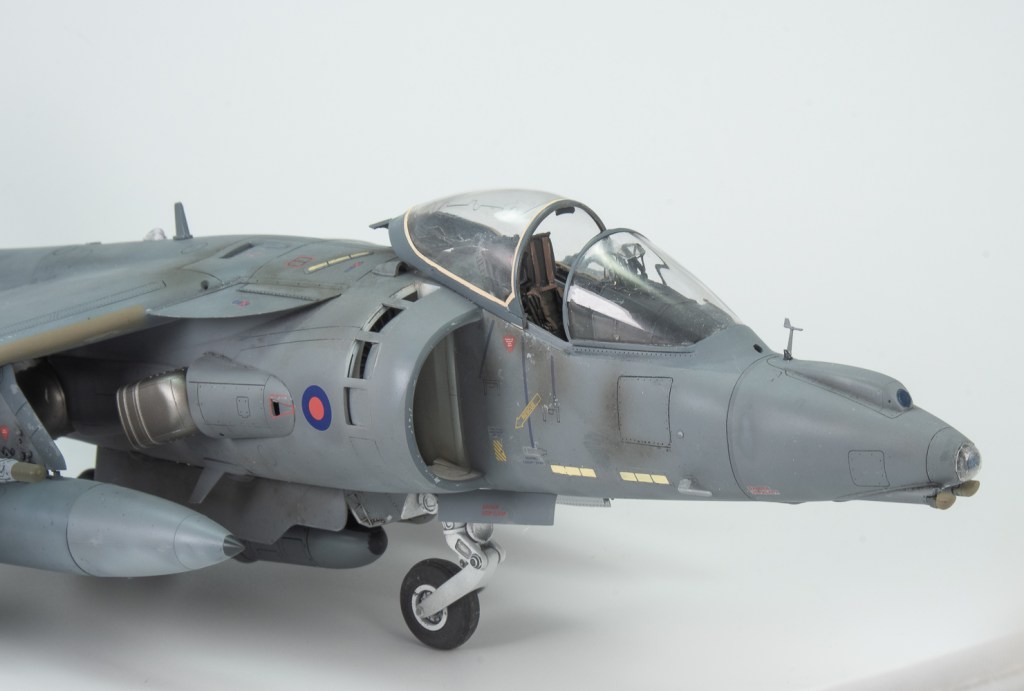
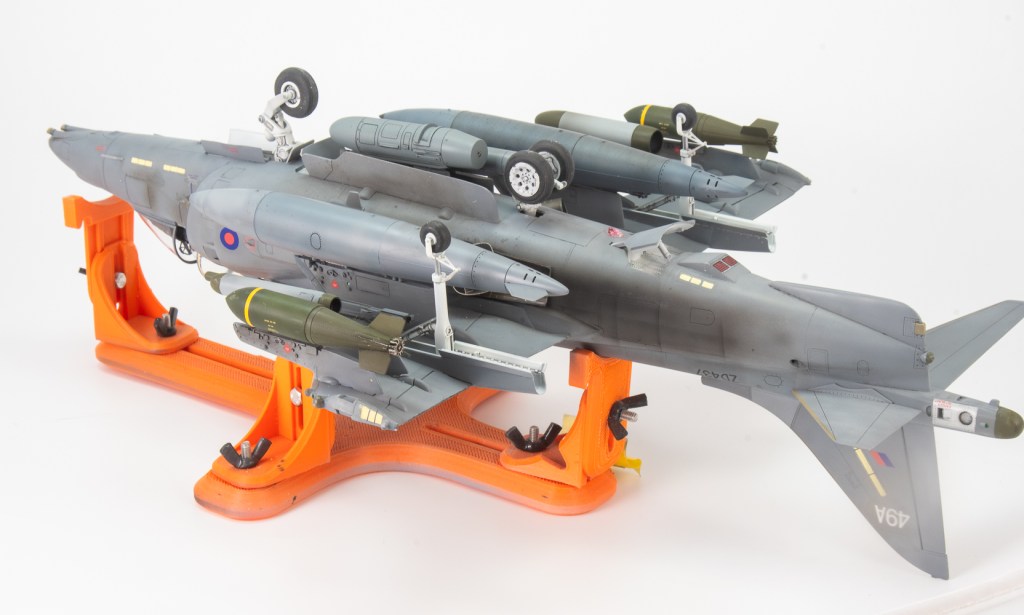
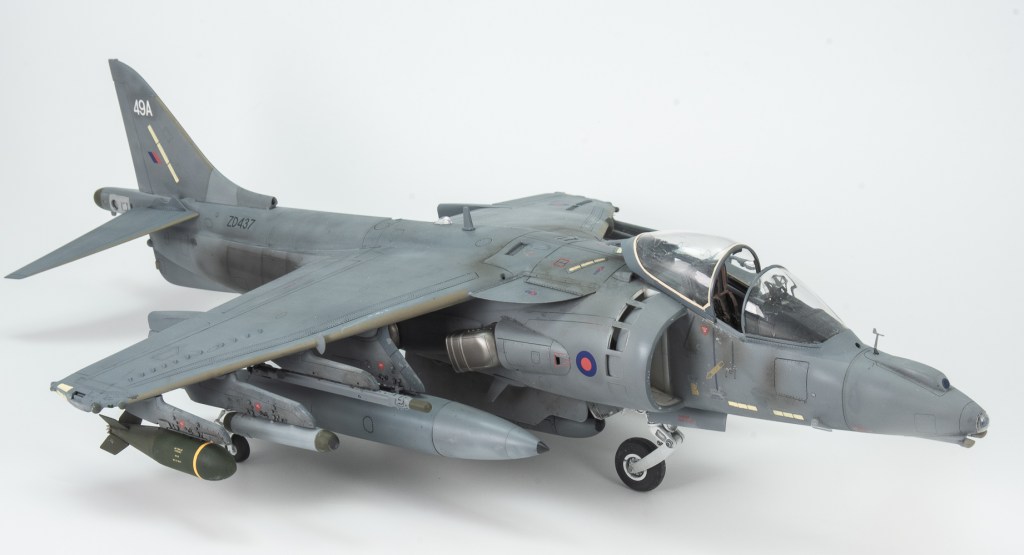
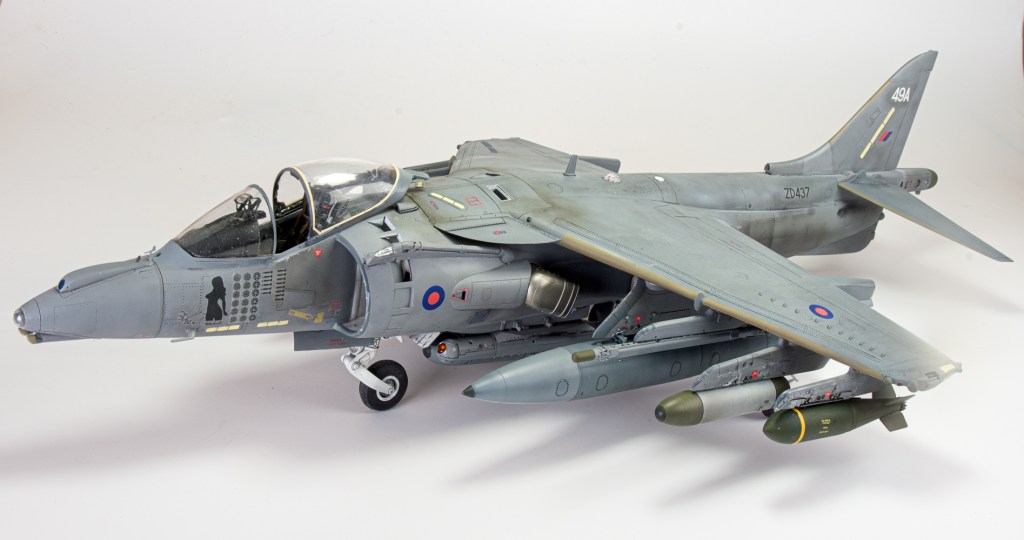
Trumpeter 1/32 Harrier GR7

  • Purchased: 2014
  • Completed; 2025
  • Enhancements;
  • Cockpit. Aires
  • Seat; resin cast by Piero on Britmodeller. No longer available
  • Jet nozzles. Aires
  • GR7 pylons: Wolfpack
  • GR7 Nose: eBay seller Sonconat
  • Tanks; Reskit
  • CRV; 3D printed from modeller on eBay. Sonconat
  • Bombs; Reskit
  • DJRP; 3dP from ebay. Sonconat
  • TIALD pod; Brassin
  • BOL Rails. ; Jet Passion

Introduction

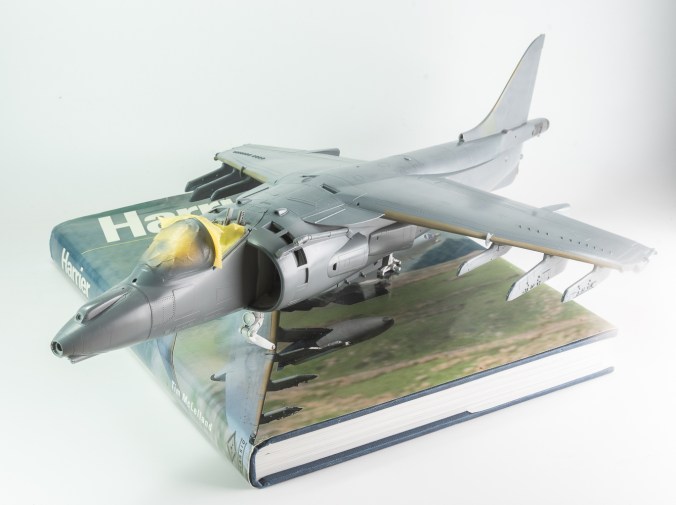
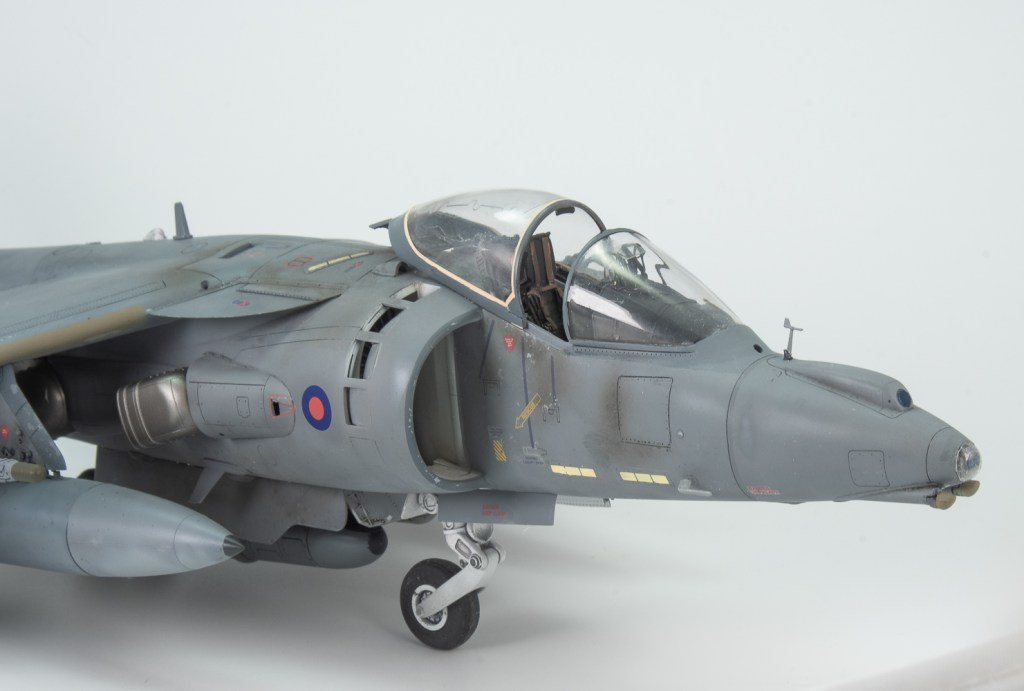
Trumpeter’s supposed GR7 Harrier followed on from their release of the US variants, these being the AV-8B and Night attack variant. I say supposed, because despite saying GR7 on the box, Trumpeter failed to include any specific GR7 parts, the nose being the most glaring inaccuracy, despite getting expert assistance from a UK Harrier model group

Trumpeter’s RAF Harrier is nothing more than their US Harrier boxed with some British markings, and even these are wrong. There are no specific RAF weapons either, the kit coming with the standard US weapon sprues. The national Markings look to be the wrong colour and size as well.

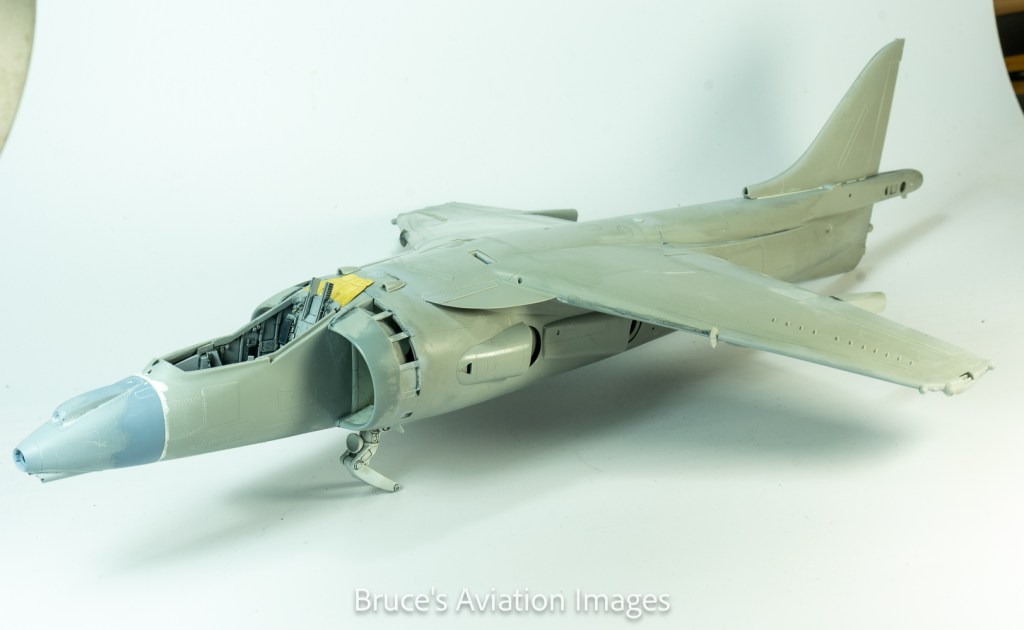
The kit has several incorrect shaped access panels for a GR7. I decided to leave these as they came in the kit, but if you want to correct your kit, pretty much all the access panels and rivet lines on the wingtips need changing .The kit wings have a weird bulge midway along the wing leading edge when looked at front on. I suspect this is Trumpeter’s method of dealing with the wing “kink” but it just looks wrong. Mould lines will also have to be removed from each upper wingtip. Raised panels on either side of the nose should be sanded flat and the foremost panel just behind the nose on the port side removed as I cannot see this panel on any GR7s I looked at. A deliberate decision was made to not go down the rabbit hole of changing every detail on the kit to accurately portray a GR7 or 9, as one could spend 6 months doing this. Consequently, whilst my model better represents a GR7 than an OOB build, it’s still not an accurate to the last detail GR7. And Im quite happy with this compromise in the name of a quick build.

Construction Notes

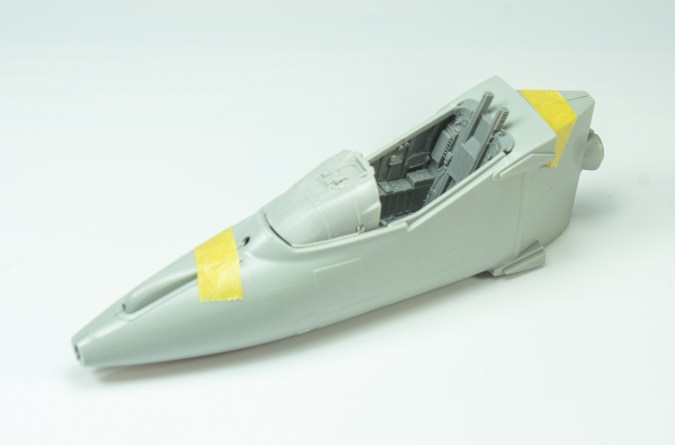
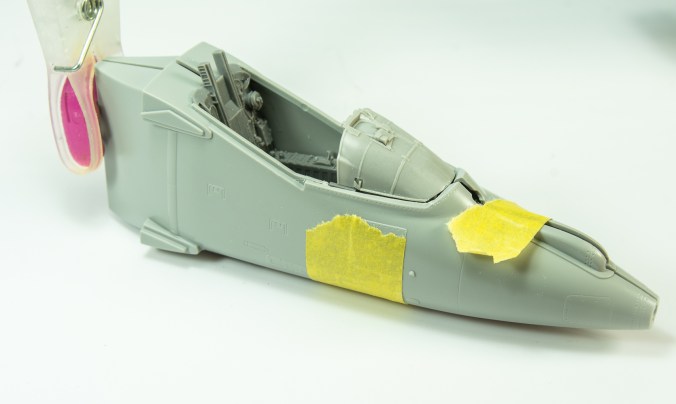
Aires’s cockpit actually wasn’t a bad fit . Although not quite a drop fit, it didn’t take too much sanding to fit between the nose halves, even locating to the kit cockpit location tabs. Ah, if only all Aires sets fitted like this.

Trumpeter would also have you glue all the auxiliary intake doors in the open position, rather than just the top 3 on each side that flopped open through gravity. Look at photos of parked Harriers to see what I mean.
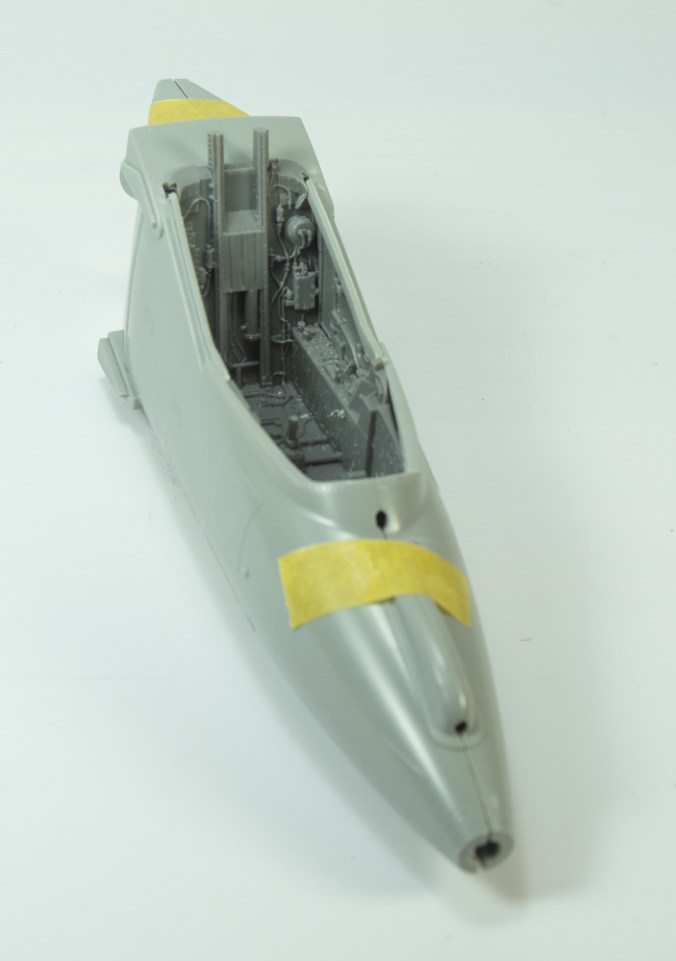
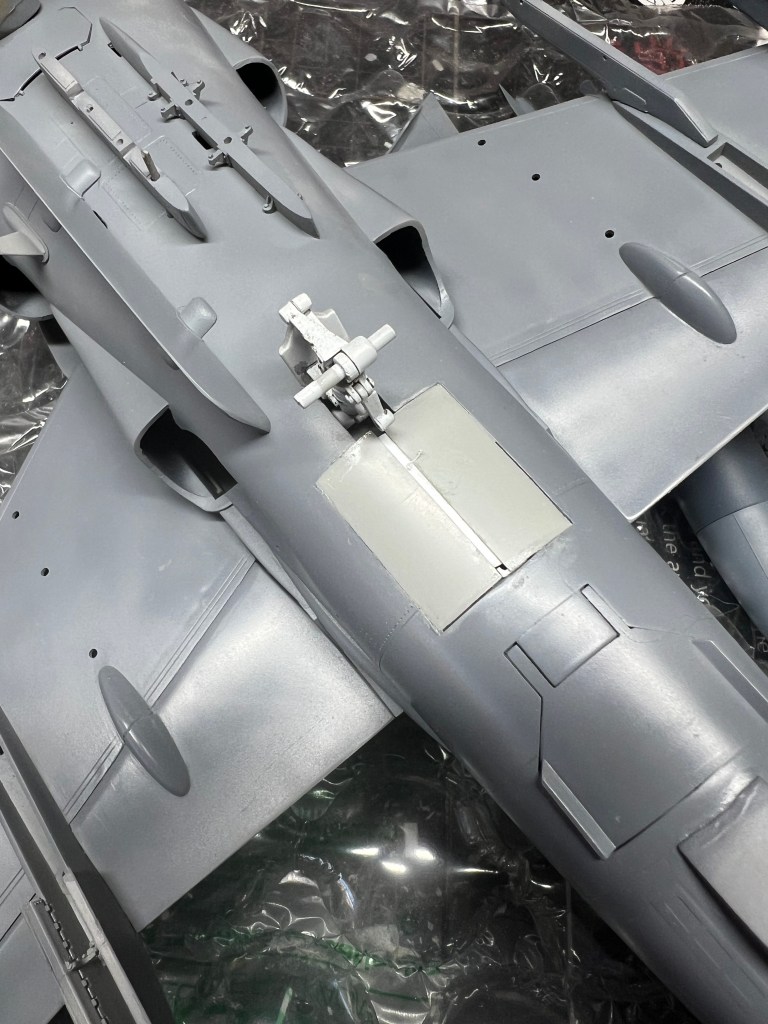
In a similar vein, Trumpeter would have you glue the main undercarriage doors in the open position, again not prototypical for the real jet. all photos I looked at showing the main doors closed. Achieving this took a bit of work, as the doors are not the best fit in the closed position, requiring lots of filling and rescribing.

The kit pylons are the US pattern, so the Flying Leathernecks supposedly RAF corrected pylons were used, although comparison to photos, showed they are still not correct for RAF pylons. In fact the Flying Leathernecks pylons were a bit of a disappointment, also being a very poor fit to the wings. At least the rear of them was contoured to fit over the flap actuators, unlike the kit pylons. Speaking of the flap (and aileron) actuators, they will need to be extended with scraps of thick plastic card as they are too short, and uncorrected, leave large gaps as they don’t meet the control surface actuators.

I only used the 2 halves of the engine and the mounting bulkheads, enough to mount the aires jet nozzles to. The rest of the kit engine parts were confined to the bin, as they will never be seen on the completed kit. Similarly thrown out were the kit blast plates and nozzles, these parts being replaced with the Aires items.

Parts D24 and D25 were not added as I could not see them on photos of real GR7As. All moulded vents on the rear fuselage and wing top were cut out and replaced with suitably sized PE mesh .

Part E55 was added but all the detail was filled and then faired into the fuselage contours. A new RAF type Flare unit was then shaped from laminated sheets of thick plastic card and added just behind the rear wheel bay. Details were represenrted with decals. The square GPS antenna was shaved off the wing centre section, and replaced with a round one as per photos.

The new 3D printed nose fit reasonably well, just requiring fairing in on one side after the kit nose was cut away, it being completely wrong for a British Harrier.

Painting and Decalling

The first thing to do here was throw out Trumpeter’s painting guide. Instead, I borrowed from the painting guide for Airfix’s 72 scale kit, which calls out the correct Herrick scheme of Dark Sea Grey and Dark Camouflage Grey. The Camouflage Grey proved a problem until I found AK Real Colours offered it.

MRP furnished the Dark Sea Grey. Photos of this particular jet were quite hard to come by and I am indebted to Nick Greenall from the UK IPMS Harrier SIG for sending me some through as well as details of the correct Operation Herrick load out.

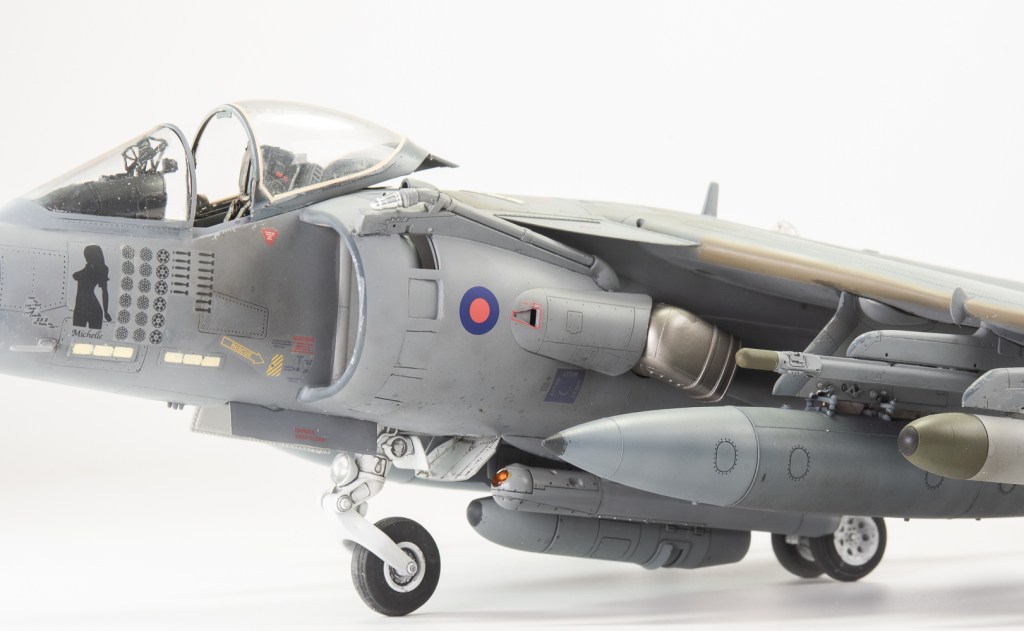
The colours were faded just slightly. Whilst photos show a lot of staining and fluid spills, there is not an awful lot of paint wear evident. A replacement grey panel was depicted on the tail despite this not being evident whilst the jet wore the nose art. Artistic Licence! The jet is pictured at a later date with light grey replacement panels in evidence, but by this stage “Michelle” had been painted out. She wasn’t getting painted out on this jet, let me tell you!! The tanks also had different greys applied to the separate sections as images of real harriers showed this was a thing.

Michelle, the mission tally and the tail number all came from Zotz decals. Not my favourite manufacturer. I find their decals quite thick, and generally non conforming to detail. Here they were coated with several layers of gloss varnish and then gently sanded to blend the carrier film into the surrounding clear coats, which, to my surprise. worked very well. A new technique to me. National markings came from an Airframe decal sheet as both Trumpeter and Zotz had the size and colours wrong, likewise all the stencilling and serial numbers. No underside stencilling was applied as it looks like it was not reapplied after the undersides were repainted with the camouflage grey on the real jet. There was some evidence of general grubbiness around the engine bay doors, so I used Starship Filth to add this. Wrong colour!! I should have just used black as it looks like there’s been an engine bay fire. Nethertheless, I was quite happy with my blending efforts, these being better than some previous attempts at the technique.

Final Assembly

In what was becoming a recurring thing with this kit, the Trumpeter pylons and weapons were thrown in the bin. ( I used to keep all this stuff, but it was becoming unmanageable, and it turned out a lot of it wasn’t getting used, so now it just gets thrown out {I imagine Jon Bryon is grimacing with horror if he’s reading this!})

I have already given my thoughts on the Flying Leathernecks pylons, but at least they are better than nothing and I’m happy that Flying Leathernecks saw fit to release them. Kit fuel tanks were replaced with the fantastic, but expensive Reskit items. Bombs are also by Reskit. These are 1000lbers, as I could not find any 540lbers, which I think are the correct bombs for this particular loadout. The pilot will soon find the jet feels a bit sluggish!!

BOL rails came from Jet passion, the CRV pods and DJRP came from a fellow on eBay who 3d prints corrections for the GR7. Originally I was going to use a cast nose that I got years ago from a bloke off Britmodeller, but the 3DP nose had a lot more fidelity, it just needs the print lines sanding off, as do the rocket pods and the fuel tanks. And finally the TIALD pod came from Brassin, it being drilled and pinned to the adaptor pylon that comes with the Wolfpack Sniper pod, with brass rod , as were all the stores.

Conclusion

Not the most enjoyable build. OOB, the Trumpeter GR7 needs A LOT of modifications if you want to accurately portray a GR7 or 9. Aside from this, the model is not some of Trumpeters finest tooling, the plastic being textured with some panel lines that fade away. However, like all Trumpeter kits, the model looks complex, but is not that complicated to assemble. The gaps between the flap actuators, misnumbered parts in the instructions and poor engineering that required the nose leg to be fitted at an early stage all combined to make the model frustrating to construct in some respects. I doubt, I’d do another.

To finish off, I thought I’d list the Aftermarket used and how important it was to the build. Please note, these are my opinions only.

Aires Cockpit. Definitely adds to finished build with minimal effort needed to fit to kit. You will need a MB Mk12 seat though and not the American Stencil one.

Aires Jet Nozzles – Essential. Much better than kit nozzles. Again minimal effort needed to integrate into build

Resin wheels. I didn’t use any, but looking at my completed model, Im going to suggest they are essential as the kit rubber tyres are rubbish. At some stage mine will get replaced with resin ones too.

Soconat 3DP nose and DJRP – Essential if you want to accurately portray a GR7/9

Flying Leatherneck correct GR7/9 pylons. – Again essential if you want to do a RAF jet, for the only reason they more closely resemble RAF pylons than the Trumpeter pylons. And that’s not saying much!

Reskit Drop tanks – Very nice to have , as the kit tanks are inaccurate. Not essential though.

Weapons – Essential as kit weapons are US pattern weapons only.

This was my first completed build of 2025. There was a stage where it was looking like it would be my only 2025 build, So Im glad its done.

BAe Systems Harrier GR7A 1 SQN Royal Air Force. Kandahar Afghanistan 2007

Leave a comment

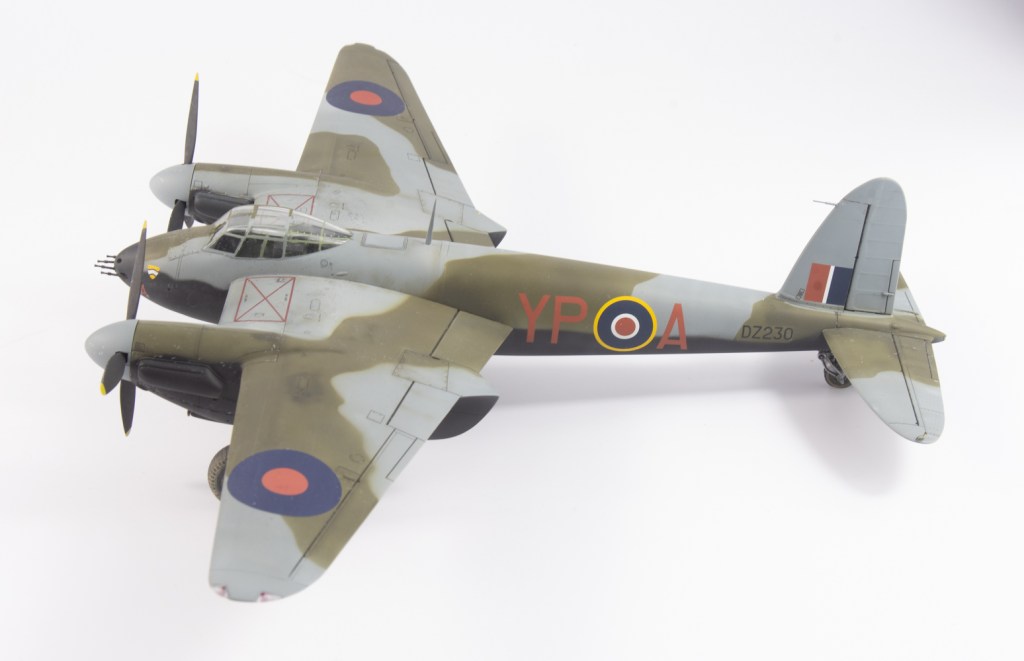
Tamiya 1/48 Mosquito NFII

  • Purchased; 2024
  • Completed; 2024
  • Enhancements
  • Wheels. Brassin
  • Gun barrels and pitot tube Master Detail
  • Landing Lights. AK lenses
  • Decals; Xtradecals 23 SQN RAF 1940-1990
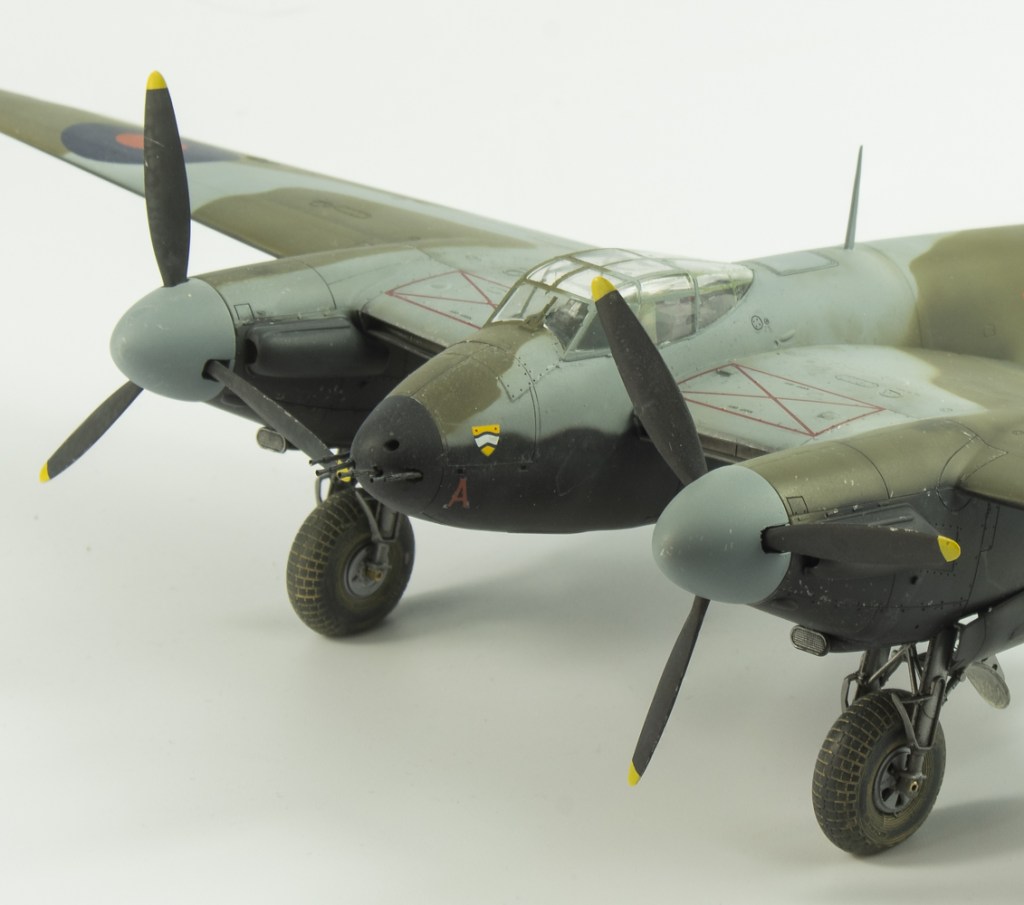
This model filled the need for a bit of a short sharp build interlude from my rather large ongoing 1/48 Hercules project.

This particular came into my collection earlier this year after being sourced for me by a friend, who had in turn sourced it from another modeller. It came half started but given I paid only 10 AUD for it, I was happy to take it on. the work done though wasn’t great. The wings had been glued together without first placing the landing light lenses in their holes, the nacelles had also been glued to the wings leaving a few steps, and one set of undercarriage struts had been assembled including the wheel with an untreated join. The original builder had also glued on the flame dampeners without first adding the exhausts.

Whilst these were all annoying, they were not unfixable, save the exhaust dampeners, they would just have to be left empty and see through .

Construction

Although one of their earlier kits from the 90s, Tamiya’s Mosquito still exhibits their legendary fit and ease of assembly. The cockpit is very simplified, even by Tamiya standards, so didn’t take long to build and paint at all. As this was going to be a quick build, I was not too worried about accuracy, so did not delve into the correct radio fit, in itself a rabbit hole, for the particular machine I was doing.

With the cockpit completed, and the wings already done, assembly of the kit was achieved in no time! I deviated from the instructions in joining each nose half to its respective fuselage half before gluing the now whole fuselage halves together. Should you build the kit as per instructions though, rest assured the completed nose mates very neatly with the completed aft fuselage.

The centreline nacelles seams proved particularly stubborn to eradicate , needing several applications of CA glue and sanding. The seam on the wheel well rear bulkhead was hidden by skinning with a thin piece of plastic card. The steps the previous builder had introduced when glueing the nacelles to the wings were somewhat lessened by rehydrating the glue join with tamiya extra thin glue and then reglueing the rear of the nacelles. They still required some filling to make a gap and step free join at the rear of the wing .

The top of the fin was reduced by 2mm by the simple expedient of tracing the outline of the one fin half onto the inside of the other fin half 2mm lower measuring from the top of the fin. The fin above this line then being cut and sanded down to this line. When the fuselage halves are joined, the other fin half is sanded down to match. The rudder hinge line will then have to be rescribed 2mm lower than the existing one. To be honest, Im really not sure it makes a very visible difference to the look of the model, this modification was called out by a thread on Britmodeller. If I build any more tamiya Mossies, it won’t be a correction that will be repeated by me. The clear under fuselage hatch will also need to be filled and its outline eradicated as it was not present on the fighter bomber version. Tamiya including it as the fuselage parts are also used in the bomber version which does have the hatch. The assembled undercarriage leg had the wheel cut away, and both legs had their axles replaced with brass tube. The holes in the lovely Brassin wheels being drilled to match. The mudguards also had the lightening holes added.

Painting and Decorating

My chosen scheme was a 23 SQN Night intruder based in Malta. This decision was arrived at purely by spotting the scheme whilst going through one of my decal folders looking for something else. How many of us have done this! there is a good photo of the actual aircraft on there Imperial war Museum site that confirms Xtradecal have got the scheme correct, although the machine did not have the radar aerials as depicted on the sheet. So starting off on the top surfaces, Gunze Medium Sea Grey was airbrushed on. The helpful camouflage plan tamiya include was photocopied before the grey bits were cut out and taped to the model so the green could then be airbrushed on, in this instance Tamiya RAF Green type 2. Blu tac sausages were used to mark out the upper camouflage delineation line and the black undersurfaces sprayed with SMS German Grey and SMS CARC Black highlights. The black demarcation on this aircraft was unusually high and also formed a wavy line on the nose and nacelle sides , all of which were reproduced on the model, although I could have possibly gone higher on the nose.

The model was then gloss coated before a wash was applied to all engraved detail using tamiya panel line colours, in this case dark grey and dark brown over the MSG and DG respectively and black used along the control surface and openable hatch lines.

The upper wing roundels gave me a few problems with them refusing to settle down wrinkle free, three different roundels having to be used before I was happy. The roundel that lies over the stiffening rib also refused to mould itself to the rib, instead tearing regardless whether I left the decal alone or tried to mould it over the rib with the aid of a cotton bud. Eventually we got there after another 3 roundels. No wonder people paint on markings! The wing do not walk squares had their inside carrier film cut away to reduce the chances of silvering. I didn’t do this nearly neatly enough. You can see the ragged edges on the model, although there was no silvering.

Photos did not show the overall paint finish looking too worn, although there was a fair bit of grime around the nose and spinners. I probably didn’t add enough, jut relying on some airbrushed brown /black stains around fuel fillers and along wing roots. Piant chips were applied with a silver pencil.

This just left the final assembly and again, a bit of earlier sloppy modelling came back to haunt me when adding the machine gun barrels. I had earlier during assembly, cut the barrels away from the breeches, knowing I would be replacing them with the master brass barrels. What I didn’t do though was be precise in drilling the holes to accept the replacement barrels, consequently, I had great difficulty in. adding and aligning the barrels. The thing to do would have been to leave the nose cap off until final assembly as it was a good fit, and this would have ensured straight barrels that would have also been far easier to add to the breeches. Little lapses in planning like this and not thinking through all steps constantly let my builds down.

I really need to address it – despite saying “I will on the next model” – to lift my models.

The underwing landing lights were represented by using AK 4mm light lenses glued with white glue to a supporting plinth of blu tac.

The wheels were weathered with a wash of Mr Weathering Colors “sandy wash” with the excess being wiped off with a cloth. Finally the masking could be peeled off the canopy, and I was happy to see on this occasion nothing had leaked or marked it, despite Eduards ill fitting mask set.

Conclusion

This was a quick build done on an impulse to build a machine that I liked the look of. The opportunity was also taken to get this half built model out of the stash and provide a bit of a respite from a bigger build. Consequently, a lot of short cuts were taken with the finish. This aside, I am still quite happy with the completed model. There are two more tamiya 48 scale in the stash, a bomber and another fighter. I enjoyed the build enough to still want to build them at some stage in the future.

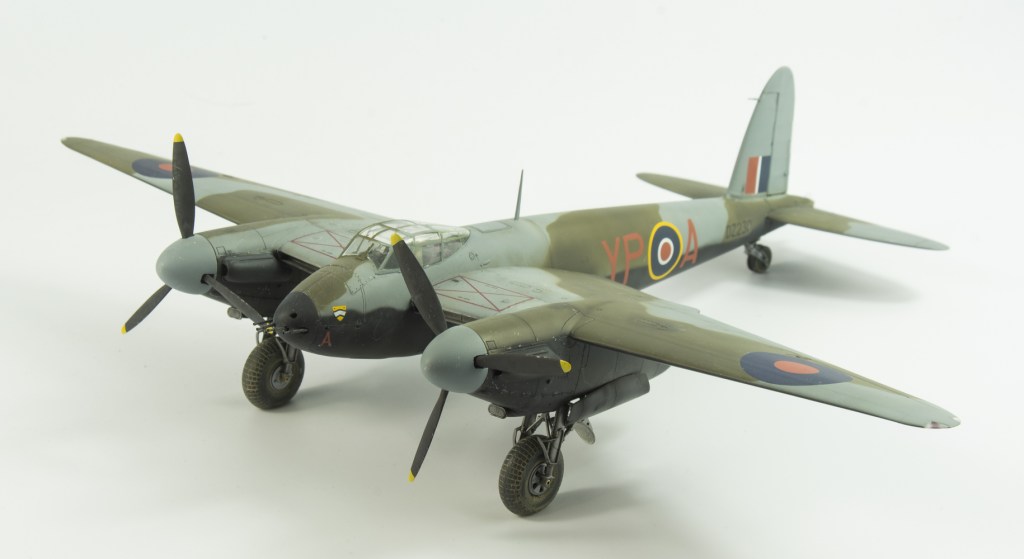
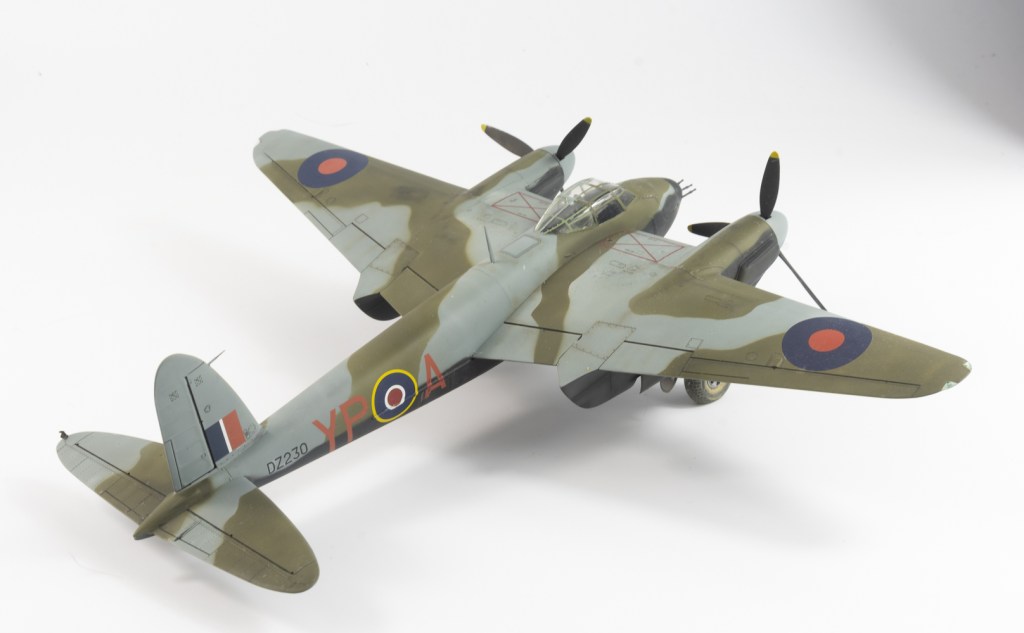
De Havilland Mosquito NFII. Royal Air Force. Luqa Malta 1942

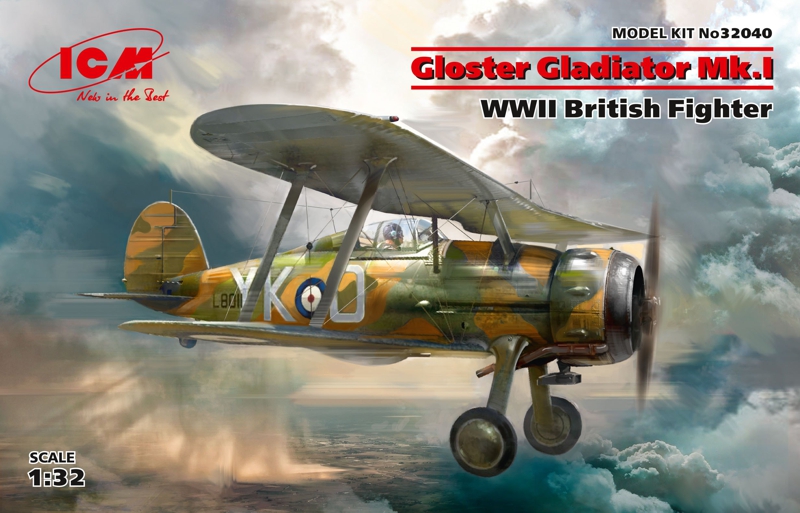
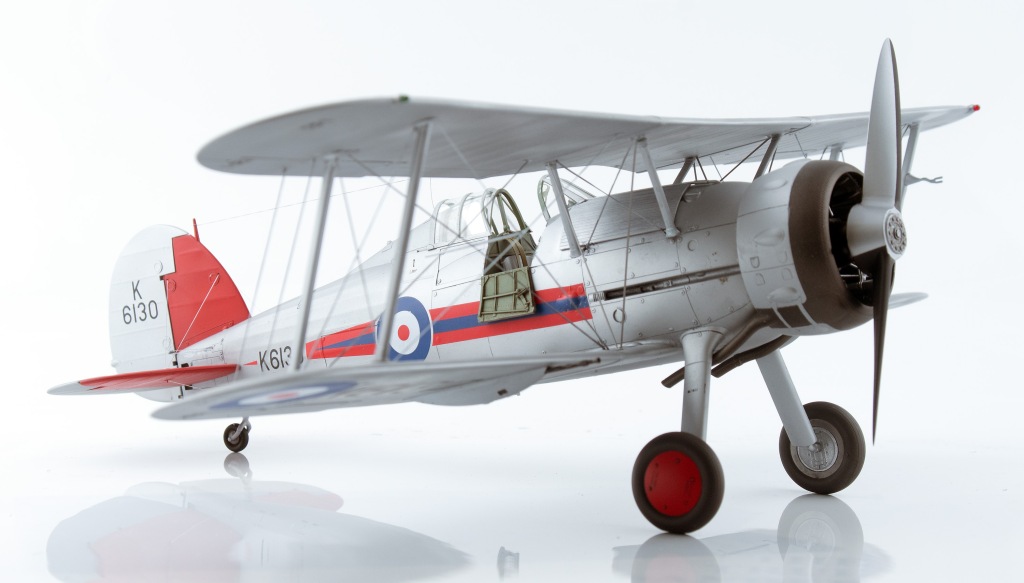
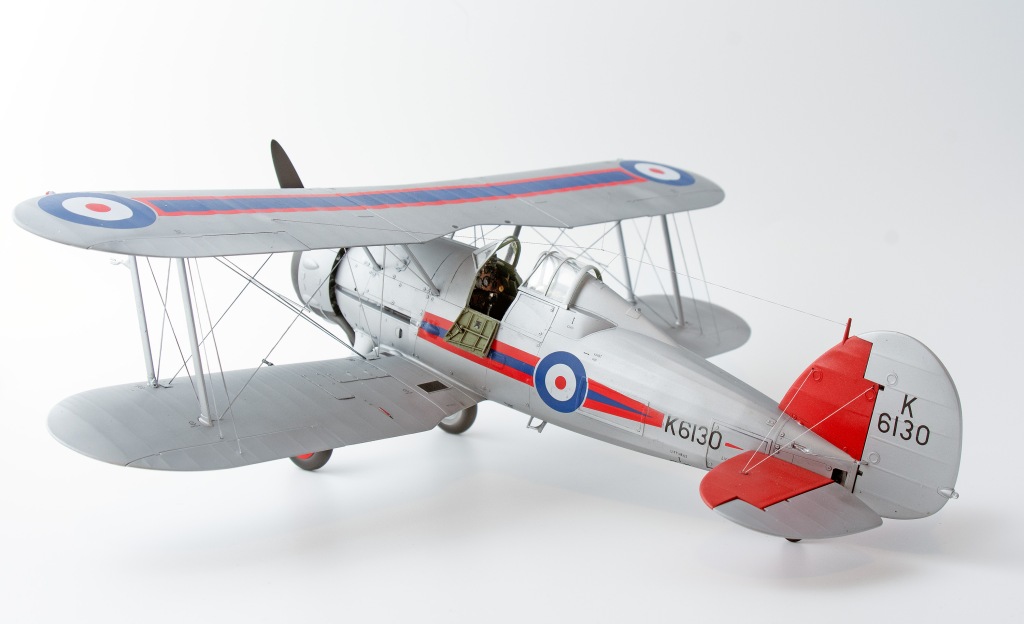
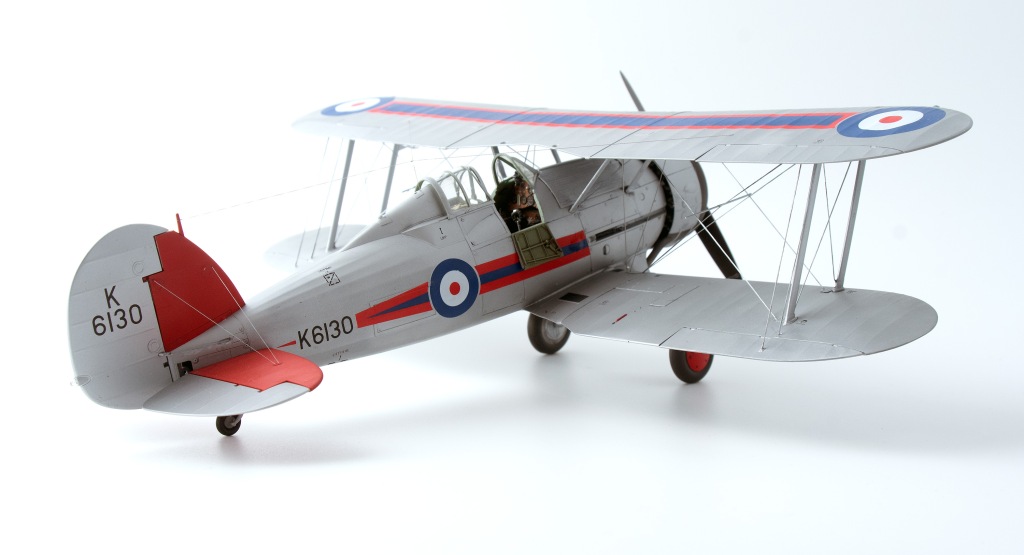
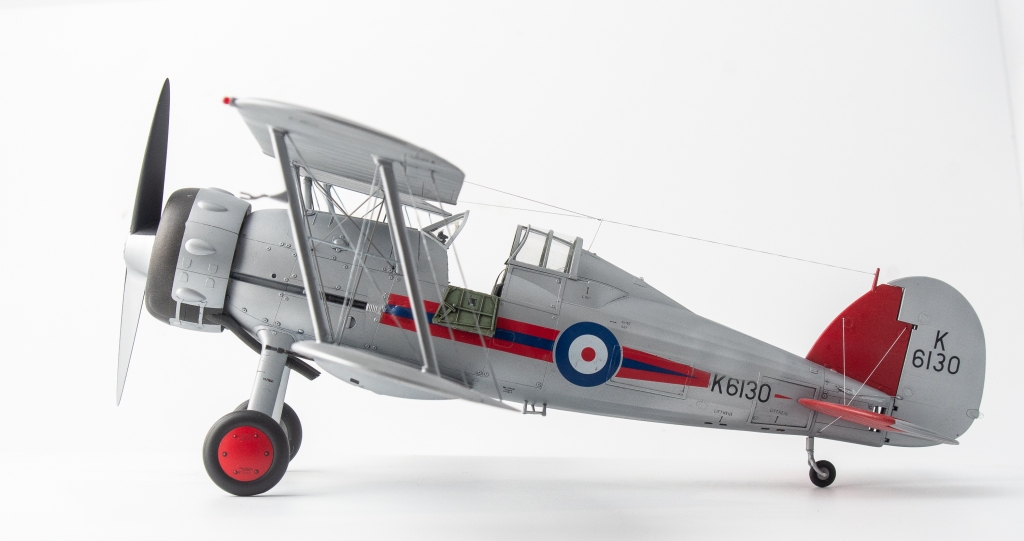
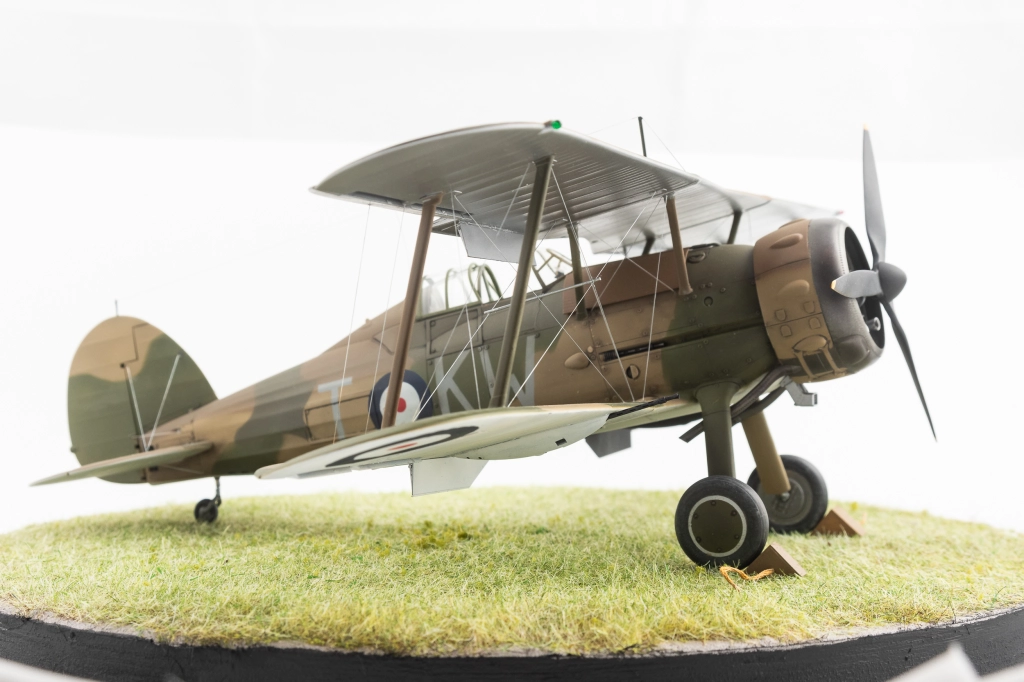
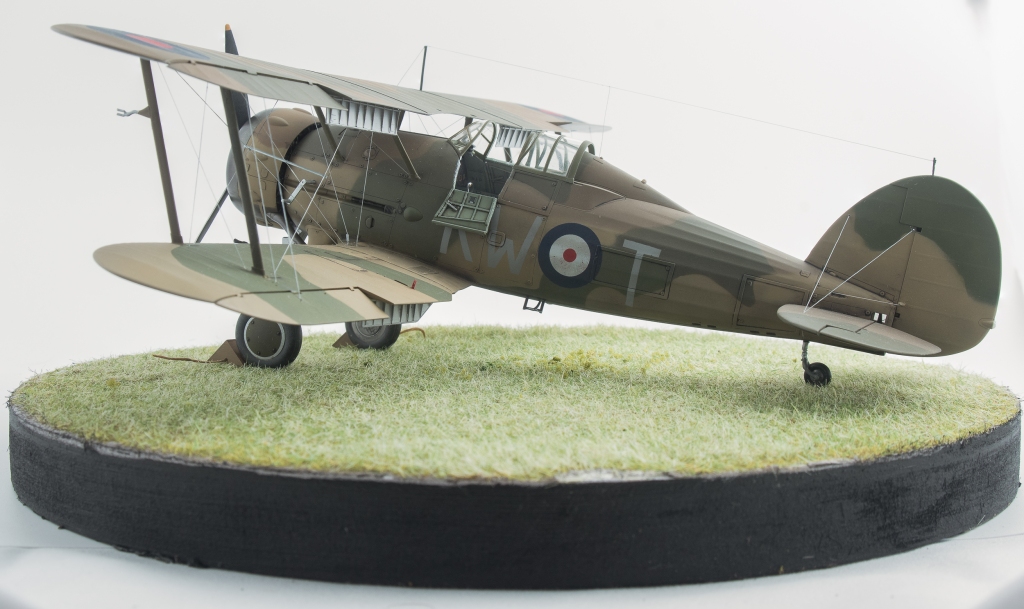
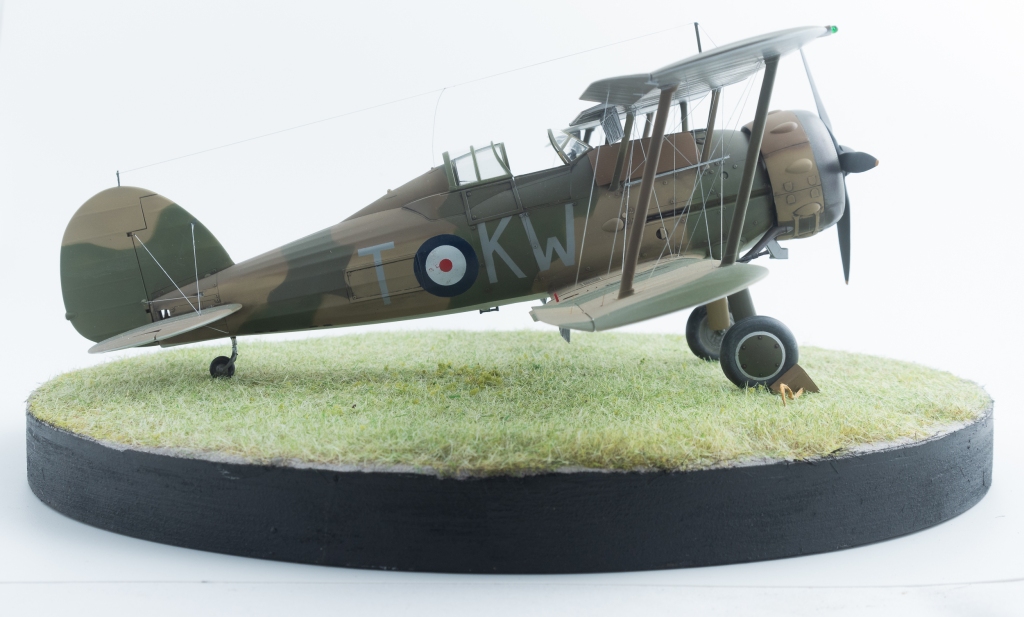
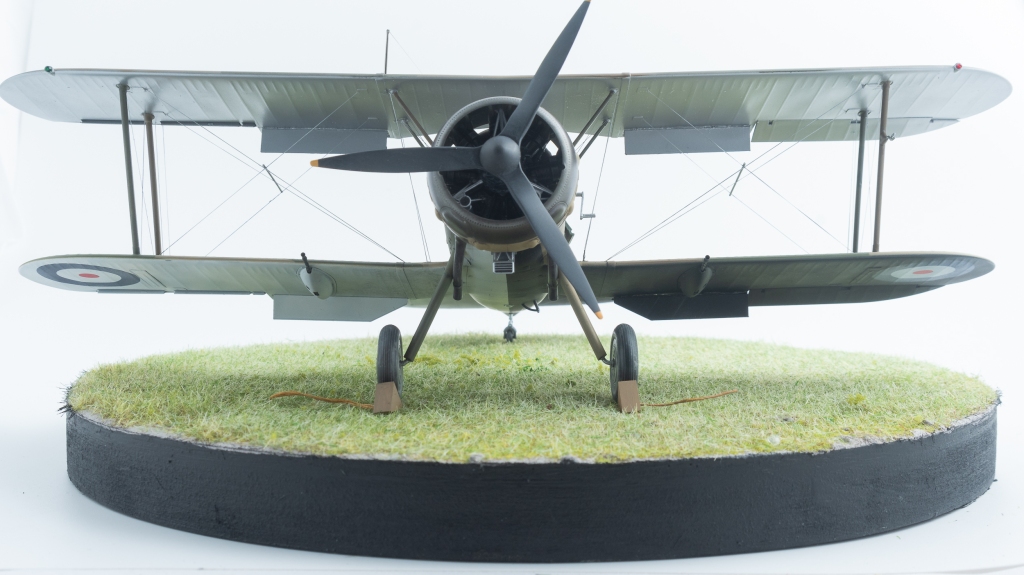
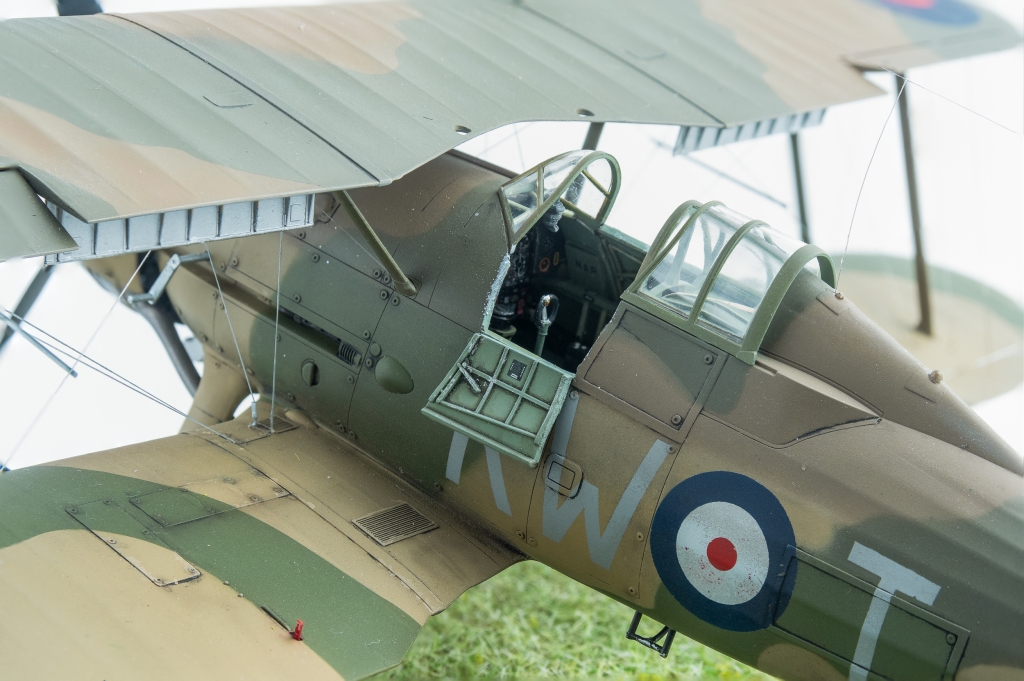
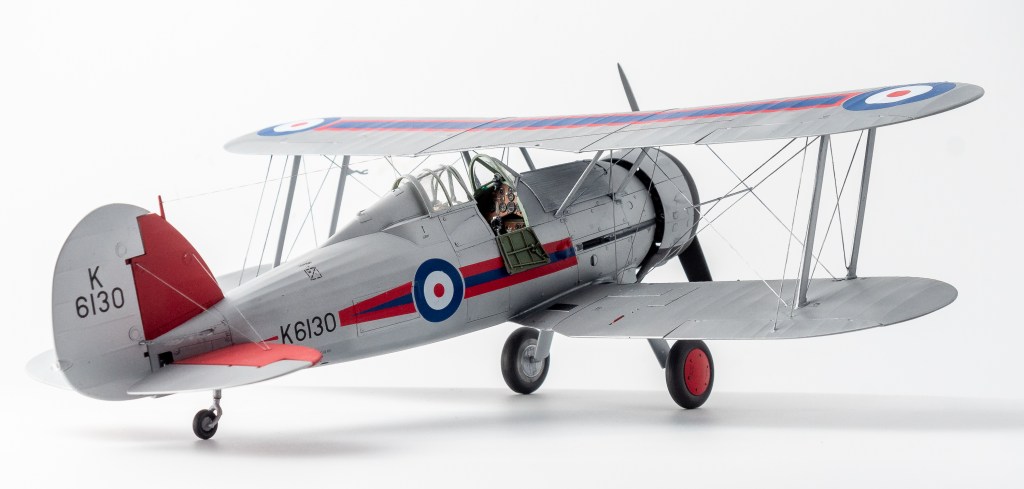
ICM 1/32 Gloster Gladiator MkI

  • Purchased; 2019
  • Built: 2024
  • Enhancements:
  • Instrument panel: Quinta
  • Seat Belts:Quinta
  • Gun barrels; Master Details
  • Cockpit Doors; Quickboost
  • Air Breather pipes; Quickboost
  • Compass Pedestal: Quickboost
  • Decals: Aero craft Models

Introduction

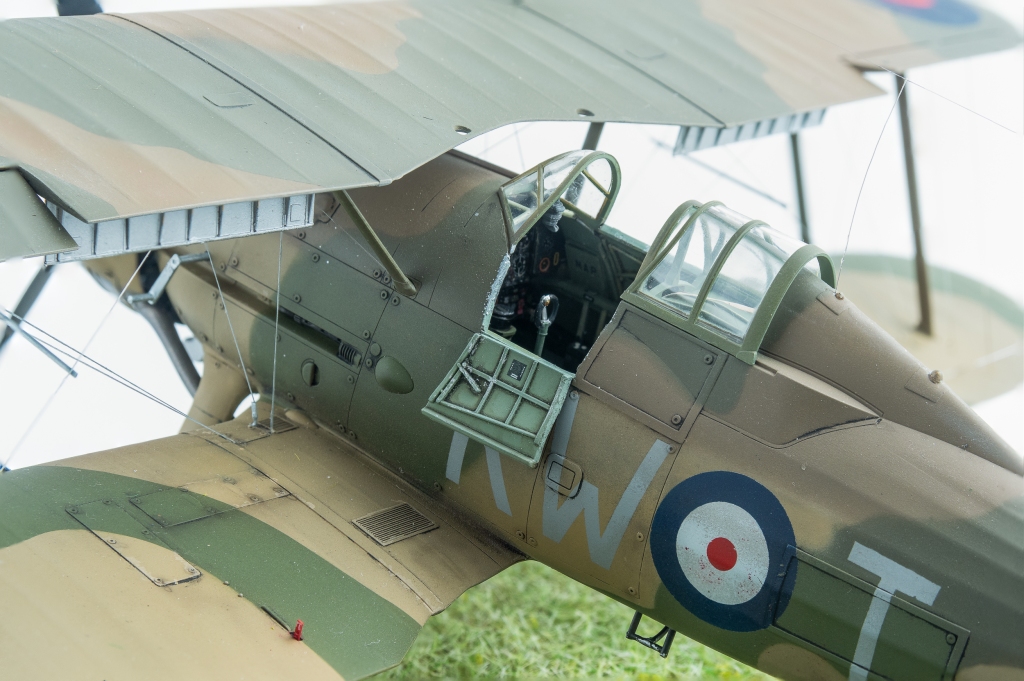
I enjoyed my other Gladiator so much, I decided to build the second one in the stash rather than selling it as was the original intention.

Even without considering the “foreign” air forces, such as Sweden or Finland one is spoilt for choice with Gladiator schemes, do you do a silver interwar one, or a camouflaged war RAF example? Then there are the Sea Gladiators as well. My previous model was finished in early war RAF camouflage, so this one would be a silver interwar RAF example.

Construction

To take a different path from the usual “starting with the cockpit”, the rudder, stabiliser and elevator halves were first glued together so that they would have time to properly set up and allow any glue shrinkage to show itself.

With this done, construction returned to following the steps outlined in ICMs instructions, starting with the cockpit.  ICM provides parts that when built up result in a reasonably busy looking cockpit.  

Of course, the builder can improve on this. In my case I included some simple additions and refinements starting off with wrapping thin copper wire around the spade grip of the very plain looking control column.  A brake lever, cam and the brake line were added from scrap plastic and solder.  

Map cases were built up out of plastic card, and the slots on the throttle quadrant deepened with a Trumpeter scriber before new throttle levers were added from slivers of plastic card topped with blobs of paint.  

Quinta 3D Decals were used to replace the instrument panels and seatbelts.  The kit compass pedestal was replaced with a better detailed Quickboost item.

There is an ejector pin in the seatback that needs to be filled and the gunsight requires the clear reticule adding.  A punched disc of clear plastic did the job here.  

Once the cockpit shelf is added, you really can’t see too much into the depths of the cockpit, even with the cockpit access doors opened.  Speaking of shelves, to better replicate the real item, the rear shelf behind the pilot (part C22) was cut down to leave just the central beam.  To my eye, this really adds to the open framework look of these 30’s era aircraft.

If you wanted to add detail to the now visible interior behind the pilots seat, frames and a radio could be built up from card and strip.  I didn’t bother as my canopy will be open and sitting over the top of the fixed canopy section, so hopefully, that empty space will not be too visible.  Finally, the machine gun barrels were cut off, as these would be replaced by brass Master Detail barrels once all painting had been completed.

With the cockpit painted and detailed to my satisfaction, the fuselage halves could now be closed.  This was achieved with Tamiya Extra Thin Glue which was liberally applied allowing the excess to ooze out to fill any gaps.

The two halves fit tightly.  The lower insert…..not so much.  That said the gaps here were minor and were eradicated with CA glue mixed with Mig Ammo Steel metallic pigment.  To me the pigment seems to make the CA slightly easier to sand and  also has the benefit of colouring the glue so you can see what you are sanding!

The fuselage was then mated to the lower wing assembly with some filler required to blend in the rear join.  A result of the soft ICM plastic the wings are alarmingly flexible but adding the struts and top wing will hopefully add some rigidity.

ICM would have you rely on a small diameter plastic peg, inserted into a hole in the fuselage to hold the horizontal stabilisers in place.  Given the soft plastic, this would likely end in tears so the pegs were cut off and a suitable diameter brass rod used to provide far more strength.  Even more fortuitous is that the real Gladiator has a small gap here between the fuselage and stabiliser.  While you have the brass rod out, the tailwheel strut can also be cut and replaced as this is another weak area of the model.

With this done, a complete airframe and top wing sat on my bench awaiting primer.  Prior to priming, a No. 77 drill was used to open up all the rigging points as I intended to use EZ line for the rigging.  Once all holes were drilled, the struts were cleaned up and attached in their respective positions.

Next up was the engine. Again, ICM have done an excellent job of portraying the Mercury engine.  When completed it looks quite busy with its cowling support braces and cooler intake tubes.  Quickboost do make one piece air cooler intake tubes that are slightly better detailed however I didn’t use them on my model as the kit ones looked fine to my eyes.  The instructions here were slightly confusing, but eventually I worked out you have the option of building the cowling closed or open.  If building the closed version, do not add the cylinder heads, parts D14 or exhaust pipe “plates parts D21 and D22.

In a perfect illustration of the pre planning that goes into all my models, it was now that I decided the model would look better rigged with the AIMS PE Bracing wire set rather than the EZ line.  The reasoning being that the PE would better represent the flat RAF wires that were used on the real aeroplane.  The set was promptly ordered from AIMS in Hungary.  Post from Hungary to Australia takes about three weeks.

Painting and Finishing

While waiting for the PE bracing to arrive the model was painted.  A primer coat of Mr Surfacer 1500 revealed a few seams, mainly around the lower fuselage insert. These were eventually dealt with, some which required multiple attempts!

The fixed tail surfaces and wheel hubs were then given several light coats of SMS red.  This was then masked off and the remaining airframe, tail control surfaces and cowling got the Tamiya LP11 treatment with the model being rubbed down with fine 8000 grit sanding pads between coats.

Once the AIMS rigging arrived a careful perusal of the instructions revealed that AIMS wants you to remove the moulded inspection hatches from the wings so that they can be replaced with PE items.  The idea being that the hatches are placed over half the hole drilled for the rigging to make a slot for the PE bracing wires.

Whilst the AIMS instructions provide clear photos of an actual Gladiator to assist you with placing the PE bracing wires, it would have been more useful to have been given precise measurements as to where to drill the holes to accept the wires.  Of course, this meant that some of my previously drilled holes were in the wrong spot so these were carefully filled and redrilled all the time dodging previously installed struts.

In the end it all looked a bit messy, so the decision was made to strip the model using Mr Thinner and repaint.  This took me back to where I was 3 weeks prior.  I would complete far more models each year if I didn’t have to do so much twice or three times to each model!

On the other Gladiator build I had used a 1 Man Army mask set for the stencils and these had really impressed me sot they were put to work again.  If you have not seen these sets, they are laser cut masks for not only the national markings, but also all the maintenance stencils.  As the surrounding area needs to be taped off to prevent overspray, all these markings were sprayed prior to applying the decals as I did not want to be applying Tamiya tape over decals.  SMS Super matt Black was used to spray all the stencils, and then the masks removed.

The decals are by Aerocraft Models.  These performed very well, laying down with the aid of Microset and Microsol.  However, (there’s always a however!) Aerocraft do not give you handed fuselage Sqn flashes.

Both flashes provided are for the port side fuselage.  To apply the flash correctly to the starboard side and have the serial read correctly, the modeller will need to cut the serial from the flash and apply it separately so it is correctly orientated.  If applied straight off the sheet without modification your serial on one side will be upside down and back to front.

The front of the stripe is also angled to follow the panel line there, and if not corrected, this will slope the wrong way also. Aerocraft helpfully supply some spare striping in both red and blue, and this was used to reverse the angle of the flash on that side.

A sealing coat of SMS flat varnish was then applied over the whole model.  Once dry, panel lines were given a wash using Tamiya dark grey panel line accent with the excess being wiped off using white spirits.  Removable panels were outlined with black wash.

I wanted something different from my usual weathered finishes so on this model I went with a cleaner finish.

The exhaust collector ring and exhaust pipes were painted in a mix of MRP Exhaust Colour and SMS Dark Bronze.  If using the kit exhaust pipes, they will need their ends drilled out.

The Master Details machine gun barrels were first sprayed with Mr Metal Primer, followed by a coat of Tamiya Semi-Gloss Black with a final coat of Humbrol Gunmetal.  This was then gently buffed for about 20 minutes which imparted a lovely metallic sheen.

Rigging

The rigging could now be attended to using the AIMS set. All started well with the crossed cabane wires and inboard wires working as advertised.  Turning to the tail, despite drilling the holes as called out in the instructions, I just could not get the AIMS wires to fit.  AIMS only provide measurements for the holes in the tailplanes.  I really wish they had supplied all measurements.

Of course, a better modeller than me would probably have measured the wires against their respective positions before drilling.  As a consequence, the interplane wires were far too short to span between the holes I had drilled so EZ line was used for the rigging.  EZ Line was also used for the tailplanes.  In all, only the cabane rigging was used from the AIMS set. Other people have used this set without drama, so the inability to get a good result using it was purely my doing.

Final Steps

On the final stretch the wheels were added.  Then the model was given another coat of SMS Flat varnish, which dulled the silver nicely, making it look more like doped silver.

The clear parts were then unmasked and the gun barrels added.

The aerial wire on these early machines extended from the tail fin post to a point just behind the canopy where it then split into two wires reaching out to each wing.  To portray this, first a length of EZ line was added stretching span wise across the wing.  Next, another length was glued to the fin post with its other end intersecting the wing line.  Tension was then taken up so that the wing line stretched into a V, meeting the fuselage wire at a point over the spine.  A couple of turns around the wing wire were added and then a drop of Superglue was added to the fuselage wire to keep it all in place.

Finally, a length of monofilament thread was run from behind the cockpit up to meet the junction of all these wires.  Small dabs of Vallejo matt varnish were brushed over the superglue to remove any shininess and the model was done.

Conclusion

I found the ICM Gladiator an enjoyable build, to the point this is the second one I have completed.

Only a minimum of aftermarket enhancements were added to enhance certain details.  In my opinion there is enough detail out of the box to satisfy most modellers, what is there providing an excellent base for further detailing and refining if that’s your thing.

For me, the machine gun barrels, seat belts and instrument panel were “must have” refinements.  To this I would add the Quickboost cockpit doors, exhaust pipes, and if doing a MKII, the carburettor intake as “seriously think about getting”.

The AIMS bracing wires did not work FOR ME, but I do think they would enhance the finished model nicely being the proper flat section wire.

Weak points (literally) of the model were the stabiliser and tailwheel mounting points due to the ICM soft plastic.

Gloster Gladiator Mk.I No.72 Sqn Royal Air Force Church Fenton. UK 1937

Leave a comment

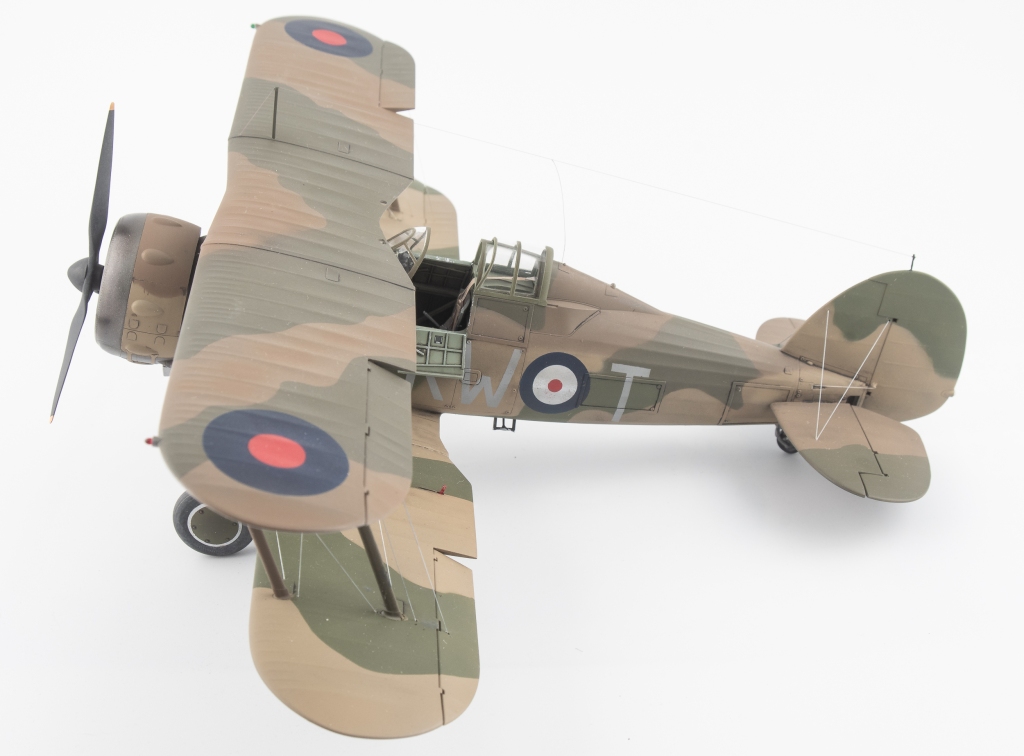
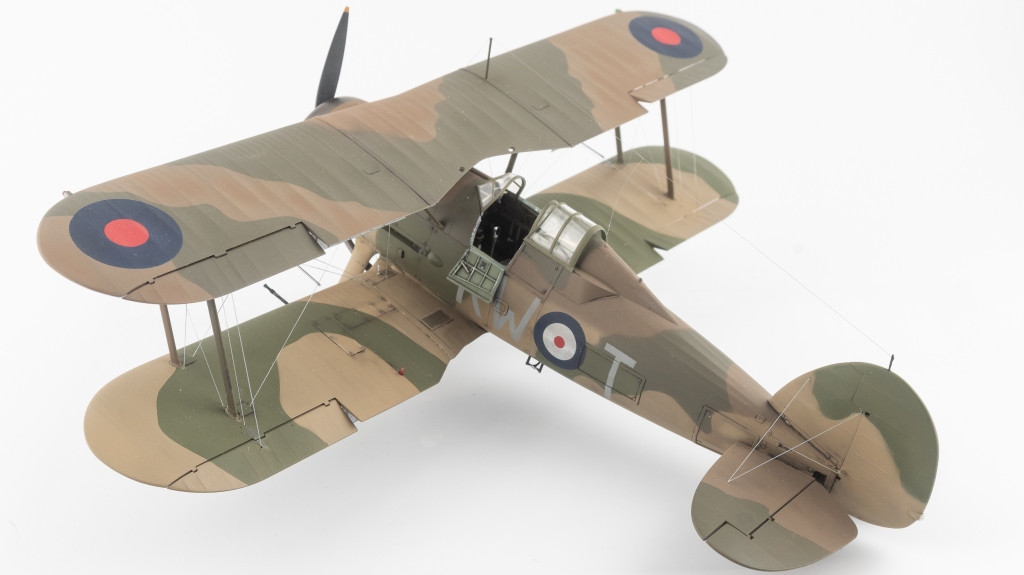
ICM 1/32 Gloster Gladiator MkII

  • Purchased; 2020
  • Built; 2024
  • Enhancements;
  • Seatbelts : HGW
  • Gun Barrels Quickboost
  • Instrument Panel; Yahu
  • Flaps; AIMS
  • Carburettor intake; Quickboost
  • Compass pedestal; Quickboost
  • Decals;1 man Army paint masks

ICM released two boxings of the Gladiator. An initial Mk.I boxing followed by the Mk.II boxing a year later.

The MKII boxing being the one to get as it also contains all the MkI parts.

The kit is well moulded and comprises surprisingly few parts. This is the second ICM kit I have built, and they’ve both been very enjoyable build experiences, aided by good fit.

I was very much looking forward to starting this one too.

Construction Notes

Construction on this model started with the engine. No additions were used, it being built straight from the box. The completed engine looking quite busy to my eye. But spark plug leads could be added if desired, for a proper prototypical look. The join between the front collector ring and manifold should be filled, although this would be tricky to clean up, unless using a water based putty.

The breakdown of the cockpit gave me the initial impression ICM had greatly simplified it -true of every kit cockpit. But again upon completion and fitted, it looked suitably busy, especially if you enhance the Instrument panel with one of the 3d printed sets on the market, like Quinta, or as I used Yahu.

The throttle quadrant had two slots cut into it to accept the throttle and pitch control levers, and the rear of it was backed with some scrap card. The compass pedestal was replaced with the better detailed Quickboost item with the -in my case- out of register Yahu compass rose added to the face. The machine guns all had their barrels cut off, to be later replaced with brass barrels from Master Detail. The gunsight, part D19 also needs the reflector added from scrap clear plastic, a strange omission by ICM. 

An example of how ICM have simplified the cockpit is Part C22, the rear shelf, which to be accurate should in fact, not be a shelf, but just the central beam. In the actual machine, you can see down into the fuselage either side. On the port side there is a TR9 radio , the face of which Yahu supplies in their set. Some photos show a rectangular box mounted to this frame that sits behind the pilots head. All this would be quite easy to replicate from scratch if the modeller so desired.

The very plain control stick really should be replaced with either a better detailed resin item, or detailed with sprue and scrap to better replicate the real thing. I just added a hand brake lever to mine, and left it at that 

SMS British interior green was used, with a wash added from Modellers World ”wash for cockpit green.” Photos were conflicting on whether the cockpit was all green or green just above the sill with everything below silver. Mine was all grey green with a silver floor and seat. Once the prominent ejector pin mark in the seatback had been filled, seatbelts from HGW were added

With the cockpit added, the airframe built up fairly quickly, even with the added complication of cutting the flaps out and building up the AIMS PE flaps, which was achieved with some thin super glue applied with a bit of brass wire. The plastic flaps were cut from the kit wings with a thin PE saw after deepening the scribed lines so as to act as a guide for the saw.

Any gaps were filled with my super glue/metallic pigment mix. The underside insert needing a couple of passes before it was completely eradicated . There is no way those skinny little tailplane locating pegs are going to survive a knock, especially given ICMs soft plastic, so they were pinned to the fuselage with an old broken drill shank. The real machine having a gap between the tailplanes and fuselage. Whilst we have the brass rod out, the tail wheel should also have its locating peg replaced with the brass. This is another part that is prone to breakage, especially as ICM would have you fit it early in the construction process. All struts were left off until the painting was completed. Their fit to the wing is both positive and secure, so no problem adding them later. Same with the undercarriage, in hindsight, I wished I had of added it later as it made handling the model during the rigging process trickier. Whatever stage you add them, ensure you check the fit of the wheels to the axles. Mine were a little tight with the consequence that I broke an axle, which was sort of inevitable, given the soft plastic. The silver lining to this was it was repaired with a bit of brass wire that greatly increased its strength and also removed the flex from the plastic.

Painting and decaling

It took a great deal of studying photographs to decide on a scheme. The decision was complicated by the fact I wanted chosen scheme to feature black and white undersides , underwing roundels, early war type roundels and the four colour counter shaded scheme. If you think this would be an easy ask, think again! Early war Gladiators featured a multitude of schemes, sometimes, even in the same SQN. The Munich crisis roundels really appealed to me, but these aircraft were mostly silver undersides with no roundels. Eventually the 615 Sqn machine was picked, and to my joy, upon opening the 1 man Army mask set, roundels and codes for this very machine were included, saving me some Silhouette design time.

Painting started with the white half of the undersides using MRP white. The areas between the ribs were then sprayed with SMS German Cream and MRP Insignia white for some tone differences. The black half was base coated with SMS Camouflage black (my favourite black incidentally) and then the areas between the ribs were sprayed Tamiya rubber black. This was then masked off and a 50:50 mix of Gunze dark earth and MRP middle stone to represent the light earth was then sprayed on the top surfaces of the wings and lower fuselage. Tamiya RAF Green type 2 was mixed with a “smidge” of SMS Yellow for the light green. For painting the flying surfaces, TopNotch masks were used for the pattern, however the masks for the fuselage did not match the camouflage pattern of this particular aircraft , so blu tac sausages were used to mask the camouflage pattern.

These machines had gone over to France camouflaged in the standard DE/DG camouflage in 1939, Whilst there, the newly developed counter shade scheme was applied, possibly around early 1940. I imagine it would not have been the neatest job, due the RAF having no large maintenance facilities in France. In any case Gladiators in France did not last too long, the SQN being re equipped with Hurricanes soon after.

The Dark Earth and Dark Green were Gunze colours subtly shaded with some lightened and darkened mixes.

There is no definitive proof what colours the wheel covers actually were. Both red and green being called out by various profiles and kit manufacturers. I went with green.. The white outline though is very clear from period photos.

MRP Medium sea grey was used for the codes, the roundel colours are tamiya Royal Blue and SMS red, the red at this stage of the war being the bright red.

Rigging

This was by far the most frustrating part of the build. Contrary to all those modelling articles stating how easy EZ line is to use. “Just add a drop of super glue into your pre drilled hole and the line pulls taut” my experience was anything but the simple, relaxing task all these articles and youtube videos make rigging out to be!.

First off, the CA, despite being a new bottle would not stick, not sure if it was the humidity, but you’d think that would help set it. This was after 10 interminable minutes first trying to get the EZ line to into my drilled hole! It seems if the EZ line even sniffs the presence of CA, it curls up, refusing to be poked into the hole. Poking the line into the unglued hole was easy enough, but then getting the CA glue onto your brass wire applicator and then apply it accurately into the hole. You need another two hands!

EZ line was used as I wanted to replicate the flat RAF wires, despite my best efforts, there are some twists in my rigging lines, and by this stage I’d lost all patience in going back and removing the twists. Anyway, for what its worth my method was to attach the various lengths of line into No.80 holes drilled into the top wing, which at this stage has not been attached to the model, ensuring that they would be aligned so as to give the flat effect of the real rigging.

The top wing was then attached and the lines cut to slightly shorter than the required length and fed into the pre drilled holes in the lower wing. This is where it all started to get pear shaped. Anyway, I persisted until all wires were added.

The eagle eyed most you will spot a gas patch white metal RAF terminal used on the lower wing to see how this looked. This was the only one used as I found it too hard trying to line up the others to the exact angle needed, the metal not being malleable at all. Finally it was all painted Vallejo steel. and the model just needed the canopies unmasking and she was done.

Well not quite done as I needed to add the antenna post as ICM don’t include one. Probably a blessing as any part supplied would probably not stand up to the pull of the EZ line that was used for the antenna wire. A mast was formed out of brass wire and glued to the starboard wing, not centrally as ICM show on their box art

CONCLUSION

I really enjoyed this build, so much so that I started the MkI that was still in the stash which was initially going to go on the for sale pile. ICM have done a lovely job on this model and delivered it in a scale which does the real aeroplane justice. There are some annoyances, the soft plastic being the main one as it really requires the modeller to replace the tailwheel and stabiliser mounts which otherwise are far too weak and prone to breakage. Other than that, I found the rigging very frustrating, but thats on me! Lots more practise needed before tackling all those Wingnut Wings kits in the stash, me thinks!

Gloster Gladiator MkII 615 SQN RAF St. Inglevert. France 1940

Leave a comment

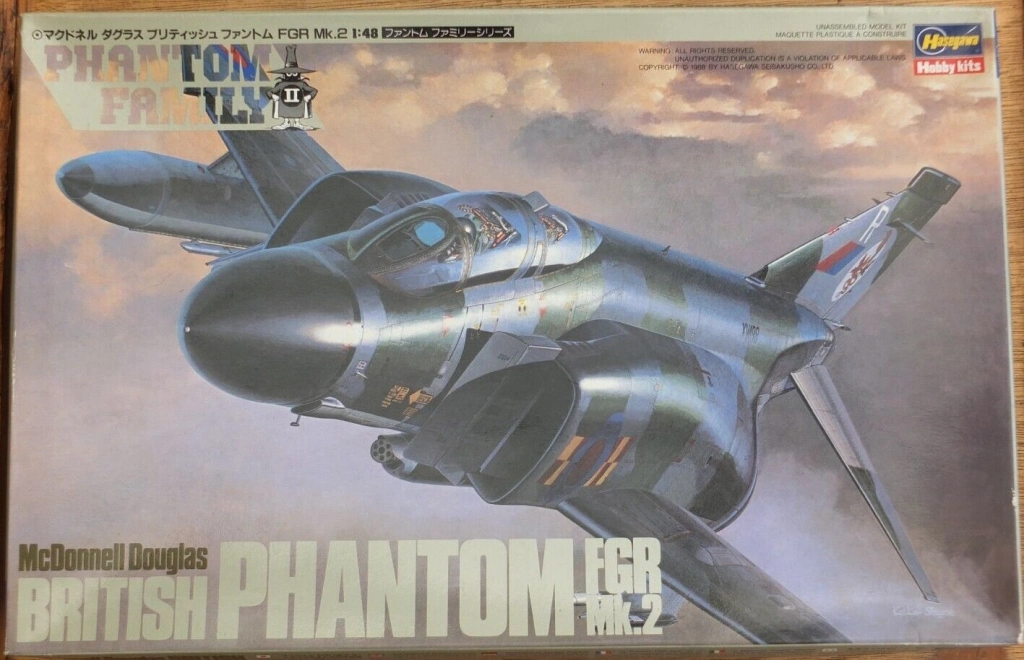
Hasegawa 1/48 Phantom FGR2

  • Acquired: 1988
  • Completed: 2023
  • Enhancements
  • Seats; Quickboost
  • Cockpit; Aires
  • Wheels; Reskit
  • Matra Pods; Reskit
  • Exhausts: Reskit
  • FOD covers; Quickboost and Two Mikes
  • Decals; Model Alliance RAF in Germany Part 1
  • Wing Tanks; Hypersonic
  • Triple Ejector Racks for Matras; Eduard Brassin
  • Ladders; LP Models

Up until completing this build 2023 had been a horror year for me modelling wise, with several kits started, but none completed.

The bin was the final repository for more than one of those builds that had not satisfied me.

Whether it was my recent retirement, the house move, the time taken setting up a new model room or a combination of all those factors playing with me, I found myself getting easily frustrated with builds that actually weren’t that bad, but to me had been ruined by some silly minor error on my part.

In an effort to reset, I decided to build the model that appeared first on m stash database, the venerable Hasegawa Phantom, even this was not without its setbacks, but this time I persevered through to completion. It may not be my finest work, but at least I have completed a model, which brings my total to 4 so far this year. Four! I built more when I was working full time.

This particular kit is the oldest kit in my stash, having been purchased in 1988 when it first appeared in Australian shops, its been packed, unpacked, placed on shelfs, shoved behind shelves, fallen down the back of shelves several times and the box bears the scars.

Opening the box revealed a fair bit of aftermarket had been purchased for it over the years. Even closer inspection showing I had at some stage made a start on the model, most likely soon after buying it, as that’s how I rolled then. Heady days indeed!

Wheel wells and undercarriage struts bore testament to my early airbrushing efforts where seemingly I blasted everything with thick underthinned paint at about 40 bar!

However what it did show me was my modelling has in fact improved greatly over the intervening years. If like me, you have long disposed of your early canon of work, it can be difficult to determine if you have indeed made great strides in modelling Looking at recent models in the cabinet sometimes only reveals incremental improvement. Looking at your amateurish attempts from 35 years ago certainly brings home the large improvements you have made in your modelling.

Construction Notes

The Aires cockpits are always incredibly detailed but have a reputation for being difficult to fit in just about all cases. That being the case with this one too, although I found it easier than some of their products. That was once I’d worked out what parts of the kit to remove. The instructions being virtually useless in this regard, save for the sage advice of “kit parts will need got be sanded”.

Eventually I worked out from studying the resin parts, the kit sills needed to go. The clue was the sill detail contained on the Aires part.

Still, the bottom of the resin cockpit floor and the top of the kit nose wheel well had to be sanded to within a mm of their life, before the cockpit would sit at the right height. Width wise though, not a lot of sanding needed to be done apart from removing the rudimentary side wall detail from the Hasegawa fuselage halves.

Stout plastic sheet locators were fabricated to hold it in place and the gaps between the sills and plastic fuselage sides filled with Milliput.

The rest of the kit went together remarkably well, minimal gaps at the intakes, a slightly wider gap at the front edge where the underside of the wing joins the nose was shimmed with plastic card which helped to minimise the filling. As the plan was to use FOD guards I could dispense with faffing around adding full intake trunking, although the abrupt end to the intakes trunking as hasegawa have moulded it is not a huge issue in my book, and can be minimised with some creative painting.

I say relatively well. There were complications but these were due to the kit missing a few parts due to the length of time it has been in my stash and the repeated packing and unpacking it has seen with various house moves. Here I have a friend, Ian Bevan who came to my rescue. If you are using the reskit exhausts, be forewarned you need to either shorten the rear of the flat area that forms the bottom of the fuselage halves or cut out openings to accept the extra length of the RESKIT exhaust tubes.

The spine just needed some panels and covers rescribed and she was pretty much ready for paint.

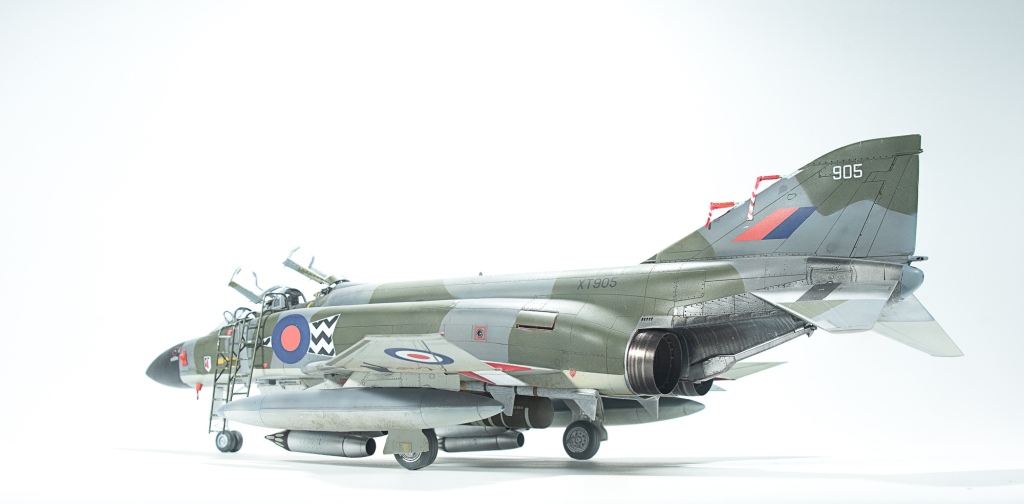
This model was always going to be in the classic cold war scheme – for me anyway- of grey/green/light grey camouflage they wore whilst employed in the strike role.

Gunze paints were used for the topside colours, AK Real Colours Light Aircraft Grey was employed on the underside due to it having a warmer tone, than Gunzes interpretation, which seemed to match my refs better

The Model Alliance decals were no problem. Stencils came from an Extradecals sheet for British Phantom stencils, and being printed by Microscale, also performed well, although Im not sure all the stencils on the sheet were applied to British Phantoms. The Xtradecal sheet was employed as the Hasegawa stencils had shown a propensity to break up when introduced to water.

Gunze gloss had been applied prior and post decal application followed by SMS Flat which gave the required sheen I was looking for. However the edges of all carrier film was still very visible, no silvering, but quite apparent edges. I have read where these lacquer clears can be too thin to hide decal carrier film edges. A coat of Testers Dullcote was applied, which hid all the carrier film, but also led to some frosting. Subsequent coats of SMS flat failed to bring back the sheen I wanted. Semi gloss should have been used in retrospect.

Later analysis showed this was the point where things started to go wrong!

My reference photos of this particular jet, (and here I need to mention Geoff Coughlin’s suburb e-book series) showed the jets from 17 SQN at this particular time to be fairly well looked after, with minimal weathering on top surfaces although the undersides were filthy. The jets at this stage being fairly new in squadron service.

To this end oils were used to impart heavy streaking and fluid loss. Speckling was also heavily employed to show the grime that would have been flicked up from wet runways.

For the loadout, I came across a photo in Double Ugly’s book on British Phantoms that showed a load of 3 MATRA Pods being carried on TERs. Hasegawa TERS from one of their weapon sets would be used, that is, until I screwed up drilling holes in them for brass pins, so Brassin TERS were used instead.

The whole drilling-tiny-holes-and-pinning-stores-to-pylons affair was incredibly frustrating. It didn’t help the hasegawa inboard pylons are an incredibly loose fit to the wing too.. The hypersonic tanks and pylons were trouble free and were a push fit.

With the Matra pods I also have to throw out a thanks to The Hamfisted Modeller for sending me the cut files for the frangible covers on the nose cones. The method is outlined in his build of the Kinetic Harrier

I did ask him to send me some skill too, but sadly , he had run out!

With the canopies, I found the Eduard PE canopy bow fascias just would not fit the canopy profiles. I should have just yanked them off, FGR2s of this era were only fitted with 2 mirrors so the centre one was cut off, Bizarre thing with the rear canopy, it had no hinges moulded on like the pilot canopy, a check of the FG! in the stash revealed that canopy also with no hinges.

Fault by Hasegawa maybe? Its marked as the standard F-4 Sprue, and all other Phantom sprues I have seen have been correctly moulded.

By this stage, as always happens with kits that aren’t going the way I envisaged, I began to take shortcuts and rush things as I really just wanted it off the bench. The next model will be wayyyyy better, right?

Therefore I didn’t bother with the full complement of RBF flags, so with the addition of the LP Ladders, I called it done.

Its not as good as I was hoping for, but Im pleased to have finally built the oldest model in my stash. There is the FG1 to build as well, but first a cheap Hasegawa Phantom will need to be sourced to replenish the parts I took from it to build this kit.

Hopefully Airfix see fit to release this iconic jet in 48 scale. The Hasegawa Phantom series have not aged as well as some of their other kits, the B/N, E, C/D and J all being rendered pretty much obsolete by newer kits from Meng and Zoukie Mura.

However, the Hasegawa kits remain the only Spey engined Phantoms in 48 scale to this day, and are still well sought after. They are still available on the second hand market as are the Revell reboxings for reasonable prices, well, here in Australia anyway.

Finally, Im not one for nostalgia kits or rebuilding kits from my youth, but this kit does have special meaning for me. Decades ago, it was purchased from a stalwart of the Perth modelling scene.,Tim Vickerage who owned a shop in Fremantle of which I forget the name, Modelcraft?

Tim was responsible for introducing me to Iwata airbrushes, Xtracolour paints and the model club scene. Tim sadly is no longer with us, so this build is dedicated to his memory.

Phantom FGR2 17 SQN. Royal Air Force RAF Bruggen Germany 1975

Leave a comment

Airfix 1/48 Spitfire Mk XIVe (conversion)

  • Acquired: 2023
  • Completed: 2023
  • Enhancements;
  • Wheels; Brassin
  • Gun Barrels; Master Model
  • Exhausts; Brassin
  • Seat Belts; Eduard
  • Decals; Xtradecal

Another project (and Spitfire) started on nothing but an impulse. That impulse came in the form of fellow modeller Andy King publishing a post on his blog on how he was tackling converting the above two kits to arrive at an early Spitfire MkXIV,

His clear photos and narrative indicated what seemed a fairly straight forward conversion, one possibly even I could handle despite my inability to constantly cut straight lines.

A mate very graciously sent me the required Airfix kits, those being the Spitfire MkVb and XIV. Thanks Norm!

First order of (de) construction was too cut the kits along the required panel line as indicated in Andy’s article, although I deviated from Andy in just cutting straight through the rear access hatch rather than cutting around it to make the cut easier. Take particular care around the fin fillet of the XIV. Once cut, I traced the fillet onto the Vb fuselage halves with a pencil so I had an accurate edge to cut to.

It was then a simple matter of joining the spine from the Vb kit to the lower fuselage of the XIV.

This had been the deciding moment. If this had not worked, the project probably would have been binned, but I was very happy with the result.

A tape together showed everything that needed to match up did

From here it was just a matter of assembling the spitfire as per the XIV instructions. The fuselage join did require some filler and subsequent rescribing of the lost panel line with that troublesome little jig just aft of the canopy. My work here was not great and I wish i had of had the patience to persist with it until I was truly happy with the result rather than settling for just “good enough”

If I could offer one bit of advice to modellers on the oft asked question of “How can I improve ?” it would be to persist until you are happy with your efforts rather than just accepting mediocrity. If only I took my own advice more often!

For the cockpit, the rear bulkhead from the Vb was married to the sidewalls of the XIV cockpit, and the fit of the fixed rear clear section from the Vb checked for fit. All good

What wasn’t so good though was when it came time to offer the lower wing section up to the fuselage, I could not get to mate to the wing fillets as it was fouling on the rear of the cockpit tub. Talking to Andy, he’d faced the same problem although in his case it was possibly due to him using the Eduard cockpit.

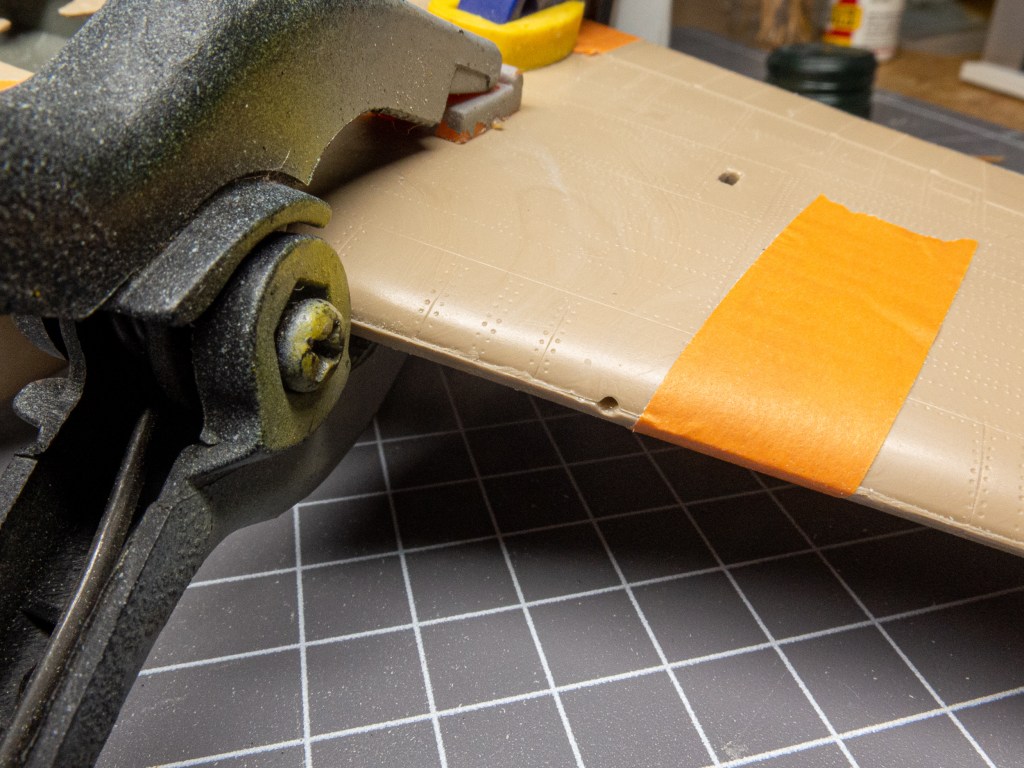
A long process of elimination and trouble shooting revealed the Vb bulkhead was not sitting as deep into the tub as it could. Remedying this sorted the problem and i got the lower wing fitted without further problem, and before you say “Bruce, that photo does not look like the fit is problem free,” the clamps are actually ensuring the underwing radiators sit flush with their cutouts. They mating surfaces do require some judicious sanding to ensure their fillets sit flush with the wing.

The top surfaces were then added for a nice tight fit. There was a small misalignment on the cannon stubs, but a skinny sanding stick paid short shift to that!

Painting time!

Annoyingly I had small flecks of paint pull up with tape all through the painting stage, no idea why as I had cleaned the plastic prior to painting with tamiya thinner X20A, and also used a primer. Nothing major, until I went to swab up some surplus Mig Ultra decal solvent with a cotton bud and removed not only the decal solvent, but also the clear finish and paint down to the plastic.

I have never had this happen before. It was easily touched up, although you can still see the scar. Also evident in the above pic are my dodgy scribing skills.

The camouflage demarcation was achieved by using the AML camouflage mask set. Its designed for the Academy kit, but still fits the airfix kit nicely. I managed to create a few ridge lines though with over judicious coats of paint.

Weathering was achieved with oil washes and spattering on Tamiya brown panel liner to represent spaces of mud kicked up by the propeller. Just needed to add the exhaust pipes and the mirror that came from a quick boost set and she was done

There exhausts were base coated in dark iron, then washed progressively with tamiya dark brown panel liner, Vallejo pale german camouflage brown and finally Vallejo white grey.

Im very happy to have this mark of Spitfire in the cabinet. A shout out to Andy King for doing the conversion as I never would have thought of it. Do check out his blog. He has always got something interesting on his bench.

Supermarine Spitfire XIVe. 350 (Belgian) SQN. R.A.F Lympne. 1944

Leave a comment

Airfix 1/48 Spitfire FRXIV (yes, another one!)

  • Added to Stash; 2022
  • Completed; 2023
  • Enhancements:
  • Exhausts: Brassin
  • Wheels: Brassin
  • Seat Belts: Eduard
  • Guns: master barrel
  • Decals: Xtradecals

Well! I certainly did not see myself completing another of these kits, immediately following on from my other one, but I had become intrigued by a few comments on my Facebook page as to how to get a better fit at the wing roots.

The suggested method was to fit the upper wings direct to the fuselage . This allowing the best way to get a tight fit, then the lower wing is added.

I was doubtful this would work on this model, given the very small contact area for the upper wings abutting the wing fillets. Instead I added the upper wings to the lower wings, only glueing the tips together to ensure there would be no step. As the wings had had no glue added inboard of the aileron cut outs, the soft plastic allowed me to spread the upper and lower wing to fit over the undercarriage location stubs moulded in situ along the wing root. My wing root gap was almost non existent this time, needing only a thin smear of Mr Surfacer to reduce the join.

My other major departure from the instructions with this build was to glue the fuselage halves together, completely dress the join, then add the fuselage from below. The fuel tank was still a poor fit.

I added a 10thou shim to the front. The shim was sanded to conform to the cross section of the cover before it was put fit on. Result was a much tighter fit.

The construction on this was looking a lot tighter than my first one, which pleased me. For the finish, a modified desert day scheme used by the RAF post war was settled on. The different scheme a mate had used on his really appealed to me, so I wanted something similar for mine.

Not the same, obviously as I didn’t want to show him up!

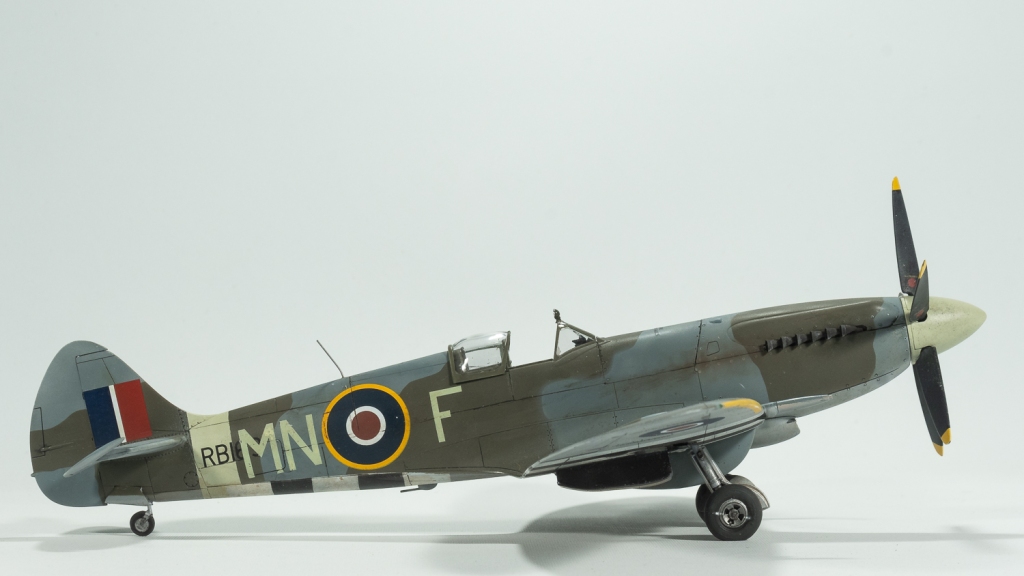
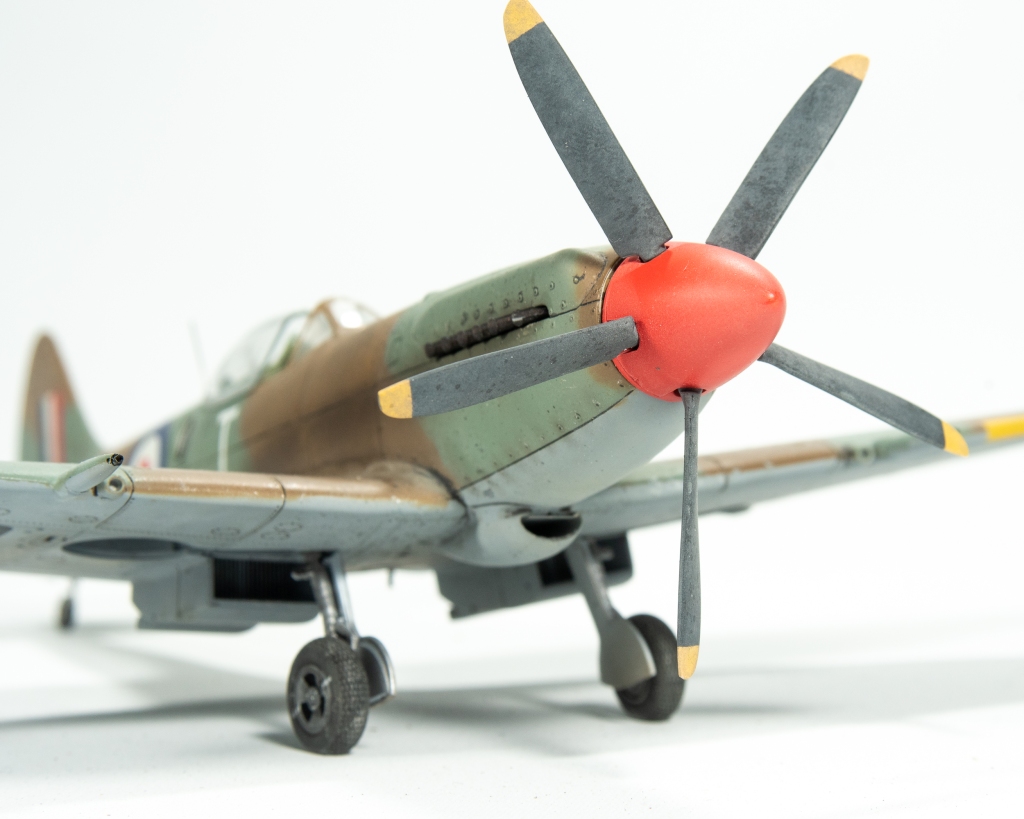
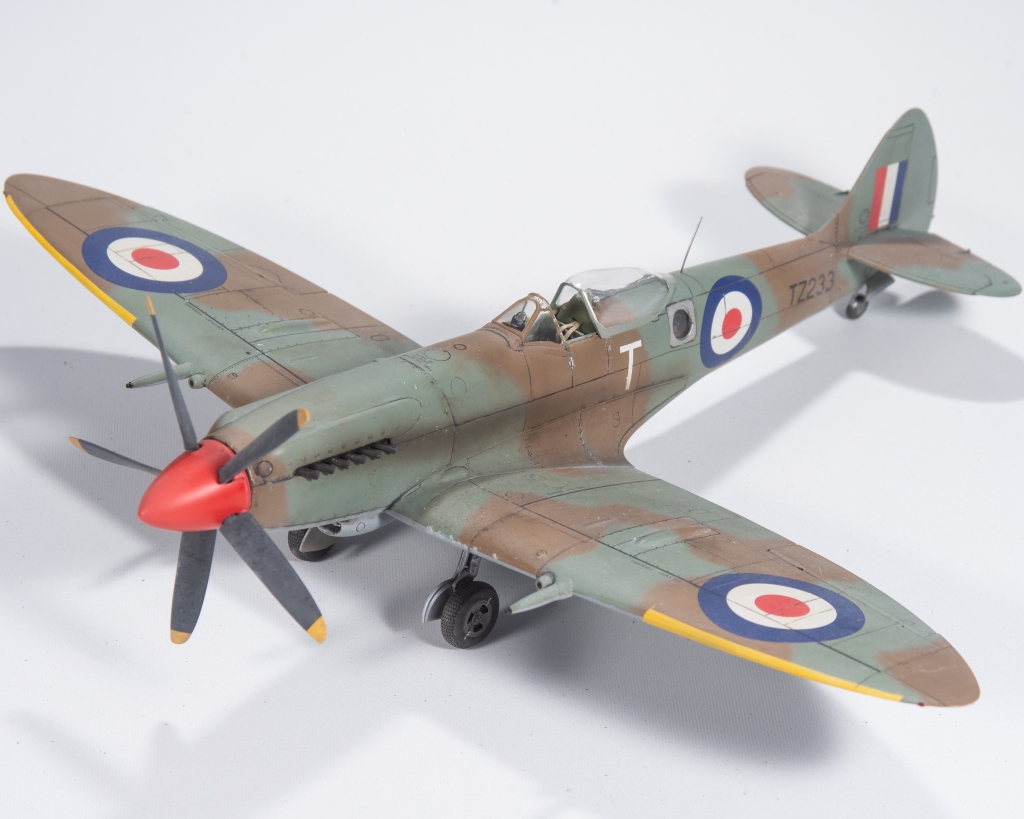
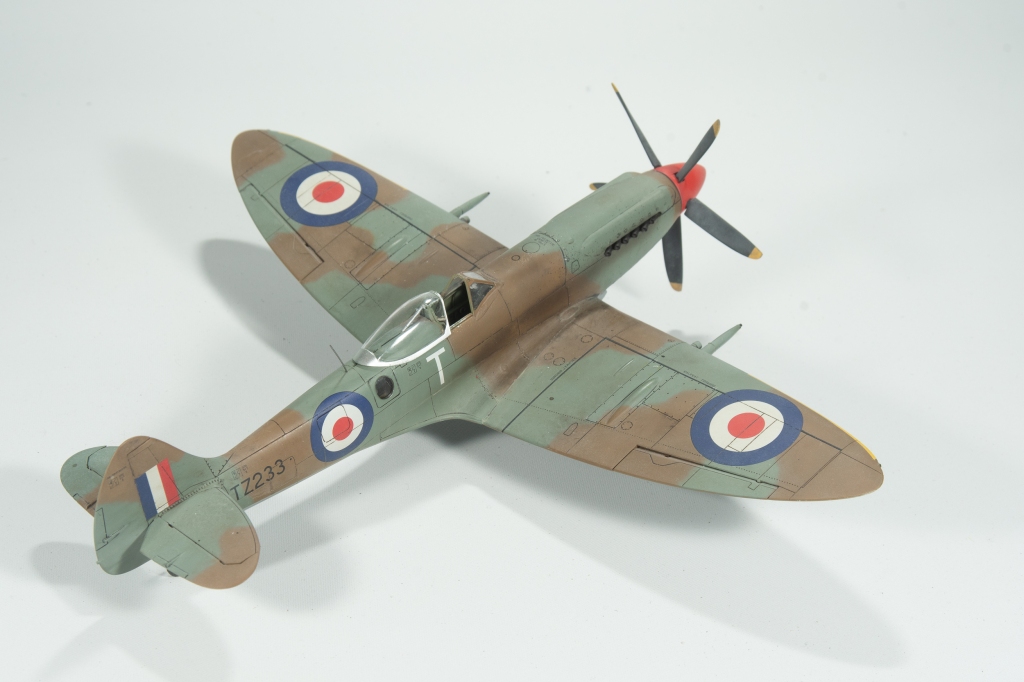
The modified desert scheme was only used on two aircraft types that I know of, the Spitfires XIVs of 208 SQN and Tempests of 6 SQN. It was arrived at to differentiate the spitfires of the RAF from those of the Israeli Air Force and the Royal Egyptian Airforce, following a couple of “friendly’ fire incidents, which led to the loss of a few RAF machines.

During this time frame, all three Air Forces flew Spitfires, albeit different marks, so making your aircraft different from the others was a necessity.

Colours used were Gunze’s dark earth and MRPs light slate grey and medium sea grey for the undersides. The camouflage being freehand with my Iwata HP-C. Some tonal variation was achieved by utilising a random preshade of differing colours such as yellow, tan and light grey,

Decals were from xtradecals and there was no problems with applying them over a gloss coat, the post war D type roundels looking superb against the drab camouflage. With the national markings done it was time for the stencils which came from the kit sheet, well that was if I hadn’t accidentally thrown them out during packing up for the house move. Actually, there was nothing accidental about it as I can remember looking at them and thinking “I won’t need these, its a field applied camouflage” so in the bin they went.

I may have been correct in this assumption as the only two photos I could find on the net of these machines showed weren’t the best quality, so I couldn’t make out if there was stencilling or not. Given the machines were completely painted in a new scheme – well the top surfaces anyway – my supposition was stencilling was reapplied. In any case a lat mark spitfire stencil sheet by Barracuda Studios was duly ordered

Given Roy Sutherland markets this as suitable for any Spitfire from mark nine to mark 22, it was disappointing to find only enough stencils for four propeller blades, not five as needed in my case, or in fact for a mark 22/24.

Wing Walk lines were masked and painted as long thin decals and I don’t get on well!

An interesting little fact I discovered on Spitfires post VIII – the mechanical undercarriage down rods which extend above the wings when the gear is down, were deleted. So I didn’t add them as was my original intent and what started me down the stencilling rabbit hole

I was particularly pleased with my handling of the canopy on this kit. It was sharply masked and remained crystal clear, which is not usual for me, well thats how I remembered it before the move.

Imagine my horror when I pulled it from the box to discover a dirty great crack the length of it.

No problem, there’s two in the kit, in fact I had two remaining ones from both kits. I had used one as a mask when painting this kit, so cleaned it up with some MR Thinner, which revealed that this one was also cracked, I mean for christs sake!!!! Maybe I applied too much pressure whist holding it when painting the kit. So, the remaining canopy was masked up and painted. Unmasking this revealed………. a tiny spot where the plastic had crazed, what caused it. I don’t know, no glue had been near it, only lacquer paint, whether it pooled on this spot whilst painting, I have no idea. The offending area was sanded out and repolished but I could not eradicate it completely.

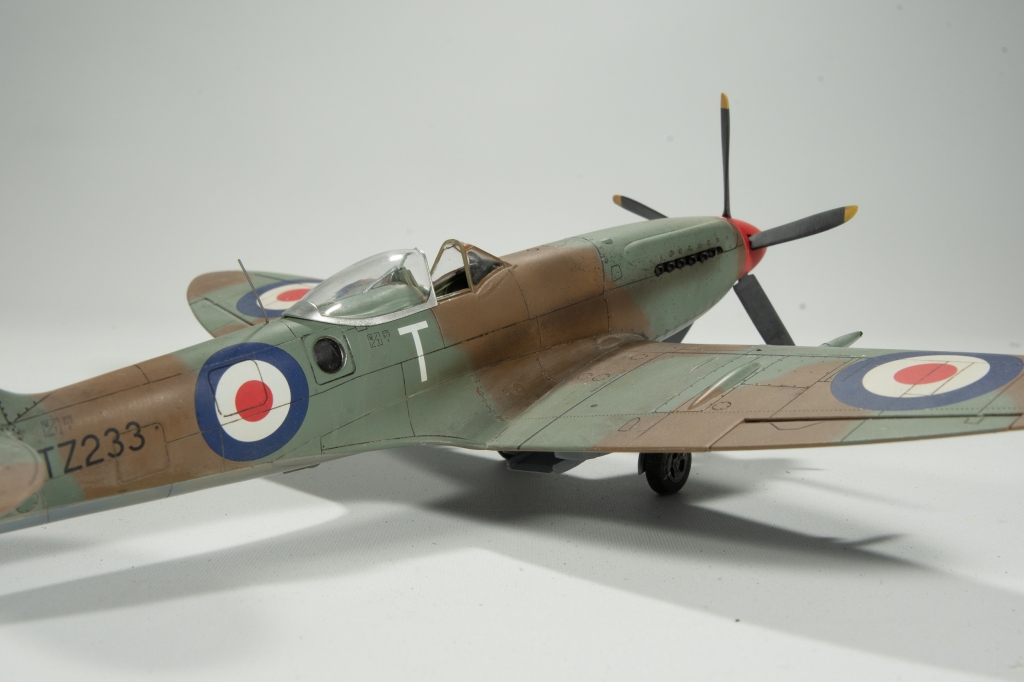
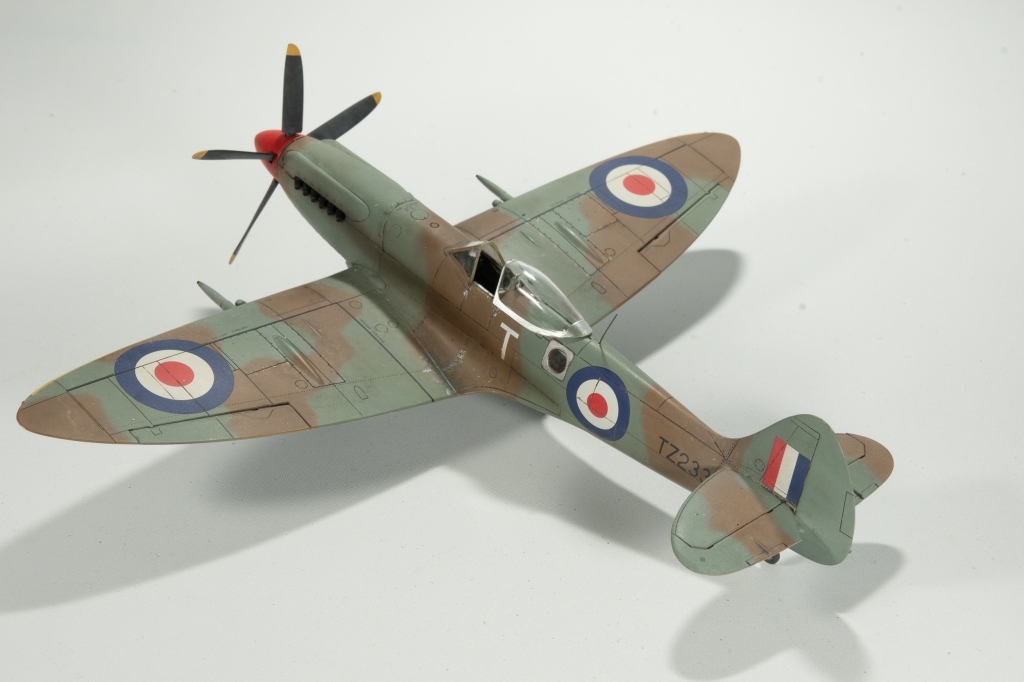
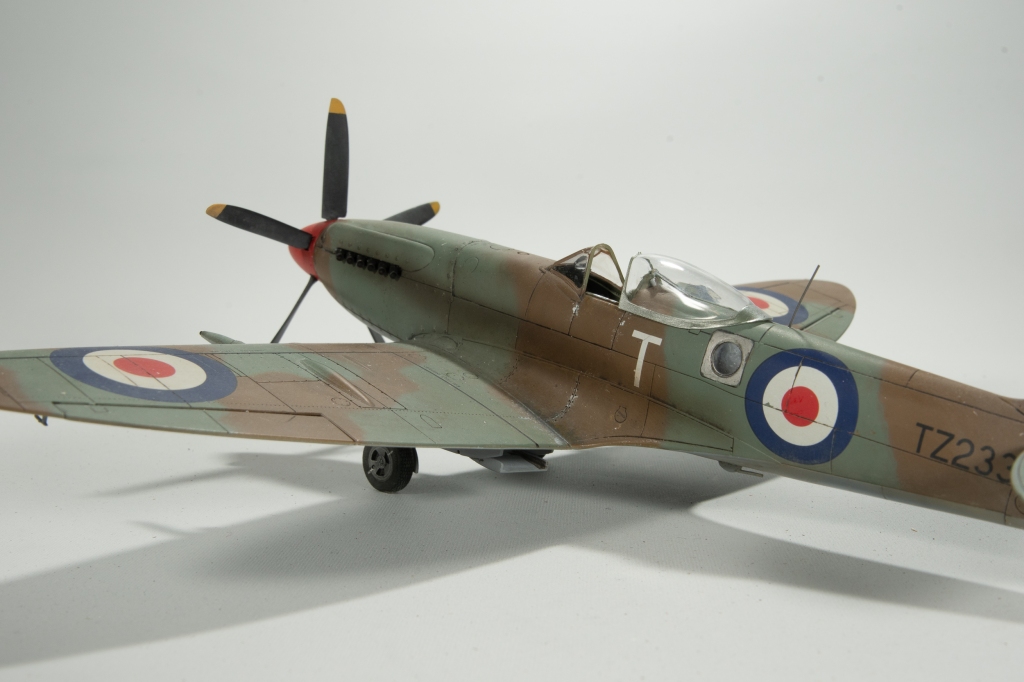
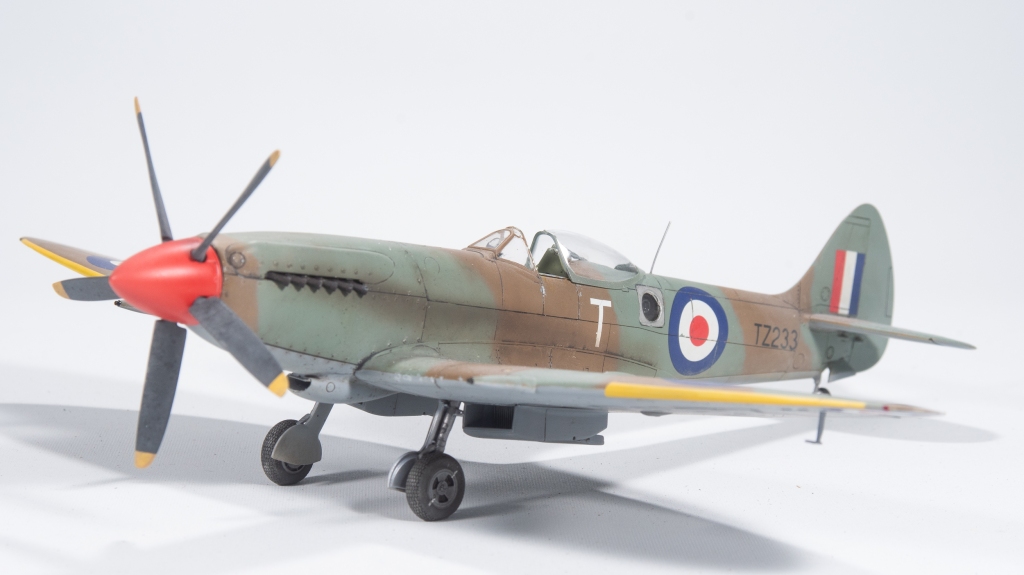
Thanks though to some fellow modellers following a plea on one of the facebook sites, I soon had not one but two extra canopies to replace my marred example. The whip aerial was added from some piano wire and she was done.

Looking at the completed model with a critical eye, there are a few areas Im not happy with, and some unforced errors I continue to make, but the different camouflage certainly sets it apart from my other Spitfires, and I have really grown to love the Griffon engined spits.

Supermarine Spitfire FRXVIII 208 SQN Royal Air Force Egypt 1949

Leave a comment

Fly Models 1/32 Hawker Hurricane llD

  • Built: 2022
  • Added to stash: 2017
  • Enhancements:
  • Instrument panel-Yahu
  • Seatbelts-HGW
  • Decals: all insignia painted on using kit scheme as templates. Stencils-1 man Army

“I can’t see any more Fly kits in my future”

My love for this particular mark of Hurricane dates back to the mid 70s when the owner of a Perth W.A hobby shop I frequented showed me his rendition of the ancient Monogram 48 scale kit.

It is still clear in my mind (yet I cant remember what I did last week!) as he had added the exhaust streaks and some scuffing around the wing roots. All the raised rivets had been dry brushed and there was not a seam or silvered decal anywhere. At the time I had no idea kits could be made to this standard, where did the seams go, and why were there no brush strokes!!!!

This stalwart of early British fighters, though has sadly been ignored by the main manufacturers when it comes to 32 scale.

There was a early kit released by Revell in the lates 60s, which remained the only game in town until Pacific Coast Models and then Fly released their non mainstream kits.

As a “lo-fi” kit, I think the Fly Models Hurricane rates above the Pacific Coast kit from what I can remember of my PCM kit before I sold it. Out of the box, the Fly kit boasts sublime surface detail on the wings in the form of raised rivets. The fabric effect on the fuselage is not overdone, there are recessed rivets on the leading edge which means it will be easy to reinstate these following sanding and filling sessions. All this complimented by some nice resin and photo etched details. Not mentioned in the instructions, there are also parts to make a MkIV out of the box, with the armoured radiator and (crude) rockets, rails, blast plates and drop tanks being included. These parts will find a new home in my spares box.

There are surprisingly few parts for a 32 scale model, but construction certainly was not simple. Not helping in this was the instruction booklet. There detail on illustrated parts in some cases not matching the detail on the actual parts in some cases. The seat adjustment handle, bulletproof glass, and armoured rear cockpit bulkhead being some examples.

I would advise washing the sprues in soapy water before assembly. Usually I would not do this but found on this particular model, my Tamiya extra thin just did not grab like it does on other plastic. I can only assume this was due to some contaminenat on the plastic, although they did not feel greasy.

The cockpit “cage” was frustrating to clean up and get square, again not aided by vague instructions. I used the compass face included in the Yahu set. Fly would have you glue the seat adjustment lever to the wrong side of the seat, they also have you incorrectly have the seat harness attaching to the rear of the seat. It should in fact run through a slot in the armour plate. Despite the diagram showing an armour plate detailed with bolt heads the PE item in the kit is featureless. I added punched plastic card discs, although mine are overscale. The control column likewise is not the detailed item shown in the instructions but a rather featureless plastic part. I wrapped fine wire around the spade grip. The super detailers amounts you could also add the chain running from the pulley mounted on the column .

The fuselage went together without too much drama, well apart from a seam on the cowling that just would not disappear despite numerous sanding sessions. In the end I scribed a trench along it then filled it with superglue and sanded it down. That did the trick.

If there is one trick to this kit, it is ensuring that you remove COMPLETELY, the casting block on the wheel well roof. My dremel got this job. When I had finished, in some areas the roof was that thin it was almost transparent!

Get this right, and assembly is reasonably straight forward, with the wing centre section fitting to the fuselage reasonably well. I chose to add plastic card tabs to the various wing sections to aid assembly. You want to avoid steps at all costs, sanding will destroy all that lovely raised detail.. To this end I chose to add the top halves of the wings to the wing roots as I wanted a clean join here. This meant, on my kit I had a step on the leading edges, but figured any detail destroyed here would be easier to re instate than the raised rivets around the wing root.

The landing light as a consequence also was not the best fit. Superglue came to the rescue. The tailplanes also required filler along their roots as did almost every trailing edge. No razor sharp trailing edges on this Hurricane!

Fly would have you add three recognition lights underneath. Wartime aircraft seem tp have only the centre one fitted based on photos I looked at, so the two outer lenses were glued in place then faired over with putty. Whilst we are on the bottom of the machine, of you are going to add the pulldown footstep, don’t forget it is linked to the handhold to the rear of the cockpit, so this should also be cut out and the inward folding cover added. I didn’t bother so I won’t add the step either.

The model required several sessions of priming, and then remedial sanding and filling to smooth over several areas. The underside could then be preshaded in SMS PRU Blue before the final colour using SMS Azure Blue. A marbled coat was then applied using lightened Azure Blue. Staying with the undersides, the wheelwells were painted silver and the underside roundels painted using Montex masks from their A type roundel set. Whilst masking the underside demarcation line, something was not looking right. My theory is Fly have engraved the bottom lines of the side cowlings too low. They should be higher up the fuselage sides which would make the bottom cowling also wider as it looks a bit too narrow. I have not compared this to any plans, just eyeballing photos. I probably should have filled and re engraved the lines, but I was on a roll now and not wanting to slow my progress.

Uppersurfaces were painted with SMS Mid Stone and SMS Dark Earth. The SMS rendition of Dark Earth looks a little too dark too me, but it does complement the mid stone nicely. Lightened mixes of each colour were applied in random streaks and mottles, with the fabric rear and control surfaces being painted in paler still shades of the basic colours to represent the different way these would have faded from the metal areas.

Masks for the codes and serials were cut by a mate. Thanks Calum. The roundels again are from Montex masks as was the fin flash. Artillery Models actually sell the decal sheets from each boxing as masks, but don’t waste your money. They are made from a very light tack transparent frisket, and just do not easily transfer from the sheet or even stick to the model.

What is worth the money (well maybe not, as they are very expensive, are the set of stencils from One Man Army out of Belgium. These are masks which you can spray all the stencils through, rather than using decals or dry transfers. Some of these stencils such as the No Step markings are tiny, but the masks are very sharply cut. I was most impressed and will be investing in more of their sets. they can be re used so my set will be re used on Revells forthcoming new tool Hurricane. TIP: buy from Hannants as even with postage to Australia, they are still cheaper than BNA have them for.

Chipping was added using Vallejo white grey and then the whole model sprayed with tamiya semi gloss varnish ready for washes and further weathering to be applied.

For this model, the oil dot filter process was used. Small dots of white, buff and yellow oil paint was applied to the top surfaces and scrubbed in with an old brush. This had the effect of bleaching the upper surfaces. Im not sure Im really happy with the effect although it does give a sun faced effect to the model.

The Artillery Models vac form canopy was cut out and fitted as the kit plastic canopy did not fit over the spine of the aircraft and sat high. Reskit wheels were purchased but they look to be significantly undersized. Looking at photo I think the kit supplied resin wheels are more correct, but their hubs are way too small.

I found the undercarriage difficult to fit as it does not locate positively within the wheelwell. The tailwheel was ri enforced with a bit of brass tubing as I did not trust the kit plastic.

Lastly the kit gun barrels were replaced with brass tubing although I think mine are fairly anaemic looking for 40mm weapons. I may revisit these later.

Conclusion

The Fly Hurricane kit is one Ive been wanting to make for a while, purely as I love the aeroplane, but it certainly tested me, to the point Ive sold the other Fly Hurricane kits I had in the stash. They are just not an enjoyable build experience.

Having this model on the shelf takes me many years back, to a young boy,, standing at the counter of that upstairs Hay St. Mall hobby shop gazing in awe at another hurricane in desert camouflage. And for that reason alone this rates as one of my favourite builds so far.

Hawker Hurricane Mk.IID. 6 SQN Royal Air Force.

Shandur. Egypt 1942