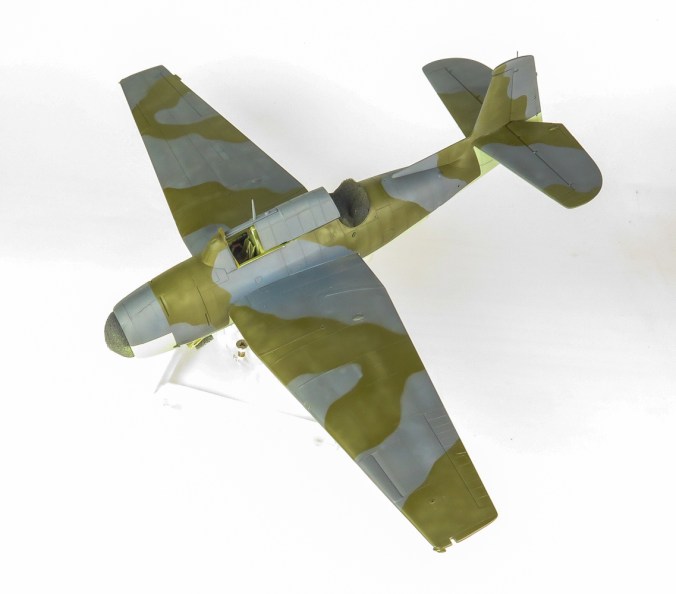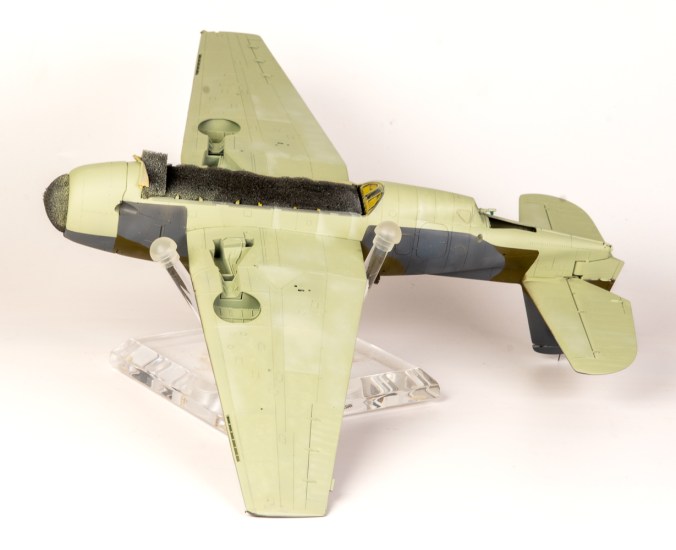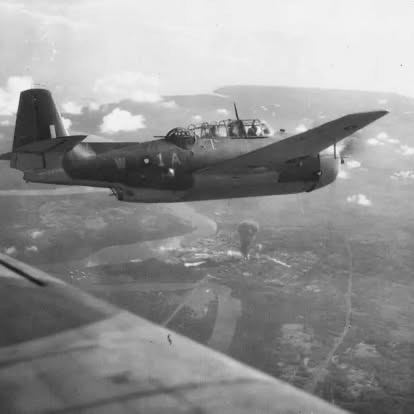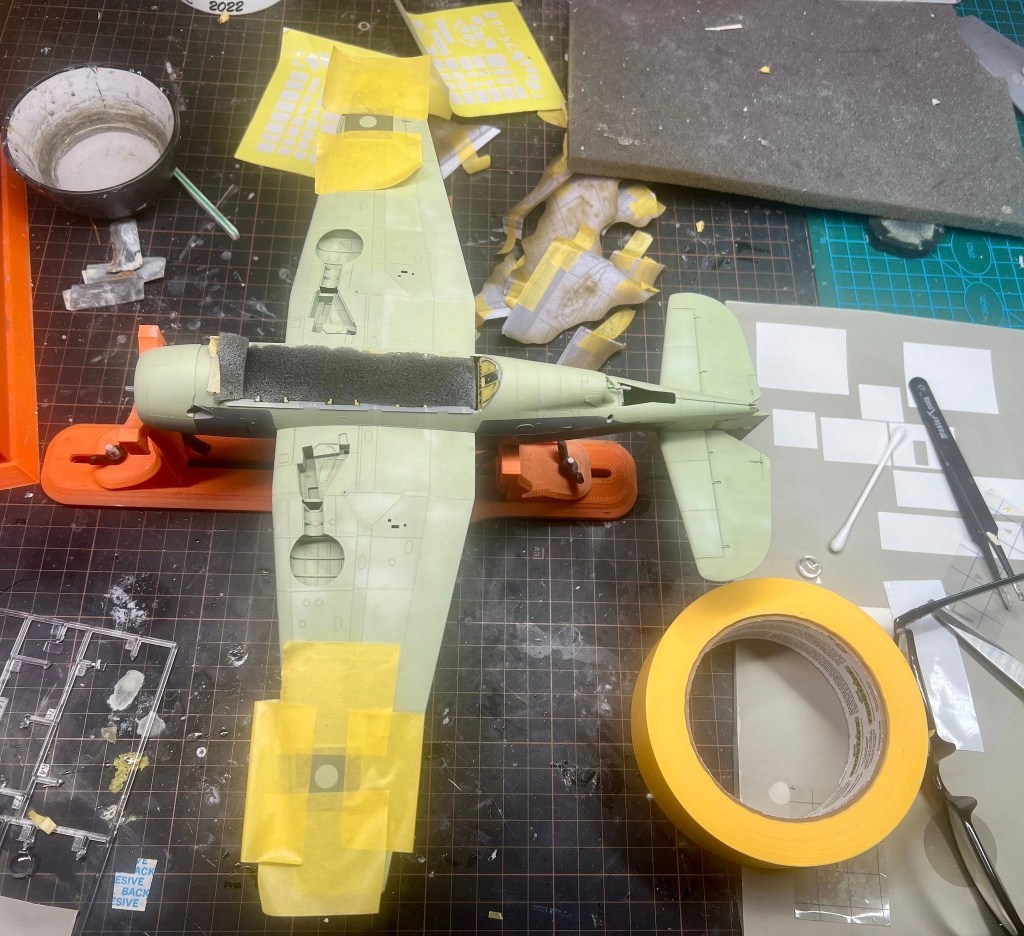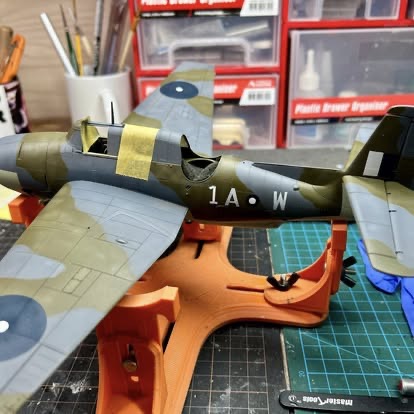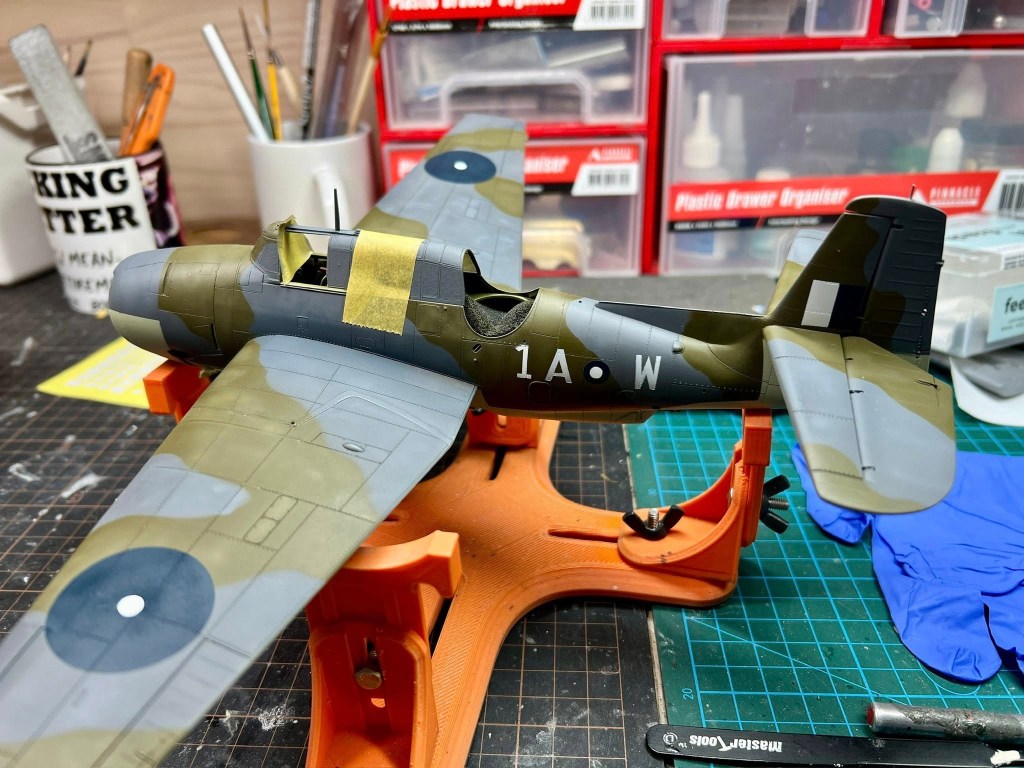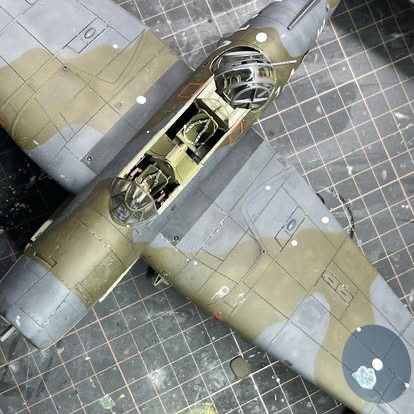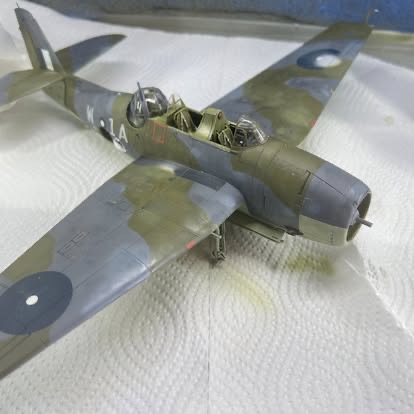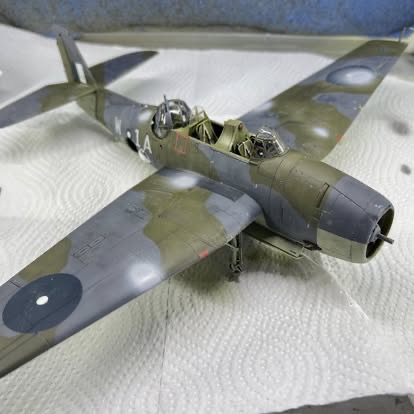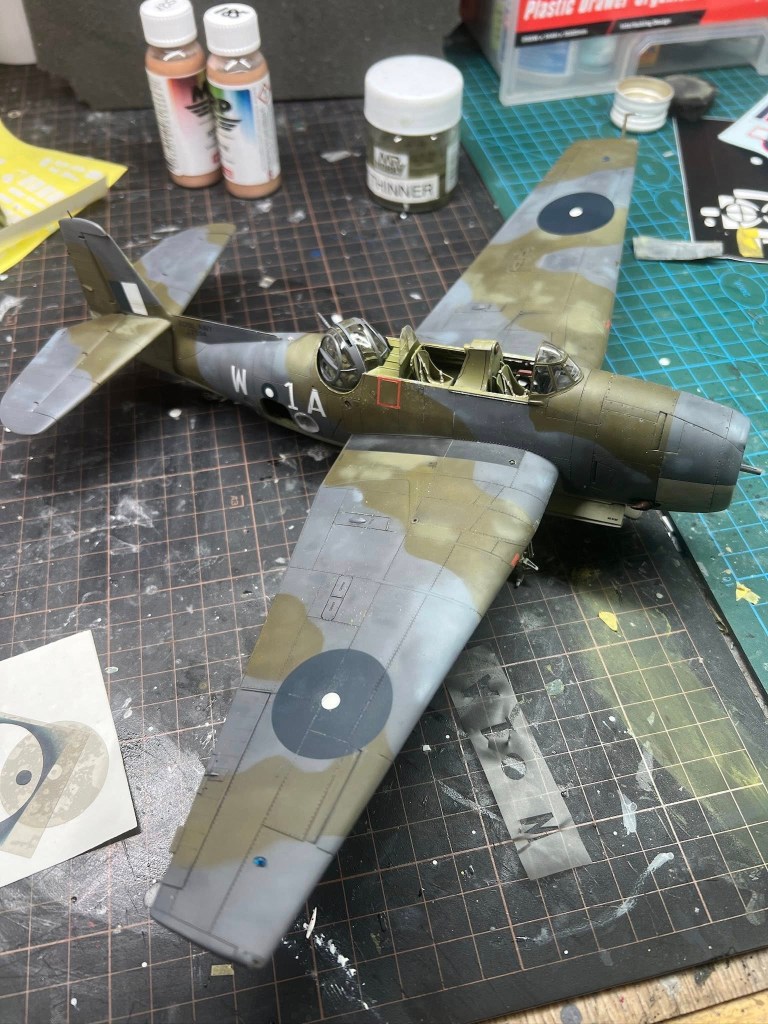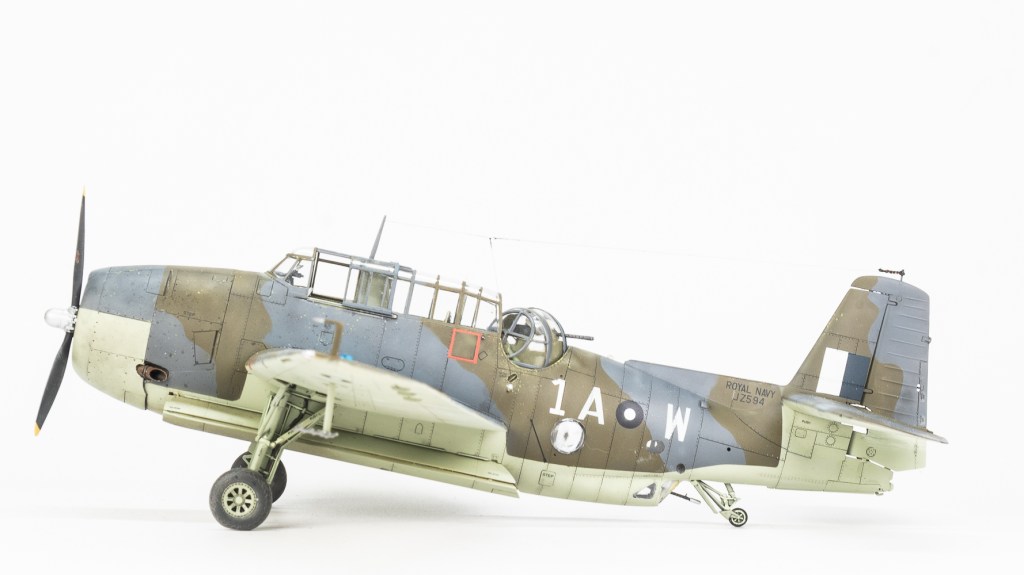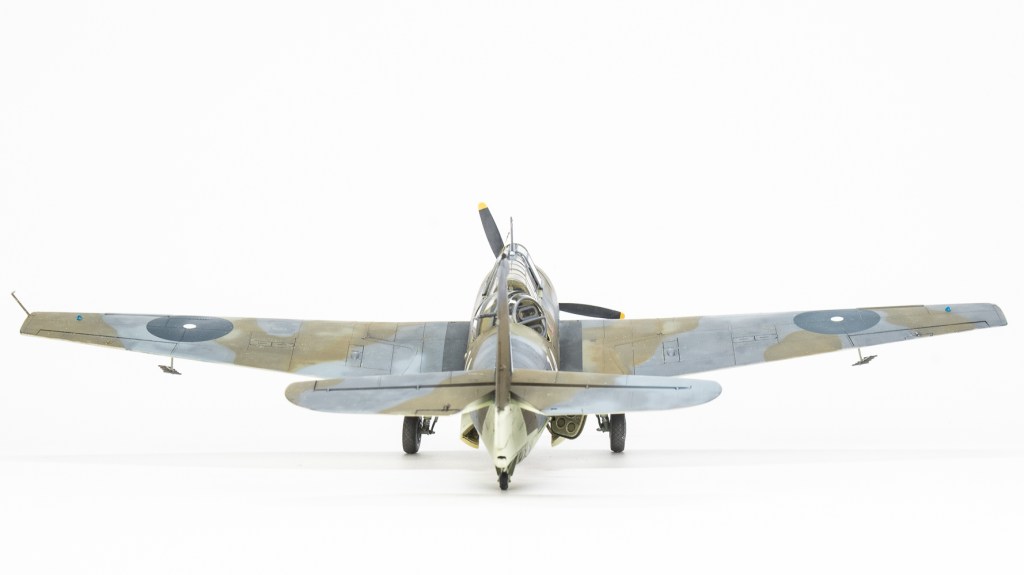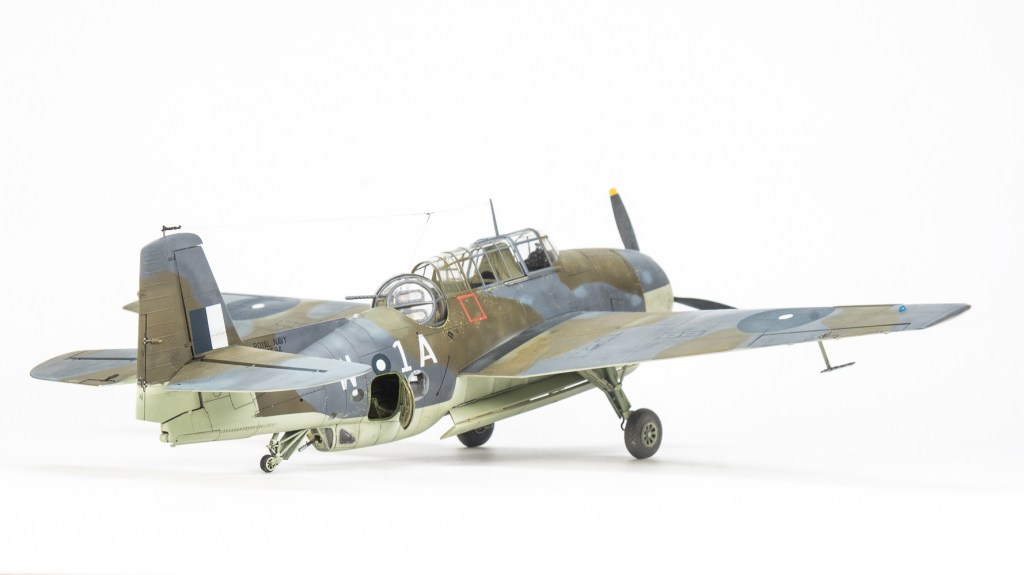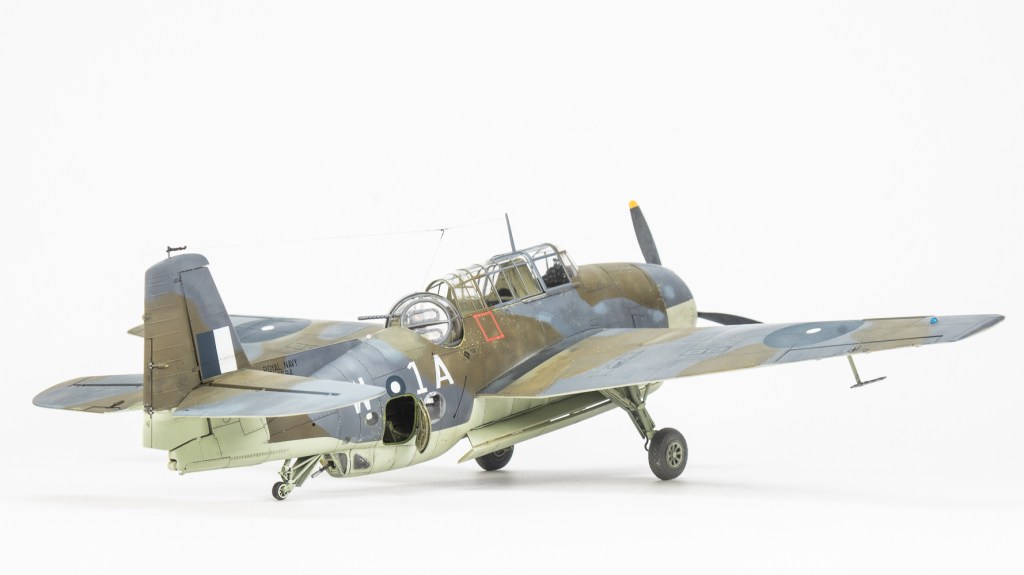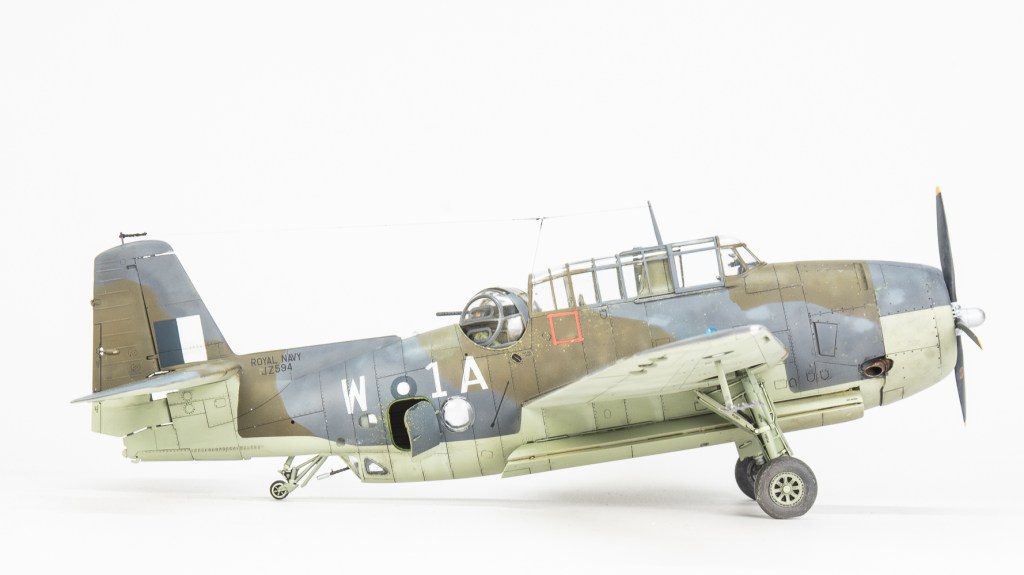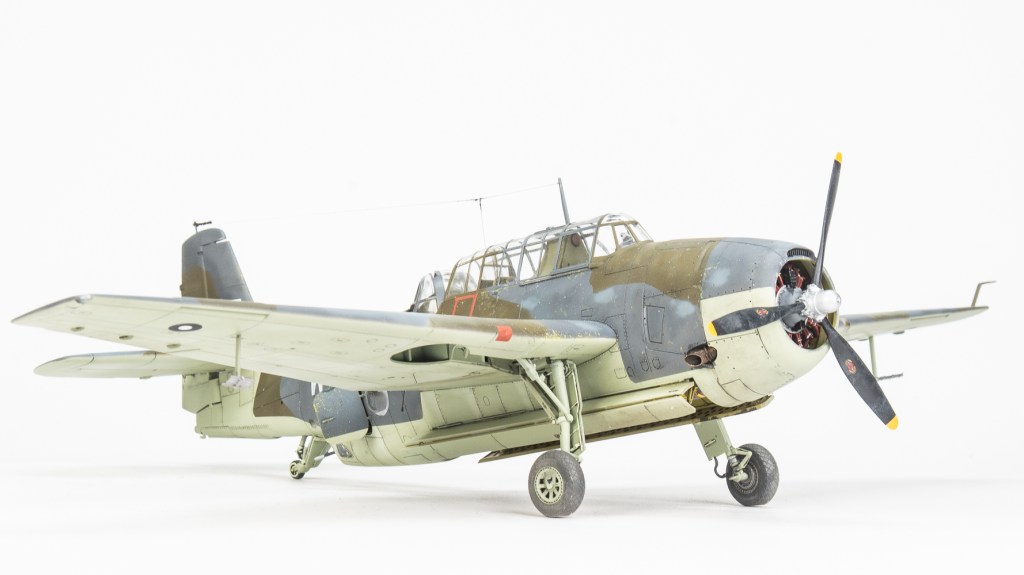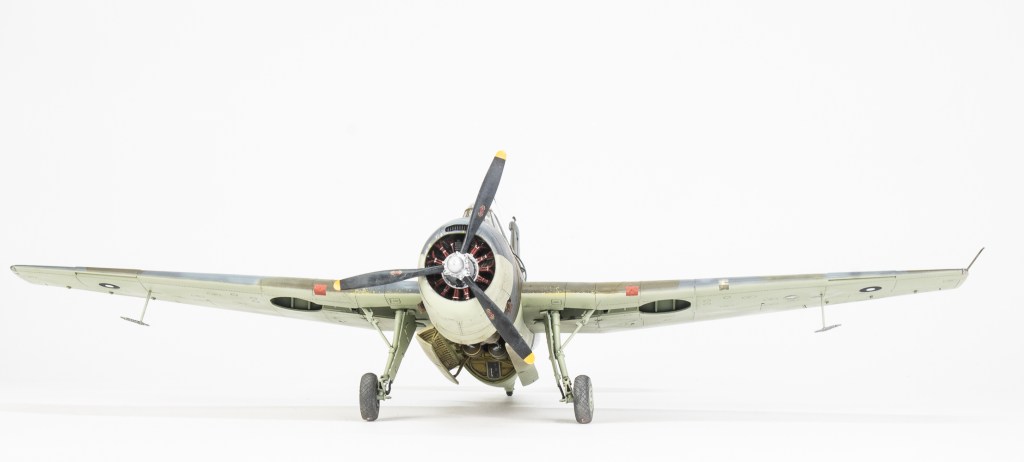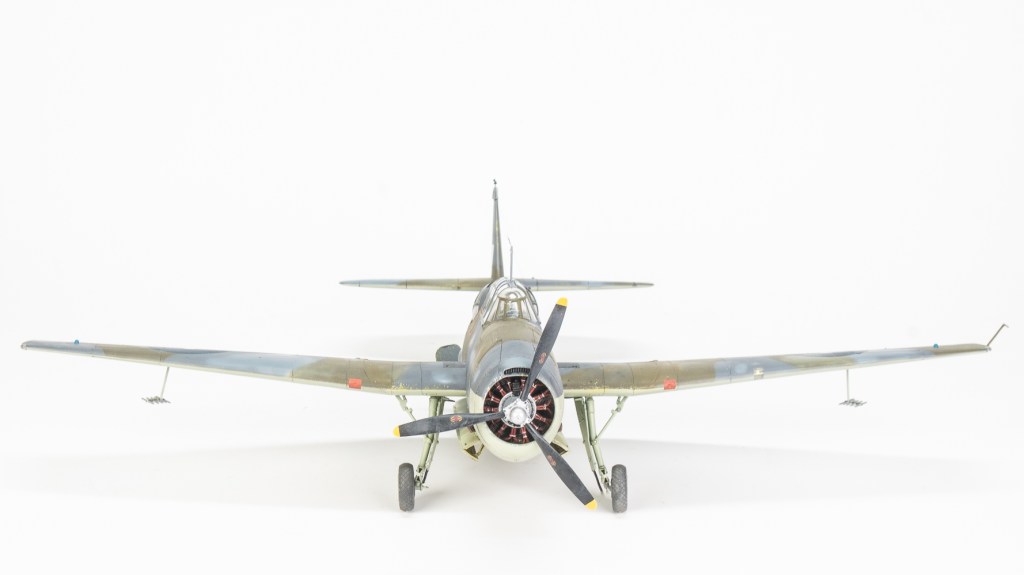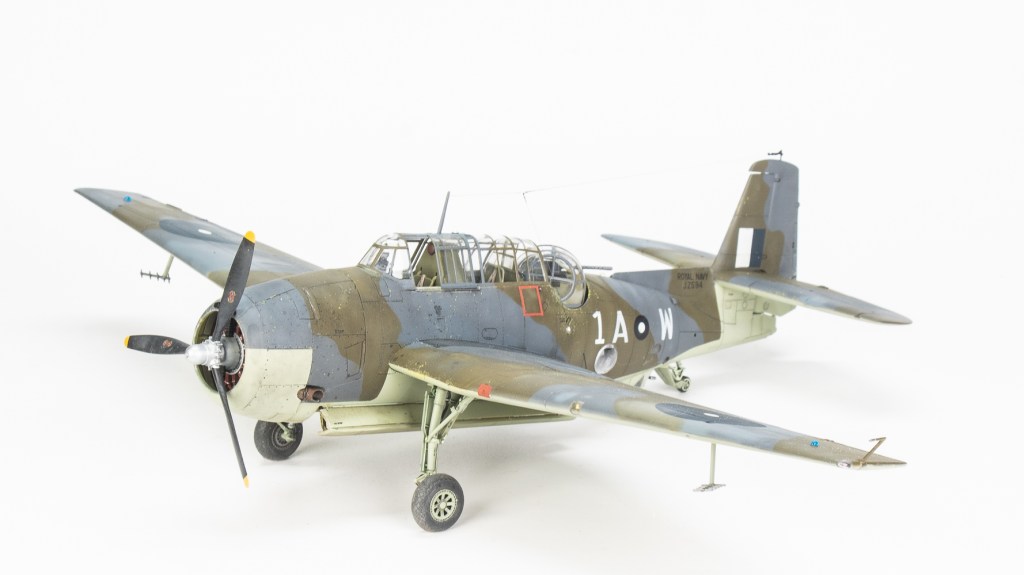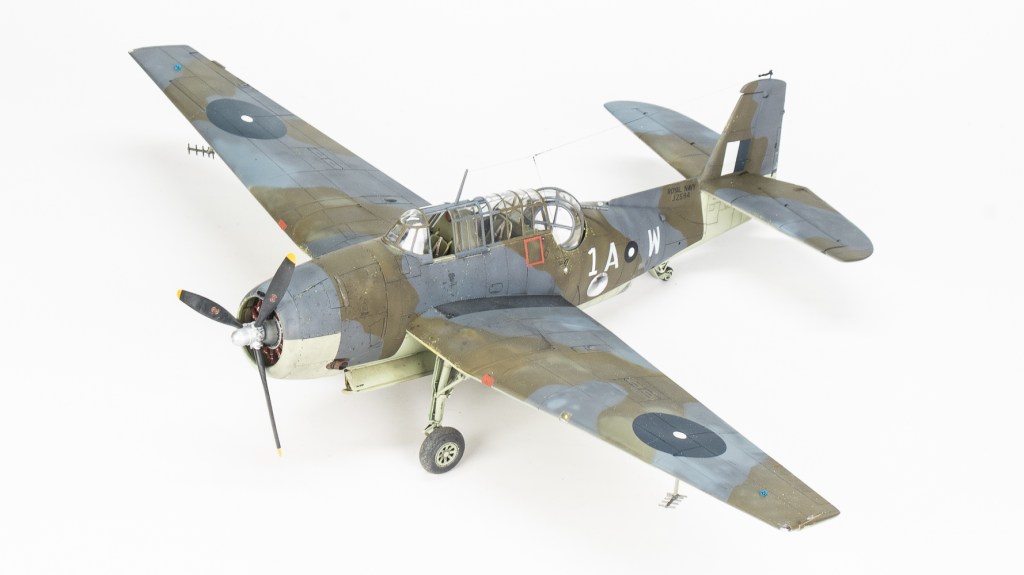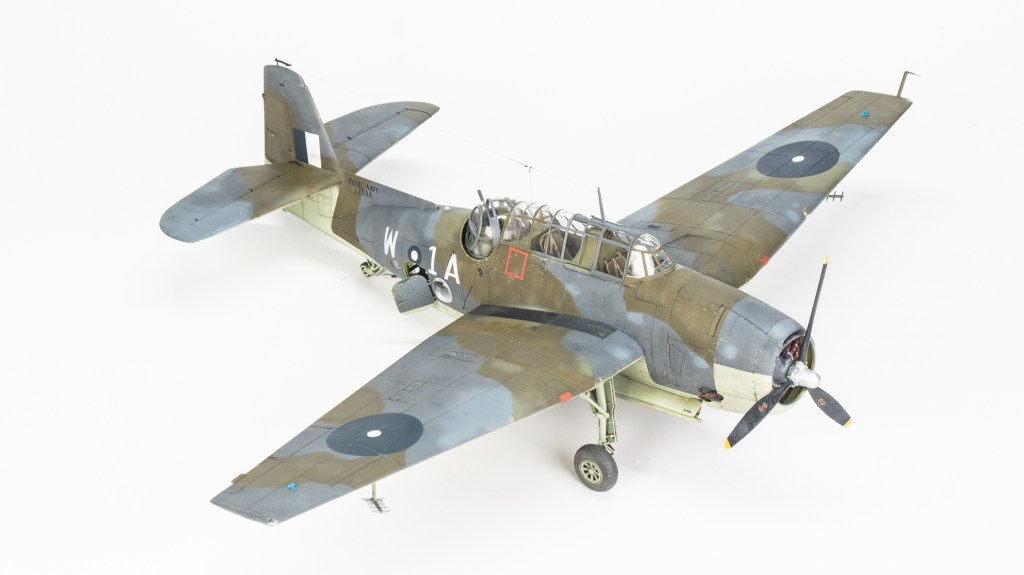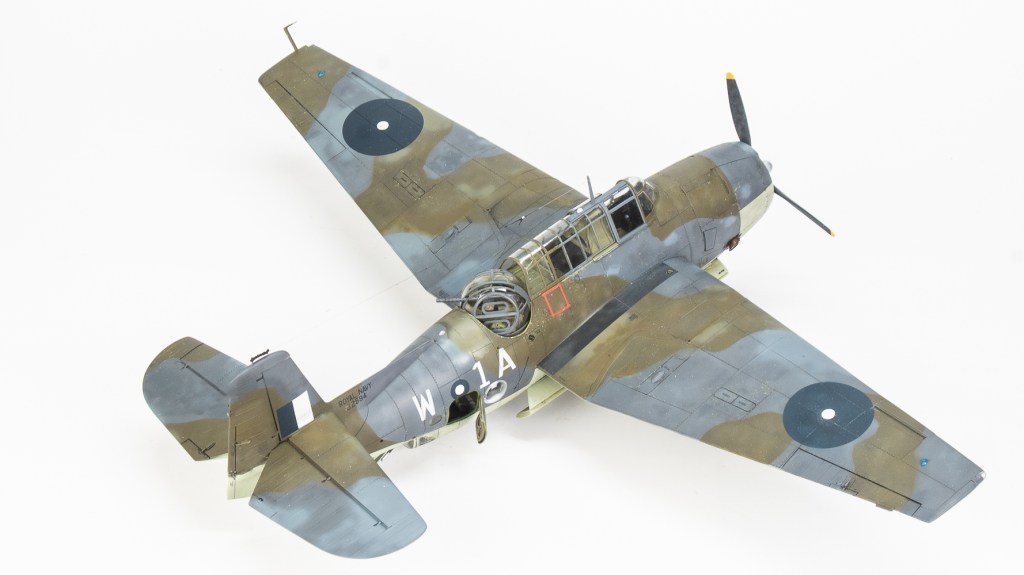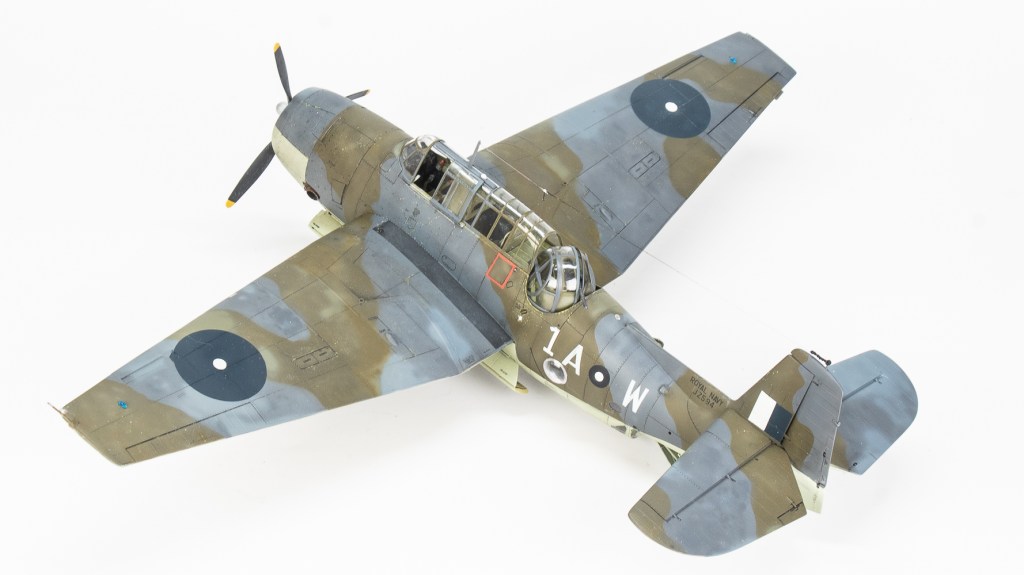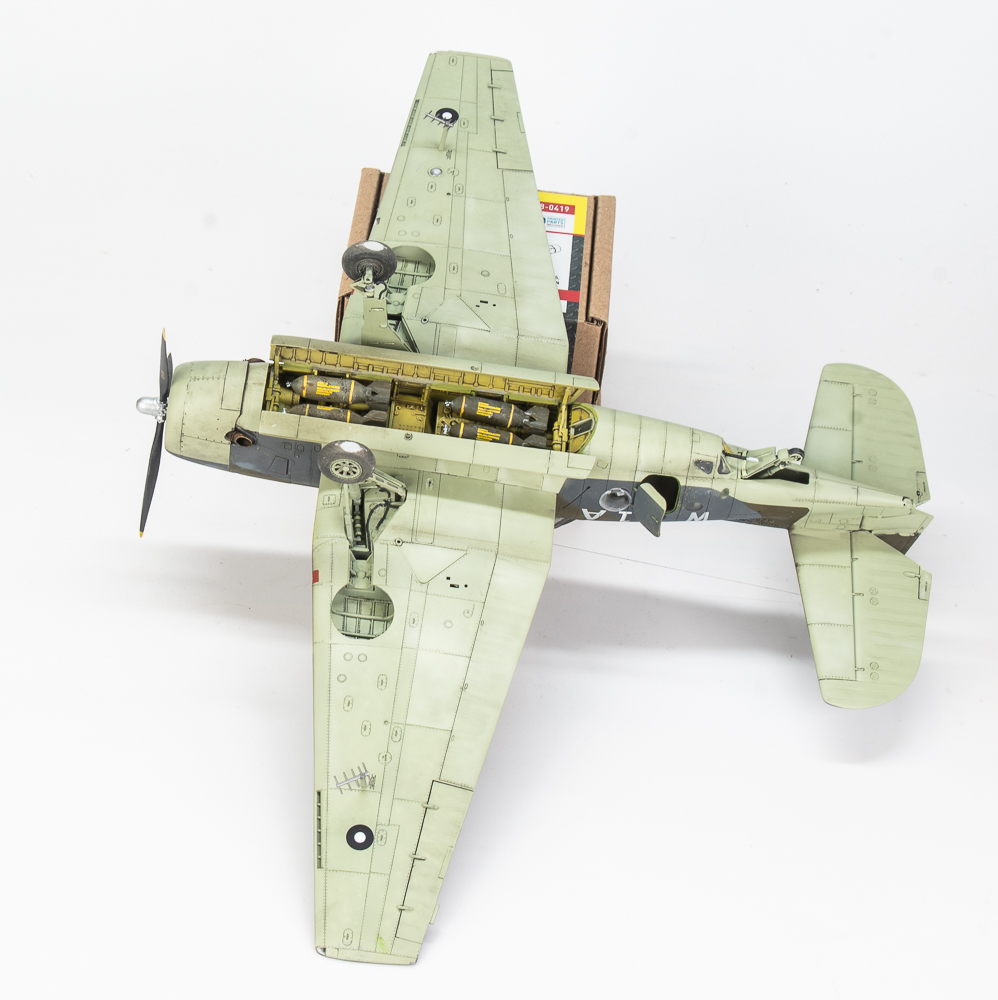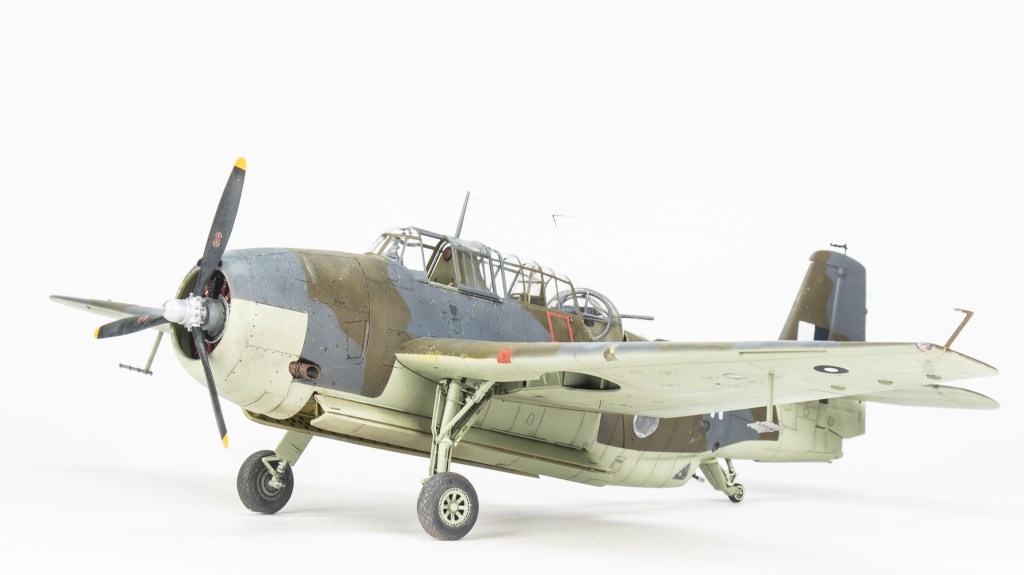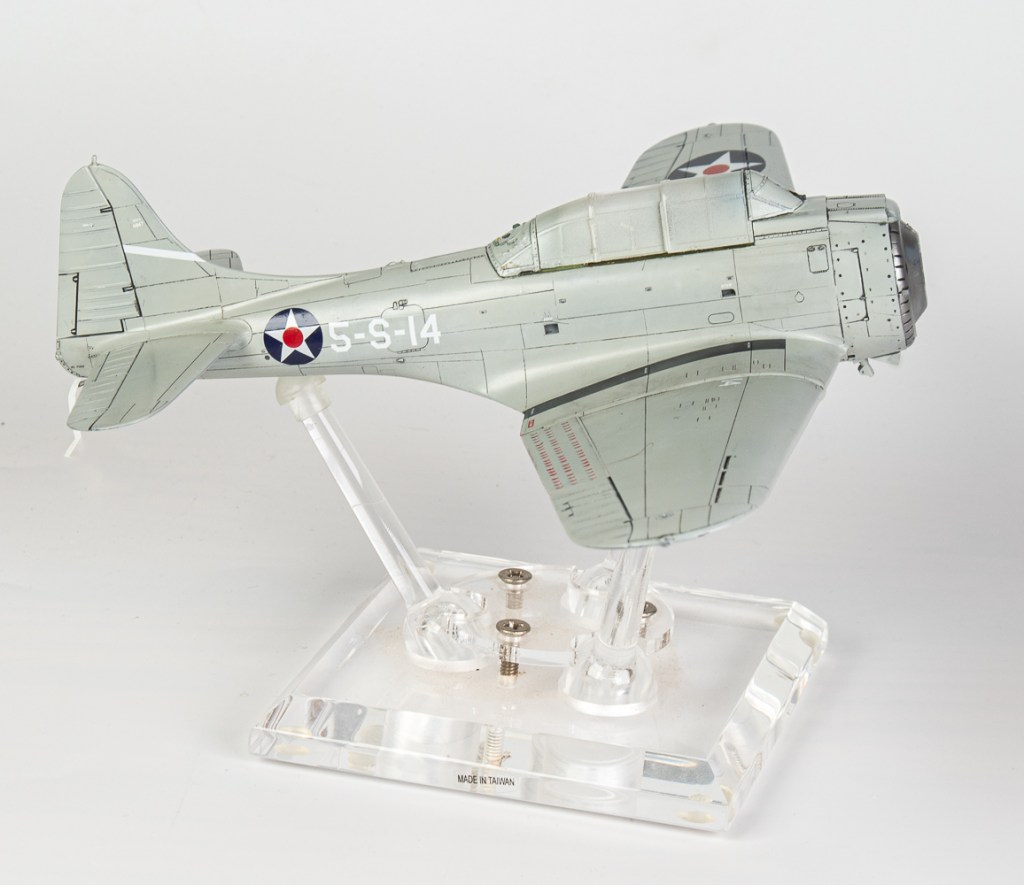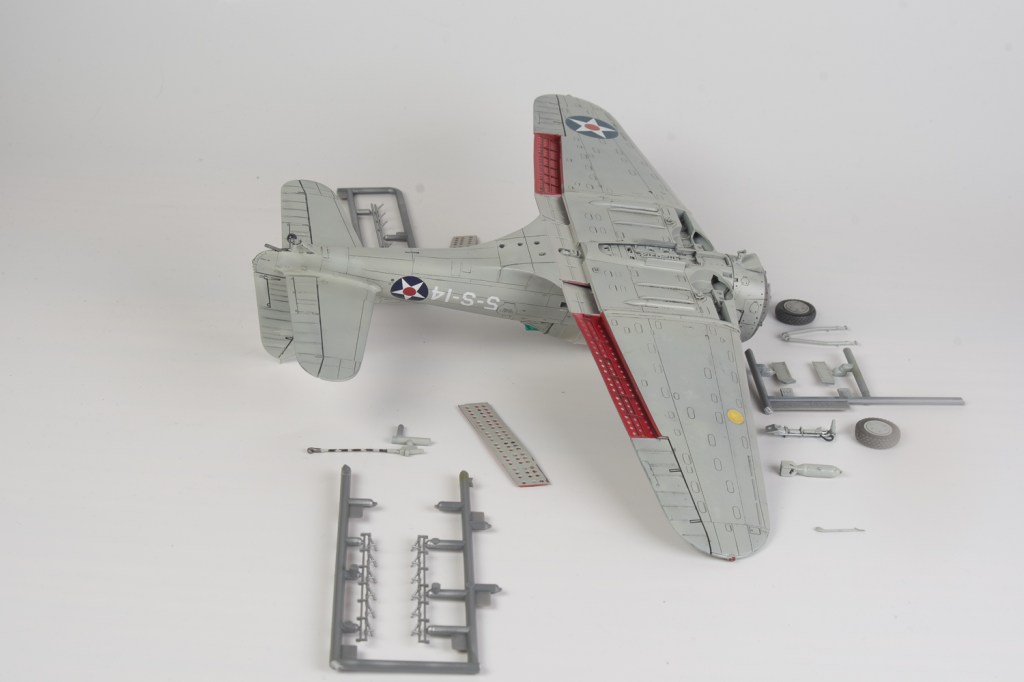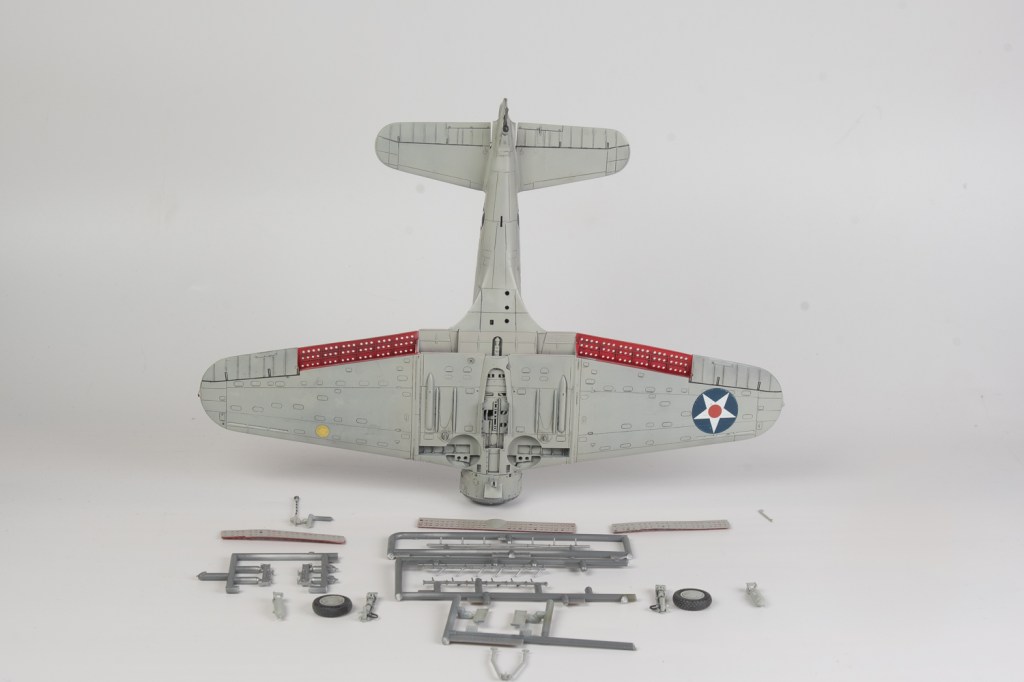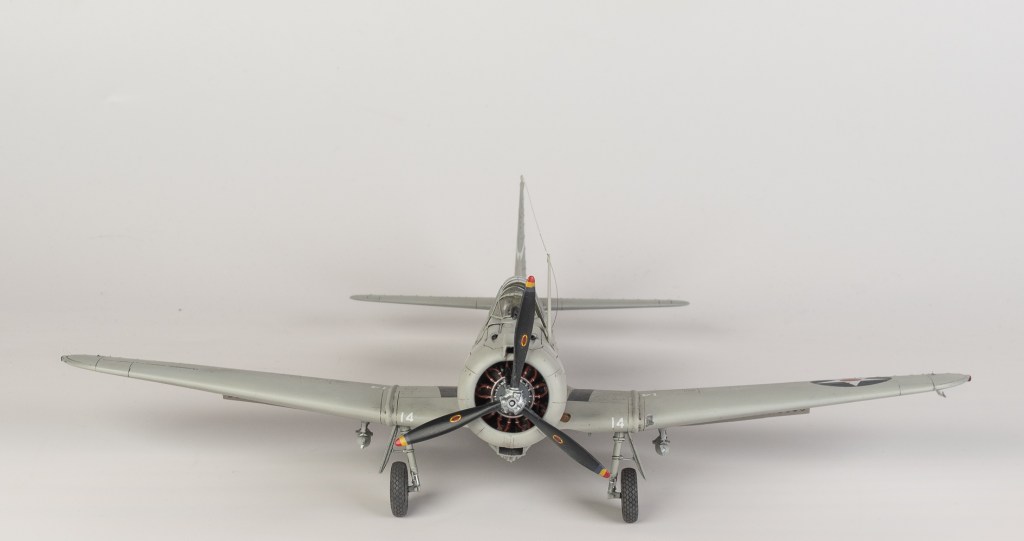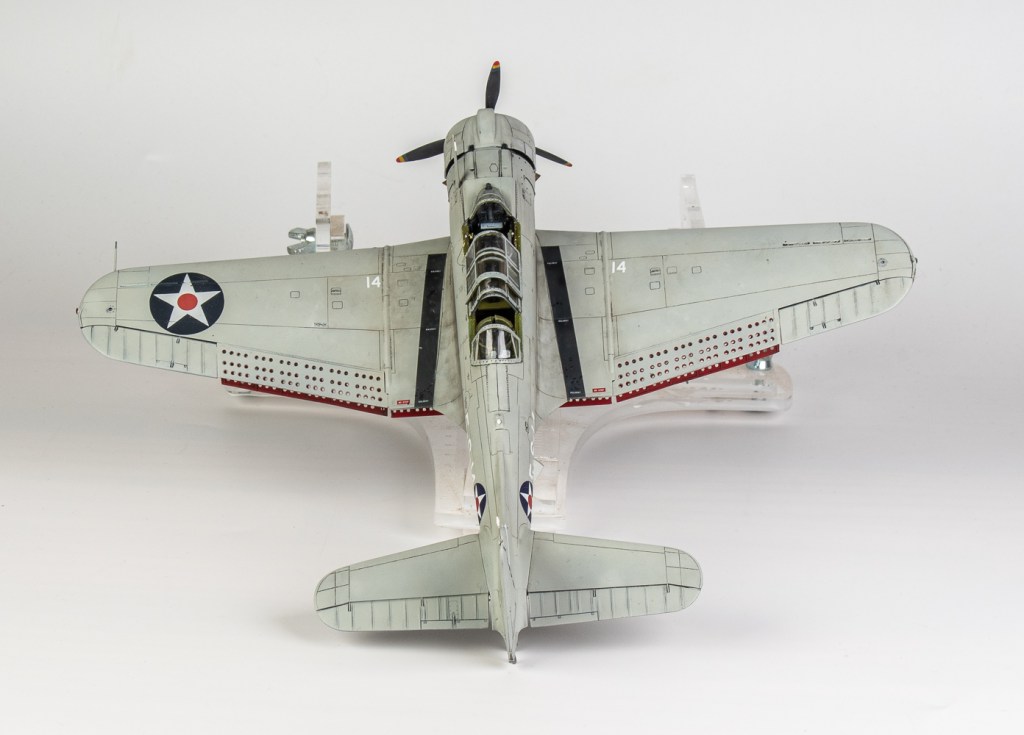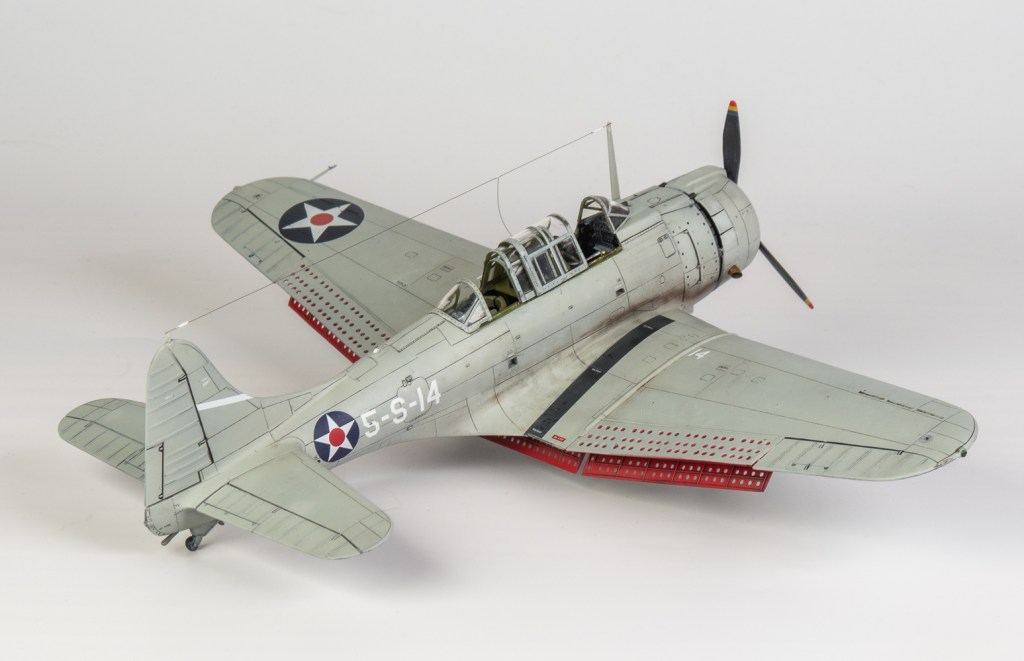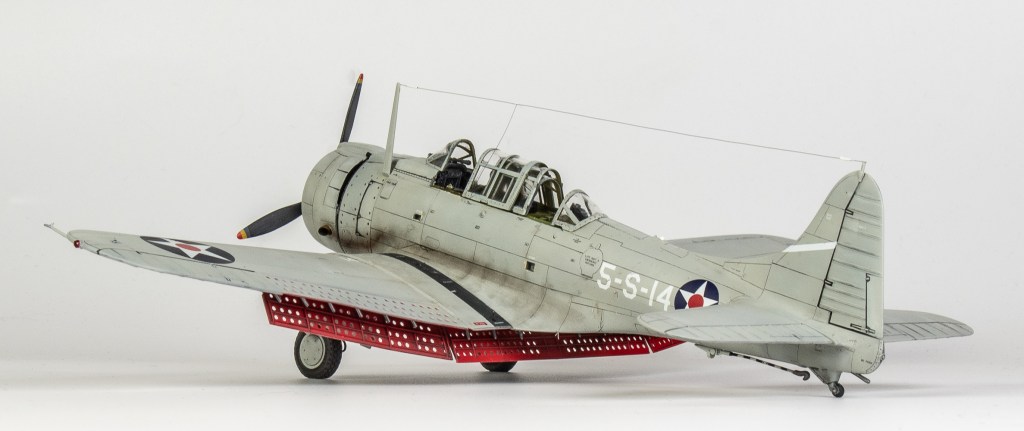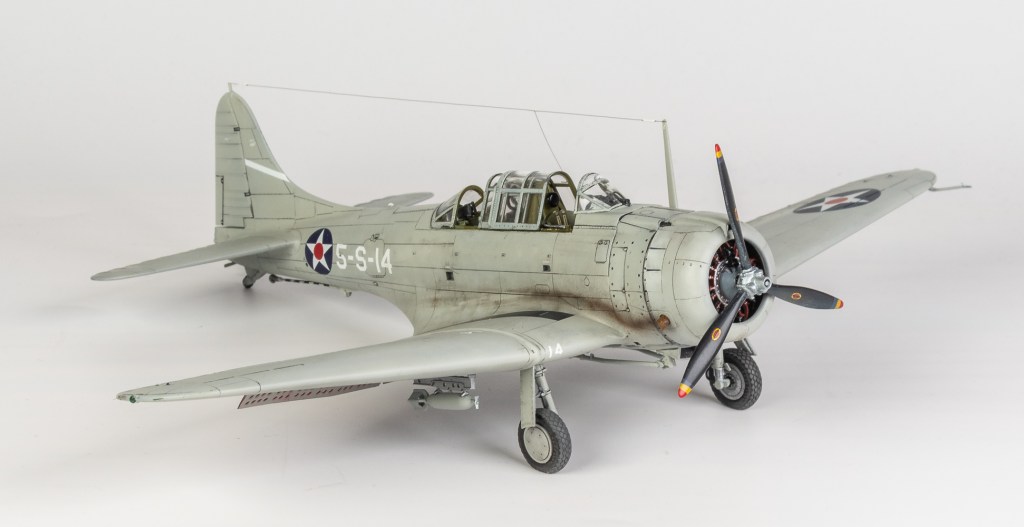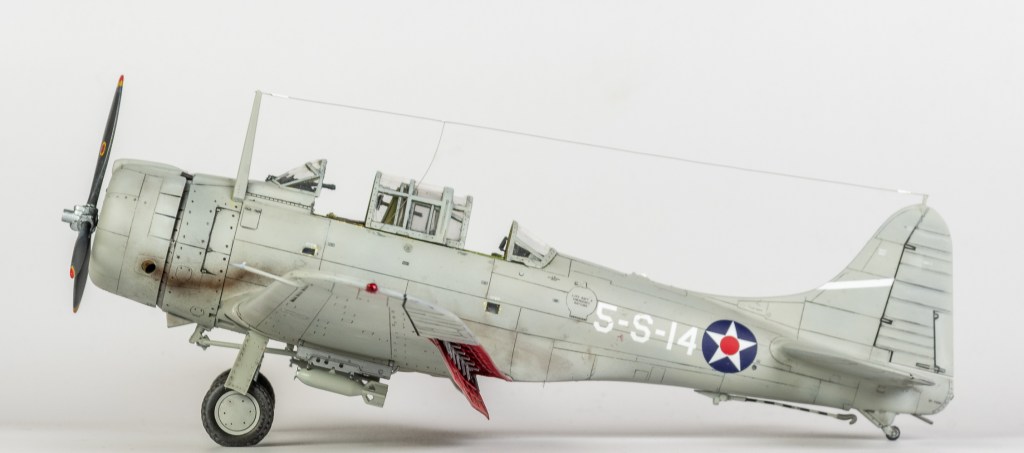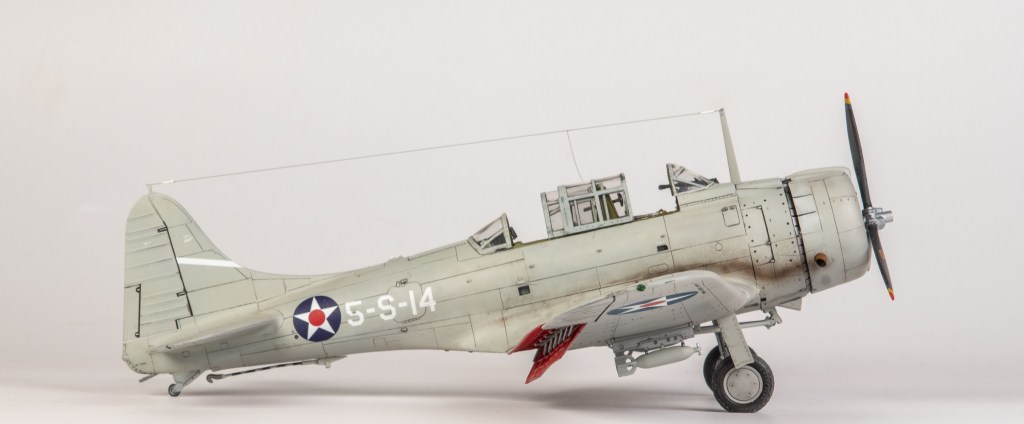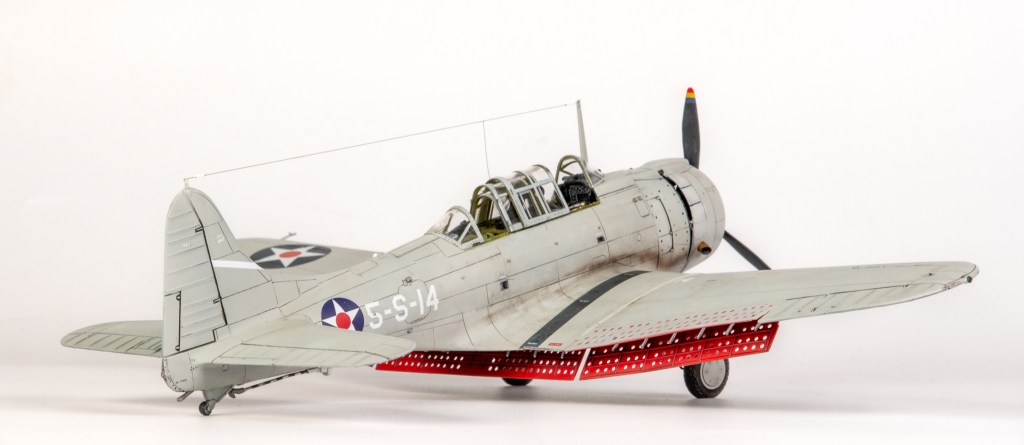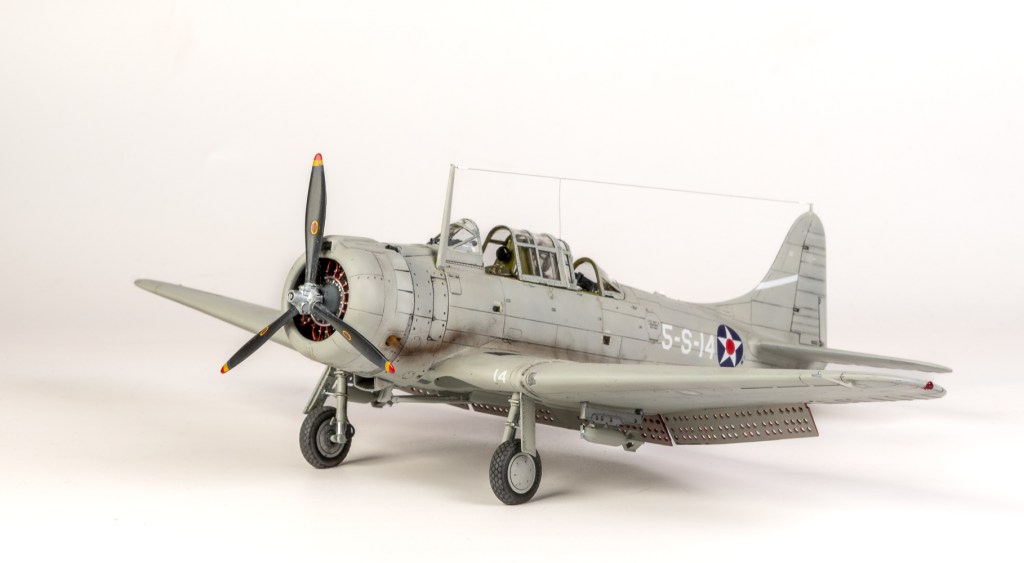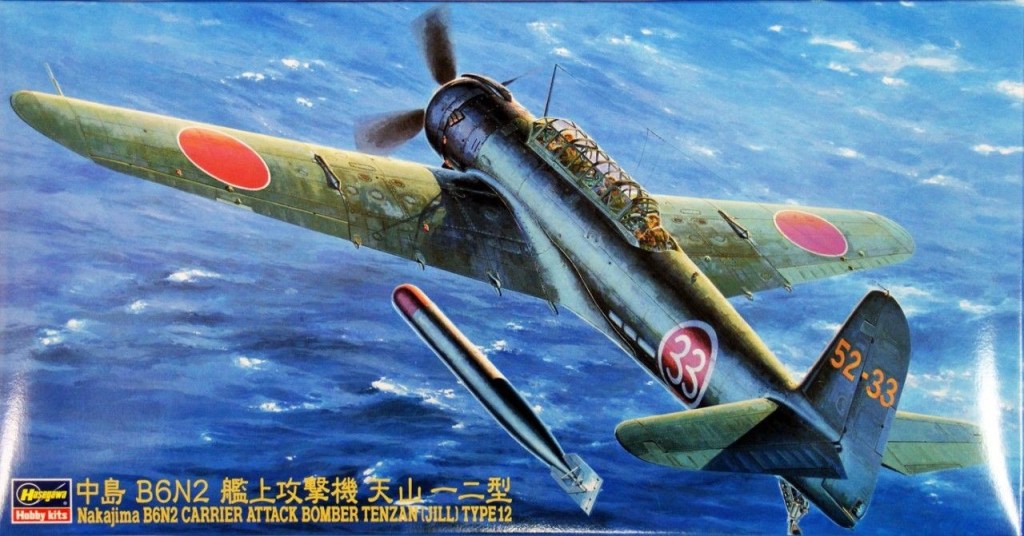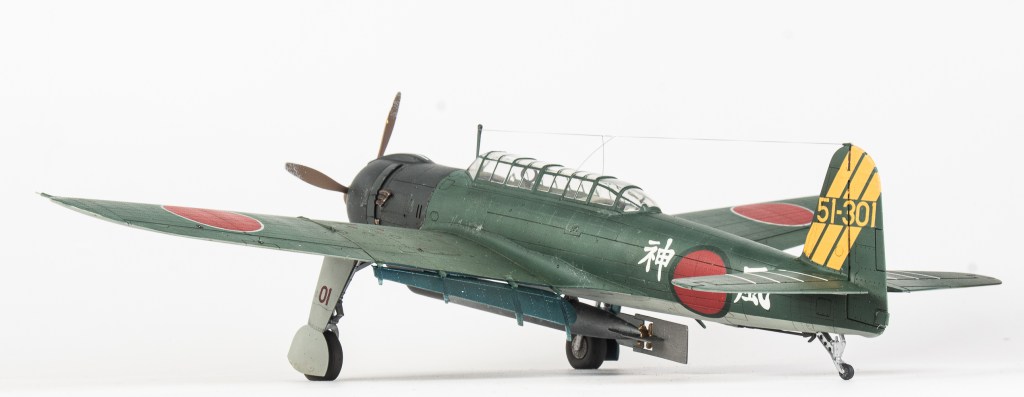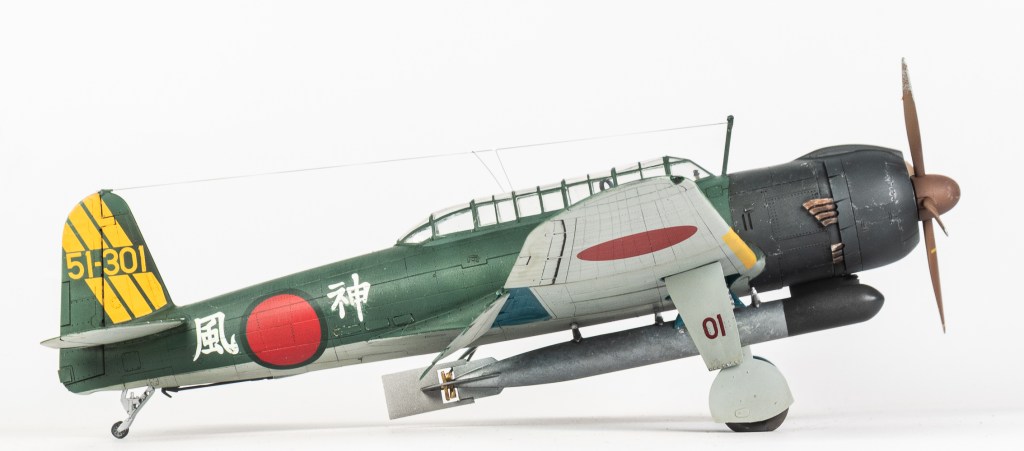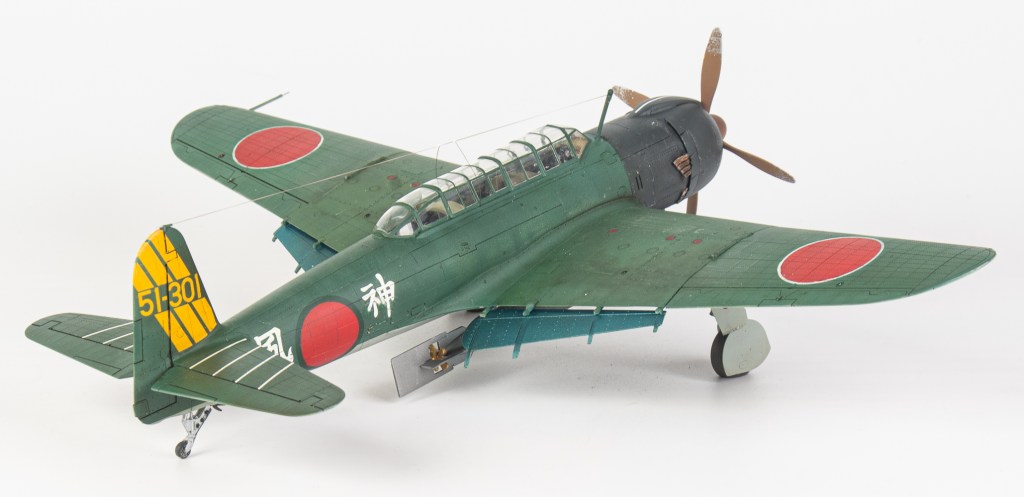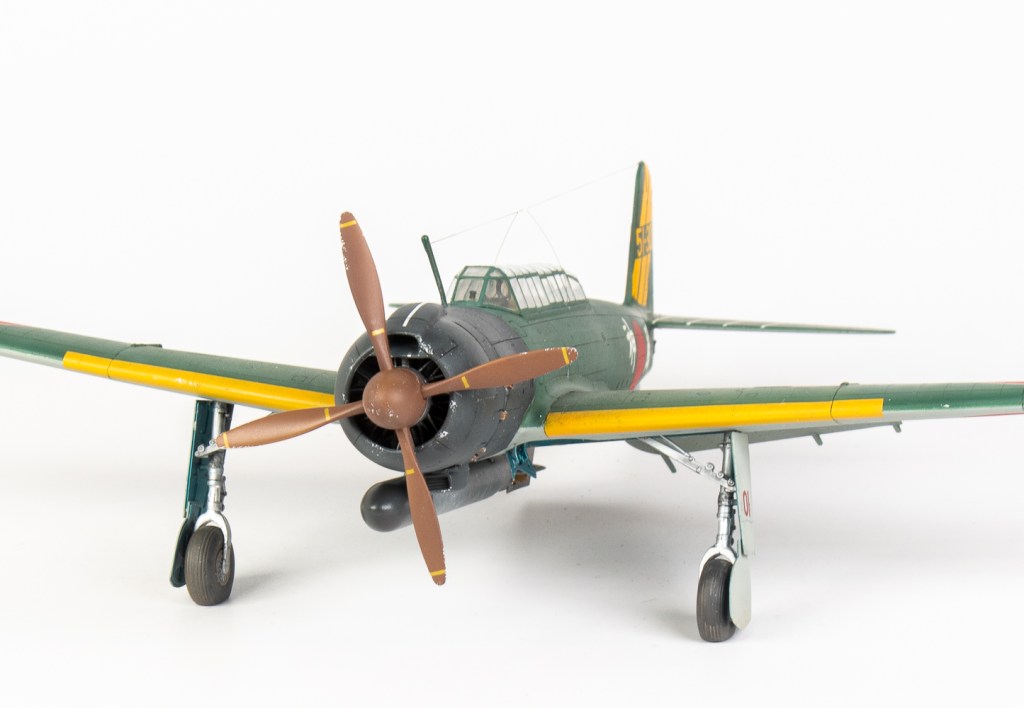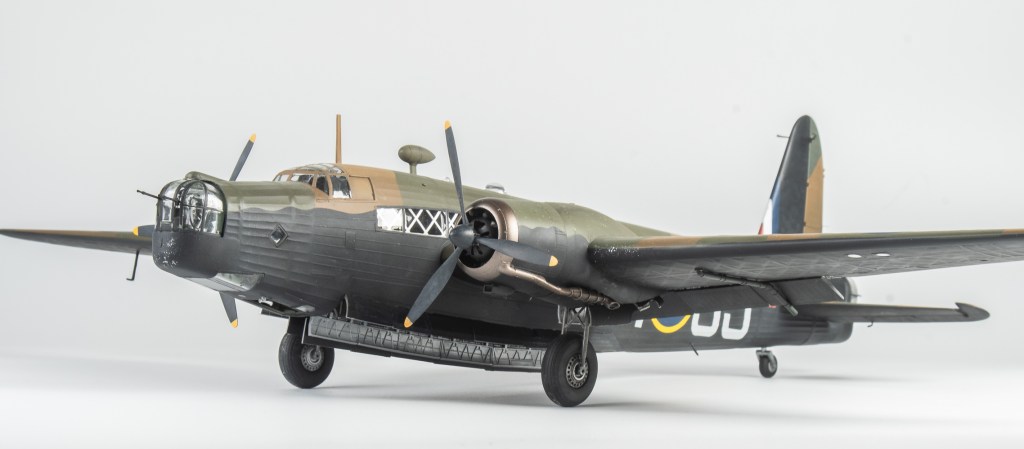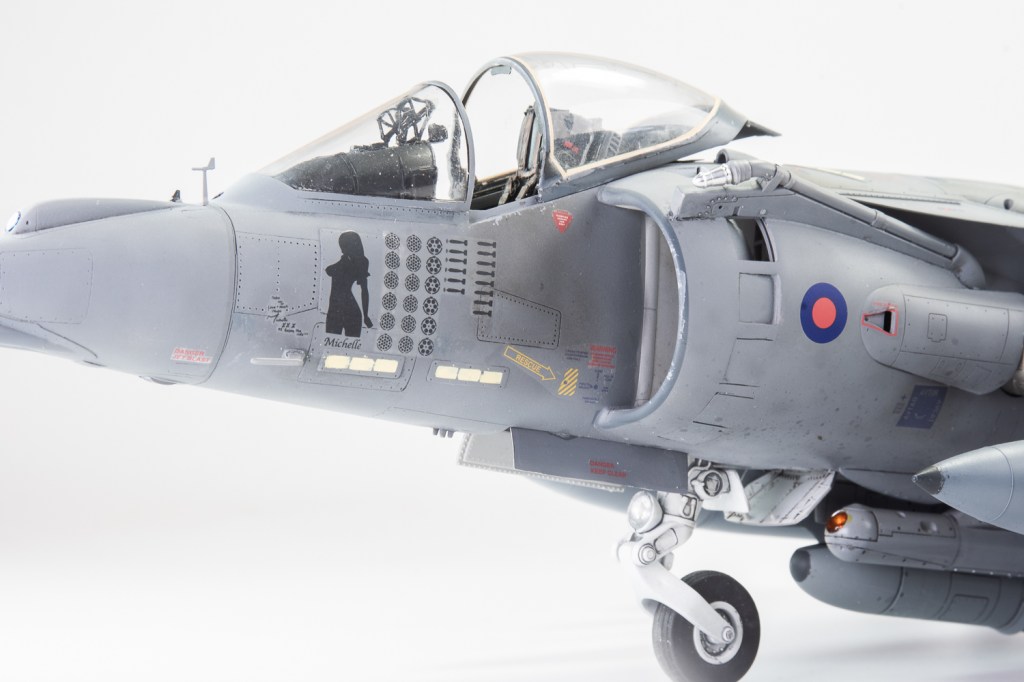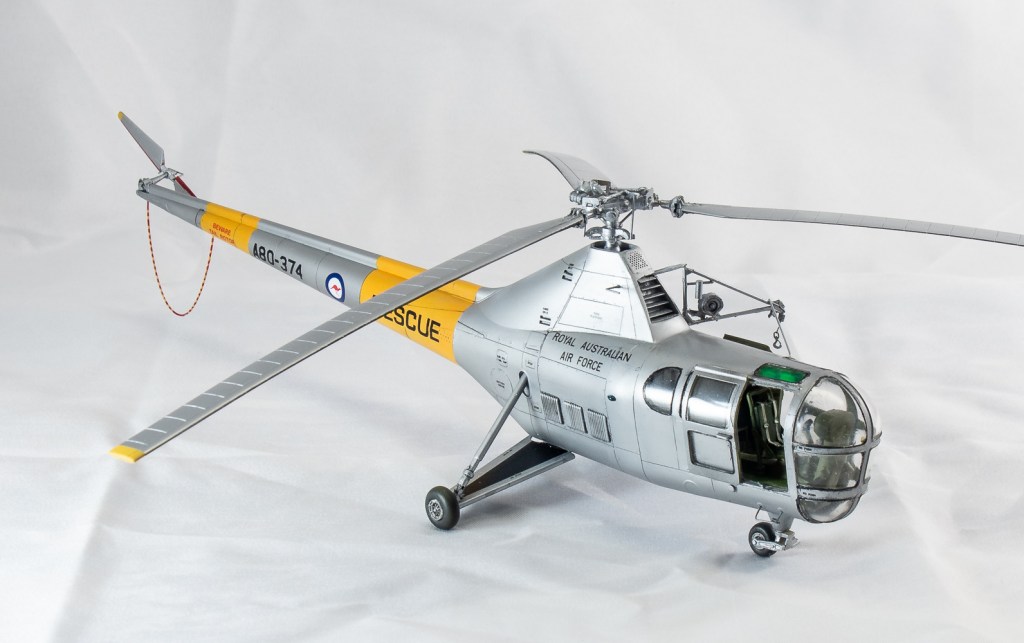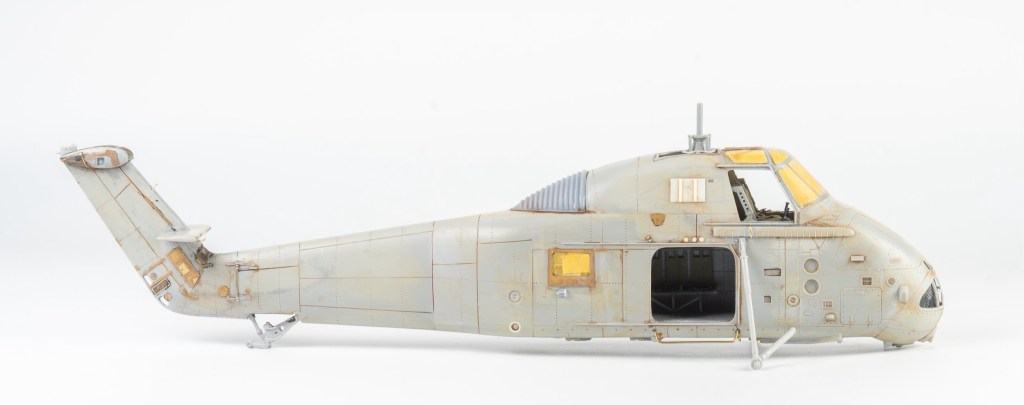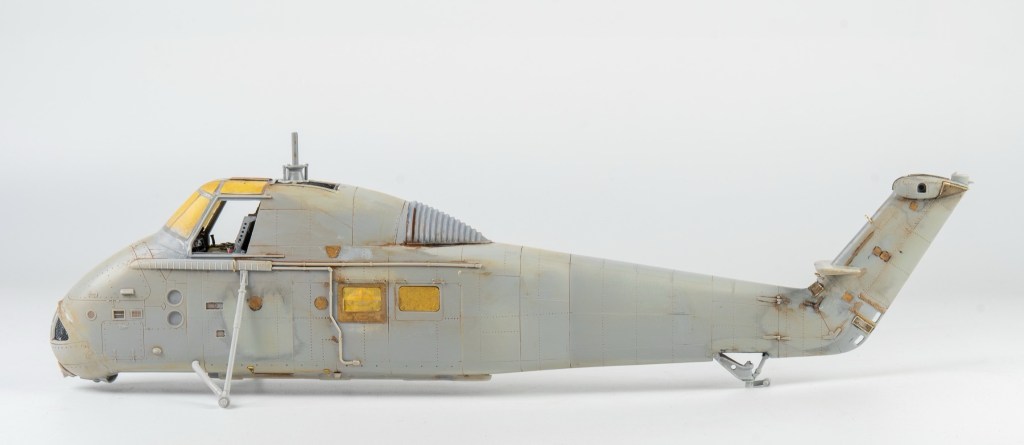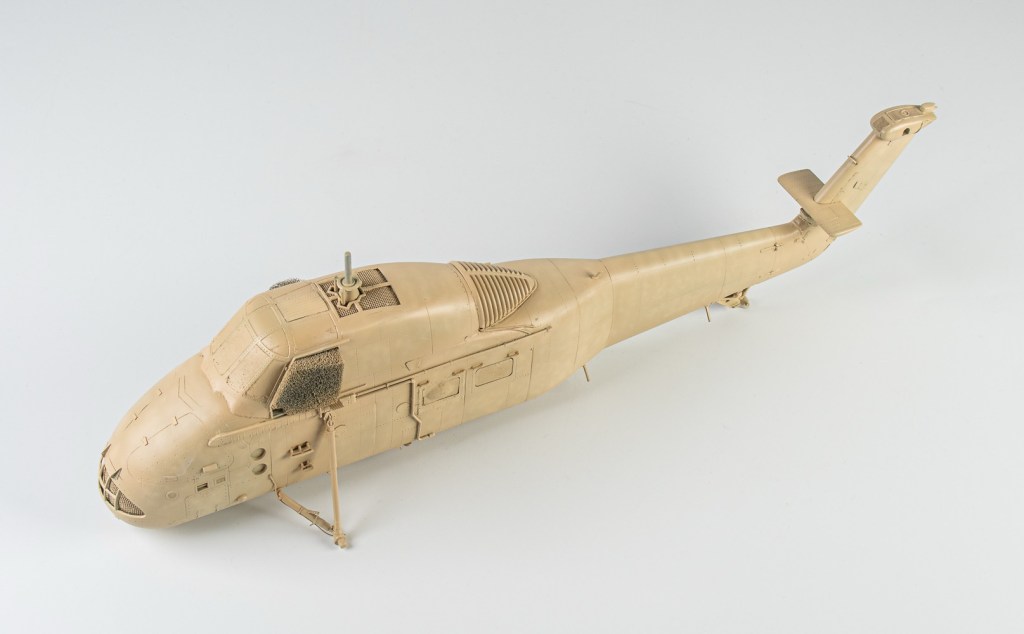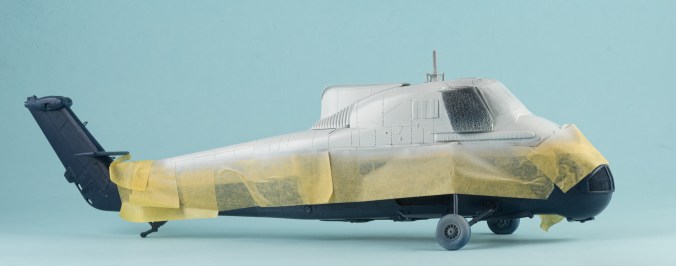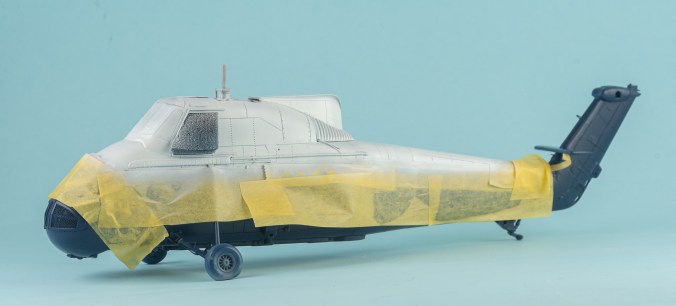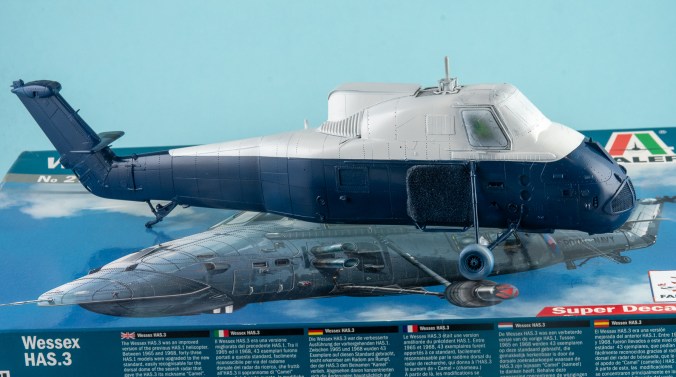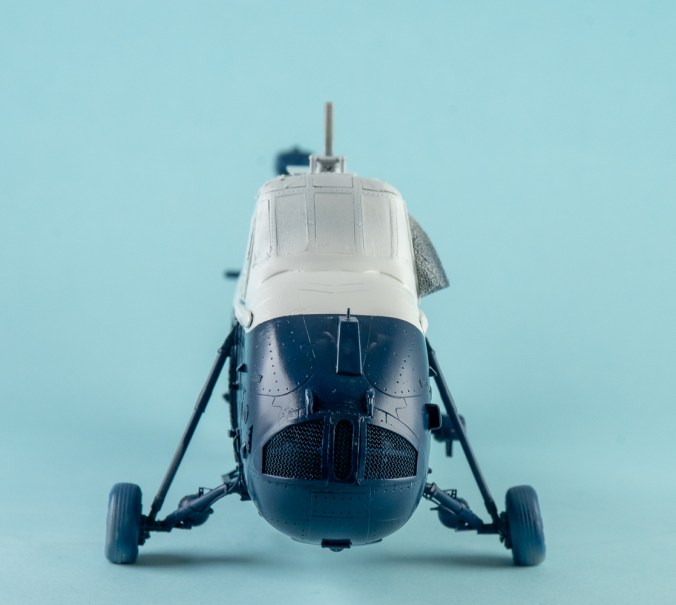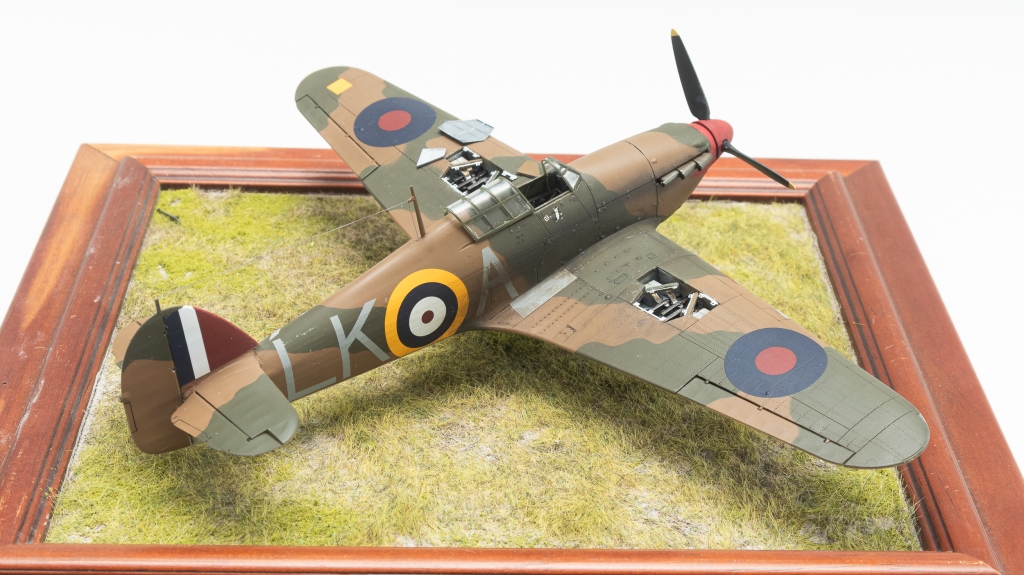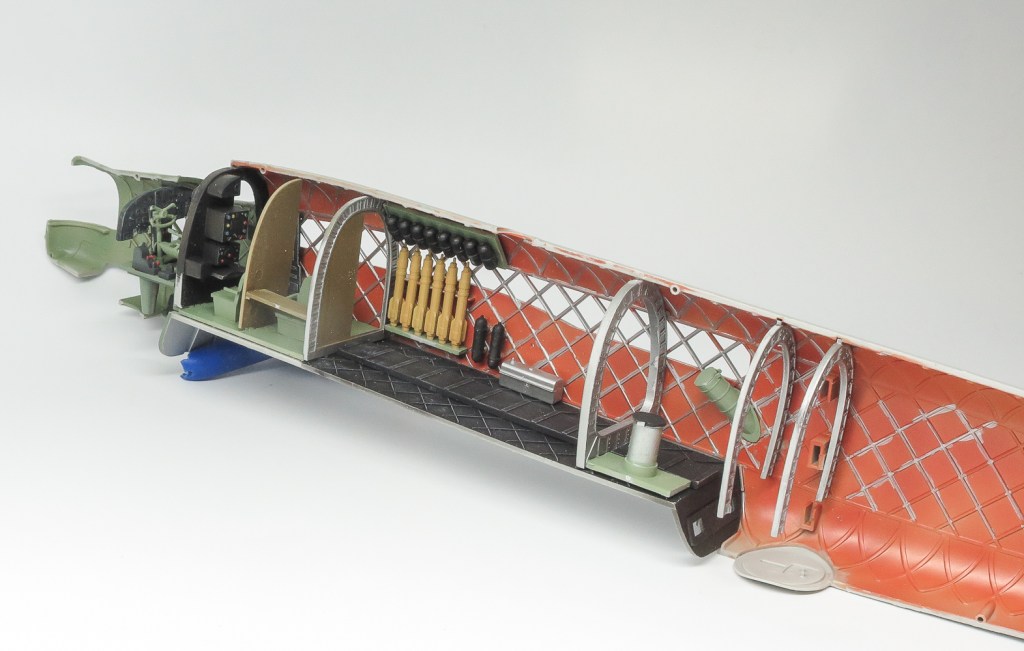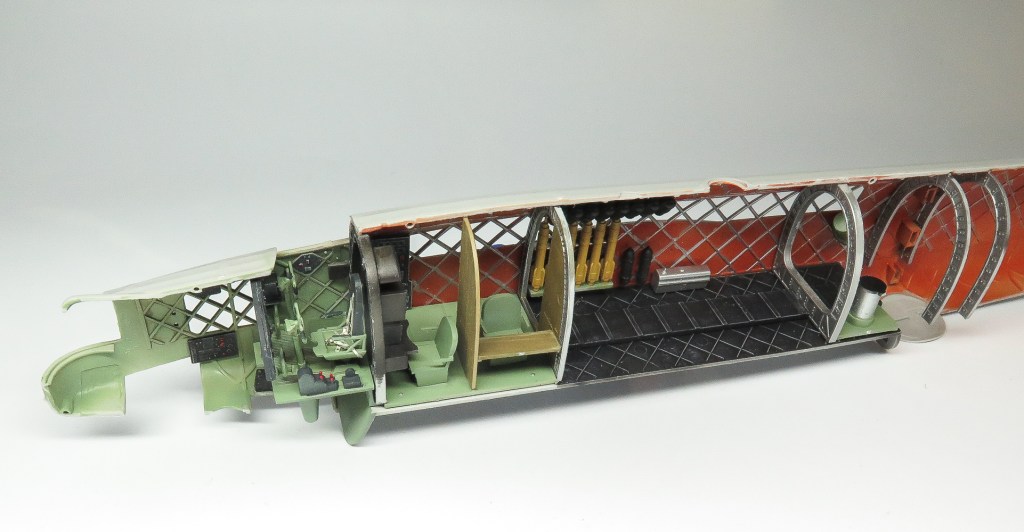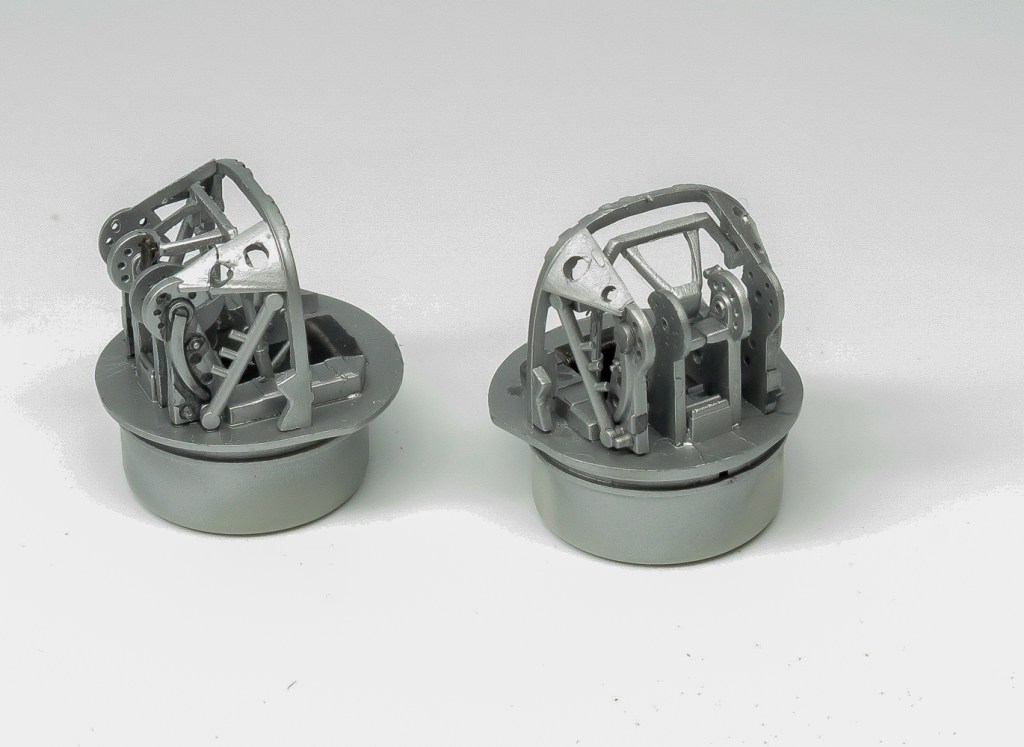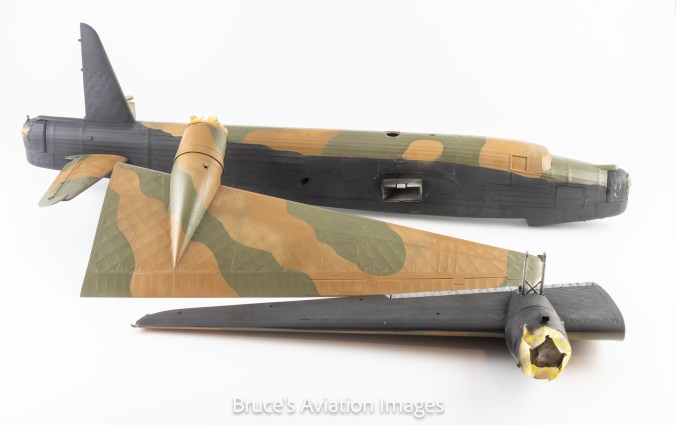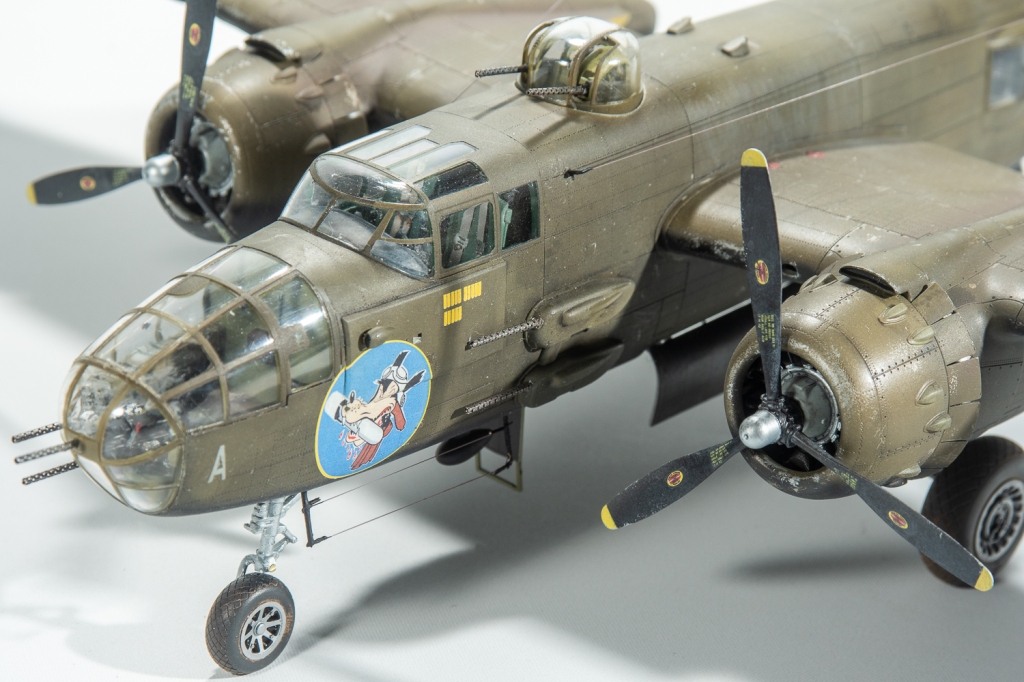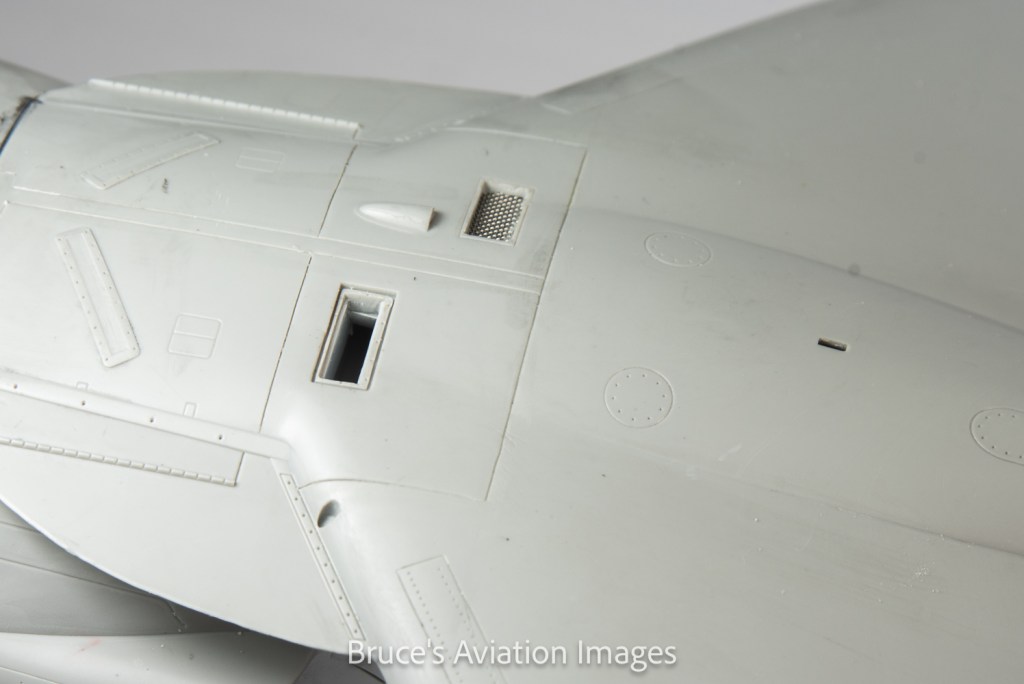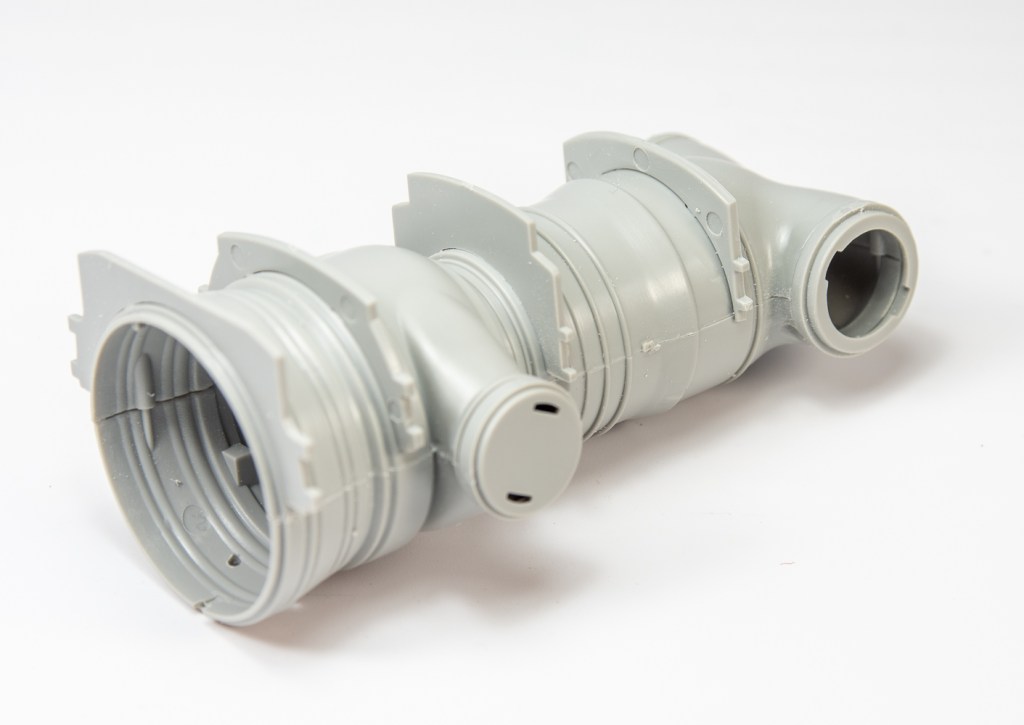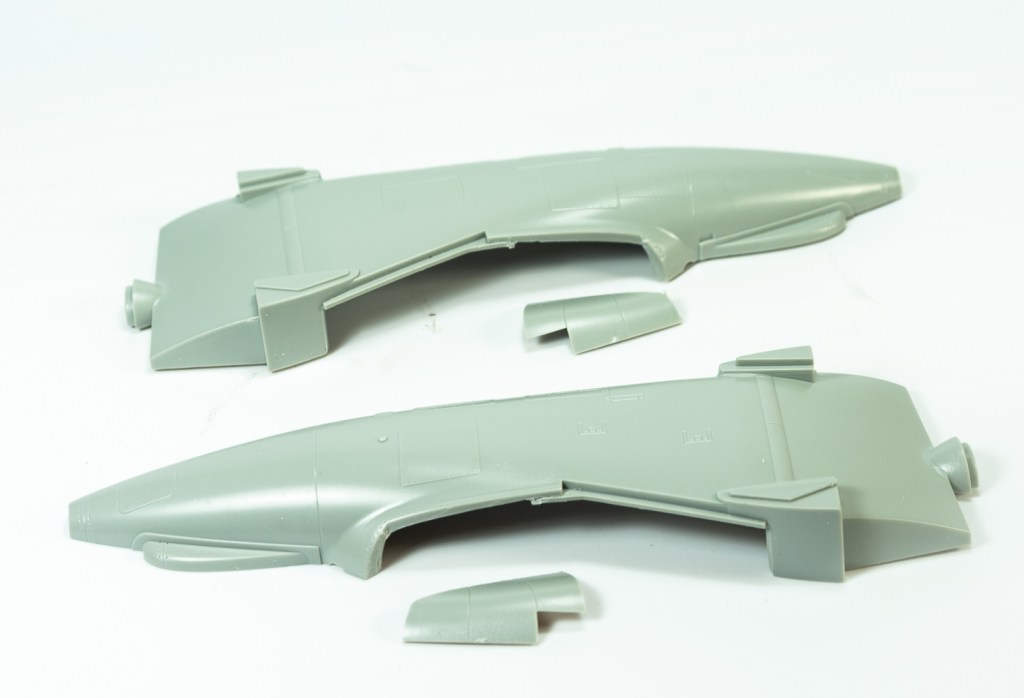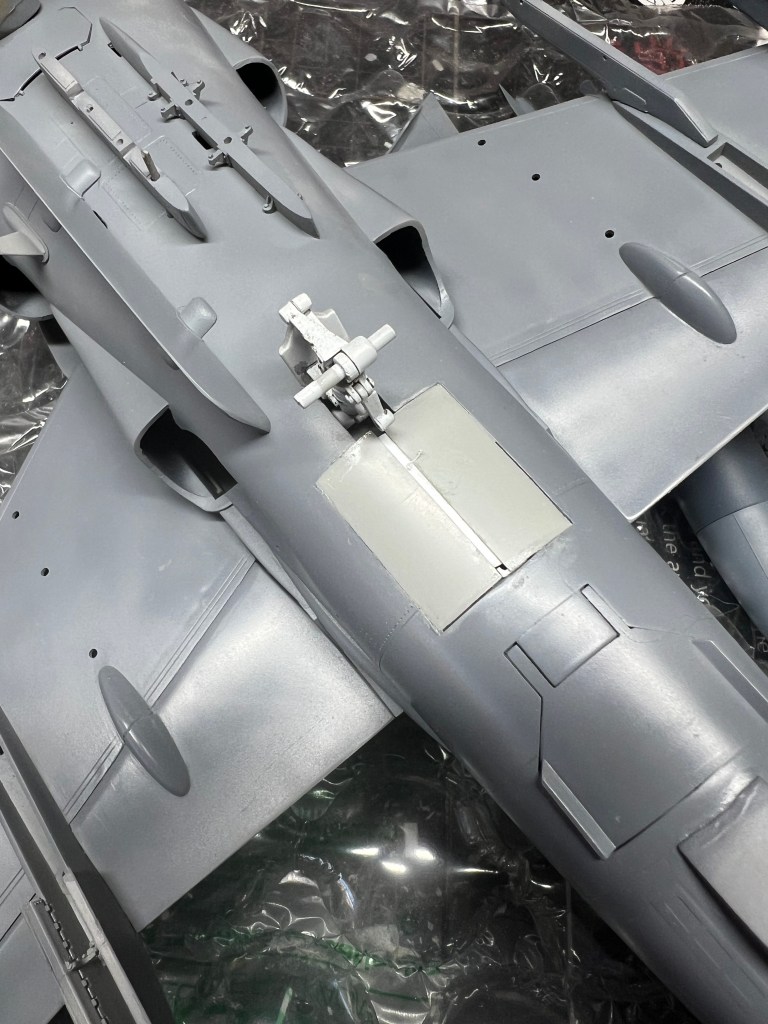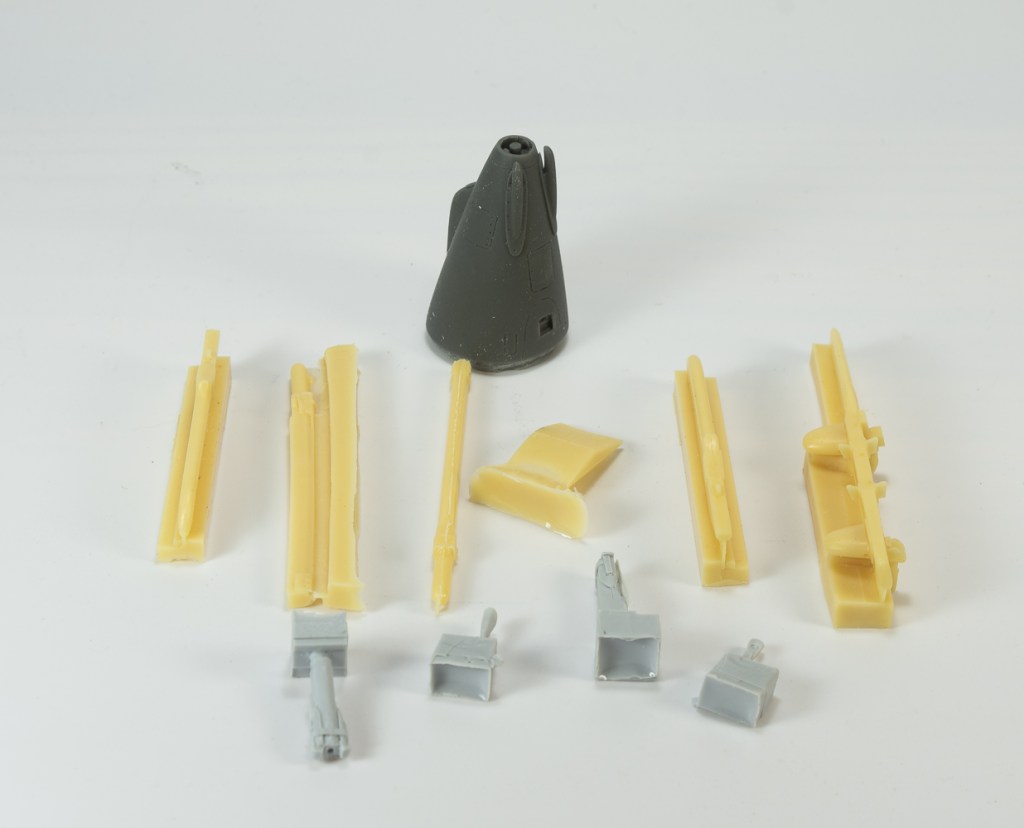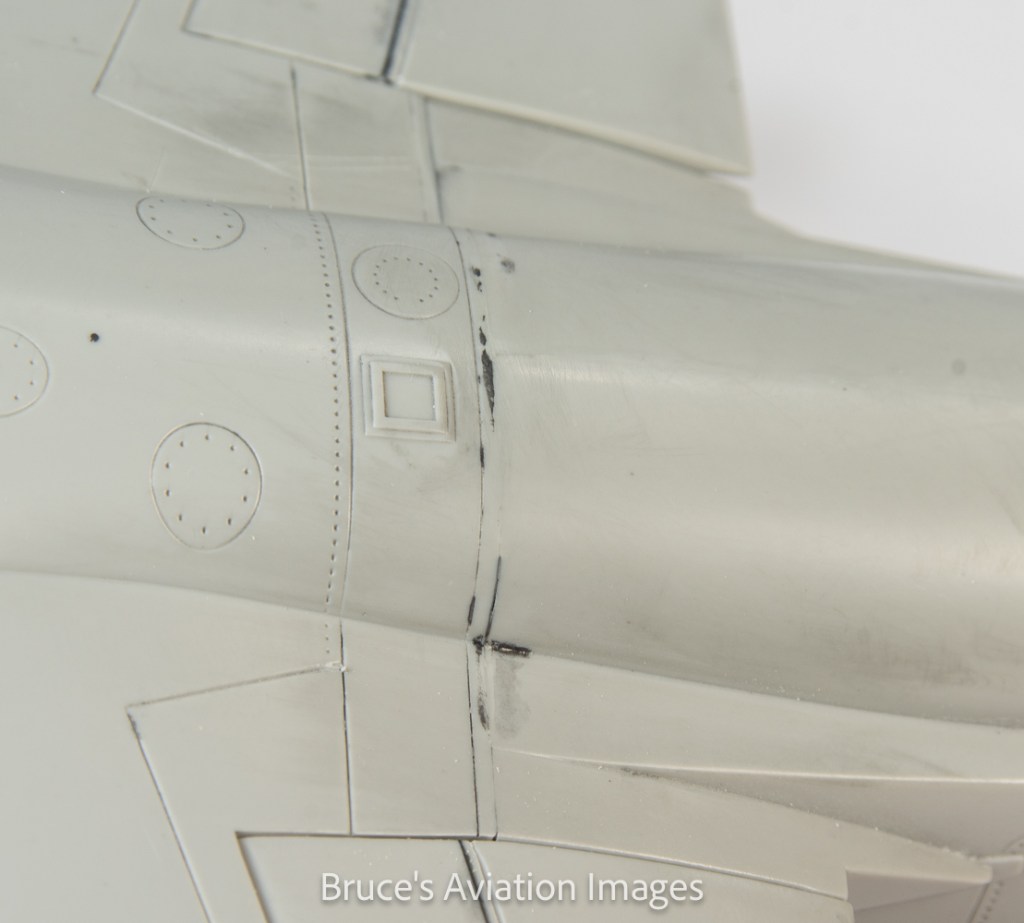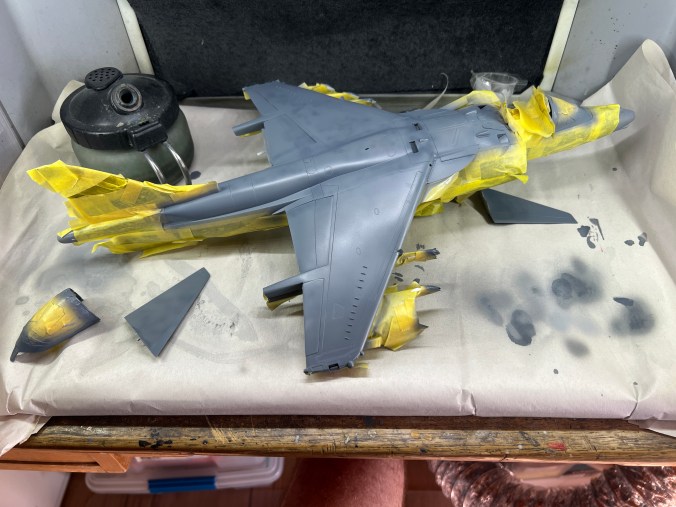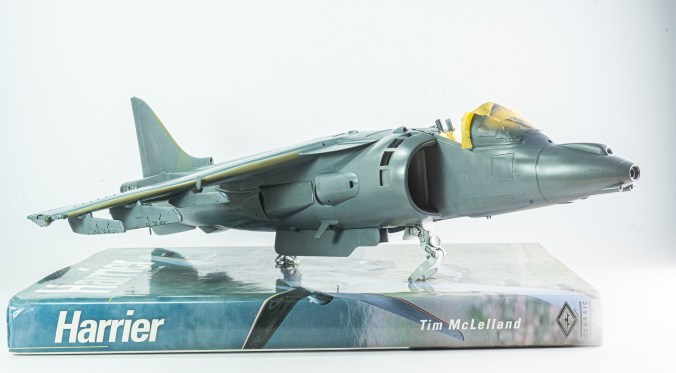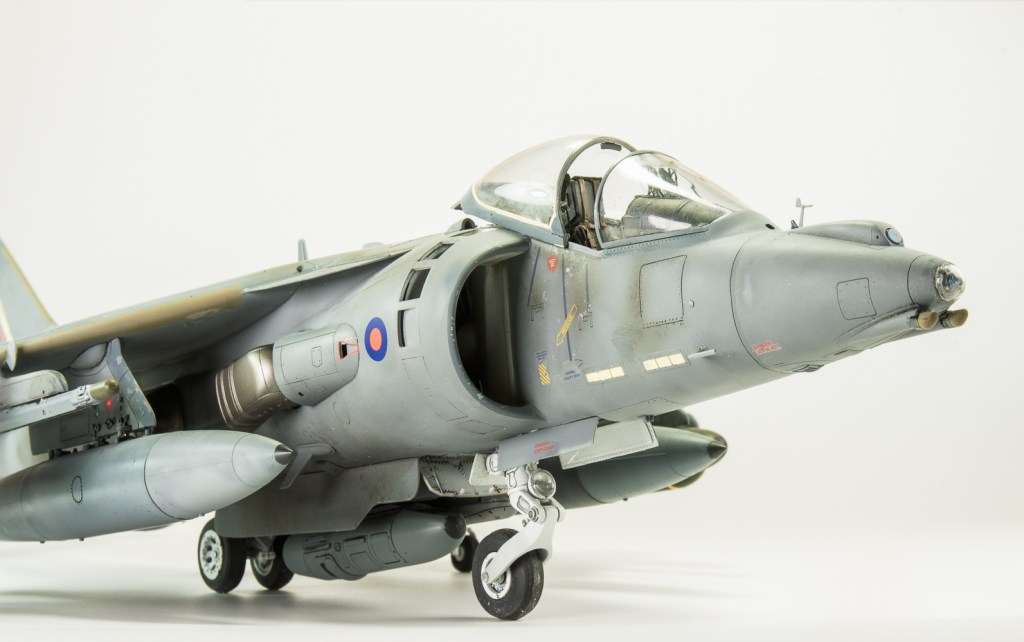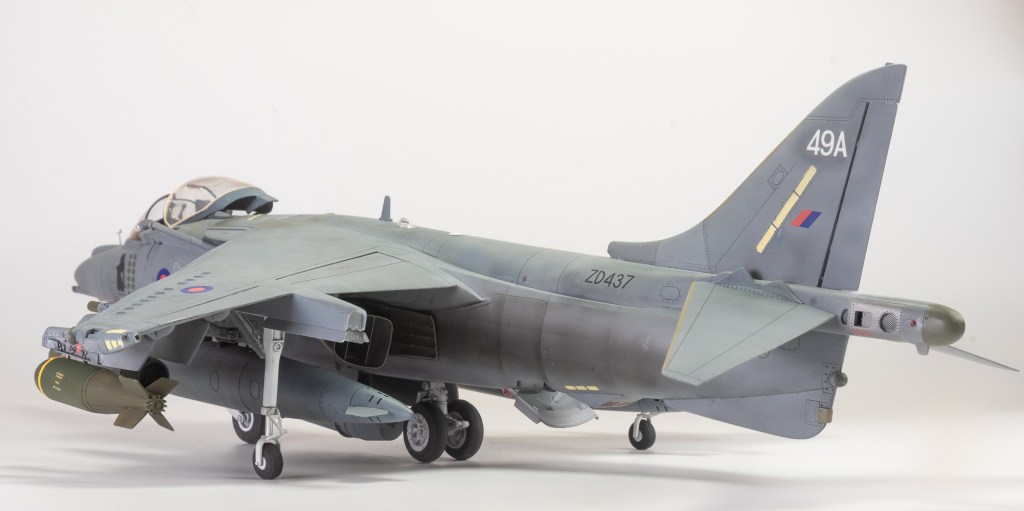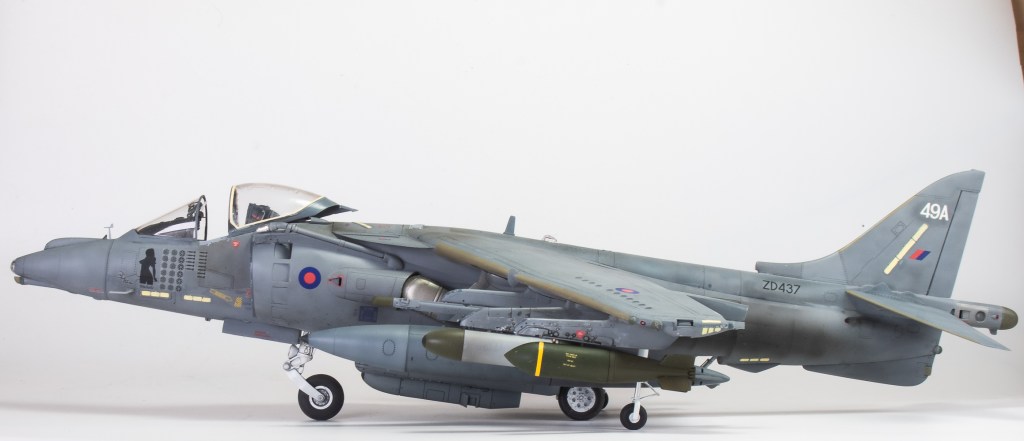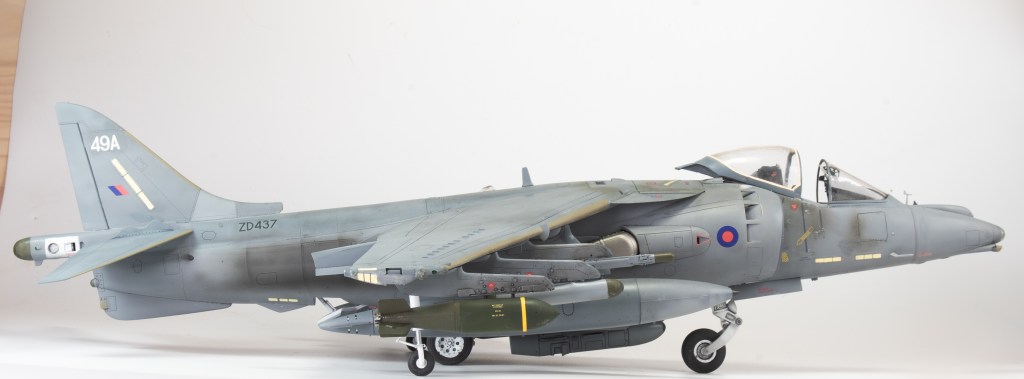
Hasegawa 1/48 B6N2 Tenzan

  • Purchased; 2023
  • Completed: 2025
  • Enhancements: OOB
  • Decals: Myk-Design

For modellers that first built these kits upon their release, there is something comforting about returning to a Hasegawa kit, many years later. Yes, far better examples of their subjects can be found in other manufacturers ranges these days. However, there is still that wonderful emotive box art by Shigeo Koike. Those nicely moulded grey parts with their sharp, but shallow engraved panel lines the crisp detail, and, for the most part, a fairly uncomplicated build. Of course, there were also the odd fit issue, the not-quite-white decals, sometimes vague instructions, and not-quite-crystal-clear transparencies. The builds were usually very enjoyable, albeit the models could be a bit bland, Hasegawa not generally offering options for open hatches or separate control surfaces to give your model a bit of individuality.

Construction Notes

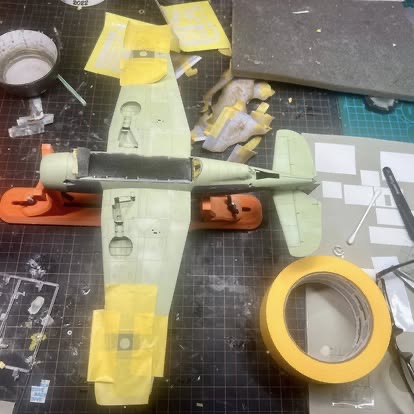
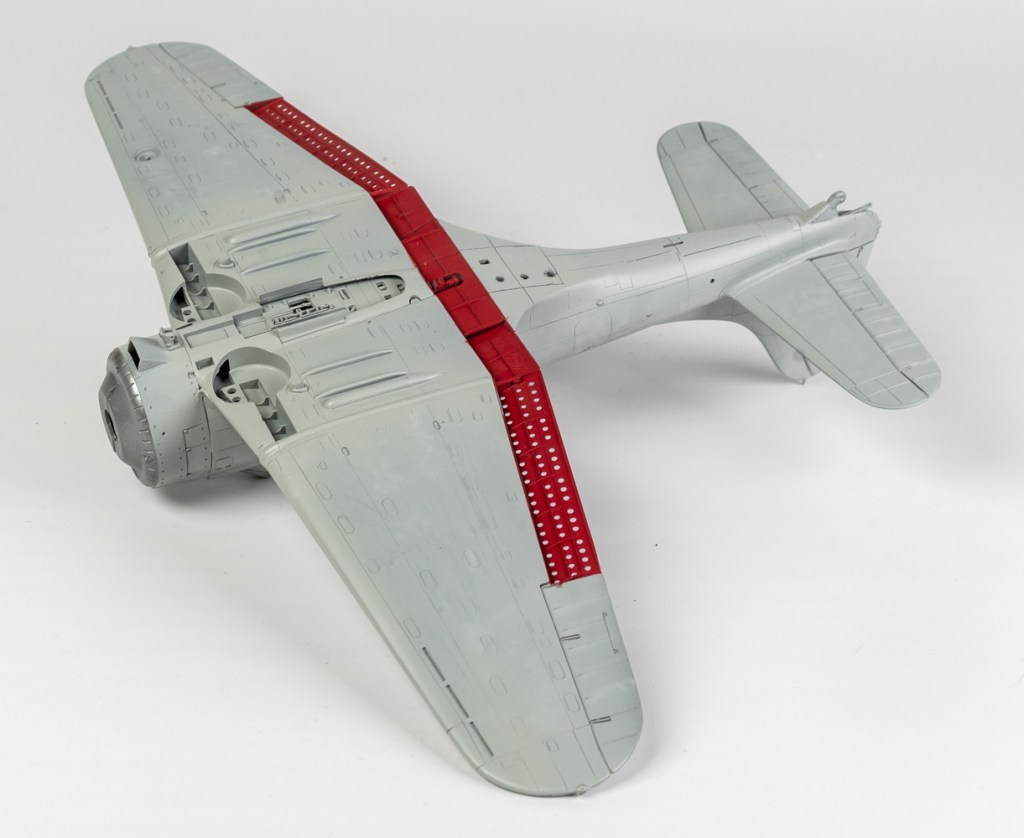
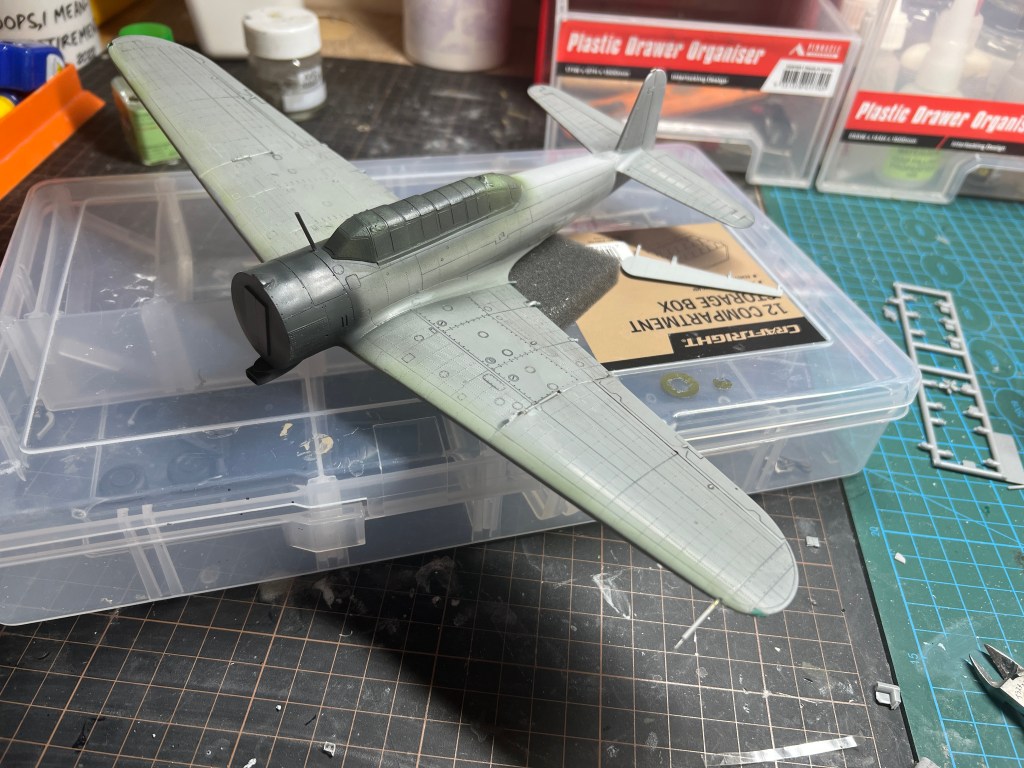
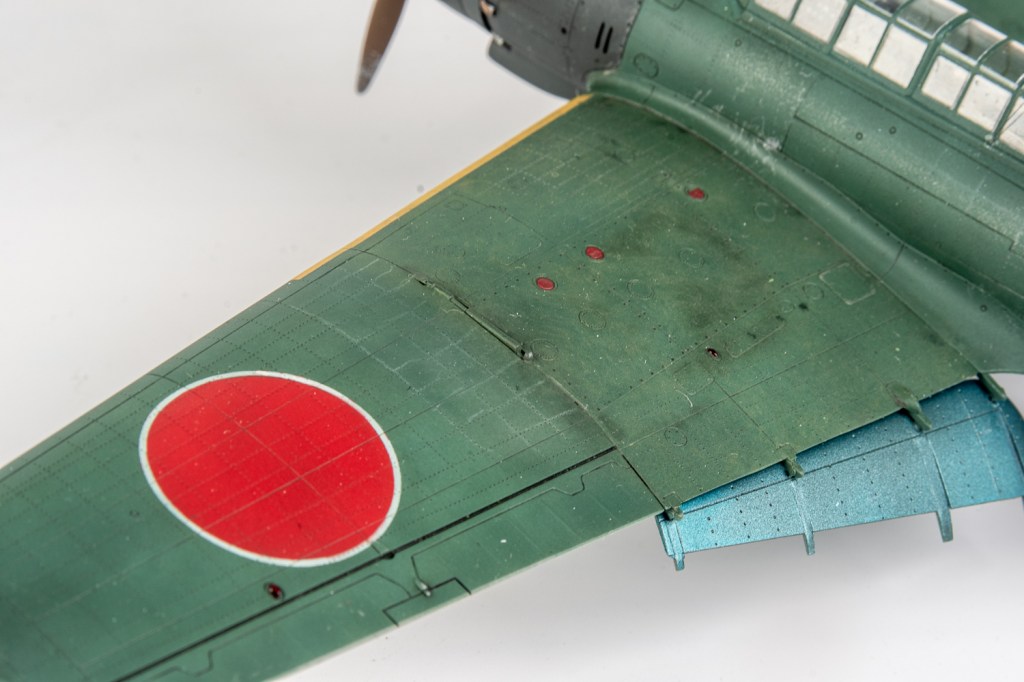
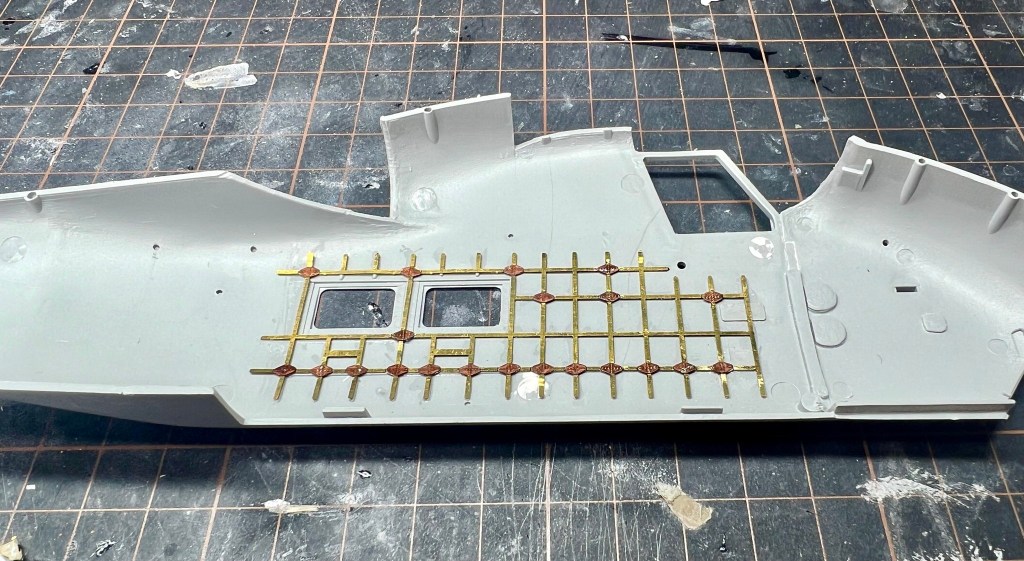
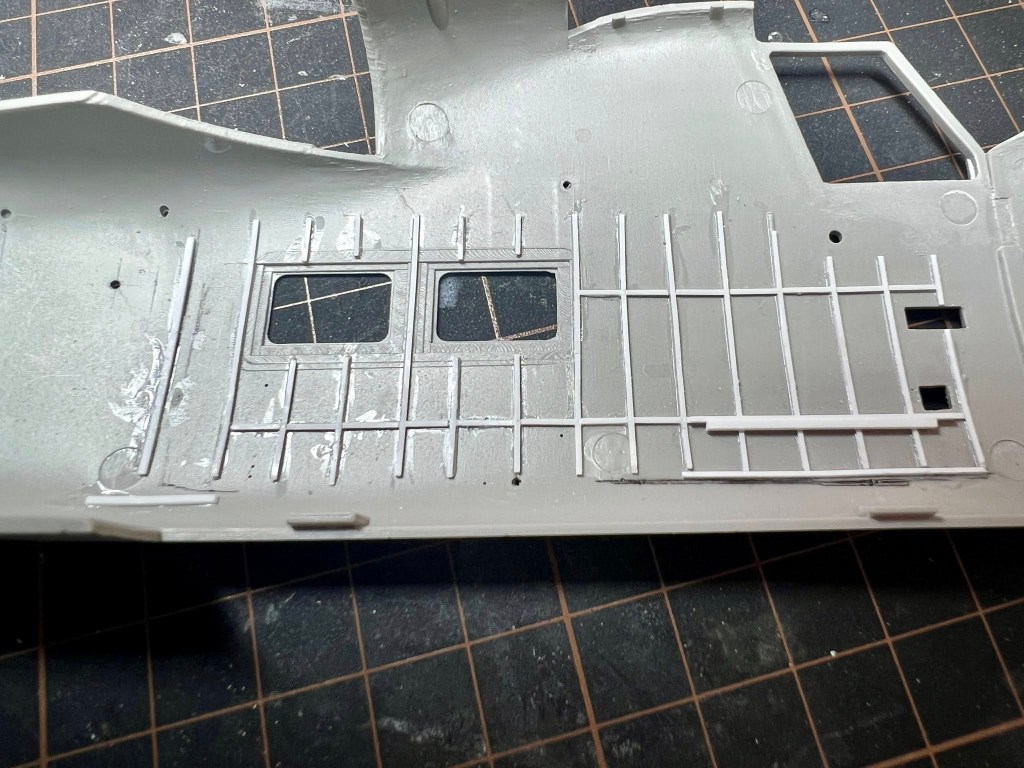
And so we come to Hasegawa’s Tenzan. It is a fitting end to my year’s builds. This one was going to be purely built from the box. It serves as a pause from my other sometimes long and protracted builds. The complication (there’s always a complication!) added by me was the decision to rivet the surfaces to add a bit of “busyness” to the airframe. To be fair, this wasn’t that much of a complication. It involves finding suitable drawings that show the rivet details. In this case, the drawings come from a Kagero Top Drawings book. The next steps are scaling the drawing up and transcribing the lines onto the model. A riveting tool is then used to push the rivets into the plastic. Search YouTube for “The Model Guy” who has a video of how to do it step by step. I couldn’t post the video here for some reason. After the riveting was completed, a black wash was run into all the rivets and panel lines to assess them. there were a few wonky lines! And as a friend mentioned there should also be river lines alongside all the panel lines as well.

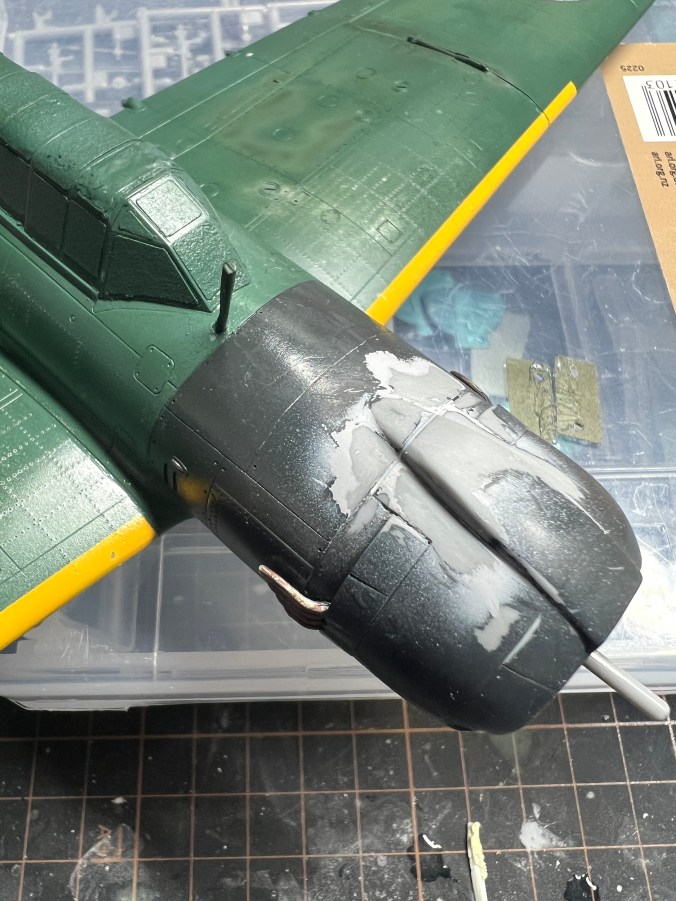
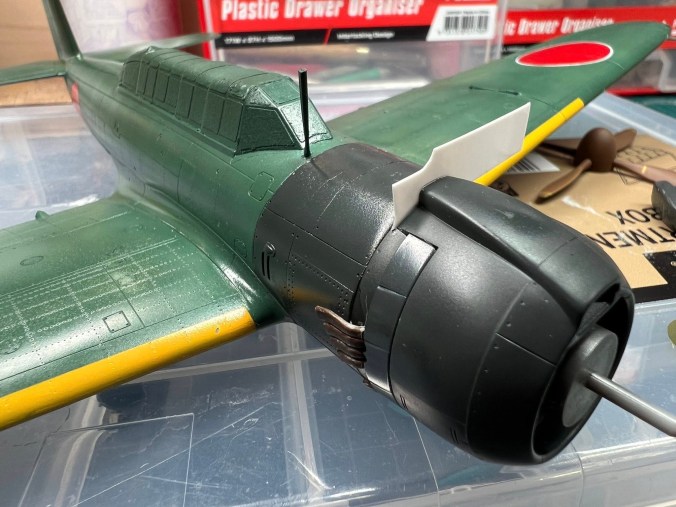
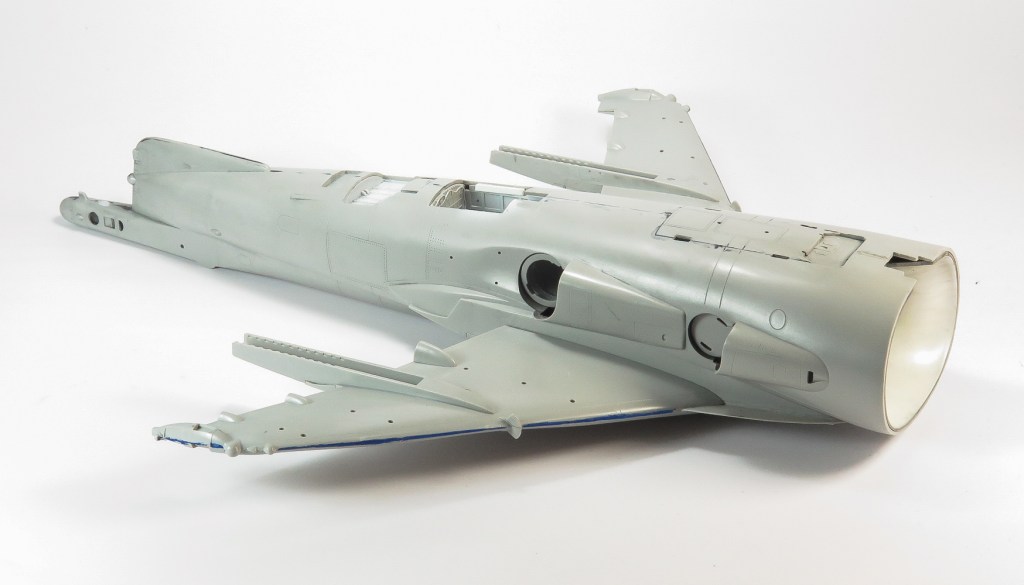
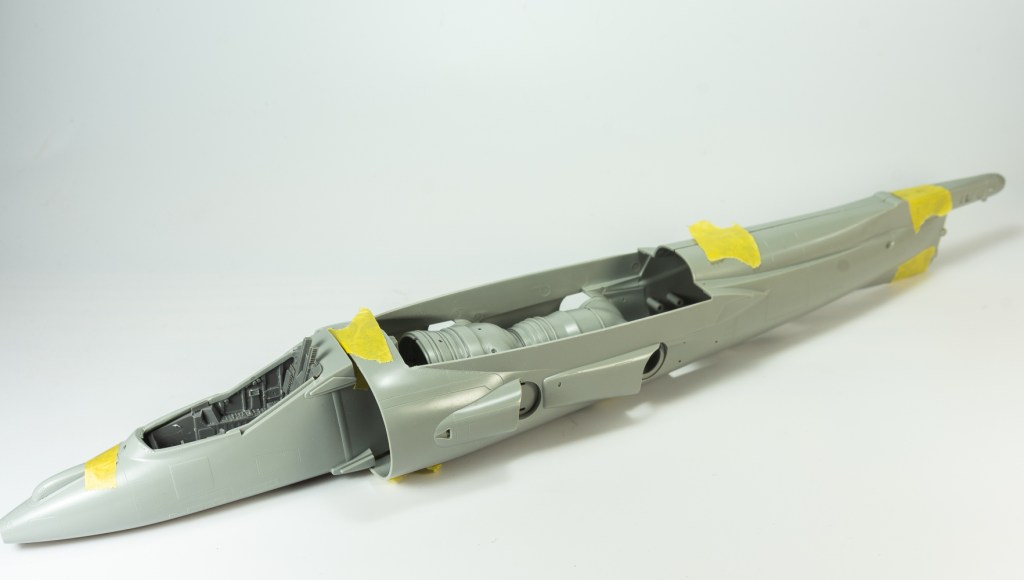
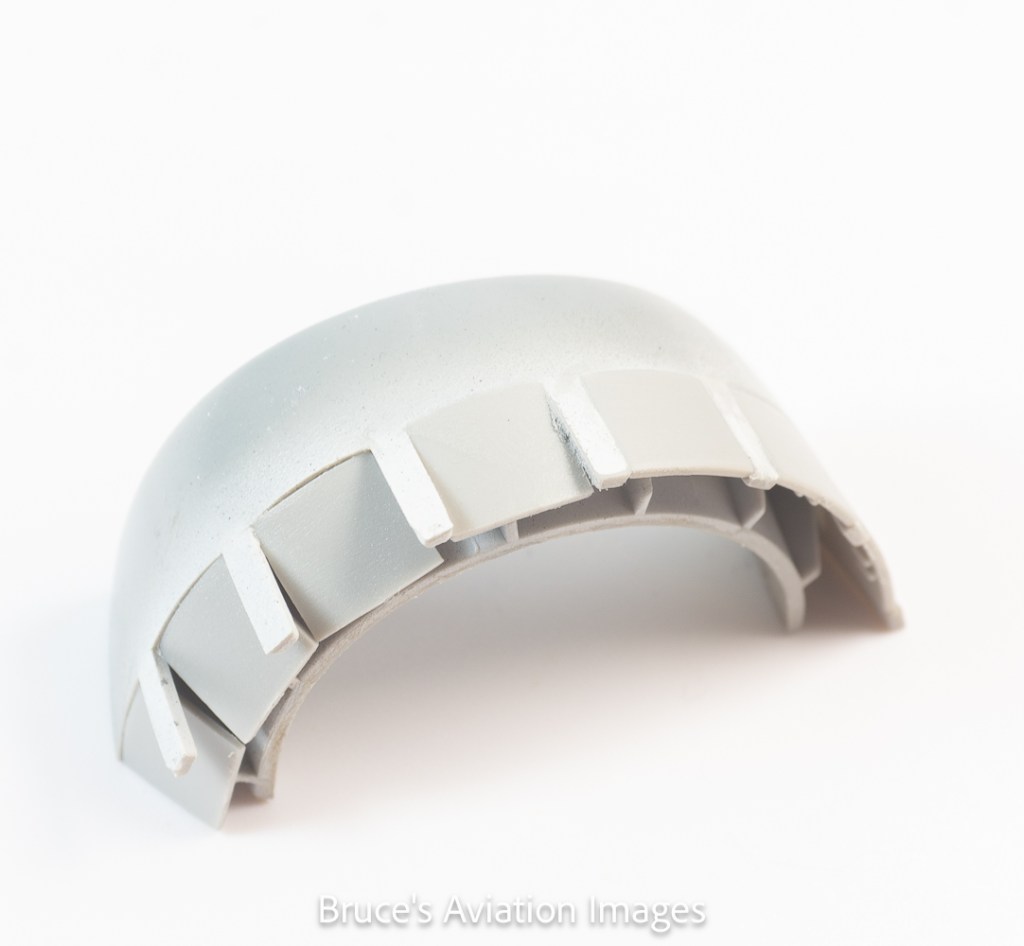
The actual build proceeded with few real issues. There was a gap when joining the front cowling to the rear cowling, despite all the parts being lined up correctly. Talking to other modellers who have built the kit, it’s a known issue. Plastic card took care of this. after the problem was discovered far too late in the build.

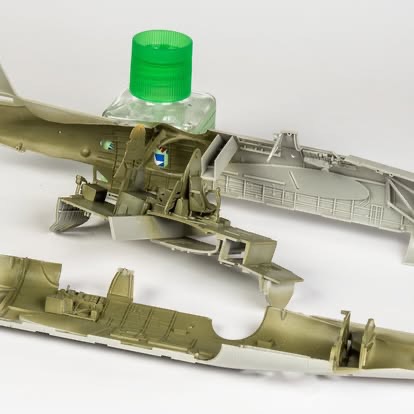
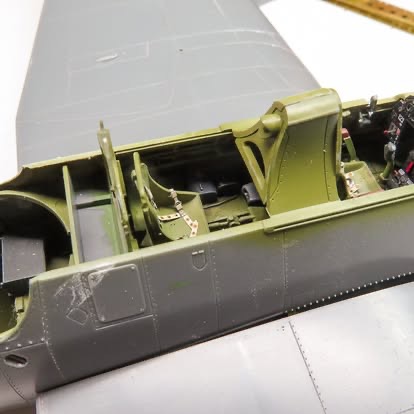
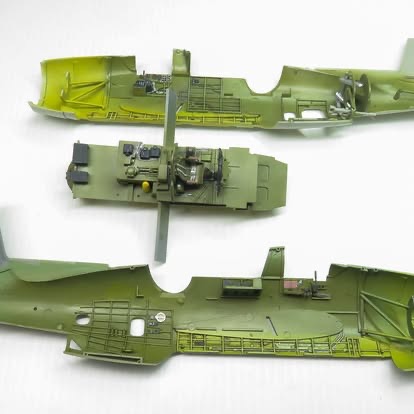
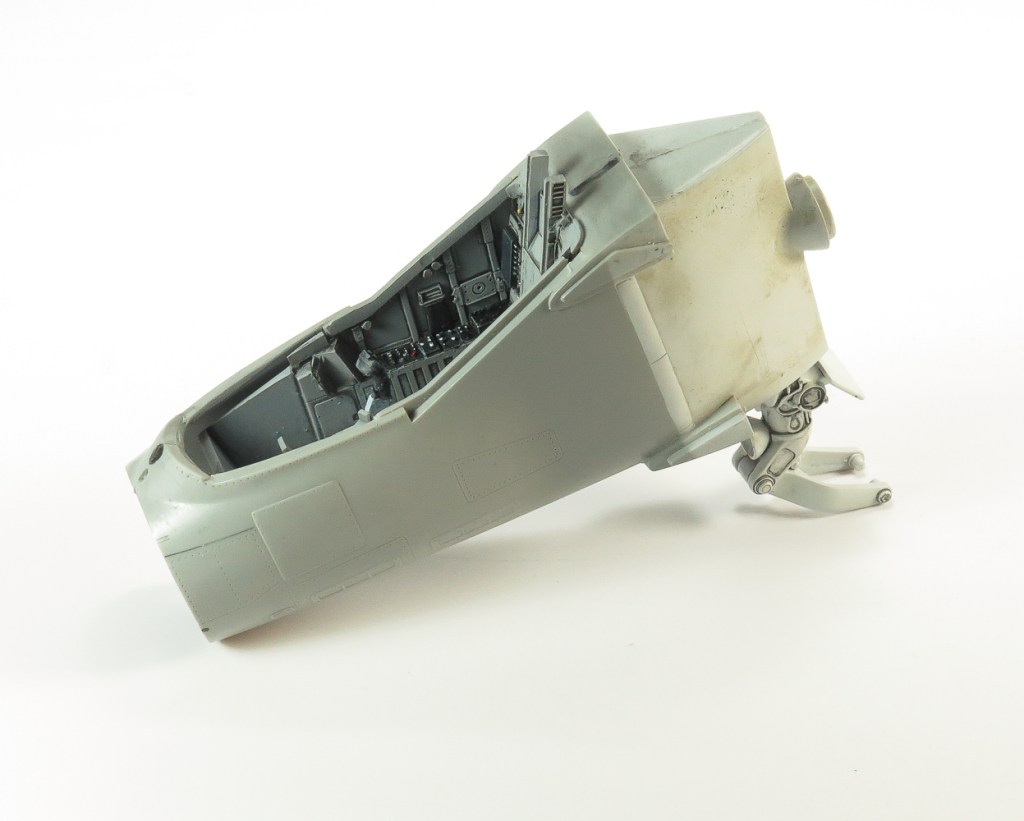
I would suggest adding the cockpit sidewalls to their respective fuselage halves rather than the floor as the instructions illustrate. I found building the kit as per instructions, my sidewalls sat a bit proud from the cockpit sills. The kit includes the option of folded or extended wings. Poly caps hold the wings in either position. This allows the modeller to change the attitude of the kit, even after completion. I thought I was smarter than Hasegawa and left their wing ribs out choosing to reinforce the wings with plastic strip. Turns out I’m not smarter than Hasegawa though, as the floppy wingtips prove!

Painting and Decalling

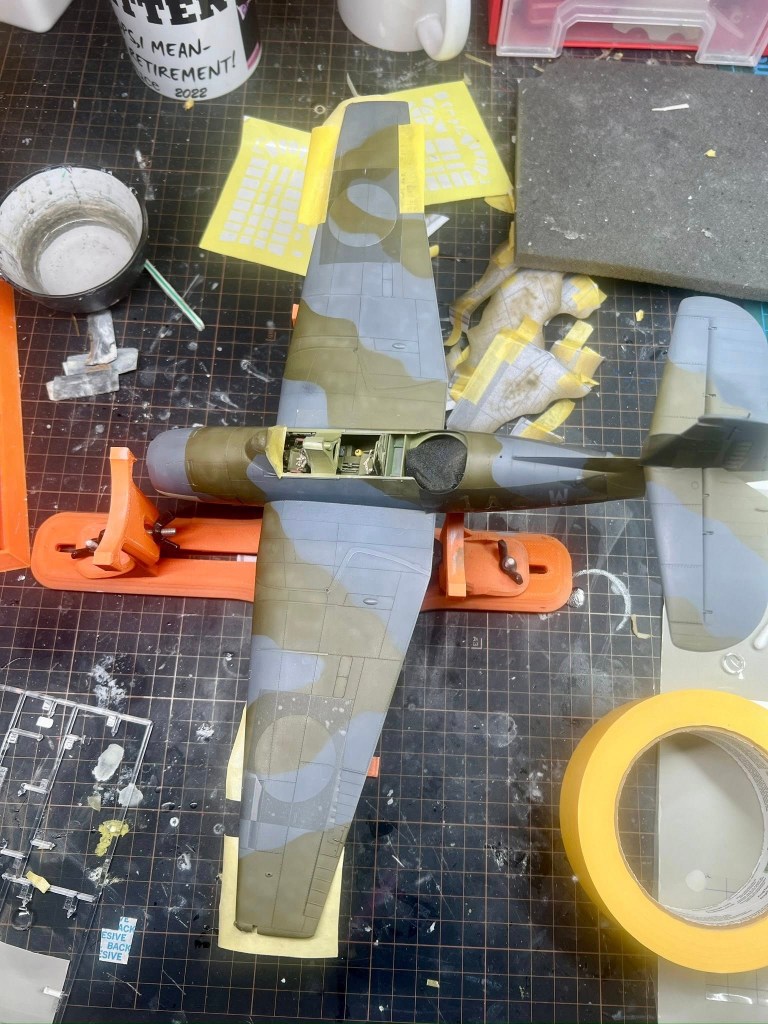
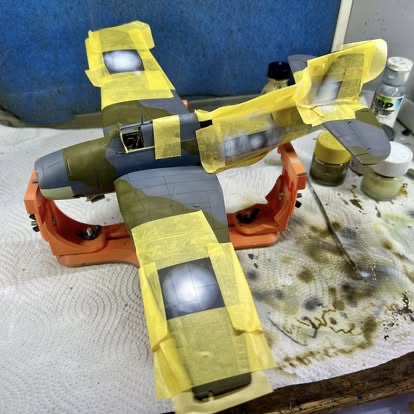
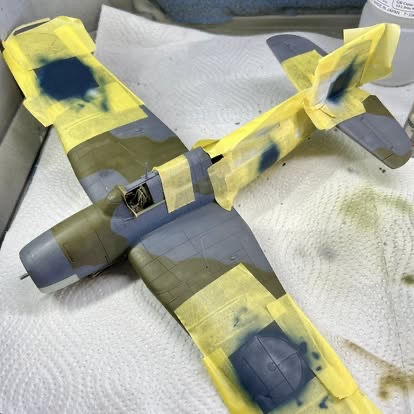
MRP Super silver was first laid down on the centre section of the wings and fuselage. The next coat to follow was a lightened version of Tamiya IJN followed by another application, this time straight from the jar. All paints were thinned with Mr Hobby thinner.

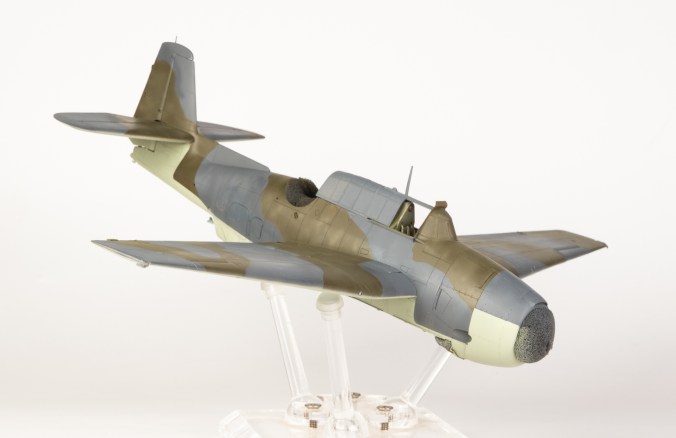
Undersides were SMS Storm Grey, which is a grey with a slight tinge of green in it. I think it does a reasonable job of standing in for IJN Grey, of which I had none. Once the colours were set, a small worn piece of 800 grit wet and dry was used. This gently abraded the inner wings, just enough to allow the rivets to show through. While researching the unit’s history, I found out they were ferried to Truk Island and only flew a couple of missions after arriving before being wiped out. Thus my weathering on this aircraft is only slight. There is just some staining and touchups on the wings. Additionally, there is chipping around the cowling. None of the photos examined showed any sort of exhaust staining. Japanese contemporary photos are pretty much universally of poor quality though. Rather Ironic, really ! Speaking of the cowling, this was finished with SMS Blue Black, and the propeller with Tamiya Red Brown. Gunze Metallic Blue was used in the wheel and flap wells.

Decals were a brand called Myk-Design that I picked up whilst roaming hobby shops in Japan. The instructions are all in Japanese, but they do have a website with English instructions on how to apply. It was here that I discovered they had peelable film, like Eduard and HGW, Unlike Eduard though, the film on these is designed to be peeled off. They were applied over Mr Setter and left for 12 hours as per the instructions. The film peeled off very easily, , usually coming away in one big sheet. An oil wash mix using Abterlung dark green and black oil paint was applied to the upper surfaces with dark brown used on the undersides . The excess being wiped off before the final matt coat was applied.

Final Assembly

Somewhere along the way, the kit aerial mast was misplaced so a replacement was made from brass rod. It was filed to a rough aerofoil section before adding it to the model. The pitot tube was also fabricated from brass rod.. Whilst we are talking about fumbles, I also managed to glue the retraction struts to the wrong gear legs, and then snapped them off trying to remove them. In addition the locating holes for the gear doors were mistakenly filled as I thought they were ejector pin holes. I probably should have just built this as an in -flight model! Did I mention the gear door that I also managed to snap in half?

The included torpedo is one of the weaker parts of the kit, and a resin replacement was almost purchased before deciding it was going to be underneath, so not really visible. The kit part was therefore used. All these parts plug in due to Hasegawa’s copious use of poly caps as locating aids throughout the kit. In fact I don’t think Ive seen another aircraft kit that uses so many of the things, even Tamiya kits!

The antenna wire was EZ Line. My enthusiasm for this product though has started to wane. Its just too easy to introduce twists into the elastic, unless you reeeeeeaaaaaly stretch it out, which just puts undue stress on everything. Although in this case I had also glued a small length of micro tube to the top of the tail fin, The EZ line was just run through this and then glued in place

Conclusion

In the end, quite an enjoyable painfree build. Yes there are some compromises in detailing and paintwork, but I long ago reconciled myself to the fact that not every model built will be a showstopper. Its a compromise that needs to be made if you want your end game to be building as many models from your stash as you can, before you are forced to give up the hobby through age or medical issues.

To close, the Jill is quite a pretty aeroplane. There will be more Japanese builds in my future.

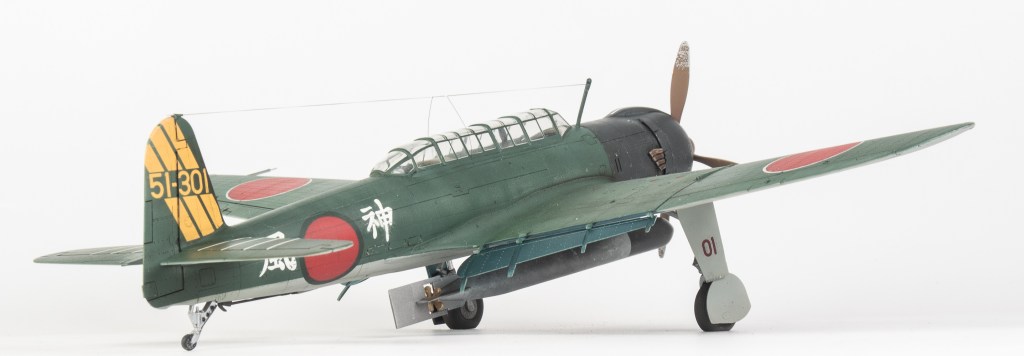
Nakajima B6N2 Tenzan. 251st Attack SQN. 551st Naval Flying Group. Imperial Japanese Navy. Chuuk Lagoon 1944

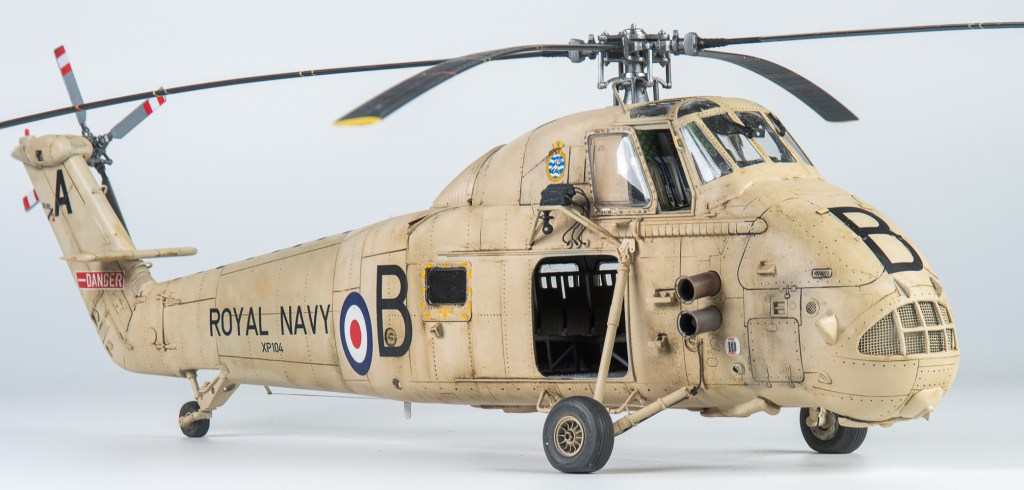
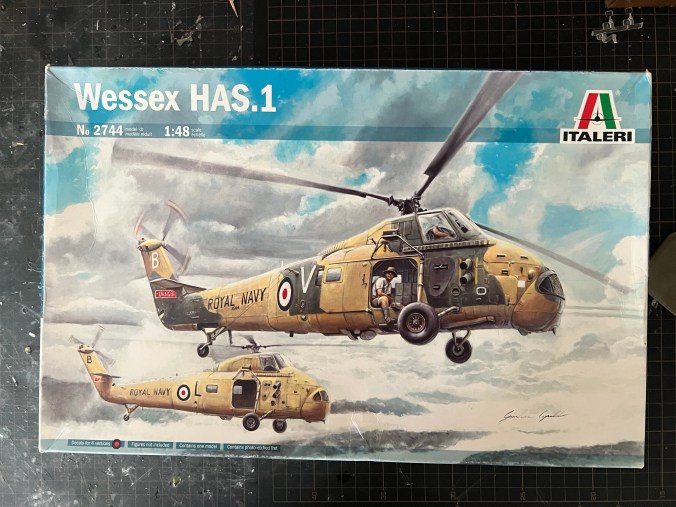
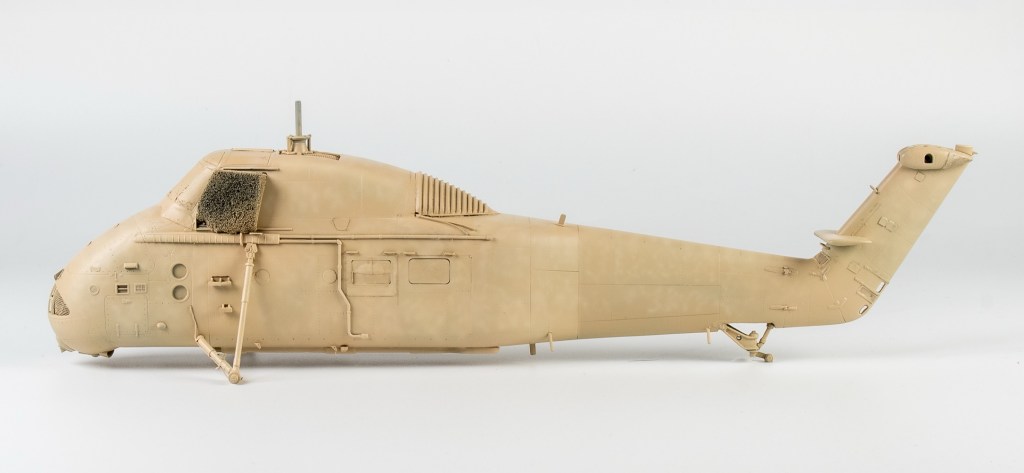
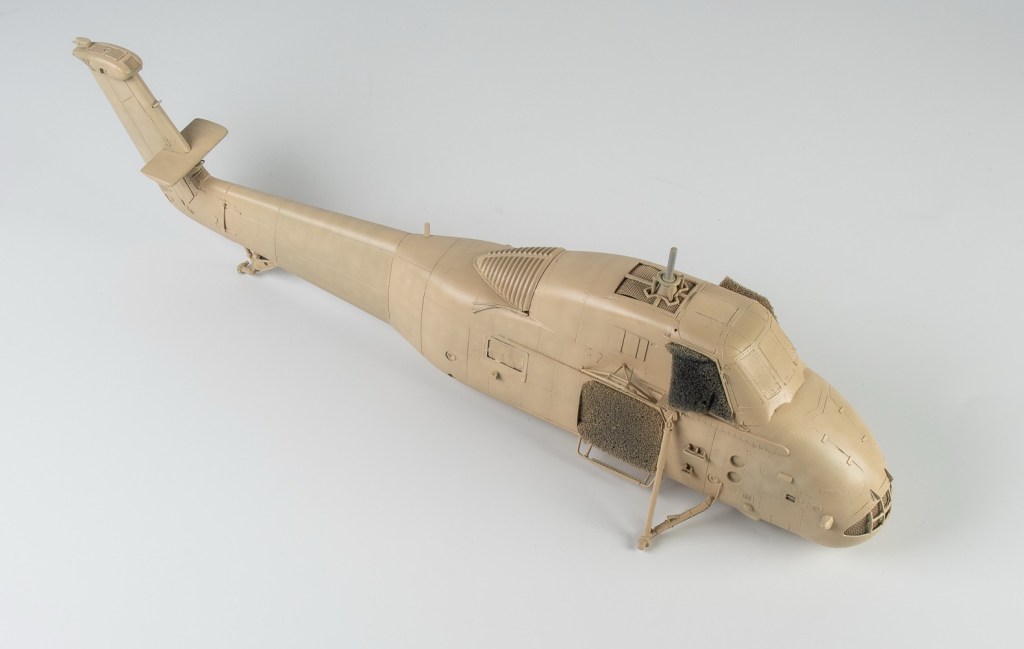
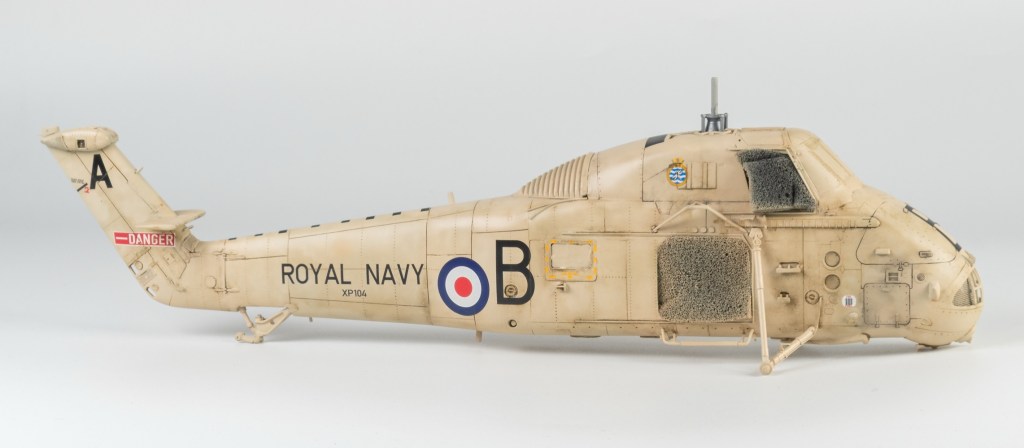
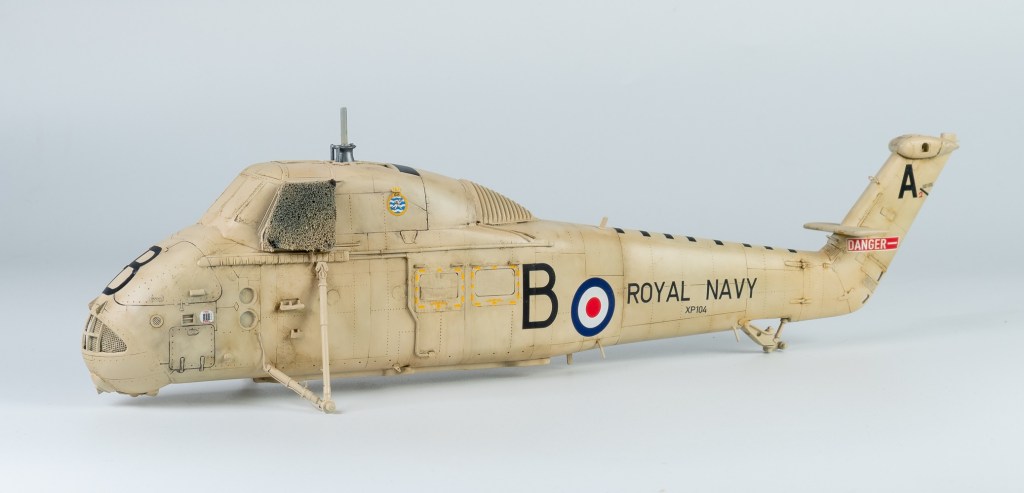
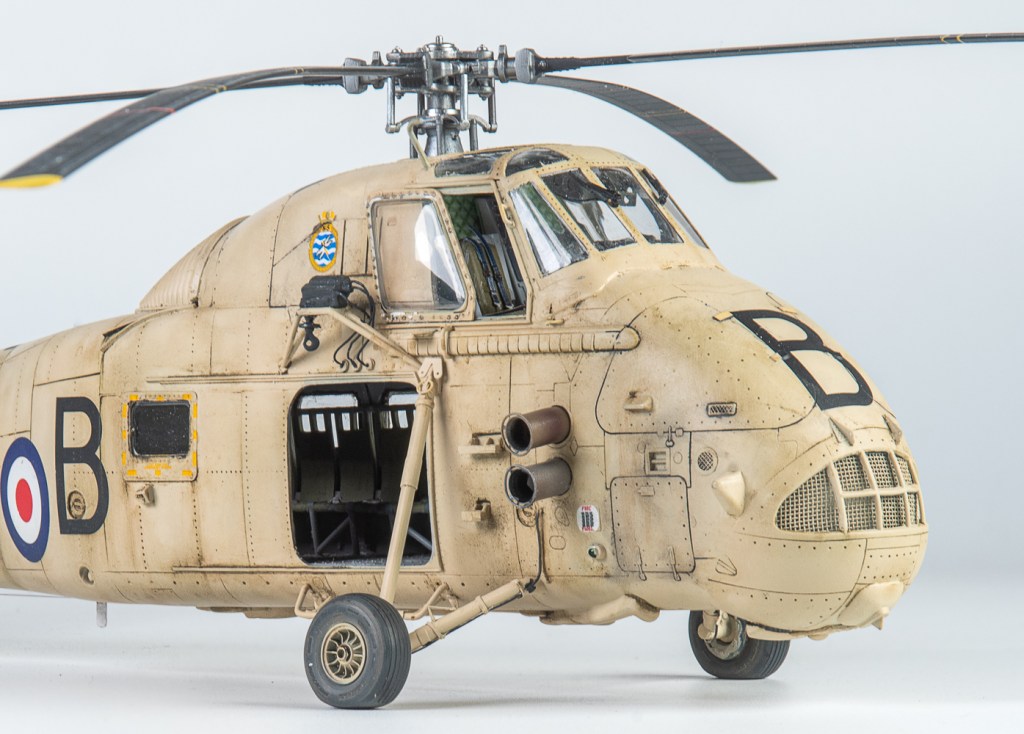
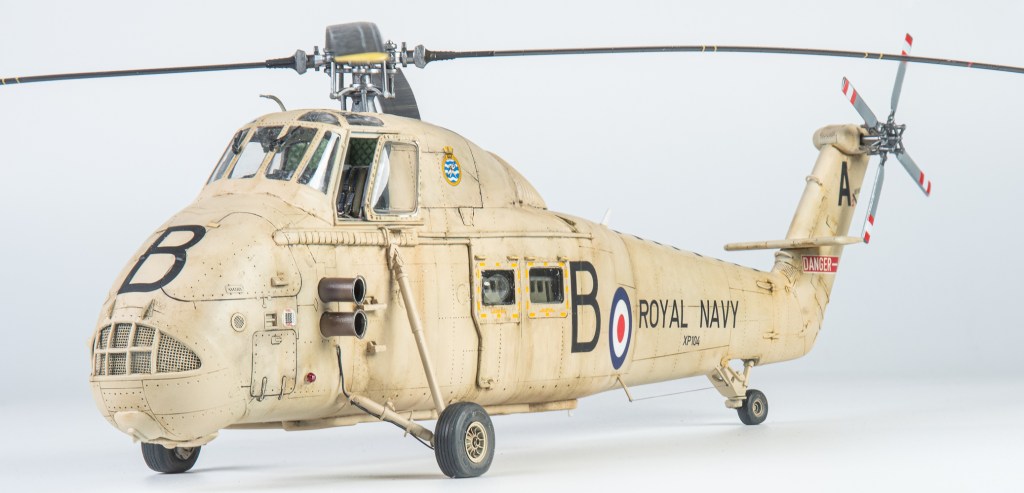
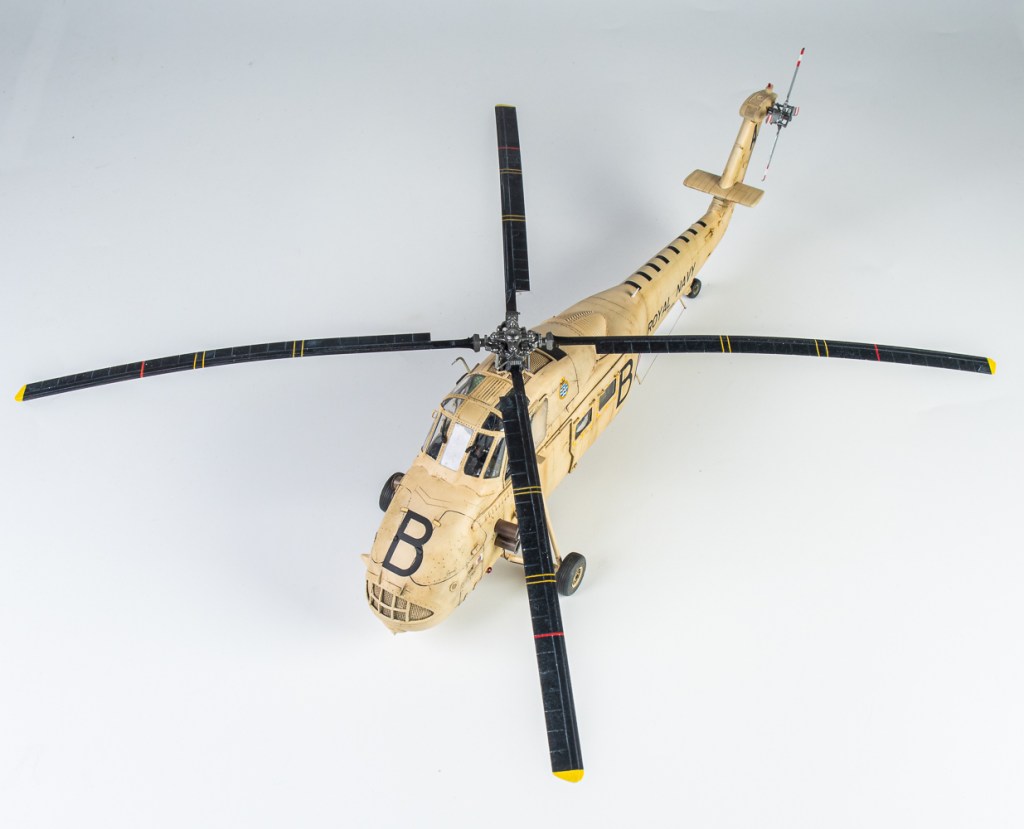
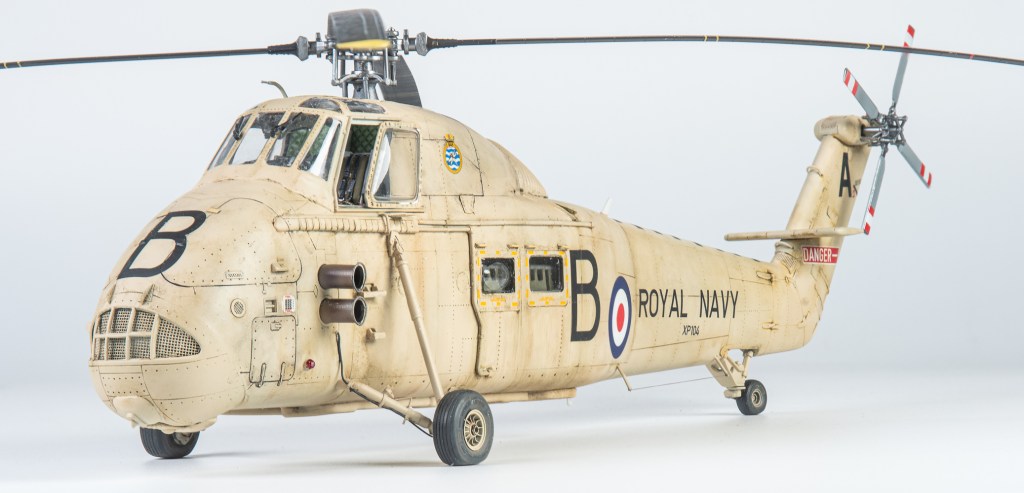
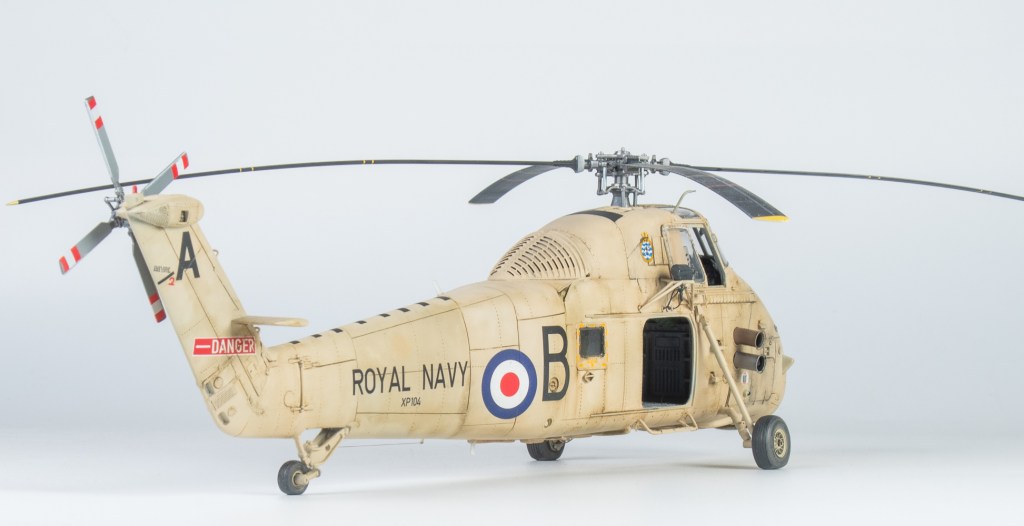
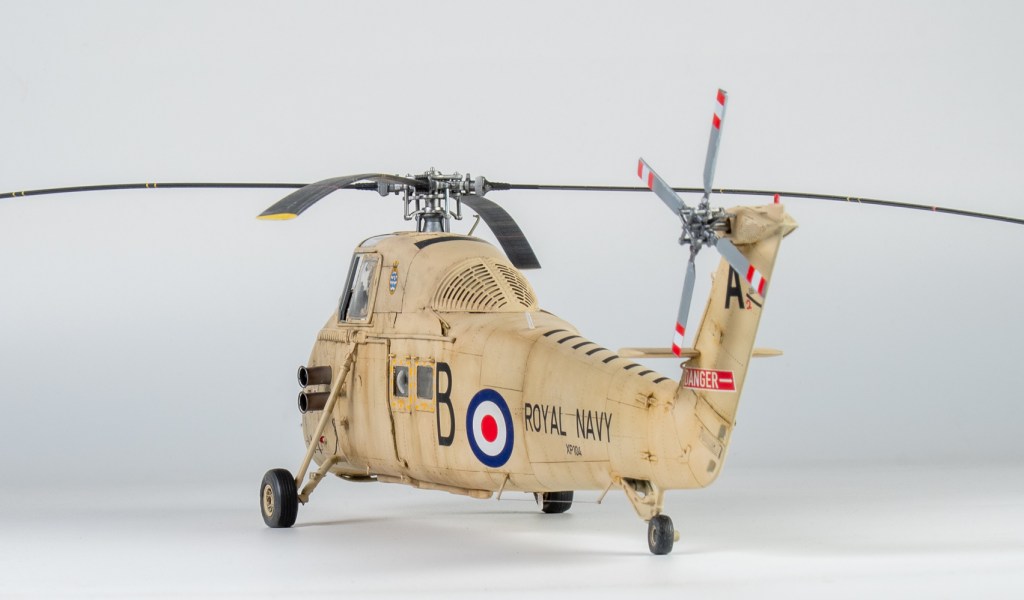
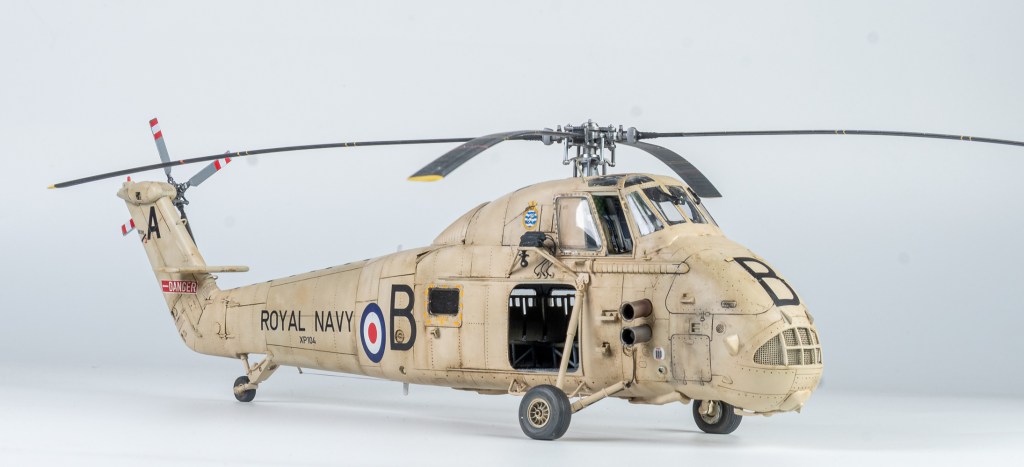
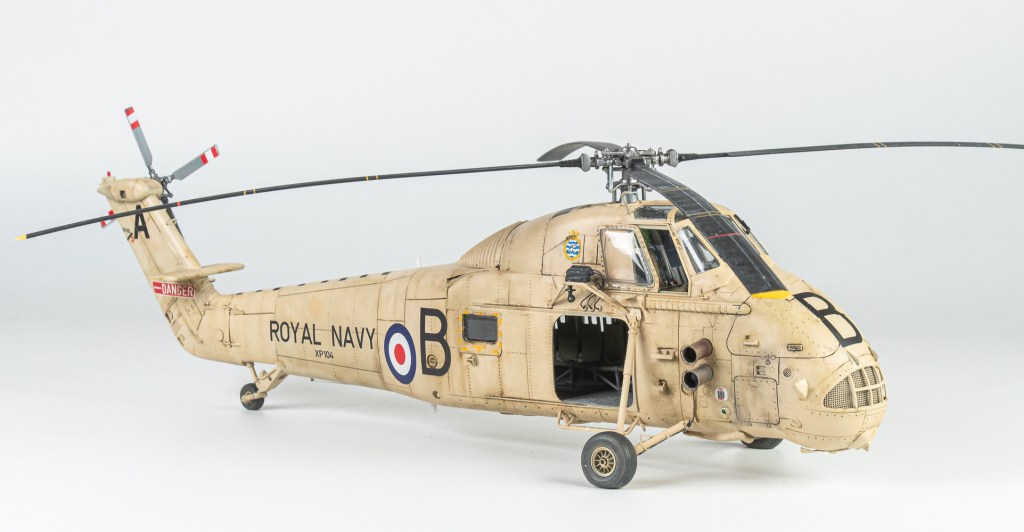
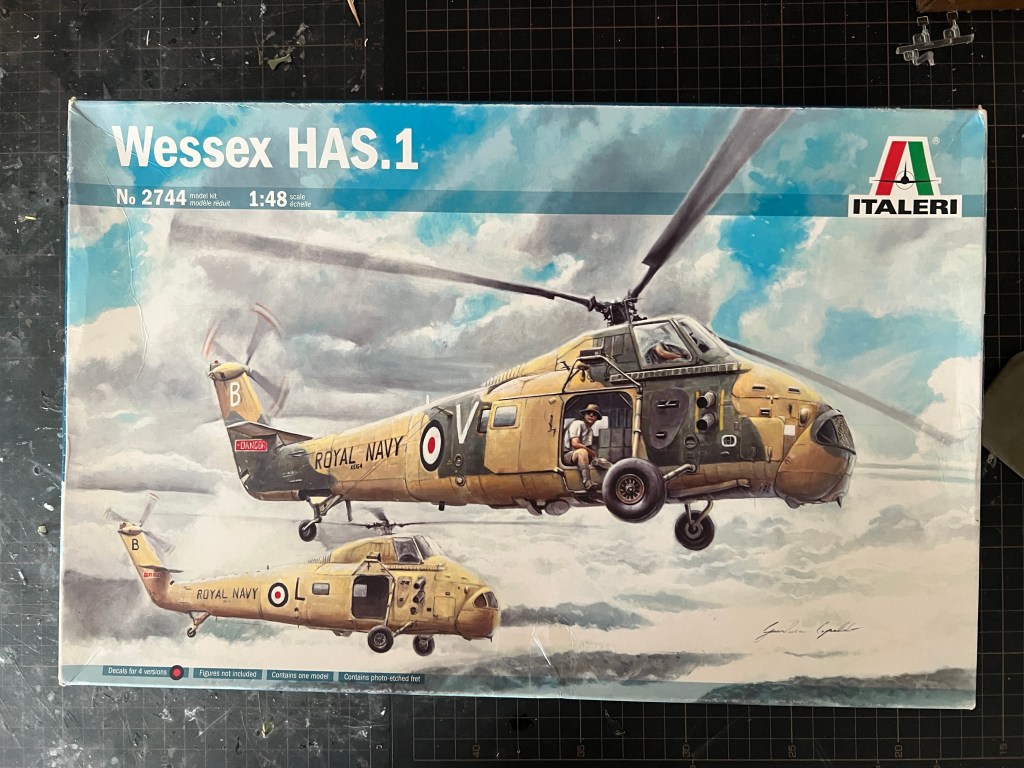
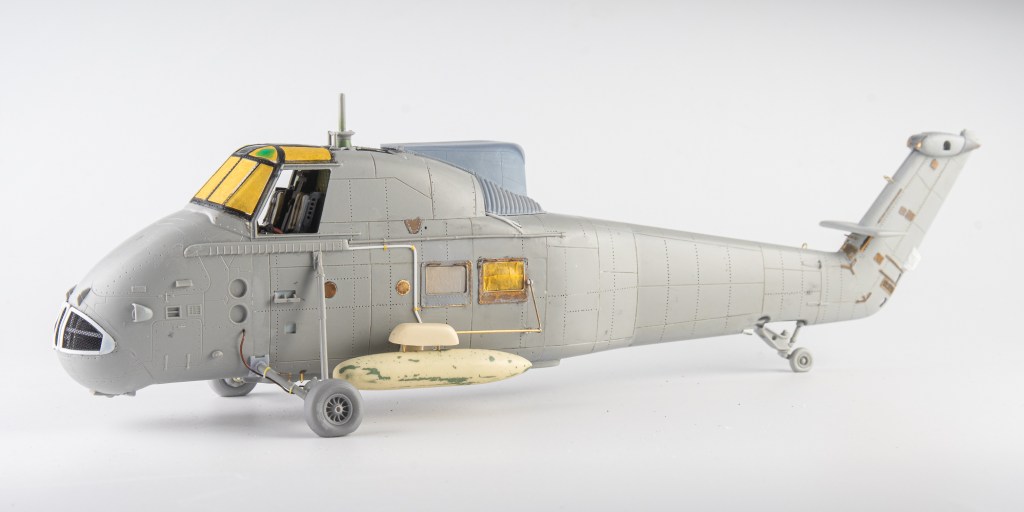
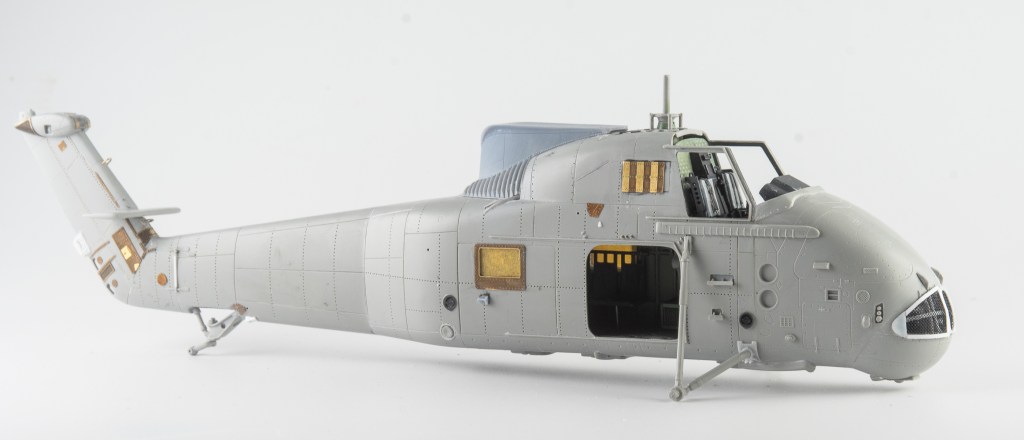
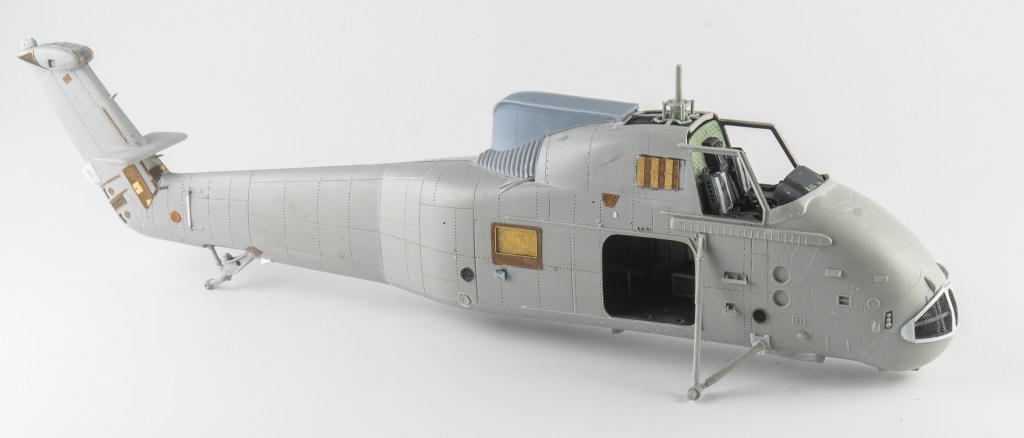
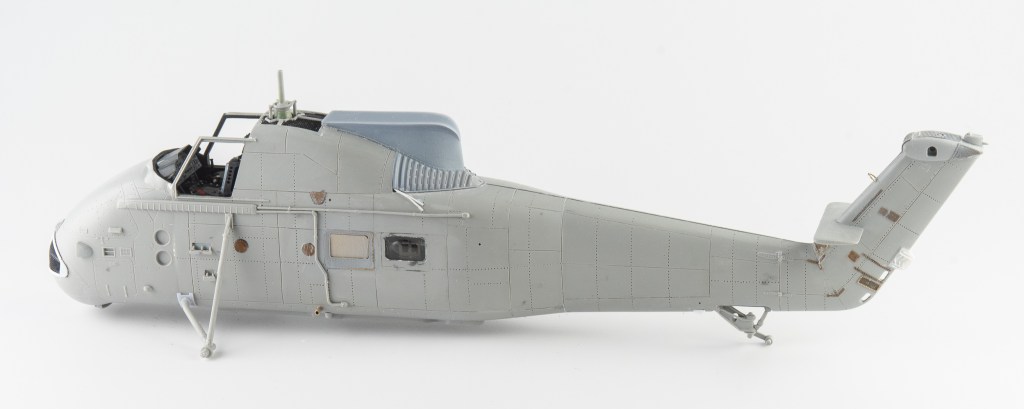
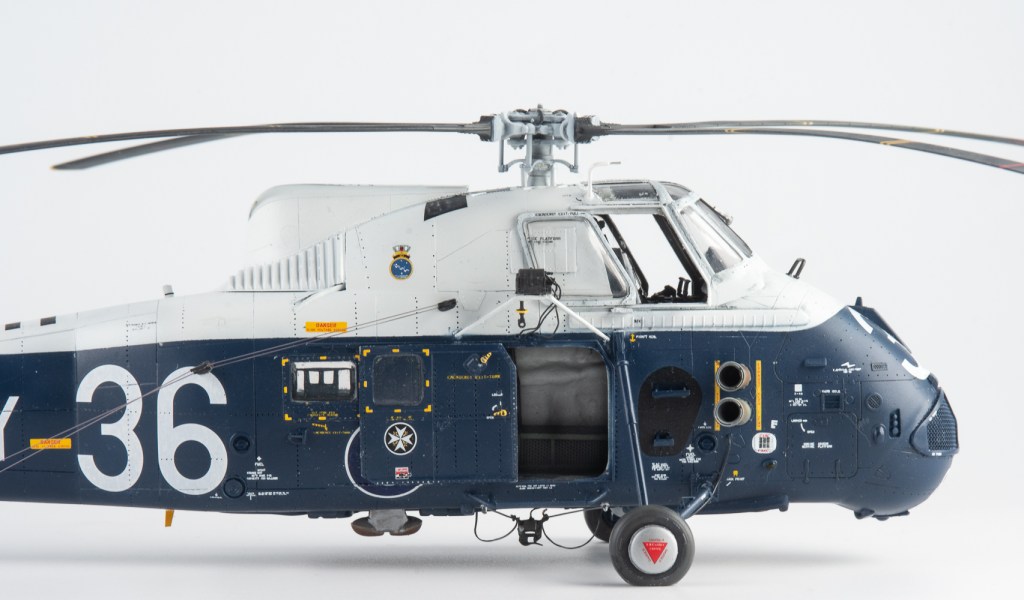
Italeri 1/48 Wessex HAS1

  • Purchased: 2025
  • Built 2025
  • Enhancements
  • Interior – Eduard Wessex Cockpit set for Wessex UH5
  • Exterior – Eduard Wessex exterior set for UH5
  • Exhausts – Hendie Scale Models
  • Lobsterdeck – Hendie Scale models
  • Wheels. Armory
  • Decals Kit

Introduction

Despite my previous Wessex build feeling at times like a bit of a slog, I still felt like there was one more left in me. The green and sand scheme on the box. quite appealed to me.

But, where to find one though? Turns out these things are like rocking horse poo, Italeri no longer producing the HAS1 boxing.

However, by a great stroke of luck and planets aligning, a local club member was selling one, so it was promptly snatched up. My second Wessex build was on! Would I regret it?

Construction Notes

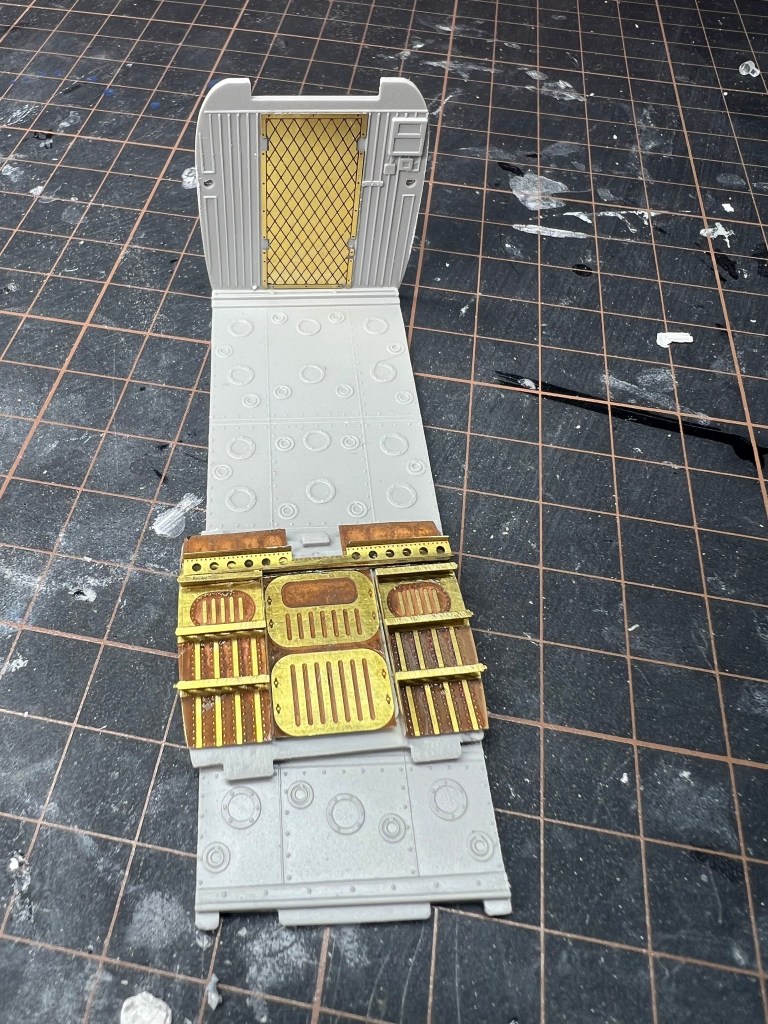
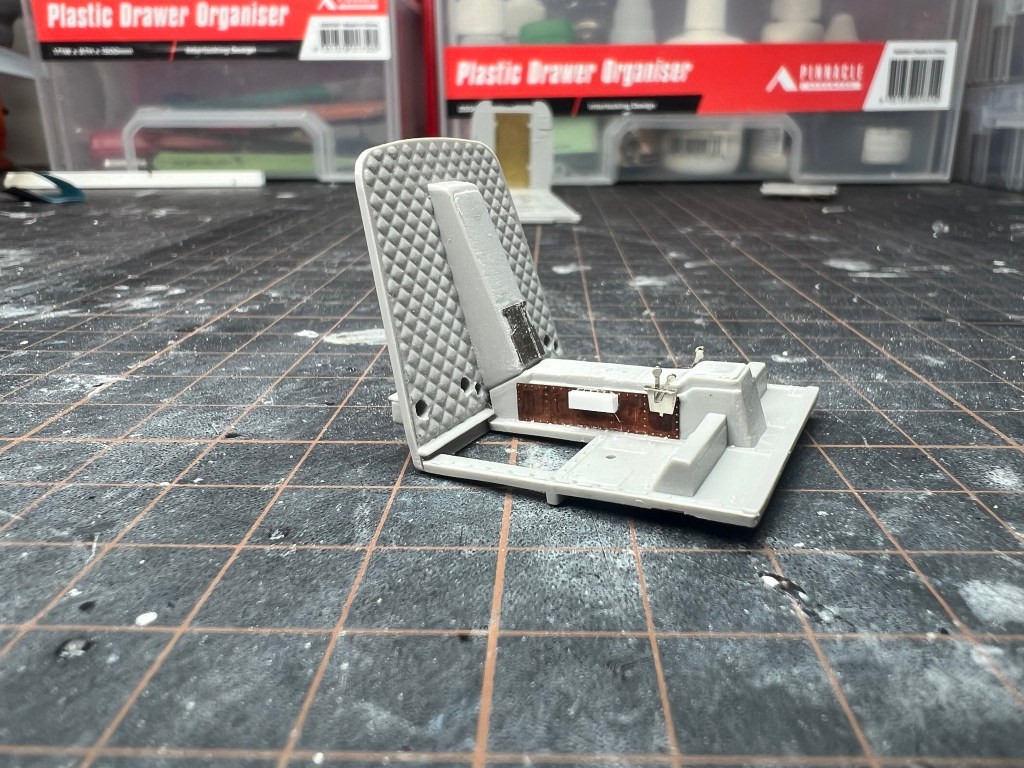
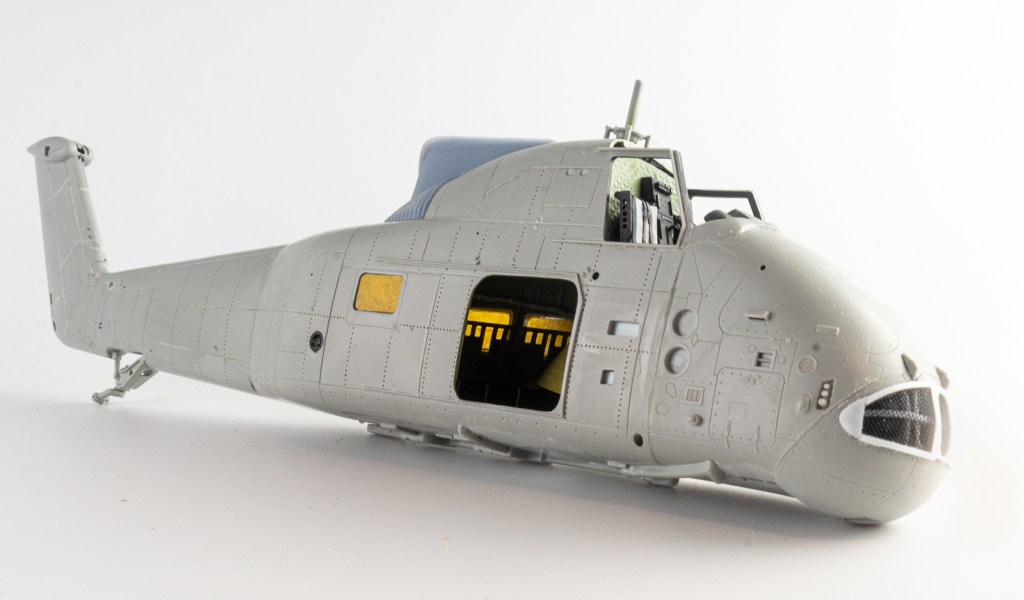
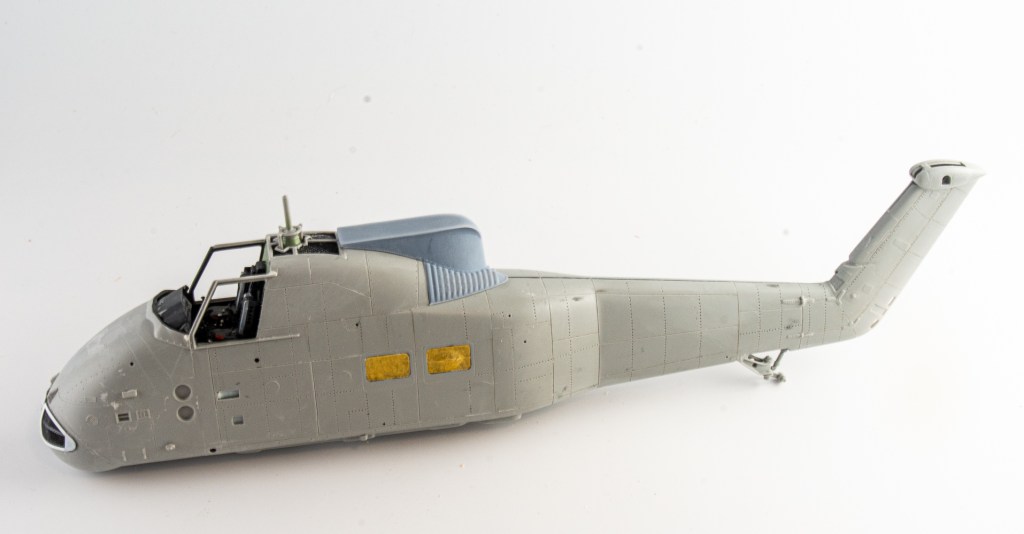
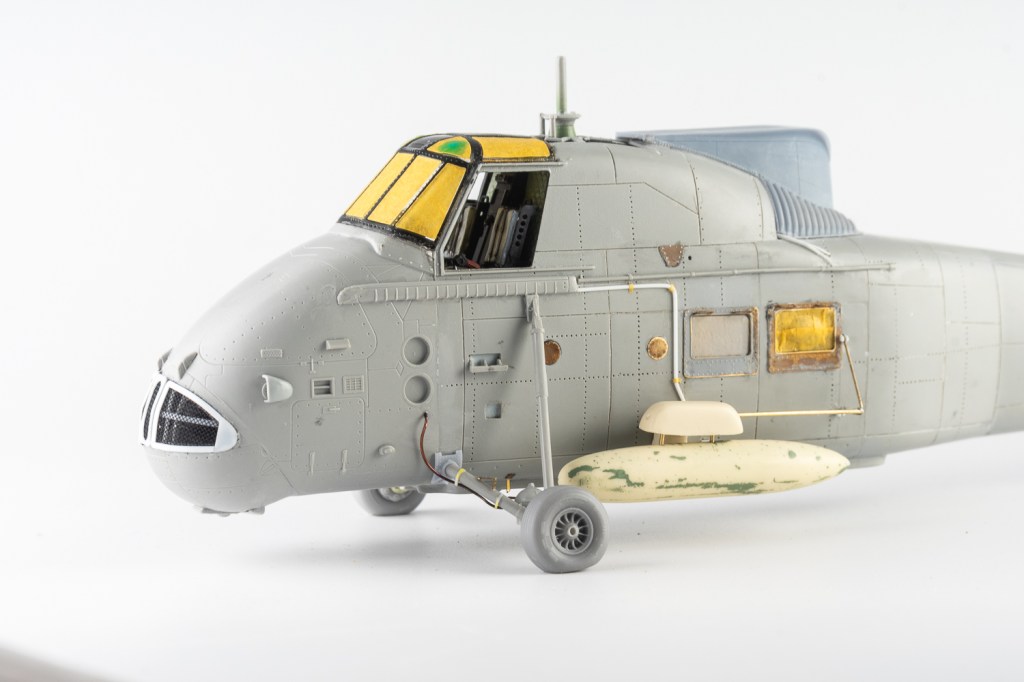
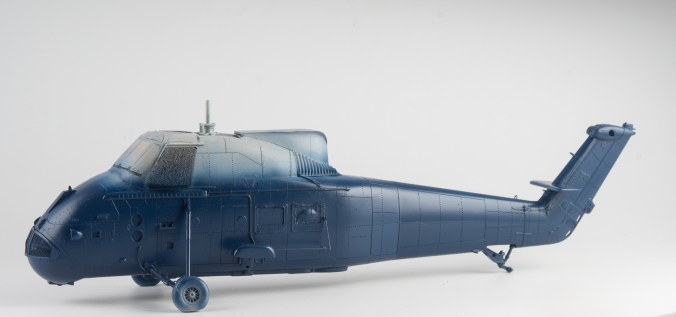
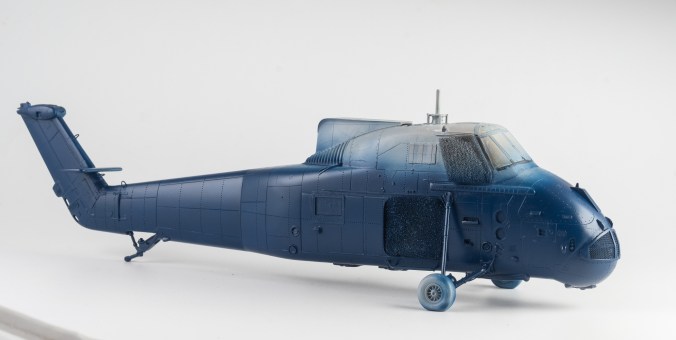
Construction of the Italeri Wessex has been outlined in my 31B article, although with this kit , I employed an Eduard cockpit PE set, Instead of building up complete PE seats, which would have been very fragile and would not have had seat cushions anyway, I chose instead to just add the seat PE side pieces as veneers to the kit parts 4c and 5d. This also had the added benefit of retaining the plastic seat locating pins so that a much more solid fit was achieved between the seats and the rear bulkhead. This would have been an extremely fragile fit just using the PE seats.

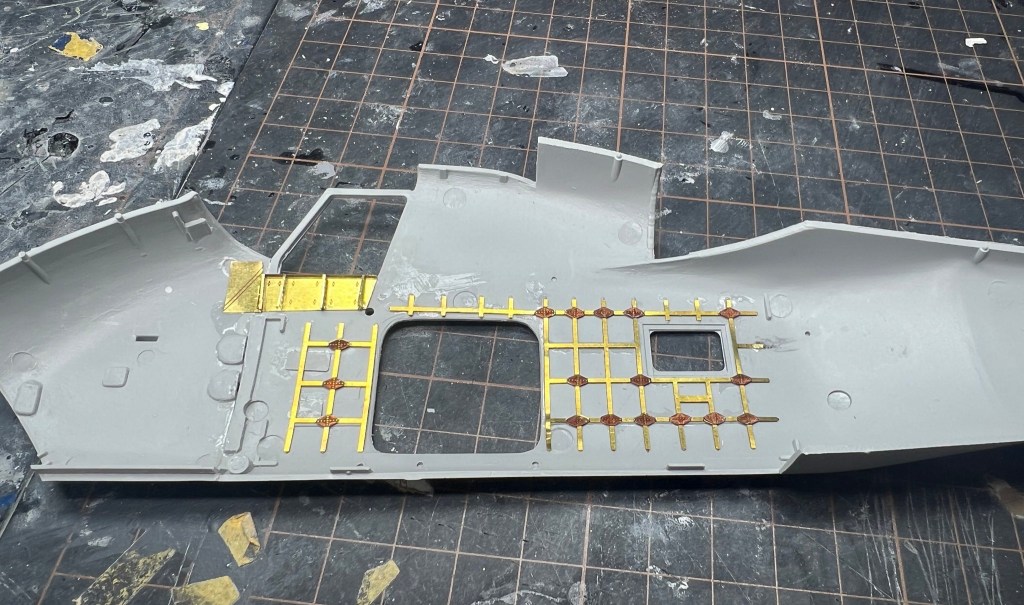
For the cabin, the same Seaking that had its seats raided for the 31B gave up its last remaining seats for this build. PE from the Eduard Wessex UH5 set was added to the kit interior framework, which surprisingly added some much needed depth to it.

The rest of the build proceeded fairly easily with the same fit issue around the hellhole mesh framework part 18A as the previous kit., although this time more care was taken with reinstating the detail around to make it look like a separate panel. Again, the windscreen was not the best fit, requiring filling around its base. Also in common with the other kit was the terrible pebbled plastic that required a lot of sanding and polishing to get a smooth surface, although in hindsight, I could have still put a bit more effect into this. Hendie’s 3DP parts again provided the lobster deck and exhaust pipes.

Painting and Decalling

I usually decide on the scheme before starting the build. This case was no different with the camouflaged version  being chosen..

However once the light sand had been applied, using Tamiya LP27 Light Sand, I decided an overall light sand machine would look quite different from other Wessex models that had been looked at on the various modelling fora. ( Yes, sites such as BritModeller are still visited on a weekly basis)

Over the existing sand coat another coat lightened with Tamiya buff was mottled and streaked in random patterns. To this mix, white was added and some random streaking applied, which imparted a bit of a bleached look to the colour. Things were progressing nicely. A thin wash made of Sepia oil paint was then applied to all the panel lines and rivets. Opening panels had a black wash applied. The next day a gloss coat using SMS Gloss clear was applied and this too was allowed to set overnight

The kit decals were used and these performed magnificently, sucking down into the detail using a couple of applications of Gunze Mr Setter. Again, the decals were left overnight to completely set and allow the decal solutions to work their magic. Allowing these things to set overnight is a recent new technique for me. Yes I know lacquer is dry within an hour, but this allowing these coats to set properly has rewarded me with hardier paint coats that less easily chip and scratch. These days, I also wet sand with micro mesh between coats.

The next clear to go on was a VMS satin coat to allow some key for the oils which were going to be used for further leaks and stains. Various photos of the real machines found on The Imperial War Museum website showed them surprisingly clean and free of leaks , although there was quite a lot of staining from grubby fingerprints around the nose access doors. Ammo Starship Filth was my weapon of choice in achieving these, whilst Sepia was used to add various rain streaks from window frames and the conduits on the fuselage. The exhausts were painted with steel and then very thin coats of Alclad Sepia and Violet glazed over the top with the airbrush.

Final Assembly

The wheels were painted AK Rubber Black with sand hubs, then Mr Weathering Color Sandy Grey liberally applied over everything., taking care to ensure no pooling. This imparts the tyres with a lovely dirty warm colour. The treads had a black wash run into them.

The winch was added with the plumbing from 0.2mm lead wire, then the previously painted rotors were added. Lastly, the clear parts were unmasked. Everyone’s favourite part of a build although, always done with trepidation. On this build, there is a slight glue blemish on the windscreen. So close!

One day, I will be rewarded with truly clear flawless clear parts.

Conclusion

Im still surprised that after finishing one Wessex, I immediately wanted to do another, given the Italeri kit is not the best- albeit only- starting point in 48 scale. What can I say. I just love the subject. Its such a purposeful, brutish looking machine, very Cold War British

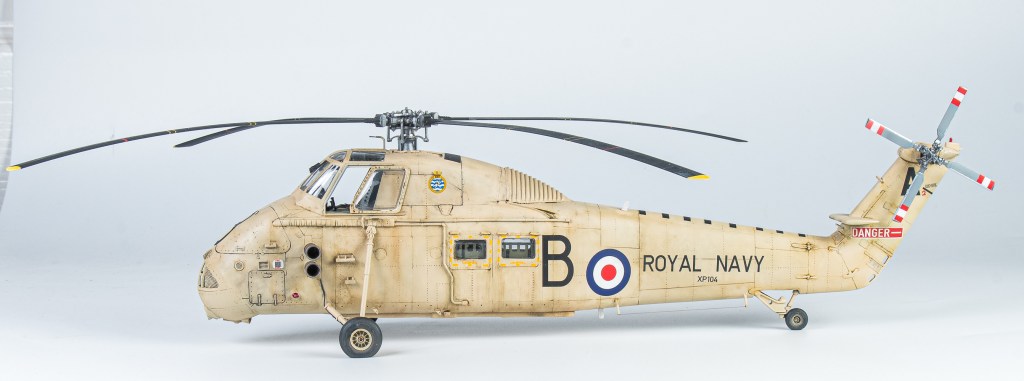
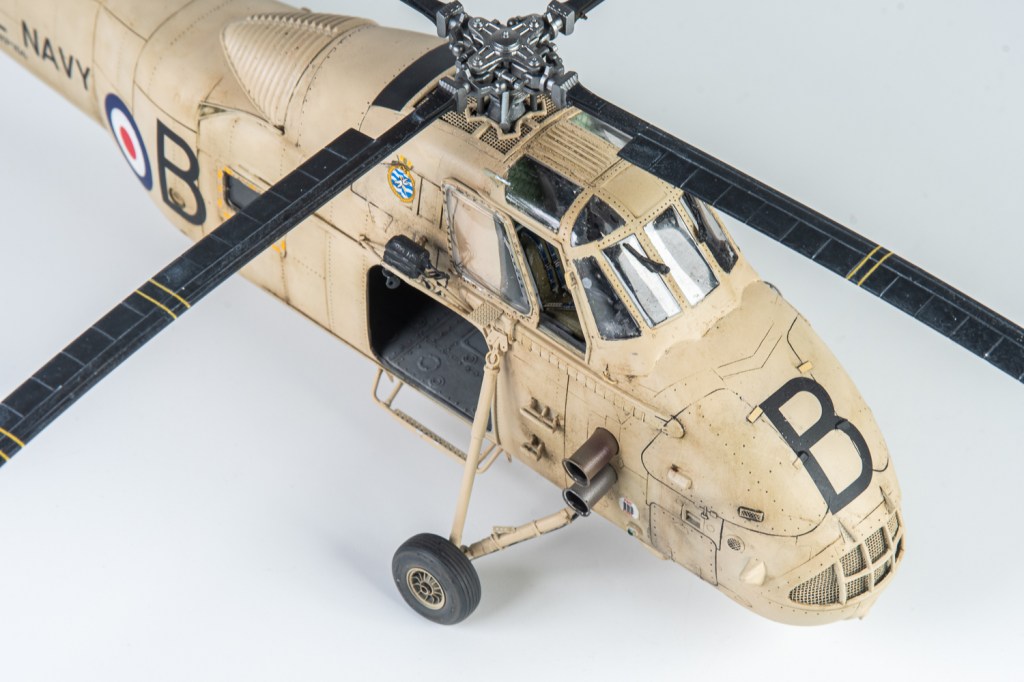
The overall light sand colour serves to emphasise those big code letters, D type roundels and Royal Navy titles. I love it, its now one of my favourite builds, but that’s it for me and the Italeri 1/48 Wessex.

Westland Wessex HAS1. 945 N.A.S Royal Navy. Borneo. 1962

Leave a comment

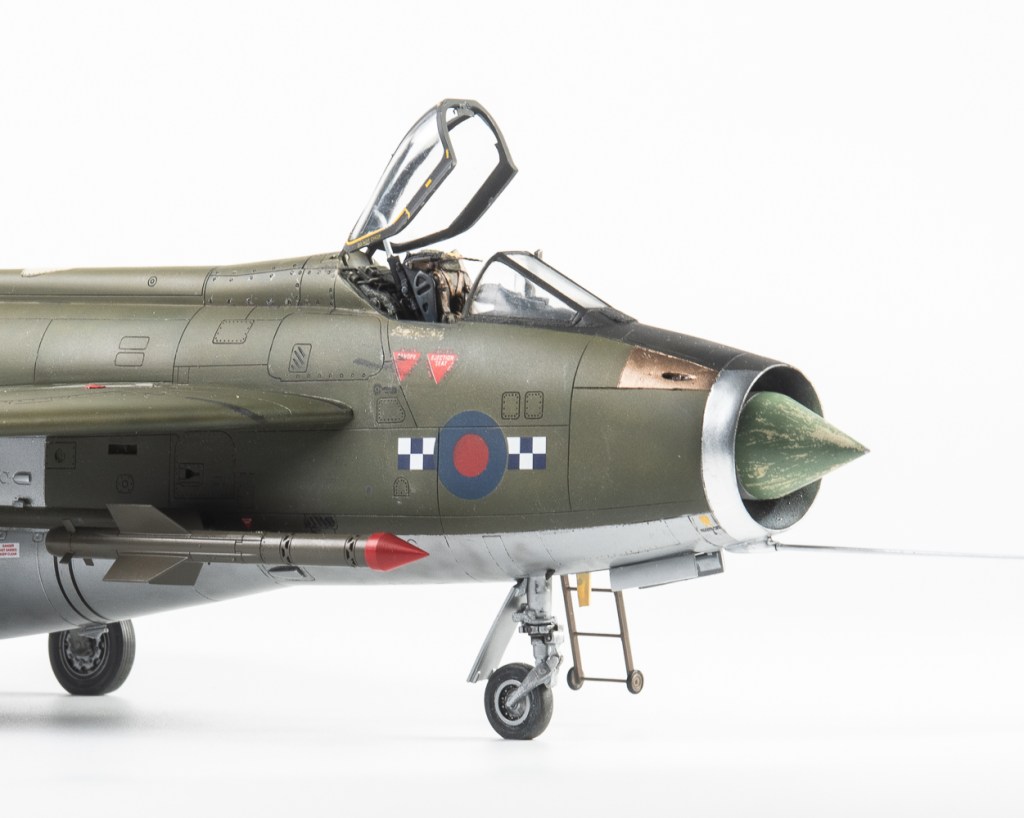
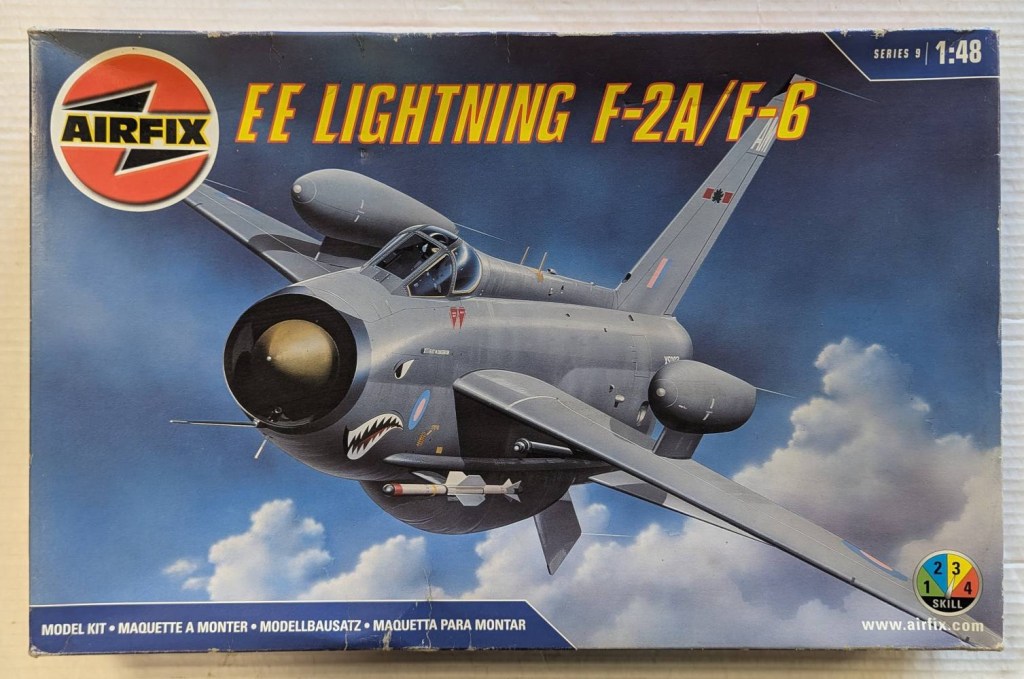
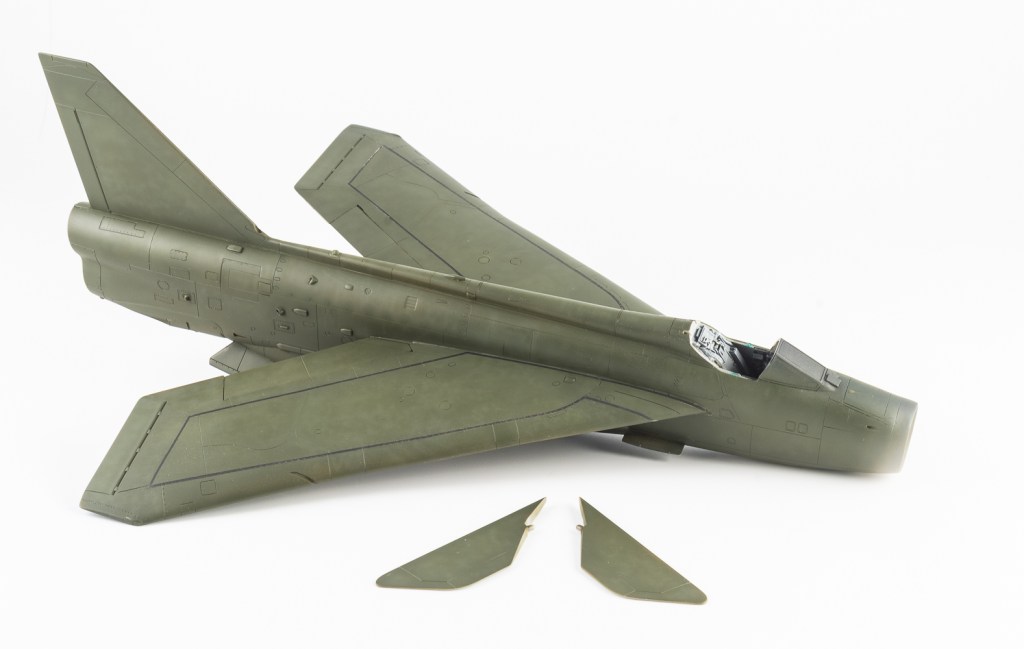
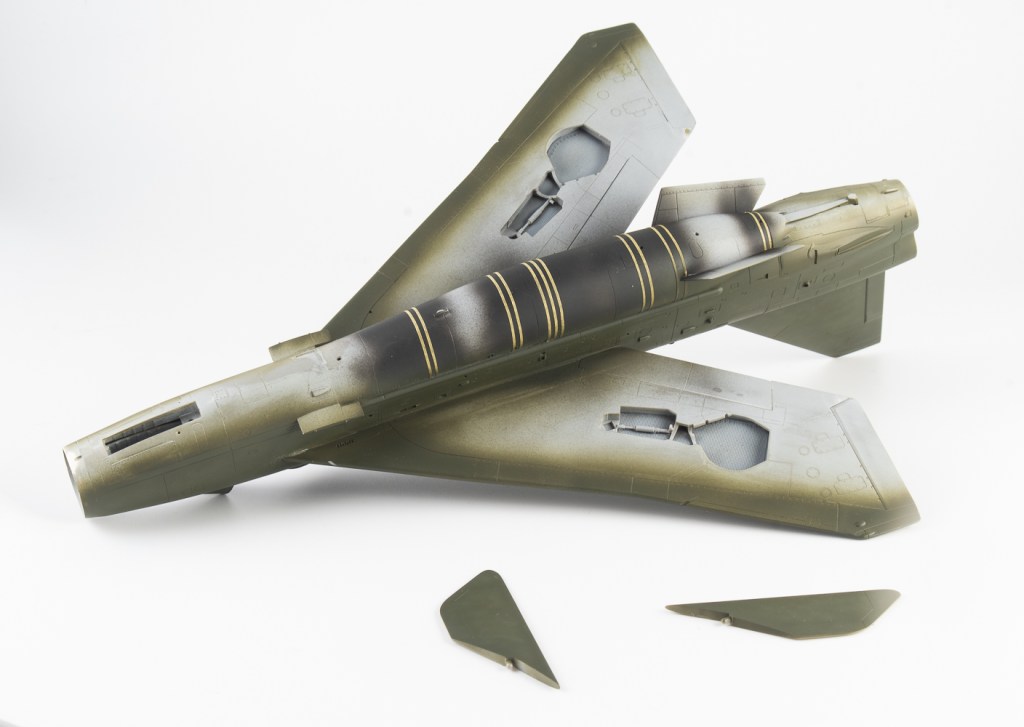
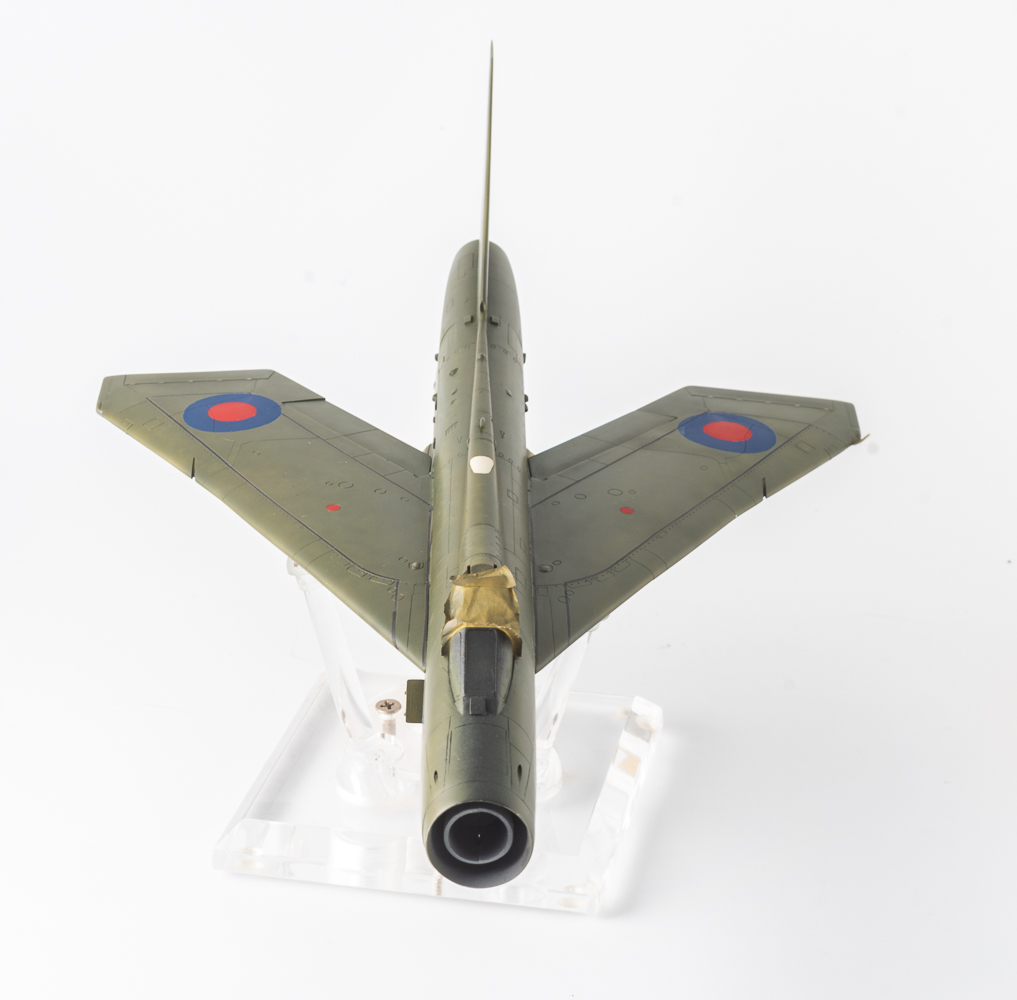
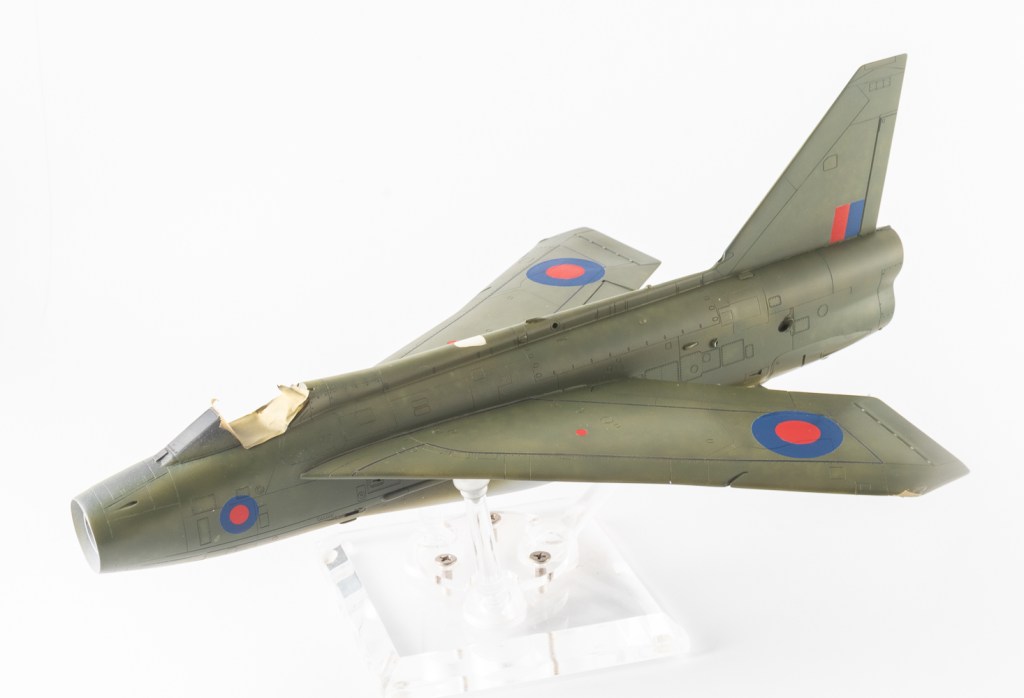
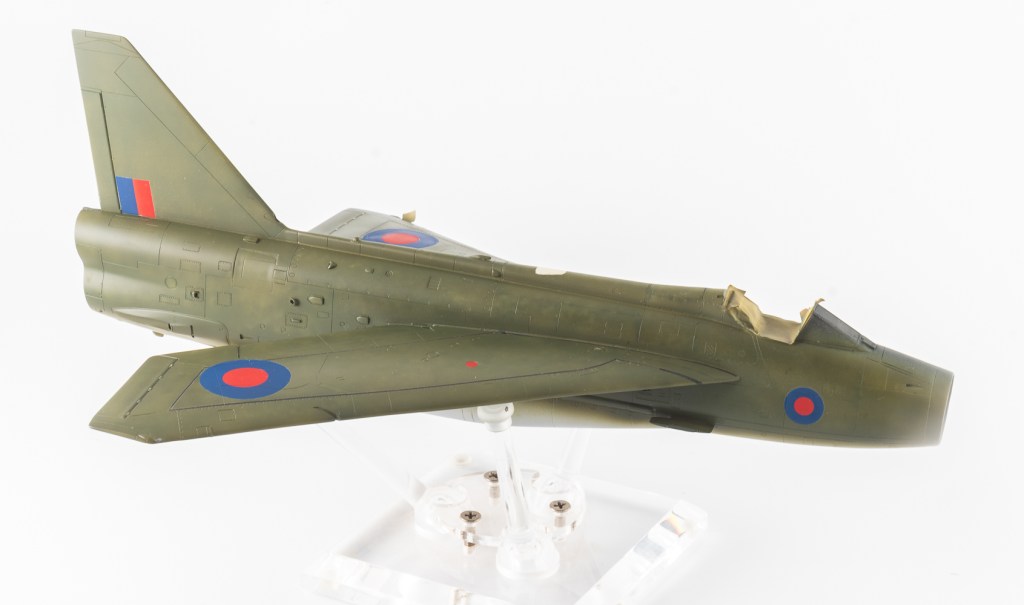
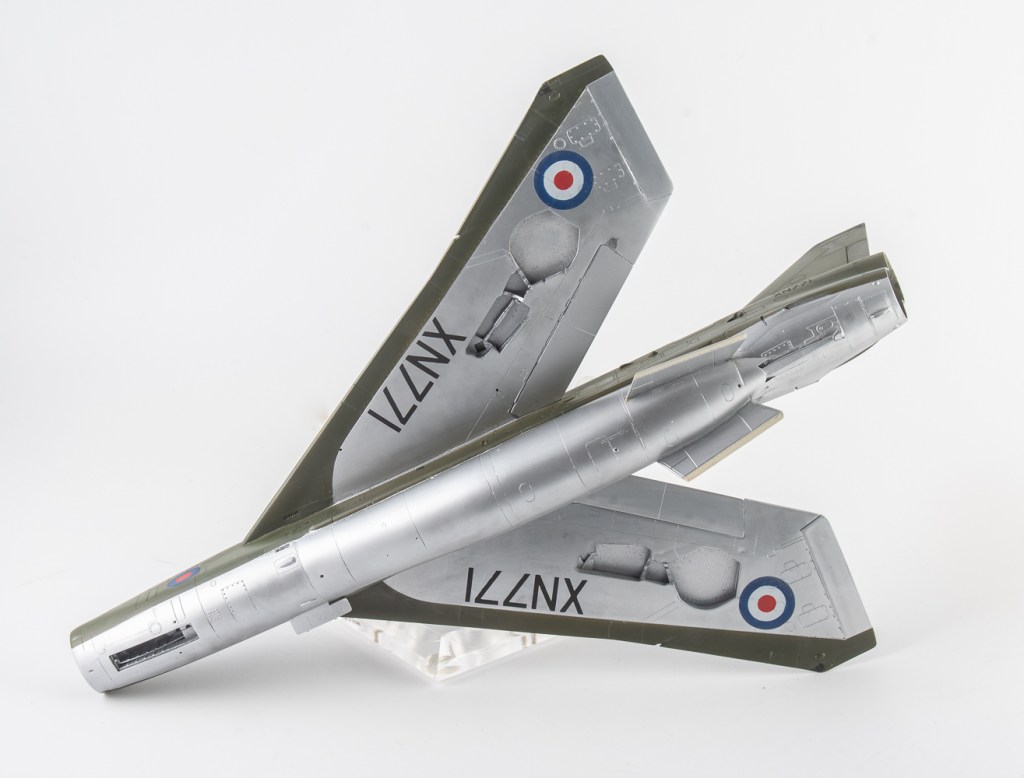
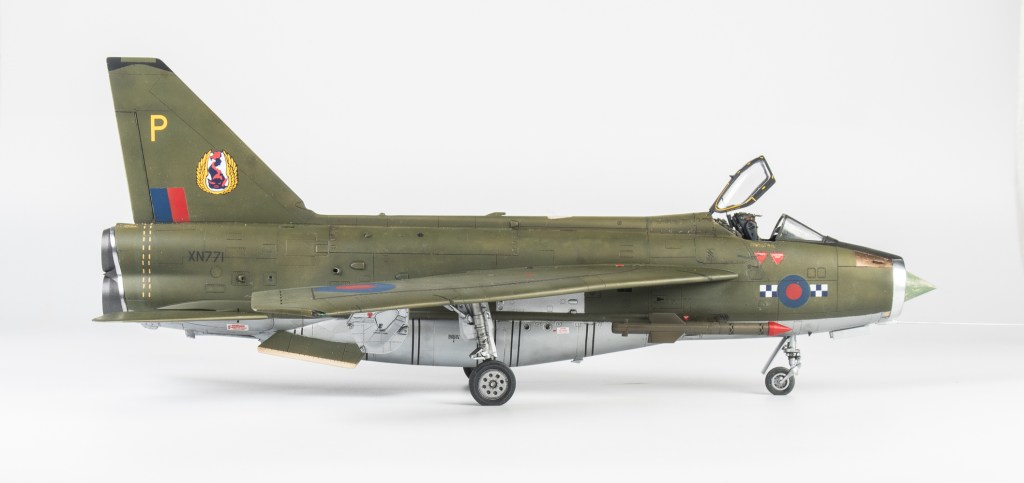
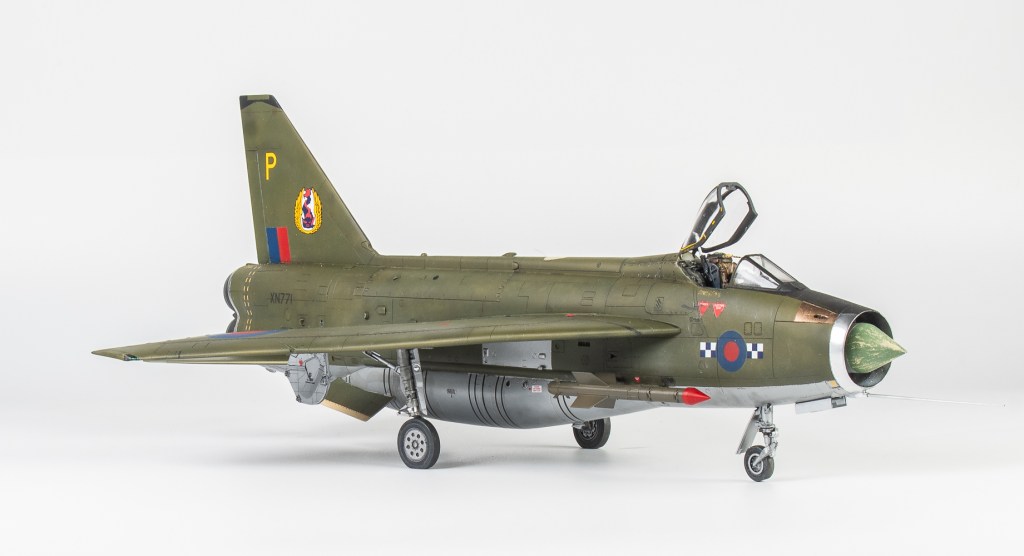
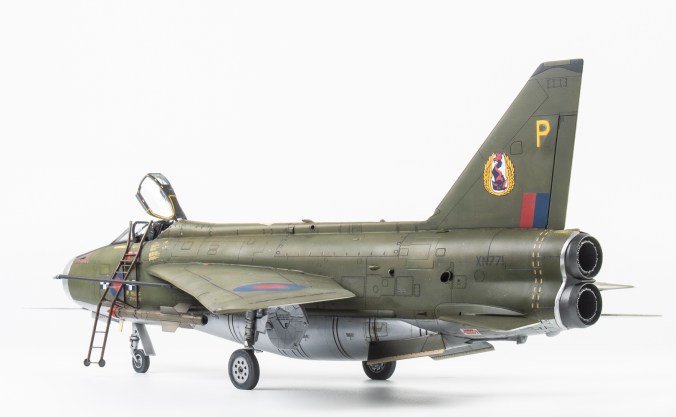
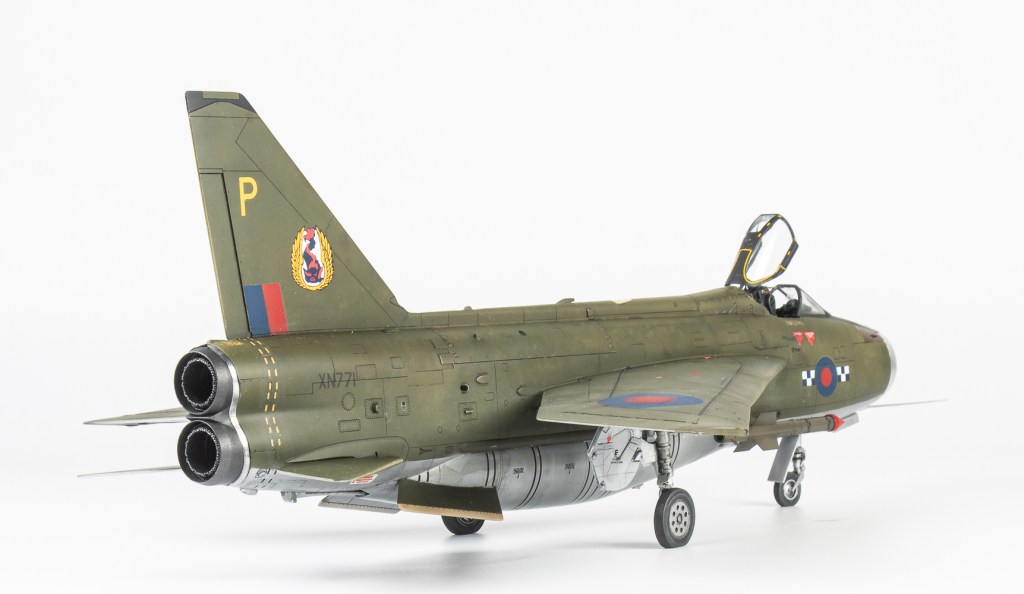
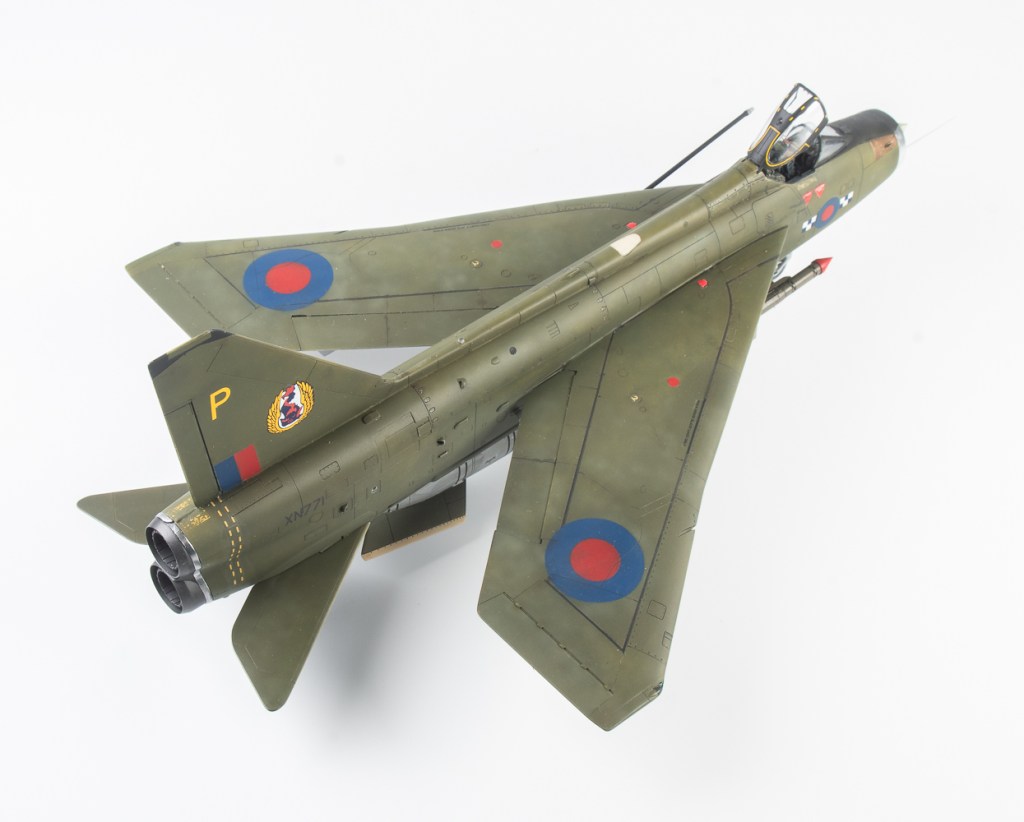
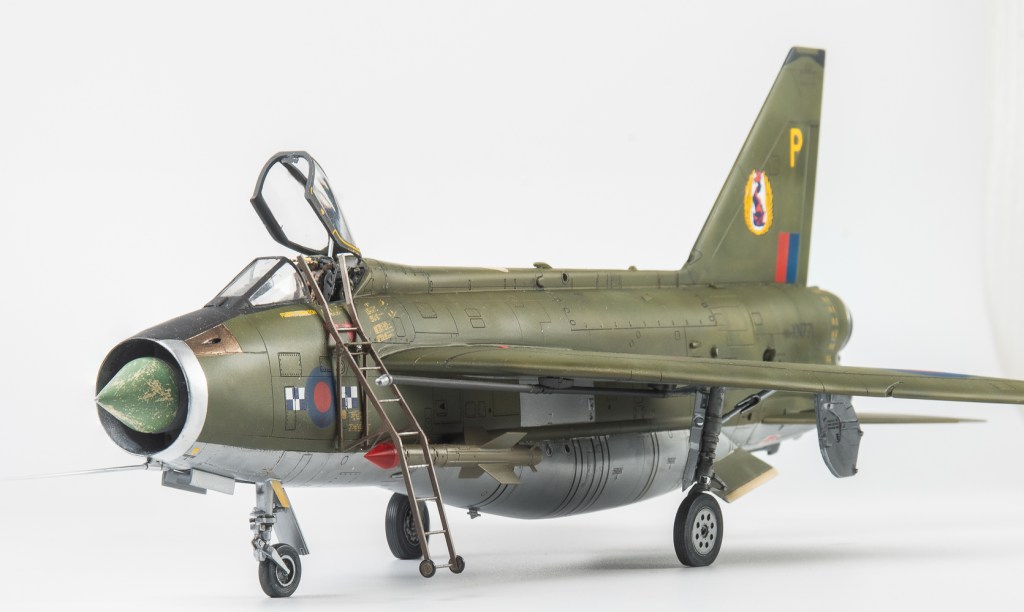
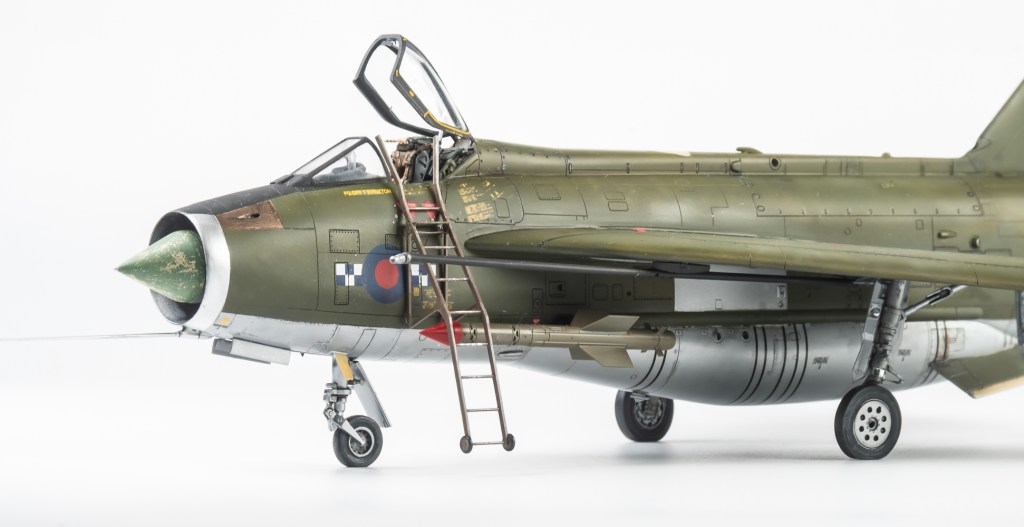
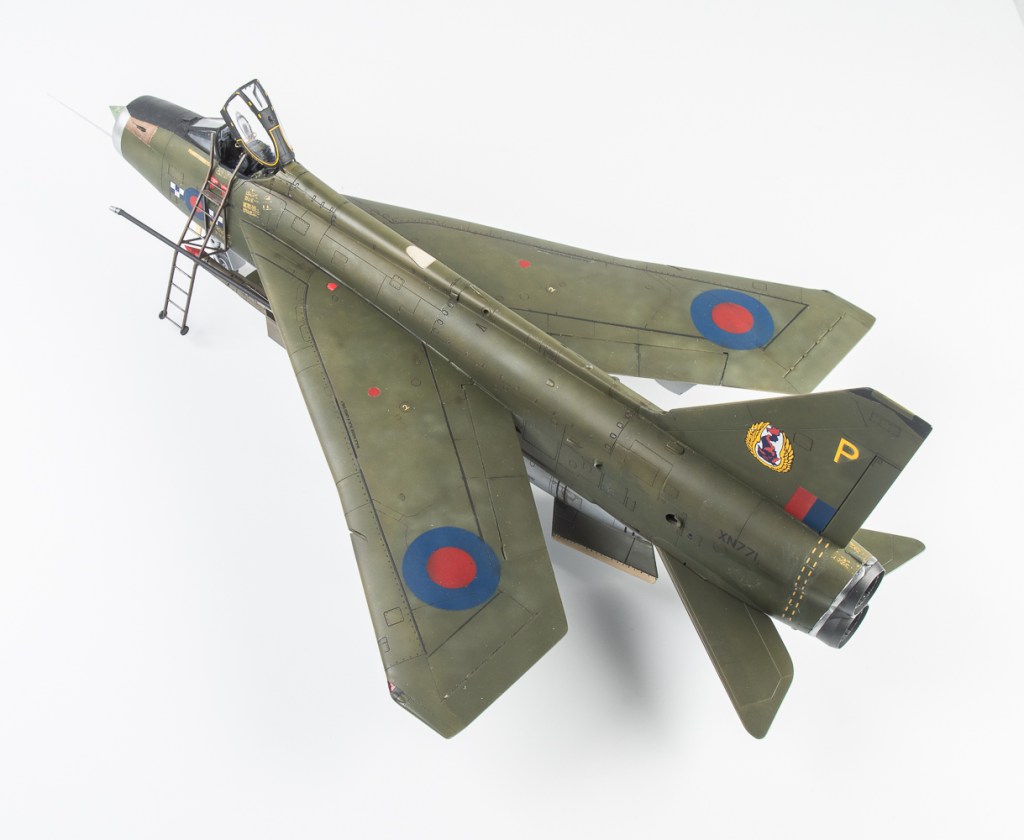
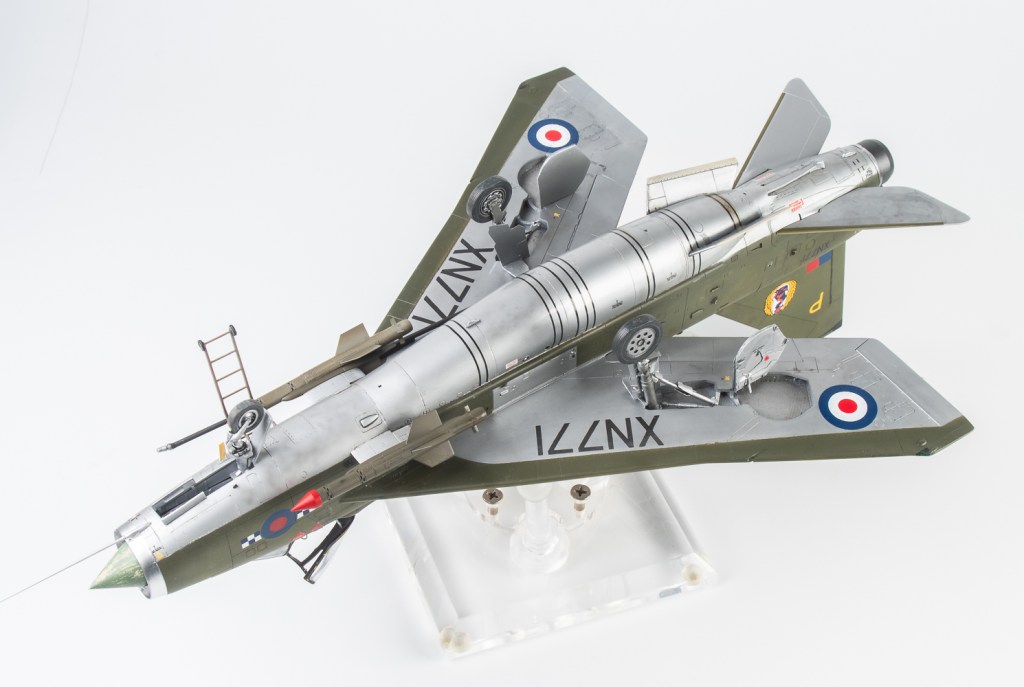
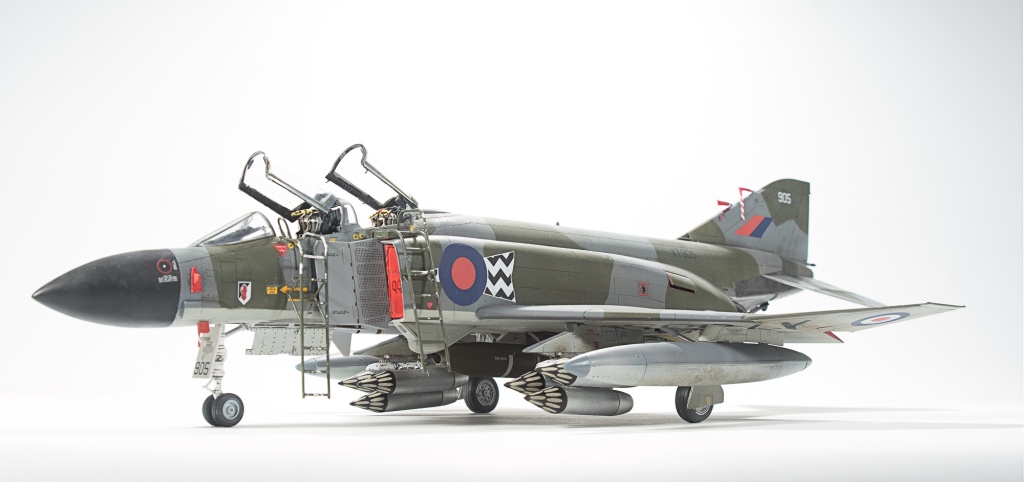
Airfix 1/48 Lightning F2A

image credit. Kingkit website
  • Purchased: 1998
  • Built: 2025
  • Enhancements:
  • Cockpit and seat – Cutting Edge
  • Wheels – Armory
  • Exhausts – Reskit
  • Wheel well roofs : Eduard PE
  • Missiles – Reskit
  • Pitot Tube – Master Details
  • Ladder: LP Models
  • Decals- Cutting Edge, then Model Alliance, then painted!

Introduction

This, after the Phantom is the oldest kit in my stash. It was purchased shortly after its original release from Wonderland Hobbies Scotland for the princely sum of 21.99 pounds according to the sticker on the box. Back when the only way to order kits from overseas was to actually telephone the shop! Back in the Jurassic Period before on-line ordering became the norm.

Upon release the Airfix Lightnings were lauded in the modelling press as Airfix at its zenith. And many modellers, particularly those from the UK still seem to think this.

This modeller though certainly does not. Perhaps if I had built the model upon its release, my impressions of it too, would still be favourable. However, building it in 2025 and measuring it – perhaps unfairly – against newer Airfix kits brings forward all its shortcomings. In fact, even measured against contemporary Japanese kits, it falls a little short. Poor cockpit details, no wheel well detail at all, vague instructions, sink marks, thick decals. It certainly was not the kit I was expecting. A mate came to the same conclusion after building his. The kit was the subject of the Annual friendly Build-Off between The HamFisted Modeller and myself. The results are judged at a local competition we both attend. It should be noted that HFM handicaps himself to give me a chance. (EDIT.) Suspiciously that last sentence only appeared after I sent the article to HFM for proofreading

Construction Notes

The Cutting Edge Super detailed Cockpit upgrade was one of many aftermarket sets stuffed in the box. It was used to replace the woefully detailed kit cockpit. Calum had stated that pretty much nothing of the cockpit can be seen anyway. Anyway , as I had the set, it was used. Unlike an Aires set, minimal sanding was required to make it fit. Just the backs of the sidewalls and some material removed from the casting block to ensure the tub sat down over the intake trunking.

The cockpit was painted with MRP Medium Sea Grey, this being a later mark Lightning.

Building the intake we come to the first “WTF Airfix?” moment. The bottom of the nose wheel well is a rectangle to fit the wheel well opening. Airfix want you to mate it to the top half which is an elliptical shape. This of course leaves large visible gaps. I left it as is, as there id very limited viewing up into the well. Very poor engineering on Airfix’s part.

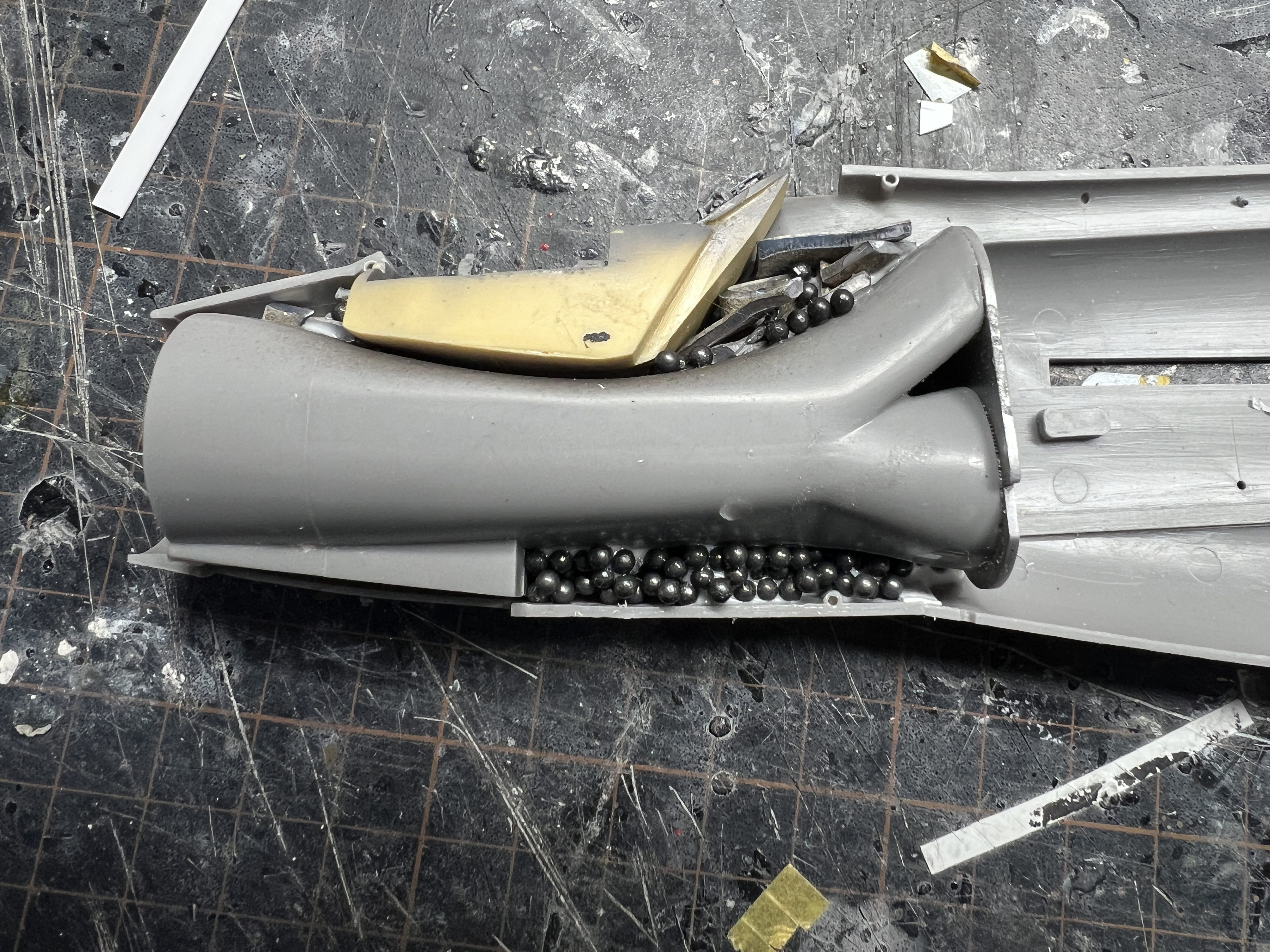
Take care to ensure the radar bullet nose cone is central in the intake. Also don’t forget the nose weight, remembering to take into account the added weight of resin exhaust cans if you are using some. Airfix helpfully includes a diagram in the instructions of the best place to pack it. The fuselage on mine closed up OK, but the panel lines did not align across the seams, requiring them all to be filled and rescribed. The nose ring is a poor fit and will require fairing in.

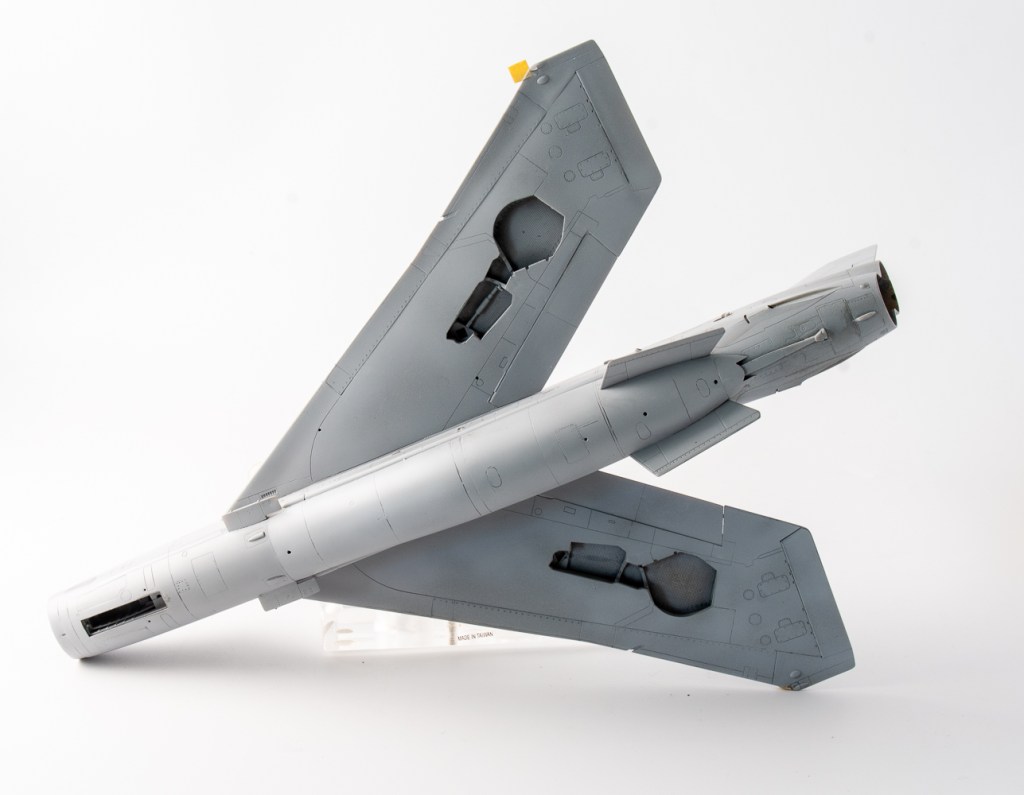
Onto the wings, and mine were looking a little warped. There were also several sink marks requiring filling. Airfix provide absolutely no wheel well detail. CMK and Aires both have resin sets in their ranges. I decided to steer clear. I knew full well the work these would require fitting to the model. Instead, The HamFisted Modeller generously provided an Eduard PE set. It was put to use to add the distinctive patterned roofs to the wheel wells. It is very worth your time to set up the undercarriage leg components now. Dry fitting them helps in seeing how they fit together. You must carefully look at photos of the real jet. The Airfix instructions are of no use at all. I had to add small blocks of sprue to each leg to allow the retraction strut to locate. There is nothing moulded on the leg. Again, really poor engineering by Airfix. I must apologise here as I thought I had photographed this step, but apparently not!

Out of the box, the kit wings do fit to the fuselage quite well, only problem is they are level, whereas the real wings had slight anhedral. Adding this to the kit wings left a slight gap on each top surface which was filled with Milliput

So far, despite the noted annoyances, the model had gone together reasonably well, and construction progress was swift. Unfortunately this was about to change rather drastically with the decalling.

Painting and Decalling

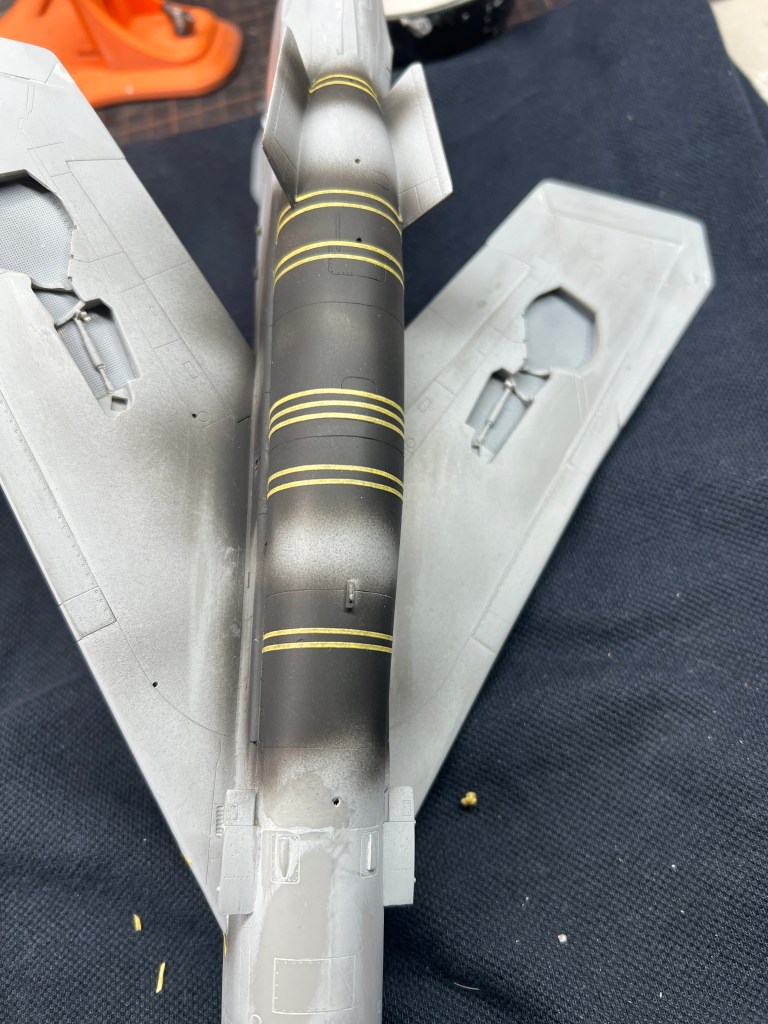
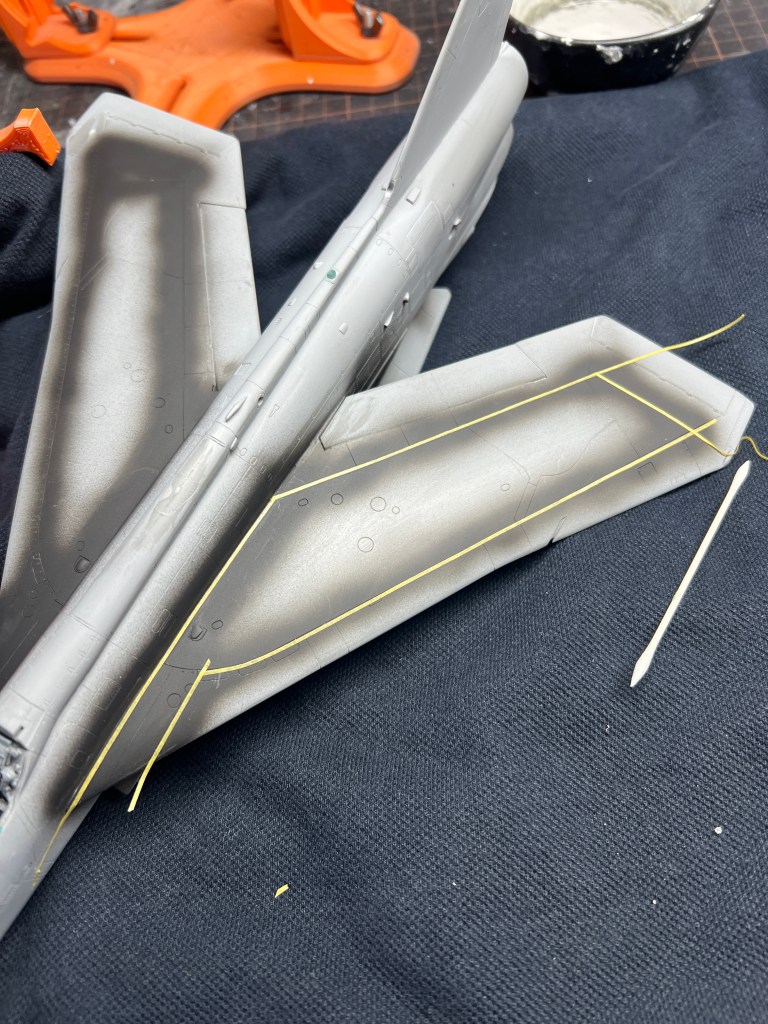
To limit the chances of silvering, I opted to paint the walkway and tank stripes. First, I applied a coat of matt black. Then, I masked out the stripes with thin strips of tape.

For the top surfaces, Gunze Mr Color 330 was used. Lightened as out of the bottle it is quite dark. Various shades lightened with yellow and white were applied with the undersides being spread with Tamiya LP-11 Silver

I was actually quite pleased with the appearance of the model. at this point so it was straight on to decalling. After applying a coat of Tamiya Gloss varnish. The decal sheet I was using was a Cutting Edge set. It had far better printing, colour, and register than the Airfix sheet. It should be noted that the sheet in my kit was the original issue. Later releases of the kit have included better printed decals

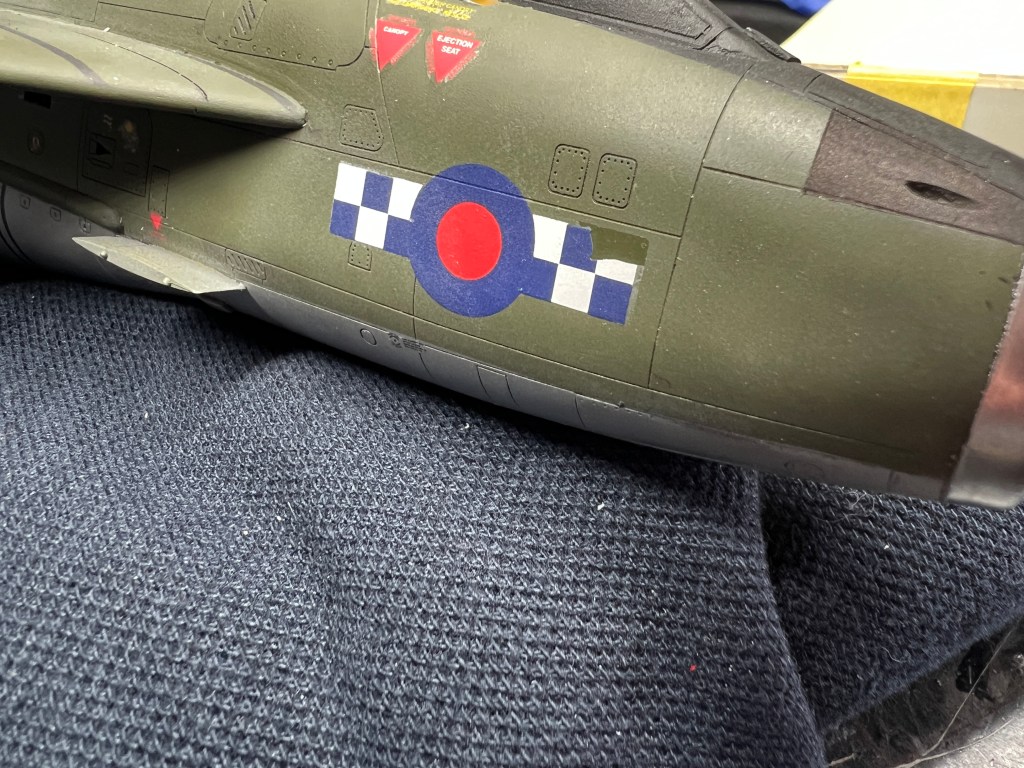
The Cutting Edge decals looked fine on the sheet, so the two large upper wing roundels were applied. One promptly tore whilst moving it into position , and the other separated into bits whilst in the water. Not a great start, but not to worry as these would be easy to mask and paint. Next up were the various individual jet markings. All decals were sandwiched between a layer of Mr Setter and Mig Ammo decal solvent.. I rolled a cotton bud across some of the decals to squeeze out excess solution. This revealed some of the decals were not adhering to the model very well..

A sealing clear coat was applied. Then, a wash using Tamiya dark Brown accent colour was run into all the panel lines. It was now that the lack of adhesion from the decals started to give me problems. After inspecting the model, I found that I had managed to remove the face of the gargoyle at some stage. Possibly with my sticky mitts! This was patched using a bit of the Airfix decal. Further handling of the model pulled the nose checks off, despite my gloves and the protective gloss coat. Some of the underwing serial numbers also pulled off, again requiring replacement.

SMS Matt coat was used to dull down the gloss to achieve the flat finish I wanted. SMS is one of my favourite matt coats, drying to a low sheen smooth finish. Not this time though, as there was frosting evident around the flanks of the fuselage behind the wings.

With its mid mounted swept back wings, the Lightning has a multitude of tricky areas to get an airbrush into. All those right angles caused turbulence in my spray pattern. They resulted in texture and buildup of the clear coat. I had some frosting along the fuselage underneath the wings. There was also some silvering evident on some of the smaller decals. I was starting to feel like the model was getting away from me but I pushed on anyway as I really wanted it off the bench. Everything came to a head., when whilst masking off the nose ring, a corner of the tape caught the nose check decal. It pulled them off with far too much ease.

To be honest, the kit almost got binned at this stage, but I decided to sleep on it. In the morning, a thorough analysis was taken of my progress on the model. There were several aspects I was not happy with. These included the frosty matt coat, silvered decals, and textured paint. Therefore, the decision was made to strip it back to bare plastic. Also I knew a DNF (did not finish) would subject me to much “Gibson Grief”, and no-one needs that!

So, out came the VMS Clean Slate and after some vigorous scrubbing we were indeed back to a clean slate.

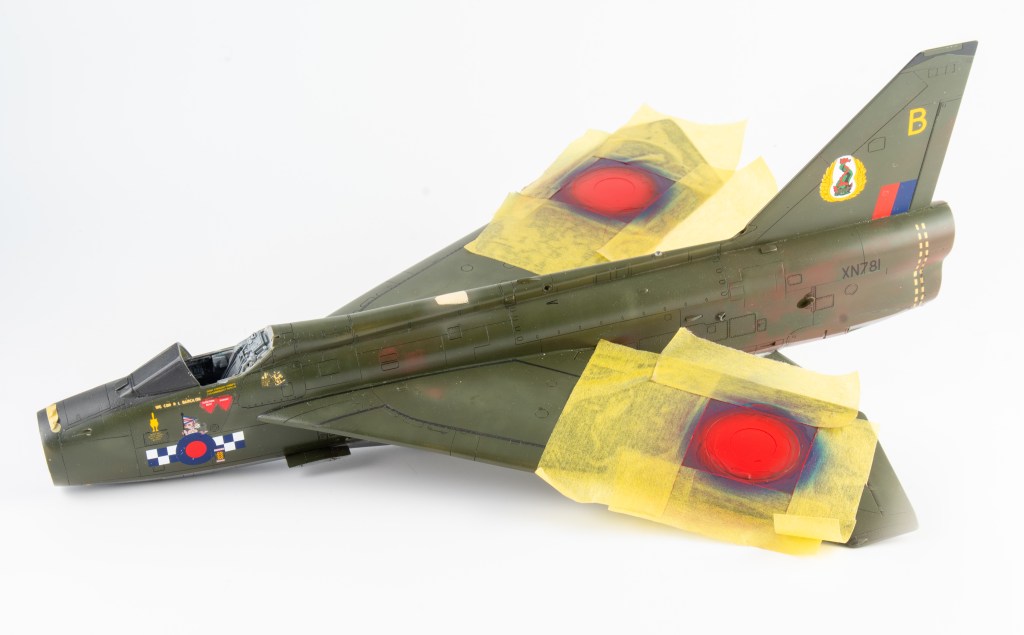
Then, it was simply a matter of repeating all the steps. This time, I painted all the National Markings and serials.

A mate sent me a set of Model Alliance decals for another jet from the same SQN. These were applied without issue. However, I had to scrimp on the stencilling out of necessity this time around. There were no yellow stencils left on any of the sheets. The Barracuda stencil sheet is very comprehensive. However, Roy, for some reason, includes none of the unique yellow stencilling seen on the RAFG jets. Quite a glaring omission in my book.

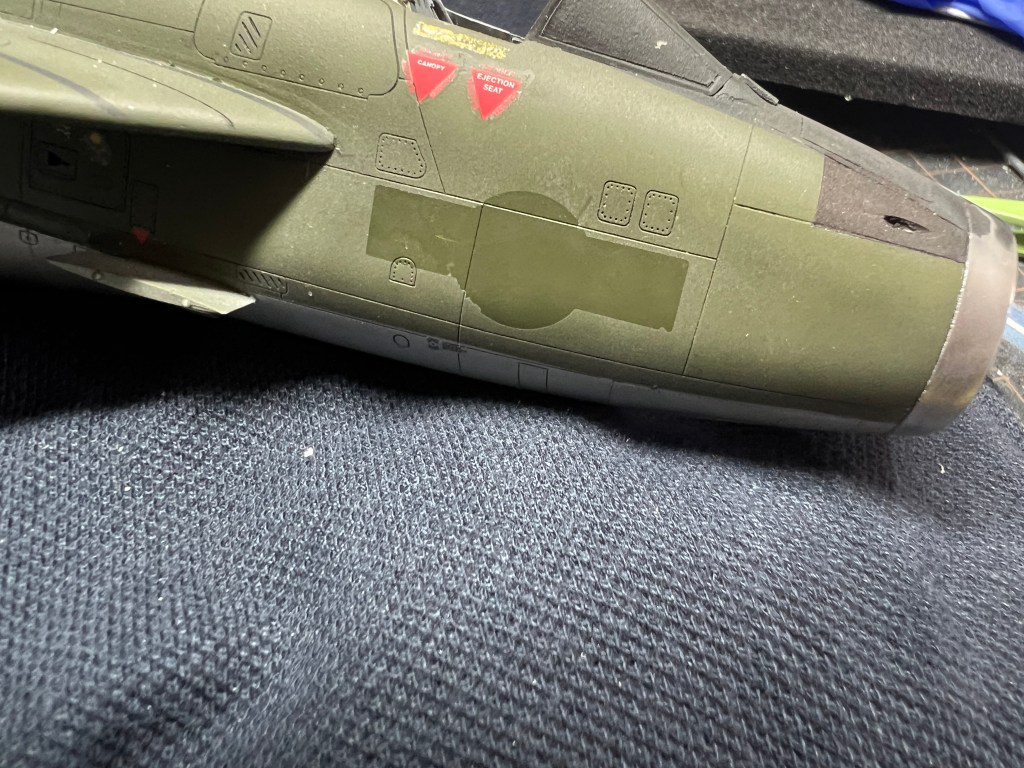
Again a Sepia wash was applied to all the panel lines. By this time, I was well over the model. Weathering was limited to some chipping around fasteners. This chipping was evident in all photos of these jets I looked at. The chipping on the nose cone was done using the hairspray method. That just left final assembly. Whilst the Reskit missiles are beautiful models in their own right, they lacked positive location devices. There was no way to mount them on the rails. I understand this is to preserve the detail on them and the rails. If you wish to mount them off the jet, 3DP should surely allow you to print them with solid locating pins. These pins can be cut off or filled if not needed. I glued them on with copious amounts of white glue.

The undercarriage was easy to locate, thanks to my pre-planning. and adding those bits of plastic stock.

Conclusion

Finally, it’s done, But, Man! What a slog in getting there! This was mainly to do with unforced errors on my part, but the kit certainly played its part.

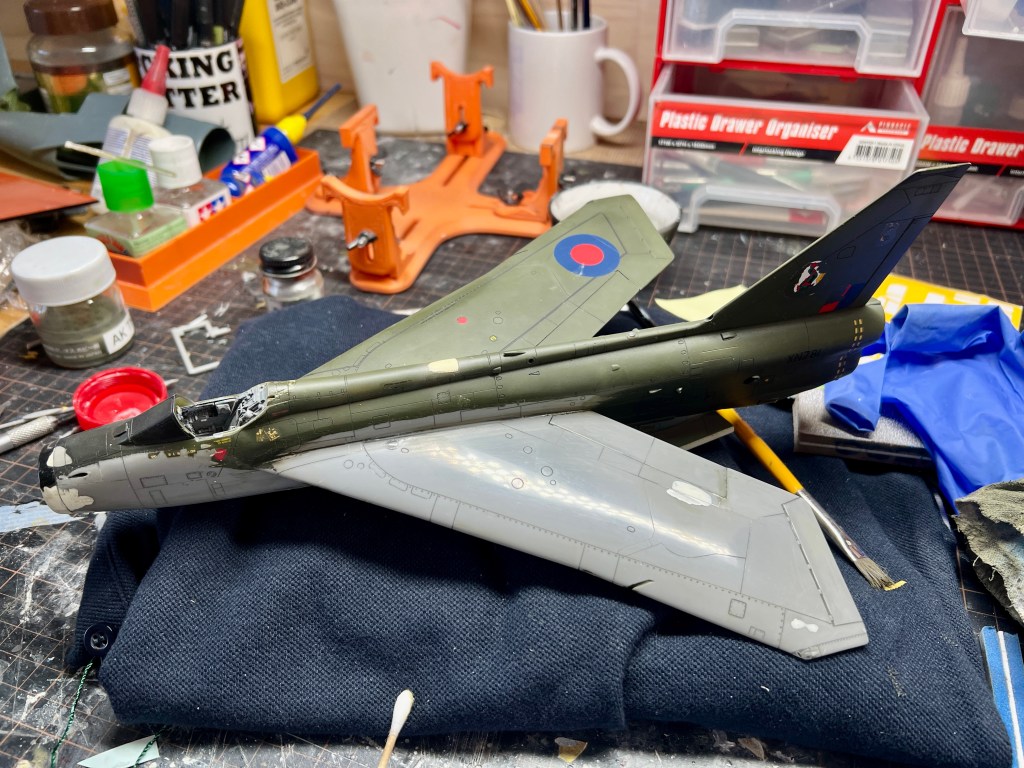
It’s great to have a Lightning in the green RAFG gracing my shelves again. My first Lightning in this scheme being the ancient Matchbox kit way back in the 1970s. My love for this scheme has stayed with me ever since. To my mind’s eye, it looks like what I envisioned when the build was started. This is due to me making the decision to strip and repaint the model. Even so, it’s not my best work. It looks just workmanlike. However, it is far better than it would have looked if I had continued pushing ahead with the original finish.

Regarding aftermarket used, the only essentials in my opinion would be a seat and metal pitot tube. Nothing can be seen of the cockpit, or even the wheel wells, despite the high wing. The Armoury wheels look good and are weighted but ,the kit wheels also suffice.

The Lightning is such a brute of a machine and an icon of Cold war British Air Power. It deserves to be retooled up to Airfix’s current standard. In its current form, Im not sure I’d build another one.

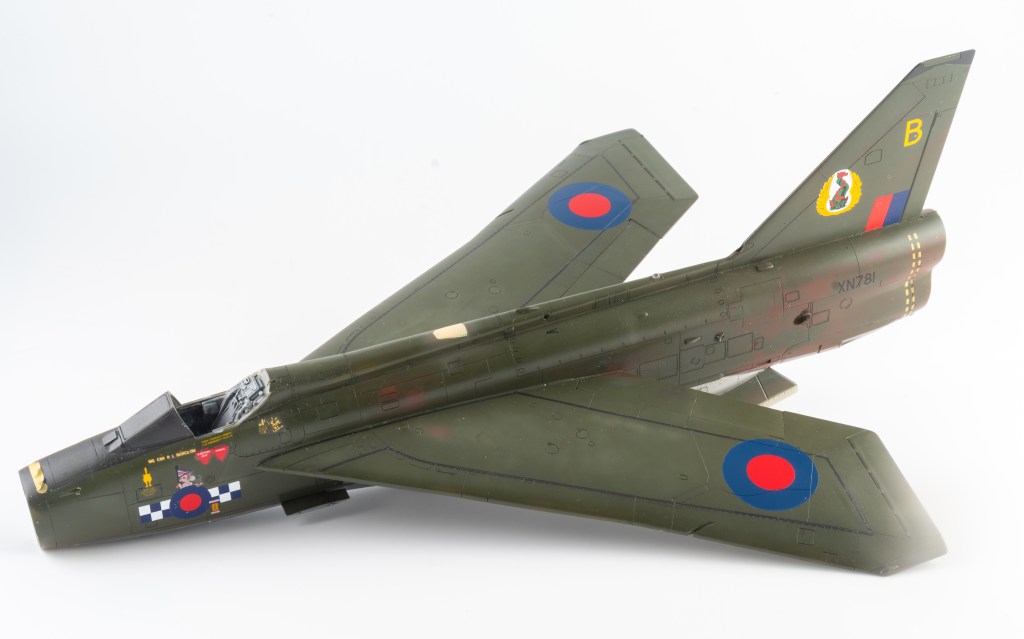
E.E Lightning F2A. Royal Air Force 19 SQN. Guttersloh Germany 1973

Leave a comment

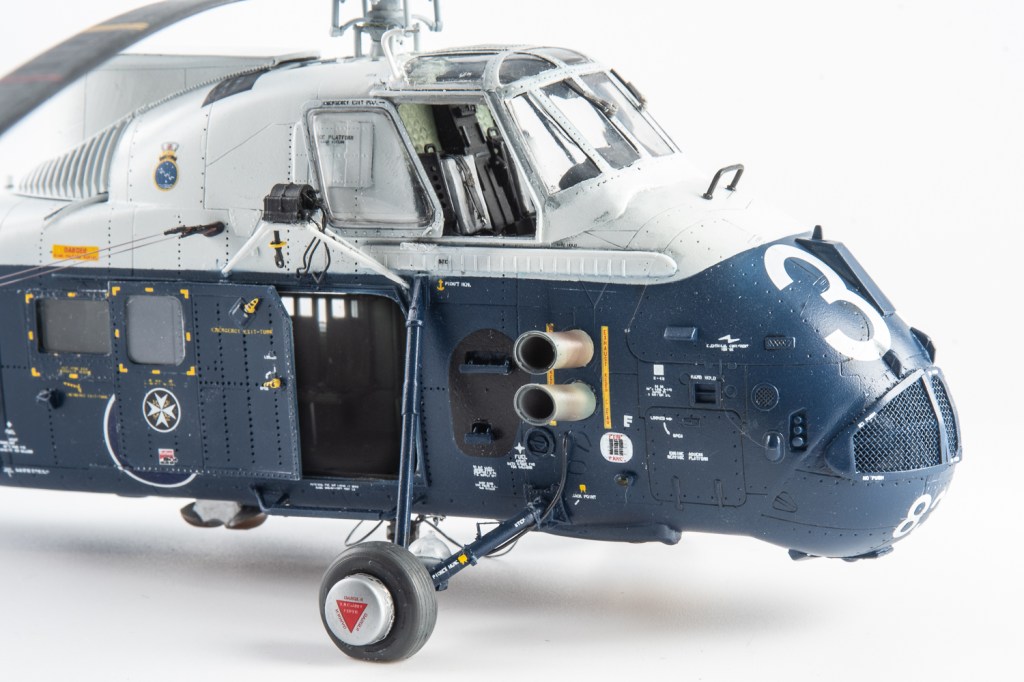
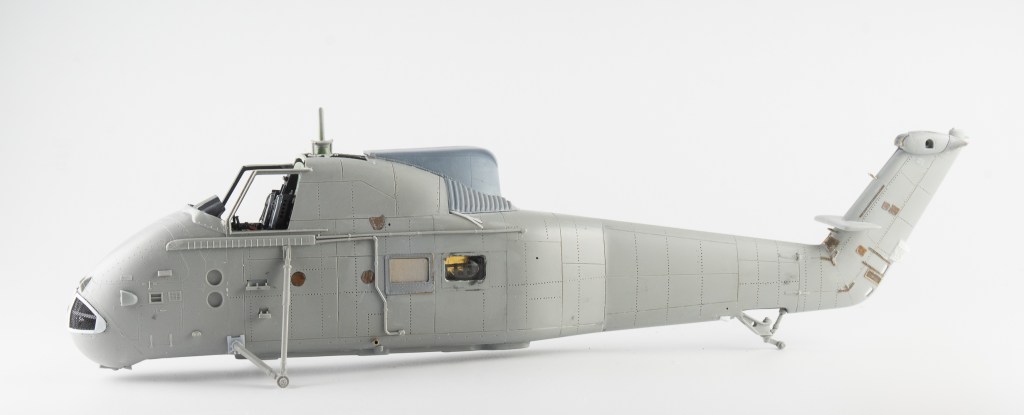
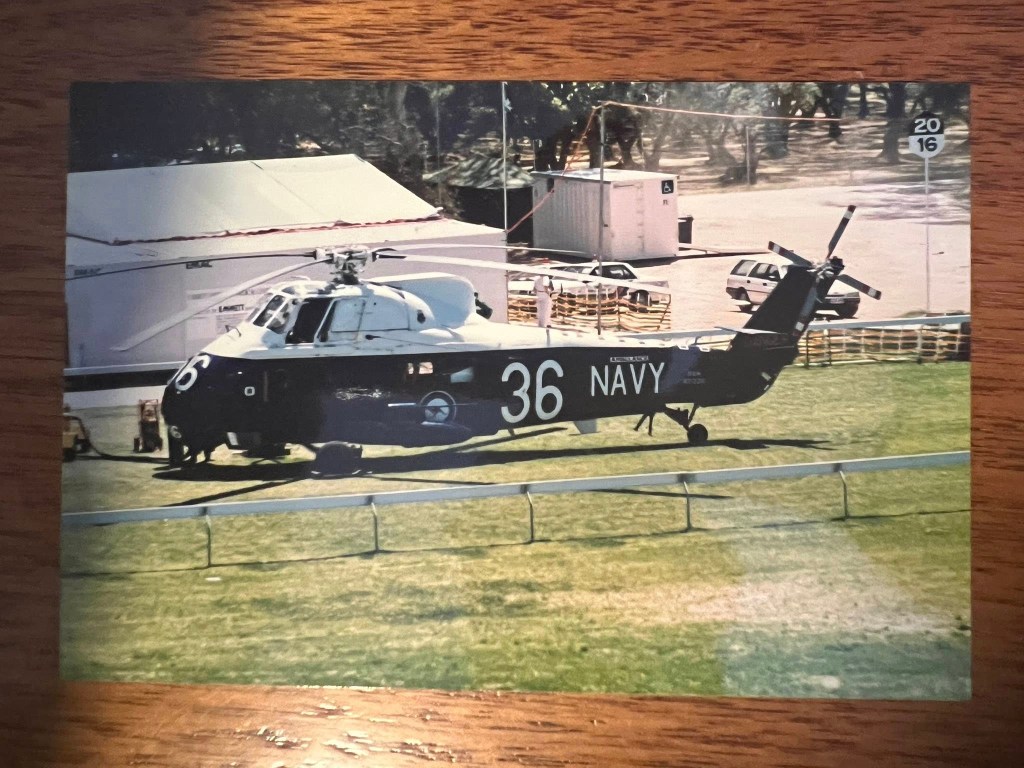
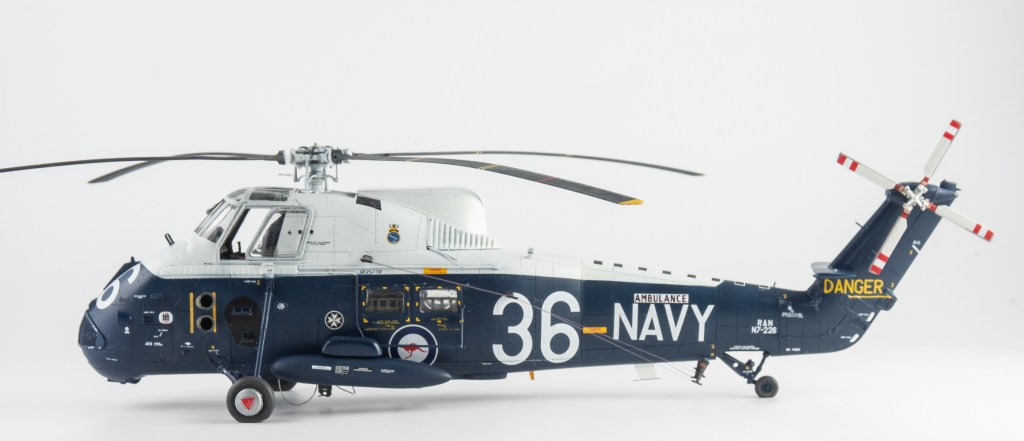
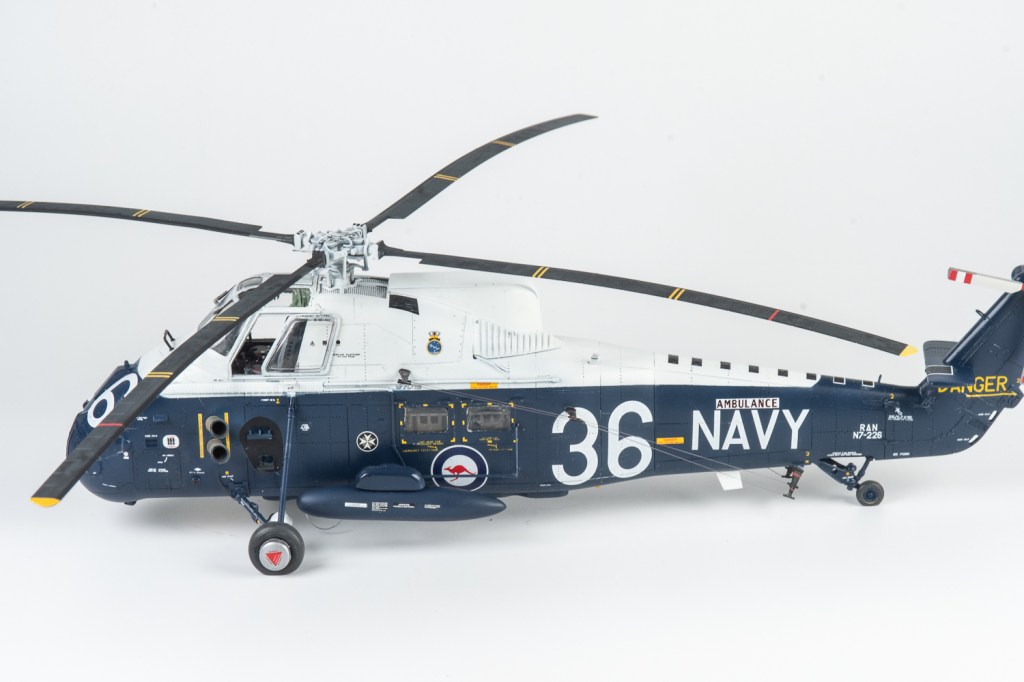
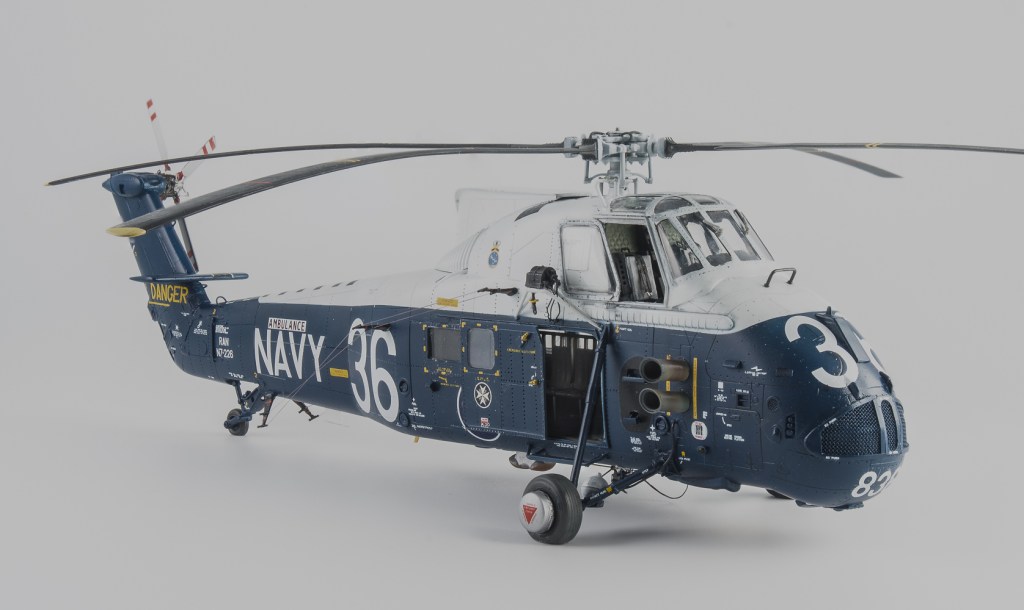
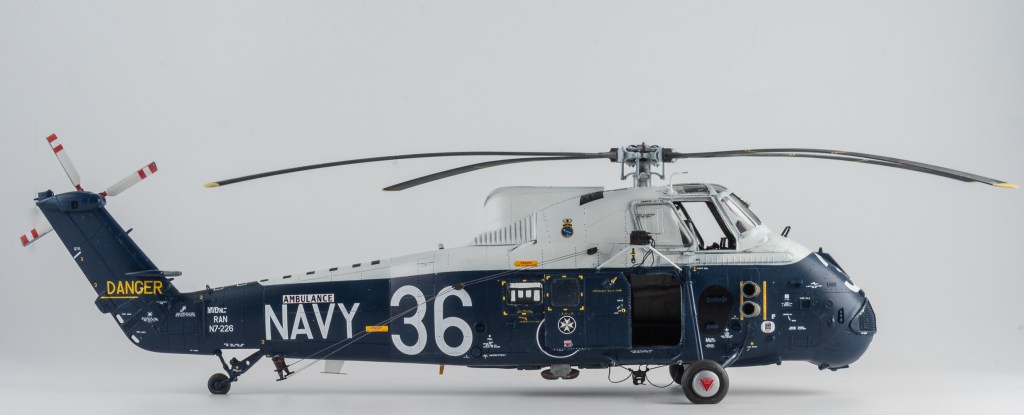
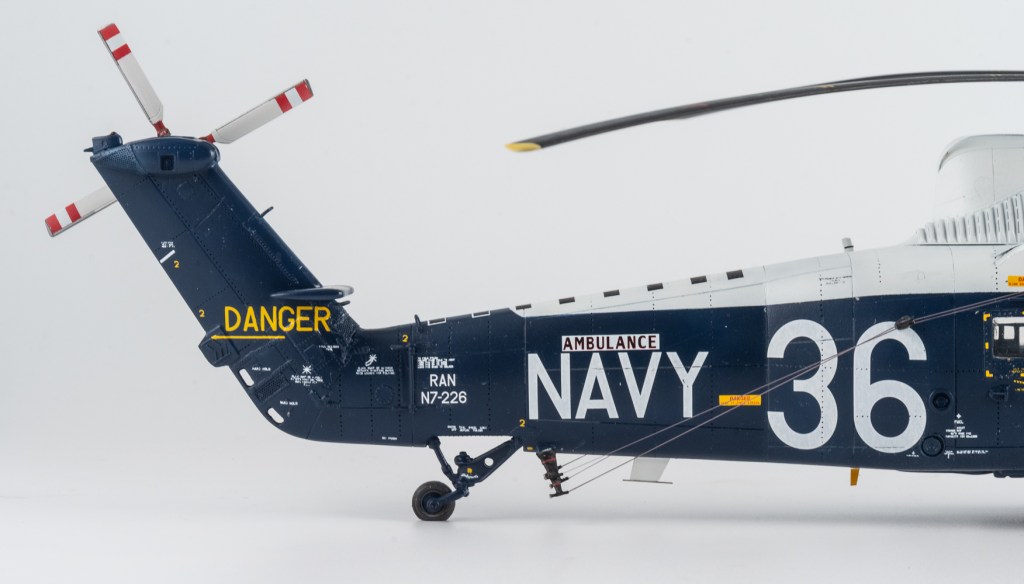
Italeri 1/48 Wessex Mk31B

  • Purchased; 2015
  • Completed; 2025
  • Enhancements:
  • Dogbox – Hendies scale models Wessex Set E
  • Pilots seats. Hendies Scale Models Wessex Set D
  • Exhausts: Hendies Scale Models. Set B
  • Wheels; Armory
  • PE details. Eduard
  • Stores carrier and fuel tank. Hamilton Hobbies
  • Decals; L Decals

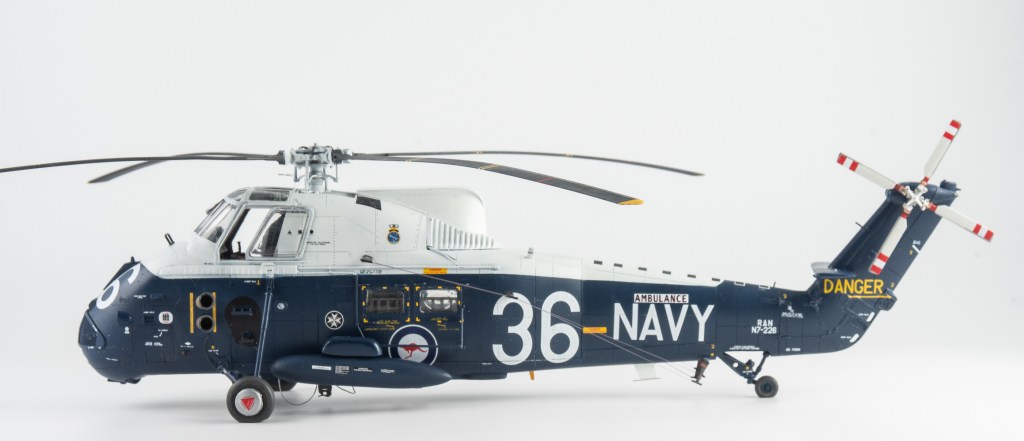
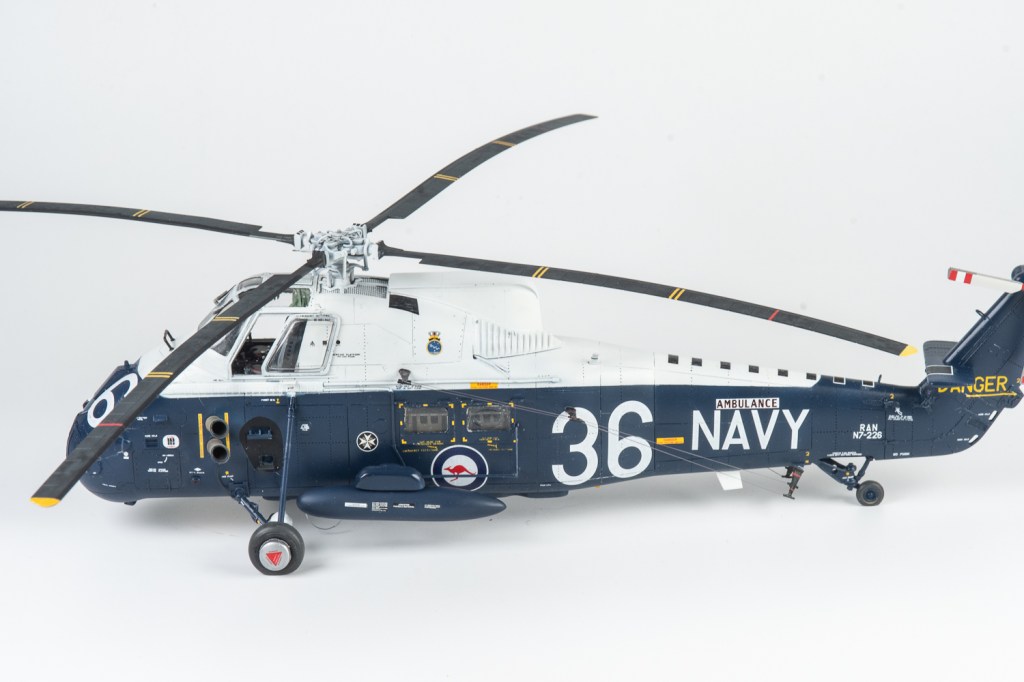
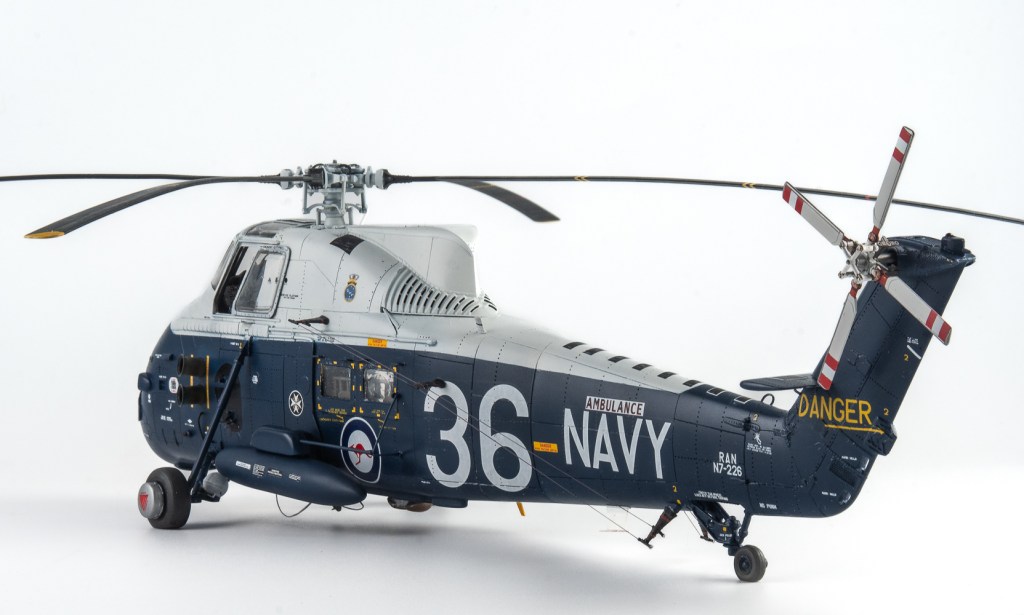
This build illustrates the progressive march of better aftermarket accessories that have hit the market over time for particular kits.

To make a Mk31B used by the Royal Australian Navy, you needed to combine this kit with the Italeri HAS3. That kit included the Dogbox, that sat on the rear engine deck. The HAS3 kit was also needed for some scoops and fairings present on a Mk31. These days though, there are people like Hendie from Britmodeller making available the parts needed here. One doesn’t need to have both kits for this conversion. If only using the HAS1, though, some scratch building of scoops and fairings will still be required.

Similarly, the decals, once upon a time, offered only the less than comprehensive Aussie Decals sheet. Now there is the far superior L Decals sheet. If you can still find it, the Southern Sky Models decal sheet includes all the stencilling as well.

Sadly, Italeri’s kit hasn’t improved with time. However, even using this as a base kit is progress. Prior to this, the modeller would have had to use the old and poorly detailed Revell kit. The plastic in this boxing is particularly pebbly and textured. It requires much sanding down and describing. Plus, all the shallow and inconsistent rivet detail needs redrilling. In the end, it needed more rubbing down. Some areas were still textured after the application of paint. Id love Airfix to release a new tool Wessex, but fear they would only do the HC2 version

Construction Notes

Of course, us Australians had to fiddle around and change stuff! So a Mk31 cannot accurately be made straight out of the Italeri box. There are a few additions and modifications required. The best online reference for these is Graeme Moulenoux’s Grubby Fingers site.

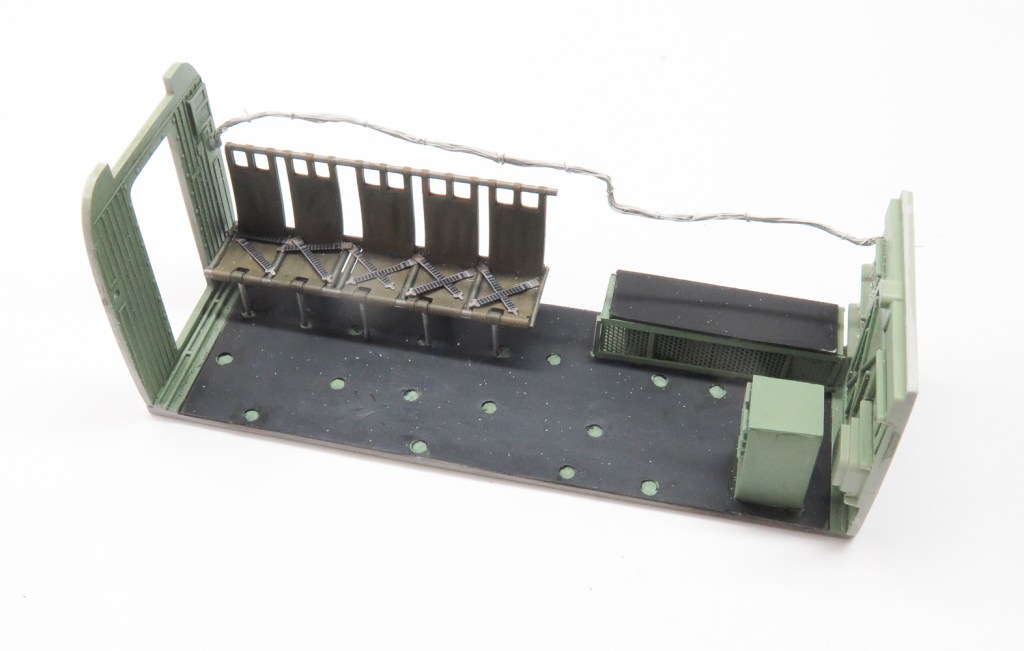
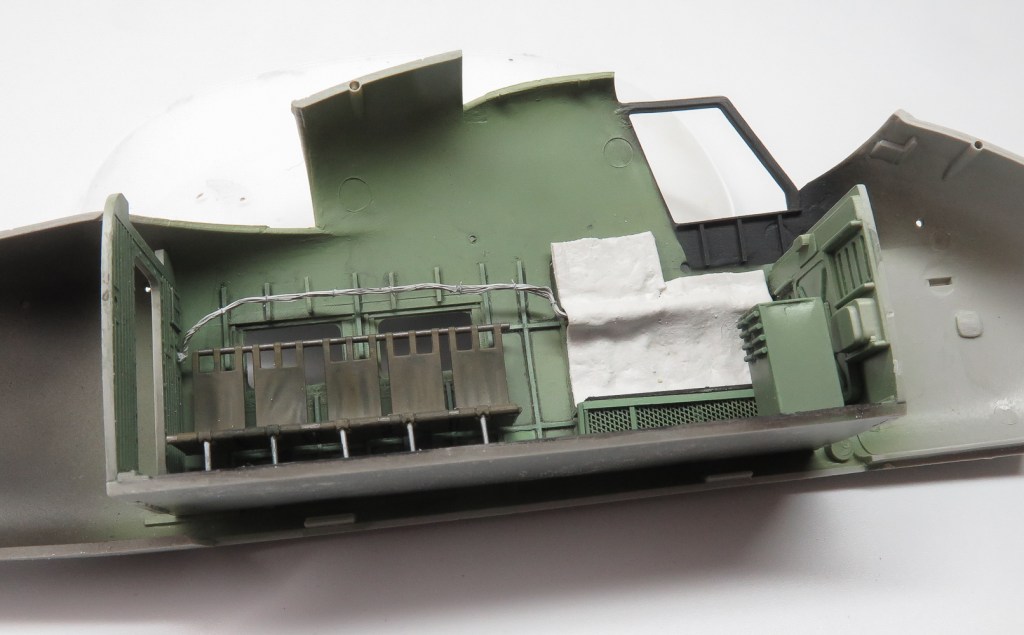
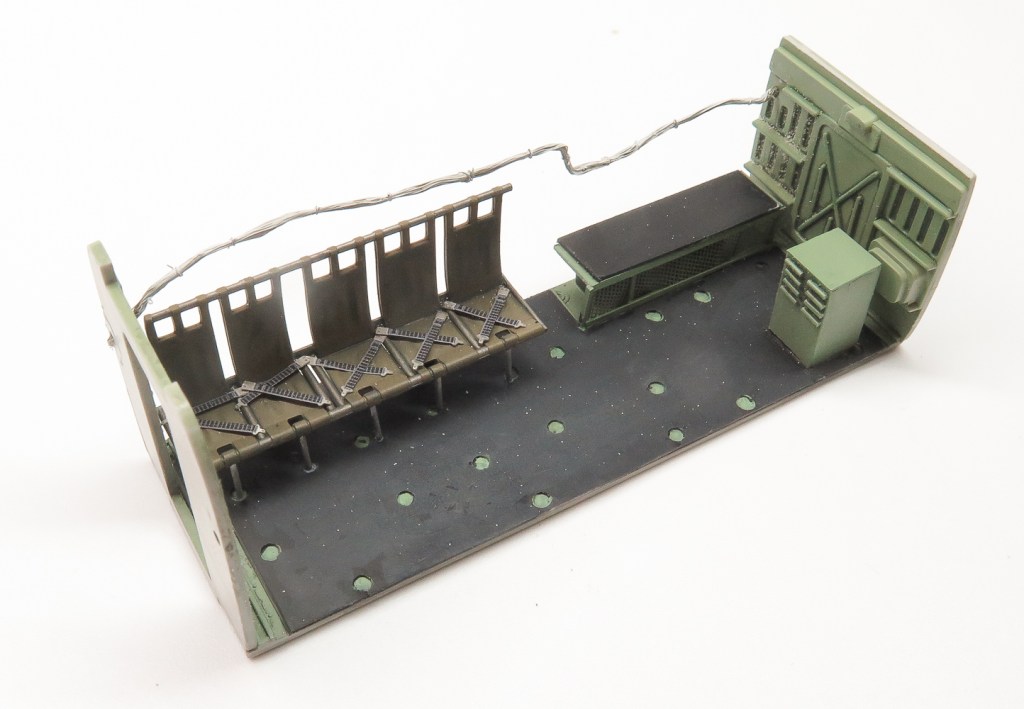
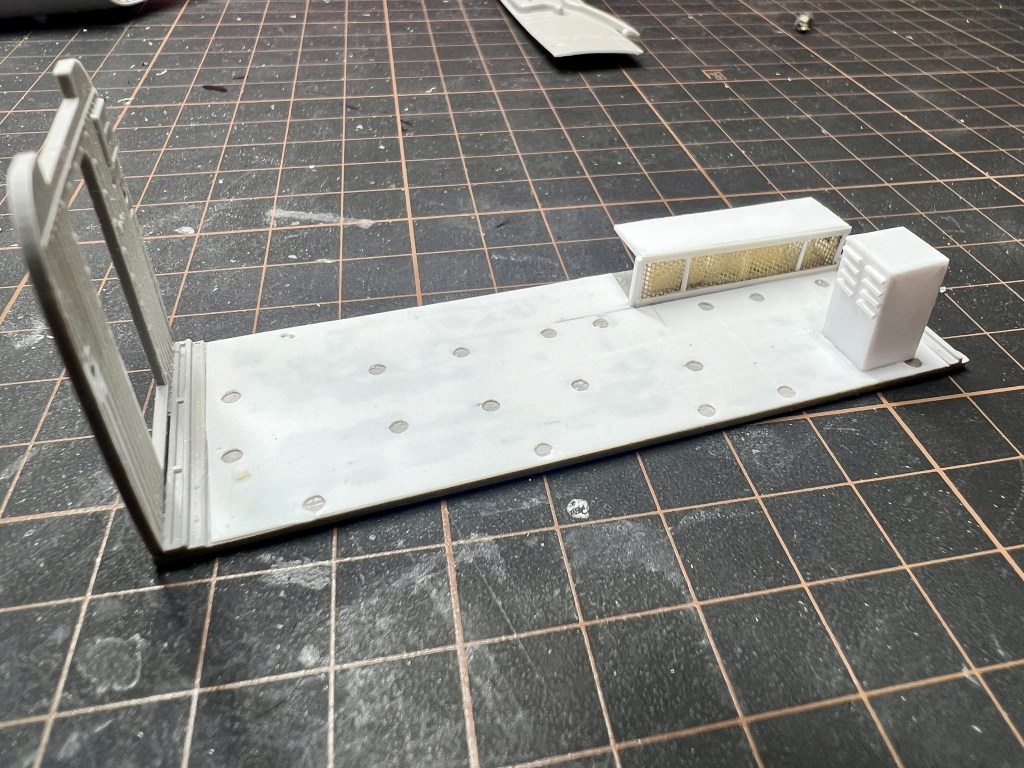
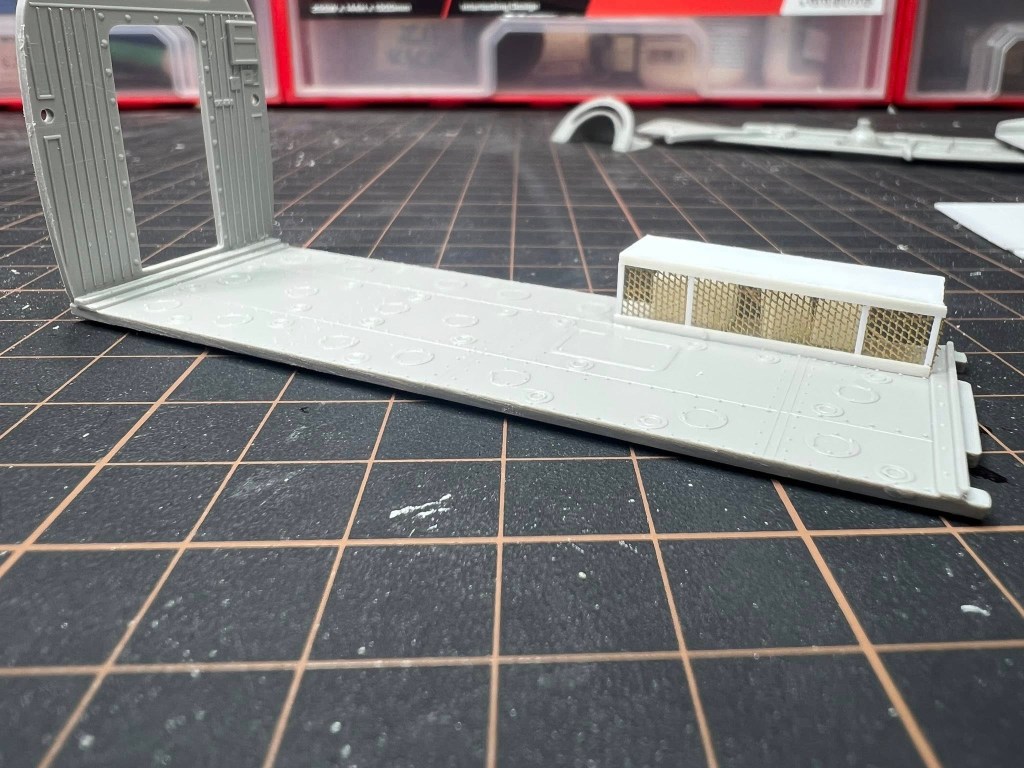
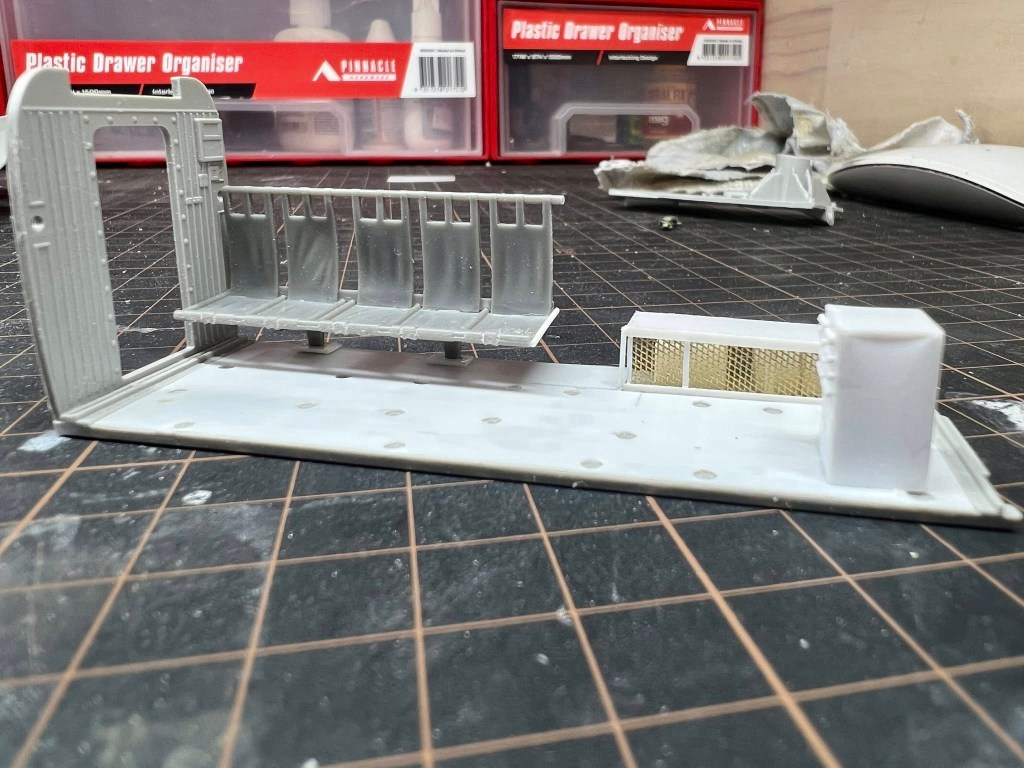
We start off with the interior. Scrap plastic strip and mesh were used to build up a bench seat. It sits over the auto hover gubbins, so no need to scratch build all this stuff. The Navy also had the good grace to hide all the interior wire jumble behind a drape. This was made from rolled Tamiya epoxy putty.

The bench seats came from an Airfix Seaking and the cabinet was built from plastic card. Plastic card also filled in for the plywood floor the RAN fitted over the actual floor. The electrical component box was constructed from the ever useful plastic card. The wire loom was crafted using speaker wire.

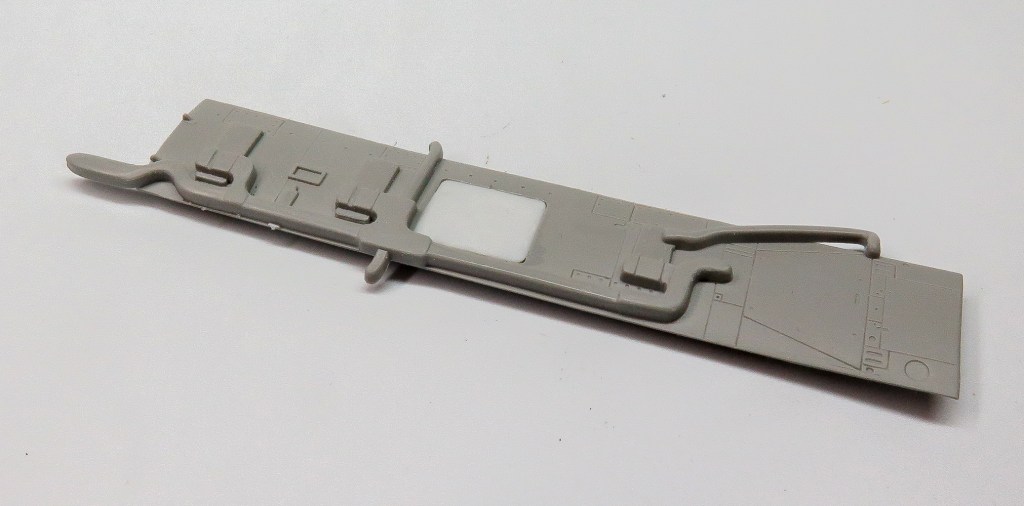
The bottom panel needs the sonar detail removed from within the hatch. Then, the opening should be faired over with a panel from plastic card.

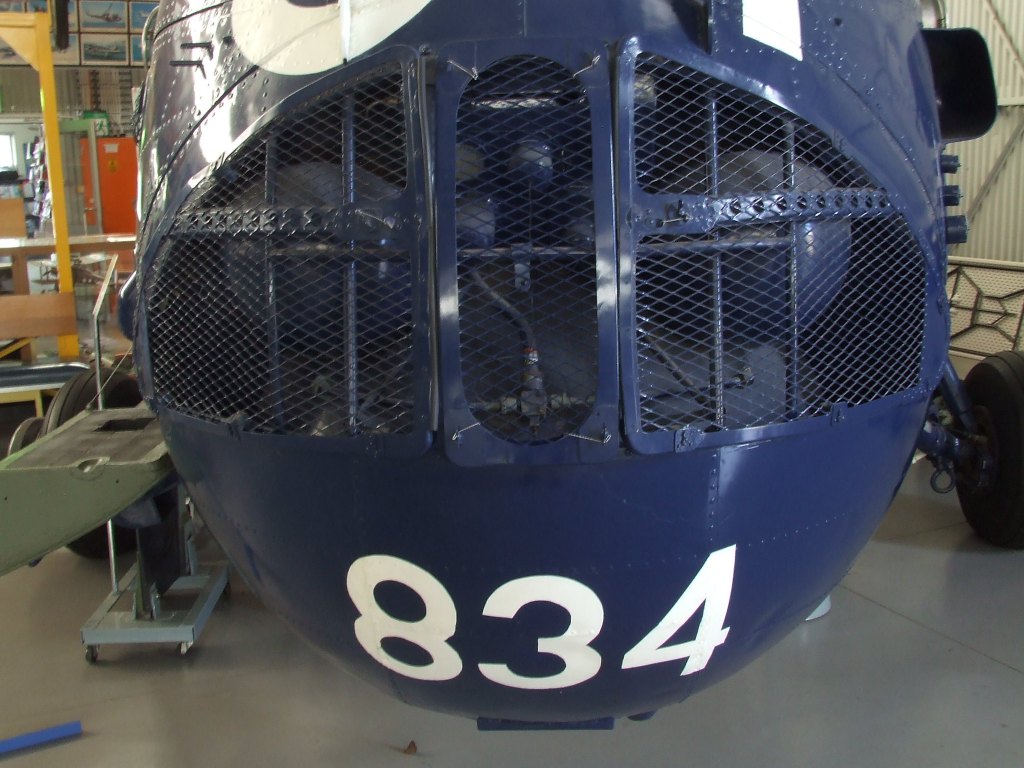
The below image taken by myself of the Wessex in the South Australia Air Museum shows what is required of the kit nose filter to properly represent a RAN Mk31B

Basically, two spherical compressed air bottles and extra framing around the grill.

Hendie Models supplied a new nose bulkhead complete with the bottles and piping, and plastic strip formed the framework. The scoop you can see on the right side of the photo will also need to be added. I used the item from a HAS3 kit I had in the stash. The HAS3 also gave up the rectangular slanted fairing that sits on the nose. From this point, I methodically worked around the airframe. I added bits and pieces that I noticed when comparing the photos to the kit parts. These included a scratchbuilt IFF antenna to the rear of the fin. I moved and added fuel caps. Additionally, extra antennae needed to be added.

The pylon, stores carrier and fuel tank were resin items from a local Australian cottage producer, Hamilton Hobbies. The tank required several rounds of filling and sanding to reduce all the pinholes. A Hawker Hunter drop tank could also be used if you have a spare one floating around. Cabling was added from the flotation bag compressed air canisters to the fuselage. Brake lines from the wheels also need to be added , although I didn’t . An eagle eyed mate spotted I had glued a length of the kit ducting on at an angle. It broke into three bits when I tried to remove it. I had to use plastic rod to make up new ducting. An Eduard PE set provided various enhancements around the airframe as well.

Sun blinds were made from paper and added to the upper panes of the windscreen. The windscreen was not the best fit, requiring a lot of fairing in around its base.

The side kit aerial masts were modified with sections of brass tubing. This allowed EZ line to be run through them to represent the aerial wires. Rather than rely on glue, these masts were all drilled and pinned with brass wire for some additional strength.

A final look was made to check for seams. The airframe then received a coat of Mr Surfacer primer. This revealed a few seams that still needed addressing. Always the case with my models. No matter how smooth and blemish free I think I have the model, the first primer coat still always reveals flaws.

Painting and Decalling

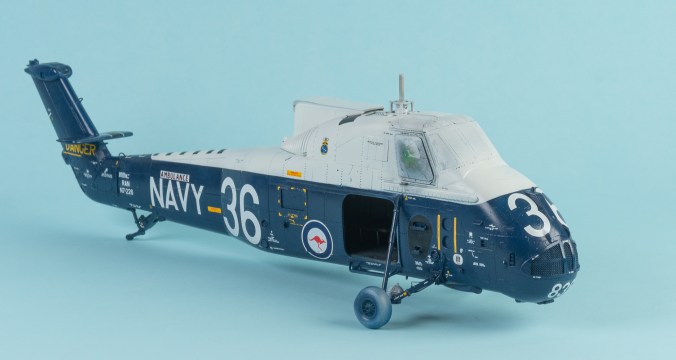
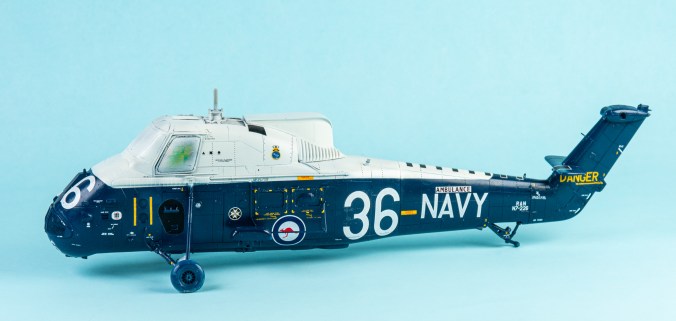
Common sense would dictate starting with the white, but on this occasion I thought masking the model would be easier starting with the blue. Initially the model was painted with Gunze Mr Color C328. I returned to the model the next day and realised it looked too “blue.” As a result, the blue was darkened with a few drops of black and resprayed. Now it looked a much better match to photos of the actual aircraft. The white was GSI Mr Color Character White. Some touchups were needed where I had not applied the tape tightly enough around protrusions. The front curved demarcation was achieved with Tamiya flexible tape. The rear one over the tail boom was created using a circle cutter to cut a tape mask.

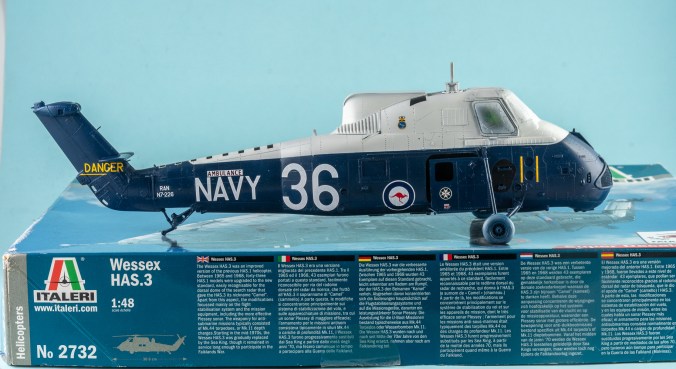
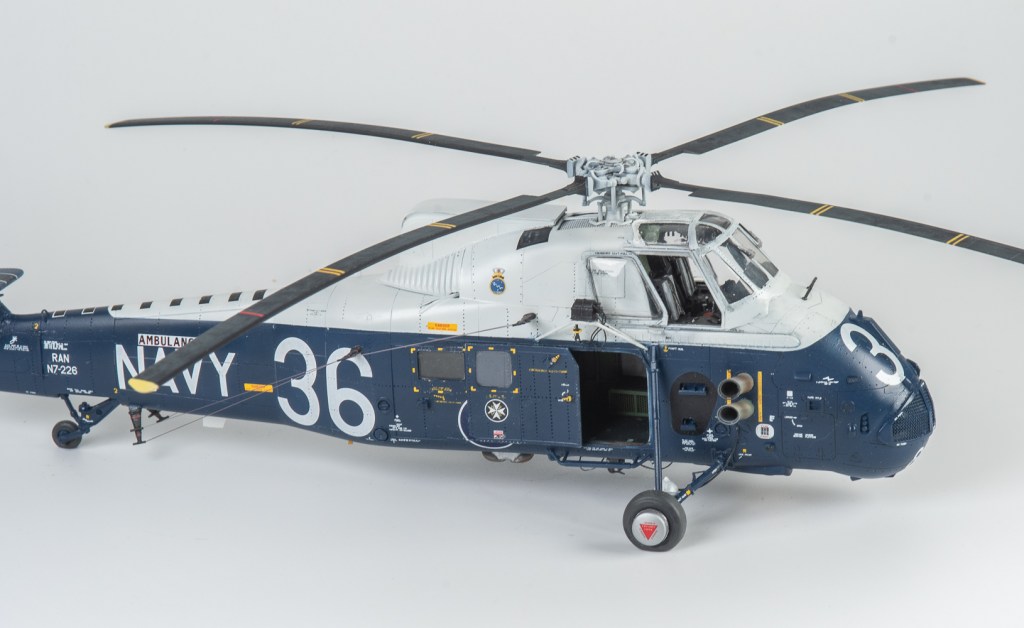
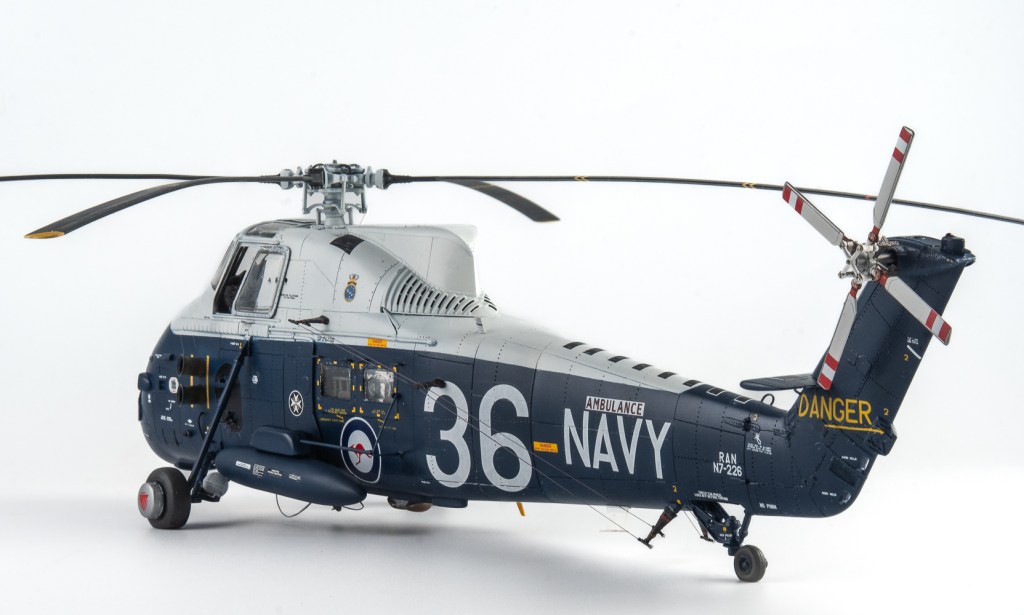
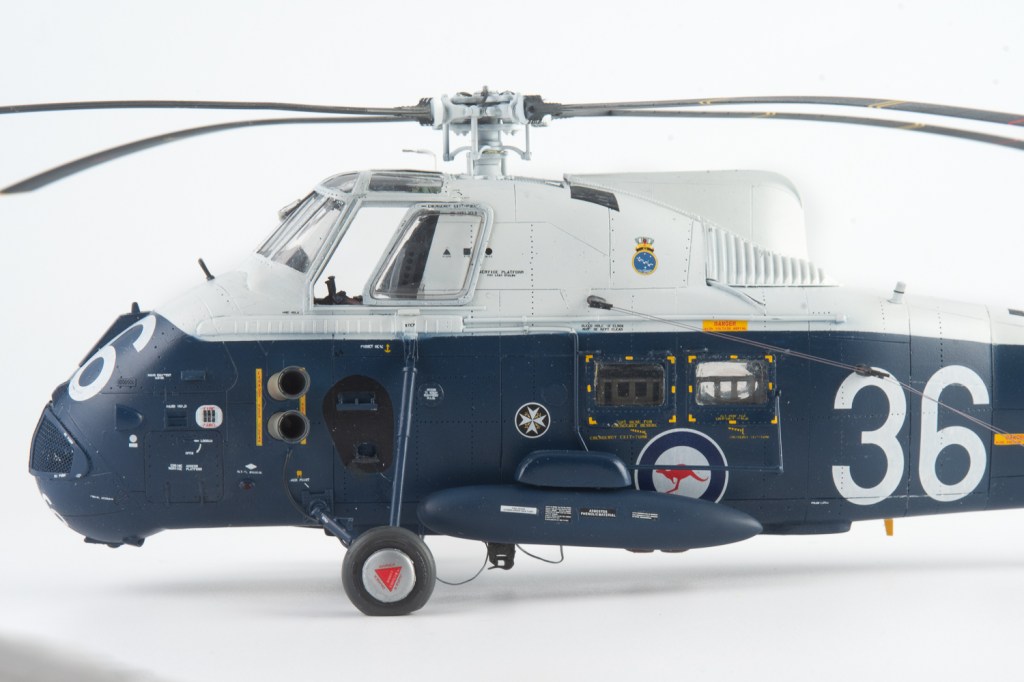
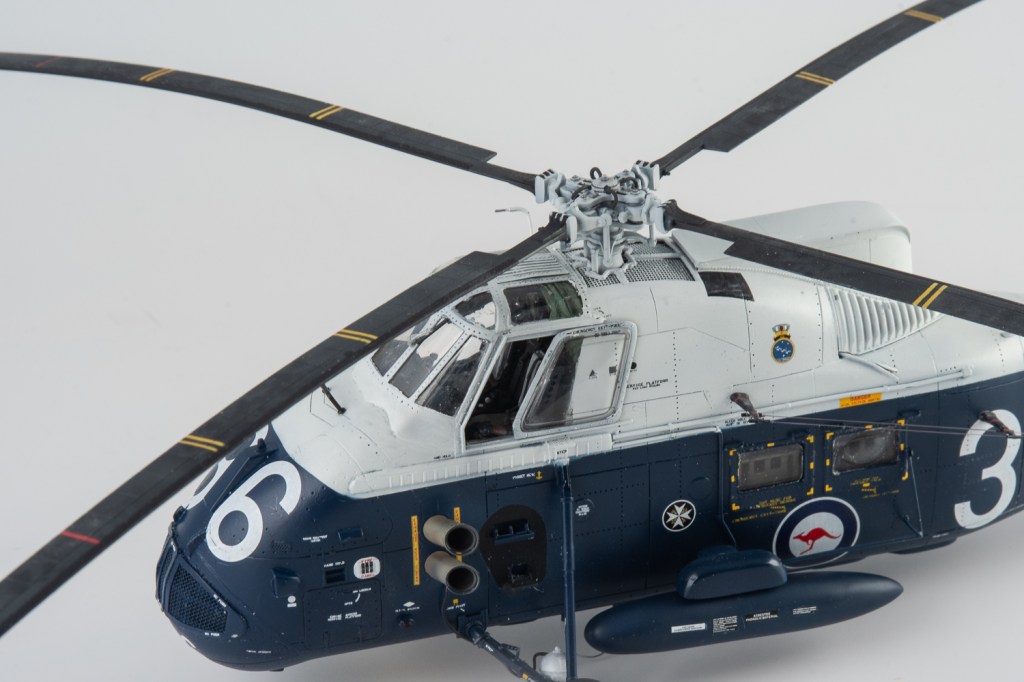
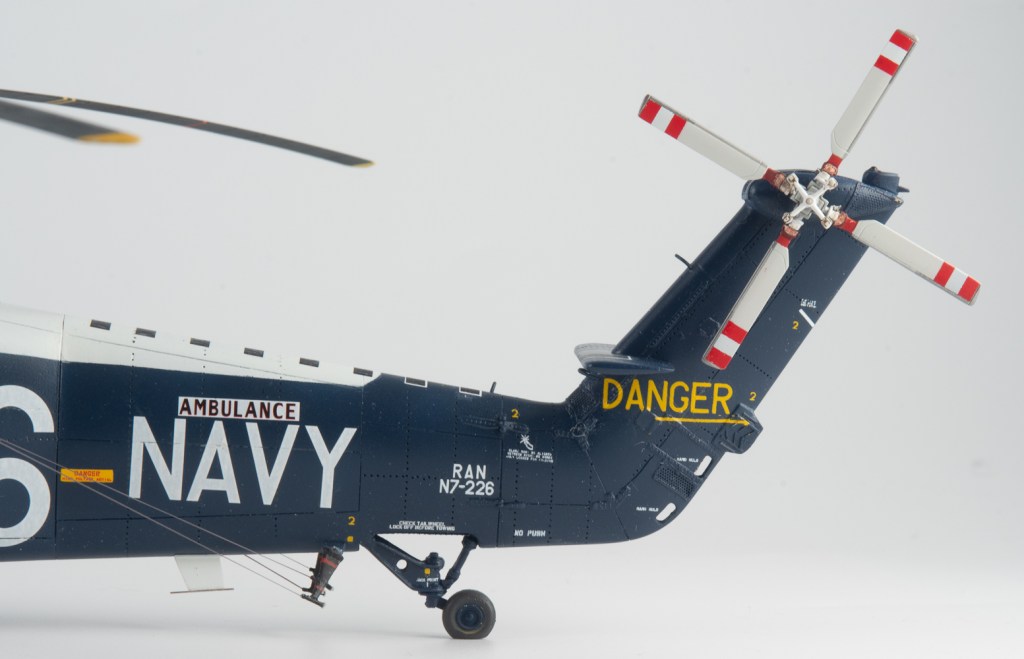
To say I was stoked when L Decals released their sheet containing 36 is putting it mildly! This particular helicopter is now preserved in the Fleet Air Arm Museum at Nowra NSW. I first came upon it whilst it was operating as an Air Ambulance at The Australian Grand Prix Adelaide 1987. The crew even allowed me to clamber up and stick my head in the cockpit. The memory of how basic the cockpit looked staying with me.And of course there is the Ambulance connection reflecting my 40 years as a Paramedic.

The L decals are beautifully printed, although some of the yellow items were slightly out of register on the sheet. No matter as I used these items from the superlative Southern Sky Models Wessex decal sheet. Unlike the L decals sheet, this contained all the stencilling for the aircraft. The kit sheet stencilling is a bit oversized in my opinion.

Decalling was carried out over 2 nights. Applying all the stencilling was finicky. However, it really does add to the busyness of the airframe. All the decals were excellent to use. They required just a couple of applications of Microsol. This allowed the decals to conform to all the raised and recessed detail. A toothpick also being employed to push the decals into all the recessed rivets where required. Stencil date from an Airfix Hunter sheet was used on the fuel tank. The writing on the white panel should have red lettering, but on the decal was black unfortunately. I will keep looking for an appropriate decal.

Final Assembly

The rotors had already been assembled and painted , just needing a matt coat. It was decided to use a semi sheen to dull down the very glossy paint used on the model., although I did brush matt clear over all the walkway areas. No weathering was added. All examples I had seen in contemporary photos looked reasonably clean. However, people who worked on the machine tell me the underside was filthy with oil leaks and stains.

Probably one of the trickiest parts of the build was rigging the cargo hook underneath. This was eventually accomplished with brass wire and EZ line. The aerial wires were then added using the same material, and with that she was done. Well, done is a relative term! But where do you stop? There were plenty of details, the modeller could still add like tie down rings and other cabling. There should also be aerial wires that wrap around under the tail. By this stage though I was ready to move on. All my models are compromises in this way, but I am happy to accept that. It is what allows me to complete 5-7 models a year. These models are reasonable in detail rather than one super detailed model that is accurate to every last detail.

Conclusion

The build was not enjoyable at times, but ultimately satisfying once complete. The Italeri kit is typical of their products, inconsistent detail, poor fit of some parts and soft mouldings. However, it is leaps and bounds over the old Revell kit. The kit has shortcomings. Despite this, I am still eager to tackle another to finish as a 945 SQN RN machine from the Borneo conflict. The aftermarket items I used are not absolutely necessary to build a RAN Mk31. You only need them if you don’t have a HAS3 to use, although , there will still need to be some scratchbuilding required. . The fuel tank and carrier can be easily converted from other components. They can also be scratch built. The Hamilton Hobbies items are still available. Naturally you will need decals for a RAN aircraft, again, the L decals are still available. The rest of the Hendie stuff is just a very nice refinement over the kit parts.

Westland Wessex Mk31B. 723 SQN R.A.N Adelaide South Australia 1987

Leave a comment

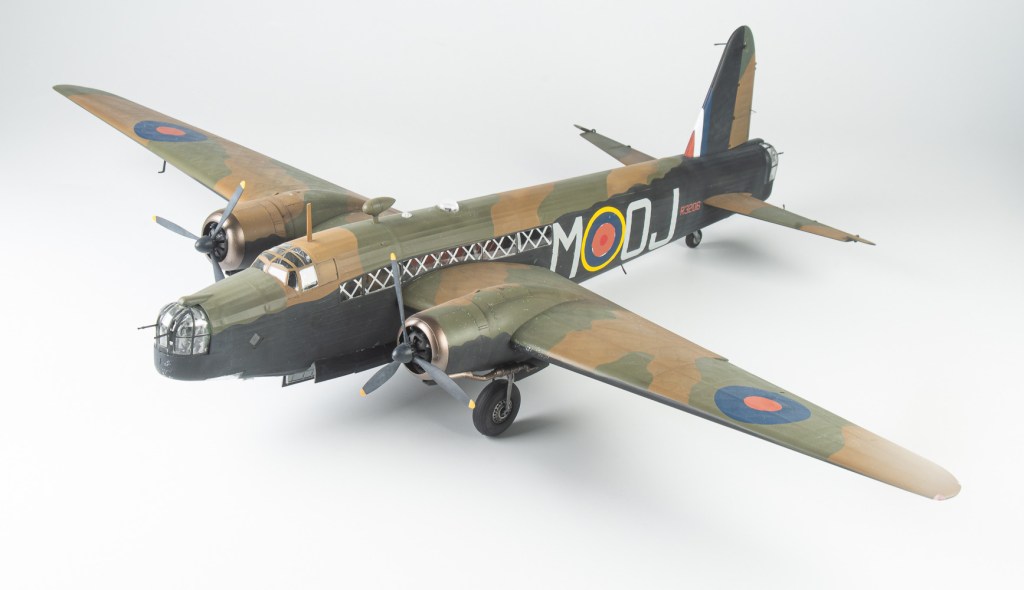
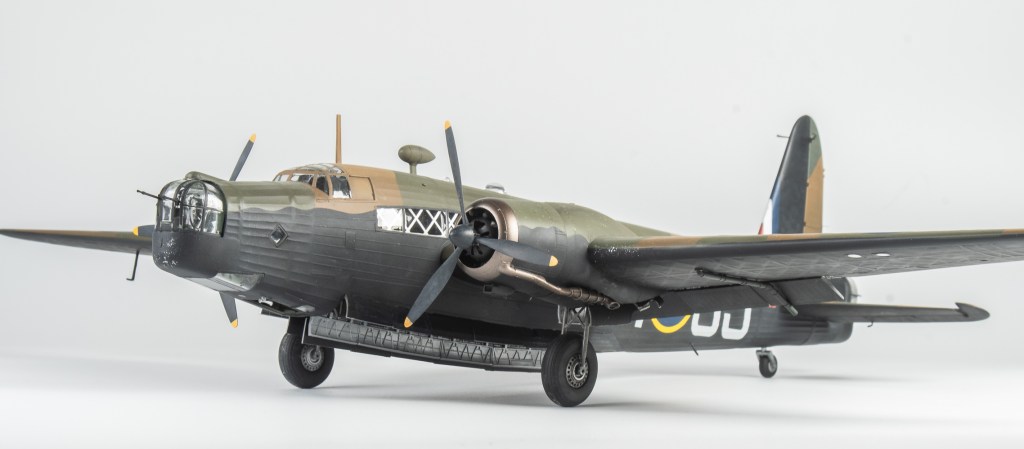
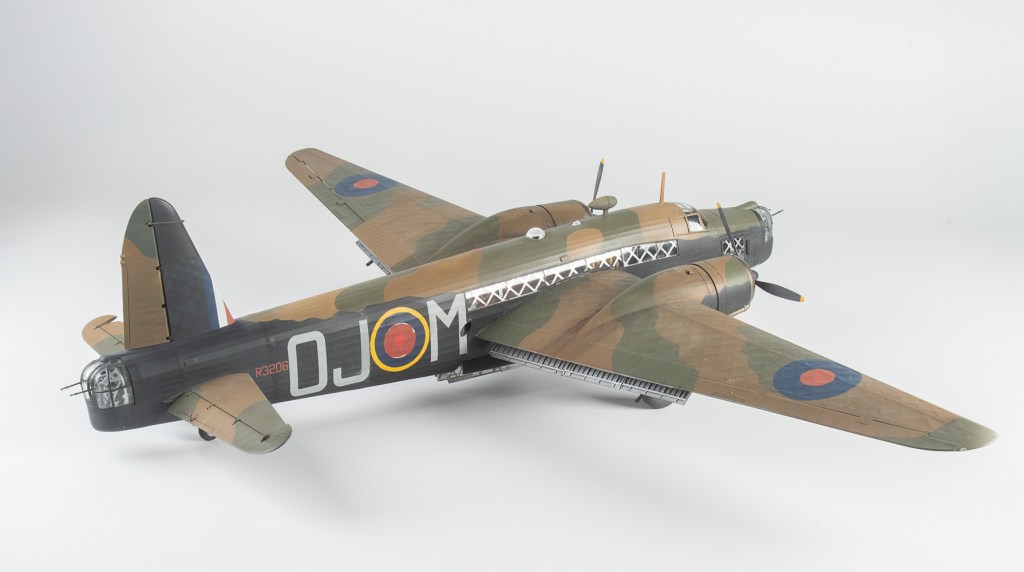
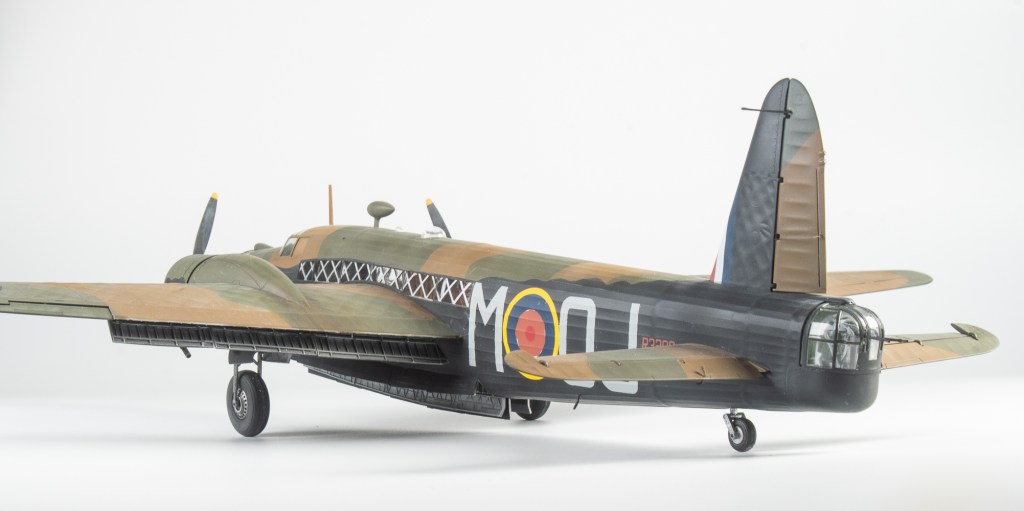
Trumpeter 1/48 Vickers Wellington Ic

  • Purchased; 2016
  • Completed; 2025
  • Enhancements;
  • Gun barrels. Master Details
  • Flaps- Brengun
  • Fuel Dump Pipes – Quickboost
  • Decals: Xtradecals

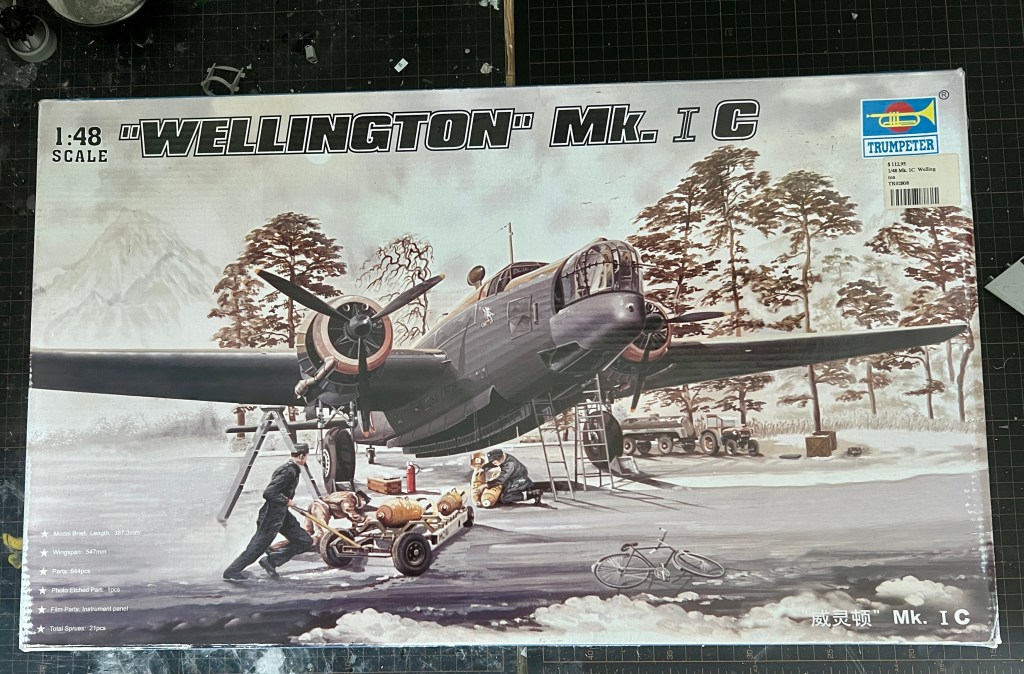
I remember being quite excited at the news that Trumpeter was releasing this, as it filled a major gap in 1/48 RAF WW2 subjects. Its not a kit that has graced many competition tables or on line sites though, so that to me tends to indicate not many are getting built, perhaps as its a sizeable model once done.

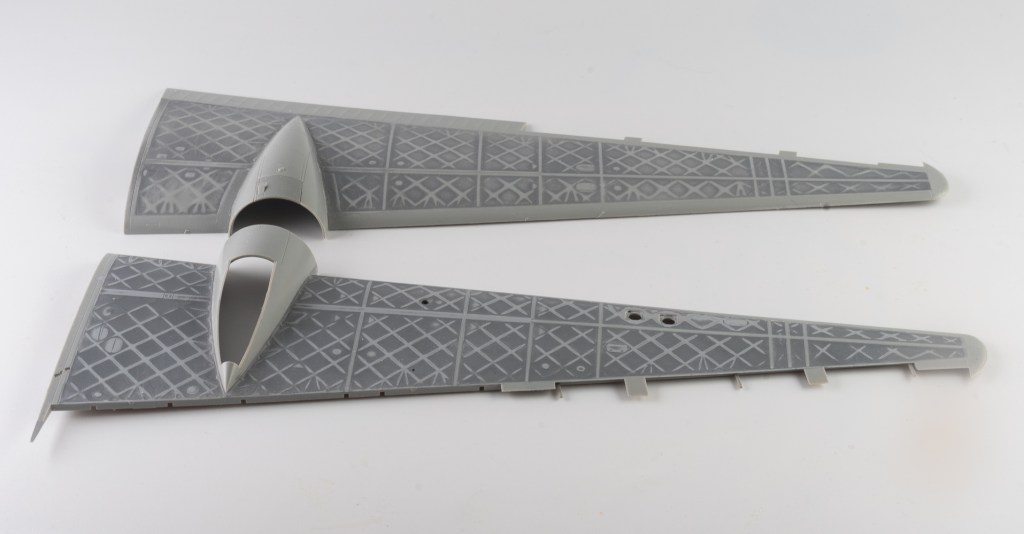
Accuracy wise, it suffers from a too narrow undercarriage and very overstated surface textures.The undercarriage I could live with, the surface detail though had to be reduced. There is a reasonably complete interior, albeit somewhat simplified, that pretty much gets hidden away once the fuselage is closed up. Fit for the most part is good, but the kit shows its age as one of Trumpeter’s earlier releases with the parts not as sharply moulded as some of their later releases, and also exhibiting fine mould seams along mating edges. Perhaps the biggest plus of the kit are the THREE sprues of early RAF type bombs Trumpeter includes to load the bomb bay with various types of bombs. Transparencies are lovely and clear, but the decal sheet, as per usual with Trumpeter RAF subjects has markings with colours that are far too bright.

Construction

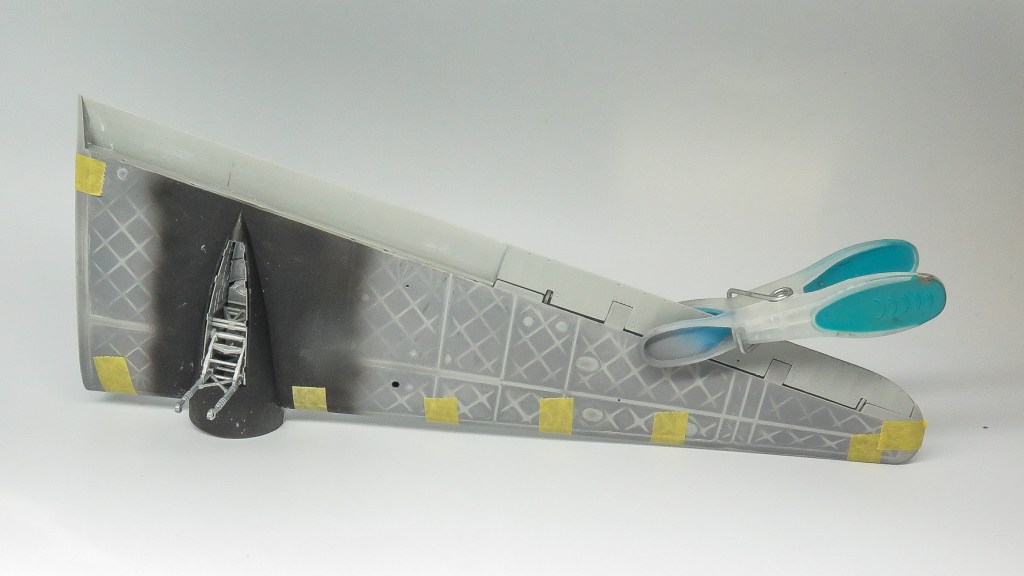
Even before construction started, several thick coats of SMS surfacer grey to the wing and horizontal stabiliser parts. Once dry, it was rubbed back until the kit surface detail showed as bare plastic . After being repeated a few times, the Trumpeter geodetic pattern had become somewhat subdued. This probably could have been taken further as it shows as quite subtle in photos, but I chose to leave it as was.

The colour call outs in the instructions were disregarded as mine would be an early war bomber and research on Britmodeller had uncovered more correct colours.

So on my kit, cockpit is RAF grey green as is the bomb aimers position. Mid fuselage is a brick red colour with silver framing. Floors are black. Bomb bay interior and insides of doors are silver.

Turret interiors are also silver. Black turret interiors seem to have come later after the RAF doctrine had changed to night bombing.

I would recommend that the turrets complete with guns are built as a whole rather than doing what I did, and leaving the guns out to be added later. This resulted in me having difficulty aligning them. The kit barrels were replaced with brass items at final assembly.

Aside from the ventral turret and rear ammunition runs, the complete interior was assembled , although not a lot of effort was expended in painting it as very little can be seen. Don’t forget to paint the underside of the front turret as this can be seen through the bomb aimers window. Trumpeter have not included a bomb sight, so one will have to be scratch built should you desire.

The engines assembled fine, just ensure you double check the instructions to ensure the parts are correctly orientated. Don’t bother with after market engines as you can see very little of the completed engines.

Why Trumpeter made the wheel well interiors from PE, is a bit of a mystery to me, but they must have been made by Bluescope Steel! Have fun removing them from the frets! I also took the precaution of drilling all the holes out so that the landing gear assembled easily. Apparently the wheels and therefore struts are too narrow., not something that bothered until me until found out, then it did!

Back in the day when this kit was first released CMK did resin wheel wells for it, but these have long since disappeared from shops (as has most AM for the kit). The kit rubber tyres needed to be dunked in boiling water to soften them enough to conform to the rims. Although I did have Brengun resin wheels, they were even narrower than the kit wheels so were not used.

The only major construction issue faced by me was, when locating the bomb aimers window, it was found to be wider than the fuselage cutout. This must have been me as the rest of the transparencies fitted like a glove. In the end a piece of clear CD cover and a shim were used to bring out the fuselage to match the bomb aimers window.

If you are reluctant to test fit the wings fearing, like the Tamiya Mosquito, they will never be able to be removed again, don’t be. The wings are a very sloppy fit, and hardly a friction fit to the support boxes, so can be slid on and off with carefree abandon. To attach these, you are best off using epoxy glue , ensuring the wings are level to get a nice solid fit. There were no gaps on my kit . The PE ?cable cutters were left off my kit as I could not find any photos of machines with them fitted. My references were the 4+ book and images from IWM website.

The Brengun flap interiors fitted nicely into the kit flap wells, once the required material had been removed. I do wish these companies though would engineer the flaps to fit far more solidly. Small glue contacts areas such as PE hinges just don’t cut it.

Painting and Decaling

From the start, my Wellington was going to portray an early war bomber to pay homage to these early Bomber Command crews that starting taking the war to Germany just a few days after the Declaration of War. An early war scheme of overall DE/DG almost won out, but the toned down roundels on the Xtradecal sheet really appealed to me, bringing home these early attempts at toned -down markings, plus it had an early fin flash, replacement rudder and those lovely large codes. What’s not to like there?

SMS Camo black is my favourite black these days, having a warmish brown tone to it. Over this was sprayed various shades of greys and other blacks such as NATO and Rubber Black. This was done through two different splatter type masks. Not forgetting to also do the flaps and bomb bay doors at the same time

For the top sides, LF camouflage masks were used with the Dark Earth being SMS, and the Dark Green GSI Gunze.. Darker and lighter shades of these colours were used to break them up. Oil paints were used to depict oil leaks and staining trailing back from the nacelles across the wings. AK Starbay sludge was used for this. A shade which in retrospect is far too browny -grey . I should have used black or Sepia

The Xtradecal decals performed well. As they are printed by Microscale, they really only needed the mild micro products to settle into any detail. As I had nil micro sol, I used Mr Setter, which was far too hot and damaged one of the roundels. It was repainted with a mask created on my silhouette machine.

Final assembly consisted of bringing the various components together and adding all the fiddly little details such as gun barrels, flaps, propellers and aerial mast. Oh! And the 30 separate bomb bay doors.

Conclusion

It’s a large model!

In the main, it was a fun build, let down by the very exaggerated surface detailing and some strange engineering choices such as the requirement to fit the turrets before closing up the fuselage

That aside, it was an enjoyable build, and most likely the only 1/48 Wellington we are likely to see, although back in 1975 we all thought the Tamiya Lancaster would be the only 1/48 Lancaster we would ever see!

The Wellington has a lovely quaint ungainly look, belying it being one of the mainstay bombers of the RAF throughout the war. Im looking forward to the ICM Hampden joining it in the cabinet to represent Bomber Command in the first year of the war.

Vickers Armstrong Wellington Ic 149 SQN R.A.F Mildenhall UK 1940

Leave a comment

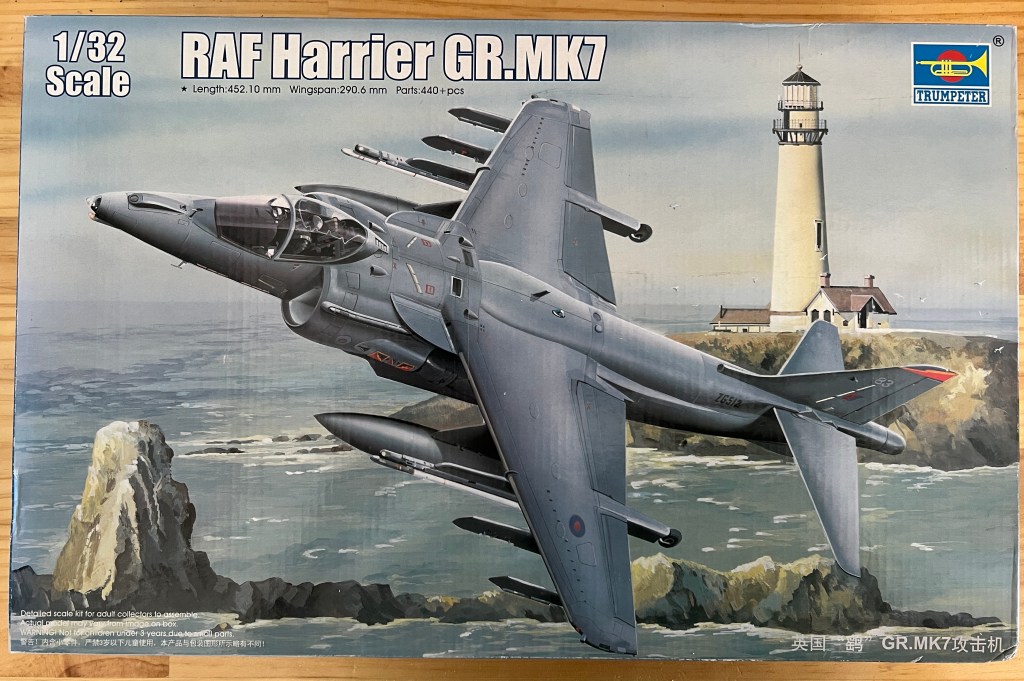
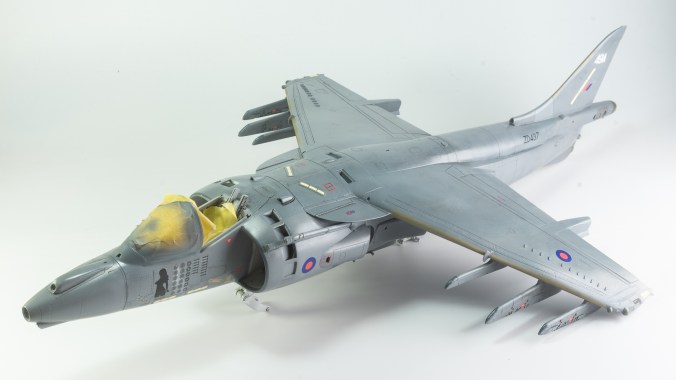
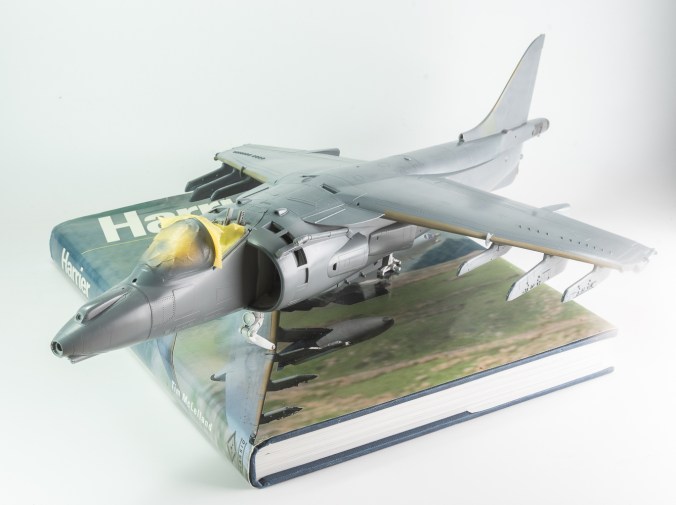
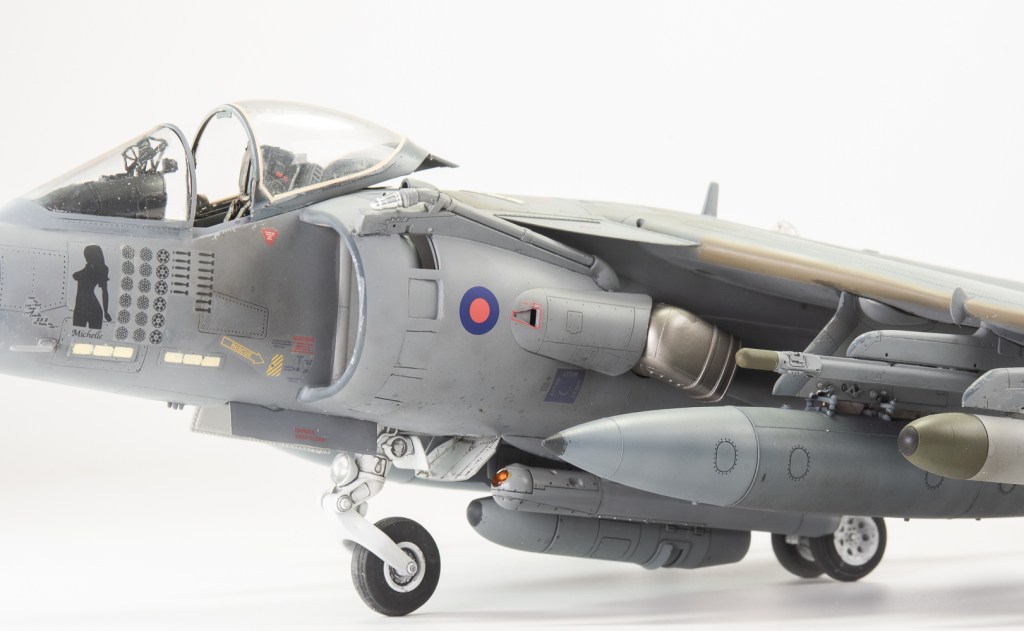
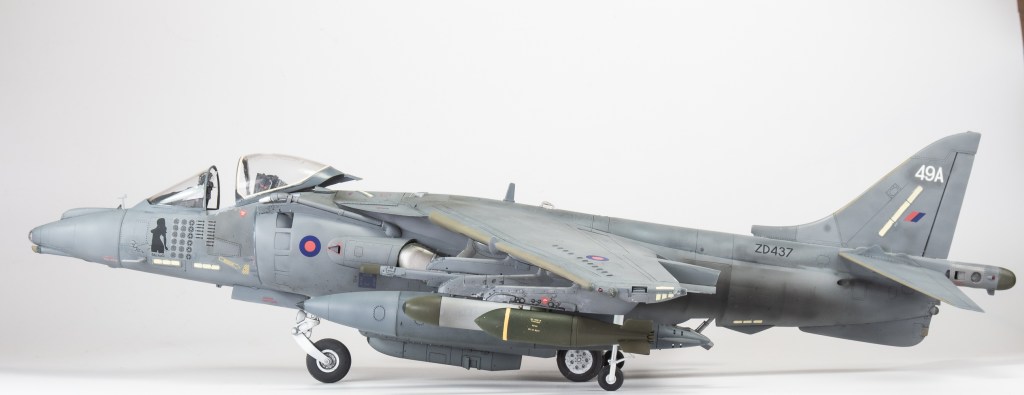
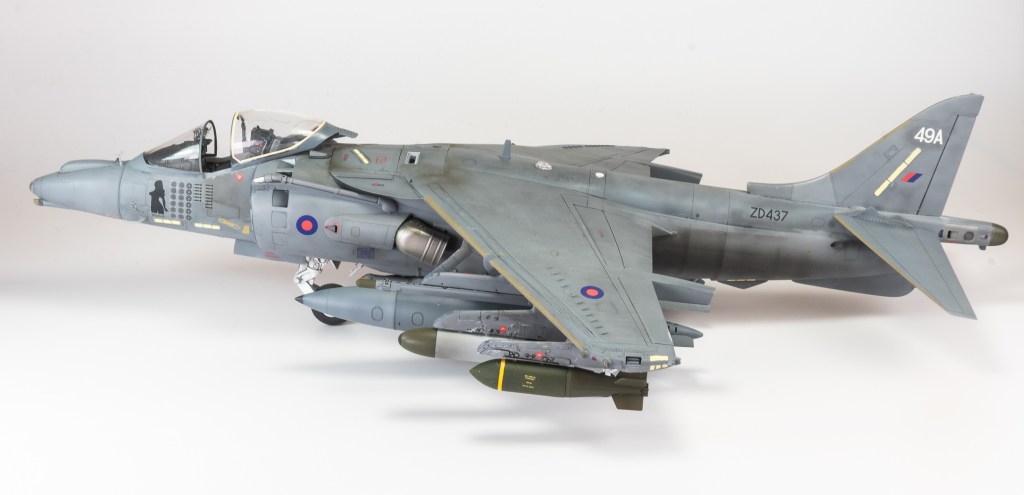
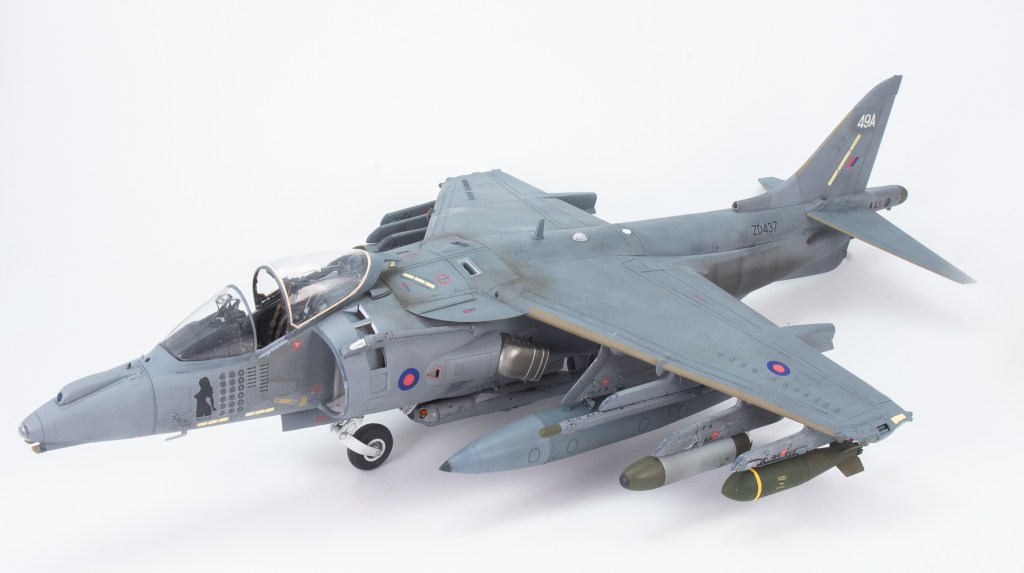
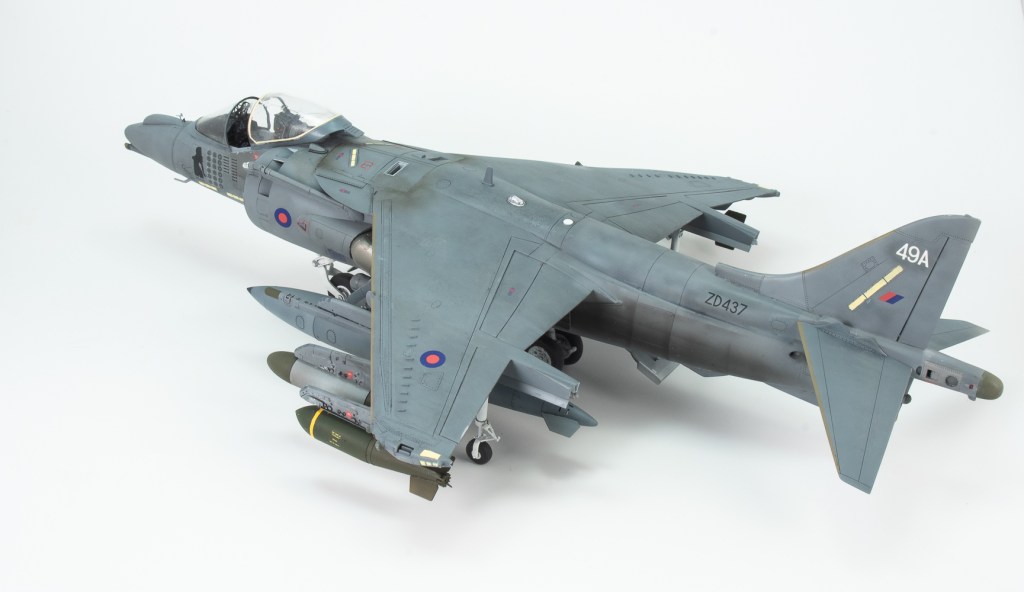
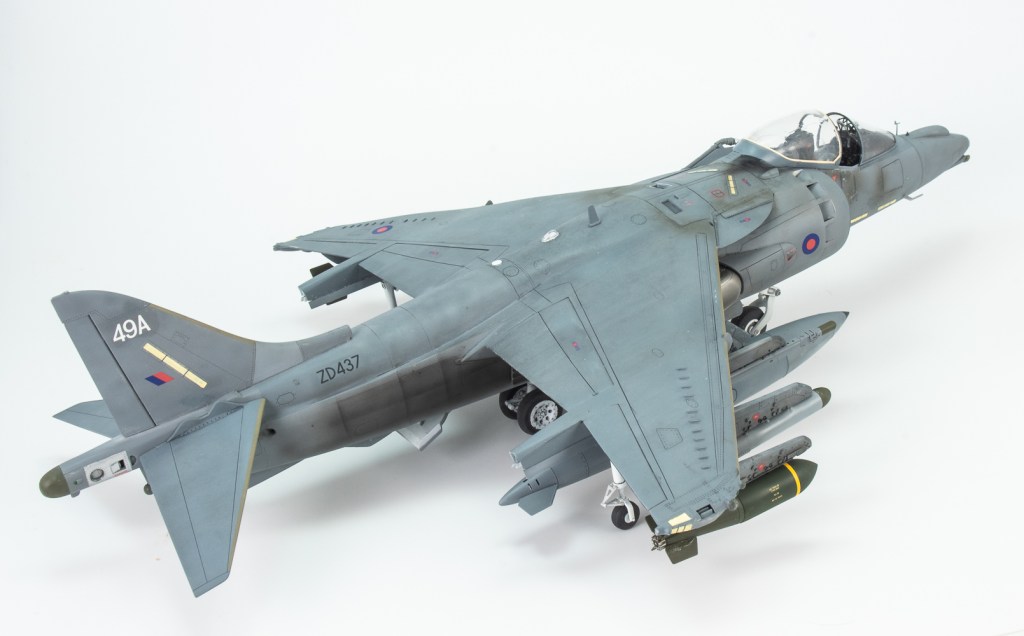
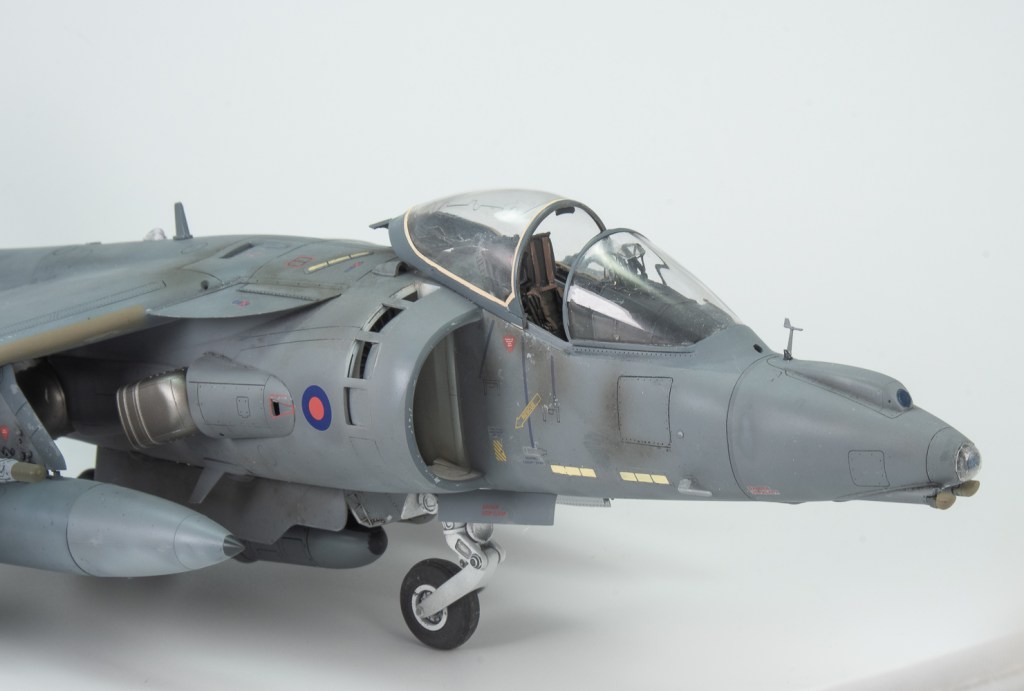
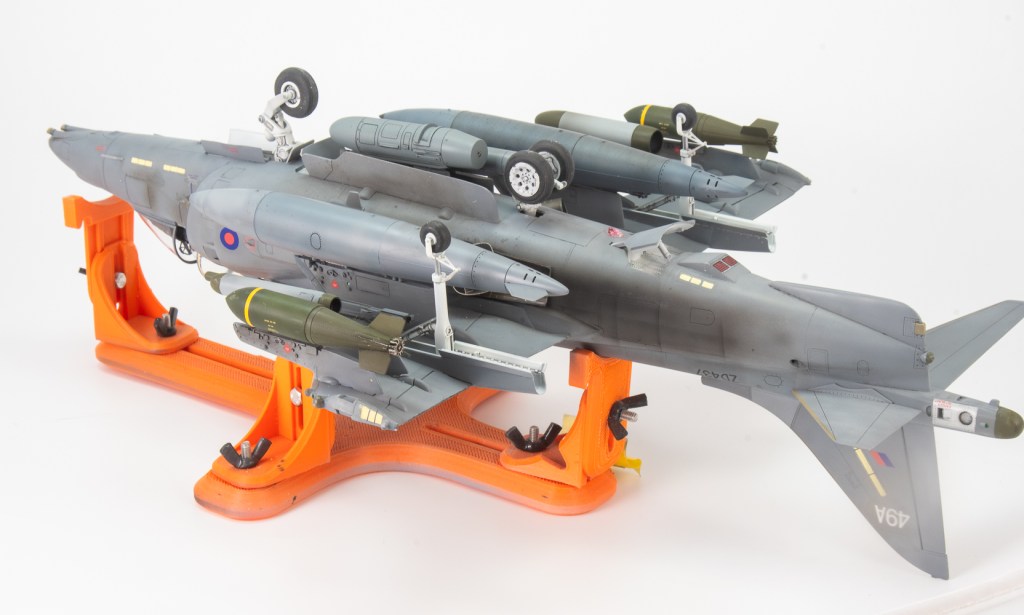
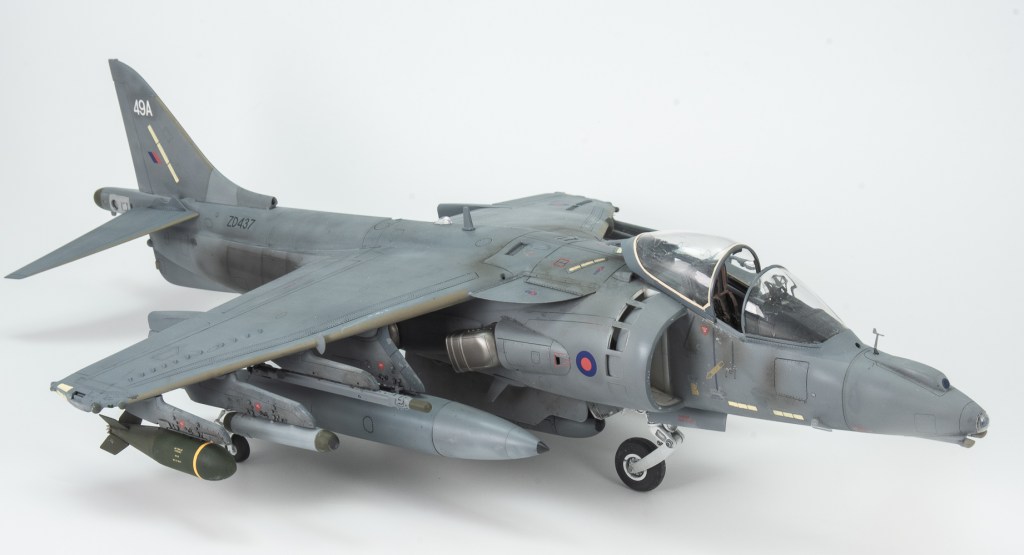
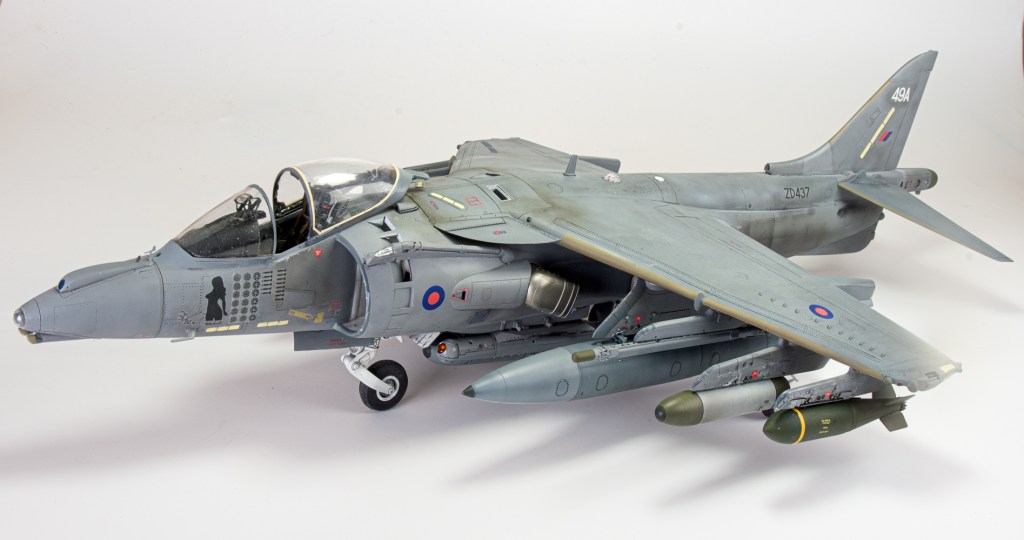
Trumpeter 1/32 Harrier GR7

  • Purchased: 2014
  • Completed; 2025
  • Enhancements;
  • Cockpit. Aires
  • Seat; resin cast by Piero on Britmodeller. No longer available
  • Jet nozzles. Aires
  • GR7 pylons: Wolfpack
  • GR7 Nose: eBay seller Sonconat
  • Tanks; Reskit
  • CRV; 3D printed from modeller on eBay. Sonconat
  • Bombs; Reskit
  • DJRP; 3dP from ebay. Sonconat
  • TIALD pod; Brassin
  • BOL Rails. ; Jet Passion

Introduction

Trumpeter’s supposed GR7 Harrier followed on from their release of the US variants, these being the AV-8B and Night attack variant. I say supposed, because despite saying GR7 on the box, Trumpeter failed to include any specific GR7 parts, the nose being the most glaring inaccuracy, despite getting expert assistance from a UK Harrier model group

Trumpeter’s RAF Harrier is nothing more than their US Harrier boxed with some British markings, and even these are wrong. There are no specific RAF weapons either, the kit coming with the standard US weapon sprues. The national Markings look to be the wrong colour and size as well.

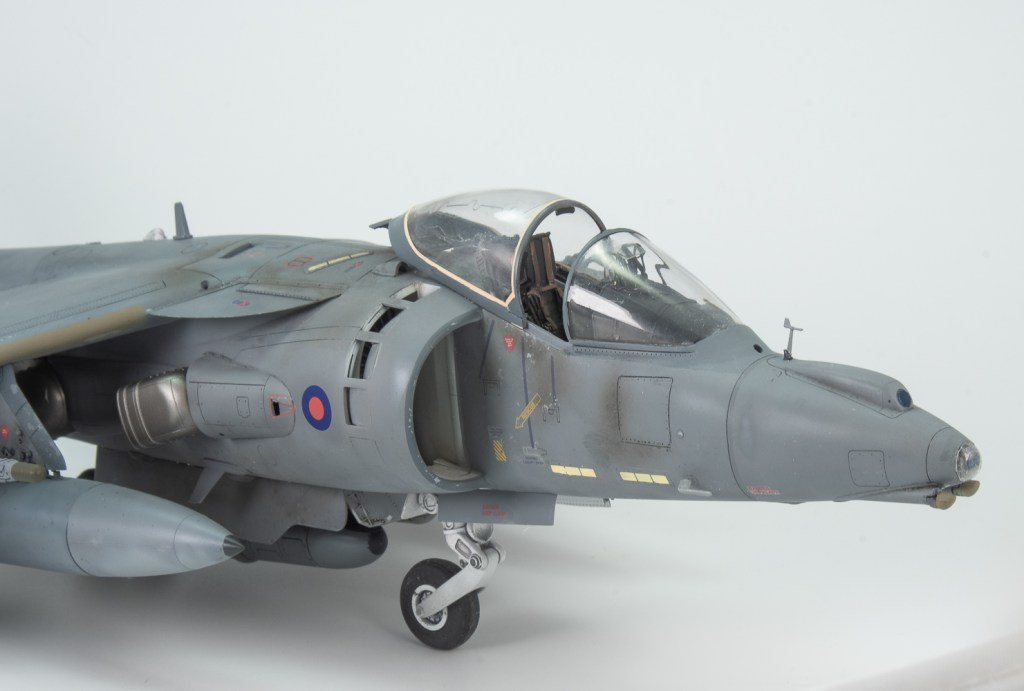
The kit has several incorrect shaped access panels for a GR7. I decided to leave these as they came in the kit, but if you want to correct your kit, pretty much all the access panels and rivet lines on the wingtips need changing .The kit wings have a weird bulge midway along the wing leading edge when looked at front on. I suspect this is Trumpeter’s method of dealing with the wing “kink” but it just looks wrong. Mould lines will also have to be removed from each upper wingtip. Raised panels on either side of the nose should be sanded flat and the foremost panel just behind the nose on the port side removed as I cannot see this panel on any GR7s I looked at. A deliberate decision was made to not go down the rabbit hole of changing every detail on the kit to accurately portray a GR7 or 9, as one could spend 6 months doing this. Consequently, whilst my model better represents a GR7 than an OOB build, it’s still not an accurate to the last detail GR7. And Im quite happy with this compromise in the name of a quick build.

Construction Notes

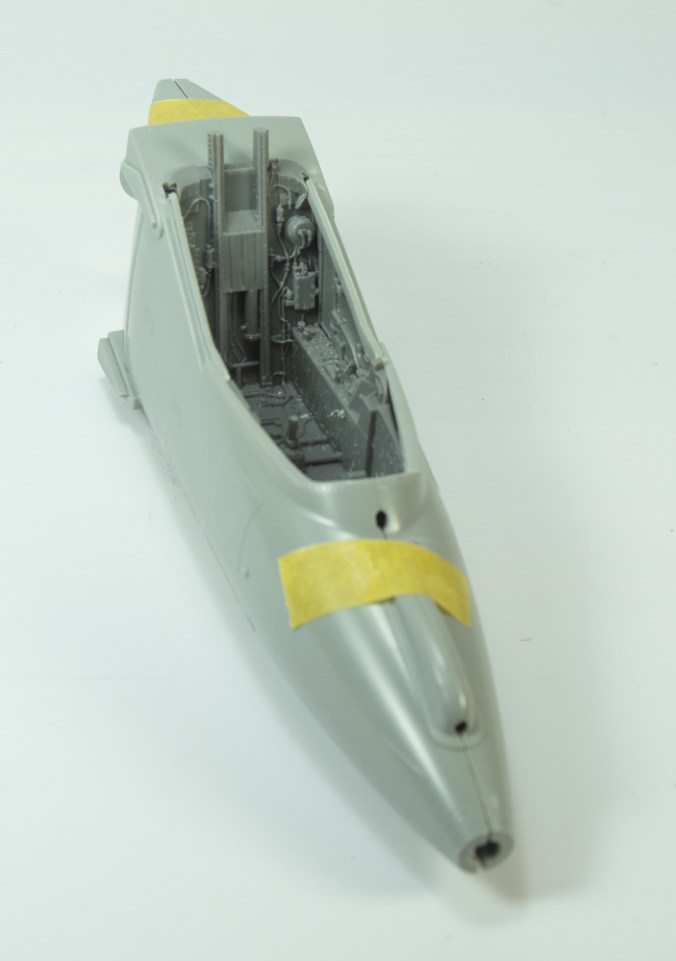
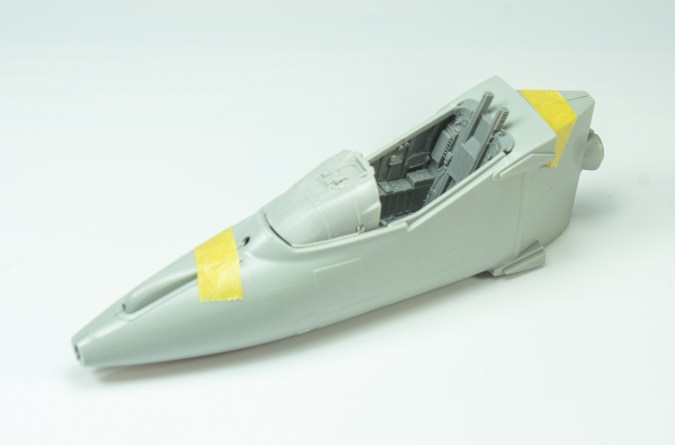
Aires’s cockpit actually wasn’t a bad fit . Although not quite a drop fit, it didn’t take too much sanding to fit between the nose halves, even locating to the kit cockpit location tabs. Ah, if only all Aires sets fitted like this.

Trumpeter would also have you glue all the auxiliary intake doors in the open position, rather than just the top 3 on each side that flopped open through gravity. Look at photos of parked Harriers to see what I mean.

In a similar vein, Trumpeter would have you glue the main undercarriage doors in the open position, again not prototypical for the real jet. all photos I looked at showing the main doors closed. Achieving this took a bit of work, as the doors are not the best fit in the closed position, requiring lots of filling and rescribing.

The kit pylons are the US pattern, so the Flying Leathernecks supposedly RAF corrected pylons were used, although comparison to photos, showed they are still not correct for RAF pylons. In fact the Flying Leathernecks pylons were a bit of a disappointment, also being a very poor fit to the wings. At least the rear of them was contoured to fit over the flap actuators, unlike the kit pylons. Speaking of the flap (and aileron) actuators, they will need to be extended with scraps of thick plastic card as they are too short, and uncorrected, leave large gaps as they don’t meet the control surface actuators.

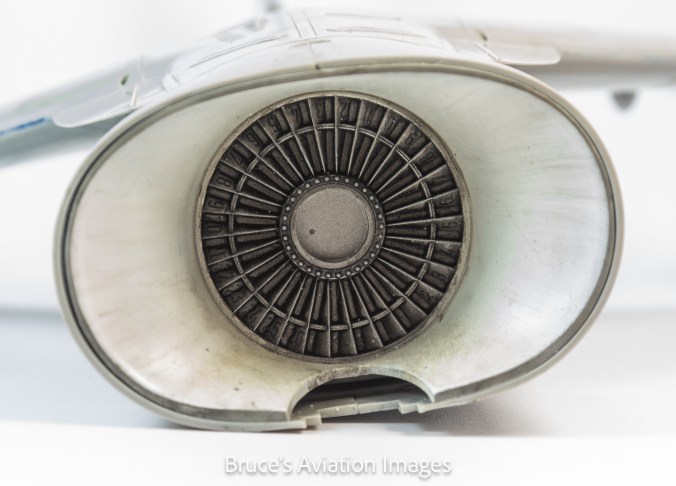
I only used the 2 halves of the engine and the mounting bulkheads, enough to mount the aires jet nozzles to. The rest of the kit engine parts were confined to the bin, as they will never be seen on the completed kit. Similarly thrown out were the kit blast plates and nozzles, these parts being replaced with the Aires items.

Parts D24 and D25 were not added as I could not see them on photos of real GR7As. All moulded vents on the rear fuselage and wing top were cut out and replaced with suitably sized PE mesh .
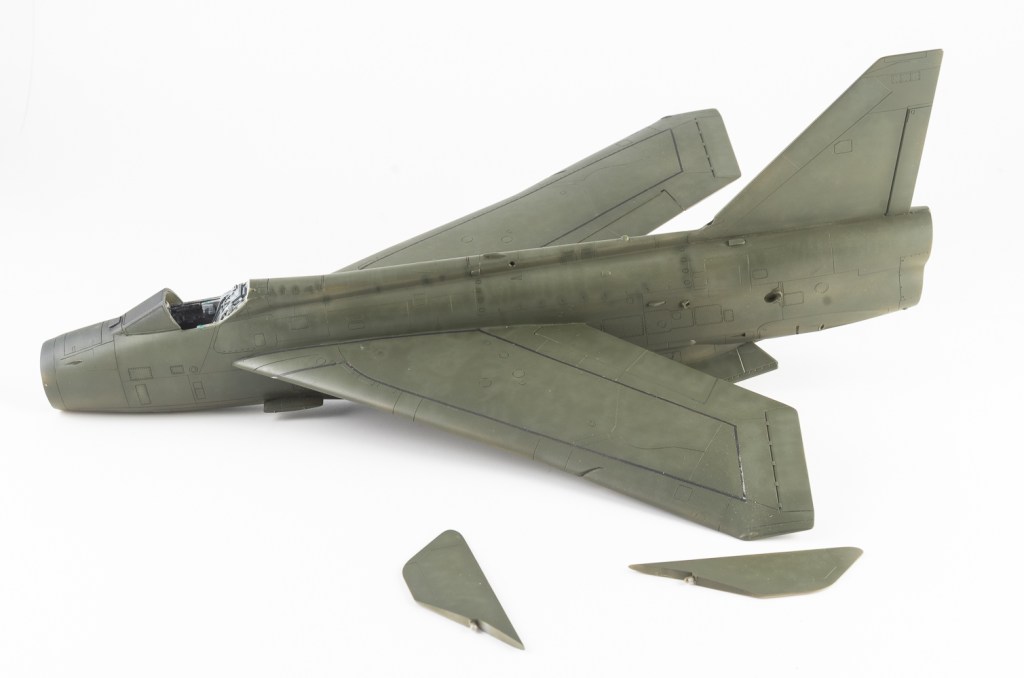
Part E55 was added but all the detail was filled and then faired into the fuselage contours. A new RAF type Flare unit was then shaped from laminated sheets of thick plastic card and added just behind the rear wheel bay. Details were represenrted with decals. The square GPS antenna was shaved off the wing centre section, and replaced with a round one as per photos.

The new 3D printed nose fit reasonably well, just requiring fairing in on one side after the kit nose was cut away, it being completely wrong for a British Harrier.

Painting and Decalling

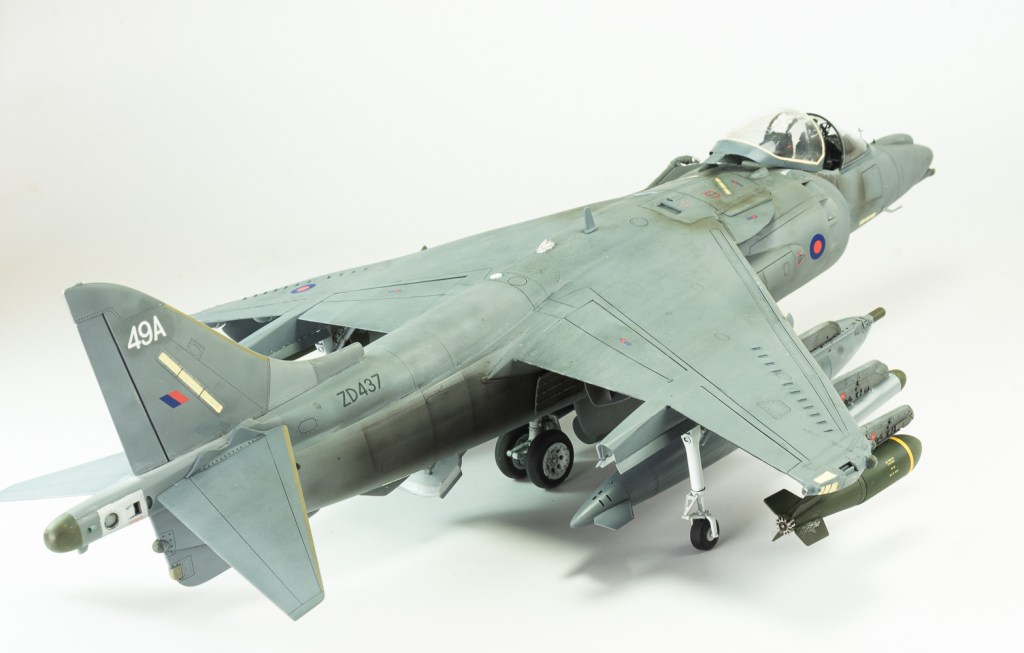
The first thing to do here was throw out Trumpeter’s painting guide. Instead, I borrowed from the painting guide for Airfix’s 72 scale kit, which calls out the correct Herrick scheme of Dark Sea Grey and Dark Camouflage Grey. The Camouflage Grey proved a problem until I found AK Real Colours offered it.

MRP furnished the Dark Sea Grey. Photos of this particular jet were quite hard to come by and I am indebted to Nick Greenall from the UK IPMS Harrier SIG for sending me some through as well as details of the correct Operation Herrick load out.

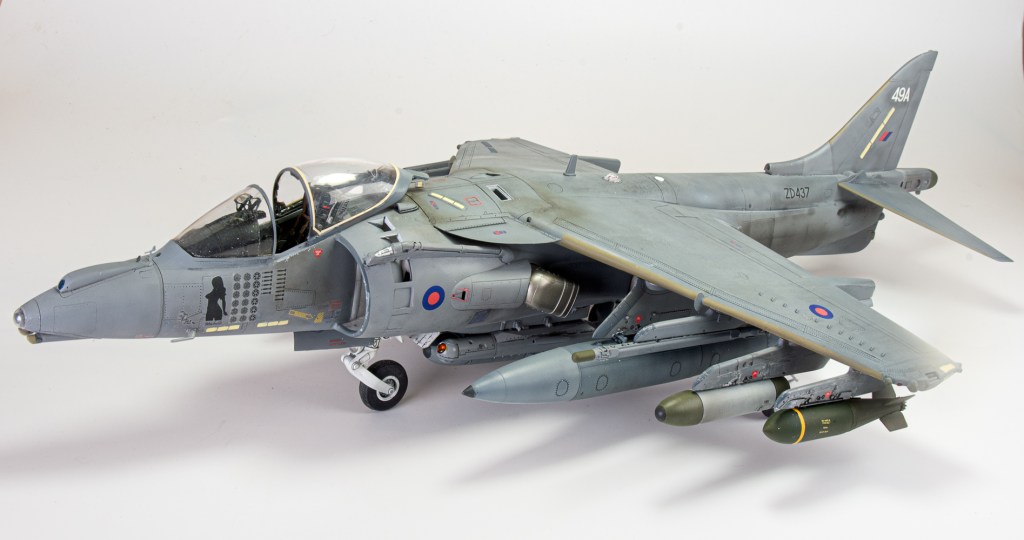
The colours were faded just slightly. Whilst photos show a lot of staining and fluid spills, there is not an awful lot of paint wear evident. A replacement grey panel was depicted on the tail despite this not being evident whilst the jet wore the nose art. Artistic Licence! The jet is pictured at a later date with light grey replacement panels in evidence, but by this stage “Michelle” had been painted out. She wasn’t getting painted out on this jet, let me tell you!! The tanks also had different greys applied to the separate sections as images of real harriers showed this was a thing.

Michelle, the mission tally and the tail number all came from Zotz decals. Not my favourite manufacturer. I find their decals quite thick, and generally non conforming to detail. Here they were coated with several layers of gloss varnish and then gently sanded to blend the carrier film into the surrounding clear coats, which, to my surprise. worked very well. A new technique to me. National markings came from an Airframe decal sheet as both Trumpeter and Zotz had the size and colours wrong, likewise all the stencilling and serial numbers. No underside stencilling was applied as it looks like it was not reapplied after the undersides were repainted with the camouflage grey on the real jet. There was some evidence of general grubbiness around the engine bay doors, so I used Starship Filth to add this. Wrong colour!! I should have just used black as it looks like there’s been an engine bay fire. Nethertheless, I was quite happy with my blending efforts, these being better than some previous attempts at the technique.

Final Assembly

In what was becoming a recurring thing with this kit, the Trumpeter pylons and weapons were thrown in the bin. ( I used to keep all this stuff, but it was becoming unmanageable, and it turned out a lot of it wasn’t getting used, so now it just gets thrown out {I imagine Jon Bryon is grimacing with horror if he’s reading this!})

I have already given my thoughts on the Flying Leathernecks pylons, but at least they are better than nothing and I’m happy that Flying Leathernecks saw fit to release them. Kit fuel tanks were replaced with the fantastic, but expensive Reskit items. Bombs are also by Reskit. These are 1000lbers, as I could not find any 540lbers, which I think are the correct bombs for this particular loadout. The pilot will soon find the jet feels a bit sluggish!!

BOL rails came from Jet passion, the CRV pods and DJRP came from a fellow on eBay who 3d prints corrections for the GR7. Originally I was going to use a cast nose that I got years ago from a bloke off Britmodeller, but the 3DP nose had a lot more fidelity, it just needs the print lines sanding off, as do the rocket pods and the fuel tanks. And finally the TIALD pod came from Brassin, it being drilled and pinned to the adaptor pylon that comes with the Wolfpack Sniper pod, with brass rod , as were all the stores.

Conclusion

Not the most enjoyable build. OOB, the Trumpeter GR7 needs A LOT of modifications if you want to accurately portray a GR7 or 9. Aside from this, the model is not some of Trumpeters finest tooling, the plastic being textured with some panel lines that fade away. However, like all Trumpeter kits, the model looks complex, but is not that complicated to assemble. The gaps between the flap actuators, misnumbered parts in the instructions and poor engineering that required the nose leg to be fitted at an early stage all combined to make the model frustrating to construct in some respects. I doubt, I’d do another.

To finish off, I thought I’d list the Aftermarket used and how important it was to the build. Please note, these are my opinions only.

Aires Cockpit. Definitely adds to finished build with minimal effort needed to fit to kit. You will need a MB Mk12 seat though and not the American Stencil one.

Aires Jet Nozzles – Essential. Much better than kit nozzles. Again minimal effort needed to integrate into build

Resin wheels. I didn’t use any, but looking at my completed model, Im going to suggest they are essential as the kit rubber tyres are rubbish. At some stage mine will get replaced with resin ones too.

Soconat 3DP nose and DJRP – Essential if you want to accurately portray a GR7/9

Flying Leatherneck correct GR7/9 pylons. – Again essential if you want to do a RAF jet, for the only reason they more closely resemble RAF pylons than the Trumpeter pylons. And that’s not saying much!

Reskit Drop tanks – Very nice to have , as the kit tanks are inaccurate. Not essential though.

Weapons – Essential as kit weapons are US pattern weapons only.

This was my first completed build of 2025. There was a stage where it was looking like it would be my only 2025 build, So Im glad its done.

BAe Systems Harrier GR7A 1 SQN Royal Air Force. Kandahar Afghanistan 2007

Leave a comment

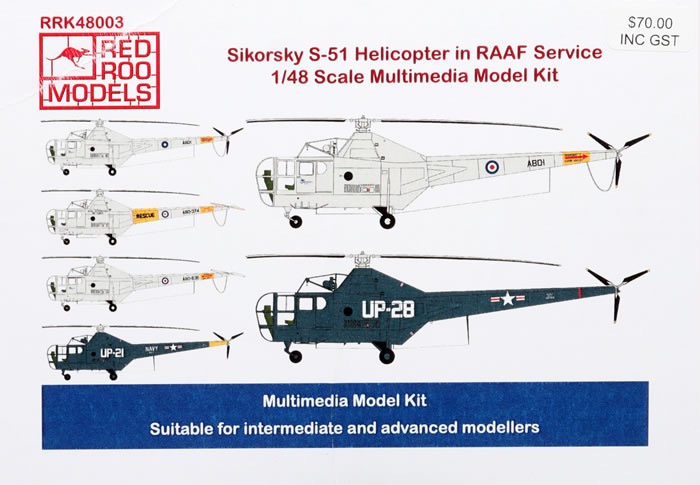
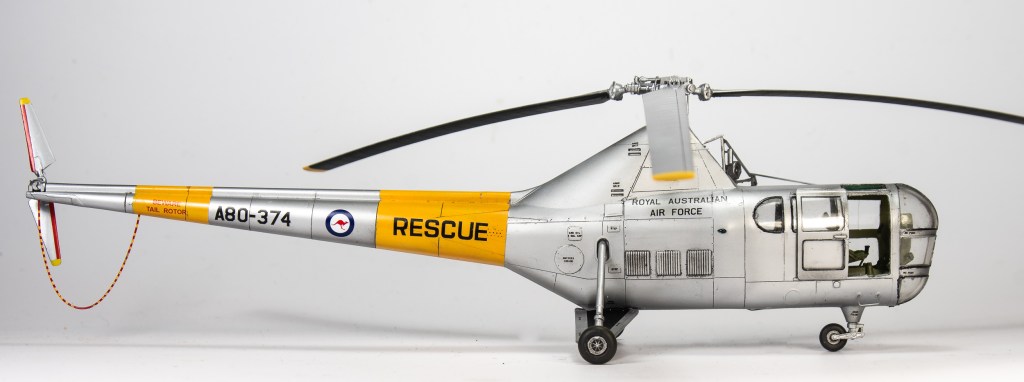
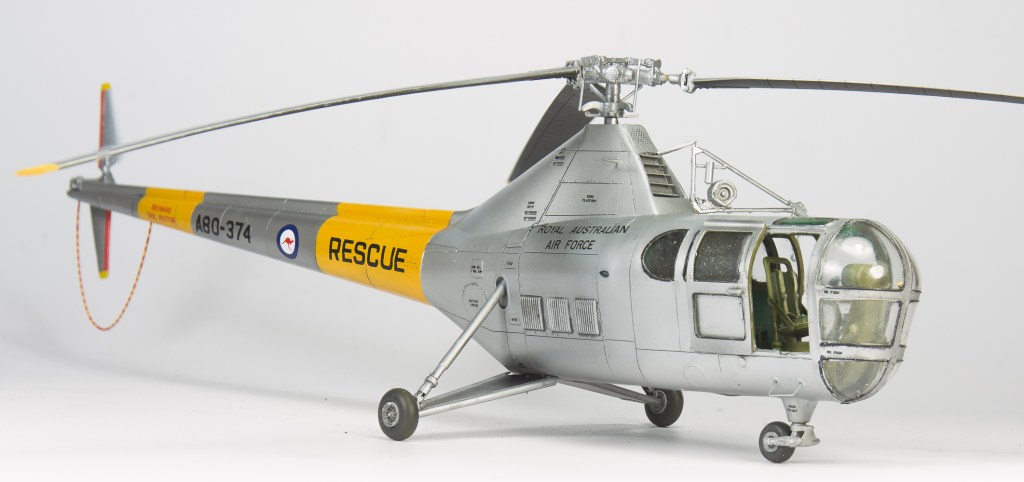
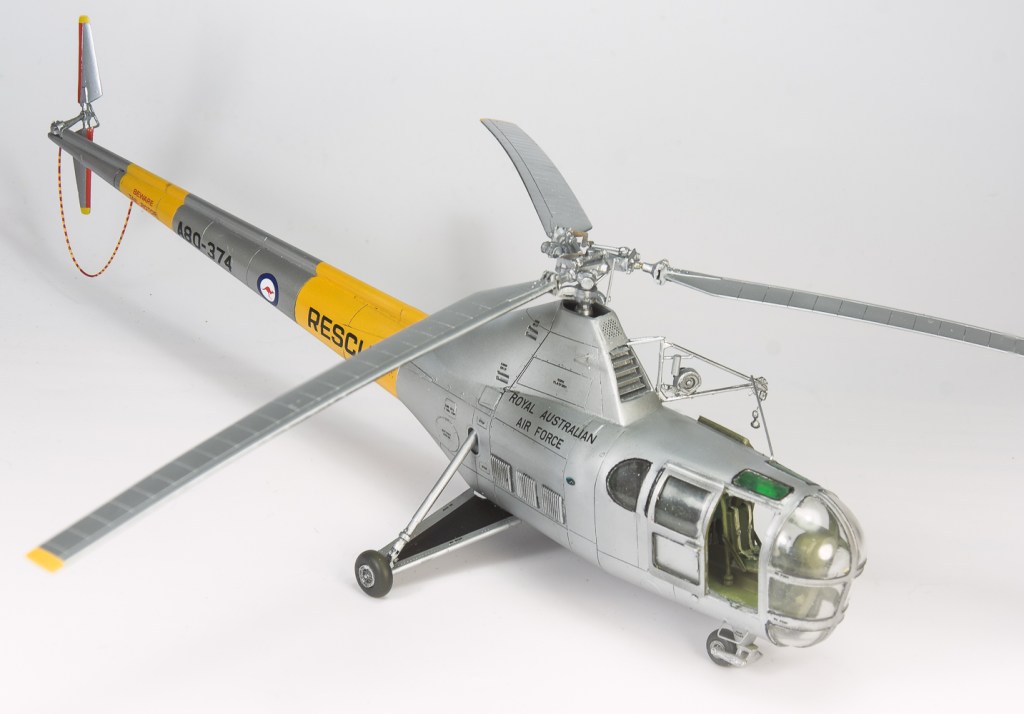
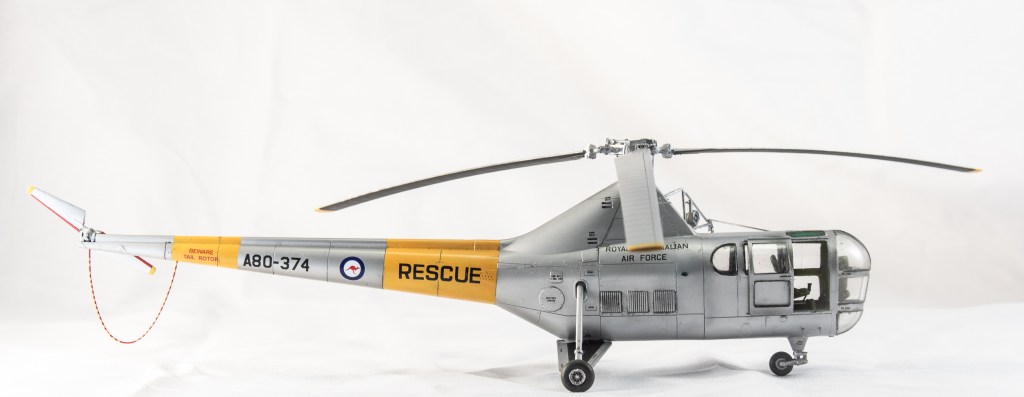
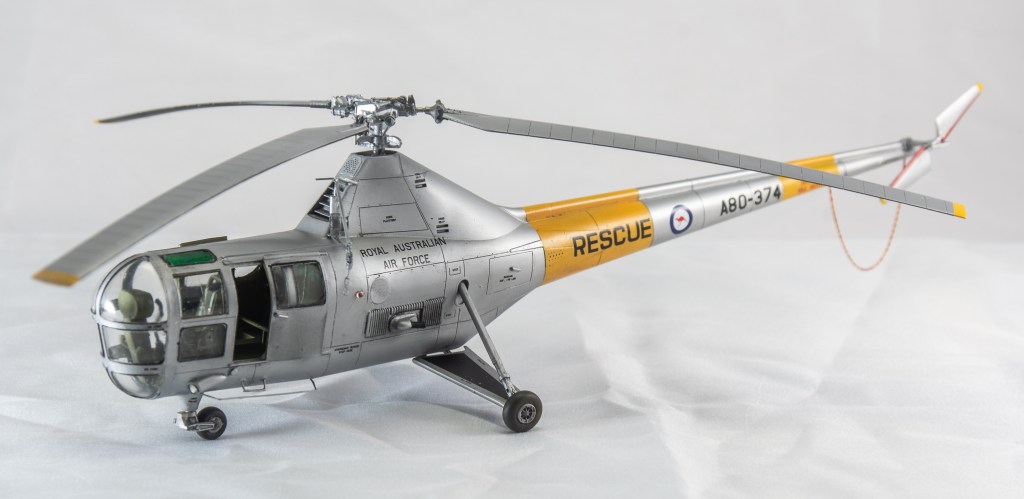
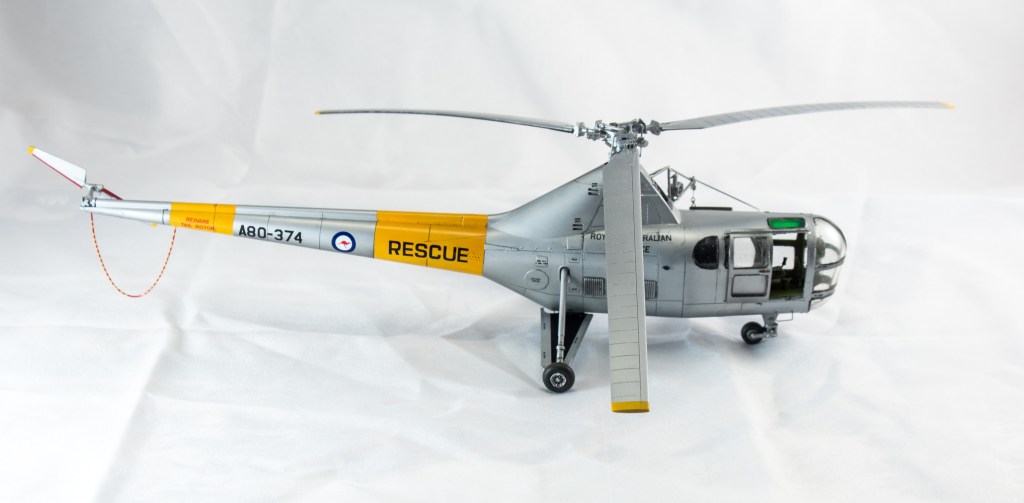
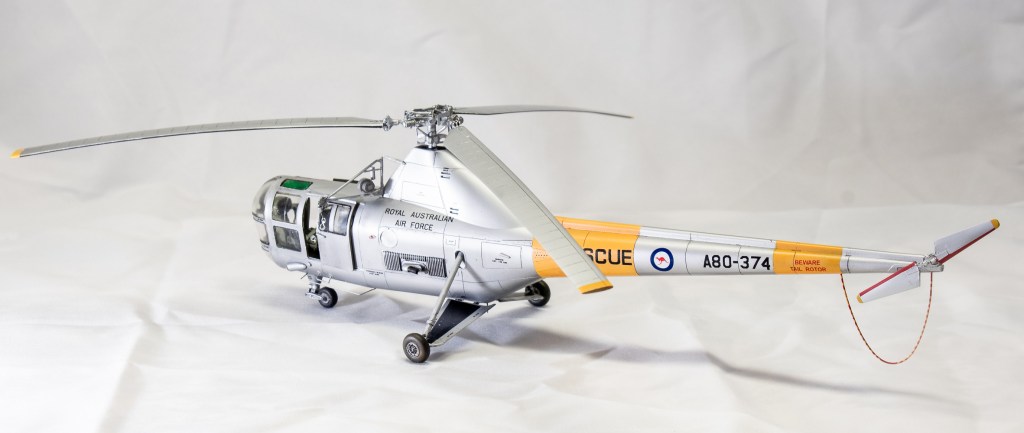
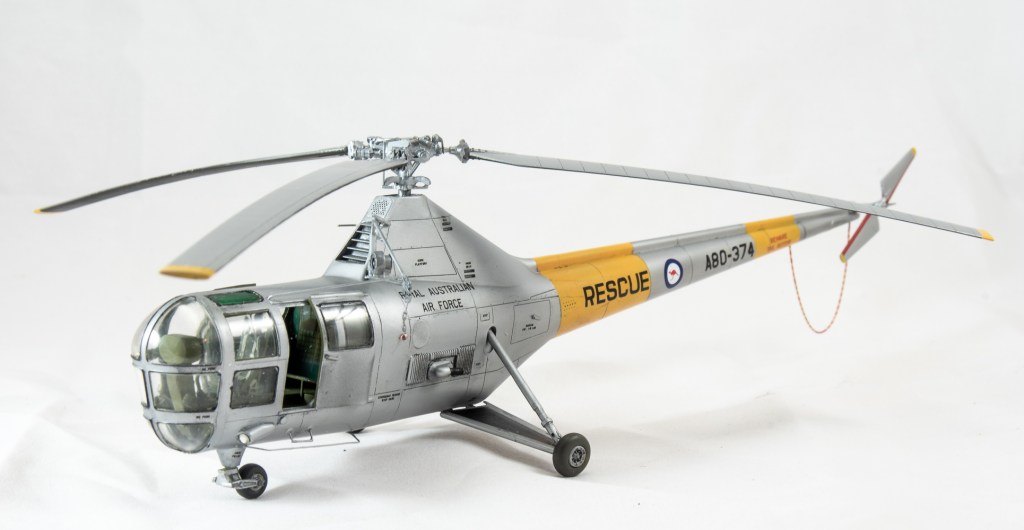
RedRoo Models 1/48 Sikorsky S-51

  • Purchased ; 2023
  • Completed; 2024
  • Enhancements; None, built completely OOB
  • Decals; Kit

Introduction

Another kit that was an impulse purchase, the reasons behind which are lost to the sands of time (despite being only last year!). A vague memory is it was possibly linked to a purchase of the AMP Sycamore around the same time, and the reason behind the Sycamore purchase? Another impulse after watching a YouTube show on it! Anyway, I digress.

This particular boxing is the A.M.P product, reboxed by Red Roo Models with new resin parts so the builder can build an example of a machine in Australian service from a variety of SQNS that used them.

The resin parts consist of a new 2 bladed tail rotor which the later RAAF machines used and wooden rotor blades as used by the earlier ones and the two USN examples that were embarked on the Sydney during the Korean War. The plastic, is as usual from some of these limited run Ukrainian companies, light grey with soft detail on the smaller parts. Clear parts are acceptable , although certainly not the clearest I have seen. The nose halves are moulded in clear plastic .

All parts will require extensive clean up to remove heavy mould seams. Redroo also include lengths of brass wire of varying diameter to build extra details and a printed rear seat on acetate to represent the web type rear seat. A very comprehensive set of instructions is included detailing exactly what needs to be added to the kit, even so , they have not done the best job of redrawing the AMP instructions, missing out a few things. For instance , there should a small instrument cluster mounted on the rear wall behind the pilots seat. The parts are included on the fret if some, but not called out in the instructions. Some of the suggested techniques are quite quaint and reminescent of Airfix Magazine back in the 70s . Pin heads to represent landing light lenses !!

Construction Notes

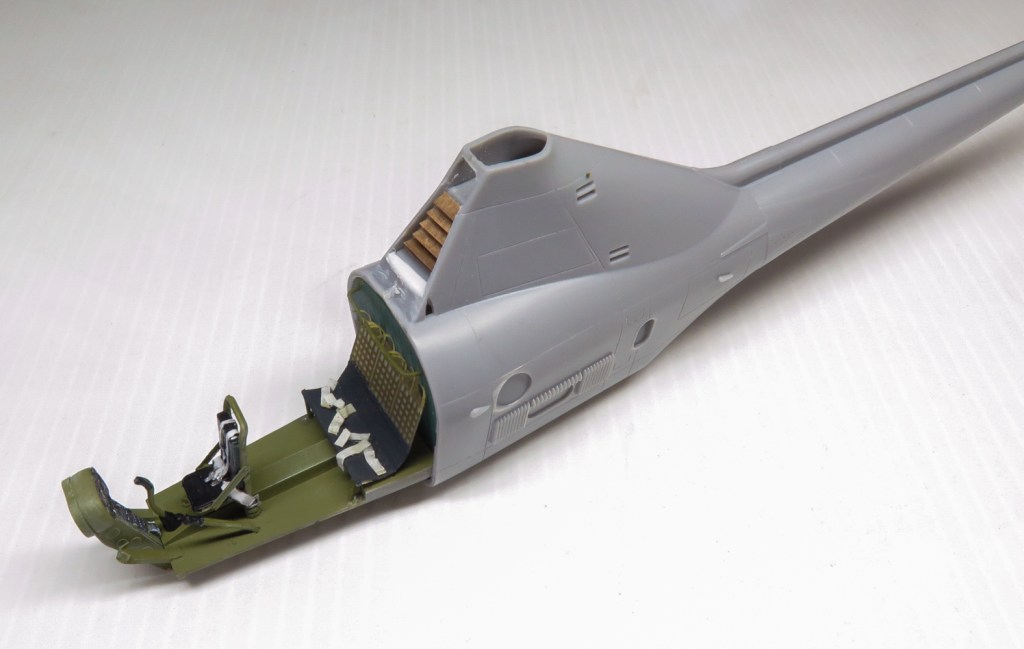
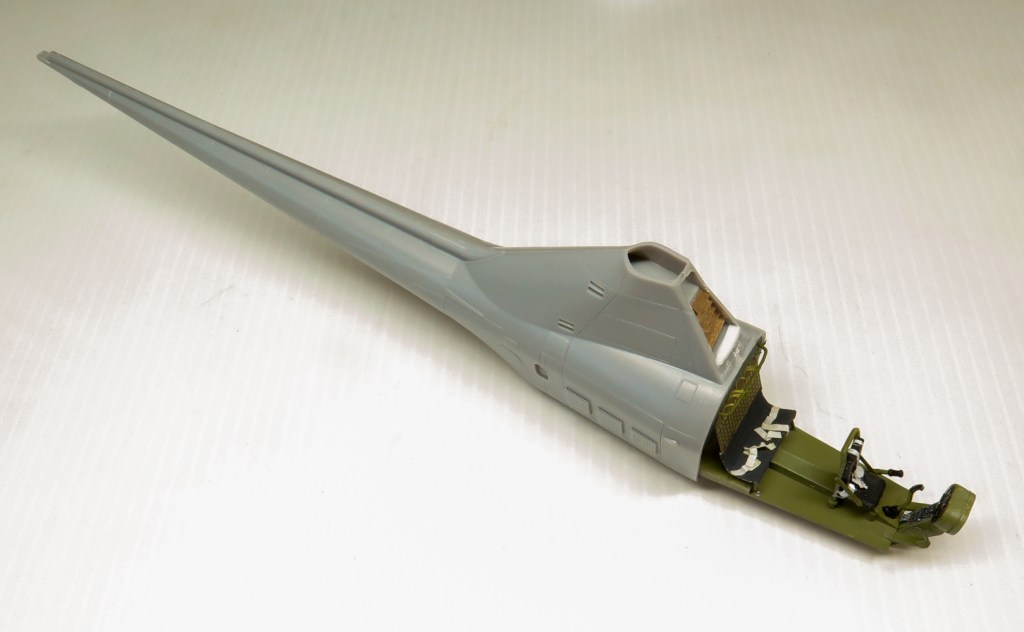
The interior builds up reasonably well, once the heavy mould seams are removed. PE seat belts are provided as are sides to the instrument console. The collective is overscale and will need replacing from small diameter wire or rod to give a better scale appearance. All locating holes will need to be enlarged to accept the opposite parts. Nothing too hard, just tedious. I used the rear seat on mine although I was worried about the glossy reflection off the acetate. You needn’t worry about this though as it really can’t be seen once the fuselage is closed up. To bend the acetate, lines were scored on the reverse side with a scalpel

Don’t forget to add some weight underneath the floor so the completed model sits on its tricycle gear. As there were no masks in my kit, tape was placed over the windows, burnished into the corners with a toothpick and then cut with a new blade. The windows all have prominent seals around their circumference, so this is quite easy to do. The inside and outside were masked and the interior halves of the nose painted Interior Green. with the lower half of the rear cabin walls and also the rear bulkhead painted a dark green rot represent the quilting. Brown vertical lines were then drawn on with a pencil to represent the stitching. Seat cushions were painted the same dark green.

The overhead window outlines are very faint so, the PE frames were added to each fuselage half and then these were used as guides to cut the masks. The interior of these windows were painted Tamiya Clear Green.

The only other complex assembly is the rotor head, again careful clean up and patience are your friends here. The PE parts adding to the delicacy of the completed assembly. I probably should have spent a bit more time cleaning up seams on my rotorhead though. I had no faith in the rotor blades remaining attached securely the way the instructions would have you build the kit, so each blade root and blade clutch was drilled and pinned with fine wire. The “knuckles” on each of these parts were also thinned with a microfile to enable the blades to fit onto the arms. Have I mentioned every part of this kit needed careful clean up or thinning or drilling out.

The join of the clear parts to the grey parts needed a bit of filling and I managed to sand a bit of a flat spot in, which I tried to smooth out with filler. The transparent nose is also not the best fit, and this gap was hidden by the simple expedient of a thin strip of tape covering it.

Finishing

The plastic , having a bit of texture took a bit of effort to get polished smooth for the primer coat . I had made the mistake of constructing all the details called out by Red Roo, such as the winch guard and steps out of thin wire and adding them prior to painting. The result of this was areas around these parts were hard to access for polishing, resulting in gritty paint around these areas. Silver was Tamiya’s superlative LP11. Simply the best paint out there for simulating silver painted finished , in my opinion anyway!

The red and yellow striped tail skid was first painted yellow then masked with strips of tape cut on my infini cutting mat. If you haven’t got one of these…..you need one!. Ensuring you leave a piece of uncut tape at one end allows you to use this as a handle to position the tape. It is just then a matter of removing every alternate strip of tape before painting the red.

Decals, although needing to be neatly cut out as the carrier film is continuous across the whole sheet performed brilliantly. The roundel was sourced from an Xtradecals sheet .

A coat of gloss to seal them in and then a wash using Tamiya Panel Line Accent. Dark grey completed the finishing process. A black marker was used to outline all the windows to represent the rubber seals.

Final assembly

The winch was assembled after cleaning it up. The whole winch should really be re built using plastic or brass rod as this would produce a much nicer item, mine has only the top rail replaced as this broke during the clean up. Now is also a good time to add the aerials, on mine, these were added earlier, thereby inflicting several puncture wounds to my thumb when handling the model.. Finally the rotors can be glued on. A.M.P have moulded a square peg on the bottom that fits into a square hole, meaning the rotorhead pretty much needs to be glued in. Id suggest replacing this with either thick plastic rod or brass wire so that the rotor can be removed at will for transport etc.

Conclusion

So that’s it. Naturally there’s things I could and should have done better, but it’s a lovely little model you don’t see built too often, . It looks great in the display case amongst all the other drab military aircraft. I wouldn’t mind having a go at a USN example one day either. An interesting postscript to my chosen subject is its last flight was aiding in flood rescue duties during The Hunter Valley floods in 1962 close to where I now live.

These are a limited run boxing from RedRoo, and Id say, once they are gone they are gone. So get one now from the Redroo website if you need a RAAF S-51 -The RAAF never referred to them as Dragonfly – in your collection

Sikorsky S-51 No. 81 Wing. RAAF Williamtown Australia 1958

Leave a comment

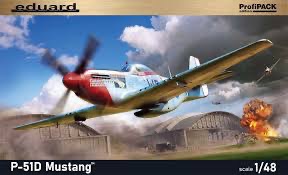
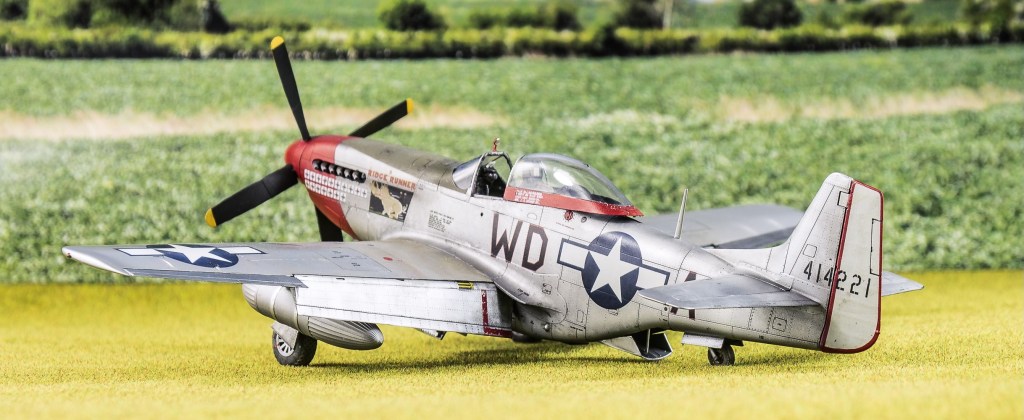
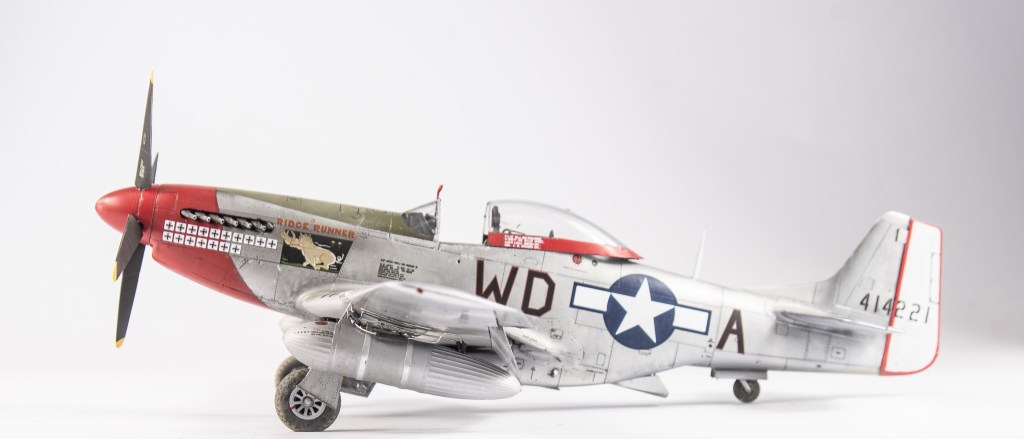
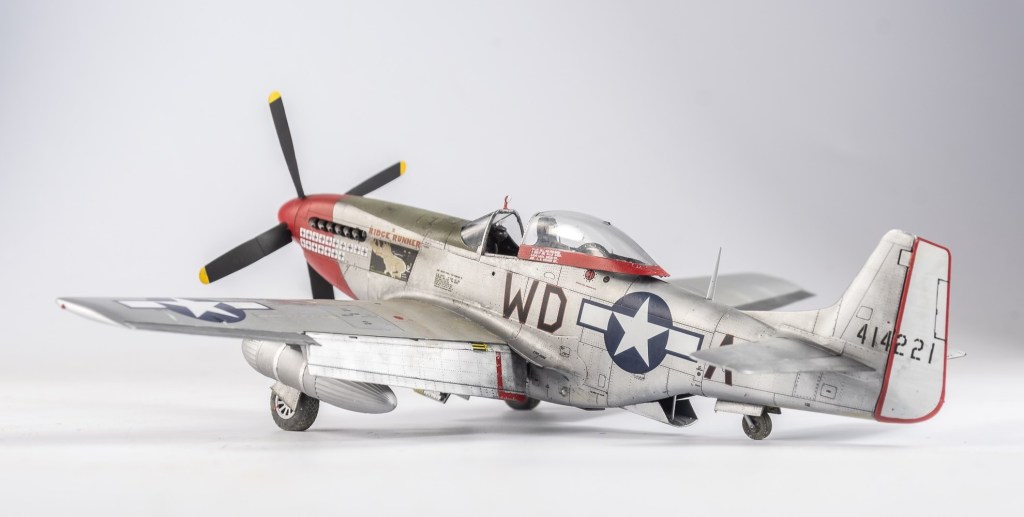
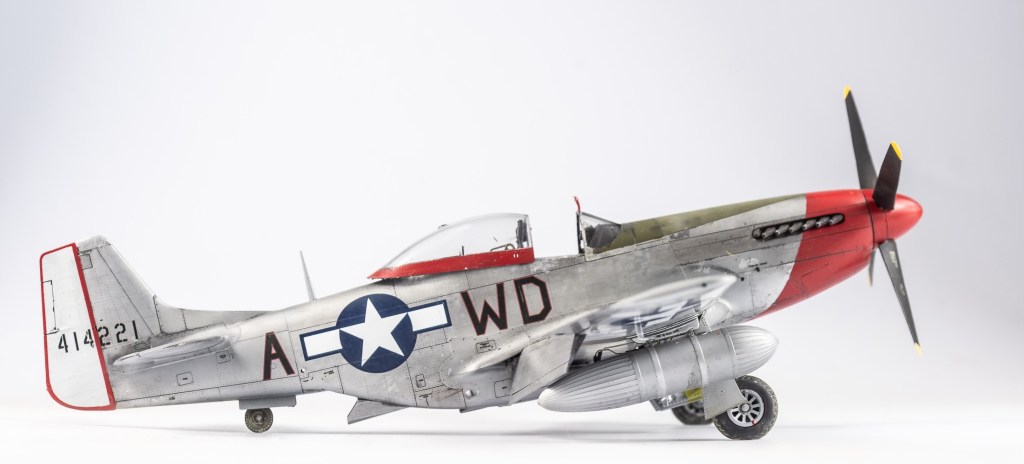
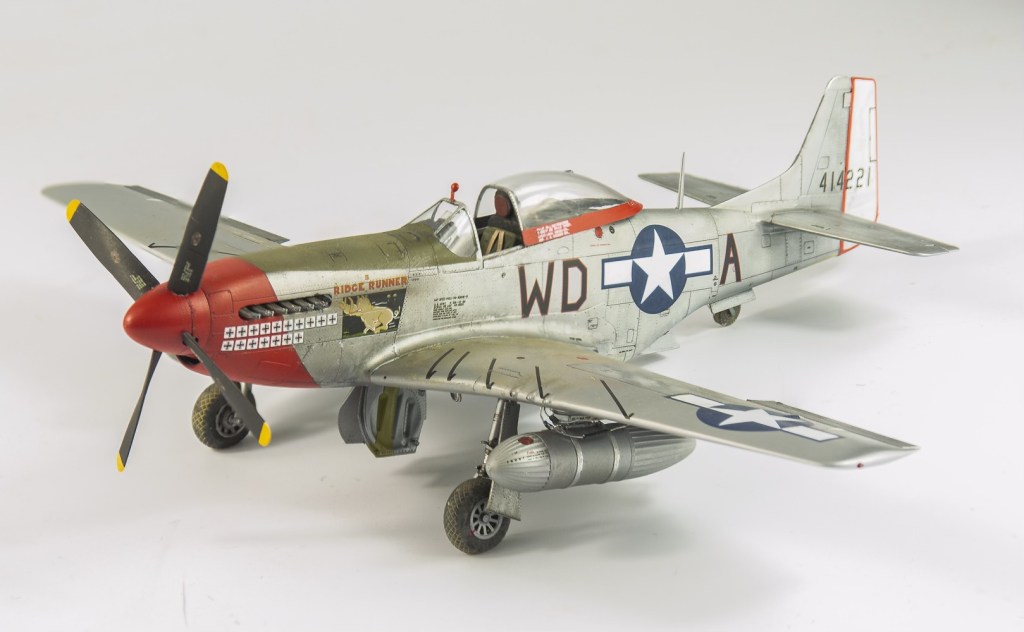
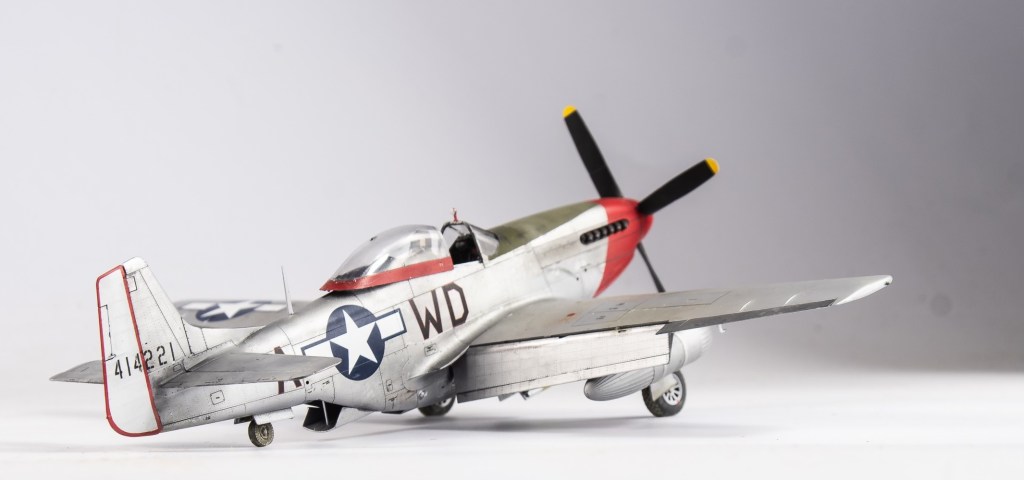
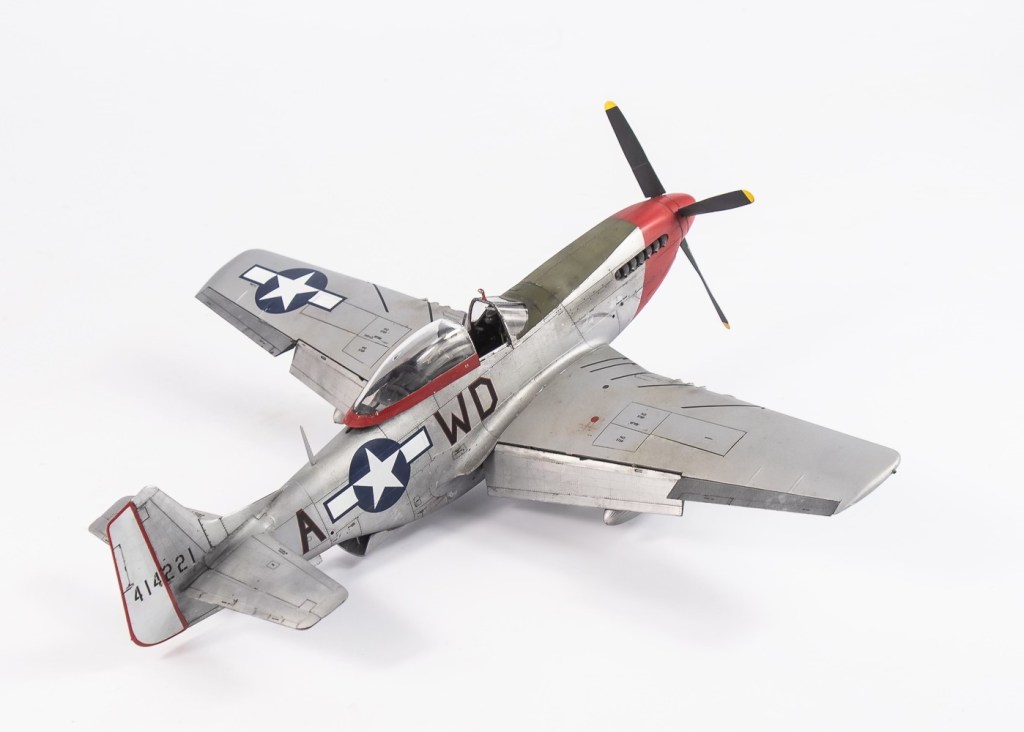
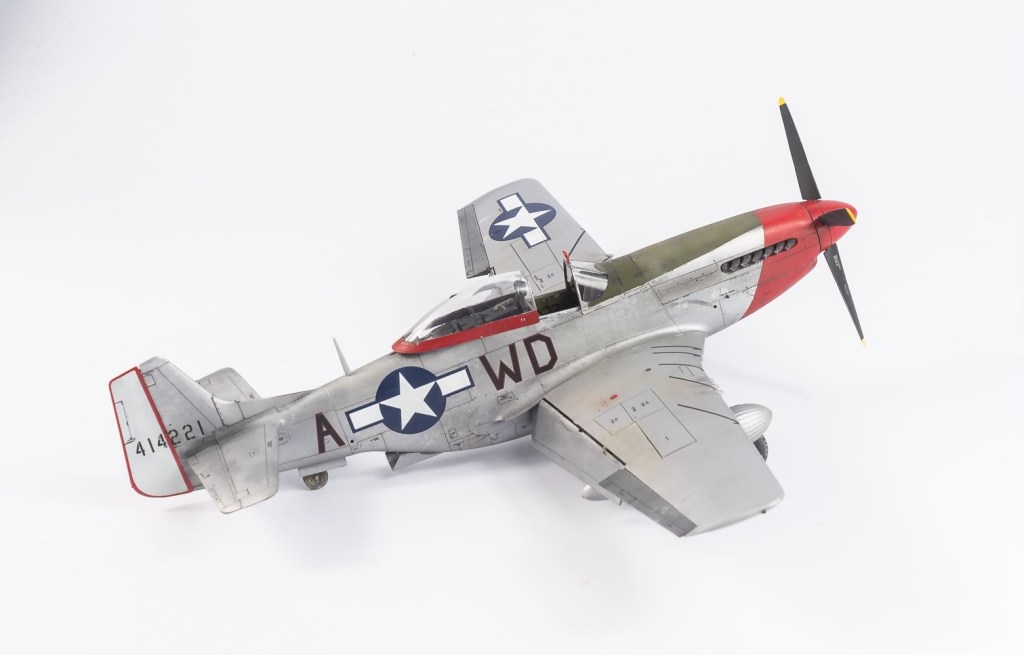
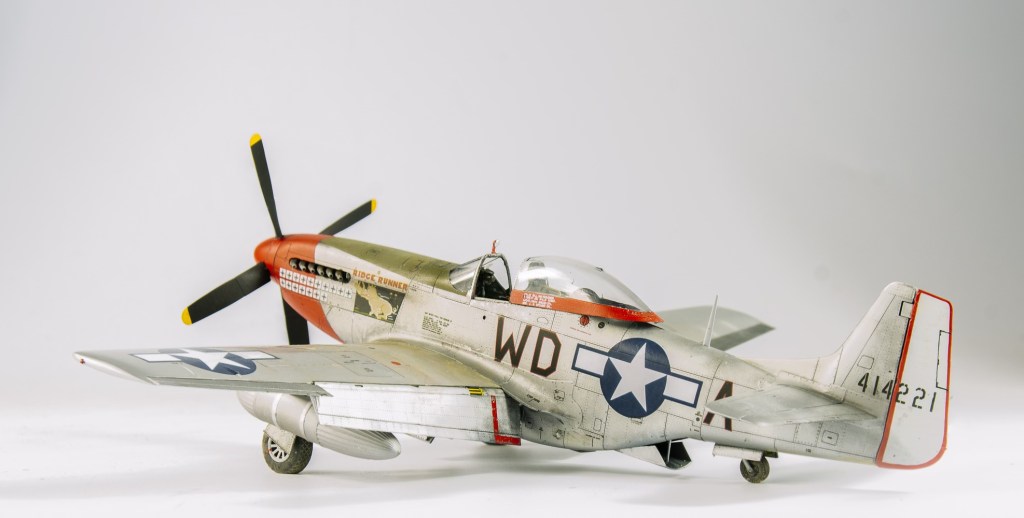
Eduard 1/48 P-51D Mustang

  • Purchased; 2023
  • Built; 2024
  • Enhancements:
  • drop tanks Eduard Brassin
  • Wheels. Eduard Brassin
  • Decals; OOB

Whoever said “Box art doesn’t sell” obviously has never laid eyes on this particular box. Because it absolutely made me pull the kit off the shelf at Frontline Hobbies in Newcastle NSW and march straight to the checkout.

Prior to this, a few friends experience with building the Eduard Mustang had left me with the impression it was one of Eduard’s more fiddly kits to assemble. That and the fact there were a few 1/32 examples of the Mustang resting in the stash made me slightly ambivalent about building the Eduard 1/48 example.

Construction

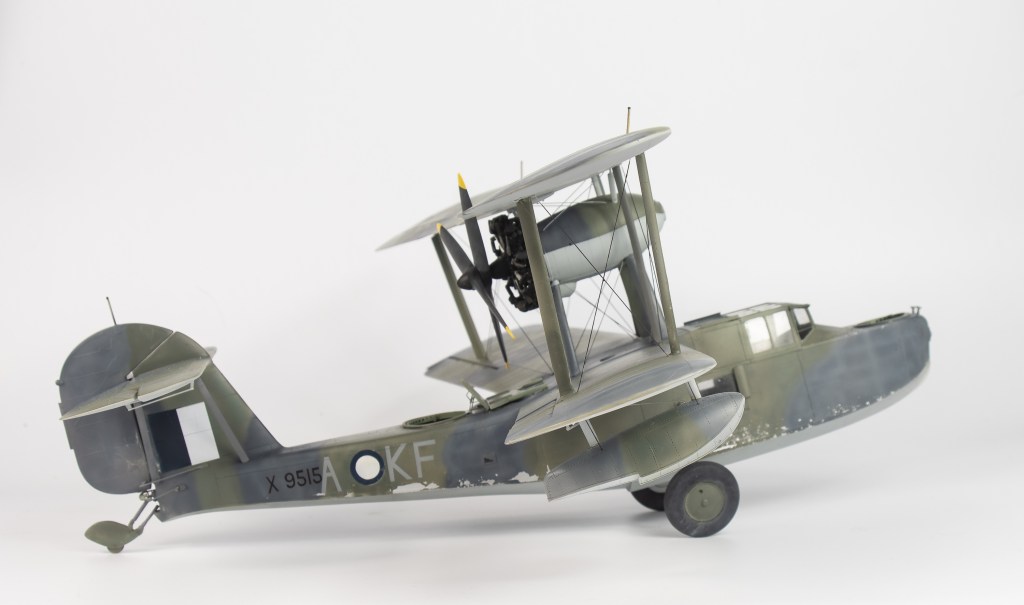
There is certainly some merit in the suggestion, the better the kit, the better the result will be. Of course a decent result can be achieved from any kit, but when, say, talking about the Walrus I did earlier in the year, far more effort is required to deliver a good result as opposed to a newer tooled kit like this Eduard kit. From opening the box to applying the final navigation light took me about a fortnight, it would have been less if I had not diverted some effort into filling the wing panel lines to represent the puttied wing joins of the Mustang’s laminar flow wing. Initially this seemed like a simple task, super glue being flowed into all the lines with a toothpick. In fact I was congratulating myself on my fast work and how easy this simple task had been.

Until the first coat of primer revealed a few infuriatingly still visible panel lines. These stubbornly remained so despite 2 other filling and sanding sessions. They finally disappeared when medium super glue was used instead of the thin CA that had previously been used.

The rest of the model assembled flawlessly, with very few fit issues, although part PE42 left me perplexed. It appearing far too small and having no real locator of any substance, It wouldn’t surprise me if there is a larger plastic piece in Weekend Edition boxings

Ensure also that you sand flat any burrs or glue globs off the top of the assembled wheel well top and bottom before sandwiching it between the wing halves. talking about the wheel wells, John Colasante from Matters of Scale FB page and PPP Podcast fame has generously shared a mask set he created for painting the spars Yellow Zinc Chromate , if you want to finish your well this way.

Download is here https://l.facebook.com/l.php?u=https%3A%2F%2Fdrive.google.com%2Ffile%2Fd%2F1_YhMnMfNkFKw5rmcnJnBeAj5_50ol1pn%2Fview%3Fusp%3Dsharing%26fbclid%3DIwZXh0bgNhZW0CMTAAAR0qu-N6dP3icPgdzLQSvrnG57iiswOR74Mj3EGm1xqwj8IIM2nq5VdSCd8_aem_o4kzKpw0kSuFAi7NWiVYYw&h=AT3evXFZRQLjhfcgPEo_QMAZkIQJOXXKapXGveyzuhWuLvYF6DEZHIQXvvDB_Nkv4ONbbYu9WaeYNhREejFgU7DeC4hxFmBzu40k4FlY6nnaBi9lbdbJ3a_ufUCqUFR2E3j_ag4&__tn__=-UK-R&c[0]=AT12ShwH-ekLdtqAN0q6n7vwcTOyXALRjvAl7585CMtWeF4k3TCOKjMNAnQuUGE_WDYITGq-GvFQNXhbf8YRCEIhBGR2VbWJv_5fhdZpXxVkQYMfHIZQH_HMrCHm66ocDise3DSDbhmQtQF9c3UUyukbKenF5HkUemHw85N4hDgDZWCbYbeX2QZC238qaYk. And I highly recommend having a look around John’s page at his fabulous work whilst you are there.

The tailplane was also a little bit of a loose fit on mine. Another fit issue I had was the spinner halves. A dry fit without the blades gave a nice tight fit, with the blades………. Not So Much, with a gap between the front and back of the spinner.

Leading me to assume the prop hub was the issue. To resolve this, the blades were cut from the hub and inserted once the spinner halves had joined. I have seen no other mention of this issue in any other build blogs, so maybe it was something I had done. On my next Eduard Mustang, I will shave the little boss moulded onto the spinner backplate that you glue the hub to, and see if this also resolves the problem.

These niggles aside, the model flew together. The Mustang, does suffer from the Achilles Heel of all Eduard kits, in that the location tabs for all control surfaces and undercarriage legs are weak and poorly engineered..

Eduard also deserves a smack on the arse for the very poor attachment points on the ordnance and pylons and having the modeller assemble PE sway braces for the stores. This is just silly.

Painting and Decalling

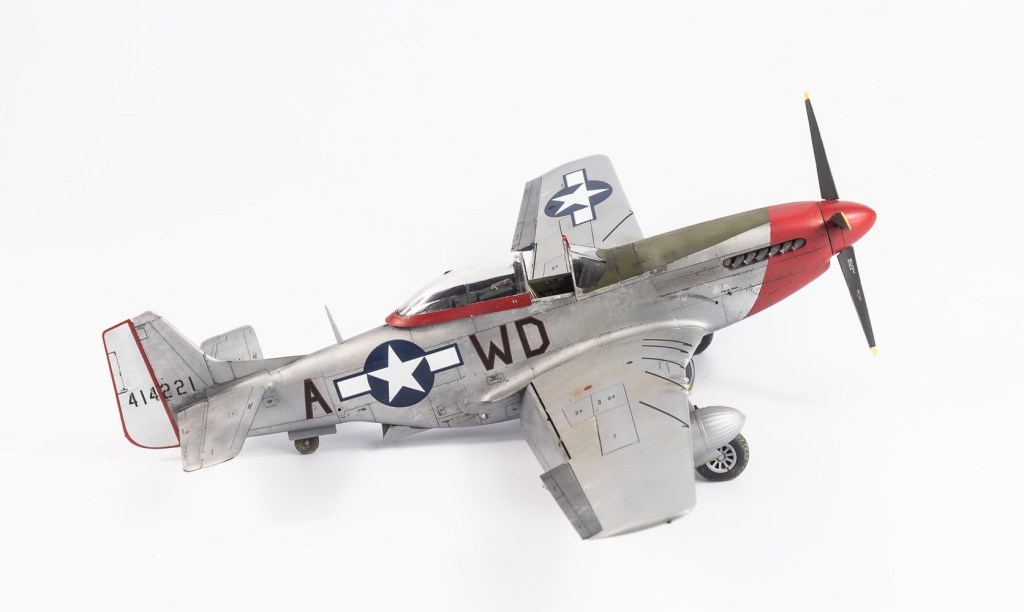
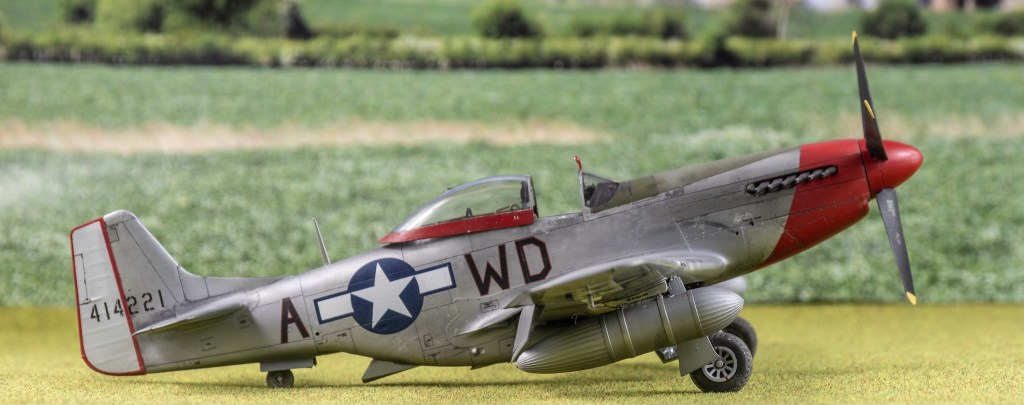
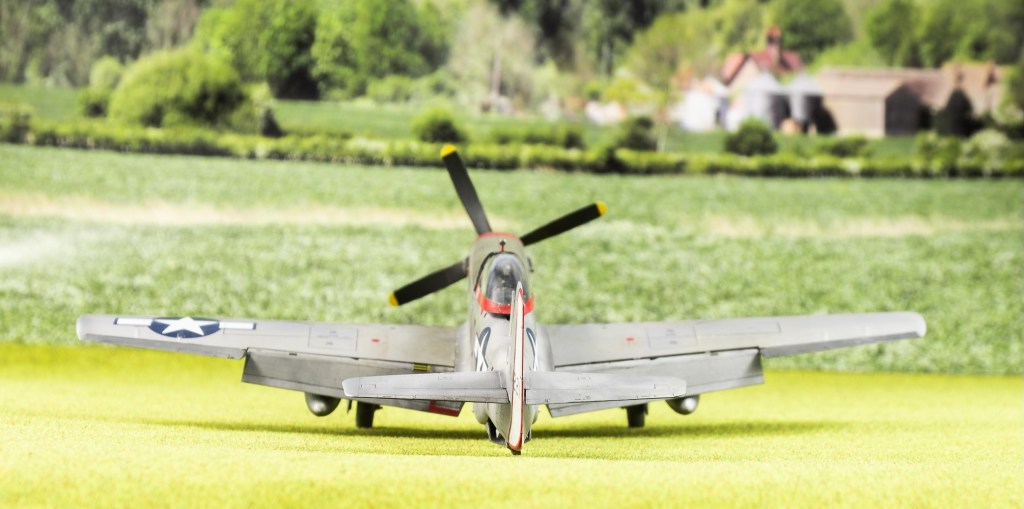
One of the prime aims with this was to simulate a worn natural metal finish. To this end all parts of the aircraft that were left unpainted are primed with Mr Surfacer black, the wings having previously being primed with Mr Surfacer Grey, then sprayed with Tamiya LP11 before being masked. The Black primer was then rubbed down to remove any irregularities. The next stage was to apply a light grey random mottle through a splatter mask. Alclad’s Polished Aluminium was then sprayed followed by Alclad Hi Speed silver , this time through a very fine splatter mask. I have seen people use a torn piece of of teased out scotchbrite pad to achieve the same effect. Alclad white Aluminium was then sprayed, again through a fine spatter mask to leave me with a variegated silver finish, which is exactly what I was after.

The red nose was sprayed by way of upscaling the Eduard paint instructions to the actual kit size, then cutting a template from the painting guide. To do this measure the kit fuselage and then the drawing fuselage size. It’s then a simple matter of dividing the kit part measurement by the drawing measurement. In this case it was 1.16, so the drawing was enlarged by 116%. Instead of using the kit red rudder border decals, I cut a mask on my silhouette machine and sprayed it. The anti glare panel was SMS OD lightened with middle stone. The panel immediately in front of the windscreen was left in neat OD to suggest a replacement panel.

The model was then clear coated with Alclad AquaGloss to prepare for the wash, in this instance Tamiya Dark Grey panel Line accent. However wiping this off with odourless thinners also removed some of the red and Alclad Polished metal. Not sure what the underlying cause of this was. Polished Aluminium is notorious for its fragility, but I thought the clear coat would protect it. Either way, the damage was repaired and the Polished Metal binned. I’ve amassed quite a selection of different branded paints over the years, but these days the ones that don’t consistently perform get binned rather than getting pushed to the back of the drawer.

Eduard’s decals performed magnificently, being bedded down between Micro Set and Micro Sol. The carrier film was removed with nil damage to the underlying decals. The decals then being sealed with another coat of Aquagloss.

As one would hope, the resin 108 gallon drop tanks are far superior to the kit provided ones, being one piece with better defined detail. Although Eduard provides the PE fuel lines, I decided to complicate things by making my own from thin copper wire.

The kit exhausts were drilled out and added, the fit being very tight. Eduard’s resin wheels must have been reprinted. A couple of mates who have built the kit previously, reported their resin wheels were slightly too big in diameter. This necessitated them trimming the bottom of the strut where it joins the yoke, so the wheel fit without rubbing.

Conclusion

Eduard’s Mustang for me was a throughly enjoyable build. There are two more in the stash, and they will get built. Is it the best 48 scale Mustang out there? That will depend on what matters to the builder. I loved the finesse, surface detail and overall buildability of it, with the caveat that some modellers my find it a bit too complex and “over engineered” for their liking, but the modeller can virtually build any sub variant of the Mustang from any boxing. That has to be a plus. For me, it’s the best Mustang currently available, well, until Tamiya decide to retool their ageing 1/48 P-51D.

Well, that’s the “Would I build it again” answered. My other question is always “Where could I have improved?” Well on this one, whilst happy with my general construction, my finishing skills again let me down. The mottled NMF technique still needs a little refinement, as does my weathering, especially the blending of the oils, and – again- I can see Ive not cleaned up the wash too well in some places. You always find this out once the matt varnish has dried!

There’s only one way to fix this.; Build. More. Models!

P-51D-10. 355th FS. 4thFG. 8th AF U.S Army Air Forces Debden UK 1945

Leave a comment

Tamiya 1/48 Mosquito NFII

  • Purchased; 2024
  • Completed; 2024
  • Enhancements
  • Wheels. Brassin
  • Gun barrels and pitot tube Master Detail
  • Landing Lights. AK lenses
  • Decals; Xtradecals 23 SQN RAF 1940-1990

This model filled the need for a bit of a short sharp build interlude from my rather large ongoing 1/48 Hercules project.

This particular came into my collection earlier this year after being sourced for me by a friend, who had in turn sourced it from another modeller. It came half started but given I paid only 10 AUD for it, I was happy to take it on. the work done though wasn’t great. The wings had been glued together without first placing the landing light lenses in their holes, the nacelles had also been glued to the wings leaving a few steps, and one set of undercarriage struts had been assembled including the wheel with an untreated join. The original builder had also glued on the flame dampeners without first adding the exhausts.

Whilst these were all annoying, they were not unfixable, save the exhaust dampeners, they would just have to be left empty and see through .

Construction

Although one of their earlier kits from the 90s, Tamiya’s Mosquito still exhibits their legendary fit and ease of assembly. The cockpit is very simplified, even by Tamiya standards, so didn’t take long to build and paint at all. As this was going to be a quick build, I was not too worried about accuracy, so did not delve into the correct radio fit, in itself a rabbit hole, for the particular machine I was doing.

With the cockpit completed, and the wings already done, assembly of the kit was achieved in no time! I deviated from the instructions in joining each nose half to its respective fuselage half before gluing the now whole fuselage halves together. Should you build the kit as per instructions though, rest assured the completed nose mates very neatly with the completed aft fuselage.

The centreline nacelles seams proved particularly stubborn to eradicate , needing several applications of CA glue and sanding. The seam on the wheel well rear bulkhead was hidden by skinning with a thin piece of plastic card. The steps the previous builder had introduced when glueing the nacelles to the wings were somewhat lessened by rehydrating the glue join with tamiya extra thin glue and then reglueing the rear of the nacelles. They still required some filling to make a gap and step free join at the rear of the wing .

The top of the fin was reduced by 2mm by the simple expedient of tracing the outline of the one fin half onto the inside of the other fin half 2mm lower measuring from the top of the fin. The fin above this line then being cut and sanded down to this line. When the fuselage halves are joined, the other fin half is sanded down to match. The rudder hinge line will then have to be rescribed 2mm lower than the existing one. To be honest, Im really not sure it makes a very visible difference to the look of the model, this modification was called out by a thread on Britmodeller. If I build any more tamiya Mossies, it won’t be a correction that will be repeated by me. The clear under fuselage hatch will also need to be filled and its outline eradicated as it was not present on the fighter bomber version. Tamiya including it as the fuselage parts are also used in the bomber version which does have the hatch. The assembled undercarriage leg had the wheel cut away, and both legs had their axles replaced with brass tube. The holes in the lovely Brassin wheels being drilled to match. The mudguards also had the lightening holes added.

Painting and Decorating

My chosen scheme was a 23 SQN Night intruder based in Malta. This decision was arrived at purely by spotting the scheme whilst going through one of my decal folders looking for something else. How many of us have done this! there is a good photo of the actual aircraft on there Imperial war Museum site that confirms Xtradecal have got the scheme correct, although the machine did not have the radar aerials as depicted on the sheet. So starting off on the top surfaces, Gunze Medium Sea Grey was airbrushed on. The helpful camouflage plan tamiya include was photocopied before the grey bits were cut out and taped to the model so the green could then be airbrushed on, in this instance Tamiya RAF Green type 2. Blu tac sausages were used to mark out the upper camouflage delineation line and the black undersurfaces sprayed with SMS German Grey and SMS CARC Black highlights. The black demarcation on this aircraft was unusually high and also formed a wavy line on the nose and nacelle sides , all of which were reproduced on the model, although I could have possibly gone higher on the nose.

The model was then gloss coated before a wash was applied to all engraved detail using tamiya panel line colours, in this case dark grey and dark brown over the MSG and DG respectively and black used along the control surface and openable hatch lines.

The upper wing roundels gave me a few problems with them refusing to settle down wrinkle free, three different roundels having to be used before I was happy. The roundel that lies over the stiffening rib also refused to mould itself to the rib, instead tearing regardless whether I left the decal alone or tried to mould it over the rib with the aid of a cotton bud. Eventually we got there after another 3 roundels. No wonder people paint on markings! The wing do not walk squares had their inside carrier film cut away to reduce the chances of silvering. I didn’t do this nearly neatly enough. You can see the ragged edges on the model, although there was no silvering.

Photos did not show the overall paint finish looking too worn, although there was a fair bit of grime around the nose and spinners. I probably didn’t add enough, jut relying on some airbrushed brown /black stains around fuel fillers and along wing roots. Piant chips were applied with a silver pencil.

This just left the final assembly and again, a bit of earlier sloppy modelling came back to haunt me when adding the machine gun barrels. I had earlier during assembly, cut the barrels away from the breeches, knowing I would be replacing them with the master brass barrels. What I didn’t do though was be precise in drilling the holes to accept the replacement barrels, consequently, I had great difficulty in. adding and aligning the barrels. The thing to do would have been to leave the nose cap off until final assembly as it was a good fit, and this would have ensured straight barrels that would have also been far easier to add to the breeches. Little lapses in planning like this and not thinking through all steps constantly let my builds down.

I really need to address it – despite saying “I will on the next model” – to lift my models.

The underwing landing lights were represented by using AK 4mm light lenses glued with white glue to a supporting plinth of blu tac.

The wheels were weathered with a wash of Mr Weathering Colors “sandy wash” with the excess being wiped off with a cloth. Finally the masking could be peeled off the canopy, and I was happy to see on this occasion nothing had leaked or marked it, despite Eduards ill fitting mask set.

Conclusion

This was a quick build done on an impulse to build a machine that I liked the look of. The opportunity was also taken to get this half built model out of the stash and provide a bit of a respite from a bigger build. Consequently, a lot of short cuts were taken with the finish. This aside, I am still quite happy with the completed model. There are two more tamiya 48 scale in the stash, a bomber and another fighter. I enjoyed the build enough to still want to build them at some stage in the future.

De Havilland Mosquito NFII. Royal Air Force. Luqa Malta 1942

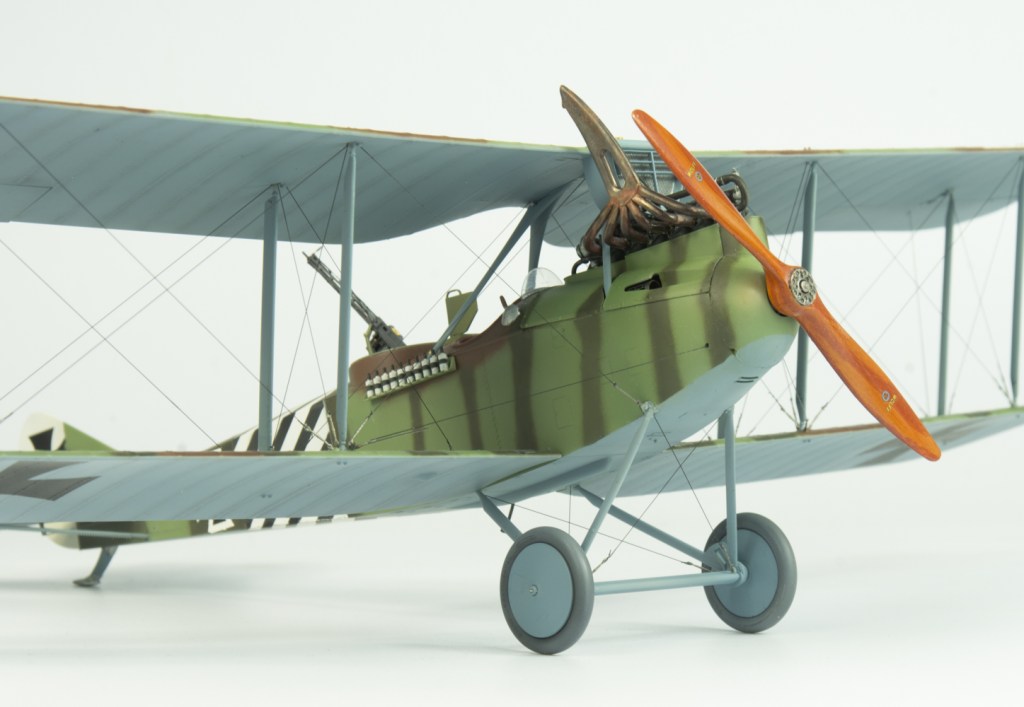
WingNut Wings Rumpler CIV Early

  • Purchased; 2012
  • Completed; 2024
  • Enhancements;
  • Gaspatch turnbuckles type A
  • Decals; kit

Construction

Im going to let the photos do the talking for this one, as it was pretty much a trouble free build, thanks to WNW quality engineering and production.

As with all my builds, construction started with removing all parts that WNW mark as “not needed”. This minimises the chance of using the wrong parts for your version.

Painting and Decalling

Painting was achieved on this occasion using Tamiya paints using the colours called out in the instructions. the exposed engine being first wrapped in GladWrap to ensure no overspray marred its finish

This would be a clean build, so no weathering was undertaken, however some shading to emphasise the ribs was done with some highly diluted black/brown airbrushed over the masked wing ribs. A tedious job, but I liked the effect.

Although masks had been cut on my silhouette machine for the markings, only the stripes were airbrushed on, the decals for the national insignia being used on this occasion. Micro sol and soft ensuring they all hunkered down over the surface details. And just like that, we were ready for the GULP…….Rigging!

Rigging and Final Assembly

Although WNW don’t advise using turnbuckles in their hints and tips section – due to them looking overscale – my thought was they would at least make the rigging easier.

Plus, there were about 4 packs of Gaspatch turnbuckles in my aftermarket tub. Care needs to be taken when fitting these into your pre drilled holes that they will lie roughly in line with the rigging line. In the case of the Rumpler, turnbuckles were only fitted to the lower wing end points of the rigging wires. Model Kasten line was used rather than my usual EZ Line. It seemed to take to the CA glue a lot better than the EZ line, which in my experience just curls away when introduced to the glue. The Model Kasten line is also round in section, so you don’t get the twists that you do with EZ line. The downside however, is its a lot more expensive than the EZ line.

Using the turnbuckles allowed the rigging to proceed far more quickly and trouble free than any of the others methods Ive used to rig my biplanes this year. I did manage to cut the actual rigging line when trying to trim the line on a few occasions, but this was easily repaired.

Also in my AM tub were brass barrels for the Spandau and Parrabellum guns, but the kit PE jackets were rolled using a rolling set and looked convincing enough. They were finished using Humbrol Gunmetal which can then be gently buffed using a cotton bud to impart a nice metallic sheen.

With the addition of the propeller and REXX exhausts – which should really have been added at the time of building the engine- she was done.

Conclusion

This was without doubt the most enjoyment Ive had from a model over the last couple of years. The parts fit is exemplary, as is the moulded detail and Wingnut’s instructions. Once you have the various interior components painted, the model builds up very quickly, and precisely.

If you are sitting on some WNW kits, so yourself a favour and build one≥. They are simply too much fun to build to have them sitting unbuilt in the collection, unless that is actually your thing.

Rumpler C.IV MFA Varsenaere. Flanders 2017

Leave a comment