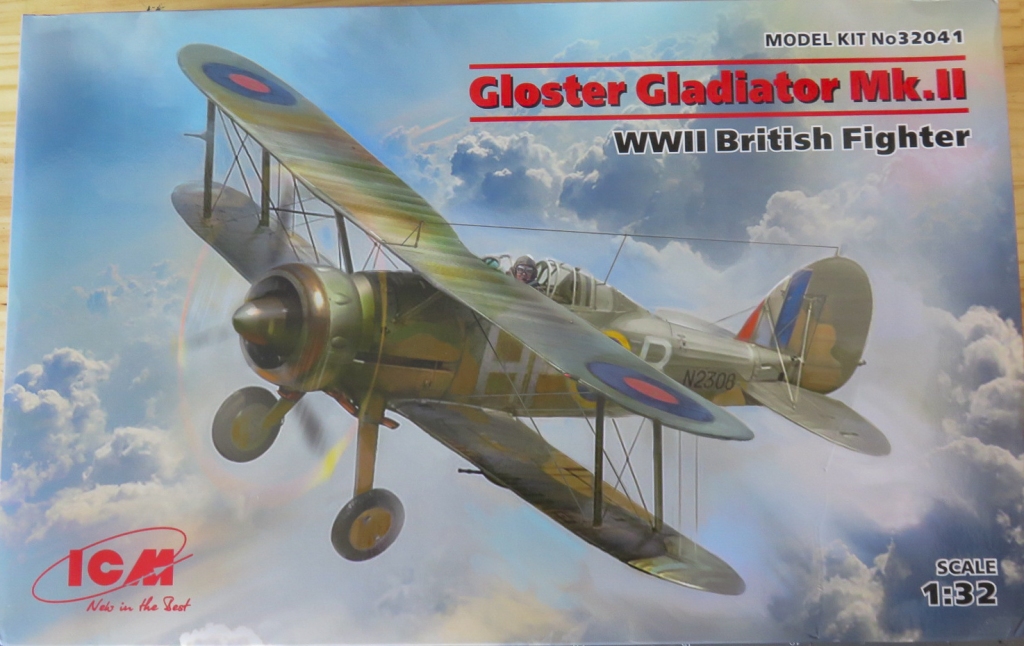
- Purchased; 2020
- Built; 2024
- Enhancements;
- Seatbelts : HGW
- Gun Barrels Quickboost
- Instrument Panel; Yahu
- Flaps; AIMS
- Carburettor intake; Quickboost
- Compass pedestal; Quickboost
- Decals;1 man Army paint masks
ICM released two boxings of the Gladiator. An initial Mk.I boxing followed by the Mk.II boxing a year later.
The MKII boxing being the one to get as it also contains all the MkI parts.
The kit is well moulded and comprises surprisingly few parts. This is the second ICM kit I have built, and they’ve both been very enjoyable build experiences, aided by good fit.
I was very much looking forward to starting this one too.
Construction Notes
Construction on this model started with the engine. No additions were used, it being built straight from the box. The completed engine looking quite busy to my eye. But spark plug leads could be added if desired, for a proper prototypical look. The join between the front collector ring and manifold should be filled, although this would be tricky to clean up, unless using a water based putty.
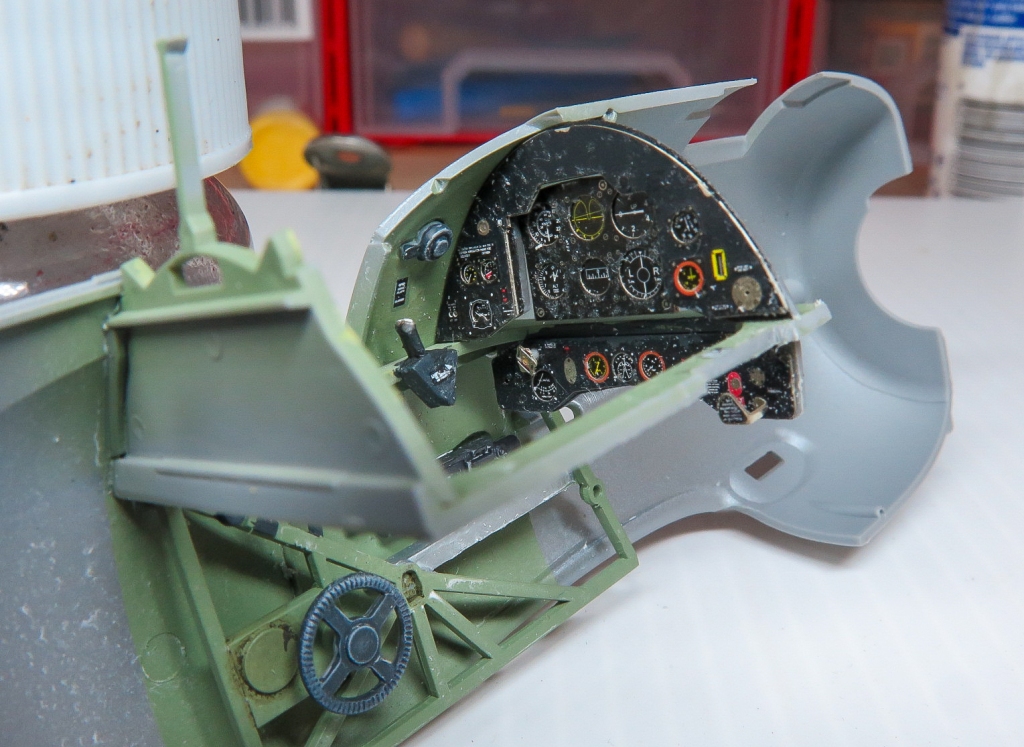
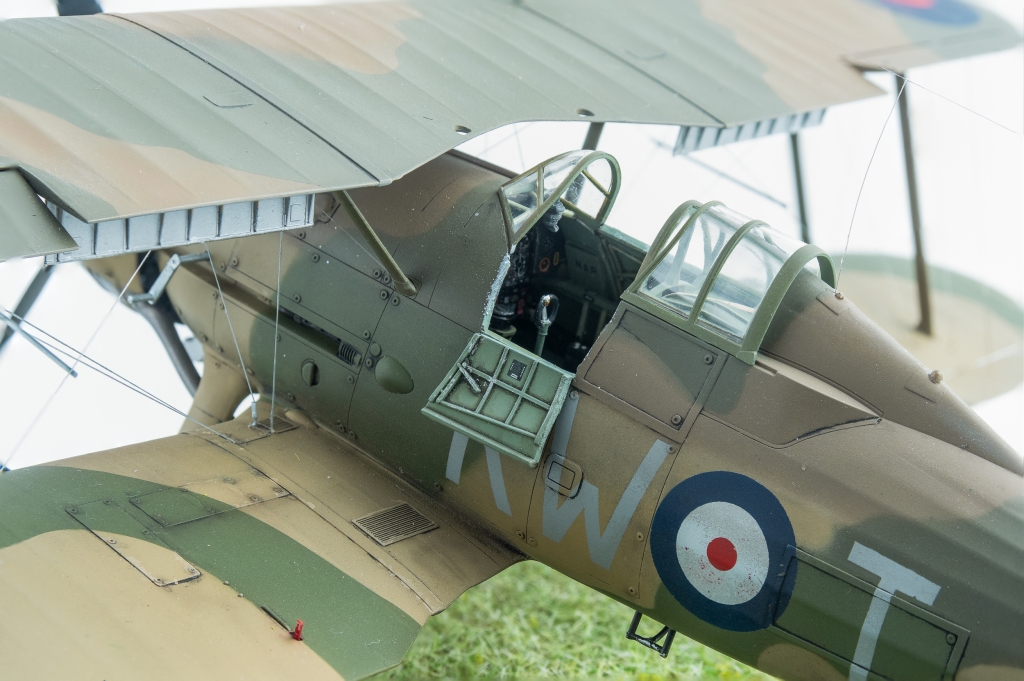
The breakdown of the cockpit gave me the initial impression ICM had greatly simplified it -true of every kit cockpit. But again upon completion and fitted, it looked suitably busy, especially if you enhance the Instrument panel with one of the 3d printed sets on the market, like Quinta, or as I used Yahu.
The throttle quadrant had two slots cut into it to accept the throttle and pitch control levers, and the rear of it was backed with some scrap card. The compass pedestal was replaced with the better detailed Quickboost item with the -in my case- out of register Yahu compass rose added to the face. The machine guns all had their barrels cut off, to be later replaced with brass barrels from Master Detail. The gunsight, part D19 also needs the reflector added from scrap clear plastic, a strange omission by ICM.
An example of how ICM have simplified the cockpit is Part C22, the rear shelf, which to be accurate should in fact, not be a shelf, but just the central beam. In the actual machine, you can see down into the fuselage either side. On the port side there is a TR9 radio , the face of which Yahu supplies in their set. Some photos show a rectangular box mounted to this frame that sits behind the pilots head. All this would be quite easy to replicate from scratch if the modeller so desired.
The very plain control stick really should be replaced with either a better detailed resin item, or detailed with sprue and scrap to better replicate the real thing. I just added a hand brake lever to mine, and left it at that
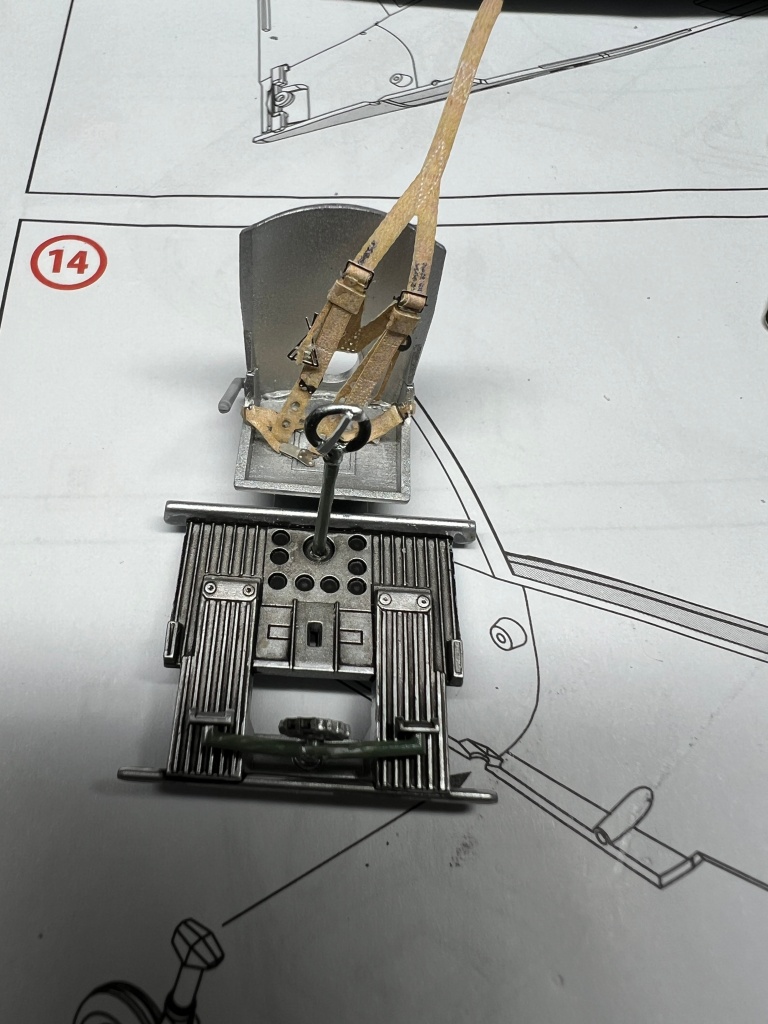
SMS British interior green was used, with a wash added from Modellers World ”wash for cockpit green.” Photos were conflicting on whether the cockpit was all green or green just above the sill with everything below silver. Mine was all grey green with a silver floor and seat. Once the prominent ejector pin mark in the seatback had been filled, seatbelts from HGW were added
With the cockpit added, the airframe built up fairly quickly, even with the added complication of cutting the flaps out and building up the AIMS PE flaps, which was achieved with some thin super glue applied with a bit of brass wire. The plastic flaps were cut from the kit wings with a thin PE saw after deepening the scribed lines so as to act as a guide for the saw.
Any gaps were filled with my super glue/metallic pigment mix. The underside insert needing a couple of passes before it was completely eradicated . There is no way those skinny little tailplane locating pegs are going to survive a knock, especially given ICMs soft plastic, so they were pinned to the fuselage with an old broken drill shank. The real machine having a gap between the tailplanes and fuselage. Whilst we have the brass rod out, the tail wheel should also have its locating peg replaced with the brass. This is another part that is prone to breakage, especially as ICM would have you fit it early in the construction process. All struts were left off until the painting was completed. Their fit to the wing is both positive and secure, so no problem adding them later. Same with the undercarriage, in hindsight, I wished I had of added it later as it made handling the model during the rigging process trickier. Whatever stage you add them, ensure you check the fit of the wheels to the axles. Mine were a little tight with the consequence that I broke an axle, which was sort of inevitable, given the soft plastic. The silver lining to this was it was repaired with a bit of brass wire that greatly increased its strength and also removed the flex from the plastic.







Painting and decaling
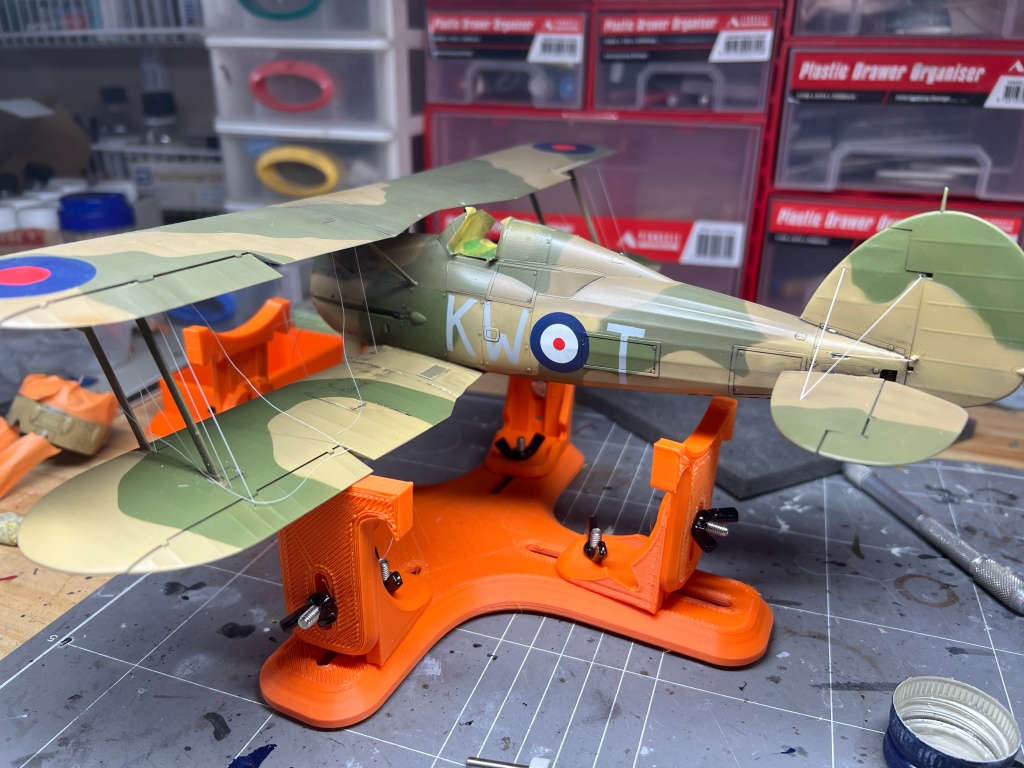
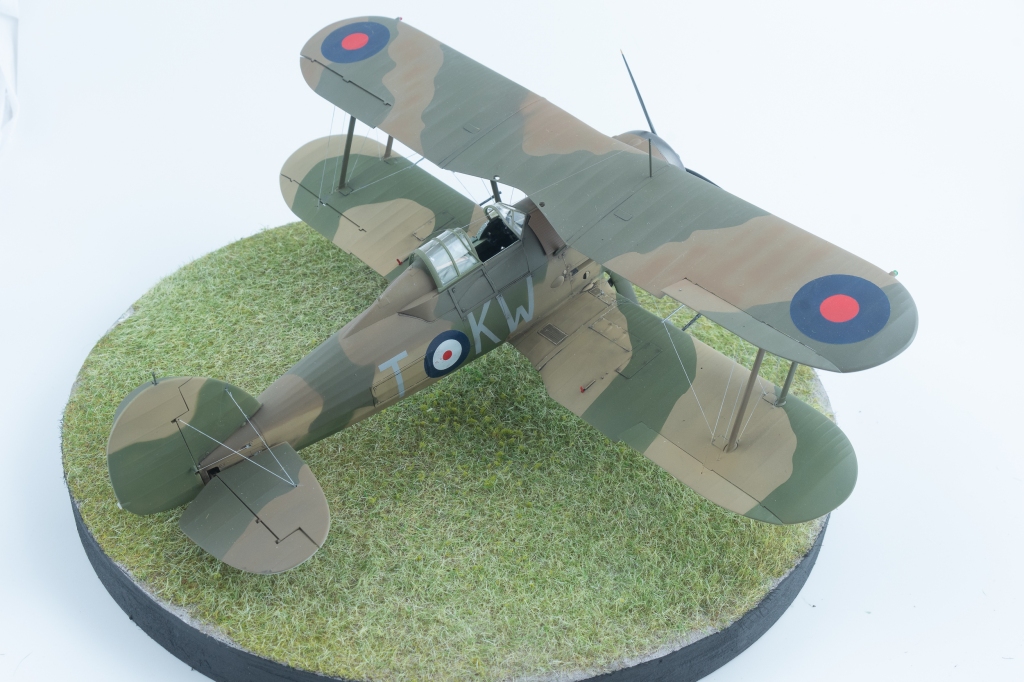
It took a great deal of studying photographs to decide on a scheme. The decision was complicated by the fact I wanted chosen scheme to feature black and white undersides , underwing roundels, early war type roundels and the four colour counter shaded scheme. If you think this would be an easy ask, think again! Early war Gladiators featured a multitude of schemes, sometimes, even in the same SQN. The Munich crisis roundels really appealed to me, but these aircraft were mostly silver undersides with no roundels. Eventually the 615 Sqn machine was picked, and to my joy, upon opening the 1 man Army mask set, roundels and codes for this very machine were included, saving me some Silhouette design time.
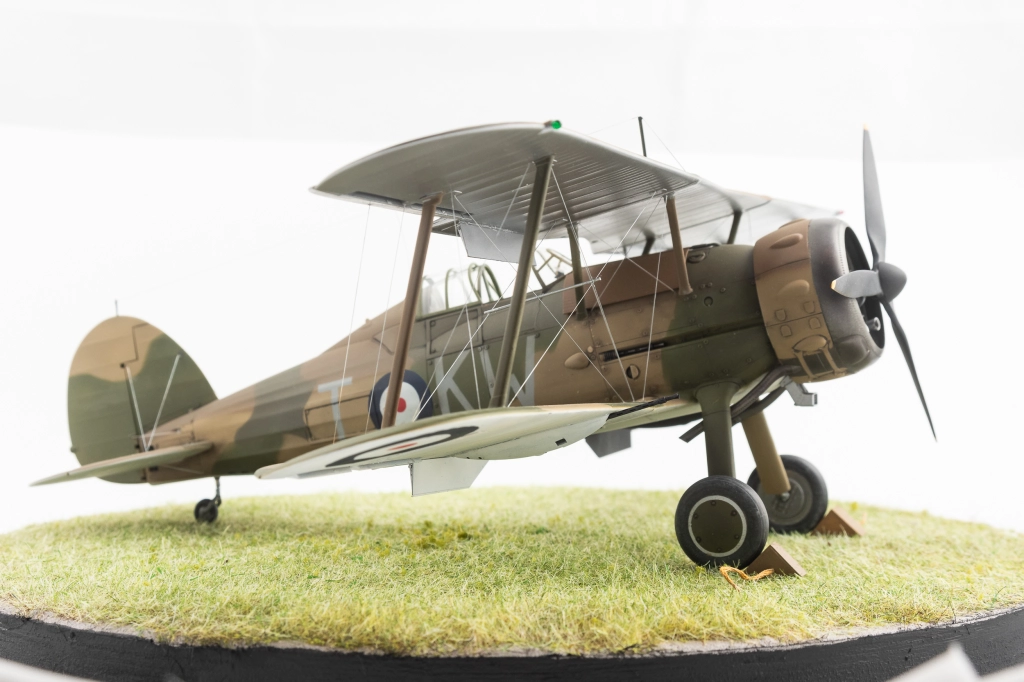
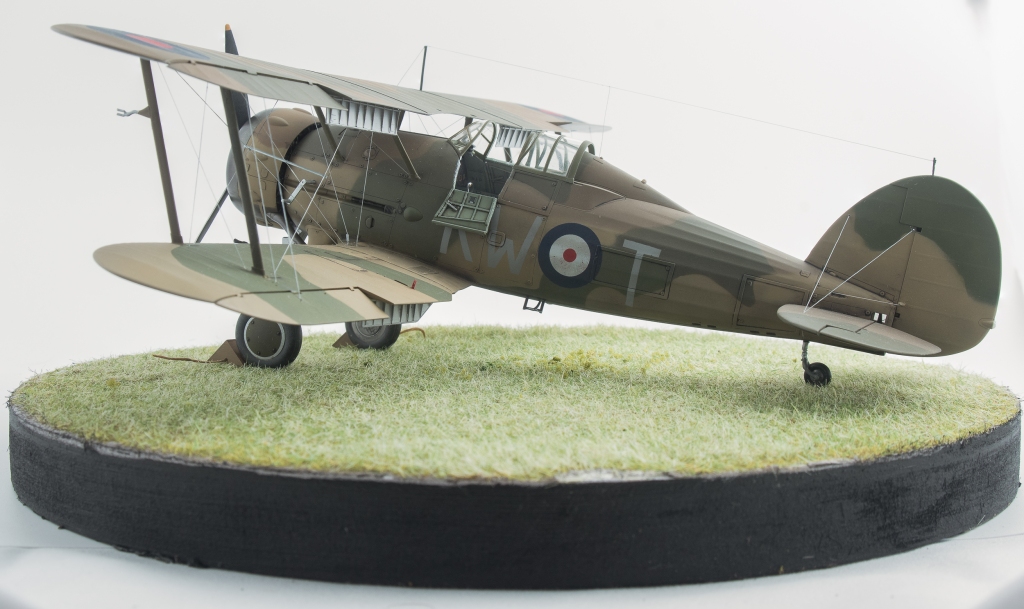
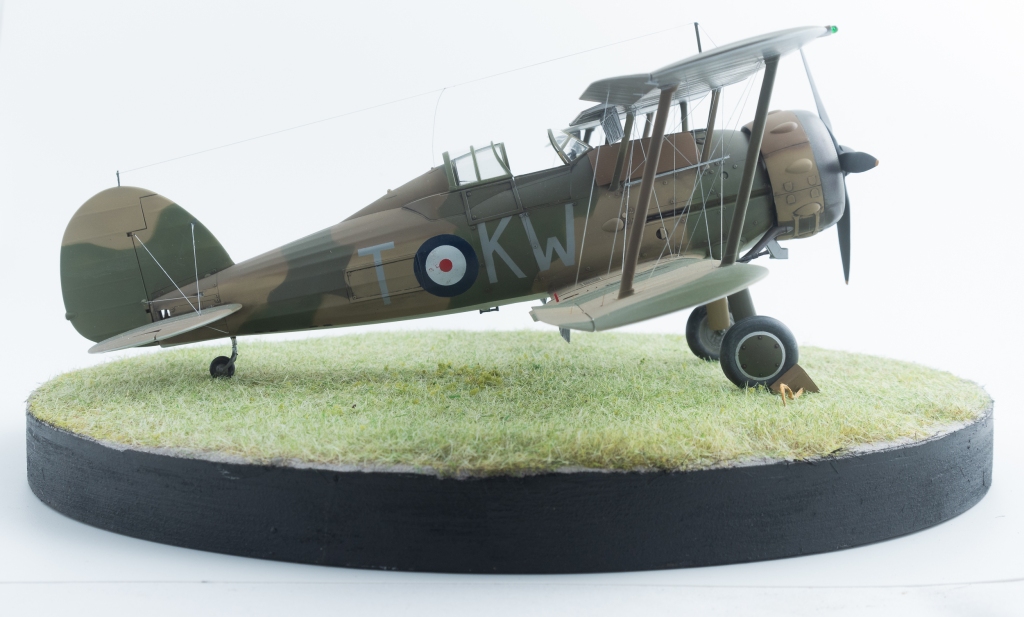
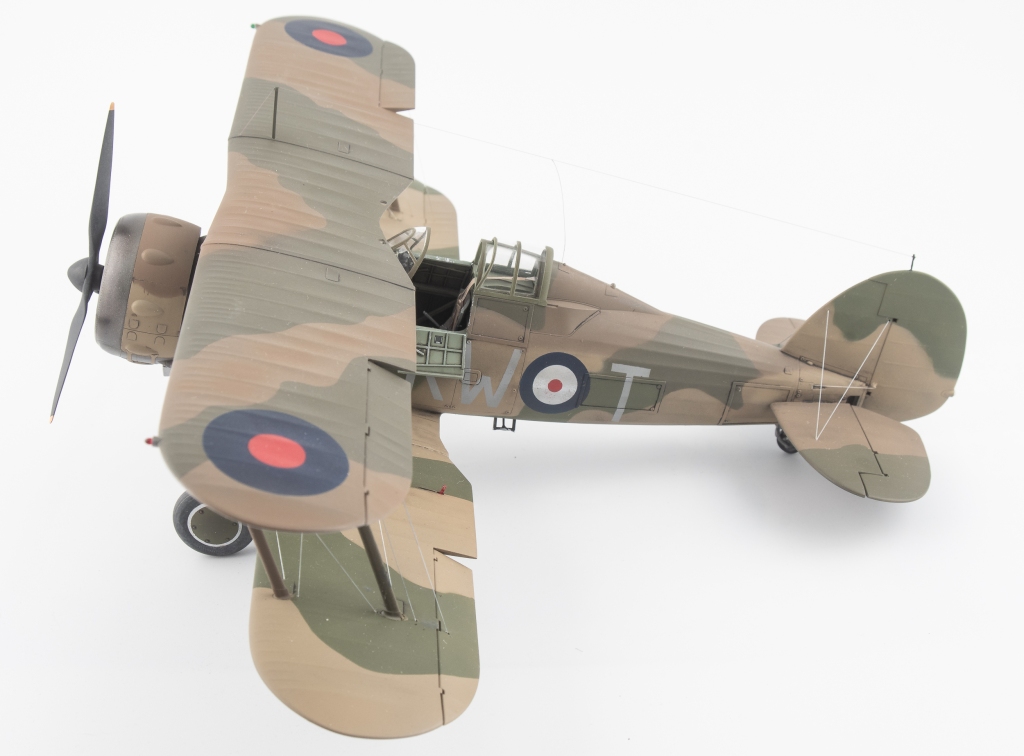
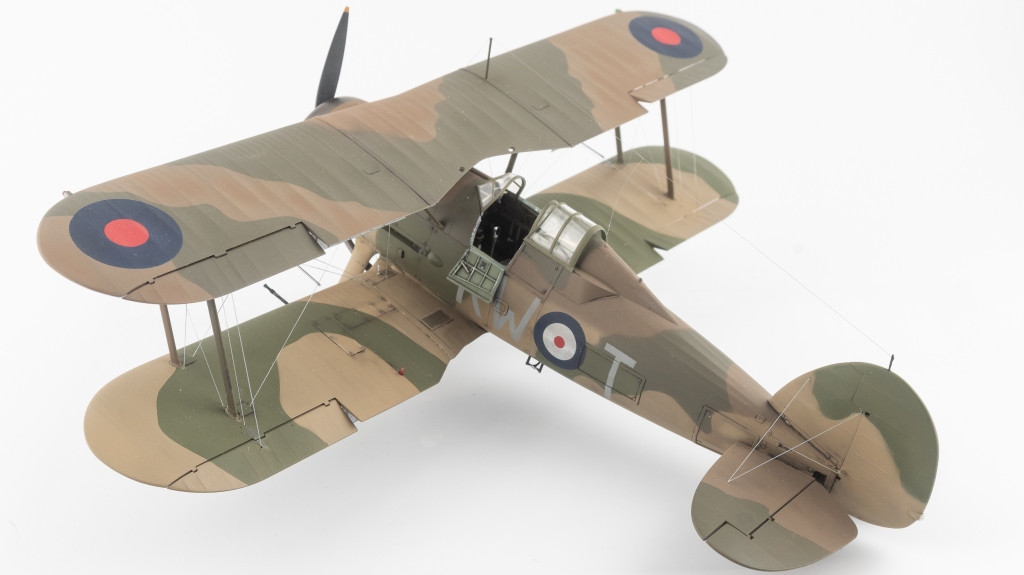
Painting started with the white half of the undersides using MRP white. The areas between the ribs were then sprayed with SMS German Cream and MRP Insignia white for some tone differences. The black half was base coated with SMS Camouflage black (my favourite black incidentally) and then the areas between the ribs were sprayed Tamiya rubber black. This was then masked off and a 50:50 mix of Gunze dark earth and MRP middle stone to represent the light earth was then sprayed on the top surfaces of the wings and lower fuselage. Tamiya RAF Green type 2 was mixed with a “smidge” of SMS Yellow for the light green. For painting the flying surfaces, TopNotch masks were used for the pattern, however the masks for the fuselage did not match the camouflage pattern of this particular aircraft , so blu tac sausages were used to mask the camouflage pattern.
These machines had gone over to France camouflaged in the standard DE/DG camouflage in 1939, Whilst there, the newly developed counter shade scheme was applied, possibly around early 1940. I imagine it would not have been the neatest job, due the RAF having no large maintenance facilities in France. In any case Gladiators in France did not last too long, the SQN being re equipped with Hurricanes soon after.
The Dark Earth and Dark Green were Gunze colours subtly shaded with some lightened and darkened mixes.
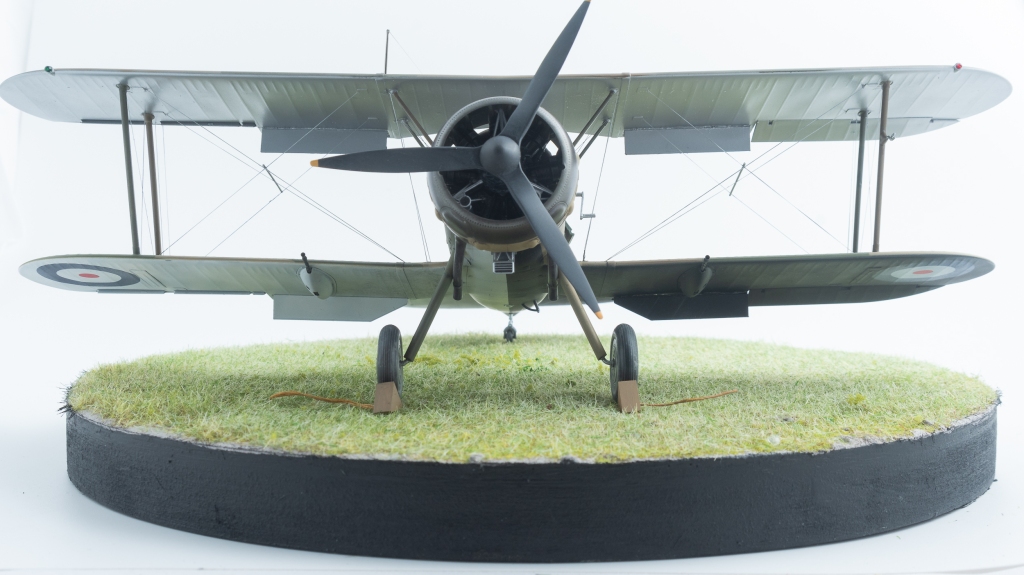
There is no definitive proof what colours the wheel covers actually were. Both red and green being called out by various profiles and kit manufacturers. I went with green.. The white outline though is very clear from period photos.
MRP Medium sea grey was used for the codes, the roundel colours are tamiya Royal Blue and SMS red, the red at this stage of the war being the bright red.
Rigging
This was by far the most frustrating part of the build. Contrary to all those modelling articles stating how easy EZ line is to use. “Just add a drop of super glue into your pre drilled hole and the line pulls taut” my experience was anything but the simple, relaxing task all these articles and youtube videos make rigging out to be!.
First off, the CA, despite being a new bottle would not stick, not sure if it was the humidity, but you’d think that would help set it. This was after 10 interminable minutes first trying to get the EZ line to into my drilled hole! It seems if the EZ line even sniffs the presence of CA, it curls up, refusing to be poked into the hole. Poking the line into the unglued hole was easy enough, but then getting the CA glue onto your brass wire applicator and then apply it accurately into the hole. You need another two hands!
EZ line was used as I wanted to replicate the flat RAF wires, despite my best efforts, there are some twists in my rigging lines, and by this stage I’d lost all patience in going back and removing the twists. Anyway, for what its worth my method was to attach the various lengths of line into No.80 holes drilled into the top wing, which at this stage has not been attached to the model, ensuring that they would be aligned so as to give the flat effect of the real rigging.
The top wing was then attached and the lines cut to slightly shorter than the required length and fed into the pre drilled holes in the lower wing. This is where it all started to get pear shaped. Anyway, I persisted until all wires were added.
The eagle eyed most you will spot a gas patch white metal RAF terminal used on the lower wing to see how this looked. This was the only one used as I found it too hard trying to line up the others to the exact angle needed, the metal not being malleable at all. Finally it was all painted Vallejo steel. and the model just needed the canopies unmasking and she was done.
Well not quite done as I needed to add the antenna post as ICM don’t include one. Probably a blessing as any part supplied would probably not stand up to the pull of the EZ line that was used for the antenna wire. A mast was formed out of brass wire and glued to the starboard wing, not centrally as ICM show on their box art
CONCLUSION
I really enjoyed this build, so much so that I started the MkI that was still in the stash which was initially going to go on the for sale pile. ICM have done a lovely job on this model and delivered it in a scale which does the real aeroplane justice. There are some annoyances, the soft plastic being the main one as it really requires the modeller to replace the tailwheel and stabiliser mounts which otherwise are far too weak and prone to breakage. Other than that, I found the rigging very frustrating, but thats on me! Lots more practise needed before tackling all those Wingnut Wings kits in the stash, me thinks!
Gloster Gladiator MkII 615 SQN RAF St. Inglevert. France 1940













 Bruce’s-Scale-Models
Leave a reply to andyk21 Cancel reply