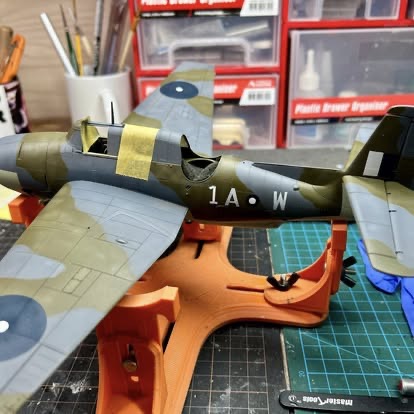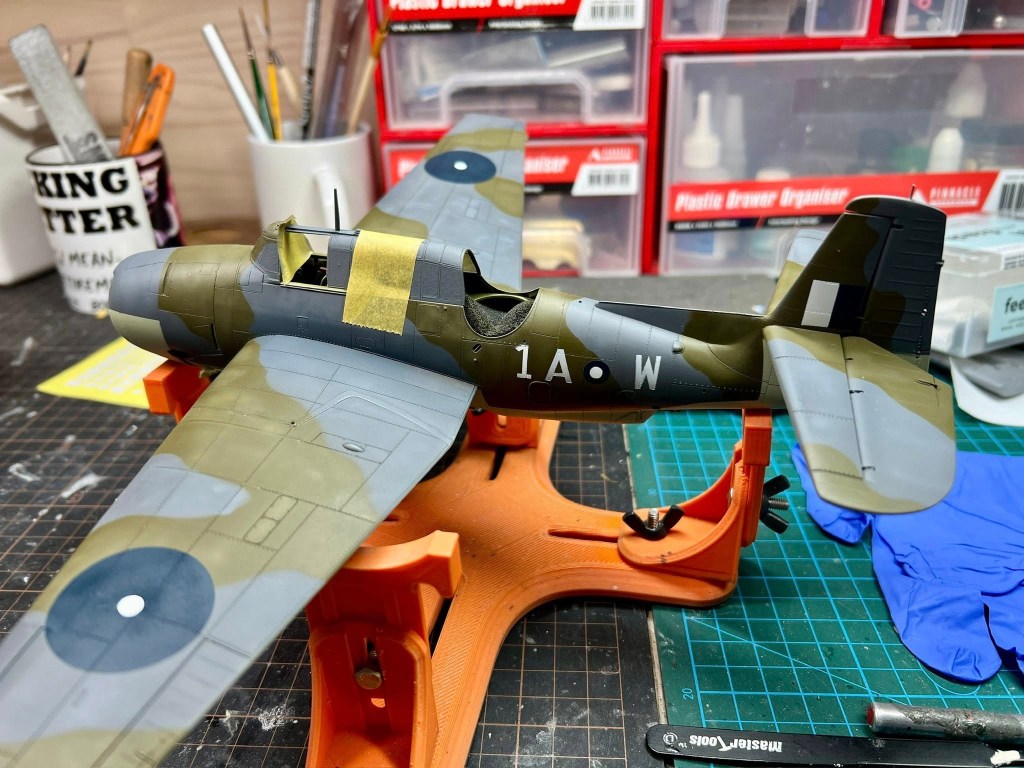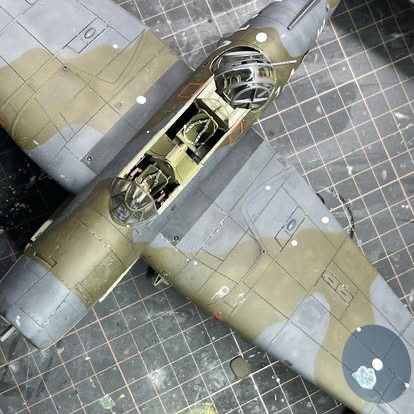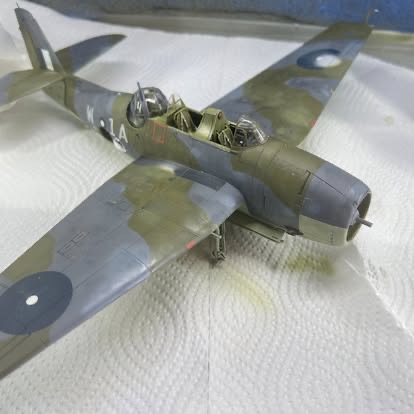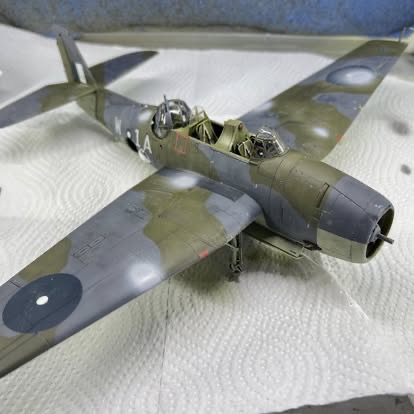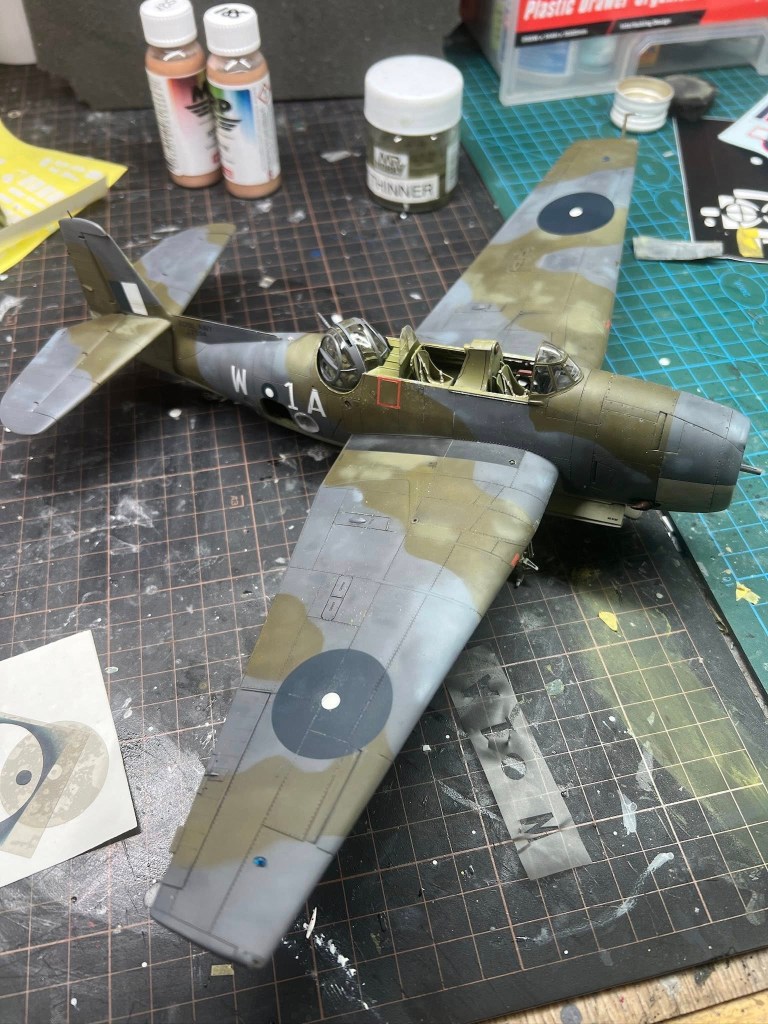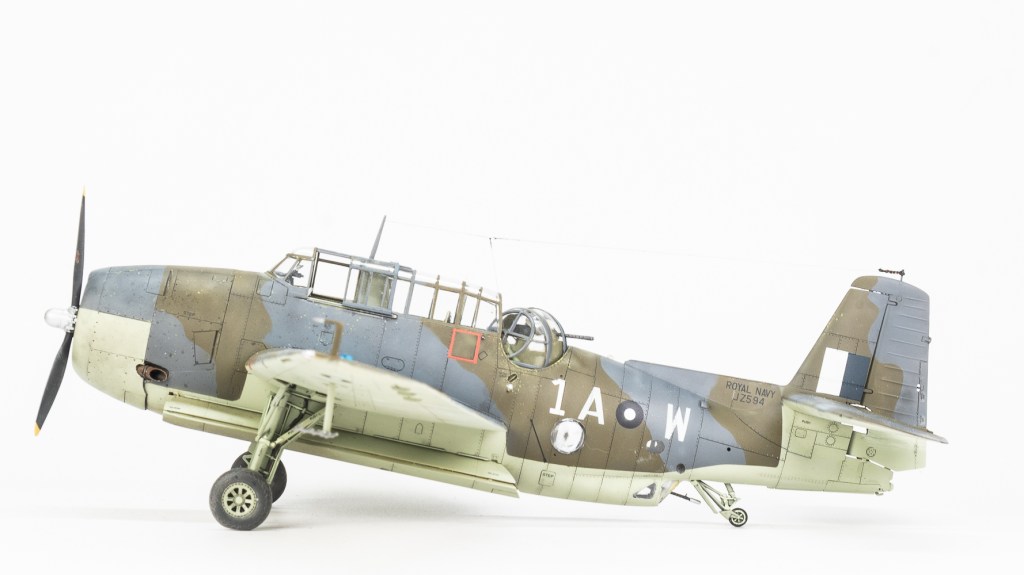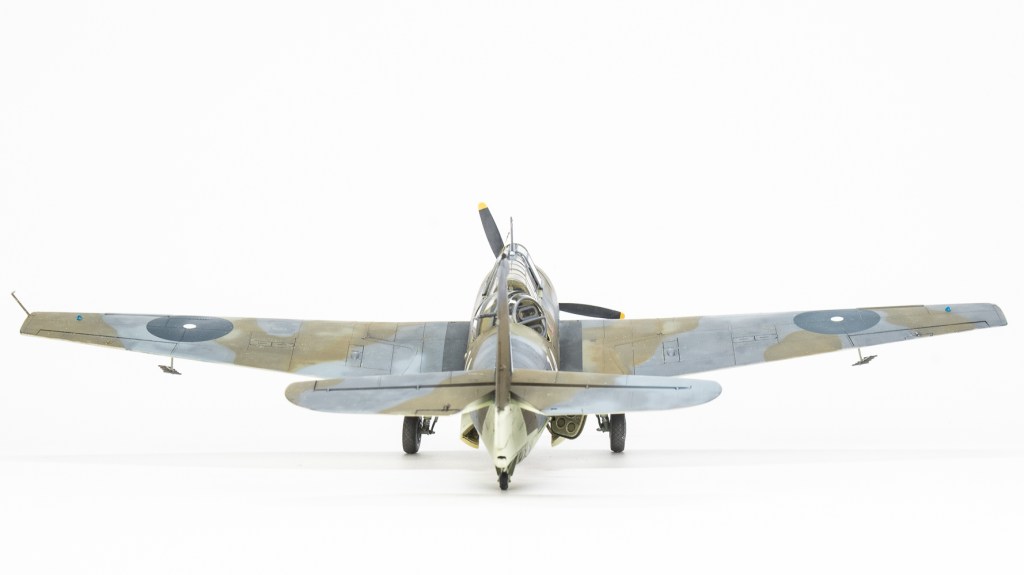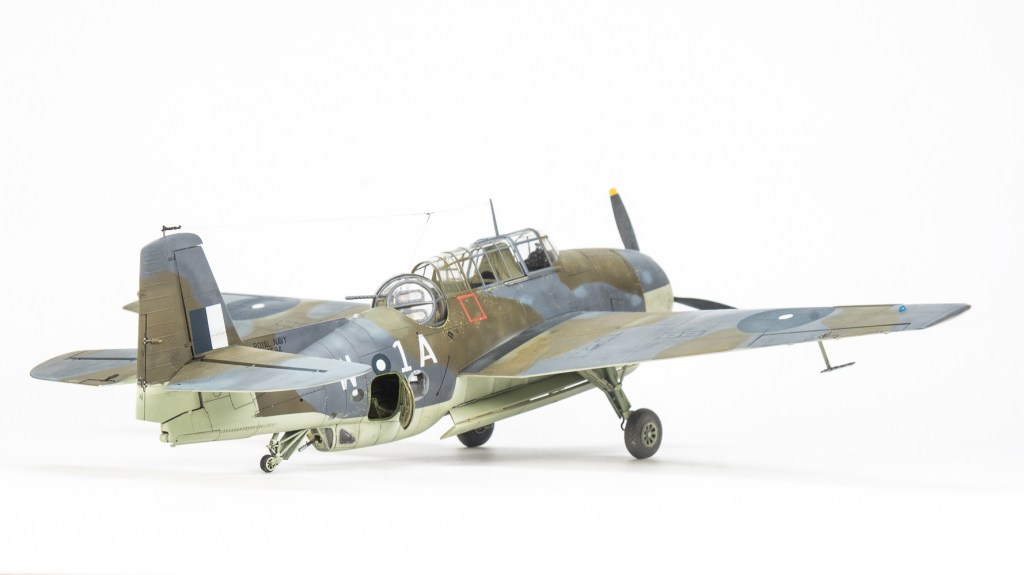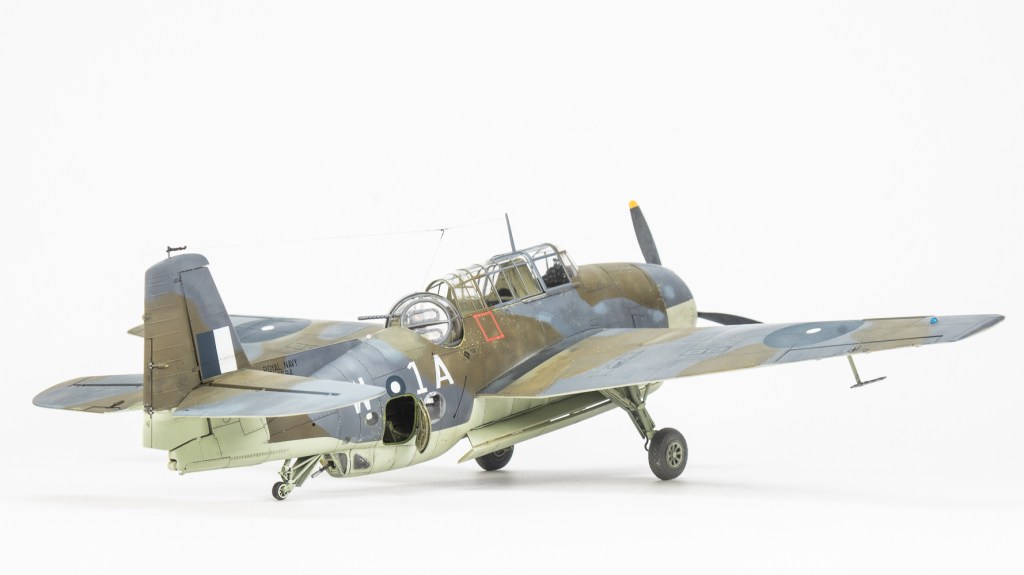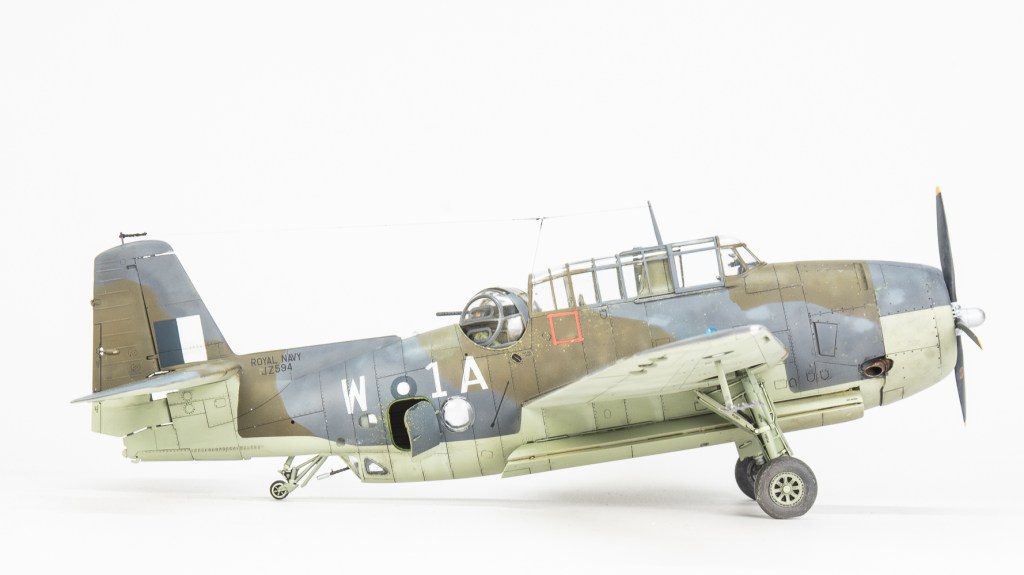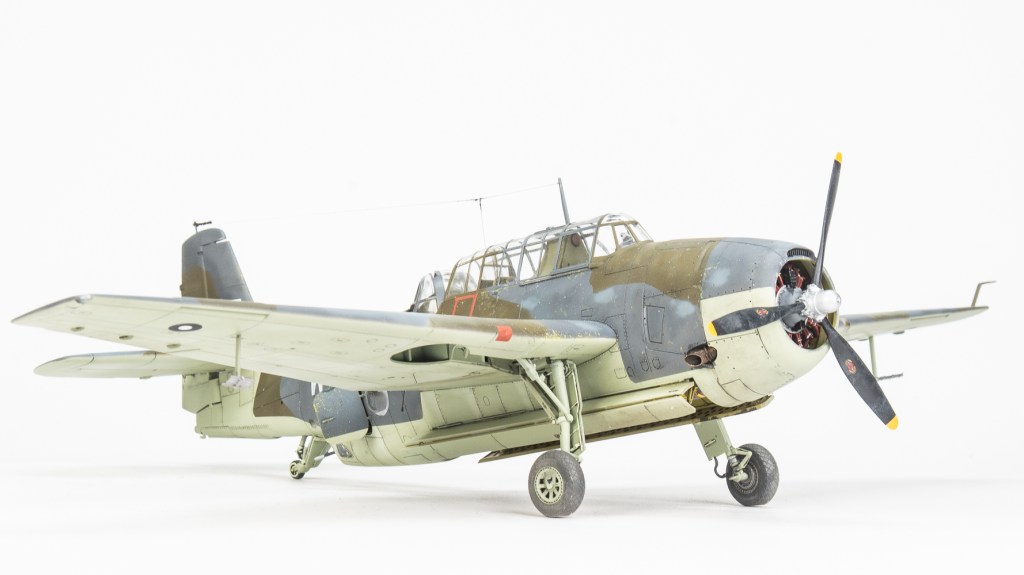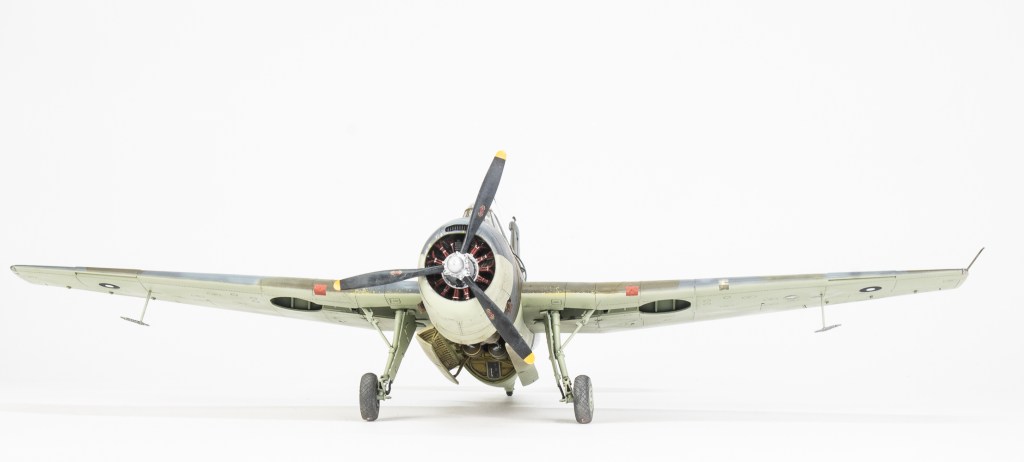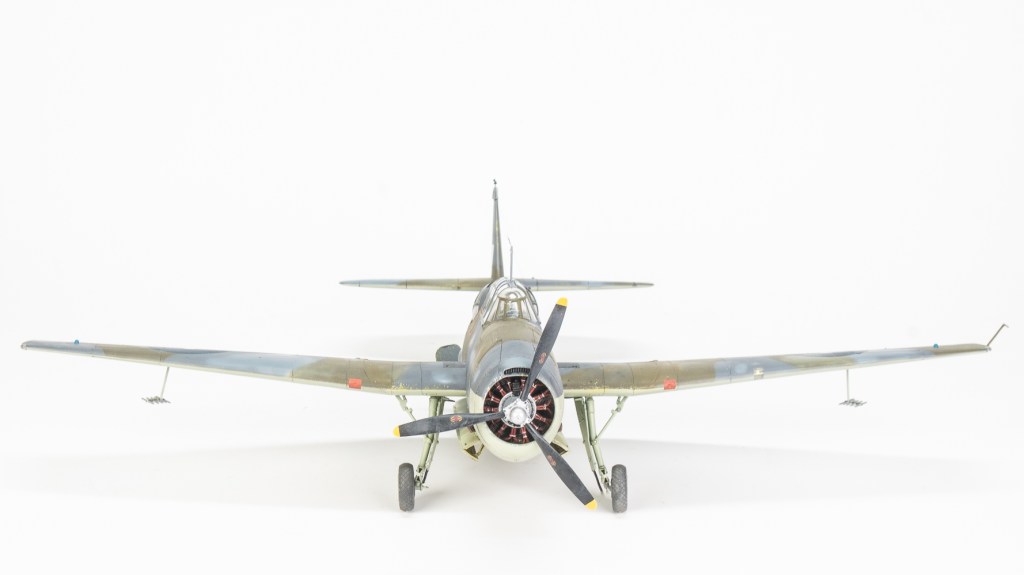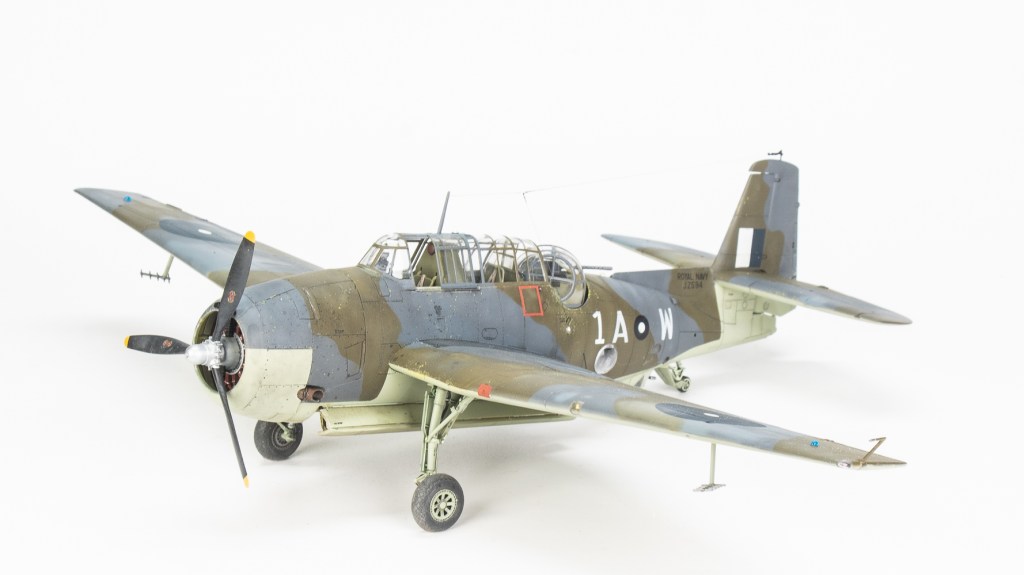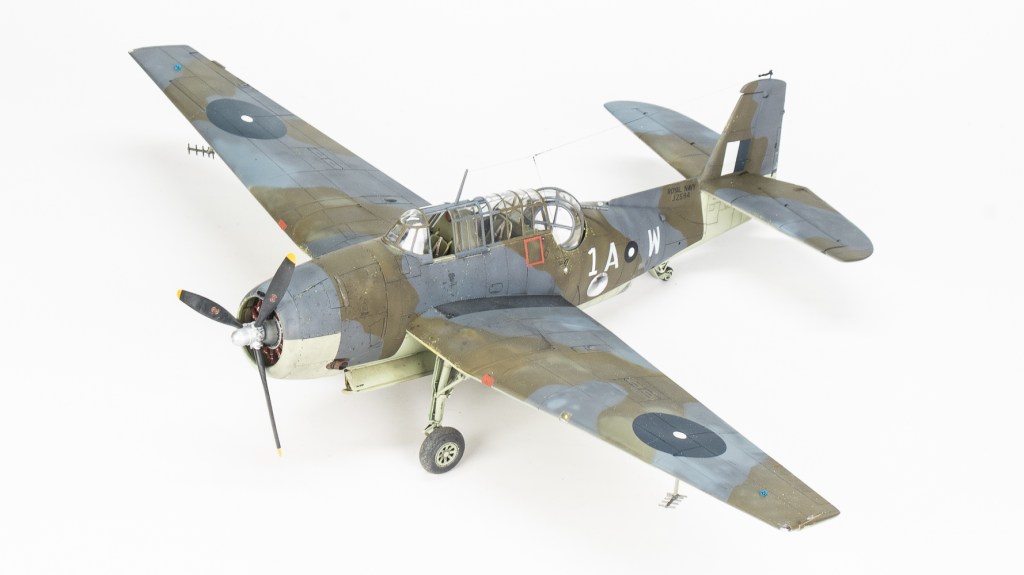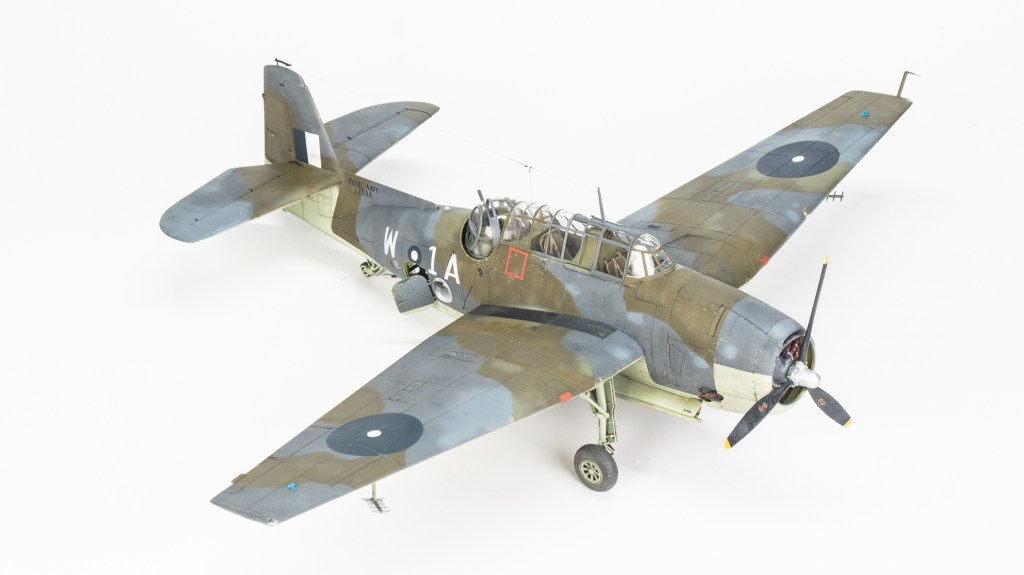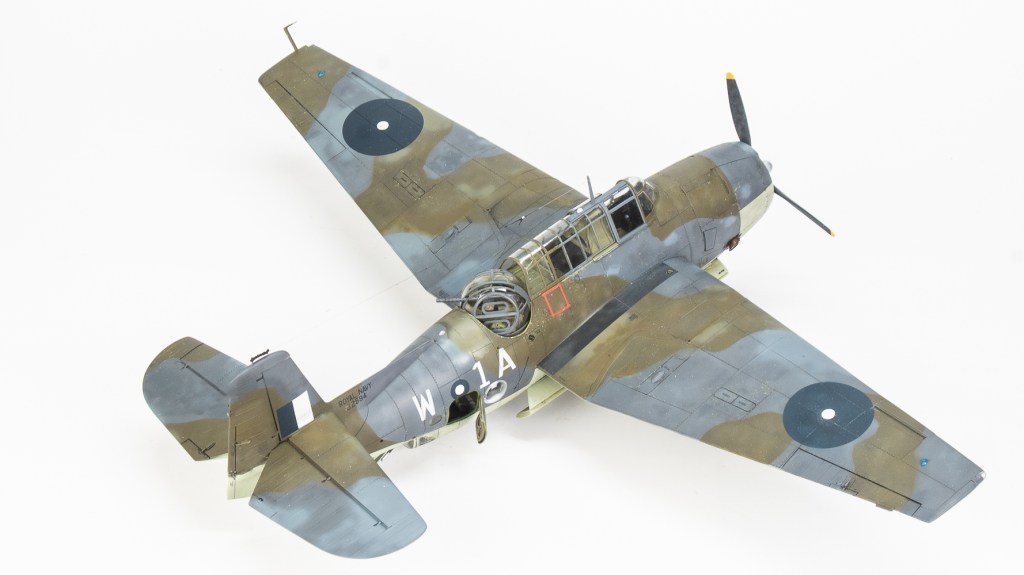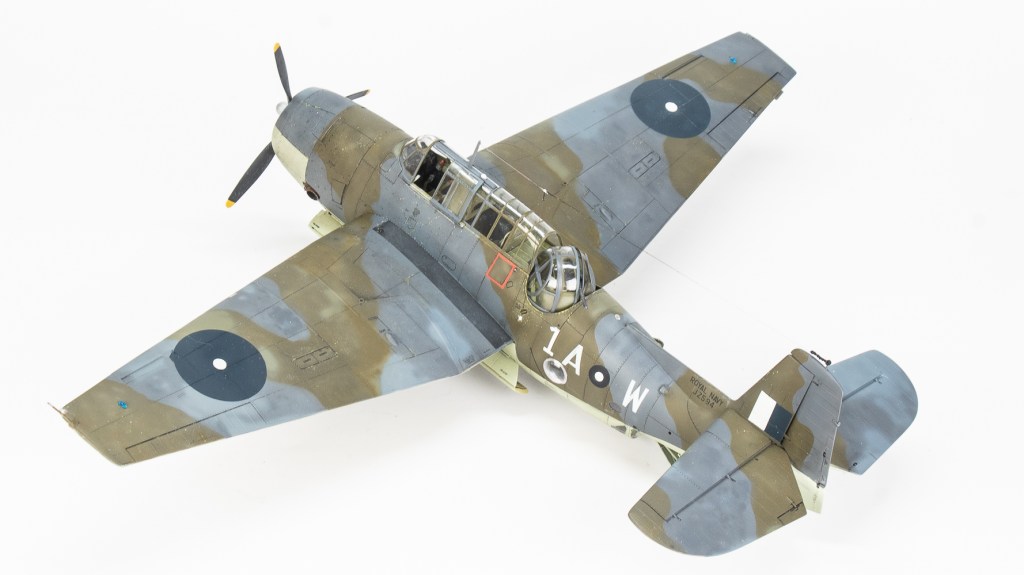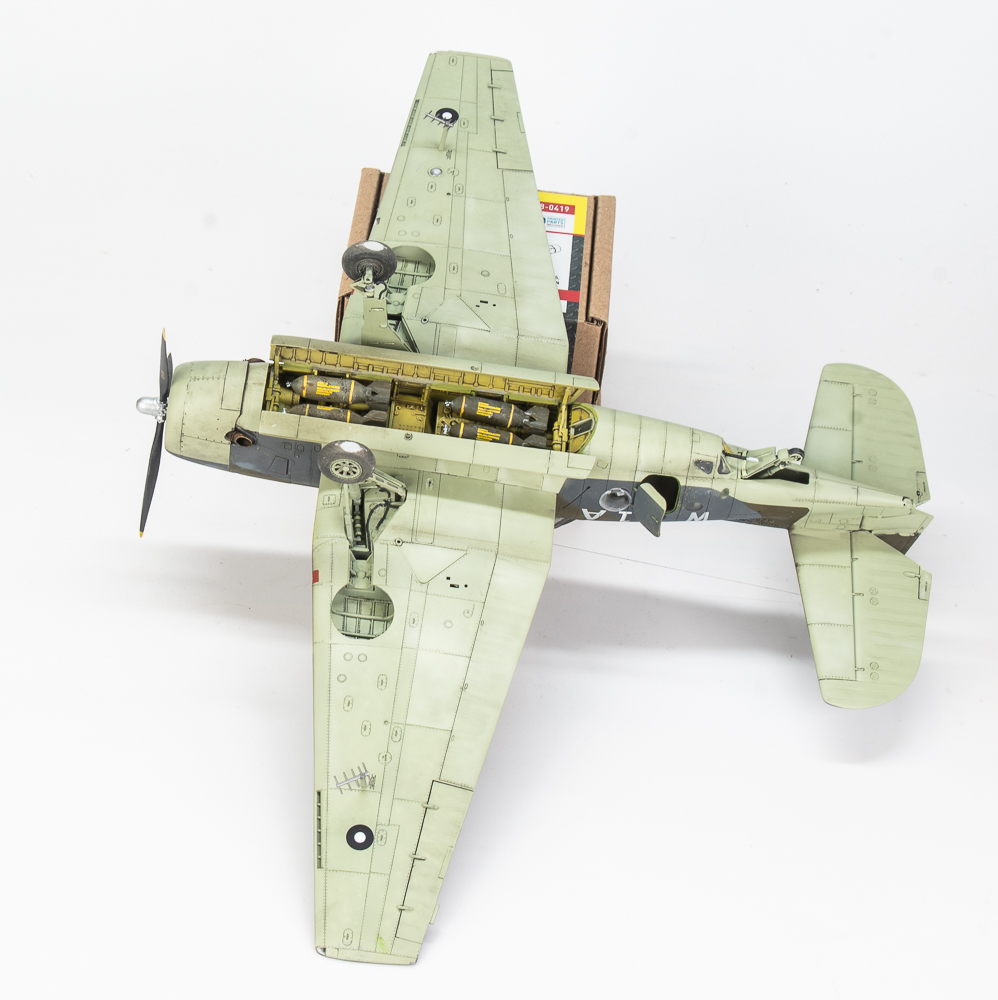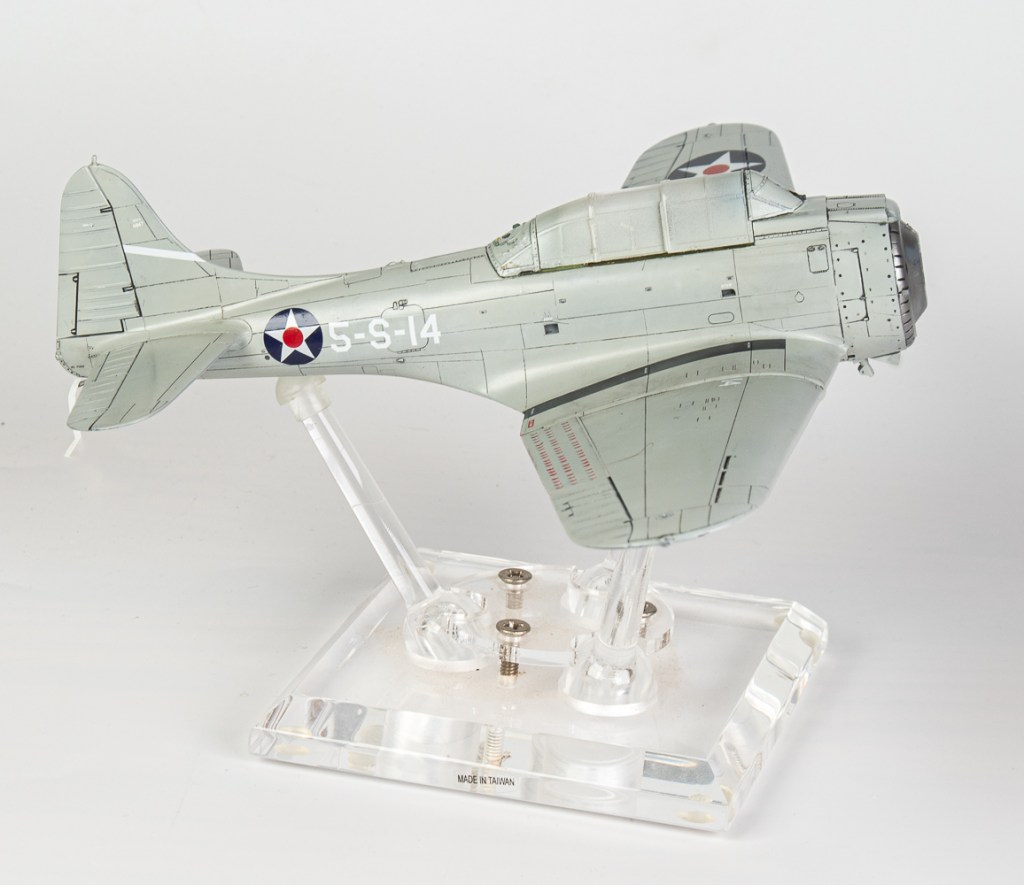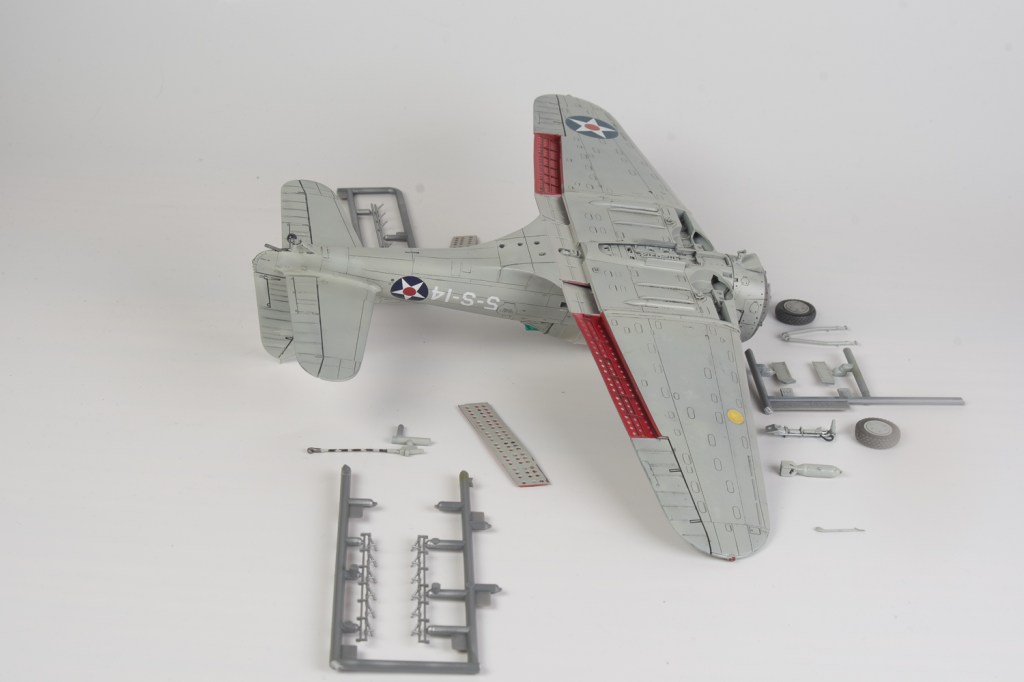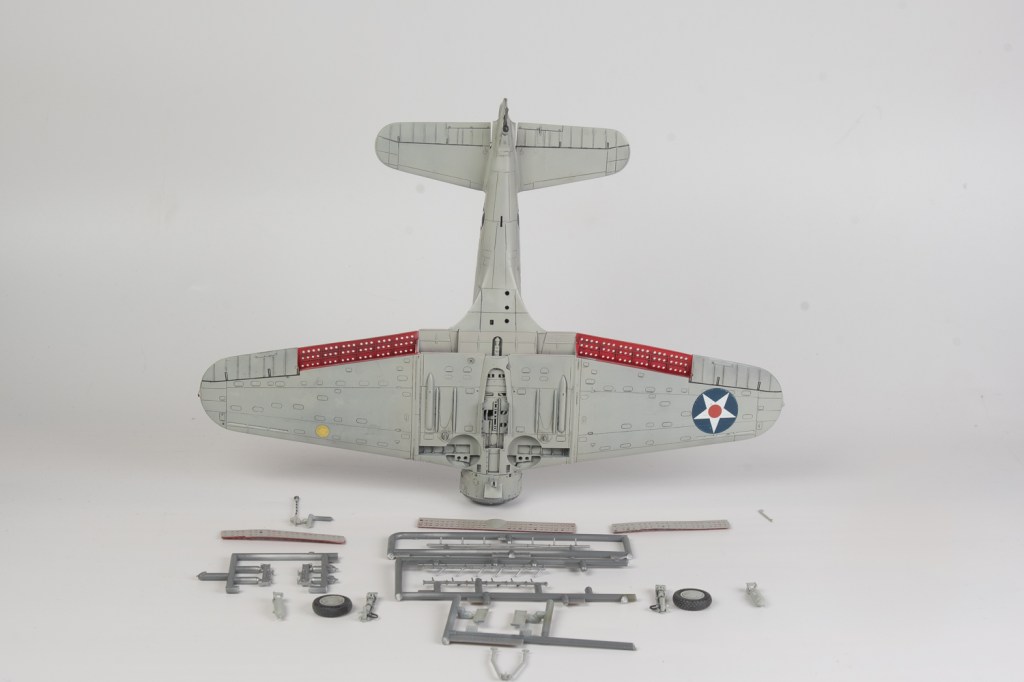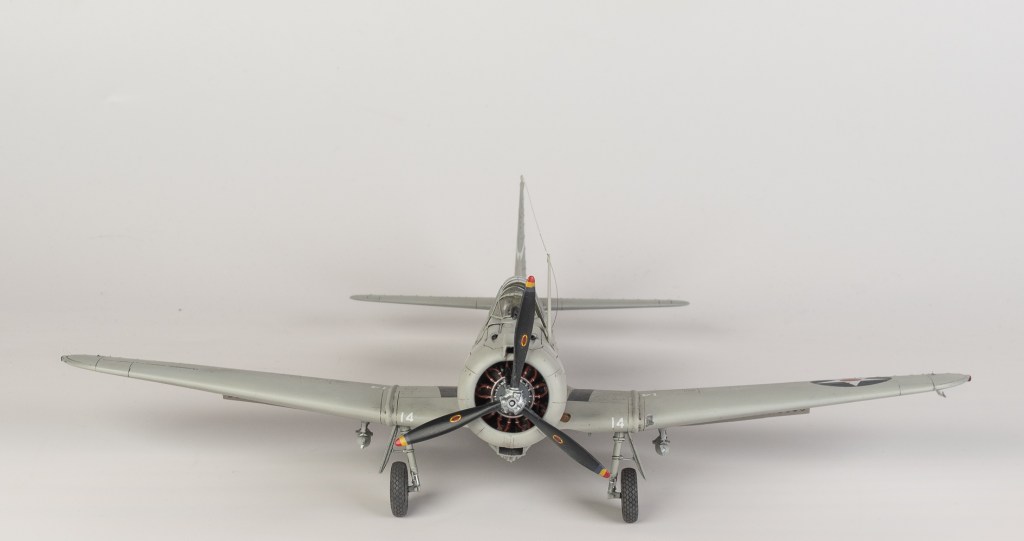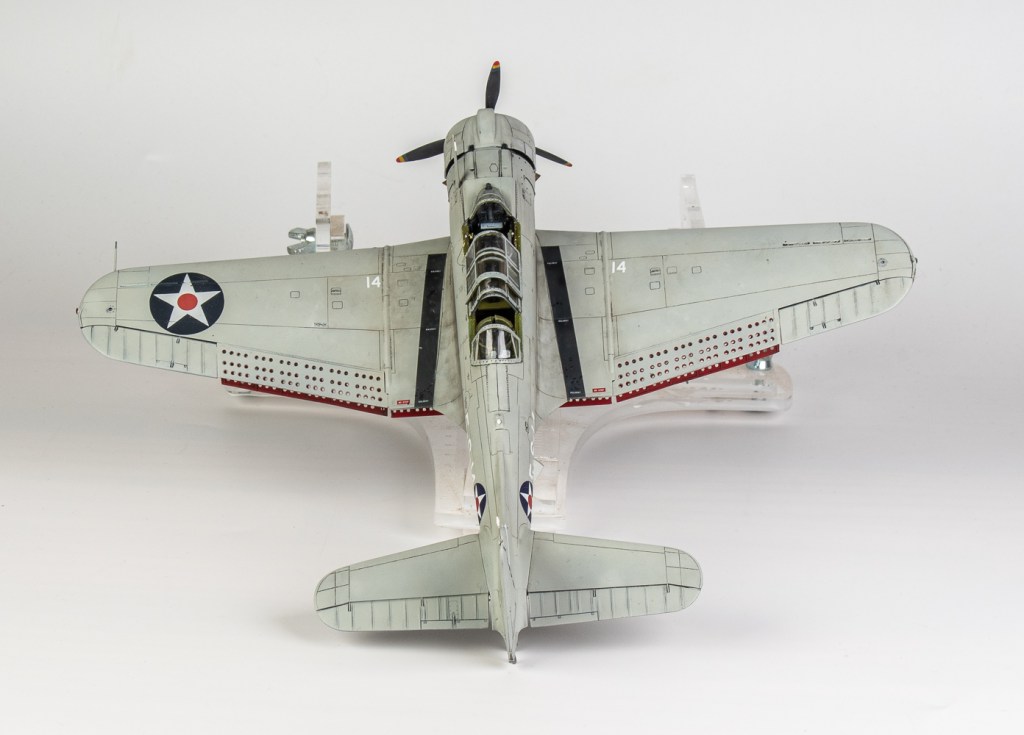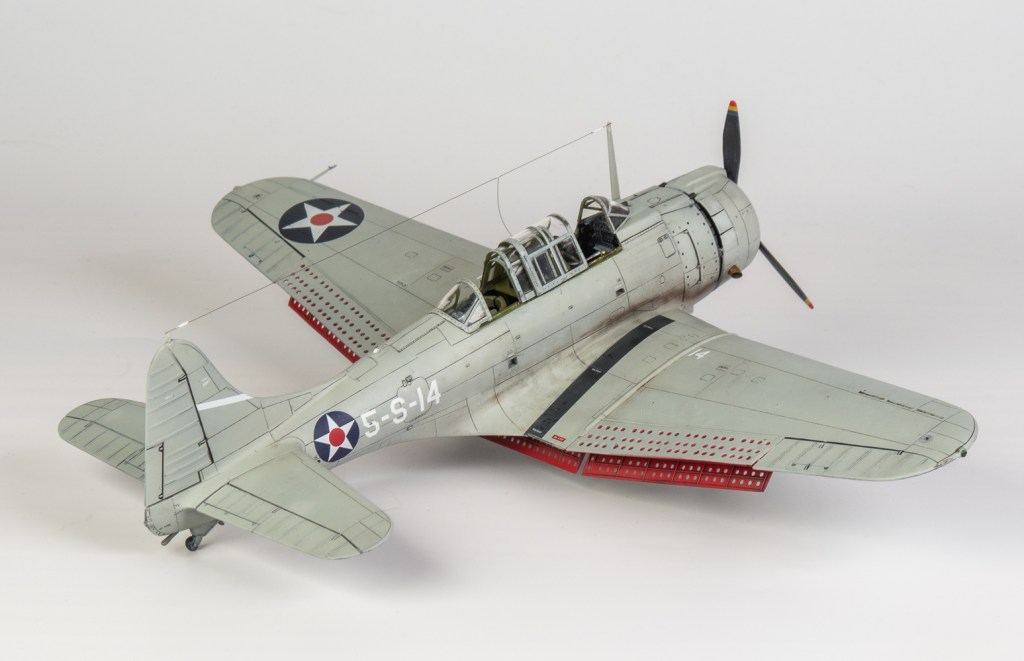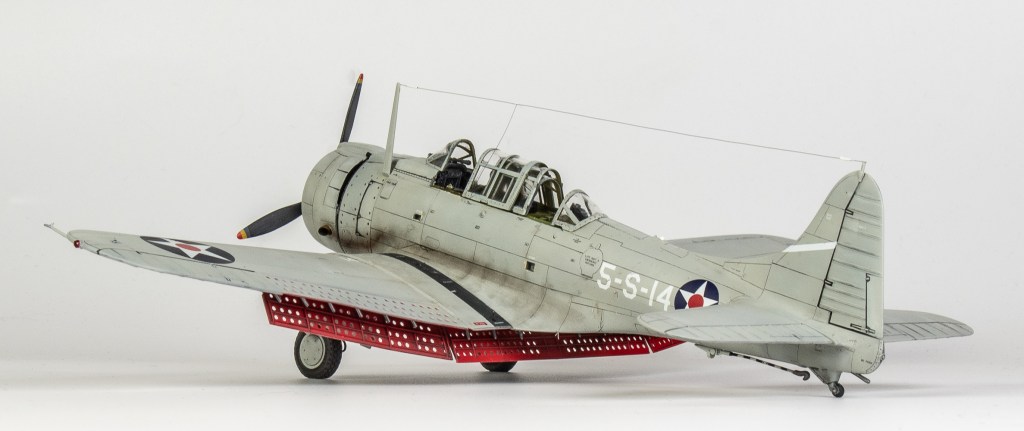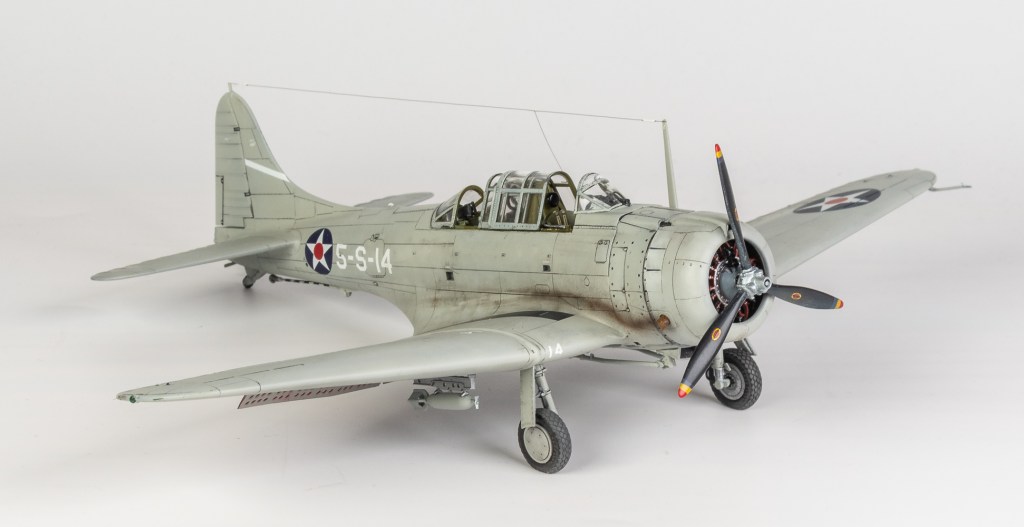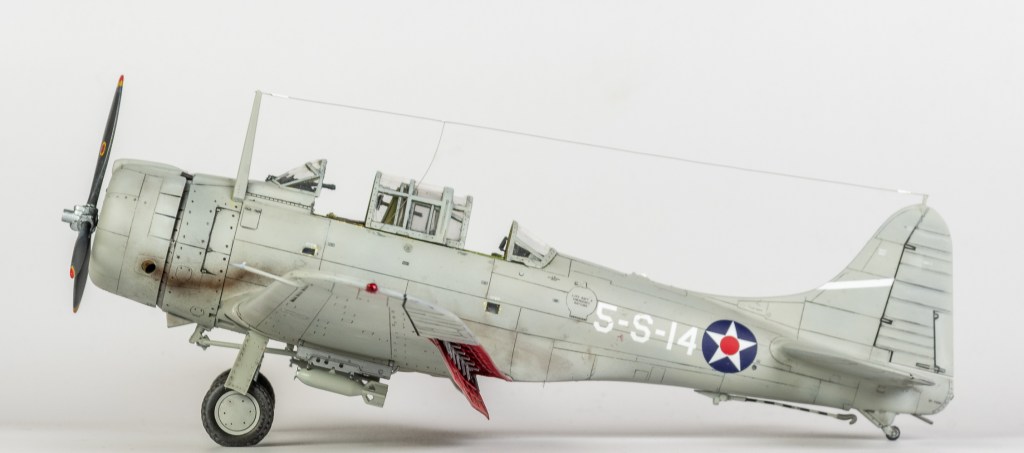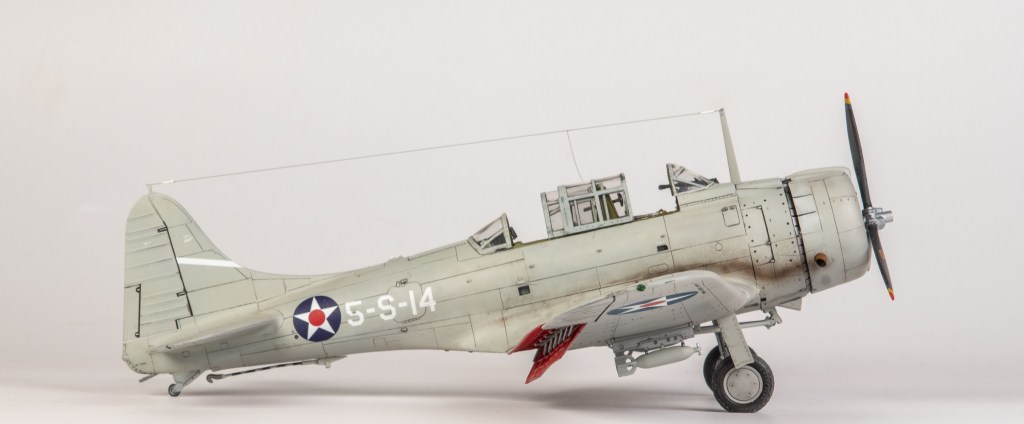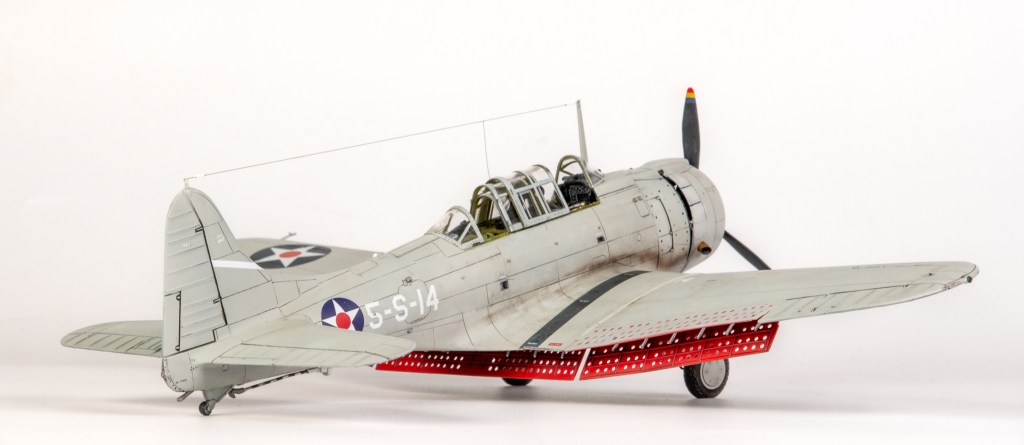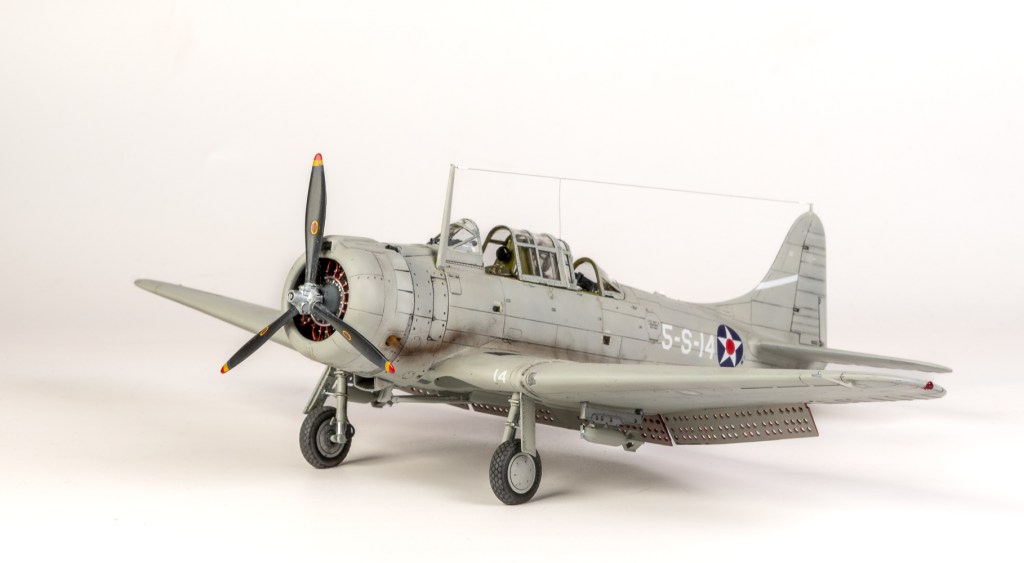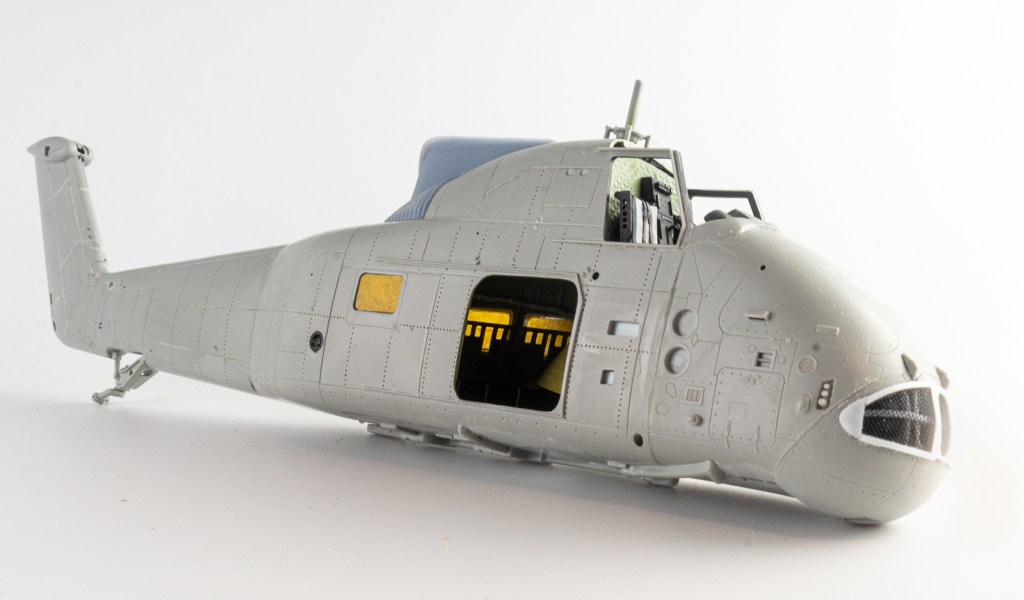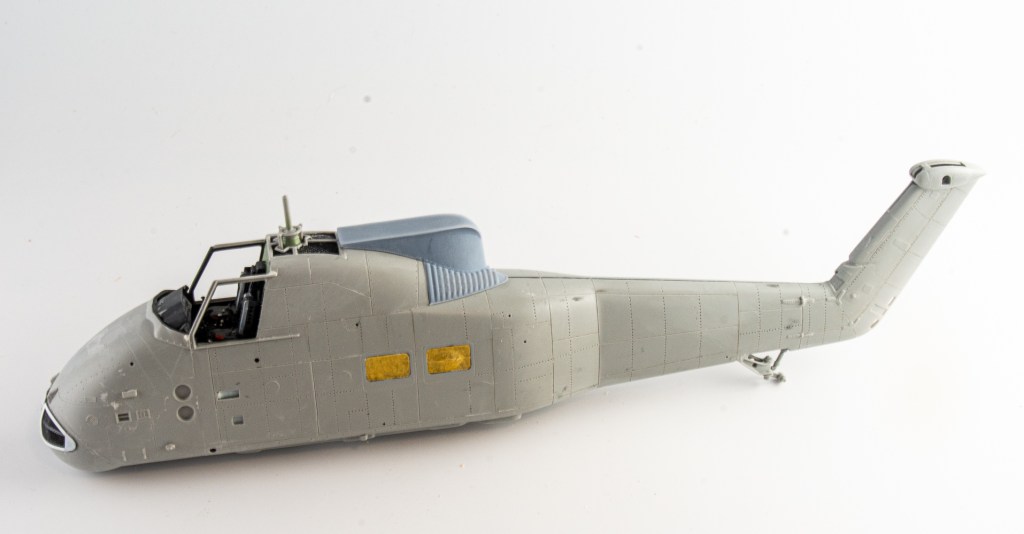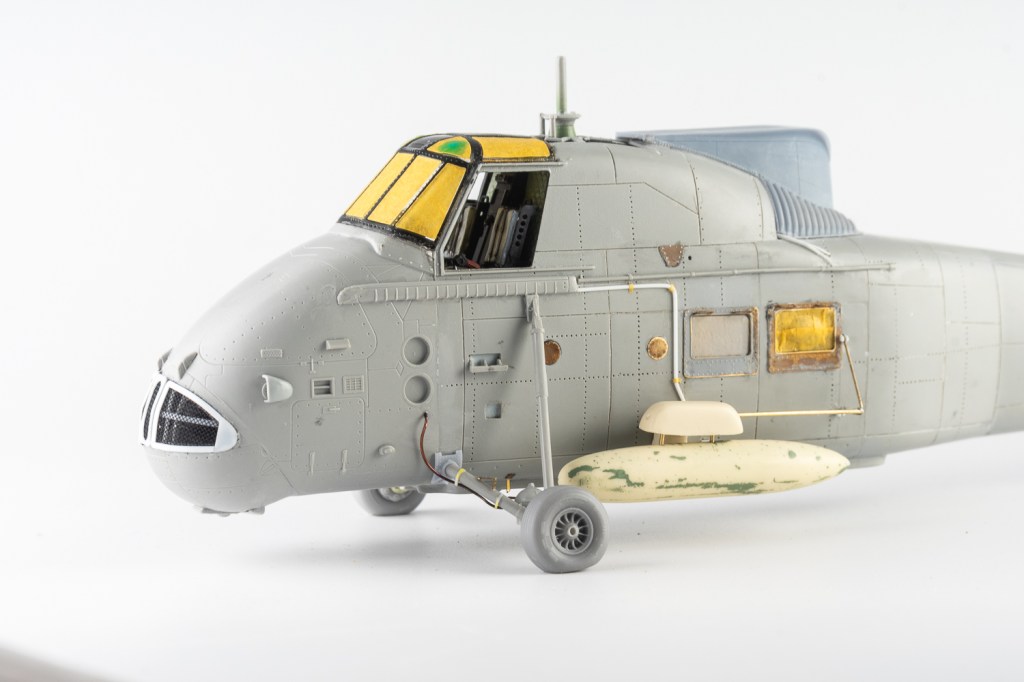
Accurate Miniatures 1/48 SBD-3 Dauntless

  • Purchased: 2024
  • Completed: 2026
  • Enhancements:
  • Wheels – Brassin
  • Exhausts – Quickboost
  • Seatbelts – Eduard
  • Decals: – Furball Colours & Markings SBD Dauntless

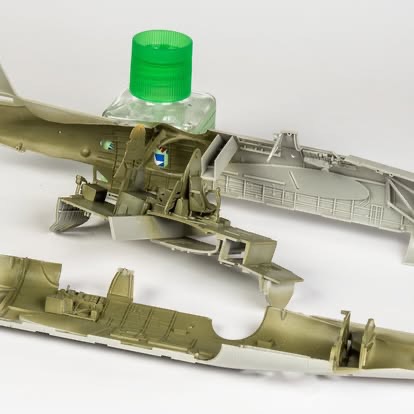
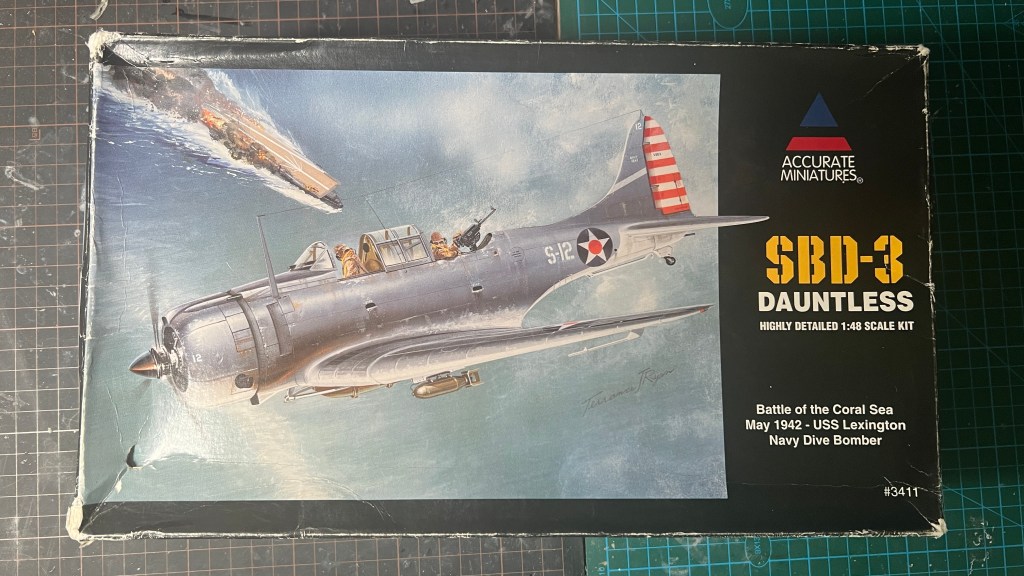
This is the second AM Dauntless kit that has crossed the bench. The first being completed just after its release waaaaaaayyyyyy back in 1997. That one was an SBD-1 finished in the very striking “yellow wings” scheme. It stood out at the time as a fun build, and I’m happy to report the second time around the experience was the same.

Build

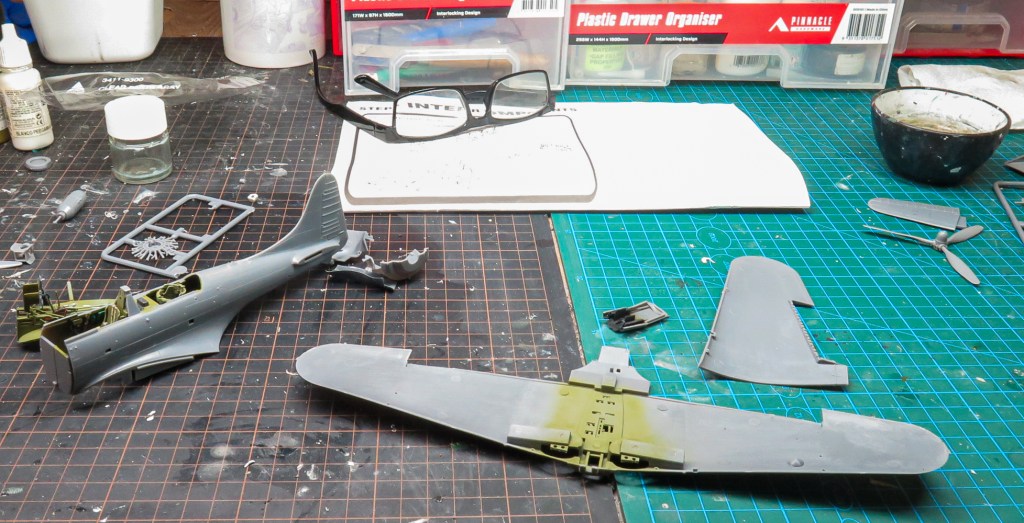
The build proceeded quickly and smoothly. This was an original boxing of the kit so I was surprised to find flash on some of the finer parts. The dive brakes were also warped, although this was a known feature of the kit, the thinness of them probably pushing the limits of moulding at the time.

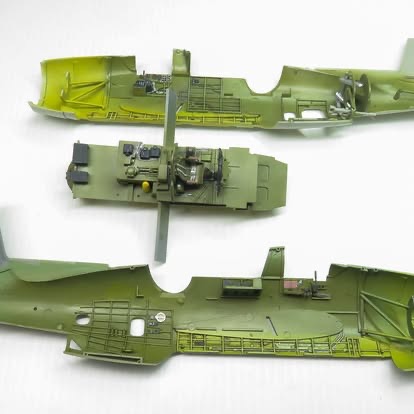
Examining the parts also revealed just how much detail AM had moulded into them. The model certainly bears the hallmarks of Bill Bosworth’s time at Monogram. Time to get stuck in!

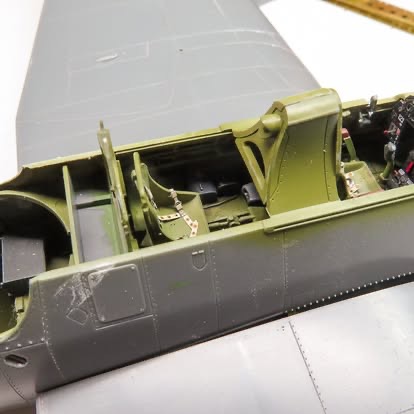
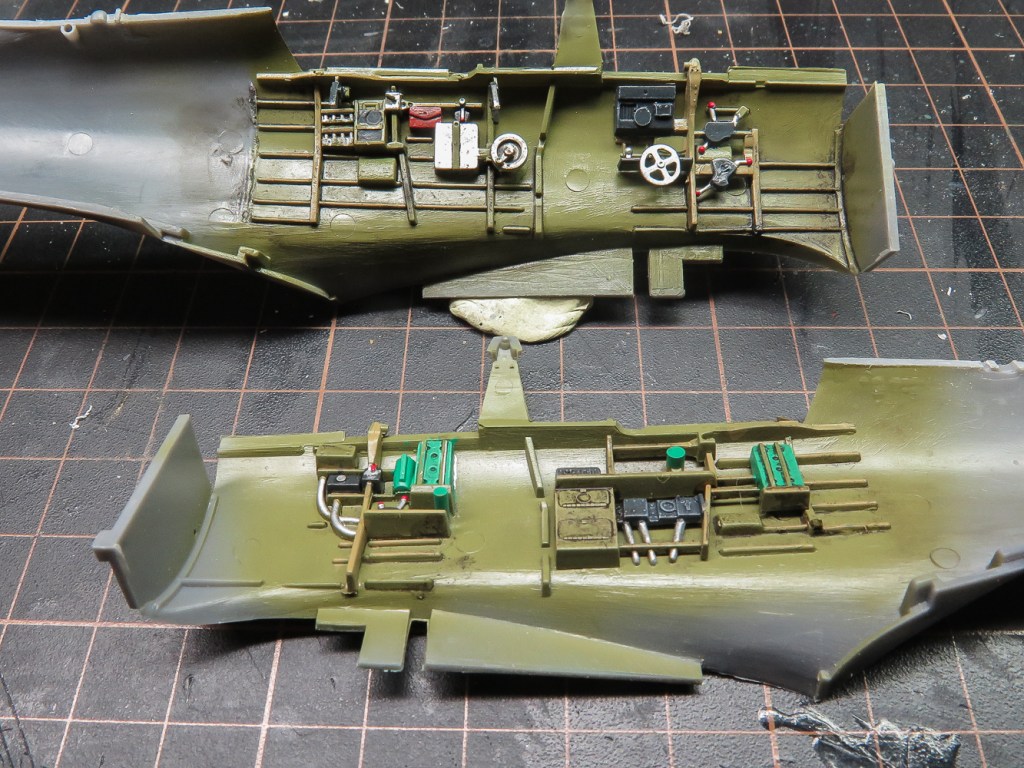
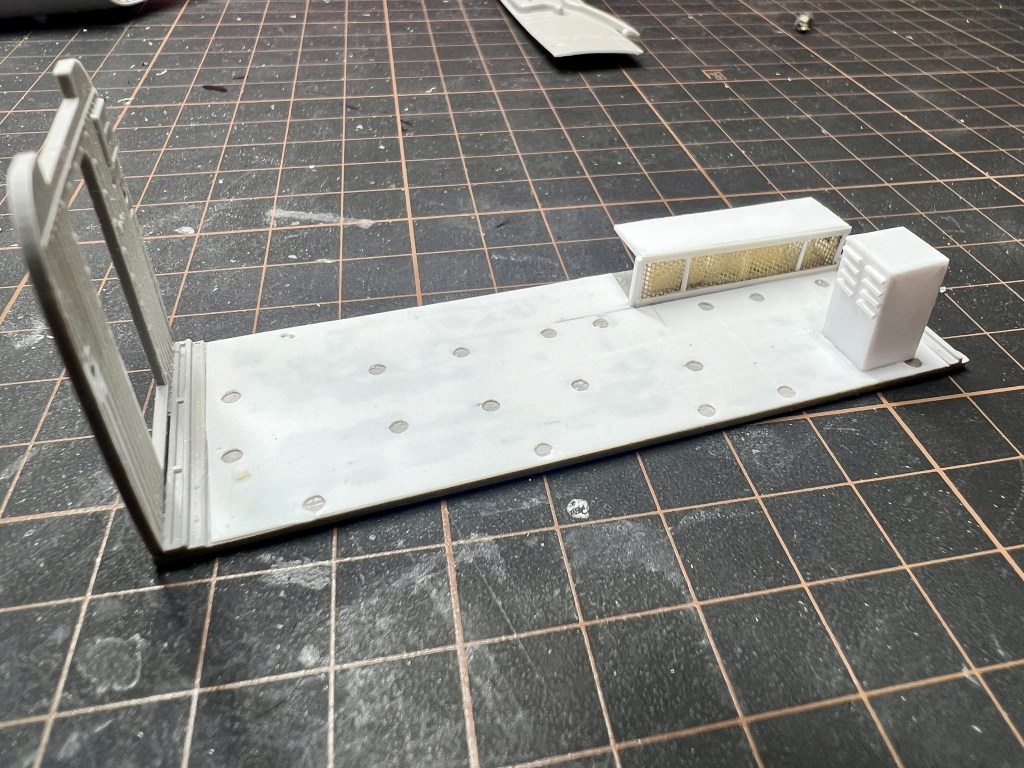
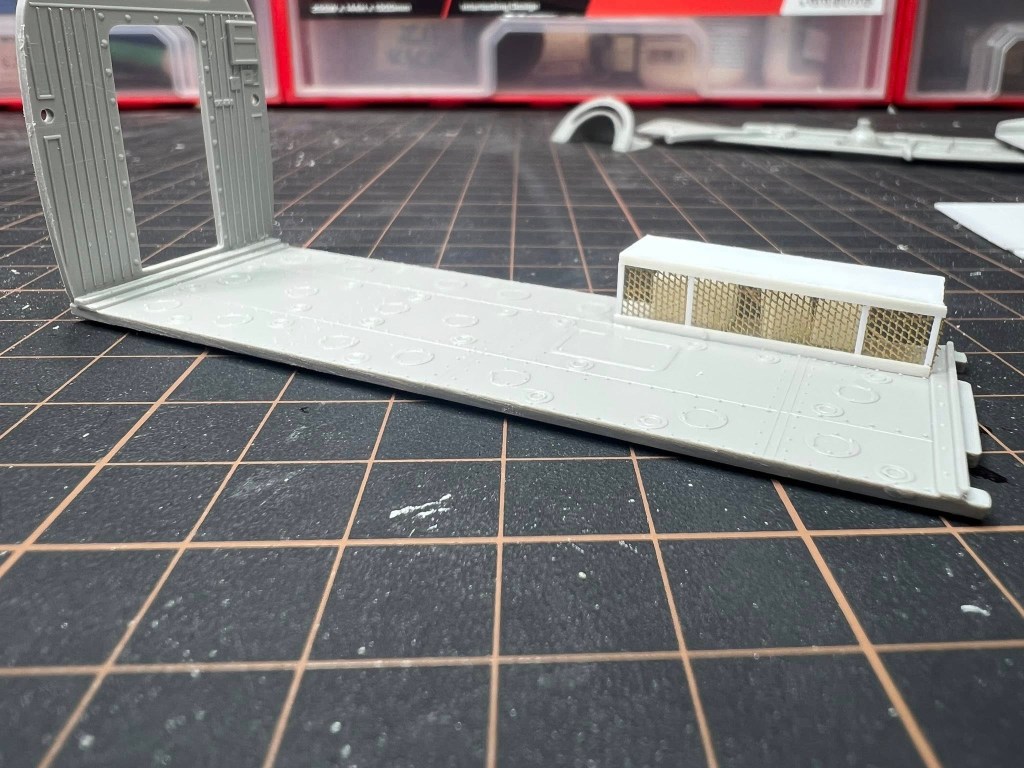
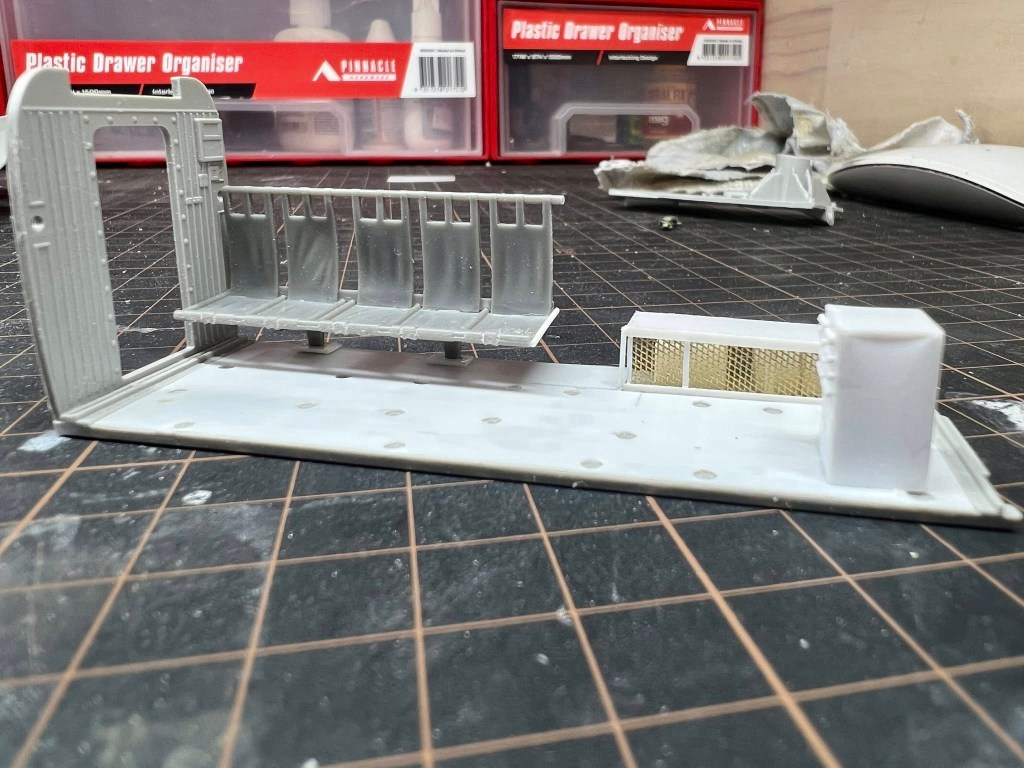
The cockpit was painted SMS Interior Green with details picked out using various Vallejo colours. Detail and Scale’s Dauntless book was used at the reference. AM supply clear plastic instrument panels with the dials being provided as a decal which is attached to the rear of the panel. The decals though are just black circles, so instead, the whole panel was painted black and drybrushed with various greys. The raised dial details were then touched in with a sharpened white pencil. A drop of gloss into each dial represented the glass. Seatbelts came from an Eduard SBD-5 set rather than using the lame kit supplied decal seatbelts. A point of annoyance with Eduard here. Eduard only give you lap belts though. No shoulder straps are provided at all. By the time of the -5, and indeed the -3, the USN was fitting shoulder harnesses . This is just Eduard being lazy again and probably relabelling an existing early Dauntless set.. All the cockpit components fitted securely in their given locations although the rear bulkhead on my kit needed a little bit of sanding to reduce its width to enable the fuselage halves to close without any gaps.

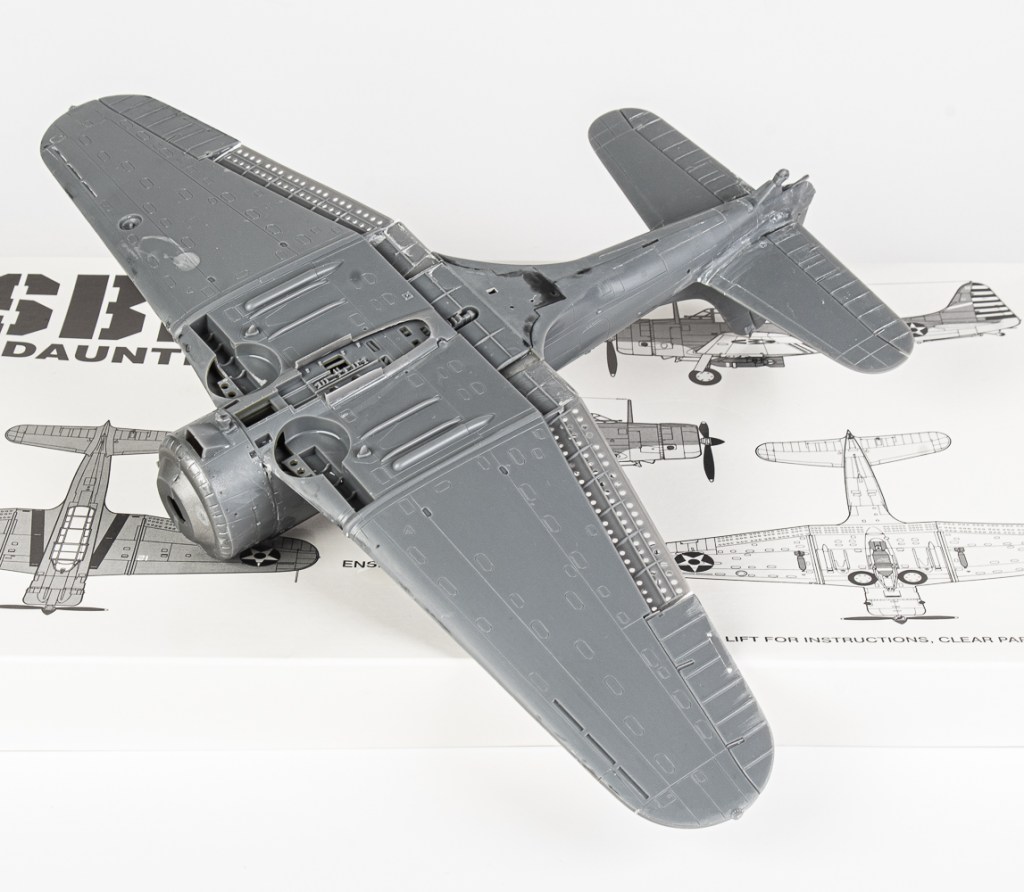
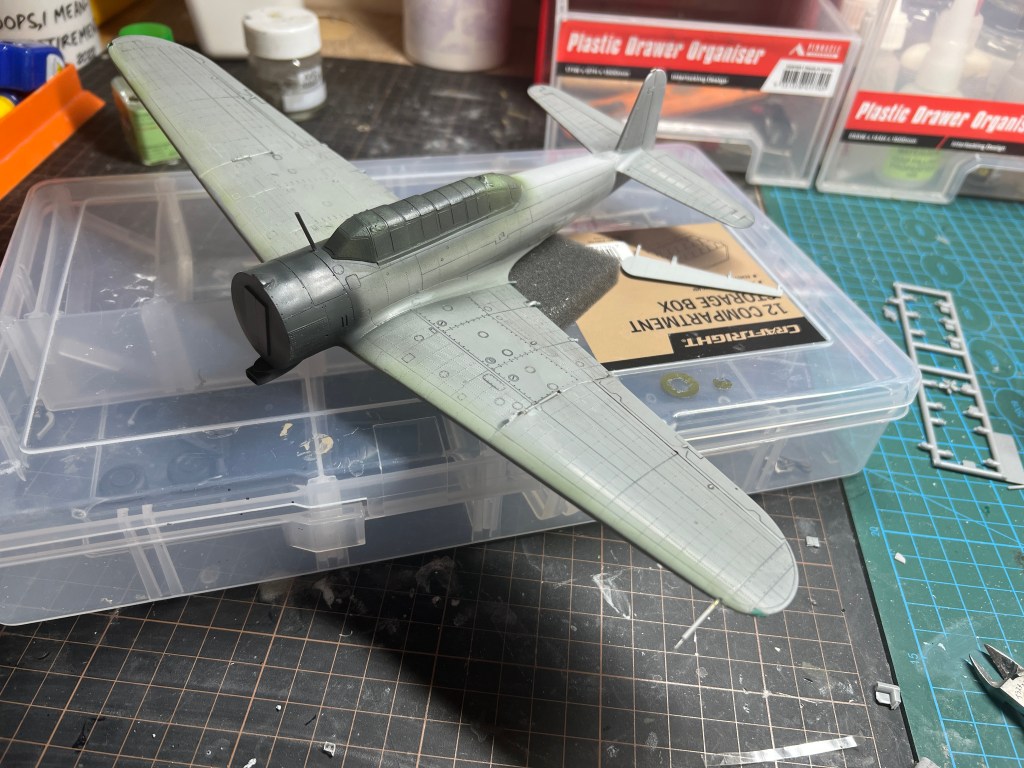
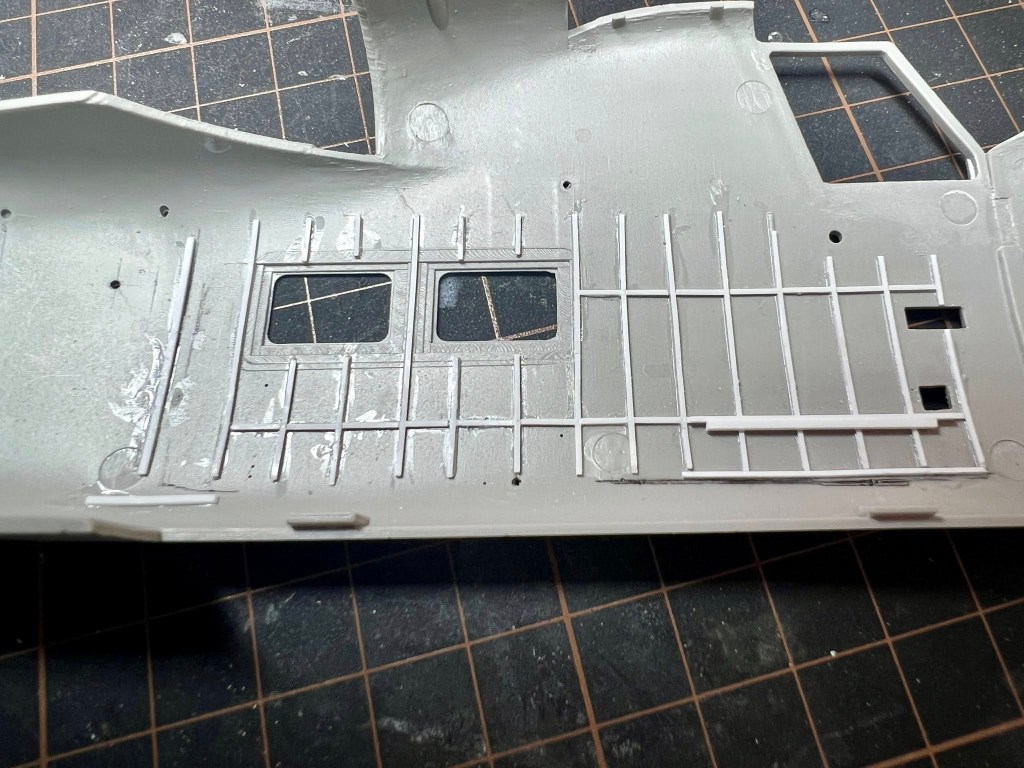
Very little filler was required on the model. The biggest application being where the bottom wing joins the fuselage. The fit here is not bad actually, and if the modeller doesn’t do as I did and manage to induce a step, it would just need some Mr Surfacer run around all the joins. However, my join needed an application of super glue to smooth it all out. During this process, the identification lights were drilled out to accept MV lenses. There is also a gap between the top dive brakes and ailerons that will need filling with plastic card.

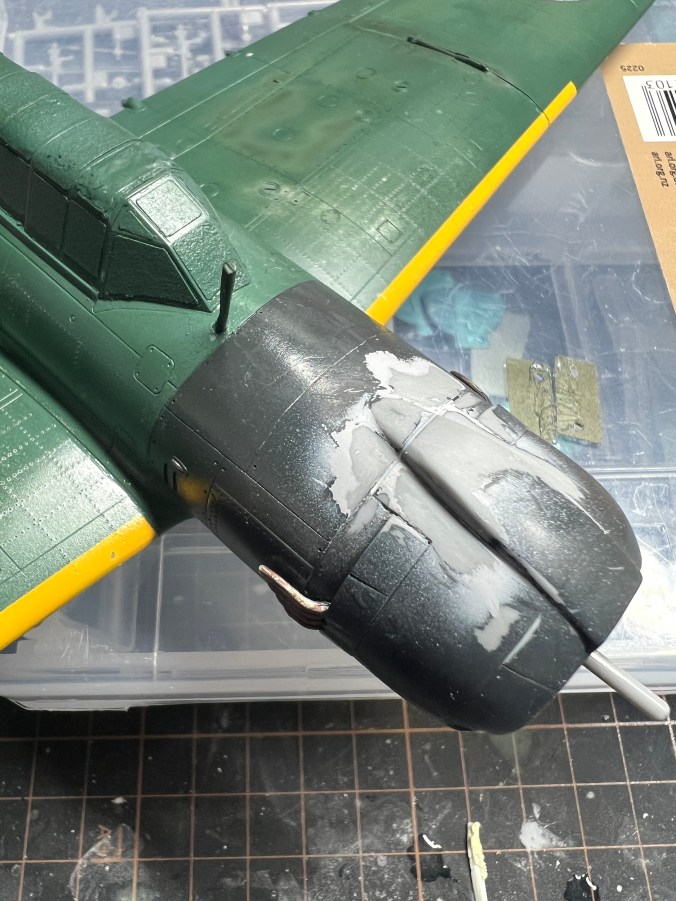
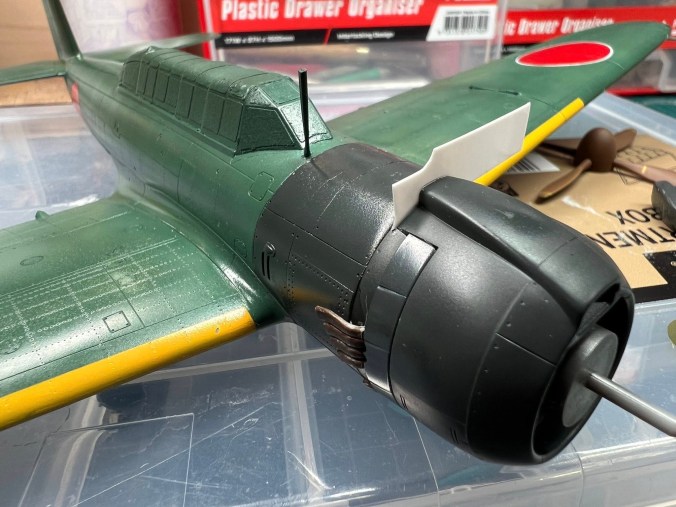
Filler was needed around the cowl scoop and gun trough panel. Here I used Mr Surfacer, removing the excess withy some Mr Thinner on a cotton bud. The kit blast tubes were cut from the cowl gun breeches, to be later replaced with drilled plastic rod.. No filler was needed at the wing roots, the join being very tight straight from the box. Prior to commencing my build, online builds were consulted to see what other people had experienced with the build. Some comments were made about the AM instructions, which surprised me as my recollections of AM instructions were that they were incredibly helpful. Now, with the passage of time, my opinion has changed to……… Not. So. Much! The written description of the build sequence contains lots of helpful information, but the drawings are sadly lacking in both detail and precise locations of where to glue the parts. However, they are still streets ahead of Italeri’s woeful efforts with their reboxed AM kits. I briefly thought about riveting the airframe, but in the end decided not to.

Painting

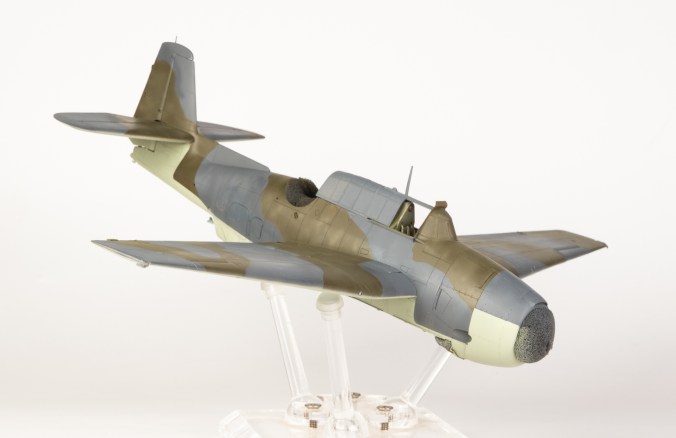
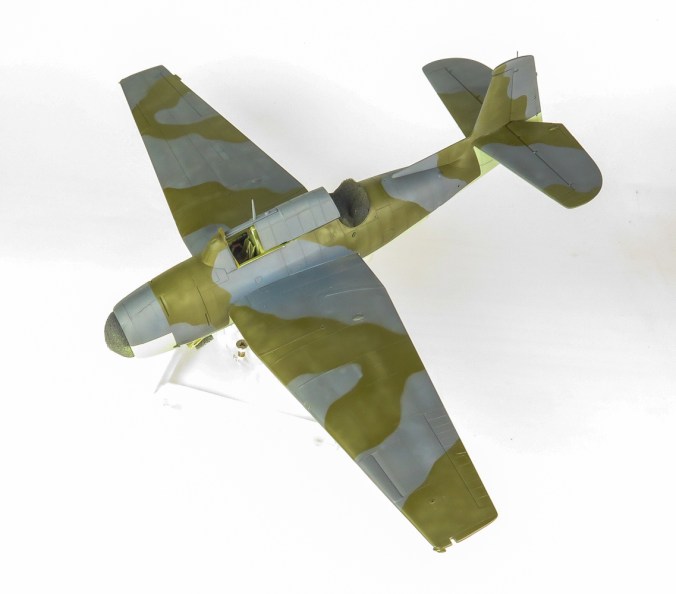
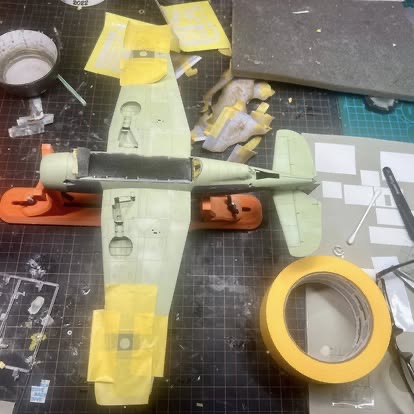
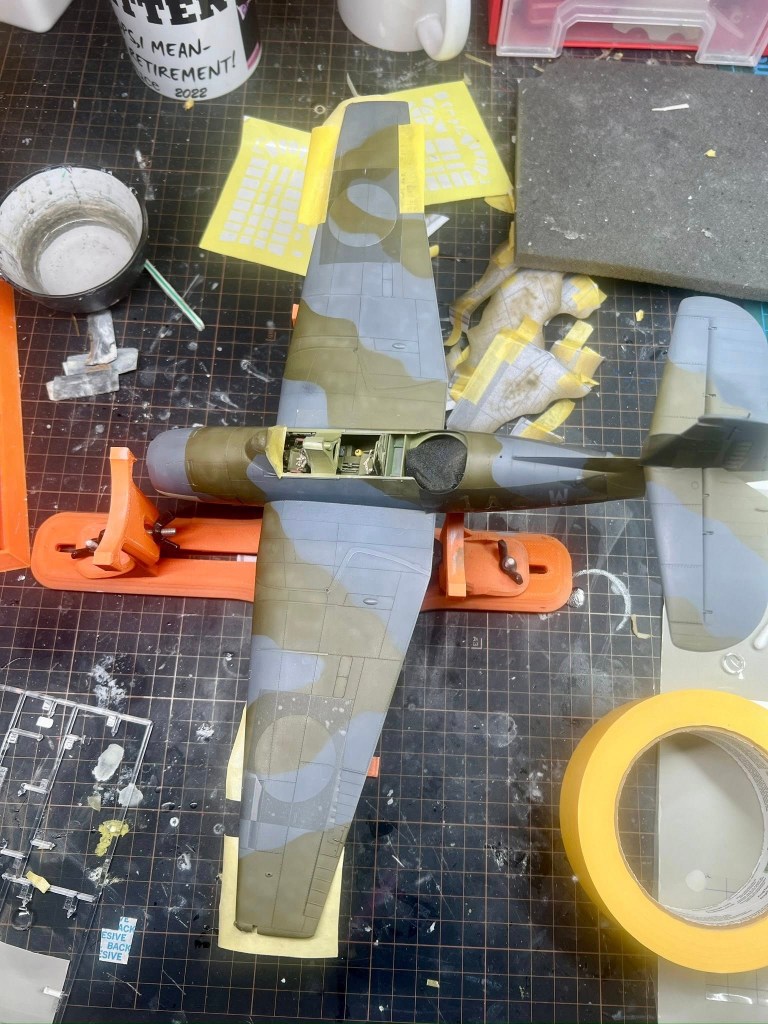
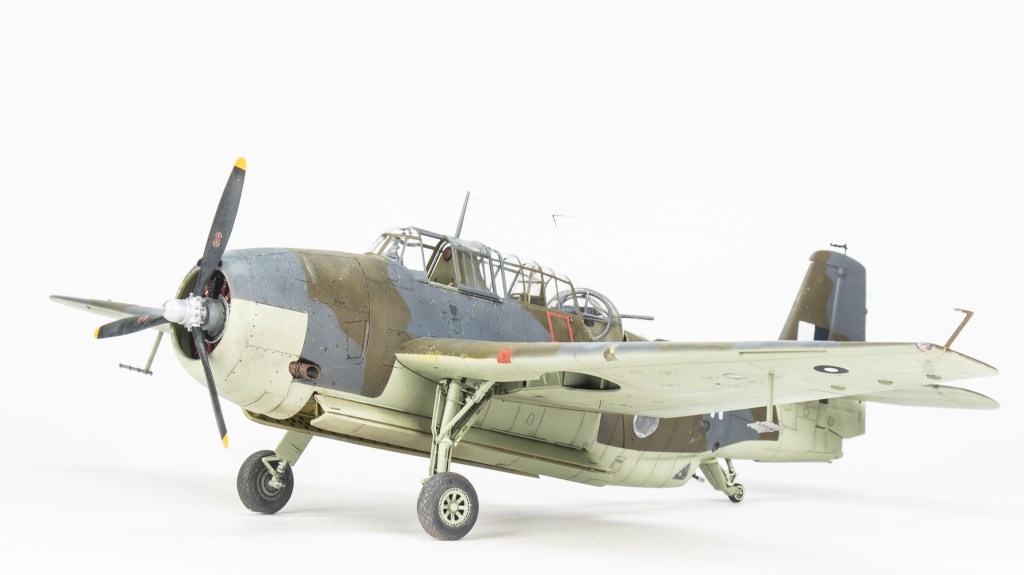
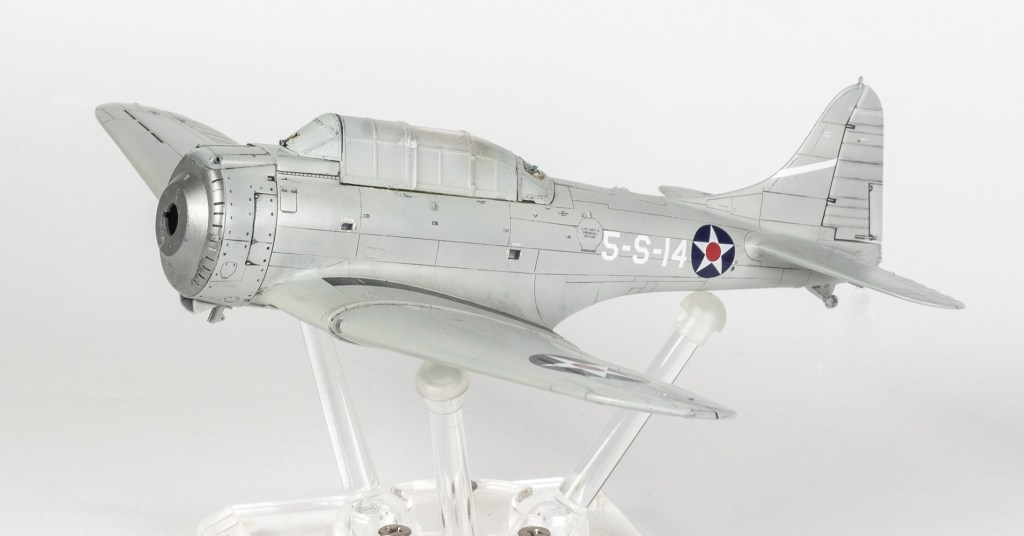
This was going to get finished as the box Coral Sea scheme, but my eye was drawn to the scheme USN aircraft wore before this. Overall Flat Light Grey. It still had the early war stars complete with red dot, although sadly not those gaudy fin stripes. And It was a lesser modelled scheme, which is also a box ticker for me. Furball offered such a scheme on their Colours and Markings Dauntless sheet, out of print on their website, but I managed to source one locally from Star Hobbies and Collectables. (locally, being Australia)

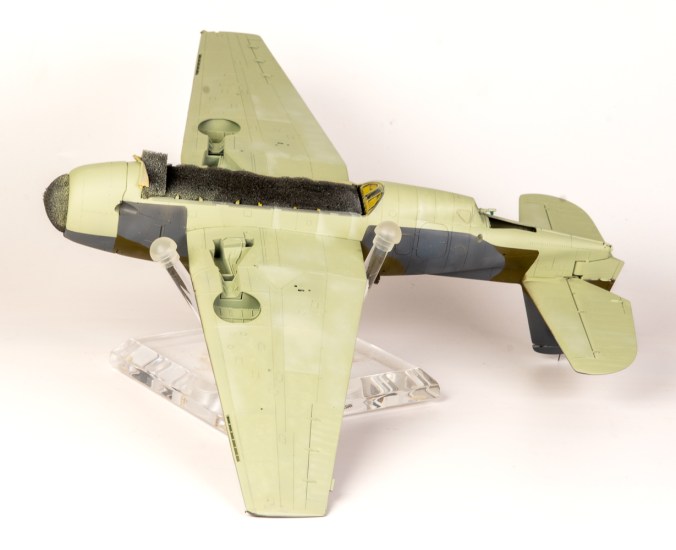
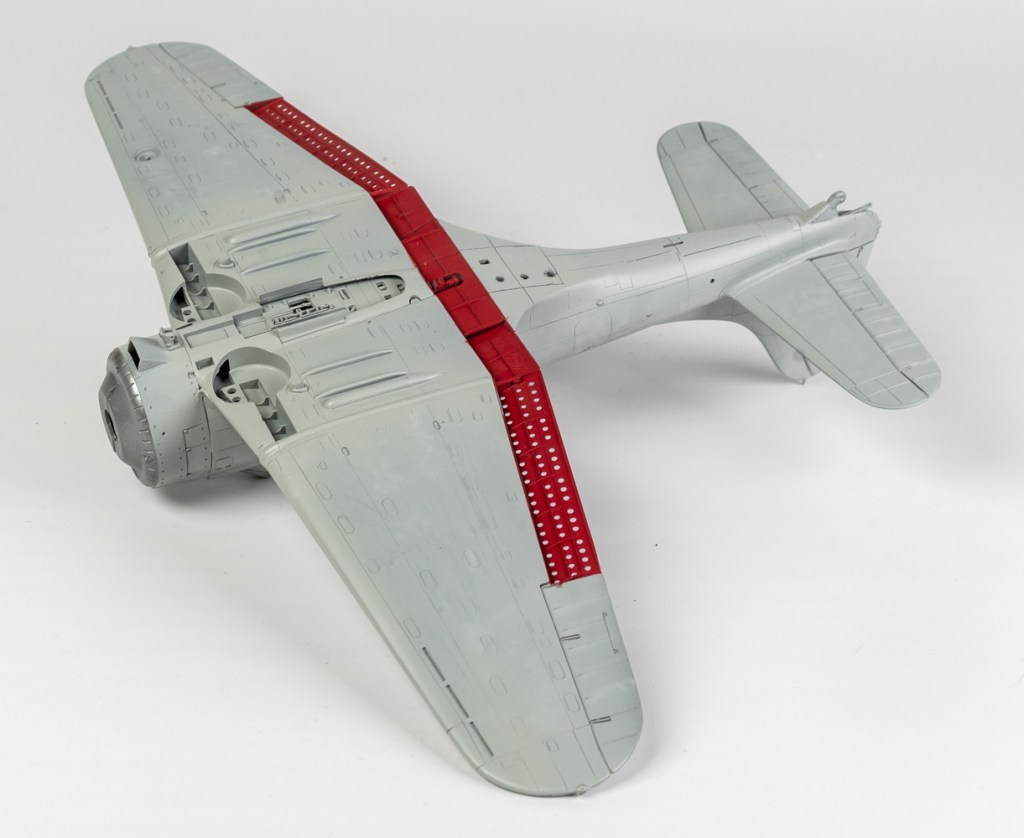
MRP Light Gull Grey was used with the interior areas of the dive brakes being SMS Flat Red. Initially all the interiors were painted red, but a local club member pointed out that the well for the central flap/dive brake was supposed to be the underside colour. Thanks Geoff, who doesn’t love even MORE masking!

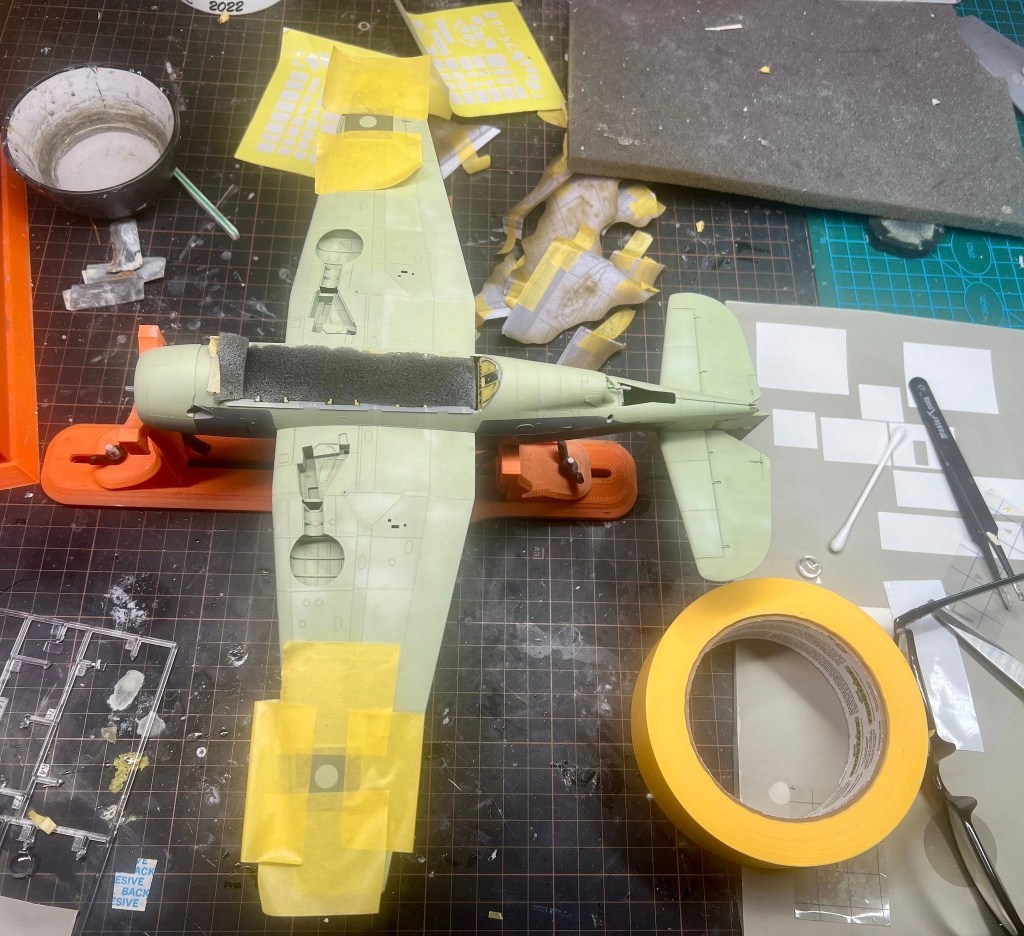
Prior to the sheet arriving, I decided to take a chance on the kit decals. The underwing roundel went on with no issues, bedded down on some Mr Setter. Some sparingly applied Mig AMMO decal fix saw it sink it the panel lines. The luck ran out though using the stencils as they broke up in the water. Time to stop for the day.

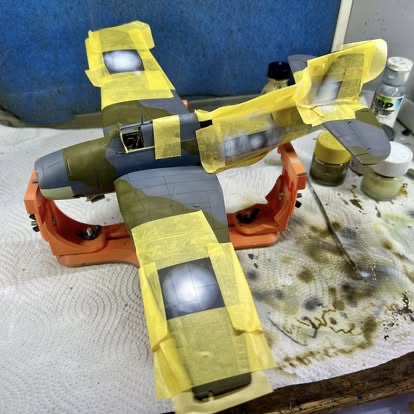
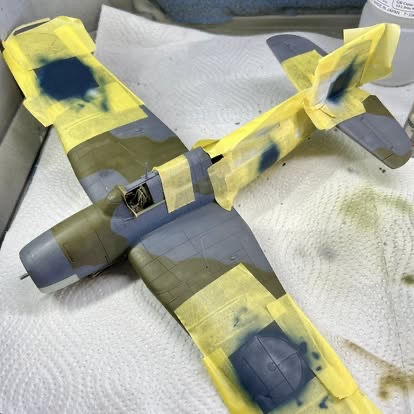
The next day started off well with the Postie delivering the Furball decals. It then took a dive when the decal set applied to the wing top star stained it due to my slightly too liberal application of the decal solvent. As it had to also lay into some vents on the wings, the decision was made to instead mask and paint the star in this location. The walkways were also painted rather than using the supplied decals. Furball decals were used in all other locations, including the stencilling.

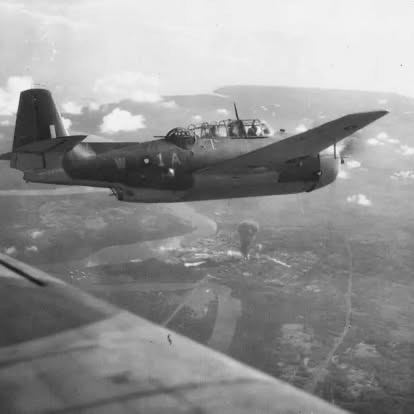
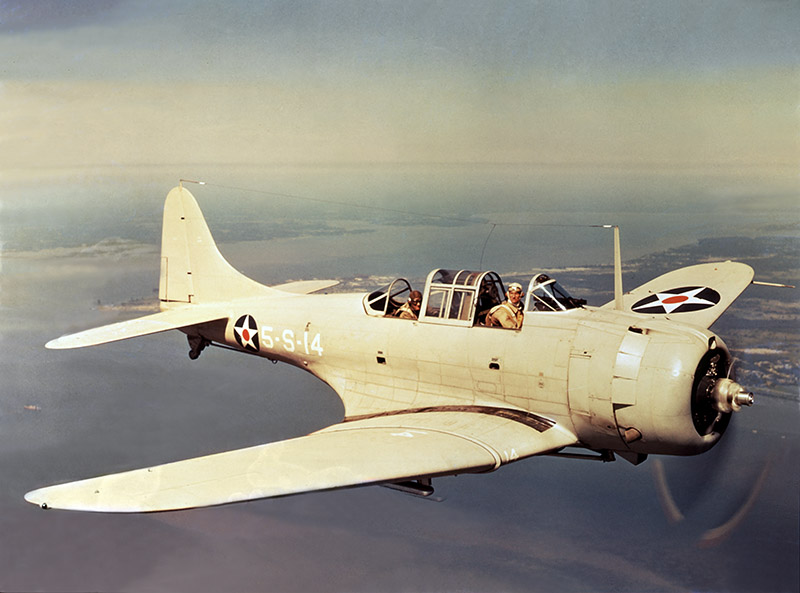
The Jeffrey Ethell collection on Flickr has a photo of the actual aircraft.

I’ve reproduced it here, as I believe it’s actually an official USN photo taken over San Diego.

Comparing the photo to the Furball sheet, one sees Furball did not include the small number 14 on the wing leading edges. These can be made up from the various other numbers included on the sheet. The wingtop numbers were also placed more towards the front of the wing than Furball show on their instruction sheet.

As you can see from the photo, she’s a fairly clean airframe aside from that exhaust stain. There being no evidence of even oil leaks from the cowling. Note no spinner is fitted and the propeller tips are still the early three colours of (from the tip) red, yellow and blue Modellers World Brown Grey was used for the panel line wash. The exhaust stain was airbrushed with very thinned ( not thinned enough though!) Tamiya black XF1 and red brown XF64

Final Details

The landing gear locates very positively, thanks to AM’s excellent engineering. I wish more kits were like this, talking about YOU Eduard!

The small struts that link the gear doors to the oleos were replaced with .20 plastic rod. This is far easier than cleaning the kit parts up. The gunner’s rearmost canopy was very carefully cut from the one piece closed canopy AM provide. You can’t use the provided open canopy due to it being too small as its designed to be stacked under the other canopies

The aerial wire was lycra thread with small brass tube lengths used for the insulators. Small 2.4mm MV lens were used for the underside ID lights. These are like the MVP of my bits bin. Try to find small lenses these days! The Brassin wheels were superglued on after having the axle holes drilled out larger. Really Eduard, this could have been done at manufacture, you say on the packet they are for the AM kits. I’m sure some modellers will label this as nitpicking, but I find it incredibly irritating. Reskit are also the same, labelling their wheels as specific to a particular kit, but again, the axle holes always need drilling out to suit the kit axle. And with that, the Dauntless rolls off the bench -not literally I hasten to add – as my first completion for 2026.

Final Thoughts

I really enjoyed this kit, perhaps because I set out from the start with the view of just making it a quick straight forward build. To me, Accurate Miniatures kits, even when looked at with a 21st century eye still stand as great model kits . A true testament to the work that went into designing them at the time. Although there is more aftermarket out there for them now, you can still build a detailed kit straight from the box. Its streets ahead of the Hasegawa Dauntless and will probably wear the crown of “Best Dauntless in 48 Scale” for some years yet.

Douglas SBD-3 Dauntless. U.S Navy VS-5 USS Yorktown 1941

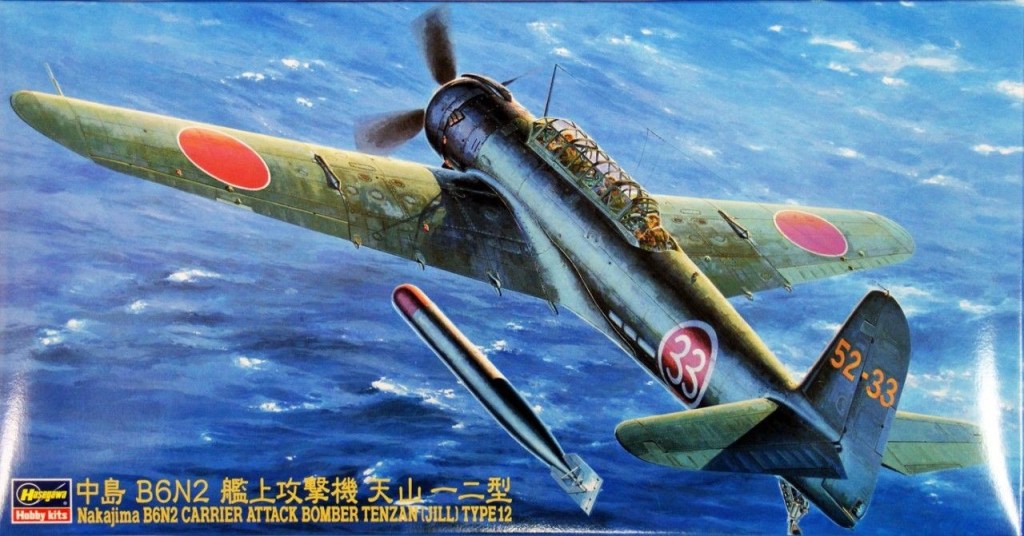
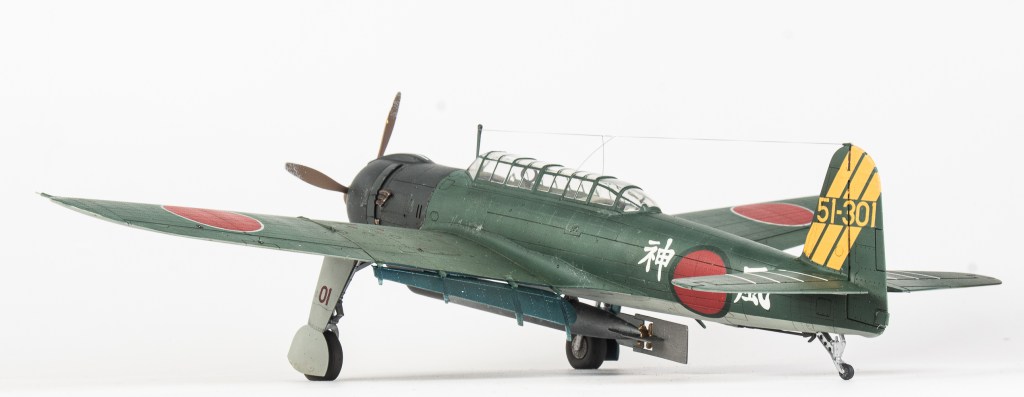
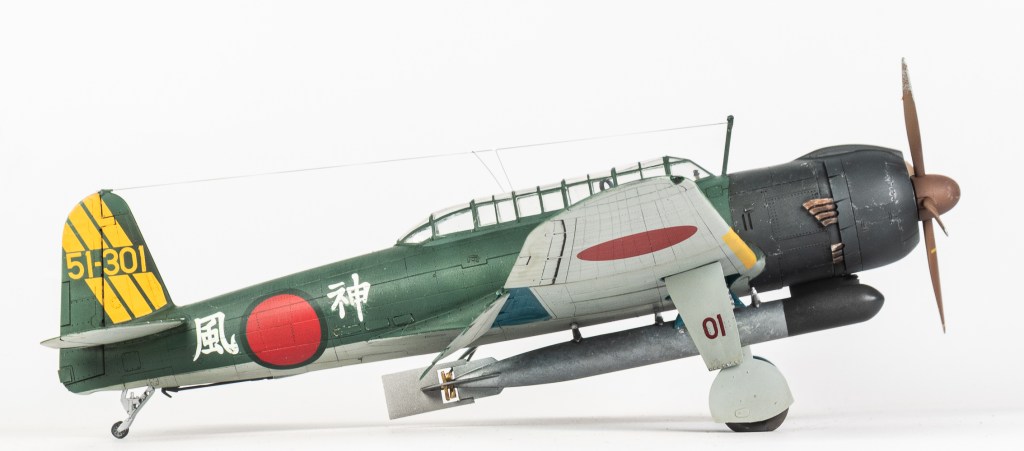
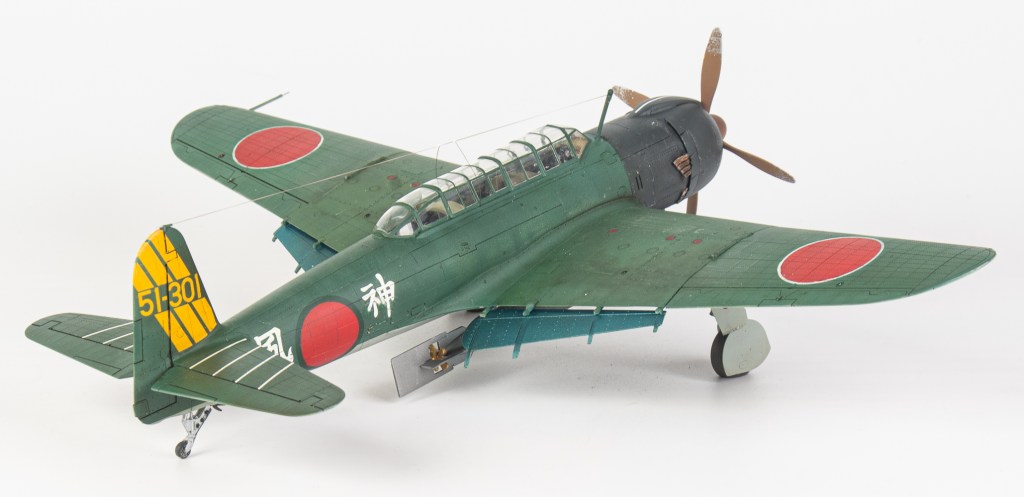
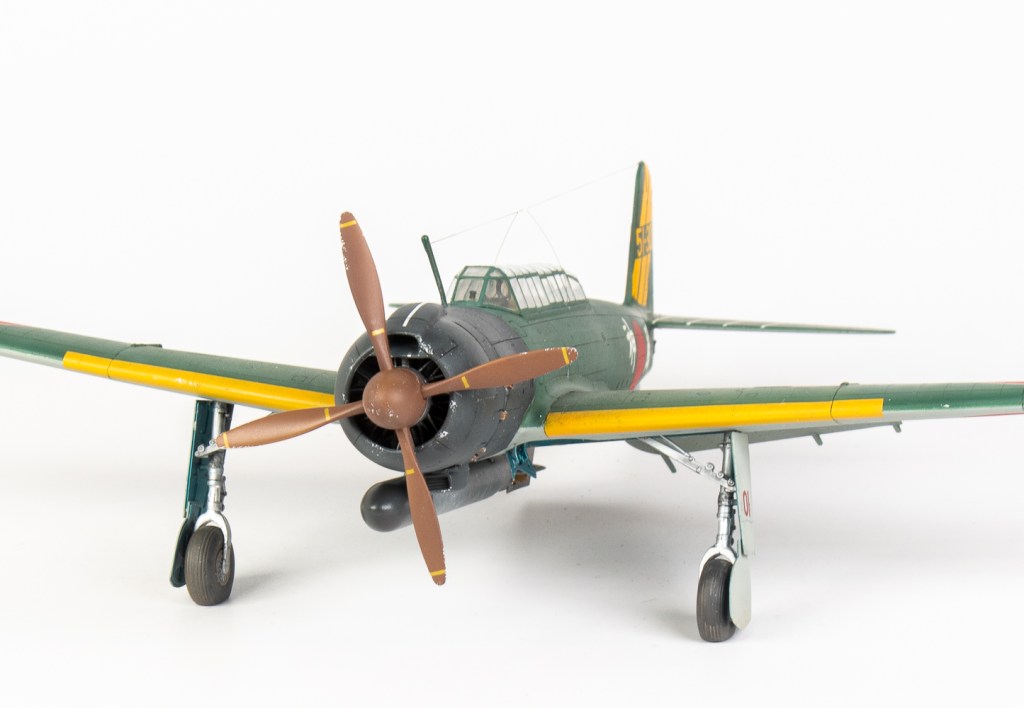
Hasegawa 1/48 B6N2 Tenzan

  • Purchased; 2023
  • Completed: 2025
  • Enhancements: OOB
  • Decals: Myk-Design

For modellers that first built these kits upon their release, there is something comforting about returning to a Hasegawa kit, many years later. Yes, far better examples of their subjects can be found in other manufacturers ranges these days. However, there is still that wonderful emotive box art by Shigeo Koike. Those nicely moulded grey parts with their sharp, but shallow engraved panel lines the crisp detail, and, for the most part, a fairly uncomplicated build. Of course, there were also the odd fit issue, the not-quite-white decals, sometimes vague instructions, and not-quite-crystal-clear transparencies. The builds were usually very enjoyable, albeit the models could be a bit bland, Hasegawa not generally offering options for open hatches or separate control surfaces to give your model a bit of individuality.

Construction Notes

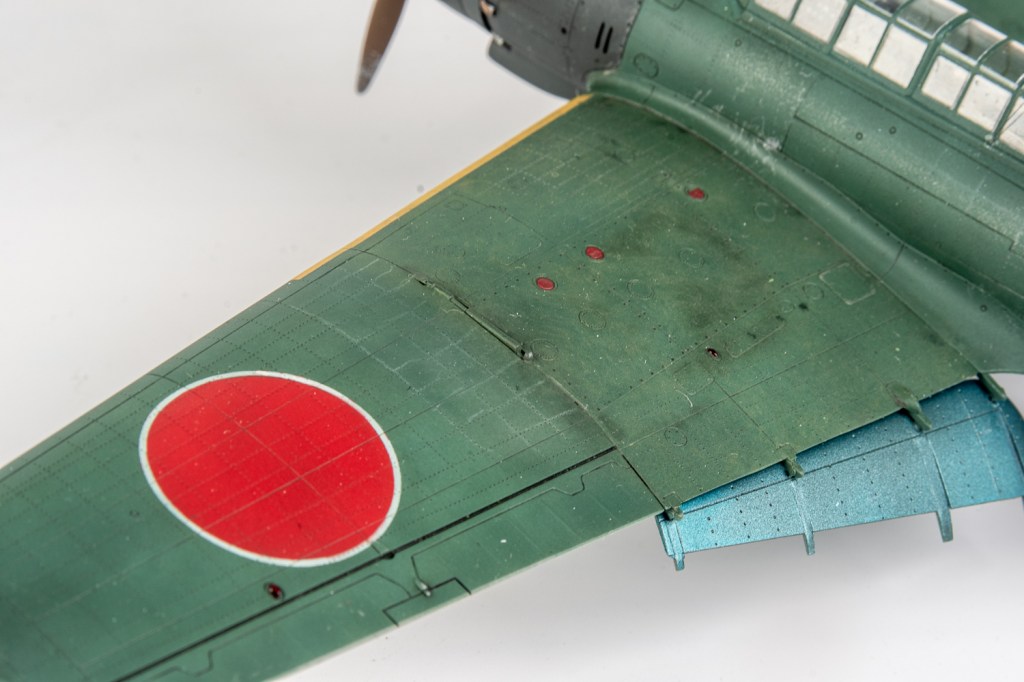
And so we come to Hasegawa’s Tenzan. It is a fitting end to my year’s builds. This one was going to be purely built from the box. It serves as a pause from my other sometimes long and protracted builds. The complication (there’s always a complication!) added by me was the decision to rivet the surfaces to add a bit of “busyness” to the airframe. To be fair, this wasn’t that much of a complication. It involves finding suitable drawings that show the rivet details. In this case, the drawings come from a Kagero Top Drawings book. The next steps are scaling the drawing up and transcribing the lines onto the model. A riveting tool is then used to push the rivets into the plastic. Search YouTube for “The Model Guy” who has a video of how to do it step by step. I couldn’t post the video here for some reason. After the riveting was completed, a black wash was run into all the rivets and panel lines to assess them. there were a few wonky lines! And as a friend mentioned there should also be river lines alongside all the panel lines as well.

The actual build proceeded with few real issues. There was a gap when joining the front cowling to the rear cowling, despite all the parts being lined up correctly. Talking to other modellers who have built the kit, it’s a known issue. Plastic card took care of this. after the problem was discovered far too late in the build.

I would suggest adding the cockpit sidewalls to their respective fuselage halves rather than the floor as the instructions illustrate. I found building the kit as per instructions, my sidewalls sat a bit proud from the cockpit sills. The kit includes the option of folded or extended wings. Poly caps hold the wings in either position. This allows the modeller to change the attitude of the kit, even after completion. I thought I was smarter than Hasegawa and left their wing ribs out choosing to reinforce the wings with plastic strip. Turns out I’m not smarter than Hasegawa though, as the floppy wingtips prove!

Painting and Decalling

MRP Super silver was first laid down on the centre section of the wings and fuselage. The next coat to follow was a lightened version of Tamiya IJN followed by another application, this time straight from the jar. All paints were thinned with Mr Hobby thinner.

Undersides were SMS Storm Grey, which is a grey with a slight tinge of green in it. I think it does a reasonable job of standing in for IJN Grey, of which I had none. Once the colours were set, a small worn piece of 800 grit wet and dry was used. This gently abraded the inner wings, just enough to allow the rivets to show through. While researching the unit’s history, I found out they were ferried to Truk Island and only flew a couple of missions after arriving before being wiped out. Thus my weathering on this aircraft is only slight. There is just some staining and touchups on the wings. Additionally, there is chipping around the cowling. None of the photos examined showed any sort of exhaust staining. Japanese contemporary photos are pretty much universally of poor quality though. Rather Ironic, really ! Speaking of the cowling, this was finished with SMS Blue Black, and the propeller with Tamiya Red Brown. Gunze Metallic Blue was used in the wheel and flap wells.

Decals were a brand called Myk-Design that I picked up whilst roaming hobby shops in Japan. The instructions are all in Japanese, but they do have a website with English instructions on how to apply. It was here that I discovered they had peelable film, like Eduard and HGW, Unlike Eduard though, the film on these is designed to be peeled off. They were applied over Mr Setter and left for 12 hours as per the instructions. The film peeled off very easily, , usually coming away in one big sheet. An oil wash mix using Abterlung dark green and black oil paint was applied to the upper surfaces with dark brown used on the undersides . The excess being wiped off before the final matt coat was applied.

Final Assembly

Somewhere along the way, the kit aerial mast was misplaced so a replacement was made from brass rod. It was filed to a rough aerofoil section before adding it to the model. The pitot tube was also fabricated from brass rod.. Whilst we are talking about fumbles, I also managed to glue the retraction struts to the wrong gear legs, and then snapped them off trying to remove them. In addition the locating holes for the gear doors were mistakenly filled as I thought they were ejector pin holes. I probably should have just built this as an in -flight model! Did I mention the gear door that I also managed to snap in half?

The included torpedo is one of the weaker parts of the kit, and a resin replacement was almost purchased before deciding it was going to be underneath, so not really visible. The kit part was therefore used. All these parts plug in due to Hasegawa’s copious use of poly caps as locating aids throughout the kit. In fact I don’t think Ive seen another aircraft kit that uses so many of the things, even Tamiya kits!

The antenna wire was EZ Line. My enthusiasm for this product though has started to wane. Its just too easy to introduce twists into the elastic, unless you reeeeeeaaaaaly stretch it out, which just puts undue stress on everything. Although in this case I had also glued a small length of micro tube to the top of the tail fin, The EZ line was just run through this and then glued in place

Conclusion

In the end, quite an enjoyable painfree build. Yes there are some compromises in detailing and paintwork, but I long ago reconciled myself to the fact that not every model built will be a showstopper. Its a compromise that needs to be made if you want your end game to be building as many models from your stash as you can, before you are forced to give up the hobby through age or medical issues.

To close, the Jill is quite a pretty aeroplane. There will be more Japanese builds in my future.

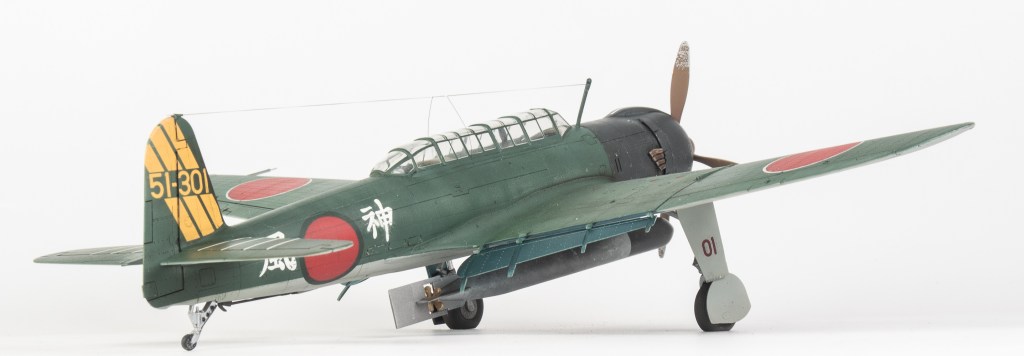
Nakajima B6N2 Tenzan. 251st Attack SQN. 551st Naval Flying Group. Imperial Japanese Navy. Chuuk Lagoon 1944

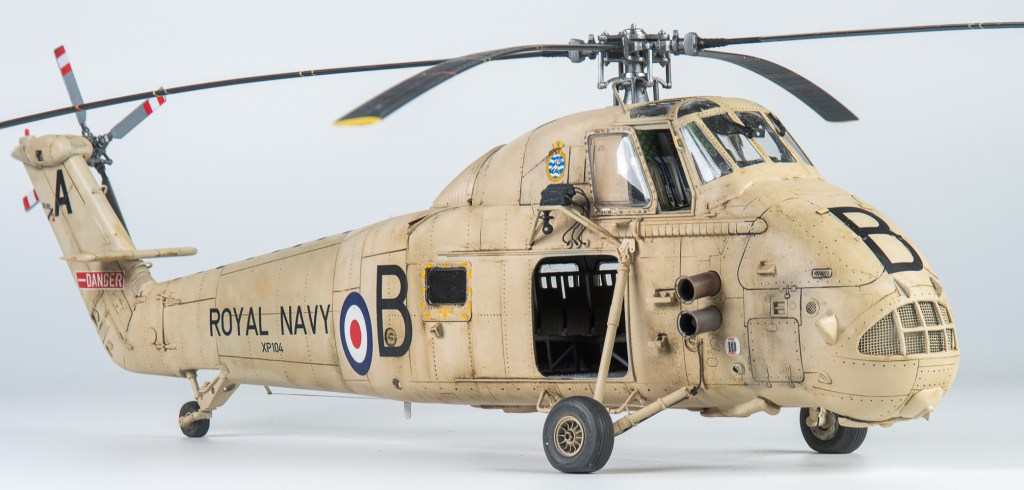
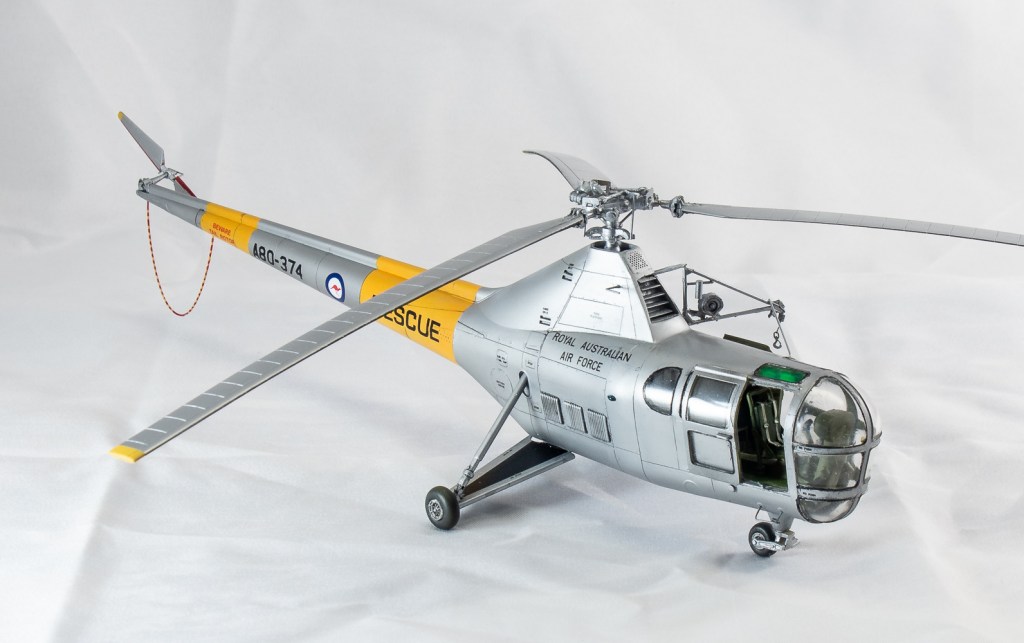
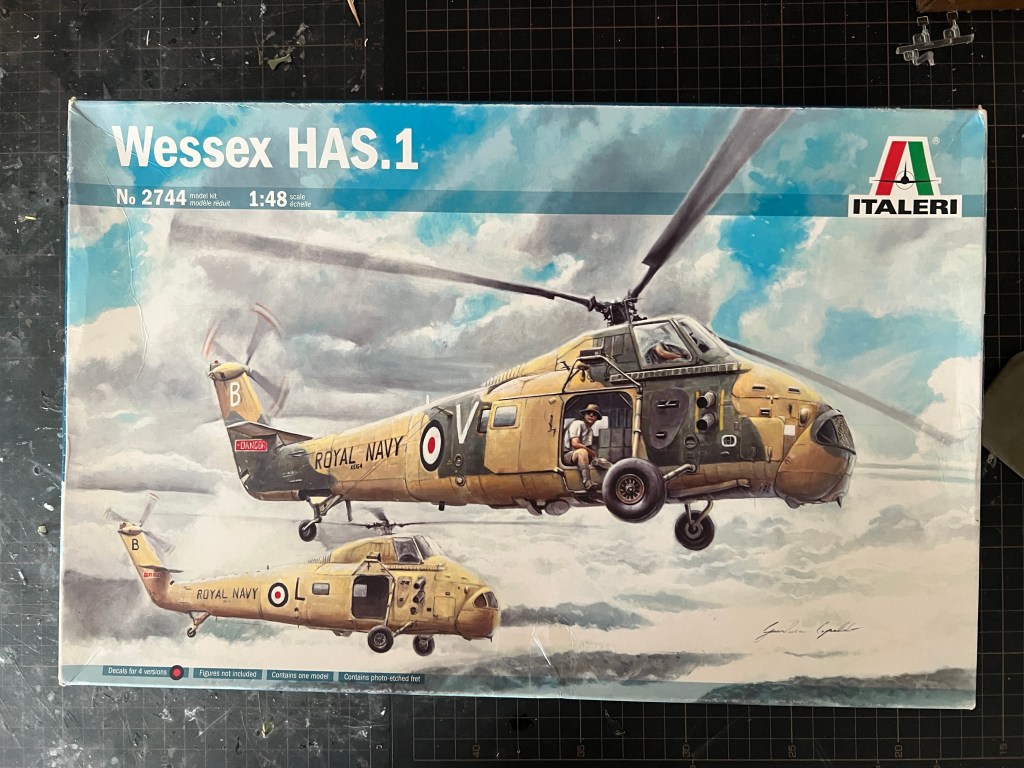
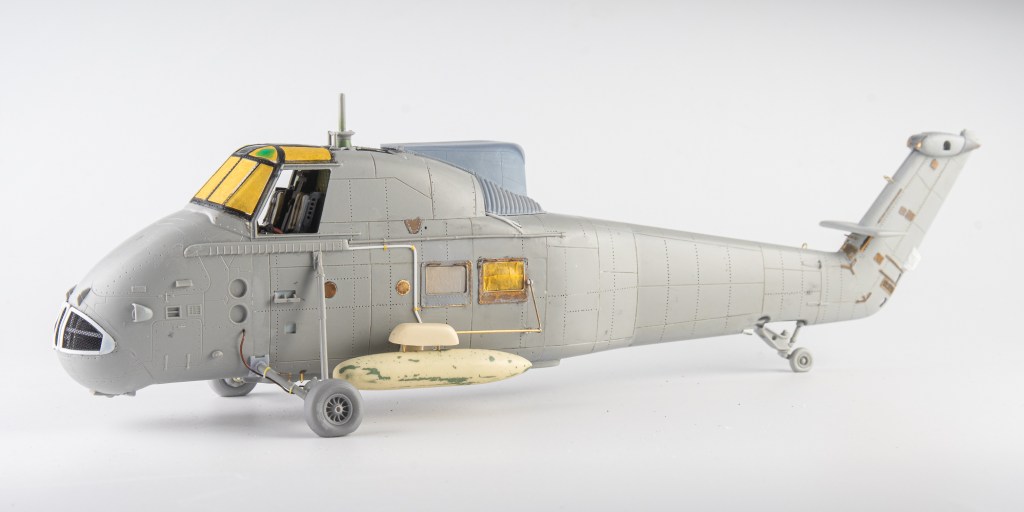
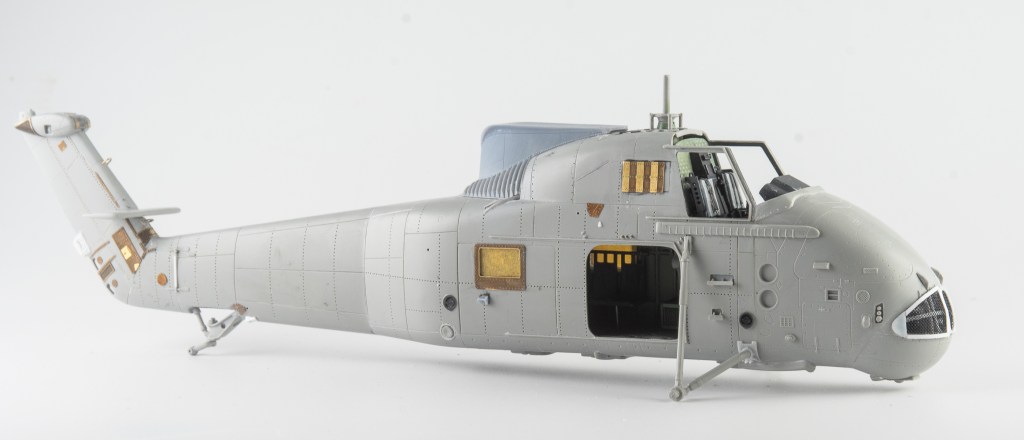
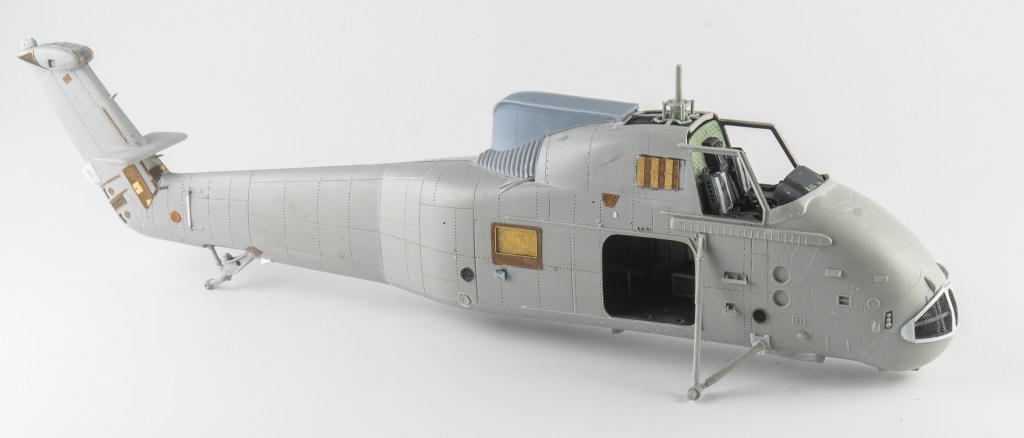
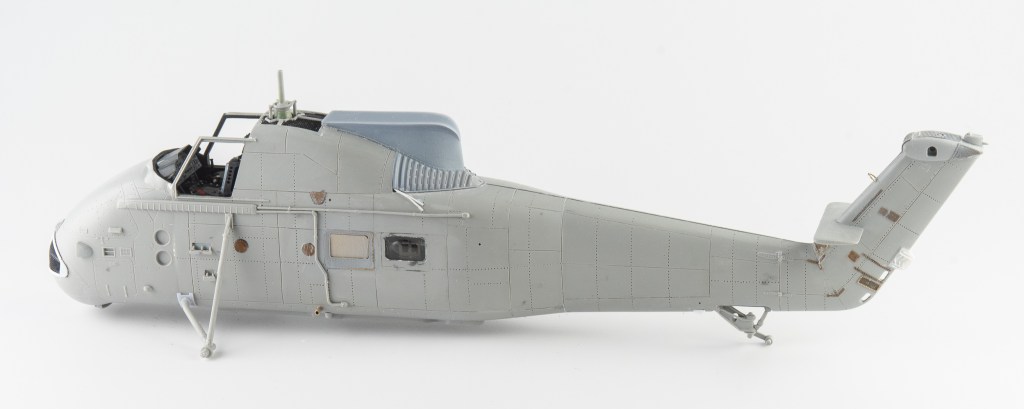
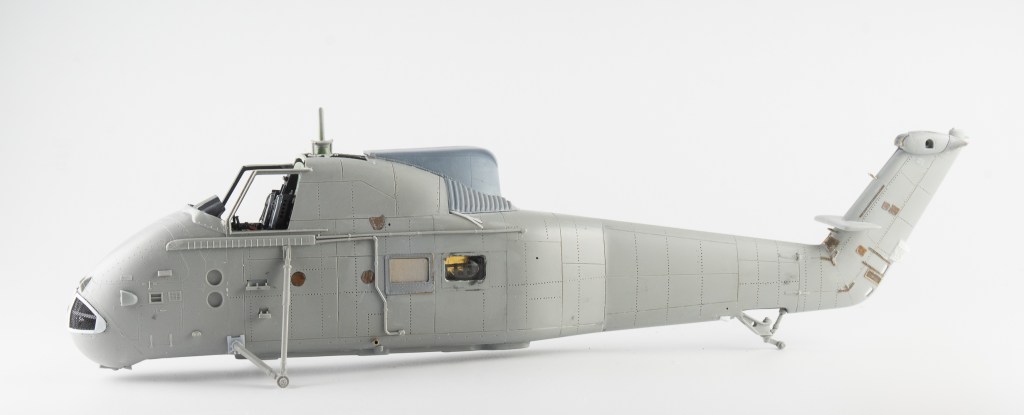
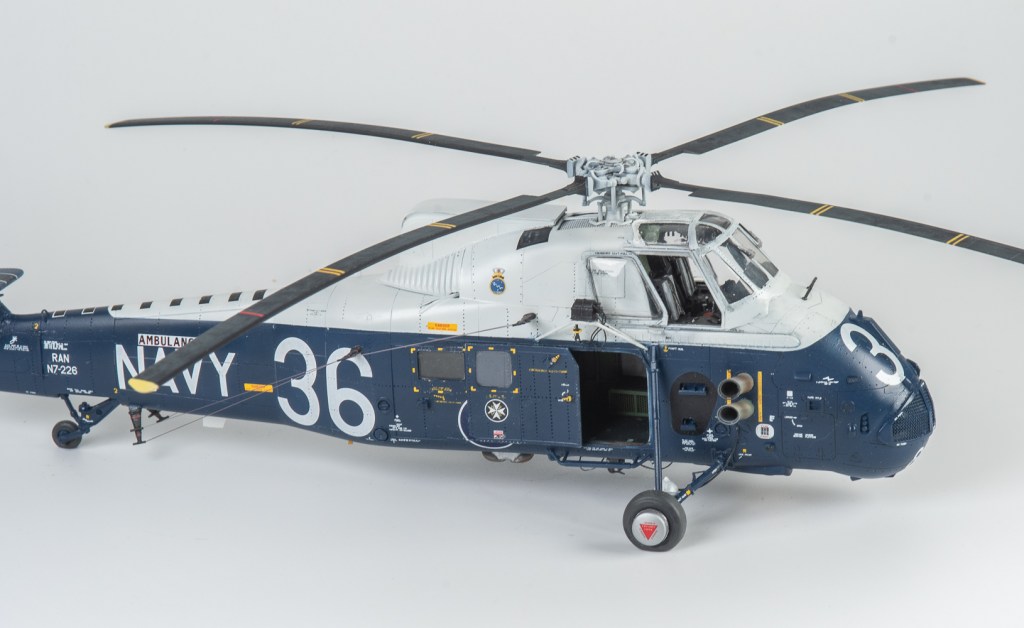
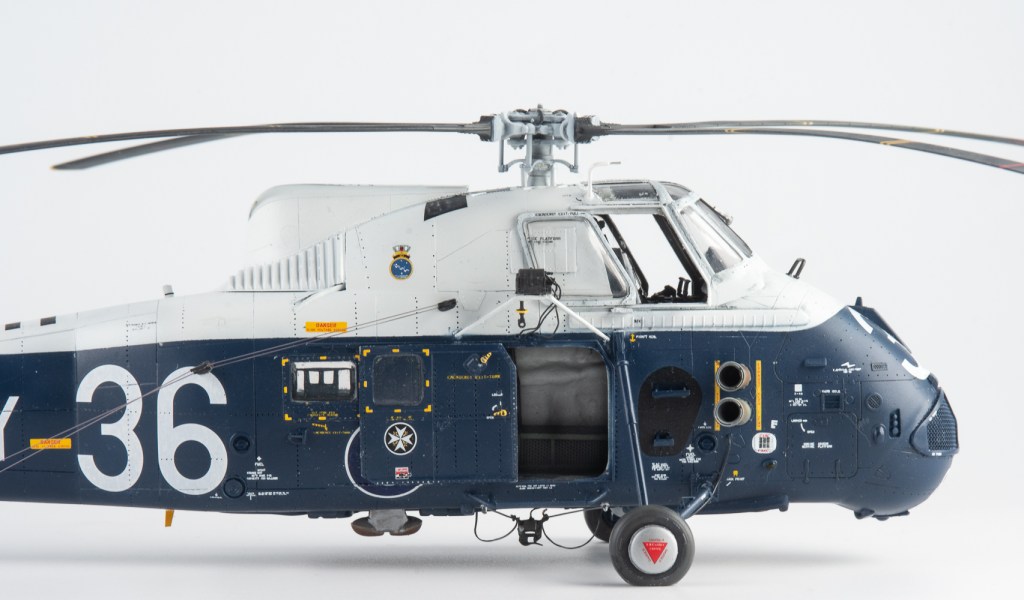
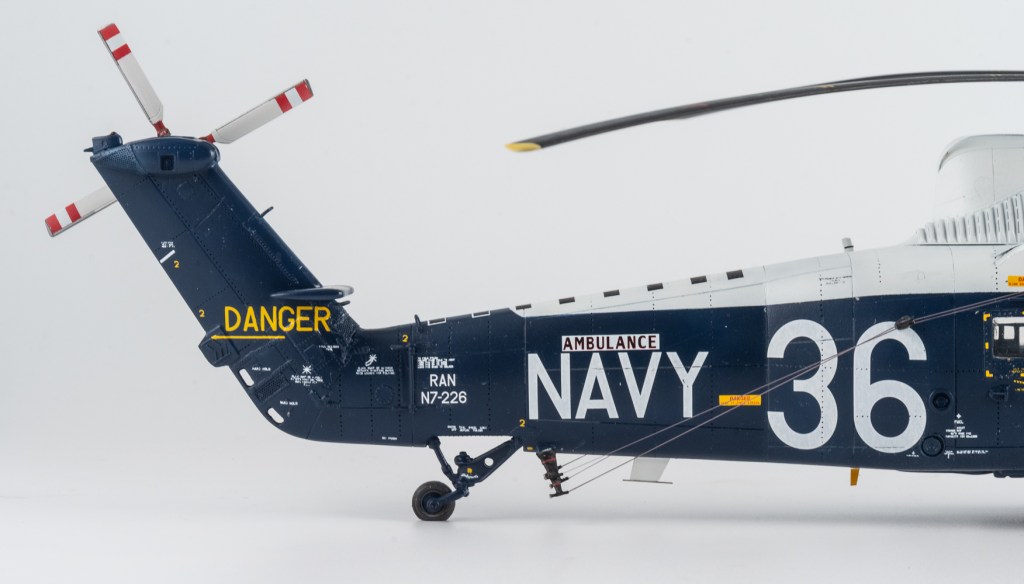
Italeri 1/48 Wessex Mk31B

  • Purchased; 2015
  • Completed; 2025
  • Enhancements:
  • Dogbox – Hendies scale models Wessex Set E
  • Pilots seats. Hendies Scale Models Wessex Set D
  • Exhausts: Hendies Scale Models. Set B
  • Wheels; Armory
  • PE details. Eduard
  • Stores carrier and fuel tank. Hamilton Hobbies
  • Decals; L Decals

This build illustrates the progressive march of better aftermarket accessories that have hit the market over time for particular kits.

To make a Mk31B used by the Royal Australian Navy, you needed to combine this kit with the Italeri HAS3. That kit included the Dogbox, that sat on the rear engine deck. The HAS3 kit was also needed for some scoops and fairings present on a Mk31. These days though, there are people like Hendie from Britmodeller making available the parts needed here. One doesn’t need to have both kits for this conversion. If only using the HAS1, though, some scratch building of scoops and fairings will still be required.

Similarly, the decals, once upon a time, offered only the less than comprehensive Aussie Decals sheet. Now there is the far superior L Decals sheet. If you can still find it, the Southern Sky Models decal sheet includes all the stencilling as well.

Sadly, Italeri’s kit hasn’t improved with time. However, even using this as a base kit is progress. Prior to this, the modeller would have had to use the old and poorly detailed Revell kit. The plastic in this boxing is particularly pebbly and textured. It requires much sanding down and describing. Plus, all the shallow and inconsistent rivet detail needs redrilling. In the end, it needed more rubbing down. Some areas were still textured after the application of paint. Id love Airfix to release a new tool Wessex, but fear they would only do the HC2 version

Construction Notes

Of course, us Australians had to fiddle around and change stuff! So a Mk31 cannot accurately be made straight out of the Italeri box. There are a few additions and modifications required. The best online reference for these is Graeme Moulenoux’s Grubby Fingers site.

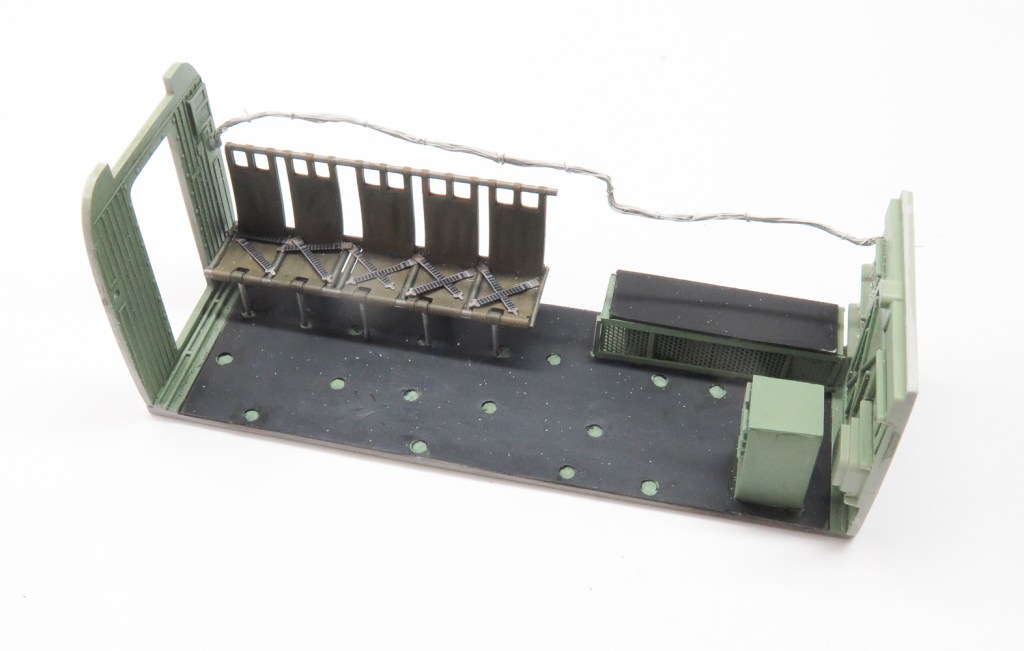
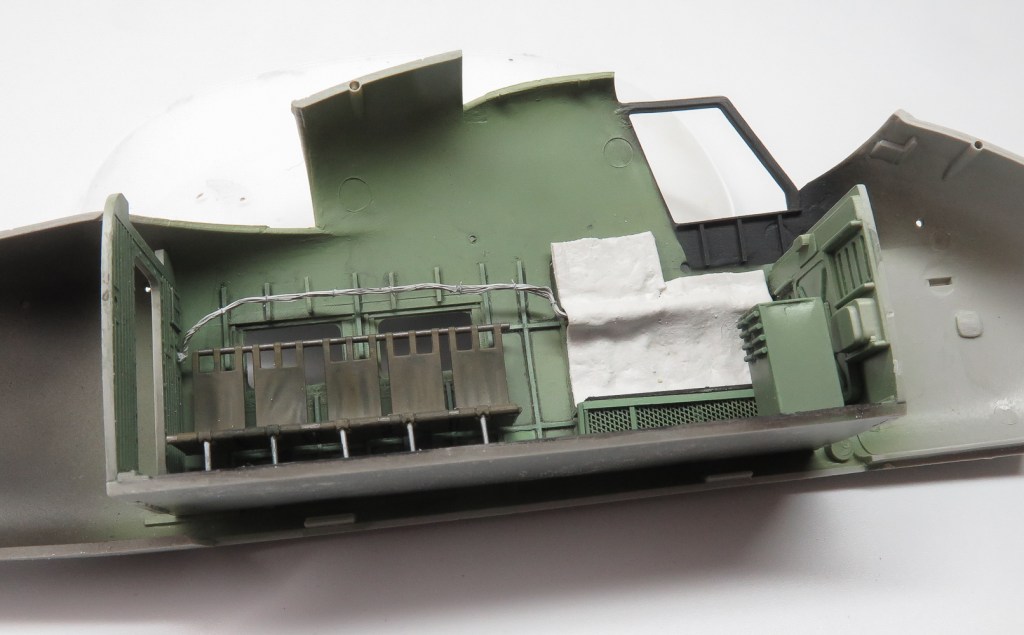
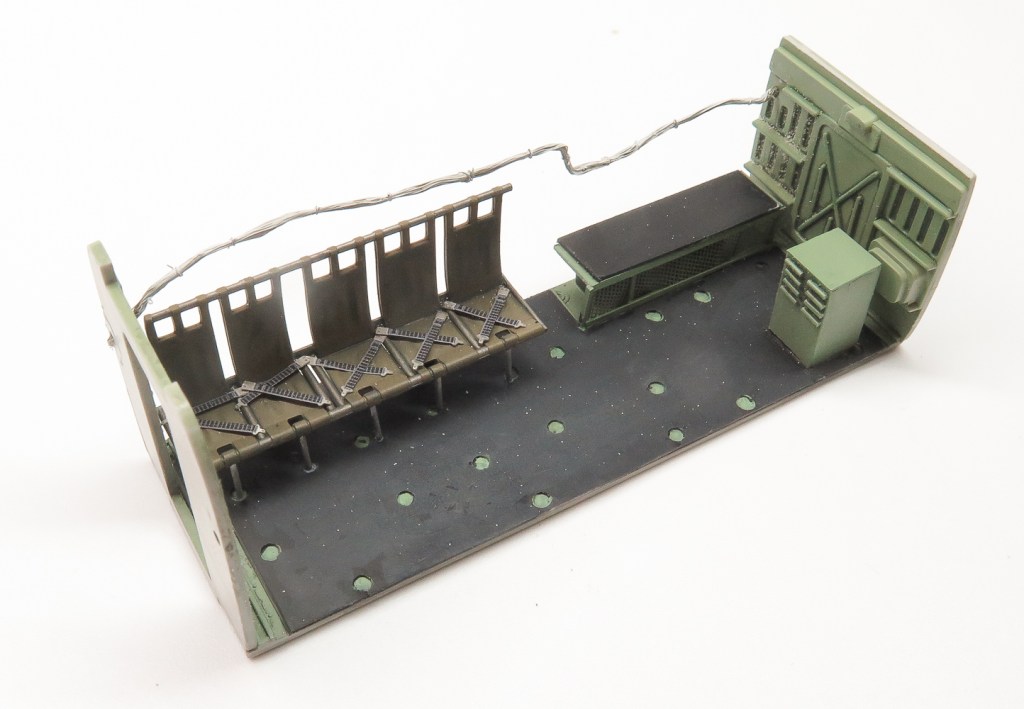
We start off with the interior. Scrap plastic strip and mesh were used to build up a bench seat. It sits over the auto hover gubbins, so no need to scratch build all this stuff. The Navy also had the good grace to hide all the interior wire jumble behind a drape. This was made from rolled Tamiya epoxy putty.

The bench seats came from an Airfix Seaking and the cabinet was built from plastic card. Plastic card also filled in for the plywood floor the RAN fitted over the actual floor. The electrical component box was constructed from the ever useful plastic card. The wire loom was crafted using speaker wire.

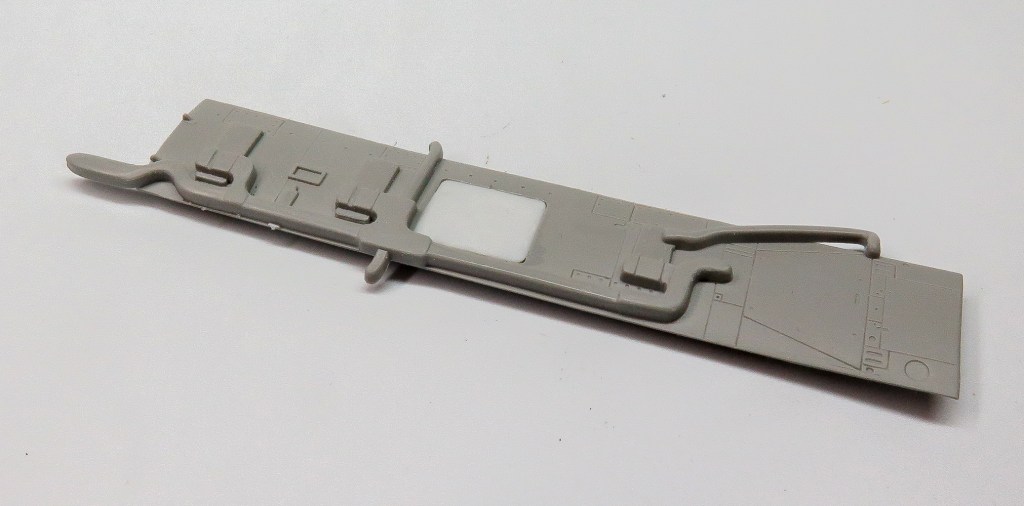
The bottom panel needs the sonar detail removed from within the hatch. Then, the opening should be faired over with a panel from plastic card.

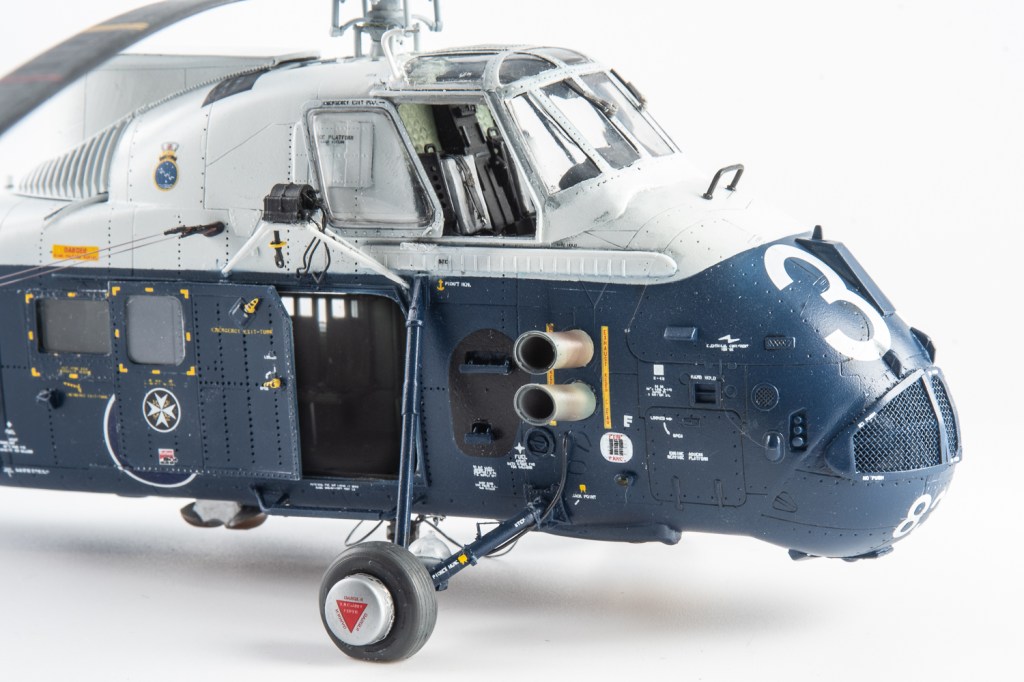
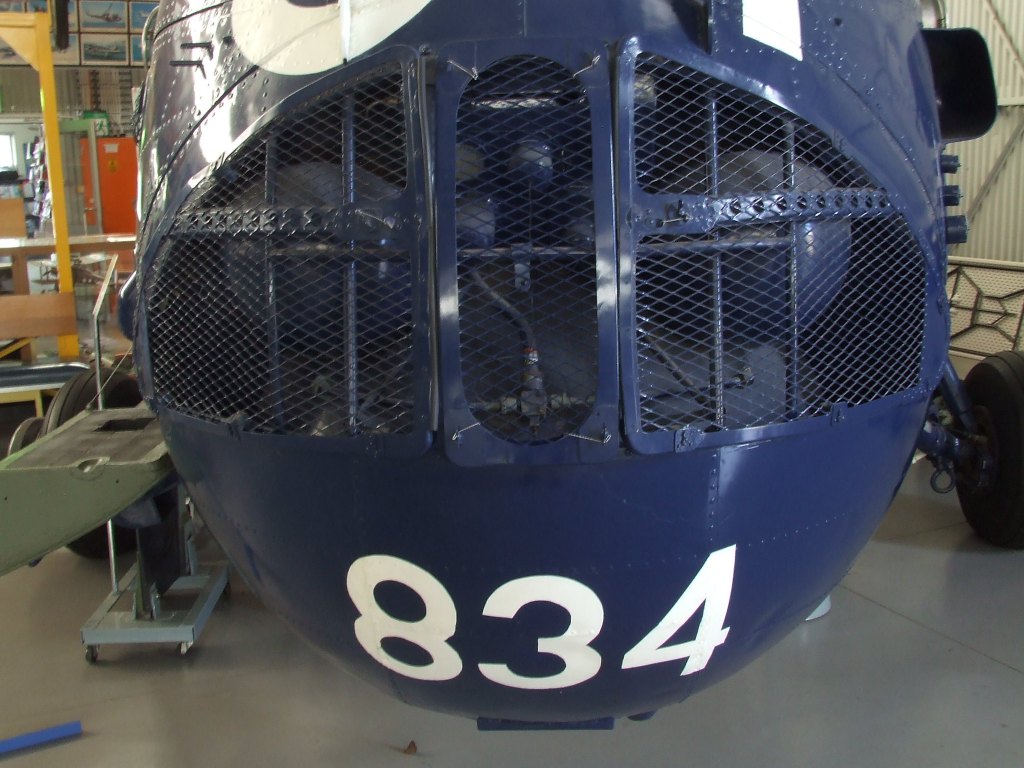
The below image taken by myself of the Wessex in the South Australia Air Museum shows what is required of the kit nose filter to properly represent a RAN Mk31B

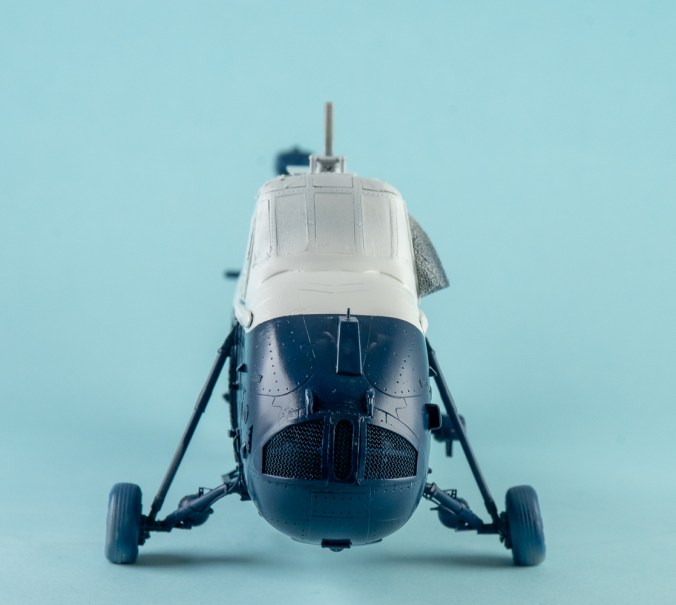
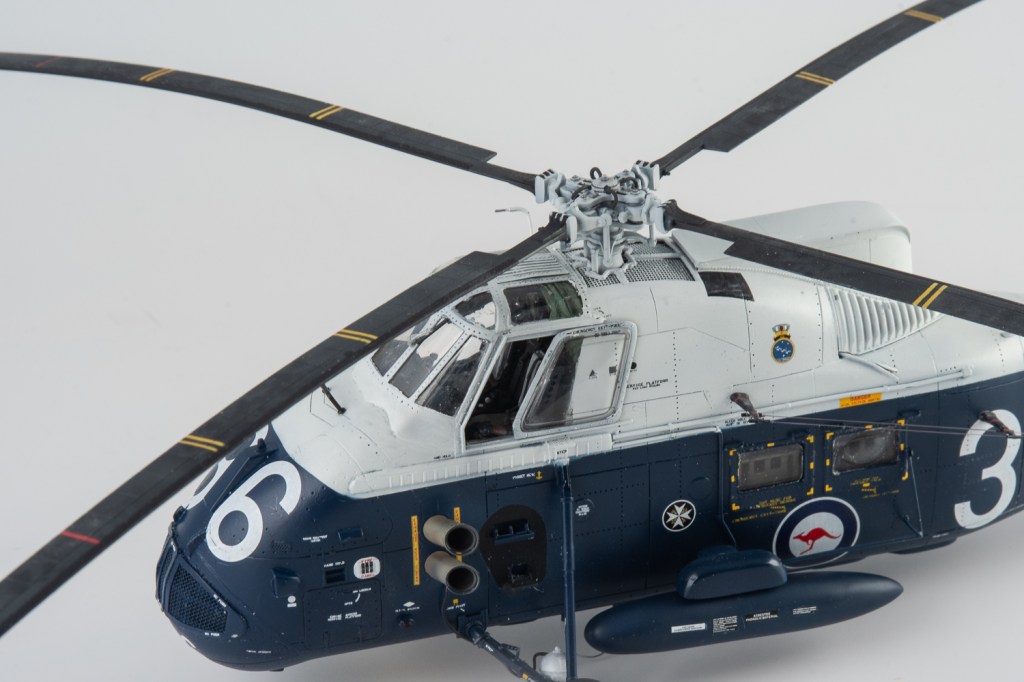
Basically, two spherical compressed air bottles and extra framing around the grill.

Hendie Models supplied a new nose bulkhead complete with the bottles and piping, and plastic strip formed the framework. The scoop you can see on the right side of the photo will also need to be added. I used the item from a HAS3 kit I had in the stash. The HAS3 also gave up the rectangular slanted fairing that sits on the nose. From this point, I methodically worked around the airframe. I added bits and pieces that I noticed when comparing the photos to the kit parts. These included a scratchbuilt IFF antenna to the rear of the fin. I moved and added fuel caps. Additionally, extra antennae needed to be added.

The pylon, stores carrier and fuel tank were resin items from a local Australian cottage producer, Hamilton Hobbies. The tank required several rounds of filling and sanding to reduce all the pinholes. A Hawker Hunter drop tank could also be used if you have a spare one floating around. Cabling was added from the flotation bag compressed air canisters to the fuselage. Brake lines from the wheels also need to be added , although I didn’t . An eagle eyed mate spotted I had glued a length of the kit ducting on at an angle. It broke into three bits when I tried to remove it. I had to use plastic rod to make up new ducting. An Eduard PE set provided various enhancements around the airframe as well.

Sun blinds were made from paper and added to the upper panes of the windscreen. The windscreen was not the best fit, requiring a lot of fairing in around its base.

The side kit aerial masts were modified with sections of brass tubing. This allowed EZ line to be run through them to represent the aerial wires. Rather than rely on glue, these masts were all drilled and pinned with brass wire for some additional strength.

A final look was made to check for seams. The airframe then received a coat of Mr Surfacer primer. This revealed a few seams that still needed addressing. Always the case with my models. No matter how smooth and blemish free I think I have the model, the first primer coat still always reveals flaws.

Painting and Decalling

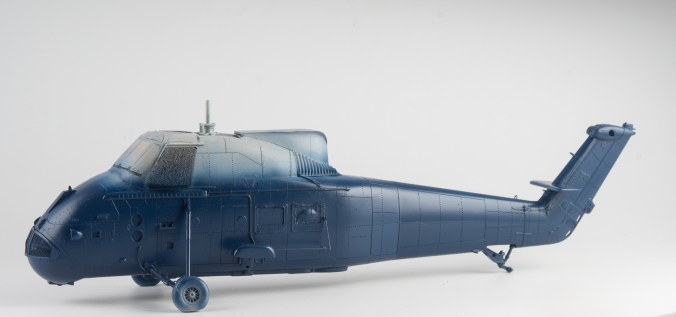
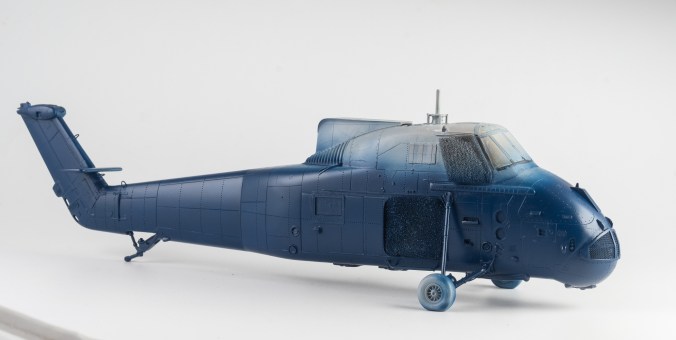
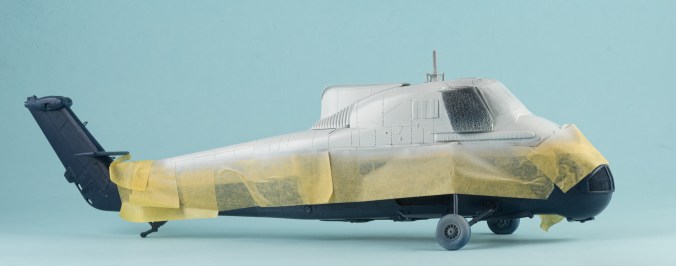
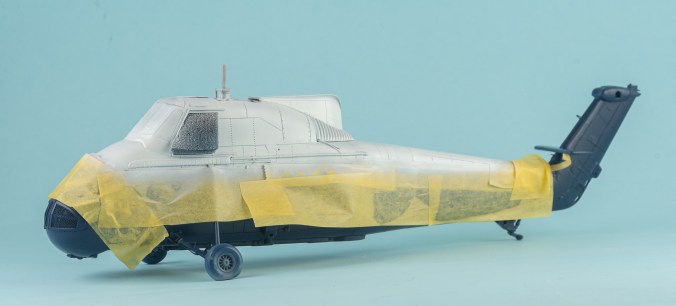
Common sense would dictate starting with the white, but on this occasion I thought masking the model would be easier starting with the blue. Initially the model was painted with Gunze Mr Color C328. I returned to the model the next day and realised it looked too “blue.” As a result, the blue was darkened with a few drops of black and resprayed. Now it looked a much better match to photos of the actual aircraft. The white was GSI Mr Color Character White. Some touchups were needed where I had not applied the tape tightly enough around protrusions. The front curved demarcation was achieved with Tamiya flexible tape. The rear one over the tail boom was created using a circle cutter to cut a tape mask.

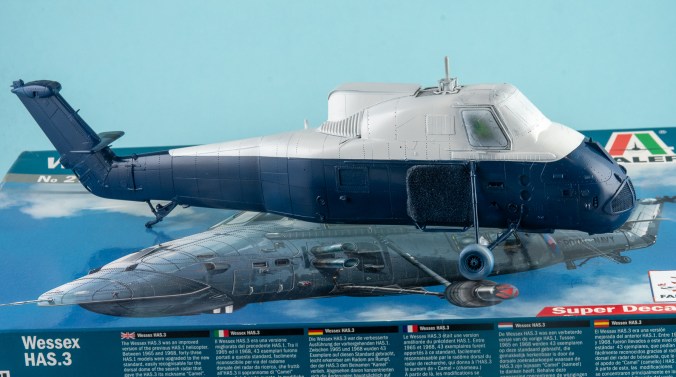
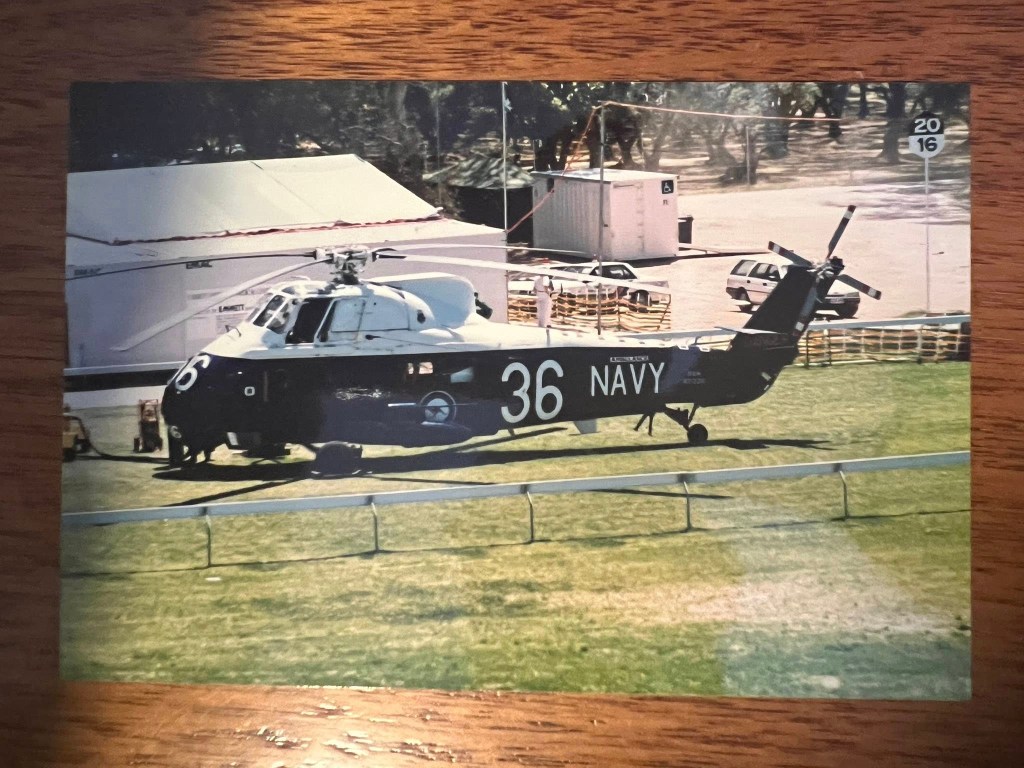
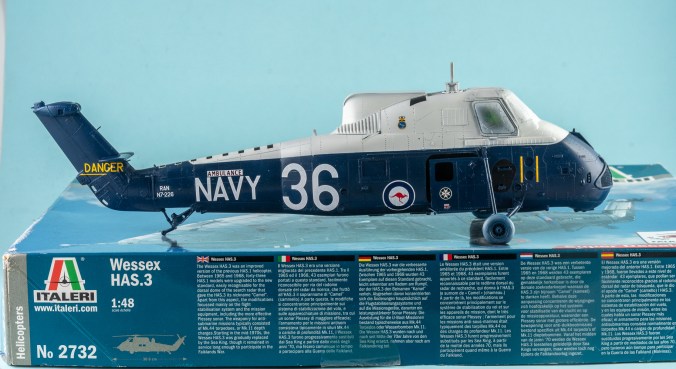
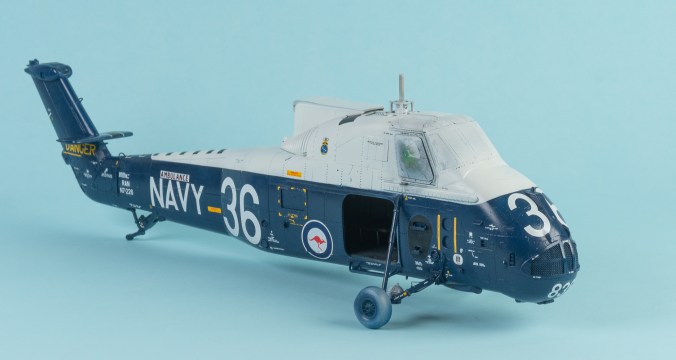
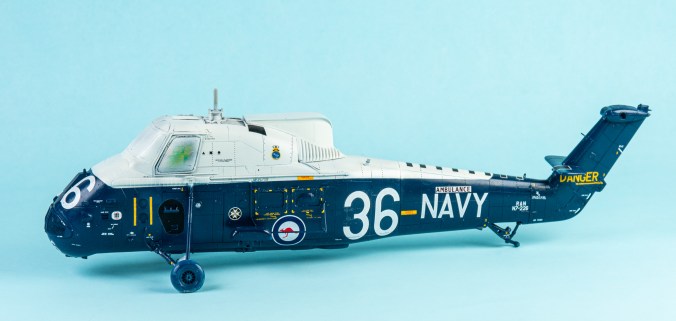
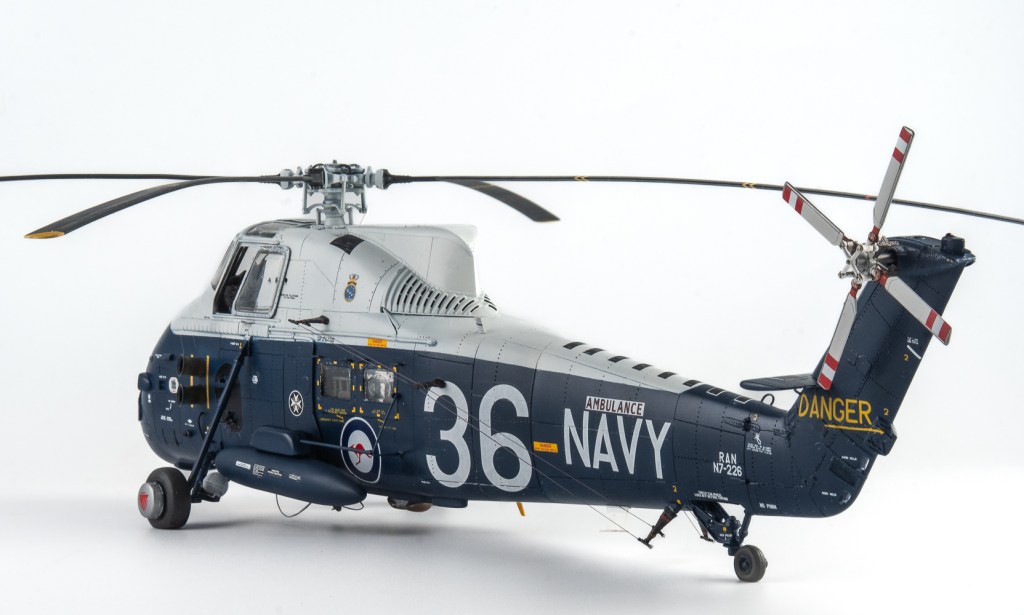
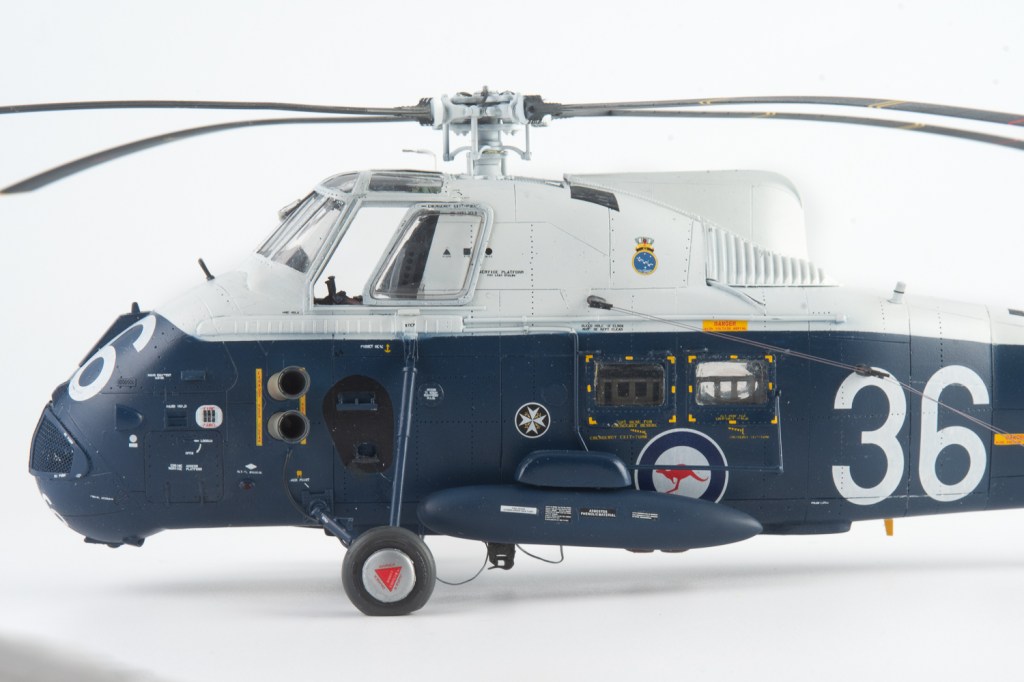
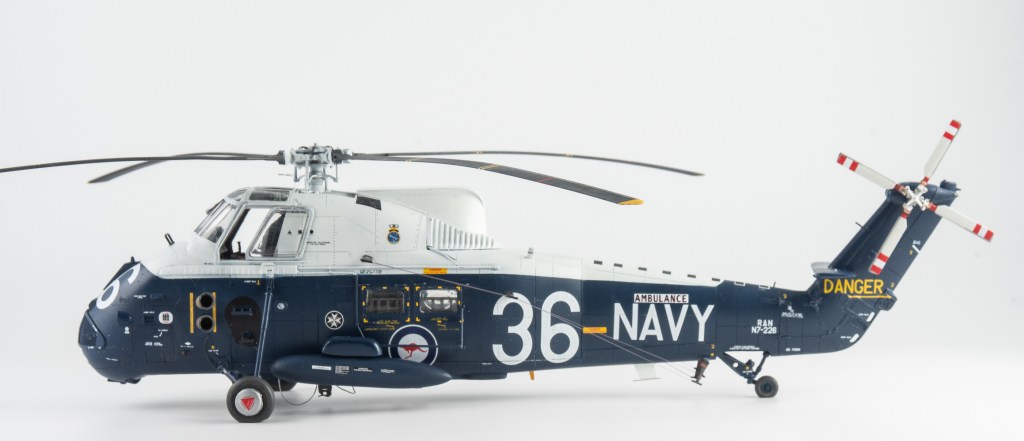
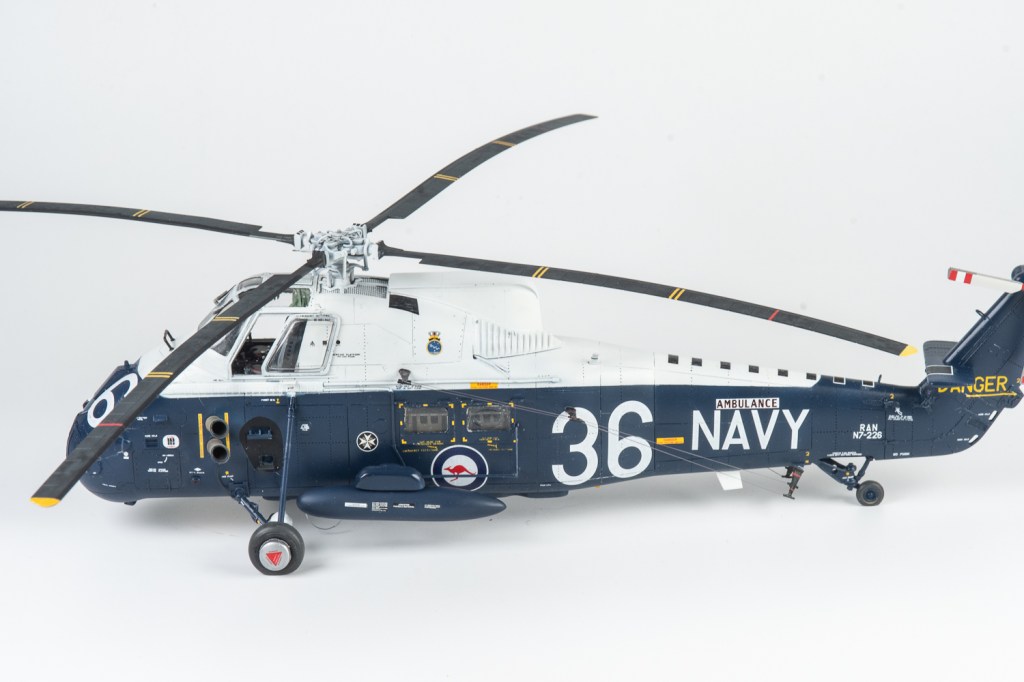
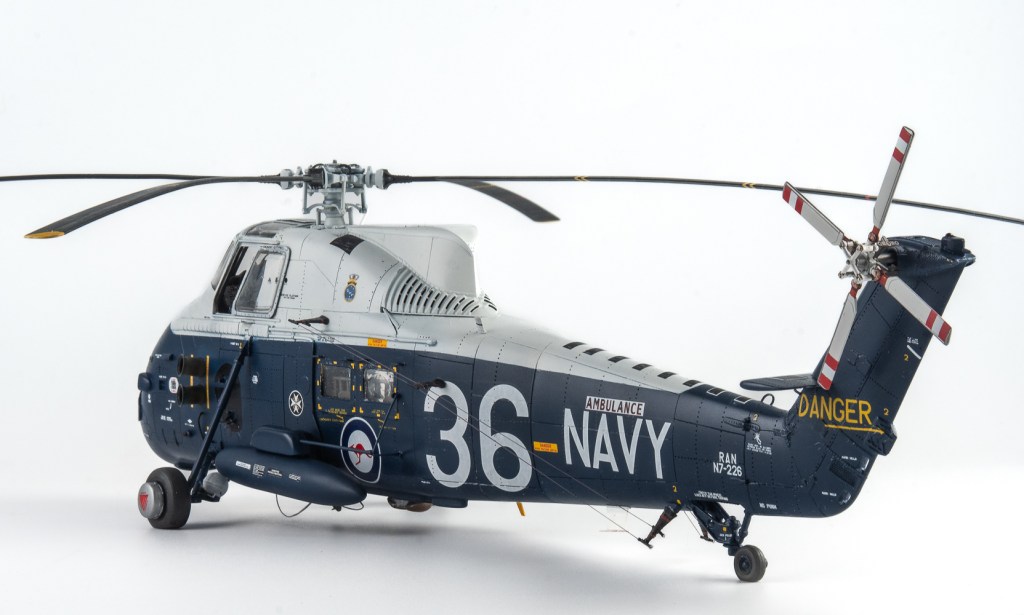
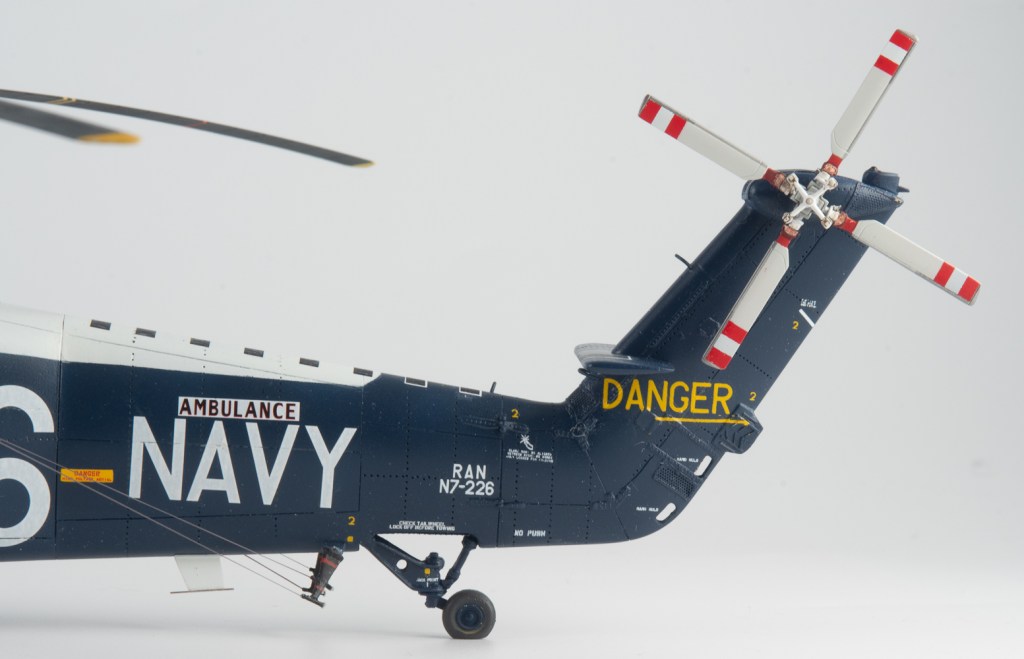
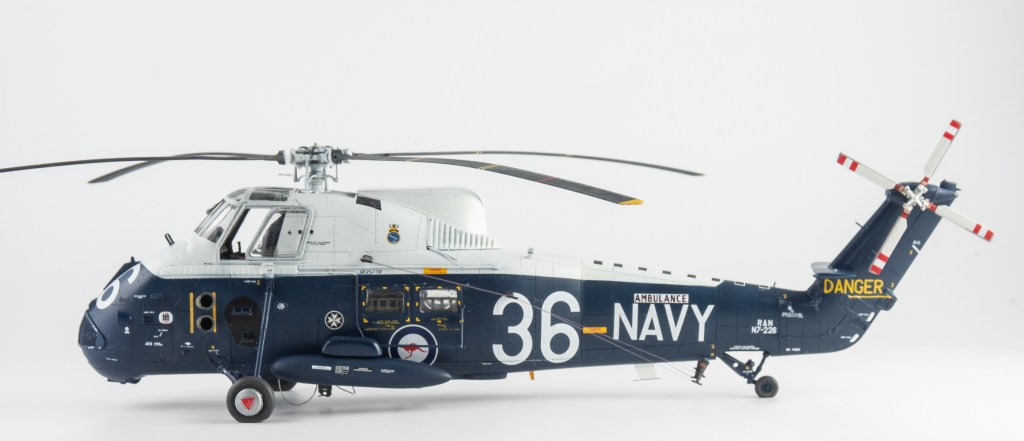
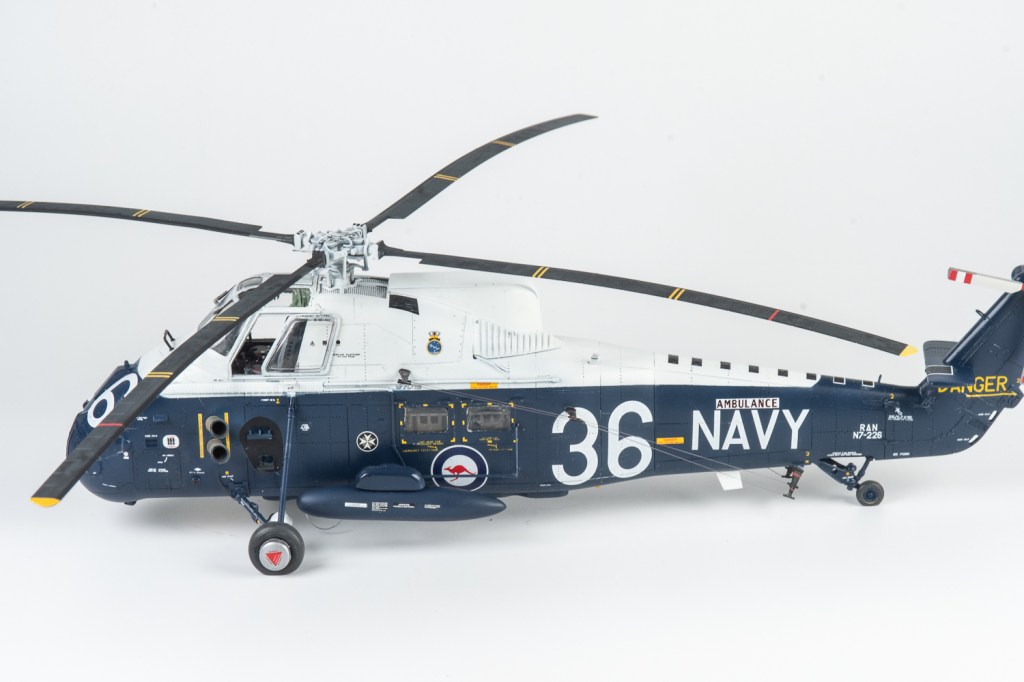
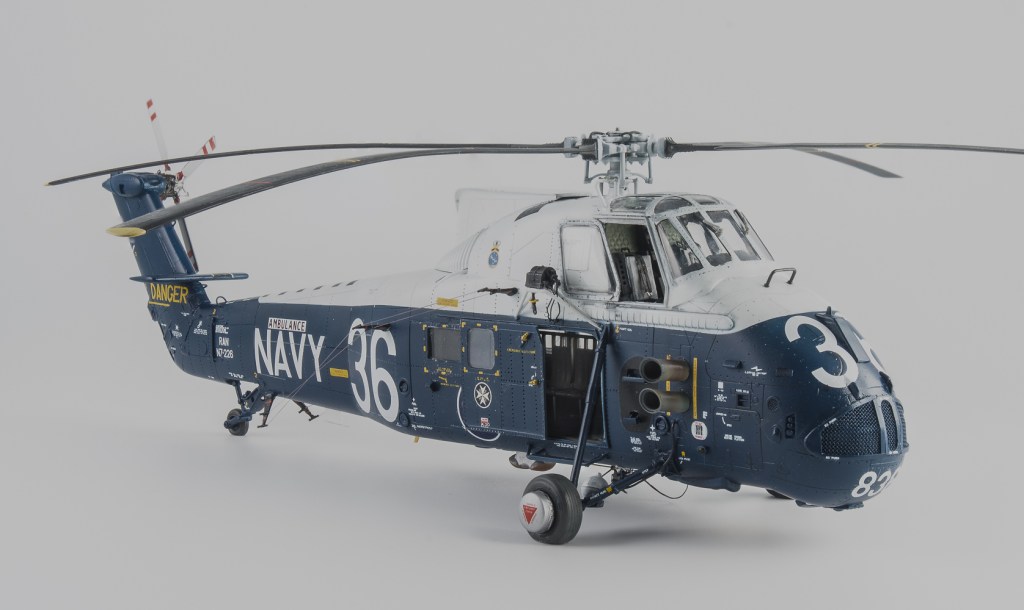
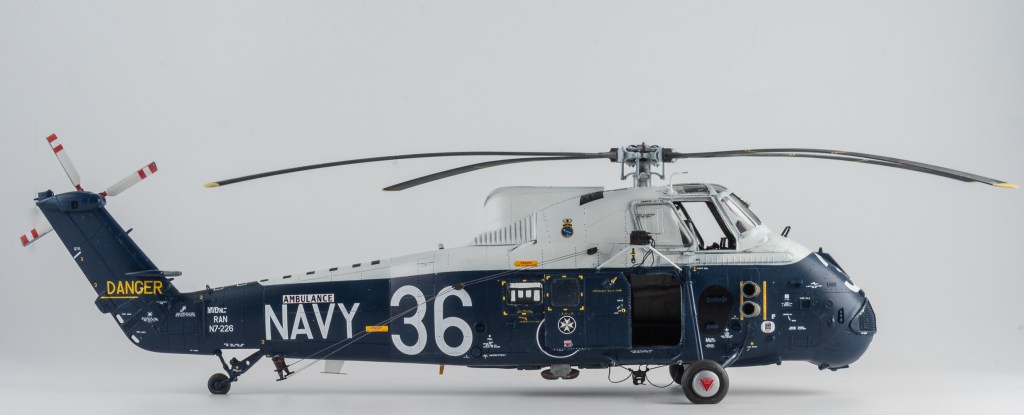
To say I was stoked when L Decals released their sheet containing 36 is putting it mildly! This particular helicopter is now preserved in the Fleet Air Arm Museum at Nowra NSW. I first came upon it whilst it was operating as an Air Ambulance at The Australian Grand Prix Adelaide 1987. The crew even allowed me to clamber up and stick my head in the cockpit. The memory of how basic the cockpit looked staying with me.And of course there is the Ambulance connection reflecting my 40 years as a Paramedic.

The L decals are beautifully printed, although some of the yellow items were slightly out of register on the sheet. No matter as I used these items from the superlative Southern Sky Models Wessex decal sheet. Unlike the L decals sheet, this contained all the stencilling for the aircraft. The kit sheet stencilling is a bit oversized in my opinion.

Decalling was carried out over 2 nights. Applying all the stencilling was finicky. However, it really does add to the busyness of the airframe. All the decals were excellent to use. They required just a couple of applications of Microsol. This allowed the decals to conform to all the raised and recessed detail. A toothpick also being employed to push the decals into all the recessed rivets where required. Stencil date from an Airfix Hunter sheet was used on the fuel tank. The writing on the white panel should have red lettering, but on the decal was black unfortunately. I will keep looking for an appropriate decal.

Final Assembly

The rotors had already been assembled and painted , just needing a matt coat. It was decided to use a semi sheen to dull down the very glossy paint used on the model., although I did brush matt clear over all the walkway areas. No weathering was added. All examples I had seen in contemporary photos looked reasonably clean. However, people who worked on the machine tell me the underside was filthy with oil leaks and stains.

Probably one of the trickiest parts of the build was rigging the cargo hook underneath. This was eventually accomplished with brass wire and EZ line. The aerial wires were then added using the same material, and with that she was done. Well, done is a relative term! But where do you stop? There were plenty of details, the modeller could still add like tie down rings and other cabling. There should also be aerial wires that wrap around under the tail. By this stage though I was ready to move on. All my models are compromises in this way, but I am happy to accept that. It is what allows me to complete 5-7 models a year. These models are reasonable in detail rather than one super detailed model that is accurate to every last detail.

Conclusion

The build was not enjoyable at times, but ultimately satisfying once complete. The Italeri kit is typical of their products, inconsistent detail, poor fit of some parts and soft mouldings. However, it is leaps and bounds over the old Revell kit. The kit has shortcomings. Despite this, I am still eager to tackle another to finish as a 945 SQN RN machine from the Borneo conflict. The aftermarket items I used are not absolutely necessary to build a RAN Mk31. You only need them if you don’t have a HAS3 to use, although , there will still need to be some scratchbuilding required. . The fuel tank and carrier can be easily converted from other components. They can also be scratch built. The Hamilton Hobbies items are still available. Naturally you will need decals for a RAN aircraft, again, the L decals are still available. The rest of the Hendie stuff is just a very nice refinement over the kit parts.

Westland Wessex Mk31B. 723 SQN R.A.N Adelaide South Australia 1987

Leave a comment

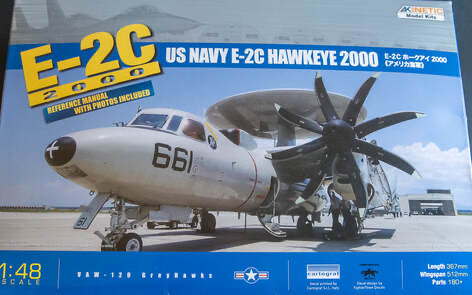
Kinetic 1/48 E-2C Hawkeye 2000

  • Purchased: 2018
  • Completed:2021
  • Enhancements:
  • Wheels  Royale Resin
  • Decals: Authentic Decals
The hawkeye was quite a bold release for the then relatively new Kinetic.  Although I have never seen a built example grace the competition tables here in Australia, there are quite a few builds featured on line.  Perhaps a better indicator of what people are building.  In any case, I hope Kinetics courage in releasing it has been rewarded by good sales.
Being one of Kinetics earlier kits, there are a few sink marks evident on wings, the crew door and the rotordome pylons, easily fixed, as they are quite shallow.
Panel lines are somewhat heavy and ejector pins mar the wheelwells.  Options out of the kit allow the modeller to fold the wings, drop the flaps or model the crew door open
Interior detail is fine for what can be seen and full intake trunking is included for the engine intakes.  Upon its release, the kit seems to have met with good reviews, some commentators remarking that the 4 bladed propellers would need some minor reshaping to better reflect the full sized blades.  All reviewers experienced a nasty step between the upper nacelle and the wing interface. otherwise the kit was found to be well fitting

Kinetic followed up their original boxing with this later boxing that includes parts for upgraded satellite antenna fits, engine cowlings with stiffeners and the 8 bladed propellers.  The four bladed props are still included.  Both boxing s are let down by the very plain markings offered.  Surprising, given the schemes this aircraft has worn and the fact the decals were designed by Fightertown.  Italeri have also reboxed the kit with a far more colourful aircraft sporting markings from “Liberty Belles”


Build Notes
Assembly
2020 was to be the year I built anything from my stash  that saw service with the United States Navy.  It didn’t work out too well!.  Pandemic aside, the start of 2020 turned out to be a modelling disaster that saw about 4 kits started and promptly consigned to the bin before finally managing to complete one.  The Hawkeye was the fifth kit started and was shaping up well, until I discovered the canopy had been short shot.  Kinetic though were very receptive when I requested a replacement, although the part did not reach me until quite some months later due to global airmail almost shutting down.

I had decided early on to build the model with wings extended as to me, wings that fold along the fuselage hide too much of the aircraft. In the Hawkeys case it would also take away from the greyhound look of the aircraft.  Kinetic offer decent spars that go some way towards ensuring the spread wings form a solid join and align with the fixed centre section.  Fit is good, but not exceptional.  I was left with gaps top and bottom that needed filling and rescribing.  Greater care and some fettling on my part would have probably reduced these, as dry fits without the spars revealed tight joints
Sink marks across the wing top surface were dealt with by application of Mr Surfacer 500.  Rather than slather on putty, the nacelle step was dealt with by careful sanding of the nacelle mating surfaces where they met the wing undersides, taking care to maintain the contours.  Serial dry fits were carried out until the step had been eliminated.  The then very minor gaps were filled with Apoxie Sculpt, the excess being removed with a damp finger.  The overscale static discharge wicks were cut off, to be replaced with toothbrush bristles.  Being the lazy Modeller I am, the ejector pins in the wheelwells were ignored.

As a result of having to wait for the canopy, the kit was built up in sub–assemblies, being the wing, comprising the nacelles, the rotordome and supporting pylons, and finally the fuselage, being I did not want to contend with possibly having to fair a badly fitting canopy into a large and unwieldy model.  I carried this method right through to painting and decalling.  Dry fits had shown the wing to fuselage fit could be easily dealt with, when the time came, and this method would also allow unfettered access to the inside faces of the nacelles and the fuselage sides that would otherwise  be underneath the wing.
Fuselage assembly was unremarkable, an average fitting belly panel required some use of Mr surfacer, and  a large amount of lead sheeting was epoxied in behind the cockpit bulkhead with lead shot filling the gaps either side of the nose wheel well to ensure the aircraft sat on all three undercarriage legs.  Fitting the clear nose cone left a step on one side.  The low side of the step was built up with apoxie sculpt and sanded to shape.

Paint and decals

Whilst still in its sub assemblies, the model was painted using Mr Color light gull grey with the tail fins in SMS Insignia Blue.  Black de icer boots were sprayed tamiya rubber black after some very time consuming masking.  The portions of the flaps hidden by the wings and the flap wells got a  coat of Mr Color Flat Red
Not a single chip of paint peeled up on the removal of the tape, unlike most of my Tornado builds.  Looks like that old Alcad grey primer was the culprit!
The cockpit tinting was done using a 50:50 mix of tamiya Metallic brown and smoke, overcoated with several layers of future.
Unless you want to build the very boring kit option, aftermarket decal sheets are a must, even then options are few, with the decal manufacturers seeming to offer nothing post 2008.  This machine has worn some very colourful markings which have not at all been mirrored by the very uninspired decal sheets out there, save for the Fightertown Liberty belles sheet.

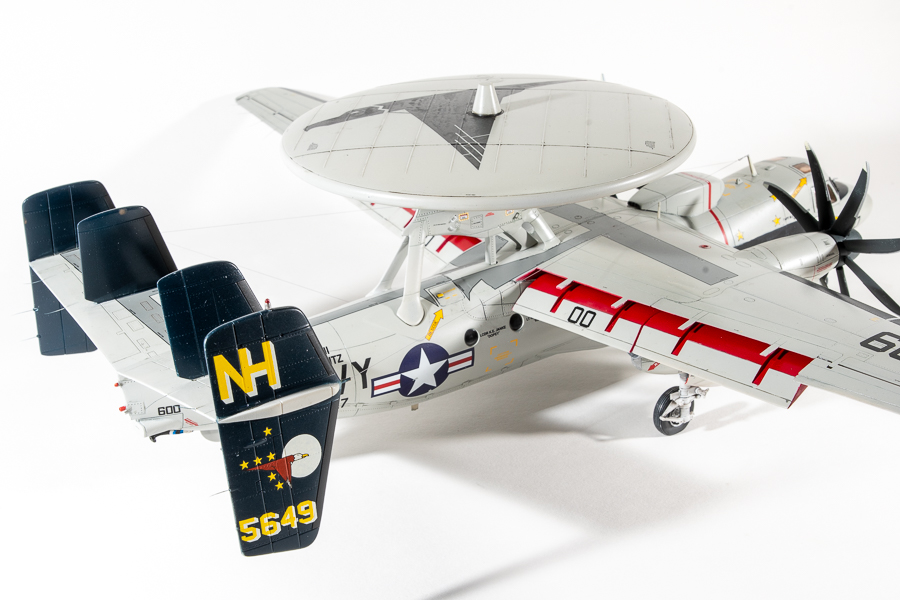
I chose a decal sheet by the-to me- unknown manufacturer, Authentic Decals that included a scheme with a large hawk on the side, and ticked my boxes of having coloured fins and a artwork on the rotordome top surfaces
My concerns about the Authentic decals not performing or breaking apart in the water were unfounded.  Turns out they are printed by Bergemot.  (EDIT, It seems this sheet is also offered under the Bingo Decals brand, I’m not sure which came first, or if one is a knock off of the other, or printed with permission)
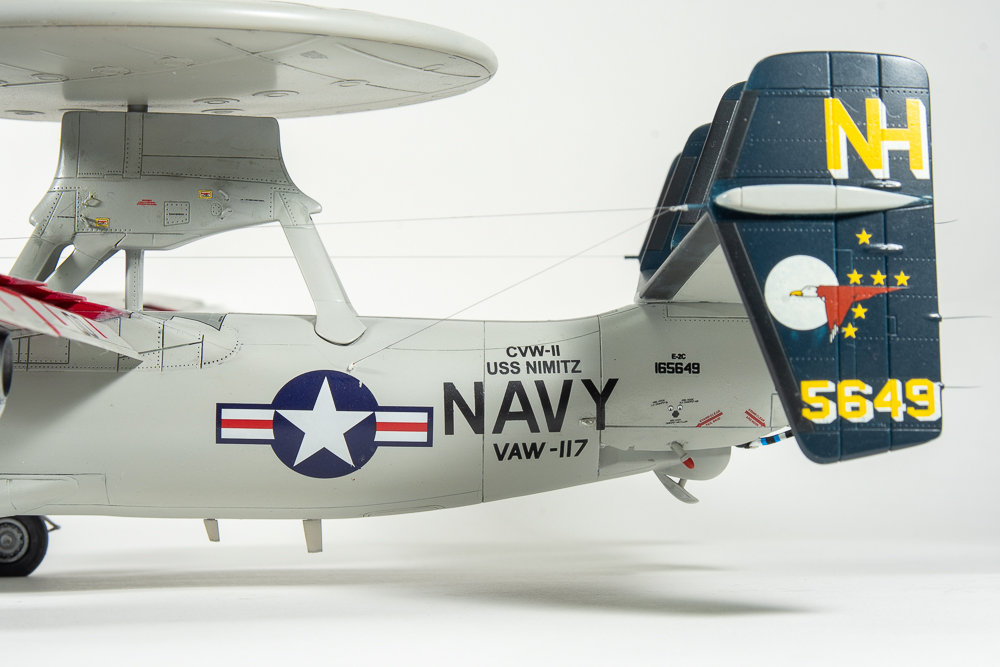
They performed flawlessly and reacted very well to the Micro decal solutions settling down into even the rivets with only two applications.  This is more than I can say for the kit decals which had been printed by cartograf. They took multiple applications of setting solution before sinking into the detail, and only after resorting to using Daco strong solution.  All walkway decals and fuselage national insignia were left off until the wing had been mated to the fuselage.  However this then exposed the fact the Authentic Decals NAVY titles were far too big, when compared to photos of the real machine and how the NAVY titles sat in relation to the national markings.  The kit NAVY titles were the correct size, but it was too late as even removing the oversize titles would still leave the ship and squadron designations in the wrong spot in relation to the NAVY titles. There was no choice but to just suck it up, and move on.  I decided to do a clean build as photos I had of the real aircraft showed it very clean indeed, like fresh paint clean, plus I was getting to the stage where I wanted it off the bench

Final details were added and EZ line used for the antenna lines.  Like  all modern aircraft , the model was starting to get hard to pick up, the more you added to it.  Royal Resin wheels replaced the rather bland, and in any case far too weighted kit wheels.  All those pesky red lines on the wheelwell doors were applied with a fine tipped gundam marker, and she was done, ready to almost take up half a shelf in my cabinet.

SO! The two questions I ask myself after each build

HOW DID I GO? 
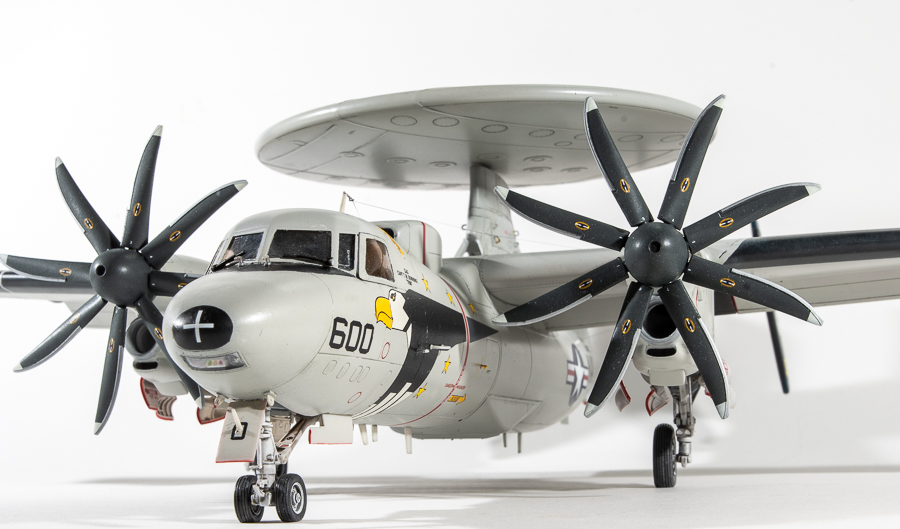
Well, not bad. I think its an incremental improvement over my Tornado builds.  I’m still marring my finish with stupid mistakes, which are only too apparent to the camera lens, damn you macro camera!!There’s some silly construction and finish mistakes as a result of just not taking my time but, overall,  I’m  pretty happy with it, and just love the look of the finished model. It just looks so busy with the aerial wires, the multi bladed props, deployed flaps and that large Hawk on the fuselage and dish.  Its one of my favourite builds.

WOULD I BUILD ANOTHER?
Not another Hawkeye, but if I found the Greyhound at a reasonable price, then possibly!
Thanks for looking in.  See you after the next build
Bruce

 Grumman E-2C Hawkeye 2000 VAW-117 Wallbangers USN.  USS Nimitz Pacific Ocean 2009                                                                                   

← Back

Thank you for your response. ✨

Warning
Warning
Warning
Warning.

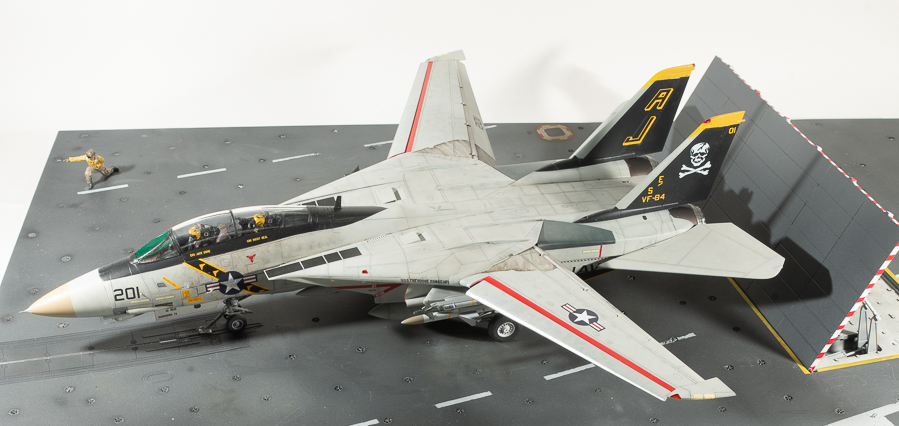
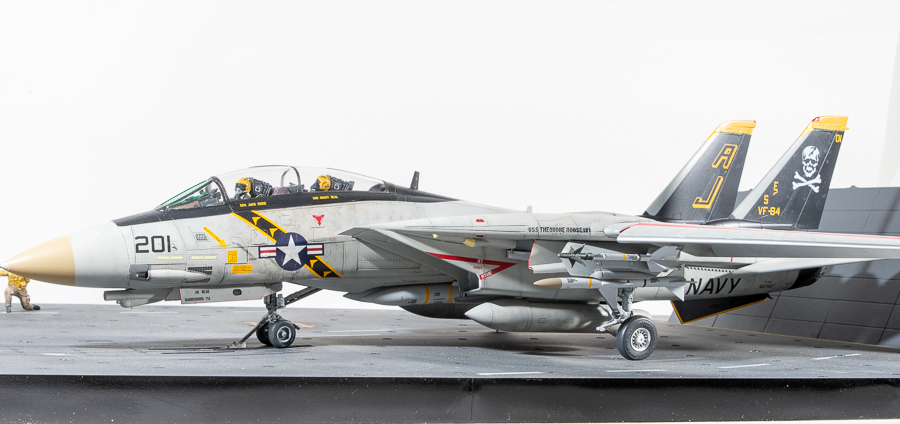
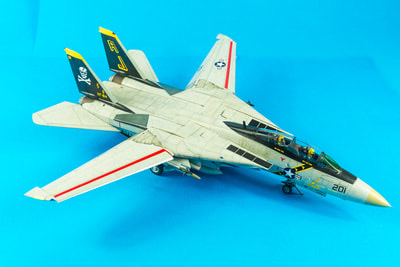
Hobby Boss 1/48 F-14A Tomcat

  • Date Completed: July2018
  • Aftermarket Used: Quickboost Pilots
  • Paint: Gunze Mr Color 
  • Decals: Kit supplied  for airframe, missile stripes from Fightertown Tomcat Data sheet           
This build was borne out of a work colleague’s request for me to build the kit for him.  As I also had the kit in my stash, I thought I would build the two of them alongside each other.  As often happens with my double builds, this one sped ahead and was completed whilst mine sat on the bench falling further and further behind.
The Eduard boxing contains the Hobby Boss plastic, brassin resin burner cans,chin pod, wheels and a PE sheet specific to this kit with a large decal sheet done by Furball Aero Designs
The HB Tomcat is a nice kit, there a few accuracy issues, most noticeably, the bottom edges of the intake openings are not parallel to the top edges as they should be, but this is only noticeable from head on.  Rivets punctuate the flying surfaces which should be smooth, but apart from that, its  a detail packed kit,  allowing you options to open the gun bay, avionics panel, display the radar and extend the wing control surfaces. 

It assembles well and does not really deserve all the wailing and teeth gnashing it gets on the internet.  I put it above the Hasegawa offering, but it has been pushed into the shade a bit with  the release of the tamiya kit.

Jeff had requested his model be finished in Jolly Roger markings as if just about to launch, so I used the compressed nose leg,  extended the wings and dropped the flaps and leading edge slats.  Naturally, all the access hatches were glued in the closed position.

  Of course this meant I also had to crew the jet, so used the aerobonus crew .  Although Aerobonus should be applauded for the idea of releasing seated pilots, I really wish that they would include alternative helmeted heads with visors down and masks in place.  As it is,  their entire range of seated pilots have visors up and masks dangling which means they can not be used for in flight models, which I imagine is what most people want them for.

I sourced correctly helmeted heads, as well as a gloved hand that grips the throttle from an Academy Phantom.  As the canopy would be closed on this particular jet, I didn’t bother using the PE consoles and panels, rather relying on the entirely adequate kit parts.  The canvas coverings over the instrument panel glare shields were beefed up with milliput draped over the kit parts, and then painted a dark leather colour, which according to the DACO book, is the shade the original black covers fade to.
The HB kit includes the short lived glove vanes, (they were wired shut in A models, puttied over in B models and left out altogether in Ds, I believe) requiring you to open up  flashed over slots in the wing gloves. Stupidly, I didn’t, thinking I could just scribe the vanes in later, This would have worked if I was halfway good at scribing, as it was, it just created more problems for me.  My tip. Open up the slots and use the kit vanes as even shut, the openings  are quite prominent on the real jet.

For some reason I had a gap when fitting the bottom plate, not sure why as dry fits had shown a good fit.  Fitting the phoenix pallets hid most of it and a plastic card shim covered the rest.  The forward fuselage fitted to the rear with no gaps or steps as did the tailfins.  I had read about fit problems when glueing the gun bay  and avionics panels in the closed position, but being patient and gluing a side at a time will reward you with reasonable fit, still, I needed a small smear of Mr Surfacer around the ladder door.

Apart from this, the kit assembled quickly.  I left the brass burner rings out after successfully bending one up, only to then  drop the pliers on it.
The WIP shots on the front page outline my painting steps in achieving a bit of tonal variation to the Light Gull Grey

Moving onto the decals, I didn’t apply any of the stencils. as photos of the actual jet showed very few.  The decal instructions call out the red turbine warning stripes to be placed along the jet nacelles whereas they should go around them.  That said, I forgot to add the stripes above the NAVY titles. I was disappointed the yellow border of the VF84 sash showed through the US star, I didn’t want to lay another start and bar over the top so left it as was.  For the other side I cut away the yellow border where from where the star and bar would overlay it.

 The Fightertown data sheet, whilst being quite comprehensive, does not include enough stripes for a full suite of phoenix, so I could only add the stripes which would remain the most visible, and with the stores fitted, the canopy was the only part left to fit.  The fit to the windscreen is not to my liking as there is a step and small gap as you can see, but at the rest of causing cracks to the canopy from forcing it, I decided to leave this too as it was.
The Jolly Rogers scheme is most attractive and I can understand why a lot of modellers choose it to adorn their Tomcats

F-14A Tomcat VF-84 “Jolly Rogers”  U.S.S Theodore Roosevelt  U.S Navy  1989